How to interpret your
own genome.
C. Titus Brown
ctbrown@ucdavis.edu
@ctitusbrown
http://ivory.idyll.org/blog/
Second in my ongoing attempt to explain what I actually do to Terry Peppers.
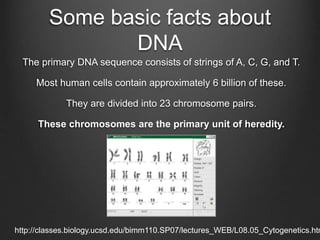
Some basic facts about
DNA
The primary DNA sequence consists of strings of A, C, G, and T.
Most human cells contain approximately 6 billion of these.
They are divided into 23 chromosome pairs.
These chromosomes are the primary unit of heredity.
http://classes.biology.ucsd.edu/bimm110.SP07/lectures_WEB/L08.05_Cytogenetics.htm
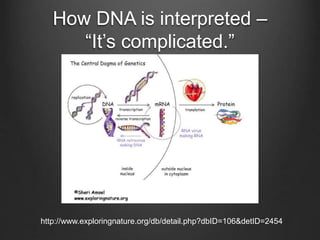
How DNA is interpreted –
“It’s complicated.”
http://www.exploringnature.org/db/detail.php?dbID=106&detID=2454
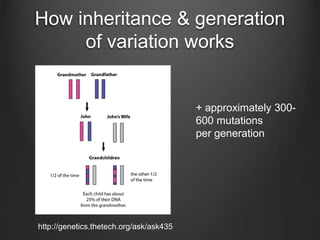
How inheritance & generation
of variation works
http://genetics.thetech.org/ask/ask435
+ approximately 300-
600 mutations
per generation
If we knew a person’s genome
sequence perfectly…
We still wouldn’t know all that much!
We could correlate variation between genomes with
diseases.
We could identify parentage and genetic inheritance.
We could probably identify ethnic origin.
We could find known “mistakes” or problems.
But… why wouldn’t we know
that much?? Isn’t the genome
the person?
Let’s ignore environmental factors, first of all…
Imagine…
…you’re locked in a room, with feral lawyers roaming
around outside;
You have a bunch of source code on a stack of CDs
to understand;
And you’ve been given a Windows 98 machine with
Python installed.
(see David Beazley, “Discovering Python”, PyCon
2014)
This talk came partly from listening to his talk…
This “locked room” problem is a
pretty good analogy to genomics!
“Here are 3 billion characters of DNA! Go
figure out what it all means!”
It’s like the previous locked room problem, and:
The code is all written in Perl 8, for which neither a
specification or software interpreter exists.
But you have access to the Internet and a world-wide
collection of other scientists, and (some of) their data and
papers.
Oh, and: the answers hold the keys to life and death.
Genomes are still useful! How
do we find sequence?
Primary approach for human genomes is: spend a lot of money
sequencing one, or a few; use that as reference.
Initial cost: $2.7 bn (in 1991)
Current human genome reference is from 13 anonymous
volunteers in Buffalo, NY (Wikipedia ;)
Older technology: identify points of variation, then target for
further investigation.
Current technology: sequence. (The rest of this talk.
Next technology: longer reads. (Sequence more, better.)
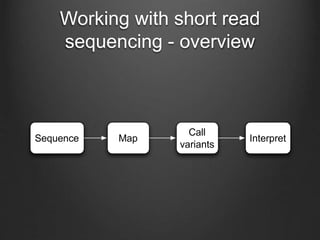
Working with short read
sequencing - overview
Sequence Map
Call
variants
Interpret
Working with short read
sequencing - sequencing
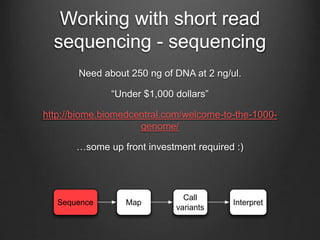
Need about 250 ng of DNA at 2 ng/ul.
“Under $1,000 dollars”
http://biome.biomedcentral.com/welcome-to-the-1000-
genome/
…some up front investment required :)
Sequence Map
Call
variants
Interpret
Working with short read
sequencing - sequencing
Sequence Map
Call
variants
Interpret
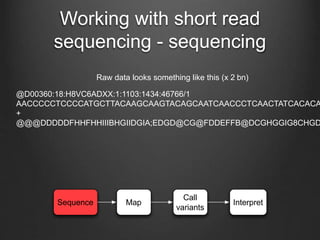
@D00360:18:H8VC6ADXX:1:1103:1434:46766/1
AACCCCCTCCCCATGCTTACAAGCAAGTACAGCAATCAACCCTCAACTATCACACA
+
@@@DDDDDFHHFHHIIIBHGIIDGIA;EDGD@CG@FDDEFFB@DCGHGGIG8CHGD
Raw data looks something like this (x 2 bn)
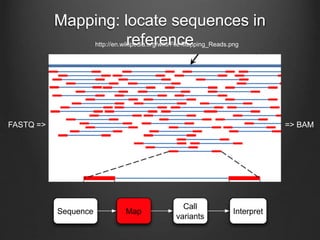
Mapping: locate sequences in
referencehttp://en.wikipedia.org/wiki/File:Mapping_Reads.png
Sequence Map
Call
variants
Interpret
=> BAMFASTQ =>
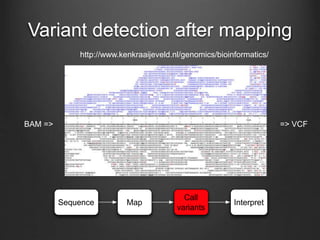
Variant detection after mapping
http://www.kenkraaijeveld.nl/genomics/bioinformatics/
Sequence Map
Call
variants
Interpret
BAM => => VCF
Working with short-read
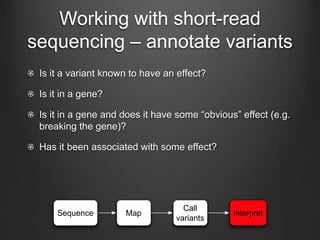
sequencing – annotate variants
Is it a variant known to have an effect?
Is it in a gene?
Is it in a gene and does it have some “obvious” effect (e.g.
breaking the gene)?
Has it been associated with some effect?
Sequence Map
Call
variants
Interpret
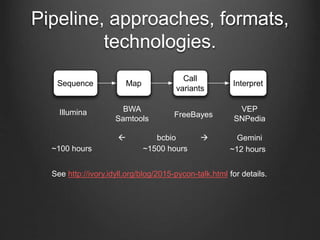
Pipeline, approaches, formats,
technologies.
Sequence Map
Call
variants
Interpret
Illumina BWA
Samtools
FreeBayes
VEP
SNPedia
Gemini bcbio 
See http://ivory.idyll.org/blog/2015-pycon-talk.html for details.
~1500 hours ~12 hours~100 hours
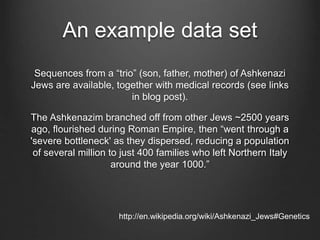
An example data set
Sequences from a “trio” (son, father, mother) of Ashkenazi
Jews are available, together with medical records (see links
in blog post).
The Ashkenazim branched off from other Jews ~2500 years
ago, flourished during Roman Empire, then “went through a
'severe bottleneck' as they dispersed, reducing a population
of several million to just 400 families who left Northern Italy
around the year 1000.”
http://en.wikipedia.org/wiki/Ashkenazi_Jews#Genetics
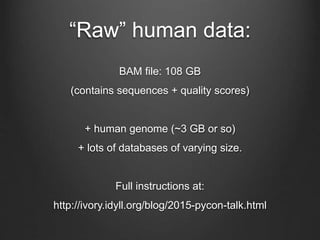
“Raw” human data:
BAM file: 108 GB
(contains sequences + quality scores)
+ human genome (~3 GB or so)
+ lots of databases of varying size.
Full instructions at:
http://ivory.idyll.org/blog/2015-pycon-talk.html
Working with short-read
sequencing – mapping.
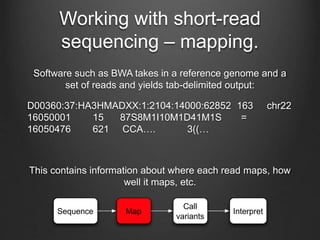
Software such as BWA takes in a reference genome and a
set of reads and yields tab-delimited output:
D00360:37:HA3HMADXX:1:2104:14000:62852 163 chr22
16050001 15 87S8M1I10M1D41M1S =
16050476 621 CCA…. 3((…
This contains information about where each read maps, how
well it maps, etc.
Sequence Map
Call
variants
Interpret
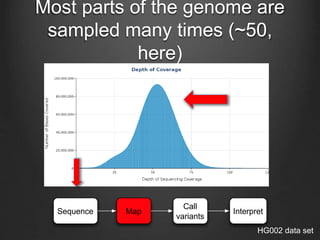
Most parts of the genome are
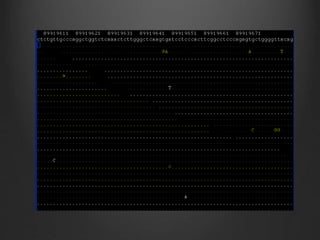
sampled many times (~50,
here)
HG002 data set
Sequence Map
Call
variants
Interpret
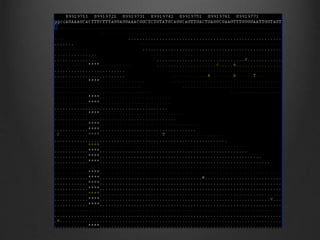
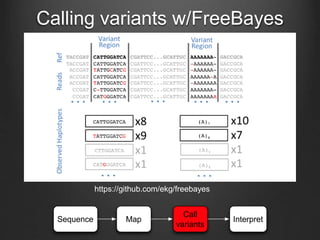
Calling variants w/FreeBayes
https://github.com/ekg/freebayes
Sequence Map
Call
variants
Interpret
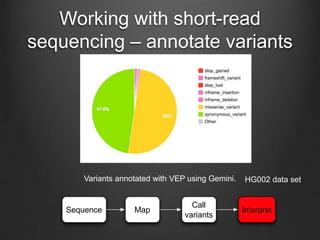
Working with short-read
sequencing – annotate variants
HG002 data setVariants annotated with VEP using Gemini.
Sequence Map
Call
variants
Interpret
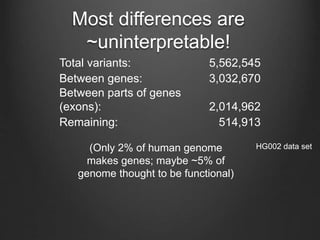
Most differences are
~uninterpretable!
Total variants: 5,562,545
Between genes: 3,032,670
Between parts of genes
(exons): 2,014,962
Remaining: 514,913
(Only 2% of human genome
makes genes; maybe ~5% of
genome thought to be functional)
HG002 data set
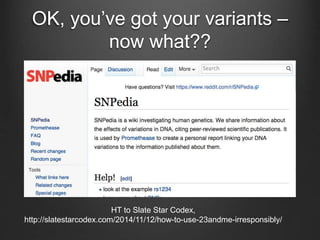
OK, you’ve got your variants –
now what??
HT to Slate Star Codex,
http://slatestarcodex.com/2014/11/12/how-to-use-23andme-irresponsibly/
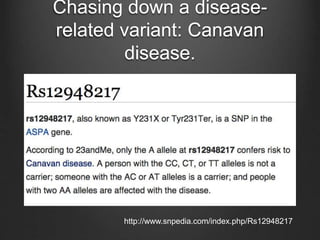
Chasing down a disease-
related variant: Canavan
disease.
http://www.snpedia.com/index.php/Rs12948217
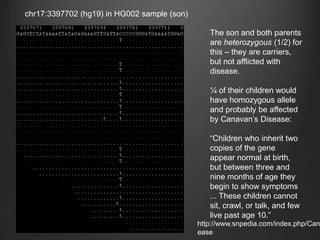
chr17:3397702 (hg19) in HG002 sample (son)
The son and both parents
are heterozygous (1/2) for
this – they are carriers,
but not afflicted with
disease.
¼ of their children would
have homozygous allele
and probably be affected
by Canavan’s Disease:
“Children who inherit two
copies of the gene
appear normal at birth,
but between three and
nine months of age they
begin to show symptoms
... These children cannot
sit, crawl, or talk, and few
live past age 10.”
http://www.snpedia.com/index.php/Can
ease
Challenges in actually
interpreting – “version hell”.
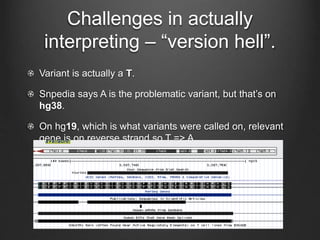
Variant is actually a T.
Snpedia says A is the problematic variant, but that’s on
hg38.
On hg19, which is what variants were called on, relevant
gene is on reverse strand so T => A.
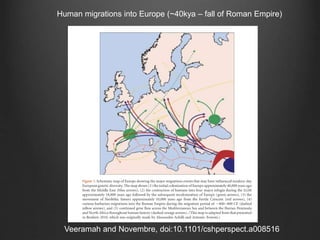
Human migrations into Europe (~40kya – fall of Roman Empire)
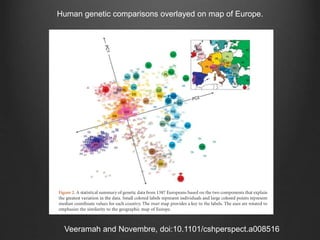
Veeramah and Novembre, doi:10.1101/cshperspect.a008516
Human genetic comparisons overlayed on map of Europe.
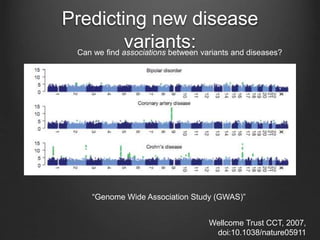
Predicting new disease
variants:Can we find associations between variants and diseases?
“Genome Wide Association Study (GWAS)”
Wellcome Trust CCT, 2007,
doi:10.1038/nature05911
…cautions of GWAS:
Need to account for relatedness in samples;
Large sample sizes needed;
Complex statistics needed & “multiple testing” issues;
Different identifier/database mixtures;
Correlation is not causation;
Large effects are rare – typically many small signals
combined.
The data science problem from hell!
Where next?
Short-term: next 2-5 years
Medium-term: 10 years
Long-term: 20 years+
Short term
Lots more data! “Millions to billions of human
genomes” coming.
Individual data – est 300,000 human genomes
sequenced in 2014.
Tumor and somatic data.
Time course data (“narcissome”) - Mike Snyder
Newer sequencing data types – e.g. longer reads.
see: http://www.nature.com/news/the-rise-of-the-narciss-ome-1.10240
Short-term software
problems
Increasingly many open source Python projects
(bcbio, Gemini);
Help with integration between tools (dependency
hell, versioning hell);
Optimization of specific approaches not so
important.
Lack of concordance => technical problem.
General speed ~meh
Flexible and robust libraries still maturing.
Medium term
We’ll be sequencing everything all the time (but still
won’t really know what it means); => data integration
and data mining.
Large scale sequencing is rapidly being extended to
agriculture, ecology, and veterinary medicine.
We will soon be able to “edit” whatever genomes we
want (check out CRISPR), but will not have a good
idea of what to actually edit (c.f. Perl8 analogy,
above).
Read up on “gene drive” if you want the bejeezus scared out of you:
http://news.sciencemag.org/biology/2015/03/chain-reaction-spreads-gene-
through-insects
Longer term
No one knows.
We’ve only had large scale sequencing & the human
genome for ~15 years!!
Free associate the following:
cheap sequencing; quantified self; Internet of Things.
How to get involved?
A lot of the software is open source!
(bwa, samtools, etc. etc.)
…but:
Warning: genomics is large, and deep, and largely invisible, and
has its own culture.
Sadly, your best bet is probably to come do a PhD with someone like me, for
free.
(just kidding! …)
bcbio and Gemini
Help with:
Gemini: SQLite to PostgreSQL conversion;
Gemini: “bigwig” parsing performance;
bcbio: improving use & cleanliness of Cloud port
bcbio: moving to Common Workflow Language (note,
reference implementation in Python)
See talk blog post at http://ivory.idyll.org/2015-pycon-
talk.html for more info.
How can you sequence your
own genome?
Most genetic testing services (23andme, etc.) don’t
actually sequence your 6 billion bases of DNA; they
instead use a more targeted approach and look at
common variants or known disease variants.
If it costs < $1000, they’re not actually sequencing you :)
DNA extraction, etc, is fairly straightforward if you have
access to a lab and the necessary expertise.
Main suggestion: see http://www.personalgenomes.org/
Thanks for coming!
Please see links to data, instructions, and more reading at
http://ivory.idyll.org/blog/2015-pycon-talk.html

2015 pycon-talk

  • 1.
    How to interpretyour own genome. C. Titus Brown ctbrown@ucdavis.edu @ctitusbrown http://ivory.idyll.org/blog/ Second in my ongoing attempt to explain what I actually do to Terry Peppers.
  • 2.
    Some basic factsabout DNA The primary DNA sequence consists of strings of A, C, G, and T. Most human cells contain approximately 6 billion of these. They are divided into 23 chromosome pairs. These chromosomes are the primary unit of heredity. http://classes.biology.ucsd.edu/bimm110.SP07/lectures_WEB/L08.05_Cytogenetics.htm
  • 3.
    How DNA isinterpreted – “It’s complicated.” http://www.exploringnature.org/db/detail.php?dbID=106&detID=2454
  • 4.
    How inheritance &generation of variation works http://genetics.thetech.org/ask/ask435 + approximately 300- 600 mutations per generation
  • 5.
    If we knewa person’s genome sequence perfectly… We still wouldn’t know all that much! We could correlate variation between genomes with diseases. We could identify parentage and genetic inheritance. We could probably identify ethnic origin. We could find known “mistakes” or problems.
  • 6.
    But… why wouldn’twe know that much?? Isn’t the genome the person? Let’s ignore environmental factors, first of all…
  • 7.
    Imagine… …you’re locked ina room, with feral lawyers roaming around outside; You have a bunch of source code on a stack of CDs to understand; And you’ve been given a Windows 98 machine with Python installed. (see David Beazley, “Discovering Python”, PyCon 2014) This talk came partly from listening to his talk…
  • 8.
    This “locked room”problem is a pretty good analogy to genomics! “Here are 3 billion characters of DNA! Go figure out what it all means!” It’s like the previous locked room problem, and: The code is all written in Perl 8, for which neither a specification or software interpreter exists. But you have access to the Internet and a world-wide collection of other scientists, and (some of) their data and papers. Oh, and: the answers hold the keys to life and death.
  • 9.
    Genomes are stilluseful! How do we find sequence? Primary approach for human genomes is: spend a lot of money sequencing one, or a few; use that as reference. Initial cost: $2.7 bn (in 1991) Current human genome reference is from 13 anonymous volunteers in Buffalo, NY (Wikipedia ;) Older technology: identify points of variation, then target for further investigation. Current technology: sequence. (The rest of this talk. Next technology: longer reads. (Sequence more, better.)
  • 10.
    Working with shortread sequencing - overview Sequence Map Call variants Interpret
  • 11.
    Working with shortread sequencing - sequencing Need about 250 ng of DNA at 2 ng/ul. “Under $1,000 dollars” http://biome.biomedcentral.com/welcome-to-the-1000- genome/ …some up front investment required :) Sequence Map Call variants Interpret
  • 12.
    Working with shortread sequencing - sequencing Sequence Map Call variants Interpret @D00360:18:H8VC6ADXX:1:1103:1434:46766/1 AACCCCCTCCCCATGCTTACAAGCAAGTACAGCAATCAACCCTCAACTATCACACA + @@@DDDDDFHHFHHIIIBHGIIDGIA;EDGD@CG@FDDEFFB@DCGHGGIG8CHGD Raw data looks something like this (x 2 bn)
  • 13.
    Mapping: locate sequencesin referencehttp://en.wikipedia.org/wiki/File:Mapping_Reads.png Sequence Map Call variants Interpret => BAMFASTQ =>
  • 15.
    Variant detection aftermapping http://www.kenkraaijeveld.nl/genomics/bioinformatics/ Sequence Map Call variants Interpret BAM => => VCF
  • 17.
    Working with short-read sequencing– annotate variants Is it a variant known to have an effect? Is it in a gene? Is it in a gene and does it have some “obvious” effect (e.g. breaking the gene)? Has it been associated with some effect? Sequence Map Call variants Interpret
  • 18.
    Pipeline, approaches, formats, technologies. SequenceMap Call variants Interpret Illumina BWA Samtools FreeBayes VEP SNPedia Gemini bcbio  See http://ivory.idyll.org/blog/2015-pycon-talk.html for details. ~1500 hours ~12 hours~100 hours
  • 19.
    An example dataset Sequences from a “trio” (son, father, mother) of Ashkenazi Jews are available, together with medical records (see links in blog post). The Ashkenazim branched off from other Jews ~2500 years ago, flourished during Roman Empire, then “went through a 'severe bottleneck' as they dispersed, reducing a population of several million to just 400 families who left Northern Italy around the year 1000.” http://en.wikipedia.org/wiki/Ashkenazi_Jews#Genetics
  • 20.
    “Raw” human data: BAMfile: 108 GB (contains sequences + quality scores) + human genome (~3 GB or so) + lots of databases of varying size. Full instructions at: http://ivory.idyll.org/blog/2015-pycon-talk.html
  • 21.
    Working with short-read sequencing– mapping. Software such as BWA takes in a reference genome and a set of reads and yields tab-delimited output: D00360:37:HA3HMADXX:1:2104:14000:62852 163 chr22 16050001 15 87S8M1I10M1D41M1S = 16050476 621 CCA…. 3((… This contains information about where each read maps, how well it maps, etc. Sequence Map Call variants Interpret
  • 22.
    Most parts ofthe genome are sampled many times (~50, here) HG002 data set Sequence Map Call variants Interpret
  • 23.
  • 24.
    Working with short-read sequencing– annotate variants HG002 data setVariants annotated with VEP using Gemini. Sequence Map Call variants Interpret
  • 25.
    Most differences are ~uninterpretable! Totalvariants: 5,562,545 Between genes: 3,032,670 Between parts of genes (exons): 2,014,962 Remaining: 514,913 (Only 2% of human genome makes genes; maybe ~5% of genome thought to be functional) HG002 data set
  • 26.
    OK, you’ve gotyour variants – now what?? HT to Slate Star Codex, http://slatestarcodex.com/2014/11/12/how-to-use-23andme-irresponsibly/
  • 27.
    Chasing down adisease- related variant: Canavan disease. http://www.snpedia.com/index.php/Rs12948217
  • 28.
    chr17:3397702 (hg19) inHG002 sample (son) The son and both parents are heterozygous (1/2) for this – they are carriers, but not afflicted with disease. ¼ of their children would have homozygous allele and probably be affected by Canavan’s Disease: “Children who inherit two copies of the gene appear normal at birth, but between three and nine months of age they begin to show symptoms ... These children cannot sit, crawl, or talk, and few live past age 10.” http://www.snpedia.com/index.php/Can ease
  • 29.
    Challenges in actually interpreting– “version hell”. Variant is actually a T. Snpedia says A is the problematic variant, but that’s on hg38. On hg19, which is what variants were called on, relevant gene is on reverse strand so T => A.
  • 30.
    Human migrations intoEurope (~40kya – fall of Roman Empire) Veeramah and Novembre, doi:10.1101/cshperspect.a008516
  • 31.
    Veeramah and Novembre,doi:10.1101/cshperspect.a008516 Human genetic comparisons overlayed on map of Europe.
  • 32.
    Predicting new disease variants:Canwe find associations between variants and diseases? “Genome Wide Association Study (GWAS)” Wellcome Trust CCT, 2007, doi:10.1038/nature05911
  • 33.
    …cautions of GWAS: Needto account for relatedness in samples; Large sample sizes needed; Complex statistics needed & “multiple testing” issues; Different identifier/database mixtures; Correlation is not causation; Large effects are rare – typically many small signals combined. The data science problem from hell!
  • 34.
    Where next? Short-term: next2-5 years Medium-term: 10 years Long-term: 20 years+
  • 35.
    Short term Lots moredata! “Millions to billions of human genomes” coming. Individual data – est 300,000 human genomes sequenced in 2014. Tumor and somatic data. Time course data (“narcissome”) - Mike Snyder Newer sequencing data types – e.g. longer reads. see: http://www.nature.com/news/the-rise-of-the-narciss-ome-1.10240
  • 36.
    Short-term software problems Increasingly manyopen source Python projects (bcbio, Gemini); Help with integration between tools (dependency hell, versioning hell); Optimization of specific approaches not so important. Lack of concordance => technical problem. General speed ~meh Flexible and robust libraries still maturing.
  • 37.
    Medium term We’ll besequencing everything all the time (but still won’t really know what it means); => data integration and data mining. Large scale sequencing is rapidly being extended to agriculture, ecology, and veterinary medicine. We will soon be able to “edit” whatever genomes we want (check out CRISPR), but will not have a good idea of what to actually edit (c.f. Perl8 analogy, above). Read up on “gene drive” if you want the bejeezus scared out of you: http://news.sciencemag.org/biology/2015/03/chain-reaction-spreads-gene- through-insects
  • 38.
    Longer term No oneknows. We’ve only had large scale sequencing & the human genome for ~15 years!! Free associate the following: cheap sequencing; quantified self; Internet of Things.
  • 39.
    How to getinvolved? A lot of the software is open source! (bwa, samtools, etc. etc.) …but: Warning: genomics is large, and deep, and largely invisible, and has its own culture. Sadly, your best bet is probably to come do a PhD with someone like me, for free. (just kidding! …)
  • 40.
    bcbio and Gemini Helpwith: Gemini: SQLite to PostgreSQL conversion; Gemini: “bigwig” parsing performance; bcbio: improving use & cleanliness of Cloud port bcbio: moving to Common Workflow Language (note, reference implementation in Python) See talk blog post at http://ivory.idyll.org/2015-pycon- talk.html for more info.
  • 41.
    How can yousequence your own genome? Most genetic testing services (23andme, etc.) don’t actually sequence your 6 billion bases of DNA; they instead use a more targeted approach and look at common variants or known disease variants. If it costs < $1000, they’re not actually sequencing you :) DNA extraction, etc, is fairly straightforward if you have access to a lab and the necessary expertise. Main suggestion: see http://www.personalgenomes.org/
  • 42.
    Thanks for coming! Pleasesee links to data, instructions, and more reading at http://ivory.idyll.org/blog/2015-pycon-talk.html