Yashaswinee Sahoo
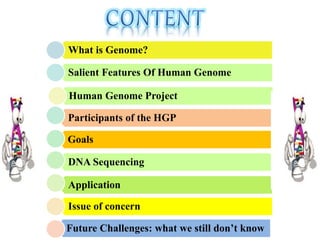
What is Genome?
Salient Features Of Human Genome
Participants of the HGP
Goals
DNA Sequencing
Application
Human Genome Project
Issue of concern
Future Challenges: what we still don’t know
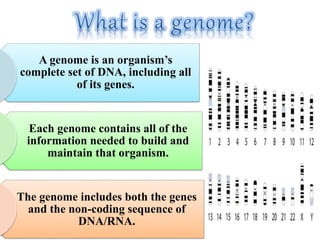
A genome is an organism’s
complete set of DNA, including all
of its genes.
Each genome contains all of the
information needed to build and
maintain that organism.
The genome includes both the genes
and the non-coding sequence of
DNA/RNA.
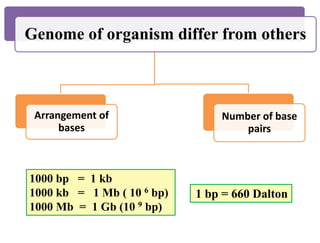
1 bp = 660 Dalton
Genome of organism differ from others
Arrangement of
bases
Number of base
pairs
1000 bp = 1 kb
1000 kb = 1 Mb ( 10 6 bp)
1000 Mb = 1 Gb (10 9 bp)
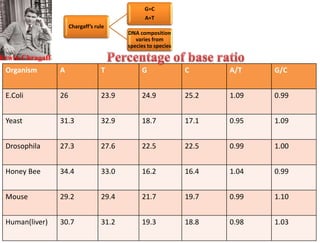
Erwin Chragaff
Organism A T G C A/T G/C
E.Coli 26 23.9 24.9 25.2 1.09 0.99
Yeast 31.3 32.9 18.7 17.1 0.95 1.09
Drosophila 27.3 27.6 22.5 22.5 0.99 1.00
Honey Bee 34.4 33.0 16.2 16.4 1.04 0.99
Mouse 29.2 29.4 21.7 19.7 0.99 1.10
Human(liver) 30.7 31.2 19.3 18.8 0.98 1.03
Chargaff’s rule
G=C
A=T
DNA composition
varies from
species to species
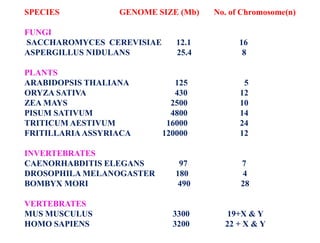
SPECIES GENOME SIZE (Mb) No. of Chromosome(n)
FUNGI
SACCHAROMYCES CEREVISIAE 12.1 16
ASPERGILLUS NIDULANS 25.4 8
PLANTS
ARABIDOPSIS THALIANA 125 5
ORYZA SATIVA 430 12
ZEA MAYS 2500 10
PISUM SATIVUM 4800 14
TRITICUM AESTIVUM 16000 24
FRITILLARIAASSYRIACA 120000 12
INVERTEBRATES
CAENORHABDITIS ELEGANS 97 7
DROSOPHILA MELANOGASTER 180 4
BOMBYX MORI 490 28
VERTEBRATES
MUS MUSCULUS 3300 19+X & Y
HOMO SAPIENS 3200 22 + X & Y
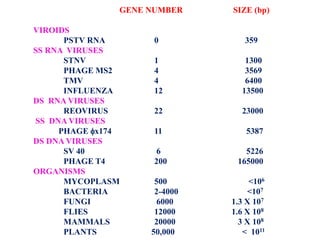
GENE NUMBER SIZE (bp)
VIROIDS
PSTV RNA 0 359
SS RNA VIRUSES
STNV 1 1300
PHAGE MS2 4 3569
TMV 4 6400
INFLUENZA 12 13500
DS RNA VIRUSES
REOVIRUS 22 23000
SS DNA VIRUSES
PHAGE x174 11 5387
DS DNA VIRUSES
SV 40 6 5226
PHAGE T4 200 165000
ORGANISMS
MYCOPLASM 500 <106
BACTERIA 2-4000 <107
FUNGI 6000 1.3 X 10⁷
FLIES 12000 1.6 X 10⁸
MAMMALS 20000 3 X 10⁸
PLANTS 50,000 < 1011
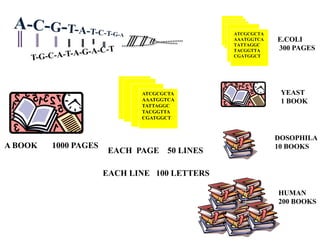
ATCGCGCTA
AAATGGTCA
TATTAGGC
TACGGTTA
CGATGGCT
A BOOK 1000 PAGES
E.COLI
300 PAGES
YEAST
1 BOOK
DOSOPHILA
10 BOOKS
HUMAN
200 BOOKS
EACH PAGE 50 LINES
EACH LINE 100 LETTERS
ATCGCGCTA
AAATGGTCA
TATTAGGC
TACGGTTA
CGATGGCT
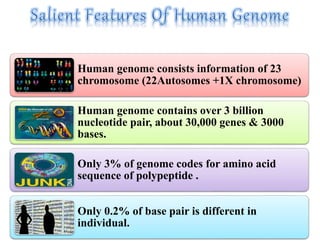
Human genome consists information of 23
chromosome (22Autosomes +1X chromosome)
Human genome contains over 3 billion
nucleotide pair, about 30,000 genes & 3000
bases.
Only 3% of genome codes for amino acid
sequence of polypeptide .
Only 0.2% of base pair is different in
individual.
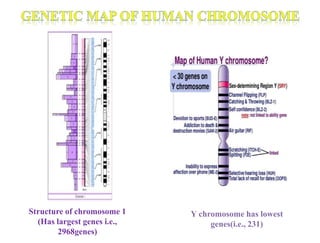
Structure of chromosome 1
(Has largest genes i.e.,
2968genes)
Y chromosome has lowest
genes(i.e., 231)
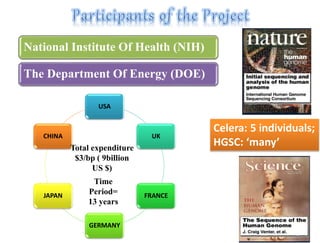
National Institute Of Health (NIH)
The Department Of Energy (DOE)
USA
UK
FRANCE
GERMANY
JAPAN
CHINA
Total expenditure
$3/bp ( 9billion
US $)
Time
Period=
13 years
Celera: 5 individuals;
HGSC: ‘many’
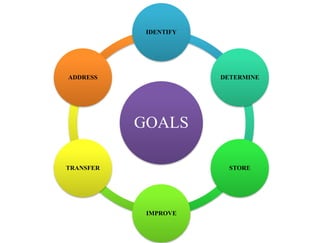
GOALS
IDENTIFY
DETERMINE
STORE
IMPROVE
TRANSFER
ADDRESS
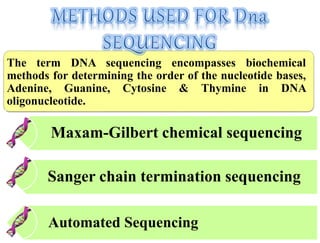
Maxam-Gilbert chemical sequencing
Sanger chain termination sequencing
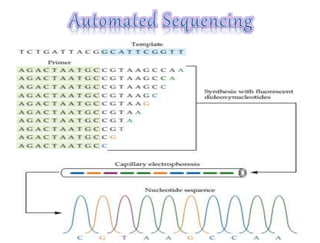
Automated Sequencing
The term DNA sequencing encompasses biochemical
methods for determining the order of the nucleotide bases,
Adenine, Guanine, Cytosine & Thymine in DNA
oligonucleotide.
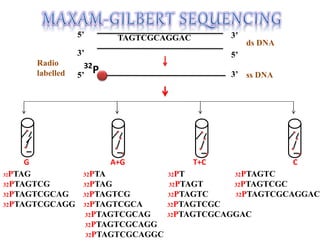
32
P
5’
5’
3’
3’
5’ 3’
TAGTCGCAGGAC
ds DNA
ss DNA
Radio
labelled
G A+G T+C C
32PTAG 32PTA 32PT 32PTAGTC
32PTAGTCG 32PTAG 32PTAGT 32PTAGTCGC
32PTAGTCGCAG 32PTAGTCG 32PTAGTC 32PTAGTCGCAGGAC
32PTAGTCGCAGG 32PTAGTCGCA 32PTAGTCGC
32PTAGTCGCAG 32PTAGTCGCAGGAC
32PTAGTCGCAGG
32PTAGTCGCAGGC
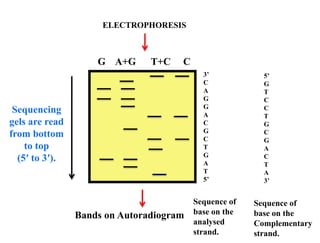
G A+G T+C C
Bands on Autoradiogram
3’
C
A
G
G
A
C
G
C
T
G
A
T
5’
Sequencing
gels are read
from bottom
to top
(5′ to 3′).
5’
G
T
C
C
T
G
C
G
A
C
T
A
3’
Sequence of
base on the
Complementary
strand.
Sequence of
base on the
analysed
strand.
ELECTROPHORESIS
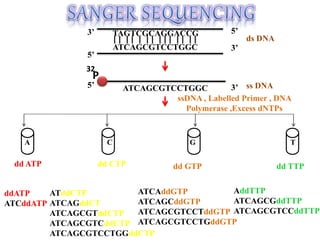
ssDNA , Labelled Primer , DNA
Polymerase ,Excess dNTPs
3’
3’
5’
5’
5’ 3’
TAGTCGCAGGACCG
ds DNA
ss DNA
A C G T
dd ATP dd CTP dd TTP
dd GTP
ATCAGCGTCCTGGC
ATCAGCGTCCTGGC
ddATP
ATCddATP
ATddCTP
ATCAGddCT
ATCAGCGTddCTP
ATCAGCGTCddCTP
ATCAGCGTCCTGGddCTP
ATCAddGTP
ATCAGCddGTP
ATCAGCGTCCTddGTP
ATCAGCGTCCTGddGTP
AddTTP
ATCAGCGddTTP
ATCAGCGTCCddTTP
P
32
Sequencing
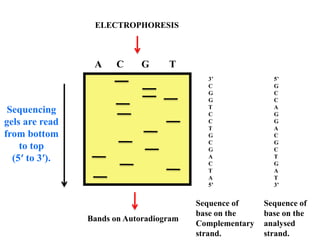
gels are read
from bottom
to top
(5′ to 3′).
A C G T
3’
C
G
G
T
C
C
T
G
C
G
A
C
T
A
5’
5’
G
C
C
A
G
G
A
C
G
C
T
G
A
T
3’
Sequence of
base on the
Complementary
strand.
Sequence of
base on the
analysed
strand.
Bands on Autoradiogram
ELECTROPHORESIS
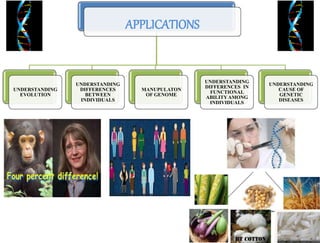
APPLICATIONS
UNDERSTANDING
EVOLUTION
UNDERSTANDING
DIFFERENCES
BETWEEN
INDIVIDUALS
UNDERSTANDING
DIFFERENCES IN
FUNCTIONAL
ABILITYAMONG
INDIVIDUALS
MANUPULATON
OF GENOME
UNDERSTANDING
CAUSE OF
GENETIC
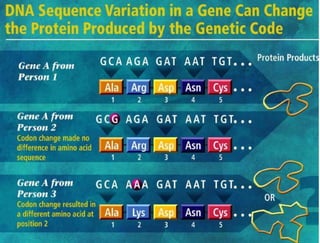
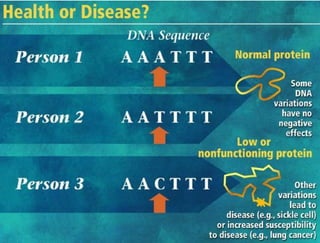
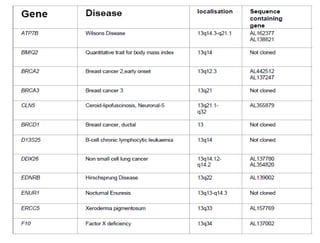
DISEASES
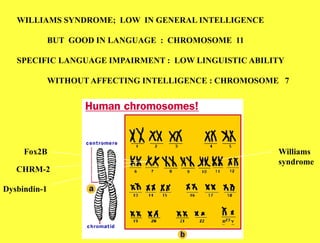
Fox2B
Dysbindin-1
CHRM-2
Williams
syndrome
WILLIAMS SYNDROME; LOW IN GENERAL INTELLIGENCE
BUT GOOD IN LANGUAGE : CHROMOSOME 11
SPECIFIC LANGUAGE IMPAIRMENT : LOW LINGUISTIC ABILITY
WITHOUT AFFECTING INTELLIGENCE : CHROMOSOME 7
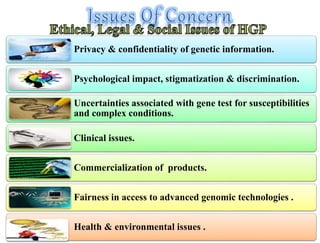
Privacy & confidentiality of genetic information.
Psychological impact, stigmatization & discrimination.
Uncertainties associated with gene test for susceptibilities
and complex conditions.
Clinical issues.
Commercialization of products.
Fairness in access to advanced genomic technologies .
Health & environmental issues .
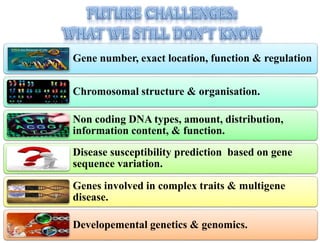
Gene number, exact location, function & regulation
Chromosomal structure & organisation.
Non coding DNA types, amount, distribution,
information content, & function.
Disease susceptibility prediction based on gene
sequence variation.
Genes involved in complex traits & multigene
disease.
Developemental genetics & genomics.
Human genome project

Human genome project

  • 1.
  • 2.
    What is Genome? SalientFeatures Of Human Genome Participants of the HGP Goals DNA Sequencing Application Human Genome Project Issue of concern Future Challenges: what we still don’t know
  • 3.
    A genome isan organism’s complete set of DNA, including all of its genes. Each genome contains all of the information needed to build and maintain that organism. The genome includes both the genes and the non-coding sequence of DNA/RNA.
  • 4.
    1 bp =660 Dalton Genome of organism differ from others Arrangement of bases Number of base pairs 1000 bp = 1 kb 1000 kb = 1 Mb ( 10 6 bp) 1000 Mb = 1 Gb (10 9 bp)
  • 5.
    Erwin Chragaff Organism AT G C A/T G/C E.Coli 26 23.9 24.9 25.2 1.09 0.99 Yeast 31.3 32.9 18.7 17.1 0.95 1.09 Drosophila 27.3 27.6 22.5 22.5 0.99 1.00 Honey Bee 34.4 33.0 16.2 16.4 1.04 0.99 Mouse 29.2 29.4 21.7 19.7 0.99 1.10 Human(liver) 30.7 31.2 19.3 18.8 0.98 1.03 Chargaff’s rule G=C A=T DNA composition varies from species to species
  • 6.
    SPECIES GENOME SIZE(Mb) No. of Chromosome(n) FUNGI SACCHAROMYCES CEREVISIAE 12.1 16 ASPERGILLUS NIDULANS 25.4 8 PLANTS ARABIDOPSIS THALIANA 125 5 ORYZA SATIVA 430 12 ZEA MAYS 2500 10 PISUM SATIVUM 4800 14 TRITICUM AESTIVUM 16000 24 FRITILLARIAASSYRIACA 120000 12 INVERTEBRATES CAENORHABDITIS ELEGANS 97 7 DROSOPHILA MELANOGASTER 180 4 BOMBYX MORI 490 28 VERTEBRATES MUS MUSCULUS 3300 19+X & Y HOMO SAPIENS 3200 22 + X & Y
  • 7.
    GENE NUMBER SIZE(bp) VIROIDS PSTV RNA 0 359 SS RNA VIRUSES STNV 1 1300 PHAGE MS2 4 3569 TMV 4 6400 INFLUENZA 12 13500 DS RNA VIRUSES REOVIRUS 22 23000 SS DNA VIRUSES PHAGE x174 11 5387 DS DNA VIRUSES SV 40 6 5226 PHAGE T4 200 165000 ORGANISMS MYCOPLASM 500 <106 BACTERIA 2-4000 <107 FUNGI 6000 1.3 X 10⁷ FLIES 12000 1.6 X 10⁸ MAMMALS 20000 3 X 10⁸ PLANTS 50,000 < 1011
  • 8.
    ATCGCGCTA AAATGGTCA TATTAGGC TACGGTTA CGATGGCT A BOOK 1000PAGES E.COLI 300 PAGES YEAST 1 BOOK DOSOPHILA 10 BOOKS HUMAN 200 BOOKS EACH PAGE 50 LINES EACH LINE 100 LETTERS ATCGCGCTA AAATGGTCA TATTAGGC TACGGTTA CGATGGCT
  • 9.
    Human genome consistsinformation of 23 chromosome (22Autosomes +1X chromosome) Human genome contains over 3 billion nucleotide pair, about 30,000 genes & 3000 bases. Only 3% of genome codes for amino acid sequence of polypeptide . Only 0.2% of base pair is different in individual.
  • 10.
    Structure of chromosome1 (Has largest genes i.e., 2968genes) Y chromosome has lowest genes(i.e., 231)
  • 12.
    National Institute OfHealth (NIH) The Department Of Energy (DOE) USA UK FRANCE GERMANY JAPAN CHINA Total expenditure $3/bp ( 9billion US $) Time Period= 13 years Celera: 5 individuals; HGSC: ‘many’
  • 14.
  • 15.
    Maxam-Gilbert chemical sequencing Sangerchain termination sequencing Automated Sequencing The term DNA sequencing encompasses biochemical methods for determining the order of the nucleotide bases, Adenine, Guanine, Cytosine & Thymine in DNA oligonucleotide.
  • 16.
    32 P 5’ 5’ 3’ 3’ 5’ 3’ TAGTCGCAGGAC ds DNA ssDNA Radio labelled G A+G T+C C 32PTAG 32PTA 32PT 32PTAGTC 32PTAGTCG 32PTAG 32PTAGT 32PTAGTCGC 32PTAGTCGCAG 32PTAGTCG 32PTAGTC 32PTAGTCGCAGGAC 32PTAGTCGCAGG 32PTAGTCGCA 32PTAGTCGC 32PTAGTCGCAG 32PTAGTCGCAGGAC 32PTAGTCGCAGG 32PTAGTCGCAGGC
  • 17.
    G A+G T+CC Bands on Autoradiogram 3’ C A G G A C G C T G A T 5’ Sequencing gels are read from bottom to top (5′ to 3′). 5’ G T C C T G C G A C T A 3’ Sequence of base on the Complementary strand. Sequence of base on the analysed strand. ELECTROPHORESIS
  • 18.
    ssDNA , LabelledPrimer , DNA Polymerase ,Excess dNTPs 3’ 3’ 5’ 5’ 5’ 3’ TAGTCGCAGGACCG ds DNA ss DNA A C G T dd ATP dd CTP dd TTP dd GTP ATCAGCGTCCTGGC ATCAGCGTCCTGGC ddATP ATCddATP ATddCTP ATCAGddCT ATCAGCGTddCTP ATCAGCGTCddCTP ATCAGCGTCCTGGddCTP ATCAddGTP ATCAGCddGTP ATCAGCGTCCTddGTP ATCAGCGTCCTGddGTP AddTTP ATCAGCGddTTP ATCAGCGTCCddTTP P 32
  • 19.
    Sequencing gels are read frombottom to top (5′ to 3′). A C G T 3’ C G G T C C T G C G A C T A 5’ 5’ G C C A G G A C G C T G A T 3’ Sequence of base on the Complementary strand. Sequence of base on the analysed strand. Bands on Autoradiogram ELECTROPHORESIS
  • 21.
  • 22.
    Fox2B Dysbindin-1 CHRM-2 Williams syndrome WILLIAMS SYNDROME; LOWIN GENERAL INTELLIGENCE BUT GOOD IN LANGUAGE : CHROMOSOME 11 SPECIFIC LANGUAGE IMPAIRMENT : LOW LINGUISTIC ABILITY WITHOUT AFFECTING INTELLIGENCE : CHROMOSOME 7
  • 26.
    Privacy & confidentialityof genetic information. Psychological impact, stigmatization & discrimination. Uncertainties associated with gene test for susceptibilities and complex conditions. Clinical issues. Commercialization of products. Fairness in access to advanced genomic technologies . Health & environmental issues .
  • 27.
    Gene number, exactlocation, function & regulation Chromosomal structure & organisation. Non coding DNA types, amount, distribution, information content, & function. Disease susceptibility prediction based on gene sequence variation. Genes involved in complex traits & multigene disease. Developemental genetics & genomics.