12/16/14 Haz com 1
HazardHazard
CommunicationCommunication
SDS
Safety Data
Sheets
12/16/1412/16/14 Haz comHaz com 22
IntroductionIntroduction
 Millions workers work with and are
potentially exposed to one or more chemical
hazards daily.
 There are tens of thousands existing chemical
products, and hundreds of new ones being introduced
annually.
 Chemical exposure may cause or contribute to many
serious health effects such as heart ailments, central
nervous system damage, kidney and lung damage,
sterility, cancer, burns, and rashes.
 Some chemicals may also be safety hazards and
have the potential to cause fires and explosions and
other serious accidents.
Why change?Why change?
 OSHA believes that revising the HazOSHA believes that revising the Haz
com standard to include GHS willcom standard to include GHS will
result in the safer handling ofresult in the safer handling of
workplace chemicals and preventworkplace chemicals and prevent
over 500 workplace injuries andover 500 workplace injuries and
illnesses and 43 fatalities annually.illnesses and 43 fatalities annually.
12/16/1412/16/14 Haz comHaz com 33
12/16/1412/16/14 Haz comHaz com 44
Globally Harmonized systemGlobally Harmonized system
Remember this: Say it:Remember this: Say it:
Globally Harmonized systemGlobally Harmonized system
What isWhat is GHS ?GHS ?
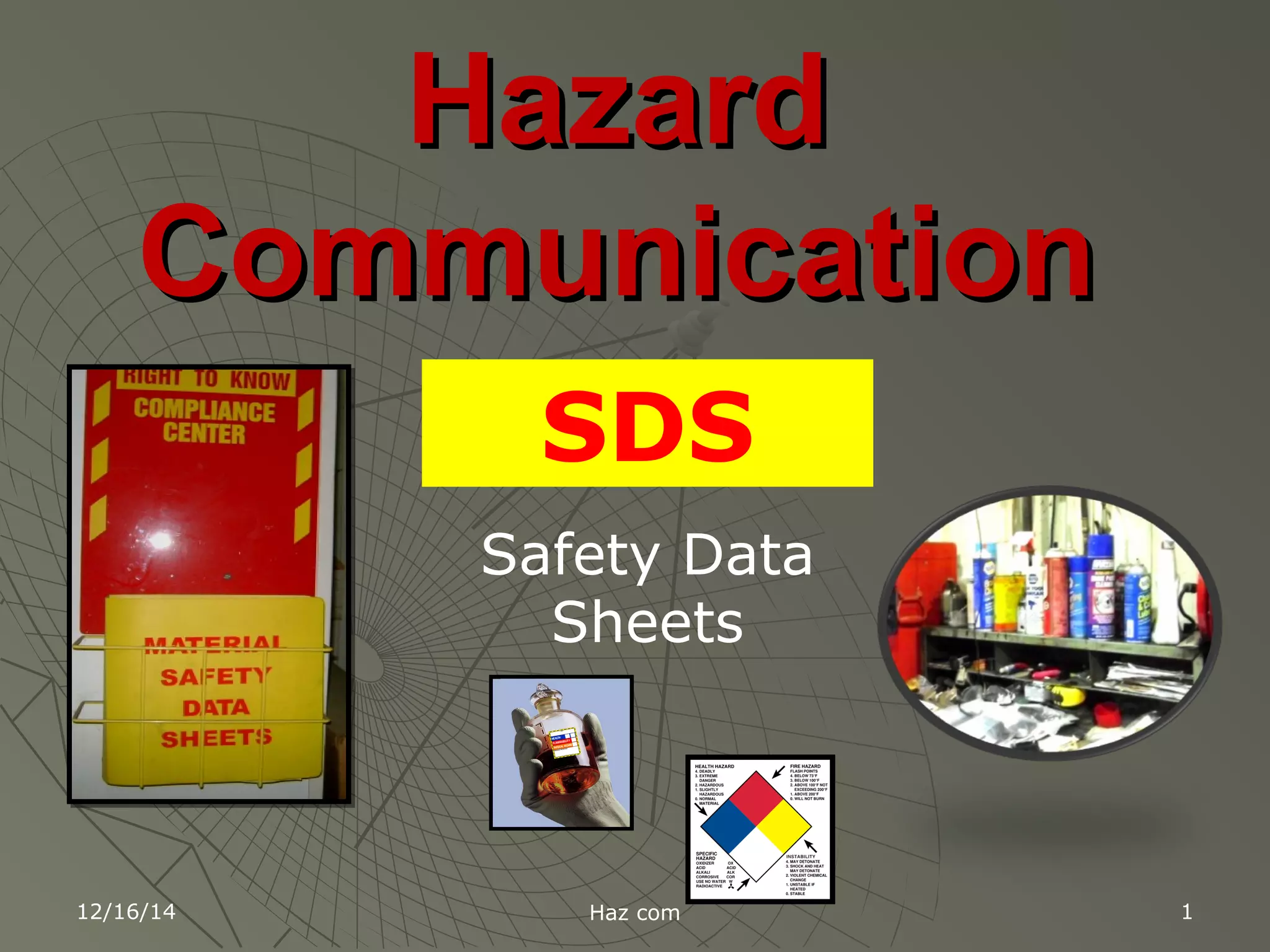
An SDS is an MSDSAn SDS is an MSDS
 Based on the MSDS provisions in HazBased on the MSDS provisions in Haz
Com 1994, there are currently aCom 1994, there are currently a
number of different MSDS styles andnumber of different MSDS styles and
formats in use in the United States,formats in use in the United States,
the most common being the 8the most common being the 8
section OSHA MSDS and the 16section OSHA MSDS and the 16
section ANSI standard MSDS.section ANSI standard MSDS.
12/16/1412/16/14 Haz comHaz com 55
Format changeFormat change
 OSHA’s adoption of GHS via HazOSHA’s adoption of GHS via Haz
Com 2012, on the other hand,Com 2012, on the other hand,
mandates the use of a single GHSmandates the use of a single GHS
format for safety data sheets, aformat for safety data sheets, a
format which features 16 sections informat which features 16 sections in
a strict ordering.a strict ordering.
12/16/1412/16/14 Haz comHaz com 66
More changesMore changes
 Another change, thanks to GHS, isAnother change, thanks to GHS, is
the renaming of material safety datathe renaming of material safety data
sheets from MSDSs to simply safetysheets from MSDSs to simply safety
data sheets, or SDSs.data sheets, or SDSs.
12/16/1412/16/14 Haz comHaz com 77
Dropping of the MDropping of the M
 Unfortunately, this dropping of the MUnfortunately, this dropping of the M
has caused more consternation thanhas caused more consternation than
is warranted. The truth is, an SDS isis warranted. The truth is, an SDS is
an MSDS, they are really the samean MSDS, they are really the same
thing, especially in terms of the rolething, especially in terms of the role
they play in the HCS. In fact, thethey play in the HCS. In fact, the
GHS SDS format is nearly identical toGHS SDS format is nearly identical to
the ANSI Standard 16 section MSDSthe ANSI Standard 16 section MSDS
– with a couple of modifications.– with a couple of modifications.
12/16/1412/16/14 Haz comHaz com 88
12/16/1412/16/14 Haz comHaz com 99
OSHA’s Hazard CommunicationOSHA’s Hazard Communication
StandardStandard
 OSHA’s Hazard communication Standard, 29CFROSHA’s Hazard communication Standard, 29CFR
1910.1200, developed in 1983 and was designed1910.1200, developed in 1983 and was designed
to protect workers from the effects of anyto protect workers from the effects of any
hazardous chemical used or stored in the workhazardous chemical used or stored in the work
setting. It requires the employers to providesetting. It requires the employers to provide
information and training on chemical hazards toinformation and training on chemical hazards to
any employees who have a potential of beingany employees who have a potential of being
exposed to a hazardous chemical ‘under normalexposed to a hazardous chemical ‘under normal
conditions of use or in a foreseeable emergency.’conditions of use or in a foreseeable emergency.’
This applies to companies with as few asThis applies to companies with as few as 11
employee, who could be exposed to onlyemployee, who could be exposed to only oneone
hazardous chemical.hazardous chemical.
12/16/1412/16/14 Haz comHaz com 1010
Employer requirementsEmployer requirements
1.1. Chemical inventoryChemical inventory:: Identify and listIdentify and list
the hazardous chemicals at the workplacethe hazardous chemicals at the workplace
or taken off site in other locations oror taken off site in other locations or
stored away from the main plant thatstored away from the main plant that
bear a hazard label.bear a hazard label.
2.2. Material safety data sheets (SDS)Material safety data sheets (SDS)::
Keep SDS sheets for hazardous chemicalsKeep SDS sheets for hazardous chemicals
or obtain them if they are not received.or obtain them if they are not received.
SDS should be accessible to allSDS should be accessible to all
employees.employees.
12/16/1412/16/14 Haz comHaz com 1111
Employer requirementsEmployer requirements
3.3. Labeling:Labeling: Ensure that all chemicalsEnsure that all chemicals
are labeled.are labeled.
4.4. Information & Training:Information & Training:
Communicate hazard information toCommunicate hazard information to
employees through the chemicalemployees through the chemical
inventory, labels, SDS, and a formalinventory, labels, SDS, and a formal
training program.training program.
5.5. Written program:Written program: Develop a writtenDevelop a written
hazard communication program.hazard communication program.
12/16/1412/16/14 Haz comHaz com 1212
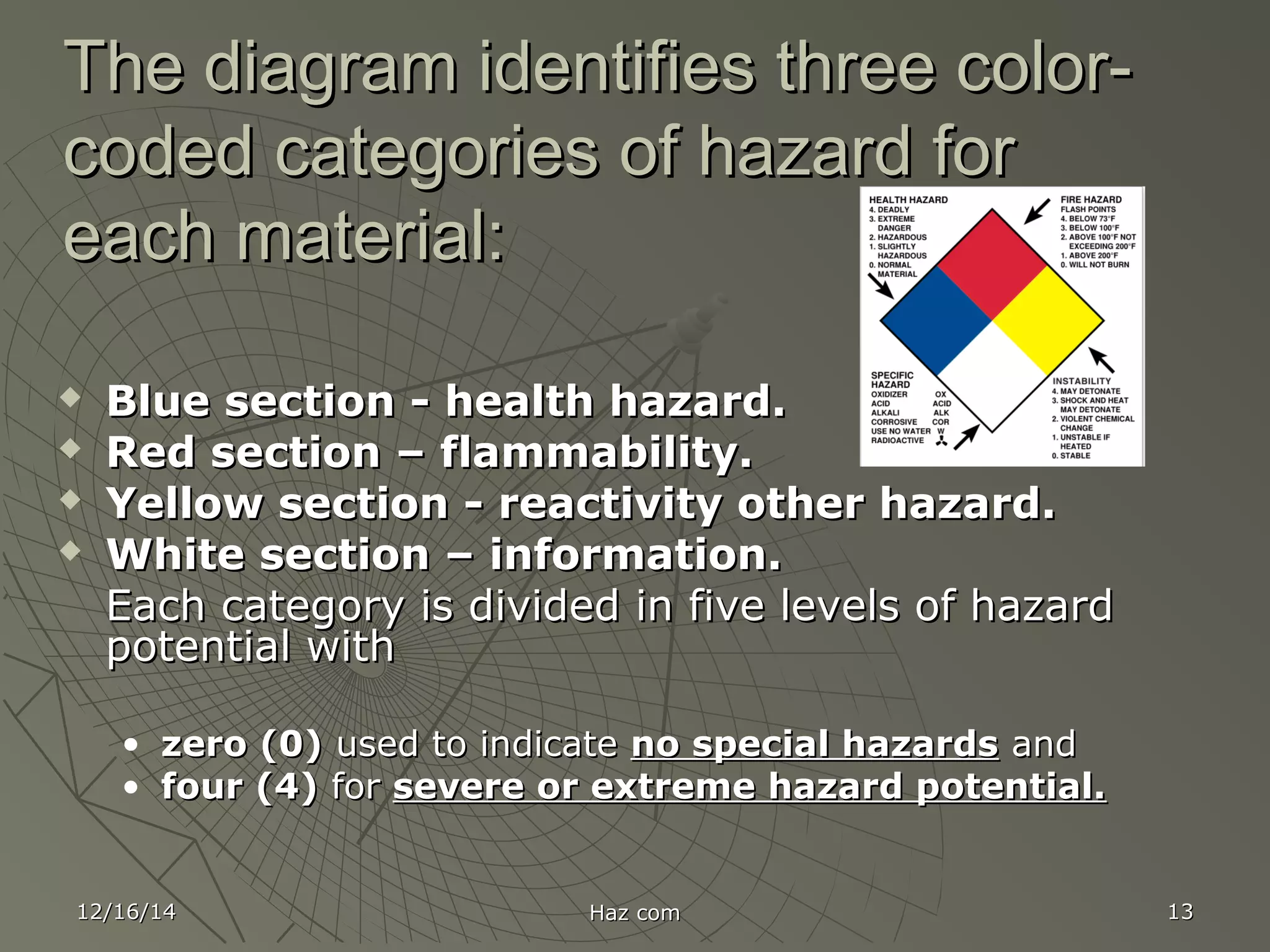
Hazard Rating SystemHazard Rating System
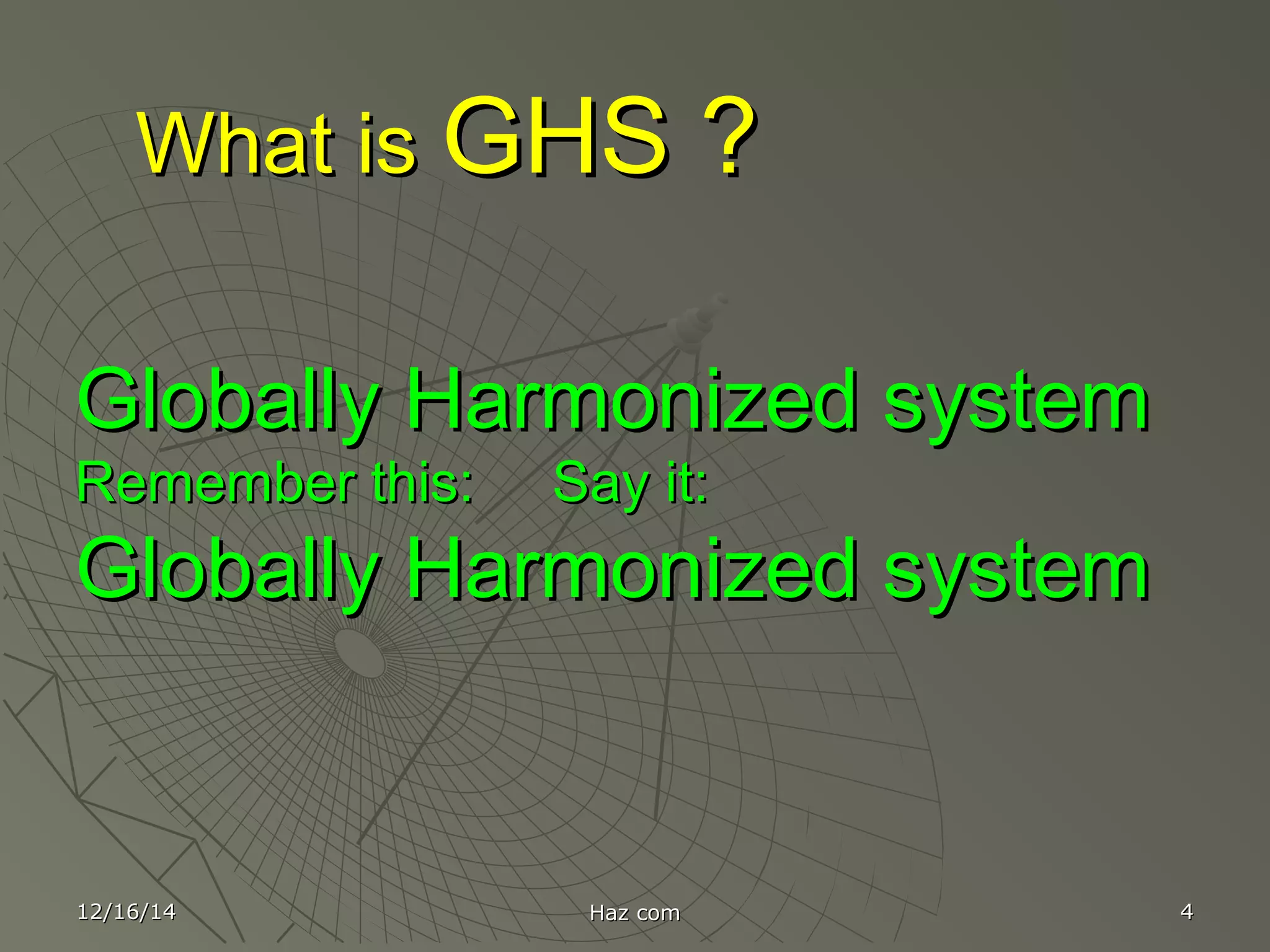
The National Fire Protection AssociationThe National Fire Protection Association
(NFPA 704) system uses an a diamond-(NFPA 704) system uses an a diamond-
shaped diagram of symbols and numbers toshaped diagram of symbols and numbers to
indicate the degree of hazard associatedindicate the degree of hazard associated
with a particular chemical or material. Thesewith a particular chemical or material. These
diamond- shaped symbols are placed ondiamond- shaped symbols are placed on
containers of chemicals or materials tocontainers of chemicals or materials to
identify the degree of hazard associated withidentify the degree of hazard associated with
the chemical or material.the chemical or material.
12/16/1412/16/14 Haz comHaz com 1313
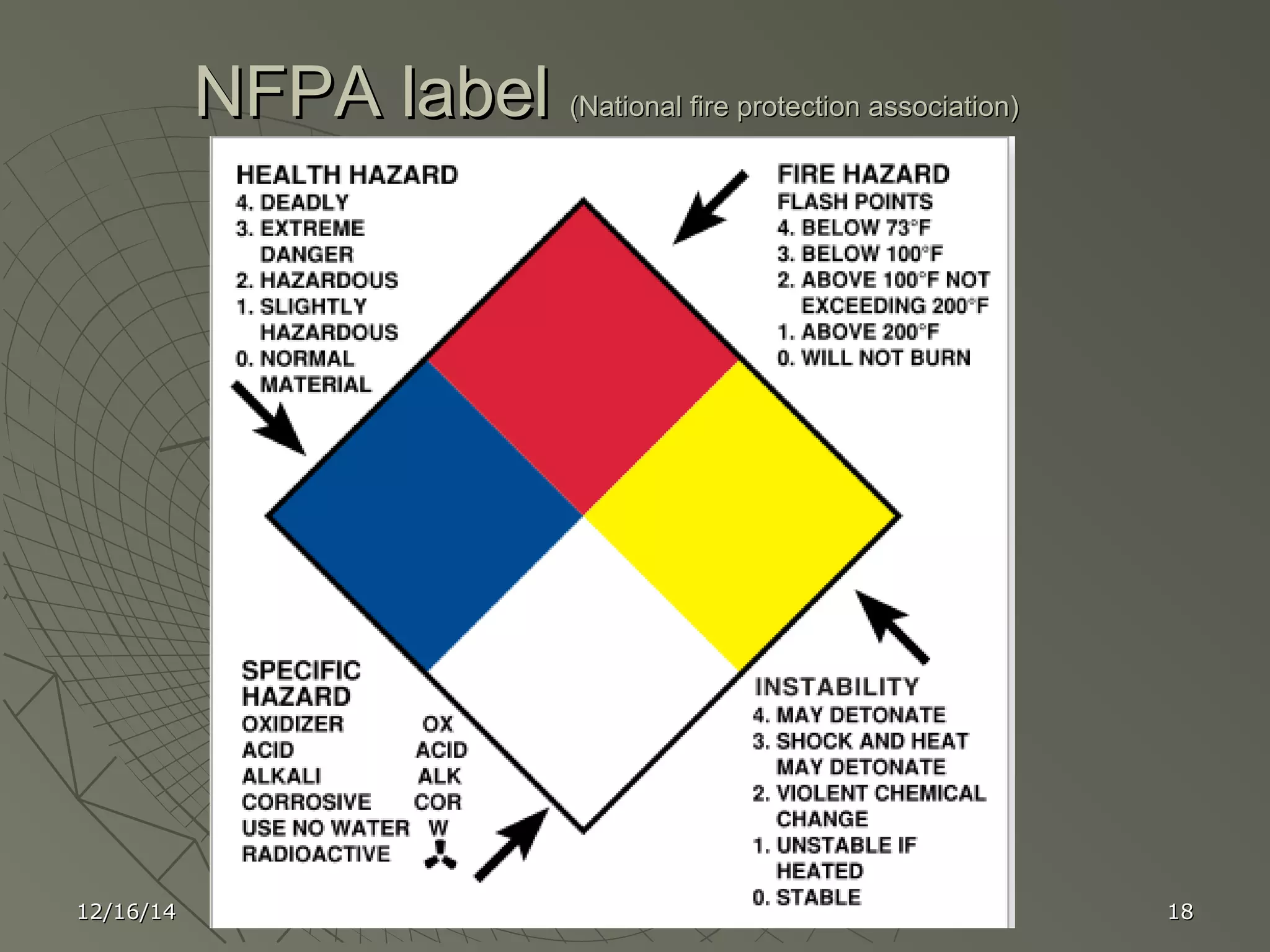
The diagram identifies three color-The diagram identifies three color-
coded categories of hazard forcoded categories of hazard for
each material:each material:
 Blue section - health hazard.Blue section - health hazard.
 Red section – flammability.Red section – flammability.
 Yellow section - reactivity other hazard.Yellow section - reactivity other hazard.
 White section – information.White section – information.
Each category is divided in five levels of hazardEach category is divided in five levels of hazard
potential withpotential with
• zero (0)zero (0) used to indicateused to indicate no special hazardsno special hazards andand
• four (4)four (4) forfor severe or extreme hazard potential.severe or extreme hazard potential.
12/16/1412/16/14 Haz comHaz com 1414
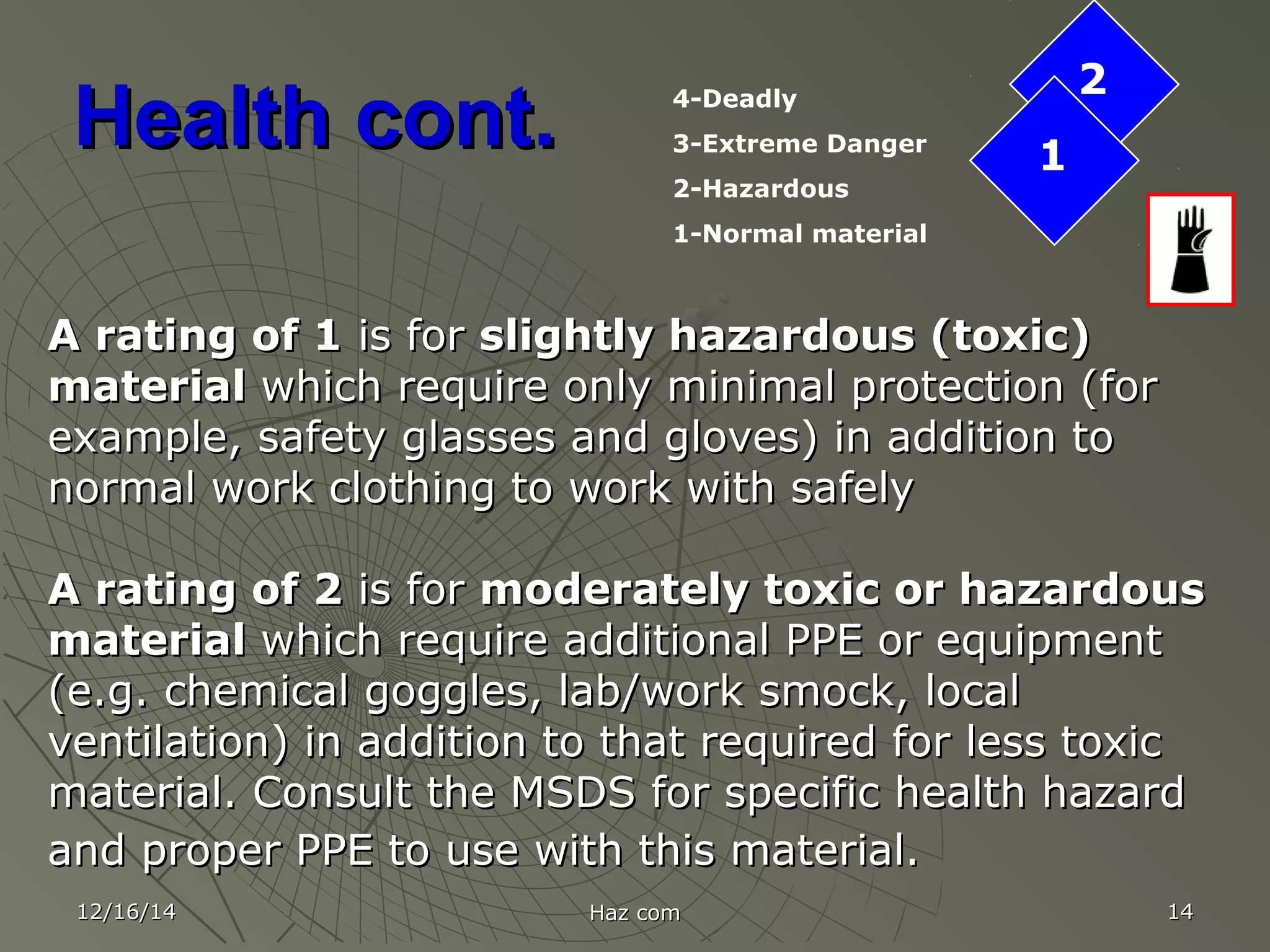
Health cont.Health cont.
A rating of 1A rating of 1 is foris for slightly hazardous (toxic)slightly hazardous (toxic)
materialmaterial which require only minimal protection (forwhich require only minimal protection (for
example, safety glasses and gloves) in addition toexample, safety glasses and gloves) in addition to
normal work clothing to work with safelynormal work clothing to work with safely
A rating of 2A rating of 2 is foris for moderately toxic or hazardousmoderately toxic or hazardous
materialmaterial which require additional PPE or equipmentwhich require additional PPE or equipment
(e.g. chemical goggles, lab/work smock, local(e.g. chemical goggles, lab/work smock, local
ventilation) in addition to that required for less toxicventilation) in addition to that required for less toxic
material. Consult the MSDS for specific health hazardmaterial. Consult the MSDS for specific health hazard
and proper PPE to use with this material.and proper PPE to use with this material.
4-Deadly
3-Extreme Danger
2-Hazardous
1-Normal material
2
1
12/16/1412/16/14 Haz comHaz com 1515
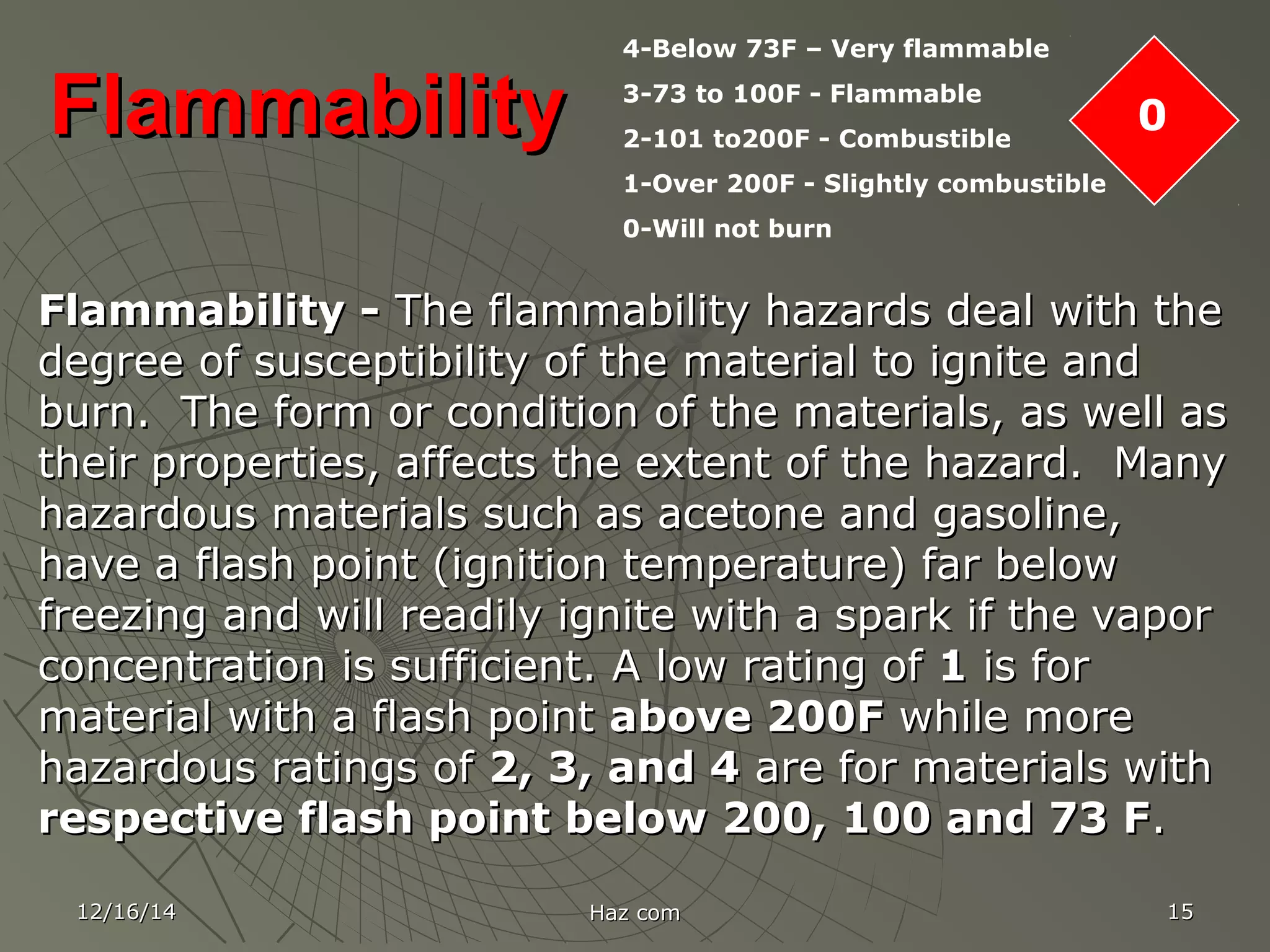
FlammabilityFlammability
Flammability -Flammability - The flammability hazards deal with theThe flammability hazards deal with the
degree of susceptibility of the material to ignite anddegree of susceptibility of the material to ignite and
burn. The form or condition of the materials, as well asburn. The form or condition of the materials, as well as
their properties, affects the extent of the hazard. Manytheir properties, affects the extent of the hazard. Many
hazardous materials such as acetone and gasoline,hazardous materials such as acetone and gasoline,
have a flash point (ignition temperature) far belowhave a flash point (ignition temperature) far below
freezing and will readily ignite with a spark if the vaporfreezing and will readily ignite with a spark if the vapor
concentration is sufficient. A low rating ofconcentration is sufficient. A low rating of 11 is foris for
material with a flash pointmaterial with a flash point above 200Fabove 200F while morewhile more
hazardous ratings ofhazardous ratings of 2, 3, and 42, 3, and 4 are for materials withare for materials with
respective flash point below 200, 100 and 73 Frespective flash point below 200, 100 and 73 F..
0
4-Below 73F – Very flammable
3-73 to 100F - Flammable
2-101 to200F - Combustible
1-Over 200F - Slightly combustible
0-Will not burn
12/16/1412/16/14 Haz comHaz com 1616
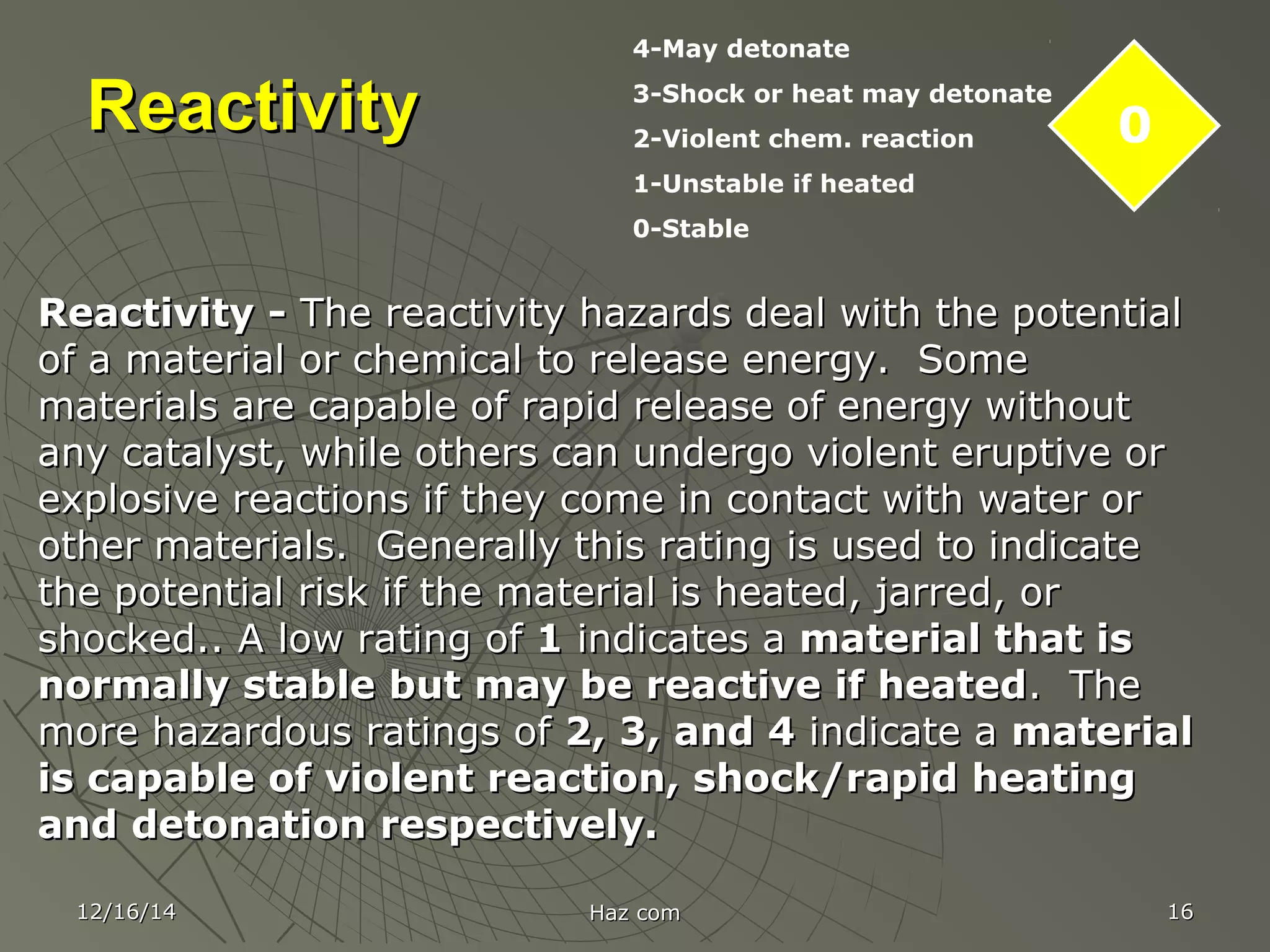
ReactivityReactivity
Reactivity -Reactivity - The reactivity hazards deal with the potentialThe reactivity hazards deal with the potential
of a material or chemical to release energy. Someof a material or chemical to release energy. Some
materials are capable of rapid release of energy withoutmaterials are capable of rapid release of energy without
any catalyst, while others can undergo violent eruptive orany catalyst, while others can undergo violent eruptive or
explosive reactions if they come in contact with water orexplosive reactions if they come in contact with water or
other materials. Generally this rating is used to indicateother materials. Generally this rating is used to indicate
the potential risk if the material is heated, jarred, orthe potential risk if the material is heated, jarred, or
shocked.. A low rating ofshocked.. A low rating of 11 indicates aindicates a material that ismaterial that is
normally stable but may be reactive if heatednormally stable but may be reactive if heated. The. The
more hazardous ratings ofmore hazardous ratings of 2, 3, and 42, 3, and 4 indicate aindicate a materialmaterial
is capable of violent reaction, shock/rapid heatingis capable of violent reaction, shock/rapid heating
and detonation respectively.and detonation respectively.
4-May detonate
3-Shock or heat may detonate
2-Violent chem. reaction
1-Unstable if heated
0-Stable
0
12/16/1412/16/14 Haz comHaz com 1717
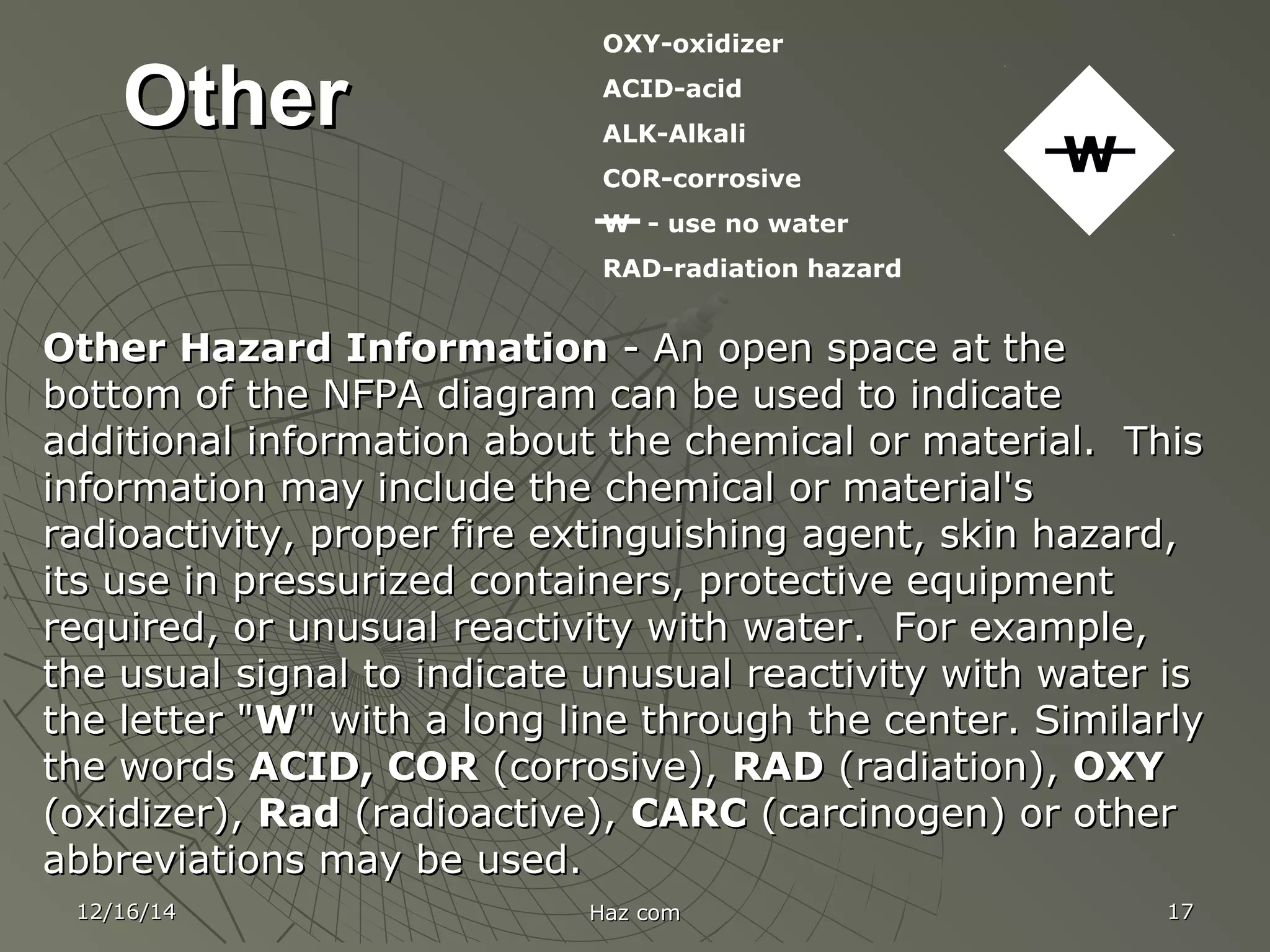
OtherOther
Other Hazard InformationOther Hazard Information - An open space at the- An open space at the
bottom of the NFPA diagram can be used to indicatebottom of the NFPA diagram can be used to indicate
additional information about the chemical or material. Thisadditional information about the chemical or material. This
information may include the chemical or material'sinformation may include the chemical or material's
radioactivity, proper fire extinguishing agent, skin hazard,radioactivity, proper fire extinguishing agent, skin hazard,
its use in pressurized containers, protective equipmentits use in pressurized containers, protective equipment
required, or unusual reactivity with water. For example,required, or unusual reactivity with water. For example,
the usual signal to indicate unusual reactivity with water isthe usual signal to indicate unusual reactivity with water is
the letter "the letter "WW" with a long line through the center. Similarly" with a long line through the center. Similarly
the wordsthe words ACID, CORACID, COR (corrosive),(corrosive), RADRAD (radiation),(radiation), OXYOXY
(oxidizer),(oxidizer), RadRad (radioactive),(radioactive), CARCCARC (carcinogen) or other(carcinogen) or other
abbreviations may be used.abbreviations may be used.
OXY-oxidizer
ACID-acid
ALK-Alkali
COR-corrosive
W - use no water
RAD-radiation hazard
W
12/16/1412/16/14 Haz comHaz com 1818
NFPA labelNFPA label (National fire protection association)(National fire protection association)
12/16/1412/16/14 Haz comHaz com 1919
Uniform labelingUniform labeling
Labeling is required and uniformLabeling is required and uniform
labeling systems are now to be put inlabeling systems are now to be put in
place.place.
Also, a hazard warning label is notAlso, a hazard warning label is not
intended to be the sole or mostintended to be the sole or most
complete source of hazard information.complete source of hazard information.
It does, however alert you to the factIt does, however alert you to the fact
that a potential hazard exists. For morethat a potential hazard exists. For more
information always check the SDS.information always check the SDS.
12/16/1412/16/14 Haz comHaz com 2020
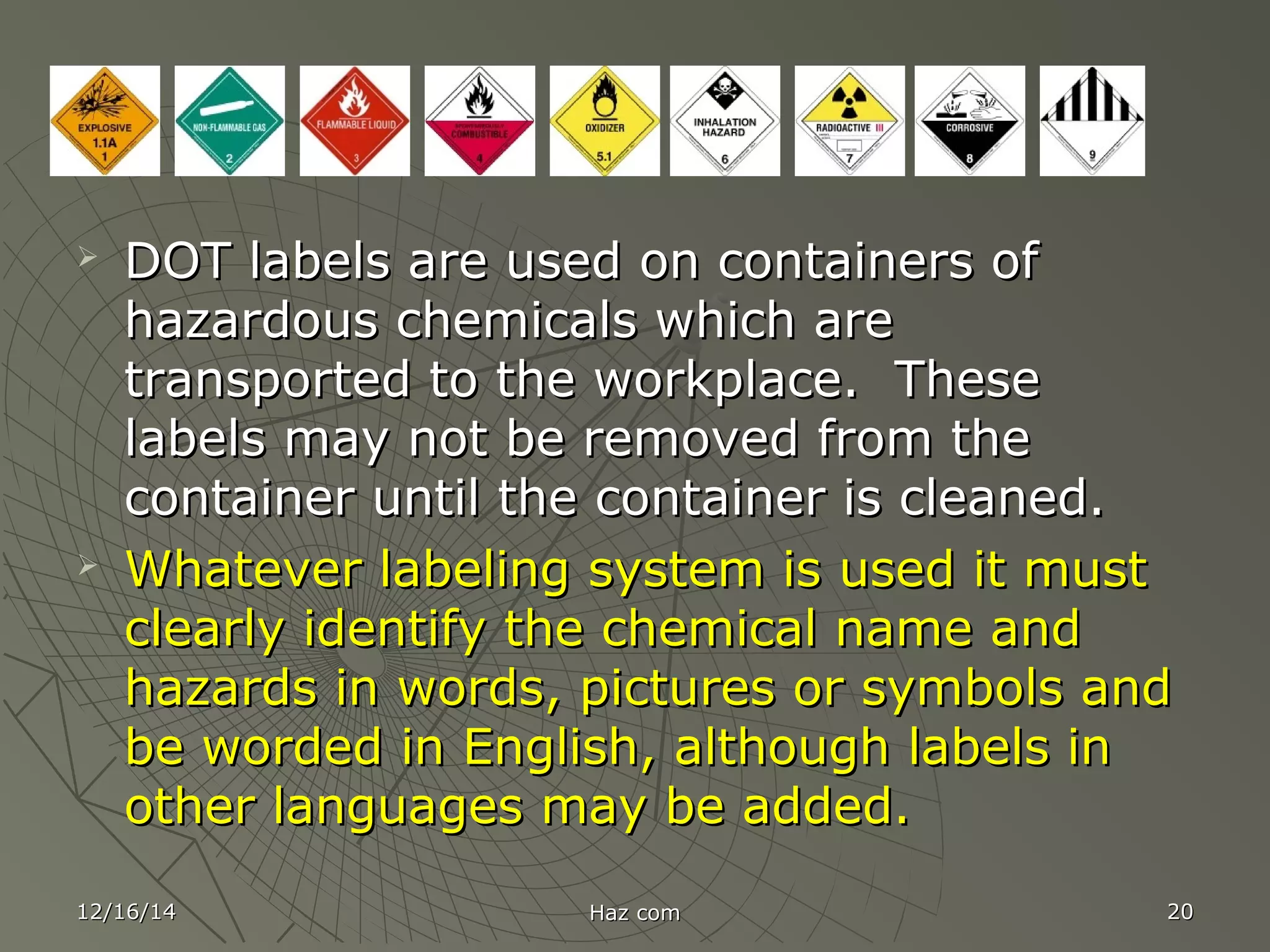
 DOT labels are used on containers ofDOT labels are used on containers of
hazardous chemicals which arehazardous chemicals which are
transported to the workplace. Thesetransported to the workplace. These
labels may not be removed from thelabels may not be removed from the
container until the container is cleaned.container until the container is cleaned.
 Whatever labeling system is used it mustWhatever labeling system is used it must
clearly identify the chemical name andclearly identify the chemical name and
hazards in words, pictures or symbols andhazards in words, pictures or symbols and
be worded in English, although labels inbe worded in English, although labels in
other languages may be added.other languages may be added.
12/16/1412/16/14 Haz comHaz com 2121
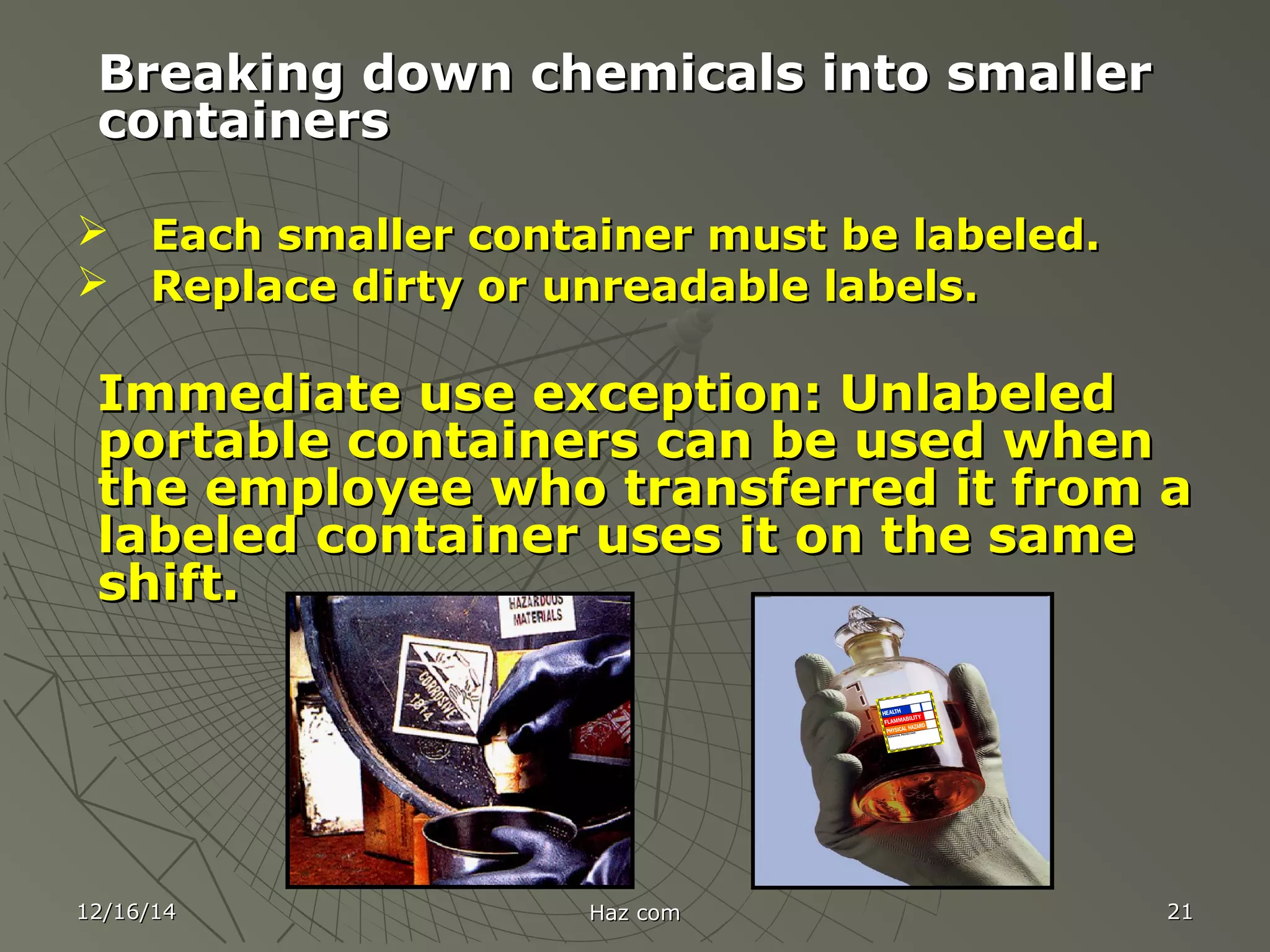
Breaking down chemicals into smallerBreaking down chemicals into smaller
containerscontainers
 Each smaller container must be labeled.Each smaller container must be labeled.
 Replace dirty or unreadable labels.Replace dirty or unreadable labels.
Immediate use exception: UnlabeledImmediate use exception: Unlabeled
portable containers can be used whenportable containers can be used when
the employee who transferred it from athe employee who transferred it from a
labeled container uses it on the samelabeled container uses it on the same
shift.shift.
Remember thisRemember this
12/16/1412/16/14 Haz comHaz com 2222
A chemical is considered
hazardous if:
 It presents a physical hazard
or a health hazard.
What Are the 16 Sections ofWhat Are the 16 Sections of
an SDS?an SDS?
12/16/1412/16/14 Haz comHaz com 2323
12/16/1412/16/14 Haz comHaz com 2424
Safety Data Sheets
SDS must now all provide the same
information:
 Section 1, IdentificationSection 1, Identification includes productincludes product
identifier; manufacturer or distributor name, address,identifier; manufacturer or distributor name, address,
phone number; emergency phone number;phone number; emergency phone number;
recommended use; restrictions on use.recommended use; restrictions on use.
 Section 2, Hazard(s) identificationSection 2, Hazard(s) identification includes allincludes all
hazards regarding the chemical; required labelhazards regarding the chemical; required label
elements.elements.
 Section 3, Composition/information onSection 3, Composition/information on
ingredientsingredients includes information on chemicalincludes information on chemical
ingredients; trade secret claims.ingredients; trade secret claims.
What Are the 16 Sections ofWhat Are the 16 Sections of
an SDS?an SDS?
 Section 4, First-aid measuresSection 4, First-aid measures includesincludes
important symptoms/ effects, acute,important symptoms/ effects, acute,
delayed; required treatment.delayed; required treatment.
 Section 5, Fire-fighting measuresSection 5, Fire-fighting measures listslists
suitable extinguishing techniques,suitable extinguishing techniques,
equipment; chemical hazards from fire.equipment; chemical hazards from fire.
 Section 6, Accidental releaseSection 6, Accidental release
measuresmeasures lists emergency procedures;lists emergency procedures;
protective equipment; proper methods ofprotective equipment; proper methods of
containment and cleanup.containment and cleanup.
12/16/1412/16/14 Haz comHaz com 2525
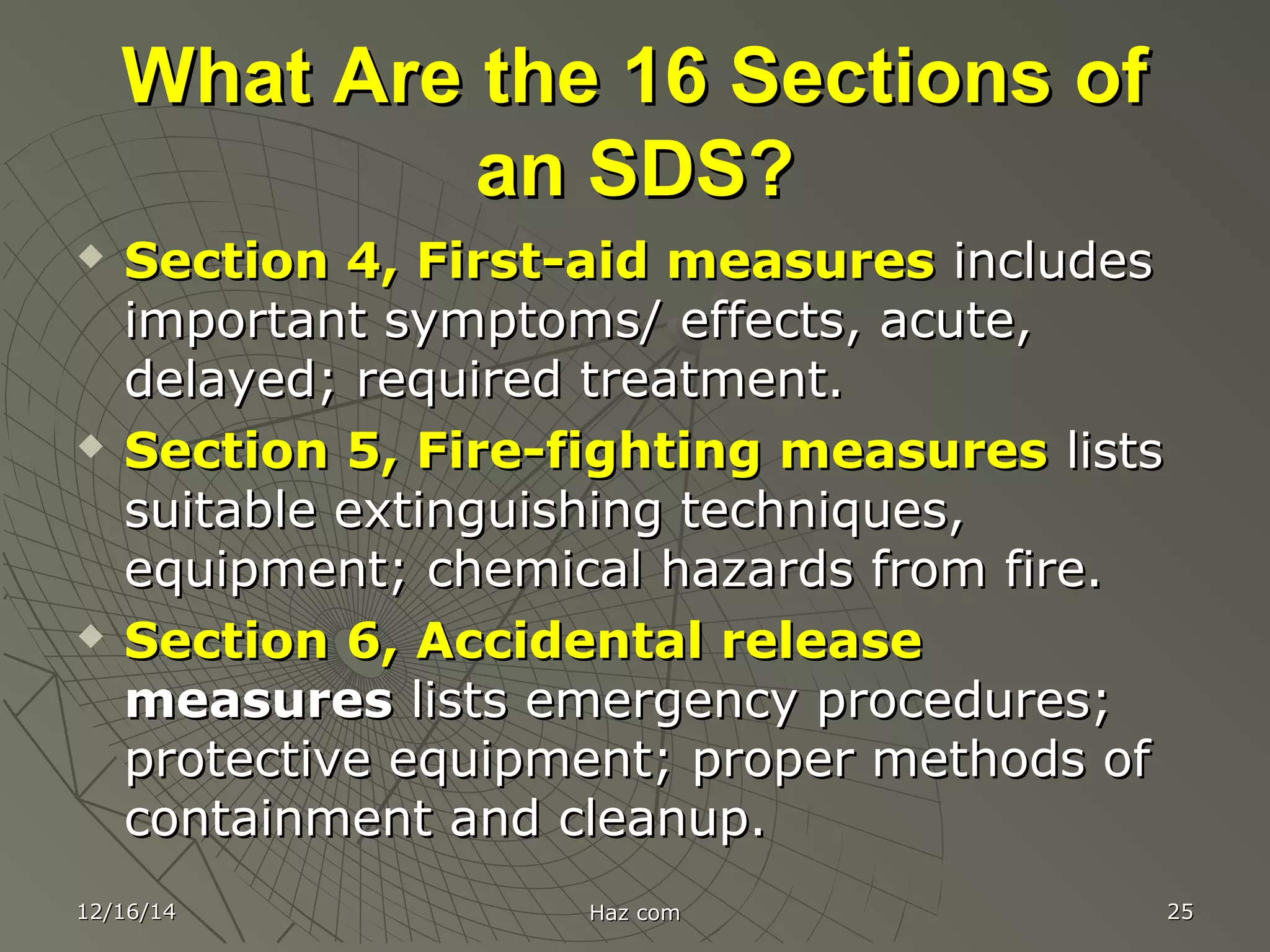
What Are the 16 Sections ofWhat Are the 16 Sections of
an SDS?an SDS?
 Section 7, Handling and storageSection 7, Handling and storage listslists
precautions for safe handling and storage,precautions for safe handling and storage,
including incompatibilities.including incompatibilities.
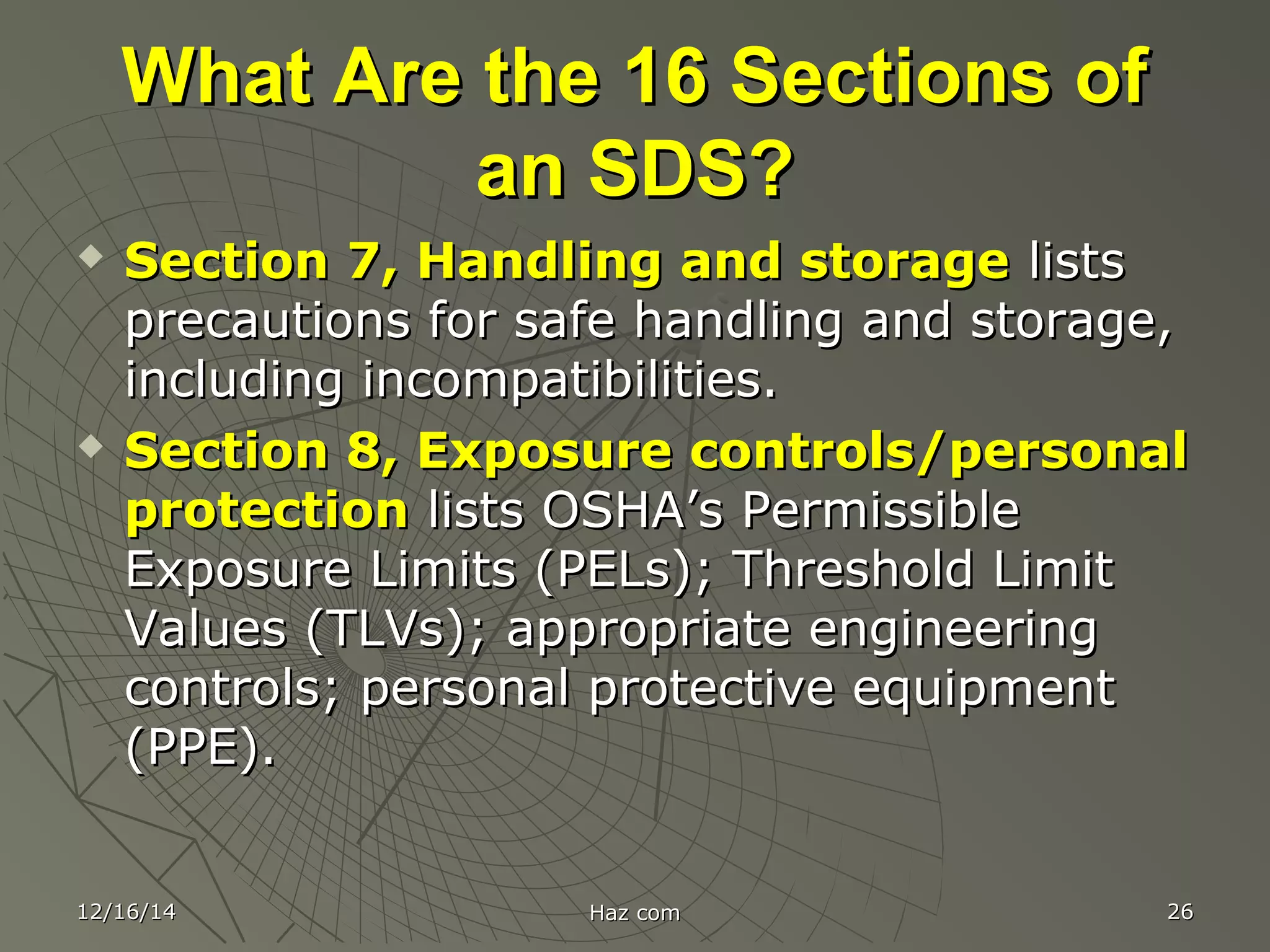
 Section 8, Exposure controls/personalSection 8, Exposure controls/personal
protectionprotection lists OSHA’s Permissiblelists OSHA’s Permissible
Exposure Limits (PELs); Threshold LimitExposure Limits (PELs); Threshold Limit
Values (TLVs); appropriate engineeringValues (TLVs); appropriate engineering
controls; personal protective equipmentcontrols; personal protective equipment
(PPE).(PPE).
12/16/1412/16/14 Haz comHaz com 2626
What Are the 16 Sections ofWhat Are the 16 Sections of
an SDS?an SDS?
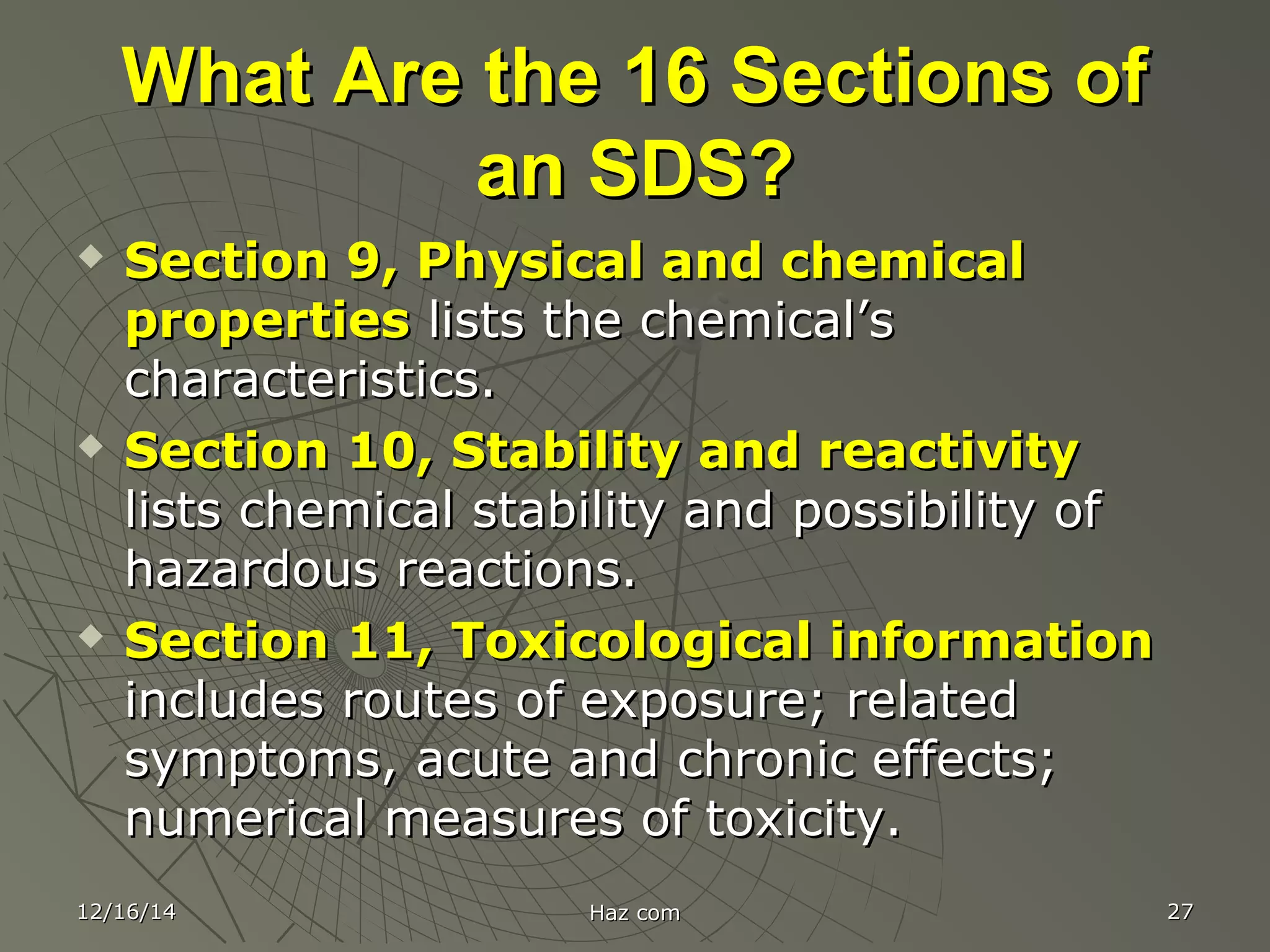
 Section 9, Physical and chemicalSection 9, Physical and chemical
propertiesproperties lists the chemical’slists the chemical’s
characteristics.characteristics.
 Section 10, Stability and reactivitySection 10, Stability and reactivity
lists chemical stability and possibility oflists chemical stability and possibility of
hazardous reactions.hazardous reactions.
 Section 11, Toxicological informationSection 11, Toxicological information
includes routes of exposure; relatedincludes routes of exposure; related
symptoms, acute and chronic effects;symptoms, acute and chronic effects;
numerical measures of toxicity.numerical measures of toxicity.
12/16/1412/16/14 Haz comHaz com 2727
What Are the 16 Sections ofWhat Are the 16 Sections of
an SDS?an SDS?
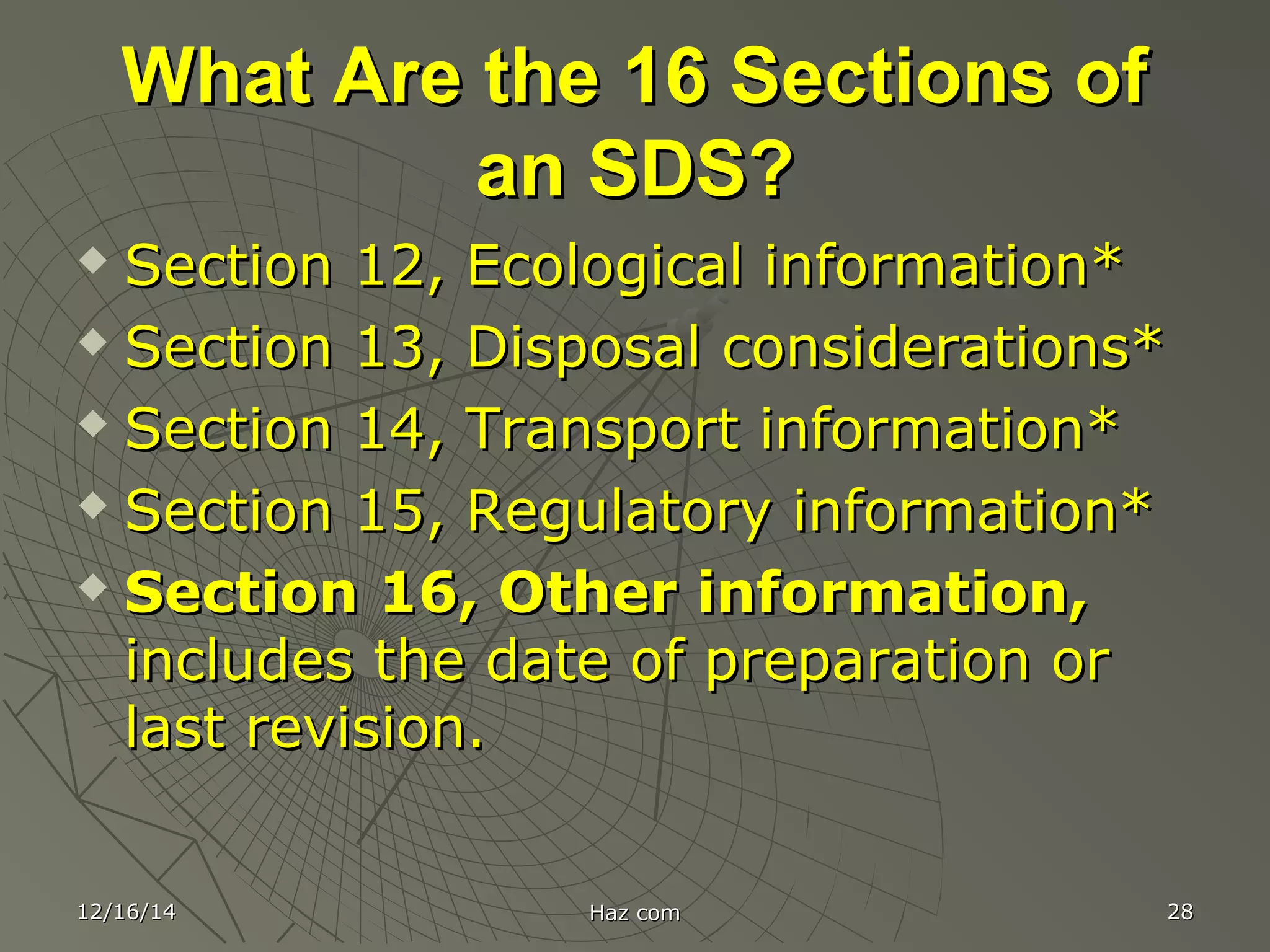
 Section 12, Ecological information*Section 12, Ecological information*
 Section 13, Disposal considerations*Section 13, Disposal considerations*
 Section 14, Transport information*Section 14, Transport information*
 Section 15, Regulatory information*Section 15, Regulatory information*
 Section 16, Other information,Section 16, Other information,
includes the date of preparation orincludes the date of preparation or
last revision.last revision.
12/16/1412/16/14 Haz comHaz com 2828
12/16/1412/16/14 Haz comHaz com 2929
Safety Data Sheets (cont’d)
Must be in English and include information regarding
the specific chemical identity and common names.
Must provide information about:
 Physical and chemical characteristics.
 Health effects.
 Exposure limits.
 Carcinogenicity. (cancer-causing)
 Identification. (name, address, and telephone
number) of the organization responsible for
preparing the sheet.
 Must be readily accessible to employees in their
work area.
12/16/1412/16/14 Haz comHaz com 3030
Remember thisRemember this
 The chemical name on the inventoryThe chemical name on the inventory
must be the same as the chemicalmust be the same as the chemical
name on the container label and onname on the container label and on
the.the.
 A chemical is considered hazardous if:A chemical is considered hazardous if:
It presents aIt presents a physical hazardphysical hazard or aor a
health hazardhealth hazard..
12/16/1412/16/14 Haz comHaz com 3131
Exposure limits
Also called “hazardous ingredients”Also called “hazardous ingredients”
this section lists what is in thethis section lists what is in the
chemical that can cause harm as wellchemical that can cause harm as well
as how much of the chemical anas how much of the chemical an
employee can safely be exposed to,employee can safely be exposed to,
this amount is referred to as either:this amount is referred to as either:
• PEL- Permissible exposure limitPEL- Permissible exposure limit
• TLV - Threshold limit valueTLV - Threshold limit value
12/16/1412/16/14 Haz comHaz com 3232
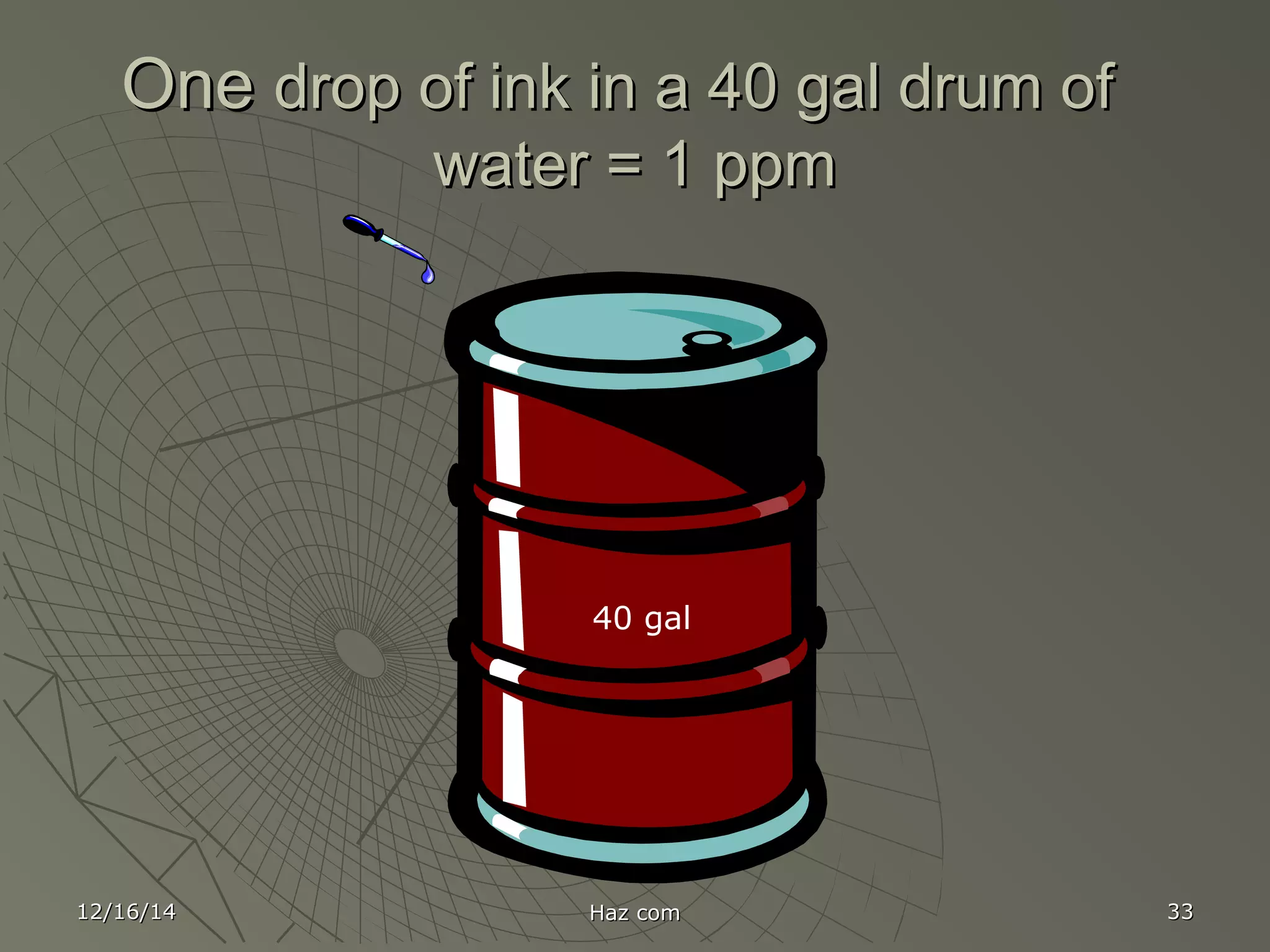
These amounts, which are listed for a typical 8These amounts, which are listed for a typical 8
-hour work shift are usually reported in parts per-hour work shift are usually reported in parts per
million or ppm.million or ppm.
As a rule of thumb the lower the number ofAs a rule of thumb the lower the number of
the (PEL) the more hazardous the chemical is forthe (PEL) the more hazardous the chemical is for
example, a chemical that is so toxic that a veryexample, a chemical that is so toxic that a very
small exposure to it may cause harm this willsmall exposure to it may cause harm this will
have a small number listed as its PEL. Thereforehave a small number listed as its PEL. Therefore
a chemical that has 1 ppm listed as it’s PEL is fara chemical that has 1 ppm listed as it’s PEL is far
more hazardous than another chemical that hasmore hazardous than another chemical that has
150 ppm listed as it’s PEL.150 ppm listed as it’s PEL.
12/16/1412/16/14 Haz comHaz com 3333
OneOne drop of ink in a 40 gal drum ofdrop of ink in a 40 gal drum of
water = 1 ppmwater = 1 ppm
40 gal
12/16/1412/16/14 Haz comHaz com 3434
Chemical specific trainingChemical specific training
Before an employees uses any chemical product
he/she should know the risks involved when working
with chemicals. Read the SDS to find out what safety
precautions are needed.
• Know how to detect the presence or release of hazardous
chemicals.
• Know the physical and health hazards involved.
• Know measures you can protect yourself against the hazards
including:
- Use of safe work practices.
- Emergency procedures.
- Proper personal protective equipment.
12/16/1412/16/14 Haz comHaz com 3535
A chemical with aA chemical with a health hazard is one for which there isis one for which there is
statistically significant evidence that acute or chronic healthstatistically significant evidence that acute or chronic health
effects may occur in exposed employees. The term “healtheffects may occur in exposed employees. The term “health
hazard” includes chemicals that are:hazard” includes chemicals that are:
 CarcinogensCarcinogens
 Toxic or highly toxic agentsToxic or highly toxic agents
 Reproductive toxinsReproductive toxins
 IrritantsIrritants (cause reversible inflammatory effect on living(cause reversible inflammatory effect on living
tissue at the site of contact)tissue at the site of contact)
 CorrosivesCorrosives (cause visible destruction or irreversible(cause visible destruction or irreversible
alterations in living tissue at the site of contact)alterations in living tissue at the site of contact)
 SensitizersSensitizers (Cause a substantial proportion of exposed(Cause a substantial proportion of exposed
people or animals to develop an allergic reaction in normalpeople or animals to develop an allergic reaction in normal
tissue after repeated exposure)tissue after repeated exposure)
12/16/1412/16/14 Haz comHaz com 3636
 HepatotoxinsHepatotoxins ( toxic to the liver)( toxic to the liver)
 NephrotoxinsNephrotoxins (toxic to kidneys)(toxic to kidneys)
 NeurotoxinsNeurotoxins (toxic to nervous system)(toxic to nervous system)
 Agents that act on the hematopoieticAgents that act on the hematopoietic
systemsystem (bone marrow and lymph nodes)(bone marrow and lymph nodes)
 Agents that damage the lungs, skin,Agents that damage the lungs, skin,
eyes, or mucous membranes.eyes, or mucous membranes.
12/16/1412/16/14 Haz comHaz com 3737
Acute vs. ChronicAcute vs. Chronic
 Acute exposureAcute exposure: Dermatitis that: Dermatitis that
may result from a one time exposuremay result from a one time exposure
of the skin to a chemical.of the skin to a chemical.
 Chronic exposureChronic exposure: Repeated: Repeated
exposure to elements such asexposure to elements such as
asbestos, or chemicals known toasbestos, or chemicals known to
cause cancer.cause cancer.
12/16/1412/16/14 Haz comHaz com 3838
Be on the lookoutBe on the lookout
If you notice a new chemical that hasIf you notice a new chemical that has
been ordered or added to your workbeen ordered or added to your work
area make sure that you check thearea make sure that you check the
inventory to see if it has been added.inventory to see if it has been added.
If the chemical is not listed or if youIf the chemical is not listed or if you
can’t locate it in the SDScan’t locate it in the SDS
letlet your supervisor know.your supervisor know.
12/16/1412/16/14 Haz comHaz com 3939
Know who does what:Know who does what:
Who must maintain a Hazardous chemical inventory?Who must maintain a Hazardous chemical inventory?
• Your EmployerYour Employer
What must the Hazardous chemical inventory contain?What must the Hazardous chemical inventory contain?
• All hazardous chemicals used at your company.All hazardous chemicals used at your company.
• Hazardous chemicals taken off-site for use in other locations.Hazardous chemicals taken off-site for use in other locations.
• Hazardous chemicals stored away from the main plant.Hazardous chemicals stored away from the main plant.
Who is responsible for labeling?Who is responsible for labeling?
• Your EmployerYour Employer
Who maintains written program.Who maintains written program.
• Your EmployerYour Employer

Hazard Communication Safety Course 2014

  • 1.
    12/16/14 Haz com1 HazardHazard CommunicationCommunication SDS Safety Data Sheets
  • 2.
    12/16/1412/16/14 Haz comHazcom 22 IntroductionIntroduction  Millions workers work with and are potentially exposed to one or more chemical hazards daily.  There are tens of thousands existing chemical products, and hundreds of new ones being introduced annually.  Chemical exposure may cause or contribute to many serious health effects such as heart ailments, central nervous system damage, kidney and lung damage, sterility, cancer, burns, and rashes.  Some chemicals may also be safety hazards and have the potential to cause fires and explosions and other serious accidents.
  • 3.
    Why change?Why change? OSHA believes that revising the HazOSHA believes that revising the Haz com standard to include GHS willcom standard to include GHS will result in the safer handling ofresult in the safer handling of workplace chemicals and preventworkplace chemicals and prevent over 500 workplace injuries andover 500 workplace injuries and illnesses and 43 fatalities annually.illnesses and 43 fatalities annually. 12/16/1412/16/14 Haz comHaz com 33
  • 4.
    12/16/1412/16/14 Haz comHazcom 44 Globally Harmonized systemGlobally Harmonized system Remember this: Say it:Remember this: Say it: Globally Harmonized systemGlobally Harmonized system What isWhat is GHS ?GHS ?
  • 5.
    An SDS isan MSDSAn SDS is an MSDS  Based on the MSDS provisions in HazBased on the MSDS provisions in Haz Com 1994, there are currently aCom 1994, there are currently a number of different MSDS styles andnumber of different MSDS styles and formats in use in the United States,formats in use in the United States, the most common being the 8the most common being the 8 section OSHA MSDS and the 16section OSHA MSDS and the 16 section ANSI standard MSDS.section ANSI standard MSDS. 12/16/1412/16/14 Haz comHaz com 55
  • 6.
    Format changeFormat change OSHA’s adoption of GHS via HazOSHA’s adoption of GHS via Haz Com 2012, on the other hand,Com 2012, on the other hand, mandates the use of a single GHSmandates the use of a single GHS format for safety data sheets, aformat for safety data sheets, a format which features 16 sections informat which features 16 sections in a strict ordering.a strict ordering. 12/16/1412/16/14 Haz comHaz com 66
  • 7.
    More changesMore changes Another change, thanks to GHS, isAnother change, thanks to GHS, is the renaming of material safety datathe renaming of material safety data sheets from MSDSs to simply safetysheets from MSDSs to simply safety data sheets, or SDSs.data sheets, or SDSs. 12/16/1412/16/14 Haz comHaz com 77
  • 8.
    Dropping of theMDropping of the M  Unfortunately, this dropping of the MUnfortunately, this dropping of the M has caused more consternation thanhas caused more consternation than is warranted. The truth is, an SDS isis warranted. The truth is, an SDS is an MSDS, they are really the samean MSDS, they are really the same thing, especially in terms of the rolething, especially in terms of the role they play in the HCS. In fact, thethey play in the HCS. In fact, the GHS SDS format is nearly identical toGHS SDS format is nearly identical to the ANSI Standard 16 section MSDSthe ANSI Standard 16 section MSDS – with a couple of modifications.– with a couple of modifications. 12/16/1412/16/14 Haz comHaz com 88
  • 9.
    12/16/1412/16/14 Haz comHazcom 99 OSHA’s Hazard CommunicationOSHA’s Hazard Communication StandardStandard  OSHA’s Hazard communication Standard, 29CFROSHA’s Hazard communication Standard, 29CFR 1910.1200, developed in 1983 and was designed1910.1200, developed in 1983 and was designed to protect workers from the effects of anyto protect workers from the effects of any hazardous chemical used or stored in the workhazardous chemical used or stored in the work setting. It requires the employers to providesetting. It requires the employers to provide information and training on chemical hazards toinformation and training on chemical hazards to any employees who have a potential of beingany employees who have a potential of being exposed to a hazardous chemical ‘under normalexposed to a hazardous chemical ‘under normal conditions of use or in a foreseeable emergency.’conditions of use or in a foreseeable emergency.’ This applies to companies with as few asThis applies to companies with as few as 11 employee, who could be exposed to onlyemployee, who could be exposed to only oneone hazardous chemical.hazardous chemical.
  • 10.
    12/16/1412/16/14 Haz comHazcom 1010 Employer requirementsEmployer requirements 1.1. Chemical inventoryChemical inventory:: Identify and listIdentify and list the hazardous chemicals at the workplacethe hazardous chemicals at the workplace or taken off site in other locations oror taken off site in other locations or stored away from the main plant thatstored away from the main plant that bear a hazard label.bear a hazard label. 2.2. Material safety data sheets (SDS)Material safety data sheets (SDS):: Keep SDS sheets for hazardous chemicalsKeep SDS sheets for hazardous chemicals or obtain them if they are not received.or obtain them if they are not received. SDS should be accessible to allSDS should be accessible to all employees.employees.
  • 11.
    12/16/1412/16/14 Haz comHazcom 1111 Employer requirementsEmployer requirements 3.3. Labeling:Labeling: Ensure that all chemicalsEnsure that all chemicals are labeled.are labeled. 4.4. Information & Training:Information & Training: Communicate hazard information toCommunicate hazard information to employees through the chemicalemployees through the chemical inventory, labels, SDS, and a formalinventory, labels, SDS, and a formal training program.training program. 5.5. Written program:Written program: Develop a writtenDevelop a written hazard communication program.hazard communication program.
  • 12.
    12/16/1412/16/14 Haz comHazcom 1212 Hazard Rating SystemHazard Rating System The National Fire Protection AssociationThe National Fire Protection Association (NFPA 704) system uses an a diamond-(NFPA 704) system uses an a diamond- shaped diagram of symbols and numbers toshaped diagram of symbols and numbers to indicate the degree of hazard associatedindicate the degree of hazard associated with a particular chemical or material. Thesewith a particular chemical or material. These diamond- shaped symbols are placed ondiamond- shaped symbols are placed on containers of chemicals or materials tocontainers of chemicals or materials to identify the degree of hazard associated withidentify the degree of hazard associated with the chemical or material.the chemical or material.
  • 13.
    12/16/1412/16/14 Haz comHazcom 1313 The diagram identifies three color-The diagram identifies three color- coded categories of hazard forcoded categories of hazard for each material:each material:  Blue section - health hazard.Blue section - health hazard.  Red section – flammability.Red section – flammability.  Yellow section - reactivity other hazard.Yellow section - reactivity other hazard.  White section – information.White section – information. Each category is divided in five levels of hazardEach category is divided in five levels of hazard potential withpotential with • zero (0)zero (0) used to indicateused to indicate no special hazardsno special hazards andand • four (4)four (4) forfor severe or extreme hazard potential.severe or extreme hazard potential.
  • 14.
    12/16/1412/16/14 Haz comHazcom 1414 Health cont.Health cont. A rating of 1A rating of 1 is foris for slightly hazardous (toxic)slightly hazardous (toxic) materialmaterial which require only minimal protection (forwhich require only minimal protection (for example, safety glasses and gloves) in addition toexample, safety glasses and gloves) in addition to normal work clothing to work with safelynormal work clothing to work with safely A rating of 2A rating of 2 is foris for moderately toxic or hazardousmoderately toxic or hazardous materialmaterial which require additional PPE or equipmentwhich require additional PPE or equipment (e.g. chemical goggles, lab/work smock, local(e.g. chemical goggles, lab/work smock, local ventilation) in addition to that required for less toxicventilation) in addition to that required for less toxic material. Consult the MSDS for specific health hazardmaterial. Consult the MSDS for specific health hazard and proper PPE to use with this material.and proper PPE to use with this material. 4-Deadly 3-Extreme Danger 2-Hazardous 1-Normal material 2 1
  • 15.
    12/16/1412/16/14 Haz comHazcom 1515 FlammabilityFlammability Flammability -Flammability - The flammability hazards deal with theThe flammability hazards deal with the degree of susceptibility of the material to ignite anddegree of susceptibility of the material to ignite and burn. The form or condition of the materials, as well asburn. The form or condition of the materials, as well as their properties, affects the extent of the hazard. Manytheir properties, affects the extent of the hazard. Many hazardous materials such as acetone and gasoline,hazardous materials such as acetone and gasoline, have a flash point (ignition temperature) far belowhave a flash point (ignition temperature) far below freezing and will readily ignite with a spark if the vaporfreezing and will readily ignite with a spark if the vapor concentration is sufficient. A low rating ofconcentration is sufficient. A low rating of 11 is foris for material with a flash pointmaterial with a flash point above 200Fabove 200F while morewhile more hazardous ratings ofhazardous ratings of 2, 3, and 42, 3, and 4 are for materials withare for materials with respective flash point below 200, 100 and 73 Frespective flash point below 200, 100 and 73 F.. 0 4-Below 73F – Very flammable 3-73 to 100F - Flammable 2-101 to200F - Combustible 1-Over 200F - Slightly combustible 0-Will not burn
  • 16.
    12/16/1412/16/14 Haz comHazcom 1616 ReactivityReactivity Reactivity -Reactivity - The reactivity hazards deal with the potentialThe reactivity hazards deal with the potential of a material or chemical to release energy. Someof a material or chemical to release energy. Some materials are capable of rapid release of energy withoutmaterials are capable of rapid release of energy without any catalyst, while others can undergo violent eruptive orany catalyst, while others can undergo violent eruptive or explosive reactions if they come in contact with water orexplosive reactions if they come in contact with water or other materials. Generally this rating is used to indicateother materials. Generally this rating is used to indicate the potential risk if the material is heated, jarred, orthe potential risk if the material is heated, jarred, or shocked.. A low rating ofshocked.. A low rating of 11 indicates aindicates a material that ismaterial that is normally stable but may be reactive if heatednormally stable but may be reactive if heated. The. The more hazardous ratings ofmore hazardous ratings of 2, 3, and 42, 3, and 4 indicate aindicate a materialmaterial is capable of violent reaction, shock/rapid heatingis capable of violent reaction, shock/rapid heating and detonation respectively.and detonation respectively. 4-May detonate 3-Shock or heat may detonate 2-Violent chem. reaction 1-Unstable if heated 0-Stable 0
  • 17.
    12/16/1412/16/14 Haz comHazcom 1717 OtherOther Other Hazard InformationOther Hazard Information - An open space at the- An open space at the bottom of the NFPA diagram can be used to indicatebottom of the NFPA diagram can be used to indicate additional information about the chemical or material. Thisadditional information about the chemical or material. This information may include the chemical or material'sinformation may include the chemical or material's radioactivity, proper fire extinguishing agent, skin hazard,radioactivity, proper fire extinguishing agent, skin hazard, its use in pressurized containers, protective equipmentits use in pressurized containers, protective equipment required, or unusual reactivity with water. For example,required, or unusual reactivity with water. For example, the usual signal to indicate unusual reactivity with water isthe usual signal to indicate unusual reactivity with water is the letter "the letter "WW" with a long line through the center. Similarly" with a long line through the center. Similarly the wordsthe words ACID, CORACID, COR (corrosive),(corrosive), RADRAD (radiation),(radiation), OXYOXY (oxidizer),(oxidizer), RadRad (radioactive),(radioactive), CARCCARC (carcinogen) or other(carcinogen) or other abbreviations may be used.abbreviations may be used. OXY-oxidizer ACID-acid ALK-Alkali COR-corrosive W - use no water RAD-radiation hazard W
  • 18.
    12/16/1412/16/14 Haz comHazcom 1818 NFPA labelNFPA label (National fire protection association)(National fire protection association)
  • 19.
    12/16/1412/16/14 Haz comHazcom 1919 Uniform labelingUniform labeling Labeling is required and uniformLabeling is required and uniform labeling systems are now to be put inlabeling systems are now to be put in place.place. Also, a hazard warning label is notAlso, a hazard warning label is not intended to be the sole or mostintended to be the sole or most complete source of hazard information.complete source of hazard information. It does, however alert you to the factIt does, however alert you to the fact that a potential hazard exists. For morethat a potential hazard exists. For more information always check the SDS.information always check the SDS.
  • 20.
    12/16/1412/16/14 Haz comHazcom 2020  DOT labels are used on containers ofDOT labels are used on containers of hazardous chemicals which arehazardous chemicals which are transported to the workplace. Thesetransported to the workplace. These labels may not be removed from thelabels may not be removed from the container until the container is cleaned.container until the container is cleaned.  Whatever labeling system is used it mustWhatever labeling system is used it must clearly identify the chemical name andclearly identify the chemical name and hazards in words, pictures or symbols andhazards in words, pictures or symbols and be worded in English, although labels inbe worded in English, although labels in other languages may be added.other languages may be added.
  • 21.
    12/16/1412/16/14 Haz comHazcom 2121 Breaking down chemicals into smallerBreaking down chemicals into smaller containerscontainers  Each smaller container must be labeled.Each smaller container must be labeled.  Replace dirty or unreadable labels.Replace dirty or unreadable labels. Immediate use exception: UnlabeledImmediate use exception: Unlabeled portable containers can be used whenportable containers can be used when the employee who transferred it from athe employee who transferred it from a labeled container uses it on the samelabeled container uses it on the same shift.shift.
  • 22.
    Remember thisRemember this 12/16/1412/16/14Haz comHaz com 2222 A chemical is considered hazardous if:  It presents a physical hazard or a health hazard.
  • 23.
    What Are the16 Sections ofWhat Are the 16 Sections of an SDS?an SDS? 12/16/1412/16/14 Haz comHaz com 2323
  • 24.
    12/16/1412/16/14 Haz comHazcom 2424 Safety Data Sheets SDS must now all provide the same information:  Section 1, IdentificationSection 1, Identification includes productincludes product identifier; manufacturer or distributor name, address,identifier; manufacturer or distributor name, address, phone number; emergency phone number;phone number; emergency phone number; recommended use; restrictions on use.recommended use; restrictions on use.  Section 2, Hazard(s) identificationSection 2, Hazard(s) identification includes allincludes all hazards regarding the chemical; required labelhazards regarding the chemical; required label elements.elements.  Section 3, Composition/information onSection 3, Composition/information on ingredientsingredients includes information on chemicalincludes information on chemical ingredients; trade secret claims.ingredients; trade secret claims.
  • 25.
    What Are the16 Sections ofWhat Are the 16 Sections of an SDS?an SDS?  Section 4, First-aid measuresSection 4, First-aid measures includesincludes important symptoms/ effects, acute,important symptoms/ effects, acute, delayed; required treatment.delayed; required treatment.  Section 5, Fire-fighting measuresSection 5, Fire-fighting measures listslists suitable extinguishing techniques,suitable extinguishing techniques, equipment; chemical hazards from fire.equipment; chemical hazards from fire.  Section 6, Accidental releaseSection 6, Accidental release measuresmeasures lists emergency procedures;lists emergency procedures; protective equipment; proper methods ofprotective equipment; proper methods of containment and cleanup.containment and cleanup. 12/16/1412/16/14 Haz comHaz com 2525
  • 26.
    What Are the16 Sections ofWhat Are the 16 Sections of an SDS?an SDS?  Section 7, Handling and storageSection 7, Handling and storage listslists precautions for safe handling and storage,precautions for safe handling and storage, including incompatibilities.including incompatibilities.  Section 8, Exposure controls/personalSection 8, Exposure controls/personal protectionprotection lists OSHA’s Permissiblelists OSHA’s Permissible Exposure Limits (PELs); Threshold LimitExposure Limits (PELs); Threshold Limit Values (TLVs); appropriate engineeringValues (TLVs); appropriate engineering controls; personal protective equipmentcontrols; personal protective equipment (PPE).(PPE). 12/16/1412/16/14 Haz comHaz com 2626
  • 27.
    What Are the16 Sections ofWhat Are the 16 Sections of an SDS?an SDS?  Section 9, Physical and chemicalSection 9, Physical and chemical propertiesproperties lists the chemical’slists the chemical’s characteristics.characteristics.  Section 10, Stability and reactivitySection 10, Stability and reactivity lists chemical stability and possibility oflists chemical stability and possibility of hazardous reactions.hazardous reactions.  Section 11, Toxicological informationSection 11, Toxicological information includes routes of exposure; relatedincludes routes of exposure; related symptoms, acute and chronic effects;symptoms, acute and chronic effects; numerical measures of toxicity.numerical measures of toxicity. 12/16/1412/16/14 Haz comHaz com 2727
  • 28.
    What Are the16 Sections ofWhat Are the 16 Sections of an SDS?an SDS?  Section 12, Ecological information*Section 12, Ecological information*  Section 13, Disposal considerations*Section 13, Disposal considerations*  Section 14, Transport information*Section 14, Transport information*  Section 15, Regulatory information*Section 15, Regulatory information*  Section 16, Other information,Section 16, Other information, includes the date of preparation orincludes the date of preparation or last revision.last revision. 12/16/1412/16/14 Haz comHaz com 2828
  • 29.
    12/16/1412/16/14 Haz comHazcom 2929 Safety Data Sheets (cont’d) Must be in English and include information regarding the specific chemical identity and common names. Must provide information about:  Physical and chemical characteristics.  Health effects.  Exposure limits.  Carcinogenicity. (cancer-causing)  Identification. (name, address, and telephone number) of the organization responsible for preparing the sheet.  Must be readily accessible to employees in their work area.
  • 30.
    12/16/1412/16/14 Haz comHazcom 3030 Remember thisRemember this  The chemical name on the inventoryThe chemical name on the inventory must be the same as the chemicalmust be the same as the chemical name on the container label and onname on the container label and on the.the.  A chemical is considered hazardous if:A chemical is considered hazardous if: It presents aIt presents a physical hazardphysical hazard or aor a health hazardhealth hazard..
  • 31.
    12/16/1412/16/14 Haz comHazcom 3131 Exposure limits Also called “hazardous ingredients”Also called “hazardous ingredients” this section lists what is in thethis section lists what is in the chemical that can cause harm as wellchemical that can cause harm as well as how much of the chemical anas how much of the chemical an employee can safely be exposed to,employee can safely be exposed to, this amount is referred to as either:this amount is referred to as either: • PEL- Permissible exposure limitPEL- Permissible exposure limit • TLV - Threshold limit valueTLV - Threshold limit value
  • 32.
    12/16/1412/16/14 Haz comHazcom 3232 These amounts, which are listed for a typical 8These amounts, which are listed for a typical 8 -hour work shift are usually reported in parts per-hour work shift are usually reported in parts per million or ppm.million or ppm. As a rule of thumb the lower the number ofAs a rule of thumb the lower the number of the (PEL) the more hazardous the chemical is forthe (PEL) the more hazardous the chemical is for example, a chemical that is so toxic that a veryexample, a chemical that is so toxic that a very small exposure to it may cause harm this willsmall exposure to it may cause harm this will have a small number listed as its PEL. Thereforehave a small number listed as its PEL. Therefore a chemical that has 1 ppm listed as it’s PEL is fara chemical that has 1 ppm listed as it’s PEL is far more hazardous than another chemical that hasmore hazardous than another chemical that has 150 ppm listed as it’s PEL.150 ppm listed as it’s PEL.
  • 33.
    12/16/1412/16/14 Haz comHazcom 3333 OneOne drop of ink in a 40 gal drum ofdrop of ink in a 40 gal drum of water = 1 ppmwater = 1 ppm 40 gal
  • 34.
    12/16/1412/16/14 Haz comHazcom 3434 Chemical specific trainingChemical specific training Before an employees uses any chemical product he/she should know the risks involved when working with chemicals. Read the SDS to find out what safety precautions are needed. • Know how to detect the presence or release of hazardous chemicals. • Know the physical and health hazards involved. • Know measures you can protect yourself against the hazards including: - Use of safe work practices. - Emergency procedures. - Proper personal protective equipment.
  • 35.
    12/16/1412/16/14 Haz comHazcom 3535 A chemical with aA chemical with a health hazard is one for which there isis one for which there is statistically significant evidence that acute or chronic healthstatistically significant evidence that acute or chronic health effects may occur in exposed employees. The term “healtheffects may occur in exposed employees. The term “health hazard” includes chemicals that are:hazard” includes chemicals that are:  CarcinogensCarcinogens  Toxic or highly toxic agentsToxic or highly toxic agents  Reproductive toxinsReproductive toxins  IrritantsIrritants (cause reversible inflammatory effect on living(cause reversible inflammatory effect on living tissue at the site of contact)tissue at the site of contact)  CorrosivesCorrosives (cause visible destruction or irreversible(cause visible destruction or irreversible alterations in living tissue at the site of contact)alterations in living tissue at the site of contact)  SensitizersSensitizers (Cause a substantial proportion of exposed(Cause a substantial proportion of exposed people or animals to develop an allergic reaction in normalpeople or animals to develop an allergic reaction in normal tissue after repeated exposure)tissue after repeated exposure)
  • 36.
    12/16/1412/16/14 Haz comHazcom 3636  HepatotoxinsHepatotoxins ( toxic to the liver)( toxic to the liver)  NephrotoxinsNephrotoxins (toxic to kidneys)(toxic to kidneys)  NeurotoxinsNeurotoxins (toxic to nervous system)(toxic to nervous system)  Agents that act on the hematopoieticAgents that act on the hematopoietic systemsystem (bone marrow and lymph nodes)(bone marrow and lymph nodes)  Agents that damage the lungs, skin,Agents that damage the lungs, skin, eyes, or mucous membranes.eyes, or mucous membranes.
  • 37.
    12/16/1412/16/14 Haz comHazcom 3737 Acute vs. ChronicAcute vs. Chronic  Acute exposureAcute exposure: Dermatitis that: Dermatitis that may result from a one time exposuremay result from a one time exposure of the skin to a chemical.of the skin to a chemical.  Chronic exposureChronic exposure: Repeated: Repeated exposure to elements such asexposure to elements such as asbestos, or chemicals known toasbestos, or chemicals known to cause cancer.cause cancer.
  • 38.
    12/16/1412/16/14 Haz comHazcom 3838 Be on the lookoutBe on the lookout If you notice a new chemical that hasIf you notice a new chemical that has been ordered or added to your workbeen ordered or added to your work area make sure that you check thearea make sure that you check the inventory to see if it has been added.inventory to see if it has been added. If the chemical is not listed or if youIf the chemical is not listed or if you can’t locate it in the SDScan’t locate it in the SDS letlet your supervisor know.your supervisor know.
  • 39.
    12/16/1412/16/14 Haz comHazcom 3939 Know who does what:Know who does what: Who must maintain a Hazardous chemical inventory?Who must maintain a Hazardous chemical inventory? • Your EmployerYour Employer What must the Hazardous chemical inventory contain?What must the Hazardous chemical inventory contain? • All hazardous chemicals used at your company.All hazardous chemicals used at your company. • Hazardous chemicals taken off-site for use in other locations.Hazardous chemicals taken off-site for use in other locations. • Hazardous chemicals stored away from the main plant.Hazardous chemicals stored away from the main plant. Who is responsible for labeling?Who is responsible for labeling? • Your EmployerYour Employer Who maintains written program.Who maintains written program. • Your EmployerYour Employer