12/16/14Bloodborne Pathogen
1
Bloodborne PathogenBloodborne Pathogen
Training
12/16/14Bloodborne Pathogen
2
WHY ARE WE HERE?WHY ARE WE HERE?
OSHA BB Pathogen standard
– anyone whose job requires exposure to BB
pathogens is required to complete training
– employees who are trained in CPR and first
aid.
The more you know, the better you will
perform in real situations!
12/16/14Bloodborne Pathogen
3
What is a BB Pathogen?What is a BB Pathogen?
Microorganisms that are carried
in the blood that can cause
disease in humans.
12/16/14Bloodborne Pathogen
4
DefinitionsDefinitions
Bloodborne Pathogens:
Pathogenic microorganisms that are present in human blood and can
cause disease in humans. These pathogens include, but are not
limited to, hepatitis B virus (HBV) and human immunodeficiency
virus (HIV).
Contaminated:
The presence or the reasonably anticipated presence of blood or
other potentially infectious materials on an item or surface.
Decontamination:
The use of physical or chemical means to remove, inactivate, or
destroy bloodborne pathogens on a surface or item to the point
where they are no longer capable of transmitting infectious particles
and the surface or item is rendered safe for handling, use, or
disposal.
12/16/14Bloodborne Pathogen
5
Exposure Incident:
A specific eye, mouth, other mucous membrane, non-intact skin, or
parenteral contact with blood or other potentially infectious
materials that results from the performance of an employee's
duties.
HBV - means hepatitis B virus.
HIV - means human immunodeficiency virus.
Occupational Exposure:
Reasonably anticipated skin, eye, mucous membrane, or parenteral
contact with blood or other potentially infectious materials that
may result from the performance of an employee's duties.
12/16/14Bloodborne Pathogen
6
Parenteral:
Piercing mucous membranes or the skin barrier through such
events as needlesticks, human bites, cuts, and abrasions.
Other Potentially Infectious Materials:
(1) The following human body fluids: semen, vaginal secretions,
cerebrospinal fluid, synovial fluid, pleural fluid, pericardial fluid,
peritoneal fluid, amniotic fluid, saliva in dental procedures, any
body fluid that is visibly contaminated with blood, and all body
fluids in situations where it is difficult or impossible to
differentiate between body fluids; (2) Any unfixed tissue or organ
(other than intact skin) from a human (living or dead); and (3)
HIV-containing cell or tissue cultures, organ cultures, and HIV-
or HBV-containing culture medium or other solutions; and blood,
organs, or other tissues from experimental animals infected with
HIV or HBV.
12/16/14Bloodborne Pathogen
7
Personal Protective Equipment:
Specialized clothing or equipment worn by an employee for
protection against a hazard. General work clothes (e.g.,
uniforms, pants, shirts or blouses) not intended to function as
protection against a hazard are not considered to be personal
protective equipment.
Regulated Waste:
Liquid or semi-liquid blood or other potentially infectious
materials; contaminated items that would release blood or other
potentially infectious materials in a liquid or semi-liquid state if
compressed; items that are caked with dried blood or other
potentially infectious materials and are capable of releasing
these materials during handling; contaminated sharps; and
pathological and microbiological wastes containing blood or
other potentially infectious materials.
12/16/14Bloodborne Pathogen
8
Source Individual :
Means any individual, living or dead, whose blood or other
potentially infectious materials may be a source of occupational
exposure to the employee. Examples include, but are not limited to,
hospital and clinic patients; clients in institutions for the
developmentally disabled; trauma victims; clients of drug and
alcohol treatment facilities; residents of hospices and nursing
homes; human remains; and individuals who donate or sell blood
or blood components.
12/16/14Bloodborne Pathogen
9
Universal Precautions: is an approach to
infection control. According to the concept of
Universal Precautions, all human blood and
certain human body fluids are treated as if known
to be infectious for HIV, HBV, and other
bloodborne pathogens.
12/16/14Bloodborne Pathogen
10
Common BB PathogenCommon BB Pathogen
DiseasesDiseases
 Malaria
 Brucellosis
 Syphilis
 Hepatitis B(HBV)
 Hepatitis C(HCV)
 Human
Immunodeficiency
Virus (HIV)
12/16/14Bloodborne Pathogen
11
 HIV is the virus that leads to AIDS
 HIV depletes the immune system
 HIV does not survive well outside
the body
 No threat on contracting HIV
through casual contact
Human Immunodeficiency VirusHuman Immunodeficiency Virus
(HIV)(HIV)
12/16/14Bloodborne Pathogen
12
Hepatitis B (HBV)Hepatitis B (HBV)
 1—1.25 million
Americans are
chronically infected
 Symptoms include:
jaundice, fatigue,
abdominal pain, loss
of appetite,
intermittent nausea,
vomiting
 May lead to chronic liver
disease, liver cancer, and
death
 Vaccination available
since 1982
 HBV can survive for at
least one week in
dried blood
 Symptoms can occur 1-9
months after exposure
12/16/14Bloodborne Pathogen
13
Hepatitis C (HCV)Hepatitis C (HCV)
 Hepatitis C is the most common chronic
bloodborne infection in the United States
 Symptoms include: jaundice, fatigue, abdominal
pain, loss of appetite, intermittent nausea,
vomiting
 May lead to chronic liver
disease and death
12/16/14Bloodborne Pathogen
14
Potentially Infectious BodilyPotentially Infectious Bodily
FluidsFluids  Blood
 Saliva
 Vomit
 Urine
 Semen or vaginal
secretions
 Skin tissue, cell
cultures
 Any other
bodily fluid
12/16/14Bloodborne Pathogen
15
Transmission PotentialTransmission Potential
 Contact with another
person’s blood or
bodily fluid that may
contain blood
 Mucous membranes:
eyes, mouth, nose
 Non-intact skin
 Contaminated
sharps/needles
12/16/14Bloodborne Pathogen
16
Your Exposure PotentialYour Exposure Potential
 Industrial accident
 Administering first aid
 Post-accident cleanup
 Handling of returned
product
 Janitorial or maintenance
work
 Handling of any waste
products
12/16/14Bloodborne Pathogen
17
Universal PrecautionsUniversal Precautions
 Use of proper PPE
 Treat all blood and
bodily fluids as if
they are contaminated
 Proper cleanup and
decontamination
 Disposal of all
contaminated material in
the proper manner
12/16/14Bloodborne Pathogen
18
Personal Protective EquipmentPersonal Protective Equipment
(PPE)(PPE)
 Anything that is used
to protect a person
from exposure
 Latex or Nitrile
gloves, goggles, CPR
mouth barriers,
aprons, respirators
12/16/14Bloodborne Pathogen
19
PPE Rules to RememberPPE Rules to Remember
 Always check PPE for defects or tears before
using.
 If PPE becomes torn or defective remove and get
new.
 Remove PPE before leaving a contaminated area.
 Do not reuse disposable equipment.
12/16/14Bloodborne Pathogen
20
DecontaminationDecontamination
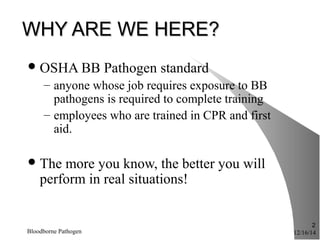
 When cleaning up surfaces use
Hepacide Quat®
 Do an initial wipe up
 Spray and allow it to stand for
ten minutes then wipe up
 Dispose of all wipes in
biohazard containers
 PPE should be removed and
disposed of in biohazard
containers
12/16/14Bloodborne Pathogen
21
Hand WashingHand Washing
 Wash hands
immediately after
removing PPE
 Use a soft
antibacterial soap
 A hand sanitizer can
be used but wash
with soap and water
as soon as possible.
12/16/14Bloodborne Pathogen
22
Hepatitis B VaccinationHepatitis B Vaccination
 Strongly endorsed by
medical communities
 Offered to all
potentially exposed
employees
 Provided at no cost
to employees
 Declination form
12/16/14Bloodborne Pathogen
23
Exposure IncidentExposure Incident
 A specific incident of contact with potentially
infectious bodily fluid.
 If there are no infiltrations of mucous membranes,
or open skin surfaces, it is not considered an
occupational exposure.
 Report all accidents involving blood or bodily
fluids.
 Post-exposure medical evaluations are offered.
 If you have blood or potentially infectious material
splashed in your eye you should flush you eye with
clean running water for no less than 15minutes.
12/16/14Bloodborne Pathogen
24
Signs & LabelsSigns & Labels
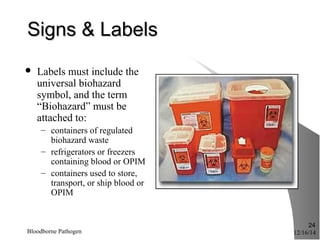
 Labels must include the
universal biohazard
symbol, and the term
“Biohazard” must be
attached to:
– containers of regulated
biohazard waste
– refrigerators or freezers
containing blood or OPIM
– containers used to store,
transport, or ship blood or
OPIM
12/16/14Bloodborne Pathogen
25
In ConclusionIn Conclusion
BB pathogen rules are in
place for your health and
safety.
Failure to follow them is a
risk that does not need to be
taken.

Bloodborne Pathogen Training Safety Course 2014

  • 1.
  • 2.
    12/16/14Bloodborne Pathogen 2 WHY AREWE HERE?WHY ARE WE HERE? OSHA BB Pathogen standard – anyone whose job requires exposure to BB pathogens is required to complete training – employees who are trained in CPR and first aid. The more you know, the better you will perform in real situations!
  • 3.
    12/16/14Bloodborne Pathogen 3 What isa BB Pathogen?What is a BB Pathogen? Microorganisms that are carried in the blood that can cause disease in humans.
  • 4.
    12/16/14Bloodborne Pathogen 4 DefinitionsDefinitions Bloodborne Pathogens: Pathogenicmicroorganisms that are present in human blood and can cause disease in humans. These pathogens include, but are not limited to, hepatitis B virus (HBV) and human immunodeficiency virus (HIV). Contaminated: The presence or the reasonably anticipated presence of blood or other potentially infectious materials on an item or surface. Decontamination: The use of physical or chemical means to remove, inactivate, or destroy bloodborne pathogens on a surface or item to the point where they are no longer capable of transmitting infectious particles and the surface or item is rendered safe for handling, use, or disposal.
  • 5.
    12/16/14Bloodborne Pathogen 5 Exposure Incident: Aspecific eye, mouth, other mucous membrane, non-intact skin, or parenteral contact with blood or other potentially infectious materials that results from the performance of an employee's duties. HBV - means hepatitis B virus. HIV - means human immunodeficiency virus. Occupational Exposure: Reasonably anticipated skin, eye, mucous membrane, or parenteral contact with blood or other potentially infectious materials that may result from the performance of an employee's duties.
  • 6.
    12/16/14Bloodborne Pathogen 6 Parenteral: Piercing mucousmembranes or the skin barrier through such events as needlesticks, human bites, cuts, and abrasions. Other Potentially Infectious Materials: (1) The following human body fluids: semen, vaginal secretions, cerebrospinal fluid, synovial fluid, pleural fluid, pericardial fluid, peritoneal fluid, amniotic fluid, saliva in dental procedures, any body fluid that is visibly contaminated with blood, and all body fluids in situations where it is difficult or impossible to differentiate between body fluids; (2) Any unfixed tissue or organ (other than intact skin) from a human (living or dead); and (3) HIV-containing cell or tissue cultures, organ cultures, and HIV- or HBV-containing culture medium or other solutions; and blood, organs, or other tissues from experimental animals infected with HIV or HBV.
  • 7.
    12/16/14Bloodborne Pathogen 7 Personal ProtectiveEquipment: Specialized clothing or equipment worn by an employee for protection against a hazard. General work clothes (e.g., uniforms, pants, shirts or blouses) not intended to function as protection against a hazard are not considered to be personal protective equipment. Regulated Waste: Liquid or semi-liquid blood or other potentially infectious materials; contaminated items that would release blood or other potentially infectious materials in a liquid or semi-liquid state if compressed; items that are caked with dried blood or other potentially infectious materials and are capable of releasing these materials during handling; contaminated sharps; and pathological and microbiological wastes containing blood or other potentially infectious materials.
  • 8.
    12/16/14Bloodborne Pathogen 8 Source Individual: Means any individual, living or dead, whose blood or other potentially infectious materials may be a source of occupational exposure to the employee. Examples include, but are not limited to, hospital and clinic patients; clients in institutions for the developmentally disabled; trauma victims; clients of drug and alcohol treatment facilities; residents of hospices and nursing homes; human remains; and individuals who donate or sell blood or blood components.
  • 9.
    12/16/14Bloodborne Pathogen 9 Universal Precautions:is an approach to infection control. According to the concept of Universal Precautions, all human blood and certain human body fluids are treated as if known to be infectious for HIV, HBV, and other bloodborne pathogens.
  • 10.
    12/16/14Bloodborne Pathogen 10 Common BBPathogenCommon BB Pathogen DiseasesDiseases  Malaria  Brucellosis  Syphilis  Hepatitis B(HBV)  Hepatitis C(HCV)  Human Immunodeficiency Virus (HIV)
  • 11.
    12/16/14Bloodborne Pathogen 11  HIVis the virus that leads to AIDS  HIV depletes the immune system  HIV does not survive well outside the body  No threat on contracting HIV through casual contact Human Immunodeficiency VirusHuman Immunodeficiency Virus (HIV)(HIV)
  • 12.
    12/16/14Bloodborne Pathogen 12 Hepatitis B(HBV)Hepatitis B (HBV)  1—1.25 million Americans are chronically infected  Symptoms include: jaundice, fatigue, abdominal pain, loss of appetite, intermittent nausea, vomiting  May lead to chronic liver disease, liver cancer, and death  Vaccination available since 1982  HBV can survive for at least one week in dried blood  Symptoms can occur 1-9 months after exposure
  • 13.
    12/16/14Bloodborne Pathogen 13 Hepatitis C(HCV)Hepatitis C (HCV)  Hepatitis C is the most common chronic bloodborne infection in the United States  Symptoms include: jaundice, fatigue, abdominal pain, loss of appetite, intermittent nausea, vomiting  May lead to chronic liver disease and death
  • 14.
    12/16/14Bloodborne Pathogen 14 Potentially InfectiousBodilyPotentially Infectious Bodily FluidsFluids  Blood  Saliva  Vomit  Urine  Semen or vaginal secretions  Skin tissue, cell cultures  Any other bodily fluid
  • 15.
    12/16/14Bloodborne Pathogen 15 Transmission PotentialTransmissionPotential  Contact with another person’s blood or bodily fluid that may contain blood  Mucous membranes: eyes, mouth, nose  Non-intact skin  Contaminated sharps/needles
  • 16.
    12/16/14Bloodborne Pathogen 16 Your ExposurePotentialYour Exposure Potential  Industrial accident  Administering first aid  Post-accident cleanup  Handling of returned product  Janitorial or maintenance work  Handling of any waste products
  • 17.
    12/16/14Bloodborne Pathogen 17 Universal PrecautionsUniversalPrecautions  Use of proper PPE  Treat all blood and bodily fluids as if they are contaminated  Proper cleanup and decontamination  Disposal of all contaminated material in the proper manner
  • 18.
    12/16/14Bloodborne Pathogen 18 Personal ProtectiveEquipmentPersonal Protective Equipment (PPE)(PPE)  Anything that is used to protect a person from exposure  Latex or Nitrile gloves, goggles, CPR mouth barriers, aprons, respirators
  • 19.
    12/16/14Bloodborne Pathogen 19 PPE Rulesto RememberPPE Rules to Remember  Always check PPE for defects or tears before using.  If PPE becomes torn or defective remove and get new.  Remove PPE before leaving a contaminated area.  Do not reuse disposable equipment.
  • 20.
    12/16/14Bloodborne Pathogen 20 DecontaminationDecontamination  Whencleaning up surfaces use Hepacide Quat®  Do an initial wipe up  Spray and allow it to stand for ten minutes then wipe up  Dispose of all wipes in biohazard containers  PPE should be removed and disposed of in biohazard containers
  • 21.
    12/16/14Bloodborne Pathogen 21 Hand WashingHandWashing  Wash hands immediately after removing PPE  Use a soft antibacterial soap  A hand sanitizer can be used but wash with soap and water as soon as possible.
  • 22.
    12/16/14Bloodborne Pathogen 22 Hepatitis BVaccinationHepatitis B Vaccination  Strongly endorsed by medical communities  Offered to all potentially exposed employees  Provided at no cost to employees  Declination form
  • 23.
    12/16/14Bloodborne Pathogen 23 Exposure IncidentExposureIncident  A specific incident of contact with potentially infectious bodily fluid.  If there are no infiltrations of mucous membranes, or open skin surfaces, it is not considered an occupational exposure.  Report all accidents involving blood or bodily fluids.  Post-exposure medical evaluations are offered.  If you have blood or potentially infectious material splashed in your eye you should flush you eye with clean running water for no less than 15minutes.
  • 24.
    12/16/14Bloodborne Pathogen 24 Signs &LabelsSigns & Labels  Labels must include the universal biohazard symbol, and the term “Biohazard” must be attached to: – containers of regulated biohazard waste – refrigerators or freezers containing blood or OPIM – containers used to store, transport, or ship blood or OPIM
  • 25.
    12/16/14Bloodborne Pathogen 25 In ConclusionInConclusion BB pathogen rules are in place for your health and safety. Failure to follow them is a risk that does not need to be taken.