11/12/15Respiratory protection training
1
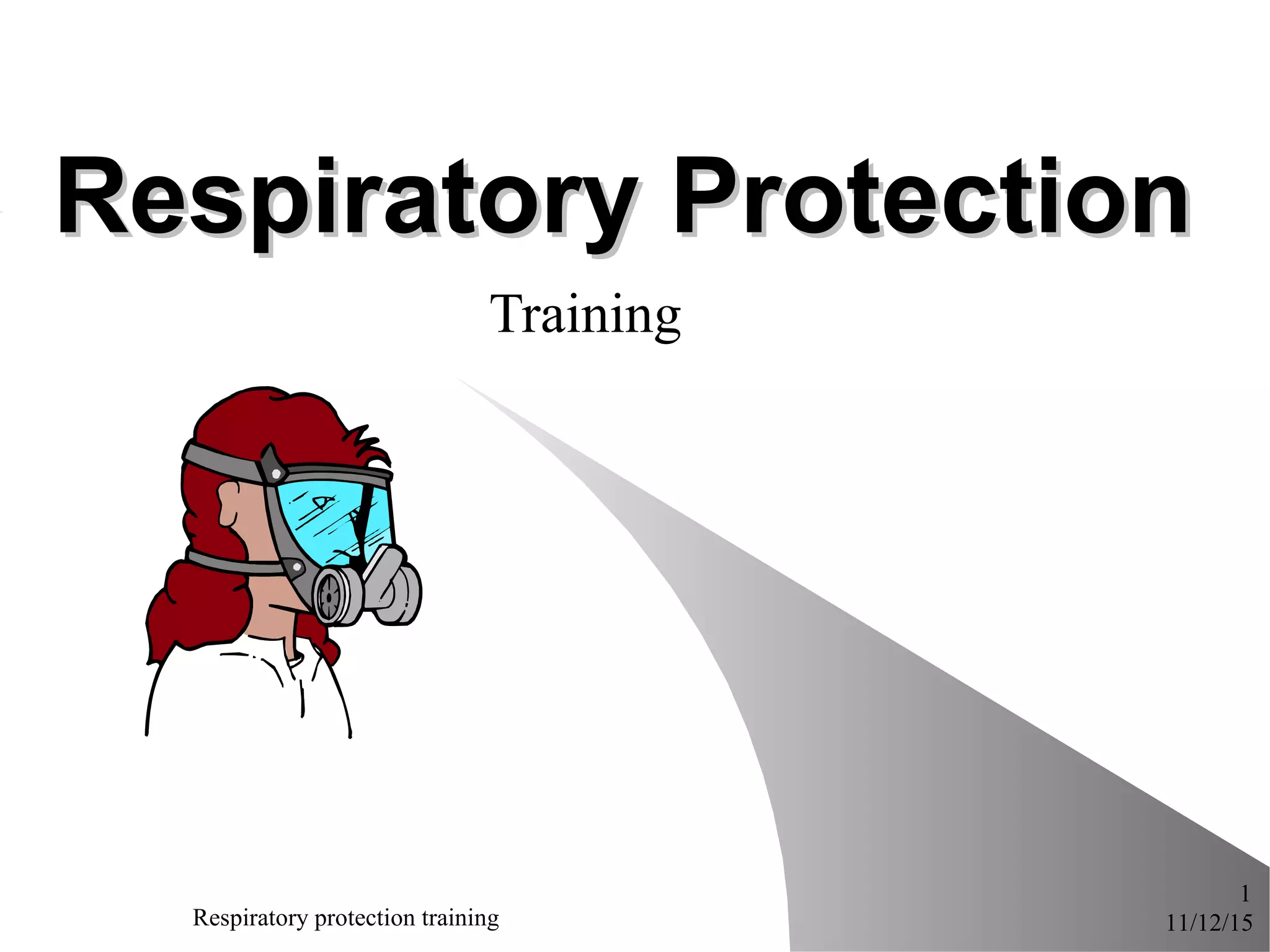
Respiratory ProtectionRespiratory Protection
Training
11/12/15Respiratory protection training
2
IntroductionIntroduction
Respiratory protection is necessary for employees who must
wear respirators when their job duties expose them to
dangerous substances present in the air. It is essential you
understand that, although the respirator prevents you from
breathing in air contaminants, the equipment does not
eliminate the hazard. If the respirator fails, or you remove it
for even a short period of time, overexposure could occur.
Both employer and employee need to know the hazards
present and the capabilities and limitations of the respirator
to be used.
The goal of this training is to ensure that employees who
may be exposed to respiratory hazards are adequately
prepared to use and care for respiratory protective
equipment.
11/12/15Respiratory protection training
3
HazardsHazards
Breathing clean air is a basic element of good
health. Many industrial settings, however,
contain substances that contaminate the air and
are a hazard to the respiratory system. These
hazards include:
 Harmful dusts
 Fog
 Fumes
 Mists and sprays
 Gases
 Smoke
 Vapors and oxygen deficiency.
11/12/15Respiratory protection training
4
Hazards cont.Hazards cont.
Air contaminants should be eliminated as much as possible
through engineering controls such as enclosing the operation,
exhausting the contaminant through general or local
ventilation, or substituting less toxic materials. When
engineering methods are not feasible, or if they can’t
completely eliminate the air contaminant, respiratory
protection is required for all workers who are, or have the
potential to be exposed to the hazards.
Types of respiratory protective equipment:
Respirators provide protection either by removing
contaminants from the air before it is inhaled or by supplying
an independent source of breathable air. The chemical and
physical properties of the contaminant, as well as it’s toxicity,
concentration, and the amount of oxygen present need to be
considered when choosing the proper type of respirator.
11/12/15Respiratory protection training
5
Mask stylesMask styles
There are two basic types of respirators, each providing protection for a different
kind of hazard.
Air purifying respirators:
Air purifying respirators use filters or sorbents to remove potentially dangerous
substances from the air. They range from simple disposable masks to sophisticated
powered air-purifying devices. These respirators do not provide oxygen, however
and cannot be used in oxygen-deficient atmospheres.
 Quarter-mask: A quarter-mask covers the mouth and nose. The lower sealing
surface rests between the chin and mouth. It is most commonly used on dust and
mist respirators.
 Half –mask: A half mask respirator covers the nose, mouth, and chin. It has a
reliable seal and is preferred for use to protect against toxic materials.
 Full-face mask: A full face mask covers the face roughly from the hairline to below
the chin. It provides the greatest protection against eye injury from splashes or flying
particles.
 Disposable mask (Dust mask): A disposable mask, often considered a single-use
respirator, has a filtering face piece that covers the mouth and nose. It is the most
commonly used type of air-purifying respirator. It filters out dusts, fumes, and mists;
but it is not effective against high concentrations of these substances.
11/12/15Respiratory protection training
6
Mask styles cont.Mask styles cont.
11/12/15Respiratory protection training
7
Masks styles cont.Masks styles cont.
Quarter, half, and full face masks style respirators have detachable cartridges and
canisters to filter out or absorb harmful particulates, gases, and vapors. Each
cartridge and or canister is designed for a specific gas or vapor. The label or
cartridge/canister is color coded and lists the hazard and the concentration for which
the mask is designed.
Air supplying respirators:
– Type A - A hose mask with a blower, air is supplied by a motor driven or hand
operated blower through a large diameter hose.
– Type B – A hose mask with out a blower, the wearer draws air through a hose by
breathing.
– Type C – An airline respirator- supplies clean air through a hose attached to a
tank of compressed air.
Classes of airline respirators include:
– Continuous flow- A regulated amount of air is fed to the face piece.
– Demand flow- Delivers air only during inhalation /Compressed air cylinders.
– Pressure-demand flow- Provides positive pressure during both inhalation and
exhalation.
11/12/15Respiratory protection training
8
Inspection and FitInspection and Fit
 Inspection:
Procedures will vary depending on the type of
respirator; however all respirators should be
inspected before and after each use for cracks or
damage.
 Proper fit- seal check:
A respirator that fits properly will be tight
enough to ensure a good face piece seal. Practice
positioning the respirator on your face, set the
strap tension, and conduct a user seal check. A
seal check must be done prior to each use to
ensure that the mask fits properly to provide
maximum protection.
11/12/15Respiratory protection training
9
Proper fitProper fit
 Positive fit test- Place the palms over the exhalation valves and
exhale into the mask and hold the breath for several seconds. If the
fit is tight, pressure will be felt inside the face piece.
 Negative fit test- Place palms over the air inlet openings and inhale
for about 10 seconds. If the fit is tight, the mask will be pulled
inward or collapse slightly.
– If a leak is detected, adjust the respirator
and repeat the test.
– If you can not get a tight fit acquire another
respirator.
Note: Any safety equipment such as safety glasses should be worn
during the test to ensure that it does not interfere with the face piece
seal. Side-burns, moustaches, beards, or other facial hair can
interfere with a proper fit and are not permitted.
11/12/15Respiratory protection training
10
Storage & CleaningStorage & Cleaning
 Storage: Store in a clean, dry place to protect from dust, dirt,
sunlight, extreme temperatures, vibration, moisture and
damaging chemicals.
 Cleaning: Wash face piece and components with mild detergent
in warm water. Disinfect as needed with a mild hypochlorite or
iodine solution or as recommended by the manufacturer. Rinse
thoroughly to remove all disinfectant and dry.
Note: Any respirator that is used by more than one individual must be
thoroughly cleaned and disinfected.

Respiratory Protection Training Course

  • 1.
    11/12/15Respiratory protection training 1 RespiratoryProtectionRespiratory Protection Training
  • 2.
    11/12/15Respiratory protection training 2 IntroductionIntroduction Respiratoryprotection is necessary for employees who must wear respirators when their job duties expose them to dangerous substances present in the air. It is essential you understand that, although the respirator prevents you from breathing in air contaminants, the equipment does not eliminate the hazard. If the respirator fails, or you remove it for even a short period of time, overexposure could occur. Both employer and employee need to know the hazards present and the capabilities and limitations of the respirator to be used. The goal of this training is to ensure that employees who may be exposed to respiratory hazards are adequately prepared to use and care for respiratory protective equipment.
  • 3.
    11/12/15Respiratory protection training 3 HazardsHazards Breathingclean air is a basic element of good health. Many industrial settings, however, contain substances that contaminate the air and are a hazard to the respiratory system. These hazards include:  Harmful dusts  Fog  Fumes  Mists and sprays  Gases  Smoke  Vapors and oxygen deficiency.
  • 4.
    11/12/15Respiratory protection training 4 Hazardscont.Hazards cont. Air contaminants should be eliminated as much as possible through engineering controls such as enclosing the operation, exhausting the contaminant through general or local ventilation, or substituting less toxic materials. When engineering methods are not feasible, or if they can’t completely eliminate the air contaminant, respiratory protection is required for all workers who are, or have the potential to be exposed to the hazards. Types of respiratory protective equipment: Respirators provide protection either by removing contaminants from the air before it is inhaled or by supplying an independent source of breathable air. The chemical and physical properties of the contaminant, as well as it’s toxicity, concentration, and the amount of oxygen present need to be considered when choosing the proper type of respirator.
  • 5.
    11/12/15Respiratory protection training 5 MaskstylesMask styles There are two basic types of respirators, each providing protection for a different kind of hazard. Air purifying respirators: Air purifying respirators use filters or sorbents to remove potentially dangerous substances from the air. They range from simple disposable masks to sophisticated powered air-purifying devices. These respirators do not provide oxygen, however and cannot be used in oxygen-deficient atmospheres.  Quarter-mask: A quarter-mask covers the mouth and nose. The lower sealing surface rests between the chin and mouth. It is most commonly used on dust and mist respirators.  Half –mask: A half mask respirator covers the nose, mouth, and chin. It has a reliable seal and is preferred for use to protect against toxic materials.  Full-face mask: A full face mask covers the face roughly from the hairline to below the chin. It provides the greatest protection against eye injury from splashes or flying particles.  Disposable mask (Dust mask): A disposable mask, often considered a single-use respirator, has a filtering face piece that covers the mouth and nose. It is the most commonly used type of air-purifying respirator. It filters out dusts, fumes, and mists; but it is not effective against high concentrations of these substances.
  • 6.
  • 7.
    11/12/15Respiratory protection training 7 Masksstyles cont.Masks styles cont. Quarter, half, and full face masks style respirators have detachable cartridges and canisters to filter out or absorb harmful particulates, gases, and vapors. Each cartridge and or canister is designed for a specific gas or vapor. The label or cartridge/canister is color coded and lists the hazard and the concentration for which the mask is designed. Air supplying respirators: – Type A - A hose mask with a blower, air is supplied by a motor driven or hand operated blower through a large diameter hose. – Type B – A hose mask with out a blower, the wearer draws air through a hose by breathing. – Type C – An airline respirator- supplies clean air through a hose attached to a tank of compressed air. Classes of airline respirators include: – Continuous flow- A regulated amount of air is fed to the face piece. – Demand flow- Delivers air only during inhalation /Compressed air cylinders. – Pressure-demand flow- Provides positive pressure during both inhalation and exhalation.
  • 8.
    11/12/15Respiratory protection training 8 Inspectionand FitInspection and Fit  Inspection: Procedures will vary depending on the type of respirator; however all respirators should be inspected before and after each use for cracks or damage.  Proper fit- seal check: A respirator that fits properly will be tight enough to ensure a good face piece seal. Practice positioning the respirator on your face, set the strap tension, and conduct a user seal check. A seal check must be done prior to each use to ensure that the mask fits properly to provide maximum protection.
  • 9.
    11/12/15Respiratory protection training 9 ProperfitProper fit  Positive fit test- Place the palms over the exhalation valves and exhale into the mask and hold the breath for several seconds. If the fit is tight, pressure will be felt inside the face piece.  Negative fit test- Place palms over the air inlet openings and inhale for about 10 seconds. If the fit is tight, the mask will be pulled inward or collapse slightly. – If a leak is detected, adjust the respirator and repeat the test. – If you can not get a tight fit acquire another respirator. Note: Any safety equipment such as safety glasses should be worn during the test to ensure that it does not interfere with the face piece seal. Side-burns, moustaches, beards, or other facial hair can interfere with a proper fit and are not permitted.
  • 10.
    11/12/15Respiratory protection training 10 Storage& CleaningStorage & Cleaning  Storage: Store in a clean, dry place to protect from dust, dirt, sunlight, extreme temperatures, vibration, moisture and damaging chemicals.  Cleaning: Wash face piece and components with mild detergent in warm water. Disinfect as needed with a mild hypochlorite or iodine solution or as recommended by the manufacturer. Rinse thoroughly to remove all disinfectant and dry. Note: Any respirator that is used by more than one individual must be thoroughly cleaned and disinfected.