Instructions Ex. 16.1
In Excel:
• File/ Open/ Folder:DataSets/ Folder:excel files/
Folder:Ch16/ Xm16-01.xls – To open data file
Note: Variable X in the 1st column & variable Y in the 2nd
column
• Insert/ Chart/ Standard Types: (XY) Scatter/ Next: Specify
the Input Y Range & the Input X Range/ Next/ Titles Tab –
Title:____; Value (X) axis:____; Value (Y) axis:____;
Finish/ - To produce Scatter Diagram
• Tools/ Data Analysis / Regression/ OK/ Highlight the Input
Y Range & the Input X Range/ Output Options: New
Worksheet Ply/ OK - To compute the least squares
regression line
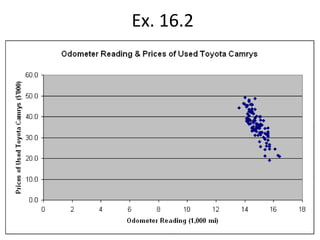
Ex. 16.2
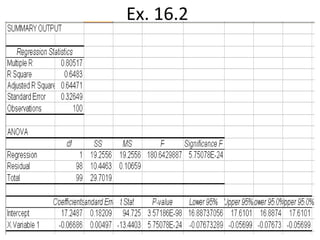
Ex. 16.2
Ex. 16.2 Interpretation

• The regression line is: ŷ = 17.25 – 0.0669x
• The slope coefficient, b1= -0.0669, means that
for each additional 1,000 miles on the odometer,
the price decreases by an average of $0.0669
thousand, i.e. each additional mile, price
decreases by 6.69 cents.
• The intercept, b0 = 17.25, means that when the
car was not driven at all, the selling price is
$17.25 thousand @$17,250 – most probably
meaningless!
Ex. 16.2 Assessing the model
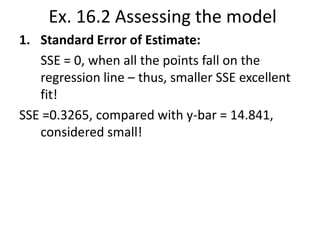
1. Standard Error of Estimate:
SSE = 0, when all the points fall on the
regression line – thus, smaller SSE excellent
fit!
SSE =0.3265, compared with y-bar = 14.841,
considered small!
Ex. 16.2 Assessing the model
2.

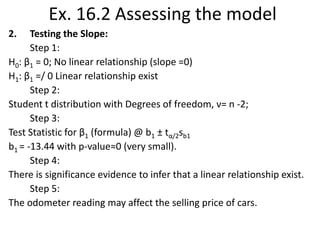
Testing the Slope:
Step 1:
H0: β1 = 0; No linear relationship (slope =0)
H1: β1 =/ 0 Linear relationship exist
Step 2:
Student t distribution with Degrees of freedom, ν= n -2;
Step 3:
Test Statistic for β1 (formula) @ b1 ± tα/2sb1
b1 = -13.44 with p-value≈0 (very small).
Step 4:
There is significance evidence to infer that a linear relationship exist.
Step 5:
The odometer reading may affect the selling price of cars.
Ex. 16.2 Assessing the model
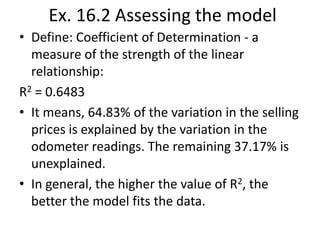
• Define: Coefficient of Determination - a
measure of the strength of the linear
relationship:
R2 = 0.6483
• It means, 64.83% of the variation in the selling
prices is explained by the variation in the
odometer readings. The remaining 37.17% is
unexplained.
• In general, the higher the value of R2, the
better the model fits the data.
Cause & Effect: Coefficient of Correlation
•
•
•
•

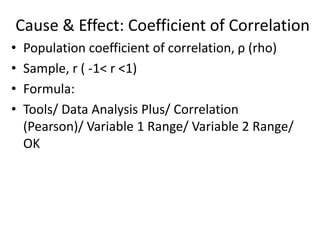
Population coefficient of correlation, ρ (rho)
Sample, r ( -1< r <1)
Formula:
Tools/ Data Analysis Plus/ Correlation
(Pearson)/ Variable 1 Range/ Variable 2 Range/
OK
CORRELATION
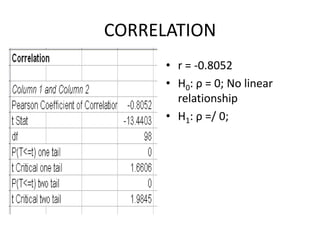
• r = -0.8052
• H0: ρ = 0; No linear
relationship
• H1: ρ =/ 0;
Data source: Managerial
Statistics, 9th Ed. (Keller)
CENGAGE

How to: Regression & Correlation

  • 2.
    Instructions Ex. 16.1 InExcel: • File/ Open/ Folder:DataSets/ Folder:excel files/ Folder:Ch16/ Xm16-01.xls – To open data file Note: Variable X in the 1st column & variable Y in the 2nd column • Insert/ Chart/ Standard Types: (XY) Scatter/ Next: Specify the Input Y Range & the Input X Range/ Next/ Titles Tab – Title:____; Value (X) axis:____; Value (Y) axis:____; Finish/ - To produce Scatter Diagram • Tools/ Data Analysis / Regression/ OK/ Highlight the Input Y Range & the Input X Range/ Output Options: New Worksheet Ply/ OK - To compute the least squares regression line
  • 3.
  • 4.
  • 5.
    Ex. 16.2 Interpretation •The regression line is: ŷ = 17.25 – 0.0669x • The slope coefficient, b1= -0.0669, means that for each additional 1,000 miles on the odometer, the price decreases by an average of $0.0669 thousand, i.e. each additional mile, price decreases by 6.69 cents. • The intercept, b0 = 17.25, means that when the car was not driven at all, the selling price is $17.25 thousand @$17,250 – most probably meaningless!
  • 6.
    Ex. 16.2 Assessingthe model 1. Standard Error of Estimate: SSE = 0, when all the points fall on the regression line – thus, smaller SSE excellent fit! SSE =0.3265, compared with y-bar = 14.841, considered small!
  • 7.
    Ex. 16.2 Assessingthe model 2. Testing the Slope: Step 1: H0: β1 = 0; No linear relationship (slope =0) H1: β1 =/ 0 Linear relationship exist Step 2: Student t distribution with Degrees of freedom, ν= n -2; Step 3: Test Statistic for β1 (formula) @ b1 ± tα/2sb1 b1 = -13.44 with p-value≈0 (very small). Step 4: There is significance evidence to infer that a linear relationship exist. Step 5: The odometer reading may affect the selling price of cars.
  • 8.
    Ex. 16.2 Assessingthe model • Define: Coefficient of Determination - a measure of the strength of the linear relationship: R2 = 0.6483 • It means, 64.83% of the variation in the selling prices is explained by the variation in the odometer readings. The remaining 37.17% is unexplained. • In general, the higher the value of R2, the better the model fits the data.
  • 9.
    Cause & Effect:Coefficient of Correlation • • • • Population coefficient of correlation, ρ (rho) Sample, r ( -1< r <1) Formula: Tools/ Data Analysis Plus/ Correlation (Pearson)/ Variable 1 Range/ Variable 2 Range/ OK
  • 10.
    CORRELATION • r =-0.8052 • H0: ρ = 0; No linear relationship • H1: ρ =/ 0;
  • 12.
    Data source: Managerial Statistics,9th Ed. (Keller) CENGAGE