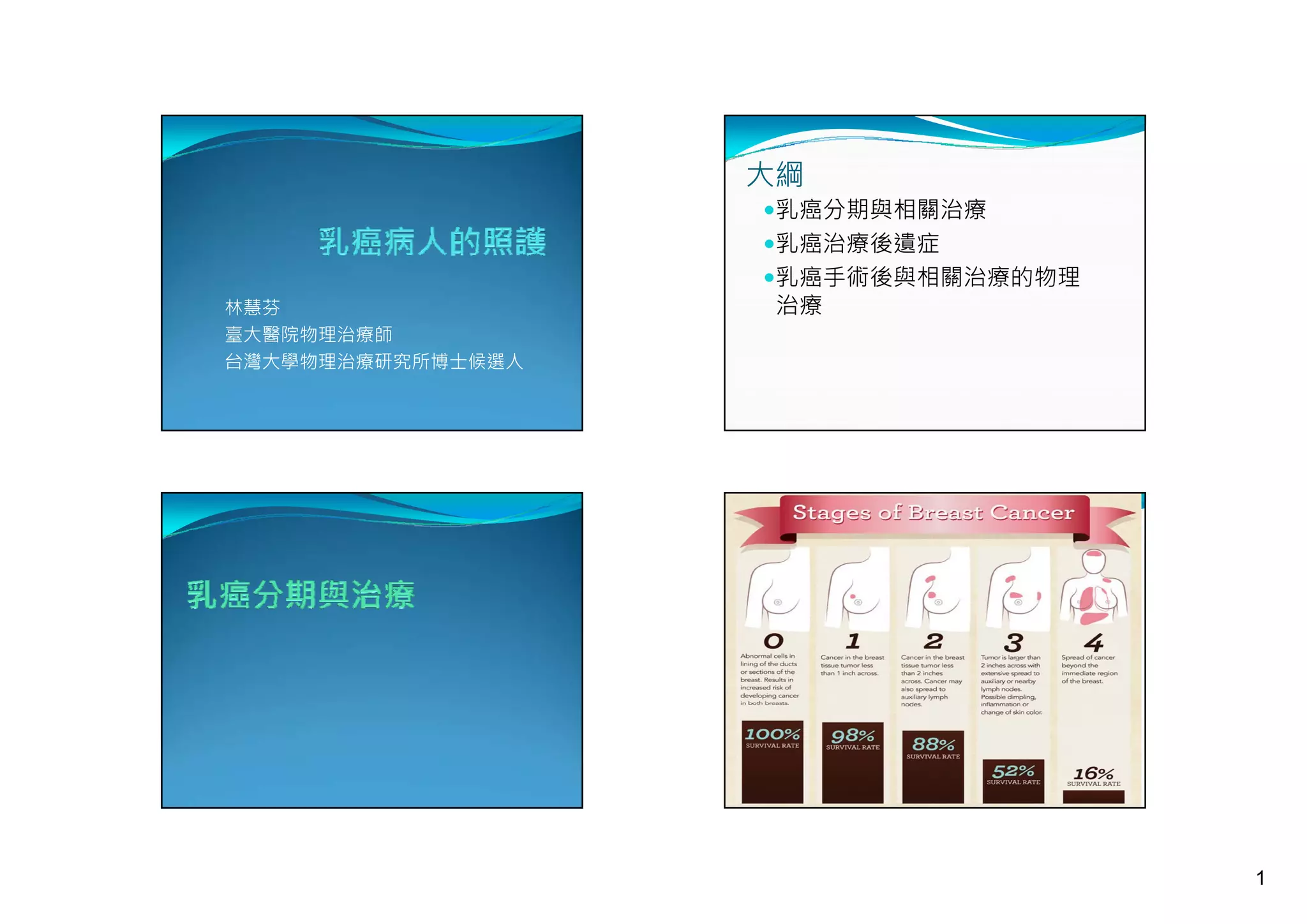
大綱
乳癌分期與相關治療
乳癌治療後遺症
乳癌手術後與相關治療的物理
林慧芬
臺大醫院物理治療師
台灣大學物理治療研究所博士候選人

治療

1
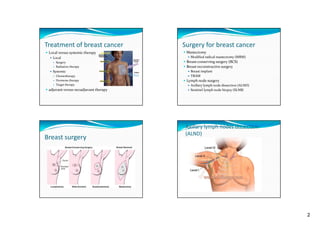
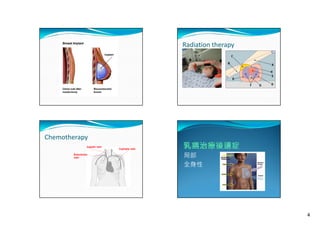
Treatment of breast cancer

Surgery for breast cancer

 Local versus systemic therapy
 Local

 Mastectomy
y
 Modified radical mastectomy (MRM)
 Breast conserving surgery (BCS)
 Breast reconstructive surgery
 Breast implant
 TRAM
h  d  
L
Lymph node surgery
 Axillary lymph node dissection (ALND)
 Sentinel lymph node biopsy (SLNB)




Surgery
Radiation therapy

 Systemic




Chemotherapy
H
 th
Hormone therapy
Target therapy

 adjuvant versus neoadjuvant therapy

Breast surgery

Axillary lymph nodes dissection 
(ALND)
i
i
I

III
II
I

2
Thoracodorsal n. ,art.
& vein

Intercostobrachial n.

Axillary vein
y
Long thoracic n.

Serratus
collateral
artery

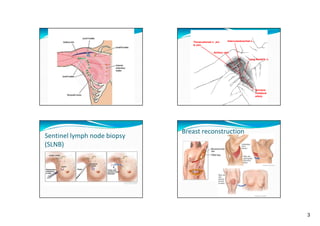
Sentinel lymph node biopsy 
(SLNB)

Breast reconstruction

3
Radiation therapy

Chemotherapy  
Jugular vein
J
l
i
Subclavian
vein

Cephalic vein

局部
全身性

4
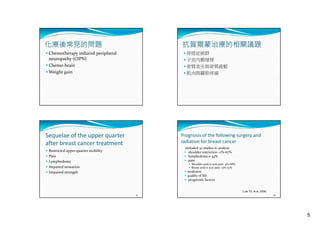
化療後常見的問題

抗賀爾蒙治療的相關議題

 Chemotherapy induced peripheral 

 停經症候群

neuropathy (CIPN)
 Chemo‐brain
 Weight gain

 子宮內膜增厚
 骨質流失與骨質疏鬆
 肌肉與關節疼痛

Sequelae of the upper quarter
after breast cancer treatment

Prognosis of the following surgery and 
radiation for breast cancer
included 32 studies to analyze
 shoulder restriction <1%‐67%
 lymphedema 0‐34%
 pain

 Restricted upper quarter mobility
 Pain
 Lymphedema

 Shoulder and/or arm pain  9%‐68%
 Breast and/or scar pain  15%‐72%

 Impaired sensation 

 weakness
 quality of life  
 prognostic factors 

 Impaired strength

( Lee TS, et al. 2008)
19

20

5
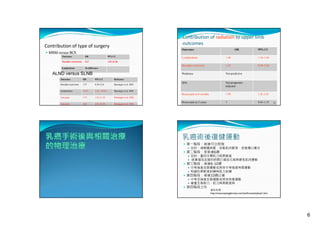
Contribution of radiation to upper limb 
outcomes

Contribution of type of surgery

Outcomes

 MRM versus BCS
Outcomes

OR

95% CI

Shoulder restriction

5.67

95% CI

1.03-31.06

lymphedema

OR

No difference

Lymphedema

95% CI

1.27

0.38-4.26

QOL

Barranger et al. 2005

lymphedema

11.67

1.45 – 94.65

3.73

1.23-11.34

4.61

2.01-10.59

Barranger et al. 2005

1.99

1.41-2.81

Breast pain at 2 years

1

0.65-1.55

Peintinger et al. 2003

Arm pain

Not prognostic
indicator

Barranger et al. 2005

Arm pain

Not predictive

Reference

Shoulder restriction

0.98-2.86

Breast pain at 6 months

OR

1.67

Weakness

Outcomes

1.16-1.84

Shoulder restriction

ALND versus SLNB

1.46

21

22

乳癌術後復健運動
 第一階段:術後可立即做
 目的:減輕腫與緊、放鬆肌肉緊張、促進傷口癒合
 第二階段:至術後6週
 目的:重回手臂肌力與柔軟度
 逐漸增加走路的時間已增加元氣與避免肌肉變軟
 第三階段:術後6-10週
 中等強度走路運動或其他中等強度有氧運動
 和緩的柔軟度訓練與肌力訓練
 第四階段:術後10週以後
 中等至強度走路運動或其他有氧運動
 著重全身耐力、肌力與柔軟度與
 第四階段之外

資料來源:
http://www.stayingabreast.com/site/browse/phase1.htm

6
乳癌術後復健運動:
第四階段之外

乳癌術後的復健
一般原則
 呼吸運動:協助放鬆與排痰
呼吸運動 協助放鬆與排痰
 四肢活動:維持關節活動與預防血栓

 肌力、恢復性運動、柔軟度運動

 及早下床活動:幫助體力恢復

 腹肌與核心訓練

 減輕手臂腫脹

 體重控制

 注意姿勢

 心肺耐力訓練

 漸進性肩關節活動

 維持骨密度
 化療期運動
 物理治療

First few weeks after surgery for 
wound healing
 Avoid splinting their arms
 Avoid repeated motion 
 Avoid heavy lifting

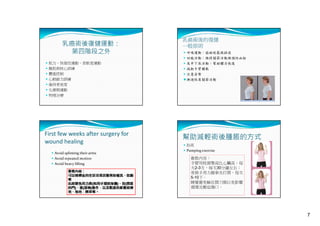
幫助減輕術後腫脹的方式
 抬高
 Pumping exercise

衛教內容:
手臂用枕頭墊高比心臟高,每
天2-3次,每次30分鐘左右;
常做手用力握拳及打開,每次
常做手用力握拳及打開 每次
5-10下。
睡覺避免躺在開刀側以免影響
循環及壓迫傷口。

7
PEDro
scale

作者/發表年

國家

研究目的

主要結果

Lacomba MT,et al
2010

Spain

早期物理治療運動是否可以預防
淋巴水腫

追蹤2年,早期物理治療運動,比控制
組淋巴水腫發生率低

8

Sagen A, et al.
g
,
2009

Norway

不限制患側活動對淋巴水腫的影
響

乳癌開刀後應鼓勵維持活動,並不會
增加淋巴水腫

7

Todd J,et al
2008

UK

術後一週內限制關節活動與不限
制關節活動在1年後的結果

術後一週內不限制肩關節活動, 1年後
發生淋巴水腫比較高。其餘在肌力、
關節角度、功能、QOL無差異

Cinar N,et al
2008

Turkey

術後開始復健比照居家自行運動
的療效

術後早期復健在關節活動度及功能恢
復較好

7

Beurskens CHG,
et al
2007

Netherland

術後PT比照居家自己運動的效果

在術後 3個月、6個月,有接受物理治
療組在肩關節前屈、外展、功能及疼
痛顯著比控制組好

7

Lauridsen, et al.
2005

Denmark

團體物理治療的在肩關節功能的
效果

團體物理治療在肩關節功能有顯著效
果

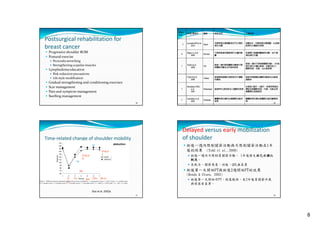
Postsurgical rehabilitation for 
breast cancer

5

 Progressive shoulder ROM
g
 Postural exercise
 Pectoralis stretching
 Strengthening scapular muscles
 Lymphedema education
 Risk reduction precautions
 Life style modification
y
 Gradual strengthening and conditioning exercises 
 Scar management 
 Pain and symptom management 
 Swelling management
29

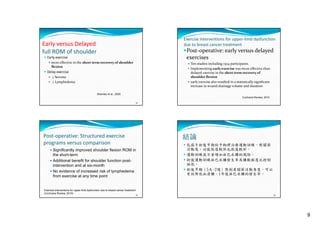
Delayed versus early mobilization 
of shoulder

Time‐related change of shoulder mobility
abduction

ns

 術後一週內限制關節活動與不限制關節活動在1年

後的結果

(Todd et al.,2008)
 術後一週內不限制肩關節活動, 1年後發生淋巴水腫比
較高。
 在肌力、關節角度、功能、QOL無差異

P<0.0
1

P<0.0
5
ns

 術後第一天開始PT與術後2週開始PT的效果

3m
D
5

1m

30

6m 12m

(Bendz & Olsen, 2002)
 術後第一天開始作PT,恢復較快。在2年後肩關節外展
與前屈有差異。

24 m

Box et al. 2002a
31

32

8
Exercise interventions for upper‐limb dysfunction 
due to breast cancer treatment 

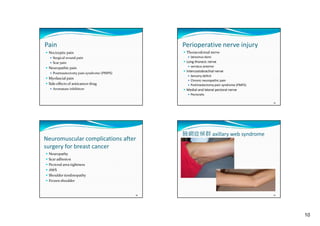
Early versus Delayed
full ROM of shoulder

Post‐operative: early versus delayed 

exercises

 Early exercise
 more effective in the short term recovery of shoulder 
flexion
 Delay exercise
 ↓Seroma
 ↓Lymphedema

 Ten studies including 1304 participants
 Implementing early exercise was more effective than 

delayed exercise in the short term recovery of 
shoulder flexion
 early exercise also resulted in a statistically significant 
increase in wound drainage volume and duration

Shamley et al., 2005
Cochrane Review, 2010
33

結論

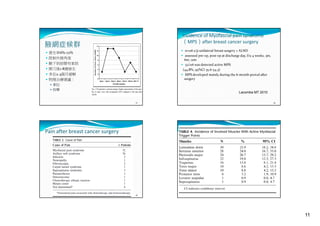
Post‐operative: Structured exercise 
programs versus comparison

 乳癌手術後早期給予物理治療運動訓練,對關節
乳癌手術後早期給予物理治療運動訓練 對關節

 Significantly improved shoulder flexion ROM in

the short-term
 Additional benefit for shoulder function postintervention and at six-month
 No evidence of increased risk of lymphedema
from exercise at any time point

Exercise interventions for upper-limb dysfunction due to breast cancer treatment
(Cochrane Review, 2010)

活動度、功能恢復較快也恢復較好。
 運動訓練並不會增加淋巴水腫的風險。
 術後運動訓練淋巴水腫發生率及腫脹程度比控制

組低。
 術後早期(5天-2週)限制肩關節活動角度,可以
有效降低血清腫、1年後淋巴水腫的發生率。
有效降低血清腫 年後淋巴水腫的發生率

35

36

9
Pain 

Perioperative nerve injury

 Nociceptic pain
 Surgical wound pain
 Scar pain
 Neuropathic pain
 Postmastectomy pain syndrome (PMPS)
 Myofascial pain
y
p

 Thoracodorsal nerve
 latissmus dorsi
 Long thoracic nerve
 serratus anterior
 Intercostobrachial nerve
 Sensory deficit
i
thi
i
 Ch
Chronic neuropathic pain
 Postmastectomy pain syndrome (PMPS)
 Medial and lateral pectoral nerve
 Pectoralis

 Side effects of anticancer drug 
 Aromatase inhibitors

38

Neuromuscular complications after 
surgery for breast cancer
surgery for breast cancer

腋網症候群 axillary web syndrome

 Neuropathy
 Scar adhesion
 Pectoral area tightness
 AWS
 Shoulder tendinopathy
 Frozen shoulder

39

40

10
Incidence of Myofascial pain syndrome 
(MPS)after breast cancer surgery

腋網症候群

 n=116 s/p unilateral breast surgery + ALND

 發生率6%‐72%
發生率6% 72%

 assessed pre‐op, post‐op at discharge day, f/u 4 weeks, 3m, 
6m, 12m

 限制外展角度
 腋下到前臂有索狀

 52/116 was detected active MPS

 開刀後1‐8週發生

(44.8%, 95%CI 35.6‐54.3)

 多在2‐3個月緩解

 MPS developed mainly during the 6‐month period after 
surgery 

 物理治療建議:
 牽拉
 按摩

Lacomba MT 2010
41

42

Pain after breast cancer surgery

43

11
24.6%

20.9%

26.8%

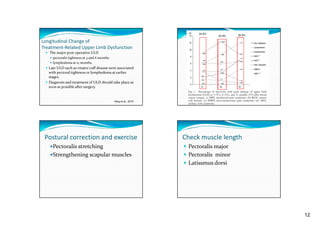
Longitudinal Change of 
Treatment‐Related Upper Limb Dysfunction
 The major post‐operative ULD 
The major post operative ULD 
 pectoralis tightness at 3 and 6 months
 lymphedema at 12 months. 
 Late ULD such as rotator cuff disease were associated 

with pectoral tightness or lymphedema at earlier 
stages. 
 Diagnosis and treatment of ULD should take place as 
soon as possible after surgery.

Yang et al., 2010

Postural correction and exercise

Check muscle length

Pectoralis stretching

 Pectoralis major

Strengthening scapular muscles

 Pectoralis minor
 Latissmus dorsi

12
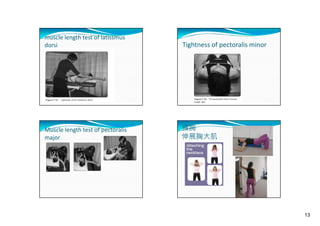
muscle length test of latissmus
dorsi

Tightness of pectoralis minor

Muscle length test of pectoralis
major

擴胸
伸展胸大肌

13
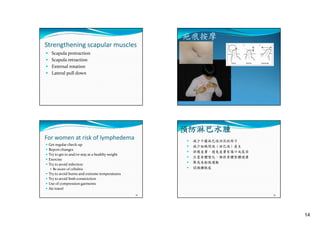
疤痕按摩
Strengthening scapular muscles
 Scapula protraction
 Scapula retraction
 External rotation
 Lateral pull down

預防淋巴水腫
For women at risk of lymphedema








Get regular check‐up
g
p
Report changes
Try to get to and/or stay at a healthy weight
Exercise
Try to avoid infection







 Be aware of cellulitis






減少干擾淋巴液回流的因子
減少組織間液(淋巴液)產生
保護皮膚,避免皮膚有傷口或感染
注意身體變化,維持身體整體健康
舉高及輕微運動
認識腫脹感

Try to avoid burns and extreme temperatures
Try to avoid limb constriction
Use of compression garments
Air travel
55

56

14
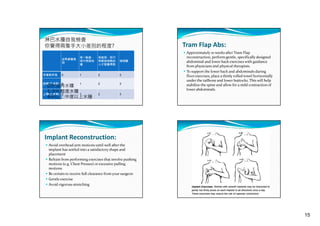
淋巴水腫自我檢查
你覺得兩隻手大小差別的程度?

Tram Flap Abs:
 Approximately 10 weeks after Tram Flap 

沒有感覺差
別

有一點差,
但只有我知
道

有差別,但只
有跟我很熟的
人才發覺得到

很明顯

0

1

2

3

前臂(下手臂) 0

1

2

3

2

3

手掌與手指

0分:沒有水腫
1-3分:輕度水腫
上臂(上手臂) 0
1
4分以上:中度以上水腫

reconstruction, perform gentle, specifically designed 
abdominal and lower back exercises with guidance 
from physicians and physical therapists. 
 To support the lower back and abdominals during 
floor exercises, place a thinly rolled towel horizontally 
d  th  t ilb
  d l
 b tt k  Thi   ill h l  
under the tailbone and lower buttocks. This will help 
stabilize the spine and allow for a mild contraction of 
lower abdominals.

Implant Reconstruction:
 Avoid overhead arm motions until well after the 

implant has settled into a satisfactory shape and 
placement
 Refrain from performing exercises that involve pushing 
motions (e.g. Chest Presses) or excessive pulling 
motions
 Be certain to receive full clearance from your surgeon
 Gentle exercise
 Avoid vigorous stretching

15
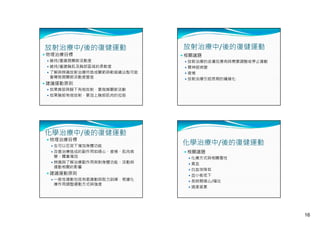
放射治療中/後的復健運動

 物理治療目標

 維持/重建肩關節活動度
 維持/重建胸肌及胸部區域的柔軟度
 了解與辨識放射治療所造成關節與軟組織沾黏可能

會導致肩關節活動度變差

 建議運動原則

放射治療中/後的復健運動
 相關議題
 放射治療的皮膚反應有時需要調整或停止運動
 臂神經病變
 疲倦
 放射治療引起長期的纖維化

 如果肩部與腋下有做放射,要做肩關節活動
 如果胸部有做放射,要加上胸部肌肉的拉筋

化學治療中/後的復健運動
 物理治療目標

 在可以忍受下增加身體功能
 改善治療造成的副作用如噁心、疲倦、肌肉病

變、體重增加
 辨識與了解治療副作用與對身體功能、活動與
運動相關的影響

 建議運動原則
 一般性運動包括有氧運動與阻力訓練,根據化

療作用調整運動方式與強度

化學治療中/後的復健運動
 相關議題
 化療方式與相關毒性
 貧血
 白血球降低
 血小板低下
 長時間噁心/嘔吐
 過度疲累

16

20131020 02 林慧芬_乳癌病人的照護

  • 1.
  • 2.
    Treatment of breast cancer Surgery for breast cancer  Local versus systemic therapy  Local Mastectomy y  Modified radical mastectomy (MRM)  Breast conserving surgery (BCS)  Breast reconstructive surgery  Breast implant  TRAM h  d   L Lymph node surgery  Axillary lymph node dissection (ALND)  Sentinel lymph node biopsy (SLNB)   Surgery Radiation therapy  Systemic    Chemotherapy H  th Hormone therapy Target therapy  adjuvant versus neoadjuvant therapy Breast surgery Axillary lymph nodes dissection  (ALND) i i I III II I 2
  • 3.
    Thoracodorsal n. ,art. &vein Intercostobrachial n. Axillary vein y Long thoracic n. Serratus collateral artery Sentinel lymph node biopsy  (SLNB) Breast reconstruction 3
  • 4.
  • 5.
    化療後常見的問題 抗賀爾蒙治療的相關議題  Chemotherapy induced peripheral   停經症候群 neuropathy (CIPN) Chemo‐brain  Weight gain  子宮內膜增厚  骨質流失與骨質疏鬆  肌肉與關節疼痛 Sequelae of the upper quarter after breast cancer treatment Prognosis of the following surgery and  radiation for breast cancer included 32 studies to analyze  shoulder restriction <1%‐67%  lymphedema 0‐34%  pain  Restricted upper quarter mobility  Pain  Lymphedema  Shoulder and/or arm pain  9%‐68%  Breast and/or scar pain  15%‐72%  Impaired sensation   weakness  quality of life    prognostic factors   Impaired strength ( Lee TS, et al. 2008) 19 20 5
  • 6.
    Contribution of radiation to upper limb  outcomes Contribution of type of surgery Outcomes  MRM versus BCS Outcomes OR 95%CI Shoulder restriction 5.67 95% CI 1.03-31.06 lymphedema OR No difference Lymphedema 95% CI 1.27 0.38-4.26 QOL Barranger et al. 2005 lymphedema 11.67 1.45 – 94.65 3.73 1.23-11.34 4.61 2.01-10.59 Barranger et al. 2005 1.99 1.41-2.81 Breast pain at 2 years 1 0.65-1.55 Peintinger et al. 2003 Arm pain Not prognostic indicator Barranger et al. 2005 Arm pain Not predictive Reference Shoulder restriction 0.98-2.86 Breast pain at 6 months OR 1.67 Weakness Outcomes 1.16-1.84 Shoulder restriction ALND versus SLNB 1.46 21 22 乳癌術後復健運動  第一階段:術後可立即做  目的:減輕腫與緊、放鬆肌肉緊張、促進傷口癒合  第二階段:至術後6週  目的:重回手臂肌力與柔軟度  逐漸增加走路的時間已增加元氣與避免肌肉變軟  第三階段:術後6-10週  中等強度走路運動或其他中等強度有氧運動  和緩的柔軟度訓練與肌力訓練  第四階段:術後10週以後  中等至強度走路運動或其他有氧運動  著重全身耐力、肌力與柔軟度與  第四階段之外 資料來源: http://www.stayingabreast.com/site/browse/phase1.htm 6
  • 7.
    乳癌術後復健運動: 第四階段之外 乳癌術後的復健 一般原則  呼吸運動:協助放鬆與排痰 呼吸運動 協助放鬆與排痰 四肢活動:維持關節活動與預防血栓  肌力、恢復性運動、柔軟度運動  及早下床活動:幫助體力恢復  腹肌與核心訓練  減輕手臂腫脹  體重控制  注意姿勢  心肺耐力訓練  漸進性肩關節活動  維持骨密度  化療期運動  物理治療 First few weeks after surgery for  wound healing  Avoid splinting their arms  Avoid repeated motion   Avoid heavy lifting 幫助減輕術後腫脹的方式  抬高  Pumping exercise 衛教內容: 手臂用枕頭墊高比心臟高,每 天2-3次,每次30分鐘左右; 常做手用力握拳及打開,每次 常做手用力握拳及打開 每次 5-10下。 睡覺避免躺在開刀側以免影響 循環及壓迫傷口。 7
  • 8.
    PEDro scale 作者/發表年 國家 研究目的 主要結果 Lacomba MT,et al 2010 Spain 早期物理治療運動是否可以預防 淋巴水腫 追蹤2年,早期物理治療運動,比控制 組淋巴水腫發生率低 8 SagenA, et al. g , 2009 Norway 不限制患側活動對淋巴水腫的影 響 乳癌開刀後應鼓勵維持活動,並不會 增加淋巴水腫 7 Todd J,et al 2008 UK 術後一週內限制關節活動與不限 制關節活動在1年後的結果 術後一週內不限制肩關節活動, 1年後 發生淋巴水腫比較高。其餘在肌力、 關節角度、功能、QOL無差異 Cinar N,et al 2008 Turkey 術後開始復健比照居家自行運動 的療效 術後早期復健在關節活動度及功能恢 復較好 7 Beurskens CHG, et al 2007 Netherland 術後PT比照居家自己運動的效果 在術後 3個月、6個月,有接受物理治 療組在肩關節前屈、外展、功能及疼 痛顯著比控制組好 7 Lauridsen, et al. 2005 Denmark 團體物理治療的在肩關節功能的 效果 團體物理治療在肩關節功能有顯著效 果 Postsurgical rehabilitation for  breast cancer 5  Progressive shoulder ROM g  Postural exercise  Pectoralis stretching  Strengthening scapular muscles  Lymphedema education  Risk reduction precautions  Life style modification y  Gradual strengthening and conditioning exercises   Scar management   Pain and symptom management   Swelling management 29 Delayed versus early mobilization  of shoulder Time‐related change of shoulder mobility abduction ns  術後一週內限制關節活動與不限制關節活動在1年 後的結果 (Todd et al.,2008)  術後一週內不限制肩關節活動, 1年後發生淋巴水腫比 較高。  在肌力、關節角度、功能、QOL無差異 P<0.0 1 P<0.0 5 ns  術後第一天開始PT與術後2週開始PT的效果 3m D 5 1m 30 6m 12m (Bendz & Olsen, 2002)  術後第一天開始作PT,恢復較快。在2年後肩關節外展 與前屈有差異。 24 m Box et al. 2002a 31 32 8
  • 9.
    Exercise interventions for upper‐limb dysfunction  due to breast cancer treatment  Early versus Delayed full ROM of shoulder Post‐operative: early versus delayed  exercises  Early exercise  more effective in the short term recovery of shoulder  flexion Delay exercise  ↓Seroma  ↓Lymphedema  Ten studies including 1304 participants  Implementing early exercise was more effective than  delayed exercise in the short term recovery of  shoulder flexion  early exercise also resulted in a statistically significant  increase in wound drainage volume and duration Shamley et al., 2005 Cochrane Review, 2010 33 結論 Post‐operative: Structured exercise  programs versus comparison  乳癌手術後早期給予物理治療運動訓練,對關節 乳癌手術後早期給予物理治療運動訓練 對關節  Significantly improved shoulder flexion ROM in the short-term  Additional benefit for shoulder function postintervention and at six-month  No evidence of increased risk of lymphedema from exercise at any time point Exercise interventions for upper-limb dysfunction due to breast cancer treatment (Cochrane Review, 2010) 活動度、功能恢復較快也恢復較好。  運動訓練並不會增加淋巴水腫的風險。  術後運動訓練淋巴水腫發生率及腫脹程度比控制 組低。  術後早期(5天-2週)限制肩關節活動角度,可以 有效降低血清腫、1年後淋巴水腫的發生率。 有效降低血清腫 年後淋巴水腫的發生率 35 36 9
  • 10.
    Pain  Perioperative nerve injury  Nociceptic pain  Surgical wound pain Scar pain  Neuropathic pain  Postmastectomy pain syndrome (PMPS)  Myofascial pain y p  Thoracodorsal nerve  latissmus dorsi  Long thoracic nerve  serratus anterior  Intercostobrachial nerve  Sensory deficit i thi i  Ch Chronic neuropathic pain  Postmastectomy pain syndrome (PMPS)  Medial and lateral pectoral nerve  Pectoralis  Side effects of anticancer drug   Aromatase inhibitors 38 Neuromuscular complications after  surgery for breast cancer surgery for breast cancer 腋網症候群 axillary web syndrome  Neuropathy  Scar adhesion  Pectoral area tightness  AWS  Shoulder tendinopathy  Frozen shoulder 39 40 10
  • 11.
    Incidence of Myofascial pain syndrome  (MPS)after breast cancer surgery 腋網症候群  n=116 s/p unilateral breast surgery + ALND  發生率6%‐72% 發生率6%72%  assessed pre‐op, post‐op at discharge day, f/u 4 weeks, 3m,  6m, 12m  限制外展角度  腋下到前臂有索狀  52/116 was detected active MPS  開刀後1‐8週發生 (44.8%, 95%CI 35.6‐54.3)  多在2‐3個月緩解  MPS developed mainly during the 6‐month period after  surgery   物理治療建議:  牽拉  按摩 Lacomba MT 2010 41 42 Pain after breast cancer surgery 43 11
  • 12.
    24.6% 20.9% 26.8% Longitudinal Change of  Treatment‐Related Upper Limb Dysfunction  The major post‐operative ULD  The major post operative ULD  pectoralis tightness at 3 and 6 months  lymphedema at 12 months.   Late ULD such as rotator cuff disease were associated  with pectoral tightness or lymphedema at earlier  stages.   Diagnosis and treatment of ULD should take place as  soon as possible after surgery. Yang et al., 2010 Postural correction and exercise Check muscle length Pectoralis stretching  Pectoralis major Strengthening scapular muscles  Pectoralis minor  Latissmus dorsi 12
  • 13.
  • 14.
    疤痕按摩 Strengthening scapular muscles  Scapula protraction  Scapula retraction External rotation  Lateral pull down 預防淋巴水腫 For women at risk of lymphedema       Get regular check‐up g p Report changes Try to get to and/or stay at a healthy weight Exercise Try to avoid infection       Be aware of cellulitis     減少干擾淋巴液回流的因子 減少組織間液(淋巴液)產生 保護皮膚,避免皮膚有傷口或感染 注意身體變化,維持身體整體健康 舉高及輕微運動 認識腫脹感 Try to avoid burns and extreme temperatures Try to avoid limb constriction Use of compression garments Air travel 55 56 14
  • 15.
    淋巴水腫自我檢查 你覺得兩隻手大小差別的程度? Tram Flap Abs:  Approximately 10 weeks after Tram Flap  沒有感覺差 別 有一點差, 但只有我知 道 有差別,但只 有跟我很熟的 人才發覺得到 很明顯 0 1 2 3 前臂(下手臂) 0 1 2 3 2 3 手掌與手指 0分:沒有水腫 1-3分:輕度水腫 上臂(上手臂)0 1 4分以上:中度以上水腫 reconstruction, perform gentle, specifically designed  abdominal and lower back exercises with guidance  from physicians and physical therapists.   To support the lower back and abdominals during  floor exercises, place a thinly rolled towel horizontally  d  th  t ilb   d l  b tt k  Thi   ill h l   under the tailbone and lower buttocks. This will help  stabilize the spine and allow for a mild contraction of  lower abdominals. Implant Reconstruction:  Avoid overhead arm motions until well after the  implant has settled into a satisfactory shape and  placement  Refrain from performing exercises that involve pushing  motions (e.g. Chest Presses) or excessive pulling  motions  Be certain to receive full clearance from your surgeon  Gentle exercise  Avoid vigorous stretching 15
  • 16.
    放射治療中/後的復健運動  物理治療目標  維持/重建肩關節活動度 維持/重建胸肌及胸部區域的柔軟度  了解與辨識放射治療所造成關節與軟組織沾黏可能 會導致肩關節活動度變差  建議運動原則 放射治療中/後的復健運動  相關議題  放射治療的皮膚反應有時需要調整或停止運動  臂神經病變  疲倦  放射治療引起長期的纖維化  如果肩部與腋下有做放射,要做肩關節活動  如果胸部有做放射,要加上胸部肌肉的拉筋 化學治療中/後的復健運動  物理治療目標  在可以忍受下增加身體功能  改善治療造成的副作用如噁心、疲倦、肌肉病 變、體重增加  辨識與了解治療副作用與對身體功能、活動與 運動相關的影響  建議運動原則  一般性運動包括有氧運動與阻力訓練,根據化 療作用調整運動方式與強度 化學治療中/後的復健運動  相關議題  化療方式與相關毒性  貧血  白血球降低  血小板低下  長時間噁心/嘔吐  過度疲累 16