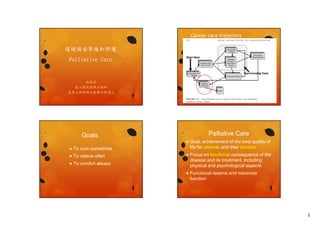
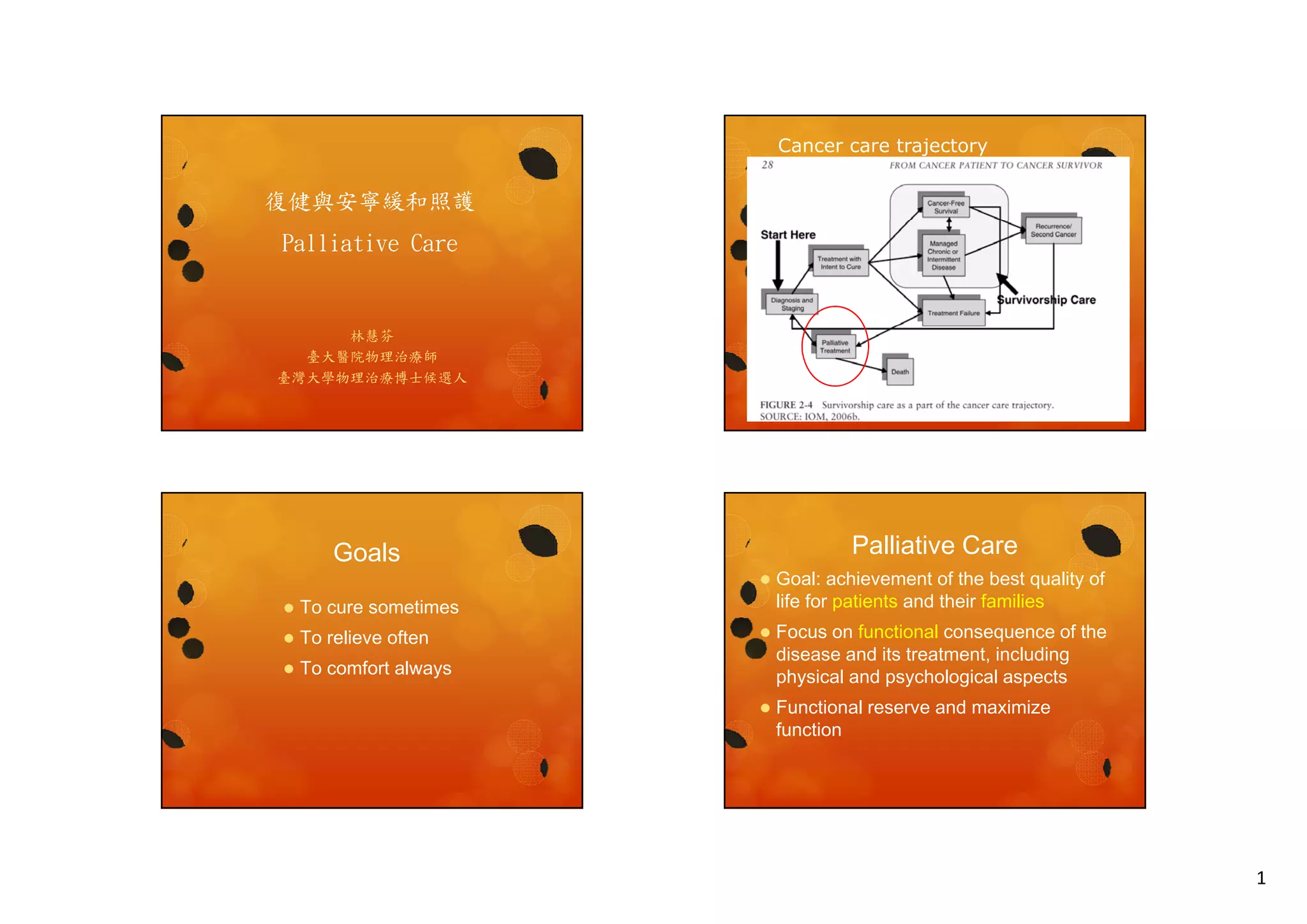
Cancer care trajectory

復健與安寧緩和照護
Palliative Care

林慧芬
臺大醫院物理治療師
臺灣大學物理治療博士候選人

Palliative Care

Goals



To relieve often





Focus on functional consequence of the
disease and its treatment, including
physical and psychological aspects

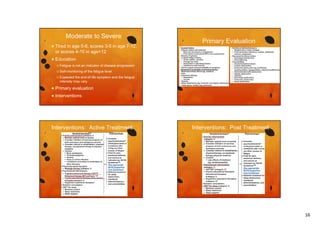


Functional reserve and maximize
F
ti
l
d
i i
function

To cure sometimes



Goal: achievement of the best quality of
life for patients and their families

To comfort always

1
How?


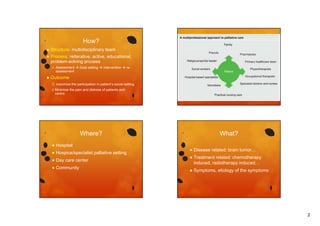
Structure: multidisciplinary team



Process: reiterative, active, educational,
problem-solving process




Assessment  Goal setting  intervention  reassessment

Outcome
 maximize the participation in patient’s social setting
 Minimize

carers

the pain and distress of patients and

Where?

What?



Hospital



Hospice/specialist palliative setting



Disease related: brain tumor…



Day care center





Community

Treatment related: chemotherapy
induced, radiotherapy induced…



Symptoms, etiology of the symptoms
y p
,
gy
y p

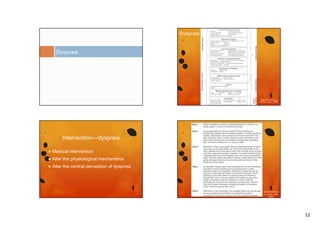
2
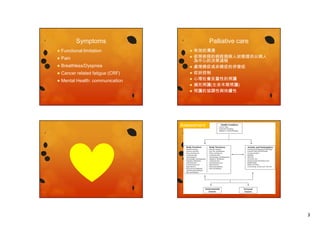
Symptoms

Palliative care



Functional limitation





Pain





Breathless/Dyspnea





Cancer related fatigue (CRF)





M t l Health: communication
i ti
Mental H lth





有效的溝通
依照疾病的病程與病人狀態提供以病人
為中心的決策過程
處理癌症或非癌症的併發症
症狀控制
心理社會及靈性的照護
瀕死照護(生命末期照護)
照護的協調性與持續性

Assessment

3
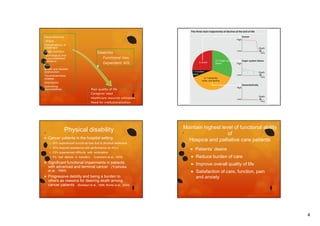
Deconditioning
Fatigue
Complications of
treatment
Under nutrition
Neurological and
musculoskeletal
problems
Pain

Disability
y
Functional loss
Dependent ADL

Bowel and bladder
dysfunction
Thromboembolic
disease
Depression
Coexisting
comorbidities

Poor quality of life
Caregiver need
Healthcare resource utilization
Need for institutionalization

Physical disability


Cancer patients in the hospital setting


35% experienced functional loss due to physical weakness



32% required assistance with performance on ADLs



23% experienced difficulty with ambulation



7% had deficits in transfers

(Lehmann et al., 1978)



Significant functional impairments in patients
with advanced and terminal cancer (Yoshioka



Progressive debility and being a burden to
others as reasons for desiring death among
cancer patients (Breitbart et al., 1998; Morita et al., 2004)

,
)
et al., 1994)

Maintain highest level of functional ability
of
Hospice and palliative care patients


Patients’ desire



Reduce burden of care



Improve overall quality of life



Satisfaction of care function pain
care, function,
and anxiety

4
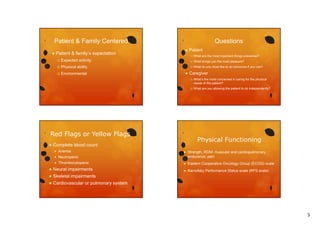
Patient & Family Centered


Patient & family’s expectation
family s


Environmental

Patient


What brings you the most pleasure?





What are the most important things prevented?



Physical ability





Expected activity



Questions

What do you most like to do tomorrow if you can?

Caregiver




Red Flags or Yellow Flags


Anemia



Neutropenic



What are you allowing the patient to do independently?

Physical Functioning

Complete blood count


What’s the most concerned in caring for the physical
What s
needs of the patient?



Strength, ROM, muscular and cardiopulmonary
endurance, pain

Thrombocytopenic



Eastern Cooperative Oncology Group (ECOG) scale



Neural impairments



Skeletal impairments

Karnofsky Performance Status scale (KPS scale)
y
(
)




Cardiovascular or pulmonary system

5
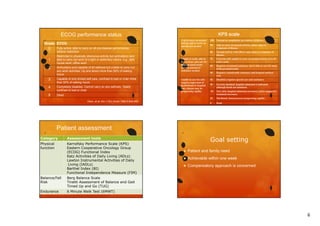
ECOG performance status

KPS scale

0

Fully active, able to carry on all pre-disease performance
without restriction

1

Restricted in physically strenuous activity but ambulatory and
able to carry out work of a light or sedentary nature, e.g., light
house work, office work

2

Ambulatory and capable of all selfcare but unable to carry out
any work activities. Up and about more than 50% of waking
hours

3

Capable of only limited self care, confined to bed or chair more
than 50% of waking hours

4

Completely disabled. Cannot carry on any selfcare. Totally
confined to bed or chair

5

100

Normal no complaints; no evidence of disease.

90

Able to carry on normal activity; minor signs or
symptoms of disease.

80

Normal activity with effort; some signs or symptoms of
disease.

Unable to work; able to
live at home and care for
most personal needs;
varying amount of
assistance needed.

70

Cares for self; unable to carry on normal activity or to do
active work.

60

Requires occasional assistance, but is able to care for most
of his personal needs.

50

Requires considerable assistance and frequent medical
care.

Unable to care for self;
requires equivalent of
institutional or hospital
care; disease may be
progressing rapidly.

40

Disabled; requires special care and assistance.
assistance

30

Severely disabled; hospital admission is indicated
although death not imminent.

20

Very sick; hospital admission necessary; active supportive
treatment necessary.

10

Grade ECOG

Able to carry on normal
activity and to work; no
special care needed.

Moribund; fatal processes progressing rapidly.

0

Dead

Dead
Oken, et al. Am J Clin Oncol 1982;5:649-655

Patient assessment
Category
Physical
function

Karnofsky Performance Scale (KPS)
Eastern Cooperative Oncology Group
(ECOG) Functional Index
Katz Activities of Daily Living (ADLs)
Lawton Instrumental Activities of Daily
Living (IADLs)
Barthel Index (BI)
Functional Independence Measure (FIM)

Goal setting

Assessment tools

Balance/Fall
Risk

Patient and family need



Achievable within one week



Compensatory approach is concerned

Berg Balance Scale
Tinetti Assessment of Balance and Gait
Timed Up and Go (TUG)

Endurance



6 Minute Walk Test (6MWT)

6
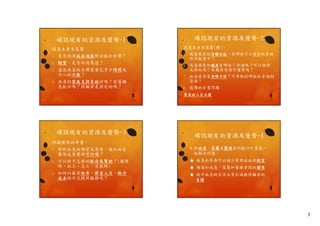
確認現有的資源及優勢-2

確認現有的資源及優勢-1
病患本身及家屬
1.

是否認清疾病進展對功能的影響?
是否認清疾病進展對功能的影響

2.

期望,是否好高騖遠?

3.

達成病患的目標需要花多少時間或
介入的次數?

4.

病患的家庭支持系統好嗎?家屬願
病患的家庭支持系統好嗎 家屬願
意配合嗎?照顧者是固定的嗎?

病患本身及家屬(續):
5
5.

病患現有的身體功能,有哪些可以安全的參與
於活動當中?

6.

病患現有的輔具有哪些?合適嗎?可以維修
或修改嗎?有輔具資源可運用嗎?

7.

病患使否有身障手冊?可爭取到哪些社會福利
資源?

8.

後續的安置問題

尊重病人自主權

確認現有的資源及優勢-3

確認現有的資源及優勢-4

照顧團隊的考量:
和病患、家屬及團隊共同擬訂計畫後一
和病患 家屬及團隊共同擬訂計畫後一
起解決問題。

1.

對於病患的期望或需要,緩和病房
團隊成員覺得可行嗎?



2.

可以給予怎樣的配合及幫助?(護理
師、社工、志工、宗教師)

★ 病患的參與可以減少其對疾病的絕望
★ 增進和病患、家屬和醫療者間的關係

3.
3

如何以最有效率、節省人力、物力
如何以最有效率 節省人力 物力
成本的方式提供服務呢?

★ 提升病患的生活品質和減輕照顧者的
負擔

7
Palliation
symptoms
mobility
 Slowing functional decline
 Maintaining QOL
 6-week structured PA: significant decrease in
fatigue & increase in physical performance &
emotional functioning
(Oldervoll et al, 2005, 2006 )
 50 patients, home-based PA, walking

Intervention—function

 Managing

 Improving

(Lowe, et al. Support Care Cancer 2010;18:1469-75)

Role of PT



Strength training, ROM exercise, muscular and
St
th t i i
i
l
d
cardiopulmonary endurance training, pain
management



Activity modification



Assistive devices



Environmental adaptation

Physical modalities for pain
control



Functional tasks



Massage



Physical modalities



heat/cold



Provision of adaptive and assistive
equipment



USD



Environment modification



TENS



Education on energy conservation



MLD



Exercise



Soft tissue mobilization

8
Adaptive equipment and
assistive devices

Caregiver education and
support

Adaptive equipment is used to improve performance in
ADLs.
ADLs
 Assistive devices are prescribed to help


Mobility



Balance



Pain



F ti
Fatigue



Joint instability



Excessive skeletal loading



Utilizations of strategies to prevent
falls and maintain balance

Weakness



Use of good body mechanics



Ambulation



Instructions on the use of equipment







Elimination of weight bearing on an affected extremity

Exercise








Maintenance of muscle strength, joint
flexibility, range of motion, and balance
Improvements in functional capacity, body
composition, mood, self-esteem, quality of
life
Fatigue
Pain
Muscle spasm
Edema

癌症末期療護最常見症狀
36










疼痛 70%
口乾 68%
缺乏食慾 61%
無力 47%
便秘 45%
呼吸困難 42%
噁心 嘔吐
噁心、嘔吐 36%
失眠 34%









盜汗 25%
吞嚥問題 23%
泌尿問題 21%
神經精神症狀 20%
皮膚問題 16%
消化不良 11%
腹瀉 70%

9
Case 1


Case 1

BC, bone meta with spine compression fracture



BC, bone meta with spine compression fracture



Intervention—pain
S
Somatic
ti

pain
i

 Neuropathic
 Visceral
 Total

Sit, dinner with family
Pain, weakness, contracture of knee, poor
endurance

Intervention—pain (I)
 Medication:

mouth, clock, the ladder

pain

pain

suffering

10
Intervention—pain (2)
 PT


Pain and Function

measures

Exercise and movement


Graded and purposeful activity



Postural re-education



Massage
assage



Manual techniques



Pain control modalities: TENS, heat & cold
(Rehabilitation in cancer care, 2008)

Pathophysiology of pain

11
Dyspnea

Dyspnea

(Rehabilitation in
cancer care, 2008)

Intervention—dyspnea


Medical intervention



Alter the physiological mechanisms



Alter the central perception of dyspnea

(Rehabilitation
in cancer care,
2008)

12
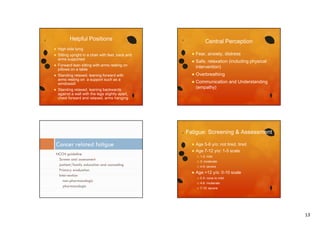
Helpful Positions


High side lying



Sitting
Sitti upright in a chair with f t b k and
i ht i
h i ith feet, back d
arms supported



Forward lean sitting with arms resting on
pillows on a table



Standing relaxed, leaning forward with
arms resting on a support such as a
windowsill

Central Perception





Fear, anxiety
Fear anxiety, distress



Safe, relaxation (including physical
intervention)



Overbreathing



Communication and Understanding
(empathy)

Standing relaxed, leaning backwards
against a wall with the legs slightly apart,
chest forward and relaxed, arms hanging

Fatigue: Screening & Assessment

Cancer related fatigue
NCCN guideline
Screen and assessment
patient/family education and counseling
Primary evaluation
Intervention
non-pharmacologic
pharmacologic



Age 5-6 y/o: not tired, tired
g
y
,



Age 7-12 y/o: 1-5 scale



3: moderate





1-2: mild
4-5: severe

Age >12 y/o: 0 10 scale
0-10


0-3: none to mild



4-6: moderate



7-10: severe

13
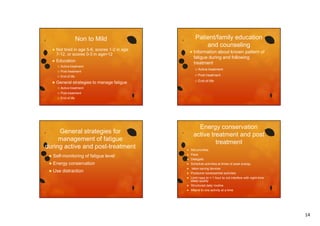
Patient/family education
and counseling

Non to Mild


Not tired in age 5-6, scores 1-2 in age
7-12,
7 12 or scores 0 3 in age>12
0-3



Education


Post treatment





Active treatment





End of life

 Active
 Post

Post treatment



treatment

Active treatment



treatment

 E d f lif
End-of-life

General strategies to manage fatigue


Information about known pattern of
p
fatigue during and following
treatment

End of life

General strategies for
management of fatigue
during active and post treatment
post-treatment

Energy conservation
active treatment and post
treatment




Self-monitoring of fatigue level





Energy conservation





Use distraction









Set priorities
Pace
Delegate
Schedule activities at times of peak energy
labor-saving devices
Postpone nonessential activities
P t
ti l ti iti
Limit naps to < 1 hour to not interfere with night-time
sleep quality
Structured daily routine
Attend to one activity at a time

14
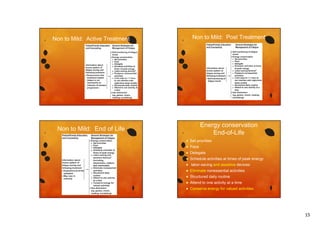
Non to Mild: Active Treatment

Non to Mild: Post Treatment

Non to Mild: End of Life

Energy conservation
End-of-Life


Set priorities



Pace



Delegate



Schedule activities at times of peak energy



labor-saving and assistive devices



Eliminate nonessential activities



Structured daily routine



Attend to one activity at a time



Conserve energy for valued activities

15
Moderate to Severe


Tired in age 5-6, scores 3-5 in age 7-12,
or scores 4-10 in age>12
g



Primary Evaluation

Education
 Fatigue

is not an indicator of disease progression

 Self-monitoring

of the fatigue level

 Expected

the end-of life symptom and the fatigue
intensity may vary



Primary evaluation



Interventions

Interventions: Active Treatment

Interventions: Post Treatment

16
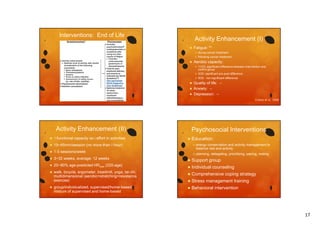
Interventions: End of Life

Activity Enhancement (I)


Fatigue: **





during cancer treatment
g
following cancer treatment

Aerobic capacity:
11/22: significant difference between intervention and
control group
 3/22: significant pre-post difference
 8/22: non significant difference


Quality of life: - Anxiety: - Depression: -

Cramp et al, 2008

Activity Enhancement (II)


↑functional capacity so↓effort in activities



15~45min/session (no more than I hour)
5 5
/sess o ( o o e t a
ou )



1-5 sessions/week



3~32 weeks, average: 12 weeks



25~80% age-predicted HRmax (220-age)



walk, bicycle, ergometer, treadmill, yoga, tai-chi,
walk bicycle ergometer treadmill yoga tai chi
multidimensional (aerobic+stretching+resistance
exercise)



group/individualized, supervised/home-based ,
mixture of supervised and home-based

Psychosocial Interventions


Education:
 energy
gy

conservation and activity management to
y
g
balance rest and activity

 planning,

delegating, prioritizing, pacing, resting



Support group



Individual counseling



Comprehensive coping strategy



Stress management training



Behavioral intervention

17
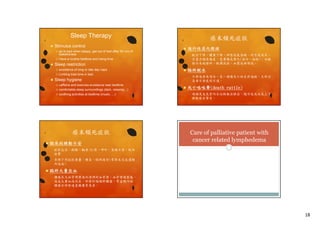
Sleep Therapy


Stimulus control









avoidance of long or late day naps
Limiting total time in bed

注意力越來越差、皮膚顏色變化(濕冷、斑駁)、四肢
發冷末端發紺、脈搏減弱、血壓逐漸降低。






caffeine and exercise avoidance near bedtime
comfortable sleep surroundings (dark, relaxing…)
soothing activities at bedtime (music, …)

臨終脫水
– 不再進食及喝水。是一預備死亡的自然過程,大部分

Sleep hygiene


進行性惡化徵候
– 肌力下降 體重下降 神智混亂昏睡 時空感消失
肌力下降、體重下降、神智混亂昏睡、時空感消失、

Sleep restriction




go to bed when sleepy, get out of bed after 20 min of
wakefulness
Have a routine bedtime and rising time

癌末頻死症狀

患者不會感到不適
患者不會感到不適。



死亡咯咯聲(death rattle)
– 喉頭及支氣管內分泌物無法排出,隨呼氣及吐氣上下

移動發出聲音。

癌末頻死症狀


臨床的躁動不安

Care of palliative patient with
cancer related lymphedema

– 症狀包含:躁動、翻身/打滾、呻吟、意識不清、肌肉

痙攣
– 亦與下列症狀重疊:瞻妄、臨終痛苦(常因未完成遺願

而造成)



臨終大量出血
– 腫瘤在大血管周圍進而浸潤到血管壁,血管壁破裂後,

造成大量血液流出,好發於頭頸部腫瘤、骨盆腔內的
腫瘤合併陰道直腸廔管患者。

18
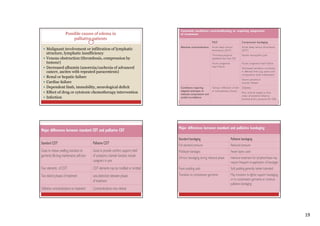
Possible causes of edema in
palliative patients
 Malignant involvement or infiltration of lymphatic








structure,
structure lymphatic insufficiency
Venous obstruction (thrombosis, compression by
tumour)
Decreased albumin (anorexia/cachexia of advanced
cancer, ascites with repeated paracentesis)
Renal or hepatic failure
Cardiac failure
Dependent limb, immobility, neurological deficit
Effect of drug or cytotoxic chemotherapy intervention
Infection

19
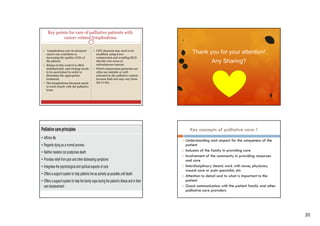
Key points for care of palliative patients with
cancer related lymphedema
 Lymphedema care in advanced

Thank you for you a e o
a
o your attention!

 CDT elements may need to be

cancer can contribute to
increasing the quality of life of
the patient.
 Edema in this context is often
multifactorial, and etiology needs
to be ascertained in order to
determine the appropriate
treatment.
 The lymphedema therapist needs
to work closely with the palliative
team.

modified,
modified using lower
compression and avoiding MLD
directly over areas of
subcutaneous tumour.
 Fitted compression garments are
often not suitable or welltolerated in the palliative context
because limb size may vary from
day to day.

Any Sharing?

Key concepts of palliative care-1











Understanding and respect for the uniqueness of the
p
patient
Inclusion of the family in providing care
Involvement of the community in providing resources
and care
Interdisciplinary (team) work with nurse, physician,
wound care or pain specialist, etc
p
p
,
Attention to detail and to what is important to the
patient
Good communication with the patient family and other
palliative care providers

20
Key concepts of palliative care-2









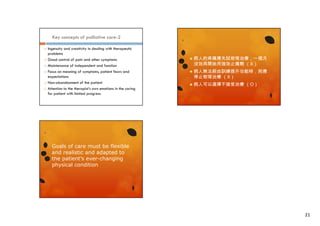
Ingenuity and creativity in dealing with therapeutic
problems
Good control of pain and other symptoms
Maintenance of independent and function
Focus on meaning of symptoms, patient fears and
expectations
Non-abandonment of the patient
Attention to the therapist’s own emotions in the caring
for patient with limited progress



病人的疼痛應先試物理治療,一個月
沒效再開始用強效止痛劑 (X)



病人無法經由訓練提升功能時,則應
停止物理治療 (X)



病人可以選擇不接受治療 (O)

Goals of care must be flexible
and realistic and adapted to
the patient’s ever-changing
physical condition

21

20131013 04 林慧芬_復健與安寧緩和照護

  • 1.
    Cancer care trajectory 復健與安寧緩和照護 PalliativeCare 林慧芬 臺大醫院物理治療師 臺灣大學物理治療博士候選人 Palliative Care Goals   To relieve often   Focus on functional consequence of the disease and its treatment, including physical and psychological aspects  Functional reserve and maximize F ti l d i i function To cure sometimes  Goal: achievement of the best quality of life for patients and their families To comfort always 1
  • 2.
    How?  Structure: multidisciplinary team  Process:reiterative, active, educational, problem-solving process   Assessment  Goal setting  intervention  reassessment Outcome  maximize the participation in patient’s social setting  Minimize carers the pain and distress of patients and Where? What?  Hospital  Hospice/specialist palliative setting  Disease related: brain tumor…  Day care center   Community Treatment related: chemotherapy induced, radiotherapy induced…  Symptoms, etiology of the symptoms y p , gy y p 2
  • 3.
    Symptoms Palliative care  Functional limitation   Pain   Breathless/Dyspnea   Cancerrelated fatigue (CRF)   M t l Health: communication i ti Mental H lth    有效的溝通 依照疾病的病程與病人狀態提供以病人 為中心的決策過程 處理癌症或非癌症的併發症 症狀控制 心理社會及靈性的照護 瀕死照護(生命末期照護) 照護的協調性與持續性 Assessment 3
  • 4.
    Deconditioning Fatigue Complications of treatment Under nutrition Neurologicaland musculoskeletal problems Pain Disability y Functional loss Dependent ADL Bowel and bladder dysfunction Thromboembolic disease Depression Coexisting comorbidities Poor quality of life Caregiver need Healthcare resource utilization Need for institutionalization Physical disability  Cancer patients in the hospital setting  35% experienced functional loss due to physical weakness  32% required assistance with performance on ADLs  23% experienced difficulty with ambulation  7% had deficits in transfers (Lehmann et al., 1978)  Significant functional impairments in patients with advanced and terminal cancer (Yoshioka  Progressive debility and being a burden to others as reasons for desiring death among cancer patients (Breitbart et al., 1998; Morita et al., 2004) , ) et al., 1994) Maintain highest level of functional ability of Hospice and palliative care patients  Patients’ desire  Reduce burden of care  Improve overall quality of life  Satisfaction of care function pain care, function, and anxiety 4
  • 5.
    Patient & FamilyCentered  Patient & family’s expectation family s  Environmental Patient  What brings you the most pleasure?   What are the most important things prevented?  Physical ability   Expected activity  Questions What do you most like to do tomorrow if you can? Caregiver   Red Flags or Yellow Flags  Anemia  Neutropenic  What are you allowing the patient to do independently? Physical Functioning Complete blood count  What’s the most concerned in caring for the physical What s needs of the patient?  Strength, ROM, muscular and cardiopulmonary endurance, pain Thrombocytopenic  Eastern Cooperative Oncology Group (ECOG) scale  Neural impairments  Skeletal impairments Karnofsky Performance Status scale (KPS scale) y ( )   Cardiovascular or pulmonary system 5
  • 6.
    ECOG performance status KPSscale 0 Fully active, able to carry on all pre-disease performance without restriction 1 Restricted in physically strenuous activity but ambulatory and able to carry out work of a light or sedentary nature, e.g., light house work, office work 2 Ambulatory and capable of all selfcare but unable to carry out any work activities. Up and about more than 50% of waking hours 3 Capable of only limited self care, confined to bed or chair more than 50% of waking hours 4 Completely disabled. Cannot carry on any selfcare. Totally confined to bed or chair 5 100 Normal no complaints; no evidence of disease. 90 Able to carry on normal activity; minor signs or symptoms of disease. 80 Normal activity with effort; some signs or symptoms of disease. Unable to work; able to live at home and care for most personal needs; varying amount of assistance needed. 70 Cares for self; unable to carry on normal activity or to do active work. 60 Requires occasional assistance, but is able to care for most of his personal needs. 50 Requires considerable assistance and frequent medical care. Unable to care for self; requires equivalent of institutional or hospital care; disease may be progressing rapidly. 40 Disabled; requires special care and assistance. assistance 30 Severely disabled; hospital admission is indicated although death not imminent. 20 Very sick; hospital admission necessary; active supportive treatment necessary. 10 Grade ECOG Able to carry on normal activity and to work; no special care needed. Moribund; fatal processes progressing rapidly. 0 Dead Dead Oken, et al. Am J Clin Oncol 1982;5:649-655 Patient assessment Category Physical function Karnofsky Performance Scale (KPS) Eastern Cooperative Oncology Group (ECOG) Functional Index Katz Activities of Daily Living (ADLs) Lawton Instrumental Activities of Daily Living (IADLs) Barthel Index (BI) Functional Independence Measure (FIM) Goal setting Assessment tools Balance/Fall Risk Patient and family need  Achievable within one week  Compensatory approach is concerned Berg Balance Scale Tinetti Assessment of Balance and Gait Timed Up and Go (TUG) Endurance  6 Minute Walk Test (6MWT) 6
  • 7.
    確認現有的資源及優勢-2 確認現有的資源及優勢-1 病患本身及家屬 1. 是否認清疾病進展對功能的影響? 是否認清疾病進展對功能的影響 2. 期望,是否好高騖遠? 3. 達成病患的目標需要花多少時間或 介入的次數? 4. 病患的家庭支持系統好嗎?家屬願 病患的家庭支持系統好嗎 家屬願 意配合嗎?照顧者是固定的嗎? 病患本身及家屬(續): 5 5. 病患現有的身體功能,有哪些可以安全的參與 於活動當中? 6. 病患現有的輔具有哪些?合適嗎?可以維修 或修改嗎?有輔具資源可運用嗎? 7. 病患使否有身障手冊?可爭取到哪些社會福利 資源? 8. 後續的安置問題 尊重病人自主權 確認現有的資源及優勢-3 確認現有的資源及優勢-4 照顧團隊的考量: 和病患、家屬及團隊共同擬訂計畫後一 和病患 家屬及團隊共同擬訂計畫後一 起解決問題。 1. 對於病患的期望或需要,緩和病房 團隊成員覺得可行嗎?  2. 可以給予怎樣的配合及幫助?(護理 師、社工、志工、宗教師) ★病患的參與可以減少其對疾病的絕望 ★ 增進和病患、家屬和醫療者間的關係 3. 3 如何以最有效率、節省人力、物力 如何以最有效率 節省人力 物力 成本的方式提供服務呢? ★ 提升病患的生活品質和減輕照顧者的 負擔 7
  • 8.
    Palliation symptoms mobility  Slowing functionaldecline  Maintaining QOL  6-week structured PA: significant decrease in fatigue & increase in physical performance & emotional functioning (Oldervoll et al, 2005, 2006 )  50 patients, home-based PA, walking Intervention—function  Managing  Improving (Lowe, et al. Support Care Cancer 2010;18:1469-75) Role of PT  Strength training, ROM exercise, muscular and St th t i i i l d cardiopulmonary endurance training, pain management  Activity modification  Assistive devices  Environmental adaptation Physical modalities for pain control  Functional tasks  Massage  Physical modalities  heat/cold  Provision of adaptive and assistive equipment  USD  Environment modification  TENS  Education on energy conservation  MLD  Exercise  Soft tissue mobilization 8
  • 9.
    Adaptive equipment and assistivedevices Caregiver education and support Adaptive equipment is used to improve performance in ADLs. ADLs  Assistive devices are prescribed to help  Mobility  Balance  Pain  F ti Fatigue  Joint instability  Excessive skeletal loading  Utilizations of strategies to prevent falls and maintain balance Weakness  Use of good body mechanics  Ambulation  Instructions on the use of equipment    Elimination of weight bearing on an affected extremity Exercise       Maintenance of muscle strength, joint flexibility, range of motion, and balance Improvements in functional capacity, body composition, mood, self-esteem, quality of life Fatigue Pain Muscle spasm Edema 癌症末期療護最常見症狀 36         疼痛 70% 口乾 68% 缺乏食慾 61% 無力 47% 便秘 45% 呼吸困難 42% 噁心 嘔吐 噁心、嘔吐 36% 失眠 34%        盜汗 25% 吞嚥問題 23% 泌尿問題 21% 神經精神症狀 20% 皮膚問題 16% 消化不良 11% 腹瀉 70% 9
  • 10.
    Case 1  Case 1 BC,bone meta with spine compression fracture  BC, bone meta with spine compression fracture   Intervention—pain S Somatic ti pain i  Neuropathic  Visceral  Total Sit, dinner with family Pain, weakness, contracture of knee, poor endurance Intervention—pain (I)  Medication: mouth, clock, the ladder pain pain suffering 10
  • 11.
    Intervention—pain (2)  PT  Painand Function measures Exercise and movement  Graded and purposeful activity  Postural re-education  Massage assage  Manual techniques  Pain control modalities: TENS, heat & cold (Rehabilitation in cancer care, 2008) Pathophysiology of pain 11
  • 12.
    Dyspnea Dyspnea (Rehabilitation in cancer care,2008) Intervention—dyspnea  Medical intervention  Alter the physiological mechanisms  Alter the central perception of dyspnea (Rehabilitation in cancer care, 2008) 12
  • 13.
    Helpful Positions  High sidelying  Sitting Sitti upright in a chair with f t b k and i ht i h i ith feet, back d arms supported  Forward lean sitting with arms resting on pillows on a table  Standing relaxed, leaning forward with arms resting on a support such as a windowsill Central Perception   Fear, anxiety Fear anxiety, distress  Safe, relaxation (including physical intervention)  Overbreathing  Communication and Understanding (empathy) Standing relaxed, leaning backwards against a wall with the legs slightly apart, chest forward and relaxed, arms hanging Fatigue: Screening & Assessment Cancer related fatigue NCCN guideline Screen and assessment patient/family education and counseling Primary evaluation Intervention non-pharmacologic pharmacologic  Age 5-6 y/o: not tired, tired g y ,  Age 7-12 y/o: 1-5 scale   3: moderate   1-2: mild 4-5: severe Age >12 y/o: 0 10 scale 0-10  0-3: none to mild  4-6: moderate  7-10: severe 13
  • 14.
    Patient/family education and counseling Nonto Mild  Not tired in age 5-6, scores 1-2 in age 7-12, 7 12 or scores 0 3 in age>12 0-3  Education  Post treatment   Active treatment   End of life  Active  Post Post treatment  treatment Active treatment  treatment  E d f lif End-of-life General strategies to manage fatigue  Information about known pattern of p fatigue during and following treatment End of life General strategies for management of fatigue during active and post treatment post-treatment Energy conservation active treatment and post treatment   Self-monitoring of fatigue level   Energy conservation   Use distraction       Set priorities Pace Delegate Schedule activities at times of peak energy labor-saving devices Postpone nonessential activities P t ti l ti iti Limit naps to < 1 hour to not interfere with night-time sleep quality Structured daily routine Attend to one activity at a time 14
  • 15.
    Non to Mild:Active Treatment Non to Mild: Post Treatment Non to Mild: End of Life Energy conservation End-of-Life  Set priorities  Pace  Delegate  Schedule activities at times of peak energy  labor-saving and assistive devices  Eliminate nonessential activities  Structured daily routine  Attend to one activity at a time  Conserve energy for valued activities 15
  • 16.
    Moderate to Severe  Tiredin age 5-6, scores 3-5 in age 7-12, or scores 4-10 in age>12 g  Primary Evaluation Education  Fatigue is not an indicator of disease progression  Self-monitoring of the fatigue level  Expected the end-of life symptom and the fatigue intensity may vary  Primary evaluation  Interventions Interventions: Active Treatment Interventions: Post Treatment 16
  • 17.
    Interventions: End ofLife Activity Enhancement (I)  Fatigue: **    during cancer treatment g following cancer treatment Aerobic capacity: 11/22: significant difference between intervention and control group  3/22: significant pre-post difference  8/22: non significant difference  Quality of life: - Anxiety: - Depression: - Cramp et al, 2008 Activity Enhancement (II)  ↑functional capacity so↓effort in activities  15~45min/session (no more than I hour) 5 5 /sess o ( o o e t a ou )  1-5 sessions/week  3~32 weeks, average: 12 weeks  25~80% age-predicted HRmax (220-age)  walk, bicycle, ergometer, treadmill, yoga, tai-chi, walk bicycle ergometer treadmill yoga tai chi multidimensional (aerobic+stretching+resistance exercise)  group/individualized, supervised/home-based , mixture of supervised and home-based Psychosocial Interventions  Education:  energy gy conservation and activity management to y g balance rest and activity  planning, delegating, prioritizing, pacing, resting  Support group  Individual counseling  Comprehensive coping strategy  Stress management training  Behavioral intervention 17
  • 18.
    Sleep Therapy  Stimulus control      avoidanceof long or late day naps Limiting total time in bed 注意力越來越差、皮膚顏色變化(濕冷、斑駁)、四肢 發冷末端發紺、脈搏減弱、血壓逐漸降低。    caffeine and exercise avoidance near bedtime comfortable sleep surroundings (dark, relaxing…) soothing activities at bedtime (music, …) 臨終脫水 – 不再進食及喝水。是一預備死亡的自然過程,大部分 Sleep hygiene  進行性惡化徵候 – 肌力下降 體重下降 神智混亂昏睡 時空感消失 肌力下降、體重下降、神智混亂昏睡、時空感消失、 Sleep restriction   go to bed when sleepy, get out of bed after 20 min of wakefulness Have a routine bedtime and rising time 癌末頻死症狀 患者不會感到不適 患者不會感到不適。  死亡咯咯聲(death rattle) – 喉頭及支氣管內分泌物無法排出,隨呼氣及吐氣上下 移動發出聲音。 癌末頻死症狀  臨床的躁動不安 Care of palliative patient with cancer related lymphedema – 症狀包含:躁動、翻身/打滾、呻吟、意識不清、肌肉 痙攣 – 亦與下列症狀重疊:瞻妄、臨終痛苦(常因未完成遺願 而造成)  臨終大量出血 – 腫瘤在大血管周圍進而浸潤到血管壁,血管壁破裂後, 造成大量血液流出,好發於頭頸部腫瘤、骨盆腔內的 腫瘤合併陰道直腸廔管患者。 18
  • 19.
    Possible causes ofedema in palliative patients  Malignant involvement or infiltration of lymphatic        structure, structure lymphatic insufficiency Venous obstruction (thrombosis, compression by tumour) Decreased albumin (anorexia/cachexia of advanced cancer, ascites with repeated paracentesis) Renal or hepatic failure Cardiac failure Dependent limb, immobility, neurological deficit Effect of drug or cytotoxic chemotherapy intervention Infection 19
  • 20.
    Key points forcare of palliative patients with cancer related lymphedema  Lymphedema care in advanced Thank you for you a e o a o your attention!  CDT elements may need to be cancer can contribute to increasing the quality of life of the patient.  Edema in this context is often multifactorial, and etiology needs to be ascertained in order to determine the appropriate treatment.  The lymphedema therapist needs to work closely with the palliative team. modified, modified using lower compression and avoiding MLD directly over areas of subcutaneous tumour.  Fitted compression garments are often not suitable or welltolerated in the palliative context because limb size may vary from day to day. Any Sharing? Key concepts of palliative care-1       Understanding and respect for the uniqueness of the p patient Inclusion of the family in providing care Involvement of the community in providing resources and care Interdisciplinary (team) work with nurse, physician, wound care or pain specialist, etc p p , Attention to detail and to what is important to the patient Good communication with the patient family and other palliative care providers 20
  • 21.
    Key concepts ofpalliative care-2       Ingenuity and creativity in dealing with therapeutic problems Good control of pain and other symptoms Maintenance of independent and function Focus on meaning of symptoms, patient fears and expectations Non-abandonment of the patient Attention to the therapist’s own emotions in the caring for patient with limited progress  病人的疼痛應先試物理治療,一個月 沒效再開始用強效止痛劑 (X)  病人無法經由訓練提升功能時,則應 停止物理治療 (X)  病人可以選擇不接受治療 (O) Goals of care must be flexible and realistic and adapted to the patient’s ever-changing physical condition 21