癌症病人術後物理治療
      1


  臺大醫院物理治療師
     蕭淑芳
Goal of surgery
                              2

 Debulking a tumor:表示腫瘤已無法完全切除,因此開
    刀時只將較大,較易切除的腫塊拿掉
   Diagnosing a tumor(biopsy)
   Removing precancerous(癌前期) lesions
   Resecting a tumor
   Correction of life-threatening conditions caused by
    cancer
   Palliation
Theme for postsurgery physical therapy
                                  3

 Early mobilization
   Prevention of complications: pneumonia, ileus, DVT, loss of lean
    body mass
 Lung hygiene
   Splinting cough, diaphragm/deep breathing exercise, posture
    education
 Gait training
   Weight bearing restriction? pain?

 ADL training
Management of some common cancer
                            4

 Breast cancer
 Head and neck cancer
 Lung cancer
 Colorectal cancer
 Gastrointestinal cancer
Breast cancer
                            5

 Introduction of surgery type
 Post op programs
前哨淋巴切除檢驗(sentinel node dissection)
                6

 優點:若哨兵淋巴結沒
  有癌細胞,則不做腋下
  淋巴清除,則減少淋巴
  水腫的問題。
 缺點:有10﹪的僞陰性
  率
 建議用在腫瘤2公分以
  內及原位癌的患者
Lumpectomy or partial mastectomy
                           7

 removal of the breast tumor
  (the "lump") and some of
  the normal tissue
 Lumpectomy : Tumor size<4
  cm
Mastectomy
                               8

 Removal of the whole breast
   Simple/ total mastectomy

   Modified radical mastectomy

   Radical mastectomy

   Partial mastectomy

   Subcutaneous (nipple-sparing) mastectomy.
Simple Mastectomy
                         9

 removes the entire
  breast, skin, nipple
 No muscles are
  removed from
  beneath the breast
Modified Radical Mastectomy
                            10

 removal of both breast
  tissue and lymph nodes:
 優點:維持胸部肌肉及
  手臂肌肉的張力,
 手臂腫脹的情形較施行
  乳房根除術輕微
 乳房重建較易。
Radical Mastectomy
                                       11

 Most extensive type of mastectomy
 Removes :
     the entire breast,
     Levels I, II, and III of the
      underarm lymph (B, C, and D in
      illustration),
     chest wall muscles under the
      breast.

 缺點:會留下很長的疤痕,胸部也
  會凹陷,可能導致淋巴水腫、手臂
  無力、痲痹、疼痛、肩膀活動受限
  制等,
Post op programs
                               12

 Progressive shoulder ROM exercise:
   Begin after removal of the drains

   http://www.breastcf.org.tw/bloom/personal.php

 Postural exercise
 Lymphedema education
Head and neck cancer
                                  13

 Site: Lip, tongue, floor of mouth, gum, salivary gland,
  oropharynx, nasopharynx, larynx, nose and sinuses,
  ear, thyroid
 Surgery type
    Radical neck dissection:
    Modified radical neck dissection
    Selective neck dissection
Head and neck cancer
                                    14

 Reconstruction: TMJ dysfunction
   Pectoralis flap:

   Fibular flap:
      reconstruct the mandible bone; non-weight bearing for 4-7 days
      Vascular integrity, peroneal nerve function
      Transfer skill, bed mobility

    Radical forearm flap:
      no weight bearing activity on donor site,
      ROM limited to 90 degree before drains removed
Head and neck cancer
                                15

 Post op care in acute phase
   Maintain airway, Lung hygiene and tracheotomy care

   Monitor circulation

   Prevent infection

   Control pain

   Postural training

   Cervical and shoulder ROM exercise
Airway management and tracheostomy care
                                 16

 Aim of care
   Ensure a patent airway
   Maintain comfort
   Ensure regular breathing rhythm, depth, and pattern

 Complication
   Bleeding
   Tracheoesophageal fistula
   Infection
   Obstruction or displacement of tracheostomy tube

 PT programs
   Breathing exercise, cleaning of tracheostomy q2-3h(suction),
    humidification
Lung cancer
                           17

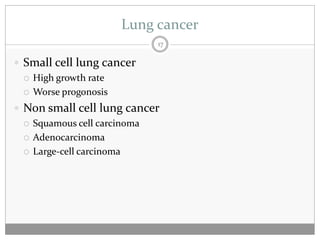
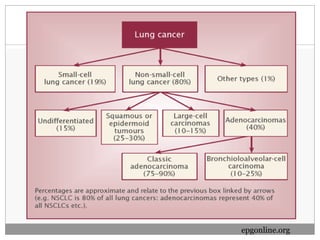
 Small cell lung cancer
   High growth rate

   Worse progonosis

 Non small cell lung cancer
   Squamous cell carcinoma

   Adenocarcinoma

   Large-cell carcinoma
18


     epgonline.org
Reduced respiratory capacity after lung surgery
                                  19

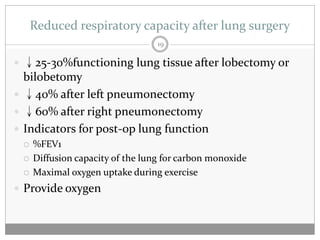
 ↓25-30%functioning lung tissue after lobectomy or
  bilobetomy
 ↓40% after left pneumonectomy
 ↓60% after right pneumonectomy
 Indicators for post-op lung function
    %FEV1
    Diffusion capacity of the lung for carbon monoxide
    Maximal oxygen uptake during exercise
 Provide oxygen
Lung cancer
                            20

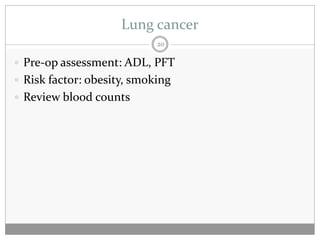
 Pre-op assessment: ADL, PFT
 Risk factor: obesity, smoking
 Review blood counts
Lung cancer
                         21

 Post op care
  Symmetrical  movement of the thoracic cage
  ROM of shoulder
  Breathing training: pursed lip and diaphragmatic
   breathing
  Drainage of secretions/ percussion, use of
   nebulizers
  Splinting cough
  Reconditioning: early ambulation, functional
   independent
Symptoms and signs of Radiation pneumonitis
                              22

 Dyspnea
 Non-productive cough
 Tachypnea
 Low grade fever
 Fullness in the chest
 ↑ESR


Treatment: corticosteroids,
Cardiovascular complications after pneumonectomy
                                    23

 Arrhytmias: 20-25%
   Atrial fibrillation, supraventricular tachycardia, artial flutter

   ↑mortality

 Myocardial infarction
 Acute heart failure
 Pulmonary emboli
 stroke
Possible organ displacement after right
                  pneumonectomy
                            24

 Displacement of the tracheal to the right side
 Displacement of esophagus
 Mediastinal displacement to the empty pleural space
 Elevation of diaphragm and liver
 Deviation of the vertebral column
Superior vena cava obstruction
                           25

 Tumor compress
 Neck swelling
 Distended veins over chest
 Swelling of one or both arms
 Dyspnea
 Hoarse voice
 Stridor
 Headache
26


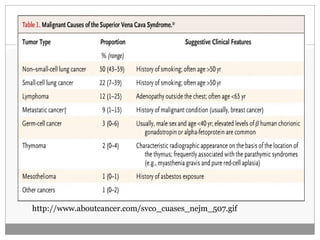
http://www.aboutcancer.com/svco_cuases_nejm_507.gif
PT intervention for SVCO
                               27

 Elevate the patient‘s head
 Oxygen therapy
 Modified chest care skill
 Avoid compression therapy
Colon cancer
                           28

 Ileostomy: after removal of colon and rectum,
  externalized ileum
 Colostomy: rectum removed, distal colon attached to
  abdominal
 Ileo-anal reservoir surgery
Somatic rehabilitation requirements after
                  hemilectomy
                          29

 Hernias
 Diarrhea/constipation
 Adhesions
 Anemia
 Diet/obesity
Precautionary measures to prevent abdominal wall
                     hernia
                            30

 Caution in lifting and carrying heavy loads
 Loads should never lifted suddenly
 Excess weight should be avoided
 Abdominal bandage
Example of physical therapeutic interventions for
                abdominal surgery
                                 31

 Breathing exercise
   Deep breathing/ inspiratory holds

   Incentive spirometry

   Huffing/ directed cough

   Chest percussion/vibration

 Early mobilization
   Log-rolling /bracing with pillow

   Transfer/ gait training

   Progressive ambulation
Gastrointestinal surgery
                         32

 Thoracoscopy
 Laparoscopy
 Esophagectomy
 Esophagus reconstruction
Pre/post upper abdominal and thoracic surgery
                                 33

 Pre op assessment: FEV1
 Post op increased risk of respiratory complication:50%
   Disruption of abdominal and diaphragmatic muscles
    ↓30%FRC for days
   Impaired mucociliary function

 PT programs
   Breathing exercise, Deep breathing, Incentive spirometry,
    Huffing, Chest percussion/vibration
   Early mobilization
Precaution for PT programs after upper abdominal
                 and thoracic surgery
                          34

 Avoid head down postural drainage:
 Suction ??
 Drips and drains
 Shoulder ROM
The environment and patient support/non-
         intravenous equipment after GI sugery
                            35

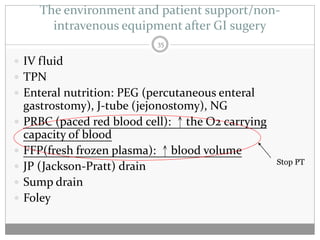
 IV fluid
 TPN
 Enteral nutrition: PEG (percutaneous enteral
    gastrostomy), J-tube (jejonostomy), NG
   PRBC (paced red blood cell): ↑the O2 carrying
    capacity of blood
   FFP(fresh frozen plasma): ↑blood volume
                                                    Stop PT
   JP (Jackson-Pratt) drain
   Sump drain
   Foley
Breathlessness management
                                  36

 Breathing exercise
 Positions
   High side lying

   Sitting upright in a chair with feet, back, and arm support

   Forward lean sitting with arm resting on pillows on a table
Bone metastasis
                        37


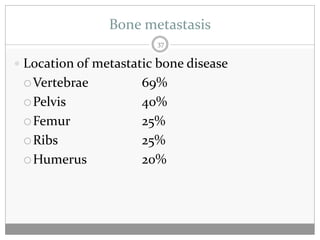
 Location of metastatic bone disease
  Vertebrae          69%
  Pelvis             40%
  Femur              25%
  Ribs               25%
  Humerus            20%
Pain characteristics that may indicate fracture
              or impending fracture
                             38

 Pain with weightbearing
 Pain in the groin
 Pain with hip external rotation and abduction
 Pain with deep breathing
 Pain in a ban around the chest wall
 Increased pain with supine
 Increased pain with valsava
Goal of Surgery for pathological fracture
                           39

 Excision of tumor
 Cure
 Stabilization of bone
 Prevention sequela from bed rest
 Palliation
Reference
                            40

 Physical therapy in acute care : a clinician's guide .
  Edited by Daniel Malone Thorofare, NJ : Slack, 2006.
 Rehabilitation in cancer care. edited by Jane Rankin
  Chichester, UK ; Ames, Iowa : Wiley-Blackwell, 2008.

癌症病人術後物理治療 蕭淑芳

  • 1.
    癌症病人術後物理治療 1 臺大醫院物理治療師 蕭淑芳
  • 2.
    Goal of surgery 2  Debulking a tumor:表示腫瘤已無法完全切除,因此開 刀時只將較大,較易切除的腫塊拿掉  Diagnosing a tumor(biopsy)  Removing precancerous(癌前期) lesions  Resecting a tumor  Correction of life-threatening conditions caused by cancer  Palliation
  • 3.
    Theme for postsurgeryphysical therapy 3  Early mobilization  Prevention of complications: pneumonia, ileus, DVT, loss of lean body mass  Lung hygiene  Splinting cough, diaphragm/deep breathing exercise, posture education  Gait training  Weight bearing restriction? pain?  ADL training
  • 4.
    Management of somecommon cancer 4  Breast cancer  Head and neck cancer  Lung cancer  Colorectal cancer  Gastrointestinal cancer
  • 5.
    Breast cancer 5  Introduction of surgery type  Post op programs
  • 6.
    前哨淋巴切除檢驗(sentinel node dissection) 6  優點:若哨兵淋巴結沒 有癌細胞,則不做腋下 淋巴清除,則減少淋巴 水腫的問題。  缺點:有10﹪的僞陰性 率  建議用在腫瘤2公分以 內及原位癌的患者
  • 7.
    Lumpectomy or partialmastectomy 7  removal of the breast tumor (the "lump") and some of the normal tissue  Lumpectomy : Tumor size<4 cm
  • 8.
    Mastectomy 8  Removal of the whole breast  Simple/ total mastectomy  Modified radical mastectomy  Radical mastectomy  Partial mastectomy  Subcutaneous (nipple-sparing) mastectomy.
  • 9.
    Simple Mastectomy 9  removes the entire breast, skin, nipple  No muscles are removed from beneath the breast
  • 10.
    Modified Radical Mastectomy 10  removal of both breast tissue and lymph nodes:  優點:維持胸部肌肉及 手臂肌肉的張力,  手臂腫脹的情形較施行 乳房根除術輕微  乳房重建較易。
  • 11.
    Radical Mastectomy 11  Most extensive type of mastectomy  Removes :  the entire breast,  Levels I, II, and III of the underarm lymph (B, C, and D in illustration),  chest wall muscles under the breast.  缺點:會留下很長的疤痕,胸部也 會凹陷,可能導致淋巴水腫、手臂 無力、痲痹、疼痛、肩膀活動受限 制等,
  • 12.
    Post op programs 12  Progressive shoulder ROM exercise:  Begin after removal of the drains  http://www.breastcf.org.tw/bloom/personal.php  Postural exercise  Lymphedema education
  • 13.
    Head and neckcancer 13  Site: Lip, tongue, floor of mouth, gum, salivary gland, oropharynx, nasopharynx, larynx, nose and sinuses, ear, thyroid  Surgery type  Radical neck dissection:  Modified radical neck dissection  Selective neck dissection
  • 14.
    Head and neckcancer 14  Reconstruction: TMJ dysfunction  Pectoralis flap:  Fibular flap:  reconstruct the mandible bone; non-weight bearing for 4-7 days  Vascular integrity, peroneal nerve function  Transfer skill, bed mobility  Radical forearm flap:  no weight bearing activity on donor site,  ROM limited to 90 degree before drains removed
  • 15.
    Head and neckcancer 15  Post op care in acute phase  Maintain airway, Lung hygiene and tracheotomy care  Monitor circulation  Prevent infection  Control pain  Postural training  Cervical and shoulder ROM exercise
  • 16.
    Airway management andtracheostomy care 16  Aim of care  Ensure a patent airway  Maintain comfort  Ensure regular breathing rhythm, depth, and pattern  Complication  Bleeding  Tracheoesophageal fistula  Infection  Obstruction or displacement of tracheostomy tube  PT programs  Breathing exercise, cleaning of tracheostomy q2-3h(suction), humidification
  • 17.
    Lung cancer 17  Small cell lung cancer  High growth rate  Worse progonosis  Non small cell lung cancer  Squamous cell carcinoma  Adenocarcinoma  Large-cell carcinoma
  • 18.
    18 epgonline.org
  • 19.
    Reduced respiratory capacityafter lung surgery 19  ↓25-30%functioning lung tissue after lobectomy or bilobetomy  ↓40% after left pneumonectomy  ↓60% after right pneumonectomy  Indicators for post-op lung function  %FEV1  Diffusion capacity of the lung for carbon monoxide  Maximal oxygen uptake during exercise  Provide oxygen
  • 20.
    Lung cancer 20  Pre-op assessment: ADL, PFT  Risk factor: obesity, smoking  Review blood counts
  • 21.
    Lung cancer 21  Post op care  Symmetrical movement of the thoracic cage  ROM of shoulder  Breathing training: pursed lip and diaphragmatic breathing  Drainage of secretions/ percussion, use of nebulizers  Splinting cough  Reconditioning: early ambulation, functional independent
  • 22.
    Symptoms and signsof Radiation pneumonitis 22  Dyspnea  Non-productive cough  Tachypnea  Low grade fever  Fullness in the chest  ↑ESR Treatment: corticosteroids,
  • 23.
    Cardiovascular complications afterpneumonectomy 23  Arrhytmias: 20-25%  Atrial fibrillation, supraventricular tachycardia, artial flutter  ↑mortality  Myocardial infarction  Acute heart failure  Pulmonary emboli  stroke
  • 24.
    Possible organ displacementafter right pneumonectomy 24  Displacement of the tracheal to the right side  Displacement of esophagus  Mediastinal displacement to the empty pleural space  Elevation of diaphragm and liver  Deviation of the vertebral column
  • 25.
    Superior vena cavaobstruction 25  Tumor compress  Neck swelling  Distended veins over chest  Swelling of one or both arms  Dyspnea  Hoarse voice  Stridor  Headache
  • 26.
  • 27.
    PT intervention forSVCO 27  Elevate the patient‘s head  Oxygen therapy  Modified chest care skill  Avoid compression therapy
  • 28.
    Colon cancer 28  Ileostomy: after removal of colon and rectum, externalized ileum  Colostomy: rectum removed, distal colon attached to abdominal  Ileo-anal reservoir surgery
  • 29.
    Somatic rehabilitation requirementsafter hemilectomy 29  Hernias  Diarrhea/constipation  Adhesions  Anemia  Diet/obesity
  • 30.
    Precautionary measures toprevent abdominal wall hernia 30  Caution in lifting and carrying heavy loads  Loads should never lifted suddenly  Excess weight should be avoided  Abdominal bandage
  • 31.
    Example of physicaltherapeutic interventions for abdominal surgery 31  Breathing exercise  Deep breathing/ inspiratory holds  Incentive spirometry  Huffing/ directed cough  Chest percussion/vibration  Early mobilization  Log-rolling /bracing with pillow  Transfer/ gait training  Progressive ambulation
  • 32.
    Gastrointestinal surgery 32  Thoracoscopy  Laparoscopy  Esophagectomy  Esophagus reconstruction
  • 33.
    Pre/post upper abdominaland thoracic surgery 33  Pre op assessment: FEV1  Post op increased risk of respiratory complication:50%  Disruption of abdominal and diaphragmatic muscles ↓30%FRC for days  Impaired mucociliary function  PT programs  Breathing exercise, Deep breathing, Incentive spirometry, Huffing, Chest percussion/vibration  Early mobilization
  • 34.
    Precaution for PTprograms after upper abdominal and thoracic surgery 34  Avoid head down postural drainage:  Suction ??  Drips and drains  Shoulder ROM
  • 35.
    The environment andpatient support/non- intravenous equipment after GI sugery 35  IV fluid  TPN  Enteral nutrition: PEG (percutaneous enteral gastrostomy), J-tube (jejonostomy), NG  PRBC (paced red blood cell): ↑the O2 carrying capacity of blood  FFP(fresh frozen plasma): ↑blood volume Stop PT  JP (Jackson-Pratt) drain  Sump drain  Foley
  • 36.
    Breathlessness management 36  Breathing exercise  Positions  High side lying  Sitting upright in a chair with feet, back, and arm support  Forward lean sitting with arm resting on pillows on a table
  • 37.
    Bone metastasis 37  Location of metastatic bone disease  Vertebrae 69%  Pelvis 40%  Femur 25%  Ribs 25%  Humerus 20%
  • 38.
    Pain characteristics thatmay indicate fracture or impending fracture 38  Pain with weightbearing  Pain in the groin  Pain with hip external rotation and abduction  Pain with deep breathing  Pain in a ban around the chest wall  Increased pain with supine  Increased pain with valsava
  • 39.
    Goal of Surgeryfor pathological fracture 39  Excision of tumor  Cure  Stabilization of bone  Prevention sequela from bed rest  Palliation
  • 40.
    Reference 40  Physical therapy in acute care : a clinician's guide . Edited by Daniel Malone Thorofare, NJ : Slack, 2006.  Rehabilitation in cancer care. edited by Jane Rankin Chichester, UK ; Ames, Iowa : Wiley-Blackwell, 2008.