Exercise of Cancer Patient:
Prevention, Survival & End of Life


           曹昭懿
         臺大物理治療學系
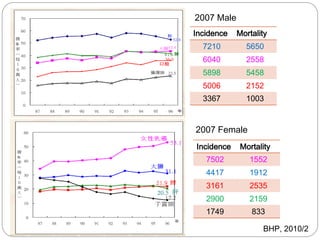
2007 Male
Incidence   Mortality
  7210        5650
  6040        2558
  5898        5458
  5006        2152
  3367        1003


2007 Female
Incidence   Mortality
   7502        1552
   4417        1912
   3161        2535
   2900        2159
   1749         833

                   BHP, 2010/2
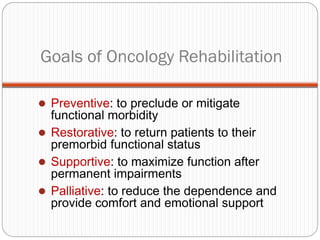
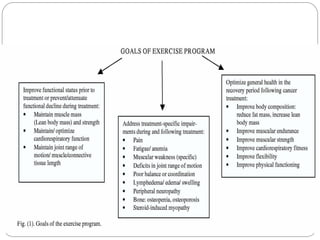
Goals of Oncology Rehabilitation

 Preventive: to preclude or mitigate
  functional morbidity
 Restorative: to return patients to their
  premorbid functional status
 Supportive: to maximize function after
  permanent impairments
 Palliative: to reduce the dependence and
  provide comfort and emotional support
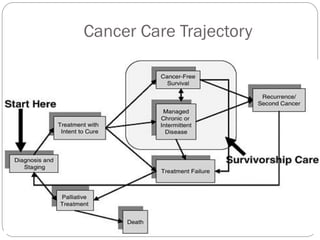
Cancer Care Trajectory


4
Cancer Rehabilitation
 System specific problems
 Activity restrictions
   ADL
   Ambulation
   Mobility
   Transfer
 Psychological problems
 Immobility syndrome
 Fatigue
 Sexuality
 Quality of life
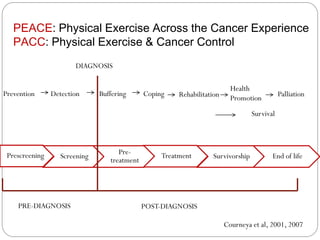
PEACE: Physical Exercise Across the Cancer Experience
   PACC: Physical Exercise & Cancer Control
                       DIAGNOSIS

                                                                          Health
Prevention      Detection     Buffering      Coping    Rehabilitation                       Palliation
                                                                          Promotion
                                                                                 Survival


 Prescreening                       Pre-          Treatment
                  Screening                                       Survivorship          End of life
                                 treatment


    PRE-DIAGNOSIS                            POST-DIAGNOSIS

                                                                        Courneya et al, 2001, 2007
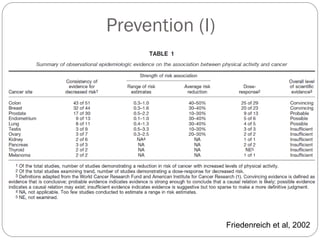
Prevention (I)


                 Friedenreich et al, 2002
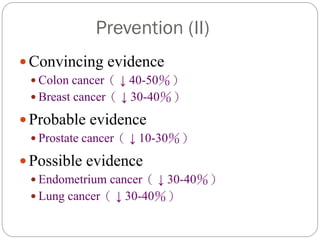
Prevention (II)
 Convincing evidence
  Colon cancer( ↓ 40-50%)
  Breast cancer( ↓ 30-40%)

 Probable evidence
  Prostate cancer( ↓ 10-30%)

 Possible evidence
  Endometrium cancer( ↓ 30-40%)
  Lung cancer( ↓ 30-40%)
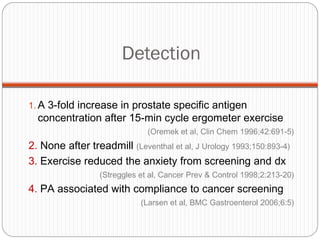
Detection

1. A 3-fold increase in prostate specific antigen
  concentration after 15-min cycle ergometer exercise
                               (Oremek et al, Clin Chem 1996;42:691-5)
2. None after treadmill (Leventhal et al, J Urology 1993;150:893-4)
3. Exercise reduced the anxiety from screening and dx
                  (Streggles et al, Cancer Prev & Control 1998;2:213-20)
4. PA associated with compliance to cancer screening
                             (Larsen et al, BMC Gastroenterol 2006;6:5)
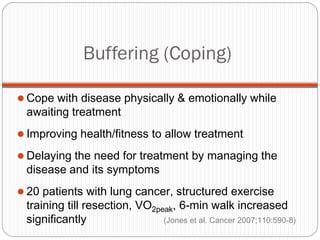
Buffering (Coping)

 Cope with disease physically & emotionally while
 awaiting treatment
 Improving health/fitness to allow treatment

 Delaying the need for treatment by managing the
 disease and its symptoms
 20 patients with lung cancer, structured exercise
 training till resection, VO2peak, 6-min walk increased
 significantly                 (Jones et al. Cancer 2007;110:590-8)
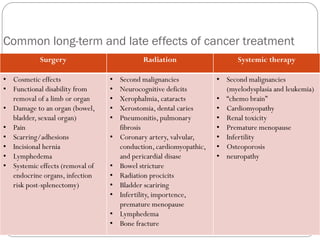
Common long-term and late effects of cancer treatment
            Surgery                         Radiation                     Systemic therapy

• Cosmetic effects               •   Second malignancies            • Second malignancies
• Functional disability from     •   Neurocognitive deficits          (myelodysplasia and leukemia)
  removal of a limb or organ     •   Xerophalmia, cataracts         • “chemo brain”
• Damage to an organ (bowel,     •   Xerostomia, dental caries      • Cardiomyopathy
  bladder, sexual organ)         •   Pneumonitis, pulmonary         • Renal toxicity
• Pain                               fibrosis                       • Premature menopause
• Scarring/adhesions             •   Coronary artery, valvular,     • Infertility
• Incisional hernia                  conduction, cardiomyopathic,   • Osteoporosis
• Lymphedema                         and pericardial disase         • neuropathy
• Systemic effects (removal of   •   Bowel stricture
  endocrine organs, infection    •   Radiation procicits
  risk post-splenectomy)         •   Bladder scariring
                                 •   Infertility, importence,
                                     premature menopause
                                 •   Lymphedema
                                 •   Bone fracture
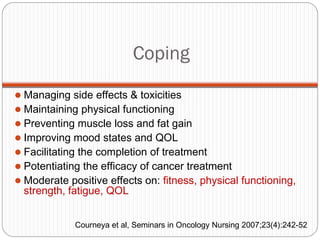
Coping
 Managing side effects & toxicities
 Maintaining physical functioning
 Preventing muscle loss and fat gain
 Improving mood states and QOL
 Facilitating the completion of treatment
 Potentiating the efficacy of cancer treatment
 Moderate positive effects on: fitness, physical functioning,
  strength, fatigue, QOL


             Courneya et al, Seminars in Oncology Nursing 2007;23(4):242-52
Rehabilitation

 10 studies: post treatment 3-6 months

 Feasible and may provide physiological and
 psychological benefits on
    Physical functioning
    Fatigue & QOL
    Immune
    Body composition


              Spence et al, Cancer Treatment Review 2010;36:185-94.
Survival

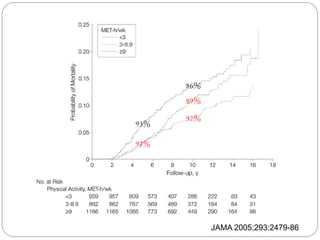
Nurses’ Health Study (NHS, N=121700):
exercise & cancer recurrence & mortality
  Holmes et al. 2005, JAMA

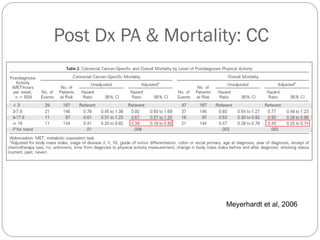
  Meyerhardt et al. 2006, J Clin Oncol
86%
      89%

      92%
93%

97%


            JAMA 2005;293:2479-86
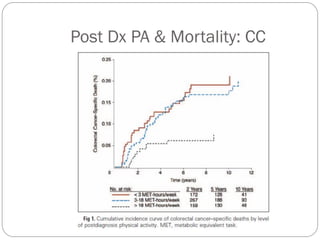
Post Dx PA & Mortality: CC


                    Meyerhardt et al, 2006
Post Dx PA & Mortality: CC
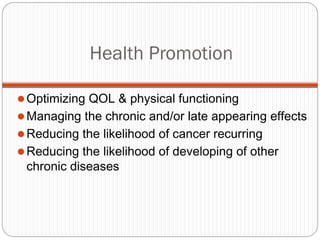
Health Promotion

 Optimizing QOL & physical functioning
 Managing the chronic and/or late appearing effects
 Reducing the likelihood of cancer recurring
 Reducing the likelihood of developing of other
 chronic diseases
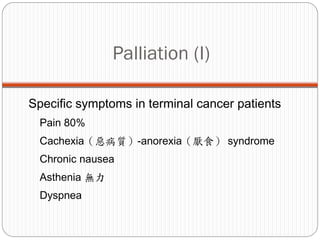
Palliation (I)

Specific symptoms in terminal cancer patients
 Pain 80%
 Cachexia(惡病質)-anorexia(厭食) syndrome
 Chronic nausea
 Asthenia 無力
 Dyspnea
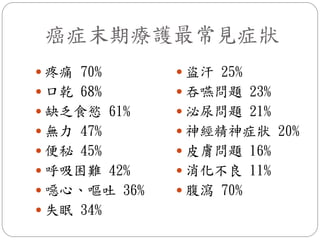
癌症末期療護最常見症狀
 疼痛 70%       盜汗 25%
 口乾 68%       吞嚥問題 23%
 缺乏食慾 61%     泌尿問題 21%
 無力 47%       神經精神症狀 20%
 便秘 45%       皮膚問題 16%
 呼吸困難 42%     消化不良 11%
 噁心、嘔吐 36%    腹瀉 70%
 失眠 34%
Palliation (II)

 Managing symptoms
 Improving mobility
 Slowing functional decline
 Maintaining QOL
 6-week structured PA : significant decrease in
  fatigue & increase in physical performance &
  emotional functioning            (Oldervoll et al, 2005, 2006 )

 50 patients, home-based PA, walking
                     (Lowe, et al. Support Care Cancer 2010;18:1469-75)
癌因性疲倦 Cancer Related Fatigue

常伴隨癌症相關治療引起
休息不會降低疲倦感
常有睡眠障礙
處理原則
 輕度適量運動
 節省體能措施
 心理支持與轉移注意力
 睡眠衛生
 治療相關症狀如貧血
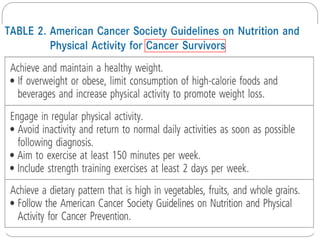
美國癌症協會防癌指引
 Achieve and maintain a healthy weight throughout life
 Adopt a physically active lifestyle
   成人:每周至少150分鐘中等程度運動或75分鐘劇烈運動,
     或是相當的運動量,最好平均分配到每一天
    兒童及青少年:每天至少60分鐘中至強度運動,每週至少3
     天以上為劇烈運動量。
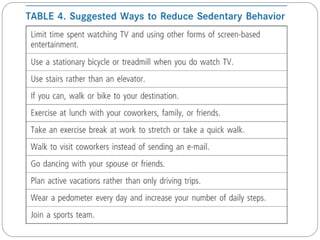
    減少靜態生活,例如坐、躺著、看電視或其它對著螢幕
     (screen-based )形式的娛樂。
    除了日常生活外,多增加身體活動,對健康有很多益處。
 Consume a healthy diet, with emphasis on plant food
 If you drink alcoholic beverage, limit consumption

 ACS guidelines on nutrition and physical activity for cancer prevention, 2012
27
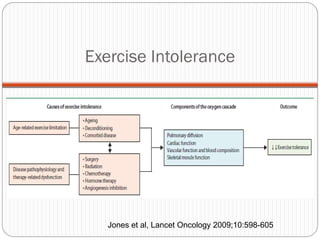
Exercise Intolerance


   Jones et al, Lancet Oncology 2009;10:598-605
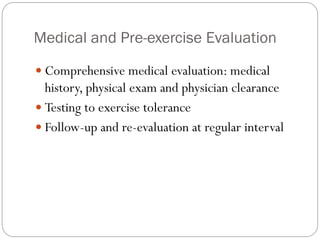
Medical and Pre-exercise Evaluation
 Comprehensive medical evaluation: medical
  history, physical exam and physician clearance
 Testing to exercise tolerance
 Follow-up and re-evaluation at regular interval
癌症病人的評估

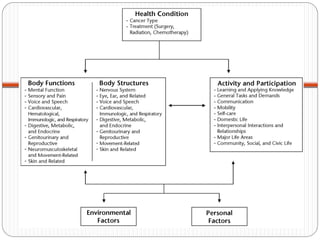
身體結構與功能(body structure and function)
 心智
 感覺功能與疼痛
 神經肌骨系統與動作相關結構與功能
 心血管、呼吸、血液、免疫
 疲倦
 Red flags and yellow flags
活動與參與(activity and participation)
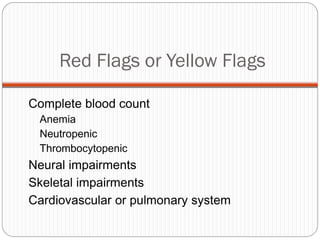
Red Flags or Yellow Flags

Complete blood count
 Anemia
 Neutropenic
 Thrombocytopenic
Neural impairments
Skeletal impairments
Cardiovascular or pulmonary system
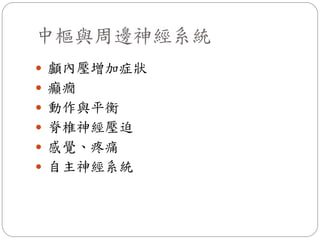
中樞與周邊神經系統
 顱內壓增加症狀
 癲癇
 動作與平衡
 脊椎神經壓迫
 感覺、疼痛
 自主神經系統
骨骼轉移
 60%的癌症復發會轉移到骨骼,其中一半轉移到脊椎骨
 癌症對骨骼的影響
  Loss of bone material (lytic tumor)
  Invasion of bone (sclerotic tumor)
  Osteonecrosis
  Reduced bone mineral density
 主要症狀
  疼痛
  脊髓神經症狀
  病理性骨折
Health-related Physical Fitness
Testing and Interpretation

Body composition: BMI, circumference,
 skinfold, DXA
Cardiorespiratory fitness: VO2max, HRmax, 6-
 min walking, 3-min step
Muscular strength and muscular endurance
Flexibility
                       ACSM’s guideline for exercise
                       testing and prescription
Physical Functioning
 Eastern Cooperative Oncology Group (ECOG)
  scale
 Karnofsky Performance Status scale (KPS scale)
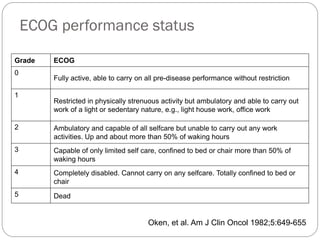
ECOG performance status

Grade   ECOG
0
        Fully active, able to carry on all pre-disease performance without restriction

1
        Restricted in physically strenuous activity but ambulatory and able to carry out
        work of a light or sedentary nature, e.g., light house work, office work

2       Ambulatory and capable of all selfcare but unable to carry out any work
        activities. Up and about more than 50% of waking hours
3       Capable of only limited self care, confined to bed or chair more than 50% of
        waking hours
4       Completely disabled. Cannot carry on any selfcare. Totally confined to bed or
        chair
5       Dead


                                       Oken, et al. Am J Clin Oncol 1982;5:649-655
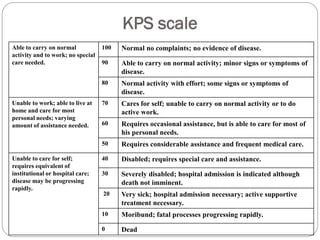
KPS scale
Able to carry on normal            100   Normal no complaints; no evidence of disease.
activity and to work; no special
care needed.                       90    Able to carry on normal activity; minor signs or symptoms of
                                         disease.
                                   80    Normal activity with effort; some signs or symptoms of
                                         disease.
Unable to work; able to live at    70    Cares for self; unable to carry on normal activity or to do
home and care for most                   active work.
personal needs; varying
amount of assistance needed.       60    Requires occasional assistance, but is able to care for most of
                                         his personal needs.
                                   50    Requires considerable assistance and frequent medical care.
Unable to care for self;           40    Disabled; requires special care and assistance.
requires equivalent of
institutional or hospital care;    30    Severely disabled; hospital admission is indicated although
disease may be progressing               death not imminent.
rapidly.
                                   20    Very sick; hospital admission necessary; active supportive
                                         treatment necessary.
                                   10    Moribund; fatal processes progressing rapidly.
                                   0     Dead
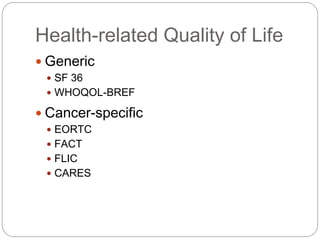
Health-related Quality of Life
 Generic
  SF 36
  WHOQOL-BREF

 Cancer-specific
  EORTC
  FACT
  FLIC
  CARES
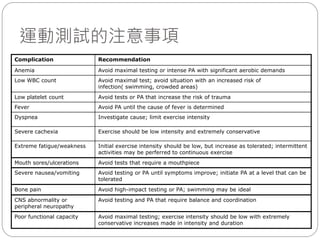
運動測試的注意事項
Complication               Recommendation

Anemia                     Avoid maximal testing or intense PA with significant aerobic demands
Low WBC count              Avoid maximal test; avoid situation with an increased risk of
                           infection( swimming, crowded areas)
Low platelet count         Avoid tests or PA that increase the risk of trauma
Fever                      Avoid PA until the cause of fever is determined
Dyspnea                    Investigate cause; limit exercise intensity

Severe cachexia            Exercise should be low intensity and extremely conservative

Extreme fatigue/weakness   Initial exercise intensity should be low, but increase as tolerated; intermittent
                           activities may be perferred to continuous exercise
Mouth sores/ulcerations    Avoid tests that require a mouthpiece
Severe nausea/vomiting     Avoid testing or PA until symptoms improve; initiate PA at a level that can be
                           tolerated
Bone pain                  Avoid high-impact testing or PA; swimming may be ideal
CNS abnormality or         Avoid testing and PA that require balance and coordination
peripheral neuropathy
Poor functional capacity   Avoid maximal testing; exercise intensity should be low with extremely
                           conservative increases made in intensity and duration
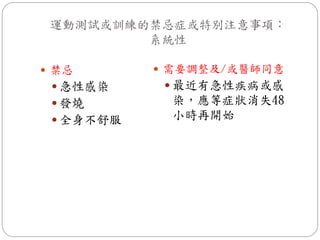
運動測試或訓練的禁忌症或特別注意事項:
         系統性

 禁忌        需要調整及/或醫師同意
  急性感染      最近有急性疾病或感
  發燒       染,應等症狀消失48
  全身不舒服    小時再開始
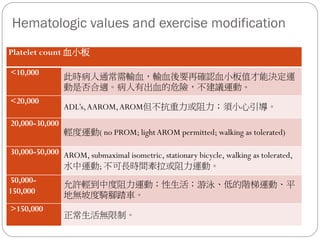
Hematologic values and exercise modification
Platelet count 血小板

<10,000         此時病人通常需輸血,輸血後要再確認血小板值才能決定運
                動是否合適。病人有出血的危險,不建議運動。
<20,000
                ADL’s, AAROM, AROM但不抗重力或阻力;須小心引導。
20,000-30,000
                輕度運動( no PROM; light AROM permitted; walking as tolerated)

30,000-50,000 AROM, submaximal isometric, stationary bicycle, walking as tolerated,
              水中運動; 不可長時間牽拉或阻力運動。
50,000-
                允許輕到中度阻力運動;性生活;游泳、低的階梯運動、平
150,000         地無坡度騎腳踏車。
>150,000
                正常生活無限制。
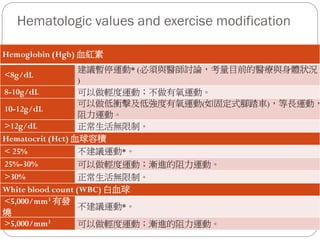
Hematologic values and exercise modification

Hemoglobin (Hgb) 血紅素
                   建議暫停運動* (必須與醫師討論,考量目前的醫療與身體狀況
<8g/dL
                   )
8-10g/dL           可以做輕度運動;不做有氧運動。
                   可以做低衝擊及低強度有氧運動(如固定式腳踏車),等長運動,
10-12g/dL
                   阻力運動。
>12g/dL            正常生活無限制。
Hematocrit (Hct) 血球容積
< 25%              不建議運動*。
25%-30%            可以做輕度運動;漸進的阻力運動。
>30%               正常生活無限制。
White blood count (WBC) 白血球
<5,000/mm3 有發
                   不建議運動*。
燒
>5,000/mm3         可以做輕度運動;漸進的阻力運動。
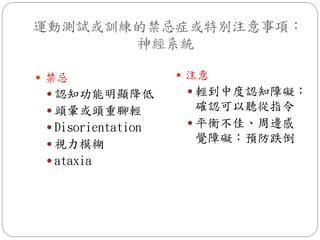
運動測試或訓練的禁忌症或特別注意事項:
       神經系統

 禁忌                 注意
  認知功能明顯降低           輕到中度認知障礙:
  頭暈或頭重腳輕             確認可以聽從指令
  Disorientation     平衡不佳、周邊感
  視力模糊
                       覺障礙:預防跌倒
  ataxia
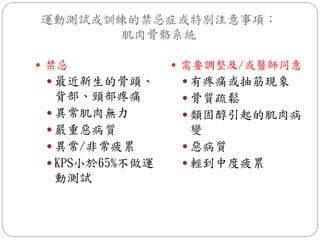
運動測試或訓練的禁忌症或特別注意事項:
       肌肉骨骼系統

 禁忌              需要調整及/或醫師同意
  最近新生的骨頭、        有疼痛或抽筋現象
   背部、頸部疼痛         骨質疏鬆
  異常肌肉無力          類固醇引起的肌肉病
  嚴重惡病質            變
  異常/非常疲累         惡病質
  KPS小於65%不做運     輕到中度疲累
   動測試
運動測試或訓練的禁忌症或特別注意事項:
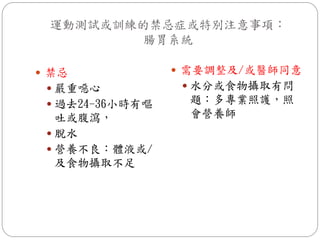
         腸胃系統

 禁忌              需要調整及/或醫師同意
  嚴重噁心            水分或食物攝取有問
  過去24-36小時有嘔    題:多專業照護,照
   吐或腹瀉,          會營養師
  脫水
  營養不良:體液或/
   及食物攝取不足
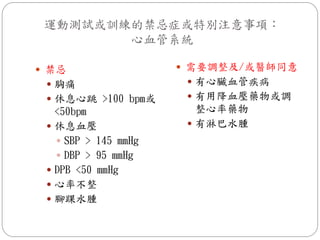
運動測試或訓練的禁忌症或特別注意事項:
        心血管系統

 禁忌                   需要調整及/或醫師同意
  胸痛                   有心臟血管疾病
  休息心跳 >100 bpm或       有用降血壓藥物或調
   <50bpm                整心率藥物
  休息血壓                 有淋巴水腫
    SBP > 145 mmHg
    DBP > 95 mmHg
  DPB <50 mmHg
  心率不整
  腳踝水腫
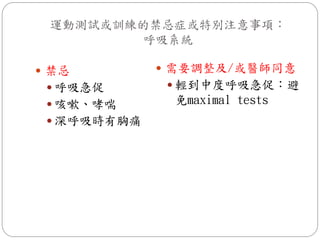
運動測試或訓練的禁忌症或特別注意事項:
         呼吸系統

 禁忌          需要調整及/或醫師同意
  呼吸急促        輕到中度呼吸急促:避
  咳嗽、哮喘      免maximal tests
  深呼吸時有胸痛
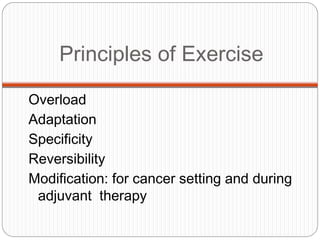
Principles of Exercise

Overload
Adaptation
Specificity
Reversibility
Modification: for cancer setting and during
 adjuvant therapy
運動處方
運動方式
 有氧運動訓練:心肺適能
 肌力與肌耐力訓練
 柔軟度:關節活動與牽拉運動
劑量
 強度
 頻率
 時間
Home-based VS supervised group
癌症治療中運動原則
 根據病人狀況與個別喜好給予個別化運動計
  畫
 本來已有運動者可以降低強度及/或縮短時
  間,但主要目標要盡量維持活動
 如果之前不太活動,先從輕度活動慢慢增加
 小心有跌倒或受傷風險
 最好有人在旁邊
 如果病人在臥床,建議物理治療協助維持肌
  力與關節活動度,以及幫助抵抗疲倦與沮喪
癌症病人運動處方之特別考量
 生命徵象
 身上有傷口、管路
 發燒
 貧血、白血球、血小板低下
 骨骼疼痛、轉移、骨質密度下降
 神經系統損傷
 嚴重疲累
有 氧 運 動
 型態:走路、跑步機、固定式腳踏車、手搖腳踏車。
太極?瑜珈?氣功?(化療期間不建議游泳)
 時間:15~30 分鐘(可增至40~50分鐘)
 強度:低至中度(一點點喘,50%最大心跳MHR開
始或是40%之保留心跳HRR+休息心跳)
  MHR=220-年齡
  =40% *HRR(最大心跳-休息心跳)+休息心跳
 頻率:每週2~3次→3~5次
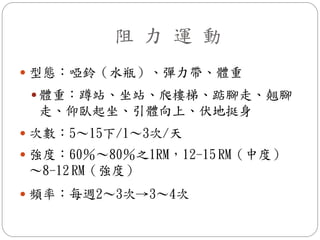
阻 力 運 動
 型態:啞鈴(水瓶)、彈力帶、體重
  體重:蹲站、坐站、爬樓梯、踮腳走、翹腳
  走、仰臥起坐、引體向上、伏地挺身
 次數:5~15下/1~3次/天
 強度:60%~80%之1RM,12-15 RM(中度)
 ~8-12 RM(強度)
 頻率:每週2~3次→3~4次
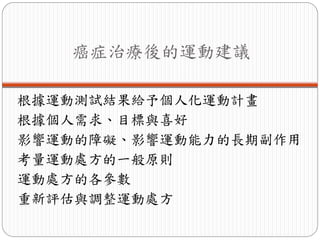
癌症治療後的運動建議

根據運動測試結果給予個人化運動計畫
根據個人需求、目標與喜好
影響運動的障礙、影響運動能力的長期副作用
考量運動處方的一般原則
運動處方的各參數
重新評估與調整運動處方
57
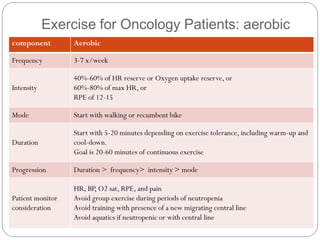
Exercise for Oncology Patients: aerobic
component         Aerobic

Frequency         3-7 x/week

                  40%-60% of HR reserve or Oxygen uptake reserve, or
Intensity         60%-80% of max HR, or
                  RPE of 12-15

Mode              Start with walking or recumbent bike

                  Start with 5-20 minutes depending on exercise tolerance, including warm-up and
Duration          cool-down.
                  Goal is 20-60 minutes of continuous exercise

Progression       Duration > frequency> intensity > mode

                  HR, BP, O2 sat, RPE, and pain
Patient monitor   Avoid group exercise during periods of neutropenia
consideration     Avoid training with presence of a new migrating central line
                  Avoid aquatics if neutropenic or with central line
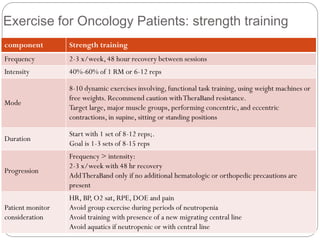
Exercise for Oncology Patients: strength training
component         Strength training
Frequency         2-3 x/week, 48 hour recovery between sessions
Intensity         40%-60% of 1 RM or 6-12 reps

                  8-10 dynamic exercises involving, functional task training, using weight machines or
                  free weights. Recommend caution with TheraBand resistance.
Mode
                  Target large, major muscle groups, performing concentric, and eccentric
                  contractions, in supine, sitting or standing positions

                  Start with 1 set of 8-12 reps;.
Duration
                  Goal is 1-3 sets of 8-15 reps
                  Frequency > intensity:
                  2-3 x/week with 48 hr recovery
Progression
                  Add TheraBand only if no additional hematologic or orthopedic precautions are
                  present
                  HR, BP, O2 sat, RPE, DOE and pain
Patient monitor   Avoid group exercise during periods of neutropenia
consideration     Avoid training with presence of a new migrating central line
                  Avoid aquatics if neutropenic or with central line
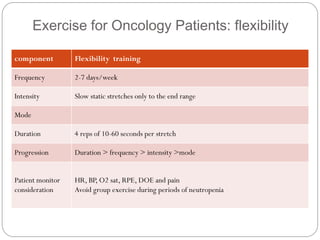
Exercise for Oncology Patients: flexibility

component         Flexibility training

Frequency         2-7 days/week

Intensity         Slow static stretches only to the end range

Mode

Duration          4 reps of 10-60 seconds per stretch

Progression       Duration > frequency > intensity >mode


Patient monitor   HR, BP, O2 sat, RPE, DOE and pain
consideration     Avoid group exercise during periods of neutropenia
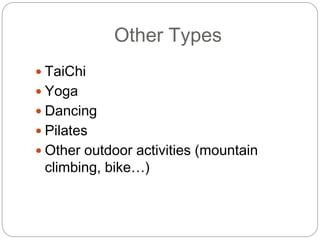
Other Types
 TaiChi
 Yoga
 Dancing
 Pilates
 Other outdoor activities (mountain
 climbing, bike…)
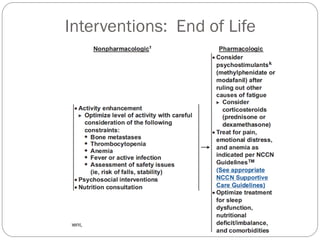
Interventions: End of Life
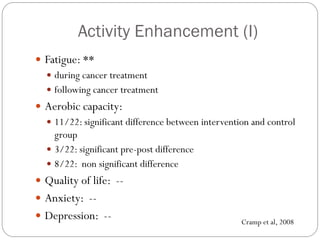
Activity Enhancement (I)
 Fatigue: **
   during cancer treatment
   following cancer treatment
 Aerobic capacity:
   11/22: significant difference between intervention and control
    group
   3/22: significant pre-post difference
   8/22: non significant difference
 Quality of life: --
 Anxiety: --
 Depression: --                                    Cramp et al, 2008
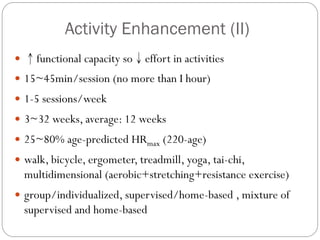
Activity Enhancement (II)
 ↑functional capacity so↓effort in activities
 15~45min/session (no more than I hour)
 1-5 sessions/week
 3~32 weeks, average: 12 weeks
 25~80% age-predicted HRmax (220-age)
 walk, bicycle, ergometer, treadmill, yoga, tai-chi,
  multidimensional (aerobic+stretching+resistance exercise)
 group/individualized, supervised/home-based , mixture of
  supervised and home-based
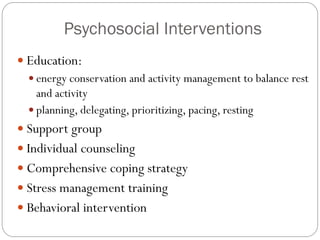
Psychosocial Interventions
 Education:
   energy conservation and activity management to balance rest
    and activity
   planning, delegating, prioritizing, pacing, resting
 Support group
 Individual counseling
 Comprehensive coping strategy
 Stress management training
 Behavioral intervention
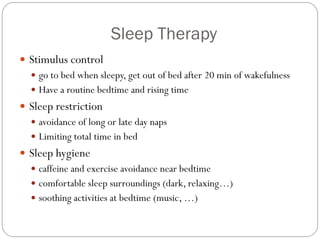
Sleep Therapy
 Stimulus control
   go to bed when sleepy, get out of bed after 20 min of wakefulness
   Have a routine bedtime and rising time
 Sleep restriction
   avoidance of long or late day naps
   Limiting total time in bed
 Sleep hygiene
   caffeine and exercise avoidance near bedtime
   comfortable sleep surroundings (dark, relaxing…)
   soothing activities at bedtime (music, …)
Thank You!

癌症病人之運動處方 曹昭懿

  • 1.
    Exercise of CancerPatient: Prevention, Survival & End of Life 曹昭懿 臺大物理治療學系
  • 2.
    2007 Male Incidence Mortality 7210 5650 6040 2558 5898 5458 5006 2152 3367 1003 2007 Female Incidence Mortality 7502 1552 4417 1912 3161 2535 2900 2159 1749 833 BHP, 2010/2
  • 3.
    Goals of OncologyRehabilitation  Preventive: to preclude or mitigate functional morbidity  Restorative: to return patients to their premorbid functional status  Supportive: to maximize function after permanent impairments  Palliative: to reduce the dependence and provide comfort and emotional support
  • 4.
  • 5.
    Cancer Rehabilitation  Systemspecific problems  Activity restrictions  ADL  Ambulation  Mobility  Transfer  Psychological problems  Immobility syndrome  Fatigue  Sexuality  Quality of life
  • 6.
    PEACE: Physical ExerciseAcross the Cancer Experience PACC: Physical Exercise & Cancer Control DIAGNOSIS Health Prevention Detection Buffering Coping Rehabilitation Palliation Promotion Survival Prescreening Pre- Treatment Screening Survivorship End of life treatment PRE-DIAGNOSIS POST-DIAGNOSIS Courneya et al, 2001, 2007
  • 7.
    Prevention (I) Friedenreich et al, 2002
  • 8.
    Prevention (II)  Convincingevidence  Colon cancer( ↓ 40-50%)  Breast cancer( ↓ 30-40%)  Probable evidence  Prostate cancer( ↓ 10-30%)  Possible evidence  Endometrium cancer( ↓ 30-40%)  Lung cancer( ↓ 30-40%)
  • 9.
    Detection 1. A 3-foldincrease in prostate specific antigen concentration after 15-min cycle ergometer exercise (Oremek et al, Clin Chem 1996;42:691-5) 2. None after treadmill (Leventhal et al, J Urology 1993;150:893-4) 3. Exercise reduced the anxiety from screening and dx (Streggles et al, Cancer Prev & Control 1998;2:213-20) 4. PA associated with compliance to cancer screening (Larsen et al, BMC Gastroenterol 2006;6:5)
  • 10.
    Buffering (Coping)  Copewith disease physically & emotionally while awaiting treatment  Improving health/fitness to allow treatment  Delaying the need for treatment by managing the disease and its symptoms  20 patients with lung cancer, structured exercise training till resection, VO2peak, 6-min walk increased significantly (Jones et al. Cancer 2007;110:590-8)
  • 11.
    Common long-term andlate effects of cancer treatment Surgery Radiation Systemic therapy • Cosmetic effects • Second malignancies • Second malignancies • Functional disability from • Neurocognitive deficits (myelodysplasia and leukemia) removal of a limb or organ • Xerophalmia, cataracts • “chemo brain” • Damage to an organ (bowel, • Xerostomia, dental caries • Cardiomyopathy bladder, sexual organ) • Pneumonitis, pulmonary • Renal toxicity • Pain fibrosis • Premature menopause • Scarring/adhesions • Coronary artery, valvular, • Infertility • Incisional hernia conduction, cardiomyopathic, • Osteoporosis • Lymphedema and pericardial disase • neuropathy • Systemic effects (removal of • Bowel stricture endocrine organs, infection • Radiation procicits risk post-splenectomy) • Bladder scariring • Infertility, importence, premature menopause • Lymphedema • Bone fracture
  • 12.
    Coping  Managing sideeffects & toxicities  Maintaining physical functioning  Preventing muscle loss and fat gain  Improving mood states and QOL  Facilitating the completion of treatment  Potentiating the efficacy of cancer treatment  Moderate positive effects on: fitness, physical functioning, strength, fatigue, QOL Courneya et al, Seminars in Oncology Nursing 2007;23(4):242-52
  • 13.
    Rehabilitation  10 studies:post treatment 3-6 months  Feasible and may provide physiological and psychological benefits on  Physical functioning  Fatigue & QOL  Immune  Body composition Spence et al, Cancer Treatment Review 2010;36:185-94.
  • 14.
    Survival Nurses’ Health Study(NHS, N=121700): exercise & cancer recurrence & mortality  Holmes et al. 2005, JAMA  Meyerhardt et al. 2006, J Clin Oncol
  • 15.
    86% 89% 92% 93% 97% JAMA 2005;293:2479-86
  • 16.
    Post Dx PA& Mortality: CC Meyerhardt et al, 2006
  • 17.
    Post Dx PA& Mortality: CC
  • 18.
    Health Promotion  OptimizingQOL & physical functioning  Managing the chronic and/or late appearing effects  Reducing the likelihood of cancer recurring  Reducing the likelihood of developing of other chronic diseases
  • 19.
    Palliation (I) Specific symptomsin terminal cancer patients Pain 80% Cachexia(惡病質)-anorexia(厭食) syndrome Chronic nausea Asthenia 無力 Dyspnea
  • 20.
    癌症末期療護最常見症狀  疼痛 70%  盜汗 25%  口乾 68%  吞嚥問題 23%  缺乏食慾 61%  泌尿問題 21%  無力 47%  神經精神症狀 20%  便秘 45%  皮膚問題 16%  呼吸困難 42%  消化不良 11%  噁心、嘔吐 36%  腹瀉 70%  失眠 34%
  • 21.
    Palliation (II)  Managingsymptoms  Improving mobility  Slowing functional decline  Maintaining QOL  6-week structured PA : significant decrease in fatigue & increase in physical performance & emotional functioning (Oldervoll et al, 2005, 2006 )  50 patients, home-based PA, walking (Lowe, et al. Support Care Cancer 2010;18:1469-75)
  • 22.
    癌因性疲倦 Cancer RelatedFatigue 常伴隨癌症相關治療引起 休息不會降低疲倦感 常有睡眠障礙 處理原則 輕度適量運動 節省體能措施 心理支持與轉移注意力 睡眠衛生 治療相關症狀如貧血
  • 23.
    美國癌症協會防癌指引  Achieve andmaintain a healthy weight throughout life  Adopt a physically active lifestyle  成人:每周至少150分鐘中等程度運動或75分鐘劇烈運動, 或是相當的運動量,最好平均分配到每一天  兒童及青少年:每天至少60分鐘中至強度運動,每週至少3 天以上為劇烈運動量。  減少靜態生活,例如坐、躺著、看電視或其它對著螢幕 (screen-based )形式的娛樂。  除了日常生活外,多增加身體活動,對健康有很多益處。  Consume a healthy diet, with emphasis on plant food  If you drink alcoholic beverage, limit consumption ACS guidelines on nutrition and physical activity for cancer prevention, 2012
  • 26.
  • 27.
    Exercise Intolerance Jones et al, Lancet Oncology 2009;10:598-605
  • 28.
    Medical and Pre-exerciseEvaluation  Comprehensive medical evaluation: medical history, physical exam and physician clearance  Testing to exercise tolerance  Follow-up and re-evaluation at regular interval
  • 29.
    癌症病人的評估 身體結構與功能(body structure andfunction) 心智 感覺功能與疼痛 神經肌骨系統與動作相關結構與功能 心血管、呼吸、血液、免疫 疲倦 Red flags and yellow flags 活動與參與(activity and participation)
  • 31.
    Red Flags orYellow Flags Complete blood count Anemia Neutropenic Thrombocytopenic Neural impairments Skeletal impairments Cardiovascular or pulmonary system
  • 32.
    中樞與周邊神經系統  顱內壓增加症狀  癲癇 動作與平衡  脊椎神經壓迫  感覺、疼痛  自主神經系統
  • 33.
    骨骼轉移  60%的癌症復發會轉移到骨骼,其中一半轉移到脊椎骨  癌症對骨骼的影響  Loss of bone material (lytic tumor)  Invasion of bone (sclerotic tumor)  Osteonecrosis  Reduced bone mineral density  主要症狀  疼痛  脊髓神經症狀  病理性骨折
  • 34.
    Health-related Physical Fitness Testingand Interpretation Body composition: BMI, circumference, skinfold, DXA Cardiorespiratory fitness: VO2max, HRmax, 6- min walking, 3-min step Muscular strength and muscular endurance Flexibility ACSM’s guideline for exercise testing and prescription
  • 35.
    Physical Functioning  EasternCooperative Oncology Group (ECOG) scale  Karnofsky Performance Status scale (KPS scale)
  • 36.
    ECOG performance status Grade ECOG 0 Fully active, able to carry on all pre-disease performance without restriction 1 Restricted in physically strenuous activity but ambulatory and able to carry out work of a light or sedentary nature, e.g., light house work, office work 2 Ambulatory and capable of all selfcare but unable to carry out any work activities. Up and about more than 50% of waking hours 3 Capable of only limited self care, confined to bed or chair more than 50% of waking hours 4 Completely disabled. Cannot carry on any selfcare. Totally confined to bed or chair 5 Dead Oken, et al. Am J Clin Oncol 1982;5:649-655
  • 37.
    KPS scale Able tocarry on normal 100 Normal no complaints; no evidence of disease. activity and to work; no special care needed. 90 Able to carry on normal activity; minor signs or symptoms of disease. 80 Normal activity with effort; some signs or symptoms of disease. Unable to work; able to live at 70 Cares for self; unable to carry on normal activity or to do home and care for most active work. personal needs; varying amount of assistance needed. 60 Requires occasional assistance, but is able to care for most of his personal needs. 50 Requires considerable assistance and frequent medical care. Unable to care for self; 40 Disabled; requires special care and assistance. requires equivalent of institutional or hospital care; 30 Severely disabled; hospital admission is indicated although disease may be progressing death not imminent. rapidly. 20 Very sick; hospital admission necessary; active supportive treatment necessary. 10 Moribund; fatal processes progressing rapidly. 0 Dead
  • 38.
    Health-related Quality ofLife  Generic  SF 36  WHOQOL-BREF  Cancer-specific  EORTC  FACT  FLIC  CARES
  • 39.
    運動測試的注意事項 Complication Recommendation Anemia Avoid maximal testing or intense PA with significant aerobic demands Low WBC count Avoid maximal test; avoid situation with an increased risk of infection( swimming, crowded areas) Low platelet count Avoid tests or PA that increase the risk of trauma Fever Avoid PA until the cause of fever is determined Dyspnea Investigate cause; limit exercise intensity Severe cachexia Exercise should be low intensity and extremely conservative Extreme fatigue/weakness Initial exercise intensity should be low, but increase as tolerated; intermittent activities may be perferred to continuous exercise Mouth sores/ulcerations Avoid tests that require a mouthpiece Severe nausea/vomiting Avoid testing or PA until symptoms improve; initiate PA at a level that can be tolerated Bone pain Avoid high-impact testing or PA; swimming may be ideal CNS abnormality or Avoid testing and PA that require balance and coordination peripheral neuropathy Poor functional capacity Avoid maximal testing; exercise intensity should be low with extremely conservative increases made in intensity and duration
  • 40.
    運動測試或訓練的禁忌症或特別注意事項: 系統性  禁忌  需要調整及/或醫師同意  急性感染  最近有急性疾病或感  發燒 染,應等症狀消失48  全身不舒服 小時再開始
  • 41.
    Hematologic values andexercise modification Platelet count 血小板 <10,000 此時病人通常需輸血,輸血後要再確認血小板值才能決定運 動是否合適。病人有出血的危險,不建議運動。 <20,000 ADL’s, AAROM, AROM但不抗重力或阻力;須小心引導。 20,000-30,000 輕度運動( no PROM; light AROM permitted; walking as tolerated) 30,000-50,000 AROM, submaximal isometric, stationary bicycle, walking as tolerated, 水中運動; 不可長時間牽拉或阻力運動。 50,000- 允許輕到中度阻力運動;性生活;游泳、低的階梯運動、平 150,000 地無坡度騎腳踏車。 >150,000 正常生活無限制。
  • 42.
    Hematologic values andexercise modification Hemoglobin (Hgb) 血紅素 建議暫停運動* (必須與醫師討論,考量目前的醫療與身體狀況 <8g/dL ) 8-10g/dL 可以做輕度運動;不做有氧運動。 可以做低衝擊及低強度有氧運動(如固定式腳踏車),等長運動, 10-12g/dL 阻力運動。 >12g/dL 正常生活無限制。 Hematocrit (Hct) 血球容積 < 25% 不建議運動*。 25%-30% 可以做輕度運動;漸進的阻力運動。 >30% 正常生活無限制。 White blood count (WBC) 白血球 <5,000/mm3 有發 不建議運動*。 燒 >5,000/mm3 可以做輕度運動;漸進的阻力運動。
  • 43.
    運動測試或訓練的禁忌症或特別注意事項: 神經系統  禁忌  注意  認知功能明顯降低  輕到中度認知障礙:  頭暈或頭重腳輕 確認可以聽從指令  Disorientation  平衡不佳、周邊感  視力模糊 覺障礙:預防跌倒  ataxia
  • 44.
    運動測試或訓練的禁忌症或特別注意事項: 肌肉骨骼系統  禁忌  需要調整及/或醫師同意  最近新生的骨頭、  有疼痛或抽筋現象 背部、頸部疼痛  骨質疏鬆  異常肌肉無力  類固醇引起的肌肉病  嚴重惡病質 變  異常/非常疲累  惡病質  KPS小於65%不做運  輕到中度疲累 動測試
  • 45.
    運動測試或訓練的禁忌症或特別注意事項: 腸胃系統  禁忌  需要調整及/或醫師同意  嚴重噁心  水分或食物攝取有問  過去24-36小時有嘔 題:多專業照護,照 吐或腹瀉, 會營養師  脫水  營養不良:體液或/ 及食物攝取不足
  • 46.
    運動測試或訓練的禁忌症或特別注意事項: 心血管系統  禁忌  需要調整及/或醫師同意  胸痛  有心臟血管疾病  休息心跳 >100 bpm或  有用降血壓藥物或調 <50bpm 整心率藥物  休息血壓  有淋巴水腫  SBP > 145 mmHg  DBP > 95 mmHg  DPB <50 mmHg  心率不整  腳踝水腫
  • 47.
    運動測試或訓練的禁忌症或特別注意事項: 呼吸系統  禁忌  需要調整及/或醫師同意  呼吸急促  輕到中度呼吸急促:避  咳嗽、哮喘 免maximal tests  深呼吸時有胸痛
  • 48.
  • 49.
    運動處方 運動方式 有氧運動訓練:心肺適能 肌力與肌耐力訓練 柔軟度:關節活動與牽拉運動 劑量 強度 頻率 時間 Home-based VS supervised group
  • 50.
    癌症治療中運動原則  根據病人狀況與個別喜好給予個別化運動計 畫  本來已有運動者可以降低強度及/或縮短時 間,但主要目標要盡量維持活動  如果之前不太活動,先從輕度活動慢慢增加  小心有跌倒或受傷風險  最好有人在旁邊  如果病人在臥床,建議物理治療協助維持肌 力與關節活動度,以及幫助抵抗疲倦與沮喪
  • 51.
    癌症病人運動處方之特別考量  生命徵象  身上有傷口、管路 發燒  貧血、白血球、血小板低下  骨骼疼痛、轉移、骨質密度下降  神經系統損傷  嚴重疲累
  • 52.
    有 氧 運動  型態:走路、跑步機、固定式腳踏車、手搖腳踏車。 太極?瑜珈?氣功?(化療期間不建議游泳)  時間:15~30 分鐘(可增至40~50分鐘)  強度:低至中度(一點點喘,50%最大心跳MHR開 始或是40%之保留心跳HRR+休息心跳)  MHR=220-年齡  =40% *HRR(最大心跳-休息心跳)+休息心跳  頻率:每週2~3次→3~5次
  • 53.
    阻 力 運動  型態:啞鈴(水瓶)、彈力帶、體重  體重:蹲站、坐站、爬樓梯、踮腳走、翹腳 走、仰臥起坐、引體向上、伏地挺身  次數:5~15下/1~3次/天  強度:60%~80%之1RM,12-15 RM(中度) ~8-12 RM(強度)  頻率:每週2~3次→3~4次
  • 54.
  • 55.
  • 56.
    Exercise for OncologyPatients: aerobic component Aerobic Frequency 3-7 x/week 40%-60% of HR reserve or Oxygen uptake reserve, or Intensity 60%-80% of max HR, or RPE of 12-15 Mode Start with walking or recumbent bike Start with 5-20 minutes depending on exercise tolerance, including warm-up and Duration cool-down. Goal is 20-60 minutes of continuous exercise Progression Duration > frequency> intensity > mode HR, BP, O2 sat, RPE, and pain Patient monitor Avoid group exercise during periods of neutropenia consideration Avoid training with presence of a new migrating central line Avoid aquatics if neutropenic or with central line
  • 57.
    Exercise for OncologyPatients: strength training component Strength training Frequency 2-3 x/week, 48 hour recovery between sessions Intensity 40%-60% of 1 RM or 6-12 reps 8-10 dynamic exercises involving, functional task training, using weight machines or free weights. Recommend caution with TheraBand resistance. Mode Target large, major muscle groups, performing concentric, and eccentric contractions, in supine, sitting or standing positions Start with 1 set of 8-12 reps;. Duration Goal is 1-3 sets of 8-15 reps Frequency > intensity: 2-3 x/week with 48 hr recovery Progression Add TheraBand only if no additional hematologic or orthopedic precautions are present HR, BP, O2 sat, RPE, DOE and pain Patient monitor Avoid group exercise during periods of neutropenia consideration Avoid training with presence of a new migrating central line Avoid aquatics if neutropenic or with central line
  • 58.
    Exercise for OncologyPatients: flexibility component Flexibility training Frequency 2-7 days/week Intensity Slow static stretches only to the end range Mode Duration 4 reps of 10-60 seconds per stretch Progression Duration > frequency > intensity >mode Patient monitor HR, BP, O2 sat, RPE, DOE and pain consideration Avoid group exercise during periods of neutropenia
  • 59.
    Other Types  TaiChi Yoga  Dancing  Pilates  Other outdoor activities (mountain climbing, bike…)
  • 60.
  • 61.
    Activity Enhancement (I) Fatigue: **  during cancer treatment  following cancer treatment  Aerobic capacity:  11/22: significant difference between intervention and control group  3/22: significant pre-post difference  8/22: non significant difference  Quality of life: --  Anxiety: --  Depression: -- Cramp et al, 2008
  • 62.
    Activity Enhancement (II) ↑functional capacity so↓effort in activities  15~45min/session (no more than I hour)  1-5 sessions/week  3~32 weeks, average: 12 weeks  25~80% age-predicted HRmax (220-age)  walk, bicycle, ergometer, treadmill, yoga, tai-chi, multidimensional (aerobic+stretching+resistance exercise)  group/individualized, supervised/home-based , mixture of supervised and home-based
  • 63.
    Psychosocial Interventions  Education:  energy conservation and activity management to balance rest and activity  planning, delegating, prioritizing, pacing, resting  Support group  Individual counseling  Comprehensive coping strategy  Stress management training  Behavioral intervention
  • 64.
    Sleep Therapy  Stimuluscontrol  go to bed when sleepy, get out of bed after 20 min of wakefulness  Have a routine bedtime and rising time  Sleep restriction  avoidance of long or late day naps  Limiting total time in bed  Sleep hygiene  caffeine and exercise avoidance near bedtime  comfortable sleep surroundings (dark, relaxing…)  soothing activities at bedtime (music, …)
  • 65.