0
PREDICITVE MULTISCALE MODELING FOR
BREAST CONSERVINGTHERAPY
Remi Salmon,Thanh Chau Nguyen, Anne-Cecile Lesage, Marc Garbey - May 2016
1
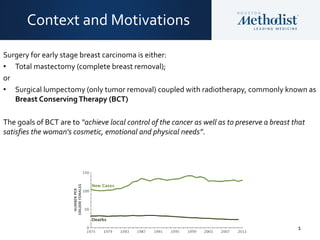
Surgery for early stage breast carcinoma is either:
• Total mastectomy (complete breast removal);
or
• Surgical lumpectomy (only tumor removal) coupled with radiotherapy, commonly known as
Breast ConservingTherapy (BCT)
The goals of BCT are to “achieve local control of the cancer as well as to preserve a breast that
satisfies the woman's cosmetic, emotional and physical needs”.
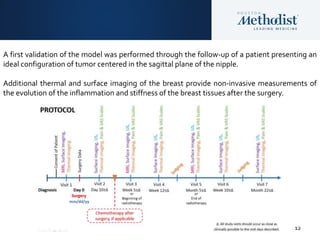
Context and Motivations
2
Our objective: develop a model able to predict the contour of the breast following surgery.
 Help the dialogue between the surgeon and the patient: facilitates the decision process for
the patient;
 Provides a virtual model of the breast of the patient after surgery: facilitates the surgical
planning for the surgeons and optimizes the surgical outcome.
Our overall hypothesis is that:
i) The complex interplay among mechanical forces due to gravity;
ii) Breast tissue constitutive law distribution;
iii) Inflammation induced by radiotherapy;
iv) Internal stress generated by the healing process play a dominant role in determining the
success or failure of lumpectomy in preserving the breast shape and cosmesis.
Context and Motivations
3
Multiscale model of BCT
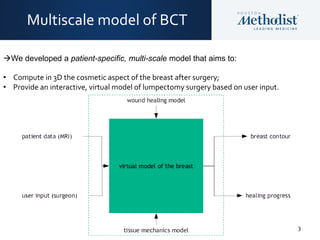
We developed a patient-specific, multi-scale model that aims to:
• Compute in 3D the cosmetic aspect of the breast after surgery;
• Provide an interactive, virtual model of lumpectomy surgery based on user input.
4
Multiscale model of BCT
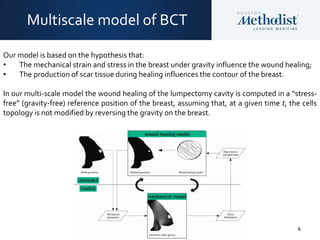
Our model is based on the hypothesis that:
• The mechanical strain and stress in the breast under gravity influence the wound healing;
• The production of scar tissue during healing influences the contour of the breast.
In our multi-scale model the wound healing of the lumpectomy cavity is computed in a “stress-
free” (gravity-free) reference position of the breast, assuming that, at a given time t, the cells
topology is not modified by reversing the gravity on the breast.
5
Multiscale model of BCT
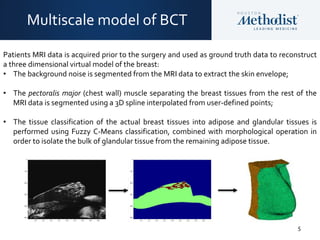
Patients MRI data is acquired prior to the surgery and used as ground truth data to reconstruct
a three dimensional virtual model of the breast:
• The background noise is segmented from the MRI data to extract the skin envelope;
• The pectoralis major (chest wall) muscle separating the breast tissues from the rest of the
MRI data is segmented using a 3D spline interpolated from user-defined points;
• The tissue classification of the actual breast tissues into adipose and glandular tissues is
performed using Fuzzy C-Means classification, combined with morphological operation in
order to isolate the bulk of glandular tissue from the remaining adipose tissue.
6
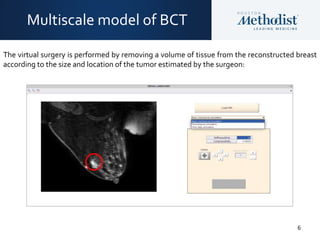
The virtual surgery is performed by removing a volume of tissue from the reconstructed breast
according to the size and location of the tumor estimated by the surgeon:
Multiscale model of BCT
7
Multiscale model of BCT
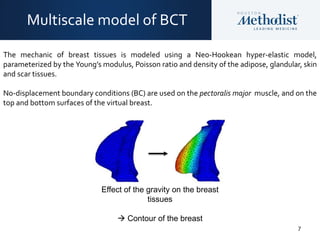
Effect of the gravity on the breast
tissues
 Contour of the breast
The mechanic of breast tissues is modeled using a Neo-Hookean hyper-elastic model,
parameterized by the Young’s modulus, Poisson ratio and density of the adipose, glandular, skin
and scar tissues.
No-displacement boundary conditions (BC) are used on the pectoralis major muscle, and on the
top and bottom surfaces of the virtual breast.
8
Multiscale model of BCT
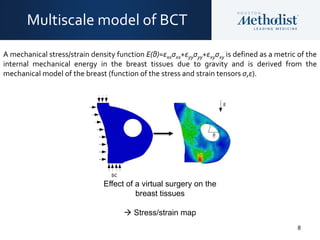
A mechanical stress/strain density function E(θ)=εxxσxx+εyyσyy+εxyσxy is defined as a metric of the
internal mechanical energy in the breast tissues due to gravity and is derived from the
mechanical model of the breast (function of the stress and strain tensors σ,ε).
Effect of a virtual surgery on the
breast tissues
 Stress/strain map
9
Multiscale model of BCT
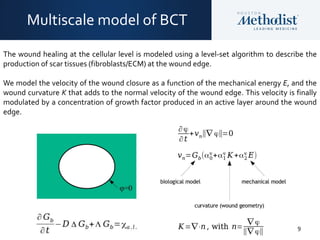
The wound healing at the cellular level is modeled using a level-set algorithm to describe the
production of scar tissues (fibroblasts/ECM) at the wound edge.
We model the velocity of the wound closure as a function of the mechanical energy E, and the
wound curvature K that adds to the normal velocity of the wound edge. This velocity is finally
modulated by a concentration of growth factor produced in an active layer around the wound
edge.
10
Multiscale model of BCT
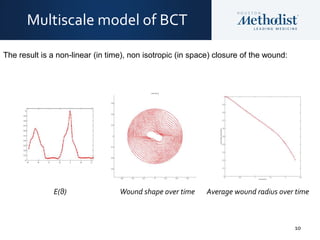
The result is a non-linear (in time), non isotropic (in space) closure of the wound:
E(θ) Wound shape over time Average wound radius over time
11
Validation and clinical trial
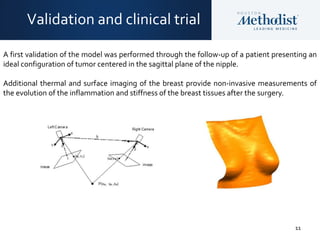
A first validation of the model was performed through the follow-up of a patient presenting an
ideal configuration of tumor centered in the sagittal plane of the nipple.
Additional thermal and surface imaging of the breast provide non-invasive measurements of
the evolution of the inflammation and stiffness of the breast tissues after the surgery.
12
A first validation of the model was performed through the follow-up of a patient presenting an
ideal configuration of tumor centered in the sagittal plane of the nipple.
Additional thermal and surface imaging of the breast provide non-invasive measurements of
the evolution of the inflammation and stiffness of the breast tissues after the surgery.
13
Validation and clinical trial
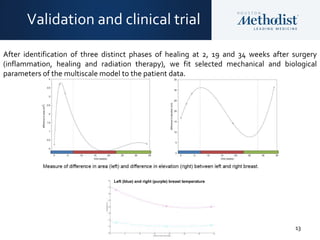
After identification of three distinct phases of healing at 2, 19 and 34 weeks after surgery
(inflammation, healing and radiation therapy), we fit selected mechanical and biological
parameters of the multiscale model to the patient data.
Left (blue) and right (purple) breast temperature
14
Validation and clinical trial
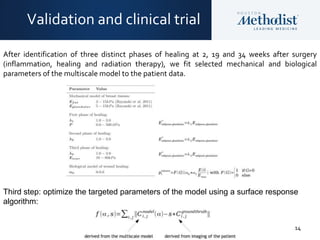
After identification of three distinct phases of healing at 2, 19 and 34 weeks after surgery
(inflammation, healing and radiation therapy), we fit selected mechanical and biological
parameters of the multiscale model to the patient data.
Third step: optimize the targeted parameters of the model using a surface response
algorithm:
15
Validation and clinical trial
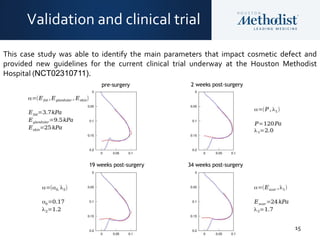
This case study was able to identify the main parameters that impact cosmetic defect and
provided new guidelines for the current clinical trial underway at the Houston Methodist
Hospital (NCT02310711).
16
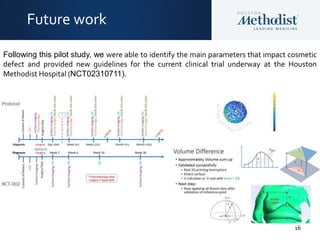
Following this pilot study, we were able to identify the main parameters that impact cosmetic
defect and provided new guidelines for the current clinical trial underway at the Houston
Methodist Hospital (NCT02310711).
Future work
17
Team and thanks
PIs:
Dr. Barbara Bass, Dr. Marc Garbey (Houston Methodist)
Residents & Instructors:
Diana Hwang, Linda Moore (Houston Methodist)
Past internships:
Marlene Gilles, Nicole Lepoutre, Valentina Simonetti (University of Houston, University
of Strasbourg, Polytechnic University of Milan)
18

4 breast conservative_therapy_remi_salmon

  • 1.
    0 PREDICITVE MULTISCALE MODELINGFOR BREAST CONSERVINGTHERAPY Remi Salmon,Thanh Chau Nguyen, Anne-Cecile Lesage, Marc Garbey - May 2016
  • 2.
    1 Surgery for earlystage breast carcinoma is either: • Total mastectomy (complete breast removal); or • Surgical lumpectomy (only tumor removal) coupled with radiotherapy, commonly known as Breast ConservingTherapy (BCT) The goals of BCT are to “achieve local control of the cancer as well as to preserve a breast that satisfies the woman's cosmetic, emotional and physical needs”. Context and Motivations
  • 3.
    2 Our objective: developa model able to predict the contour of the breast following surgery.  Help the dialogue between the surgeon and the patient: facilitates the decision process for the patient;  Provides a virtual model of the breast of the patient after surgery: facilitates the surgical planning for the surgeons and optimizes the surgical outcome. Our overall hypothesis is that: i) The complex interplay among mechanical forces due to gravity; ii) Breast tissue constitutive law distribution; iii) Inflammation induced by radiotherapy; iv) Internal stress generated by the healing process play a dominant role in determining the success or failure of lumpectomy in preserving the breast shape and cosmesis. Context and Motivations
  • 4.
    3 Multiscale model ofBCT We developed a patient-specific, multi-scale model that aims to: • Compute in 3D the cosmetic aspect of the breast after surgery; • Provide an interactive, virtual model of lumpectomy surgery based on user input.
  • 5.
    4 Multiscale model ofBCT Our model is based on the hypothesis that: • The mechanical strain and stress in the breast under gravity influence the wound healing; • The production of scar tissue during healing influences the contour of the breast. In our multi-scale model the wound healing of the lumpectomy cavity is computed in a “stress- free” (gravity-free) reference position of the breast, assuming that, at a given time t, the cells topology is not modified by reversing the gravity on the breast.
  • 6.
    5 Multiscale model ofBCT Patients MRI data is acquired prior to the surgery and used as ground truth data to reconstruct a three dimensional virtual model of the breast: • The background noise is segmented from the MRI data to extract the skin envelope; • The pectoralis major (chest wall) muscle separating the breast tissues from the rest of the MRI data is segmented using a 3D spline interpolated from user-defined points; • The tissue classification of the actual breast tissues into adipose and glandular tissues is performed using Fuzzy C-Means classification, combined with morphological operation in order to isolate the bulk of glandular tissue from the remaining adipose tissue.
  • 7.
    6 The virtual surgeryis performed by removing a volume of tissue from the reconstructed breast according to the size and location of the tumor estimated by the surgeon: Multiscale model of BCT
  • 8.
    7 Multiscale model ofBCT Effect of the gravity on the breast tissues  Contour of the breast The mechanic of breast tissues is modeled using a Neo-Hookean hyper-elastic model, parameterized by the Young’s modulus, Poisson ratio and density of the adipose, glandular, skin and scar tissues. No-displacement boundary conditions (BC) are used on the pectoralis major muscle, and on the top and bottom surfaces of the virtual breast.
  • 9.
    8 Multiscale model ofBCT A mechanical stress/strain density function E(θ)=εxxσxx+εyyσyy+εxyσxy is defined as a metric of the internal mechanical energy in the breast tissues due to gravity and is derived from the mechanical model of the breast (function of the stress and strain tensors σ,ε). Effect of a virtual surgery on the breast tissues  Stress/strain map
  • 10.
    9 Multiscale model ofBCT The wound healing at the cellular level is modeled using a level-set algorithm to describe the production of scar tissues (fibroblasts/ECM) at the wound edge. We model the velocity of the wound closure as a function of the mechanical energy E, and the wound curvature K that adds to the normal velocity of the wound edge. This velocity is finally modulated by a concentration of growth factor produced in an active layer around the wound edge.
  • 11.
    10 Multiscale model ofBCT The result is a non-linear (in time), non isotropic (in space) closure of the wound: E(θ) Wound shape over time Average wound radius over time
  • 12.
    11 Validation and clinicaltrial A first validation of the model was performed through the follow-up of a patient presenting an ideal configuration of tumor centered in the sagittal plane of the nipple. Additional thermal and surface imaging of the breast provide non-invasive measurements of the evolution of the inflammation and stiffness of the breast tissues after the surgery.
  • 13.
    12 A first validationof the model was performed through the follow-up of a patient presenting an ideal configuration of tumor centered in the sagittal plane of the nipple. Additional thermal and surface imaging of the breast provide non-invasive measurements of the evolution of the inflammation and stiffness of the breast tissues after the surgery.
  • 14.
    13 Validation and clinicaltrial After identification of three distinct phases of healing at 2, 19 and 34 weeks after surgery (inflammation, healing and radiation therapy), we fit selected mechanical and biological parameters of the multiscale model to the patient data. Left (blue) and right (purple) breast temperature
  • 15.
    14 Validation and clinicaltrial After identification of three distinct phases of healing at 2, 19 and 34 weeks after surgery (inflammation, healing and radiation therapy), we fit selected mechanical and biological parameters of the multiscale model to the patient data. Third step: optimize the targeted parameters of the model using a surface response algorithm:
  • 16.
    15 Validation and clinicaltrial This case study was able to identify the main parameters that impact cosmetic defect and provided new guidelines for the current clinical trial underway at the Houston Methodist Hospital (NCT02310711).
  • 17.
    16 Following this pilotstudy, we were able to identify the main parameters that impact cosmetic defect and provided new guidelines for the current clinical trial underway at the Houston Methodist Hospital (NCT02310711). Future work
  • 18.
    17 Team and thanks PIs: Dr.Barbara Bass, Dr. Marc Garbey (Houston Methodist) Residents & Instructors: Diana Hwang, Linda Moore (Houston Methodist) Past internships: Marlene Gilles, Nicole Lepoutre, Valentina Simonetti (University of Houston, University of Strasbourg, Polytechnic University of Milan)
  • 19.