癌症病人醫療照護需求
 長庚科技大學護理系所
  腫瘤護理學會理事
    陳淑卿
大綱
                需求的定義
                癌症不同的疾病歷程
                癌症病人復健醫療的需求
                癌症復健的背景
                癌症復健的目標
                癌症復健的分類
                癌症復健的模式
                癌症復健的挑戰與契機

Cancer Rehabilitation Needs    Page 2 of 33
    2008/10/21~10/30這幾天我一個人躲著偷偷哭泣,實在很
                 無助,剛開始覺得在還沒確診前,我不想告訴任何人。
                 因為不想太多人跟著緊張擔心,但這樣無助的日子,真
                 的受不了,所以幾天後我先告訴了我姊姊。在沒確診的
                 這段日子,我覺得自己像個稻草人,有體無魂,……

                2008/11/01~06其實還沒等到看確診報告的那一天,我的
                 心裏就已經有數了,這一關我是在也無法逃避了,從發
                 病到開刀當天,我的日子在惡夢、晃神、哭泣中度過,
                 我再也無法壓抑心中的難過,……


Cancer Rehabilitation Needs                     Page 3 of 33
    崔先生5年前罹患口腔癌第4期,術後又意外發現
                 罹患血友病,半年內接受11次手術,雖然活了下
                 來,卻因術後留下的臉部缺陷,使他意志陷入極
                 度低潮,長達一年的時間都要戴口罩出門。
                              2012/7/11中時電子報


Cancer Rehabilitation Needs              Page 4 of 33
    蕭先生也表示,過去,菸、酒、檳榔曾是他最好
                 的朋友,罹癌後他才驚覺它們是奪走健康的殺手。
                 他分享經驗說,手術治療除可能導致外觀改變、
                 說話不清楚,術後初期甚至會因吞嚥困難,必須
                 靠插鼻胃管灌牛奶果腹;放射線治療可能造成口
                 腔炎、皮膚炎,或肌肉僵硬;化學治療最常見的
                 副作用則是噁心嘔吐,但只要相信醫師、相信自
                 己,就能慢慢調適。
                             2012/7/11中時電子報

Cancer Rehabilitation Needs             Page 5 of 33
需求的定義
                牛津字典的定義:個體在面對困難的或苦惱的事
                 件時的情境,或一段時間,個體對於現存的事件
                 中所發出急迫的呼喊或請求 (Oxford English
                 Dictionary, OED)

                韋氏字典的定義需求為︰
                      (1)心理或生理上缺乏一些想要的或需要的事,
                      (2)需要或希望得到的事,
                      (3)具有必須或行動的意義,
                      (4)實質上的缺乏 (Weber English Dictionary, 1983)。
Cancer Rehabilitation Needs                                     Page 6 of 33
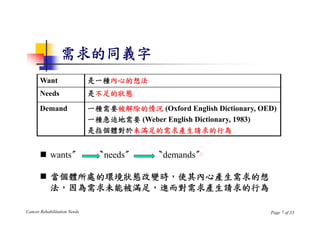
需求的同義字
       Want                   是一種內心的想法
       Needs                  是不足的狀態
       Demand                 一種需要被解除的情況 (Oxford English Dictionary, OED)
                              一種急迫地需要 (Weber English Dictionary, 1983)
                              是指個體對於未滿足的需求產生請求的行為


        wants〞                〝needs〞               x
                                             〝demands〞

        當個體所處的環境狀態改變時,使其內心產生需求的想
         法,因為需求未能被滿足,進而對需求產生請求的行為

Cancer Rehabilitation Needs                                            Page 7 of 33
需求的特性
                在社區護理教育與實務的研究中提及需求
                 具有:
                      個別性 (personal)、
                      主觀的 (subjective)、
                      可變的 (variable)、
                      且持續在改變 (constantly changing)
                                   (Cowley et al., 2000)。

Cancer Rehabilitation Needs                                 Page 8 of 33
癌症疾病的歷程
        Pre-diagnosis                      Treatment                  Recurrence                Bereavement


                      Diagnosis/Referral               Survivorship                Palliative


           Figure 1 Patients’ spectrum of experience during cancer journey


Cancer Rehabilitation Needs                                                                                   Page 9 of 33
未滿足的需求會引起病人困擾
          疾病的不同階段有不
           同的需求
          部分病人面對需求,
           部分病人以退縮
           (withdraw)的方式處理
          部分病人經歷到困擾
           (distress)

Cancer Rehabilitation Needs   Page 10 of 33
癌症病人的復健需求
              確認復健需求:癌症復健在不同的癌症中遇到的問題;復健
               服務的需要與提供復健護理間的差距
              正在接受復健的癌症病人:有超過50%的病人有身體方面
               的問題(physical problems)
              有身體問題的病人中約有50%伴隨著心理的問題
               (psychological problems),約有29%的病人有心理問題但
               卻沒有身體的問題。
              神經系統的癌症病人發生心理問題高於其他類型的癌症病
               人。


                 Lehmann JF, DeLisa JA, Warren CG, et al., Cancer rehabilitation: assessment of need, development, and evaluation of a
                 model of care. Arch Phys Med Rehabil. 1978; 59(9): 410-9.
Cancer Rehabilitation Needs                                                                                                     Page 11 of 33
癌症病人的復健需求
               提供癌症復健服務主要的障礙:是缺乏辨識病人問題或缺
                乏適當的轉介的復健概念

               研究結果建議在腫瘤照護中提供心理社會支持性的服務
                (psychosocial support services),癌症相關的身體失能復健
                ,完整的復健團隊(comprehensive rehabilitation team)包
                含具有心理復健的能力是需要的

                Lehmann JF, DeLisa JA, Warren CG, et al., Cancer rehabilitation: assessment of need, development, and evaluation of a
                model of care. Arch Phys Med Rehabil. 1978; 59(9): 410-9.


Cancer Rehabilitation Needs                                                                                                    Page 12 of 33
癌症病人的復健需求
               Ganz 調查500位大腸直腸癌、肺癌、前列腺癌病人,發現
                病人與疾病共同存活(有疾病症狀)超過3年以上。
               約有80%的病人有移動(ambulation)的問題,且此問題嚴
                重。
               病人(41% with colorectal cancer, 69% with lung cancer,
                and 40% with prostate cancer) 主訴有執行日常生活活動
                困難的問題
               心理的問題(psychosocial problems)呈多樣性的變化,出現
                在病人被診斷為癌症之後存活一年以上


                 Ganz PA, Schag CA, Lee JJ, Sim MS. The CARES: a generic measure of health-related quality of life for patients with cancer.
Cancer Rehabilitation NeedsRes. 1992; 1(1), 19-29.
                 Qual Life                                                                                                      Page 13 of 33
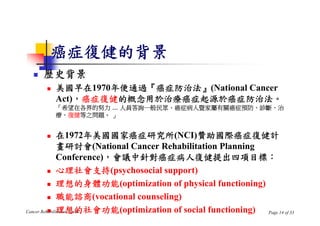
癌症復健的背景
     歷史背景
         美國早在1970年便通過『癌症防治法』(National Cancer
          Act),癌症復健的概念用於治療癌症起源於癌症防治法。
          「希望在各界的努力 ... 人員答詢一般民眾、癌症病人暨家屬有關癌症預防、診斷、治
          療、復健等之問題。 」


              在1972年美國國家癌症研究所(NCI)贊助國際癌症復健計
               畫研討會(National Cancer Rehabilitation Planning
               Conference),會議中針對癌症病人復健提出四項目標:
           心理社會支持(psychosocial support)

           理想的身體功能(optimization of physical functioning)

           職能諮商(vocational counseling)

           理想的社會功能(optimization of social functioning)
Cancer Rehabilitation Needs                                 Page 14 of 33
癌症復健的定義與目標
             定義
                   癌症病人因疾病與治療的限制,在身體、社會、心
                    理及職能須要獲得最大功能的協助 (Cromes, 1978)


             理想的目標
                   癌症病人在疾病與治療的限制之下,盡可能的達到
                    最大的功能狀態 (DeLisa, 2001)


Cancer Rehabilitation Needs                          Page 15 of 33
癌症復健的目標
               影響癌症復健達成目標的因素:
               -   預期壽命縮短
               -   廣泛的合併症
               -   疼痛干擾的程度
               -   持續的病變
               -   快速的病程變化
               -   請求同步抗癌治療
               -   獨特及高度的個人化照護目標
               -   投入持續的抗癌治療
               -   可望將剩餘的時間與愛的人相處
               -   經濟與家庭資源
               -   保險給付
               -   家屬接受癌末狀態
               -   自願接受緩和照顧
               -   營養的問題與需求         (DeLisa, 2001)
Cancer Rehabilitation Needs                    Page 16 of 33
癌症復健的治療團隊
               復健治療團隊
                     多學科的方法(multidisciplinary approach)
                     治理治療醫師(physiatrist);語言治療師;社工師;心理
                      師;職能治療師;病人的有意義他人


               物理治療醫師(Physiatrist )
                   接受醫學及復健訓練
                   評估失能、生理機轉、運動功能,提供藥物、物理治

                    療、義肢、輔具等處方
                   (DeLisa, 2001)
Cancer Rehabilitation Needs                          Page 17 of 33
癌症復健的分類
               癌症復健的分類:
           (1)預防性(Preventive rehabilitation)
            從癌症診斷開始,手術、放射線治療或化學治療後立即開

              始,以預防功能缺損為復健的目的
           (2)恢復性復健(Restorative rehabilitation)
            病人剩餘的功能及能力,以最大功能恢復為目的。

            使有失能缺損的病人嘗試達到最大功能恢復

                                                 (Diez, 1981)


Cancer Rehabilitation Needs                              Page 18 of 33
癌症復健的分類
              癌症復健的分類:
          (3)支持性的復健(Supportive rehabilitation)
           對於癌症病程進展的功能缺損的病人,使用有效
            的方法增加自我照顧及移動的能力
           例如:指導裝置設備、自我照顧的技能

           預防殘障,例如:攣縮、肌肉萎縮


                                  Diez, 1981


Cancer Rehabilitation Needs                    Page 19 of 33
癌症復健的分類
            癌症復健的分類:
           (4) 緩和性復健(Palliative rehabilitation)
            末期病人使其有高品質的身體、心理、社會生活

             品質。
            設計緩解症狀的處置

            如:疼痛、呼吸困難、水腫的處置,可使用熱敷
             、低週波治療、擺位、呼吸輔助、放鬆治療、或
             使用輔具等。
                                   Diez, 1981
Cancer Rehabilitation Needs                     Page 20 of 33
癌症復健的模式
Table 1. Updated model: opportunities for rehabilitation interventions throughout the disease continuum
階段                        可能的症狀              功能影響層面                 復健重點

I. 診斷/治療前                 焦慮、疼痛、功能喪失         日常功能、睡眠、疲              教育病人治療的衝擊,功能保留
                                             倦                      治療前的復健:ROM, ADL, strengthening,
                                                                    須要時使用輔具協助活動


II. 治療                    疼痛、憂鬱、活動度下         日常功能、睡眠、自  評值治療的成效
                          降、傷口、語言及吞嚥         我照顧、外觀、溝通、 經由運動、淋巴水腫的處置、ROM、增
                          困難、疲倦              進食/營養      加活動、疼痛處置、放鬆保留及恢復功能


III. 治療後                  疼痛、虛弱、焦慮、憂  睡眠、疲倦、日常生                     發展計畫以恢復活動及日常生活功能,促
                          鬱、活動力下降、水腫、 活、工作/失業、外觀                    進健康生活型態
                          疲倦、功能惡化、體重                                教育病人自我監測,維持運動計畫及水腫
                          上升                                        處置


                                                                                       (Gerber, 2005)
Cancer Rehabilitation Needs                                                                      Page 21 of 33
癌症復健的模式
Table 1. Updated model: opportunities for rehabilitation interventions throughout the disease continuum (cont.)

階段                      可能的症狀                 功能影響層面                     復健重點

IV. 復發                  疼痛、虛弱、焦慮、             睡眠、疲倦、失能、日 教育病人復發對於功能的衝擊,持續監測及預
                        憂鬱、疲倦、水腫、             常生活、工作/失業、 防功能下降(包括:足部輔具、柺杖、有氧運
                        缺乏食慾、中樞神經             外觀         動),維持其活動及生活品質
                        系統、其他器官受影                        治療前的復健:ROM, ADL, strengthening, 須
                        響                                要時使用輔具協助活動


V.末期                    疼痛、疲倦、缺乏食             活動力下降、自我照顧 教育病人及家屬能量保存
                        慾                     可能需依賴他人    轉介病人接受身體力學及輔具訓練
                                                         疼痛處置及症狀控制
                                                         維持獨立及生活品質


                                                                                                     (Gerber, 2005)
Cancer Rehabilitation Needs                                                                                       Page 22 of 33
癌症病人復健需求的團隊照護


              Speech/language pathologists    Vocational counselors     Nurses


        Occupational/physical therapists                               Physiatrists

                                                     Client/Family

                  Nutritionist

                                 Pharmacist            Psychologists        Social workers


               Figure 1 committee membership team
Cancer Rehabilitation Needs                                                            Page 23 of 33
提供連續性照護的方法
                多科照護團隊的組成與運作
                合作性的關係
                      Shared planning and decision making
                      Team approach
                      Power is shared based on knowledge and expertise and role and
                       title
                      Effective group dynamics including excellent communication skills,
                       respect and trust
                制訂治療照護指引,召開團隊會議


Cancer Rehabilitation Needs                                                       Page 24 of 33
癌症復健的目的與重點
               復健是動態的、以目標為導向的過程設計,幫
                助個體因疾病及治療的限制,是其功能恢復至
                最大的程度。
               當腫瘤或治療引起功能下降,復健假設是支持
                性的角色,其目標是能提供病人持續構造及生
                理上的功能。


Cancer Rehabilitation Needs        Page 25 of 33
癌症復健的目的與重點
               復健在支付費用之前評估缺損、失能、及缺陷
                是極為重要的。
               強調在開始時恢復病人的日常生活功能(ADL)
                、認知及溝通的最大獨立
               存活及社區再統整議題需包含:回到工作、疾
                病追蹤


Cancer Rehabilitation Needs          Page 26 of 33
成功的復健計畫
                  持續性的評估復健需求與復健計畫
                  具有個別性的復健計畫
                  儘早安排復健:從癌症診斷開始參與復健計
                   畫
                  有效的團對溝通


                Broadwell DC. Rehabilitation needs of the patient with cancer. Cancer. 1987;60(3 Suppl):563-8.

Cancer Rehabilitation Needs                                                                                      Page 27 of 33
癌症復健:挑戰與契機
              許多健康照護提供者有困難認同癌症是慢性疾病
               ,因而限制病人的復健有適當的轉介(limits
               referrals for rehabilitation)
              癌症治療的慢性副作用未被察覺或未被給付,病
               人對於收費無法認同


Cancer Rehabilitation Needs               Page 28 of 33
癌症復健:挑戰與契機
              復健醫療人員(rehabilitation medical staff)教育過
               程主要內容:
              癌症是慢性病概念化,需要持續治療直到長期的
               存活(long-term survivorship)
              化學藥物治療的基本概念與原則
              再確認治療相關的副作用,提升病人正接受治療
               期間的舒適程度


Cancer Rehabilitation Needs                        Page 29 of 33
結論
          提供癌症存活者照護典範,並持續大幅進化
          癌症復健的角色及目標同時的被重新加以解
           釋說明,尤其是復健單位(rehabilitation units
           )及復健服務(rehabilitation services)
          腫瘤照護人員與復健人員需提倡治療與疾病
           的副作用對病人長期功能及生活品質造成最
           小的衝擊


Cancer Rehabilitation Needs             Page 30 of 33
結論
            使用一致的篩檢工具及明訂推薦的措施或
             轉介
            腫瘤照護與復健人員需指導其他相關的人
             員與學生癌症復健教育與諮詢
            從病人被診斷為癌症開始盡可能維持最大
             的功能狀態(maximize function)及生活品質
             (QOL)


Cancer Rehabilitation Needs             Page 31 of 33
References
         1. Broadwell DC. Rehabilitation needs of the patient with cancer. Cancer. 1987;60(3 Suppl):563-8.
         2. Cromes GF. Implementation of interdisciplinary cancer rehabilitation. Rehabil Counsel Bull 1978;21:230–7.
         2. DeLisa, J. A. A history of cancer rehabilitation. Cancer 2001; 92: 970-974.
         3. Dietz JH. Rehabilitation Oncology. New York, NY:. John Wiley & Sons;1981.
         4. Ganz PA, Schag CA, Lee JJ, Sim MS. The CARES: a generic measure of health-related quality of life for patients with cancer.
          Qual Life Res. 1992; 1(1), 19-29.
         5. Gerber LH. Cancer rehabilitation into the future. Cancer 2001;92:975–9.
         6. Gerber LH, Vargo MH, Smith RG, Rehabilitation of the cancer patient. In: Devita V, Hellman S, Risenberg S, editors.
            Cancer: principles and practice of oncology. 7th edition. Philadelphia: Lippincott Williams and Wilkins; 2005. p.3089-
            3110.
         7. Lehmann JF, DeLisa JA, Warren CG, et al., Cancer rehabilitation: assessment of need, development, and evaluation of
            a model of care. Arch Phys Med Rehabil. 1978; 59(9): 410-9.
         8. Movsas SB, Chang VT, Tunkel RS, et al. Rehabilitation needs of an inpatient medical oncology unit. Arch Phys Med
            Rehabil. Nov 2003; 84(11):1642-6.
         9. Trotti A. Toxicity in head and neck cancer: a review of trends and issues. International Journal of Radiation Oncology,
            Biology, Physics, 2000; 47(1), 1-12.
         10. van Harten WH, van Noort O, Warmerdam R, et al. Assessment of rehabilitation needs in cancer patients. Int J
             Rehabil Res. 1998; 21(3):247-57.
         10. van Weert E, Hoekstra-Weebers JE, Grol BM, et al. Physical functioning and quality of life after cancer rehabilitation.
             Int J Rehabil Res. 2004;27(1):27-35.
         14.Zackrisson B, Mercke C, Strander H, Wennerberg J, Cavallin-Stahl E. A systematic overview of radiation therapy
             effects in head and neck cancer. Acta Oncol. 2003;42(5-6):443-61.
Cancer Rehabilitation Needs                                                                                                        Page 32 of 33
Thank You


Cancer Rehabilitation Needs               Page 33 of 33

癌症病人醫療照護需求 陳淑卿

  • 1.
  • 2.
    大綱  需求的定義  癌症不同的疾病歷程  癌症病人復健醫療的需求  癌症復健的背景  癌症復健的目標  癌症復健的分類  癌症復健的模式  癌症復健的挑戰與契機 Cancer Rehabilitation Needs Page 2 of 33
  • 3.
    2008/10/21~10/30這幾天我一個人躲著偷偷哭泣,實在很 無助,剛開始覺得在還沒確診前,我不想告訴任何人。 因為不想太多人跟著緊張擔心,但這樣無助的日子,真 的受不了,所以幾天後我先告訴了我姊姊。在沒確診的 這段日子,我覺得自己像個稻草人,有體無魂,……  2008/11/01~06其實還沒等到看確診報告的那一天,我的 心裏就已經有數了,這一關我是在也無法逃避了,從發 病到開刀當天,我的日子在惡夢、晃神、哭泣中度過, 我再也無法壓抑心中的難過,…… Cancer Rehabilitation Needs Page 3 of 33
  • 4.
    崔先生5年前罹患口腔癌第4期,術後又意外發現 罹患血友病,半年內接受11次手術,雖然活了下 來,卻因術後留下的臉部缺陷,使他意志陷入極 度低潮,長達一年的時間都要戴口罩出門。 2012/7/11中時電子報 Cancer Rehabilitation Needs Page 4 of 33
  • 5.
    蕭先生也表示,過去,菸、酒、檳榔曾是他最好 的朋友,罹癌後他才驚覺它們是奪走健康的殺手。 他分享經驗說,手術治療除可能導致外觀改變、 說話不清楚,術後初期甚至會因吞嚥困難,必須 靠插鼻胃管灌牛奶果腹;放射線治療可能造成口 腔炎、皮膚炎,或肌肉僵硬;化學治療最常見的 副作用則是噁心嘔吐,但只要相信醫師、相信自 己,就能慢慢調適。 2012/7/11中時電子報 Cancer Rehabilitation Needs Page 5 of 33
  • 6.
    需求的定義  牛津字典的定義:個體在面對困難的或苦惱的事 件時的情境,或一段時間,個體對於現存的事件 中所發出急迫的呼喊或請求 (Oxford English Dictionary, OED)  韋氏字典的定義需求為︰  (1)心理或生理上缺乏一些想要的或需要的事,  (2)需要或希望得到的事,  (3)具有必須或行動的意義,  (4)實質上的缺乏 (Weber English Dictionary, 1983)。 Cancer Rehabilitation Needs Page 6 of 33
  • 7.
    需求的同義字 Want 是一種內心的想法 Needs 是不足的狀態 Demand 一種需要被解除的情況 (Oxford English Dictionary, OED) 一種急迫地需要 (Weber English Dictionary, 1983) 是指個體對於未滿足的需求產生請求的行為  wants〞 〝needs〞 x 〝demands〞  當個體所處的環境狀態改變時,使其內心產生需求的想 法,因為需求未能被滿足,進而對需求產生請求的行為 Cancer Rehabilitation Needs Page 7 of 33
  • 8.
    需求的特性  在社區護理教育與實務的研究中提及需求 具有:  個別性 (personal)、  主觀的 (subjective)、  可變的 (variable)、  且持續在改變 (constantly changing) (Cowley et al., 2000)。 Cancer Rehabilitation Needs Page 8 of 33
  • 9.
    癌症疾病的歷程 Pre-diagnosis Treatment Recurrence Bereavement Diagnosis/Referral Survivorship Palliative  Figure 1 Patients’ spectrum of experience during cancer journey Cancer Rehabilitation Needs Page 9 of 33
  • 10.
    未滿足的需求會引起病人困擾  疾病的不同階段有不 同的需求  部分病人面對需求, 部分病人以退縮 (withdraw)的方式處理  部分病人經歷到困擾 (distress) Cancer Rehabilitation Needs Page 10 of 33
  • 11.
    癌症病人的復健需求  確認復健需求:癌症復健在不同的癌症中遇到的問題;復健 服務的需要與提供復健護理間的差距  正在接受復健的癌症病人:有超過50%的病人有身體方面 的問題(physical problems)  有身體問題的病人中約有50%伴隨著心理的問題 (psychological problems),約有29%的病人有心理問題但 卻沒有身體的問題。  神經系統的癌症病人發生心理問題高於其他類型的癌症病 人。 Lehmann JF, DeLisa JA, Warren CG, et al., Cancer rehabilitation: assessment of need, development, and evaluation of a model of care. Arch Phys Med Rehabil. 1978; 59(9): 410-9. Cancer Rehabilitation Needs Page 11 of 33
  • 12.
    癌症病人的復健需求  提供癌症復健服務主要的障礙:是缺乏辨識病人問題或缺 乏適當的轉介的復健概念  研究結果建議在腫瘤照護中提供心理社會支持性的服務 (psychosocial support services),癌症相關的身體失能復健 ,完整的復健團隊(comprehensive rehabilitation team)包 含具有心理復健的能力是需要的 Lehmann JF, DeLisa JA, Warren CG, et al., Cancer rehabilitation: assessment of need, development, and evaluation of a model of care. Arch Phys Med Rehabil. 1978; 59(9): 410-9. Cancer Rehabilitation Needs Page 12 of 33
  • 13.
    癌症病人的復健需求  Ganz 調查500位大腸直腸癌、肺癌、前列腺癌病人,發現 病人與疾病共同存活(有疾病症狀)超過3年以上。  約有80%的病人有移動(ambulation)的問題,且此問題嚴 重。  病人(41% with colorectal cancer, 69% with lung cancer, and 40% with prostate cancer) 主訴有執行日常生活活動 困難的問題  心理的問題(psychosocial problems)呈多樣性的變化,出現 在病人被診斷為癌症之後存活一年以上 Ganz PA, Schag CA, Lee JJ, Sim MS. The CARES: a generic measure of health-related quality of life for patients with cancer. Cancer Rehabilitation NeedsRes. 1992; 1(1), 19-29. Qual Life Page 13 of 33
  • 14.
    癌症復健的背景  歷史背景  美國早在1970年便通過『癌症防治法』(National Cancer Act),癌症復健的概念用於治療癌症起源於癌症防治法。 「希望在各界的努力 ... 人員答詢一般民眾、癌症病人暨家屬有關癌症預防、診斷、治 療、復健等之問題。 」  在1972年美國國家癌症研究所(NCI)贊助國際癌症復健計 畫研討會(National Cancer Rehabilitation Planning Conference),會議中針對癌症病人復健提出四項目標:  心理社會支持(psychosocial support)  理想的身體功能(optimization of physical functioning)  職能諮商(vocational counseling)  理想的社會功能(optimization of social functioning) Cancer Rehabilitation Needs Page 14 of 33
  • 15.
    癌症復健的定義與目標  定義  癌症病人因疾病與治療的限制,在身體、社會、心 理及職能須要獲得最大功能的協助 (Cromes, 1978)  理想的目標  癌症病人在疾病與治療的限制之下,盡可能的達到 最大的功能狀態 (DeLisa, 2001) Cancer Rehabilitation Needs Page 15 of 33
  • 16.
    癌症復健的目標  影響癌症復健達成目標的因素: - 預期壽命縮短 - 廣泛的合併症 - 疼痛干擾的程度 - 持續的病變 - 快速的病程變化 - 請求同步抗癌治療 - 獨特及高度的個人化照護目標 - 投入持續的抗癌治療 - 可望將剩餘的時間與愛的人相處 - 經濟與家庭資源 - 保險給付 - 家屬接受癌末狀態 - 自願接受緩和照顧 - 營養的問題與需求 (DeLisa, 2001) Cancer Rehabilitation Needs Page 16 of 33
  • 17.
    癌症復健的治療團隊  復健治療團隊  多學科的方法(multidisciplinary approach)  治理治療醫師(physiatrist);語言治療師;社工師;心理 師;職能治療師;病人的有意義他人  物理治療醫師(Physiatrist )  接受醫學及復健訓練  評估失能、生理機轉、運動功能,提供藥物、物理治 療、義肢、輔具等處方 (DeLisa, 2001) Cancer Rehabilitation Needs Page 17 of 33
  • 18.
    癌症復健的分類  癌症復健的分類: (1)預防性(Preventive rehabilitation)  從癌症診斷開始,手術、放射線治療或化學治療後立即開 始,以預防功能缺損為復健的目的 (2)恢復性復健(Restorative rehabilitation)  病人剩餘的功能及能力,以最大功能恢復為目的。  使有失能缺損的病人嘗試達到最大功能恢復  (Diez, 1981) Cancer Rehabilitation Needs Page 18 of 33
  • 19.
    癌症復健的分類  癌症復健的分類: (3)支持性的復健(Supportive rehabilitation)  對於癌症病程進展的功能缺損的病人,使用有效 的方法增加自我照顧及移動的能力  例如:指導裝置設備、自我照顧的技能  預防殘障,例如:攣縮、肌肉萎縮 Diez, 1981 Cancer Rehabilitation Needs Page 19 of 33
  • 20.
    癌症復健的分類  癌症復健的分類: (4) 緩和性復健(Palliative rehabilitation)  末期病人使其有高品質的身體、心理、社會生活 品質。  設計緩解症狀的處置  如:疼痛、呼吸困難、水腫的處置,可使用熱敷 、低週波治療、擺位、呼吸輔助、放鬆治療、或 使用輔具等。 Diez, 1981 Cancer Rehabilitation Needs Page 20 of 33
  • 21.
    癌症復健的模式 Table 1. Updatedmodel: opportunities for rehabilitation interventions throughout the disease continuum 階段 可能的症狀 功能影響層面 復健重點 I. 診斷/治療前 焦慮、疼痛、功能喪失 日常功能、睡眠、疲 教育病人治療的衝擊,功能保留 倦 治療前的復健:ROM, ADL, strengthening, 須要時使用輔具協助活動 II. 治療 疼痛、憂鬱、活動度下 日常功能、睡眠、自 評值治療的成效 降、傷口、語言及吞嚥 我照顧、外觀、溝通、 經由運動、淋巴水腫的處置、ROM、增 困難、疲倦 進食/營養 加活動、疼痛處置、放鬆保留及恢復功能 III. 治療後 疼痛、虛弱、焦慮、憂 睡眠、疲倦、日常生 發展計畫以恢復活動及日常生活功能,促 鬱、活動力下降、水腫、 活、工作/失業、外觀 進健康生活型態 疲倦、功能惡化、體重 教育病人自我監測,維持運動計畫及水腫 上升 處置 (Gerber, 2005) Cancer Rehabilitation Needs Page 21 of 33
  • 22.
    癌症復健的模式 Table 1. Updatedmodel: opportunities for rehabilitation interventions throughout the disease continuum (cont.) 階段 可能的症狀 功能影響層面 復健重點 IV. 復發 疼痛、虛弱、焦慮、 睡眠、疲倦、失能、日 教育病人復發對於功能的衝擊,持續監測及預 憂鬱、疲倦、水腫、 常生活、工作/失業、 防功能下降(包括:足部輔具、柺杖、有氧運 缺乏食慾、中樞神經 外觀 動),維持其活動及生活品質 系統、其他器官受影 治療前的復健:ROM, ADL, strengthening, 須 響 要時使用輔具協助活動 V.末期 疼痛、疲倦、缺乏食 活動力下降、自我照顧 教育病人及家屬能量保存 慾 可能需依賴他人 轉介病人接受身體力學及輔具訓練 疼痛處置及症狀控制 維持獨立及生活品質 (Gerber, 2005) Cancer Rehabilitation Needs Page 22 of 33
  • 23.
    癌症病人復健需求的團隊照護 Speech/language pathologists Vocational counselors Nurses Occupational/physical therapists Physiatrists Client/Family Nutritionist Pharmacist Psychologists Social workers Figure 1 committee membership team Cancer Rehabilitation Needs Page 23 of 33
  • 24.
    提供連續性照護的方法  多科照護團隊的組成與運作  合作性的關係  Shared planning and decision making  Team approach  Power is shared based on knowledge and expertise and role and title  Effective group dynamics including excellent communication skills, respect and trust  制訂治療照護指引,召開團隊會議 Cancer Rehabilitation Needs Page 24 of 33
  • 25.
    癌症復健的目的與重點  復健是動態的、以目標為導向的過程設計,幫 助個體因疾病及治療的限制,是其功能恢復至 最大的程度。  當腫瘤或治療引起功能下降,復健假設是支持 性的角色,其目標是能提供病人持續構造及生 理上的功能。 Cancer Rehabilitation Needs Page 25 of 33
  • 26.
    癌症復健的目的與重點  復健在支付費用之前評估缺損、失能、及缺陷 是極為重要的。  強調在開始時恢復病人的日常生活功能(ADL) 、認知及溝通的最大獨立  存活及社區再統整議題需包含:回到工作、疾 病追蹤 Cancer Rehabilitation Needs Page 26 of 33
  • 27.
    成功的復健計畫  持續性的評估復健需求與復健計畫  具有個別性的復健計畫  儘早安排復健:從癌症診斷開始參與復健計 畫  有效的團對溝通 Broadwell DC. Rehabilitation needs of the patient with cancer. Cancer. 1987;60(3 Suppl):563-8. Cancer Rehabilitation Needs Page 27 of 33
  • 28.
    癌症復健:挑戰與契機  許多健康照護提供者有困難認同癌症是慢性疾病 ,因而限制病人的復健有適當的轉介(limits referrals for rehabilitation)  癌症治療的慢性副作用未被察覺或未被給付,病 人對於收費無法認同 Cancer Rehabilitation Needs Page 28 of 33
  • 29.
    癌症復健:挑戰與契機  復健醫療人員(rehabilitation medical staff)教育過 程主要內容:  癌症是慢性病概念化,需要持續治療直到長期的 存活(long-term survivorship)  化學藥物治療的基本概念與原則  再確認治療相關的副作用,提升病人正接受治療 期間的舒適程度 Cancer Rehabilitation Needs Page 29 of 33
  • 30.
    結論  提供癌症存活者照護典範,並持續大幅進化  癌症復健的角色及目標同時的被重新加以解 釋說明,尤其是復健單位(rehabilitation units )及復健服務(rehabilitation services)  腫瘤照護人員與復健人員需提倡治療與疾病 的副作用對病人長期功能及生活品質造成最 小的衝擊 Cancer Rehabilitation Needs Page 30 of 33
  • 31.
    結論  使用一致的篩檢工具及明訂推薦的措施或 轉介  腫瘤照護與復健人員需指導其他相關的人 員與學生癌症復健教育與諮詢  從病人被診斷為癌症開始盡可能維持最大 的功能狀態(maximize function)及生活品質 (QOL) Cancer Rehabilitation Needs Page 31 of 33
  • 32.
    References  1. Broadwell DC. Rehabilitation needs of the patient with cancer. Cancer. 1987;60(3 Suppl):563-8.  2. Cromes GF. Implementation of interdisciplinary cancer rehabilitation. Rehabil Counsel Bull 1978;21:230–7.  2. DeLisa, J. A. A history of cancer rehabilitation. Cancer 2001; 92: 970-974.  3. Dietz JH. Rehabilitation Oncology. New York, NY:. John Wiley & Sons;1981.  4. Ganz PA, Schag CA, Lee JJ, Sim MS. The CARES: a generic measure of health-related quality of life for patients with cancer. Qual Life Res. 1992; 1(1), 19-29.  5. Gerber LH. Cancer rehabilitation into the future. Cancer 2001;92:975–9.  6. Gerber LH, Vargo MH, Smith RG, Rehabilitation of the cancer patient. In: Devita V, Hellman S, Risenberg S, editors.  Cancer: principles and practice of oncology. 7th edition. Philadelphia: Lippincott Williams and Wilkins; 2005. p.3089-  3110.  7. Lehmann JF, DeLisa JA, Warren CG, et al., Cancer rehabilitation: assessment of need, development, and evaluation of  a model of care. Arch Phys Med Rehabil. 1978; 59(9): 410-9.  8. Movsas SB, Chang VT, Tunkel RS, et al. Rehabilitation needs of an inpatient medical oncology unit. Arch Phys Med  Rehabil. Nov 2003; 84(11):1642-6.  9. Trotti A. Toxicity in head and neck cancer: a review of trends and issues. International Journal of Radiation Oncology,  Biology, Physics, 2000; 47(1), 1-12.  10. van Harten WH, van Noort O, Warmerdam R, et al. Assessment of rehabilitation needs in cancer patients. Int J  Rehabil Res. 1998; 21(3):247-57.  10. van Weert E, Hoekstra-Weebers JE, Grol BM, et al. Physical functioning and quality of life after cancer rehabilitation.  Int J Rehabil Res. 2004;27(1):27-35.  14.Zackrisson B, Mercke C, Strander H, Wennerberg J, Cavallin-Stahl E. A systematic overview of radiation therapy  effects in head and neck cancer. Acta Oncol. 2003;42(5-6):443-61. Cancer Rehabilitation Needs Page 32 of 33
  • 33.