Naïve Bayes Classifiers
Dae-Ki Kang
Probability
• What is the probability that you get hit in the
head with bird droppings when you go outside?
▫ Initially shown in one episode of Korea TV show
▫ Asked in one BBS of an elite group in Korea
 no one gave the right answer
• It is difficult to define “probability”
▫ As difficult as defining “science”, “history”, etc.
• 16 different definitions
• Frequentist vs. Bayesian
Bayesian Probability
• Can assign probability on any statement
• Can be used to show the degree of one’s belief, or
degree of one’s knowledge.
• Example of subjectiveness: Alice, Bob, and Carol
▫ Alice tosses a new coin 10 times  3/10 heads
▫ Bob tosses the coin 10 times  4/10 heads
▫ Carol has watched them all  7/20 heads
• Probabilities in Monty Hall
▫ MC knows where the car is  1
▫ Guest asked again after MC opened the door  2/3
▫ Viewer started watching the show after MC opened the
door  1/2
Bayes Theorem
• Probability – P(A)
• Conditional Probability – P(A|C)
• P(A|B) = P(A,B)/P(B)
• P(B|A) = P(A,B)/P(A)
• P(A|B) = {P(B|A)P(A)}/P(B)
• P(C|D) = {P(D|C)P(C)}/P(D)
▫ P(C|D) : The probability of class given data (Posterior
Probability)
▫ P(C) : Prior Probability
▫ P(D|C) : Likelihood
▫ P(D) : constant, so ignored
Does patient have cancer or not?
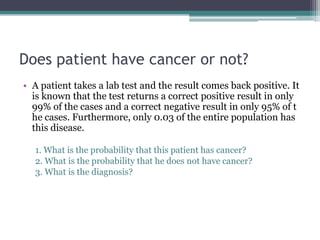
• A patient takes a lab test and the result comes back positive. It
is known that the test returns a correct positive result in only
99% of the cases and a correct negative result in only 95% of t
he cases. Furthermore, only 0.03 of the entire population has
this disease.
1. What is the probability that this patient has cancer?
2. What is the probability that he does not have cancer?
3. What is the diagnosis?
Bayes Classifier
• Recall P(C|X1,X2,…Xn) =
P(C)P(X1,X2,…Xn|C)/P(X1,X2,…Xn)
•  P(C|X1,X2,…Xn) α P(C)P(X1,X2,…Xn|C)
• Maximum A Posteriori hypothesis
▫ hMAP = argmax P(D|h)P(h)
• Maximum Likelihood hypothesis
▫ hML = argmax P(D|h)
Naïve Bayes Classifier
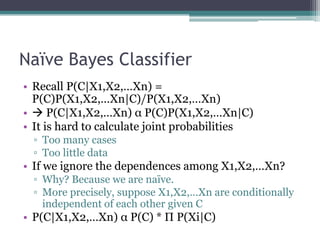
• Recall P(C|X1,X2,…Xn) =
P(C)P(X1,X2,…Xn|C)/P(X1,X2,…Xn)
•  P(C|X1,X2,…Xn) α P(C)P(X1,X2,…Xn|C)
• It is hard to calculate joint probabilities
▫ Too many cases
▫ Too little data
• If we ignore the dependences among X1,X2,…Xn?
▫ Why? Because we are naïve.
▫ More precisely, suppose X1,X2,…Xn are conditionally
independent of each other given C
• P(C|X1,X2,…Xn) α P(C) * Π P(Xi|C)
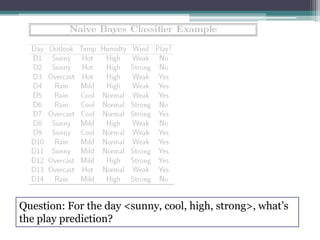
Question: For the day <sunny, cool, high, strong>, what’s
the play prediction?
Wind
Humidity
Temp
Outlook
PlayP(Play=Y) 9/14
P(Play=N) 4/14
P(Sunny|P) P(Overcast|P) P(Rain|P)
Play=
Y
2/9 4/9 3/9
Play=
N
3/5 0/5 2/5
P(Hot|P) P(Mild|P) P(Cool|P)
Play=
Y
2/9 4/9 3/9
Play=
N
2/5 2/5 1/5
Zero Occurrence
• When a feature is never occurred in the training
set  zero frequency  PANIC: makes all terms
zero
• Smoothing the distribution
▫ Laplacian Smoothing
▫ Dirichlet Priors Smoothing
▫ and many more (Absolute Discouting, Jelinek-
Mercer smoothing, Katz smoothing, Good-Turing
smoothing, etc.)
Extension of NBC
• NBC is actually very effective
• Selective Bayesian Classifiers (SBC)
• Tree Augmented Naïve Bayes (TAN)
▫ ChowLiu algorithm (CL-TAN)
▫ SuperParent algorithm (SP-TAN)
• Attribute Value Taxonomy Guided Naïve Bayes
Learner (AVT-NBL)
• n-gram Augmented Naïve Bayes

2013-1 Machine Learning Lecture 03 - Naïve Bayes Classifiers

  • 1.
  • 2.
    Probability • What isthe probability that you get hit in the head with bird droppings when you go outside? ▫ Initially shown in one episode of Korea TV show ▫ Asked in one BBS of an elite group in Korea  no one gave the right answer • It is difficult to define “probability” ▫ As difficult as defining “science”, “history”, etc. • 16 different definitions • Frequentist vs. Bayesian
  • 3.
    Bayesian Probability • Canassign probability on any statement • Can be used to show the degree of one’s belief, or degree of one’s knowledge. • Example of subjectiveness: Alice, Bob, and Carol ▫ Alice tosses a new coin 10 times  3/10 heads ▫ Bob tosses the coin 10 times  4/10 heads ▫ Carol has watched them all  7/20 heads • Probabilities in Monty Hall ▫ MC knows where the car is  1 ▫ Guest asked again after MC opened the door  2/3 ▫ Viewer started watching the show after MC opened the door  1/2
  • 4.
    Bayes Theorem • Probability– P(A) • Conditional Probability – P(A|C) • P(A|B) = P(A,B)/P(B) • P(B|A) = P(A,B)/P(A) • P(A|B) = {P(B|A)P(A)}/P(B) • P(C|D) = {P(D|C)P(C)}/P(D) ▫ P(C|D) : The probability of class given data (Posterior Probability) ▫ P(C) : Prior Probability ▫ P(D|C) : Likelihood ▫ P(D) : constant, so ignored
  • 5.
    Does patient havecancer or not? • A patient takes a lab test and the result comes back positive. It is known that the test returns a correct positive result in only 99% of the cases and a correct negative result in only 95% of t he cases. Furthermore, only 0.03 of the entire population has this disease. 1. What is the probability that this patient has cancer? 2. What is the probability that he does not have cancer? 3. What is the diagnosis?
  • 6.
    Bayes Classifier • RecallP(C|X1,X2,…Xn) = P(C)P(X1,X2,…Xn|C)/P(X1,X2,…Xn) •  P(C|X1,X2,…Xn) α P(C)P(X1,X2,…Xn|C) • Maximum A Posteriori hypothesis ▫ hMAP = argmax P(D|h)P(h) • Maximum Likelihood hypothesis ▫ hML = argmax P(D|h)
  • 7.
    Naïve Bayes Classifier •Recall P(C|X1,X2,…Xn) = P(C)P(X1,X2,…Xn|C)/P(X1,X2,…Xn) •  P(C|X1,X2,…Xn) α P(C)P(X1,X2,…Xn|C) • It is hard to calculate joint probabilities ▫ Too many cases ▫ Too little data • If we ignore the dependences among X1,X2,…Xn? ▫ Why? Because we are naïve. ▫ More precisely, suppose X1,X2,…Xn are conditionally independent of each other given C • P(C|X1,X2,…Xn) α P(C) * Π P(Xi|C)
  • 8.
    Question: For theday <sunny, cool, high, strong>, what’s the play prediction?
  • 9.
    Wind Humidity Temp Outlook PlayP(Play=Y) 9/14 P(Play=N) 4/14 P(Sunny|P)P(Overcast|P) P(Rain|P) Play= Y 2/9 4/9 3/9 Play= N 3/5 0/5 2/5 P(Hot|P) P(Mild|P) P(Cool|P) Play= Y 2/9 4/9 3/9 Play= N 2/5 2/5 1/5
  • 10.
    Zero Occurrence • Whena feature is never occurred in the training set  zero frequency  PANIC: makes all terms zero • Smoothing the distribution ▫ Laplacian Smoothing ▫ Dirichlet Priors Smoothing ▫ and many more (Absolute Discouting, Jelinek- Mercer smoothing, Katz smoothing, Good-Turing smoothing, etc.)
  • 11.
    Extension of NBC •NBC is actually very effective • Selective Bayesian Classifiers (SBC) • Tree Augmented Naïve Bayes (TAN) ▫ ChowLiu algorithm (CL-TAN) ▫ SuperParent algorithm (SP-TAN) • Attribute Value Taxonomy Guided Naïve Bayes Learner (AVT-NBL) • n-gram Augmented Naïve Bayes