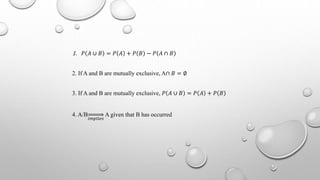
1. 𝑃 𝐴 ∪ 𝐵 = 𝑃 𝐴 + 𝑃 𝐵 − 𝑃 𝐴 ∩ 𝐵
2. If A and B are mutually exclusive, A∩ 𝐵 = ∅
3. If A and B are mutually exclusive, 𝑃 𝐴 ∪ 𝐵 = 𝑃 𝐴 + 𝑃 𝐵
4. A/B
𝑖𝑚𝑝𝑙𝑖𝑒𝑠
A given that B has occurred
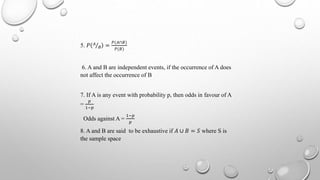
5. 𝑃 𝐴
𝐵 =
𝑃(𝐴∩𝐵)
𝑃(𝐵)
6. A and B are independent events, if the occurrence of A does
not affect the occurrence of B
7. If A is any event with probability p, then odds in favour of A
=
𝑝
1−𝑝
Odds against A =
1−𝑝
𝑝
8. A and B are said to be exhaustive if 𝐴 ∪ 𝐵 = 𝑆 where S is
the sample space
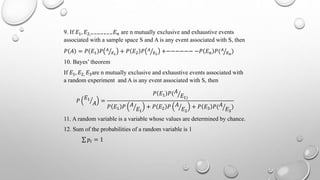
9. If 𝐸1, 𝐸2,−−−−−−− 𝐸 𝑛 are n mutually exclusive and exhaustive events
associated with a sample space S and A is any event associated with S, then
𝑃 𝐴 = 𝑃 𝐸1 𝑃 𝐴
𝐸1
+ 𝑃 𝐸2 𝑃 𝐴
𝐸2
+−−−−−− −𝑃 𝐸 𝑛 𝑃( 𝐴
𝐸 𝑛
)
10. Bayes’ theorem
If 𝐸1, 𝐸2, 𝐸3are n mutually exclusive and exhaustive events associated with
a random experiment and A is any event associated with S, then
𝑃
𝐸1
𝐴 =
𝑃 𝐸1 𝑃( 𝐴
𝐸1)
𝑃 𝐸1 𝑃 𝐴
𝐸1
+ 𝑃 𝐸2 𝑃 𝐴
𝐸2
+ 𝑃 𝐸3 𝑃( 𝐴
𝐸3
)
11. A random variable is a variable whose values are determined by chance.
12. Sum of the probabilities of a random variable is 1
𝑝𝑖 = 1
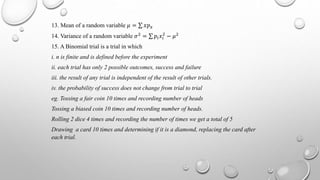
13. Mean of a random variable 𝜇 = 𝑥𝑝 𝑥
14. Variance of a random variable 𝜎2
= 𝑝𝑖 𝑥𝑖
2
− 𝜇2
15. A Binomial trial is a trial in which
i. n is finite and is defined before the experiment
ii. each trial has only 2 possible outcomes, success and failure
iii. the result of any trial is independent of the result of other trials.
iv. the probability of success does not change from trial to trial
eg. Tossing a fair coin 10 times and recording number of heads
Tossing a biased coin 10 times and recording number of heads.
Rolling 2 dice 4 times and recording the number of times we get a total of 5
Drawing a card 10 times and determining if it is a diamond, replacing the card after
each trial.
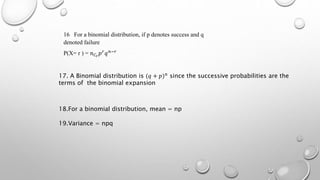
16 For a binomial distribution, if p denotes success and q
denoted failure
P(X= r ) = 𝑛 𝐶 𝑟
𝑝 𝑟
𝑞 𝑛−𝑟
17. A Binomial distribution is (𝑞 + 𝑝) 𝑛
since the successive probabilities are the
terms of the binomial expansion
18.For a binomial distribution, mean = np
19.Variance = npq
Formulas of Probability :Class 12 maths

Formulas of Probability :Class 12 maths

  • 2.
    1. 𝑃 𝐴∪ 𝐵 = 𝑃 𝐴 + 𝑃 𝐵 − 𝑃 𝐴 ∩ 𝐵 2. If A and B are mutually exclusive, A∩ 𝐵 = ∅ 3. If A and B are mutually exclusive, 𝑃 𝐴 ∪ 𝐵 = 𝑃 𝐴 + 𝑃 𝐵 4. A/B 𝑖𝑚𝑝𝑙𝑖𝑒𝑠 A given that B has occurred
  • 3.
    5. 𝑃 𝐴 𝐵= 𝑃(𝐴∩𝐵) 𝑃(𝐵) 6. A and B are independent events, if the occurrence of A does not affect the occurrence of B 7. If A is any event with probability p, then odds in favour of A = 𝑝 1−𝑝 Odds against A = 1−𝑝 𝑝 8. A and B are said to be exhaustive if 𝐴 ∪ 𝐵 = 𝑆 where S is the sample space
  • 4.
    9. If 𝐸1,𝐸2,−−−−−−− 𝐸 𝑛 are n mutually exclusive and exhaustive events associated with a sample space S and A is any event associated with S, then 𝑃 𝐴 = 𝑃 𝐸1 𝑃 𝐴 𝐸1 + 𝑃 𝐸2 𝑃 𝐴 𝐸2 +−−−−−− −𝑃 𝐸 𝑛 𝑃( 𝐴 𝐸 𝑛 ) 10. Bayes’ theorem If 𝐸1, 𝐸2, 𝐸3are n mutually exclusive and exhaustive events associated with a random experiment and A is any event associated with S, then 𝑃 𝐸1 𝐴 = 𝑃 𝐸1 𝑃( 𝐴 𝐸1) 𝑃 𝐸1 𝑃 𝐴 𝐸1 + 𝑃 𝐸2 𝑃 𝐴 𝐸2 + 𝑃 𝐸3 𝑃( 𝐴 𝐸3 ) 11. A random variable is a variable whose values are determined by chance. 12. Sum of the probabilities of a random variable is 1 𝑝𝑖 = 1
  • 5.
    13. Mean ofa random variable 𝜇 = 𝑥𝑝 𝑥 14. Variance of a random variable 𝜎2 = 𝑝𝑖 𝑥𝑖 2 − 𝜇2 15. A Binomial trial is a trial in which i. n is finite and is defined before the experiment ii. each trial has only 2 possible outcomes, success and failure iii. the result of any trial is independent of the result of other trials. iv. the probability of success does not change from trial to trial eg. Tossing a fair coin 10 times and recording number of heads Tossing a biased coin 10 times and recording number of heads. Rolling 2 dice 4 times and recording the number of times we get a total of 5 Drawing a card 10 times and determining if it is a diamond, replacing the card after each trial.
  • 6.
    16 For abinomial distribution, if p denotes success and q denoted failure P(X= r ) = 𝑛 𝐶 𝑟 𝑝 𝑟 𝑞 𝑛−𝑟 17. A Binomial distribution is (𝑞 + 𝑝) 𝑛 since the successive probabilities are the terms of the binomial expansion 18.For a binomial distribution, mean = np 19.Variance = npq