Data Warehousing
  And Data Mining


“ Naïve Bayes ”
 Classification

                Ankit Gadgil : 11030142027
                   MSc(CA), SICSR, Pune
Contents
1.Introduction Classification.
2.What is Naïve-Bayes
 classification.
3.Theory.
4.Conclusion.
5.Advantages and Disadvantages.
Introduction
Classification:

In machine learning and statistics classification is the problem of

identifying to which of a set of categories a new observation belongs.


The individual observations are analyzed into a set of quantifiable

properties, known as various explanatory variables, features, etc.

These properties may variously be categorical (e.g. "A", "B", "AB" or

"O", for blood type), ordinal (e.g. "large", "medium" or "small"),
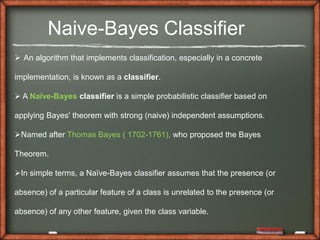
Naive-Bayes Classifier
 An algorithm that implements classification, especially in a concrete

implementation, is known as a classifier.

 A Naïve-Bayes classifier is a simple probabilistic classifier based on

applying Bayes' theorem with strong (naive) independent assumptions.

Named after Thomas Bayes ( 1702-1761), who proposed the Bayes

Theorem.

In simple terms, a Naïve-Bayes classifier assumes that the presence (or

absence) of a particular feature of a class is unrelated to the presence (or

absence) of any other feature, given the class variable.
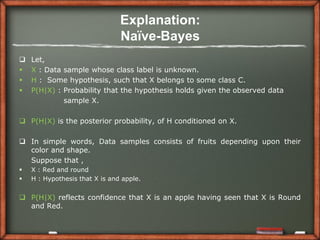
Explanation:
                                Naïve-Bayes
   Let,
   X : Data sample whose class label is unknown.
   H : Some hypothesis, such that X belongs to some class C.
   P(H|X) : Probability that the hypothesis holds given the observed data
             sample X.

 P(H|X) is the posterior probability, of H conditioned on X.

 In simple words, Data samples consists of fruits depending upon their
  color and shape.
  Suppose that ,
   X : Red and round
   H : Hypothesis that X is and apple.


 P(H|X) reflects confidence that X is an apple having seen that X is Round
  and Red.
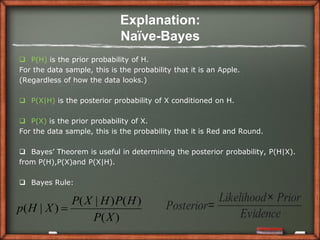
Explanation:
                             Naïve-Bayes
 P(H) is the prior probability of H.
For the data sample, this is the probability that it is an Apple.
(Regardless of how the data looks.)

 P(X|H) is the posterior probability of X conditioned on H.

 P(X) is the prior probability of X.
For the data sample, this is the probability that it is Red and Round.

 Bayes’ Theorem is useful in determining the posterior probability, P(H|X).
from P(H),P(X)and P(X|H).

 Bayes Rule:

             P( X | H ) P( H )                        Likelihood× Prior
p( H | X )                                Posterior=
                                                           Evidence
                  P( X )
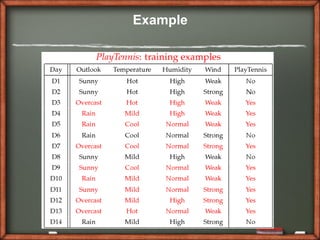
Example
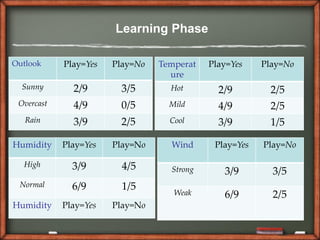
Learning Phase

Outlook     Play=Yes   Play=No   Temperat   Play=Yes    Play=No
                                   ure
  Sunny       2/9       3/5        Hot        2/9         2/5
 Overcast     4/9       0/5        Mild       4/9         2/5
   Rain       3/9       2/5        Cool       3/9         1/5

Humidity    Play=Yes   Play=No     Wind      Play=Yes   Play=No

  High        3/9        4/5       Strong      3/9        3/5
 Normal       6/9        1/5
                                    Weak       6/9        2/5
Humidity    Play=Yes   Play=No
Instance

   Test Phase
          Given a new instance,
          x’=(Outlook=Sunny, Temperature=Cool, Humidity=High,
           Wind=Strong)


  P(Outlook=Sunny|Play=Yes) = 2/9
                                            P(Outlook=Sunny|Play=No) = 3/5
  P(Temperature=Cool|Play=Yes) = 3/9
                                            P(Temperature=Cool|Play==No) = 1/5
  P(Huminity=High|Play=Yes) = 3/9
                                            P(Huminity=High|Play=No) = 4/5
  P(Wind=Strong|Play=Yes) = 3/9
                                            P(Wind=Strong|Play=No) = 3/5
  P(Play=Yes) = 9/14
                                            P(Play=No) = 5/14
P(Yes|x’): *P(Sunny|Yes)P(Cool|Yes)P(High|Yes)P(Strong|Yes)]P(Play=Yes) = 0.0053
P(No|x’): *P(Sunny|No) P(Cool|No)P(High|No)P(Strong|No)]P(Play=No) = 0.0206

     Given the fact P(Yes|x’) < P(No|x’), we label x’ to be “No”.
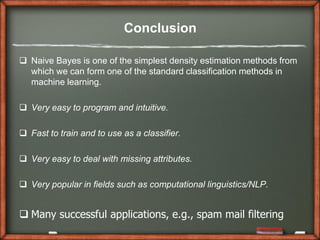
Conclusion

 Naive Bayes is one of the simplest density estimation methods from
  which we can form one of the standard classification methods in
  machine learning.

 Very easy to program and intuitive.

 Fast to train and to use as a classifier.

 Very easy to deal with missing attributes.

 Very popular in fields such as computational linguistics/NLP.


 Many successful applications, e.g., spam mail filtering
•   References:

 Data Mining :Concepts and Techniques – JiaweiHan, Micheline Kamber
  Simon Fraser University.

 Naïve-Bayes Classifier by Ke Chen - comp24111 Machine Learning.

 Introduction to Baysian Learning - Ata Kaban, University of Birmingham .

 Learning from Data 1 Naive Bayes - David Barber 2001-2004,Amos Storkey


                     Thank You !!

Dwdm naive bayes_ankit_gadgil_027

  • 1.
    Data Warehousing And Data Mining “ Naïve Bayes ” Classification Ankit Gadgil : 11030142027 MSc(CA), SICSR, Pune
  • 2.
    Contents 1.Introduction Classification. 2.What isNaïve-Bayes classification. 3.Theory. 4.Conclusion. 5.Advantages and Disadvantages.
  • 3.
    Introduction Classification: In machine learningand statistics classification is the problem of identifying to which of a set of categories a new observation belongs. The individual observations are analyzed into a set of quantifiable properties, known as various explanatory variables, features, etc. These properties may variously be categorical (e.g. "A", "B", "AB" or "O", for blood type), ordinal (e.g. "large", "medium" or "small"),
  • 4.
    Naive-Bayes Classifier  Analgorithm that implements classification, especially in a concrete implementation, is known as a classifier.  A Naïve-Bayes classifier is a simple probabilistic classifier based on applying Bayes' theorem with strong (naive) independent assumptions. Named after Thomas Bayes ( 1702-1761), who proposed the Bayes Theorem. In simple terms, a Naïve-Bayes classifier assumes that the presence (or absence) of a particular feature of a class is unrelated to the presence (or absence) of any other feature, given the class variable.
  • 5.
    Explanation: Naïve-Bayes  Let,  X : Data sample whose class label is unknown.  H : Some hypothesis, such that X belongs to some class C.  P(H|X) : Probability that the hypothesis holds given the observed data sample X.  P(H|X) is the posterior probability, of H conditioned on X.  In simple words, Data samples consists of fruits depending upon their color and shape. Suppose that ,  X : Red and round  H : Hypothesis that X is and apple.  P(H|X) reflects confidence that X is an apple having seen that X is Round and Red.
  • 6.
    Explanation: Naïve-Bayes  P(H) is the prior probability of H. For the data sample, this is the probability that it is an Apple. (Regardless of how the data looks.)  P(X|H) is the posterior probability of X conditioned on H.  P(X) is the prior probability of X. For the data sample, this is the probability that it is Red and Round.  Bayes’ Theorem is useful in determining the posterior probability, P(H|X). from P(H),P(X)and P(X|H).  Bayes Rule: P( X | H ) P( H ) Likelihood× Prior p( H | X )  Posterior= Evidence P( X )
  • 7.
  • 8.
    Learning Phase Outlook Play=Yes Play=No Temperat Play=Yes Play=No ure Sunny 2/9 3/5 Hot 2/9 2/5 Overcast 4/9 0/5 Mild 4/9 2/5 Rain 3/9 2/5 Cool 3/9 1/5 Humidity Play=Yes Play=No Wind Play=Yes Play=No High 3/9 4/5 Strong 3/9 3/5 Normal 6/9 1/5 Weak 6/9 2/5 Humidity Play=Yes Play=No
  • 9.
    Instance Test Phase  Given a new instance,  x’=(Outlook=Sunny, Temperature=Cool, Humidity=High, Wind=Strong) P(Outlook=Sunny|Play=Yes) = 2/9 P(Outlook=Sunny|Play=No) = 3/5 P(Temperature=Cool|Play=Yes) = 3/9 P(Temperature=Cool|Play==No) = 1/5 P(Huminity=High|Play=Yes) = 3/9 P(Huminity=High|Play=No) = 4/5 P(Wind=Strong|Play=Yes) = 3/9 P(Wind=Strong|Play=No) = 3/5 P(Play=Yes) = 9/14 P(Play=No) = 5/14 P(Yes|x’): *P(Sunny|Yes)P(Cool|Yes)P(High|Yes)P(Strong|Yes)]P(Play=Yes) = 0.0053 P(No|x’): *P(Sunny|No) P(Cool|No)P(High|No)P(Strong|No)]P(Play=No) = 0.0206 Given the fact P(Yes|x’) < P(No|x’), we label x’ to be “No”.
  • 10.
    Conclusion  Naive Bayesis one of the simplest density estimation methods from which we can form one of the standard classification methods in machine learning.  Very easy to program and intuitive.  Fast to train and to use as a classifier.  Very easy to deal with missing attributes.  Very popular in fields such as computational linguistics/NLP.  Many successful applications, e.g., spam mail filtering
  • 11.
    References:  Data Mining :Concepts and Techniques – JiaweiHan, Micheline Kamber Simon Fraser University.  Naïve-Bayes Classifier by Ke Chen - comp24111 Machine Learning.  Introduction to Baysian Learning - Ata Kaban, University of Birmingham .  Learning from Data 1 Naive Bayes - David Barber 2001-2004,Amos Storkey Thank You !!