Downloaded 31 times
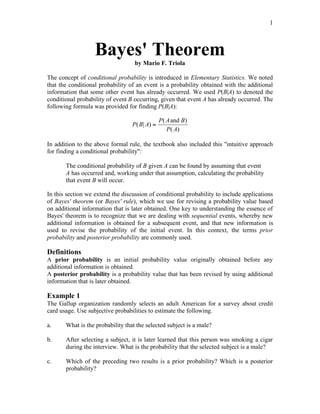
![2
Solution
a. Roughly half of all Americans are males, so we estimate the probability of
selecting a male subject to be 0.5. Denoting a male by M, we can express this
probability as follows: P(M) = 0.5.
b. Although some women smoke cigars, the vast majority of cigar smokers are
males. A reasonable guess is that 85% of cigar smokers are males. Based on this
additional subsequent information that the survey respondent was smoking a
cigar, we estimate the probability of this person being a male as 0.85. Denoting a
male by M and denoting a cigar smoker by C, we can express this result as
follows: P(M | C) = 0.85.
c. In part (a), the value of 0.5 is the initial probability, so we refer to it as the prior
probability. Because the probability of 0.85 in part (b) is a revised probability
based on the additional information that the survey subject was smoking a cigar,
this value of 0.85 is referred to a posterior probability.
The Reverend Thomas Bayes [1701 (approximately) − 1761] was an English
minister and mathematician. Although none of his work was published during his
lifetime, later (posterior?) publications included the following theorem (or rule) that he
developed for determining probabilities of events by incorporating information about
subsequent events.
Bayes' Theorem
The probability of event A, given that event B has subsequently occurred, is
P A B
P A P B A
P A P B A P A P B A
( | )
( ) ( | )
[ ( ) ( | )] [ ( ) ( | )]
=
!
! + !
That's a formidable expression, but we will simplify its calculation. See the following
example, which illustrates use of the above expression, but also see the alternative
method based on a more intuitive application of Bayes' theorem.
Example 2
In Orange County, 51% of the adults are males. (It doesn't take too much advanced
mathematics to deduce that the other 49% are females.) One adult is randomly selected
for a survey involving credit card usage.
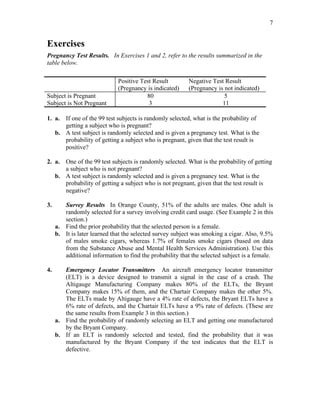
a. Find the prior probability that the selected person is a male.
b. It is later learned that the selected survey subject was smoking a cigar. Also, 9.5%
of males smoke cigars, whereas 1.7% of females smoke cigars (based on data
from the Substance Abuse and Mental Health Services Administration). Use this
additional information to find the probability that the selected subject is a male.](https://image.slidesharecdn.com/bayestheorem-151029071910-lva1-app6891/85/Bayes-theorem-2-320.jpg)
![3
Solution
Let's use the following notation:
M = male M = female (or not male)
C = cigar smoker C = not a cigar smoker.
a. Before using the information given in part b, we know only that 51% of the adults
in Orange County are males, so the probability of randomly selecting an adult and
getting a male is given by P(M) = 0.51.
b. Based on the additional given information, we have the following:
P(M) = 0.51 because 51% of the adults are males
P( M ) = 0.49 because 49% of the adults are females (not males)
P(C|M) = 0.095 because 9.5% of the males smoke cigars (That is,
the probability of getting someone who smokes
cigars, given that the person is a male, is 0.095.)
P(C| M ) = 0.017. because 1.7% of the females smoke cigars (That is,
the probability of getting someone who smokes
cigars, given that the person is a female, is 0.017.)
Let's now apply Bayes' theorem by using the preceding formula with M in place
of A, and C in place of B. We get the following result:
P(M | C) =
P M P C M
P M P C M P M P C M
( ) ( | )
[ ( ) ( | )] [ ( ) ( | )]
!
! + !
=
051 0 095
051 0 095 0 49 0 017
. .
[ . . ] [ . . ]
!
! + !
= 0.85329341
= 0.853 (rounded)
Before we knew that the survey subject smoked a cigar, there is a 0.51 probability
that the survey subject is male (because 51% of the adults in Orange County are
males). However, after learning that the subject smoked a cigar, we revised the
probability to 0.853. There is a 0.853 probability that the cigar−smoking
respondent is a male. This makes sense, because the likelihood of a male
increases dramatically with the additional information that the subject smokes
cigars (because so many more males smoke cigars than females).](https://image.slidesharecdn.com/bayestheorem-151029071910-lva1-app6891/85/Bayes-theorem-3-320.jpg)
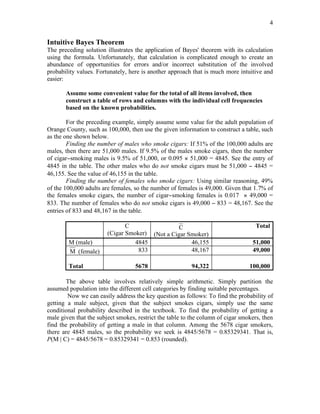
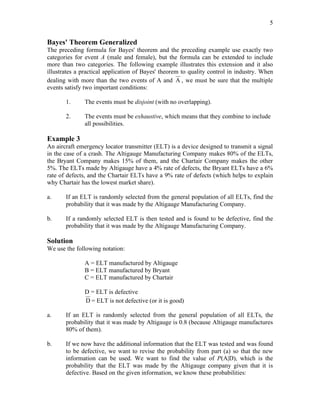
![6
P(A) = 0.80 because Altigauge makes 80% of the ELTs
P(B) = 0.15 because Bryant makes 15% of the ELTs
P(C) = 0.05 because Chartair makes 5% of the ELTs
P(D|A) = 0.04 because 4% of the Altigauge ELTs are defective
P(D|B) = 0.06 because 6% of the Bryant ELTs are defective
P(D|C) = 0.09 because 9% of the Chartair ELTs are defective
Here is Bayes' theorem extended to include three events corresponding to the
selection of ELTs from the three manufacturers (A, B, C):
P(A|D) =
P A P D A
P A P D A P B P D B P C P D C
( ) ( | )
[ ( ) ( | )] [ ( ) ( | )] [ ( ) ( | )]
!
! + ! + !
=
080 0 04
080 0 04 015 0 06 0 05 0 09
. .
[ . . ] [ . . ] [ . . ]
!
! + ! + !
= 0.703 (rounded)
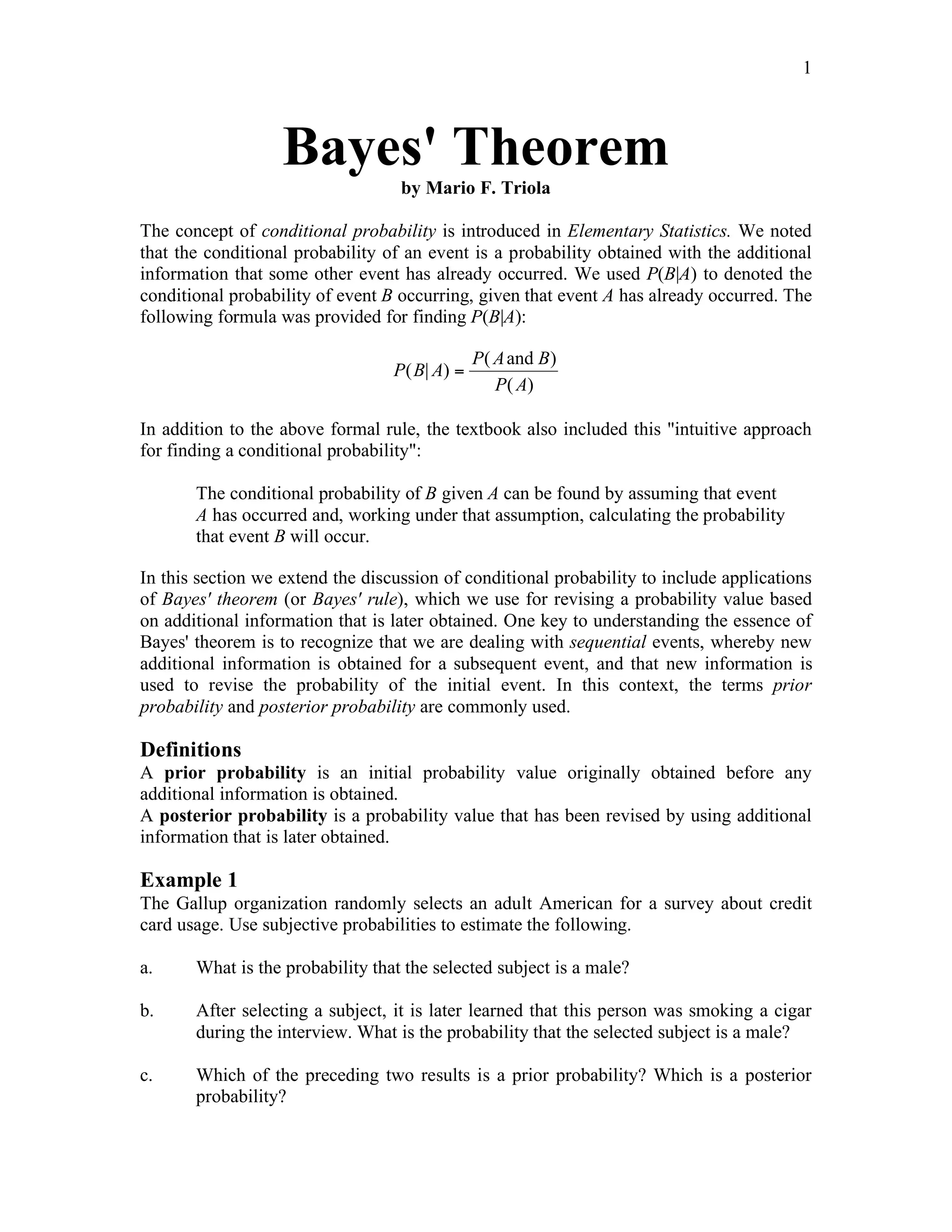
Intuitive Baye's Theorem: Now let's find P(A|D) by using a table. Let's arbitrarily
assume that 10,000 ELTs were manufactured. (The solution doesn't depend on the
number selected, but it's helpful to select a number large enough so that the cells
in the table are all whole numbers.) Because 80% of the ELTs are made by
Altigauge, we have 8000 ELTs made by Altigauge, and 4% of them (or 320) are
defective. Also, if 320 of the Altigauge ELTs are defective, the other 7680 are not
defective. See the values of 320 and 7680 in the table below. The other values are
found using the same reasoning.
D (defective) D (not defective) Total
A (Altigauge) 320 7680 8,000
B (Bryant) 90 1410 1,500
C (Chartair) 45 455 500
Total 455 9545 10,000
We want to find the probability that an ELT was made by Altigauge, given
that it is known to be defective. Because we know the condition that the ELT is
defective, we can refer to the first column of values where we see that among the
455 total defective ELTs, 320 were made by Altigauge, so that the probability is
320/455 = 0.703 (rounded). This is the same result obtained with the formula
from Bayes' theorem.
The preceding example involve an extension of Bayes' theorem to three
events denoted by A, B, C. Based on the format of the formula used in the
solution, it is easy to extend Bayes' theorem so that it can be used with four or
more events. (See Exercises 11 and 12.)](https://image.slidesharecdn.com/bayestheorem-151029071910-lva1-app6891/85/Bayes-theorem-6-320.jpg)
![9
Answers to Odd−Numbered Exercises
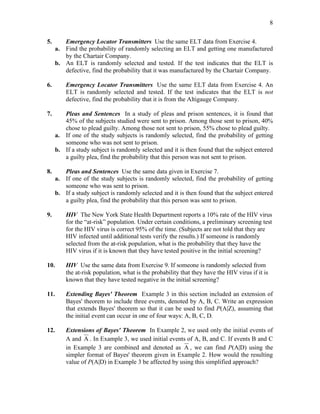
1. a. 85/99 or 0.859
b. 80/83 or 0.964
3. a. 0.49
b. 0.147
5. a. 0.05
b. 0.0989
7. a. 0.55
b. 0.627
9. 0.679
11. P(A|Z) =
P A P Z A
P A P Z A P B P Z B P C P Z C P D P Z D
( ) ( | )
[ ( ) ( | )] [ ( ) ( | )] [ ( ) ( | )] [ ( ) ( | )]
!
! + ! + ! + !](https://image.slidesharecdn.com/bayestheorem-151029071910-lva1-app6891/85/Bayes-theorem-9-320.jpg)

- Bayes' Theorem is used to revise a probability value based on additional information obtained later. It deals with sequential events where new information is incorporated to update the probability of the initial event. - A prior probability is the initial probability value before any additional information. A posterior probability is a revised probability that incorporates new information. - Bayes' Theorem provides a formula for calculating the posterior probability P(A|B) from the prior probabilities P(A), P(B|A) and P(B). It can be applied when there are more than two possible events, as long as the events are mutually exclusive and exhaustive.


