Overview of NSA Security
    Enhanced Linux

        James Morris
       jmorris@namei.org


         FOSS.IN/2005
         Bangalore, India
What is SELinux?
●
    Fine­grained Mandatory Access Control (MAC)
●
    Strongly separated domains
●
    Provides confinement of:
        ●
            malicious code
        ●
            flawed code
        ●
            user error/intention
●
    Enforces least privilege
●
    Protects integrity
●
    Flexible policy
Discretionary Access Control (DAC) 
●
    Traditional Unix security model
●
    DAC is inadequate:
    –   Decisions only based on user identity and ownership
    –   No protection against malicious or flawed software
    –   Each user has complete discretion over own objects
    –   Only two major categories of users: admin and other
    –   Coarse­grained and too much privilege
    –   Unbounded privilege escalation
Mandatory Access Control (MAC)
●
    “Missing link” of security in general OSs
●
    Primary features:
    –   Administratively­set security policy
    –   Control over all processes and objects
    –   Decisions based on all security­relevant information
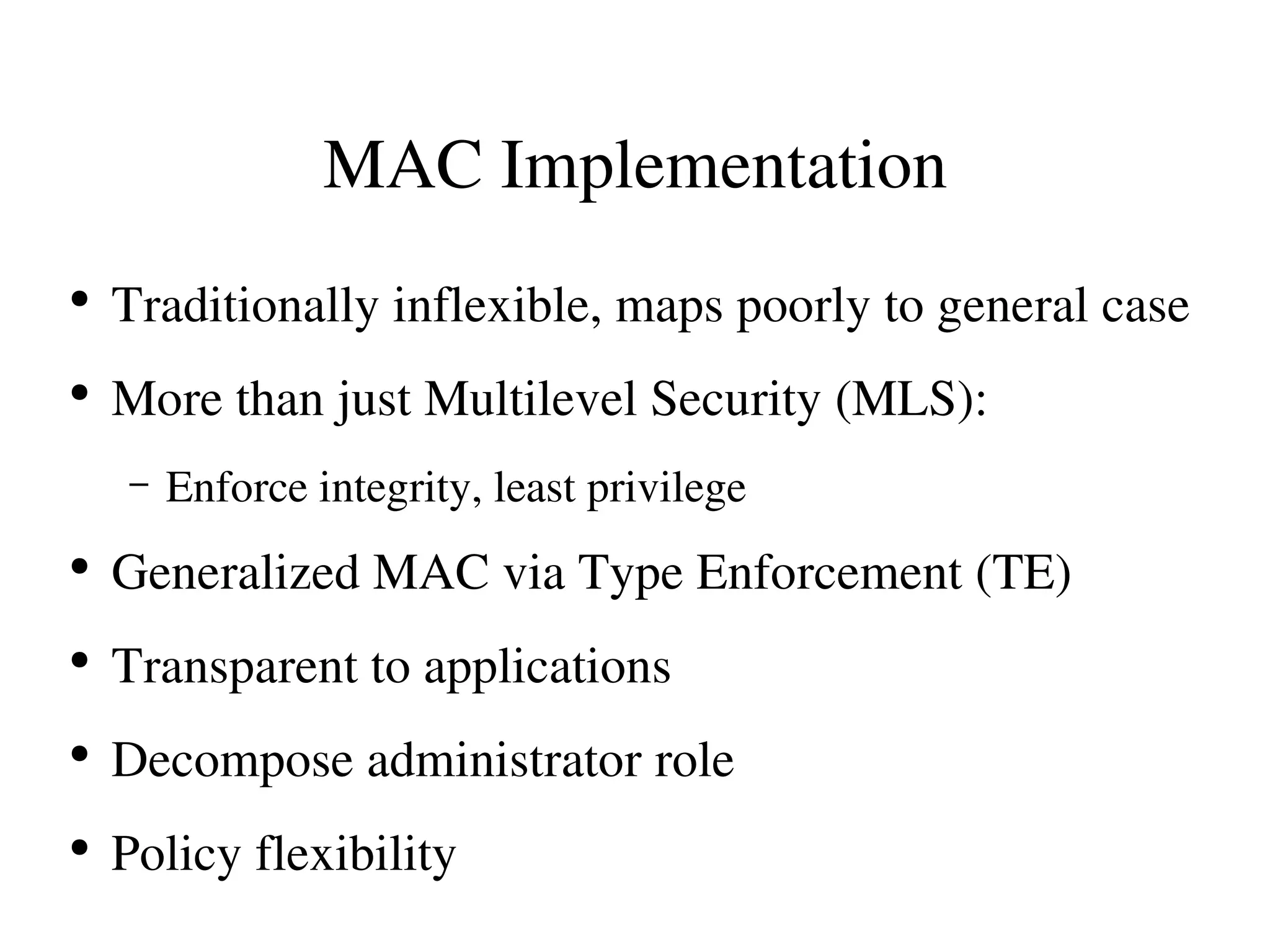
MAC Implementation
●
    Traditionally inflexible, maps poorly to general case
●
    More than just Multilevel Security (MLS):
    –   Enforce integrity, least privilege
●
    Generalized MAC via Type Enforcement (TE)
●
    Transparent to applications
●
    Decompose administrator role
●
    Policy flexibility
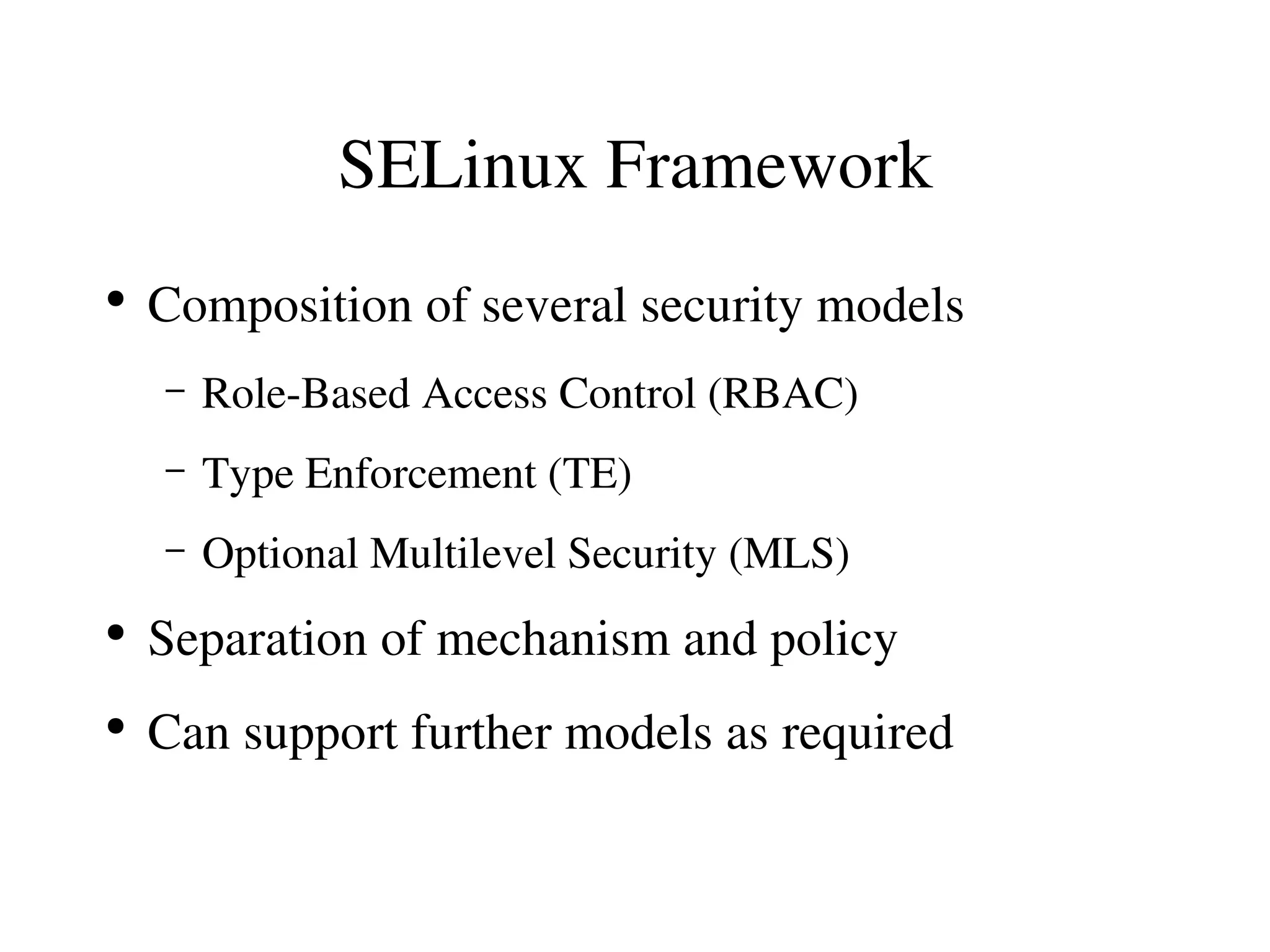
SELinux Framework
●
    Composition of several security models
    –   Role­Based Access Control (RBAC)
    –   Type Enforcement (TE)
    –   Optional Multilevel Security (MLS)
●
    Separation of mechanism and policy
●
    Can support further models as required
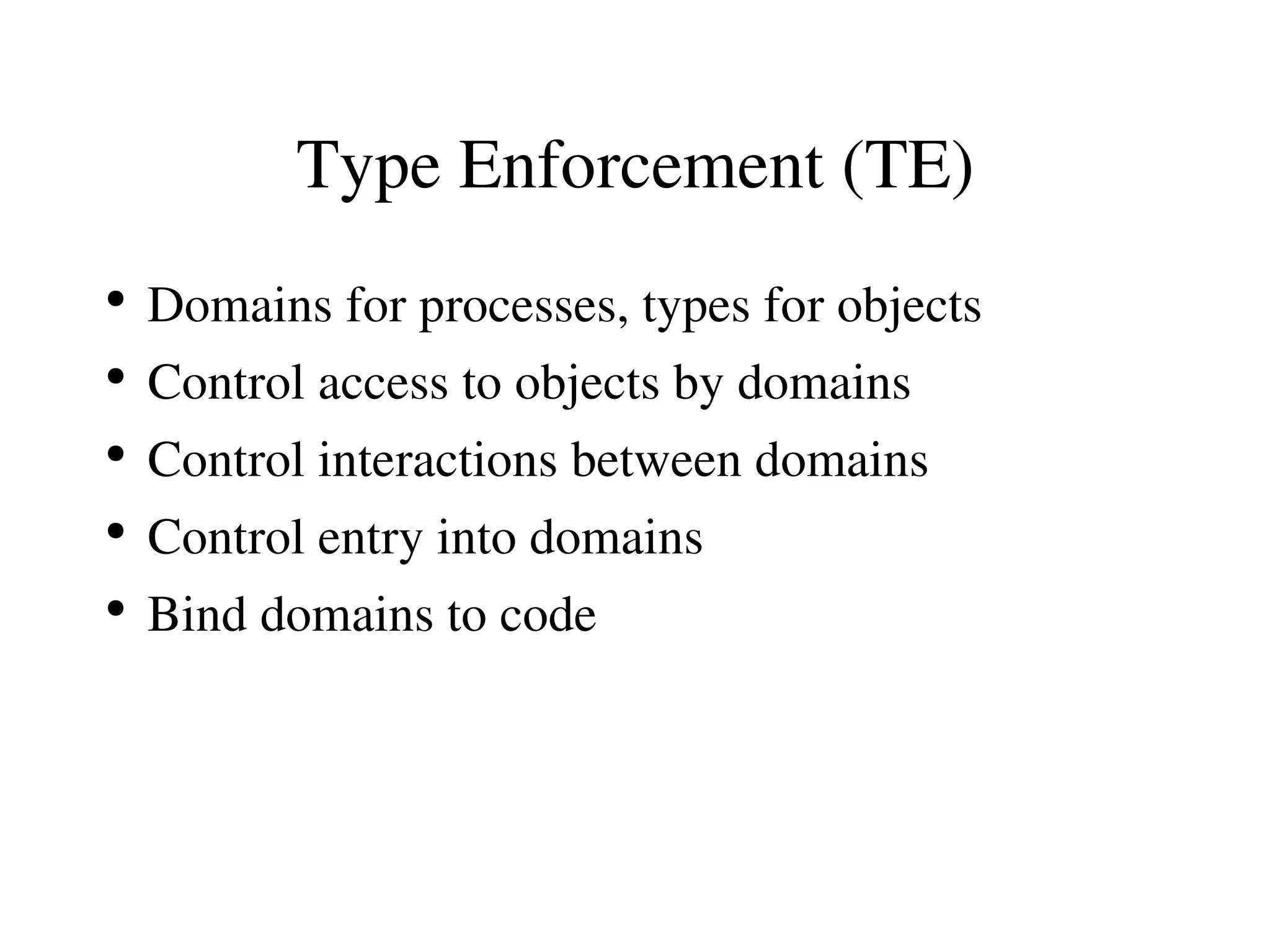
Type Enforcement (TE)
●
    Domains for processes, types for objects
●
    Control access to objects by domains
●
    Control interactions between domains
●
    Control entry into domains
●
    Bind domains to code
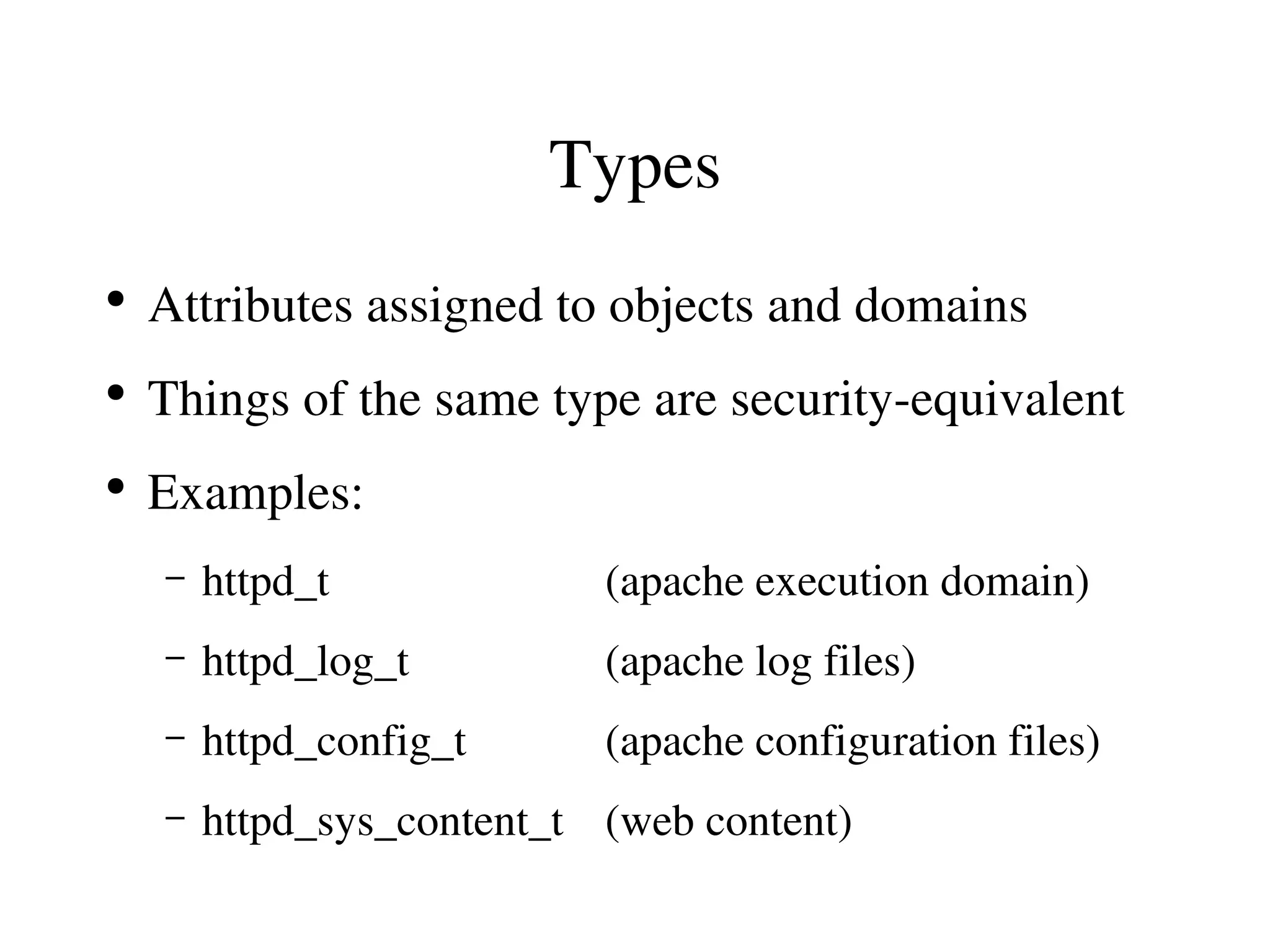
Types
●
    Attributes assigned to objects and domains
●
    Things of the same type are security­equivalent
●
    Examples:
    –   httpd_t             (apache execution domain)
    –   httpd_log_t         (apache log files)
    –   httpd_config_t      (apache configuration files)
    –   httpd_sys_content_t (web content)
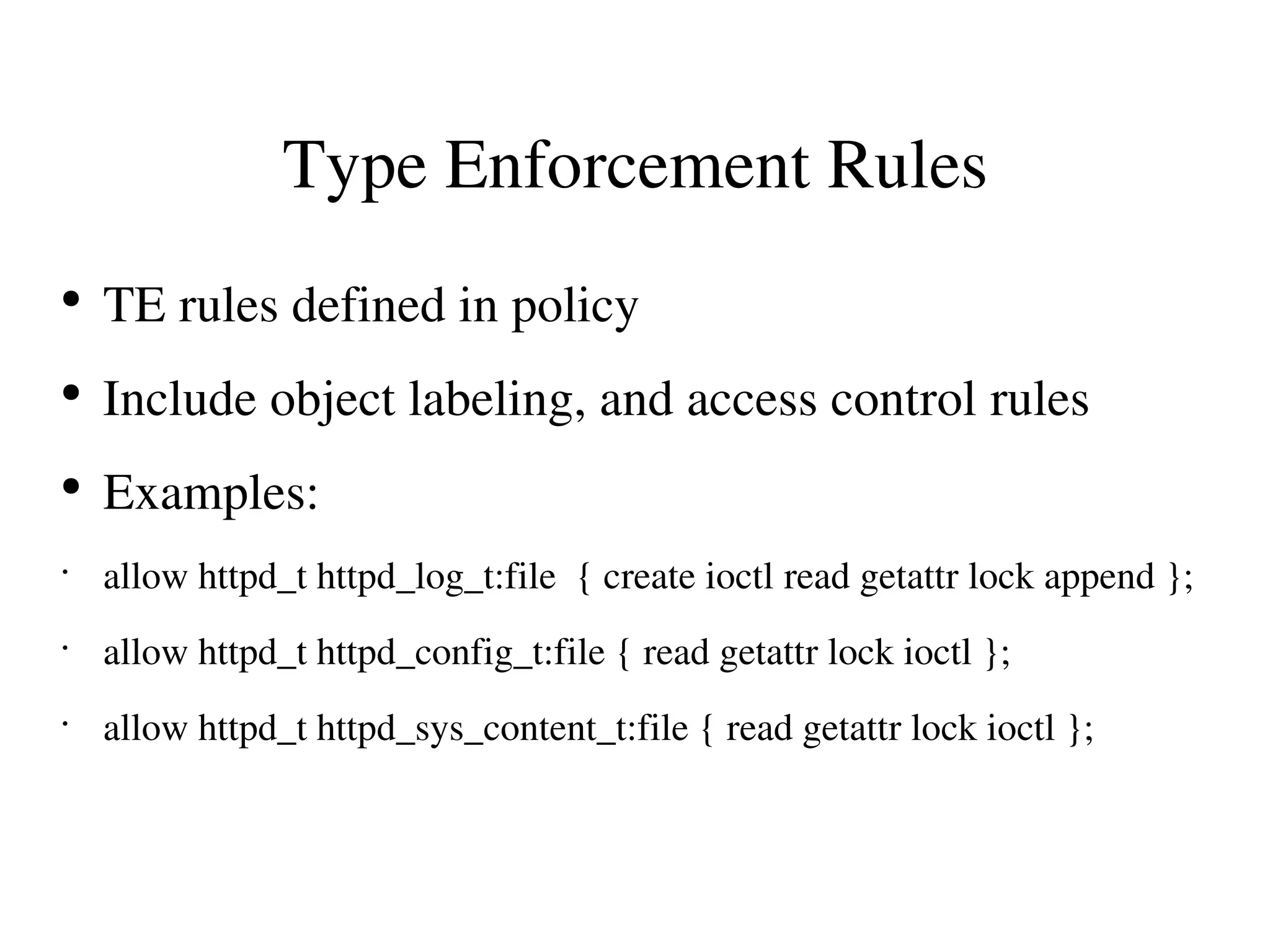
Type Enforcement Rules
●
    TE rules defined in policy
●
    Include object labeling, and access control rules
●
    Examples:
•
    allow httpd_t httpd_log_t:file  { create ioctl read getattr lock append };
•
    allow httpd_t httpd_config_t:file { read getattr lock ioctl };
•
    allow httpd_t httpd_sys_content_t:file { read getattr lock ioctl };
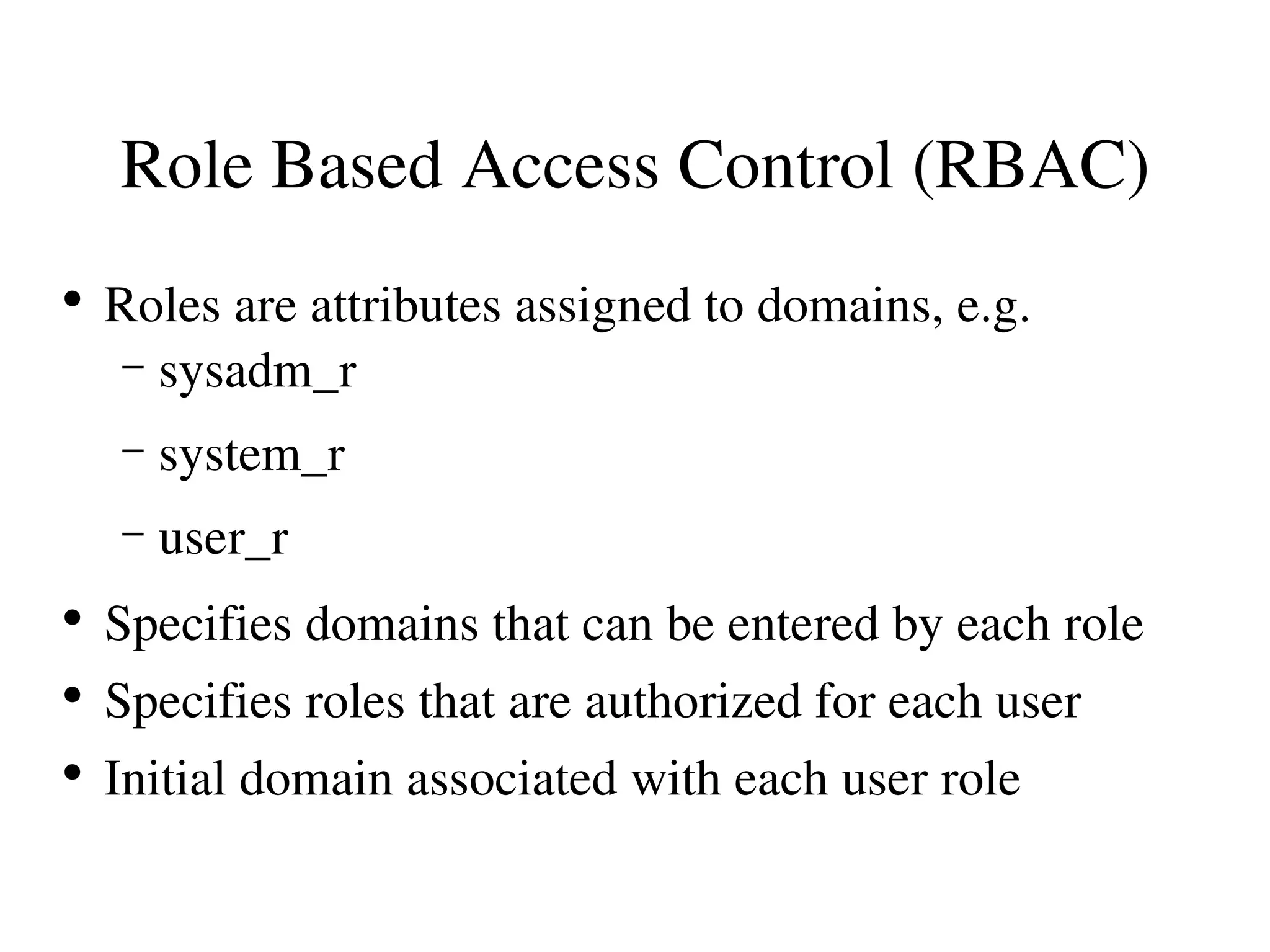
Role Based Access Control (RBAC)
●
    Roles are attributes assigned to domains, e.g.
     – sysadm_r

    –   system_r
    –   user_r
●
    Specifies domains that can be entered by each role
●
    Specifies roles that are authorized for each user
●
    Initial domain associated with each user role
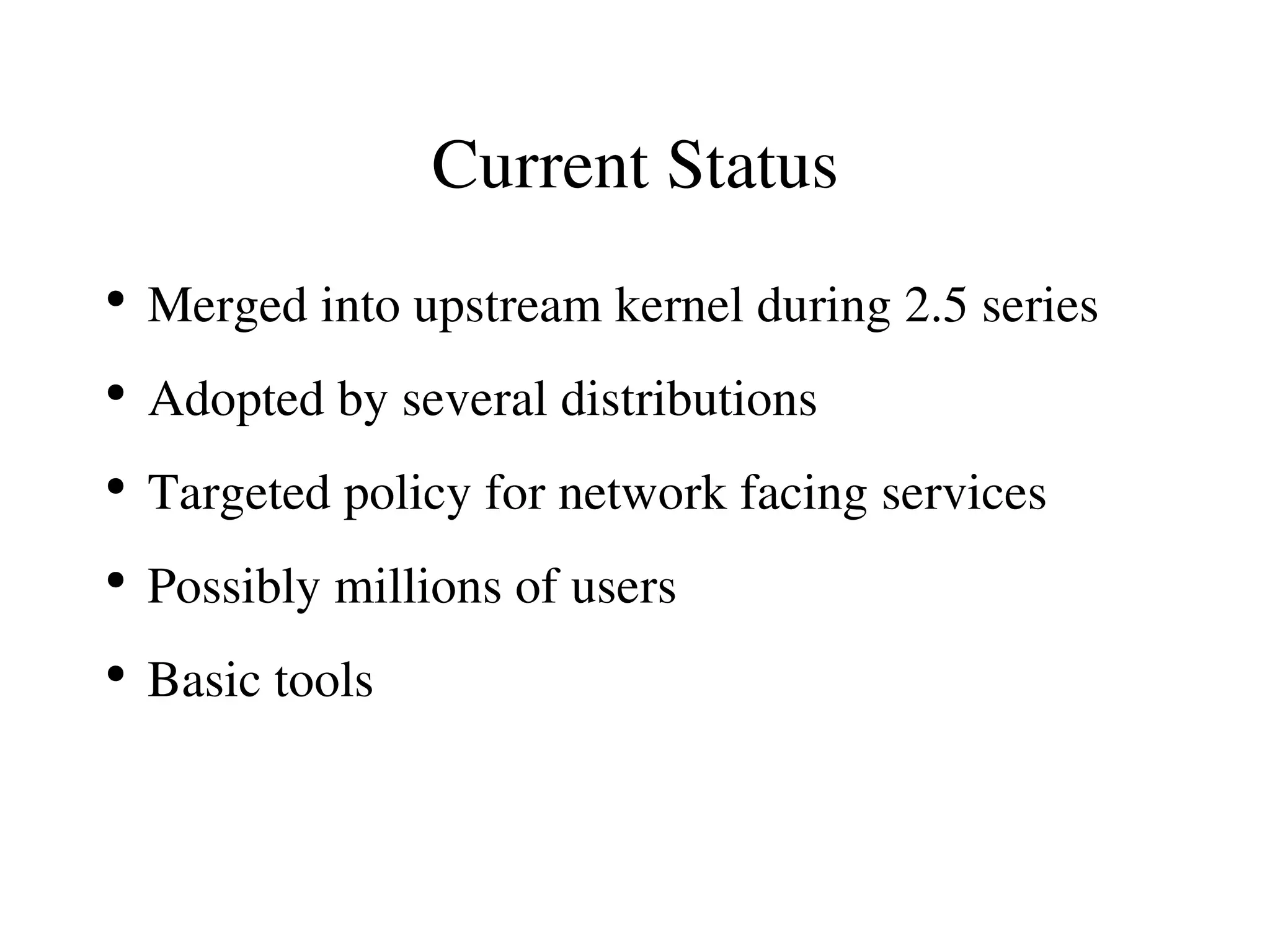
Current Status
●
    Merged into upstream kernel during 2.5 series
●
    Adopted by several distributions
●
    Targeted policy for network facing services
●
    Possibly millions of users
●
    Basic tools
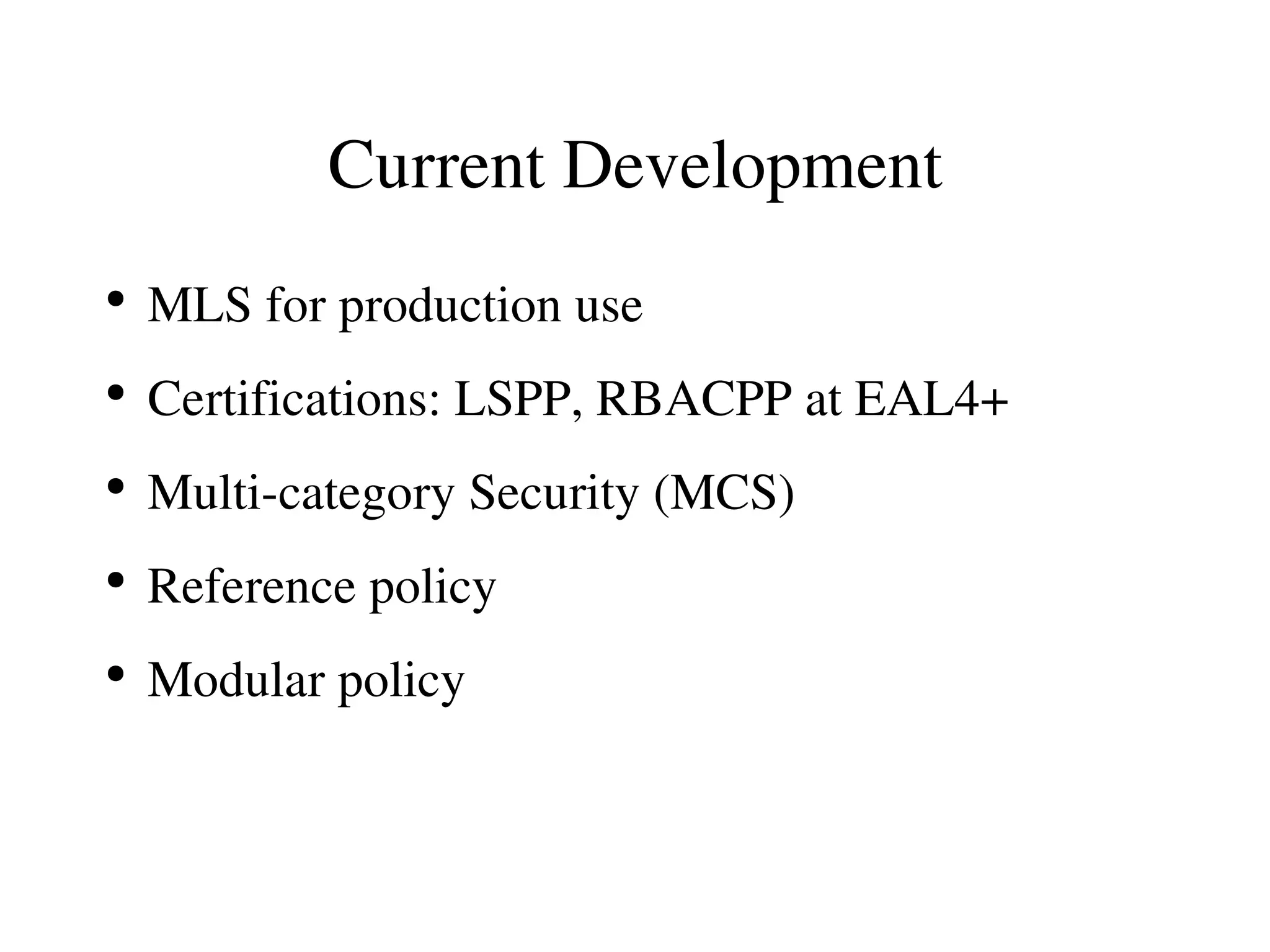
Current Development
●
    MLS for production use
●
    Certifications: LSPP, RBACPP at EAL4+
●
    Multi­category Security (MCS)
●
    Reference policy
●
    Modular policy
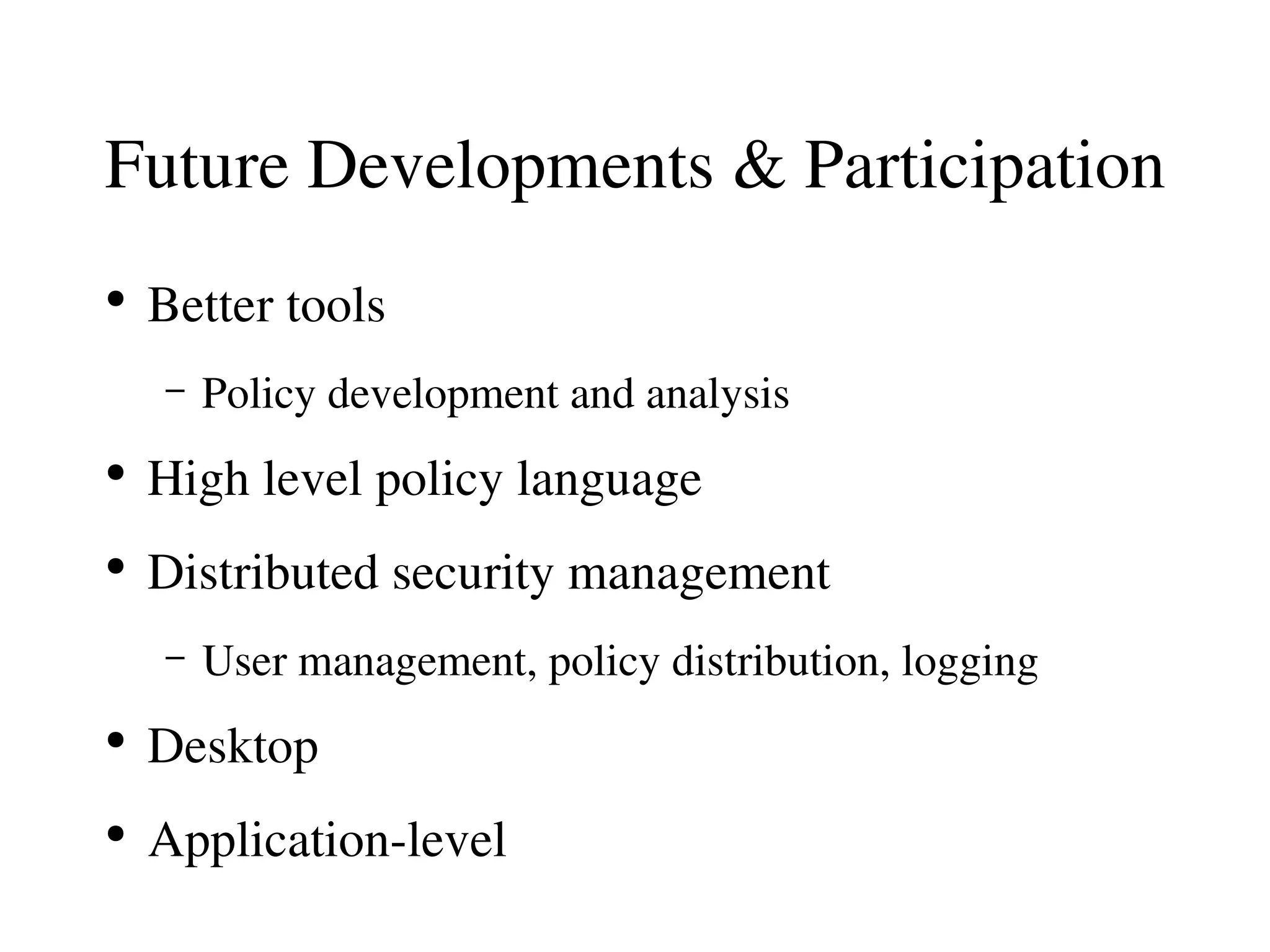
Future Developments & Participation
●
    Better tools
    –   Policy development and analysis
●
    High level policy language
●
    Distributed security management
    –   User management, policy distribution, logging
●
    Desktop
●
    Application­level
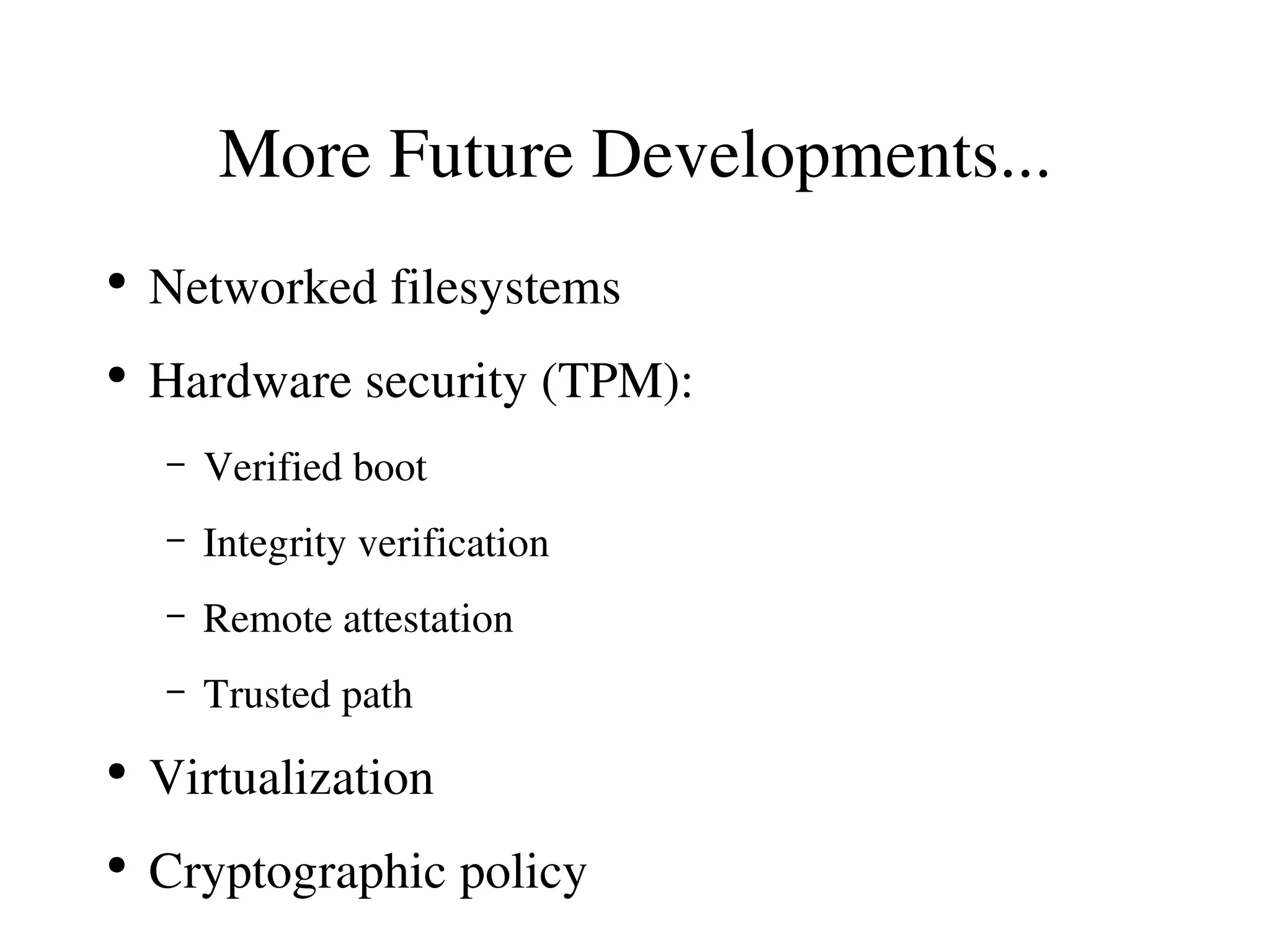
More Future Developments...
●
    Networked filesystems
●
    Hardware security (TPM):
    –   Verified boot
    –   Integrity verification
    –   Remote attestation
    –   Trusted path
●
    Virtualization
●
    Cryptographic policy
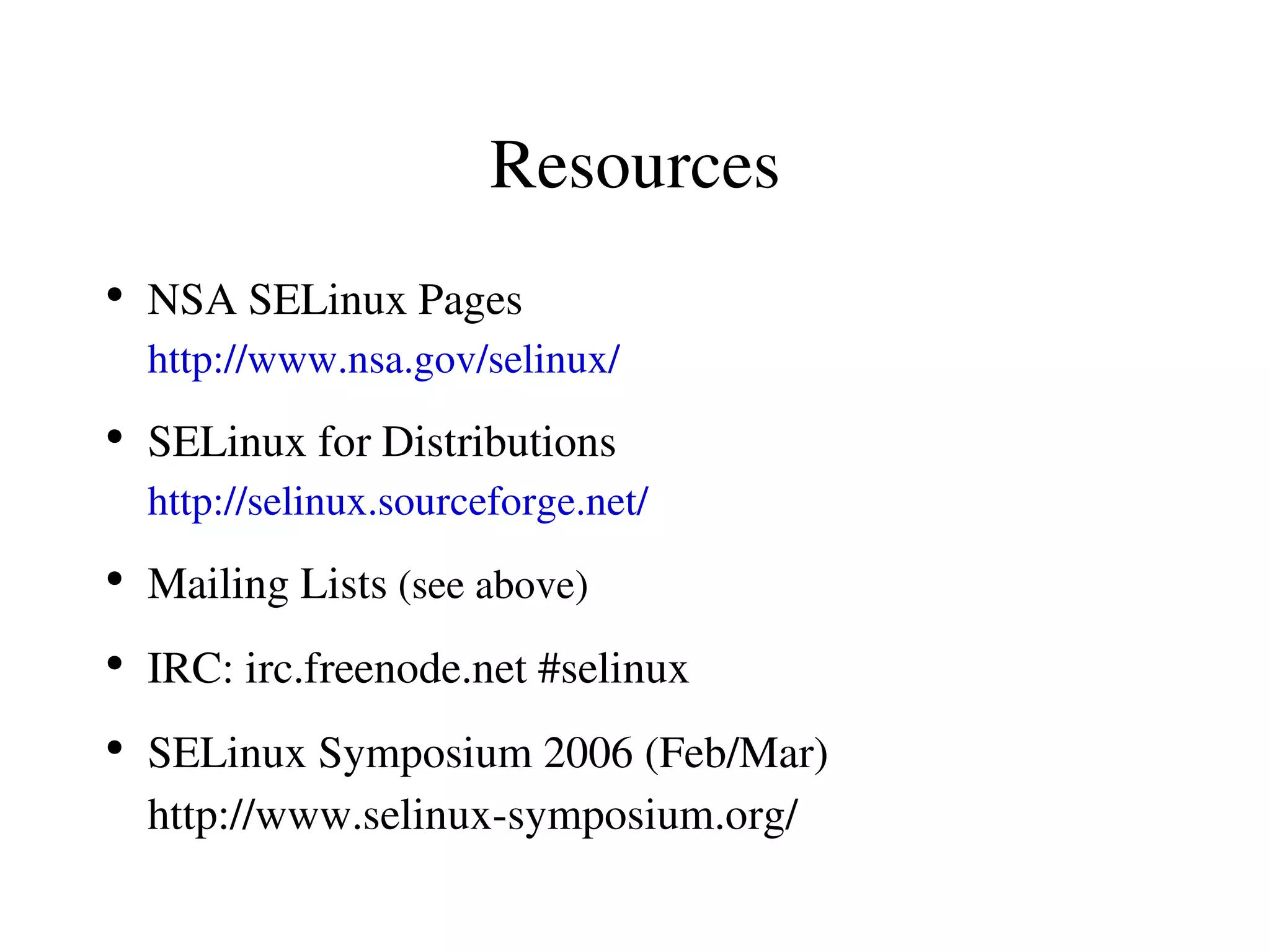
Resources
●
    NSA SELinux Pages
    http://www.nsa.gov/selinux/
●
    SELinux for Distributions
    http://selinux.sourceforge.net/
●
    Mailing Lists (see above)
●
    IRC: irc.freenode.net #selinux
●
    SELinux Symposium 2006 (Feb/Mar)
    http://www.selinux­symposium.org/
Acknowledgments
●
    Much of the source material for these slides was 
    derived from existing NSA presentations:
    –   http://www.nsa.gov/selinux/info/docs.cfm

Overview of NSA Security Enhanced Linux - FOSS.IN/2005

  • 1.
    Overview of NSA Security Enhanced Linux James Morris jmorris@namei.org FOSS.IN/2005 Bangalore, India
  • 2.
    What is SELinux? ● Fine­grained Mandatory Access Control (MAC) ● Strongly separated domains ● Provides confinement of: ● malicious code ● flawed code ● user error/intention ● Enforces least privilege ● Protects integrity ● Flexible policy
  • 3.
    Discretionary Access Control (DAC)  ● Traditional Unix security model ● DAC is inadequate: – Decisions only based on user identity and ownership – No protection against malicious or flawed software – Each user has complete discretion over own objects – Only two major categories of users: admin and other – Coarse­grained and too much privilege – Unbounded privilege escalation
  • 4.
    Mandatory Access Control (MAC) ● “Missing link” of security in general OSs ● Primary features: – Administratively­set security policy – Control over all processes and objects – Decisions based on all security­relevant information
  • 5.
    MAC Implementation ● Traditionally inflexible, maps poorly to general case ● More than just Multilevel Security (MLS): – Enforce integrity, least privilege ● Generalized MAC via Type Enforcement (TE) ● Transparent to applications ● Decompose administrator role ● Policy flexibility
  • 6.
    SELinux Framework ● Composition of several security models – Role­Based Access Control (RBAC) – Type Enforcement (TE) – Optional Multilevel Security (MLS) ● Separation of mechanism and policy ● Can support further models as required
  • 7.
    Type Enforcement (TE) ● Domains for processes, types for objects ● Control access to objects by domains ● Control interactions between domains ● Control entry into domains ● Bind domains to code
  • 8.
    Types ● Attributes assigned to objects and domains ● Things of the same type are security­equivalent ● Examples: – httpd_t (apache execution domain) – httpd_log_t (apache log files) – httpd_config_t (apache configuration files) – httpd_sys_content_t (web content)
  • 9.
    Type Enforcement Rules ● TE rules defined in policy ● Include object labeling, and access control rules ● Examples: • allow httpd_t httpd_log_t:file  { create ioctl read getattr lock append }; • allow httpd_t httpd_config_t:file { read getattr lock ioctl }; • allow httpd_t httpd_sys_content_t:file { read getattr lock ioctl };
  • 10.
    Role Based Access Control (RBAC) ● Roles are attributes assigned to domains, e.g. – sysadm_r – system_r – user_r ● Specifies domains that can be entered by each role ● Specifies roles that are authorized for each user ● Initial domain associated with each user role
  • 11.
    Current Status ● Merged into upstream kernel during 2.5 series ● Adopted by several distributions ● Targeted policy for network facing services ● Possibly millions of users ● Basic tools
  • 12.
    Current Development ● MLS for production use ● Certifications: LSPP, RBACPP at EAL4+ ● Multi­category Security (MCS) ● Reference policy ● Modular policy
  • 13.
    Future Developments & Participation ● Better tools – Policy development and analysis ● High level policy language ● Distributed security management – User management, policy distribution, logging ● Desktop ● Application­level
  • 14.
    More Future Developments... ● Networked filesystems ● Hardware security (TPM): – Verified boot – Integrity verification – Remote attestation – Trusted path ● Virtualization ● Cryptographic policy
  • 15.
    Resources ● NSA SELinux Pages http://www.nsa.gov/selinux/ ● SELinux for Distributions http://selinux.sourceforge.net/ ● Mailing Lists (see above) ● IRC: irc.freenode.net #selinux ● SELinux Symposium 2006 (Feb/Mar) http://www.selinux­symposium.org/
  • 16.
    Acknowledgments ● Much of the source material for these slides was  derived from existing NSA presentations: – http://www.nsa.gov/selinux/info/docs.cfm