Embedded Recipes 2019 - Pipewire a new foundation for embedded multimedia
PipeWire is a new multimedia framework for Linux that serves as a generic platform for handling both audio and video devices, designed by Wim Taymans. It aims to replace existing systems like PulseAudio and JACK with a low-latency and efficient solution, utilizing modern Linux kernel APIs for performance. Currently in development with version 0.3 on the way, PipeWire is embraced by various developers and is being integrated into projects like Automotive Grade Linux.
3
Fresh multimedia frameworkfor linux
●
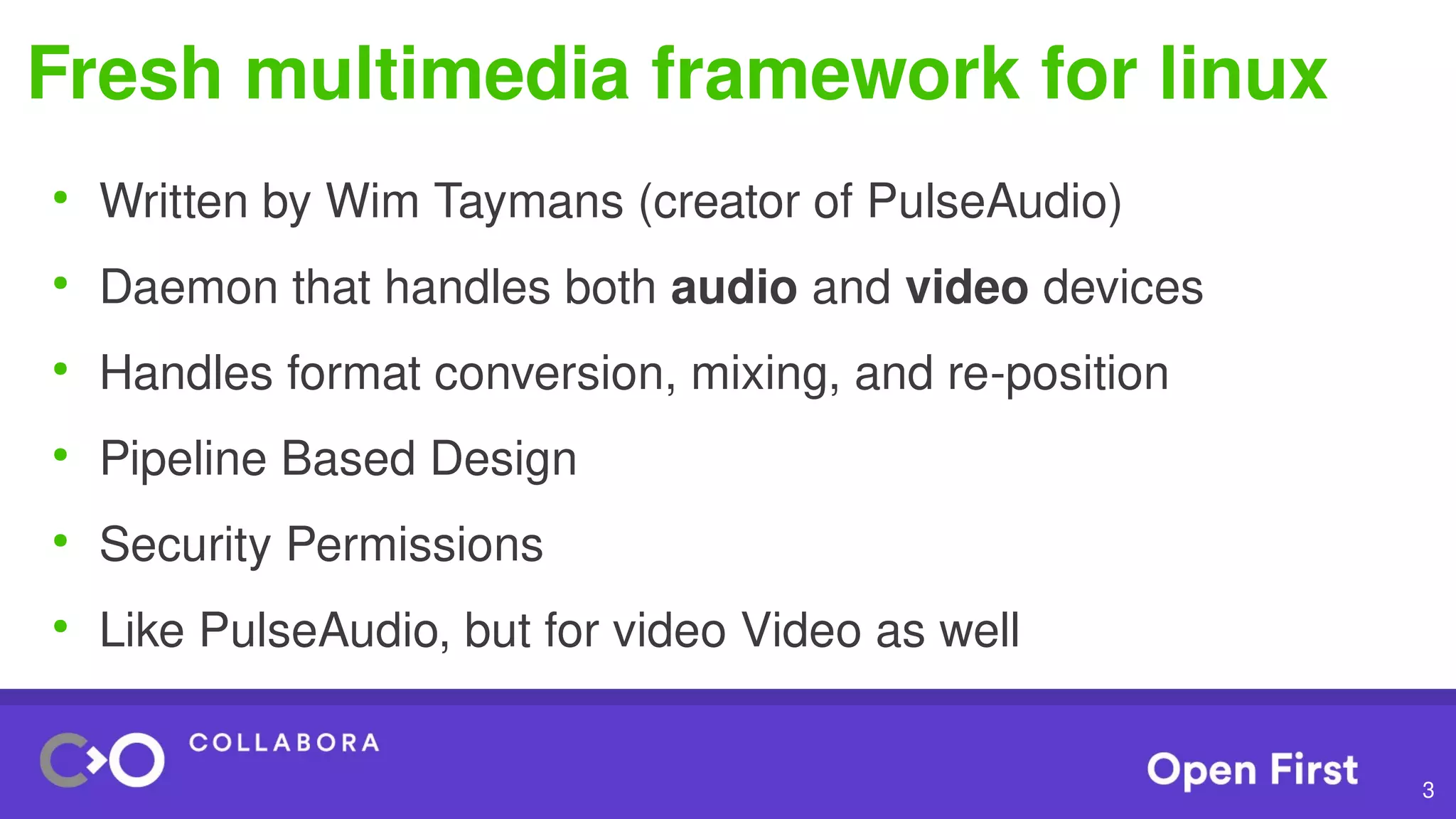
Written by Wim Taymans (creator of PulseAudio)
●
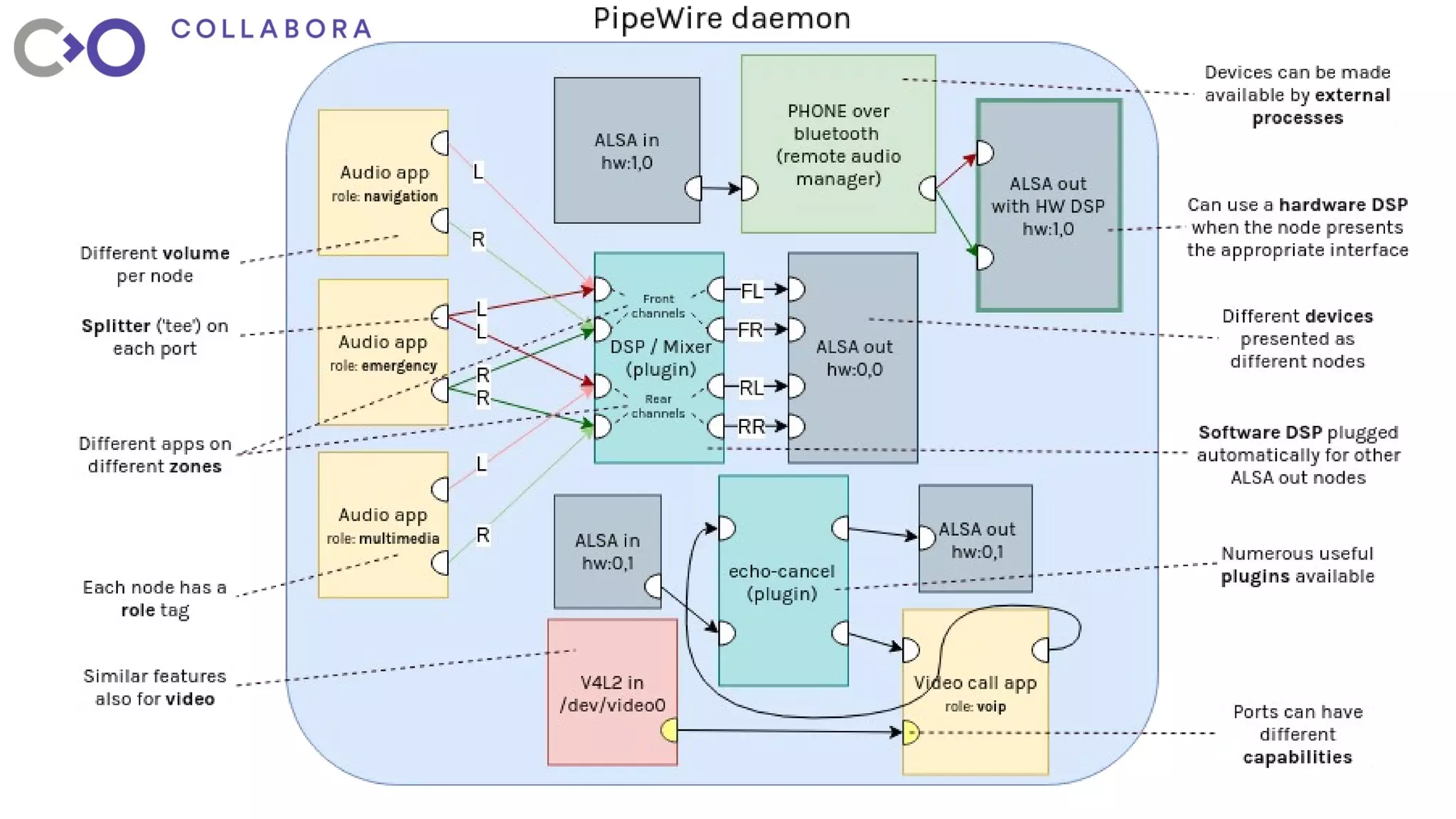
Daemon that handles both audio and video devices
●
Handles format conversion, mixing, and re-position
●
Pipeline Based Design
●
Security Permissions
●
Like PulseAudio, but for video Video as well
4.
4
PipeWire
●
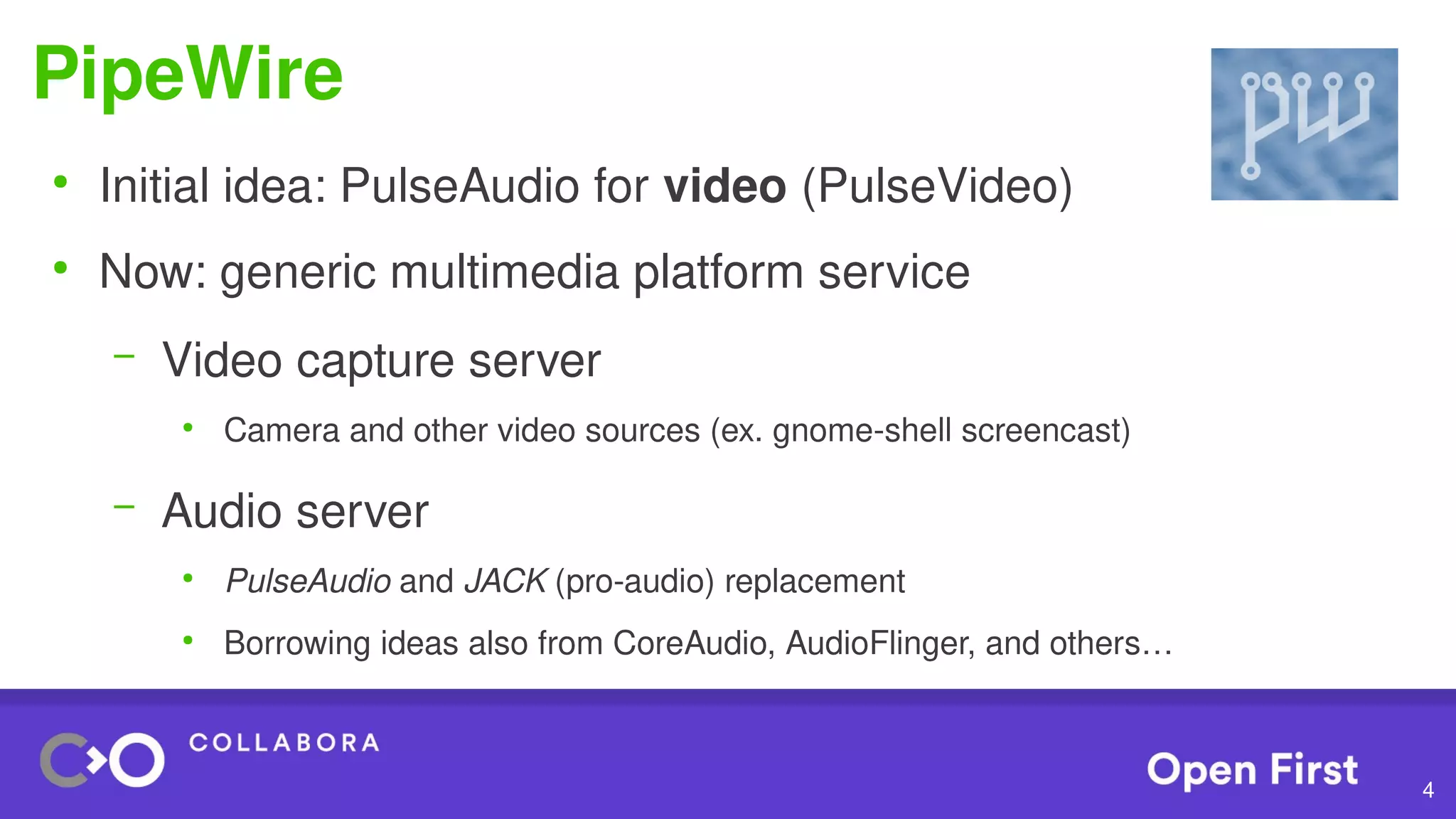
Initial idea: PulseAudiofor video (PulseVideo)
●
Now: generic multimedia platform service
– Video capture server
●
Camera and other video sources (ex. gnome-shell screencast)
– Audio server
●
PulseAudio and JACK (pro-audio) replacement
●
Borrowing ideas also from CoreAudio, AudioFlinger, and others…
7
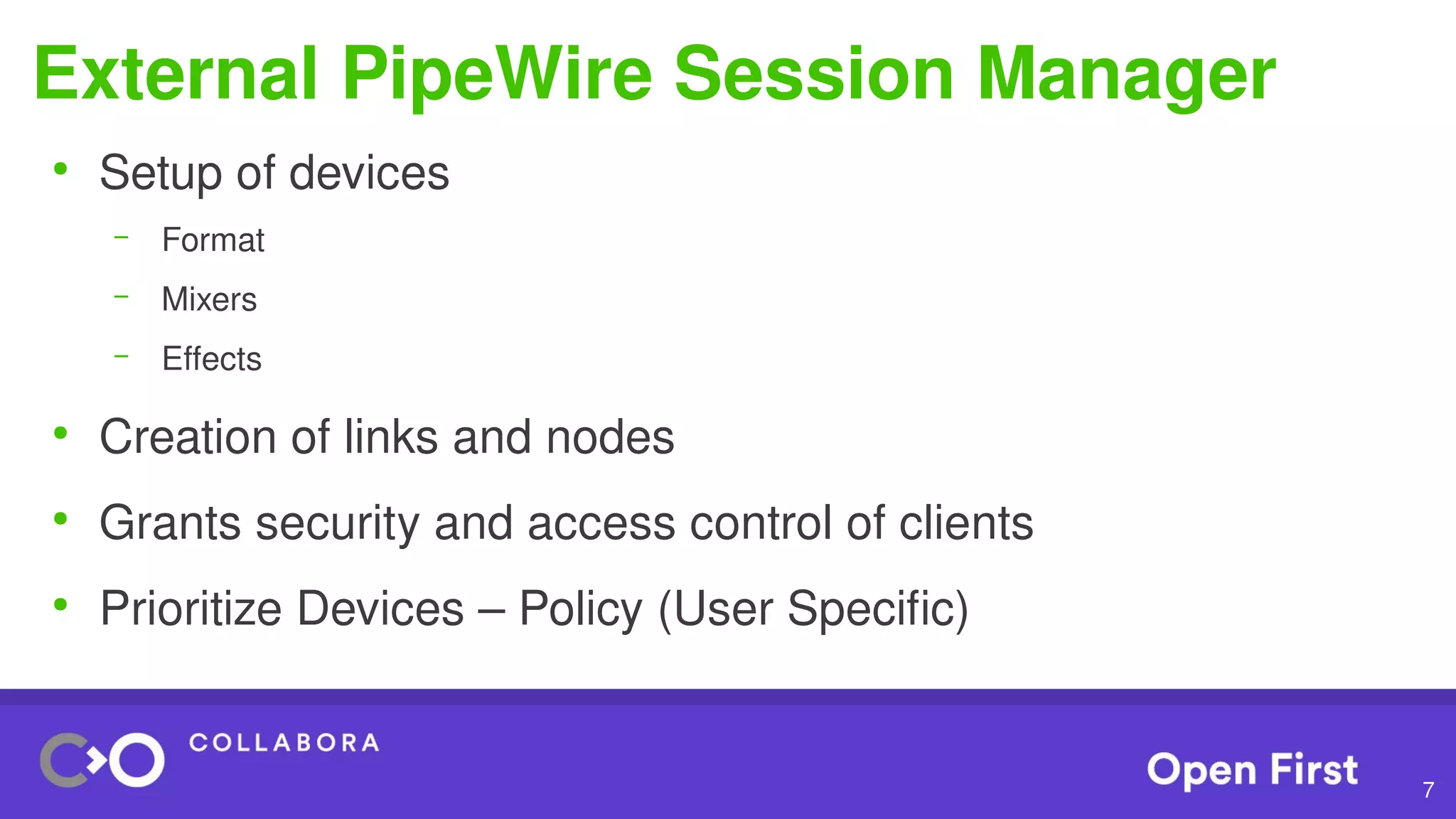
External PipeWire SessionManager
●
Setup of devices
– Format
– Mixers
– Effects
●
Creation of links and nodes
●
Grants security and access control of clients
●
Prioritize Devices – Policy (User Specific)
8.
8
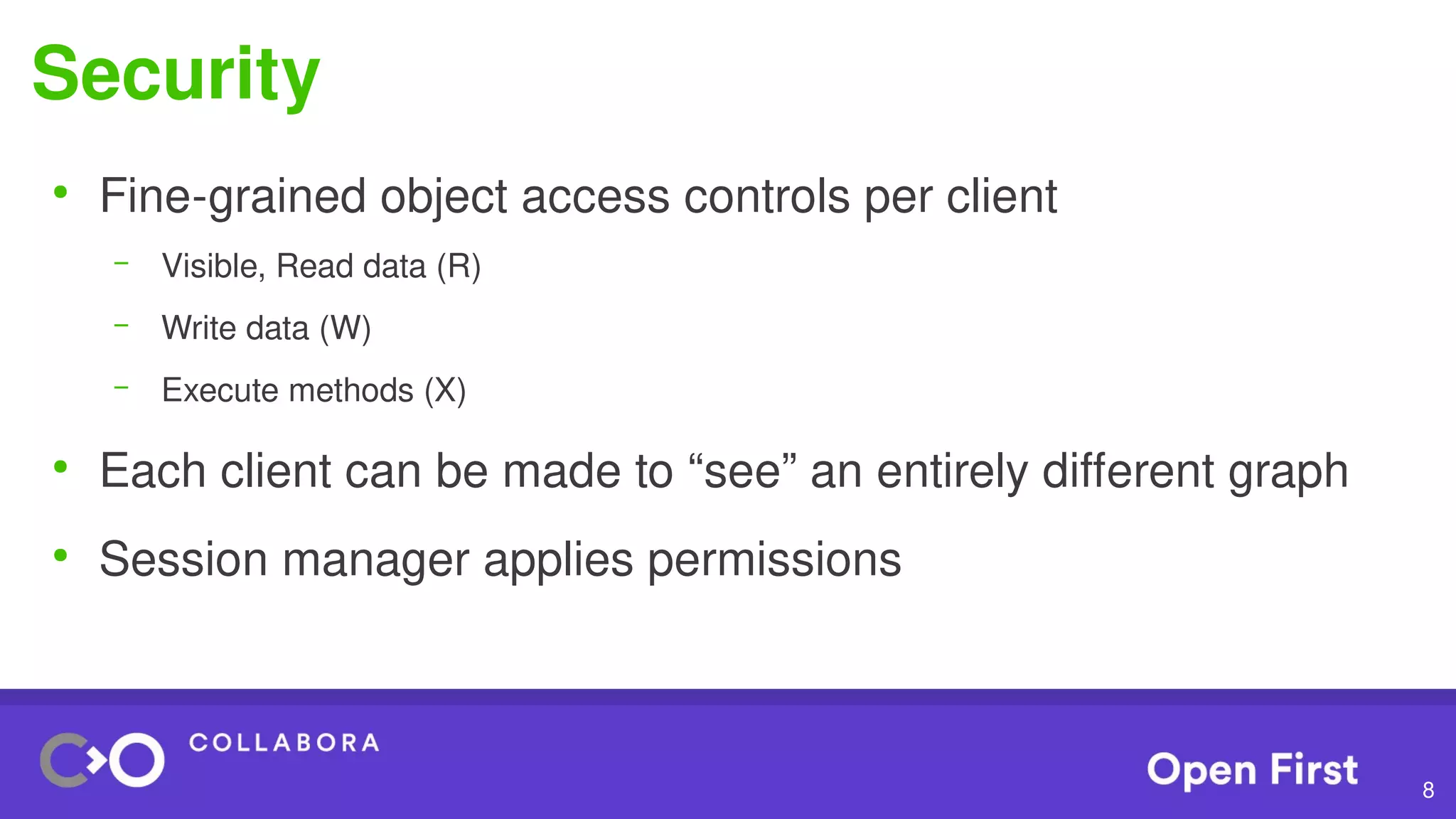
Security
●
Fine-grained object accesscontrols per client
– Visible, Read data (R)
– Write data (W)
– Execute methods (X)
●
Each client can be made to “see” an entirely different graph
●
Session manager applies permissions
9.
9
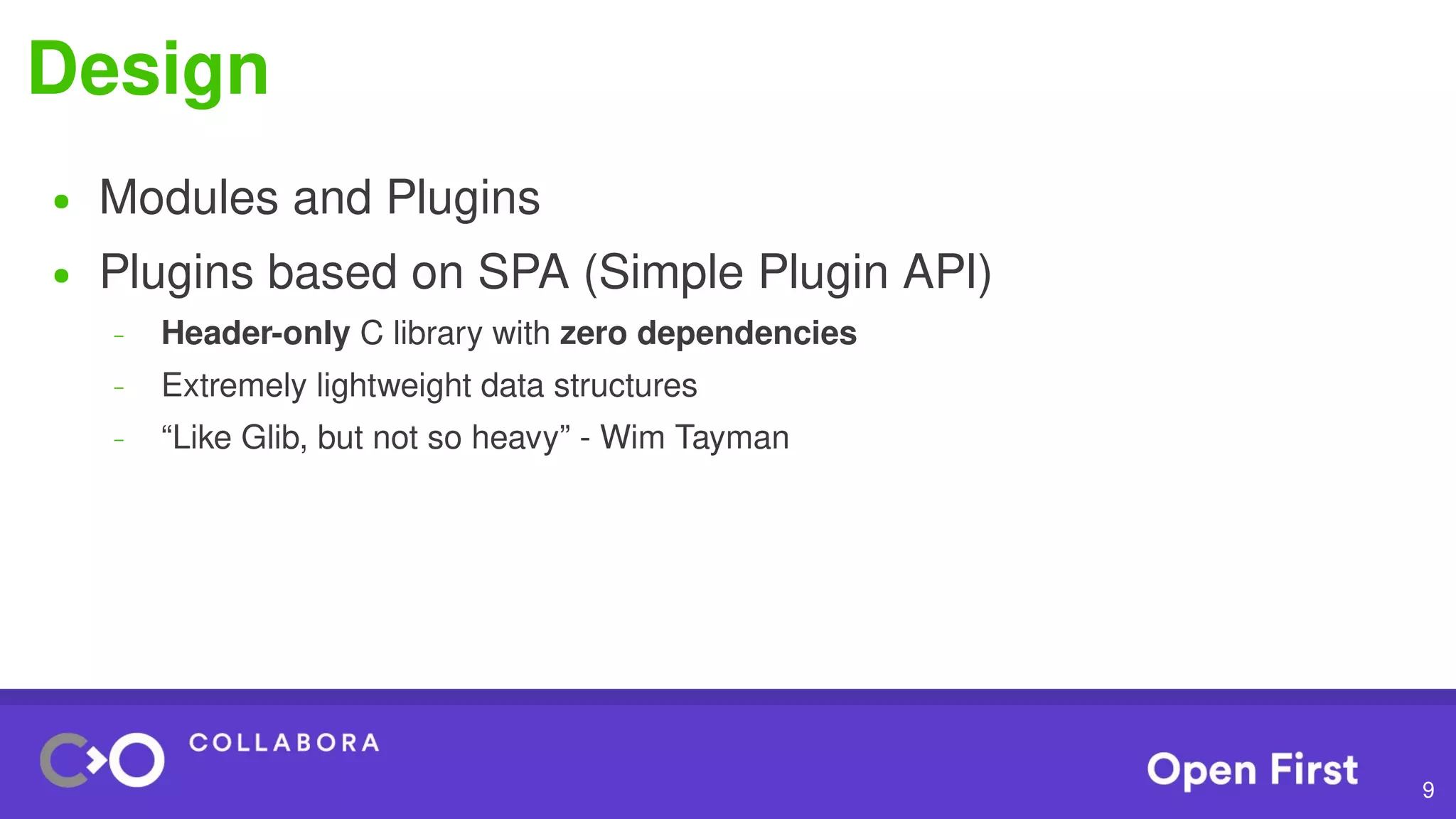
Design
● Modules andPlugins
● Plugins based on SPA (Simple Plugin API)
– Header-only C library with zero dependencies
– Extremely lightweight data structures
– “Like Glib, but not so heavy” - Wim Tayman
10.
10
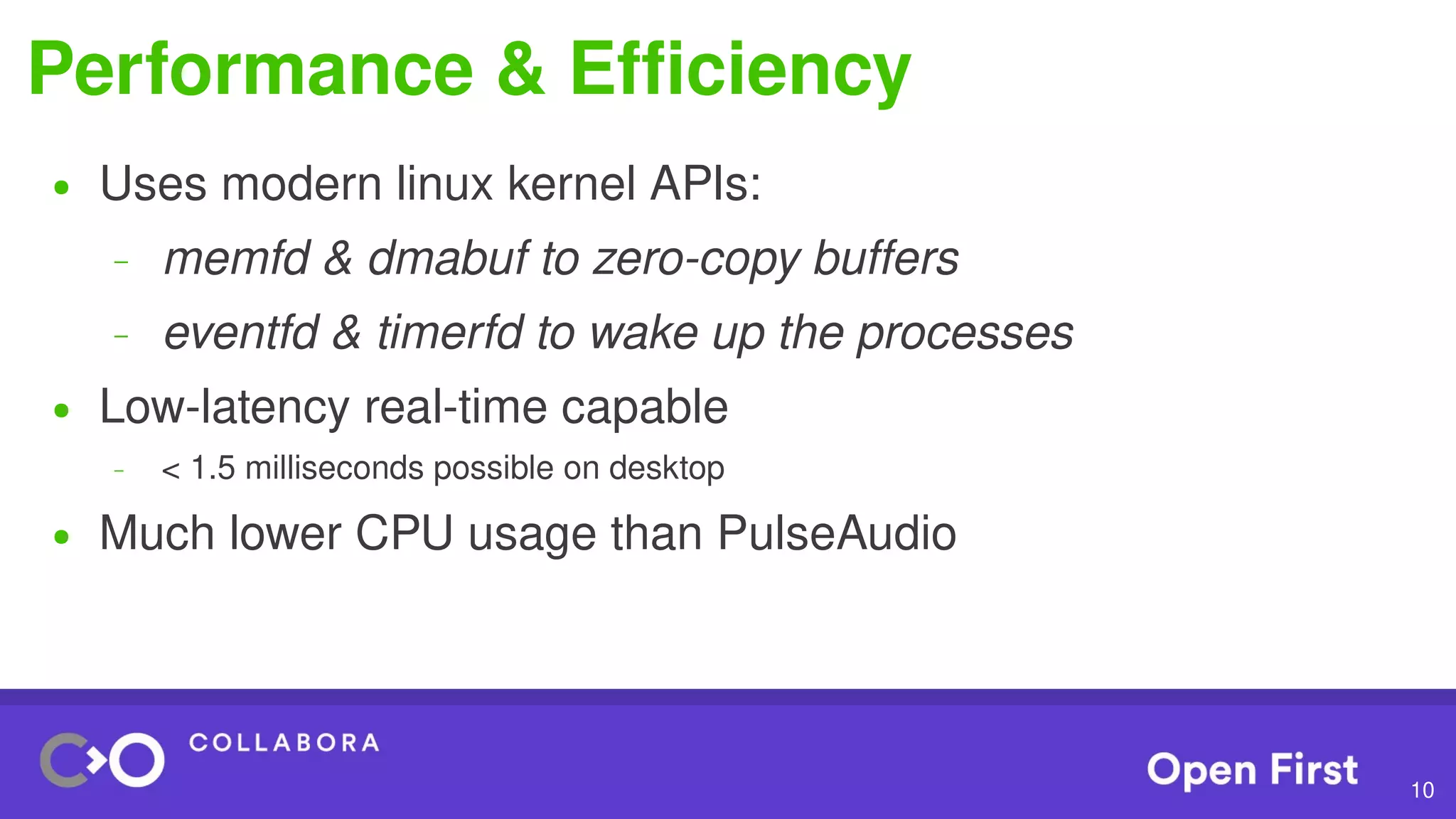
Performance & Efficiency
●Uses modern linux kernel APIs:
– memfd & dmabuf to zero-copy buffers
– eventfd & timerfd to wake up the processes
● Low-latency real-time capable
– < 1.5 milliseconds possible on desktop
● Much lower CPU usage than PulseAudio
11.
11
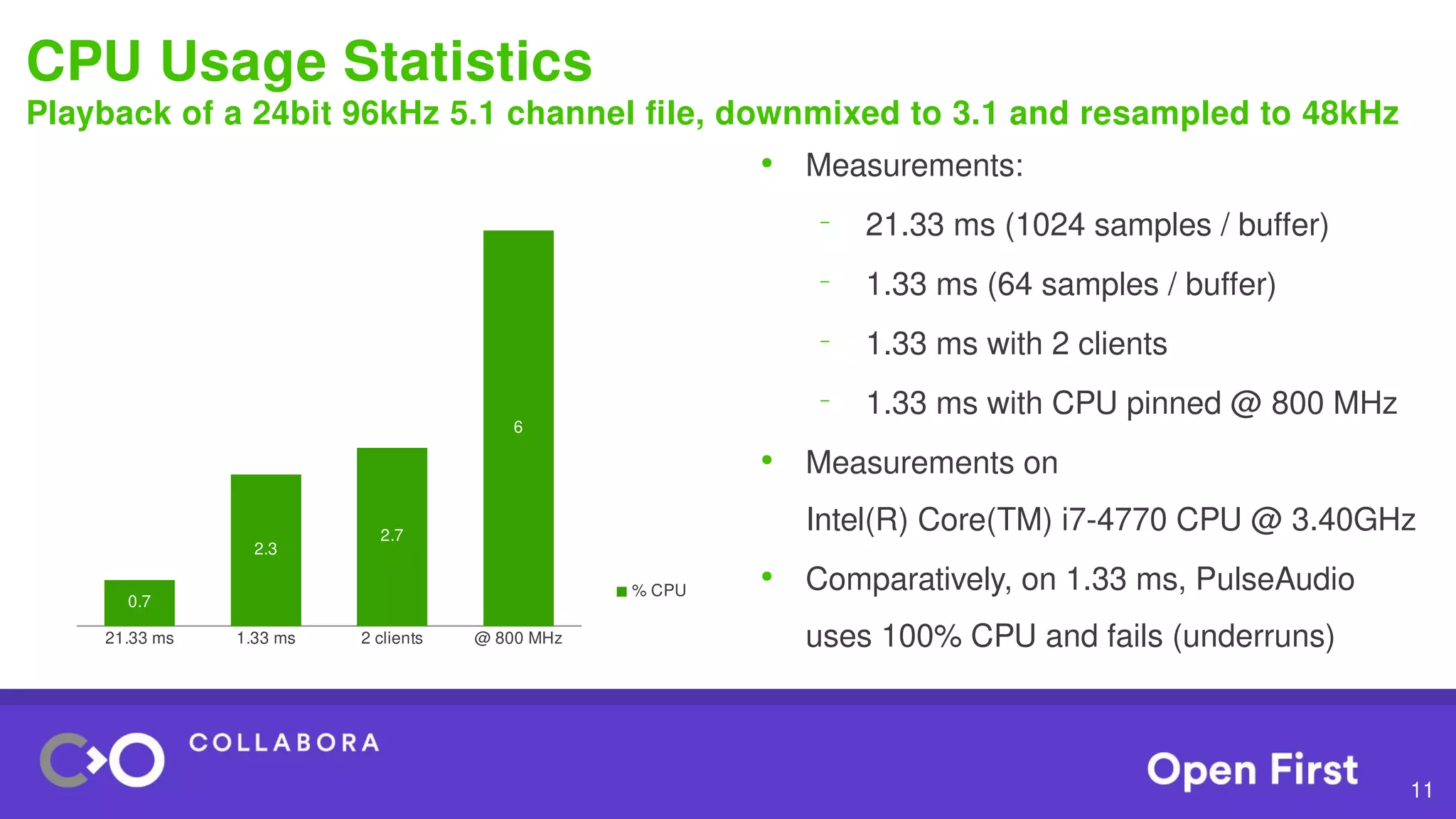
CPU Usage Statistics
Playbackof a 24bit 96kHz 5.1 channel file, downmixed to 3.1 and resampled to 48kHz
21.33 ms 1.33 ms 2 clients @ 800 MHz
0.7
2.3
2.7
6
% CPU
●
Measurements:
–
21.33 ms (1024 samples / buffer)
–
1.33 ms (64 samples / buffer)
–
1.33 ms with 2 clients
–
1.33 ms with CPU pinned @ 800 MHz
●
Measurements on
Intel(R) Core(TM) i7-4770 CPU @ 3.40GHz
●
Comparatively, on 1.33 ms, PulseAudio
uses 100% CPU and fails (underruns)
12.
12
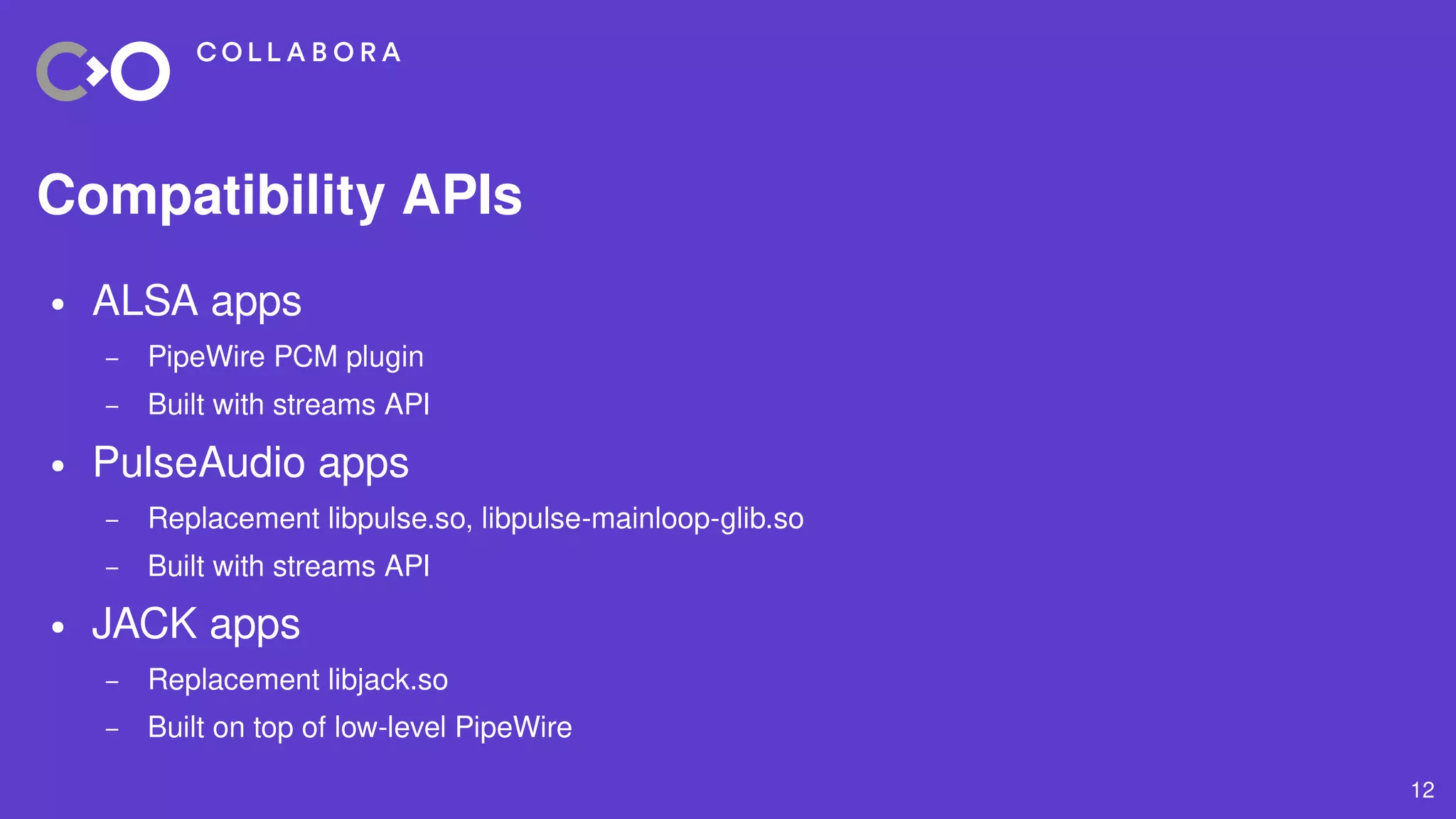
Compatibility APIs
● ALSAapps
– PipeWire PCM plugin
– Built with streams API
● PulseAudio apps
– Replacement libpulse.so, libpulse-mainloop-glib.so
– Built with streams API
● JACK apps
– Replacement libjack.so
– Built on top of low-level PipeWire
13.
13
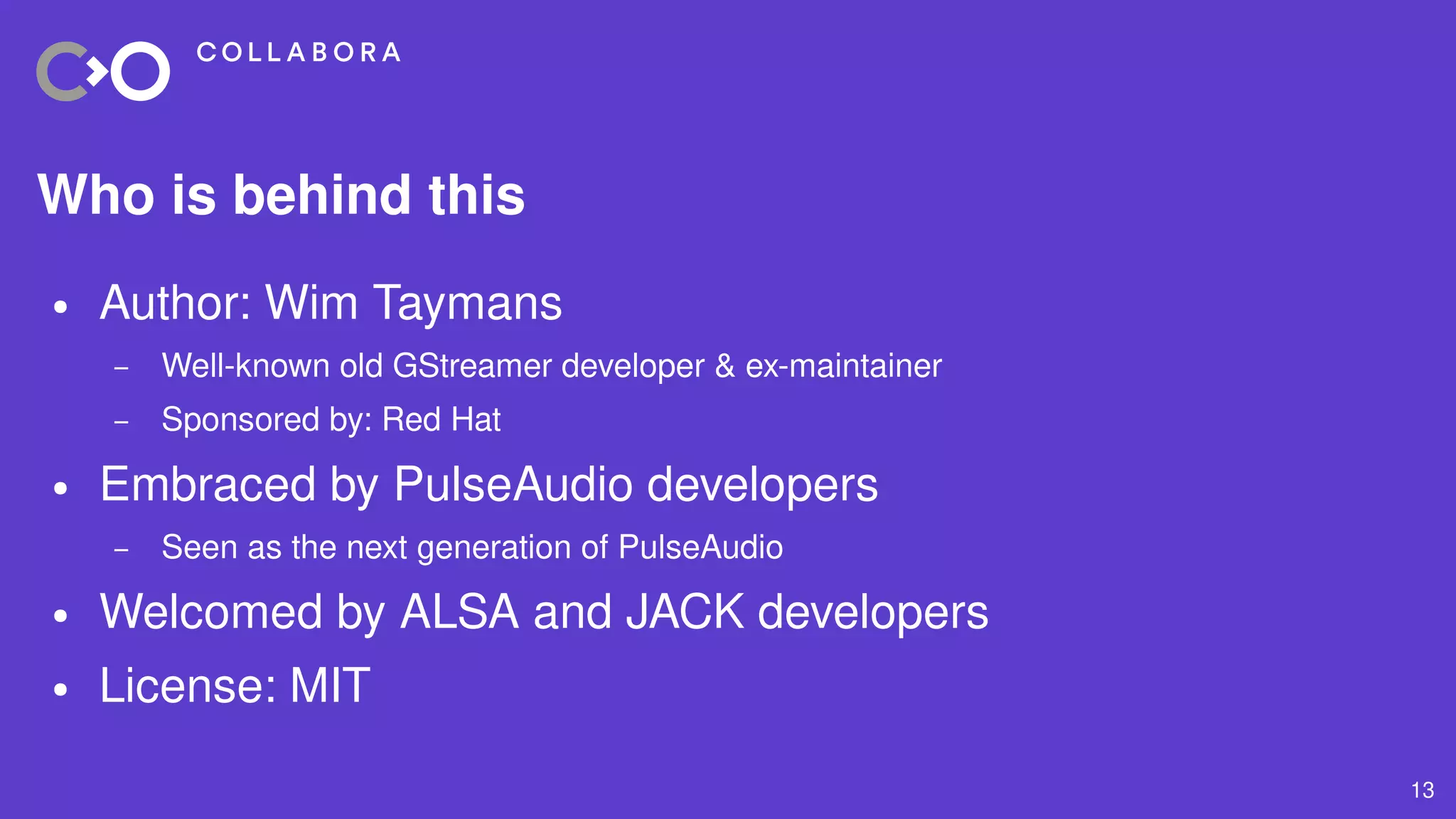
Who is behindthis
● Author: Wim Taymans
– Well-known old GStreamer developer & ex-maintainer
– Sponsored by: Red Hat
● Embraced by PulseAudio developers
– Seen as the next generation of PulseAudio
● Welcomed by ALSA and JACK developers
● License: MIT
14.
14
Status
● Version 0.2distributed in fedora
– Used for video only
● Version 0.3 to be released soon
– Estimated for later this year
– A lot of audio work & refactoring done
– Bluetooth starting to be fully supported
– Used in AGL (Automotive Grade Linux)
16
PipeWire in AutomotiveGrade Linux
● Audio system implemented with PipeWire for Connected Cars
– Replaces PulseAudio
– Mixer, Media player & Radio player using the native API
– ALSA compatibility plugin available
● Session manager: WirePlumber
● Merged in Happy Halibut (8.0.0) RC2
● In the future also: video
17.
17
WirePlumber
● First sessionmanager implementation
● Target: reusable session manager for embedded use cases
– we’ll see about desktop…
● Modular & extensible, like PipeWire
● Based on GObject
– To support writing modules using bindings in other languages
18.
18
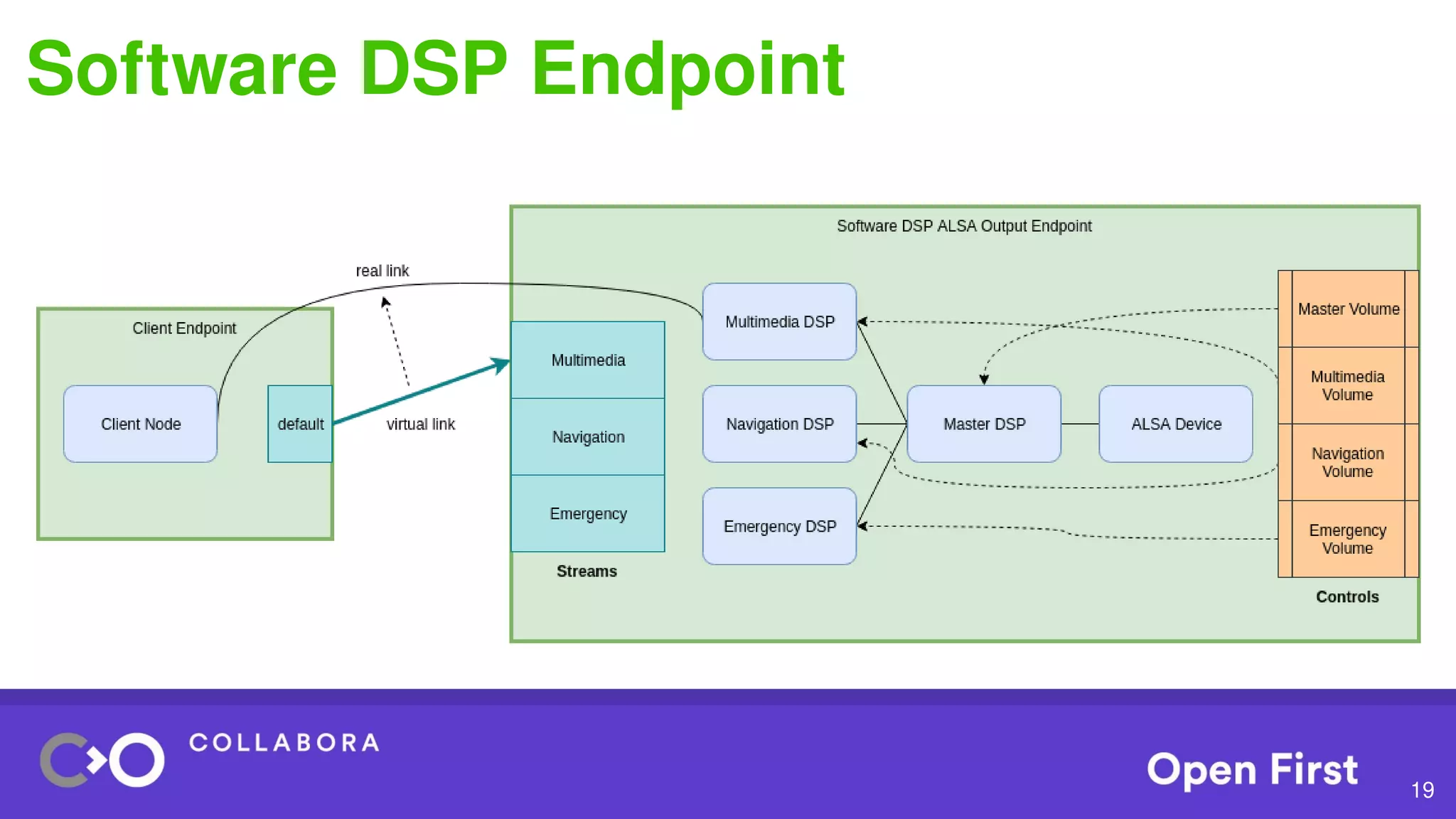
WirePlumber concepts
● Graphabstraction: Endpoint
– Closer to PulseAudio’s representation (sources, sinks, source-outputs, sink-inputs)
– Described by name & media-class (Audio/Source, Audio/Sink, Stream/Audio/Input,
Stream/Audio/Output)
● Extensibility: Modules & Factories like PipeWire
● Pipewire Proxies and Properties
– GObject-ify the pipewire API (ease of use + access from bindings)
21
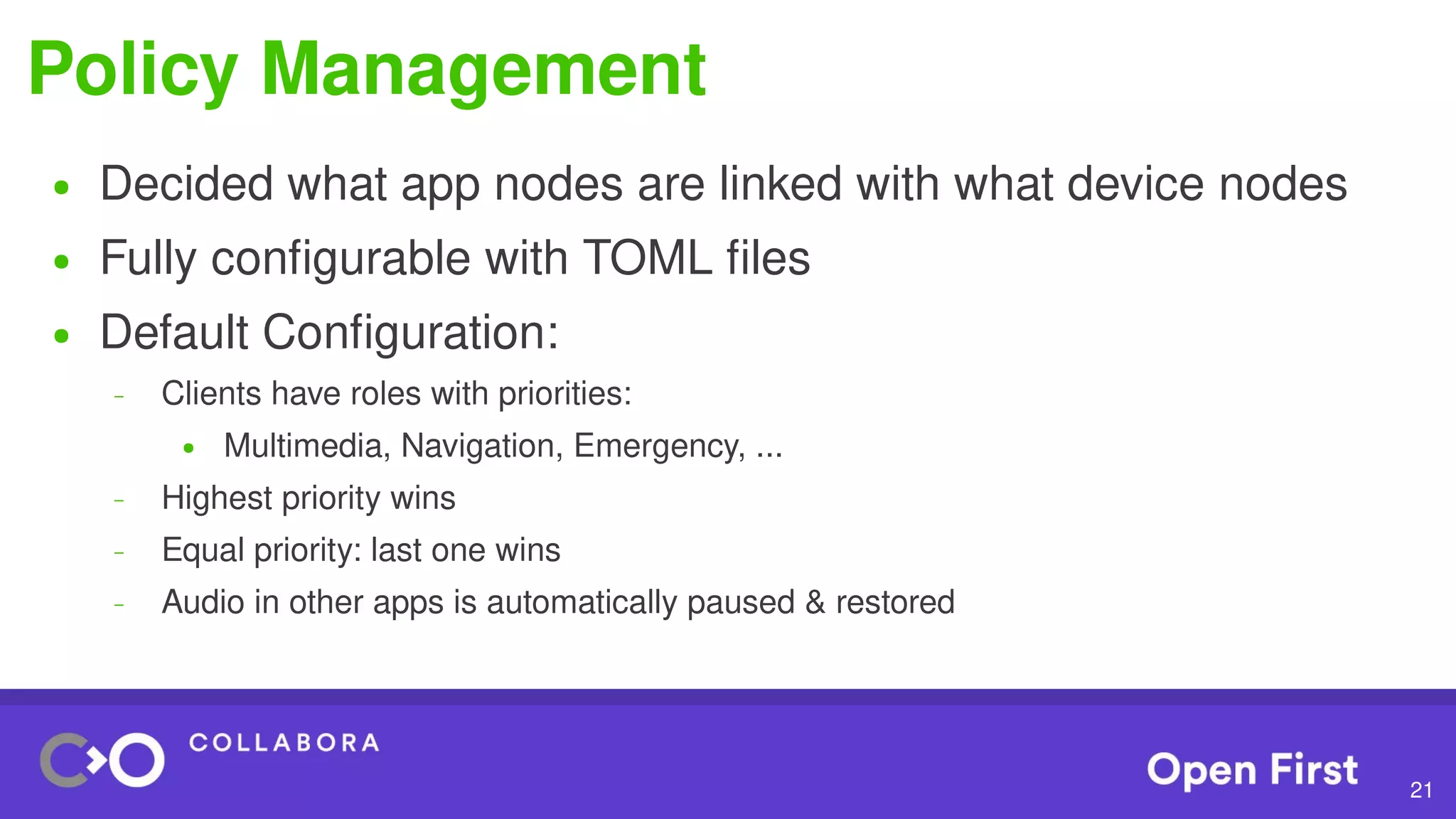
Policy Management
● Decidedwhat app nodes are linked with what device nodes
● Fully configurable with TOML files
● Default Configuration:
– Clients have roles with priorities:
● Multimedia, Navigation, Emergency, ...
– Highest priority wins
– Equal priority: last one wins
– Audio in other apps is automatically paused & restored
22.
22
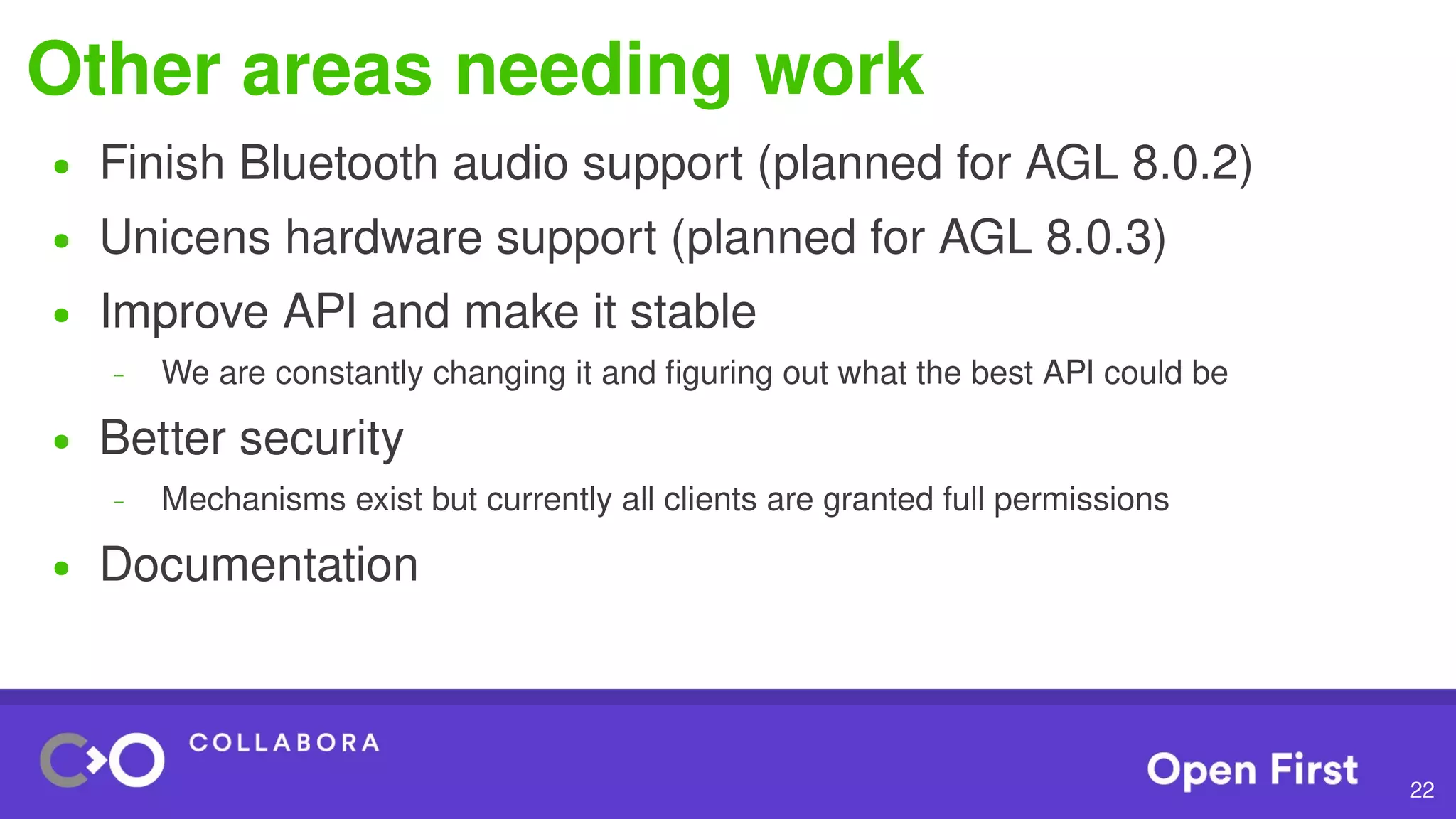
Other areas needingwork
● Finish Bluetooth audio support (planned for AGL 8.0.2)
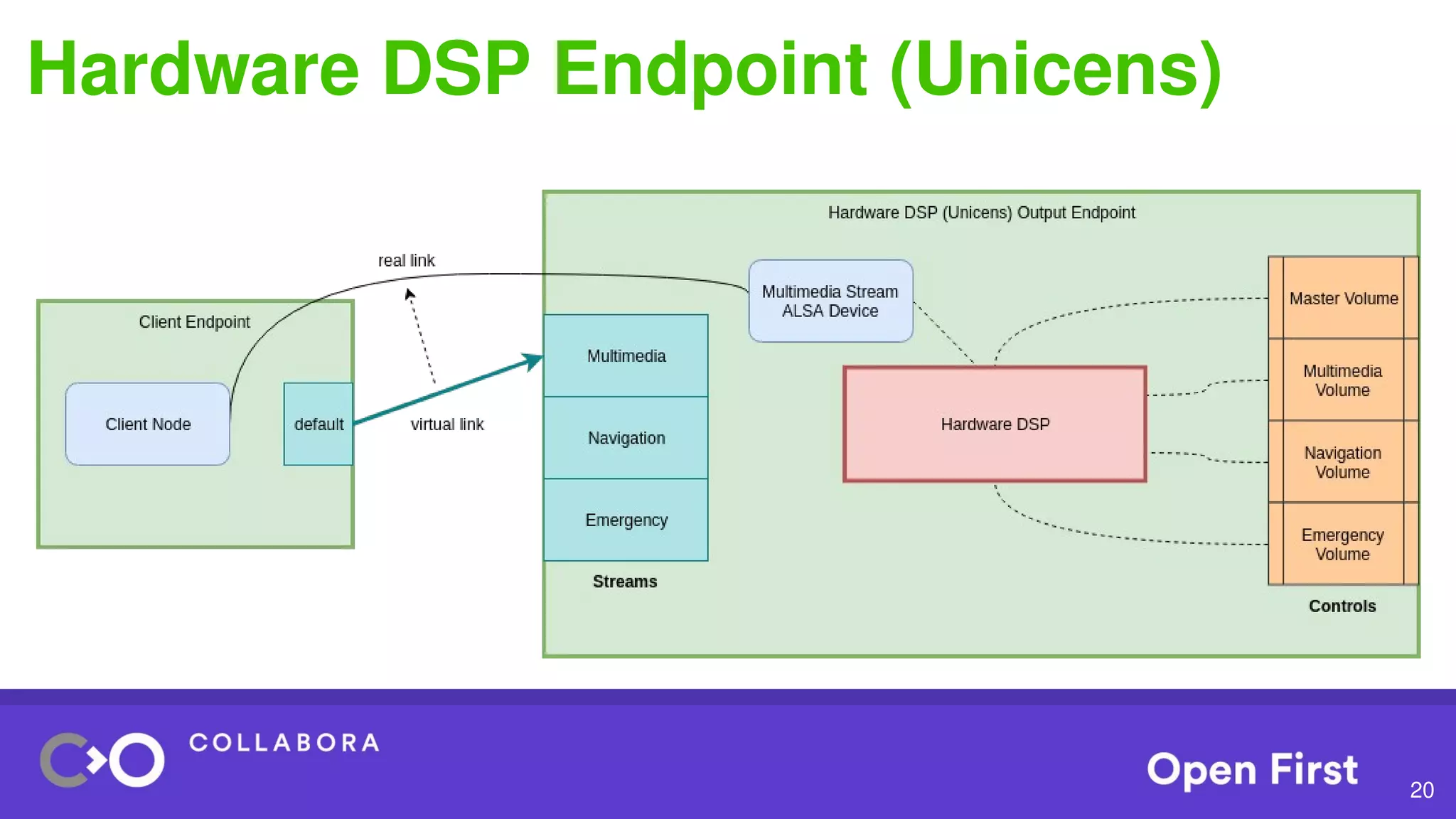
● Unicens hardware support (planned for AGL 8.0.3)
● Improve API and make it stable
– We are constantly changing it and figuring out what the best API could be
● Better security
– Mechanisms exist but currently all clients are granted full permissions
● Documentation
24
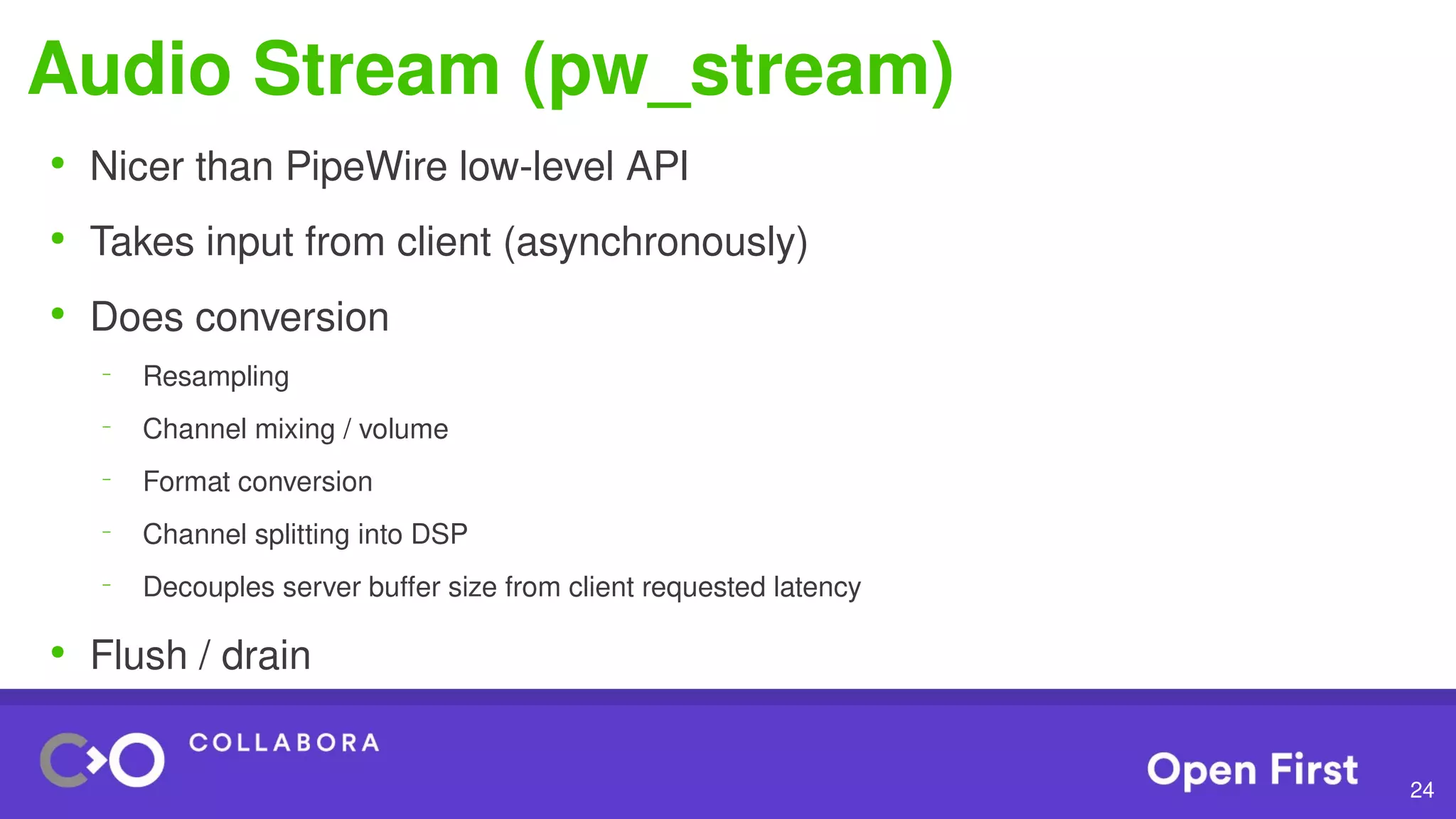
Audio Stream (pw_stream)
●
Nicerthan PipeWire low-level API
●
Takes input from client (asynchronously)
●
Does conversion
–
Resampling
–
Channel mixing / volume
–
Format conversion
–
Channel splitting into DSP
–
Decouples server buffer size from client requested latency
●
Flush / drain
25.
25
In GStreamer
●
pipewiresrc /pipwiresink
–
Available upstream
–
Built mainly for video; have issues with audio at the moment
●
pwaudiosrc / pwaudiosink
–
Available in AGL
–
Smooth operation with audio
–
Upstream-Status: Submitted [https://github.com/PipeWire/pipewire/pull/140]
●
All built with the streams API
26.
26
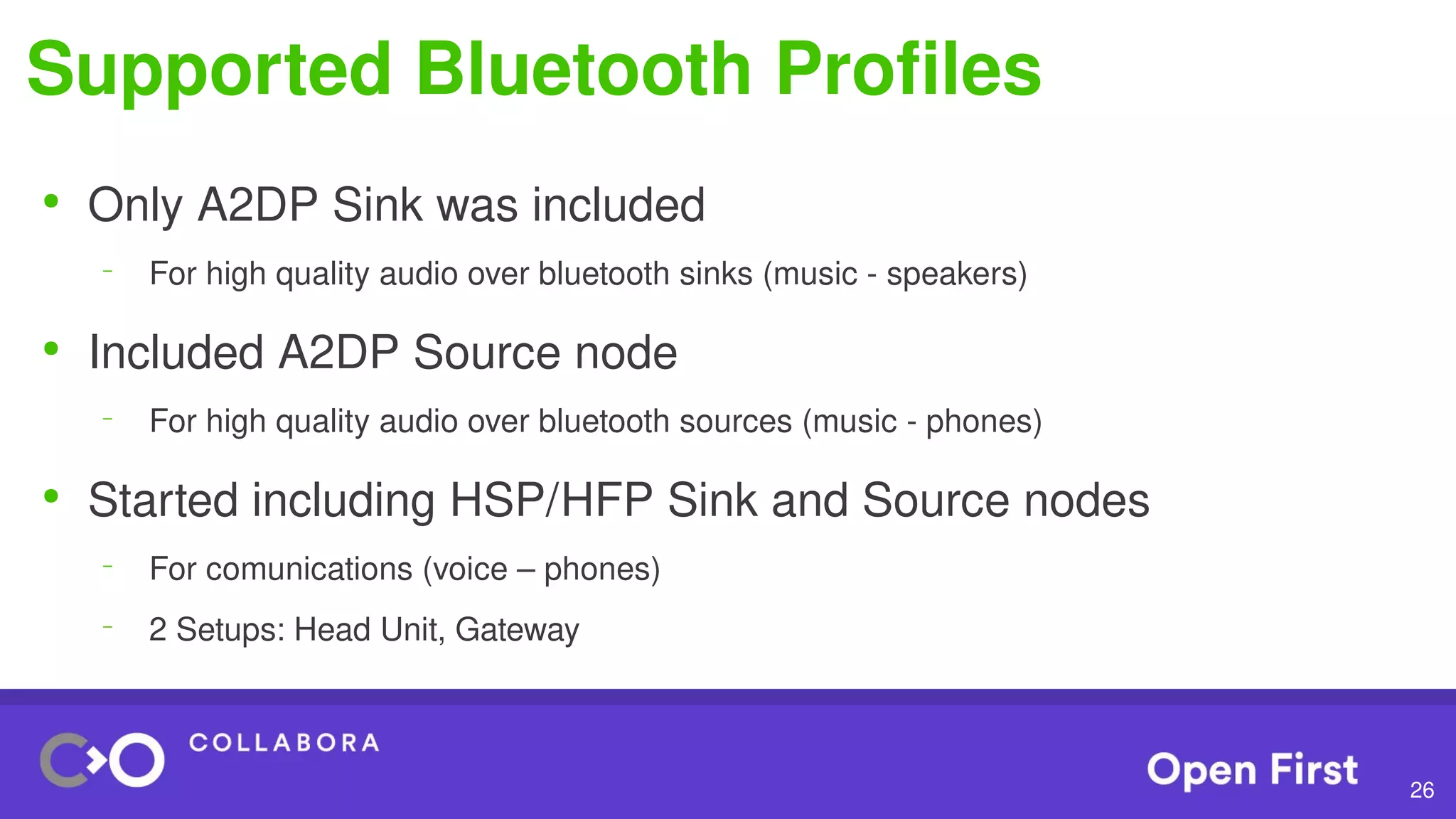
Supported Bluetooth Profiles
●
OnlyA2DP Sink was included
–
For high quality audio over bluetooth sinks (music - speakers)
●
Included A2DP Source node
–
For high quality audio over bluetooth sources (music - phones)
●
Started including HSP/HFP Sink and Source nodes
–
For comunications (voice – phones)
–
2 Setups: Head Unit, Gateway