Visit https://ebookultra.com to download the full version and
explore more ebooks
An introdution to reliability and
maintainability engineering 2nd ed Edition
Ebeling
_____ Click the link below to download _____
https://ebookultra.com/download/an-introdution-to-
reliability-and-maintainability-engineering-2nd-ed-
edition-ebeling/
Explore and download more ebooks at ebookultra.com
Here are some suggested products you might be interested in.
Click the link to download
Gas and Oil Reliability Engineering Modeling and Analysis
2nd Edition Eduardo Calixto
https://ebookultra.com/download/gas-and-oil-reliability-engineering-
modeling-and-analysis-2nd-edition-eduardo-calixto/
Workbook to Accompany Maintenance Reliability Best
Practices 2nd ed Edition Ramesh Gulati
https://ebookultra.com/download/workbook-to-accompany-maintenance-
reliability-best-practices-2nd-ed-edition-ramesh-gulati/
Equipment Management Key to Equipment Reliability and
productivity in mining 2nd ed Edition Tomlingson
https://ebookultra.com/download/equipment-management-key-to-equipment-
reliability-and-productivity-in-mining-2nd-ed-edition-tomlingson/
Reliability maintainability and risk practical methods for
engineers including reliability centred maintenance and
safety related systems 7th Edition David J. Smith Bsc Phd
Ceng Fiee Fiqa Honfsars Migase.
https://ebookultra.com/download/reliability-maintainability-and-risk-
practical-methods-for-engineers-including-reliability-centred-
maintenance-and-safety-related-systems-7th-edition-david-j-smith-bsc-
phd-ceng-fiee-fiqa-honfsar/
Software Reliability Engineering More Reliable Software
Faster and Cheaper 2nd Edition John D. Musa
https://ebookultra.com/download/software-reliability-engineering-more-
reliable-software-faster-and-cheaper-2nd-edition-john-d-musa/
Reliability and statistics in geotechnical engineering 1st
Edition Gregory Baecher
https://ebookultra.com/download/reliability-and-statistics-in-
geotechnical-engineering-1st-edition-gregory-baecher/
Introduction to microelectromechanical systems engineering
2nd ed Edition Nadim Maluf
https://ebookultra.com/download/introduction-to-
microelectromechanical-systems-engineering-2nd-ed-edition-nadim-maluf/
Risk and Reliability Coastal and Hydraulic Engineering 1st
Edition Dominic Reeve (Author)
https://ebookultra.com/download/risk-and-reliability-coastal-and-
hydraulic-engineering-1st-edition-dominic-reeve-author/
Reliability Verification Testing and Analysis in
Engineering Design Mechanical Engineering Marcell Dekker
1st Edition Gary Wasserman
https://ebookultra.com/download/reliability-verification-testing-and-
analysis-in-engineering-design-mechanical-engineering-marcell-
dekker-1st-edition-gary-wasserman/
An introdution to reliability and maintainability
engineering 2nd ed Edition Ebeling Digital Instant

Download
Author(s): Ebeling, Charles E
ISBN(s): 9781577666257, 1577666259
Edition: 2nd ed
File Details: PDF, 78.21 MB
Year: 2010
Language: english
An INTRODUCTION
to RELIABILITY and
MAINTAINABILITY
ENGINEERING
Charles E. Ebeling
University of Dayton
An INTRODUCTION
to RELIABILITY and
MAINTAINABILITY
ENGINEERING
Second Edition
WAVELAND
PRESS, INC.
Long Grove, Illinois
For information about this book, contact:
Waveland Press, Inc.
4180 IL Route 83, Suite 101
Long Grove, IL 60047-9580
(847) 634-0081
info@waveland.com
www.waveland.com
Copyright © 2010, 1997 by Charles E. Ebeling
10-digit ISBN 1-57766-625-9
13-digit ISBN 978-1-57766-625-7
All rights reserved. No part of this book may be reproduced, stored in a retrieval
system, or transmitted in any form or by any means without permission in writing
from the publisher.
Printed in Canada
8 7 6 5 4 3 2 1
v
CONTENTS
Preface xiii
Course Software xvi
1 Introduction 1
1.1 The Study of Reliability and Maintainability 3
1.1.1 Reliability Improvement / 1.1.2 Random
versus Deterministic Failure Phenomena
1.2 Concepts, Terms, and Definitions 5
1.3 Applications 7
1.4 A Brief History 10
1.5 Scope of the Text 11
Appendix 1A A Probability Primer 13
1A.1 Random Events / 1A.2 Bayes’ Formula /
1A.3 Random Variables / 1A.4 Discrete
Distributions / 1A.5 Binomial Distribution /
1A.6 Poisson Distribution / 1A.7 Continuous
Distributions
P A R T 1 Basic Reliability Models
2 The Failure Distribution 23
2.1 The Reliability Function 23
2.2 Mean Time to Failure 26
2.3 Hazard Rate Function 28
2.4 Bathtub Curve 31
2.5 Conditional Reliability 32
2.6 Summary 34
Appendix 2A Derivation of Equation (2.8) 35
Appendix 2B Derivation of Equation (2.12) 36
Appendix 2C Conditional Reliability and
Failure Rates 36
Appendix 2D Intermediate Calculations for the
Linear Bathtub Curve 37
Appendix 2E Table of Integrals 38
2E.1 Indefinite Integrals / 2E.2 Definite
Integrals
Exercises 38
vi Contents
3 Constant Failure Rate Model 44
3.1 The Exponential Reliability Function 44
3.2 Failure Modes 48
3.2.1 Failure Modes with CFR Model / 3.2.2
Failures on Demand
3.3 Applications 50
3.3.1 Renewal Process / 3.3.2 Repetitive
Loading / 3.3.3 Reliability Bounds
3.4 The Two-Parameter Exponential Distribution 54
3.5 Poisson Process 55
3.6 Redundancy and the CFR Model 57
Exercises 59
4 Time-Dependent Failure Models 63
4.1 The Weibull Distribution 63
4.1.1 Design Life, Median, and Mode / 4.1.2
Burn-In Screening for Weibull / 4.1.3 Failure
Modes / 4.1.4 Identical Weibull Components /
4.1.5 The Three-Parameter Weibull / 4.1.6
Redundancy with Weibull Failures / 4.1.7 The
Minimum Extreme Value Distribution
4.2 The Normal Distribution 76
4.3 The Lognormal Distribution 80
4.4 The Gamma Distribution 84
Appendix 4A Derivation of the MTTF for the
Weibull Distribution 87
Appendix 4B Derivation of the Mode for the
Weibull Distribution 88
Appendix 4C Minimum Extreme-Value
Distribution 89
Appendix 4D Hazard Rate for the Two-
Component Weibull Redundant System 89
Appendix 4E Derivation of the Mean of the
Gamma Distribution 90
Appendix 4F Derivation of the Mode of the
Gamma Distribution 90
Exercises 90
5 Reliability of Systems 98
5.1 Serial Configuration 98
5.2 Parallel Configuration 100
5.3 Combined Series-Parallel Systems 102
5.3.1 High-Level versus Low-Level Redundancy /
5.3.2 k-out-of-n Redundancy / 5.3.3 Complex
Configurations
Contents vii
5.4 System Structure Function, Minimal Cuts, and
Minimal Paths (Optional) 108
5.4.1 Coherent Systems / 5.4.2 Minimal Path
and Cut Sets / 5.4.3 System Bounds
5.5 Common-Mode Failures 112
5.6 Three-State Devices 113
5.6.1 Series Structure / 5.6.2 Parallel
Structure / 5.6.3 Low-Level Redundancy / 5.6.4
High-Level Redundancy
Exercises 117
6 State-Dependent Systems 126
6.1 Markov Analysis 126
6.2 Load-Sharing System 129
6.3 Standby Systems 130
6.3.1 Identical Standby Units / 6.3.2 Standby
System with Switching Failures / 6.3.3 Three-
Component Standby System
6.4 Degraded Systems 135
6.5 Three-State Devices 136
Appendix 6A Solution to Two-Component
Redundant System 137
Appendix 6B Solution to Load-Sharing System 138
Appendix 6C Solution to Standby System Model 138
Exercises 139
7 Physical Reliability Models 144
7.1 Covariate Models 144
7.1.1 Proportional Hazards Models / 7.1.2
Location-Scale Models
7.2 Static Models 148
7.2.1 Random Stress and Constant Strength /
7.2.2 Constant Stress and Random Strength /
7.2.3 Random Stress and Random Strength
7.3 Dynamic Models 156
7.3.1 Periodic Loads / 7.3.2 Random Loads /
7.3.3 Random Fixed Stress and Strength
7.4 Physics-of-Failure Models 159
Exercises 162
viii Contents
8 Design for Reliability 171
8.1 Reliability Specification and System Measurements 173
8.1.1 System Effectiveness / 8.1.2 Economic
Analysis and Life-Cycle Costs
8.2 Reliability Allocation 177
8.2.1 Exponential Case / 8.2.2 Optimal
Allocations / 8.2.3 ARINC Method / 8.2.4
AGREE Method / 8.2.5 Redundancies
8.3 Design Methods 183
8.3.1 Parts and Material Selection / 8.3.2
Derating / 8.3.3 Stress-Strength Analysis /
8.3.4 Complexity and Technology / 8.3.5
Redundancy
8.4 Failure Analysis 192
8.4.1 Product Definition / 8.4.2 Identification of
Failure Modes / 8.4.3 Determination of Cause /
8.4.4 Assessment of Effect / 8.4.5 Estimation of
Probability of Occurrence / 8.4.6 Estimation of
Detection / 8.4.7 Classification of Severity /
8.4.8 Computation of Criticality / 8.4.9
Determination of Corrective Action
8.5 System Safety and Fault Tree Analysis 202
8.5.1 Fault Tree Analysis / 8.5.2 Minimal Cut
Sets / 8.5.3 Quantitative Analysis
Exercises 212
9 Maintainability 219
9.1 Analysis of Downtime 219
9.2 The Repair-Time Distribution 221
9.2.1 Exponential Repair Times / 9.2.2
Lognormal Repair Times
9.3 Stochastic Point Processes 224
9.3.1 Renewal Process / 9.3.2 Minimal Repair
Process / 9.3.3 Overhaul and Cycle Time
9.4 System Repair Time 236
9.5 Reliability under Preventive Maintenance 237
9.6 State-Dependent Systems with Repair 241
Appendix 9A The MTTF for the Preventive
Maintenance Model 244
Appendix 9B Solution to the Active Redundant
System with Repair 245
Appendix 9C Solution to Standby System with
Repair 245
Appendix 9D System MTTR Derivation under
Simultaneous Repair (Table 9.1) 246
Exercises 247
Contents ix
10 Design for Maintainability 254
10.1 Maintenance Requirements 255
10.1.1 Measurements and Specifications / 10.1.2
Maintenance Concepts and Procedures / 10.1.3
Component Reliability and Maintainability
10.2 Design Methods 261
10.2.1 Fault Isolation and Self-Diagnostics /
10.2.2 Parts Standardization and
Interchangeability / 10.2.3 Modularization and
Accessibility / 10.2.4 Repair versus
Replacement / 10.2.5 Proactive Maintenance
10.3 Human Factors and Ergonomics 271
10.4 Maintainability Prediction and Demonstration 273
10.4.1 Maintainability Prediction / 10.4.2
Maintainability Demonstration
Exercises 277
11 Availability 283
11.1 Concepts and Definitions 283
11.1.1 Inherent Availability / 11.1.2 Achieved
Availability / 11.1.3 Operational Availability /
11.1.4 Generalized Operational Availability /
11.1.5 Availability with Minimal Repair
11.2 Exponential Availability Model 287
11.3 System Availability 288
11.3.1 Availability with Standby Systems / 11.3.2
Steady-State Availability / 11.3.3 Matrix Approach
11.4 Inspection and Repair Availability Model 294
Appendix 11A Solution to Single Unit with
Repair Model 296
Exercises 297
P A R T 2 The Analysis of Failure Data
12 Data Collection and Empirical Methods 305
12.1 Data Collection 305
12.2 Empirical Methods 308
12.2.1 Ungrouped Complete Data / 12.2.2
Grouped Complete Data / 12.2.3 Ungrouped
Censored Data / 12.2.4 Grouped Censored Data
12.3 Static Life Estimation 324
12.4 Nonparametric Confidence Intervals 326
Exercises 328
x Contents
13 Reliability Testing 334
13.1 Product Testing 334
13.2 Reliability Life Testing 335
13.3 Test Time Calculations 336
13.3.1 Length of Test
13.4 Burn-In Testing 338
13.5 Acceptance Testing 341
13.5.1 Binomial Acceptance Testing / 13.5.2
Sequential Tests
13.6 Accelerated Life Testing 349
13.6.1 Number of Units on Test / 13.6.2 Time
Compression / 13.6.3 Constant-Stress Models /
13.6.4 Other Acceleration Models
13.7 Competing Failure Modes 360
Appendix 13A Derivation of Expected Test
Time 361
Appendix 13B Expected Test Time (Type II
Testing) 362
Exercises 363
14 Reliability Growth Testing 369
14.1 Reliability Growth Process 369
14.2 Idealized Growth Curve 370
14.3 Duane Growth Model 372
14.4 AMSAA Model 376
14.4.1 Parameter Estimation for the Power Law
Intensity Function / 14.4.2 Parameter
Estimation with Grouped Data
14.5 Other Growth Models 381
Exercises 383
15 Identifying Failure and Repair Distributions 388
15.1 Identifying Candidate Distributions 389
15.2 Probability Plots and Least-Squares Curve-Fitting 392
15.2.1 Exponential Plots / 15.2.2 Weibull
Plots / 15.2.3 Normal Plots / 15.2.4 Lognormal
Plots / 15.2.5 Multiply Censored Time Plots /
15.2.6 Curve Fitting for the Minimum Extreme
Value Distribution
15.3 Parameter Estimation 406
15.3.1 Maximum Likelihood Estimator / 15.3.2
Exponential MLE / 15.3.3 Weibull MLE / 15.3.4
Normal and Lognormal MLEs / 15.3.5 Maximum
Likelihood Estimation with Multiply Censored
Data / 15.3.6 Location Parameter Estimation /
Contents xi
15.3.7 Parameter Estimation for the Minimum
Extreme Value Distribution / 15.3.8 Parameter
Estimation for the Gamma Distribution / 15.3.9
Parameter Estimation for Interval Data
15.4 Confidence Intervals 419
15.4.1 Confidence Intervals for the Constant
Failure Rate Model / 15.4.2 Confidence
Intervals for Other Distributions
15.5 Parameter Estimation for Covariate Models 425
Appendix 15A Weibull Maximum Likelihood
Estimator 427
Appendix 15B Weibull MLE with Multiply
Censored Data 428
Appendix 15C MLE for Normal and Lognormal
Distributions with Censored Data 428
Appendix 15D MLE for Gamma Distribution
with Multiply Censored Data 429
Exercises 430
16 Statistical Tests 435
16.1 Chi-Square Goodness-of-Fit Test 436
16.2 Bartlett’s Test for the Exponential Distribution 443
16.3 Mann’s Test for the Weibull Distribution 444
16.4 Kolmogorov-Smirnov Test for Normal and
Lognormal Distributions 446
16.5 Tests for the Power-Law Process Model 448
16.6 On Fitting Distributions 452
Exercises 453
P A R T 3 Application
17 Reliability Estimation and Application 461
17.1 Case 1: Redundancy 461
17.2 Case 2: Burn-In Testing 463
17.3 Case 3: Preventive Maintenance Analysis 466
17.4 Case 4: Reliability Allocation 469
17.5 Case 5: Reliability Growth Testing 471
17.6 Case 6: Repairable System Analysis 472
17.7 Case 7: Multiply Censored Data 474
17.8 Case 8: Multiple Failure Modes 476
17.9 Case 9: Availability 479
Exercises (Mini-Cases) 481
xii Contents
18 Implementation 486
18.1 Objectives, Functions, and Processes 486
18.2 The Economics of Reliability and Maintainability
and System Design 487
18.2.1 Life-Cycle Cost Model / 18.2.2 Minimal
Repair
18.3 Organizational Considerations 494
18.4 Data Sources and Data Collection Methods 496
18.4.1 Field Data / 18.4.2 Process Reliability
and Operational Failures / 18.4.3 External Data
Sources
18.5 Product Liability, Warranties, and Related Matters 502
18.6 Software Reliability 504
References 507
Appendix 513
Index 537
xiii
PREFACE
ABOUT THE BOOK
This is an introductory textbook on reliability and maintainability engineering. It is
written at the undergraduate senior and first-year graduate levels. The majority of
this text may be covered in a one-semester course or the entire text may be covered
in two academic quarters. The text is divided into three parts. The first part covers
reliability and maintainability modeling, the second part addresses the analysis of
failure and repair data, and the third part provides examples and applications of re-
liability engineering and considers implementation of reliability and maintainabil-
ity programs. Current textbooks on reliability have typically focused on either
modeling activity or the statistical analysis of failure data. Many are written at an
advanced level requiring extensive background in probability and statistics on the
part of the student. It is the intent of this book to provide a breadth of coverage of
the important concepts in reliability and maintainability and to avoid the more for-
mal theory–proof approach. The student interested in more depth is encouraged to
read some of the advanced texts available as well as the appropriate technical jour-
nals. This text should provide a foundation for such additional study.
Accompanying the text is a CD containing reliability and maintainability soft-
ware for use on a PC as well as Microsoft Excel templates. This software follows
the methodology discussed in the text. Since failure- and repair-data analysis is
computationally intensive, this software alleviates the student from the burden of
performing numerous and tedious calculations. Students fortunate enough to have
one of the many commercial software reliability packages available are encouraged
to use it as well as the one provided. The practicing reliability or maintainability
engineer needs to make extensive use of computers in performing data analysis, so
computer applications should be included as part of any study in reliability. The
software provided is intended for educational use only. While every effort has been
made to ensure the software is error-free, there is no guarantee of its accuracy and
the author assumes no liability for its use. This software is considered part of the
text, and its use and reproduction is limited to the student for use with the text.
OBJECTIVE
The primary objective of the text is to introduce the subject of reliability and main-
tainability engineering to the engineering student, practicing engineer, or technical
manager who has had a very limited formal education in probability and statistics.
This is accomplished in part by introducing probability and statistics concepts
within the context of their use in reliability. Additionally, derivations of many of the
xiv Preface
formulae are relegated to appendices so as to focus primarily on concepts and appli-
cations. Notation has been kept as simple as possible while attempting to adhere to
convention. References to more advanced material are provided in appropriate
places. Neverthless, it is certainly true that those students who have had a formal in-
troductory course or courses in probability and statistics will benefit the most from
this text. A secondary objective is to prepare the student for more advanced study in
reliability and maintainability engineering and to enable the student to access the
increasing amount of technical material available in the literature.
It is hoped that the material in this text will enable the student to collect and
analyze failure and repair data, derive appropriate reliability and maintainability
models, and apply these models in the design of products, components, and sys-
tems. The end result should be products and systems having improved reliability
and maintainability characteristics.
COMMENTS ON THE SECOND EDITION
The primary objective of the second edition was to increase the breadth of cover-
age of the material while still maintaining an introductory level of presentation. In-
cluded are new reliability models such as the minimum extreme value and gamma
distributions, alternatives to the power law process model, parameter estimation for
grouped data, availability under minimal repair, and additional material on confi-
dence interval estimation. The important subject of failure mode and effect analysis
(FMEA) has been updated to reflect its more recent implementation. The sections
on stochastic point processes and accelerated life testing have been expanded with
new material and additional examples. Numerous additional end-of-chapter exer-
cises have been included, some of which will challenge the student to go beyond
the material presented. New mini-cases and student exercises have been added to
Chapter 17, which enables the student to integrate the models in Part 1 with the
data analysis covered in Part 2.
In order to keep the page count reasonable, several sections were removed
from the textbook—the sections on maintenance and spares provisioning, design
trade-off analysis, and experimental design. The primary concepts presented in
these sections (queuing, optimization, and factorial designs) are not central to the
main development, are major subjects themselves, and can only be briefly intro-
duced here relative to their application in reliability. Instructors that wish to include
these subjects in their courses will find the deleted sections on the student and in-
structor CDs.
ACKNOWLEDGMENTS
I wish to thank the several (anonymous) reviewers for their many helpful sugges-
tions. To the extent that I have been able to respond to their criticism, the text has
Preface xv
been immeasurably improved. If I fell short of their expectations, the limitation has
been mine alone. I would be remiss if I did not acknowledge the help of several
graduate students. Ken Beasley and Colleen Donohue have been of particular help
throughout this effort in numerous ways. The following individuals have contrib-
uted examples, exercises, or verified solutions: Wilbur Bhagat, Annette Clayton,
David Gels, Ronald Niehaus, John Stahl, and James Wafzig. I also feel indebted to
the management and engineering staff at General Electric Aircraft Engines and The
Procter and Gamble Company. Reliability and maintainability workshops that I
conducted at both of these fine organizations provided much of the incentive and
background for this book. Finally, a special thanks to my wife Patricia who gave up
several well-earned vacations and many evenings out while I worked on this manu-
script. It is to her that I dedicate this book.
TO THE INSTRUCTOR
The feedback I have received from the first edition has been mostly positive.
Therefore, in order not to ruin a “good” thing, I have avoided revising most of the
material in favor of adding new material and breadth to the text. The one primary
exception has been the section on FMEA which I felt was somewhat outdated.
Some of the newer chapter exercises are more difficult or more involved than the
original problems. When assigning problems to students, their level of difficulty
should be considered. Occasionally an exercise will require the student to go be-
yond the material presented in the book. In addition to the software described ear-
lier and the deleted material, the instructor’s CD contains the Solutions Manual and
a complete set of PowerPoint presentations. In a few cases, the presentations intro-
duce material not found in the textbook and present different examples from those
in the book. As was the case with the first edition, many of the derivations continue
to be placed in end-of-chapter appendices in order not to distract from the concepts
and applications. Depending upon the class and their background and interest, I
have elected at times to skip over this material or to leave it to the student to review.
xvi Preface
COURSE SOFTWARE FOR THE SECOND EDITION
Both the Excel templates and the course software have been updated and expanded
in scope. Much more reliance has been placed on the use of the spreadsheets. In
particular, Excel Solver is used to compute maximum likelihood estimates and Ex-
cel graphics are used to display the numerous functions used throughout the text-
book. There are now separate Excel workbooks for each of Chapters 2–17. The
software on the CD is designed to analyze failure and repair data using the method-
ologies described in the textbook. While this software is intended primarily for use
in data analysis (Part 2 of the text), there is also a reliability calculator that can be
used throughout much of the first part of the book. The Microsoft Excel workbooks
contain templates that perform most of the computations discussed throughout the
text and automate the data analyses procedures. Both the software and Excel
spreadsheets perform many of the same calculations and it is a matter of preference
which one is used. In most cases, data can be copied to the clipboard and pasted
from one application to the other.
The Excel workbooks may be copied from the CD to a separate folder on the
computer’s hard drive. To install the course software, run setup.exe following the
directions provided. Once installed, data may be entered from the keyboard, from
the clipboard (such as copying data from an Excel spreadsheet), or from a compat-
ible (.dat) file created by the application. Once you have entered data, it may be
saved in a file for subsequent use. Censored times are entered as negative values.
Depending upon the type of data entered, several analysis options are available.
Group data using life tables and the Duane growth curve require entering data sep-
arately. Example data sets are provided as part of the normal installation process.
Additional information concerning the use of this software is provided on the CD
by opening the file named “Instructions.”
CHAPTER 1
Introduction
Things fail. Over a two-year period this author has experienced a lawn-mower casing
crack, a washing machine fail, a car battery go dead, a toaster oven electrical plug bum,
a water-heater leak, a floppy disk drive go bad, a TV remote control quit functioning, a
stereo amplifier quit, an automobile engine starter fail, and a house roof leak. The
cracked lawn-mower casing was a result of its aluminum construction having insuffi-
cient strength to withstand the stresses placed on it. The car battery, the engine starter,
and the washing-machine motor experienced wearout after a "normal" life. The toaster
oven plug was a poor design, considering the amount of current passing through it.
Corrosion ofthe hot water tank caused it to leak. The corrosion was partly attributed to
the lack ofpreventive maintenance, which required periodical draining ofthe bottom of
the tank. The failure ofthe disk drive was a result of an unknown (premature) mechan-
ical failure, and the TV remote control's failure was caused by a "random" electronic
component failure. On the other hand, the stereo amplifier failure was caused by an
open at a solder joint. Poor construction resulted in the house roof leaking adjacent to
the dormers. Some of these failures caused much inconvenience in addition to their
economic impact. Several of the failures raised concerns about personal safety,
although no injuries resulted from them.
Many failures, however, are much more significant in both their economic
and safety effects. For example, in 1946 the entire fleet of Lockheed Constellation
aircraft was grounded following a crash killing four of the five crew members.
The crash was attributed to a faulty design in an electrical conduit that caused the
fuselage to bum. In 1979 the left engine of a DC-l0 broke away from the aircraft
during takeoff, killing 271 people. Poor maintenance procedures and a bad design
led to the crash. Engine removal procedures introduced unacceptable stresses on
the pylons. The Ford Pinto, introduced in 1971, was recalled by Ford in 1978 for
modifications to the fuel tank to reduce fuel leakage and fires resulting from rear-end
collisions. Numerous reported deaths, lawsuits, and the negative publicity eventually
contributed to Ford discontinuing production of the Pinto. Firestone's steel-belted
radials, introduced in 1972, failed at an abnormal rate as a result of the outer tread
2 An Introduction to Reliability and Maintainability Engineering
coming apart from the main body of the tire. Because of the excessive number of
failures, Firestone was forced to recall 7.5 million tires. On November 8, 1940, the
Tacoma Narrows Bridge, five months old, collapsed into Puget Sound from vibra-
tions caused by high winds. Metal fatigue induced by several months of oscillations
led to the failure. The Manus River bridge (Greenwich, Connecticut) collapsed in
1983, killing three people and injuring three. While there is disagreement on the
cause of the disaster, blame has been placed on the original design, on corrosion that
had caused undetected displacement of the pin-and-hanger suspension assembly, on
poor maintenance, and on inadequate inspections. The Hartford (Connecticut) Civic
Center Coliseum roof collapsed in 1978 from structural failure due to the weight of
the snow and ice accumulated on the roof. A major shortcoming in the roof frame
system was the lack of redundancy of members to carry loads when other individual
members failed. An inadequate safety margin may also have contributed. The Three
Mile Island disaster in 1979, which resulted in a partial meltdown of a nuclear reac-
tor, was a result ofboth mechanical and human error. When a backup cooling system
was down for routine maintenance, air cut off the flow ofcooling water to the reactor.
Warning lights were hidden by maintenance tags. An emergency relief valve failed
to close, causing additional water to be lost from the cooling system. Operators were
either reading gauges that were not working properly or taking the wrong actions
on the basis of those that were operating. The 1986 explosion of the space shuttle
Challenger was a result of the failure of the rubber O-rings that were used to seal
the four sections of the booster rockets. The below-freezing temperatures before the
launch contributed to the failure by making the rubber brittle.!
From the above examples one can conclude that the impact of product and sys-
tem failures varies from minor inconvenience and costs to personal injury, signif-
icant economic loss, and death. Causes of these failures include bad engineering
design, faulty construction or manufacturing processes, human error, poor mainte-
nance, inadequate testing and inspection, improper use, and lack ofprotection against
excessive environmental stress. Under current laws and recent court decisions, the
manufacturer can be held liable for failing to account properly for product safety
and reliability. Engineers responsible for product design must therefore include both
reliability and maintainability as design criteria. The objective of this text is to intro-
duce the technical manager and the engineer to the concepts, models, and analysis
techniques that form the basis of reliability and maintainability engineering.
This, then, is a book on the failure and repair characteristics ofsystems, products,
and their component parts. Reliability and maintainability engineering attempts to
study, characterize, measure, and analyze the failure and repair ofsystems in order to
improve their operational use by increasing their design life, eliminating or reducing
the likelihood of failures and safety risks, and reducing downtime, thereby increas-
ing available operating time. Closely associated with reliability and maintainability
for systems or components that can be repaired or restored to an operating state once
they have failed is the concept of availability. Availability measures the combined
I Details ofthese and other disasters may be found in the highly interesting book When Technology Fails
[Schlager, 1994].
CHAPTER 1: Introduction 3
effect of both the failure and the repair process and is an important characteristic of
the system.
1.1
THE STUDY OF RELIABILITY AND MAINTAINABILITY
As engineering disciplines, reliability and maintainability are relatively new. Their
growth has been motivated by several factors, which include the increased com-
plexity and sophistication of systems, public awareness of and insistence on product
quality, new laws and regulations concerning product liability, government contrac-
tual requirements to meet reliability and maintainability performance specifications,
and profit considerations resulting from the high cost of failures, their repairs, and
warranty programs.
A Gallup poll conducted in 1985 for the American Society for Quality Control
interviewed over 1000 individuals to determine what attributes were most important
to them in selecting a product. The 10 attributes listed in Table 1.1 were ranked by
each individual on a scale from 1 (least important) to 10 (most important); the aver-
age scores are as shown in the table. Obviously, both reliability and maintainability
are important considerations in consumer purchasing.
Reliability and maintainability are not only an important part of the engineering
design process but also necessary functions in life-cycle costing, cost benefit analy-
sis, operational capability studies, repair and facility resourcing, inventory and spare
parts requirement determinations, replacement decisions, and the establishment of
preventive maintenance programs.
1.1.1 Reliability Improvement
A product has value as a result of its utility or performance in satisfying a need or
requirement. Factors that contribute to a high value for a product are its versatility,
TABLE 1.1
Ten most important product attributes
Attribute rAverage score
Performance 9.5
Lasts a long time (reliability) 9.0
Service 8.9
Easily repaired (maintainability) 8.8
Warranty 8.4
Easy to use 8.3
Appearance 7.7
Brand name 6.3
Packaging/display 5.8
Latest model 5.4
Source: Quality Progress. yol. 18 (NaY.), pp. 12-17, 1985.
4 An Introduction to Reliability and Maintainability Engineering
ease of use, safety, aesthetics, and reliability. The primary reason for reliability and
maintainability engineering is to improve the reliability and availability of the prod-
uct or system being developed and thereby add to its value. During the initial de-
sign activity, this improvement can be achieved in several ways. For critical and
high-failure rate components, redundancy or duplication of functions may be fea-
sible. Designing excess strength into components or careful selection of material or
parts will decrease the probability of failure. Derating, meaning operating the sys-
tem below its rated stress level, provides an alternative means of achieving a desired
reliability goal. For example, an electronic component may be designed to operate
at 200 volts at a specified temperature but normal usage may dictate only 120 volts.
Choice of technology, such as mechanical versus electronic switches or transistors
versus integrated circuits, can have a significant effect on reliability. Reducing the
complexity of the system, particularly as measured by the number of components or
subassemblies, will also reduce the failure rate. As will be shown later, as the num-
ber of components in a system increases, the reliability of the components must be
significantly increased in order to maintain a target system reliability. Once the lim-
its of reliability improvement have been reached, further gain in product availability
may be obtained by decreasing downtime through good maintainability design. To a
large degree, then, reliability and maintainability must be addressed during system
design, and they therefore become an inherent design feature of the system.
Reliability improvement, however, is not limited to the product design itself.
For example, during initial product development an aggressive reliability growth
program can playa major role in determining final product reliability. During man-
ufacture a good quality control program will maintain product design reliability by
ensuring conformance to production specifications and tolerances and by reducing
variability in the manufacturing process. Inspection and acceptance sampling pro-
cedures ensure that raw material and supplier parts meet agreed standards. Once
a product becomes operational, failures may be reduced through preventive main-
tenance, sound parts replacement policies, engineering modifications, and careful
attention to environmental conditions and operating loads. Once the system is op-
erational, downtime can be decreased (maintainability improved) with the proper
amount of repair resources, including maintenance technicians, test equipment, and
available spare parts. Secondary considerations such as skill levels, resupply lead
times, maintenance training, and the ease of use of technical manuals will also im-
prove maintainability. Reliability and maintainability engineering, therefore, must
be practiced throughout the product's life cycle.
1.1.2 Random versus Deterministic Failure Phenomena
The traditional approach to safety in engineering is to design a high safety margin
or safety factor into the product. This is a deterministic method in which a safety
factor of perhaps 4 to 10 times the expected load or stress would be allowed for in
the design. Safety factors often result in overdesign, thus increasing costs, or, less
frequently, in underdesign, resulting in failure caused by an unanticipated load or
a material weakness. On the other hand, the classic point ofview taken in developing
CHAPTER 1: Introduction 5
reliability is to treat system and component failures as random, or probabilistic, oc-
currences. In theory, if we were able to comprehend the exact physics and chemistry
of a failure process, many internal failures of a component could be predicted with
certainty. In practice, however, with limited data on the physical state of a compo-
nent and an incomplete knowledge of the physical and chemical (and perhaps bio-
logical) processes that cause failures, failures will appear to occur at random over
time. Even failures caused by events external to the component, for example, envi-
ronmental conditions such as hurricanes, earthquakes, or excessive heat or vibration,
will appear to be random. However, if we had sufficient understanding of the con-
ditions resulting in the event as well as the effect such an event would have on the
component, then we would also be able to predict these failures deterministically.
This uncertainty, or incomplete information, about a failure process is therefore a
result of its complexity, imprecise measurements of the relevant physical constants
and variables, and the indeterminate nature of certain future events.
This random process may exhibit a pattern that can be modeled by some proba-
bility distribution. Such phenomena are often observed in practice, especially when
large numbers of components are involved. We are able to predict the failure (or
nonfailure) behavior of these systems statistically.
A currently fashionable alternative view of reliability attempts to analyze the
physics of the failure process and, through a mathematical model, determine the
time to failure. This approach requires knowledge of the failure mechanisms and
the basic causes of failures. Mean times to failure are determined on the basis of
known or predicted stresses, environmental factors, operating conditions, material
properties, and part geometries. We will return to the physics-of-failure approach
later. The definitions and much of the development that follow are based on the
probabilistic and statistical view of reliability.
1.2
CONCEPTS, TERMS, AND DEFINITIONS
Reliability is defined to be the probability that a component or system will peiform
a required function for a given period of time when used under stated operating
conditions. It is the probability of a nonfailure over time. To determine reliability
in an operational sense, the definition must be made specific. First, an unambigu-
ous and observable description of a failure must be established. Failures should be
defined relative to the function being performed by the system. Second, the unit of
time must be identified. For example, the specified time interval may be based on
calendar or clock time, operating hours, or cycles. A cycle, for example, may be the
landing of an aircraft, a load reversal, or the turning on of an electric motor. In some
cases reliability is not defined over time but over another measurement, such as miles
traveled. For production systems failures may be defined in terms of units or batches
produced. Third, the system should be observed under normal performance. This
would include such factors as design loads (e.g., weight, voltages, pressure), envi-
ronment (e.g., temperature, humidity, vibration, altitude), and operating conditions
(e.g., use, storage, maintenance, transportation).
6 An Introduction to Reliability and Maintainability Engineering
Maintainability is defined to be the probability that afailed component or sys-
tem will be restored or repaired to a specified condition within a period of time
when maintenance is performed in accordance with prescribed procedures. Main-
tainability is the probability of repair in a given time. Usually, when maintainabil-
ity is computed, time is defined to be clock time (although it could, for example,
be duty or shift time). It mayor may not include such measures as waiting time
for maintenance personnel and parts, travel time, and administrative time. Often,
however, maintainability refers to the inherent repair time, which includes only
the hands-on repair of the failed unit and not any administrative or resource delay
times.
Prescribed maintenance procedures include not only the manner in which re-
pair is to be performed but also the availability of maintenance resources (people,
spare parts, tools, and manuals), the preventive maintenance program, skill levels of
personnel, and the number of people assigned to the maintenance crew.
Availability is defined as the probability that a component or system is per-
forming its required function at a given point in time when used under stated op-
erating conditions. Availability may also be interpreted as the percentage of time
a component or system is operating over a specified time interval or the percent-
age of components operating at a given time. As we will see later, availability can
be mathematically defined in several different ways depending on how system up-
time and downtime are measured. It differs from reliability in that availability is the
probability that the component is currently in a nonfailure state even though it may
have previously failed and been restored to its normal operating condition. There-
fore system availability can never be less than system reliability. Availability may
be the preferred measure when the system or component can be restored since it ac-
counts for both failures (reliability) and repairs (maintainability). These definitions
will become more precise in subsequent chapters when these concepts are defined
mathematically.
Reliability versus quality
Reliability is closely associated with the quality of a product and is often con-
sidered a subset of quality. Quality can be defined qualitatively as the amount by
which the product satisfies the users' (customers') requirements. Product quality is
in part a function ofdesign and conformance to design specifications. It also depends
on the production system and on adherence to manufacturing procedures and toler-
ances. Quality is achieved through a good quality assurance program. Quality assur-
ance is a planned set of processes and procedures necessary to achieve high product
quality.
On the other hand, reliability is concerned with how long the product continues
to function once it becomes operational. A poor-quality product will likely have poor
reliability, and a high-quality product will have a high reliability. As we have seen,
however, reliability may depend on external factors and not just the quality of the
product itself. Nevertheless, reliability may be viewed as the quality of the prod-
uct's operational performance over time, and as such it extends quality into the time
domain.
CHAFfER 1: Introduction 7
TABLE 1.2
Reliability test data results
Motor
1-100 101-200 201-300 301-400 401-500 Total
Number tested 12
Hours on test 2540
Number failed 1
Failure rate 0.000394
1.3
APPLICATIONS
11 12
2714 2291
0 1
0 0.000436
12 15 62
1890 2438 11873
5 7 14
0.002646 0.002871 0.001179
The types of problems solved through the use of reliability and maintainability con-
cepts are illustrated by the following examples.
EXAMPLE 1.1. The B. A. Miller Company manufactures small motors for use in house-
hold appliances such as washing machines, dryers, refrigerators, and vacuum cleaners.
It has recently designed a new motor that has experienced the abnormally high failure
rate of 43 failures among the first 1000 motors produced. Several of these failures were
observed during final product testing by the appliance manufacturer. These motors were
inspected, and it appeared that the bearing case was turning in its seat. The sealed ball
bearings, however, appeared to be okay. Possible causes of these failures included faulty
design, defective material, and a manufacturing (tolerance) problem. The company initi-
ated an aggressive program of accelerated life testing of motors randomly selected from
the production line. As a result of the testing program, it observed that those motors pro-
duced near the end of a production run were failing at a higher rate than those at the start
of the run. Table 1.2 summarizes the results of the testing program, which are displayed
graphically in Fig. 1.1.
The failure rate is computed by dividing the number of failures by the total num-
ber of hours on test. Dividing total hours on test by the number of failures provides an
0.0030
.... 0.0025
] 0.0020
....
<I)
c.. 0.0015
'"
!:l
.a
'<a
0.0010
~
0.0005
0
1-100
FIGURE 1.1
Failure rates of motors.
101-200 201-300 301-400 401-500 Touu
Production number
8 An Introduction to Reliability and Maintainability Engineering
estimate for the mean time to failure (MTTF). The MTTF ofthe first 300 units produced
is 3773.5 operating hours (7545/2), and the MTTF of the last 200 units produced2 is
360.7 operating hours (4328/12). As a result, it was assumed that the production pro-
cess was going out of control and design tolerances were not being met. The company
therefore placed additional emphasis on its quality control program in order to eliminate
premature failures of the motors.
EXAMPLE 1.2. Most electronic products sold have a warranty in which the seller or
manufacturer will replace or repair with no cost to the consumer a failed unit if the
failure occurs within a specified time, such as one year from the date of purchase. In
order to estimate the number offailures that will occur over a warranty period and hence
the cost of the warranty program, the probability distribution of the time to failure of the
product must be established. For a new VCR unit produced by the XYZ Company, the
distribution ofthe time to failure shown in Fig. 1.2 was obtained from a reliability testing
program.
From these data, and using the techniques discussed in Part II of the text, the prob-
ability F(t) of a VCR failure occurring by time t (in operating hours)3 was found to be
F(t) = 1 - e-tI8750. Assuming that the typical consumer will use the VCR an average of
3 hr a day, for the first year 1095 operating hours (3 X 365) will be observed. Therefore,
the probability of a unit failing is
F(l095) = 1 - e-1095/8750 = 1 - 0.8824 = 0.1176
With over 10 percent of the units sold expected to fail during the first year, the company
decided to initiate a reliability growth program in order to improve product reliability,
reduce warranty costs, and increase customer satisfaction.
0.12
0.10
"0 0.08
~
;.§
,::
0.06
0
'.0
u
£ 0.04
0.02
0
1000
FIGURE 1.2
3000 5000
Operating hours
Distribution of VCR failure times.
2The MTTF is defined formally in Chapter 2.
7000 9000
3This formula is based on the exponential distribution discussed in Chapter 3, and the constant 8750 is
theMTTF.
CHAPTER 1: Introduction 9
EXAMPLE 1.3. A continuous-flow production line requires a product to be processed
sequentially on 10 different machines. When a machine breaks down, the entire line
must be stopped until the failure is repaired. The average downtime of the line is 12 hr.
This includes time spent waiting for parts and maintenance personnel as well as time
spent troubleshooting and fixing the failed machine. Machine specifications require a
0.99 reliability for each machine over an 8-hr production run. Therefore the reliability of
the production line over an 8-hr run is 0.9910 = 90 percent.4 Assuming a constant failure
rate (exponential failure distribution), this is equivalent to a mean time between failures
(MTBF) of 75.9 operating hours, found by solving the following for MTBF: R(8) =
e-8IMTBF = 0.90, where R(8) is the production line reliability over an 8-hr period.
Under fairly general conditions the steady-state availability of a system is given by
MTBF
A = MTBF + MTTR
where MTTR = the mean time to repair. Therefore, the steady-state availability of the
production line is currently 75.9/(75.9 +12) = 0.86. In order to meet production quotas,
the line must maintain at least a 0.92 availability. Since improvements in machine reli-
ability above 0.99 did not appear feasible, the company decided to increase availability
by improving the maintainability (i.e., decreasing the MTTR).
A minimum MTTR is obtained from Fig. 1.3 or by solving the availability formula
75.9/(75.9 + x) = 0.92 for x: x = 6.6 hr.
By hiring an additional maintenance person, increasing machine spare parts inven-
tory, relocating the inventory closer to the production line, improving diagnostic pro-
cedures, and simplifying the removal and replacement of high-failure components, the
company was able to reduce the MTTR to under 6 hr and achieve the desired availability
goal.
.:s
:g
1.00
0.95
~ 0.90
~
~
>, 0.85
]
CIl
0.80
6.6
0.75 L---'_---'-_--'--_-'-_--'--'-.L.-_L---'_---'-_--'--_-'-_--'----'
1 2 3 4 5 6 7 8 9 10 11 12 13 14
Mean time to repair
FIGURE 1.3
Availability of the production line.
4The logic of computing a system reliability for serial units is discussed in Chapter 5.
10 An Introduction to Reliability and Maintainability Engineering
1.4
A BRIEF HISTORY
Early foundations of reliability5 may be found in actuarial concepts used in the
insurance industry, particularly in the study of human survival probabilities. In
the late 1930s and 1940s Weibull analyzed fatigue life in materials, leading to
the probability distribution bearing his name. The study of structural reliability
and fatigue failure began in the 1930s and has since continued. Although early
(l930s and 1940s) development in such areas as queuing and renewal theory,
particularly with the use of the exponential distribution, provided some of the
mathematical foundations of reliability, it was not until after World War II that
reliability became a subject of study. This came about because of the relatively
complex electronic equipment used during the war and the rather high failure
rates observed. In particular, vacuum tubes were notoriously unreliable.
Following the war, Aeronautical Radio, Inc. (ARINC) was established by
commercial airlines to improve airborne electronic equipment (referred to as
avionics by the military). In 1950 the U.S. Air Force formed an ad hoc group to
improve general equipment reliability, and in 1952 the Defense Department
established the Advisory Group on Reliability of Electronic Equipment
(AGREE). The requirement of reliability testing and demonstration of new
systems emerged from this advisory group.
Work published during the 1950s centered around the use of the exponential
distribution to represent failure times, although interest in and the importance of
the Weibull distribution increased by the end of the decade. Initial textbooks on
reliability include Bazovsky [1961] and Barlow and Proschan [1967]. These were
followed by Smith [1976] and Kapur and Lamberson [1977]; the latter book is
still popular today. During the 1970s focus shifted to fault tree analysis, largely
because of concern about nuclear reactor safety. Progressing into the 1980s,
reliability networks received considerable attention in the literature. Both
reliability and maintainability received renewed emphasis in the mid-1980s with
the introduction of the Air Force's Reliability and Maintainability (R&M) 2000
program. Objectives of the R&M 2000 program were to increase system
readiness and availability and to reduce maintenance personnel requirements and
life-cycle costs through increased reliability and maintainability by the year 2000.
Since the turn of the century, much of the research in reliability has
transitioned from the military to industry and academia. This is particularly true
with regard to automotive manufacturers and their suppliers, who have had to
compete in the world market with increasingly reliable vehicles. To participate in
a global economy, companies must consider product reliability as a primary
concern. More universities are teaching reliability and faculty research and
publications on reliability have seen steady growth. Perhaps the most significant
development in reliability research has been the increased availability of
reliability data in electronic format. Today, there is little reason for a company
5Students interested in more detail about the development ofreliability are encouraged to read "Mathematical
Theory of Reliability: A Historical Perspective,'· by Barlow [1984].
CHAPTER 1: Introduction 11
not to automate and capture failure and repair data pertaining to their products
and processes.
Some of the current literature in reliability and maintainability may be found
in the following journals and proceedings:
1.5
IEEE Transactions on Reliability
Proceedings: Annual Reliability and Maintainability Symposium
Technometrics
Applied Statistics
Operations Research
lIE Transactions
Journal ofthe American Statistical Association
Reliability Review
Naval Research Logistics
International Journal ofReliability, Quality and Safety Engineering
Microelectronics and Reliability
Reliability Engineering
Reliability Engineering and Systems Safety
Journal ofApplied Reliability
SCOPE OF THE TEXT
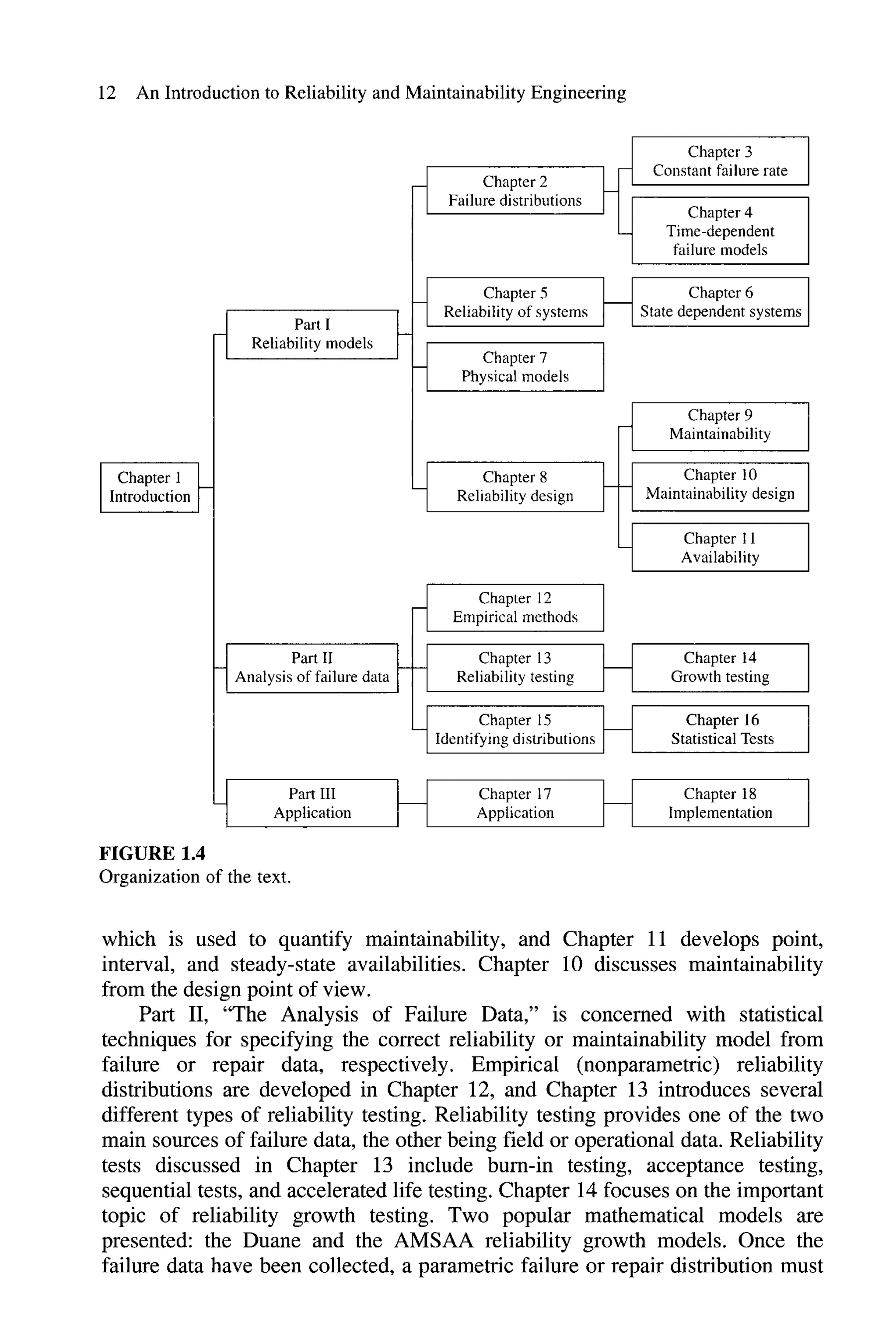
Figure 1.4 shows the organization of this book. The book is divided into three
parts. Part I, "Reliability Models," develops mathematical models useful in
analyzing component and system reliability, maintainability, and availability.
Chapters 2-4 develop the common failure laws based upon the exponential,
Weibull, normal, lognormal, extreme value, and gamma distributions. The
failure distribution is defined in its three most useful representations: the density
function, the reliability function, and the hazard rate function. Conditional
reliability and the mean time to failure are also presented. Chapters 5 and 6
develop the mathematics for analyzing complex system reliability given
knowledge of the reliability of the components and their configuration within the
system. Chapter 5 assumes independence among the components, and Chapter 6
addresses the case in which component failures depend on the state of the
system. These dependencies, such as those encountered with standby and shared
load systems, are analyzed with Markov processes. Chapter 7 deviates somewhat
from the primary development of reliability by introducing models based on the
physical processes involved. In Chapter 8 the important task of integrating
reliability into the engineering design process is presented. This is further
developed in the next three chapters, in which maintainability and availability
are defined, thereby allowing for design trade-offs between reliability and
maintainability. Specifically, Chapter 9 defines the repair time distribution,
12 An Introduction to Reliability and Maintainability Engineering
Part I
Reliability models
Part II
Analysis of failure data
Part III
Application
FIGURE 1.4
Organization of the text.
Chapter 2
Failure distributions
Chapter 5
Reliability of systems
Chapter 7
Physical models
Chapter 8
Reliability design
Chapter 12
Empirical methods
Chapter 13
Reliability testing
Chapter 15
Identifying distributions
Chapter 17
Application
Chapter 3
Constant failure rate
Chapter 4
Time-dependent
failure models
Chapter 6
State dependent systems
Chapter 9
Maintainability
Chapter 10
Maintainability design
Chapter II
Availability
Chapter 14
Growth testing
Chapter 16
Statistical Tests
Chapter 18
Implementation
which is used to quantify maintainability, and Chapter 11 develops point,
interval, and steady-state availabilities. Chapter 10 discusses maintainability
from the design point of view.
Part II, "The Analysis of Failure Data," is concerned with statistical
techniques for specifying the correct reliability or maintainability model from
failure or repair data, respectively. Empirical (nonparametric) reliability
distributions are developed in Chapter 12, and Chapter 13 introduces several
different types of reliability testing. Reliability testing provides one of the two
main sources of failure data, the other being field or operational data. Reliability
tests discussed in Chapter 13 include bum-in testing, acceptance testing,
sequential tests, and accelerated life testing. Chapter 14 focuses on the important
topic of reliability growth testing. Two popular mathematical models are
presented: the Duane and the AMSAA reliability growth models. Once the
failure data have been collected, a parametric failure or repair distribution must
CHAPTER 1: Introduction 13
be selected from among those models discussed in Part I. This requires
estimation of the distribution parameters, discussed in Chapter 15, and a
statistical goodness-of-fit test, discussed in Chapter 16, to either reject or not
reject the hypothesized distribution. From the material presented in Part II, the
reliability engineer should be able to establish a test plan, collect failure or repair
data, and complete a statistical analysis of the data, resulting in an acceptable
Part III, "Application," concludes the development of reliability engineering
by presenting several applications in Chapter 17 and by identifying policies,
procedures, issues, and concerns in implementing a reliability program in
Chapter 18. Together, these last two chapters attempt to integrate the material
from Parts I and II.
Other introductory texts on reliability include Bain and Engelhardt [1991],
Blanks [1992], Bunday [1991], Crowder et al. [1991], Dai and Wang [1992],
Elsayed [1996], Grosh [1989], Kales [1998], Kececioglu [1991], Leemis [1995],
Ramakumar [1993], Rao [1992], Sundararajan [1991], Todinov [2005], and
Zacks [1992].
APPENDIX IA
A PROBABILITY PRIMER
There are two general approaches to modeling uncertainty by using probability con-
cepts. The more basic method makes use of the idea of a sample space and events
defined over the sample space. It then defines the probability of these events and
computes probabilities of more complex events formed from unions and intersec-
tions of elementary events. The second method is based on the concept of a random
variable and a probability distribution associated with the random variable. A ran-
dom variable is a variable that takes on certain values in accordance with specified
probabilities. By specifying the probability distribution of a random variable, we can
completely characterize the random process. We will have occasion throughout this
text to utilize both methods. For example, we may define an event to be a component
failure and a random variable to be the time to failure of the same component.
IA.I
RANDOM EVENTS
In reliability engineering a failure can be described as a random event. A random
event E will occur with some probability denoted by peE) where 0 :s; peE) :s; 1.
peE) = 0 describes an impossible event, and peE) = 1denotes a certain event. The
closer peE) is to 1, the more likely it is that the event (e.g., failure) will occur.
14 An Introduction to Reliability and Maintainability Engineering
The collection of all possible outcomes (events) relative to a random process is
called the sample space S, where S = {E1, E2, ... , Ek} and peS) = 1.
Every event E has associated with it a complementary event EC , which is the
negation of the event E. For example, if E represents a failure, then EC represents a
nonfailure. Since either the event or its complement must occur,
pee) + P(EC) = 1
or P(EC) = 1 - pee) (1.1)
There are two primary operations performed on events. The first is defined as the
intersection of two events A and B and is written A n B. The intersection is the event
consisting of those outcomes common to both events A and B. The second operation
is defined as the union of two events A and B and is written A U B. The union is the
event consisting of those outcomes in either event A or in event B (or common to
both).
EXAMPLE IA.I. Let the event A = the failure of component 1 and B = the failure of
component 2. Then
A n B = the event that both components have failed
A" n B = the event that component 1 did not fail and component 2 failed
AC U B = the event that component 1 did not fail or component 2 failed
Two events A and B are mutually exclusive if the occurrence of one precludes
the occurrence of the other. For example, an event and its complement are mutually
exclusive. A component cannot both fail and not fail as a result of the same random
process. In general, ifA and B are mutually exclusive,
peA U B) = peA) + PCB)
peA n B) = P(0) = 0
where 0 is the null, or impossible, event; P(0) = O.
Two events A and B are independent if and only if
peA n B) = peA) PCB)
(1.2)
(1.3)
(1.4)
That is, the probability of their intersection is equal to the product of their probabil-
ities.
EXAMPLE IA.2. Define the events A and B as in Example 1A.l, where peA) = 0.1
and PCB) = 0.2. Then peA nB) = (0.1)(0.2) = 0.02 is the probability that both compo-
nents fail.
If two events are not independent (that is, they are dependent), the probability
of their intersection must be defined using conditional probability. Define the con-
ditional probability as
peA IB) = peA n B)
PCB)
(1.5)
CHAPTER 1: Introduction 15
which is read as "the probability ofA given B." Then
P(A n B) = P(A IB) P(B) (1.6)
Equation (1.6) provides a general formula for finding ajoint (intersection) probability
ifthe conditional and individual probabilities are known. The conditional probability
can be viewed as a reduced sample space in which the event B defines the set of all
possible outcomes (i.e., the reduced sample space) and the intersection of A and B
represents those events that are also part ofA. From this perspective, Eq. (1.5) gives
the percentage of outcomes in B that are also in A. IfA and B are independent,
P(A IB) = P(A n B) = P(A)P(B) = P(A)
P(B) P(B)
This result provides insight into the concept of independent events. If A and B are
independent, the occurrence of event B does not alter the probability ofA.
EXAMPLE IA.3. Two identical components operating in parallel share a common load.6
If one component fails, the probability that the other component fails increases as a
result of the increased load placed on it. Let A and B be the event that component 1
fails and the event that component 2 fails, respectively. If P(A) = P(B) = 0.05 and
P(A IB) = P(B IA) = 0.10, we are interested in the event that both components fail,
or using Eq. (1.6),
P(A n B) = P(B)P(A IB) = P(A)P(B IA) = 0.05(0.10) = 0.005
EXA MP LEI A. 4. A two-component parallel system (repairable) is in a failure state (both
components have failed) 3 percent ofthe time. Component 1 is in a failed state 8 percent
of the time, and component 2 is in a failed state 6 percent of the time. If we let A = the
event that component 1 is in a failed state and B = the event that component 2 is in a
failed state, then P(A IB) = 3/6 = 0.5 and P(B IA) = 3/8 = 0.375.
The above discussion provides a general approach to analyzing the intersection
of events. The following rule, referred to as the addition rule, does much the same
for the union of two events:
P(A U B) = P(A) + P(B) - P(A n B) (1.7)
Equation (1.7) can be explained by observing that P(A) and P(B) both include
P(A n B). Therefore P(A n B) must be subtracted out once. If A and B are inde-
pendent, Eq. (1.7) becomes
otherwise
P(A U B) = P(A) + P(B) - P(A)P(B)
P(A U B) = P(A) + P(B) - P(A IB)P(B)
(1.8)
(1.9)
EXAMPLE IA.S. Given the two events A and B in Example lA.3 and using Eq. (1.9),
P(A U B) = 0.05 + 0.05 - 0.005 = 0.095 is the probability that at least one of the two
components fails. Also, P(A U B)c = I - 0.095 = 0.905 is the probability that neither
component fails. In this example the reliability ofthe system is found from P(A n B)C =
60perating in parallel implies a redundant system in which both components must fail for the system to
fail.
16 An Introduction to Reliability and Maintainability Engineering
1 - 0.005 = 0.995, which is the probability that at least one ofthe two components does
not fail.
lA.2
BAYES' FORMULA
Bayes' formula involves conditional probabilities of two events. It can be derived
by observing that
p(AnB) p(BnA)
peA IB) = PCB) = P[(B n A) U (B n N)]
PCB IA)P(A)
PCB IA)P(A) + PCB IN)P(AC)
where the events B n A and B n AC are mutually exclusive.
(LlO)
EXAMPLE lA.6. A smoke detector is routinely inspected. Eighty percent of the detec-
tors found inoperative had experienced a power surge, and 10 percent of those found
in operating condition had experienced a power surge. Twenty percent of the detectors
inspected have failed. What is the probability of a detector failing given it experiences
a power surge?
Solution. LetA = the event that a detector has failed and B = the event that the detector
had experienced a power surge. Then peA) = 0.20, PCB IA) = 0.80, and PCB IAC) =
0.10. Therefore
peA IB) (0.80)(0.20) = 0.16 = 0667
= (0.80)(0.20) + (0.10)(0.80) 0.24 .
Bayes' formula is generalized as follows:
i = 1, ... , n (1.11)
where the events Ai, i = 1, ... , n, form a partition. That is, they are mutually exclu-
sive and their intersection comprises the entire sample space (they are collectively
exhaustive). As a result the denominator in Eq. (1.11) is equal to P(B).
lA.3
RANDOM VARIABLES
Although the concept of a random event is a useful one in describing random pro-
cesses, a more useful concept is that of a random variable. A random variable is a
variable that takes on numerical values in accordance with some probability dis-
tribution. Random variables may be either continuous (taking on real numbers)
or discrete (usually taking on nonnegative integer values). The probability dis-
CHAPTER 1: Introduction 17
tribution that assigns a probability to each value of a discrete random variable
or assigns a probability to an interval of values of a continuous random variable
can be described in terms of a probability mass function (PMF) p(x) in the dis-
crete case and a probability density function (PDF) f(x) in the continuous case.
For both discrete and continuous distributions a cumulative distribution function
(CDF) F(x) is defined. The PMF or PDF describes the shape of the probabil-
ity distribution, whereas the CDF provides a cumulative probability, i.e., Pr{X :5
x} = F(x). By convention, capital letters represent the random variable and the
corresponding lowercase letters denote particular values the random variable may
assume.
EXAMPLE IA.7. Here are some examples of random variables:
T = the continuous random variable representing the time to failure of a component
Y = the discrete random variable representing the number offailures occurring in some
timet
W = the continuous random variable representing the time to repair a failed system
X = the discrete random variable representing the numberofcycles until the first failure
occurs
lA.4
DISCRETE DISTRIBUTIONS
For any discrete distribution, we will define p(x) = Pr{X = x} to be its probability
mass function. Then
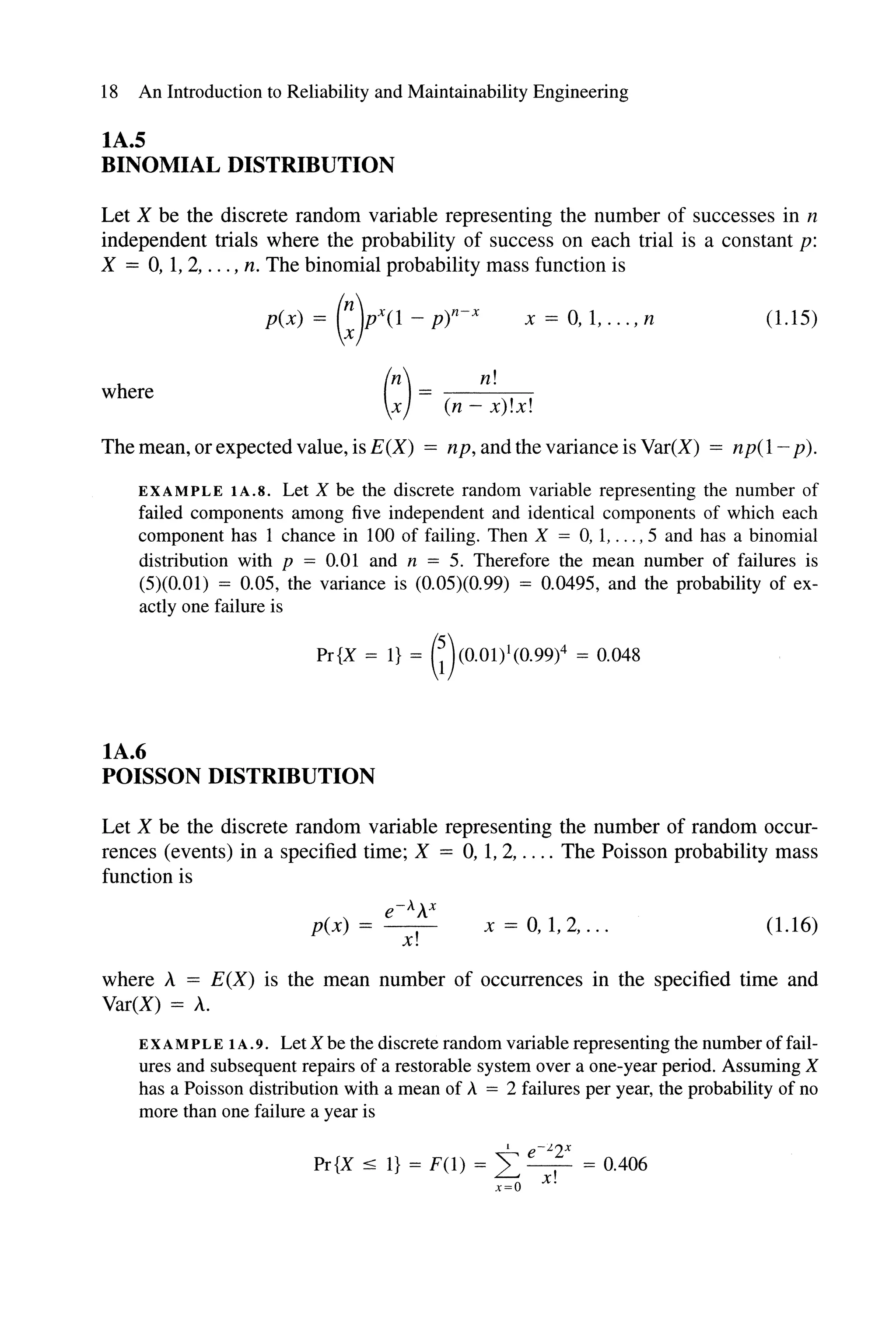
x
F(x) = Pr{X :5 x} = LP(~)
all g
(1.12)
is the CDF. Therefore F(x) is monotonically increasing, with 0 :5 F(x) :5 I and in
particular F(O) = 0 and F(oo) = 1. For any discrete distribution,
1. 0 :5 p(x) :5 1
2. LP(x) = 1
all x
3. JL = L xp(x) (1.13)
all x
is the mean of the distribution.
4. (J'2 = L(x - JL)2p(X) (1.14)
all x
is the variance of the distribution.
Two discrete distributions are very useful in reliability: the binomial and the
Poisson.
18 An Introduction to Reliability and Maintainability Engineering
lA.S
BINOMIAL DISTRmUTION
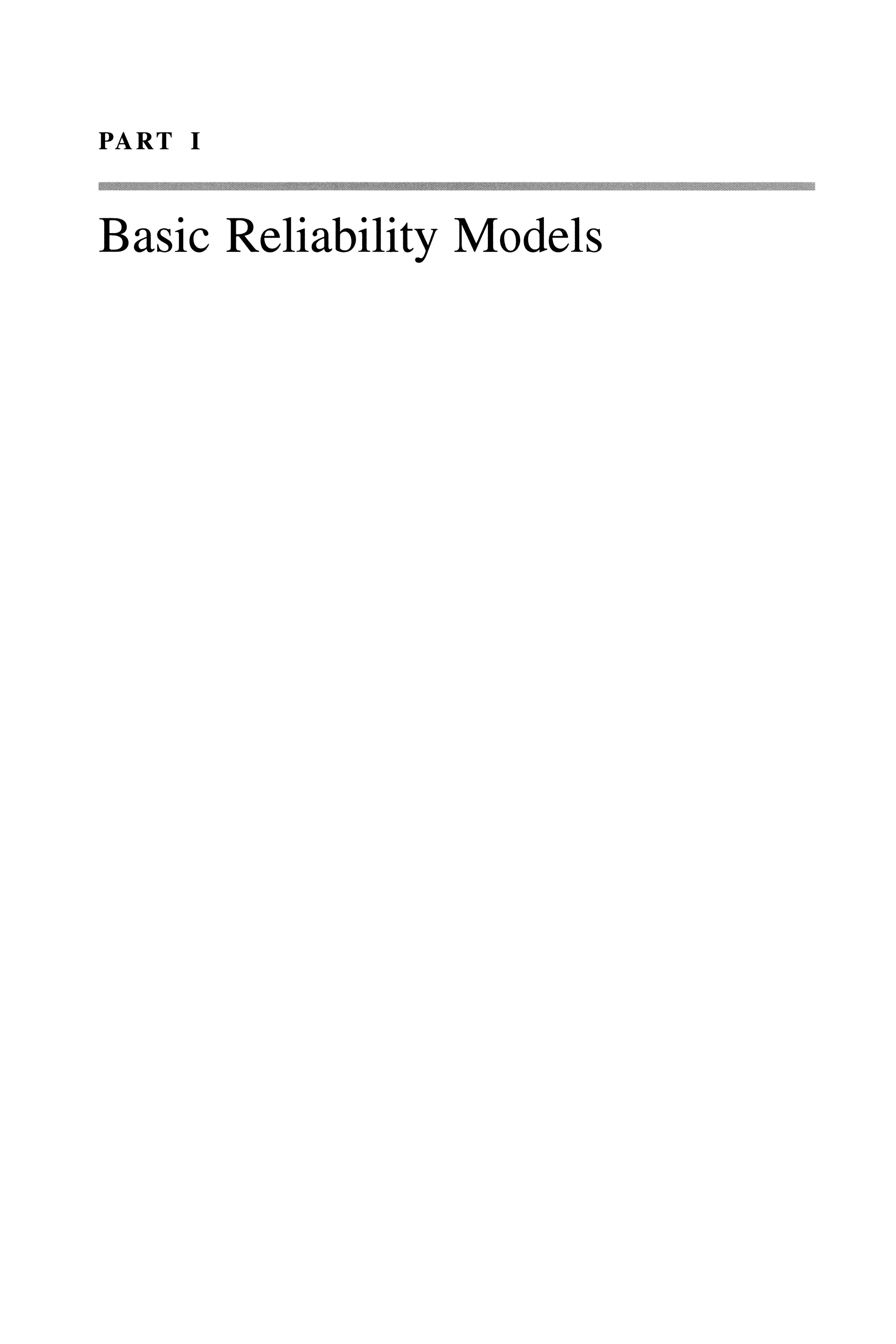
Let X be the discrete random variable representing the number of successes in n
independent trials where the probability of success on each trial is a constant p:
X = 0, 1, 2, ... , n. The binomial probability mass function is
p(x) = (:)pX(1 - p)n-x x = 0,1, ... , n (1.15)
where (:) = (n _n~)!X!
The mean, or expected value, isE(X) = np, and the variance is Var(X) = np(1- p).
EXAMPLE lA.S. Let X be the discrete random variable representing the number of
failed components among five independent and identical components of which each
component has 1 chance in 100 of failing. Then X = 0, 1, ... ,5 and has a binomial
distribution with p = 0.01 and n = 5. Therefore the mean number of failures is
(5)(0.01) = 0.05, the variance is (0.05)(0.99) = 0.0495, and the probability of ex-
actly one failure is
Pr{X = I} = (i)(0.01)1(0.99)4 = 0.048
lA.6
POISSON DISTRmUTION
Let X be the discrete random variable representing the number of random occur-
rences (events) in a specified time; X = 0, 1, 2, .... The Poisson probability mass
function is
e-AAX
p(x) = --
x!
x = 0,1,2, ... (1.16)
where A = E(X) is the mean number of occurrences in the specified time and
Var(X) = A.
E XA MPL E 1A.9. Let X be the discrete random variable representing the number offail-
ures and subsequent repairs of a restorable system over a one-year period. Assuming X
has a Poisson distribution with a mean of A = 2 failures per year, the probability of no
more than one failure a year is
1 e-k 2x
Pr{X ~ I} = F(1) = L - = 0.406
x=o x!
CHAPTER 1: Introduction 19
lA.7
CONTINUOUS DISTRIBUTIONS
The following relations hold for any continuous probability distribution:
1. 0 :5 F(x) :5 1
x
2. Pr{X :5 x} = F(x) = If({) d{
3. f(x) = d~~x)
00
4. I f(x)dx = 1
-00
b
5. Pr{a:5 X :5 b} = If(x)dx = F(b) - F(a)
a
00
6. E(X) = JL = Ixf(x)dx
-00
where JL is the mean or expected value of the random variable X.
00
7. Var(X) = u 2 = I(x - JL)2 f(x)dx
where u 2 is the variance of the distribution.
(1.17)
(1.18)
(1.19)
(1.20)
(1.21)
(1.22)
8. If Y = L.7=1 aiXi where the Xi are independent random variables having means
JLi and variances uf and the ai are constants, then
n
E(Y) = 2:aiJLi
i= 1
and
n
Var(Y) = 2:afuf (1.23)
i= 1
In general we may describe the distribution of a random variable in terms of its
PDF, f(x), or its CDF, F(x). Although a random variable may be defined over the
open interval (-00,00), when the random variable represents a failure time or repair
time, only nonnegative values are permitted. Therefore the domain of the random
variable would normally be [0, 00), and the lower limits of the integrals in relations
2, 4, 6, and 7 would reflect this change. The concepts ofrandom variables and proba-
bility distributions are explored more fully in the next several chapters as the failure
probability distribution is developed as the primary focus ofPart I. Examples ofthese
distributions will therefore be presented in the context of their use in developing re-
liability models. More detailed coverage of probability theory may be found in Ross
[1987].
PART I
Basic Reliability Models
CHAPTER 2
The Failure Distribution
The initial focus of this book is on the development of mathematical models that de-
scribe the reliability of components and systems. This chapter develops four related
probability functions: the reliability function, the cumulative distribution function,
the probability density function, and the hazard rate function. Each of these func-
tions can be used to compute reliabilities, but they offer four different perspectives.
Specifying anyone of these functions will uniquely and completely characterize the
failure process. Various summary measures of reliability, such as the mean time to
failure, the variance of the failure distribution, and the median time to failure, may
then be determined. Subsequent chapters will define several common and highly
useful theoretical reliability models.
2.1
THE RELIABILITY FUNCTION
Reliability is defined as the probability that a system (component) will function over
some time period t. To express this relationship mathematically we define the contin-
uous random variable T to be the time to failure of the system (component); T ;::: O.
Then reliability can be expressed as
R(t) = Pr{T ;::: t} (2.1)
where R(t) ;::: 0, R(O) = 1, and limHoc R(t) = O. For a given value of t, R(t) is the
probability that the time to failure is greater than or equal to t.
If we define
F(t) = 1 - R(t) = Pr{T < t} (2.2)
23
24 PART I: Basic Reliability Models
where
and
F(O) = 0
limF(t) = 1
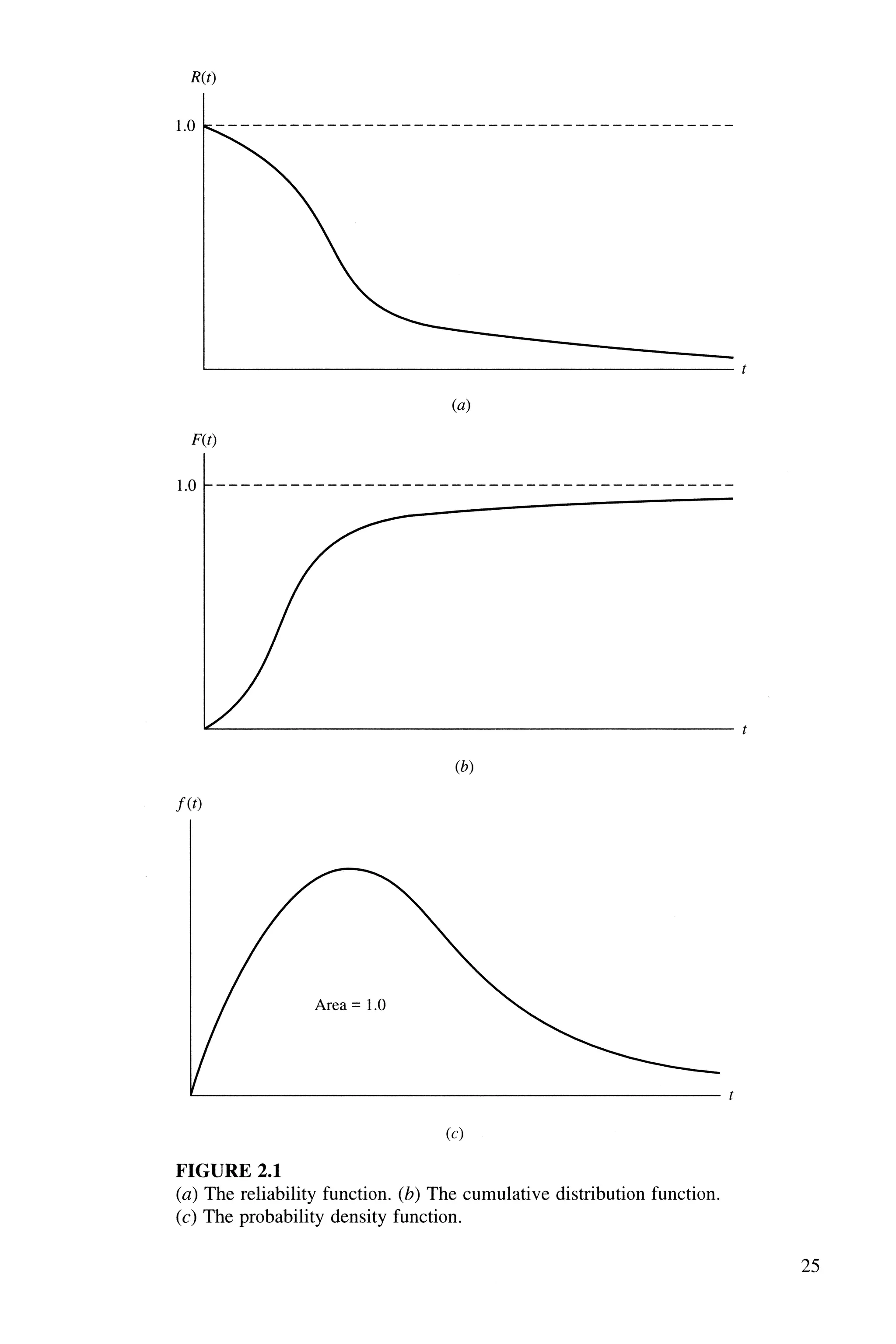
t .....oo
then F(t) is the probability that a failure occurs before time t.
We will refer to R(t) as the reliability function and F(t) as the cumulative dis-
tributionfunction (CDF) of the failure distribution. A third function, defined by
f(t) = dF(t) = _ dR(t)
dt dt
(2.3)
is called the probability density function (PDF). This function describes the shape
of the failure distribution. These three functions are illustrated in Fig. 2.1.
and
The PDF, f(t), has these two properties:
f(t) ;::: 0
Given the PDF, f(t), then
and tOO f(t) dt = 1
F(t) = I:f(t')dt'
R(t) = Ioo
f(t') dt'
(2.4)
(2.5)
In other words, both the reliability function and the CDF represent areas under the
curve defined by f(t). Therefore, since the area beneath the entire curve is equal to
one, both the reliability and the failure probability will be defined so that
o :S R(t) :S 1 o :S F(t) :S 1
The function R(t) is normally used when reliabilities are being computed, and the
function F(t) is normally used when failure probabilities are being computed. Graph-
ing the PDF, f(t), provides a visual representation of the failure distribution.
EXAMPLE 2.1. Given the following PDF for the random variable T, the time (in op-
erating hours) to failure of a compressor, what is its reliability for a 1oo-hr operating
life?
Solution
{
0.001
f(t) = 6o.001t + 1)2
t :=:: 0
otherwise
Solution
R() foo 0.001 d' -1 1
00
t = t (O.OOlt' + 1)2 t = (O.OOlt' + 1) t O.OOlt + 1
and
1 O.OOlt
F(t) = 1 - R(t) = 1 - O.OOlt + 1 O.OOlt + 1
Then
1
R(1oo) = 0.1 + 1 = 0.909
R(t)
1~ ------------------------------------------
(a)
F(t)
1~ ------------------------------------------
(b)
f(t)
(c)
FIGURE 2.1
(a) The reliability function. (b) The cumulative distribution function.
(c) The probability density function.
25
26 PART I: Basic Reliability Models
A design life is defined to be the time to failure tR that corresponds to a specified reliabil-
ity R. That is R(tR) = R. To find the design life if a reliability of 0.95 is desired, we set
1
R(t ) = 0.95
R O.OOltR +1
Solving for tct,
tR =1000(0.~5 -1)= 52.6hr
The probability of a failure occurring within some interval of time [a, b] may be
found using any of the three probability functions, since
Pr{ a :::; T :::; b} = F(b) - F(a) = R(a) - R(b) = rf(t)dt (2.6)
From the previous example,
1 1
Pr{ 10 :::; T :::; 100} = R(10) - R(100) = 0.01 + 1 - 0.1 + 1 = 0.081
2.2
MEAN TIME TO FAILURE
The mean time to failure (MTTF) is defined by
MTTF = E(T) = fo'''' tf(t)dt (2.7)
which is the mean, or expected value, of the probability distribution defined by f(t).
It can also be shown (Appendix 2A) that
MTTF = fo'''' R(t) dt (2.8)
Equation (2.8) is often easier to apply than (2.7).
The mean of the failure distribution is only one of several measures of central
tendency of the failure distribution. Another is the median time to failure, defined by
R(tmed) = 0.5 = Pr{ T 2: tmed} (2.9)
The median divides the distribution into two halves, with 50 percent of the fail-
ures occurring before the median time to failure and 50 percent occurring after the
median. The median may be preferred to the mean when the distribution is highly
skewed.
A third frequently used average is the mode, or most likely observed failure
time, defined by
f(tmode) = max f(t)
O:s«oo
(2.10)
For a small fixed interval of time centered around the mode, the probability offailure
will generally be greater than for an interval of the same size located elsewhere
within the distribution. Figure 2.2 shows the locations of the mean, the median, and
the mode for a distribution skewed to the right.
CHAPTER 2: The Failure Distribution 27
f(t)
FIGURE 2.2
Comparison of the measures of central tendency.
EXAMPLE 2.2. Consider the probability density function
with t in hours. Then
f(t) = { 00·002e-O
.OO2t t 2': 0
otherwise
R(t) = ro0.002e-0.OO2t dt = e-0.002t
and foo e-0.OO2t 100
1
MTTF = 0 e-0.OO2t dt = = 0.002 = 500 hr
-0.002 0
To find the median time to failure, set
R(tmed) = e-0.OO2tmed = 0.5
Then solving for tmed,
InO.5
tmed = -0.002 = 346.6 hr
To find the mode, we observe that the function f(t) is monotonically decreasing and
positive. Therefore its maximum value occurs at t = 0, and tmode = O.
EXAMP LE 2.3. Even if two reliability functions have the same mean, their reliabilities
may be quite different for the same operating time. For example, let
R, (t) = e-0.OO2t t 2': 0
with MTTF, = 500 hr (as shown in Example 2.2),
and R()= 1000-t
2 t 1000 o ~ t ~ 1000
where MTTF2 = 1'000(1 - 1~0)dt = t - 2~01~000 = 500 hr
We compute their reliabilities for an operating time of 400 hr. For R, (t) we obtain
R,(400) = e-0.002(4oo) = 0.449
28 PART I: Basic Reliability Models
R (400) = 1000 - 400 = °60
2 1000·
Obviously, the MTTF alone will not uniquely characterize a failure distribution.
Other measures are necessary. One measure that is often used to further describe a
failure distribution is its variance (j2, defined by
(j2 = Iooo(t - MTTF)2 f(t)dt (2.11)
The variance represents an average squared distance a failure time will be from the
MTTF. It is a measure of the spread, or dispersion, of the failure times about the
mean. It is shown in Appendix 2B that the variance can also be written as
(j2 = L'" t2 f(t)dt - (MTTF)2 (2.12)
Equation (2.12) is computationally simpler than the definitional Eq. (2.11). The
square root of the variance is the standard deviation. Since the standard deviation
will be measured in the same time units as the random variable, T, it is easier to
interpret than the variance (which is measured in square units).
2.3
EXAMPLE 2.4. From the first failure distribution in Example 2.3, we have
u 2 = L'"t2(0.002e-o.002t)dt - (500)2 = 250,000
andu = 500.
From the second, with f(t) = -dR(t)/dt = 111000,
u 2 = t2 - - dt - (500)2
flOOO ( 1 )
o 1000
t
3
1
1000
= 3000 0 - (SOW = 83,333~
and u = 288.67.
Therefore, although their MTTFs are identical, they have considerably different
standard deviations, from which we would conclude that their reliability distributions
should be inherently different. We would generally prefer the distribution having the
smaller variance. Why?
HAZARD RATE FUNCTION
In addition to the probability functions defined earlier, another function, called the
failure rate or hazard ratejunction, is often used in reliability. It provides an instan-
taneous (at time t) rate of failure. From Eq. (2.6),
Pr{ t ::::; T ::::; t + at} = R(t) - R(t + at)
and the conditional probability of a failure in the time interval from t to t + at given
that the system has survived to time tis
Then
CHAPTER 2: The Failure Distribution 29
Pr{t :::; T :::; t + !It IT;::: t} = _R-,-(t,---)---=-R-,-:,(t_+_L1....:...t)
R(t)
R(t) - R(t + L1t)
R(t) L1t
is the conditional probability of failure per unit of time (failure rate).
Set
A(t) = lim -[R(t + L1t) - R(t)] . _1_
~t-+O !It R(t)
-dR(t) 1 f(t)
-----:d:--t:....:... . -R(-t) = -R(-t)
(2.13)
Then A(t) is known as the instantaneous hazard rate or failure rate function. The
failure rate function A(t) provides an alternative way of describing a failure distribu-
tion. Failure rates in some cases may be characterized as increasing (IFR), decreas-
ing (DFR), or constant (CFR) when A(t) is an increasing, decreasing, or constant
function.
A particular hazard rate function will uniquely determine a reliability function.
To see this, let
A(t) = -dR(t) . _1_
dt R(t)
or ( )d = -dR(t)
1 t t R(t)
Integrating,
(t , , _ IR(t) -dR(t')
Jo A(t ) dt - 1 R(t')
where R(O) = 1 establishes the lower limit in the integral on the right-hand side.
Then
-I:A(t') dt' = In R(t)
or R(t) = exp [- I:A(t')dt'] (2.14)
Equation (2.14) can then be used to derive the reliability function from a known
hazard rate function.
EXAMPLE 2.5. Given the linear hazard rate function A(t) = 5 x 1O-6t where t is mea-
sured in operating hours, what is the design life if a 0.98 reliability is desired?
Solution
Another Random Scribd Document
with Unrelated Content
and telephones—all these are objects of wonder and marvel to those
Tibetans, and it is not strange that most of them become the more
disinclined to return home the longer they live in India. In the
presence of these evidences of material greatness, the Tibetans
naturally come to the conclusion that a Government which can
afford to establish and maintain such splendid structures must be
immensely rich, and they therefore begin to nurture the hope of
having such a wealthy and great Government over them, and of
sharing in its prosperity. This sentiment seems to be especially
strong among those of the higher classes, who have seen India, and
it is shared by their inferiors who know that greatness only from
hearsay.
The policy of indirectly winning the goodwill of the Tibetans, so far
pursued by the Indian Government, has failed, however, to produce
any perceptible effect on the Government circles of Tibet. They are
too far engrossed with personal interests to be open to any great
extent to indirect suasion of a moral nature. They are far more
inclined to gain advantage for themselves directly from offers of
bribes than to profit by an exemplary model of administration. The
main reason why they are favorably disposed towards Russia is
because they have received gold from that country; it was never by
the effect of any display of good administrative method that Russia
has succeeded so well. In short, these greedy Tibetan officials offer
their friendship to the highest bidders, and they do not care at all
whence the gold comes so long as they grasp a large sum. The
policy of the British Government therefore rests on a pedestal set a
little too high to be understood and appreciated by the majority of
the official circles of Tibet.
The attitude of the priesthood towards England is a puzzled one.
They are puzzled to determine whether they should denounce the
English as devils incarnate, or respect them as the incarnations of
saints. The benevolent arrangements made by them, such as
establishing philanthropic institutions, laying of railroads and such
like, lead the sceptical Lamas to think that Englishmen must
understand the ways of Buḍḍhism and be a godly race. But when
they think that these same Englishmen did not scruple to annex
other people’s land to their own dominions, their favorable
impression about Englishmen receives a sudden and complete check.
These two conflicting notions seem to have taken a deep hold on
their minds, and they try to solve the puzzle without compromising
their two convictions. They explain that there must be two distinct
kinds of Englishmen in India, one benevolent and godly and the
other infernal and quite wicked. Otherwise, they think, such a
marvellous phenomenon as that witnessed in India could hardly
have been possible.
The same priests held a strange notion about the late Queen. They
believed her to be an incarnation of the patron Goddess of the Cho-
khang temple in Lhasa, and therefore endowed with a supernatural
power of subjugating and governing the whole world. Because of
this occult affinity the Queen entertained, they believed, a fraternal
feeling towards Tibet, but some of the courtiers about her were
wicked and obstructed her benevolent intentions, just as the great
Buḍḍha himself had among His disciples some wicked and
incorrigible characters. The Tibetans, they said, must get rid of those
pernicious persons for the Queen.
When the news of the death of the Queen reached Tibet, the
people, while mourning for her, at the same time rejoiced, for they
thought that their Panden Lhamo, the Goddess in question, was
once more restored to them.
I may add that I was frequently asked by the literates and other
men of learning of my own impression about British India, for they
knew that I had visited Buḍḍhagayā and other places in India. On
such occasions I merely confined myself as much as possible to
general remarks, for I feared that any accurate explanation might
awake their suspicions about my supposed personality.
The existence of the Siberian railway can hardly be expected to give
any great help to Russia, if ever the latter should be obliged from
one reason or another to send a warlike expedition to Lhasa. The
distance from the nearest station to Lhasa is prohibitive of any such
undertaking, for the march, even if nothing happens on the road,
must require five or six months and is through districts abounding in
deserts and hills. The presence of wild natives in Amdo and Kham is
also a discouraging factor, for they are people who are perfectly
uncontrollable, given up to plunder and murder, and of course
thoroughly at home in their own haunts. Even discipline and superior
weapons would not balance the natural advantages which these
dreadful people enjoy over intruders, however well informed the
latter may be about the topography of the districts. Russia can
hardly expect to subdue Tibet by force of arms. It was in
consideration of this fact that the Tsan-ni Kenbo has been
endeavoring to impose upon the Tibetans that audacious fiction
about the identity of the Tsar’s person with that of the long dead
Founder of the New Sect, so that his master might accomplish by
peaceful means what he could hardly effect by force.
However, even the Tsan-ni’s painstaking efforts appear to have fallen
short of his expectations, and there is a danger of a reaction setting
in against him.
It must be remembered that the sentiment of the common people
towards China still retains its old force, even though they know that
the power of their old patron has considerably declined lately. They
are well aware that Tibet has been placed from time immemorial in a
state of vassalage to China, that Prince Srong-tsan Gambo who first
introduced Buḍḍhism into Tibet had as his wife a daughter of the
then Emperor of China, while the Tibetans believe that the present
Emperor of China is an incarnation of a Buḍḍhist deity (the Chang-
chub Semba Tambe yang in Tibetan) worshipped on Mount Utai,
China. And so both from tradition and prejudice and from present
superstition, the mass of the people, who are conservative, cannot
but regard China with a lingering sentiment of respect and
attachment, and the position which China still occupies in the niches
of their hearts can hardly be supplanted by Russia, even when the
Tsan-ni Kenbo ingeniously represents her as the country indicated in
the Tibetan Book of Prophecy.
As I have mentioned before, some few of the influential Government
officials do not seem to approve of the Tsan-ni’s movement. They
even suspect that Russia might have some sinister object in view
when she presented gold and other valuable things to the Dalai
Lama and others. Tibet has no newspapers, but even without that
organ of public opinion the public become acquainted sooner or later
with most important occurrences, and so it stands to reason that the
unfavorable view which is secretly entertained by a limited number
of thoughtful men must have leaked out one way or other to at least
a section of the public. The result is that not a small number of
priests have begun to side, though not as an organised movement,
with these prudent thinkers, and therefore to rebel against Shata
and his faction. The priests of the colleges and the warrior-priests
seem to be particularly conspicuous in this reactionary movement.
Indeed the fact is that Shata has never been a persona grata with
those young men since the tragedy of Temo Rinpoche, and so they
were inclined to view anything done by the crafty author of that
tragedy with suspicious eyes. Then again the thoughtful portion of
the college-priests never tolerated the Nechung oracles. They
despised the oracle-priests as not much better than men of unsound
mind, as drunkards, and corrupters of national interests. The very
fact that Shata patronised this vile set further estranged him from
the college-priests.
Under the circumstances, something like a reaction seems already to
have set in against the pro-Russian agitation ingeniously planned by
the Tsan-ni Kenbo. It remains to be seen what steps Russia will take
towards Tibet to prevent the Lama’s country from slipping away from
her grasp.
In reviewing the relations that formerly existed between British India
and Tibet, it must be stated first of all that British India was closely
connected with Tibet many years ago. At least Tibet’s attitude
toward the Indian Government was not embittered by any hostile
sentiment. In the eighteenth century, during the Governor-
Generalship of Warren Hastings, he sent George Bogle to make
commercial arrangements between the two countries. This
gentleman resided a few years at Shigatze. Then Captain Turner also
lived at the same place as a commercial agent for some time. After
that time India did not send any more such commissioners, but till
about twenty-four years ago the Indian natives were permitted to
enter Tibet unmolested. They were generally pilgrims or priests bent
on visiting the sacred places. Quite a large number of such Indians
must have entered Tibet. Prior to the exploration of Saraṭ Chanḍra
Ḍās it was not an uncommon sight, I have been told, to see a party
of naked priests, each carrying a water-vessel made of gourd, and
iron tongs, and with faces smeared with ashes, proceeding towards
Tibet. Though official relations had ceased between Tibet and India,
their people therefore were bound together by some friendly
connexions till quite recently. It is not unlikely that if the Indian
Government had made at that time some advances acceptable to
Tibet, it would have succeeded in establishing cordial relations with
the latter.
The exploration of Saraṭ Chanḍra Ḍās disguised as an ordinary
Sikkimese priest, and the frontier trouble that followed it, completely
changed the attitude of Tibet towards India and the outer world and
made it adopt a strict policy of exclusion. The publication of the
results of that exploration directed the attention of the Indian
Government to the question of delimiting the boundary between
Sikkim, its protectorate, and Tibet. It was at that time that the
Tibetan Government adopted most indiscreet measures at the
instance of a fanatical Nechung, and proceeded to build a fort at a
frontier place which distinctly belonged to Sikkim. The Tibetan
Government is said to have at first hesitated to follow that insidious
advice, but the Nechung was clamorous and declared that his
presence in the fort would disarm any troops which the Indian
Government might send against it. Tibet therefore, continued the
fanatic, need not be afraid of the Indian Government and must
proceed to construct a fort with all promptitude. He argued that the
presence of a fort would go far towards promoting Tibet’s cause in
settling the boundary dispute and the fort would become the
permanent boundary mark.
Accordingly the fort was built at a place that was beyond the
legitimate boundary line of Tibet. Soon the Indian troops arrived
and, ‘infidels’ as they were, they made short work of it, in utter
defiance of the terrible anathema hurled by the indomitable
Nechung against them. The stronghold was carried by assault by the
invaders. The crumbled stone walls standing on a hill at a place
about twenty miles on this side of Nyatong, which marks the
boundary between Sikkim and Tibet, indicate the site of this short-
lived stronghold built by the Tibetan Government. Now in building a
fort in a place which the Tibetans themselves knew to belong to
Sikkim, they may have reasoned with self-complacency that as
Sikkim formerly belonged to Tibet, therefore they might not
improperly revive their original claim on, at least, a portion of that
district now under the jurisdiction of England. Of course England
could never concur in such an arrangement, and the trouble
between her and Tibet at last culminated in war. This was about
sixteen years ago. The issue of that war was from the first a
foregone conclusion, and the troops sent by the Indian Government
easily put to rout the fighting men of Tibet. The latter held better
positions, but they lacked discipline, training and good weapons,
while they had the further disadvantage of being commanded by
would-be generals and captains who did not care to lead their men
in person, but contented themselves with issuing orders and leaving
them to be carried out anyhow. Needless to add that the orders
could never be carried out, but were invariably frustrated by the
invaders. The Tibetan generals and captains escaped unhurt, for the
simple reason that they had never exposed themselves to danger.
After issuing orders, they always remained in the camp and spent
their time in gambling, leaving their soldiers to be killed or wounded
on the field. Thus the war ended with some heavy casualty returns
on the Tibetan side, and far shorter returns on the part of the
invaders.
As the result of this war the frontier line was drawn through
Nyatong, and though the Indian Government would have been
justified in extending it further down to Chumbi Samba, it did not
push its claim so far.
Apparently the action of the Indian Viceroy of that time was crowned
with success, but when this complication is viewed with an eye to a
longer and more permanent end, I cannot approve of the measures
adopted by him. He should I think, have adopted a course of
leniency instead of one of stern punishment, and should have
endeavored by some clever manœuvres, not excluding a rather
liberal disbursement of secret service funds, to win the good-will of
the ruling circles of Tibet. I think the result would have been far
more advantageous for the future success of England than
recovering at the point of the bayonet a barren tract covering only
thirty miles in area. Who knows but that the influence of England
might have been firmly established in Tibet by this time if that
patronising policy had been adopted then, and that Englishmen
might not be free to come and reside in and about Lhasa to enjoy
the pure atmosphere and cool and healthy climate of that district?
CHAPTER LXXIII.
China, Nepal and Tibet.
It requires the erudition and investigations of experts to write with
any adequacy about the earlier relations between China and Tibet. I
must therefore confine myself here only to the existing state of
those relations.
Tibet is nominally a protectorate of China, and as such she is bound
to pay a tribute to the Suzerain State. In days gone by, Tibet used to
forward this tribute to China, but subsequently the payment was
commuted against expenses which China had to allow Tibet, on
account of the Grand Prayer which is performed every year at Lhasa
for the prosperity of the Chinese Emperor. As a result of this
arrangement, Tibet ceased to send the tribute and China to send the
prayer fund.
The loss of Chinese prestige in Tibet has been truly extraordinary
since the Japano-Chinese War. Previous to that disastrous event,
China used to treat Tibet in a high-handed way, while the latter,
overawed by the display of force of the Suzerain, tamely submitted.
All is now changed, and instead of that subservient attitude Tibet
regards China with scorn. The Tibetans have come to the conclusion
that their masters are no longer able to protect and help them, and
therefore do not deserve to be feared and respected any more. It
can easily be understood how the Chinese are mortified at this
sudden downfall of their prestige in Tibet. They have tried to recover
their old position, but all their endeavors have as yet been of no
avail. The Tibetans listen to Chinese advice when it is acceptable,
but any order that is distasteful to them is utterly disregarded.
While I was staying in Lhasa a yellow paper, containing the Chinese
Emperor’s decree issued at the termination of the Boxer trouble, was
hung up in the square of that city. The decree was addressed to all
the eighteen provinces of China and all her protectorates. It warned
the people under pain of severe penalty against molesting and
persecuting foreigners, as they, the people, were too frequently
liable to do from their ignorance of the state of affairs abroad and
their misunderstanding of the motives of the foreigners who came to
their respective districts. These foreigners, the decree continued,
have really come to engage in industrial pursuits or in diffusing
religion, and for other purposes beneficial alike to the people and
themselves. In order to promote these aims of mutual benefit, the
middle kingdom has been opened so as to allow foreigners freedom
of travelling to any place they wish, and so, concluded the decree,
this policy of welcome and hospitality should be adopted in all the
provinces and protectorates.
Two other decrees of like import arrived afterwards and were
similarly posted up, and I thought at that time that the allies must
have entered Peking, and that this decree must have been issued as
a result of the conclusion of peace between the Powers and China.
The decree, however, failed to produce any particular impression on
the Tibetans. I asked a high Government official what Tibet was
going to do with the order set forth in the decree, and whether the
Tibetan Government, in the face of that injunction, could refuse, for
instance, to allow Englishmen to enter the country. The official
scornfully replied that his Government was not obliged to obey an
order which the Chinese Emperor issued at his own pleasure. And
besides it was highly doubtful whether the Emperor, who was an
incarnation of a high saint, could have issued a decree of that
nature, which he must have known to be utterly opposed to the
interests and traditional policy of Tibet. It was more probably
clandestinely issued by some wicked men near the Emperor’s
person, as a result of bribes received from foreigners. It did not
deserve to be trusted, much less to be obeyed, declared my Tibetan
friend.
Whatever be the motive, therefore, the Tibetans are utterly
indifferent to most of the decrees coming from China, and treat
them like so many gamblers’ oaths, neither more nor less.
Whether it be from polygamous customs or from other causes, the
fact remains, though it is not possible to prove it by accurate
statistical returns, that the population of Nepāl is rapidly increasing.
It must be remembered that the Government takes great pains to
increase its population, in order to expand its interests both at home
and abroad, and, probably under the impression that polygamy is
conducive to that end, it is encouraging this questionable practice. In
Nepāl therefore even a man who can hardly support his family has
two or three wives, and one who is better off has many more.
Apparently this policy is attended with success, so far as the main
object aimed at is concerned, for I have never seen so many
children anywhere as I saw in Nepāl, where every family consisted of
a large number of boys and girls.
Be the cause what it may, the beneficial effect of this steady
advance of population is plainly visible in that country, where almost
every nook and corner of available land is brought under tillage,
where woods are tended with extreme care, and even the remote
forests inhabited by wild beasts are made to contribute their share
to the stock of lumber, of which a large portion is annually exported
to lower India. Already the population of Nepāl appears to be too
large for the limited area of the country, and so a considerable
emigration is taking place. Thus we find the Nepālese serving in the
army of the Indian Government, or pursuing trade or opening up
wild lands in Sikkim or at Darjeeling. Above all the Nepālese seem to
cast their longing glances towards Tibet as the best field for their
superfluous population; for Tibet, while possessing an area about
twelve-fold that of Nepāl, is far more thinly populated. They even
seem to be prepared to go through the ordeal of war, if necessary, to
secure that best outlet for their needy population, which cannot find
sufficient elbowroom at home. Perhaps the Nepāl Government has
that contingency in view in maintaining, as it does, a standing army
which is evidently far above its home requirements in numerical
strength.
In Nepāl the military department receives appropriations which are
quite out of proportion to those set apart for peaceful matters, as
education, justice and philanthropy. Indeed the Nepāl troops, the
famous Gurkhas, may even rival regular British troops in discipline
and effectiveness; they may perhaps even surpass the others in
mountain warfare, such as would take place in their own country.
Certainly in their capacity of enduring hardships and in running up
and down hills, bearing heavy knapsacks, they are superior to the
British soldiers. They very much resemble the Japanese soldiers in
stature and general appearance, and also in temperament. The one
might easily be mistaken for the other, so close is the resemblance
between the two. In short, as fighters in mountainous places the
Gurkhas form ideal soldiers; and it seems as though circumstances
will sooner or later compel Nepāl to employ for her self-defence this
highly effective force. Russia is at the bottom of the impending
trouble, while Tibet supplies the immediate cause.
The Russianising tendency of Tibet has recently put Nepāl on her
guard, and when intelligence reached Nepāl that Tibet had
concluded a secret treaty with Russia, that the Dalai Lama had
received a bishop’s robe from the Tsar, and that a large quantity of
arms and ammunition had reached Lhasa from S. Petersburg, Nepāl
became considerably alarmed, and with good reason. For with
Russia established in Tibet, Nepāl must necessarily feel uneasy, as it
would be exposed to the danger of absorption. The very presence of
a powerful neighbor must subject Nepāl to a great strain which can
hardly be borne for long.
It is not surprising to hear that Nepāl is said to have communicated
in an informal manner with Tibet and to have demanded an
explanation of the rumors concerning the conclusion of a secret
treaty between her and Russia, adding that if that were really the
case then Nepāl, from considerations of self-defence, must oppose
that arrangement even if the opposition entailed an appeal to arms.
What reply Tibet has made to this communication is not accurately
known, but that Nepāl sent an informal message to this effect
admits of no doubt.
Nepāl may be driven to declare war on Tibet should the latter persist
in pursuing her pro-Russian policy, and allow Russia to establish
herself in that country; and it is quite likely that England may be
pleased to see Nepāl adopt that resolute attitude. She may even
extend a helping hand, for instance by supplying part of the war
expense, and thus enabling Nepāl to prosecute that movement. The
reason is obvious, for England has nothing to lose but everything to
gain from trouble between Nepāl and Tibet, in which the former may
certainly be expected to win. But even if Nepāl is victorious her
victory will bring her only a small benefit, and the lion’s share will go
to England; Nepāl therefore would be placed in the rather foolish
position of having taken the chestnuts from the fire for the British
lion to eat. The present Ruler of Nepāl is too intelligent a statesman
not to perceive that—judging at least from my personal
observations, when I was allowed to see the Ruler, the Cabinet
Minister. He knows that it would be far better for his countrymen to
content himself with the reality of benefit rather than with the glory
of a successful but necessarily costly war. He should confine himself
to making some arrangements with Tibet by which the Nepālese
may be enabled to enter, or settle in Tibet, and to carry on profitable
undertakings there. If once his countrymen establish their influence
in Tibet by virtue of economic undertakings, then they may regard
with comparative complacency any advance of Russian influence in
Tibet, for Nepāl would be in a position to counteract that influence
by peaceful means or even by war if necessary.
Thus, it is hardly likely that Nepāl will go to extreme measures
towards Tibet, even if England should cleverly encourage her.
It must be remembered that the relations between the two countries
are not yet strained. The Tibetans do not seem to harbor any ill-
feeling towards their neighbors beyond the mountains, nor do they
regard them as a whole with fear, though they do fear the Gurkhas
on account of their valor and discipline. The Tibetan Government
also seems to be desirous of maintaining a friendly relation with
Nepāl. For instance, when on one occasion the Ruler of Nepāl sent
his messenger to Tibet to procure a set of Tibetan sūṭras, the Dalai
Lama, who heard of that errand, caused a set to be sent to Nepāl as
a present from himself, which is now kept in the Royal Library of
Nepāl.
The Nepāl Government, on its part, appears to be doing its best to
create a favorable impression on the Tibetans. The Ruler, it must be
remembered, is not a Buḍḍhist but a Brāhmaṇa; still, he pursues the
policy of toleration towards all faiths, and is especially kindly to
Buḍḍhists. The Buḍḍhists from Tibet who are staying in Nepāl enjoy
protection from the Government, and the Ruler not unfrequently
makes grants of money or timber when Buḍḍhist temples are to be
built in his dominion. The care bestowed by the Ruler on the
Buḍḍhists is highly appreciated by their friends at home, and Nepāl
is therefore favorably situated for winning the hearts of the Tibetan
people. It is easily conceivable that with a judicious use of secret
service funds Nepāl might easily establish her influence in Tibet.
This, however, cannot be readily expected from that country, as
internal conditions now are, for order is far from being firmly
established in that little kingdom, and domestic troubles and
administrative changes occur too frequently. Even the Prime Minister,
who wields the real power, has been assassinated more than once,
while changes have very frequently taken place in the incumbency of
that post. Nepāl is at present too deeply absorbed in her internal
affairs, and cannot spare either energy or money for pursuing any
consistent policy towards Tibet. Thus, though the military service of
Nepāl is sufficiently creditable, her diplomacy leaves much to be
desired.
CHAPTER LXXIV.
The Future of Tibetan Diplomacy.
Tibet may be said to be menaced by three countries—England,
Russia and Nepāl, for China is at present a negligible quantity as a
factor in determining its future. The question is which of the three is
most likely to become master of that table-land. It is evident that
the three can never come to terms in regard to this question; at best
England and Nepāl may combine for attaining their common object,
but the combination of Russia with either of them is out of the
question. Russia’s ambition in bringing Tibet under her control is too
obviously at variance with the interest of the other two to admit of
their coming to terms with her, for Russia’s occupation would be
merely preparatory to the far greater end of making a descent on
the fertile plains on the south side of the Himālayas by using Tibet
as a base of operation. As circumstances stand, Nepāl has to confine
her ambition to pushing her interests in Tibet by peaceful means.
This is evidently the safest and most prudent plan for that country,
seeing that when once that object has been attained her interest
would remain unimpaired whether Tibet should fall into the hands of
England or into those of Russia. After all, therefore, the future of
Tibet is a problem to be solved between those two Powers. At
present Russia has the ears of an important section of the ruling
circles of Tibet, while on the other hand England has the mass of the
Tibetan people on her side. The Russian policy, depending as it does
on clever manœuvres and a free use of gold, is in danger of being
upset by any sudden turn of affairs in Tibet, while the procedure of
England being moderate and matter-of-fact is more lasting in its
effect. Which policy is more likely to prevail cannot easily be
determined, for though moderation and practical method will win in
the long run, diplomacy is a ticklish affair and must take many other
factors into consideration. At any rate England is warned to be on
the alert, for otherwise Russia may steal a march upon her and upon
Lhasa.
If the Russian troops should ever succeed in reaching Lhasa, that
would open up a new era for Tibet, for the country would passively
submit to the Russian rule. The Tibetans, it must be remembered,
are thoroughly imbued with the spirit of negative fatalism, and the
arrival of Russian troops in Lhasa would therefore be regarded as
the inevitable effect of a predetermined causation, and therefore as
an event that must be submitted to without resistance. The entry of
those troops would never rouse the patriotic sentiment of the
people. But the effect of this imaginary entry would constitute a
serious menace to India. In fact, with Russia established in the
natural strongholds of Tibet, India, it may be said, would be placed
at the mercy of Russia, which could send her troops at any moment
down to the fertile plains below. Thus would the dream of Peter the
Great be realised, and of course the British supremacy on the sea
would avail nothing against this overland descent across the
Himālayas. Some may think that what I have stated is too
extravagant, and is utterly beyond the sphere of possibility. I reply
that any such thought comes from ignorance of the natural position
of Tibet. Any person who has ever personally observed the immense
strength which Tibet naturally commands must agree with me that
its occupation by Russia would be followed sooner or later by that of
India by the same aggressive power.
The question naturally arises: “Will Tibet then cease to be an
independent country?” It is of course impossible to come to any
positive conclusion about it, but from what I have observed and
studied I cannot give a reassuring answer. The spirit of dependence
on the strong is too deeply implanted in the hearts of the Tibetan
people to be superseded now by the spirit of self-assertion and
independence. During the long period of more than a thousand
years, the Tibetan people has always maintained the idea of relying
upon one or another great power, placing itself under the protection
of one suzerain State or another, first India and then China. How far
the Tibetans lack the manly spirit of independence may easily be
judged from the following story about the Dalai Lama, who is
unquestionably a man of character, gifted with energy and power of
decision, who would be well qualified to lead his country to progress
and prosperity did he possess modern knowledge and were he well
informed of the general trend of affairs abroad. He is thoroughly
familiar with the condition of his own people, and has done much
towards satisfying popular wishes, redressing grievances and
discouraging corrupt practices. If ever there were a man in Tibet
whose heart was set on maintaining the independence of the
country, it must be the Dalai Lama. So I had thought, but my fond
hope was rudely shaken, and I was left in despair about the future
of Tibet.
This supreme chief of the Lama Hierarchy has recently undergone a
complete change in his attitude towards England. Formerly
whenever England opened some negotiation with Tibet, the Dalai
Lama was overcome by great perturbation, while any display of force
on the part of England invariably plunged him into the deepest
anxiety. He was often seen on such occasions to shut himself up in a
room and, refusing food or rest, to be absorbed in painful reflexions.
Now all is changed, and the same Dalai Lama regards all threats or
even encroachments with indifference or even defiance. For
instance, when England, chiefly to feel the attitude of Tibet and not
from any object of encroachment, included, when fixing the
boundary, a small piece of land that had formerly belonged to Tibet,
the Dalai Lama was not at all perturbed. Instead of that he is said to
have talked big and breathed defiance, saying that he would make
England rue this sooner or later. His subjects, it is reported, were
highly impressed on this occasion and they began to regard him as a
great hero.
For my part this sudden change in the behavior of the supreme
Lama only caused me to heave a heavy sigh for the future of Tibet.
It cruelly disillusioned me of the great hopes I had reposed in his
character for the welfare of his country. The reason why the Grand
Lama, who was at first as timid as a hare towards England, should
become suddenly as bold as a lion, is not far to seek. The conclusion
of a secret treaty with Russia was at the bottom of the strange
phenomenon. Strong in the idea that Russia, as she had promised
the Dalai Lama, would extend help whenever his country was
threatened by England, he who had formerly trembled at the mere
thought of the possibility of England’s encroachment began now to
hurl defiance at her. He may even have thought that the arrival of a
large number of arms from Russia would enable Tibet to resist
England single-handed. In short, the Dalai Lama believed that Russia
being the only country in the world strong enough to thwart
England, therefore he need no longer be harassed by any fear of the
latter country.
With the Dalai Lama—perhaps one of the greatest Lama pontiffs that
has ever sat on the throne—given up shamelessly, and even with
exultation, to that servile thought of subserviency, and with no great
men prepared to uphold the independence of the country, Tibet
must be looked upon as doomed. All things considered therefore,
unless some miracle should happen, she is sure to be absorbed by
some strong Power sooner or later, and there is no hope that she will
continue to exist as an independent country.
CHAPTER LXXV.
The “Monlam” Festival.
Monlam literally means supplication, but in practice it is the name of
the great Tibetan festival performed for the benefit of the reigning
Emperor of China, the offering of prayers to the deities for his
prosperity and long life. The festival commences either on the 3rd or
4th of January, according to the lunar calendar, and closes on the
25th of the month. The three days beginning on New Year’s Day and
ending with the 3rd are given up to the New Year’s Festival, and
from the following day the great Monlam season sets in.
In order to make arrangements for the coming festival, the priests
are given holiday from the 20th of December. Holiday however is a
gross misnomer, for the days are spent in profane pleasures and in
all sorts of sinful amusements. The temples are no longer sacred
places; they are more like gambling-houses—places where the
priests make themselves merry by holding revels far into the night.
Now is the time when the Tibetan priesthood bids good-bye for a
while to all moral and social restraints, when young and old indulge
themselves freely to their heart’s content, and when those who
remain aloof from this universal practice are laughed at as old
fogeys. I had been regularly employing one little boy to run errands
and to do all sorts of work. In order to allow him to enjoy the
season, I engaged another boy on this occasion. I might have
dispensed with this additional boy altogether, for as the two boys
never remained at home, and even stayed away at night, it was just
as if I had had no boy at all. And so for days and days religion and
piety were suspended and in their places profanity and vice were
allowed to reign supreme.
The wild season being over—it lasts about twelve days—the Monlam
festival commences. This is preceded by the arrival of priests at
Lhasa from all parts of Tibet. From the monasteries of Sera, Rebon,
Ganden and other large and small temples, situated at a greater or
less distance, arrive the contingents of the priestly hosts. These
must number about twenty-five thousand, sometimes more and
sometimes less, according to the year. They take up their quarters in
ordinary houses, for the citizens are under obligation to offer one or
two rooms for the use of the priests during this season, just as
people of other countries are obliged to do for soldiers when they
carry out manœuvres in their neighborhood. And as in the case
when soldiers are billeted, so the priests who come from the country
are crowded in their temporary abodes. Some of them are even
obliged to sleep outside, owing to lack of accommodation, but they
do not seem to mind the discomfort much, so long as snow does not
fall. Besides the priests, the city receives at the same time an equally
numerous host of lay visitors from the country, so that the
population of Lhasa during this festival season is swollen to twice its
regular number, or even more. In ordinary days Lhasa contains
about fifty thousand inhabitants, but there must be at least a
hundred thousand on this special occasion. I ought to state that
formerly, and before the time of the present Dalai Lama, the arrival
of the Monlam festival was signalised not by the inflow of people
from the country but by the contrary movement, the temporary
exodus of the citizens to the provinces. Since the accession of the
present Grand Lama the direction of the temporary movement has
been reversed, and the festival has begun to be celebrated amidst a
vast concourse of the people instead of amidst a desolate scene.
This apparent anomaly was due to the extortion which the Festival
Commissioners practised on the citizens.
This function is undertaken by two of the higher priests of the Rebon
Monastery, the largest of the three important establishments, who
take charge of the judicial affairs of the temple during the term of
one year, and are known by the title of Shal-ngo. The appointment
to the post of Shal-ngo was and still is an expensive affair for its
holder, for he must present to the officials who determine the
nomination bribes amounting to perhaps five thousand yen. As soon
as the post has been secured at such a cost the Shal-ngo loses no
time in employing it as a means of recovering that sum, with heavy
interest, during his short tenure of office and especially during the
two festival seasons of Monlam and Sang-joe, over which the two
Commissioners exercise absolute control. They set themselves to
collect enough to enable them to live in competence and luxury
during the rest of their lives. Driven by this inordinate greed, the
dealings of the Commissioners are excessively strict during those
days. Fines are imposed for every trivial offence; the citizens are
frequently fined as much as two hundred yen, in Japanese currency,
on the pretext of the imperfect cleansing of the doorways or of the
streets in front of their houses. The parties engaged in a quarrel are
ordered to pay a similarly heavy fine, and without any discrimination
as to the relative justice of their causes. Then too the festival
seasons are a dreadful time for those who have debts not yet
redeemed, for then the creditors can easily recover the sum through
the help of the Commissioners, provided they are prepared to give
to them one-half the sum thus recovered. On receipt of a petition
from a creditor, the greedy officials at once order the debtors and
their friends to pay the money on pain of having their property
confiscated. The whole proceedings of the Festival Commissioners,
therefore, are not much better than the villainous practices of
brigands and highwaymen. It is not to be wondered at that at the
approach of the festivals the citizens began in a hurry to lock away
their valuable property in the secret depths of their houses, and then
leaving one or two men to take charge during their absence, left the
city for the country, the houses being given over as lodgings for the
priests. During the Monlam season, therefore, there did not remain
in the city even one-tenth of its ordinary population.
A CORRUPT CHIEF JUSTICE OF
THE MONKS.
The shark-like practices of the Shal-ngos are not confined to the
festival seasons or to the citizens; on the contrary, they prey even on
their brother-priests for the purpose of satisfying their voracious
greed, and extort money from them. The Shal-ngos are like wolves
in a fold of sheep, or like robbers living with impunity amidst
ordinary law abiding people. That such gross abuses and injustice
should have been allowed within the sacred precincts of a monastery
is really marvellous, but it is a fact. The Shal-ngos’ extortions from
the citizens were checked when the present Dalai Lama ascended
the throne, and the citizens were thus enabled to live in peace and
to participate in the festival during the Monlam season, but the sinful
practices of the Legal Commissioners in other quarters are still left
uncurtailed.
An interesting story is told which shows how the Shal-ngos are
abhorred and detested by the Tibetans. A certain Lama,
superstitiously believed to possess a supernatural power of visiting
any place in this world or the next and of visiting Paradise or Hell,
was once asked by a merchant of Lhasa to tell him with what he, the
Lama, had been most impressed during his visits to Hell. The Lama
replied that he was surprised to see so many priests suffering
tortures at the hands of the guardians of Hell. However he continued
with an air of veracity, the tortures to which ordinary priests were
being subjected were not very extreme, and they were therefore
allowed to live in their new abode with less suffering. But the
tortures inflicted on the Shal-ngos of Rebon monastery were
horrible; they were such that the mere recollection of them caused
his hair to stand on end. Such is the story told at the expense of
these Lama sharks, and indeed from the way in which they act
during their short tenure of the office, Hell, and the lowest circle in
it, seems to be the only place for which they are fit.
Lhasa puts on her cleanest and finest appearance with the advent of
this season. The filth and garbage that have been left accumulating
during the preceding months are carried away, the gutters are
cleaned, and the public are no longer allowed to drop dirt about or
in any way to pollute the streets.
The grand service is performed at the magnificent three-storied
edifice which is so conspicuous in Lhasa, namely the Cho Khang, the
celebrated Buḍḍha’s Hall. During the service this hall is packed to
overflowing with priests and pious believers, and there is not space
left to move one’s elbows. Not infrequently, therefore, casualties are
said to happen.
The service is performed three times a day, first from five to seven in
the morning, then from ten to a little before one and lastly from
three to about half past four in the afternoon. The second service is
the most important one for the priests who attend the ceremony, as
it is accompanied by monetary gifts. The gifts come either from
philanthropic folk or from the Government, and range on each
occasion from twenty-four sen (Japanese) to seventy-two sen. The
gifts generally amount during the period of the Festival to about ten
yen for ordinary priests. This sum is considerably larger on a special
occasion, as when a Dalai Lama is enthroned or dies, when it may
increase to about twenty yen.
The receipts of the higher Lamas during this season are far greater—
often one thousand, two thousand or even as much five thousand
yen.
On the other hand all the priests who arrive in Lhasa to attend the
ceremony are required to pay their own lodging expenses, at the
rate of twenty-five to fifty sen a day. For a room or set of rooms
better furnished than usual the charge may be three to five yen, and
of course only aristocratic priests can afford to hire such rooms. The
lodging of the priests is somewhat exclusive, and they are forbidden
to stay at houses selling liquors, or containing many females.
During this season, besides the Festival Commissioners who are the
Lama sharks of the year, a special office for supervising priests,
called Khamtsan-gi Giken, is created, commissioned with the duty of
controlling the conduct of the priests. Quarrels are, however, very
rare during the season, though from the ordinary behavior of priests
they might naturally be expected to occasion such troubles. At any
rate the priests maintain decorum externally. They are expected to
attend the three services performed each day, and they are not
allowed to attend the ceremony at their own temples, even when
those temples are situated near the city. They must live in the city,
and remain there, unless under exceptional circumstances, such as
illness. The attendance at the three services is not compulsory, yet it
is very rarely neglected, for a distribution of gifts is very often made
at each service.
THE FINAL CEREMONY OF THE MONLAM.
On January 15th, according to the lunar calendar, the most
magnificent ceremony is carried out at night. The offerings are
arranged around the Buḍḍha’s Hall, and the most conspicuous object
among them is a triangular wooden frame with sharp apex, the
structure measuring about forty feet high and thirty feet long at the
base. Two dragons in an ascending position are fixed to the two
sides, while about the middle of the frame the “Enchanted Garden”
is represented, peopled either with figures of the Buḍḍha teaching
human beings or of Princes and other important dignitaries. These
figures are all made of butter. Besides human figures there are
figures of several of the alleged birds of paradise, such as are
mentioned in Buḍḍhist books. All these are of Tibetan workmanship,
and creditably executed, probably as a result of long experience. I
should add that the butter figures are all finely painted and even
gilded, and as the butter takes color easily the effect produced is
very splendid, when those highly decorated and painted figures are
seen by the light of butter-lamps or torches that are burning at a
suitable distance from the figures. There must be as many as a
hundred and twenty such ornamental structures around the Hall,
while the lamps and torches that are burning are quite countless.
Indeed, it seemed to me as if some gorgeous scene such as we
imagine to exist only in Heaven had been transplanted to earth on
that particular occasion. To the Tibetans the scene as exhibited on
this particular night marks the high-water level of all that is splendid
in this world, and it is therefore quoted as an ideal standard in
speaking of anything that is uncommonly magnificent.
This offering ceremony concludes at about two o’clock the following
morning, and two hours later the decorated figures are removed, for
they are in danger of being melted when exposed to the rays of the
sun. The ceremony, it must be remembered, is attended only by a
limited number of priests, probably three hundred at the utmost out
of the twenty-five thousand who are present in the city to attend the
Monlam festival. The privilege of inspecting this yearly show is
therefore regarded as a great honor by the Tibetan priests.
The reason why this magnificent display is denied to the inspection
of the majority of priests and to the whole of the populace is
because formerly, when it was open to universal inspection,
uncontrollable commotion attended by casualties used to mar the
function. And so the authorities decided about thirty years ago to
perform it in this semi-private manner.
The ceremony begins at about eight in the evening and closes, as
before mentioned, at about four the following morning. The function
is sometimes inspected by the Dalai Lama, while at other times he
does not come, as was the case when I had the good fortune to
witness it in the company of the ex-Finance Minister. The Amban
however does not omit to attend the ceremony. He was attired in
the gorgeous official garments of China, and sat in a carriage lit up
inside with twenty-four tussore silk lanterns in which were burning
foreign-made candles. On his head he wore the official cap befitting
his rank. The procession was preceded by a cavalcade of Chinese
officers also in their gala dresses, and behind the carriage followed
another train of mounted guards. It was really a fine scene, this
procession of the Chinese Amban as it passed through the streets lit
up with tens of thousands of butter-lamps; only I thought that the
sight was too showy and that it lacked the element of solemnity.
After the procession of the Amban followed the trains of the high
priests, then high lay officials and last of all the Premiers. On that
occasion only two of the four Premiers attended, the other two being
unable to be present.
The Premiers come to the function in order to inspect the offerings,
which are contributed by the Peers and the wealthy as a sort of
obligation. Butter decorations are expensive things, costing from
three hundred to two thousand yen in Japanese currency, according
to their magnitude and the finish of the workmanship; and here
were over one hundred and twenty such costly decorations arranged
as offerings, and that only for one evening. I believe no such costly
butter decorations are to be seen anywhere else in the world.
A SCENE FROM THE MONLAM FESTIVAL.
During the festival I remained as before under the hospitable roof of
the ex-Minister, and though through the favor of my host I inspected
the offering ceremony, I did not attend the prayer services. The
former I saw from mere curiosity and as an outsider. The scene on
the occasion was sufficiently enjoyable; I went first to the quarters
assigned to the warrior-priests and observed that these young men
were spending their time in their own customary way even during
the time of the service, singing songs, trying feats of arms, or
engaged in hot disputes or even open quarrels. All at once the
clamor ceased and order was restored as if by magic, and the young
priests were seen demurely reciting the service; they had noticed
some subordinates of the Festival Commissioners coming towards
them in order to maintain order. Those subordinates were armed
with willow sticks about four feet long and fairly thick—sticks which
were green and supple and well suited for inflicting stinging blows.
Then I moved on to the quarters where the learned priests were
intently engaged in carrying out the examination held for the
aspirants to the highest degrees obtainable in Tibet. The
examination was oral and in the form of interrogations put to the
candidates by the examination committee, the latter being
composed of the most celebrated theologians in the three colleges.
The candidates too were not unworthy to be examined by such
divines, for those only are qualified to apply for permission to
undergo the examination who have studied hard for twenty years,
and have acquired a thorough knowledge of all the abstruse points
in Buḍḍhist theology and have made themselves masters of the art
of question and answer. The learned discourses delivered by
examiners and examinees awoke in me high admiration. The
forensic skill of the two parties was such as I had rarely seen
anywhere else. The examiners put most tortuous questions to entice
the candidates into the snare of sophistry, while the latter met them
with replies similarly searching and intended to upset the whole
stratagem of the querents. So forcible and exciting were the
arguments offered by both parties that they might be compared, I
Welcome to our website – the ideal destination for book lovers and
knowledge seekers. With a mission to inspire endlessly, we offer a
vast collection of books, ranging from classic literary works to
specialized publications, self-development books, and children's
literature. Each book is a new journey of discovery, expanding
knowledge and enriching the soul of the reade
Our website is not just a platform for buying books, but a bridge
connecting readers to the timeless values of culture and wisdom. With
an elegant, user-friendly interface and an intelligent search system,
we are committed to providing a quick and convenient shopping
experience. Additionally, our special promotions and home delivery
services ensure that you save time and fully enjoy the joy of reading.
Let us accompany you on the journey of exploring knowledge and
personal growth!
ebookultra.com

An introdution to reliability and maintainability engineering 2nd ed Edition Ebeling

  • 1.
    Visit https://ebookultra.com todownload the full version and explore more ebooks An introdution to reliability and maintainability engineering 2nd ed Edition Ebeling _____ Click the link below to download _____ https://ebookultra.com/download/an-introdution-to- reliability-and-maintainability-engineering-2nd-ed- edition-ebeling/ Explore and download more ebooks at ebookultra.com

  • 2.
    Here are somesuggested products you might be interested in. Click the link to download Gas and Oil Reliability Engineering Modeling and Analysis 2nd Edition Eduardo Calixto https://ebookultra.com/download/gas-and-oil-reliability-engineering- modeling-and-analysis-2nd-edition-eduardo-calixto/ Workbook to Accompany Maintenance Reliability Best Practices 2nd ed Edition Ramesh Gulati https://ebookultra.com/download/workbook-to-accompany-maintenance- reliability-best-practices-2nd-ed-edition-ramesh-gulati/ Equipment Management Key to Equipment Reliability and productivity in mining 2nd ed Edition Tomlingson https://ebookultra.com/download/equipment-management-key-to-equipment- reliability-and-productivity-in-mining-2nd-ed-edition-tomlingson/ Reliability maintainability and risk practical methods for engineers including reliability centred maintenance and safety related systems 7th Edition David J. Smith Bsc Phd Ceng Fiee Fiqa Honfsars Migase. https://ebookultra.com/download/reliability-maintainability-and-risk- practical-methods-for-engineers-including-reliability-centred- maintenance-and-safety-related-systems-7th-edition-david-j-smith-bsc- phd-ceng-fiee-fiqa-honfsar/
  • 3.
    Software Reliability EngineeringMore Reliable Software Faster and Cheaper 2nd Edition John D. Musa https://ebookultra.com/download/software-reliability-engineering-more- reliable-software-faster-and-cheaper-2nd-edition-john-d-musa/ Reliability and statistics in geotechnical engineering 1st Edition Gregory Baecher https://ebookultra.com/download/reliability-and-statistics-in- geotechnical-engineering-1st-edition-gregory-baecher/ Introduction to microelectromechanical systems engineering 2nd ed Edition Nadim Maluf https://ebookultra.com/download/introduction-to- microelectromechanical-systems-engineering-2nd-ed-edition-nadim-maluf/ Risk and Reliability Coastal and Hydraulic Engineering 1st Edition Dominic Reeve (Author) https://ebookultra.com/download/risk-and-reliability-coastal-and- hydraulic-engineering-1st-edition-dominic-reeve-author/ Reliability Verification Testing and Analysis in Engineering Design Mechanical Engineering Marcell Dekker 1st Edition Gary Wasserman https://ebookultra.com/download/reliability-verification-testing-and- analysis-in-engineering-design-mechanical-engineering-marcell- dekker-1st-edition-gary-wasserman/
  • 5.
    An introdution toreliability and maintainability engineering 2nd ed Edition Ebeling Digital Instant Download Author(s): Ebeling, Charles E ISBN(s): 9781577666257, 1577666259 Edition: 2nd ed File Details: PDF, 78.21 MB Year: 2010 Language: english

  • 6.
    An INTRODUCTION to RELIABILITYand MAINTAINABILITY ENGINEERING
  • 8.
    Charles E. Ebeling Universityof Dayton An INTRODUCTION to RELIABILITY and MAINTAINABILITY ENGINEERING Second Edition WAVELAND PRESS, INC. Long Grove, Illinois
  • 9.
    For information aboutthis book, contact: Waveland Press, Inc. 4180 IL Route 83, Suite 101 Long Grove, IL 60047-9580 (847) 634-0081 info@waveland.com www.waveland.com Copyright © 2010, 1997 by Charles E. Ebeling 10-digit ISBN 1-57766-625-9 13-digit ISBN 978-1-57766-625-7 All rights reserved. No part of this book may be reproduced, stored in a retrieval system, or transmitted in any form or by any means without permission in writing from the publisher. Printed in Canada 8 7 6 5 4 3 2 1
  • 10.
    v CONTENTS Preface xiii Course Softwarexvi 1 Introduction 1 1.1 The Study of Reliability and Maintainability 3 1.1.1 Reliability Improvement / 1.1.2 Random versus Deterministic Failure Phenomena 1.2 Concepts, Terms, and Definitions 5 1.3 Applications 7 1.4 A Brief History 10 1.5 Scope of the Text 11 Appendix 1A A Probability Primer 13 1A.1 Random Events / 1A.2 Bayes’ Formula / 1A.3 Random Variables / 1A.4 Discrete Distributions / 1A.5 Binomial Distribution / 1A.6 Poisson Distribution / 1A.7 Continuous Distributions P A R T 1 Basic Reliability Models 2 The Failure Distribution 23 2.1 The Reliability Function 23 2.2 Mean Time to Failure 26 2.3 Hazard Rate Function 28 2.4 Bathtub Curve 31 2.5 Conditional Reliability 32 2.6 Summary 34 Appendix 2A Derivation of Equation (2.8) 35 Appendix 2B Derivation of Equation (2.12) 36 Appendix 2C Conditional Reliability and Failure Rates 36 Appendix 2D Intermediate Calculations for the Linear Bathtub Curve 37 Appendix 2E Table of Integrals 38 2E.1 Indefinite Integrals / 2E.2 Definite Integrals Exercises 38
  • 11.
    vi Contents 3 ConstantFailure Rate Model 44 3.1 The Exponential Reliability Function 44 3.2 Failure Modes 48 3.2.1 Failure Modes with CFR Model / 3.2.2 Failures on Demand 3.3 Applications 50 3.3.1 Renewal Process / 3.3.2 Repetitive Loading / 3.3.3 Reliability Bounds 3.4 The Two-Parameter Exponential Distribution 54 3.5 Poisson Process 55 3.6 Redundancy and the CFR Model 57 Exercises 59 4 Time-Dependent Failure Models 63 4.1 The Weibull Distribution 63 4.1.1 Design Life, Median, and Mode / 4.1.2 Burn-In Screening for Weibull / 4.1.3 Failure Modes / 4.1.4 Identical Weibull Components / 4.1.5 The Three-Parameter Weibull / 4.1.6 Redundancy with Weibull Failures / 4.1.7 The Minimum Extreme Value Distribution 4.2 The Normal Distribution 76 4.3 The Lognormal Distribution 80 4.4 The Gamma Distribution 84 Appendix 4A Derivation of the MTTF for the Weibull Distribution 87 Appendix 4B Derivation of the Mode for the Weibull Distribution 88 Appendix 4C Minimum Extreme-Value Distribution 89 Appendix 4D Hazard Rate for the Two- Component Weibull Redundant System 89 Appendix 4E Derivation of the Mean of the Gamma Distribution 90 Appendix 4F Derivation of the Mode of the Gamma Distribution 90 Exercises 90 5 Reliability of Systems 98 5.1 Serial Configuration 98 5.2 Parallel Configuration 100 5.3 Combined Series-Parallel Systems 102 5.3.1 High-Level versus Low-Level Redundancy / 5.3.2 k-out-of-n Redundancy / 5.3.3 Complex Configurations
  • 12.
    Contents vii 5.4 SystemStructure Function, Minimal Cuts, and Minimal Paths (Optional) 108 5.4.1 Coherent Systems / 5.4.2 Minimal Path and Cut Sets / 5.4.3 System Bounds 5.5 Common-Mode Failures 112 5.6 Three-State Devices 113 5.6.1 Series Structure / 5.6.2 Parallel Structure / 5.6.3 Low-Level Redundancy / 5.6.4 High-Level Redundancy Exercises 117 6 State-Dependent Systems 126 6.1 Markov Analysis 126 6.2 Load-Sharing System 129 6.3 Standby Systems 130 6.3.1 Identical Standby Units / 6.3.2 Standby System with Switching Failures / 6.3.3 Three- Component Standby System 6.4 Degraded Systems 135 6.5 Three-State Devices 136 Appendix 6A Solution to Two-Component Redundant System 137 Appendix 6B Solution to Load-Sharing System 138 Appendix 6C Solution to Standby System Model 138 Exercises 139 7 Physical Reliability Models 144 7.1 Covariate Models 144 7.1.1 Proportional Hazards Models / 7.1.2 Location-Scale Models 7.2 Static Models 148 7.2.1 Random Stress and Constant Strength / 7.2.2 Constant Stress and Random Strength / 7.2.3 Random Stress and Random Strength 7.3 Dynamic Models 156 7.3.1 Periodic Loads / 7.3.2 Random Loads / 7.3.3 Random Fixed Stress and Strength 7.4 Physics-of-Failure Models 159 Exercises 162
  • 13.
    viii Contents 8 Designfor Reliability 171 8.1 Reliability Specification and System Measurements 173 8.1.1 System Effectiveness / 8.1.2 Economic Analysis and Life-Cycle Costs 8.2 Reliability Allocation 177 8.2.1 Exponential Case / 8.2.2 Optimal Allocations / 8.2.3 ARINC Method / 8.2.4 AGREE Method / 8.2.5 Redundancies 8.3 Design Methods 183 8.3.1 Parts and Material Selection / 8.3.2 Derating / 8.3.3 Stress-Strength Analysis / 8.3.4 Complexity and Technology / 8.3.5 Redundancy 8.4 Failure Analysis 192 8.4.1 Product Definition / 8.4.2 Identification of Failure Modes / 8.4.3 Determination of Cause / 8.4.4 Assessment of Effect / 8.4.5 Estimation of Probability of Occurrence / 8.4.6 Estimation of Detection / 8.4.7 Classification of Severity / 8.4.8 Computation of Criticality / 8.4.9 Determination of Corrective Action 8.5 System Safety and Fault Tree Analysis 202 8.5.1 Fault Tree Analysis / 8.5.2 Minimal Cut Sets / 8.5.3 Quantitative Analysis Exercises 212 9 Maintainability 219 9.1 Analysis of Downtime 219 9.2 The Repair-Time Distribution 221 9.2.1 Exponential Repair Times / 9.2.2 Lognormal Repair Times 9.3 Stochastic Point Processes 224 9.3.1 Renewal Process / 9.3.2 Minimal Repair Process / 9.3.3 Overhaul and Cycle Time 9.4 System Repair Time 236 9.5 Reliability under Preventive Maintenance 237 9.6 State-Dependent Systems with Repair 241 Appendix 9A The MTTF for the Preventive Maintenance Model 244 Appendix 9B Solution to the Active Redundant System with Repair 245 Appendix 9C Solution to Standby System with Repair 245 Appendix 9D System MTTR Derivation under Simultaneous Repair (Table 9.1) 246 Exercises 247
  • 14.
    Contents ix 10 Designfor Maintainability 254 10.1 Maintenance Requirements 255 10.1.1 Measurements and Specifications / 10.1.2 Maintenance Concepts and Procedures / 10.1.3 Component Reliability and Maintainability 10.2 Design Methods 261 10.2.1 Fault Isolation and Self-Diagnostics / 10.2.2 Parts Standardization and Interchangeability / 10.2.3 Modularization and Accessibility / 10.2.4 Repair versus Replacement / 10.2.5 Proactive Maintenance 10.3 Human Factors and Ergonomics 271 10.4 Maintainability Prediction and Demonstration 273 10.4.1 Maintainability Prediction / 10.4.2 Maintainability Demonstration Exercises 277 11 Availability 283 11.1 Concepts and Definitions 283 11.1.1 Inherent Availability / 11.1.2 Achieved Availability / 11.1.3 Operational Availability / 11.1.4 Generalized Operational Availability / 11.1.5 Availability with Minimal Repair 11.2 Exponential Availability Model 287 11.3 System Availability 288 11.3.1 Availability with Standby Systems / 11.3.2 Steady-State Availability / 11.3.3 Matrix Approach 11.4 Inspection and Repair Availability Model 294 Appendix 11A Solution to Single Unit with Repair Model 296 Exercises 297 P A R T 2 The Analysis of Failure Data 12 Data Collection and Empirical Methods 305 12.1 Data Collection 305 12.2 Empirical Methods 308 12.2.1 Ungrouped Complete Data / 12.2.2 Grouped Complete Data / 12.2.3 Ungrouped Censored Data / 12.2.4 Grouped Censored Data 12.3 Static Life Estimation 324 12.4 Nonparametric Confidence Intervals 326 Exercises 328
  • 15.
    x Contents 13 ReliabilityTesting 334 13.1 Product Testing 334 13.2 Reliability Life Testing 335 13.3 Test Time Calculations 336 13.3.1 Length of Test 13.4 Burn-In Testing 338 13.5 Acceptance Testing 341 13.5.1 Binomial Acceptance Testing / 13.5.2 Sequential Tests 13.6 Accelerated Life Testing 349 13.6.1 Number of Units on Test / 13.6.2 Time Compression / 13.6.3 Constant-Stress Models / 13.6.4 Other Acceleration Models 13.7 Competing Failure Modes 360 Appendix 13A Derivation of Expected Test Time 361 Appendix 13B Expected Test Time (Type II Testing) 362 Exercises 363 14 Reliability Growth Testing 369 14.1 Reliability Growth Process 369 14.2 Idealized Growth Curve 370 14.3 Duane Growth Model 372 14.4 AMSAA Model 376 14.4.1 Parameter Estimation for the Power Law Intensity Function / 14.4.2 Parameter Estimation with Grouped Data 14.5 Other Growth Models 381 Exercises 383 15 Identifying Failure and Repair Distributions 388 15.1 Identifying Candidate Distributions 389 15.2 Probability Plots and Least-Squares Curve-Fitting 392 15.2.1 Exponential Plots / 15.2.2 Weibull Plots / 15.2.3 Normal Plots / 15.2.4 Lognormal Plots / 15.2.5 Multiply Censored Time Plots / 15.2.6 Curve Fitting for the Minimum Extreme Value Distribution 15.3 Parameter Estimation 406 15.3.1 Maximum Likelihood Estimator / 15.3.2 Exponential MLE / 15.3.3 Weibull MLE / 15.3.4 Normal and Lognormal MLEs / 15.3.5 Maximum Likelihood Estimation with Multiply Censored Data / 15.3.6 Location Parameter Estimation /
  • 16.
    Contents xi 15.3.7 ParameterEstimation for the Minimum Extreme Value Distribution / 15.3.8 Parameter Estimation for the Gamma Distribution / 15.3.9 Parameter Estimation for Interval Data 15.4 Confidence Intervals 419 15.4.1 Confidence Intervals for the Constant Failure Rate Model / 15.4.2 Confidence Intervals for Other Distributions 15.5 Parameter Estimation for Covariate Models 425 Appendix 15A Weibull Maximum Likelihood Estimator 427 Appendix 15B Weibull MLE with Multiply Censored Data 428 Appendix 15C MLE for Normal and Lognormal Distributions with Censored Data 428 Appendix 15D MLE for Gamma Distribution with Multiply Censored Data 429 Exercises 430 16 Statistical Tests 435 16.1 Chi-Square Goodness-of-Fit Test 436 16.2 Bartlett’s Test for the Exponential Distribution 443 16.3 Mann’s Test for the Weibull Distribution 444 16.4 Kolmogorov-Smirnov Test for Normal and Lognormal Distributions 446 16.5 Tests for the Power-Law Process Model 448 16.6 On Fitting Distributions 452 Exercises 453 P A R T 3 Application 17 Reliability Estimation and Application 461 17.1 Case 1: Redundancy 461 17.2 Case 2: Burn-In Testing 463 17.3 Case 3: Preventive Maintenance Analysis 466 17.4 Case 4: Reliability Allocation 469 17.5 Case 5: Reliability Growth Testing 471 17.6 Case 6: Repairable System Analysis 472 17.7 Case 7: Multiply Censored Data 474 17.8 Case 8: Multiple Failure Modes 476 17.9 Case 9: Availability 479 Exercises (Mini-Cases) 481
  • 17.
    xii Contents 18 Implementation486 18.1 Objectives, Functions, and Processes 486 18.2 The Economics of Reliability and Maintainability and System Design 487 18.2.1 Life-Cycle Cost Model / 18.2.2 Minimal Repair 18.3 Organizational Considerations 494 18.4 Data Sources and Data Collection Methods 496 18.4.1 Field Data / 18.4.2 Process Reliability and Operational Failures / 18.4.3 External Data Sources 18.5 Product Liability, Warranties, and Related Matters 502 18.6 Software Reliability 504 References 507 Appendix 513 Index 537
  • 18.
    xiii PREFACE ABOUT THE BOOK Thisis an introductory textbook on reliability and maintainability engineering. It is written at the undergraduate senior and first-year graduate levels. The majority of this text may be covered in a one-semester course or the entire text may be covered in two academic quarters. The text is divided into three parts. The first part covers reliability and maintainability modeling, the second part addresses the analysis of failure and repair data, and the third part provides examples and applications of re- liability engineering and considers implementation of reliability and maintainabil- ity programs. Current textbooks on reliability have typically focused on either modeling activity or the statistical analysis of failure data. Many are written at an advanced level requiring extensive background in probability and statistics on the part of the student. It is the intent of this book to provide a breadth of coverage of the important concepts in reliability and maintainability and to avoid the more for- mal theory–proof approach. The student interested in more depth is encouraged to read some of the advanced texts available as well as the appropriate technical jour- nals. This text should provide a foundation for such additional study. Accompanying the text is a CD containing reliability and maintainability soft- ware for use on a PC as well as Microsoft Excel templates. This software follows the methodology discussed in the text. Since failure- and repair-data analysis is computationally intensive, this software alleviates the student from the burden of performing numerous and tedious calculations. Students fortunate enough to have one of the many commercial software reliability packages available are encouraged to use it as well as the one provided. The practicing reliability or maintainability engineer needs to make extensive use of computers in performing data analysis, so computer applications should be included as part of any study in reliability. The software provided is intended for educational use only. While every effort has been made to ensure the software is error-free, there is no guarantee of its accuracy and the author assumes no liability for its use. This software is considered part of the text, and its use and reproduction is limited to the student for use with the text. OBJECTIVE The primary objective of the text is to introduce the subject of reliability and main- tainability engineering to the engineering student, practicing engineer, or technical manager who has had a very limited formal education in probability and statistics. This is accomplished in part by introducing probability and statistics concepts within the context of their use in reliability. Additionally, derivations of many of the
  • 19.
    xiv Preface formulae arerelegated to appendices so as to focus primarily on concepts and appli- cations. Notation has been kept as simple as possible while attempting to adhere to convention. References to more advanced material are provided in appropriate places. Neverthless, it is certainly true that those students who have had a formal in- troductory course or courses in probability and statistics will benefit the most from this text. A secondary objective is to prepare the student for more advanced study in reliability and maintainability engineering and to enable the student to access the increasing amount of technical material available in the literature. It is hoped that the material in this text will enable the student to collect and analyze failure and repair data, derive appropriate reliability and maintainability models, and apply these models in the design of products, components, and sys- tems. The end result should be products and systems having improved reliability and maintainability characteristics. COMMENTS ON THE SECOND EDITION The primary objective of the second edition was to increase the breadth of cover- age of the material while still maintaining an introductory level of presentation. In- cluded are new reliability models such as the minimum extreme value and gamma distributions, alternatives to the power law process model, parameter estimation for grouped data, availability under minimal repair, and additional material on confi- dence interval estimation. The important subject of failure mode and effect analysis (FMEA) has been updated to reflect its more recent implementation. The sections on stochastic point processes and accelerated life testing have been expanded with new material and additional examples. Numerous additional end-of-chapter exer- cises have been included, some of which will challenge the student to go beyond the material presented. New mini-cases and student exercises have been added to Chapter 17, which enables the student to integrate the models in Part 1 with the data analysis covered in Part 2. In order to keep the page count reasonable, several sections were removed from the textbook—the sections on maintenance and spares provisioning, design trade-off analysis, and experimental design. The primary concepts presented in these sections (queuing, optimization, and factorial designs) are not central to the main development, are major subjects themselves, and can only be briefly intro- duced here relative to their application in reliability. Instructors that wish to include these subjects in their courses will find the deleted sections on the student and in- structor CDs. ACKNOWLEDGMENTS I wish to thank the several (anonymous) reviewers for their many helpful sugges- tions. To the extent that I have been able to respond to their criticism, the text has
  • 20.
    Preface xv been immeasurablyimproved. If I fell short of their expectations, the limitation has been mine alone. I would be remiss if I did not acknowledge the help of several graduate students. Ken Beasley and Colleen Donohue have been of particular help throughout this effort in numerous ways. The following individuals have contrib- uted examples, exercises, or verified solutions: Wilbur Bhagat, Annette Clayton, David Gels, Ronald Niehaus, John Stahl, and James Wafzig. I also feel indebted to the management and engineering staff at General Electric Aircraft Engines and The Procter and Gamble Company. Reliability and maintainability workshops that I conducted at both of these fine organizations provided much of the incentive and background for this book. Finally, a special thanks to my wife Patricia who gave up several well-earned vacations and many evenings out while I worked on this manu- script. It is to her that I dedicate this book. TO THE INSTRUCTOR The feedback I have received from the first edition has been mostly positive. Therefore, in order not to ruin a “good” thing, I have avoided revising most of the material in favor of adding new material and breadth to the text. The one primary exception has been the section on FMEA which I felt was somewhat outdated. Some of the newer chapter exercises are more difficult or more involved than the original problems. When assigning problems to students, their level of difficulty should be considered. Occasionally an exercise will require the student to go be- yond the material presented in the book. In addition to the software described ear- lier and the deleted material, the instructor’s CD contains the Solutions Manual and a complete set of PowerPoint presentations. In a few cases, the presentations intro- duce material not found in the textbook and present different examples from those in the book. As was the case with the first edition, many of the derivations continue to be placed in end-of-chapter appendices in order not to distract from the concepts and applications. Depending upon the class and their background and interest, I have elected at times to skip over this material or to leave it to the student to review.
  • 21.
    xvi Preface COURSE SOFTWAREFOR THE SECOND EDITION Both the Excel templates and the course software have been updated and expanded in scope. Much more reliance has been placed on the use of the spreadsheets. In particular, Excel Solver is used to compute maximum likelihood estimates and Ex- cel graphics are used to display the numerous functions used throughout the text- book. There are now separate Excel workbooks for each of Chapters 2–17. The software on the CD is designed to analyze failure and repair data using the method- ologies described in the textbook. While this software is intended primarily for use in data analysis (Part 2 of the text), there is also a reliability calculator that can be used throughout much of the first part of the book. The Microsoft Excel workbooks contain templates that perform most of the computations discussed throughout the text and automate the data analyses procedures. Both the software and Excel spreadsheets perform many of the same calculations and it is a matter of preference which one is used. In most cases, data can be copied to the clipboard and pasted from one application to the other. The Excel workbooks may be copied from the CD to a separate folder on the computer’s hard drive. To install the course software, run setup.exe following the directions provided. Once installed, data may be entered from the keyboard, from the clipboard (such as copying data from an Excel spreadsheet), or from a compat- ible (.dat) file created by the application. Once you have entered data, it may be saved in a file for subsequent use. Censored times are entered as negative values. Depending upon the type of data entered, several analysis options are available. Group data using life tables and the Duane growth curve require entering data sep- arately. Example data sets are provided as part of the normal installation process. Additional information concerning the use of this software is provided on the CD by opening the file named “Instructions.”
  • 22.
    CHAPTER 1 Introduction Things fail.Over a two-year period this author has experienced a lawn-mower casing crack, a washing machine fail, a car battery go dead, a toaster oven electrical plug bum, a water-heater leak, a floppy disk drive go bad, a TV remote control quit functioning, a stereo amplifier quit, an automobile engine starter fail, and a house roof leak. The cracked lawn-mower casing was a result of its aluminum construction having insuffi- cient strength to withstand the stresses placed on it. The car battery, the engine starter, and the washing-machine motor experienced wearout after a "normal" life. The toaster oven plug was a poor design, considering the amount of current passing through it. Corrosion ofthe hot water tank caused it to leak. The corrosion was partly attributed to the lack ofpreventive maintenance, which required periodical draining ofthe bottom of the tank. The failure ofthe disk drive was a result of an unknown (premature) mechan- ical failure, and the TV remote control's failure was caused by a "random" electronic component failure. On the other hand, the stereo amplifier failure was caused by an open at a solder joint. Poor construction resulted in the house roof leaking adjacent to the dormers. Some of these failures caused much inconvenience in addition to their economic impact. Several of the failures raised concerns about personal safety, although no injuries resulted from them. Many failures, however, are much more significant in both their economic and safety effects. For example, in 1946 the entire fleet of Lockheed Constellation aircraft was grounded following a crash killing four of the five crew members. The crash was attributed to a faulty design in an electrical conduit that caused the fuselage to bum. In 1979 the left engine of a DC-l0 broke away from the aircraft during takeoff, killing 271 people. Poor maintenance procedures and a bad design led to the crash. Engine removal procedures introduced unacceptable stresses on the pylons. The Ford Pinto, introduced in 1971, was recalled by Ford in 1978 for modifications to the fuel tank to reduce fuel leakage and fires resulting from rear-end collisions. Numerous reported deaths, lawsuits, and the negative publicity eventually contributed to Ford discontinuing production of the Pinto. Firestone's steel-belted radials, introduced in 1972, failed at an abnormal rate as a result of the outer tread
  • 23.
    2 An Introductionto Reliability and Maintainability Engineering coming apart from the main body of the tire. Because of the excessive number of failures, Firestone was forced to recall 7.5 million tires. On November 8, 1940, the Tacoma Narrows Bridge, five months old, collapsed into Puget Sound from vibra- tions caused by high winds. Metal fatigue induced by several months of oscillations led to the failure. The Manus River bridge (Greenwich, Connecticut) collapsed in 1983, killing three people and injuring three. While there is disagreement on the cause of the disaster, blame has been placed on the original design, on corrosion that had caused undetected displacement of the pin-and-hanger suspension assembly, on poor maintenance, and on inadequate inspections. The Hartford (Connecticut) Civic Center Coliseum roof collapsed in 1978 from structural failure due to the weight of the snow and ice accumulated on the roof. A major shortcoming in the roof frame system was the lack of redundancy of members to carry loads when other individual members failed. An inadequate safety margin may also have contributed. The Three Mile Island disaster in 1979, which resulted in a partial meltdown of a nuclear reac- tor, was a result ofboth mechanical and human error. When a backup cooling system was down for routine maintenance, air cut off the flow ofcooling water to the reactor. Warning lights were hidden by maintenance tags. An emergency relief valve failed to close, causing additional water to be lost from the cooling system. Operators were either reading gauges that were not working properly or taking the wrong actions on the basis of those that were operating. The 1986 explosion of the space shuttle Challenger was a result of the failure of the rubber O-rings that were used to seal the four sections of the booster rockets. The below-freezing temperatures before the launch contributed to the failure by making the rubber brittle.! From the above examples one can conclude that the impact of product and sys- tem failures varies from minor inconvenience and costs to personal injury, signif- icant economic loss, and death. Causes of these failures include bad engineering design, faulty construction or manufacturing processes, human error, poor mainte- nance, inadequate testing and inspection, improper use, and lack ofprotection against excessive environmental stress. Under current laws and recent court decisions, the manufacturer can be held liable for failing to account properly for product safety and reliability. Engineers responsible for product design must therefore include both reliability and maintainability as design criteria. The objective of this text is to intro- duce the technical manager and the engineer to the concepts, models, and analysis techniques that form the basis of reliability and maintainability engineering. This, then, is a book on the failure and repair characteristics ofsystems, products, and their component parts. Reliability and maintainability engineering attempts to study, characterize, measure, and analyze the failure and repair ofsystems in order to improve their operational use by increasing their design life, eliminating or reducing the likelihood of failures and safety risks, and reducing downtime, thereby increas- ing available operating time. Closely associated with reliability and maintainability for systems or components that can be repaired or restored to an operating state once they have failed is the concept of availability. Availability measures the combined I Details ofthese and other disasters may be found in the highly interesting book When Technology Fails [Schlager, 1994].
  • 24.
    CHAPTER 1: Introduction3 effect of both the failure and the repair process and is an important characteristic of the system. 1.1 THE STUDY OF RELIABILITY AND MAINTAINABILITY As engineering disciplines, reliability and maintainability are relatively new. Their growth has been motivated by several factors, which include the increased com- plexity and sophistication of systems, public awareness of and insistence on product quality, new laws and regulations concerning product liability, government contrac- tual requirements to meet reliability and maintainability performance specifications, and profit considerations resulting from the high cost of failures, their repairs, and warranty programs. A Gallup poll conducted in 1985 for the American Society for Quality Control interviewed over 1000 individuals to determine what attributes were most important to them in selecting a product. The 10 attributes listed in Table 1.1 were ranked by each individual on a scale from 1 (least important) to 10 (most important); the aver- age scores are as shown in the table. Obviously, both reliability and maintainability are important considerations in consumer purchasing. Reliability and maintainability are not only an important part of the engineering design process but also necessary functions in life-cycle costing, cost benefit analy- sis, operational capability studies, repair and facility resourcing, inventory and spare parts requirement determinations, replacement decisions, and the establishment of preventive maintenance programs. 1.1.1 Reliability Improvement A product has value as a result of its utility or performance in satisfying a need or requirement. Factors that contribute to a high value for a product are its versatility, TABLE 1.1 Ten most important product attributes Attribute rAverage score Performance 9.5 Lasts a long time (reliability) 9.0 Service 8.9 Easily repaired (maintainability) 8.8 Warranty 8.4 Easy to use 8.3 Appearance 7.7 Brand name 6.3 Packaging/display 5.8 Latest model 5.4 Source: Quality Progress. yol. 18 (NaY.), pp. 12-17, 1985.
  • 25.
    4 An Introductionto Reliability and Maintainability Engineering ease of use, safety, aesthetics, and reliability. The primary reason for reliability and maintainability engineering is to improve the reliability and availability of the prod- uct or system being developed and thereby add to its value. During the initial de- sign activity, this improvement can be achieved in several ways. For critical and high-failure rate components, redundancy or duplication of functions may be fea- sible. Designing excess strength into components or careful selection of material or parts will decrease the probability of failure. Derating, meaning operating the sys- tem below its rated stress level, provides an alternative means of achieving a desired reliability goal. For example, an electronic component may be designed to operate at 200 volts at a specified temperature but normal usage may dictate only 120 volts. Choice of technology, such as mechanical versus electronic switches or transistors versus integrated circuits, can have a significant effect on reliability. Reducing the complexity of the system, particularly as measured by the number of components or subassemblies, will also reduce the failure rate. As will be shown later, as the num- ber of components in a system increases, the reliability of the components must be significantly increased in order to maintain a target system reliability. Once the lim- its of reliability improvement have been reached, further gain in product availability may be obtained by decreasing downtime through good maintainability design. To a large degree, then, reliability and maintainability must be addressed during system design, and they therefore become an inherent design feature of the system. Reliability improvement, however, is not limited to the product design itself. For example, during initial product development an aggressive reliability growth program can playa major role in determining final product reliability. During man- ufacture a good quality control program will maintain product design reliability by ensuring conformance to production specifications and tolerances and by reducing variability in the manufacturing process. Inspection and acceptance sampling pro- cedures ensure that raw material and supplier parts meet agreed standards. Once a product becomes operational, failures may be reduced through preventive main- tenance, sound parts replacement policies, engineering modifications, and careful attention to environmental conditions and operating loads. Once the system is op- erational, downtime can be decreased (maintainability improved) with the proper amount of repair resources, including maintenance technicians, test equipment, and available spare parts. Secondary considerations such as skill levels, resupply lead times, maintenance training, and the ease of use of technical manuals will also im- prove maintainability. Reliability and maintainability engineering, therefore, must be practiced throughout the product's life cycle. 1.1.2 Random versus Deterministic Failure Phenomena The traditional approach to safety in engineering is to design a high safety margin or safety factor into the product. This is a deterministic method in which a safety factor of perhaps 4 to 10 times the expected load or stress would be allowed for in the design. Safety factors often result in overdesign, thus increasing costs, or, less frequently, in underdesign, resulting in failure caused by an unanticipated load or a material weakness. On the other hand, the classic point ofview taken in developing
  • 26.
    CHAPTER 1: Introduction5 reliability is to treat system and component failures as random, or probabilistic, oc- currences. In theory, if we were able to comprehend the exact physics and chemistry of a failure process, many internal failures of a component could be predicted with certainty. In practice, however, with limited data on the physical state of a compo- nent and an incomplete knowledge of the physical and chemical (and perhaps bio- logical) processes that cause failures, failures will appear to occur at random over time. Even failures caused by events external to the component, for example, envi- ronmental conditions such as hurricanes, earthquakes, or excessive heat or vibration, will appear to be random. However, if we had sufficient understanding of the con- ditions resulting in the event as well as the effect such an event would have on the component, then we would also be able to predict these failures deterministically. This uncertainty, or incomplete information, about a failure process is therefore a result of its complexity, imprecise measurements of the relevant physical constants and variables, and the indeterminate nature of certain future events. This random process may exhibit a pattern that can be modeled by some proba- bility distribution. Such phenomena are often observed in practice, especially when large numbers of components are involved. We are able to predict the failure (or nonfailure) behavior of these systems statistically. A currently fashionable alternative view of reliability attempts to analyze the physics of the failure process and, through a mathematical model, determine the time to failure. This approach requires knowledge of the failure mechanisms and the basic causes of failures. Mean times to failure are determined on the basis of known or predicted stresses, environmental factors, operating conditions, material properties, and part geometries. We will return to the physics-of-failure approach later. The definitions and much of the development that follow are based on the probabilistic and statistical view of reliability. 1.2 CONCEPTS, TERMS, AND DEFINITIONS Reliability is defined to be the probability that a component or system will peiform a required function for a given period of time when used under stated operating conditions. It is the probability of a nonfailure over time. To determine reliability in an operational sense, the definition must be made specific. First, an unambigu- ous and observable description of a failure must be established. Failures should be defined relative to the function being performed by the system. Second, the unit of time must be identified. For example, the specified time interval may be based on calendar or clock time, operating hours, or cycles. A cycle, for example, may be the landing of an aircraft, a load reversal, or the turning on of an electric motor. In some cases reliability is not defined over time but over another measurement, such as miles traveled. For production systems failures may be defined in terms of units or batches produced. Third, the system should be observed under normal performance. This would include such factors as design loads (e.g., weight, voltages, pressure), envi- ronment (e.g., temperature, humidity, vibration, altitude), and operating conditions (e.g., use, storage, maintenance, transportation).
  • 27.
    6 An Introductionto Reliability and Maintainability Engineering Maintainability is defined to be the probability that afailed component or sys- tem will be restored or repaired to a specified condition within a period of time when maintenance is performed in accordance with prescribed procedures. Main- tainability is the probability of repair in a given time. Usually, when maintainabil- ity is computed, time is defined to be clock time (although it could, for example, be duty or shift time). It mayor may not include such measures as waiting time for maintenance personnel and parts, travel time, and administrative time. Often, however, maintainability refers to the inherent repair time, which includes only the hands-on repair of the failed unit and not any administrative or resource delay times. Prescribed maintenance procedures include not only the manner in which re- pair is to be performed but also the availability of maintenance resources (people, spare parts, tools, and manuals), the preventive maintenance program, skill levels of personnel, and the number of people assigned to the maintenance crew. Availability is defined as the probability that a component or system is per- forming its required function at a given point in time when used under stated op- erating conditions. Availability may also be interpreted as the percentage of time a component or system is operating over a specified time interval or the percent- age of components operating at a given time. As we will see later, availability can be mathematically defined in several different ways depending on how system up- time and downtime are measured. It differs from reliability in that availability is the probability that the component is currently in a nonfailure state even though it may have previously failed and been restored to its normal operating condition. There- fore system availability can never be less than system reliability. Availability may be the preferred measure when the system or component can be restored since it ac- counts for both failures (reliability) and repairs (maintainability). These definitions will become more precise in subsequent chapters when these concepts are defined mathematically. Reliability versus quality Reliability is closely associated with the quality of a product and is often con- sidered a subset of quality. Quality can be defined qualitatively as the amount by which the product satisfies the users' (customers') requirements. Product quality is in part a function ofdesign and conformance to design specifications. It also depends on the production system and on adherence to manufacturing procedures and toler- ances. Quality is achieved through a good quality assurance program. Quality assur- ance is a planned set of processes and procedures necessary to achieve high product quality. On the other hand, reliability is concerned with how long the product continues to function once it becomes operational. A poor-quality product will likely have poor reliability, and a high-quality product will have a high reliability. As we have seen, however, reliability may depend on external factors and not just the quality of the product itself. Nevertheless, reliability may be viewed as the quality of the prod- uct's operational performance over time, and as such it extends quality into the time domain.
  • 28.
    CHAFfER 1: Introduction7 TABLE 1.2 Reliability test data results Motor 1-100 101-200 201-300 301-400 401-500 Total Number tested 12 Hours on test 2540 Number failed 1 Failure rate 0.000394 1.3 APPLICATIONS 11 12 2714 2291 0 1 0 0.000436 12 15 62 1890 2438 11873 5 7 14 0.002646 0.002871 0.001179 The types of problems solved through the use of reliability and maintainability con- cepts are illustrated by the following examples. EXAMPLE 1.1. The B. A. Miller Company manufactures small motors for use in house- hold appliances such as washing machines, dryers, refrigerators, and vacuum cleaners. It has recently designed a new motor that has experienced the abnormally high failure rate of 43 failures among the first 1000 motors produced. Several of these failures were observed during final product testing by the appliance manufacturer. These motors were inspected, and it appeared that the bearing case was turning in its seat. The sealed ball bearings, however, appeared to be okay. Possible causes of these failures included faulty design, defective material, and a manufacturing (tolerance) problem. The company initi- ated an aggressive program of accelerated life testing of motors randomly selected from the production line. As a result of the testing program, it observed that those motors pro- duced near the end of a production run were failing at a higher rate than those at the start of the run. Table 1.2 summarizes the results of the testing program, which are displayed graphically in Fig. 1.1. The failure rate is computed by dividing the number of failures by the total num- ber of hours on test. Dividing total hours on test by the number of failures provides an 0.0030 .... 0.0025 ] 0.0020 .... <I) c.. 0.0015 '" !:l .a '<a 0.0010 ~ 0.0005 0 1-100 FIGURE 1.1 Failure rates of motors. 101-200 201-300 301-400 401-500 Touu Production number
  • 29.
    8 An Introductionto Reliability and Maintainability Engineering estimate for the mean time to failure (MTTF). The MTTF ofthe first 300 units produced is 3773.5 operating hours (7545/2), and the MTTF of the last 200 units produced2 is 360.7 operating hours (4328/12). As a result, it was assumed that the production pro- cess was going out of control and design tolerances were not being met. The company therefore placed additional emphasis on its quality control program in order to eliminate premature failures of the motors. EXAMPLE 1.2. Most electronic products sold have a warranty in which the seller or manufacturer will replace or repair with no cost to the consumer a failed unit if the failure occurs within a specified time, such as one year from the date of purchase. In order to estimate the number offailures that will occur over a warranty period and hence the cost of the warranty program, the probability distribution of the time to failure of the product must be established. For a new VCR unit produced by the XYZ Company, the distribution ofthe time to failure shown in Fig. 1.2 was obtained from a reliability testing program. From these data, and using the techniques discussed in Part II of the text, the prob- ability F(t) of a VCR failure occurring by time t (in operating hours)3 was found to be F(t) = 1 - e-tI8750. Assuming that the typical consumer will use the VCR an average of 3 hr a day, for the first year 1095 operating hours (3 X 365) will be observed. Therefore, the probability of a unit failing is F(l095) = 1 - e-1095/8750 = 1 - 0.8824 = 0.1176 With over 10 percent of the units sold expected to fail during the first year, the company decided to initiate a reliability growth program in order to improve product reliability, reduce warranty costs, and increase customer satisfaction. 0.12 0.10 "0 0.08 ~ ;.§ ,:: 0.06 0 '.0 u £ 0.04 0.02 0 1000 FIGURE 1.2 3000 5000 Operating hours Distribution of VCR failure times. 2The MTTF is defined formally in Chapter 2. 7000 9000 3This formula is based on the exponential distribution discussed in Chapter 3, and the constant 8750 is theMTTF.
  • 30.
    CHAPTER 1: Introduction9 EXAMPLE 1.3. A continuous-flow production line requires a product to be processed sequentially on 10 different machines. When a machine breaks down, the entire line must be stopped until the failure is repaired. The average downtime of the line is 12 hr. This includes time spent waiting for parts and maintenance personnel as well as time spent troubleshooting and fixing the failed machine. Machine specifications require a 0.99 reliability for each machine over an 8-hr production run. Therefore the reliability of the production line over an 8-hr run is 0.9910 = 90 percent.4 Assuming a constant failure rate (exponential failure distribution), this is equivalent to a mean time between failures (MTBF) of 75.9 operating hours, found by solving the following for MTBF: R(8) = e-8IMTBF = 0.90, where R(8) is the production line reliability over an 8-hr period. Under fairly general conditions the steady-state availability of a system is given by MTBF A = MTBF + MTTR where MTTR = the mean time to repair. Therefore, the steady-state availability of the production line is currently 75.9/(75.9 +12) = 0.86. In order to meet production quotas, the line must maintain at least a 0.92 availability. Since improvements in machine reli- ability above 0.99 did not appear feasible, the company decided to increase availability by improving the maintainability (i.e., decreasing the MTTR). A minimum MTTR is obtained from Fig. 1.3 or by solving the availability formula 75.9/(75.9 + x) = 0.92 for x: x = 6.6 hr. By hiring an additional maintenance person, increasing machine spare parts inven- tory, relocating the inventory closer to the production line, improving diagnostic pro- cedures, and simplifying the removal and replacement of high-failure components, the company was able to reduce the MTTR to under 6 hr and achieve the desired availability goal. .:s :g 1.00 0.95 ~ 0.90 ~ ~ >, 0.85 ] CIl 0.80 6.6 0.75 L---'_---'-_--'--_-'-_--'--'-.L.-_L---'_---'-_--'--_-'-_--'----' 1 2 3 4 5 6 7 8 9 10 11 12 13 14 Mean time to repair FIGURE 1.3 Availability of the production line. 4The logic of computing a system reliability for serial units is discussed in Chapter 5.
  • 31.
    10 An Introductionto Reliability and Maintainability Engineering 1.4 A BRIEF HISTORY Early foundations of reliability5 may be found in actuarial concepts used in the insurance industry, particularly in the study of human survival probabilities. In the late 1930s and 1940s Weibull analyzed fatigue life in materials, leading to the probability distribution bearing his name. The study of structural reliability and fatigue failure began in the 1930s and has since continued. Although early (l930s and 1940s) development in such areas as queuing and renewal theory, particularly with the use of the exponential distribution, provided some of the mathematical foundations of reliability, it was not until after World War II that reliability became a subject of study. This came about because of the relatively complex electronic equipment used during the war and the rather high failure rates observed. In particular, vacuum tubes were notoriously unreliable. Following the war, Aeronautical Radio, Inc. (ARINC) was established by commercial airlines to improve airborne electronic equipment (referred to as avionics by the military). In 1950 the U.S. Air Force formed an ad hoc group to improve general equipment reliability, and in 1952 the Defense Department established the Advisory Group on Reliability of Electronic Equipment (AGREE). The requirement of reliability testing and demonstration of new systems emerged from this advisory group. Work published during the 1950s centered around the use of the exponential distribution to represent failure times, although interest in and the importance of the Weibull distribution increased by the end of the decade. Initial textbooks on reliability include Bazovsky [1961] and Barlow and Proschan [1967]. These were followed by Smith [1976] and Kapur and Lamberson [1977]; the latter book is still popular today. During the 1970s focus shifted to fault tree analysis, largely because of concern about nuclear reactor safety. Progressing into the 1980s, reliability networks received considerable attention in the literature. Both reliability and maintainability received renewed emphasis in the mid-1980s with the introduction of the Air Force's Reliability and Maintainability (R&M) 2000 program. Objectives of the R&M 2000 program were to increase system readiness and availability and to reduce maintenance personnel requirements and life-cycle costs through increased reliability and maintainability by the year 2000. Since the turn of the century, much of the research in reliability has transitioned from the military to industry and academia. This is particularly true with regard to automotive manufacturers and their suppliers, who have had to compete in the world market with increasingly reliable vehicles. To participate in a global economy, companies must consider product reliability as a primary concern. More universities are teaching reliability and faculty research and publications on reliability have seen steady growth. Perhaps the most significant development in reliability research has been the increased availability of reliability data in electronic format. Today, there is little reason for a company 5Students interested in more detail about the development ofreliability are encouraged to read "Mathematical Theory of Reliability: A Historical Perspective,'· by Barlow [1984].
  • 32.
    CHAPTER 1: Introduction11 not to automate and capture failure and repair data pertaining to their products and processes. Some of the current literature in reliability and maintainability may be found in the following journals and proceedings: 1.5 IEEE Transactions on Reliability Proceedings: Annual Reliability and Maintainability Symposium Technometrics Applied Statistics Operations Research lIE Transactions Journal ofthe American Statistical Association Reliability Review Naval Research Logistics International Journal ofReliability, Quality and Safety Engineering Microelectronics and Reliability Reliability Engineering Reliability Engineering and Systems Safety Journal ofApplied Reliability SCOPE OF THE TEXT Figure 1.4 shows the organization of this book. The book is divided into three parts. Part I, "Reliability Models," develops mathematical models useful in analyzing component and system reliability, maintainability, and availability. Chapters 2-4 develop the common failure laws based upon the exponential, Weibull, normal, lognormal, extreme value, and gamma distributions. The failure distribution is defined in its three most useful representations: the density function, the reliability function, and the hazard rate function. Conditional reliability and the mean time to failure are also presented. Chapters 5 and 6 develop the mathematics for analyzing complex system reliability given knowledge of the reliability of the components and their configuration within the system. Chapter 5 assumes independence among the components, and Chapter 6 addresses the case in which component failures depend on the state of the system. These dependencies, such as those encountered with standby and shared load systems, are analyzed with Markov processes. Chapter 7 deviates somewhat from the primary development of reliability by introducing models based on the physical processes involved. In Chapter 8 the important task of integrating reliability into the engineering design process is presented. This is further developed in the next three chapters, in which maintainability and availability are defined, thereby allowing for design trade-offs between reliability and maintainability. Specifically, Chapter 9 defines the repair time distribution,
  • 33.
    12 An Introductionto Reliability and Maintainability Engineering Part I Reliability models Part II Analysis of failure data Part III Application FIGURE 1.4 Organization of the text. Chapter 2 Failure distributions Chapter 5 Reliability of systems Chapter 7 Physical models Chapter 8 Reliability design Chapter 12 Empirical methods Chapter 13 Reliability testing Chapter 15 Identifying distributions Chapter 17 Application Chapter 3 Constant failure rate Chapter 4 Time-dependent failure models Chapter 6 State dependent systems Chapter 9 Maintainability Chapter 10 Maintainability design Chapter II Availability Chapter 14 Growth testing Chapter 16 Statistical Tests Chapter 18 Implementation which is used to quantify maintainability, and Chapter 11 develops point, interval, and steady-state availabilities. Chapter 10 discusses maintainability from the design point of view. Part II, "The Analysis of Failure Data," is concerned with statistical techniques for specifying the correct reliability or maintainability model from failure or repair data, respectively. Empirical (nonparametric) reliability distributions are developed in Chapter 12, and Chapter 13 introduces several different types of reliability testing. Reliability testing provides one of the two main sources of failure data, the other being field or operational data. Reliability tests discussed in Chapter 13 include bum-in testing, acceptance testing, sequential tests, and accelerated life testing. Chapter 14 focuses on the important topic of reliability growth testing. Two popular mathematical models are presented: the Duane and the AMSAA reliability growth models. Once the failure data have been collected, a parametric failure or repair distribution must
  • 34.
    CHAPTER 1: Introduction13 be selected from among those models discussed in Part I. This requires estimation of the distribution parameters, discussed in Chapter 15, and a statistical goodness-of-fit test, discussed in Chapter 16, to either reject or not reject the hypothesized distribution. From the material presented in Part II, the reliability engineer should be able to establish a test plan, collect failure or repair data, and complete a statistical analysis of the data, resulting in an acceptable Part III, "Application," concludes the development of reliability engineering by presenting several applications in Chapter 17 and by identifying policies, procedures, issues, and concerns in implementing a reliability program in Chapter 18. Together, these last two chapters attempt to integrate the material from Parts I and II. Other introductory texts on reliability include Bain and Engelhardt [1991], Blanks [1992], Bunday [1991], Crowder et al. [1991], Dai and Wang [1992], Elsayed [1996], Grosh [1989], Kales [1998], Kececioglu [1991], Leemis [1995], Ramakumar [1993], Rao [1992], Sundararajan [1991], Todinov [2005], and Zacks [1992]. APPENDIX IA A PROBABILITY PRIMER There are two general approaches to modeling uncertainty by using probability con- cepts. The more basic method makes use of the idea of a sample space and events defined over the sample space. It then defines the probability of these events and computes probabilities of more complex events formed from unions and intersec- tions of elementary events. The second method is based on the concept of a random variable and a probability distribution associated with the random variable. A ran- dom variable is a variable that takes on certain values in accordance with specified probabilities. By specifying the probability distribution of a random variable, we can completely characterize the random process. We will have occasion throughout this text to utilize both methods. For example, we may define an event to be a component failure and a random variable to be the time to failure of the same component. IA.I RANDOM EVENTS In reliability engineering a failure can be described as a random event. A random event E will occur with some probability denoted by peE) where 0 :s; peE) :s; 1. peE) = 0 describes an impossible event, and peE) = 1denotes a certain event. The closer peE) is to 1, the more likely it is that the event (e.g., failure) will occur.
  • 35.
    14 An Introductionto Reliability and Maintainability Engineering The collection of all possible outcomes (events) relative to a random process is called the sample space S, where S = {E1, E2, ... , Ek} and peS) = 1. Every event E has associated with it a complementary event EC , which is the negation of the event E. For example, if E represents a failure, then EC represents a nonfailure. Since either the event or its complement must occur, pee) + P(EC) = 1 or P(EC) = 1 - pee) (1.1) There are two primary operations performed on events. The first is defined as the intersection of two events A and B and is written A n B. The intersection is the event consisting of those outcomes common to both events A and B. The second operation is defined as the union of two events A and B and is written A U B. The union is the event consisting of those outcomes in either event A or in event B (or common to both). EXAMPLE IA.I. Let the event A = the failure of component 1 and B = the failure of component 2. Then A n B = the event that both components have failed A" n B = the event that component 1 did not fail and component 2 failed AC U B = the event that component 1 did not fail or component 2 failed Two events A and B are mutually exclusive if the occurrence of one precludes the occurrence of the other. For example, an event and its complement are mutually exclusive. A component cannot both fail and not fail as a result of the same random process. In general, ifA and B are mutually exclusive, peA U B) = peA) + PCB) peA n B) = P(0) = 0 where 0 is the null, or impossible, event; P(0) = O. Two events A and B are independent if and only if peA n B) = peA) PCB) (1.2) (1.3) (1.4) That is, the probability of their intersection is equal to the product of their probabil- ities. EXAMPLE IA.2. Define the events A and B as in Example 1A.l, where peA) = 0.1 and PCB) = 0.2. Then peA nB) = (0.1)(0.2) = 0.02 is the probability that both compo- nents fail. If two events are not independent (that is, they are dependent), the probability of their intersection must be defined using conditional probability. Define the con- ditional probability as peA IB) = peA n B) PCB) (1.5)
  • 36.
    CHAPTER 1: Introduction15 which is read as "the probability ofA given B." Then P(A n B) = P(A IB) P(B) (1.6) Equation (1.6) provides a general formula for finding ajoint (intersection) probability ifthe conditional and individual probabilities are known. The conditional probability can be viewed as a reduced sample space in which the event B defines the set of all possible outcomes (i.e., the reduced sample space) and the intersection of A and B represents those events that are also part ofA. From this perspective, Eq. (1.5) gives the percentage of outcomes in B that are also in A. IfA and B are independent, P(A IB) = P(A n B) = P(A)P(B) = P(A) P(B) P(B) This result provides insight into the concept of independent events. If A and B are independent, the occurrence of event B does not alter the probability ofA. EXAMPLE IA.3. Two identical components operating in parallel share a common load.6 If one component fails, the probability that the other component fails increases as a result of the increased load placed on it. Let A and B be the event that component 1 fails and the event that component 2 fails, respectively. If P(A) = P(B) = 0.05 and P(A IB) = P(B IA) = 0.10, we are interested in the event that both components fail, or using Eq. (1.6), P(A n B) = P(B)P(A IB) = P(A)P(B IA) = 0.05(0.10) = 0.005 EXA MP LEI A. 4. A two-component parallel system (repairable) is in a failure state (both components have failed) 3 percent ofthe time. Component 1 is in a failed state 8 percent of the time, and component 2 is in a failed state 6 percent of the time. If we let A = the event that component 1 is in a failed state and B = the event that component 2 is in a failed state, then P(A IB) = 3/6 = 0.5 and P(B IA) = 3/8 = 0.375. The above discussion provides a general approach to analyzing the intersection of events. The following rule, referred to as the addition rule, does much the same for the union of two events: P(A U B) = P(A) + P(B) - P(A n B) (1.7) Equation (1.7) can be explained by observing that P(A) and P(B) both include P(A n B). Therefore P(A n B) must be subtracted out once. If A and B are inde- pendent, Eq. (1.7) becomes otherwise P(A U B) = P(A) + P(B) - P(A)P(B) P(A U B) = P(A) + P(B) - P(A IB)P(B) (1.8) (1.9) EXAMPLE IA.S. Given the two events A and B in Example lA.3 and using Eq. (1.9), P(A U B) = 0.05 + 0.05 - 0.005 = 0.095 is the probability that at least one of the two components fails. Also, P(A U B)c = I - 0.095 = 0.905 is the probability that neither component fails. In this example the reliability ofthe system is found from P(A n B)C = 60perating in parallel implies a redundant system in which both components must fail for the system to fail.
  • 37.
    16 An Introductionto Reliability and Maintainability Engineering 1 - 0.005 = 0.995, which is the probability that at least one ofthe two components does not fail. lA.2 BAYES' FORMULA Bayes' formula involves conditional probabilities of two events. It can be derived by observing that p(AnB) p(BnA) peA IB) = PCB) = P[(B n A) U (B n N)] PCB IA)P(A) PCB IA)P(A) + PCB IN)P(AC) where the events B n A and B n AC are mutually exclusive. (LlO) EXAMPLE lA.6. A smoke detector is routinely inspected. Eighty percent of the detec- tors found inoperative had experienced a power surge, and 10 percent of those found in operating condition had experienced a power surge. Twenty percent of the detectors inspected have failed. What is the probability of a detector failing given it experiences a power surge? Solution. LetA = the event that a detector has failed and B = the event that the detector had experienced a power surge. Then peA) = 0.20, PCB IA) = 0.80, and PCB IAC) = 0.10. Therefore peA IB) (0.80)(0.20) = 0.16 = 0667 = (0.80)(0.20) + (0.10)(0.80) 0.24 . Bayes' formula is generalized as follows: i = 1, ... , n (1.11) where the events Ai, i = 1, ... , n, form a partition. That is, they are mutually exclu- sive and their intersection comprises the entire sample space (they are collectively exhaustive). As a result the denominator in Eq. (1.11) is equal to P(B). lA.3 RANDOM VARIABLES Although the concept of a random event is a useful one in describing random pro- cesses, a more useful concept is that of a random variable. A random variable is a variable that takes on numerical values in accordance with some probability dis- tribution. Random variables may be either continuous (taking on real numbers) or discrete (usually taking on nonnegative integer values). The probability dis-
  • 38.
    CHAPTER 1: Introduction17 tribution that assigns a probability to each value of a discrete random variable or assigns a probability to an interval of values of a continuous random variable can be described in terms of a probability mass function (PMF) p(x) in the dis- crete case and a probability density function (PDF) f(x) in the continuous case. For both discrete and continuous distributions a cumulative distribution function (CDF) F(x) is defined. The PMF or PDF describes the shape of the probabil- ity distribution, whereas the CDF provides a cumulative probability, i.e., Pr{X :5 x} = F(x). By convention, capital letters represent the random variable and the corresponding lowercase letters denote particular values the random variable may assume. EXAMPLE IA.7. Here are some examples of random variables: T = the continuous random variable representing the time to failure of a component Y = the discrete random variable representing the number offailures occurring in some timet W = the continuous random variable representing the time to repair a failed system X = the discrete random variable representing the numberofcycles until the first failure occurs lA.4 DISCRETE DISTRIBUTIONS For any discrete distribution, we will define p(x) = Pr{X = x} to be its probability mass function. Then x F(x) = Pr{X :5 x} = LP(~) all g (1.12) is the CDF. Therefore F(x) is monotonically increasing, with 0 :5 F(x) :5 I and in particular F(O) = 0 and F(oo) = 1. For any discrete distribution, 1. 0 :5 p(x) :5 1 2. LP(x) = 1 all x 3. JL = L xp(x) (1.13) all x is the mean of the distribution. 4. (J'2 = L(x - JL)2p(X) (1.14) all x is the variance of the distribution. Two discrete distributions are very useful in reliability: the binomial and the Poisson.
  • 39.
    18 An Introductionto Reliability and Maintainability Engineering lA.S BINOMIAL DISTRmUTION Let X be the discrete random variable representing the number of successes in n independent trials where the probability of success on each trial is a constant p: X = 0, 1, 2, ... , n. The binomial probability mass function is p(x) = (:)pX(1 - p)n-x x = 0,1, ... , n (1.15) where (:) = (n _n~)!X! The mean, or expected value, isE(X) = np, and the variance is Var(X) = np(1- p). EXAMPLE lA.S. Let X be the discrete random variable representing the number of failed components among five independent and identical components of which each component has 1 chance in 100 of failing. Then X = 0, 1, ... ,5 and has a binomial distribution with p = 0.01 and n = 5. Therefore the mean number of failures is (5)(0.01) = 0.05, the variance is (0.05)(0.99) = 0.0495, and the probability of ex- actly one failure is Pr{X = I} = (i)(0.01)1(0.99)4 = 0.048 lA.6 POISSON DISTRmUTION Let X be the discrete random variable representing the number of random occur- rences (events) in a specified time; X = 0, 1, 2, .... The Poisson probability mass function is e-AAX p(x) = -- x! x = 0,1,2, ... (1.16) where A = E(X) is the mean number of occurrences in the specified time and Var(X) = A. E XA MPL E 1A.9. Let X be the discrete random variable representing the number offail- ures and subsequent repairs of a restorable system over a one-year period. Assuming X has a Poisson distribution with a mean of A = 2 failures per year, the probability of no more than one failure a year is 1 e-k 2x Pr{X ~ I} = F(1) = L - = 0.406 x=o x!
  • 40.
    CHAPTER 1: Introduction19 lA.7 CONTINUOUS DISTRIBUTIONS The following relations hold for any continuous probability distribution: 1. 0 :5 F(x) :5 1 x 2. Pr{X :5 x} = F(x) = If({) d{ 3. f(x) = d~~x) 00 4. I f(x)dx = 1 -00 b 5. Pr{a:5 X :5 b} = If(x)dx = F(b) - F(a) a 00 6. E(X) = JL = Ixf(x)dx -00 where JL is the mean or expected value of the random variable X. 00 7. Var(X) = u 2 = I(x - JL)2 f(x)dx where u 2 is the variance of the distribution. (1.17) (1.18) (1.19) (1.20) (1.21) (1.22) 8. If Y = L.7=1 aiXi where the Xi are independent random variables having means JLi and variances uf and the ai are constants, then n E(Y) = 2:aiJLi i= 1 and n Var(Y) = 2:afuf (1.23) i= 1 In general we may describe the distribution of a random variable in terms of its PDF, f(x), or its CDF, F(x). Although a random variable may be defined over the open interval (-00,00), when the random variable represents a failure time or repair time, only nonnegative values are permitted. Therefore the domain of the random variable would normally be [0, 00), and the lower limits of the integrals in relations 2, 4, 6, and 7 would reflect this change. The concepts ofrandom variables and proba- bility distributions are explored more fully in the next several chapters as the failure probability distribution is developed as the primary focus ofPart I. Examples ofthese distributions will therefore be presented in the context of their use in developing re- liability models. More detailed coverage of probability theory may be found in Ross [1987].
  • 42.
  • 44.
    CHAPTER 2 The FailureDistribution The initial focus of this book is on the development of mathematical models that de- scribe the reliability of components and systems. This chapter develops four related probability functions: the reliability function, the cumulative distribution function, the probability density function, and the hazard rate function. Each of these func- tions can be used to compute reliabilities, but they offer four different perspectives. Specifying anyone of these functions will uniquely and completely characterize the failure process. Various summary measures of reliability, such as the mean time to failure, the variance of the failure distribution, and the median time to failure, may then be determined. Subsequent chapters will define several common and highly useful theoretical reliability models. 2.1 THE RELIABILITY FUNCTION Reliability is defined as the probability that a system (component) will function over some time period t. To express this relationship mathematically we define the contin- uous random variable T to be the time to failure of the system (component); T ;::: O. Then reliability can be expressed as R(t) = Pr{T ;::: t} (2.1) where R(t) ;::: 0, R(O) = 1, and limHoc R(t) = O. For a given value of t, R(t) is the probability that the time to failure is greater than or equal to t. If we define F(t) = 1 - R(t) = Pr{T < t} (2.2) 23
  • 45.
    24 PART I:Basic Reliability Models where and F(O) = 0 limF(t) = 1 t .....oo then F(t) is the probability that a failure occurs before time t. We will refer to R(t) as the reliability function and F(t) as the cumulative dis- tributionfunction (CDF) of the failure distribution. A third function, defined by f(t) = dF(t) = _ dR(t) dt dt (2.3) is called the probability density function (PDF). This function describes the shape of the failure distribution. These three functions are illustrated in Fig. 2.1. and The PDF, f(t), has these two properties: f(t) ;::: 0 Given the PDF, f(t), then and tOO f(t) dt = 1 F(t) = I:f(t')dt' R(t) = Ioo f(t') dt' (2.4) (2.5) In other words, both the reliability function and the CDF represent areas under the curve defined by f(t). Therefore, since the area beneath the entire curve is equal to one, both the reliability and the failure probability will be defined so that o :S R(t) :S 1 o :S F(t) :S 1 The function R(t) is normally used when reliabilities are being computed, and the function F(t) is normally used when failure probabilities are being computed. Graph- ing the PDF, f(t), provides a visual representation of the failure distribution. EXAMPLE 2.1. Given the following PDF for the random variable T, the time (in op- erating hours) to failure of a compressor, what is its reliability for a 1oo-hr operating life? Solution { 0.001 f(t) = 6o.001t + 1)2 t :=:: 0 otherwise Solution R() foo 0.001 d' -1 1 00 t = t (O.OOlt' + 1)2 t = (O.OOlt' + 1) t O.OOlt + 1 and 1 O.OOlt F(t) = 1 - R(t) = 1 - O.OOlt + 1 O.OOlt + 1 Then 1 R(1oo) = 0.1 + 1 = 0.909
  • 46.
    R(t) 1~ ------------------------------------------ (a) F(t) 1~ ------------------------------------------ (b) f(t) (c) FIGURE2.1 (a) The reliability function. (b) The cumulative distribution function. (c) The probability density function. 25
  • 47.
    26 PART I:Basic Reliability Models A design life is defined to be the time to failure tR that corresponds to a specified reliabil- ity R. That is R(tR) = R. To find the design life if a reliability of 0.95 is desired, we set 1 R(t ) = 0.95 R O.OOltR +1 Solving for tct, tR =1000(0.~5 -1)= 52.6hr The probability of a failure occurring within some interval of time [a, b] may be found using any of the three probability functions, since Pr{ a :::; T :::; b} = F(b) - F(a) = R(a) - R(b) = rf(t)dt (2.6) From the previous example, 1 1 Pr{ 10 :::; T :::; 100} = R(10) - R(100) = 0.01 + 1 - 0.1 + 1 = 0.081 2.2 MEAN TIME TO FAILURE The mean time to failure (MTTF) is defined by MTTF = E(T) = fo'''' tf(t)dt (2.7) which is the mean, or expected value, of the probability distribution defined by f(t). It can also be shown (Appendix 2A) that MTTF = fo'''' R(t) dt (2.8) Equation (2.8) is often easier to apply than (2.7). The mean of the failure distribution is only one of several measures of central tendency of the failure distribution. Another is the median time to failure, defined by R(tmed) = 0.5 = Pr{ T 2: tmed} (2.9) The median divides the distribution into two halves, with 50 percent of the fail- ures occurring before the median time to failure and 50 percent occurring after the median. The median may be preferred to the mean when the distribution is highly skewed. A third frequently used average is the mode, or most likely observed failure time, defined by f(tmode) = max f(t) O:s«oo (2.10) For a small fixed interval of time centered around the mode, the probability offailure will generally be greater than for an interval of the same size located elsewhere within the distribution. Figure 2.2 shows the locations of the mean, the median, and the mode for a distribution skewed to the right.
  • 48.
    CHAPTER 2: TheFailure Distribution 27 f(t) FIGURE 2.2 Comparison of the measures of central tendency. EXAMPLE 2.2. Consider the probability density function with t in hours. Then f(t) = { 00·002e-O .OO2t t 2': 0 otherwise R(t) = ro0.002e-0.OO2t dt = e-0.002t and foo e-0.OO2t 100 1 MTTF = 0 e-0.OO2t dt = = 0.002 = 500 hr -0.002 0 To find the median time to failure, set R(tmed) = e-0.OO2tmed = 0.5 Then solving for tmed, InO.5 tmed = -0.002 = 346.6 hr To find the mode, we observe that the function f(t) is monotonically decreasing and positive. Therefore its maximum value occurs at t = 0, and tmode = O. EXAMP LE 2.3. Even if two reliability functions have the same mean, their reliabilities may be quite different for the same operating time. For example, let R, (t) = e-0.OO2t t 2': 0 with MTTF, = 500 hr (as shown in Example 2.2), and R()= 1000-t 2 t 1000 o ~ t ~ 1000 where MTTF2 = 1'000(1 - 1~0)dt = t - 2~01~000 = 500 hr We compute their reliabilities for an operating time of 400 hr. For R, (t) we obtain R,(400) = e-0.002(4oo) = 0.449
  • 49.
    28 PART I:Basic Reliability Models R (400) = 1000 - 400 = °60 2 1000· Obviously, the MTTF alone will not uniquely characterize a failure distribution. Other measures are necessary. One measure that is often used to further describe a failure distribution is its variance (j2, defined by (j2 = Iooo(t - MTTF)2 f(t)dt (2.11) The variance represents an average squared distance a failure time will be from the MTTF. It is a measure of the spread, or dispersion, of the failure times about the mean. It is shown in Appendix 2B that the variance can also be written as (j2 = L'" t2 f(t)dt - (MTTF)2 (2.12) Equation (2.12) is computationally simpler than the definitional Eq. (2.11). The square root of the variance is the standard deviation. Since the standard deviation will be measured in the same time units as the random variable, T, it is easier to interpret than the variance (which is measured in square units). 2.3 EXAMPLE 2.4. From the first failure distribution in Example 2.3, we have u 2 = L'"t2(0.002e-o.002t)dt - (500)2 = 250,000 andu = 500. From the second, with f(t) = -dR(t)/dt = 111000, u 2 = t2 - - dt - (500)2 flOOO ( 1 ) o 1000 t 3 1 1000 = 3000 0 - (SOW = 83,333~ and u = 288.67. Therefore, although their MTTFs are identical, they have considerably different standard deviations, from which we would conclude that their reliability distributions should be inherently different. We would generally prefer the distribution having the smaller variance. Why? HAZARD RATE FUNCTION In addition to the probability functions defined earlier, another function, called the failure rate or hazard ratejunction, is often used in reliability. It provides an instan- taneous (at time t) rate of failure. From Eq. (2.6), Pr{ t ::::; T ::::; t + at} = R(t) - R(t + at) and the conditional probability of a failure in the time interval from t to t + at given that the system has survived to time tis
  • 50.
    Then CHAPTER 2: TheFailure Distribution 29 Pr{t :::; T :::; t + !It IT;::: t} = _R-,-(t,---)---=-R-,-:,(t_+_L1....:...t) R(t) R(t) - R(t + L1t) R(t) L1t is the conditional probability of failure per unit of time (failure rate). Set A(t) = lim -[R(t + L1t) - R(t)] . _1_ ~t-+O !It R(t) -dR(t) 1 f(t) -----:d:--t:....:... . -R(-t) = -R(-t) (2.13) Then A(t) is known as the instantaneous hazard rate or failure rate function. The failure rate function A(t) provides an alternative way of describing a failure distribu- tion. Failure rates in some cases may be characterized as increasing (IFR), decreas- ing (DFR), or constant (CFR) when A(t) is an increasing, decreasing, or constant function. A particular hazard rate function will uniquely determine a reliability function. To see this, let A(t) = -dR(t) . _1_ dt R(t) or ( )d = -dR(t) 1 t t R(t) Integrating, (t , , _ IR(t) -dR(t') Jo A(t ) dt - 1 R(t') where R(O) = 1 establishes the lower limit in the integral on the right-hand side. Then -I:A(t') dt' = In R(t) or R(t) = exp [- I:A(t')dt'] (2.14) Equation (2.14) can then be used to derive the reliability function from a known hazard rate function. EXAMPLE 2.5. Given the linear hazard rate function A(t) = 5 x 1O-6t where t is mea- sured in operating hours, what is the design life if a 0.98 reliability is desired? Solution
  • 51.
    Another Random ScribdDocument with Unrelated Content
  • 52.
    and telephones—all theseare objects of wonder and marvel to those Tibetans, and it is not strange that most of them become the more disinclined to return home the longer they live in India. In the presence of these evidences of material greatness, the Tibetans naturally come to the conclusion that a Government which can afford to establish and maintain such splendid structures must be immensely rich, and they therefore begin to nurture the hope of having such a wealthy and great Government over them, and of sharing in its prosperity. This sentiment seems to be especially strong among those of the higher classes, who have seen India, and it is shared by their inferiors who know that greatness only from hearsay. The policy of indirectly winning the goodwill of the Tibetans, so far pursued by the Indian Government, has failed, however, to produce any perceptible effect on the Government circles of Tibet. They are too far engrossed with personal interests to be open to any great extent to indirect suasion of a moral nature. They are far more inclined to gain advantage for themselves directly from offers of bribes than to profit by an exemplary model of administration. The main reason why they are favorably disposed towards Russia is because they have received gold from that country; it was never by the effect of any display of good administrative method that Russia has succeeded so well. In short, these greedy Tibetan officials offer their friendship to the highest bidders, and they do not care at all whence the gold comes so long as they grasp a large sum. The policy of the British Government therefore rests on a pedestal set a little too high to be understood and appreciated by the majority of the official circles of Tibet. The attitude of the priesthood towards England is a puzzled one. They are puzzled to determine whether they should denounce the English as devils incarnate, or respect them as the incarnations of saints. The benevolent arrangements made by them, such as establishing philanthropic institutions, laying of railroads and such like, lead the sceptical Lamas to think that Englishmen must understand the ways of Buḍḍhism and be a godly race. But when
  • 53.
    they think thatthese same Englishmen did not scruple to annex other people’s land to their own dominions, their favorable impression about Englishmen receives a sudden and complete check. These two conflicting notions seem to have taken a deep hold on their minds, and they try to solve the puzzle without compromising their two convictions. They explain that there must be two distinct kinds of Englishmen in India, one benevolent and godly and the other infernal and quite wicked. Otherwise, they think, such a marvellous phenomenon as that witnessed in India could hardly have been possible. The same priests held a strange notion about the late Queen. They believed her to be an incarnation of the patron Goddess of the Cho- khang temple in Lhasa, and therefore endowed with a supernatural power of subjugating and governing the whole world. Because of this occult affinity the Queen entertained, they believed, a fraternal feeling towards Tibet, but some of the courtiers about her were wicked and obstructed her benevolent intentions, just as the great Buḍḍha himself had among His disciples some wicked and incorrigible characters. The Tibetans, they said, must get rid of those pernicious persons for the Queen. When the news of the death of the Queen reached Tibet, the people, while mourning for her, at the same time rejoiced, for they thought that their Panden Lhamo, the Goddess in question, was once more restored to them. I may add that I was frequently asked by the literates and other men of learning of my own impression about British India, for they knew that I had visited Buḍḍhagayā and other places in India. On such occasions I merely confined myself as much as possible to general remarks, for I feared that any accurate explanation might awake their suspicions about my supposed personality. The existence of the Siberian railway can hardly be expected to give any great help to Russia, if ever the latter should be obliged from one reason or another to send a warlike expedition to Lhasa. The distance from the nearest station to Lhasa is prohibitive of any such
  • 54.
    undertaking, for themarch, even if nothing happens on the road, must require five or six months and is through districts abounding in deserts and hills. The presence of wild natives in Amdo and Kham is also a discouraging factor, for they are people who are perfectly uncontrollable, given up to plunder and murder, and of course thoroughly at home in their own haunts. Even discipline and superior weapons would not balance the natural advantages which these dreadful people enjoy over intruders, however well informed the latter may be about the topography of the districts. Russia can hardly expect to subdue Tibet by force of arms. It was in consideration of this fact that the Tsan-ni Kenbo has been endeavoring to impose upon the Tibetans that audacious fiction about the identity of the Tsar’s person with that of the long dead Founder of the New Sect, so that his master might accomplish by peaceful means what he could hardly effect by force. However, even the Tsan-ni’s painstaking efforts appear to have fallen short of his expectations, and there is a danger of a reaction setting in against him. It must be remembered that the sentiment of the common people towards China still retains its old force, even though they know that the power of their old patron has considerably declined lately. They are well aware that Tibet has been placed from time immemorial in a state of vassalage to China, that Prince Srong-tsan Gambo who first introduced Buḍḍhism into Tibet had as his wife a daughter of the then Emperor of China, while the Tibetans believe that the present Emperor of China is an incarnation of a Buḍḍhist deity (the Chang- chub Semba Tambe yang in Tibetan) worshipped on Mount Utai, China. And so both from tradition and prejudice and from present superstition, the mass of the people, who are conservative, cannot but regard China with a lingering sentiment of respect and attachment, and the position which China still occupies in the niches of their hearts can hardly be supplanted by Russia, even when the Tsan-ni Kenbo ingeniously represents her as the country indicated in the Tibetan Book of Prophecy.
  • 55.
    As I havementioned before, some few of the influential Government officials do not seem to approve of the Tsan-ni’s movement. They even suspect that Russia might have some sinister object in view when she presented gold and other valuable things to the Dalai Lama and others. Tibet has no newspapers, but even without that organ of public opinion the public become acquainted sooner or later with most important occurrences, and so it stands to reason that the unfavorable view which is secretly entertained by a limited number of thoughtful men must have leaked out one way or other to at least a section of the public. The result is that not a small number of priests have begun to side, though not as an organised movement, with these prudent thinkers, and therefore to rebel against Shata and his faction. The priests of the colleges and the warrior-priests seem to be particularly conspicuous in this reactionary movement. Indeed the fact is that Shata has never been a persona grata with those young men since the tragedy of Temo Rinpoche, and so they were inclined to view anything done by the crafty author of that tragedy with suspicious eyes. Then again the thoughtful portion of the college-priests never tolerated the Nechung oracles. They despised the oracle-priests as not much better than men of unsound mind, as drunkards, and corrupters of national interests. The very fact that Shata patronised this vile set further estranged him from the college-priests. Under the circumstances, something like a reaction seems already to have set in against the pro-Russian agitation ingeniously planned by the Tsan-ni Kenbo. It remains to be seen what steps Russia will take towards Tibet to prevent the Lama’s country from slipping away from her grasp. In reviewing the relations that formerly existed between British India and Tibet, it must be stated first of all that British India was closely connected with Tibet many years ago. At least Tibet’s attitude toward the Indian Government was not embittered by any hostile sentiment. In the eighteenth century, during the Governor- Generalship of Warren Hastings, he sent George Bogle to make commercial arrangements between the two countries. This
  • 56.
    gentleman resided afew years at Shigatze. Then Captain Turner also lived at the same place as a commercial agent for some time. After that time India did not send any more such commissioners, but till about twenty-four years ago the Indian natives were permitted to enter Tibet unmolested. They were generally pilgrims or priests bent on visiting the sacred places. Quite a large number of such Indians must have entered Tibet. Prior to the exploration of Saraṭ Chanḍra Ḍās it was not an uncommon sight, I have been told, to see a party of naked priests, each carrying a water-vessel made of gourd, and iron tongs, and with faces smeared with ashes, proceeding towards Tibet. Though official relations had ceased between Tibet and India, their people therefore were bound together by some friendly connexions till quite recently. It is not unlikely that if the Indian Government had made at that time some advances acceptable to Tibet, it would have succeeded in establishing cordial relations with the latter. The exploration of Saraṭ Chanḍra Ḍās disguised as an ordinary Sikkimese priest, and the frontier trouble that followed it, completely changed the attitude of Tibet towards India and the outer world and made it adopt a strict policy of exclusion. The publication of the results of that exploration directed the attention of the Indian Government to the question of delimiting the boundary between Sikkim, its protectorate, and Tibet. It was at that time that the Tibetan Government adopted most indiscreet measures at the instance of a fanatical Nechung, and proceeded to build a fort at a frontier place which distinctly belonged to Sikkim. The Tibetan Government is said to have at first hesitated to follow that insidious advice, but the Nechung was clamorous and declared that his presence in the fort would disarm any troops which the Indian Government might send against it. Tibet therefore, continued the fanatic, need not be afraid of the Indian Government and must proceed to construct a fort with all promptitude. He argued that the presence of a fort would go far towards promoting Tibet’s cause in settling the boundary dispute and the fort would become the permanent boundary mark.
  • 57.
    Accordingly the fortwas built at a place that was beyond the legitimate boundary line of Tibet. Soon the Indian troops arrived and, ‘infidels’ as they were, they made short work of it, in utter defiance of the terrible anathema hurled by the indomitable Nechung against them. The stronghold was carried by assault by the invaders. The crumbled stone walls standing on a hill at a place about twenty miles on this side of Nyatong, which marks the boundary between Sikkim and Tibet, indicate the site of this short- lived stronghold built by the Tibetan Government. Now in building a fort in a place which the Tibetans themselves knew to belong to Sikkim, they may have reasoned with self-complacency that as Sikkim formerly belonged to Tibet, therefore they might not improperly revive their original claim on, at least, a portion of that district now under the jurisdiction of England. Of course England could never concur in such an arrangement, and the trouble between her and Tibet at last culminated in war. This was about sixteen years ago. The issue of that war was from the first a foregone conclusion, and the troops sent by the Indian Government easily put to rout the fighting men of Tibet. The latter held better positions, but they lacked discipline, training and good weapons, while they had the further disadvantage of being commanded by would-be generals and captains who did not care to lead their men in person, but contented themselves with issuing orders and leaving them to be carried out anyhow. Needless to add that the orders could never be carried out, but were invariably frustrated by the invaders. The Tibetan generals and captains escaped unhurt, for the simple reason that they had never exposed themselves to danger. After issuing orders, they always remained in the camp and spent their time in gambling, leaving their soldiers to be killed or wounded on the field. Thus the war ended with some heavy casualty returns on the Tibetan side, and far shorter returns on the part of the invaders. As the result of this war the frontier line was drawn through Nyatong, and though the Indian Government would have been
  • 58.
    justified in extendingit further down to Chumbi Samba, it did not push its claim so far. Apparently the action of the Indian Viceroy of that time was crowned with success, but when this complication is viewed with an eye to a longer and more permanent end, I cannot approve of the measures adopted by him. He should I think, have adopted a course of leniency instead of one of stern punishment, and should have endeavored by some clever manœuvres, not excluding a rather liberal disbursement of secret service funds, to win the good-will of the ruling circles of Tibet. I think the result would have been far more advantageous for the future success of England than recovering at the point of the bayonet a barren tract covering only thirty miles in area. Who knows but that the influence of England might have been firmly established in Tibet by this time if that patronising policy had been adopted then, and that Englishmen might not be free to come and reside in and about Lhasa to enjoy the pure atmosphere and cool and healthy climate of that district?
  • 59.
    CHAPTER LXXIII. China, Nepaland Tibet. It requires the erudition and investigations of experts to write with any adequacy about the earlier relations between China and Tibet. I must therefore confine myself here only to the existing state of those relations. Tibet is nominally a protectorate of China, and as such she is bound to pay a tribute to the Suzerain State. In days gone by, Tibet used to forward this tribute to China, but subsequently the payment was commuted against expenses which China had to allow Tibet, on account of the Grand Prayer which is performed every year at Lhasa for the prosperity of the Chinese Emperor. As a result of this arrangement, Tibet ceased to send the tribute and China to send the prayer fund. The loss of Chinese prestige in Tibet has been truly extraordinary since the Japano-Chinese War. Previous to that disastrous event, China used to treat Tibet in a high-handed way, while the latter, overawed by the display of force of the Suzerain, tamely submitted. All is now changed, and instead of that subservient attitude Tibet regards China with scorn. The Tibetans have come to the conclusion that their masters are no longer able to protect and help them, and therefore do not deserve to be feared and respected any more. It can easily be understood how the Chinese are mortified at this sudden downfall of their prestige in Tibet. They have tried to recover their old position, but all their endeavors have as yet been of no avail. The Tibetans listen to Chinese advice when it is acceptable, but any order that is distasteful to them is utterly disregarded.
  • 60.
    While I wasstaying in Lhasa a yellow paper, containing the Chinese Emperor’s decree issued at the termination of the Boxer trouble, was hung up in the square of that city. The decree was addressed to all the eighteen provinces of China and all her protectorates. It warned the people under pain of severe penalty against molesting and persecuting foreigners, as they, the people, were too frequently liable to do from their ignorance of the state of affairs abroad and their misunderstanding of the motives of the foreigners who came to their respective districts. These foreigners, the decree continued, have really come to engage in industrial pursuits or in diffusing religion, and for other purposes beneficial alike to the people and themselves. In order to promote these aims of mutual benefit, the middle kingdom has been opened so as to allow foreigners freedom of travelling to any place they wish, and so, concluded the decree, this policy of welcome and hospitality should be adopted in all the provinces and protectorates. Two other decrees of like import arrived afterwards and were similarly posted up, and I thought at that time that the allies must have entered Peking, and that this decree must have been issued as a result of the conclusion of peace between the Powers and China. The decree, however, failed to produce any particular impression on the Tibetans. I asked a high Government official what Tibet was going to do with the order set forth in the decree, and whether the Tibetan Government, in the face of that injunction, could refuse, for instance, to allow Englishmen to enter the country. The official scornfully replied that his Government was not obliged to obey an order which the Chinese Emperor issued at his own pleasure. And besides it was highly doubtful whether the Emperor, who was an incarnation of a high saint, could have issued a decree of that nature, which he must have known to be utterly opposed to the interests and traditional policy of Tibet. It was more probably clandestinely issued by some wicked men near the Emperor’s person, as a result of bribes received from foreigners. It did not deserve to be trusted, much less to be obeyed, declared my Tibetan friend.
  • 61.
    Whatever be themotive, therefore, the Tibetans are utterly indifferent to most of the decrees coming from China, and treat them like so many gamblers’ oaths, neither more nor less. Whether it be from polygamous customs or from other causes, the fact remains, though it is not possible to prove it by accurate statistical returns, that the population of Nepāl is rapidly increasing. It must be remembered that the Government takes great pains to increase its population, in order to expand its interests both at home and abroad, and, probably under the impression that polygamy is conducive to that end, it is encouraging this questionable practice. In Nepāl therefore even a man who can hardly support his family has two or three wives, and one who is better off has many more. Apparently this policy is attended with success, so far as the main object aimed at is concerned, for I have never seen so many children anywhere as I saw in Nepāl, where every family consisted of a large number of boys and girls. Be the cause what it may, the beneficial effect of this steady advance of population is plainly visible in that country, where almost every nook and corner of available land is brought under tillage, where woods are tended with extreme care, and even the remote forests inhabited by wild beasts are made to contribute their share to the stock of lumber, of which a large portion is annually exported to lower India. Already the population of Nepāl appears to be too large for the limited area of the country, and so a considerable emigration is taking place. Thus we find the Nepālese serving in the army of the Indian Government, or pursuing trade or opening up wild lands in Sikkim or at Darjeeling. Above all the Nepālese seem to cast their longing glances towards Tibet as the best field for their superfluous population; for Tibet, while possessing an area about twelve-fold that of Nepāl, is far more thinly populated. They even seem to be prepared to go through the ordeal of war, if necessary, to secure that best outlet for their needy population, which cannot find sufficient elbowroom at home. Perhaps the Nepāl Government has that contingency in view in maintaining, as it does, a standing army
  • 62.
    which is evidentlyfar above its home requirements in numerical strength. In Nepāl the military department receives appropriations which are quite out of proportion to those set apart for peaceful matters, as education, justice and philanthropy. Indeed the Nepāl troops, the famous Gurkhas, may even rival regular British troops in discipline and effectiveness; they may perhaps even surpass the others in mountain warfare, such as would take place in their own country. Certainly in their capacity of enduring hardships and in running up and down hills, bearing heavy knapsacks, they are superior to the British soldiers. They very much resemble the Japanese soldiers in stature and general appearance, and also in temperament. The one might easily be mistaken for the other, so close is the resemblance between the two. In short, as fighters in mountainous places the Gurkhas form ideal soldiers; and it seems as though circumstances will sooner or later compel Nepāl to employ for her self-defence this highly effective force. Russia is at the bottom of the impending trouble, while Tibet supplies the immediate cause. The Russianising tendency of Tibet has recently put Nepāl on her guard, and when intelligence reached Nepāl that Tibet had concluded a secret treaty with Russia, that the Dalai Lama had received a bishop’s robe from the Tsar, and that a large quantity of arms and ammunition had reached Lhasa from S. Petersburg, Nepāl became considerably alarmed, and with good reason. For with Russia established in Tibet, Nepāl must necessarily feel uneasy, as it would be exposed to the danger of absorption. The very presence of a powerful neighbor must subject Nepāl to a great strain which can hardly be borne for long. It is not surprising to hear that Nepāl is said to have communicated in an informal manner with Tibet and to have demanded an explanation of the rumors concerning the conclusion of a secret treaty between her and Russia, adding that if that were really the case then Nepāl, from considerations of self-defence, must oppose that arrangement even if the opposition entailed an appeal to arms.
  • 63.
    What reply Tibethas made to this communication is not accurately known, but that Nepāl sent an informal message to this effect admits of no doubt. Nepāl may be driven to declare war on Tibet should the latter persist in pursuing her pro-Russian policy, and allow Russia to establish herself in that country; and it is quite likely that England may be pleased to see Nepāl adopt that resolute attitude. She may even extend a helping hand, for instance by supplying part of the war expense, and thus enabling Nepāl to prosecute that movement. The reason is obvious, for England has nothing to lose but everything to gain from trouble between Nepāl and Tibet, in which the former may certainly be expected to win. But even if Nepāl is victorious her victory will bring her only a small benefit, and the lion’s share will go to England; Nepāl therefore would be placed in the rather foolish position of having taken the chestnuts from the fire for the British lion to eat. The present Ruler of Nepāl is too intelligent a statesman not to perceive that—judging at least from my personal observations, when I was allowed to see the Ruler, the Cabinet Minister. He knows that it would be far better for his countrymen to content himself with the reality of benefit rather than with the glory of a successful but necessarily costly war. He should confine himself to making some arrangements with Tibet by which the Nepālese may be enabled to enter, or settle in Tibet, and to carry on profitable undertakings there. If once his countrymen establish their influence in Tibet by virtue of economic undertakings, then they may regard with comparative complacency any advance of Russian influence in Tibet, for Nepāl would be in a position to counteract that influence by peaceful means or even by war if necessary. Thus, it is hardly likely that Nepāl will go to extreme measures towards Tibet, even if England should cleverly encourage her. It must be remembered that the relations between the two countries are not yet strained. The Tibetans do not seem to harbor any ill- feeling towards their neighbors beyond the mountains, nor do they regard them as a whole with fear, though they do fear the Gurkhas
  • 64.
    on account oftheir valor and discipline. The Tibetan Government also seems to be desirous of maintaining a friendly relation with Nepāl. For instance, when on one occasion the Ruler of Nepāl sent his messenger to Tibet to procure a set of Tibetan sūṭras, the Dalai Lama, who heard of that errand, caused a set to be sent to Nepāl as a present from himself, which is now kept in the Royal Library of Nepāl. The Nepāl Government, on its part, appears to be doing its best to create a favorable impression on the Tibetans. The Ruler, it must be remembered, is not a Buḍḍhist but a Brāhmaṇa; still, he pursues the policy of toleration towards all faiths, and is especially kindly to Buḍḍhists. The Buḍḍhists from Tibet who are staying in Nepāl enjoy protection from the Government, and the Ruler not unfrequently makes grants of money or timber when Buḍḍhist temples are to be built in his dominion. The care bestowed by the Ruler on the Buḍḍhists is highly appreciated by their friends at home, and Nepāl is therefore favorably situated for winning the hearts of the Tibetan people. It is easily conceivable that with a judicious use of secret service funds Nepāl might easily establish her influence in Tibet. This, however, cannot be readily expected from that country, as internal conditions now are, for order is far from being firmly established in that little kingdom, and domestic troubles and administrative changes occur too frequently. Even the Prime Minister, who wields the real power, has been assassinated more than once, while changes have very frequently taken place in the incumbency of that post. Nepāl is at present too deeply absorbed in her internal affairs, and cannot spare either energy or money for pursuing any consistent policy towards Tibet. Thus, though the military service of Nepāl is sufficiently creditable, her diplomacy leaves much to be desired.
  • 65.
    CHAPTER LXXIV. The Futureof Tibetan Diplomacy. Tibet may be said to be menaced by three countries—England, Russia and Nepāl, for China is at present a negligible quantity as a factor in determining its future. The question is which of the three is most likely to become master of that table-land. It is evident that the three can never come to terms in regard to this question; at best England and Nepāl may combine for attaining their common object, but the combination of Russia with either of them is out of the question. Russia’s ambition in bringing Tibet under her control is too obviously at variance with the interest of the other two to admit of their coming to terms with her, for Russia’s occupation would be merely preparatory to the far greater end of making a descent on the fertile plains on the south side of the Himālayas by using Tibet as a base of operation. As circumstances stand, Nepāl has to confine her ambition to pushing her interests in Tibet by peaceful means. This is evidently the safest and most prudent plan for that country, seeing that when once that object has been attained her interest would remain unimpaired whether Tibet should fall into the hands of England or into those of Russia. After all, therefore, the future of Tibet is a problem to be solved between those two Powers. At present Russia has the ears of an important section of the ruling circles of Tibet, while on the other hand England has the mass of the Tibetan people on her side. The Russian policy, depending as it does on clever manœuvres and a free use of gold, is in danger of being upset by any sudden turn of affairs in Tibet, while the procedure of England being moderate and matter-of-fact is more lasting in its effect. Which policy is more likely to prevail cannot easily be determined, for though moderation and practical method will win in
  • 66.
    the long run,diplomacy is a ticklish affair and must take many other factors into consideration. At any rate England is warned to be on the alert, for otherwise Russia may steal a march upon her and upon Lhasa. If the Russian troops should ever succeed in reaching Lhasa, that would open up a new era for Tibet, for the country would passively submit to the Russian rule. The Tibetans, it must be remembered, are thoroughly imbued with the spirit of negative fatalism, and the arrival of Russian troops in Lhasa would therefore be regarded as the inevitable effect of a predetermined causation, and therefore as an event that must be submitted to without resistance. The entry of those troops would never rouse the patriotic sentiment of the people. But the effect of this imaginary entry would constitute a serious menace to India. In fact, with Russia established in the natural strongholds of Tibet, India, it may be said, would be placed at the mercy of Russia, which could send her troops at any moment down to the fertile plains below. Thus would the dream of Peter the Great be realised, and of course the British supremacy on the sea would avail nothing against this overland descent across the Himālayas. Some may think that what I have stated is too extravagant, and is utterly beyond the sphere of possibility. I reply that any such thought comes from ignorance of the natural position of Tibet. Any person who has ever personally observed the immense strength which Tibet naturally commands must agree with me that its occupation by Russia would be followed sooner or later by that of India by the same aggressive power. The question naturally arises: “Will Tibet then cease to be an independent country?” It is of course impossible to come to any positive conclusion about it, but from what I have observed and studied I cannot give a reassuring answer. The spirit of dependence on the strong is too deeply implanted in the hearts of the Tibetan people to be superseded now by the spirit of self-assertion and independence. During the long period of more than a thousand years, the Tibetan people has always maintained the idea of relying upon one or another great power, placing itself under the protection
  • 67.
    of one suzerainState or another, first India and then China. How far the Tibetans lack the manly spirit of independence may easily be judged from the following story about the Dalai Lama, who is unquestionably a man of character, gifted with energy and power of decision, who would be well qualified to lead his country to progress and prosperity did he possess modern knowledge and were he well informed of the general trend of affairs abroad. He is thoroughly familiar with the condition of his own people, and has done much towards satisfying popular wishes, redressing grievances and discouraging corrupt practices. If ever there were a man in Tibet whose heart was set on maintaining the independence of the country, it must be the Dalai Lama. So I had thought, but my fond hope was rudely shaken, and I was left in despair about the future of Tibet. This supreme chief of the Lama Hierarchy has recently undergone a complete change in his attitude towards England. Formerly whenever England opened some negotiation with Tibet, the Dalai Lama was overcome by great perturbation, while any display of force on the part of England invariably plunged him into the deepest anxiety. He was often seen on such occasions to shut himself up in a room and, refusing food or rest, to be absorbed in painful reflexions. Now all is changed, and the same Dalai Lama regards all threats or even encroachments with indifference or even defiance. For instance, when England, chiefly to feel the attitude of Tibet and not from any object of encroachment, included, when fixing the boundary, a small piece of land that had formerly belonged to Tibet, the Dalai Lama was not at all perturbed. Instead of that he is said to have talked big and breathed defiance, saying that he would make England rue this sooner or later. His subjects, it is reported, were highly impressed on this occasion and they began to regard him as a great hero. For my part this sudden change in the behavior of the supreme Lama only caused me to heave a heavy sigh for the future of Tibet. It cruelly disillusioned me of the great hopes I had reposed in his character for the welfare of his country. The reason why the Grand
  • 68.
    Lama, who wasat first as timid as a hare towards England, should become suddenly as bold as a lion, is not far to seek. The conclusion of a secret treaty with Russia was at the bottom of the strange phenomenon. Strong in the idea that Russia, as she had promised the Dalai Lama, would extend help whenever his country was threatened by England, he who had formerly trembled at the mere thought of the possibility of England’s encroachment began now to hurl defiance at her. He may even have thought that the arrival of a large number of arms from Russia would enable Tibet to resist England single-handed. In short, the Dalai Lama believed that Russia being the only country in the world strong enough to thwart England, therefore he need no longer be harassed by any fear of the latter country. With the Dalai Lama—perhaps one of the greatest Lama pontiffs that has ever sat on the throne—given up shamelessly, and even with exultation, to that servile thought of subserviency, and with no great men prepared to uphold the independence of the country, Tibet must be looked upon as doomed. All things considered therefore, unless some miracle should happen, she is sure to be absorbed by some strong Power sooner or later, and there is no hope that she will continue to exist as an independent country.
  • 69.
    CHAPTER LXXV. The “Monlam”Festival. Monlam literally means supplication, but in practice it is the name of the great Tibetan festival performed for the benefit of the reigning Emperor of China, the offering of prayers to the deities for his prosperity and long life. The festival commences either on the 3rd or 4th of January, according to the lunar calendar, and closes on the 25th of the month. The three days beginning on New Year’s Day and ending with the 3rd are given up to the New Year’s Festival, and from the following day the great Monlam season sets in. In order to make arrangements for the coming festival, the priests are given holiday from the 20th of December. Holiday however is a gross misnomer, for the days are spent in profane pleasures and in all sorts of sinful amusements. The temples are no longer sacred places; they are more like gambling-houses—places where the priests make themselves merry by holding revels far into the night. Now is the time when the Tibetan priesthood bids good-bye for a while to all moral and social restraints, when young and old indulge themselves freely to their heart’s content, and when those who remain aloof from this universal practice are laughed at as old fogeys. I had been regularly employing one little boy to run errands and to do all sorts of work. In order to allow him to enjoy the season, I engaged another boy on this occasion. I might have dispensed with this additional boy altogether, for as the two boys never remained at home, and even stayed away at night, it was just as if I had had no boy at all. And so for days and days religion and piety were suspended and in their places profanity and vice were allowed to reign supreme.
  • 70.
    The wild seasonbeing over—it lasts about twelve days—the Monlam festival commences. This is preceded by the arrival of priests at Lhasa from all parts of Tibet. From the monasteries of Sera, Rebon, Ganden and other large and small temples, situated at a greater or less distance, arrive the contingents of the priestly hosts. These must number about twenty-five thousand, sometimes more and sometimes less, according to the year. They take up their quarters in ordinary houses, for the citizens are under obligation to offer one or two rooms for the use of the priests during this season, just as people of other countries are obliged to do for soldiers when they carry out manœuvres in their neighborhood. And as in the case when soldiers are billeted, so the priests who come from the country are crowded in their temporary abodes. Some of them are even obliged to sleep outside, owing to lack of accommodation, but they do not seem to mind the discomfort much, so long as snow does not fall. Besides the priests, the city receives at the same time an equally numerous host of lay visitors from the country, so that the population of Lhasa during this festival season is swollen to twice its regular number, or even more. In ordinary days Lhasa contains about fifty thousand inhabitants, but there must be at least a hundred thousand on this special occasion. I ought to state that formerly, and before the time of the present Dalai Lama, the arrival of the Monlam festival was signalised not by the inflow of people from the country but by the contrary movement, the temporary exodus of the citizens to the provinces. Since the accession of the present Grand Lama the direction of the temporary movement has been reversed, and the festival has begun to be celebrated amidst a vast concourse of the people instead of amidst a desolate scene. This apparent anomaly was due to the extortion which the Festival Commissioners practised on the citizens. This function is undertaken by two of the higher priests of the Rebon Monastery, the largest of the three important establishments, who take charge of the judicial affairs of the temple during the term of one year, and are known by the title of Shal-ngo. The appointment to the post of Shal-ngo was and still is an expensive affair for its
  • 71.
    holder, for hemust present to the officials who determine the nomination bribes amounting to perhaps five thousand yen. As soon as the post has been secured at such a cost the Shal-ngo loses no time in employing it as a means of recovering that sum, with heavy interest, during his short tenure of office and especially during the two festival seasons of Monlam and Sang-joe, over which the two Commissioners exercise absolute control. They set themselves to collect enough to enable them to live in competence and luxury during the rest of their lives. Driven by this inordinate greed, the dealings of the Commissioners are excessively strict during those days. Fines are imposed for every trivial offence; the citizens are frequently fined as much as two hundred yen, in Japanese currency, on the pretext of the imperfect cleansing of the doorways or of the streets in front of their houses. The parties engaged in a quarrel are ordered to pay a similarly heavy fine, and without any discrimination as to the relative justice of their causes. Then too the festival seasons are a dreadful time for those who have debts not yet redeemed, for then the creditors can easily recover the sum through the help of the Commissioners, provided they are prepared to give to them one-half the sum thus recovered. On receipt of a petition from a creditor, the greedy officials at once order the debtors and their friends to pay the money on pain of having their property confiscated. The whole proceedings of the Festival Commissioners, therefore, are not much better than the villainous practices of brigands and highwaymen. It is not to be wondered at that at the approach of the festivals the citizens began in a hurry to lock away their valuable property in the secret depths of their houses, and then leaving one or two men to take charge during their absence, left the city for the country, the houses being given over as lodgings for the priests. During the Monlam season, therefore, there did not remain in the city even one-tenth of its ordinary population.
  • 72.
    A CORRUPT CHIEFJUSTICE OF THE MONKS.
  • 73.
    The shark-like practicesof the Shal-ngos are not confined to the festival seasons or to the citizens; on the contrary, they prey even on their brother-priests for the purpose of satisfying their voracious greed, and extort money from them. The Shal-ngos are like wolves in a fold of sheep, or like robbers living with impunity amidst ordinary law abiding people. That such gross abuses and injustice should have been allowed within the sacred precincts of a monastery is really marvellous, but it is a fact. The Shal-ngos’ extortions from the citizens were checked when the present Dalai Lama ascended the throne, and the citizens were thus enabled to live in peace and to participate in the festival during the Monlam season, but the sinful practices of the Legal Commissioners in other quarters are still left uncurtailed. An interesting story is told which shows how the Shal-ngos are abhorred and detested by the Tibetans. A certain Lama, superstitiously believed to possess a supernatural power of visiting any place in this world or the next and of visiting Paradise or Hell, was once asked by a merchant of Lhasa to tell him with what he, the Lama, had been most impressed during his visits to Hell. The Lama replied that he was surprised to see so many priests suffering tortures at the hands of the guardians of Hell. However he continued with an air of veracity, the tortures to which ordinary priests were being subjected were not very extreme, and they were therefore allowed to live in their new abode with less suffering. But the tortures inflicted on the Shal-ngos of Rebon monastery were horrible; they were such that the mere recollection of them caused his hair to stand on end. Such is the story told at the expense of these Lama sharks, and indeed from the way in which they act during their short tenure of the office, Hell, and the lowest circle in it, seems to be the only place for which they are fit. Lhasa puts on her cleanest and finest appearance with the advent of this season. The filth and garbage that have been left accumulating during the preceding months are carried away, the gutters are cleaned, and the public are no longer allowed to drop dirt about or in any way to pollute the streets.
  • 74.
    The grand serviceis performed at the magnificent three-storied edifice which is so conspicuous in Lhasa, namely the Cho Khang, the celebrated Buḍḍha’s Hall. During the service this hall is packed to overflowing with priests and pious believers, and there is not space left to move one’s elbows. Not infrequently, therefore, casualties are said to happen. The service is performed three times a day, first from five to seven in the morning, then from ten to a little before one and lastly from three to about half past four in the afternoon. The second service is the most important one for the priests who attend the ceremony, as it is accompanied by monetary gifts. The gifts come either from philanthropic folk or from the Government, and range on each occasion from twenty-four sen (Japanese) to seventy-two sen. The gifts generally amount during the period of the Festival to about ten yen for ordinary priests. This sum is considerably larger on a special occasion, as when a Dalai Lama is enthroned or dies, when it may increase to about twenty yen. The receipts of the higher Lamas during this season are far greater— often one thousand, two thousand or even as much five thousand yen. On the other hand all the priests who arrive in Lhasa to attend the ceremony are required to pay their own lodging expenses, at the rate of twenty-five to fifty sen a day. For a room or set of rooms better furnished than usual the charge may be three to five yen, and of course only aristocratic priests can afford to hire such rooms. The lodging of the priests is somewhat exclusive, and they are forbidden to stay at houses selling liquors, or containing many females. During this season, besides the Festival Commissioners who are the Lama sharks of the year, a special office for supervising priests, called Khamtsan-gi Giken, is created, commissioned with the duty of controlling the conduct of the priests. Quarrels are, however, very rare during the season, though from the ordinary behavior of priests they might naturally be expected to occasion such troubles. At any rate the priests maintain decorum externally. They are expected to
  • 75.
    attend the threeservices performed each day, and they are not allowed to attend the ceremony at their own temples, even when those temples are situated near the city. They must live in the city, and remain there, unless under exceptional circumstances, such as illness. The attendance at the three services is not compulsory, yet it is very rarely neglected, for a distribution of gifts is very often made at each service.
  • 76.
    THE FINAL CEREMONYOF THE MONLAM. On January 15th, according to the lunar calendar, the most magnificent ceremony is carried out at night. The offerings are arranged around the Buḍḍha’s Hall, and the most conspicuous object among them is a triangular wooden frame with sharp apex, the structure measuring about forty feet high and thirty feet long at the base. Two dragons in an ascending position are fixed to the two sides, while about the middle of the frame the “Enchanted Garden” is represented, peopled either with figures of the Buḍḍha teaching human beings or of Princes and other important dignitaries. These figures are all made of butter. Besides human figures there are figures of several of the alleged birds of paradise, such as are mentioned in Buḍḍhist books. All these are of Tibetan workmanship, and creditably executed, probably as a result of long experience. I should add that the butter figures are all finely painted and even gilded, and as the butter takes color easily the effect produced is very splendid, when those highly decorated and painted figures are seen by the light of butter-lamps or torches that are burning at a suitable distance from the figures. There must be as many as a hundred and twenty such ornamental structures around the Hall, while the lamps and torches that are burning are quite countless. Indeed, it seemed to me as if some gorgeous scene such as we imagine to exist only in Heaven had been transplanted to earth on that particular occasion. To the Tibetans the scene as exhibited on this particular night marks the high-water level of all that is splendid in this world, and it is therefore quoted as an ideal standard in speaking of anything that is uncommonly magnificent. This offering ceremony concludes at about two o’clock the following morning, and two hours later the decorated figures are removed, for they are in danger of being melted when exposed to the rays of the sun. The ceremony, it must be remembered, is attended only by a limited number of priests, probably three hundred at the utmost out of the twenty-five thousand who are present in the city to attend the Monlam festival. The privilege of inspecting this yearly show is therefore regarded as a great honor by the Tibetan priests.
  • 77.
    The reason whythis magnificent display is denied to the inspection of the majority of priests and to the whole of the populace is because formerly, when it was open to universal inspection, uncontrollable commotion attended by casualties used to mar the function. And so the authorities decided about thirty years ago to perform it in this semi-private manner. The ceremony begins at about eight in the evening and closes, as before mentioned, at about four the following morning. The function is sometimes inspected by the Dalai Lama, while at other times he does not come, as was the case when I had the good fortune to witness it in the company of the ex-Finance Minister. The Amban however does not omit to attend the ceremony. He was attired in the gorgeous official garments of China, and sat in a carriage lit up inside with twenty-four tussore silk lanterns in which were burning foreign-made candles. On his head he wore the official cap befitting his rank. The procession was preceded by a cavalcade of Chinese officers also in their gala dresses, and behind the carriage followed another train of mounted guards. It was really a fine scene, this procession of the Chinese Amban as it passed through the streets lit up with tens of thousands of butter-lamps; only I thought that the sight was too showy and that it lacked the element of solemnity. After the procession of the Amban followed the trains of the high priests, then high lay officials and last of all the Premiers. On that occasion only two of the four Premiers attended, the other two being unable to be present. The Premiers come to the function in order to inspect the offerings, which are contributed by the Peers and the wealthy as a sort of obligation. Butter decorations are expensive things, costing from three hundred to two thousand yen in Japanese currency, according to their magnitude and the finish of the workmanship; and here were over one hundred and twenty such costly decorations arranged as offerings, and that only for one evening. I believe no such costly butter decorations are to be seen anywhere else in the world.
  • 78.
    A SCENE FROMTHE MONLAM FESTIVAL.
  • 79.
    During the festivalI remained as before under the hospitable roof of the ex-Minister, and though through the favor of my host I inspected the offering ceremony, I did not attend the prayer services. The former I saw from mere curiosity and as an outsider. The scene on the occasion was sufficiently enjoyable; I went first to the quarters assigned to the warrior-priests and observed that these young men were spending their time in their own customary way even during the time of the service, singing songs, trying feats of arms, or engaged in hot disputes or even open quarrels. All at once the clamor ceased and order was restored as if by magic, and the young priests were seen demurely reciting the service; they had noticed some subordinates of the Festival Commissioners coming towards them in order to maintain order. Those subordinates were armed with willow sticks about four feet long and fairly thick—sticks which were green and supple and well suited for inflicting stinging blows. Then I moved on to the quarters where the learned priests were intently engaged in carrying out the examination held for the aspirants to the highest degrees obtainable in Tibet. The examination was oral and in the form of interrogations put to the candidates by the examination committee, the latter being composed of the most celebrated theologians in the three colleges. The candidates too were not unworthy to be examined by such divines, for those only are qualified to apply for permission to undergo the examination who have studied hard for twenty years, and have acquired a thorough knowledge of all the abstruse points in Buḍḍhist theology and have made themselves masters of the art of question and answer. The learned discourses delivered by examiners and examinees awoke in me high admiration. The forensic skill of the two parties was such as I had rarely seen anywhere else. The examiners put most tortuous questions to entice the candidates into the snare of sophistry, while the latter met them with replies similarly searching and intended to upset the whole stratagem of the querents. So forcible and exciting were the arguments offered by both parties that they might be compared, I
  • 80.
    Welcome to ourwebsite – the ideal destination for book lovers and knowledge seekers. With a mission to inspire endlessly, we offer a vast collection of books, ranging from classic literary works to specialized publications, self-development books, and children's literature. Each book is a new journey of discovery, expanding knowledge and enriching the soul of the reade Our website is not just a platform for buying books, but a bridge connecting readers to the timeless values of culture and wisdom. With an elegant, user-friendly interface and an intelligent search system, we are committed to providing a quick and convenient shopping experience. Additionally, our special promotions and home delivery services ensure that you save time and fully enjoy the joy of reading. Let us accompany you on the journey of exploring knowledge and personal growth! ebookultra.com