
www.efquel.org
• OER and Open Education offer
unprecedented opportunities to
improve quality, access and equity in
education and training.
• Individuals can learn
anything, anywhere, at any time for
free.
• OER usage take up too slow
• Teachers often skeptical, Learners
insecure about recognition, ‚closed‗
institutions lack open business models
• Three Grand Challenges for the Open
Education Movement
– Business Models
– Recognition
– Quality of open curricula
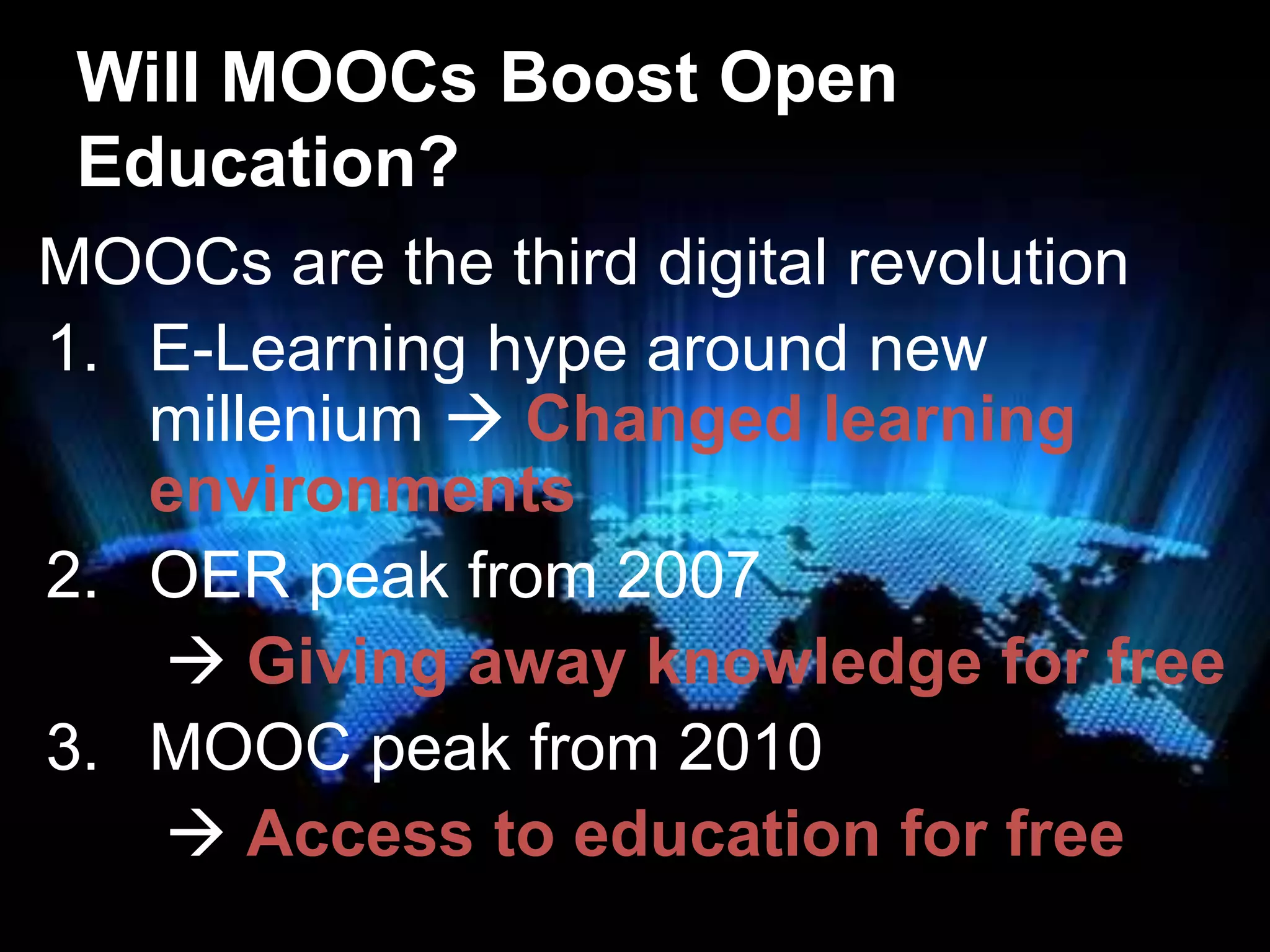
Will MOOCs Boost Open
Education?
MOOCs are the third digital revolution
1. E-Learning hype around new
millenium  Changed learning
environments
2. OER peak from 2007
 Giving away knowledge for free
3. MOOC peak from 2010
 Access to education for free
The Quality Challenge
• Start from digital and
technological innovation,
• move on to educational
(r)evolution and change, and
• lead to a quest for quality and
innovation strategies.
MOOCs and Quality...?!
• Should we care about the MOOC drop
outs?
• Do MOOCs challenge the current HE
model?
• How will it be looking when learning and
certification will be disaggregated?
• What is it that makes a model with high
drop out, little success rates and
heterogenious target groups popular?
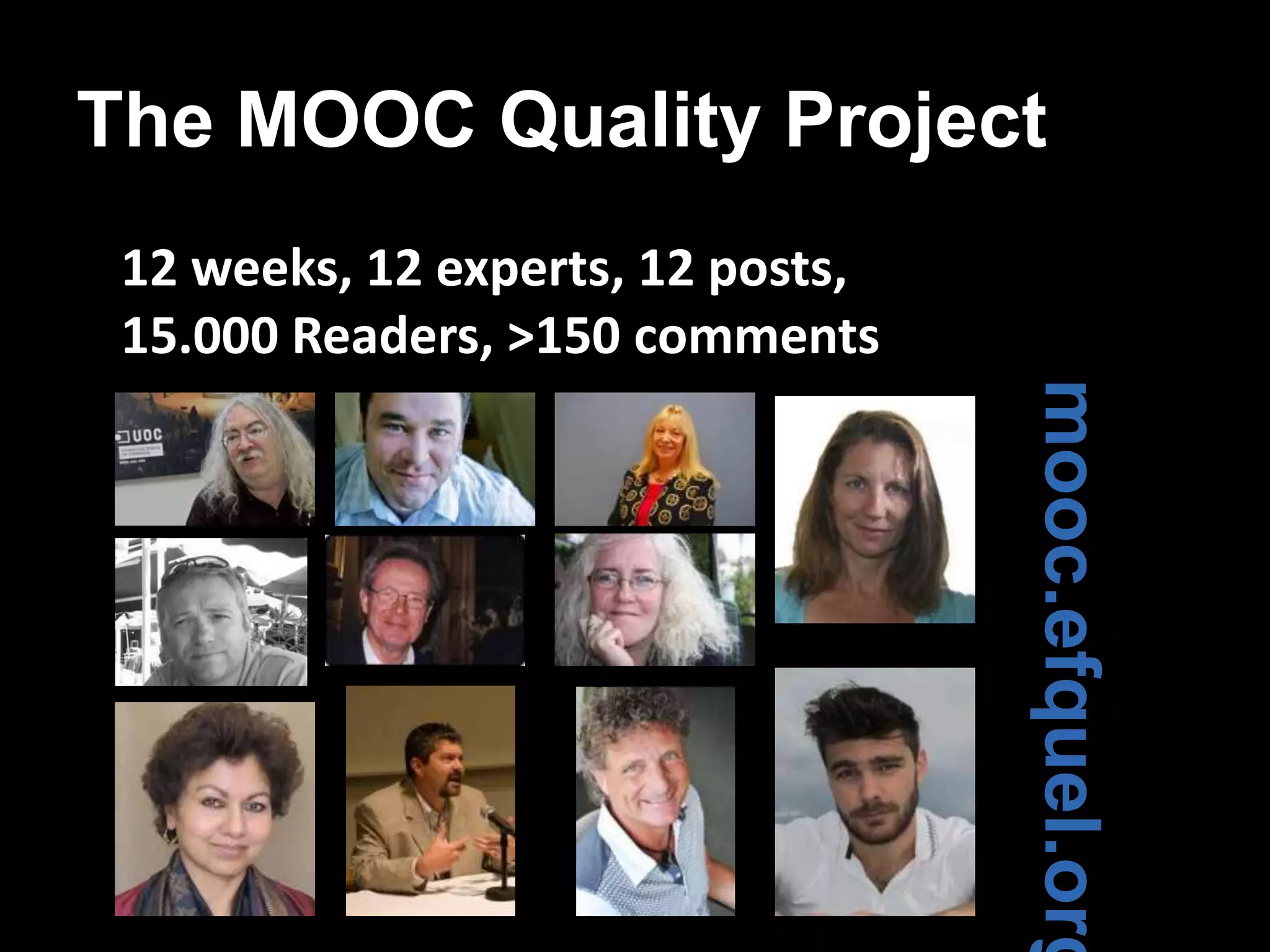
The MOOC Quality Project
12 weeks, 12 experts, 12 posts,
15.000 Readers, >150 comments

mooc.efquel.org
1. Massive Target Audience?
• Change from „no target audience―-thinking
to having one in mind, even if it is wide.
Take into acount new participation profiles.
Lurkers

Drop-ins

MOOC

Active participants

Passive
participants

HILL, P. (2013) “The Four Student Archetypes Emerging in MOOCs” [Online] eLiterate blog post 02/03/13 [accessed 19/04/13]. Available: http://mfeldstein.com/thefour-student-archetypes-emerging-in-moocs/
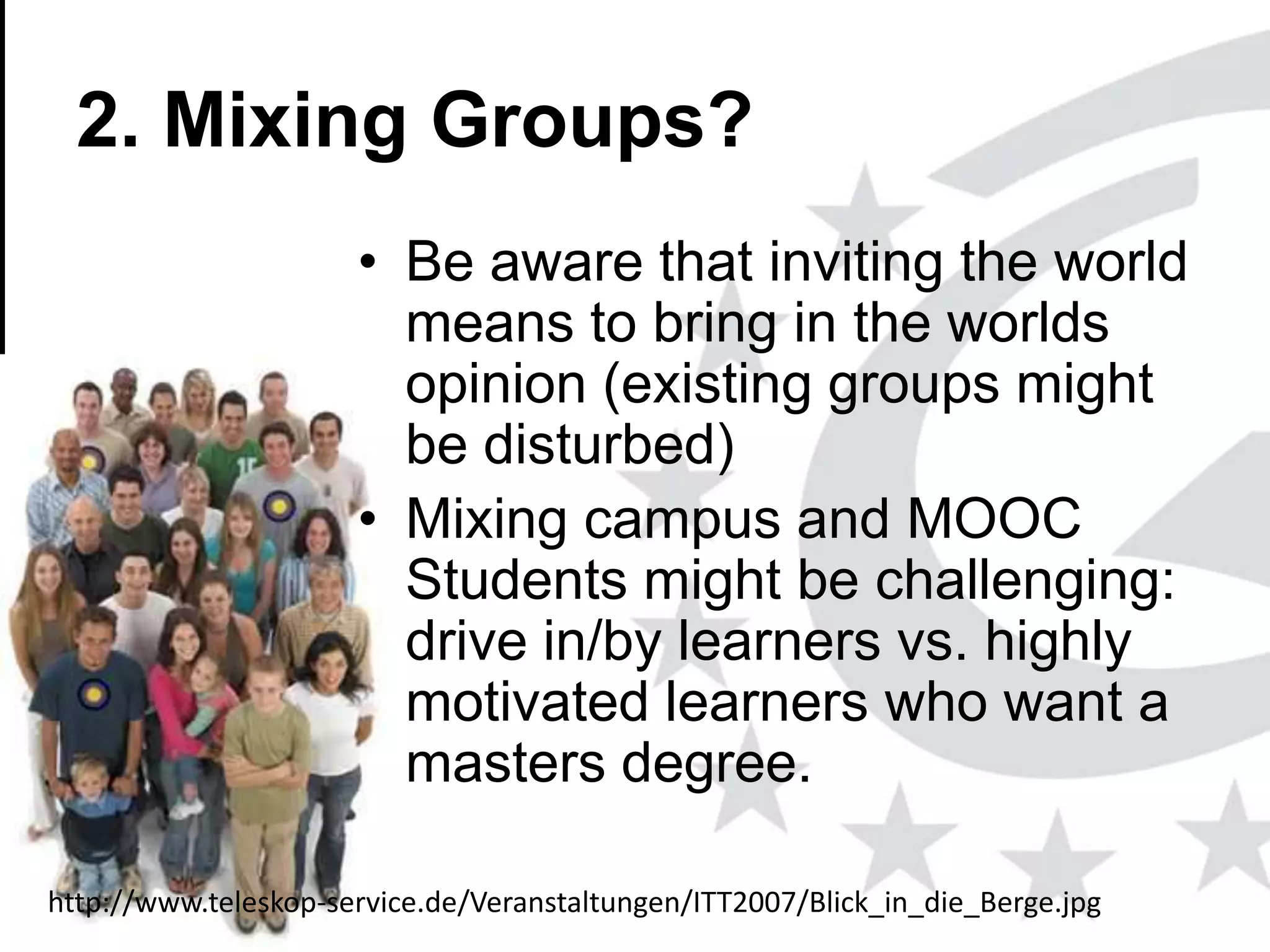
2. Mixing Groups?
• Be aware that inviting the world
means to bring in the worlds
opinion (existing groups might
be disturbed)
• Mixing campus and MOOC
Students might be challenging:
drive in/by learners vs. highly
motivated learners who want a
masters degree.
http://www.teleskop-service.de/Veranstaltungen/ITT2007/Blick_in_die_Berge.jpg
www.efquel.org
3. Learning Across Contexts
• Be aware that the quality paradigm ―fitness
for purpose‖ is not working for MOOCs
because MOOCs mean learning across
contexts and purposes.
• Quality measures become
individualized, quality methods like self- &
peer-assessment and –reflection are
suitable.
http://www.teleskop-service.de/Veranstaltungen/ITT2007/Blick_in_die_Berge.jpg
4. Support Self-Organization
• Be open about your requirements of selforganization, provide scaffolding for those
who lack that self-organization.

www.efquel.org
http://upload.wikimedia.org/wikipedia/commons/d/d6/Fugle%2C_%C3%B8rns%C3%B8_073.jpg
5. Declare What‘s in it!
Be precise about the content and
purpose of the MOOC (selfdeclaration) and keep promises! (Use
a MOOC description model)
1.
2.

3.
4.
5.
6.

the degree of openness,
the scale of participation
(massification),
the amount of use of multimedia,
the amount of communication,
the extent to which collaboration
is included,
the type of learner pathway
(from learner centered to
teacher-centered and highly
structured),

1.
2.

3.
4.
5.
6.

the level of quality assurance,
the extent to which reflection is
encouraged,
the level of assessment,
how informal or formal it is,
autonomy,
and diversity.

(Conole 2013)
6. Peer-to-Peer Pedagogy
• Use peer-to-peer pedagogy: peerlearning, peer-review, peerassessment, collaborative
learning, multiple learning pathways and
exploratory learning
• Understand that teaching is not a
prerequsite of learning.

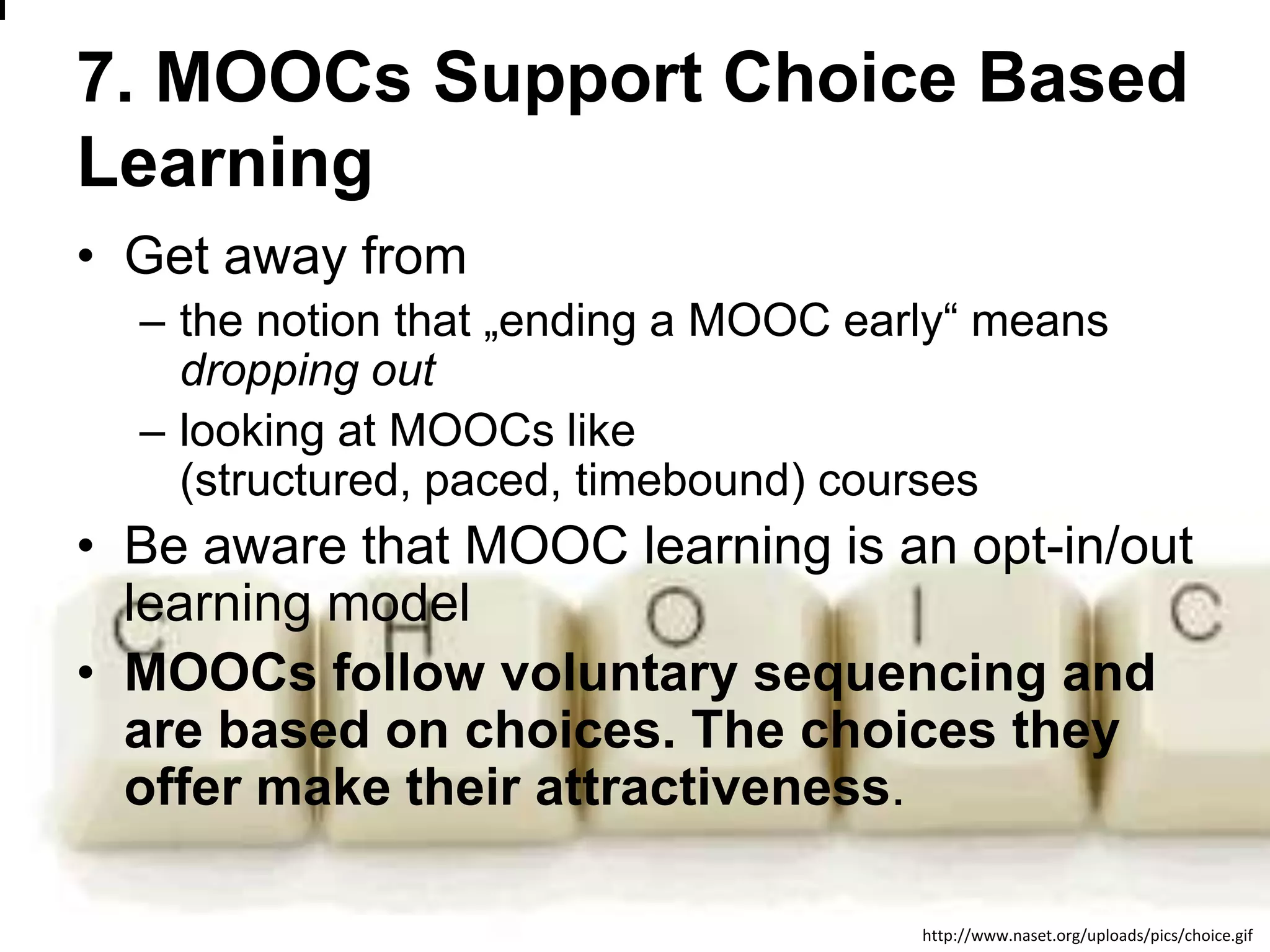
http://www.naset.org/uploads/pics/choice.gif
7. MOOCs Support Choice Based
Learning
• Get away from
– the notion that „ending a MOOC early― means
dropping out
– looking at MOOCs like
(structured, paced, timebound) courses

• Be aware that MOOC learning is an opt-in/out
learning model
• MOOCs follow voluntary sequencing and
are based on choices. The choices they
offer make their attractiveness.
www.efquel.org
http://www.naset.org/uploads/pics/choice.gif
WWW.EFQUEL.ORG
EFQUEL office in Brussels
Rue des deux Eglises 35
B – 1000 BRUSSELS
BELGIUM
Tel : + 32 2 639 30 32
Fax : + 32 2 644 35 83
Email : info@efquel.org

Released under a Creative Commons Attribution
ShareAlike 3.0 Belgium License

www.efquel.org

You are free:
• to Share — to copy, distribute and transmit the work
• to Remix — to adapt the work

Under the following conditions:
Attribution — You must attribute the work in the manner
specified by the author or licensor (but not in any way that
suggests that they endorse you or your use of the work).
Share Alike — If you alter, transform, or build upon this
work, you may distribute the resulting work only under the
same or similar license to this one.

Quality of Open Education and MOOCs

  • 1.
  • 3.
    • OER andOpen Education offer unprecedented opportunities to improve quality, access and equity in education and training. • Individuals can learn anything, anywhere, at any time for free.
  • 4.
    • OER usagetake up too slow • Teachers often skeptical, Learners insecure about recognition, ‚closed‗ institutions lack open business models • Three Grand Challenges for the Open Education Movement – Business Models – Recognition – Quality of open curricula
  • 5.
    Will MOOCs BoostOpen Education? MOOCs are the third digital revolution 1. E-Learning hype around new millenium  Changed learning environments 2. OER peak from 2007  Giving away knowledge for free 3. MOOC peak from 2010  Access to education for free
  • 6.
    The Quality Challenge •Start from digital and technological innovation, • move on to educational (r)evolution and change, and • lead to a quest for quality and innovation strategies.
  • 8.
    MOOCs and Quality...?! •Should we care about the MOOC drop outs? • Do MOOCs challenge the current HE model? • How will it be looking when learning and certification will be disaggregated? • What is it that makes a model with high drop out, little success rates and heterogenious target groups popular?
  • 9.
    The MOOC QualityProject 12 weeks, 12 experts, 12 posts, 15.000 Readers, >150 comments mooc.efquel.org
  • 10.
    1. Massive TargetAudience? • Change from „no target audience―-thinking to having one in mind, even if it is wide. Take into acount new participation profiles. Lurkers Drop-ins MOOC Active participants Passive participants HILL, P. (2013) “The Four Student Archetypes Emerging in MOOCs” [Online] eLiterate blog post 02/03/13 [accessed 19/04/13]. Available: http://mfeldstein.com/thefour-student-archetypes-emerging-in-moocs/
  • 11.
    2. Mixing Groups? •Be aware that inviting the world means to bring in the worlds opinion (existing groups might be disturbed) • Mixing campus and MOOC Students might be challenging: drive in/by learners vs. highly motivated learners who want a masters degree. http://www.teleskop-service.de/Veranstaltungen/ITT2007/Blick_in_die_Berge.jpg www.efquel.org
  • 12.
    3. Learning AcrossContexts • Be aware that the quality paradigm ―fitness for purpose‖ is not working for MOOCs because MOOCs mean learning across contexts and purposes. • Quality measures become individualized, quality methods like self- & peer-assessment and –reflection are suitable. http://www.teleskop-service.de/Veranstaltungen/ITT2007/Blick_in_die_Berge.jpg
  • 13.
    4. Support Self-Organization •Be open about your requirements of selforganization, provide scaffolding for those who lack that self-organization. www.efquel.org http://upload.wikimedia.org/wikipedia/commons/d/d6/Fugle%2C_%C3%B8rns%C3%B8_073.jpg
  • 14.
    5. Declare What‘sin it! Be precise about the content and purpose of the MOOC (selfdeclaration) and keep promises! (Use a MOOC description model) 1. 2. 3. 4. 5. 6. the degree of openness, the scale of participation (massification), the amount of use of multimedia, the amount of communication, the extent to which collaboration is included, the type of learner pathway (from learner centered to teacher-centered and highly structured), 1. 2. 3. 4. 5. 6. the level of quality assurance, the extent to which reflection is encouraged, the level of assessment, how informal or formal it is, autonomy, and diversity. (Conole 2013)
  • 15.
    6. Peer-to-Peer Pedagogy •Use peer-to-peer pedagogy: peerlearning, peer-review, peerassessment, collaborative learning, multiple learning pathways and exploratory learning • Understand that teaching is not a prerequsite of learning. http://www.naset.org/uploads/pics/choice.gif
  • 16.
    7. MOOCs SupportChoice Based Learning • Get away from – the notion that „ending a MOOC early― means dropping out – looking at MOOCs like (structured, paced, timebound) courses • Be aware that MOOC learning is an opt-in/out learning model • MOOCs follow voluntary sequencing and are based on choices. The choices they offer make their attractiveness. www.efquel.org http://www.naset.org/uploads/pics/choice.gif
  • 17.
    WWW.EFQUEL.ORG EFQUEL office inBrussels Rue des deux Eglises 35 B – 1000 BRUSSELS BELGIUM Tel : + 32 2 639 30 32 Fax : + 32 2 644 35 83 Email : info@efquel.org Released under a Creative Commons Attribution ShareAlike 3.0 Belgium License www.efquel.org You are free: • to Share — to copy, distribute and transmit the work • to Remix — to adapt the work Under the following conditions: Attribution — You must attribute the work in the manner specified by the author or licensor (but not in any way that suggests that they endorse you or your use of the work). Share Alike — If you alter, transform, or build upon this work, you may distribute the resulting work only under the same or similar license to this one.