Qualität von
MOOCs
Campus Innovation Hamburg
2013

Ulf-Daniel Ehlers
Duale Hochschule Baden-Württemberg (www.dhbw.de)
European Foundation for Quality in E-Learning
(www.efquel.org)

www.efquel.org
Digitale (R)Evolutionen in der
HS
MOOCs als dritte digitale (R)evolution
1. E-Learning Hype Anfang des
Milleniums Lernumgebungen
2. OER Peak ab 2007
“Giving away knowledge for free“
3. MOOC Peak ab 2010
“Giving away education for free“
Die Qualitätsdebatte
Alle digitalen (R)evolutionen führen zu
einer Qualitätsdebatte
• Von der digitalen und technologischen
Innovation
• Über den Wandel der Lehr-/Lernkultur
• Zu Qualitätsfragen und Innovationsstrategien
Qualität von MOOCs...?!
•
•
•
•
•
•

(Wie) kann man sie messen?
Was sind Qualitätskriterien?
Gute MOOCs – schlechte MOOC?
Was sind wertvolle MOOCs?
Sind sie besser, je massiver?
Sind sie besser, je niedriger die DropoutQuote?
• Sind Dropouts eigentlich überhaupt ein
Kriterium für Qualität von MOOCs?
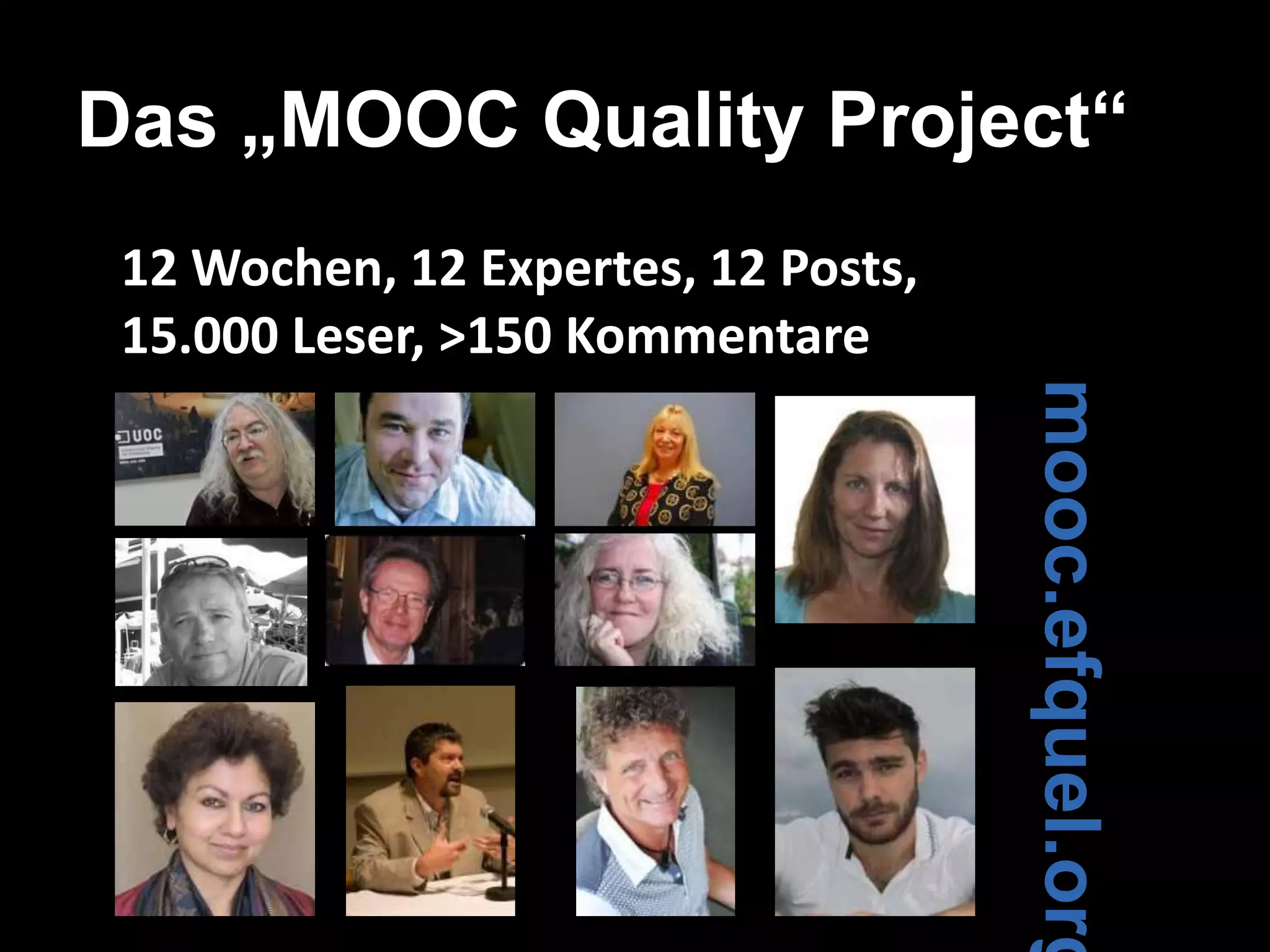
Das „MOOC Quality Project“
12 Wochen, 12 Expertes, 12 Posts,
15.000 Leser, >150 Kommentare

mooc.efquel.org
1. „Massive“ Zielgruppen?
• „Change from „no target audience―thinking to having one in mind, even if it is
wide. Take into acount new participation
profiles.―
Lurkers

Drop-ins

MOOC

Aktive
Teilnehmer

Passive
Teilnehmer

HILL, P. (2013) ―The Four Student Archetypes Emerging in MOOCs‖ [Online] e-Literate
blog post 02/03/13 [accessed 19/04/13]. Available: http://mfeldstein.com/the-fourstudent-archetypes-emerging-in-moocs/
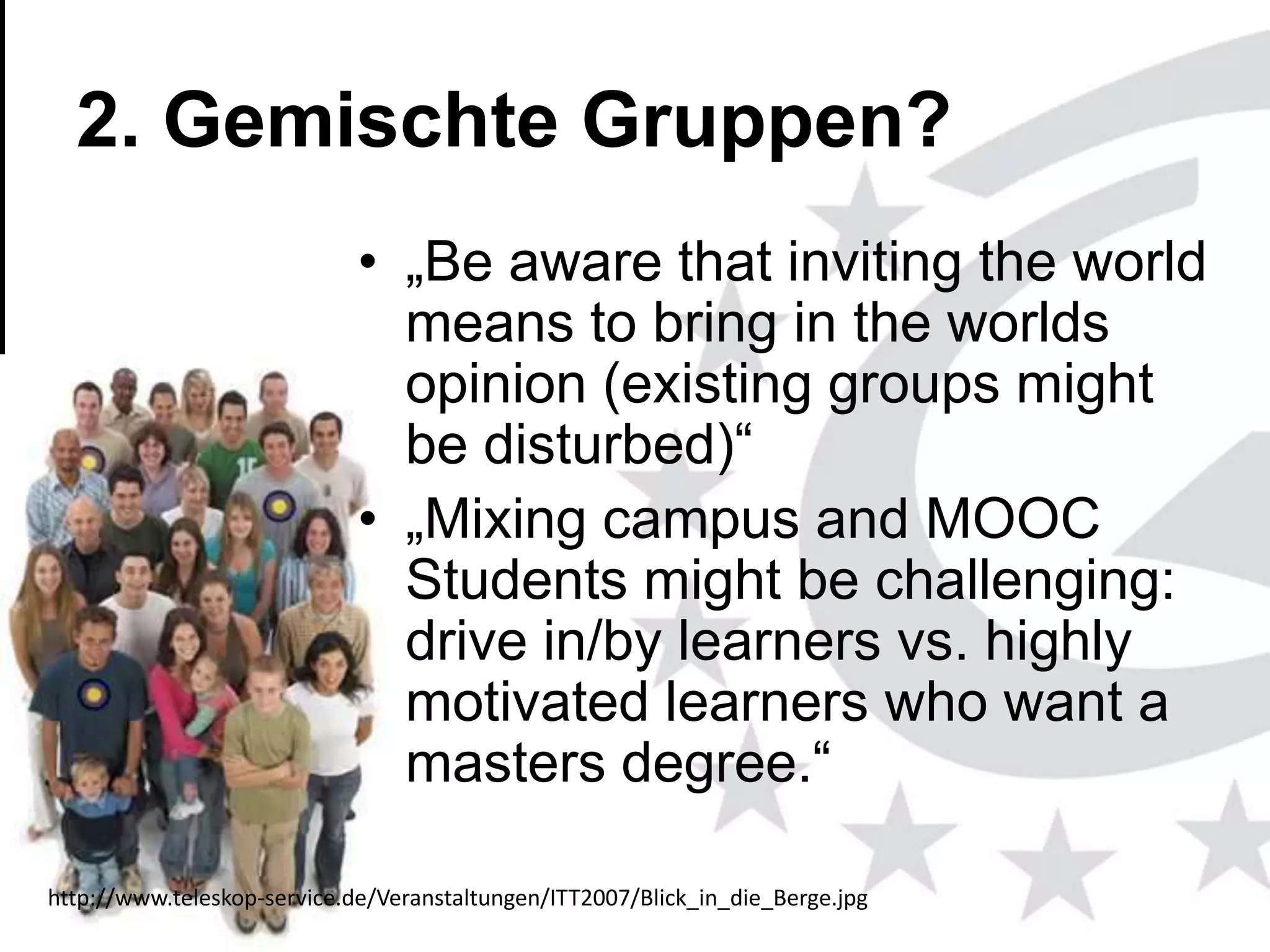
2. Gemischte Gruppen?
• „Be aware that inviting the world
means to bring in the worlds
opinion (existing groups might
be disturbed)―
• „Mixing campus and MOOC
Students might be challenging:
drive in/by learners vs. highly
motivated learners who want a
masters degree.―
http://www.teleskop-service.de/Veranstaltungen/ITT2007/Blick_in_die_Berge.jpg
www.efquel.org
3. Vielfältige Lernkontexte
• „Be aware that the quality paradigm
―fitness for purpose‖ is not working for
MOOCs because MOOCs mean learning
across contexts and purposes.―
• „Quality measures become
individualised, quality methods like self- &
peer-assessment and –reflection are
suitable.―
http://www.teleskop-service.de/Veranstaltungen/ITT2007/Blick_in_die_Berge.jpg
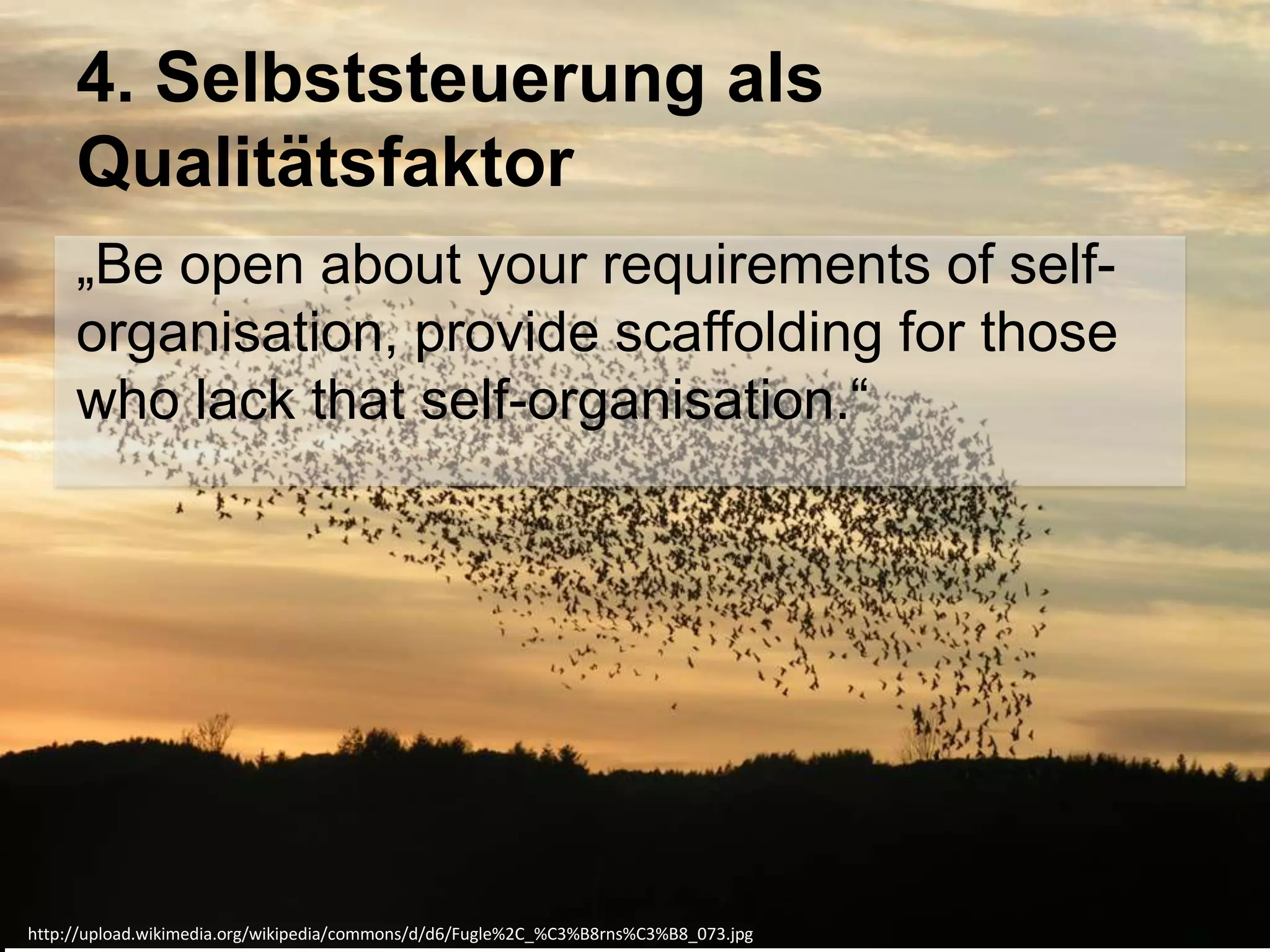
4. Selbststeuerung als
Qualitätsfaktor
„Be open about your requirements of selforganisation, provide scaffolding for those
who lack that self-organisation.―

www.efquel.org
http://upload.wikimedia.org/wikipedia/commons/d/d6/Fugle%2C_%C3%B8rns%C3%B8_073.jpg
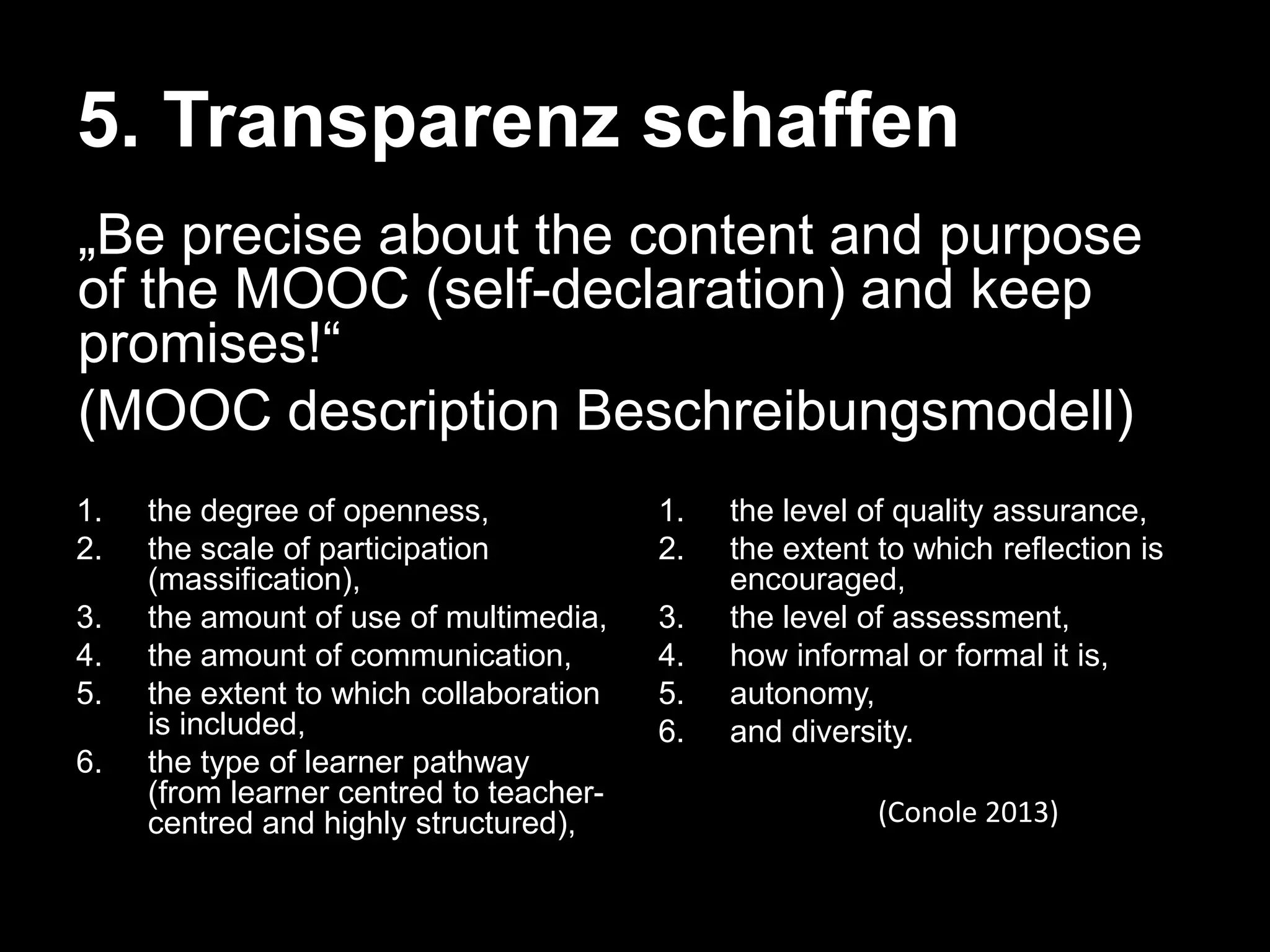
5. Transparenz schaffen
„Be precise about the content and purpose
of the MOOC (self-declaration) and keep
promises!―
(MOOC description Beschreibungsmodell)
1.
2.

3.
4.
5.
6.

the degree of openness,
the scale of participation
(massification),
the amount of use of multimedia,
the amount of communication,
the extent to which collaboration
is included,
the type of learner pathway
(from learner centred to teachercentred and highly structured),

1.
2.

3.
4.
5.
6.

the level of quality assurance,
the extent to which reflection is
encouraged,
the level of assessment,
how informal or formal it is,
autonomy,
and diversity.
(Conole 2013)
6. Pädagogische Prinzipien
• „Use peer-to-peer pedagogy: peerlearning, peer-review, peerassessment, collaborative
learning, multiple learning pathways and
exploratory learning.―
• „Understand that teaching is not a
prerequsite of learning.―

http://www.naset.org/uploads/pics/choice.gif
7. MOOCs sind „ChoiceBased“
• „Get away from
– the notion that „ending a MOOC early― means
dropping out
– looking at MOOCs like
(structured, paced, timebound) courses―

• „Be aware that MOOC learning is an optin/out learning model―
• „MOOCs follow voluntary sequencing and
are based on choices. The choices they
offer make their attractiveness.―
www.efquel.org
http://www.naset.org/uploads/pics/choice.gif
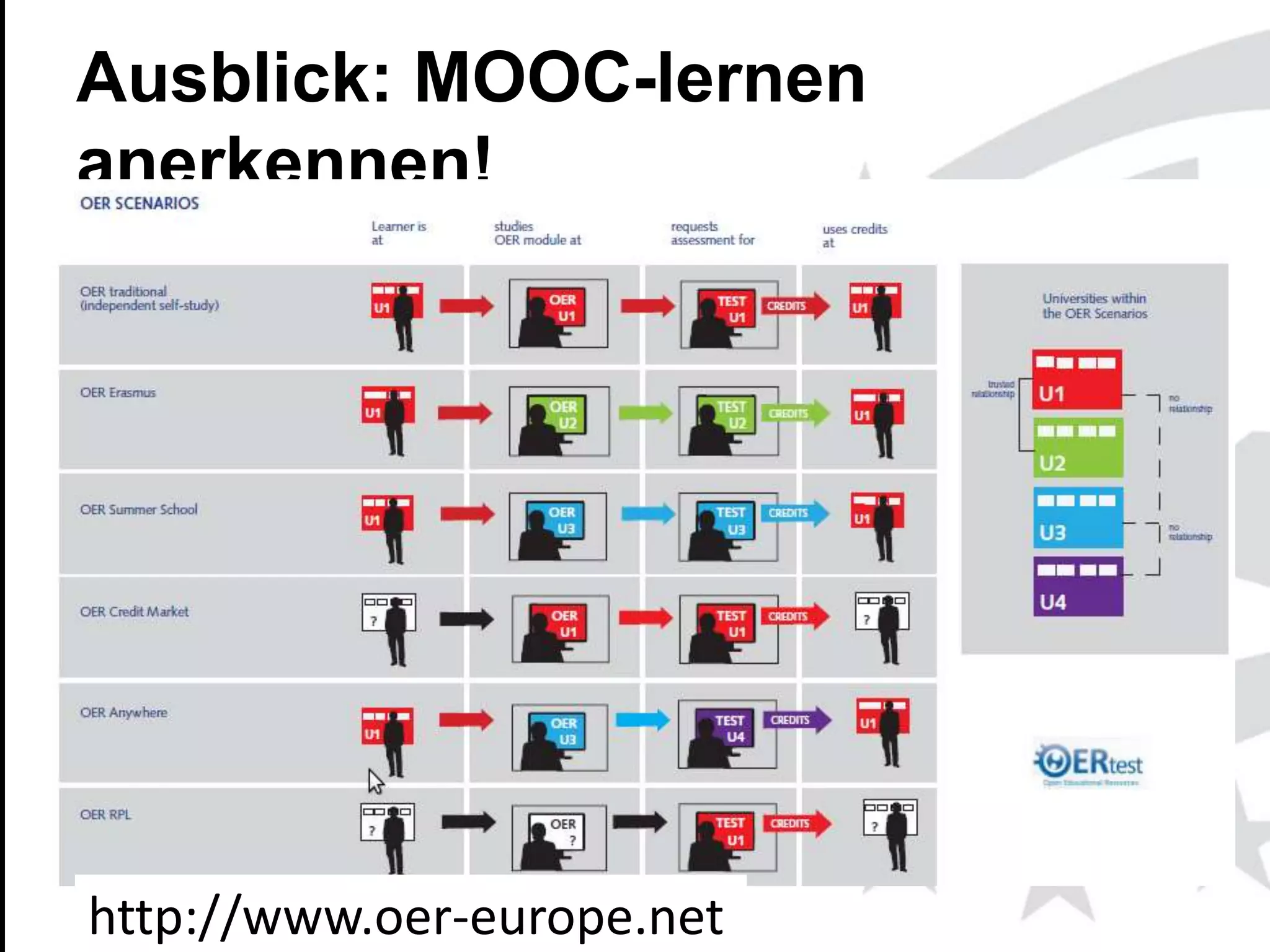
Ausblick: MOOC-lernen
anerkennen!

http://www.oer-europe.net

www.efquel.org
Danke!WWW.EFQUEL
.ORG
EFQUEL office in Brussels
Rue des deux Eglises 35
B – 1000 BRUSSELS
BELGIUM
Tel : + 32 2 639 30 32
Fax : + 32 2 644 35 83
Email : info@efquel.org
Released under a Creative Commons
Attribution ShareAlike 3.0 Belgium
License

www.efquel.org

You are free:
• to Share — to copy, distribute and transmit
the work
• to Remix — to adapt the work

Under the following conditions:
Attribution — You must attribute the work in the
manner specified by the author or licensor (but
not in any way that suggests that they endorse
you or your use of the work).
Share Alike — If you alter, transform, or build
upon this work, you may distribute the resulting
work only under the same or similar license to
this one.

Qualität von MOOCs

  • 1.
    Qualität von MOOCs Campus InnovationHamburg 2013 Ulf-Daniel Ehlers Duale Hochschule Baden-Württemberg (www.dhbw.de) European Foundation for Quality in E-Learning (www.efquel.org) www.efquel.org
  • 2.
    Digitale (R)Evolutionen inder HS MOOCs als dritte digitale (R)evolution 1. E-Learning Hype Anfang des Milleniums Lernumgebungen 2. OER Peak ab 2007 “Giving away knowledge for free“ 3. MOOC Peak ab 2010 “Giving away education for free“
  • 3.
    Die Qualitätsdebatte Alle digitalen(R)evolutionen führen zu einer Qualitätsdebatte • Von der digitalen und technologischen Innovation • Über den Wandel der Lehr-/Lernkultur • Zu Qualitätsfragen und Innovationsstrategien
  • 5.
    Qualität von MOOCs...?! • • • • • • (Wie)kann man sie messen? Was sind Qualitätskriterien? Gute MOOCs – schlechte MOOC? Was sind wertvolle MOOCs? Sind sie besser, je massiver? Sind sie besser, je niedriger die DropoutQuote? • Sind Dropouts eigentlich überhaupt ein Kriterium für Qualität von MOOCs?
  • 6.
    Das „MOOC QualityProject“ 12 Wochen, 12 Expertes, 12 Posts, 15.000 Leser, >150 Kommentare mooc.efquel.org
  • 7.
    1. „Massive“ Zielgruppen? •„Change from „no target audience―thinking to having one in mind, even if it is wide. Take into acount new participation profiles.― Lurkers Drop-ins MOOC Aktive Teilnehmer Passive Teilnehmer HILL, P. (2013) ―The Four Student Archetypes Emerging in MOOCs‖ [Online] e-Literate blog post 02/03/13 [accessed 19/04/13]. Available: http://mfeldstein.com/the-fourstudent-archetypes-emerging-in-moocs/
  • 8.
    2. Gemischte Gruppen? •„Be aware that inviting the world means to bring in the worlds opinion (existing groups might be disturbed)― • „Mixing campus and MOOC Students might be challenging: drive in/by learners vs. highly motivated learners who want a masters degree.― http://www.teleskop-service.de/Veranstaltungen/ITT2007/Blick_in_die_Berge.jpg www.efquel.org
  • 9.
    3. Vielfältige Lernkontexte •„Be aware that the quality paradigm ―fitness for purpose‖ is not working for MOOCs because MOOCs mean learning across contexts and purposes.― • „Quality measures become individualised, quality methods like self- & peer-assessment and –reflection are suitable.― http://www.teleskop-service.de/Veranstaltungen/ITT2007/Blick_in_die_Berge.jpg
  • 10.
    4. Selbststeuerung als Qualitätsfaktor „Beopen about your requirements of selforganisation, provide scaffolding for those who lack that self-organisation.― www.efquel.org http://upload.wikimedia.org/wikipedia/commons/d/d6/Fugle%2C_%C3%B8rns%C3%B8_073.jpg
  • 11.
    5. Transparenz schaffen „Beprecise about the content and purpose of the MOOC (self-declaration) and keep promises!― (MOOC description Beschreibungsmodell) 1. 2. 3. 4. 5. 6. the degree of openness, the scale of participation (massification), the amount of use of multimedia, the amount of communication, the extent to which collaboration is included, the type of learner pathway (from learner centred to teachercentred and highly structured), 1. 2. 3. 4. 5. 6. the level of quality assurance, the extent to which reflection is encouraged, the level of assessment, how informal or formal it is, autonomy, and diversity. (Conole 2013)
  • 12.
    6. Pädagogische Prinzipien •„Use peer-to-peer pedagogy: peerlearning, peer-review, peerassessment, collaborative learning, multiple learning pathways and exploratory learning.― • „Understand that teaching is not a prerequsite of learning.― http://www.naset.org/uploads/pics/choice.gif
  • 13.
    7. MOOCs sind„ChoiceBased“ • „Get away from – the notion that „ending a MOOC early― means dropping out – looking at MOOCs like (structured, paced, timebound) courses― • „Be aware that MOOC learning is an optin/out learning model― • „MOOCs follow voluntary sequencing and are based on choices. The choices they offer make their attractiveness.― www.efquel.org http://www.naset.org/uploads/pics/choice.gif
  • 14.
  • 15.
    Danke!WWW.EFQUEL .ORG EFQUEL office inBrussels Rue des deux Eglises 35 B – 1000 BRUSSELS BELGIUM Tel : + 32 2 639 30 32 Fax : + 32 2 644 35 83 Email : info@efquel.org Released under a Creative Commons Attribution ShareAlike 3.0 Belgium License www.efquel.org You are free: • to Share — to copy, distribute and transmit the work • to Remix — to adapt the work Under the following conditions: Attribution — You must attribute the work in the manner specified by the author or licensor (but not in any way that suggests that they endorse you or your use of the work). Share Alike — If you alter, transform, or build upon this work, you may distribute the resulting work only under the same or similar license to this one.