Prof. Dr. Ulf-Daniel Ehlers
Baden-Wurttemberg Cooperative State University
European Association for Institutes of Higher
Education
Future Skills for
Tomorrow’s Gradutes:
Turning Around Higher
Education in Europe
Creating Relevant Learning
Experiences; employers’ involvement
with higher education’, BEEHIVES,
Leuven
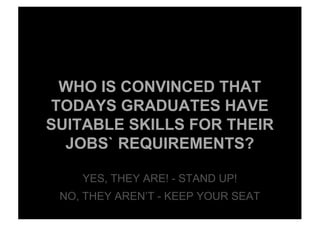
WHO IS CONVINCED THAT
TODAYS GRADUATES HAVE
SUITABLE SKILLS FOR THEIR
JOBS` REQUIREMENTS?
YES, THEY ARE! - STAND UP!
NO, THEY AREN’T - KEEP YOUR SEAT
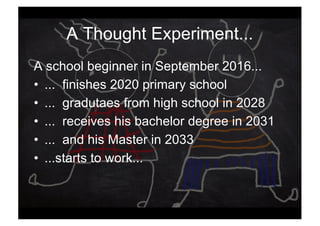
A Thought Experiment...
A school beginner in September 2016...
• ... finishes 2020 primary school
• ... gradutaes from high school in 2028
• ... receives his bachelor degree in 2031
• ... and his Master in 2033
• ...starts to work...
The skill myth…
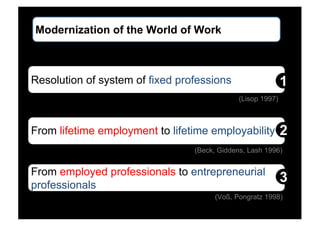
Modernization of the World of Work
Resolution of system of fixed professions
From lifetime employment to lifetime employability
From employed professionals to entrepreneurial
professionals
1
2
3
(Lisop 1997)
(Beck, Giddens, Lash 1996)
(Voß, Pongratz 1998)
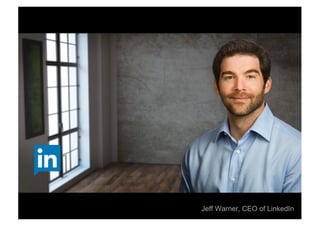
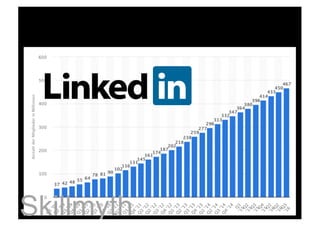
Jeff Warner, CEO of LinkedIn
Skillmyth
The time myth
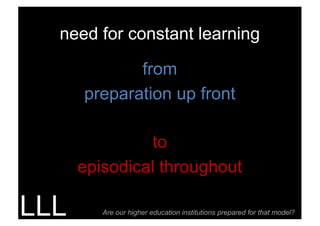
need for constant learning
from
preparation up front
to
episodical throughout
LLL Are our higher education institutions prepared for that model?
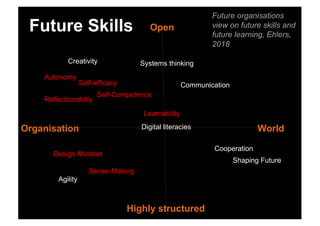
From Knowledge to future skills
Creativity
Autonomy
Self-efficacy
Reflectionabilty
Self-Competence
Learnability
Systems thinking
Communication
Design Mindset
Sense-Making
Agility
Cooperation
Shaping Future
WorldOrganisation
Open
Highly structured
Digital literacies
Future Skills
Future organisations
view on future skills and
future learning, Ehlers,
2018
Higher Education
„Competencies are […] in principle unlimited dispositions and abilities, to
act self-organised and successfully in an unknown, complex and
undetermined future.“ (translated)
Knowing-in-Action
Reflection-in-Action
Reflection on Reflection-in-Action
Higher Education as Reflection-Laboratory
(Schön 1983, 1986)
Implicit Action-Knowledge
Ad-Hoc Strategies
Development of ind. Action Theories
Professionality
Competence Responsibility
Action Adequacy
Abilities Will
Knowledge Apply
Information Connect (Wildt 2006)
(Erpenbeck 2005)
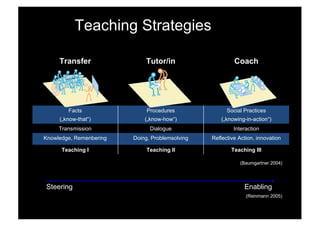
Teaching Strategies
Transfer Tutor/in Coach
Facts
(„know-that“)
Procedures
(„know-how“)
Social Practices
(„knowing-in-action“)
Transmission Dialogue Interaction
Knowledge, Remenbering Doing, Problemsolving Reflective Action, innovation
Teaching I Teaching II Teaching III
Steering Enabling
(Baumgartner 2004)
(Reinmann 2005)
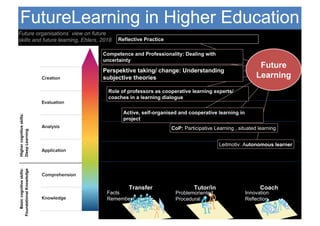
Transfer Tutor/in Coach
Reflective Practice
Active, self-organised and cooperative learning in
project
Leitmotiv: Autonomous learner
Competence and Professionality: Dealing with
uncertainty
CoP: Participative Learning , situated learning
Role of professors as cooperative learning experts/
coaches in a learning dialogue
Future
Learning
Facts
Remember
Innovation
Reflection
Problemoriented
Procedural
Perspektive taking/ change: Understanding
subjective theories
FutureLearning in Higher Education
Future organisations` view on future
skills and future learning, Ehlers, 2018
Zeit für
15
Changingperspective
Turning around higher education (in Europe)
THE MASS MYTH
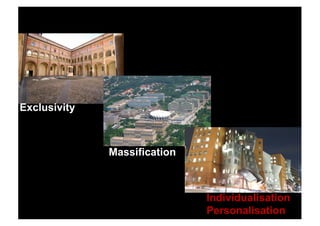
Exclusivity
Massification
Individualisation
Personalisation
THE STANDARDIZATION MYTH
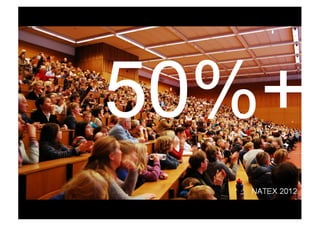
50%+
THE ELITE MYTH
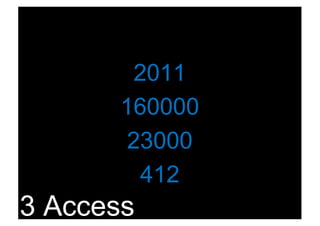
2011
160000
23000
412
3 Access
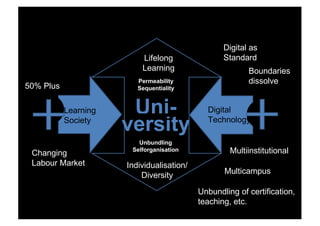
Learning
Society
Digital
Technology
Unbundling
Selforganisation
Lifelong
Learning
Permeability
Sequentiality
Individualisation/
Diversity
Uni-
versity
50% Plus
Changing
Labour Market
Unbundling of certification,
teaching, etc.
Multicampus
Digital as
Standard
Boundaries
dissolve
Multiinstitutional
ulf.ehlers@dhbw-karlsruhe.de
Baden-Wurttemberg Cooperative State University
European Association for Institutes of Higher
Education
www.dhbw-karlsruhe.de
www.ulf-ehlers.net
www.mindful-leaders.net
Thank you for your attention!
?
What works better?
Digital
or
analogous - „Business as usual“?
How can we shape
the digital turn?
27
Thesen
1. Digitalisation ist not „technofying“ higher
education but pedagogical, curricula and
organisational innovation.
2. The key for successfull digitalisation of higher
education teaching/ learning is collaboration.
3. Digital technology is not only enabing new virtual
learning spaces but also changes existing
physical learning spaces.
29
http://isdsbologna2013.org/blog/location/bologna/#!prettyPhoto-205/0/
MOOCS
• vs. Massive Learning Opportunities
Digital scalable Learning Services
• vs. Individualised and Personalised
Learning Scenarios
Open Education Resources
• vs. Open Educational Practices
http://isdsbologna2013.org/blog/location/bologna/#!prettyPhoto-205/0/
Will the digital turn be a
technical or an educational
revolution?
How to deal with openess?
How to create a suitable
blend of digital/ non-digital?
It is not only technology
that drives the change but
Unsolved Challenges
Time for
36
ChangingPerspective
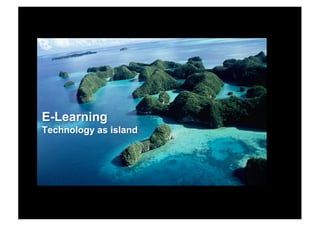
E-Learning
Technology as island
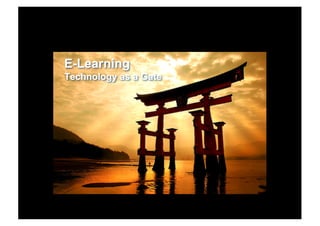
E-Learning
Technology as a Gate
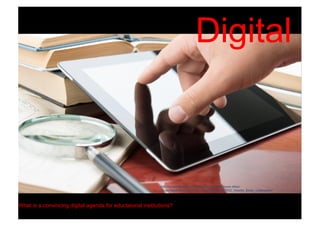
Digital
What is a convincing digital agenda for eductaional institutions?
http://images.google.de/imgres?imgurl=http://www.dhbw-
vs.de/fileadmin/content/101_HEADER_BILDER/02_Header_Bilder_Unterseiten/
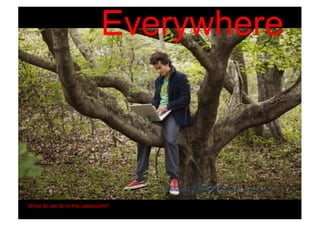
Everywhere
What do we do in the classroom?
http://images.google.de/imgres?imgurl=http://www.dhbw-
vs.de/fileadmin/content/101_HEADER_BILDER/02_Header_Bilder_Unterseiten/
Learning Community
Open
Shared
Learner generated
Digital Import of Curriculum
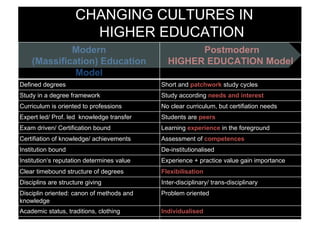
Modern
(Massification) Education
Model
Postmodern
HIGHER EDUCATION Model
Defined degrees Short and patchwork study cycles
Study in a degree framework Study according needs and interest
Curriculum is oriented to professions No clear curriculum, but certifiation needs
Expert led/ Prof. led knowledge transfer Students are peers
Exam driven/ Certification bound Learning experience in the foreground
Certifiation of knowledge/ achievements Assessment of competences
Institution bound De-institutionalised
Institution‘s reputation determines value Experience + practice value gain importance
Clear timebound structure of degrees Flexibilisation
Disciplins are structure giving Inter-disciplinary/ trans-disciplinary
Disciplin oriented: canon of methods and
knowledge
Problem oriented
Academic status, traditions, clothing Individualised
Differentiation against „non-higher education“ Continuum through ed.-sectors + levels
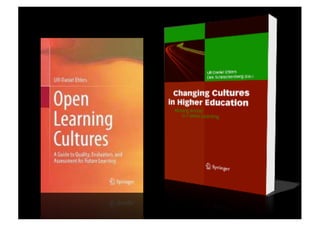
CHANGING CULTURES IN
HIGHER EDUCATION

Future Skills for Future Graduates