www.efquel.org
Qualität von MOOCs
Ulf-Daniel Ehlers, Duale Hochschule Baden-Württemberg/
EFQUEL
Rolf Schulmeister, Universität Hamburg
Sandra Hofhues, PH Heidelberg
Claudia Bremer, Universität Frankfurt
www.efquel.org
Was ist die Qualität von
MOOCs?
• (Wie) kann man sie messen?
• Was sind Qualitätskriterien?
• Gute MOOCs – schlechte MOOC?
• Was sind wertvolle MOOCs?
• Sind sie besser, je massiver?
• Sind sie besser, je niedriger die Dropout-
Quote?
• Sind Dropouts eigentlich überhaupt ein
Kriterium für Qualität von MOOCs?
www.efquel.org
Ablauf
• 15 Minuten pro Runde
• 5-7 Minuten Präsentation
• 5-7 Minuten Fragen und Diskussion
• Wechsel zum nächsten Tisch
• 4 Runden
Trendreport
MOOC Geschäftsmodellen und ihr Einfluss auf
die amerikanischen Hochschulpolitik, Rolf
Schulmeister
www.efquel.org
Thementische
• Tisch 1: Rolf Schulmeister - Erfahrungen zur
Qualität von MOOCs aus Sicht eines MOOC
Teilnehmers unter Pseudonym
• Tisch 2: Claudia Bremer – Erfahrungen zur
Qualität von MOOCs aus Sicht einer MOOC
Anbieterin/ Organisatorin
• Tisch 3: Sandra Hofhues - Erfahrungen zur
Qualität von MOOCs in der Initiative
MoocProductionFellowship (Stiferverband/
iversity)
• Tisch 4: Ulf Ehlers - Erfahrungen zur Qualität von
MOOCs aus Sicht des Projektes “The MOOC
Quality Project" (http://mooc.efquel.org)
www.efquel.org
Empfehlungen zur Qualität
bei MOOCs
Results from The MOOC Quality Project
Prof. Dr. Ulf-Daniel Ehlers
Vicepresident Baden-Wurttemberg Cooperative State
University
President European Foundation for Quality in E-Learning
www.efquel.org
The MOOC Quality Project
• The MOOC Quality Project
• Was ist Qualität von MOOCs?
• Lineup: Personen der ersten Stunde
• 12 weeks (May-July 2013)
• 12 Autoren
• 12 Beiträge á 1500 Wörter
• Großes Interesse: 12.000 Leser/ innen
• Auswertung: Empfehlungen für gute MOOC
Qualität
www.efquel.org
1. Massive target audience?
Change from „no target audience“-thinking
to having one in mind, even if it is wide. Take
into acount new participation profiles.
MOOC
Lurkers
Passive
participants
Active participants
Drop-ins
HILL, P. (2013) “The Four Student Archetypes Emerging in MOOCs” [Online] e-Literate
blog post 02/03/13 [accessed 19/04/13]. Available: http://mfeldstein.com/the-four-
student-archetypes-emerging-in-moocs/
www.efquel.org
2. Mixing groups
Be aware that inviting the world means to
bring in the worlds opinion (existing groups
might be disturbed), e.g. mixing campus and
MOOC Students might be challenging
(totally different motivations) → drive in/by
learners and highly motivated learners who
want a masters degree.
www.efquel.org
3. What is the context of a
MOOC?
Be aware that the quality paradigm “fitness
for purpose” is not working for MOOCs
because there is no common context or
purpose. Quality measures become
individualised, quality methods like self- &
peer-assessment and reflection matter
more.
www.efquel.org
4. Support Self-Organization
Be open about your requirements of self-
organisation, provide scaffolding for those
who lack that self-organisation.
www.efquel.org
5. Quality Self-Declaration
Be precise about the
content and purpose of
the MOOC (self-
declaration) and keep
promises! (Use a MOOC
description model)
www.efquel.org
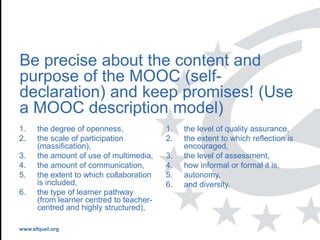
1. the degree of openness,
2. the scale of participation
(massification),
3. the amount of use of multimedia,
4. the amount of communication,
5. the extent to which collaboration
is included,
6. the type of learner pathway
(from learner centred to teacher-
centred and highly structured),
1. the level of quality assurance,
2. the extent to which reflection is
encouraged,
3. the level of assessment,
4. how informal or formal it is,
5. autonomy,
6. and diversity.
Be precise about the content and
purpose of the MOOC (self-
declaration) and keep promises! (Use
a MOOC description model)
www.efquel.org
6. Peer-to-Peer Pedagogy
• Use peer-to-peer pedagogy: peer-learning,
peer-review, peer-assessment,
collaborative learning, multiple learning
pathways and exploratory learning
• Understand that teaching is not a
prerequsite of learning.
www.efquel.org
10. Leverage Mass
Participation
• Use technology which supports social
learning: blogs, chat, discussion
forums, wikis, and group assignments
• Leverage massive participation: Have all
students contribute something that adds to
or improves the course overall.
www.efquel.org
7. From MOOC o
MOOL(earning)
• Be aware that MOOC learning is an opt-
in/out learning model: MOOCs encourage
“dipping in for some time”
• The majority of learners does not use
MOOCs as coherent courses
• Get away from looking at MOOCs like
(structured, paced, timebound) courses
www.efquel.org
8. MOOCs are choice based
learning
Get away from the notion that „ending a
MOOC early“ means dropping out - MOOCs
follow voluntary sequencing and are based
on choices-
www.efquel.org
9. Disaggregation
Understand the disaggregation of learning
and assessment/ certification is coming
along with MOOCs (xMOOCs are starting to
move away from challenging universities -
they start to challenge publishing houses,
franchise models are developed now which
enable universities to use input & content
from a MOOC but the credits are given by
the university)

Qualität von MOOCs - Folien zum GMW Workshop mit Rolf Schulmeister, Claudia Bremer und Sandra Hofhues

  • 1.
    www.efquel.org Qualität von MOOCs Ulf-DanielEhlers, Duale Hochschule Baden-Württemberg/ EFQUEL Rolf Schulmeister, Universität Hamburg Sandra Hofhues, PH Heidelberg Claudia Bremer, Universität Frankfurt
  • 3.
    www.efquel.org Was ist dieQualität von MOOCs? • (Wie) kann man sie messen? • Was sind Qualitätskriterien? • Gute MOOCs – schlechte MOOC? • Was sind wertvolle MOOCs? • Sind sie besser, je massiver? • Sind sie besser, je niedriger die Dropout- Quote? • Sind Dropouts eigentlich überhaupt ein Kriterium für Qualität von MOOCs?
  • 4.
    www.efquel.org Ablauf • 15 Minutenpro Runde • 5-7 Minuten Präsentation • 5-7 Minuten Fragen und Diskussion • Wechsel zum nächsten Tisch • 4 Runden Trendreport MOOC Geschäftsmodellen und ihr Einfluss auf die amerikanischen Hochschulpolitik, Rolf Schulmeister
  • 5.
    www.efquel.org Thementische • Tisch 1:Rolf Schulmeister - Erfahrungen zur Qualität von MOOCs aus Sicht eines MOOC Teilnehmers unter Pseudonym • Tisch 2: Claudia Bremer – Erfahrungen zur Qualität von MOOCs aus Sicht einer MOOC Anbieterin/ Organisatorin • Tisch 3: Sandra Hofhues - Erfahrungen zur Qualität von MOOCs in der Initiative MoocProductionFellowship (Stiferverband/ iversity) • Tisch 4: Ulf Ehlers - Erfahrungen zur Qualität von MOOCs aus Sicht des Projektes “The MOOC Quality Project" (http://mooc.efquel.org)
  • 6.
    www.efquel.org Empfehlungen zur Qualität beiMOOCs Results from The MOOC Quality Project Prof. Dr. Ulf-Daniel Ehlers Vicepresident Baden-Wurttemberg Cooperative State University President European Foundation for Quality in E-Learning
  • 7.
    www.efquel.org The MOOC QualityProject • The MOOC Quality Project • Was ist Qualität von MOOCs? • Lineup: Personen der ersten Stunde • 12 weeks (May-July 2013) • 12 Autoren • 12 Beiträge á 1500 Wörter • Großes Interesse: 12.000 Leser/ innen • Auswertung: Empfehlungen für gute MOOC Qualität
  • 8.
    www.efquel.org 1. Massive targetaudience? Change from „no target audience“-thinking to having one in mind, even if it is wide. Take into acount new participation profiles. MOOC Lurkers Passive participants Active participants Drop-ins HILL, P. (2013) “The Four Student Archetypes Emerging in MOOCs” [Online] e-Literate blog post 02/03/13 [accessed 19/04/13]. Available: http://mfeldstein.com/the-four- student-archetypes-emerging-in-moocs/
  • 9.
    www.efquel.org 2. Mixing groups Beaware that inviting the world means to bring in the worlds opinion (existing groups might be disturbed), e.g. mixing campus and MOOC Students might be challenging (totally different motivations) → drive in/by learners and highly motivated learners who want a masters degree.
  • 10.
    www.efquel.org 3. What isthe context of a MOOC? Be aware that the quality paradigm “fitness for purpose” is not working for MOOCs because there is no common context or purpose. Quality measures become individualised, quality methods like self- & peer-assessment and reflection matter more.
  • 11.
    www.efquel.org 4. Support Self-Organization Beopen about your requirements of self- organisation, provide scaffolding for those who lack that self-organisation.
  • 12.
    www.efquel.org 5. Quality Self-Declaration Beprecise about the content and purpose of the MOOC (self- declaration) and keep promises! (Use a MOOC description model)
  • 13.
    www.efquel.org 1. the degreeof openness, 2. the scale of participation (massification), 3. the amount of use of multimedia, 4. the amount of communication, 5. the extent to which collaboration is included, 6. the type of learner pathway (from learner centred to teacher- centred and highly structured), 1. the level of quality assurance, 2. the extent to which reflection is encouraged, 3. the level of assessment, 4. how informal or formal it is, 5. autonomy, 6. and diversity. Be precise about the content and purpose of the MOOC (self- declaration) and keep promises! (Use a MOOC description model)
  • 14.
    www.efquel.org 6. Peer-to-Peer Pedagogy •Use peer-to-peer pedagogy: peer-learning, peer-review, peer-assessment, collaborative learning, multiple learning pathways and exploratory learning • Understand that teaching is not a prerequsite of learning.
  • 15.
    www.efquel.org 10. Leverage Mass Participation •Use technology which supports social learning: blogs, chat, discussion forums, wikis, and group assignments • Leverage massive participation: Have all students contribute something that adds to or improves the course overall.
  • 16.
    www.efquel.org 7. From MOOCo MOOL(earning) • Be aware that MOOC learning is an opt- in/out learning model: MOOCs encourage “dipping in for some time” • The majority of learners does not use MOOCs as coherent courses • Get away from looking at MOOCs like (structured, paced, timebound) courses
  • 17.
    www.efquel.org 8. MOOCs arechoice based learning Get away from the notion that „ending a MOOC early“ means dropping out - MOOCs follow voluntary sequencing and are based on choices-
  • 18.
    www.efquel.org 9. Disaggregation Understand thedisaggregation of learning and assessment/ certification is coming along with MOOCs (xMOOCs are starting to move away from challenging universities - they start to challenge publishing houses, franchise models are developed now which enable universities to use input & content from a MOOC but the credits are given by the university)