Considering MOOCs:
Pros, Cons, Questions
Doug Holton, Associate Director
Center for Teaching and Learning Excellence
Embry-Riddle Aeronautical University


These slides are at: http://bit.ly/considermoocs
What are MOOCs

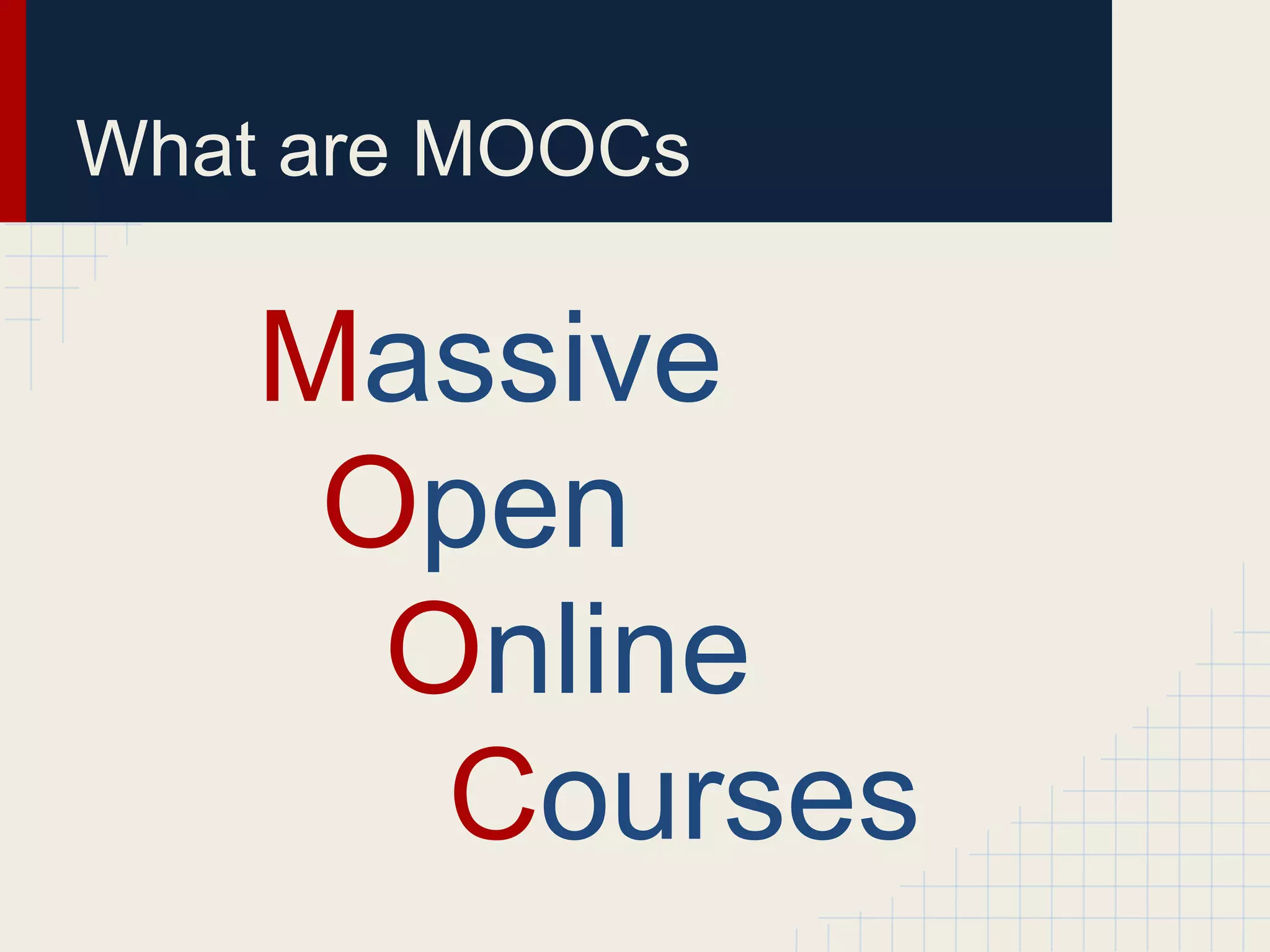
    Massive
     Open
      Online
       Courses
What are MOOCs
MOOCs are online courses that are
open for anyone in the world to take,
usually for free and not for credit.*

These courses have had anywhere
from a few thousand to over 180,000
people enroll.

*Exceptions include California State University: http://chronicle.com/article/California-State-U-Will/136677/
See also MOOC2Degree and OERu in later slides
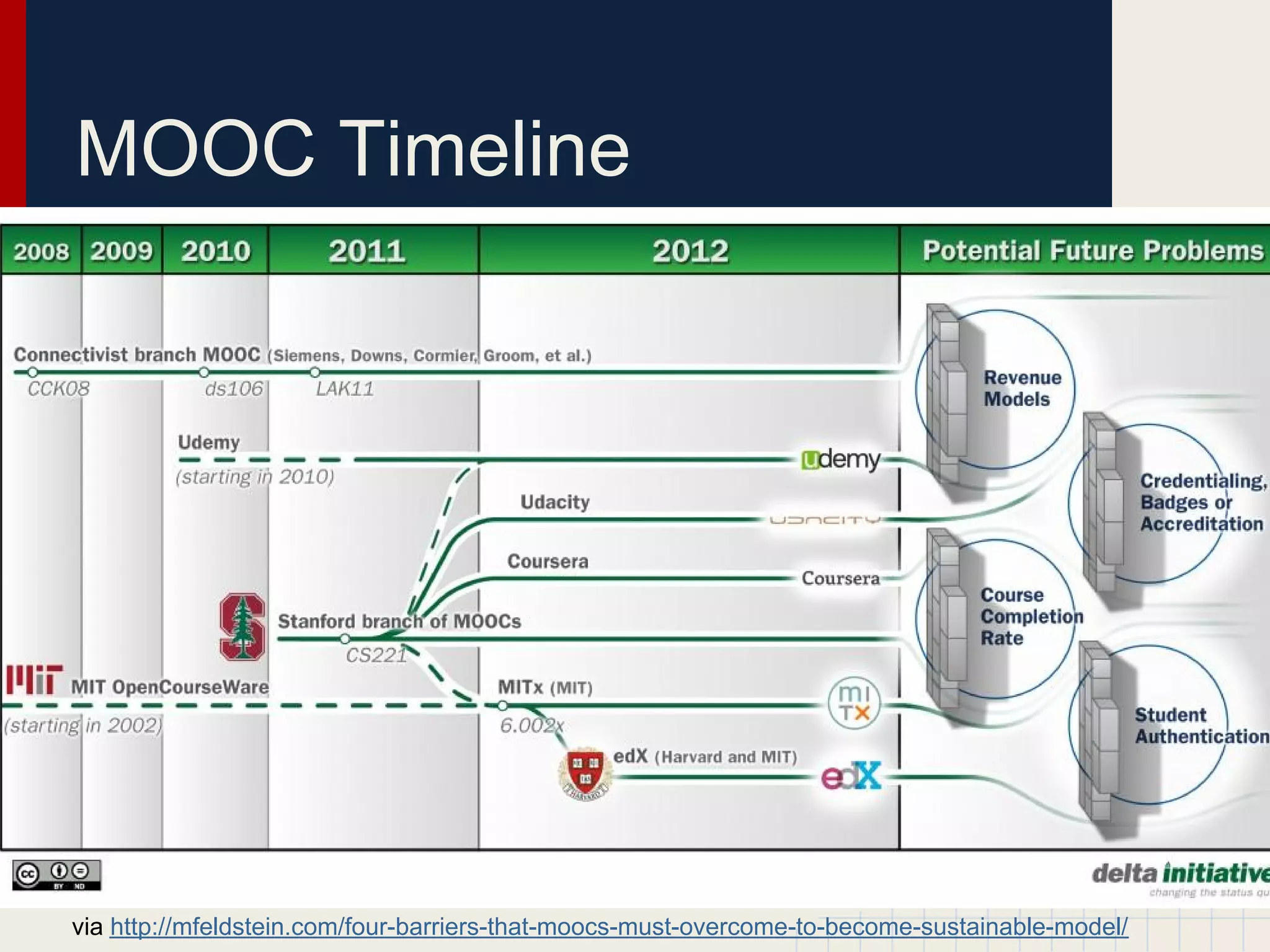
MOOC Timeline


via http://mfeldstein.com/four-barriers-that-moocs-must-overcome-to-become-sustainable-model/
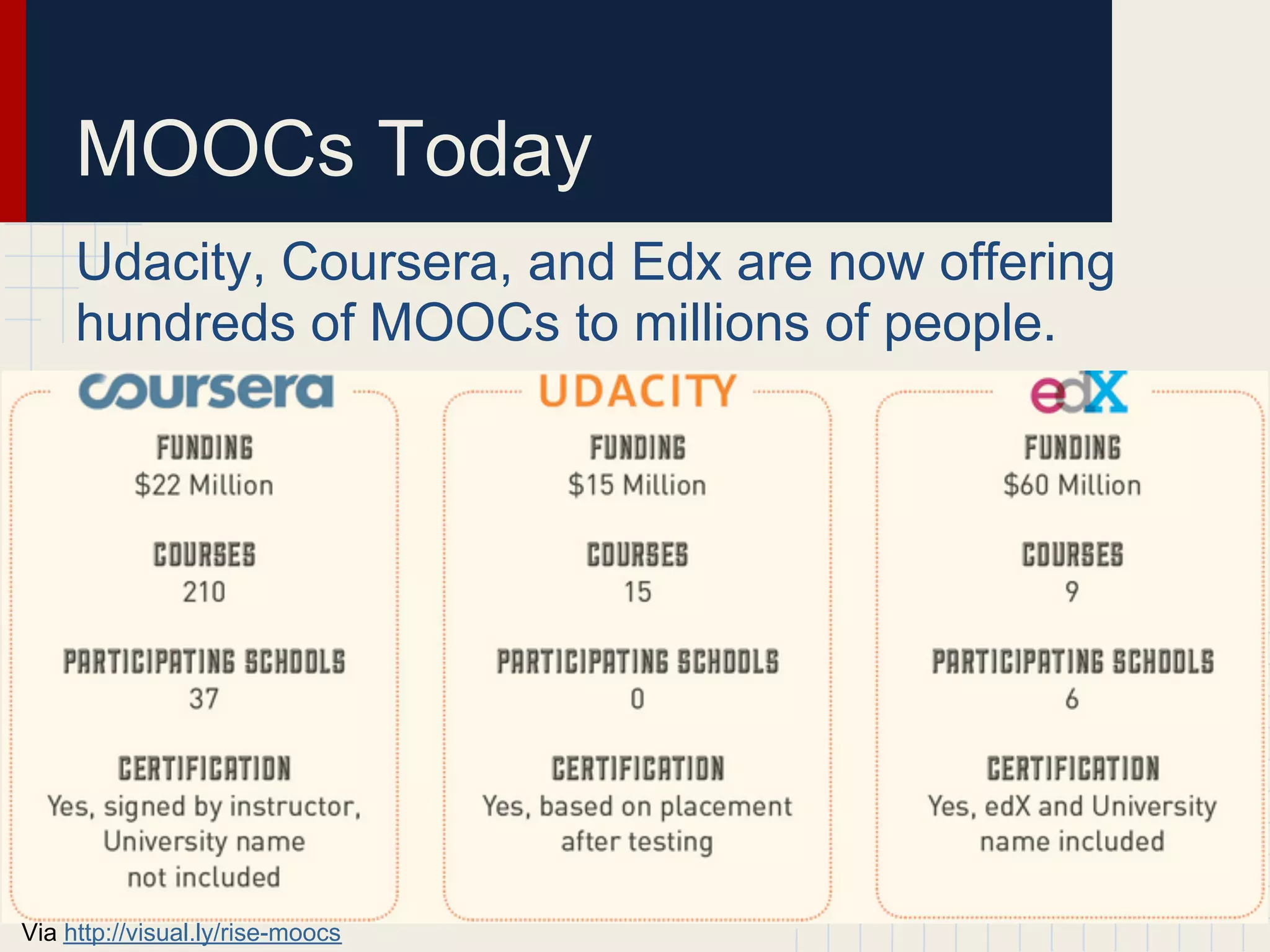
History of MOOCs
A timeline of MOOC articles:
http://chronicle.com/article/What-You-Need-to-
Know-About/133475/

Infographic on the rise of MOOCs:
http://visual.ly/rise-moocs
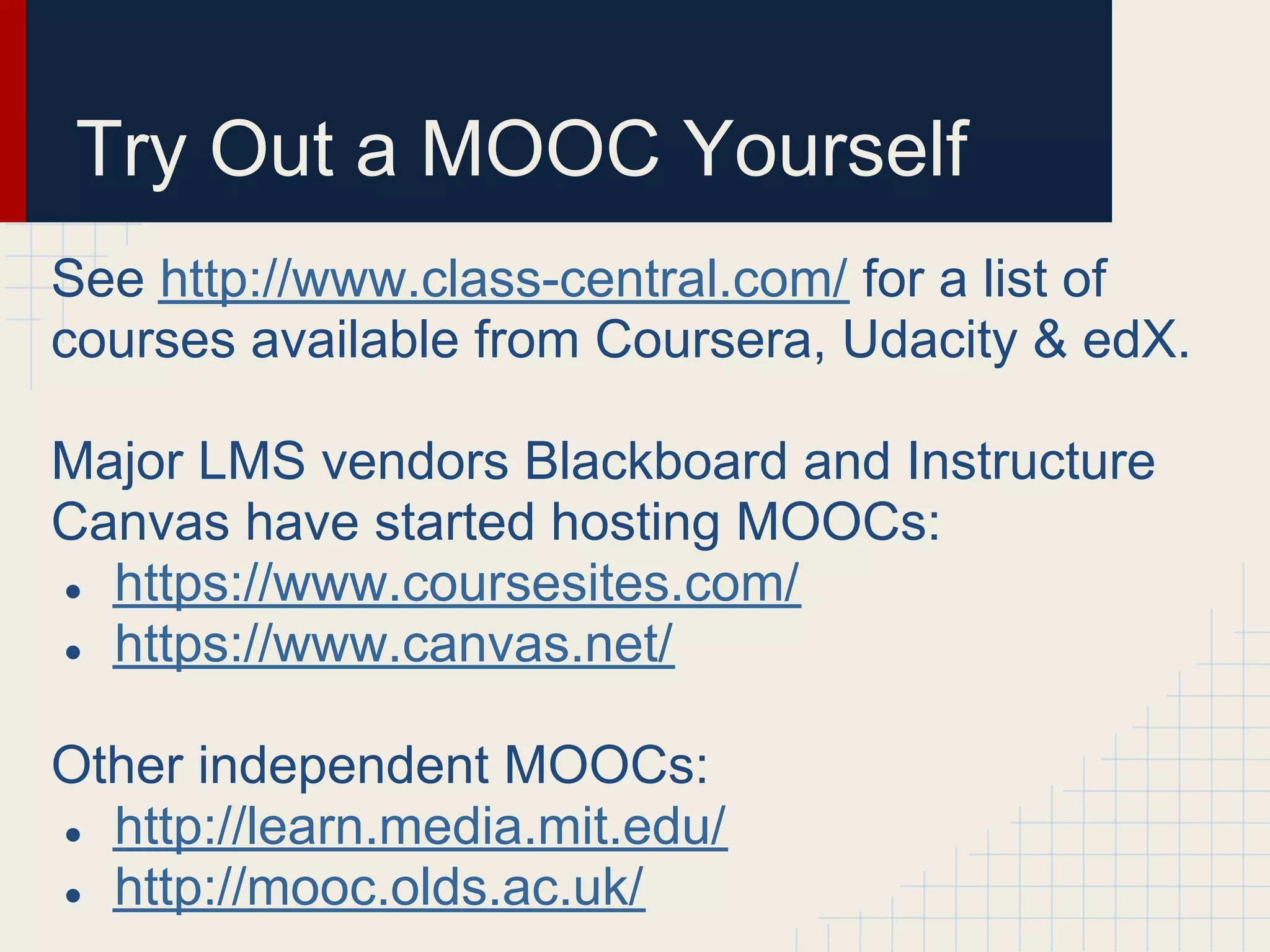
MOOCs Today
     Udacity, Coursera, and Edx are now offering
     hundreds of MOOCs to millions of people.


Via http://visual.ly/rise-moocs
Try Out a MOOC Yourself
See http://www.class-central.com/ for a list of
courses available from Coursera, Udacity & edX.

Major LMS vendors Blackboard and Instructure
Canvas have started hosting MOOCs:
● https://www.coursesites.com/
● https://www.canvas.net/


Other independent MOOCs:
● http://learn.media.mit.edu/
● http://mooc.olds.ac.uk/
Blackboard CourseSites
CourseSites MOOC Platform FAQ (PDF)

Partnerships:
● FIU http://open.fiu.edu/
● SUNY https://opensuny.coursesites.com/
● Blackboard Sponsored https://open.
  coursesites.com/
● UIS https://uis.coursesites.com/


Most of these courses have only had dozens or
hundreds of students.
Pros and Cons of MOOCs
Let's look at pros and cons from a few
different points of view:

1.   students (ours and others)
2.   faculty
3.   the university
4.   teaching and learning (pedagogy)
Perspective from Our
Students: MOOCs
See this article from the perspective of a Stanford student.

Pros
● Higher profile, exposure to prospective employers, help
  from and to outsiders, learn from world experts
Cons
● Less one on one contact with instructor, less interactive,
  high dropout rate
● Some students need expert support: “sharing of
  erroneous information and other shortcomings of peer-
  to-peer coaching”
Other pros and cons?
Outside Students in MOOCs
MOOC demographics: most students are non-traditional,
international, already have degrees. 39% “just curious about
the topic”, 30% wanting to "sharpen their skills"

Pros
● Learn for free about college topics for which they may not
  have access, like engineering, computer science
● Prospective students can learn about a university
● Former students can refresh knowledge

Cons - same as cons for our own students
Faculty Perspective: MOOCs
Pros
●   Greater exposure of your work and teaching and the
    university.
●   MOOC-wrapping - using a MOOC as a textbook
●   Example motivations from MIT OpenCourseWare:
    reputation, networking, improved course content and
    student feedback

Cons
●   Example concerns from a U. Wisconsin faculty member
●   Quality of learning, extremely high dropout rate (>90%)
●   Demands on time: both planning and teaching
●   Intellectual Property Rights, Risk, Cost, Reimbursement
University Perspective:
 MOOCs
Benefits
● Outreach, service to the community and public
● Marketing the university and its courses and faculty
● Fosters sense of community across campuses
● Spur innovations in teaching and learning - see next slide


Challenges
● Won’t directly generate revenue (unless you charge for certificates)
● Requires investment - faculty time, resources
● Other questions to consider in following slides, such as
  accreditation, competition, and evaluation

Provosts and presidents are split down the middle on MOOCs
Teaching & Learning
 Perspective: MOOCs
Pros
● Encourages sharing of teaching practices, research and
   data on teaching (SOTL), highlight & showcase faculty
   teaching.
● “Placing their MOOCs in the public domain for a
   worldwide audience will oblige institutions to do more
   than pay lip service to importance of teaching and put
   it at the core their missions. This is the real revolution
   of MOOCs.”
Cons
● Videos+quizzes not enough. MOOCs need better learning
   design.
● MOOCs: The Dark Side (infographic)
Frequently Asked Questions
How do MOOCs make money?
   See How EdX Plans to Earn Money and Emerging
business models for MOOCs.

Are accrediting agencies paying attention to
MOOCs?
    Yes. ACE recently accredited 5 MOOCs.

Are employers paying attention to MOOCs?
  Yes. Employers are recruiting top students from
MOOCs. MOOCs are charging for access to student data.
The last two in particular suggest universities shouldn't ignore MOOCs.
Frequently Asked Questions
What's involved in designing and implementing a
MOOC?
   See http://bit.ly/dukecoursera for a behind the scenes
look, and also a later slide: "Differences When Teaching a
MOOC." MOOCs should not be taught like regular courses.

Can students get a degree or credit taking
MOOCs?
   Various solutions for credit such as digital badges,
certificates, e-portfolios. Universities are starting to give
credit for MOOCs with MOOC2Degree & OERu (next slide)
See also http://myeducationpath.com/
MOOC2Degree & OERu
http://www.mooc2degree.com/
● Multi-university partnership to offer MOOCs for college
    credit.
● "Through this new initiative, the initial course in select
    online degree programs will be converted into a
    MOOC."

http://wikieducator.org/OER_university/Home
● OER = Open Educational Resources
● "The OER university aims to provide free learning to all
    students worldwide using OER learning materials with
    pathways to gain credible qualifications from recognised
    education institutions."
Frequently Asked Questions
Are MOOCs a fad?
Probably not
● Millions of dollars invested in MOOCs
● Millions of students signing up for MOOCs around globe
● Developing & using new and innovative tools to support
   MOOCs - cheat detection, better discussion forums,
   sophisticated learner analytics, new MOOC platforms,
   Google Apps, etc.

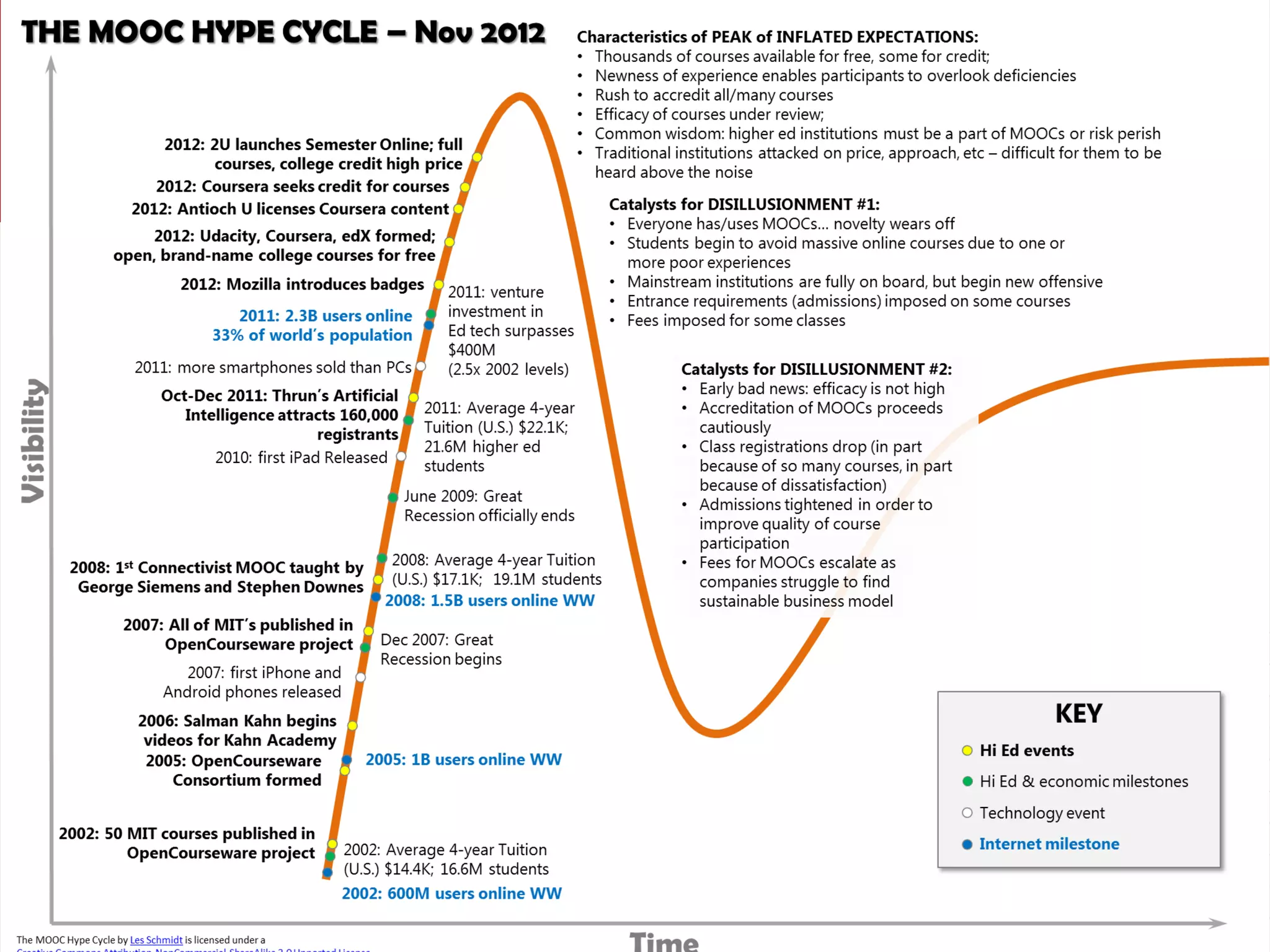
Are MOOCs hyped?
Probably yes
● MOOC hype cycle (next slide)
Open Questions
●   How do we evaluate Quality, ROI of
    MOOCs?
●   How are MOOCs to be accredited?
●   What about alternative models, such as:
    ○ Self-Paced Learning (like Khan Academy or
        Udemy)?
    ○   Blended/Hybrid Models (like the Open Learning
        Initiative?
    ○   Games? Gamification?
    ○   MOOC-Wrapping?
    ○   Online Professional Development
        Communities? (continuous, like tappedin)
What Should We Do?
● Talk to Faculty
  ○ Is there faculty interest & enthusiasm for
      MOOCs?
  ○ Do their courses use copyrighted
      materials? Would they scale to MOOCs?
● Talk to Students
  ○ Current, Former, Prospective
● Try Out MOOCs Yourself:
  ○ http://www.class-central.com/
● If Need Be: Implement a Pilot Test
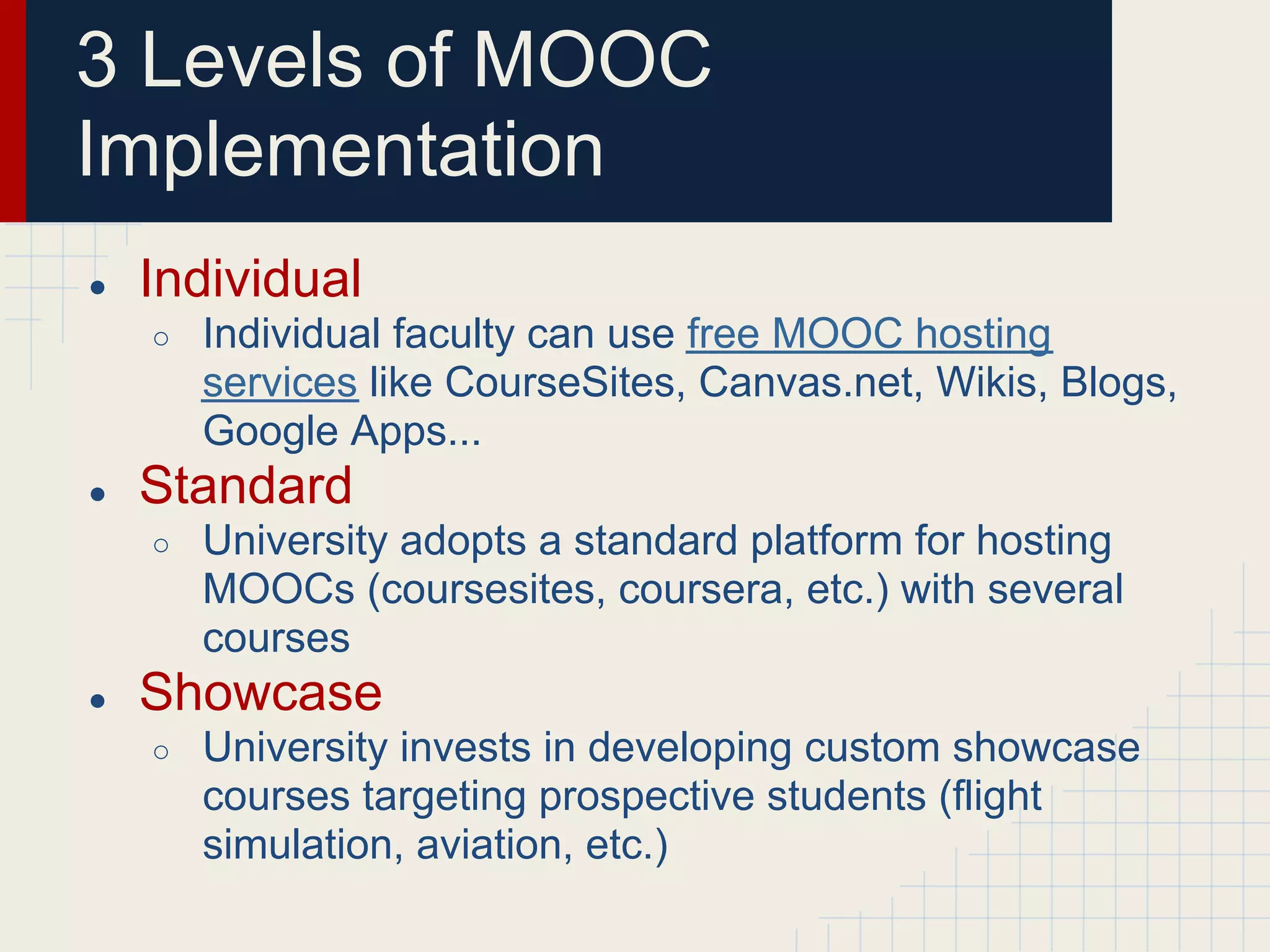
3 Levels of MOOC
Implementation
●   Individual
    ○   Individual faculty can use free MOOC hosting
        services like CourseSites, Canvas.net, Wikis, Blogs,
        Google Apps...
●   Standard
    ○   University adopts a standard platform for hosting
        MOOCs (coursesites, coursera, etc.) with several
        courses
●   Showcase
    ○   University invests in developing custom showcase
        courses targeting prospective students (flight
        simulation, aviation, etc.)
For More Information about
MOOCs
See these papers on MOOCs:
● European University Assocation: MOOCs (Jan. 2013)
● John Daniel: Making Sense of MOOCs: Musings in a
  Maze of Myth, Paradox and Possibility (2012)
● EDUCAUSE: What Campus Leaders Need to Know
  About MOOCs (2012)

MOOC News:
● InsideHigherEd: MOOC articles
● Chronicle of Higher Education: MOOC articles
Thank You

Contact me if you have any questions:

douglas.holton@erau.edu


Bonus slides appear after this one.

Considering MOOCs: Pros, Cons, Questions

  • 1.
    Considering MOOCs: Pros, Cons,Questions Doug Holton, Associate Director Center for Teaching and Learning Excellence Embry-Riddle Aeronautical University These slides are at: http://bit.ly/considermoocs
  • 2.
    What are MOOCs Massive Open Online Courses
  • 3.
    What are MOOCs MOOCsare online courses that are open for anyone in the world to take, usually for free and not for credit.* These courses have had anywhere from a few thousand to over 180,000 people enroll. *Exceptions include California State University: http://chronicle.com/article/California-State-U-Will/136677/ See also MOOC2Degree and OERu in later slides
  • 4.
  • 5.
    History of MOOCs Atimeline of MOOC articles: http://chronicle.com/article/What-You-Need-to- Know-About/133475/ Infographic on the rise of MOOCs: http://visual.ly/rise-moocs
  • 6.
    MOOCs Today Udacity, Coursera, and Edx are now offering hundreds of MOOCs to millions of people. Via http://visual.ly/rise-moocs
  • 7.
    Try Out aMOOC Yourself See http://www.class-central.com/ for a list of courses available from Coursera, Udacity & edX. Major LMS vendors Blackboard and Instructure Canvas have started hosting MOOCs: ● https://www.coursesites.com/ ● https://www.canvas.net/ Other independent MOOCs: ● http://learn.media.mit.edu/ ● http://mooc.olds.ac.uk/
  • 8.
    Blackboard CourseSites CourseSites MOOCPlatform FAQ (PDF) Partnerships: ● FIU http://open.fiu.edu/ ● SUNY https://opensuny.coursesites.com/ ● Blackboard Sponsored https://open. coursesites.com/ ● UIS https://uis.coursesites.com/ Most of these courses have only had dozens or hundreds of students.
  • 9.
    Pros and Consof MOOCs Let's look at pros and cons from a few different points of view: 1. students (ours and others) 2. faculty 3. the university 4. teaching and learning (pedagogy)
  • 10.
    Perspective from Our Students:MOOCs See this article from the perspective of a Stanford student. Pros ● Higher profile, exposure to prospective employers, help from and to outsiders, learn from world experts Cons ● Less one on one contact with instructor, less interactive, high dropout rate ● Some students need expert support: “sharing of erroneous information and other shortcomings of peer- to-peer coaching” Other pros and cons?
  • 11.
    Outside Students inMOOCs MOOC demographics: most students are non-traditional, international, already have degrees. 39% “just curious about the topic”, 30% wanting to "sharpen their skills" Pros ● Learn for free about college topics for which they may not have access, like engineering, computer science ● Prospective students can learn about a university ● Former students can refresh knowledge Cons - same as cons for our own students
  • 12.
    Faculty Perspective: MOOCs Pros ● Greater exposure of your work and teaching and the university. ● MOOC-wrapping - using a MOOC as a textbook ● Example motivations from MIT OpenCourseWare: reputation, networking, improved course content and student feedback Cons ● Example concerns from a U. Wisconsin faculty member ● Quality of learning, extremely high dropout rate (>90%) ● Demands on time: both planning and teaching ● Intellectual Property Rights, Risk, Cost, Reimbursement
  • 13.
    University Perspective: MOOCs Benefits ●Outreach, service to the community and public ● Marketing the university and its courses and faculty ● Fosters sense of community across campuses ● Spur innovations in teaching and learning - see next slide Challenges ● Won’t directly generate revenue (unless you charge for certificates) ● Requires investment - faculty time, resources ● Other questions to consider in following slides, such as accreditation, competition, and evaluation Provosts and presidents are split down the middle on MOOCs
  • 14.
    Teaching & Learning Perspective: MOOCs Pros ● Encourages sharing of teaching practices, research and data on teaching (SOTL), highlight & showcase faculty teaching. ● “Placing their MOOCs in the public domain for a worldwide audience will oblige institutions to do more than pay lip service to importance of teaching and put it at the core their missions. This is the real revolution of MOOCs.” Cons ● Videos+quizzes not enough. MOOCs need better learning design. ● MOOCs: The Dark Side (infographic)
  • 15.
    Frequently Asked Questions Howdo MOOCs make money? See How EdX Plans to Earn Money and Emerging business models for MOOCs. Are accrediting agencies paying attention to MOOCs? Yes. ACE recently accredited 5 MOOCs. Are employers paying attention to MOOCs? Yes. Employers are recruiting top students from MOOCs. MOOCs are charging for access to student data. The last two in particular suggest universities shouldn't ignore MOOCs.
  • 16.
    Frequently Asked Questions What'sinvolved in designing and implementing a MOOC? See http://bit.ly/dukecoursera for a behind the scenes look, and also a later slide: "Differences When Teaching a MOOC." MOOCs should not be taught like regular courses. Can students get a degree or credit taking MOOCs? Various solutions for credit such as digital badges, certificates, e-portfolios. Universities are starting to give credit for MOOCs with MOOC2Degree & OERu (next slide) See also http://myeducationpath.com/
  • 17.
    MOOC2Degree & OERu http://www.mooc2degree.com/ ●Multi-university partnership to offer MOOCs for college credit. ● "Through this new initiative, the initial course in select online degree programs will be converted into a MOOC." http://wikieducator.org/OER_university/Home ● OER = Open Educational Resources ● "The OER university aims to provide free learning to all students worldwide using OER learning materials with pathways to gain credible qualifications from recognised education institutions."
  • 18.
    Frequently Asked Questions AreMOOCs a fad? Probably not ● Millions of dollars invested in MOOCs ● Millions of students signing up for MOOCs around globe ● Developing & using new and innovative tools to support MOOCs - cheat detection, better discussion forums, sophisticated learner analytics, new MOOC platforms, Google Apps, etc. Are MOOCs hyped? Probably yes ● MOOC hype cycle (next slide)
  • 20.
    Open Questions ● How do we evaluate Quality, ROI of MOOCs? ● How are MOOCs to be accredited? ● What about alternative models, such as: ○ Self-Paced Learning (like Khan Academy or Udemy)? ○ Blended/Hybrid Models (like the Open Learning Initiative? ○ Games? Gamification? ○ MOOC-Wrapping? ○ Online Professional Development Communities? (continuous, like tappedin)
  • 21.
    What Should WeDo? ● Talk to Faculty ○ Is there faculty interest & enthusiasm for MOOCs? ○ Do their courses use copyrighted materials? Would they scale to MOOCs? ● Talk to Students ○ Current, Former, Prospective ● Try Out MOOCs Yourself: ○ http://www.class-central.com/ ● If Need Be: Implement a Pilot Test
  • 22.
    3 Levels ofMOOC Implementation ● Individual ○ Individual faculty can use free MOOC hosting services like CourseSites, Canvas.net, Wikis, Blogs, Google Apps... ● Standard ○ University adopts a standard platform for hosting MOOCs (coursesites, coursera, etc.) with several courses ● Showcase ○ University invests in developing custom showcase courses targeting prospective students (flight simulation, aviation, etc.)
  • 23.
    For More Informationabout MOOCs See these papers on MOOCs: ● European University Assocation: MOOCs (Jan. 2013) ● John Daniel: Making Sense of MOOCs: Musings in a Maze of Myth, Paradox and Possibility (2012) ● EDUCAUSE: What Campus Leaders Need to Know About MOOCs (2012) MOOC News: ● InsideHigherEd: MOOC articles ● Chronicle of Higher Education: MOOC articles
  • 24.
    Thank You Contact meif you have any questions: douglas.holton@erau.edu Bonus slides appear after this one.
  • 25.
  • 26.
    Differences When Teaching aMOOC vs. Reg. Course ● takes more time, less room for error ● copyright issues - no more fair use ● many tools you use may not scale to thousands of students - different set of tools needed for MOOCs ● things that cause a few to grumble in a regular online class may cause a revolt in a MOOC - expensive textbook, too much reading, boring lectures, powerpoint ● some issues are amplified in a MOOC: dropout rate, cheating, off-topic noise in forums, time zone issues, accessibility ● most MOOCs are shorter - 5-8 weeks instead of 15
  • 27.
    Create Your OwnMOOC: MOOC Platforms Open Source ● CourseBuilder, by Google ● Class2Go, by Stanford ● OpenMOOC ● MechanicalMOOC, by P2PU ● Edx platform by MIT, to be released Free ● Google Apps - Google+, Google Sites, Google Groups ● CourseSites by Blackboard ● Canvas.net by Instructure (based on open source) ● Wordpress, Wikis, Blogs, Twitter, Facebook
  • 28.
    MOOCs for Corporate Learning Froma Feb. 27 webinar: http://futureworkplace.com/ We think of MOOCs as courses and how they might replace traditional training/instruction, but you can also look at MOOCs as: ● Marketing – advertising your services, recruiting new employees, students, customers ● Supplementing Instruction - like a textbook: MOOC- wrapping ● Networking – providing a space for employees and others to network with one another
  • 29.
    Benefits in TakingMOOCs There are various things an organization might gain by allowing employees or students to take MOOCs, and by offering MOOCs to your own employees or students, or to your customers and the public. When employees (or students) take public MOOCs, benefits include: ● Learning from world-class experts ● Saving money – most MOOCs are free, partly because they serve as advertising, marketing ● Networking with one another, and possibly finding talented folks to recruit ● Supplementing local instruction and training – MOOC- wrapping
  • 30.
    Benefits in CreatingMOOCs By creating MOOCs for your own organization, you might: ● Have job applicants complete a MOOC to assess their skills ● Create an organization-wide course to foster a larger sense of community, breaking down silos ● Standardize basic training – less duplication By creating MOOCs for other companies and people, you might ● Create standard introductory courses for your products or services ● Train customers on your product or services, perhaps to accompany a demo or trial ● Help the public better understand what it is your organization does or provides, what makes it special