
Open101 
An Introduction to Open and Online Education 
Robert Schuwer 
Open Universiteit (Netherlands)
Agenda 
• What are OER? 
• Why OER? 
• What is a MOOC? 
• What is open education? 
• Business models for OER 
• Open policies 
• Challenges for introducing OER 
2
3 
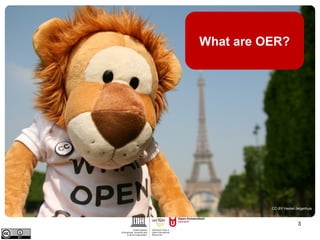
What are OER? 
CC-BY Hester Jelgerhuis
Open Educational Resources 
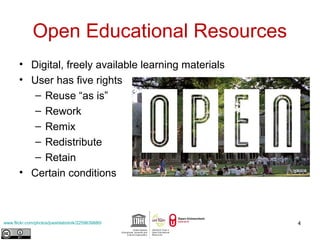
• Digital, freely available learning materials 
• User has five rights 
– Reuse “as is” 
– Rework 
– Remix 
– Redistribute 
– Retain 
• Certain conditions 
www.flickr.com/photos/joeshlabotnik/2259639880/ 4
Conditions: open license 
Creative Commons 
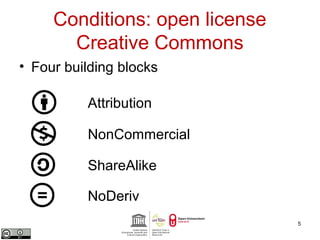
• Four building blocks 
5 
Attribution 
NonCommercial 
ShareAlike 
NoDeriv
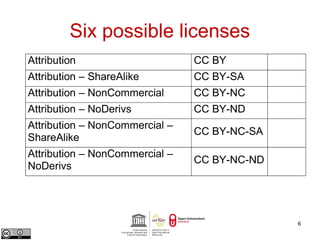
Six possible licenses 
6 
Attribution CC BY 
Attribution – ShareAlike CC BY-SA 
Attribution – NonCommercial CC BY-NC 
Attribution – NoDerivs CC BY-ND 
Attribution – NonCommercial – 
ShareAlike CC BY-NC-SA 
Attribution – NonCommercial – 
NoDerivs CC BY-NC-ND
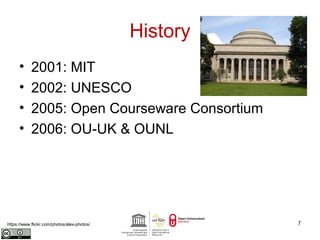
History 
• 2001: MIT 
• 2002: UNESCO 
• 2005: Open Courseware Consortium 
• 2006: OU-UK & OUNL 
https://www.flickr.com/photos/alex-photos/ 7
8 
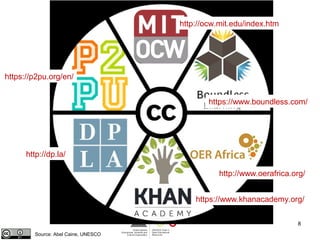
https://p2pu.org/en/ 
http://dp.la/ 
Source: Abel Caine, UNESCO 
http://ocw.mit.edu/index.htm 
https://www.boundless.com/ 
http://www.oerafrica.org/ 
https://www.khanacademy.org/
More examples 
• Institution-based 
– University of Cape Town 
(http://opencontent.uct.ac.za/) 
– African Virtual University (http://oer.avu.org/) 
• Community-based 
– MERLOT (http://www.merlot.org/merlot/index.htm) 
– Curriki (http://www.curriki.org/) 
– OERCommons (https://www.oercommons.org/) 
9
CC-BY Hester Jelgerhuis 
10 
Why OER?
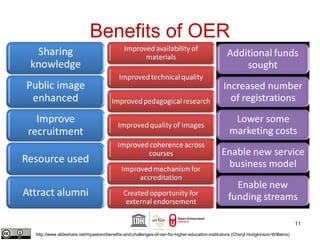
Benefits of OER 
11 
http://www.slideshare.net/mpaskevi/benefits-and-challenges-of-oer-for-higher-education-institutions (Cheryl Hodgkinson-Williams)
Benefits of OER (2) 
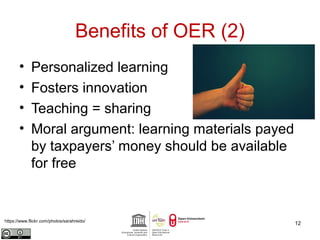
• Personalized learning 
• Fosters innovation 
• Teaching = sharing 
• Moral argument: learning materials payed 
by taxpayers’ money should be available 
for free 
https://www.flickr.com/photos/sarahreido/ 12
Why not OER? 
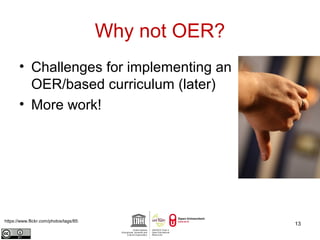
• Challenges for implementing an 
OER/based curriculum (later) 
• More work! 
https://www.flickr.com/photos/tags/85: 13
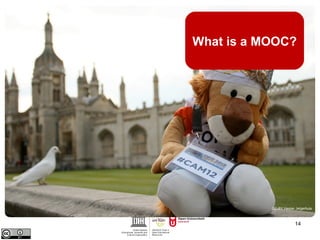
What is a MOOC? 
CC-BY Hester Jelgerhuis 
14
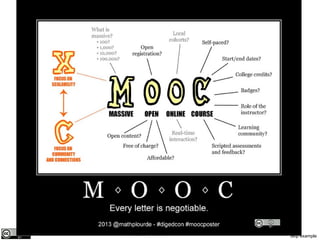
MOOC 
• Massive: many participants (> Dunbars 
number) 
• Open: free available 
• Online: via the internet 
• Course: unit of offer (5-10 weeks 
througput time) 
• Complete learning experience 
15
16 
Skip example
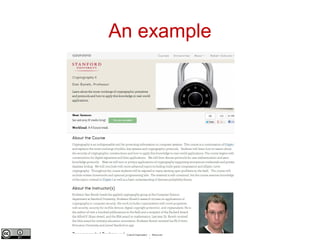
An example 
Pagina 17
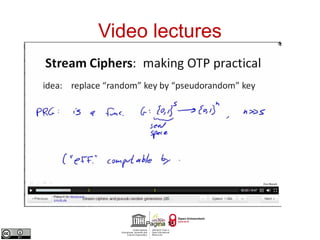
Video lectures 
Pagina 18
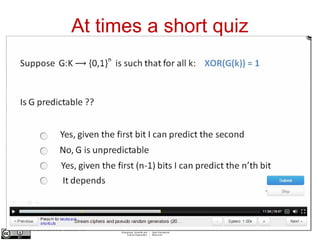
At times a short quiz 
Pagina 19
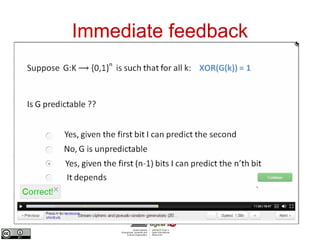
Immediate feedback 
Pagina 20
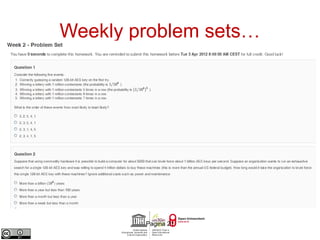
Weekly problem sets… 
Pagina 21
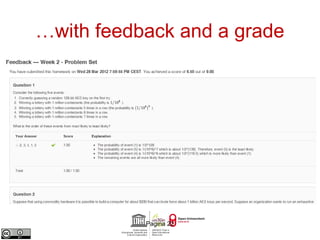
…with feedback and a grade 
Pagina 22
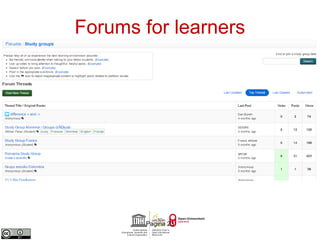
Forums for learners 
Pagina 23
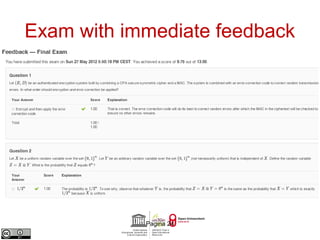
Exam with immediate feedback 
Pagina 24
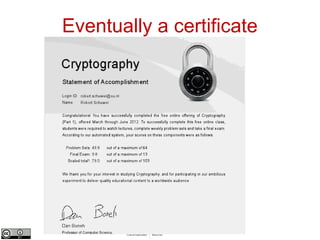
Eventually a certificate 
Pagina 25
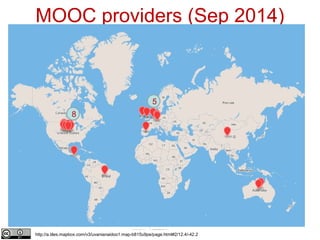
MOOC providers (Sep 2014) 
26 
8 
5 
http://a.tiles.mapbox.com/v3/uvanianaidoo1.map-b815u9pe/page.html#2/12.4/-42.2
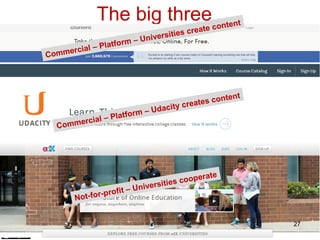
The big three 
Commercial – Platform – Universities create content 
Commercial – Platform – Udacity creates content 
Not-for-profit – Universities cooperate 
27 Pagina 27 
27
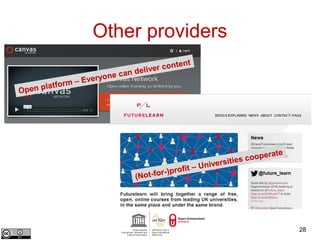
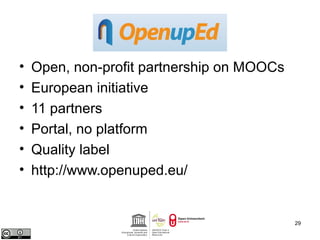
Other providers 
28 
Open platform – Everyone can deliver content 
(Not-for-)profit – Universities cooperate 
28
• Open, non-profit partnership on MOOCs 
• European initiative 
• 11 partners 
• Portal, no platform 
• Quality label 
• http://www.openuped.eu/ 
29
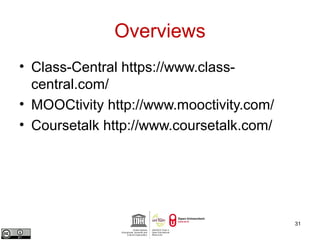
Offering Feedback Certificate Pacing Didactics 
30 
EdX 
(Consort.) 
Courses Instructor/ 
automated 
Achievement Paced Instructor led 
Udacity 
(Company) 
Courses Instructor/ 
automated 
Achievement/ 
Participation 
Paced Instructor led 
Coursera 
(Company/ 
Consort.) 
Courses Instructor/ 
Automated/ 
Peer 
Achievement/ 
Participation 
Paced Instructor led 
Ted Ed Lectures - - Self-directed Instructor led 
Khan 
Lectures - Badges Self-directed Instructor led 
Academy 
cMOOC Courses Peer None/Achievement/ 
Badges 
Paced Connec-tivism 
OpenUpEd Courses Peer None/Achievement/ 
Recognition 
Self-directed/ 
Paced 
Self study 
Saylor.org Programs - - Self-directed Instructor led 
OERu Programs - Diploma Self-directed May vary p. 
course
Overviews 
• Class-Central https://www.class-central. 
com/ 
• MOOCtivity http://www.mooctivity.com/ 
• Coursetalk http://www.coursetalk.com/ 
31
CC-BY Hester Jelgerhuis 
32 
What is Open 
Education?
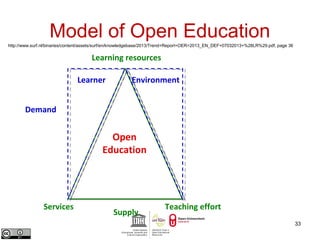
Model of Open Education 
33 
http://www.surf.nl/binaries/content/assets/surf/en/knowledgebase/2013/Trend+Report+OER+2013_EN_DEF+07032013+%28LR%29.pdf, page 36 
Learning resources 
Learner Environment 
Open 
Education 
Services Teaching effort 
Supply 
Demand
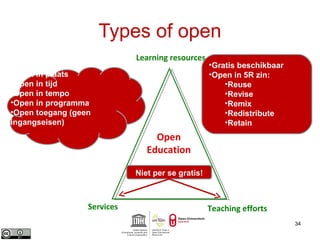
Types of open 
34 
Learning resources 
Open 
Education 
•Gratis beschikbaar 
•Open in 5R zin: 
•Reuse 
•Revise 
•Remix 
•Redistribute 
•Retain 
•Open in plaats 
•Open in tijd 
•Open in tempo 
•Open in programma 
•Open toegang (geen 
ingangseisen) 
Niet per se gratis! 
Services Teaching efforts
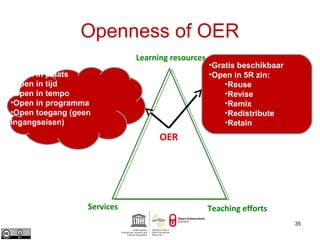
Openness of OER 
35 
Learning resources 
•Gratis beschikbaar 
•Open in 5R zin: 
•Reuse 
•Revise 
•Remix 
•Redistribute 
•Retain 
•Open in plaats 
•Open in tijd 
•Open in tempo 
•Open in programma 
•Open toegang (geen 
ingangseisen) 
OER 
Services Teaching efforts
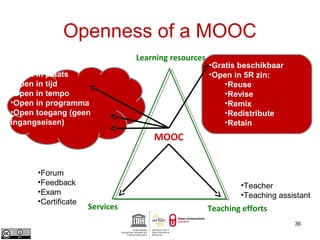
Openness of a MOOC 
36 
Learning resources 
•Gratis beschikbaar 
•Open in 5R zin: 
•Reuse 
•Revise 
•Remix 
•Redistribute 
•Retain 
•Open in plaats 
•Open in tijd 
•Open in tempo 
•Open in programma 
•Open toegang (geen 
ingangseisen) 
MOOC 
Services Teaching efforts 
•Forum 
•Feedback 
•Exam 
•Certificate 
•Teacher 
•Teaching assistant
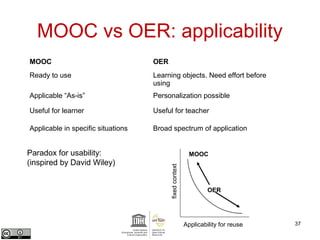
MOOC vs OER: applicability 
37 
MOOC OER 
Ready to use Learning objects. Need effort before 
using 
Applicable “As-is” Personalization possible 
Useful for learner Useful for teacher 
Applicable in specific situations Broad spectrum of application 
Paradox for usability: 
(inspired by David Wiley) 
OER 
Applicability for reuse 
fixed context 
MOOC
Business models 
CC-BY Hester Jelgerhuis 
38
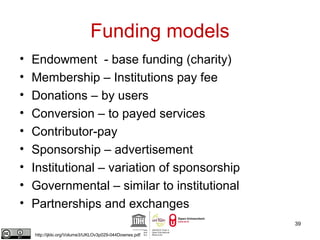
Funding models 
• Endowment - base funding (charity) 
• Membership – Institutions pay fee 
• Donations – by users 
• Conversion – to payed services 
• Contributor-pay 
• Sponsorship – advertisement 
• Institutional – variation of sponsorship 
• Governmental – similar to institutional 
• Partnerships and exchanges 
39 
http://ijklo.org/Volume3/IJKLOv3p029-044Downes.pdf
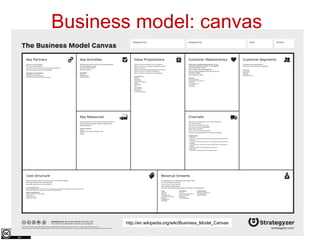
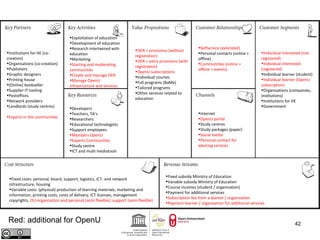
Business model: canvas 
http://en.wikipedia.org/wiki/Business_Model_Canvas 40
Example: OpenU @ OUNL 
• 10% of each course is provided as OER. 
• Customers can remain anonymous, register 
free of charge and create a profile, or can be 
paying customers. 
• Each individual or organisation can take out a 
subscription to products or services. 
• Communities are encouraged 
• All forms of education are provided free of 
charge, (e.g. online master classes) 
41
42 
•Institutions for HE (co-creation) 
•Organisations (co-creation) 
•Publishers 
•Graphic designers 
•Printing house 
•(Online) bookseller 
•Supplier IT-tooling 
•Postoffices 
•Network providers 
•Landlords (study centres) 
•Experts in the communities 
•Exploitation of education 
•Development of education 
•Research intertwined with 
education 
•Marketing 
•Starting and moderating 
communities 
•Create and manage OER 
•Manage OpenU 
infrastructure and services 
•Developers 
•Teachers, TA’s 
•Researchers 
•Educational technologists 
•Support employees 
•Members OpenU 
•Experts Communities 
•Study centre 
•ICT and multi mediatools 
•OER + provisions (without 
registration) 
•OER + extra provisions (with 
registration) 
•OpenU subscriptions 
•Individual courses 
•Full programs (BaMa) 
•Tailored programs 
•Other services related to 
education 
•Selfservice (extended) 
•Personal contacts (online + 
offline) 
•Communities (online + 
offline + events) 
•Internet 
•OpenU portal 
•Study centres 
•Study packages (paper) 
•Social media 
•Personal contact for 
advicing services 
•Individual interested (not 
registered) 
•Individual interested 
(registered) 
•Individual learner (student) 
•Individual learner (OpenU 
subscription) 
•Organisations (companies, 
institutions) 
•Institutions for HE 
•Government 
•Fixed costs: personal, board, support, logistics, ICT- and network 
infrastructure, housing 
•Variable costs: (physical) production of learning materials, marketing and 
information, printing costs, costs of delivery, ICT licenses, management 
copyrights, OU-organisation and personal (semi flexible), support (semi-flexible) 
•Fixed subsidy Ministry of Education 
•Variable subsidy Ministry of Education 
•Course incomes (student / organisation) 
•Payment for additional services 
•Subscription fee from a learner / organisation 
•Payment learner / organisation for additional services 
Red: additional for OpenU
Funding models for MOOC 
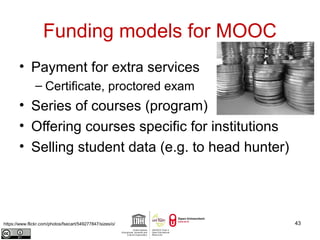
• Payment for extra services 
– Certificate, proctored exam 
• Series of courses (program) 
• Offering courses specific for institutions 
• Selling student data (e.g. to head hunter) 
https://www.flickr.com/photos/fsecart/549277847/sizes/o/ 43
44 
Challenges for 
introducing OER 
CC-BY Hester Jelgerhuis
Potential hurdles 
• Findability of OER 
• Quality of OER 
– Context specific 
• Open licenses 
• Business models 
• Human factors 
http://www.flickr.com/photos/gowestphoto/3955671300/sizes/o/ 45
46 
Robert.Schuwer@ou.nl 
@fagottissimo 
bassoonvenlo 
http://nl.linkedin.com/in/robertschuwer 
robertschuwer.nl 
+31 - 6 1446 9300

Open 101: An Introduction to Open and Online Education

  • 1.
    Open101 An Introductionto Open and Online Education Robert Schuwer Open Universiteit (Netherlands)
  • 2.
    Agenda • Whatare OER? • Why OER? • What is a MOOC? • What is open education? • Business models for OER • Open policies • Challenges for introducing OER 2
  • 3.
    3 What areOER? CC-BY Hester Jelgerhuis
  • 4.
    Open Educational Resources • Digital, freely available learning materials • User has five rights – Reuse “as is” – Rework – Remix – Redistribute – Retain • Certain conditions www.flickr.com/photos/joeshlabotnik/2259639880/ 4
  • 5.
    Conditions: open license Creative Commons • Four building blocks 5 Attribution NonCommercial ShareAlike NoDeriv
  • 6.
    Six possible licenses 6 Attribution CC BY Attribution – ShareAlike CC BY-SA Attribution – NonCommercial CC BY-NC Attribution – NoDerivs CC BY-ND Attribution – NonCommercial – ShareAlike CC BY-NC-SA Attribution – NonCommercial – NoDerivs CC BY-NC-ND
  • 7.
    History • 2001:MIT • 2002: UNESCO • 2005: Open Courseware Consortium • 2006: OU-UK & OUNL https://www.flickr.com/photos/alex-photos/ 7
  • 8.
    8 https://p2pu.org/en/ http://dp.la/ Source: Abel Caine, UNESCO http://ocw.mit.edu/index.htm https://www.boundless.com/ http://www.oerafrica.org/ https://www.khanacademy.org/
  • 9.
    More examples •Institution-based – University of Cape Town (http://opencontent.uct.ac.za/) – African Virtual University (http://oer.avu.org/) • Community-based – MERLOT (http://www.merlot.org/merlot/index.htm) – Curriki (http://www.curriki.org/) – OERCommons (https://www.oercommons.org/) 9
  • 10.
  • 11.
    Benefits of OER 11 http://www.slideshare.net/mpaskevi/benefits-and-challenges-of-oer-for-higher-education-institutions (Cheryl Hodgkinson-Williams)
  • 12.
    Benefits of OER(2) • Personalized learning • Fosters innovation • Teaching = sharing • Moral argument: learning materials payed by taxpayers’ money should be available for free https://www.flickr.com/photos/sarahreido/ 12
  • 13.
    Why not OER? • Challenges for implementing an OER/based curriculum (later) • More work! https://www.flickr.com/photos/tags/85: 13
  • 14.
    What is aMOOC? CC-BY Hester Jelgerhuis 14
  • 15.
    MOOC • Massive:many participants (> Dunbars number) • Open: free available • Online: via the internet • Course: unit of offer (5-10 weeks througput time) • Complete learning experience 15
  • 16.
  • 17.
  • 18.
  • 19.
    At times ashort quiz Pagina 19
  • 20.
  • 21.
  • 22.
    …with feedback anda grade Pagina 22
  • 23.
  • 24.
    Exam with immediatefeedback Pagina 24
  • 25.
  • 26.
    MOOC providers (Sep2014) 26 8 5 http://a.tiles.mapbox.com/v3/uvanianaidoo1.map-b815u9pe/page.html#2/12.4/-42.2
  • 27.
    The big three Commercial – Platform – Universities create content Commercial – Platform – Udacity creates content Not-for-profit – Universities cooperate 27 Pagina 27 27
  • 28.
    Other providers 28 Open platform – Everyone can deliver content (Not-for-)profit – Universities cooperate 28
  • 29.
    • Open, non-profitpartnership on MOOCs • European initiative • 11 partners • Portal, no platform • Quality label • http://www.openuped.eu/ 29
  • 30.
    Offering Feedback CertificatePacing Didactics 30 EdX (Consort.) Courses Instructor/ automated Achievement Paced Instructor led Udacity (Company) Courses Instructor/ automated Achievement/ Participation Paced Instructor led Coursera (Company/ Consort.) Courses Instructor/ Automated/ Peer Achievement/ Participation Paced Instructor led Ted Ed Lectures - - Self-directed Instructor led Khan Lectures - Badges Self-directed Instructor led Academy cMOOC Courses Peer None/Achievement/ Badges Paced Connec-tivism OpenUpEd Courses Peer None/Achievement/ Recognition Self-directed/ Paced Self study Saylor.org Programs - - Self-directed Instructor led OERu Programs - Diploma Self-directed May vary p. course
  • 31.
    Overviews • Class-Centralhttps://www.class-central. com/ • MOOCtivity http://www.mooctivity.com/ • Coursetalk http://www.coursetalk.com/ 31
  • 32.
    CC-BY Hester Jelgerhuis 32 What is Open Education?
  • 33.
    Model of OpenEducation 33 http://www.surf.nl/binaries/content/assets/surf/en/knowledgebase/2013/Trend+Report+OER+2013_EN_DEF+07032013+%28LR%29.pdf, page 36 Learning resources Learner Environment Open Education Services Teaching effort Supply Demand
  • 34.
    Types of open 34 Learning resources Open Education •Gratis beschikbaar •Open in 5R zin: •Reuse •Revise •Remix •Redistribute •Retain •Open in plaats •Open in tijd •Open in tempo •Open in programma •Open toegang (geen ingangseisen) Niet per se gratis! Services Teaching efforts
  • 35.
    Openness of OER 35 Learning resources •Gratis beschikbaar •Open in 5R zin: •Reuse •Revise •Remix •Redistribute •Retain •Open in plaats •Open in tijd •Open in tempo •Open in programma •Open toegang (geen ingangseisen) OER Services Teaching efforts
  • 36.
    Openness of aMOOC 36 Learning resources •Gratis beschikbaar •Open in 5R zin: •Reuse •Revise •Remix •Redistribute •Retain •Open in plaats •Open in tijd •Open in tempo •Open in programma •Open toegang (geen ingangseisen) MOOC Services Teaching efforts •Forum •Feedback •Exam •Certificate •Teacher •Teaching assistant
  • 37.
    MOOC vs OER:applicability 37 MOOC OER Ready to use Learning objects. Need effort before using Applicable “As-is” Personalization possible Useful for learner Useful for teacher Applicable in specific situations Broad spectrum of application Paradox for usability: (inspired by David Wiley) OER Applicability for reuse fixed context MOOC
  • 38.
    Business models CC-BYHester Jelgerhuis 38
  • 39.
    Funding models •Endowment - base funding (charity) • Membership – Institutions pay fee • Donations – by users • Conversion – to payed services • Contributor-pay • Sponsorship – advertisement • Institutional – variation of sponsorship • Governmental – similar to institutional • Partnerships and exchanges 39 http://ijklo.org/Volume3/IJKLOv3p029-044Downes.pdf
  • 40.
    Business model: canvas http://en.wikipedia.org/wiki/Business_Model_Canvas 40
  • 41.
    Example: OpenU @OUNL • 10% of each course is provided as OER. • Customers can remain anonymous, register free of charge and create a profile, or can be paying customers. • Each individual or organisation can take out a subscription to products or services. • Communities are encouraged • All forms of education are provided free of charge, (e.g. online master classes) 41
  • 42.
    42 •Institutions forHE (co-creation) •Organisations (co-creation) •Publishers •Graphic designers •Printing house •(Online) bookseller •Supplier IT-tooling •Postoffices •Network providers •Landlords (study centres) •Experts in the communities •Exploitation of education •Development of education •Research intertwined with education •Marketing •Starting and moderating communities •Create and manage OER •Manage OpenU infrastructure and services •Developers •Teachers, TA’s •Researchers •Educational technologists •Support employees •Members OpenU •Experts Communities •Study centre •ICT and multi mediatools •OER + provisions (without registration) •OER + extra provisions (with registration) •OpenU subscriptions •Individual courses •Full programs (BaMa) •Tailored programs •Other services related to education •Selfservice (extended) •Personal contacts (online + offline) •Communities (online + offline + events) •Internet •OpenU portal •Study centres •Study packages (paper) •Social media •Personal contact for advicing services •Individual interested (not registered) •Individual interested (registered) •Individual learner (student) •Individual learner (OpenU subscription) •Organisations (companies, institutions) •Institutions for HE •Government •Fixed costs: personal, board, support, logistics, ICT- and network infrastructure, housing •Variable costs: (physical) production of learning materials, marketing and information, printing costs, costs of delivery, ICT licenses, management copyrights, OU-organisation and personal (semi flexible), support (semi-flexible) •Fixed subsidy Ministry of Education •Variable subsidy Ministry of Education •Course incomes (student / organisation) •Payment for additional services •Subscription fee from a learner / organisation •Payment learner / organisation for additional services Red: additional for OpenU
  • 43.
    Funding models forMOOC • Payment for extra services – Certificate, proctored exam • Series of courses (program) • Offering courses specific for institutions • Selling student data (e.g. to head hunter) https://www.flickr.com/photos/fsecart/549277847/sizes/o/ 43
  • 44.
    44 Challenges for introducing OER CC-BY Hester Jelgerhuis
  • 45.
    Potential hurdles •Findability of OER • Quality of OER – Context specific • Open licenses • Business models • Human factors http://www.flickr.com/photos/gowestphoto/3955671300/sizes/o/ 45
  • 46.
    46 Robert.Schuwer@ou.nl @fagottissimo bassoonvenlo http://nl.linkedin.com/in/robertschuwer robertschuwer.nl +31 - 6 1446 9300