More than mere information assets

The reach of social media in
information services delivery


University of Edinburgh Business School New Directions in Management series
Professor Hazel Hall, Director, Centre for Social Informatics, 11 November 2011
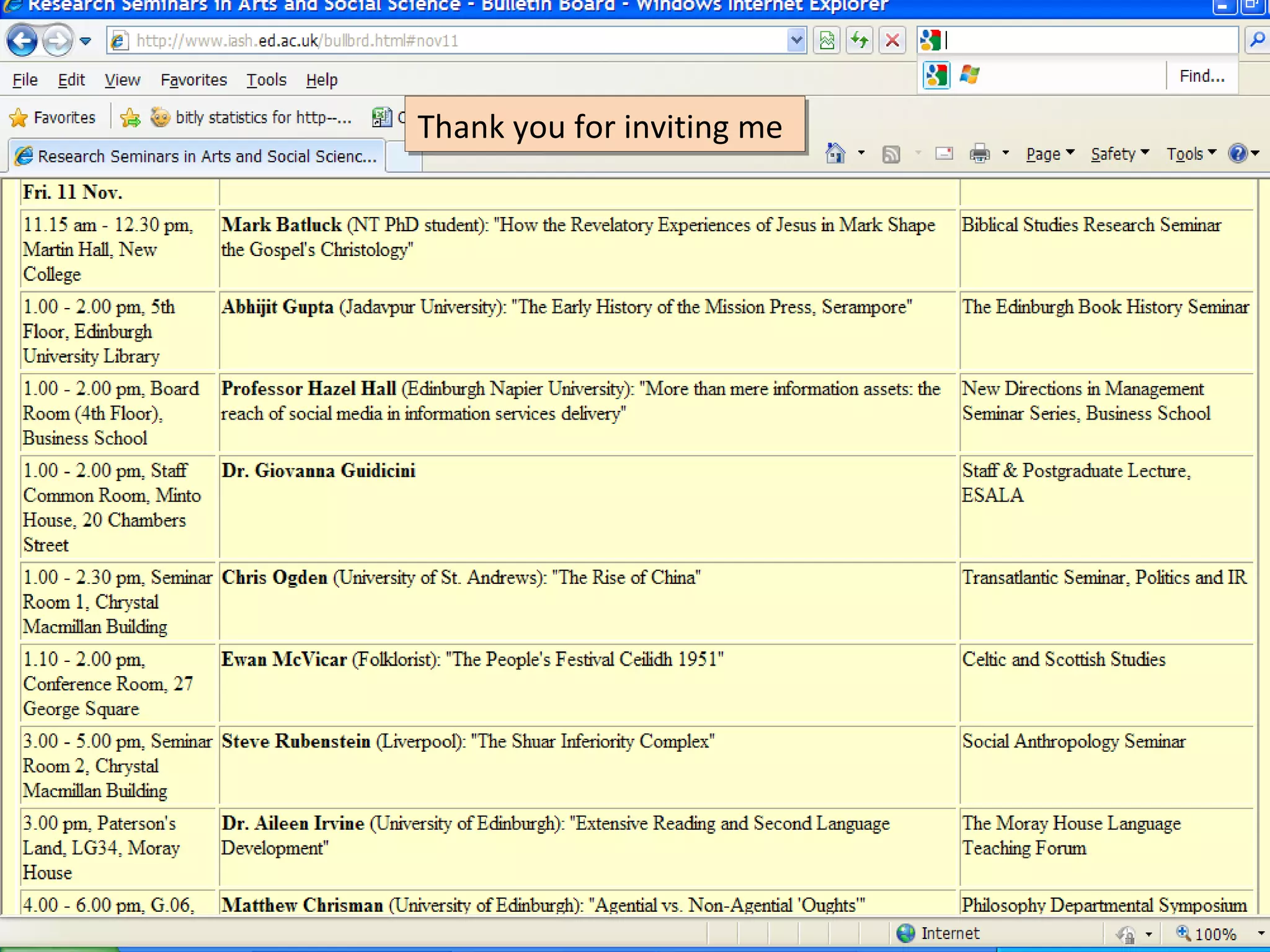
Thank you for inviting me


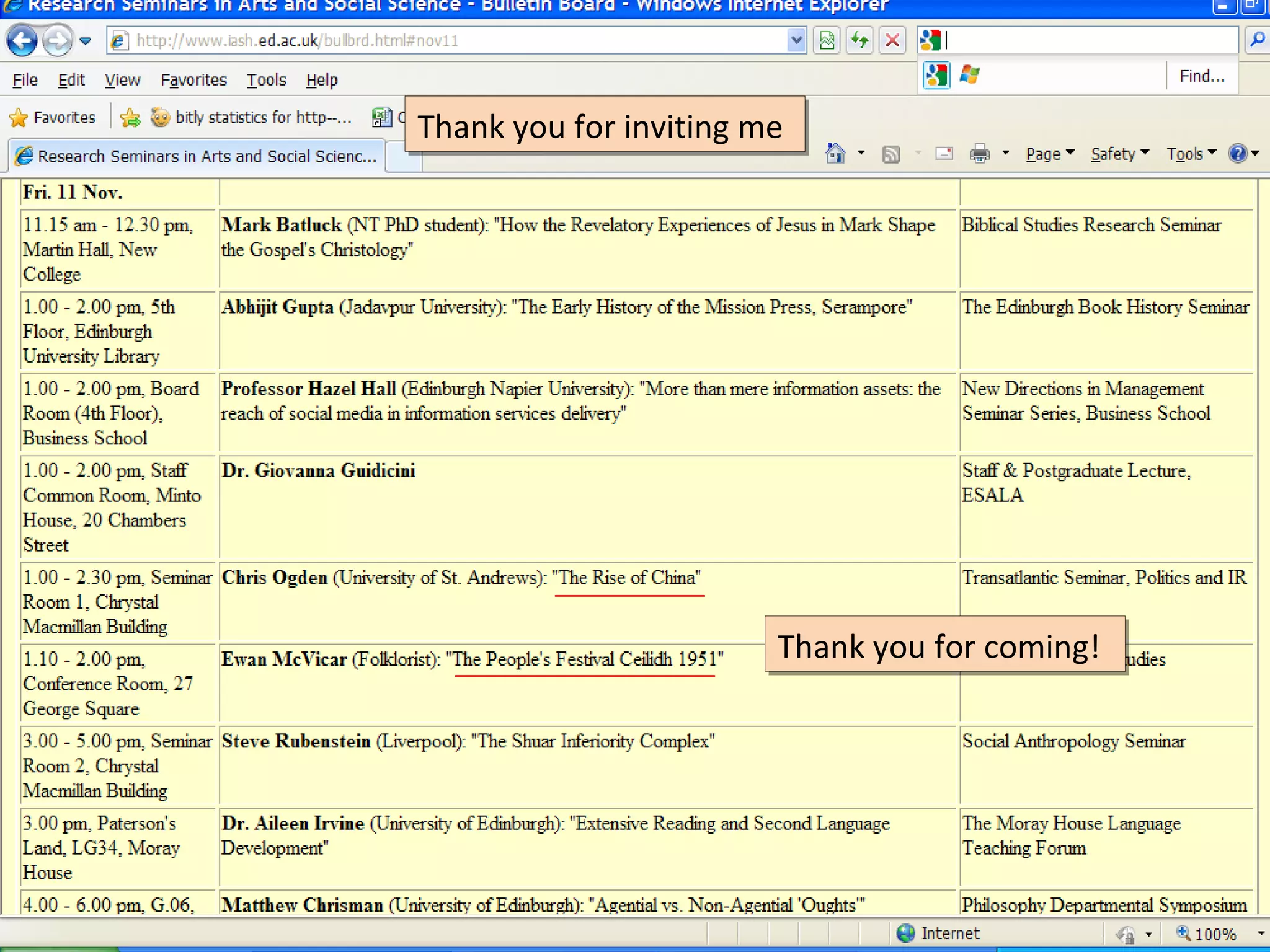
                        Thank you for coming!
                        Thank you for coming!
http://about.me/hazelh

Twitter: @hazelh
Twitter: @hazelh
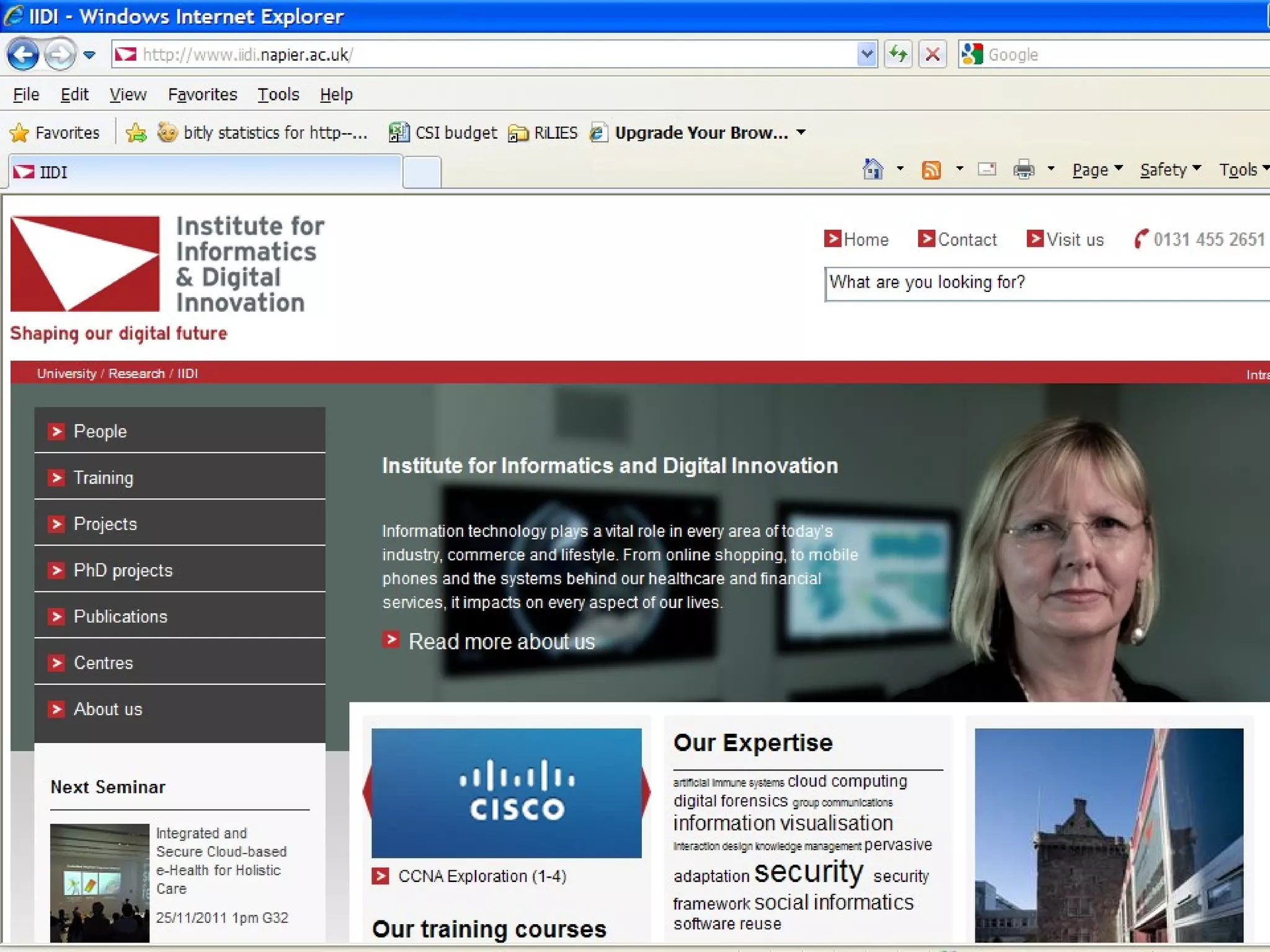
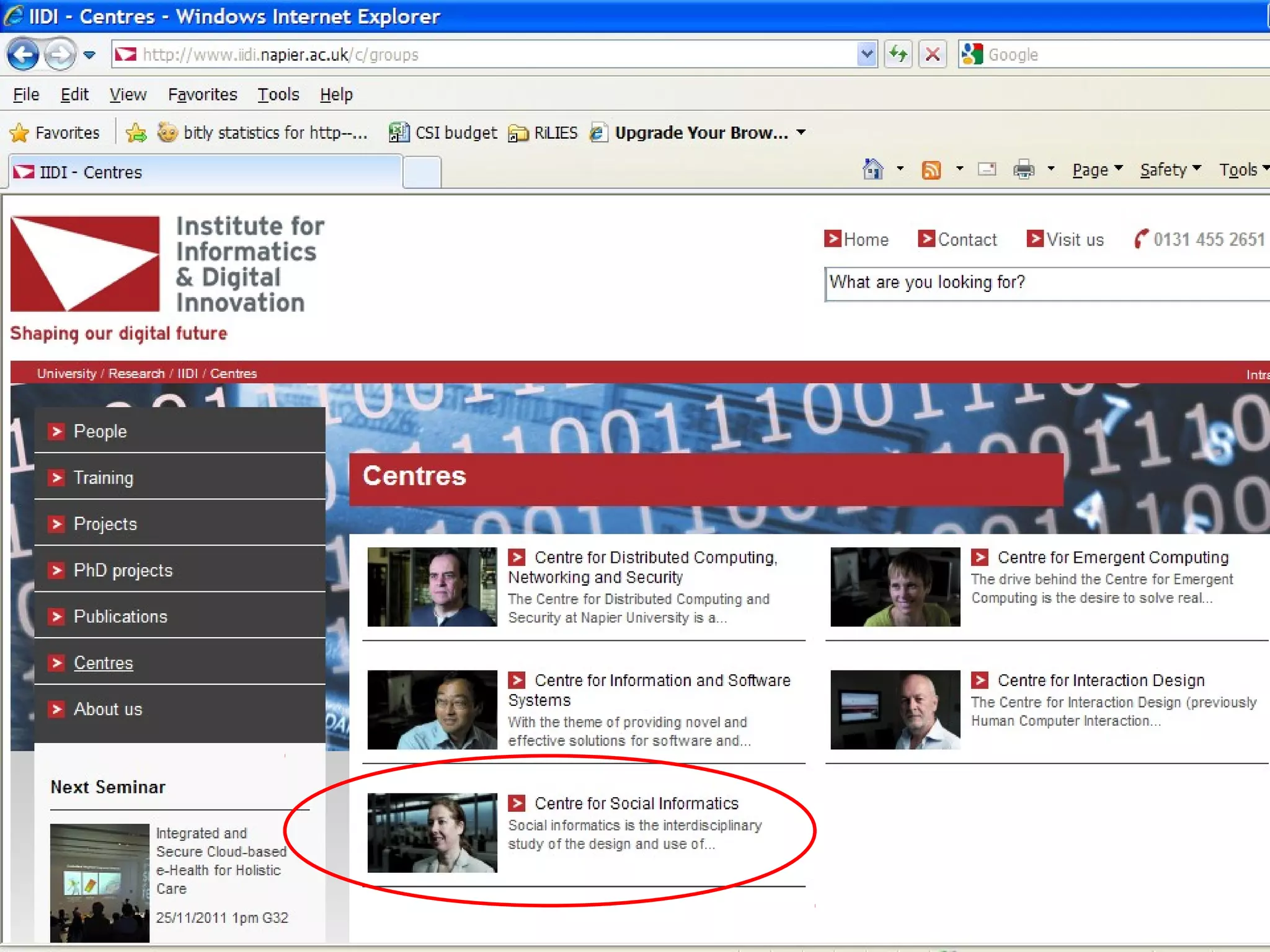
Centre for Social Informatics

 e-democracy, e-government, e-participation,
  e-petitioning
 information society
 information and knowledge management
 library and information science research
Research, evaluate, advise,
                                Research, evaluate, advise,
                                train on for example:
                                train on for example:
                                Systems
                                Systems
                                Markets
                                Markets
Centre for Social Informatics   Communities
                                Communities
                                Impact
                                Impact

 e-democracy, e-government, e-participation,
  e-petitioning
 information society
 information and knowledge management
 library and information science research
Provide strategic
Provide strategic
approach to LIS
approach to LIS
research in the UK
research in the UK
Provide strategic
Provide strategic    Develop a formal
                     Develop a formal
approach to LIS
approach to LIS      UK-wide network
                     UK-wide network
research in the UK
research in the UK   of LIS researchers
                     of LIS researchers
Explore the extent
                                          Explore the extent
Provide strategic
Provide strategic    Develop a formal
                     Develop a formal     to which LIS
                                          to which LIS
approach to LIS
approach to LIS      UK-wide network
                     UK-wide network      research influences
                                          research influences
research in the UK
research in the UK   of LIS researchers
                     of LIS researchers   practice in the UK
                                          practice in the UK
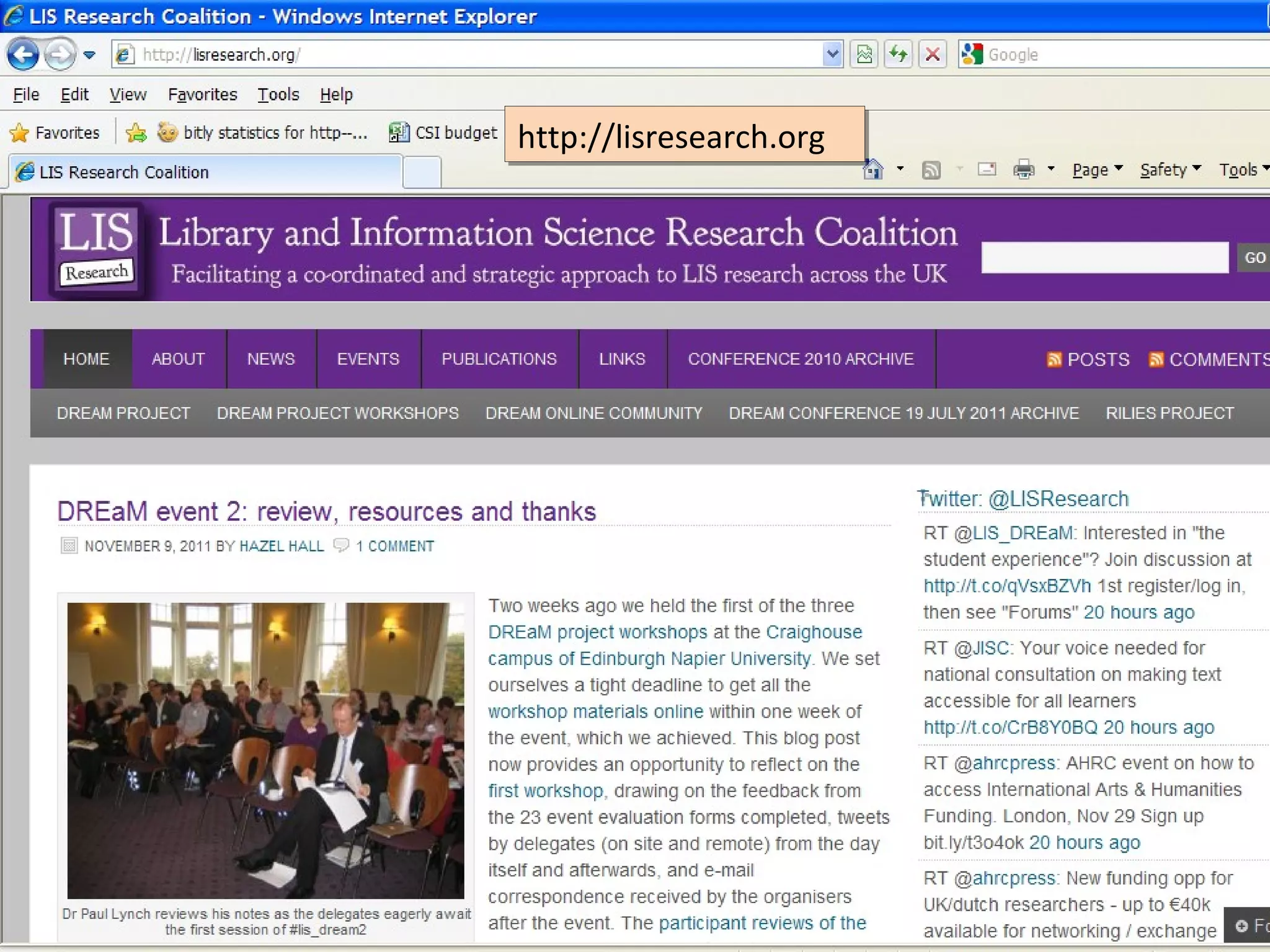
http://lisresearch.org
This presentation aligns with personal research
   interests
 Information sharing in online environments
 Communities
 Tool adoption/adaptation
This presentation aligns with personal research
   interests
 Information sharing in online environments
 Communities
 Tool adoption/adaptation

Within specific professional context
 Information services delivery
Key points

 Social media deployment in information
  services delivery (generally) replicates
  traditional models of provision
Key points

 Social media deployment in information
  services delivery (generally) replicates
  traditional models of provision
 Personal professional use of social media
  amongst library and information services staff
  points to possibilities for sophisticated services
  enhancement
Key points

 Social media deployment in information
  services delivery (generally) replicates
  traditional models of provision
 Personal professional use of social media
  amongst library and information services staff
  points to possibilities for sophisticated services
  enhancement
 Tool uncertainty, role traditions and
  restrictions of external environment limit
  scope
 Social media deployment in information
  services delivery (generally) replicates
  traditional models of provision
   Treated as information assets to be integrated into
    existing service models
 Social media deployment in information
  services delivery (generally) replicates
  traditional models of provision
   Treated as information assets to be integrated into
    existing service models
       Information access and discovery (think cataloguing)
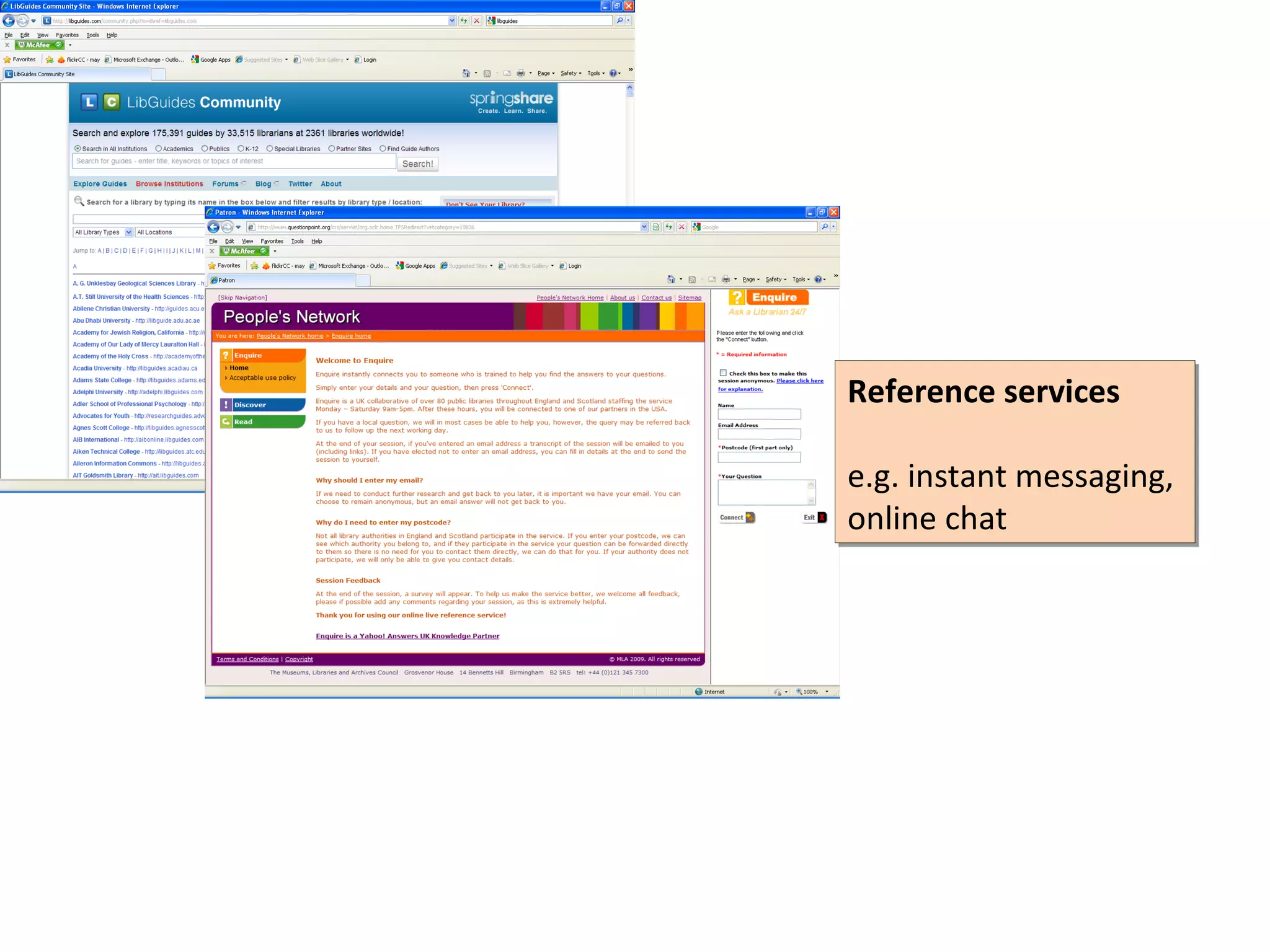
       Reference services
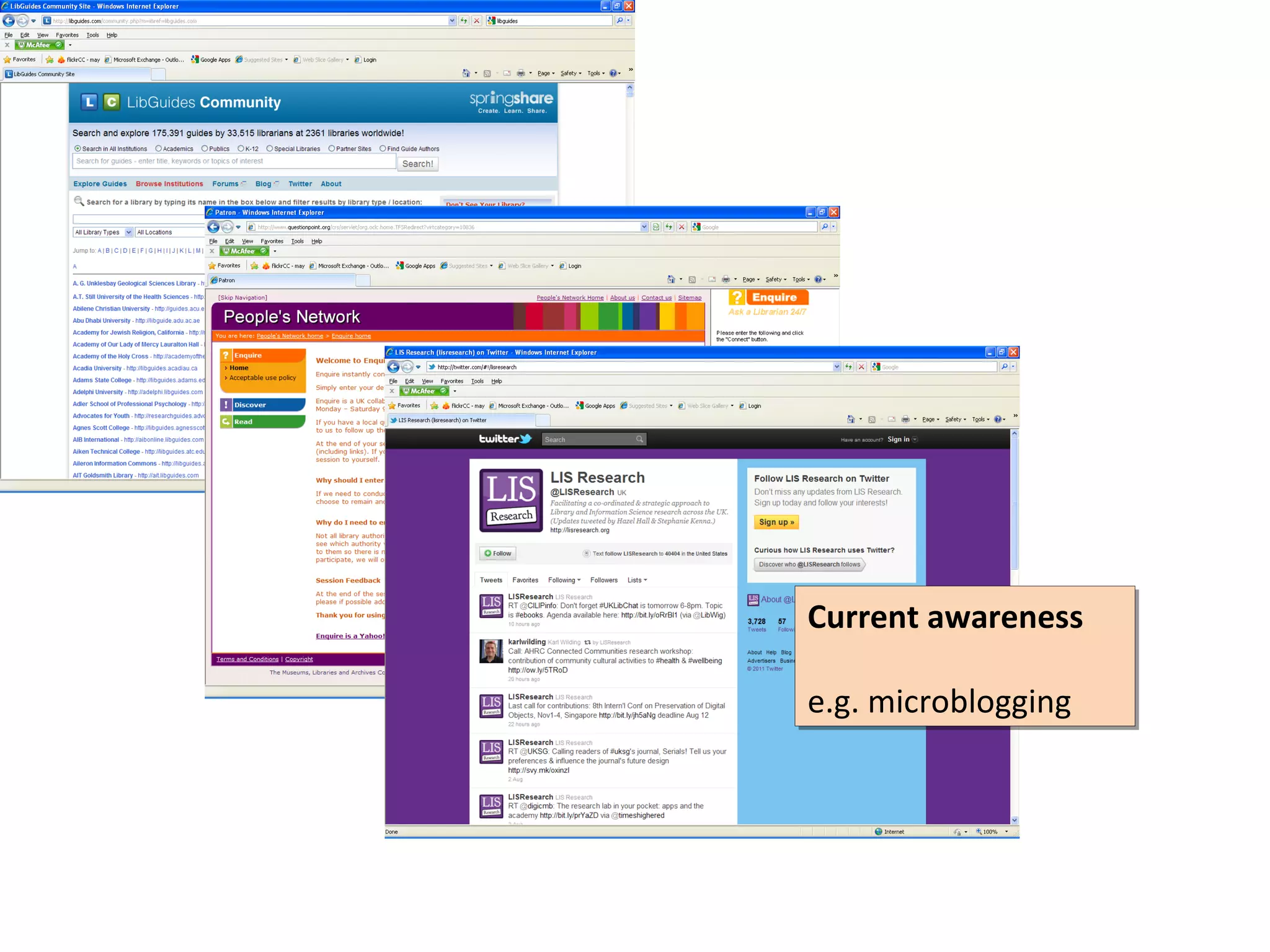
       Current awareness
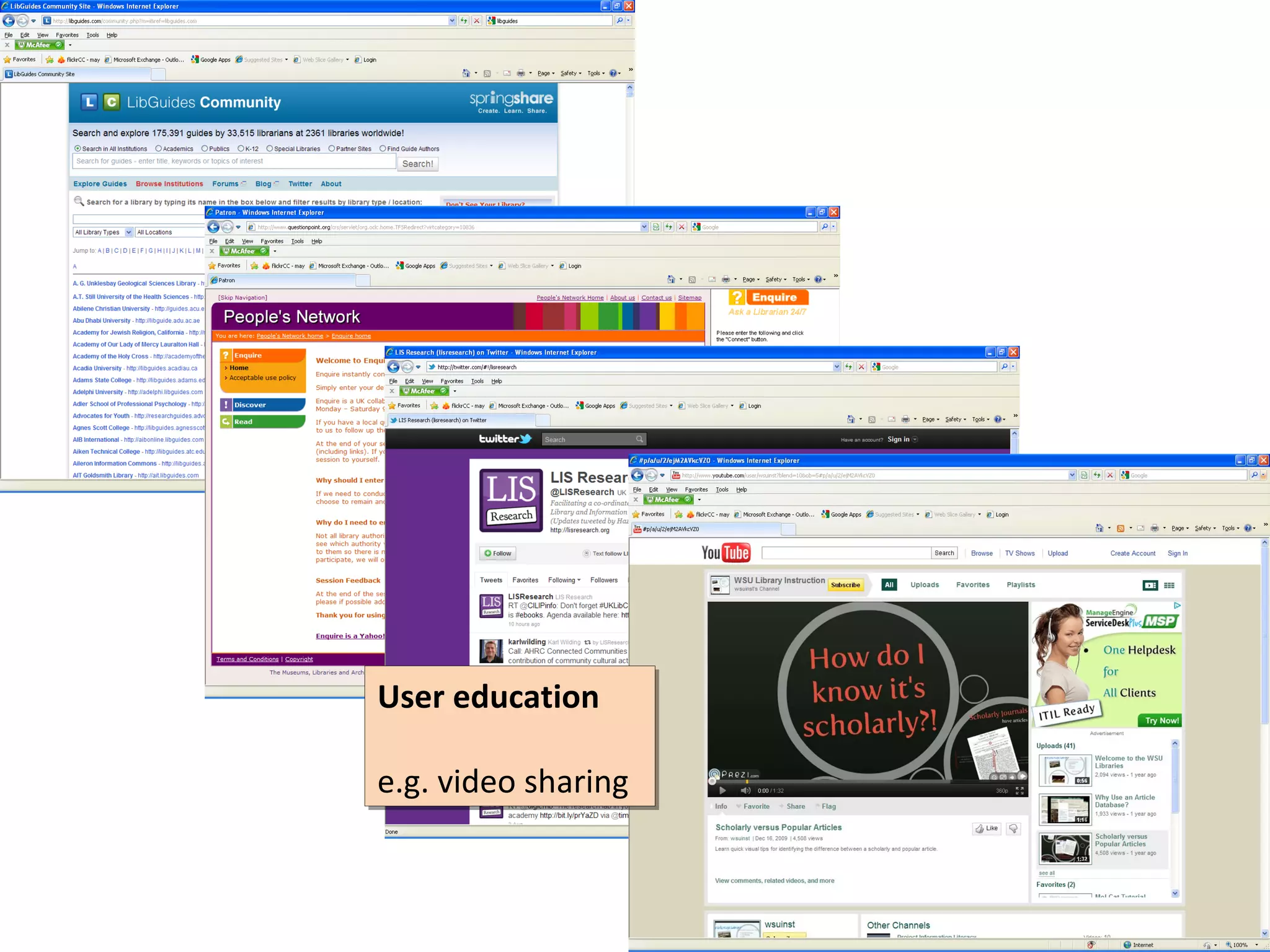
       User education
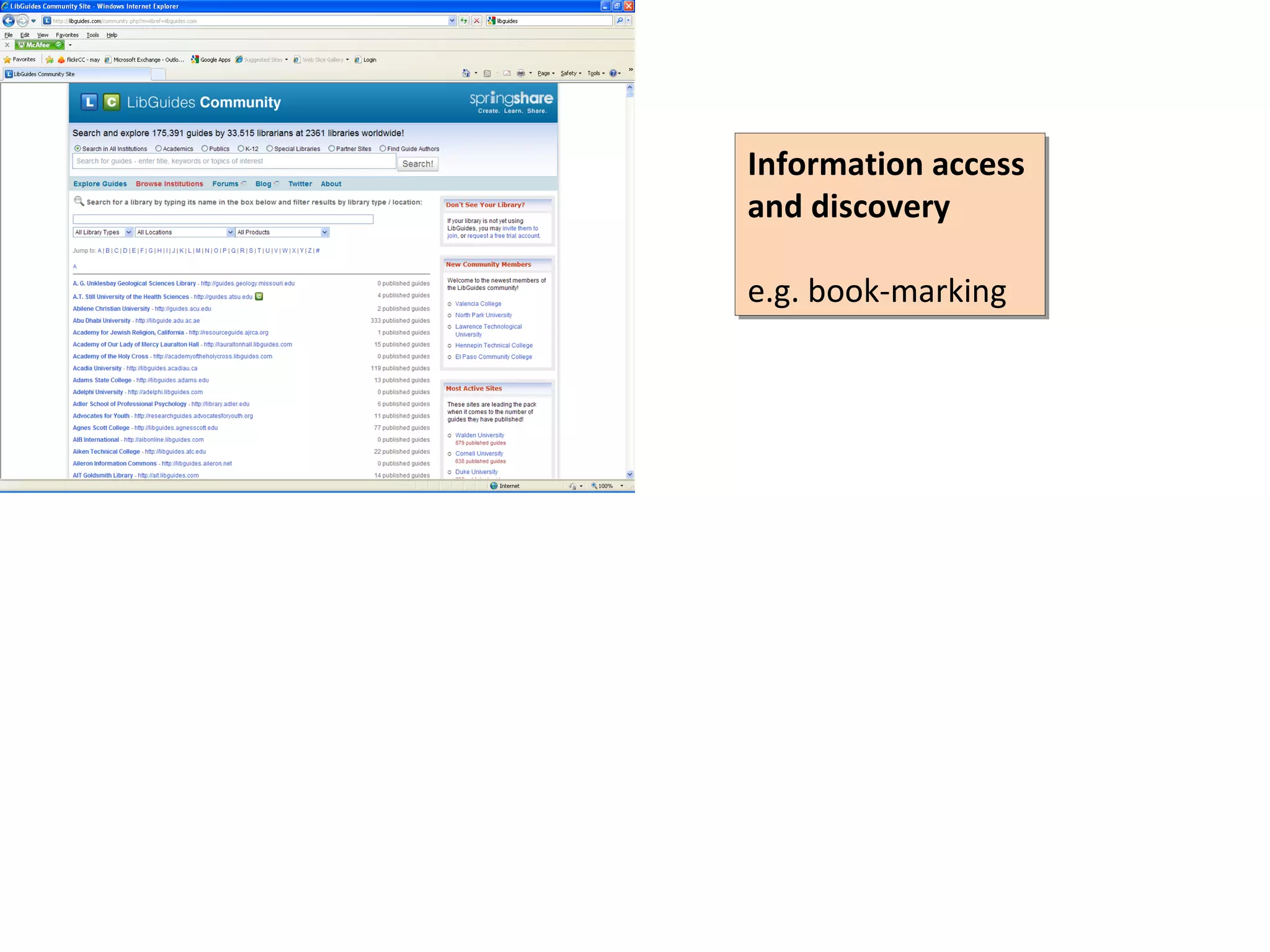
Information access
Information access
and discovery
and discovery

e.g. book-marking
e.g. book-marking
Reference services
Reference services

e.g. instant messaging,
online chat
online chat
Current awareness
Current awareness

e.g. microblogging
e.g. microblogging
User education
User education

e.g. video sharing
e.g. video sharing
 So, in general…
   Broadcasters (librarians) create
   Customers (users) consume
   There are few opportunities (if any) for user
    collaboration, co-production, contributions to
    decision making
       To take advantage of the “social”, recognition that these
        tools aggregate more than data/information:
        relationships, experience…
   Communication is prioritised over community
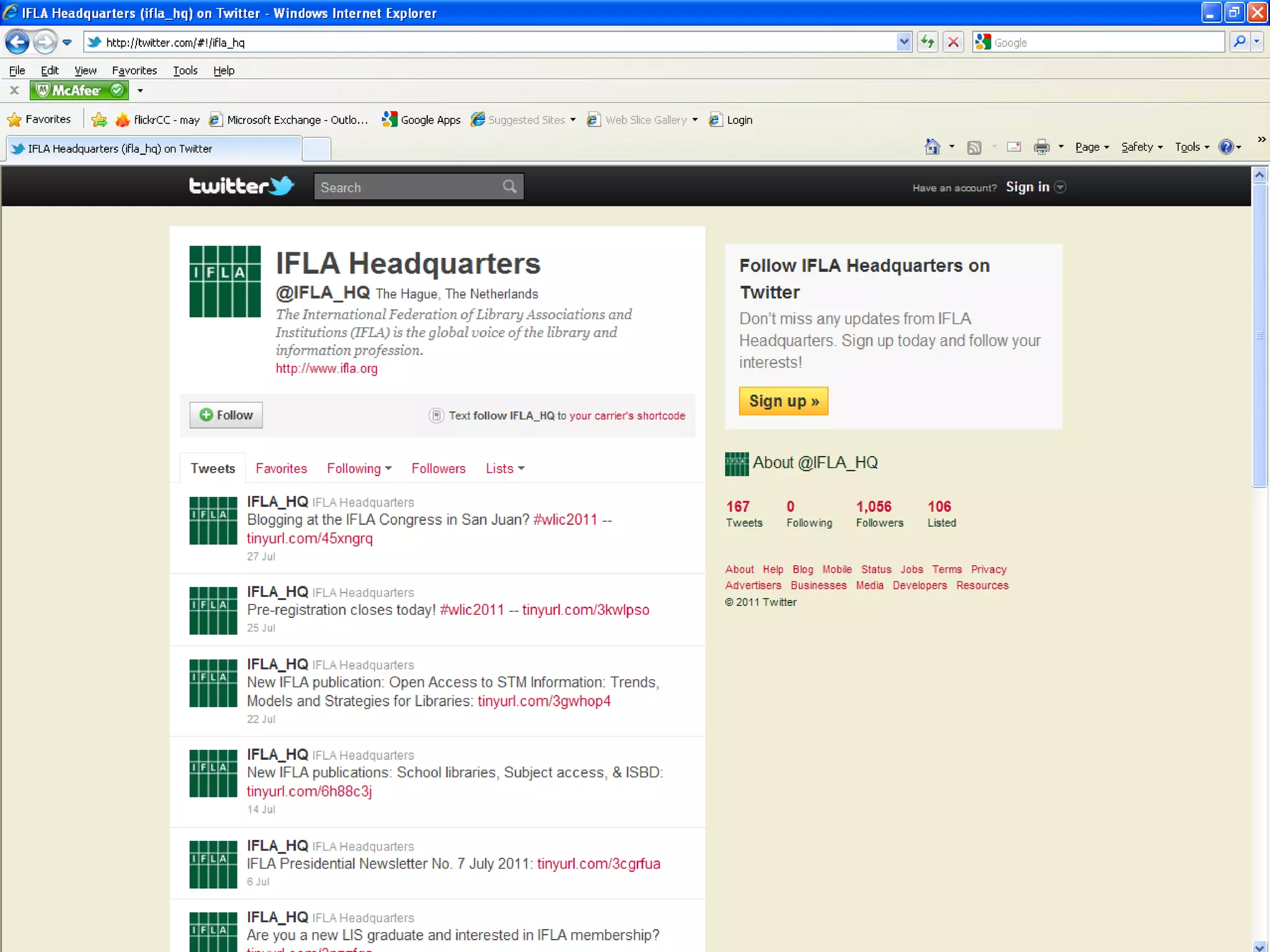
News and current awareness


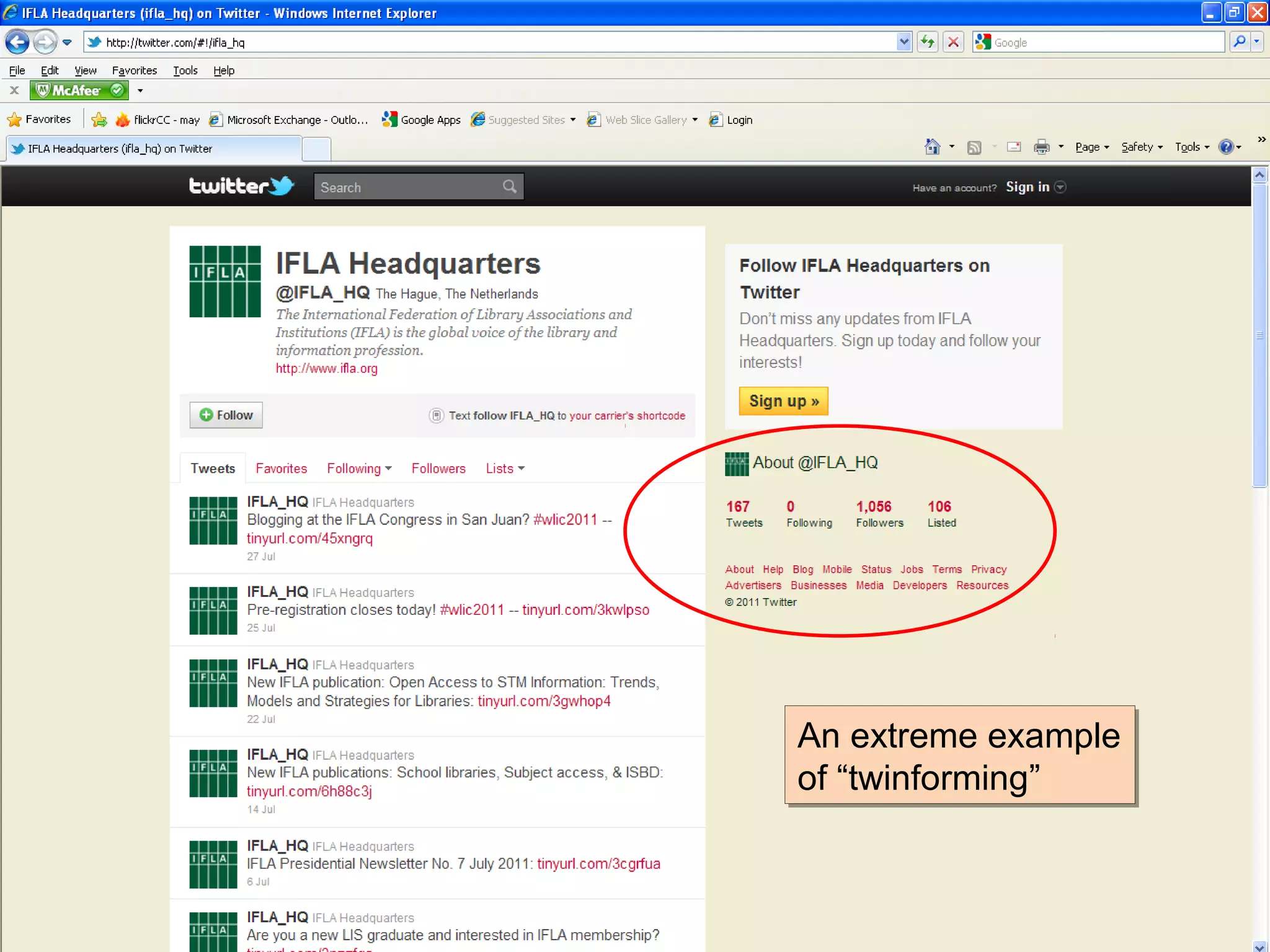
                             An extreme example
                             An extreme example
                             of “twinforming”
                             of “twinforming”
Key points

 Social media deployment in information
  services delivery (generally) replicates
  traditional models of provision
 Personal professional use of social media
  amongst library and information services staff
  points to possibilities for sophisticated services
  enhancement
Key points

 Social media deployment in information
  services delivery (generally) replicates
  traditional models of provision
 Personal professional use of social media
  amongst library and information services staff
  points to possibilities for sophisticated services
  enhancement
       Loudon, L. & Hall, H. (2010). From triviality to business
       Loudon, L. & Hall, H. (2010). From triviality to business
       tool: the case of Twitter in information services
       tool: the case of Twitter in information services
       delivery. Business Information Review, 27(4), 236-241.
       delivery. Business Information Review, 27(4), 236-241.
Community, collaboration and co-production

 “Meeting” in social media space
   A “place” for members
 Collaborating in social media space
   Platforms for membership co-production
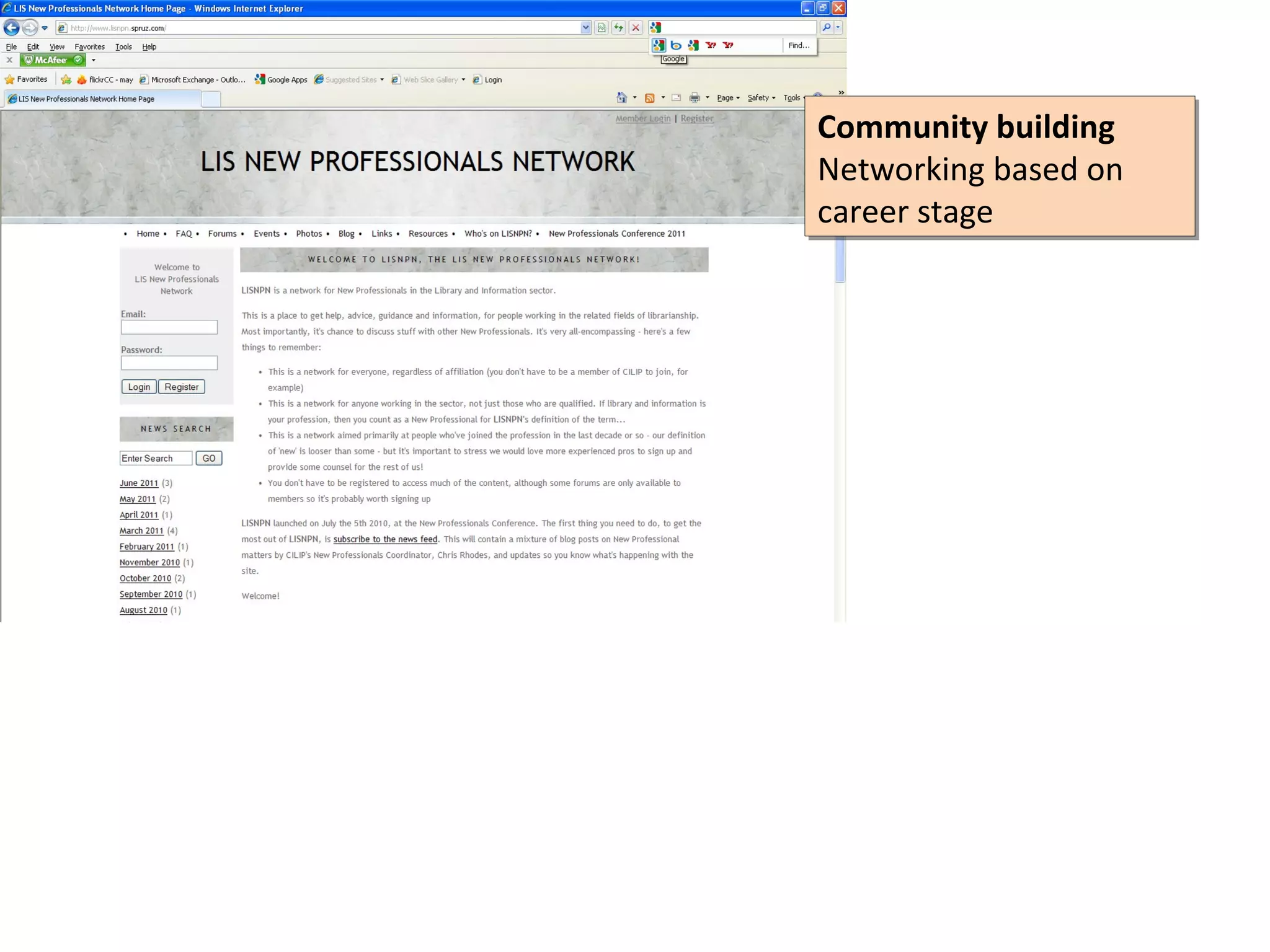
Community building
Community building
Networking based on
Networking based on
career stage
career stage
Community building
                        Community building
                        Networking based on
                        Networking based on
                        career stage
                        career stage


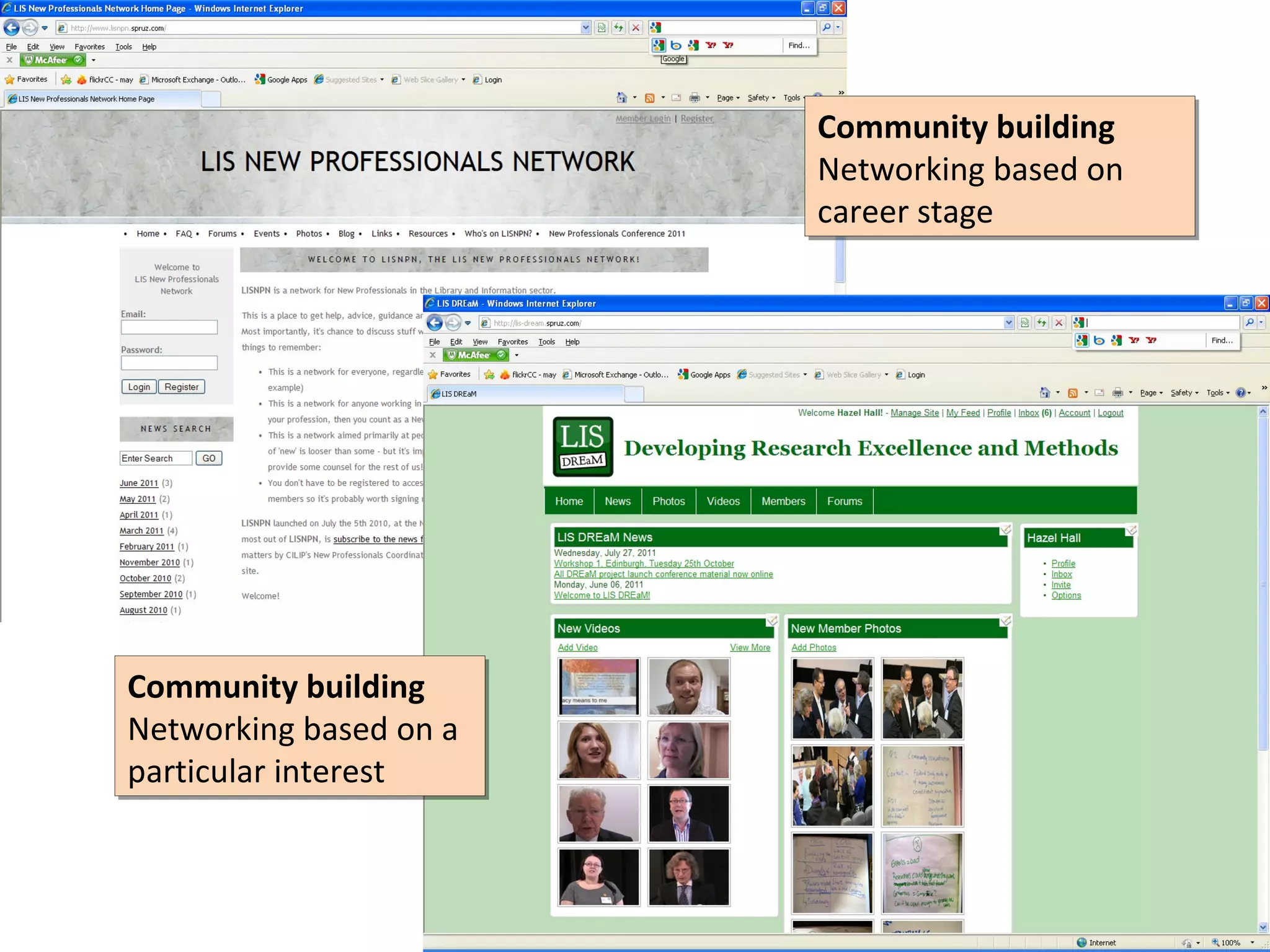
Community building
Community building
Networking based on a
particular interest
particular interest
Community building
                                        Community building
                                        Networking based on
                                        Networking based on
                                        career stage
                                        career stage


           Meeting, making
           Meeting, making
           connections as peers
           connections as peers


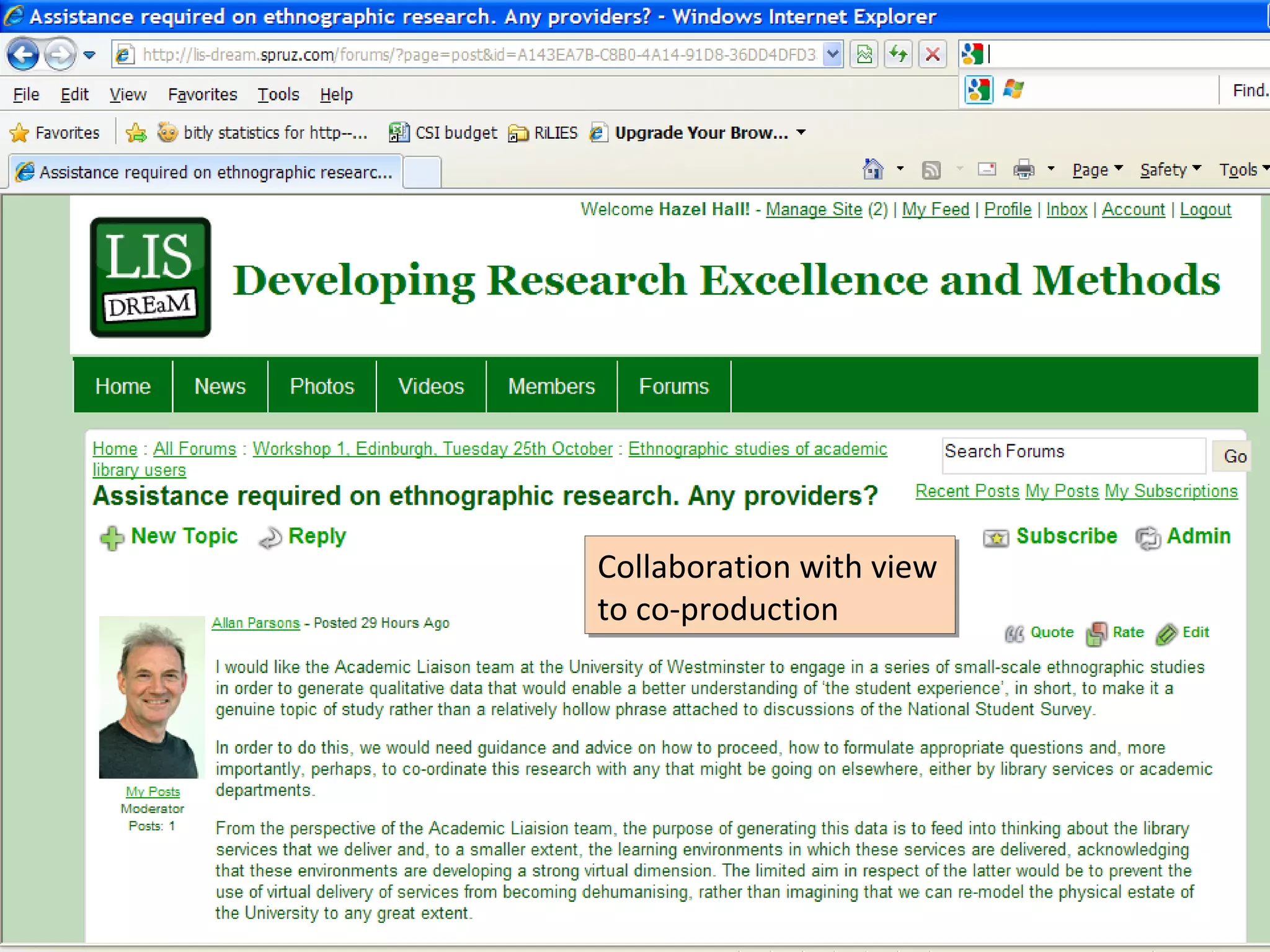
                          Collaboration with view
                          Collaboration with view
                          to co-production
                          to co-production

Community building
Community building
Networking based on
Networking based on
a particular interest
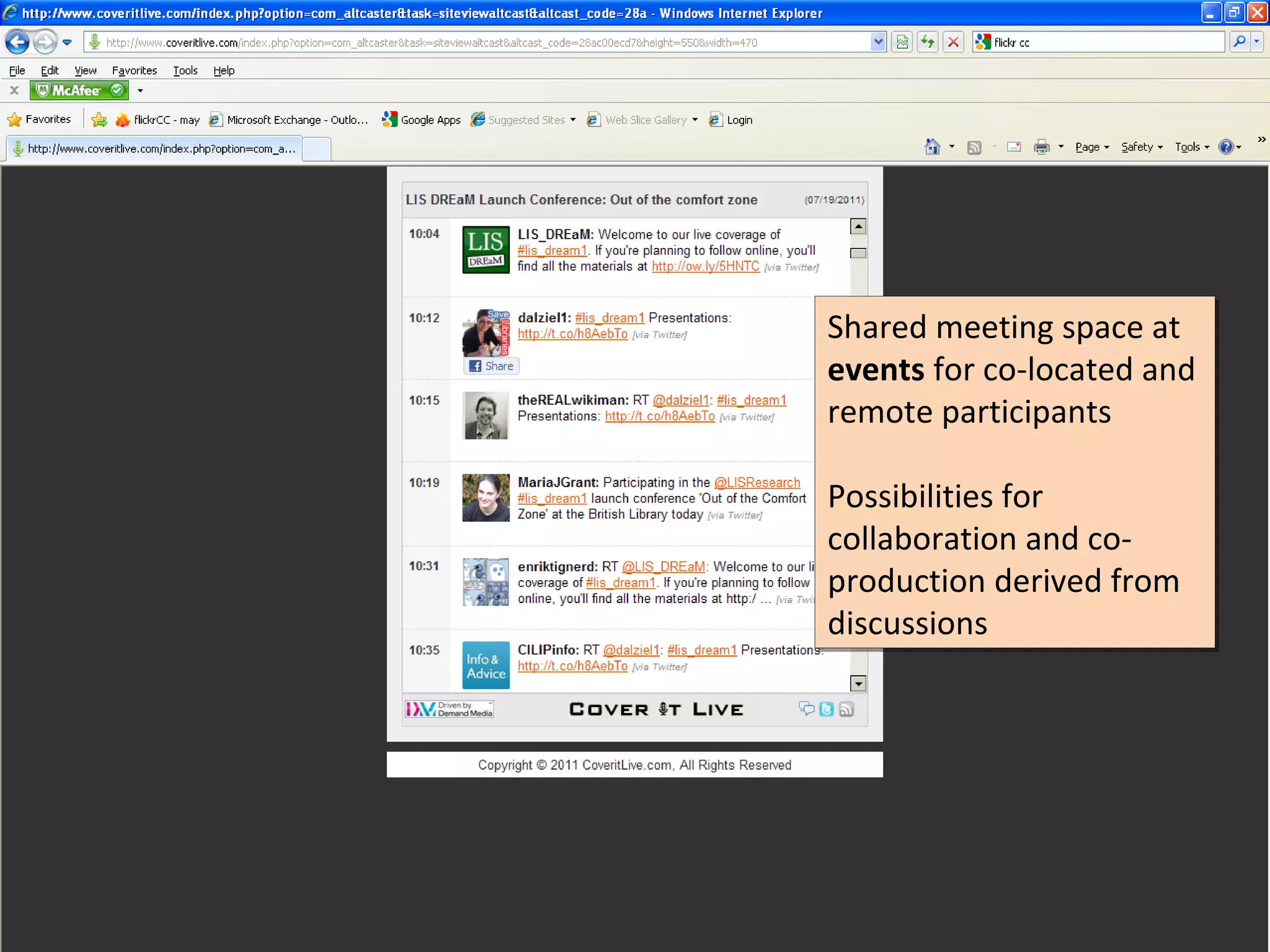
Shared meeting space at
events for co-located and
remote participants
remote participants

Possibilities for
Possibilities for
collaboration and co-
production derived from
discussions
discussions
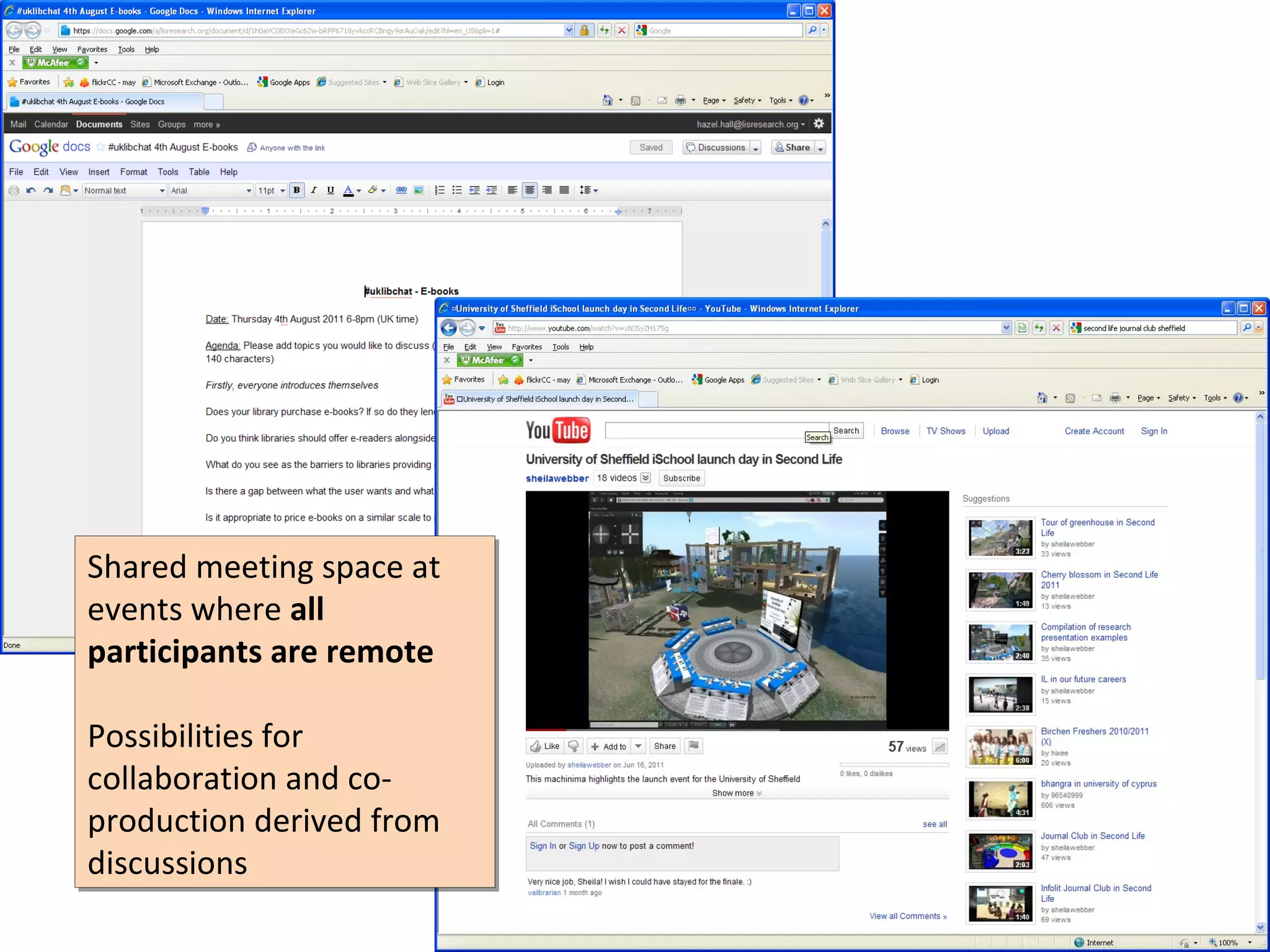
Shared meeting space at
events where all
events where all
participants are remote

Possibilities for
Possibilities for
collaboration and co-
production derived from
discussions
discussions
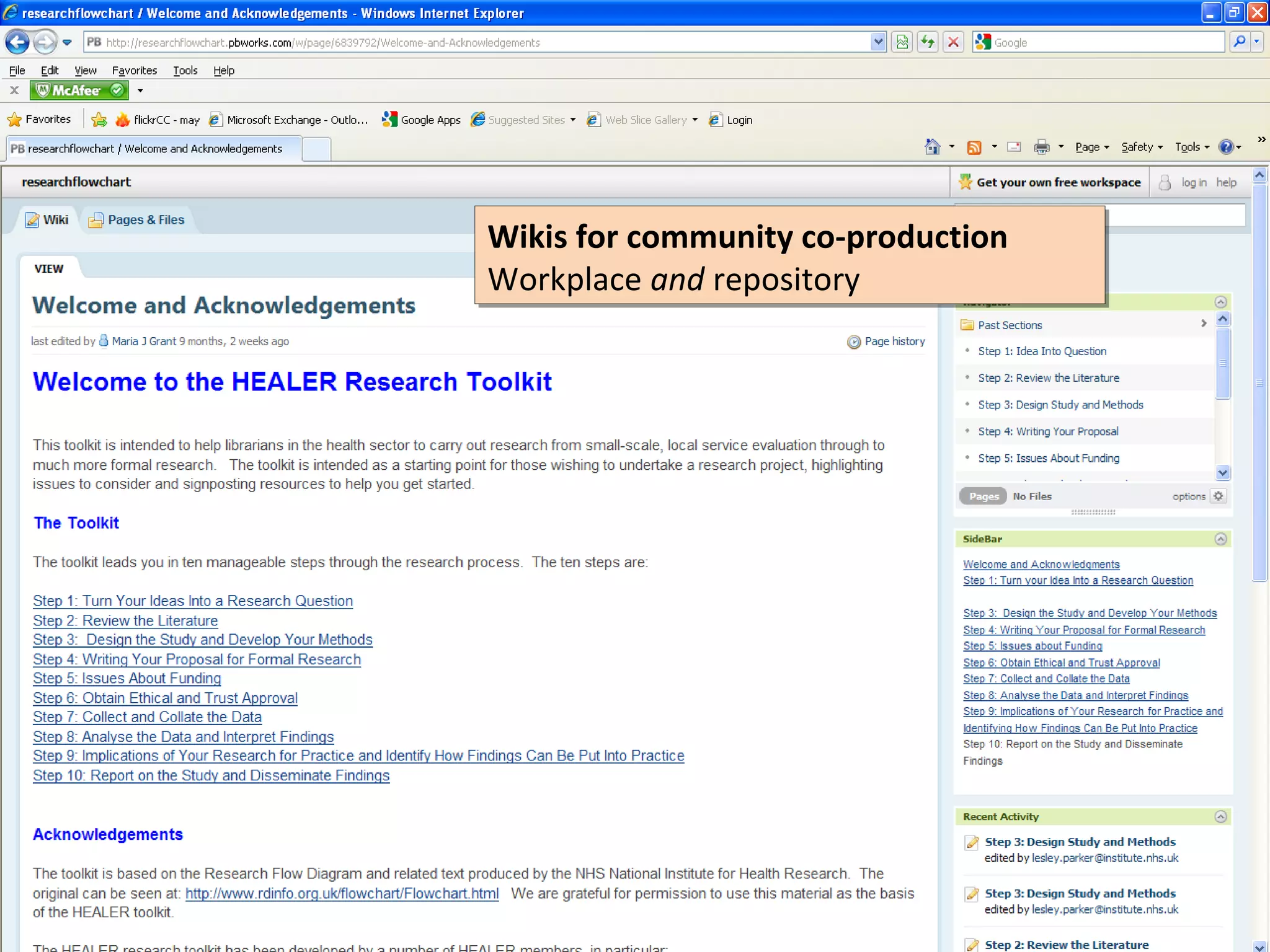
Wikis for community co-production
Workplace and repository
Other sophisticated information behaviours
  exhibited by librarians using social media
 To support staff development and career
  direction
 To promote productivity and efficiency at work
 To inspire innovation and services
  development
Blogging supports development and
career direction, e.g. peer review –
 career direction, e.g. peer review –
  ideas, work (and profile raising)
   ideas, work (and profile raising)
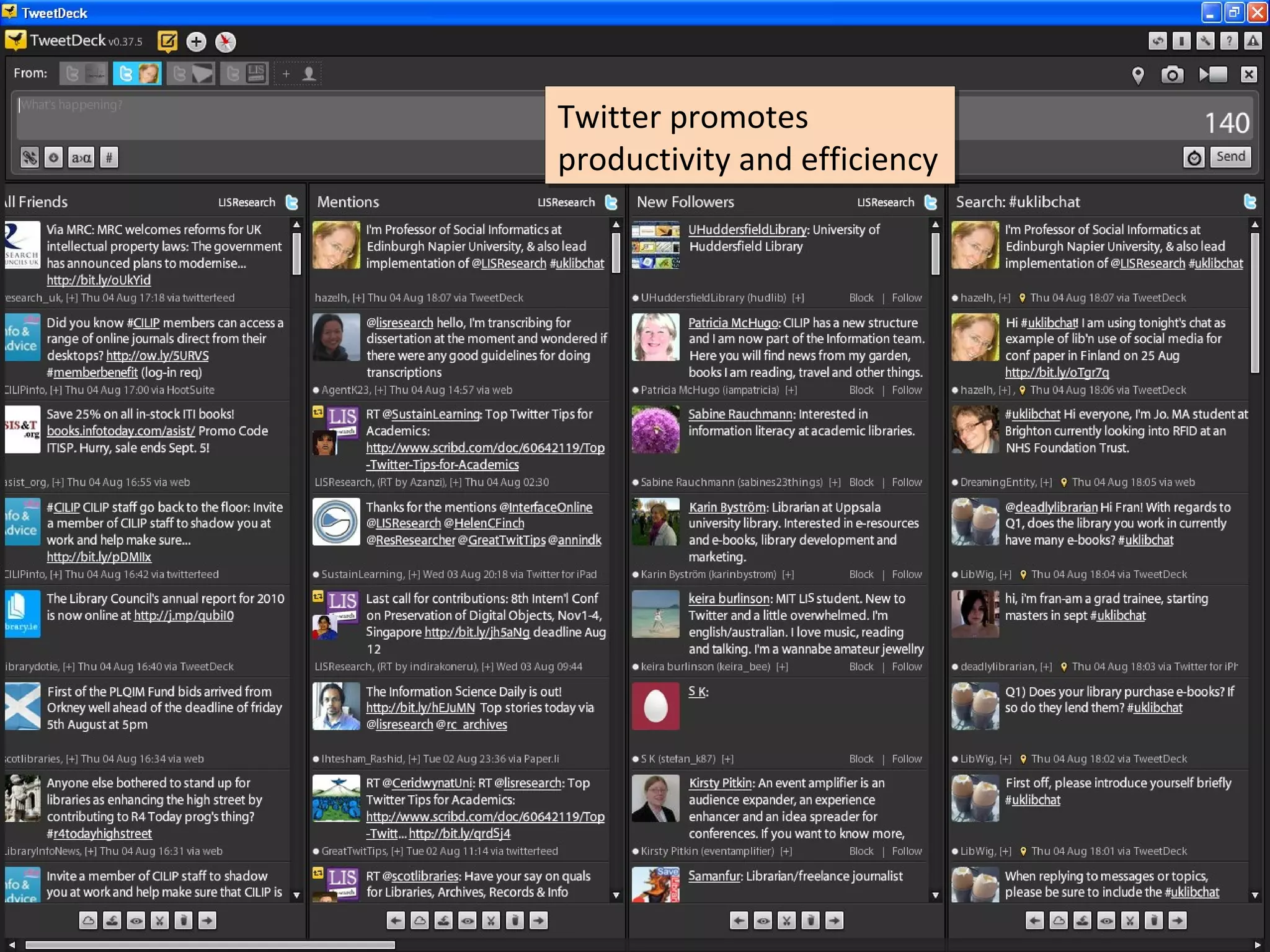
Twitter promotes
Twitter promotes
productivity and efficiency
Twitter promotes
                        Twitter promotes
                        productivity and efficiency
                        productivity and efficiency


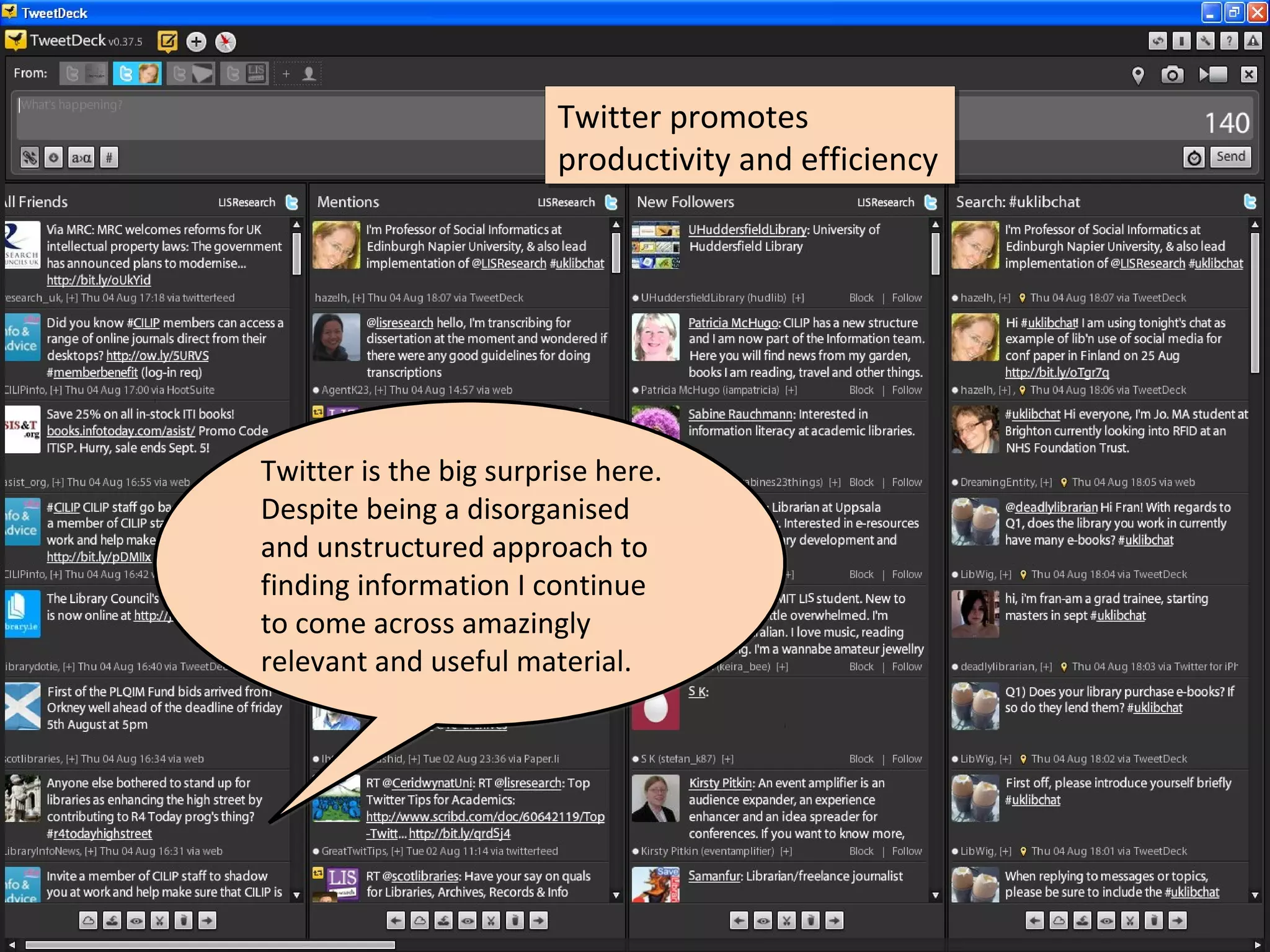
Twitter is the big surprise here.
Despite being a disorganised
and unstructured approach to
finding information I continue
to come across amazingly
relevant and useful material.
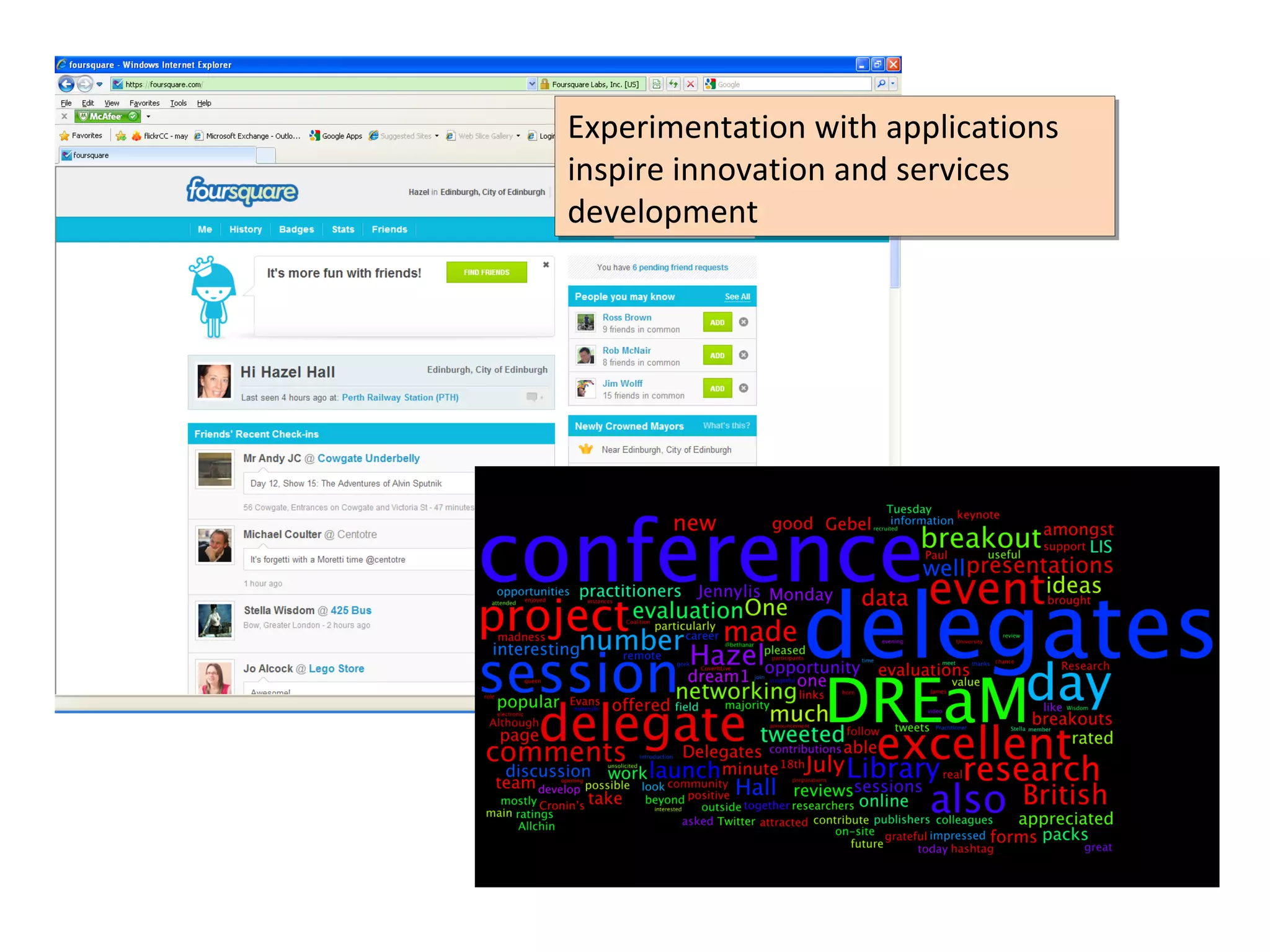
Experimentation with applications
inspire innovation and services
development
development
Key points

 Social media deployment in information
  services delivery (generally) replicates
  traditional models of provision
 Personal professional use of social media
  amongst library and information services staff
  points to possibilities for sophisticated services
  enhancement
 Tool uncertainty, role traditions and
  restrictions of external environment limit
  scope
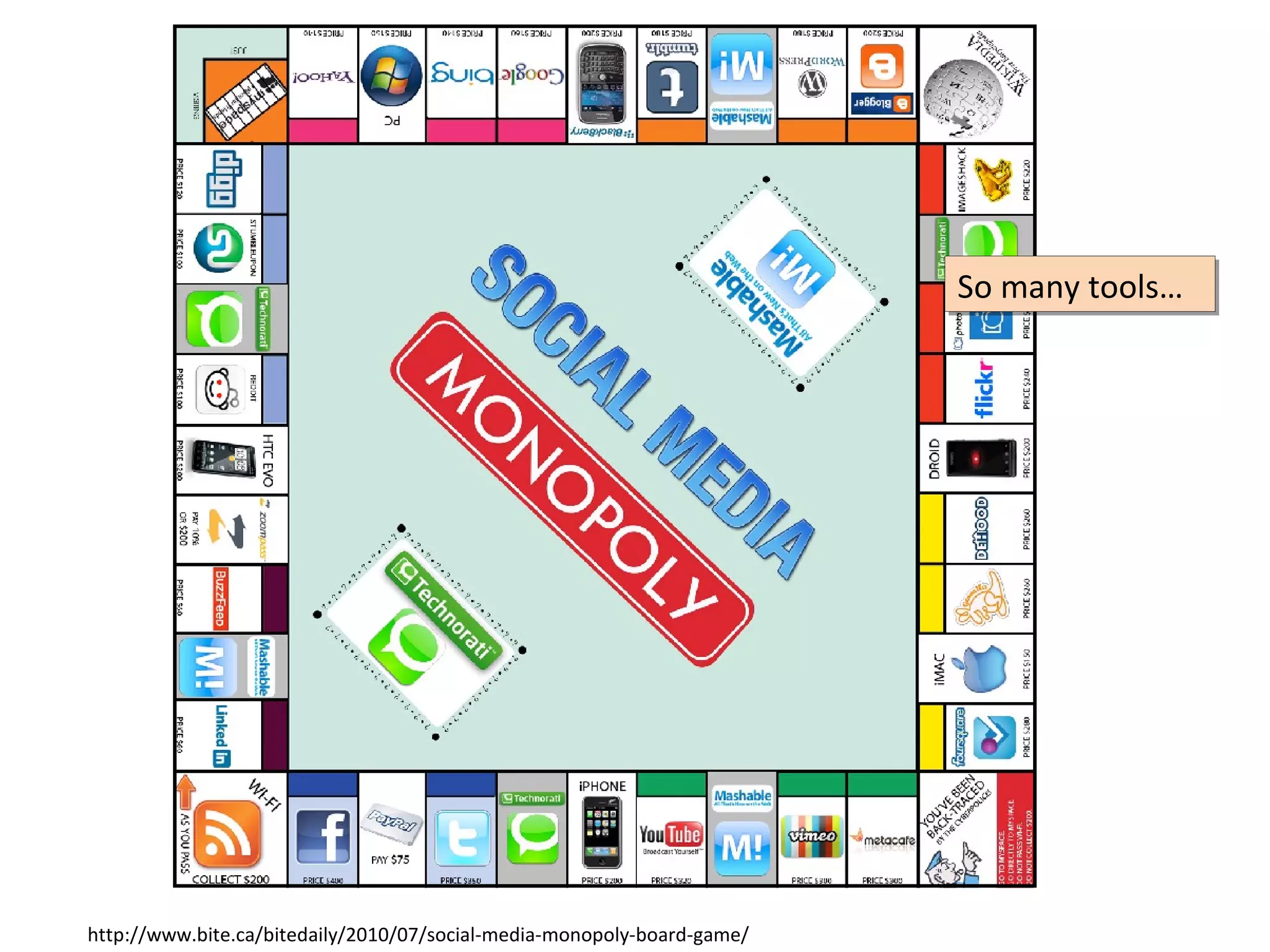
So many tools…
                                                                         So many tools…


http://www.bite.ca/bitedaily/2010/07/social-media-monopoly-board-game/
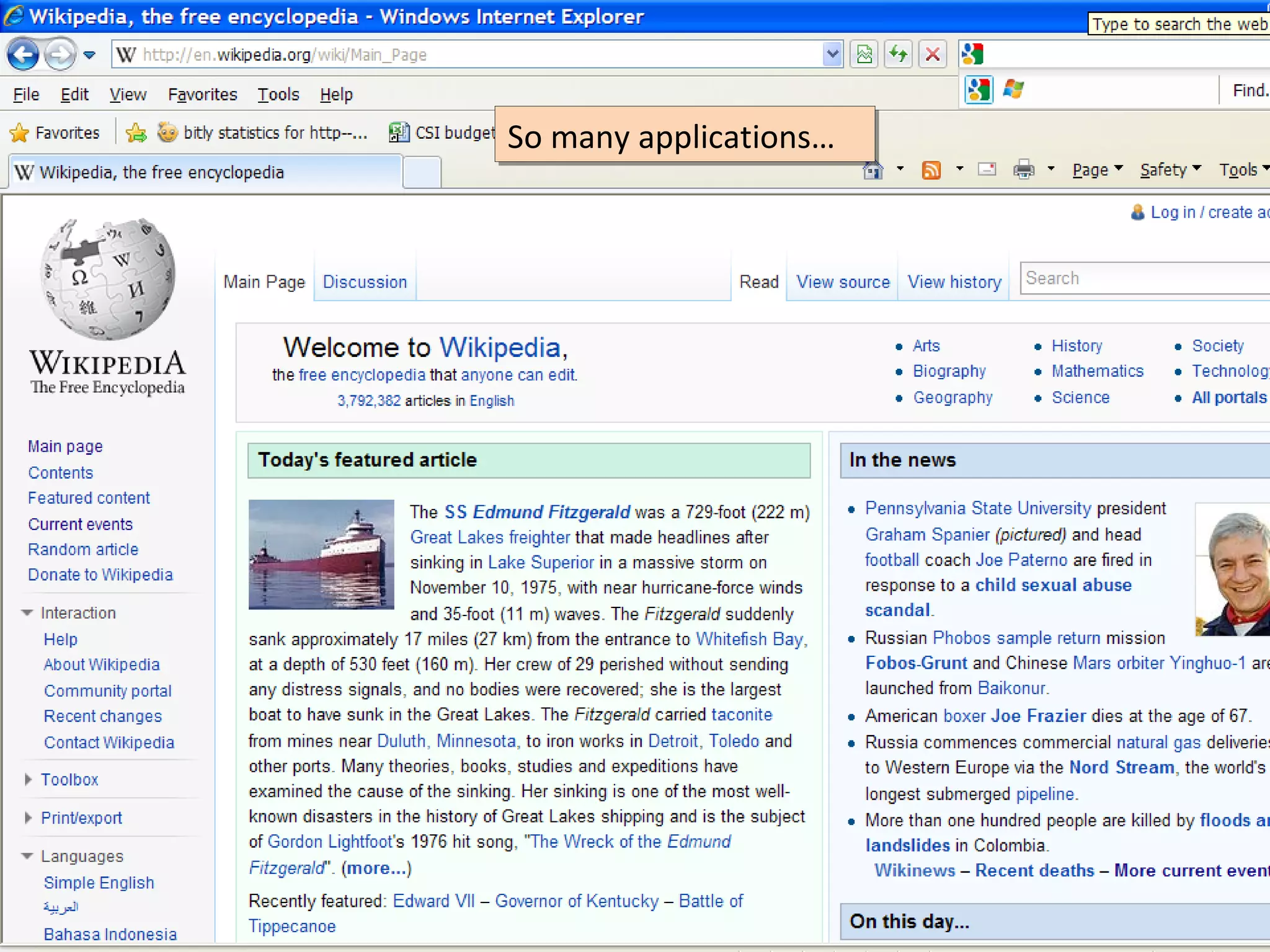
So many applications…
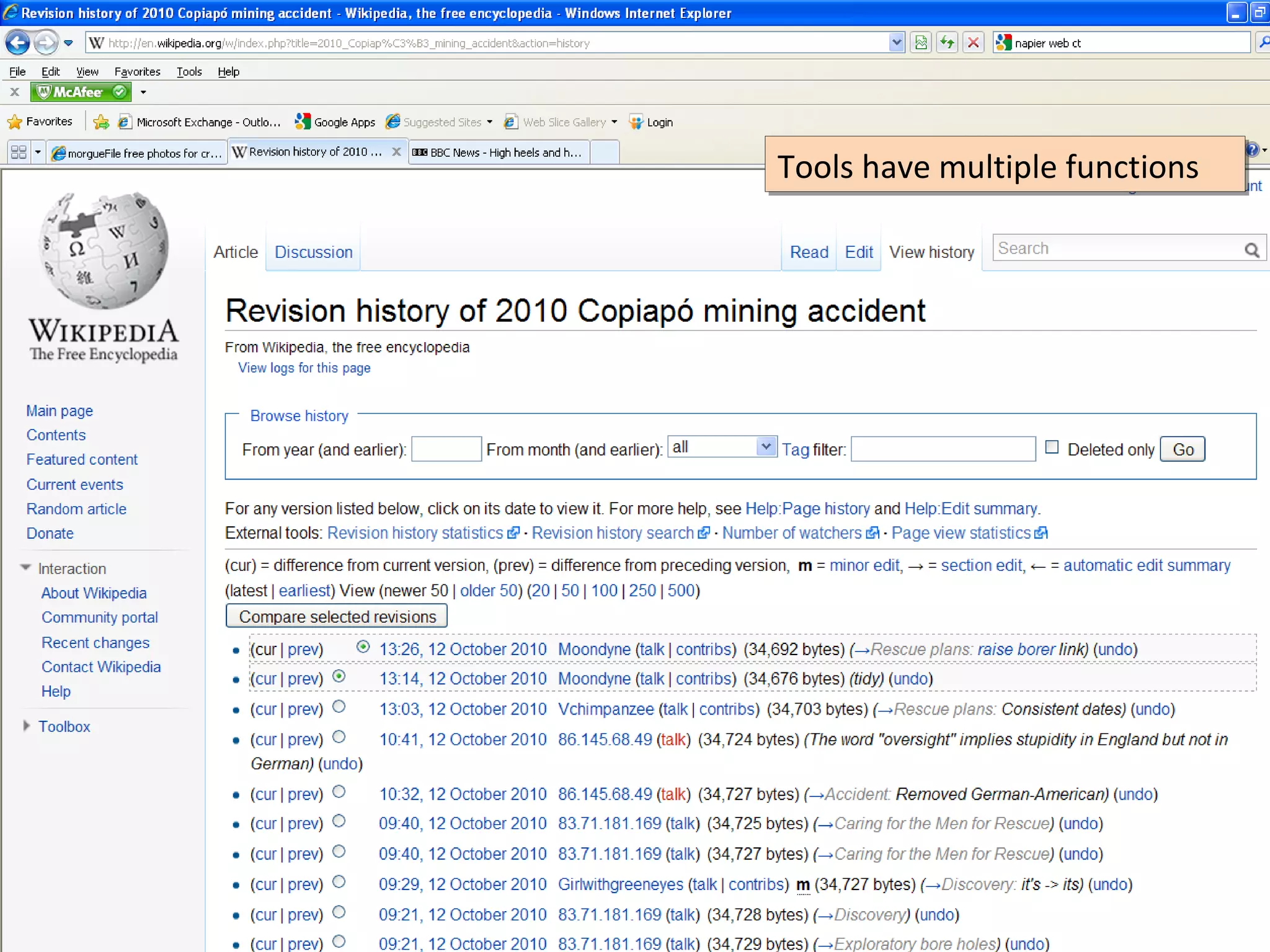
Tools have multiple functions
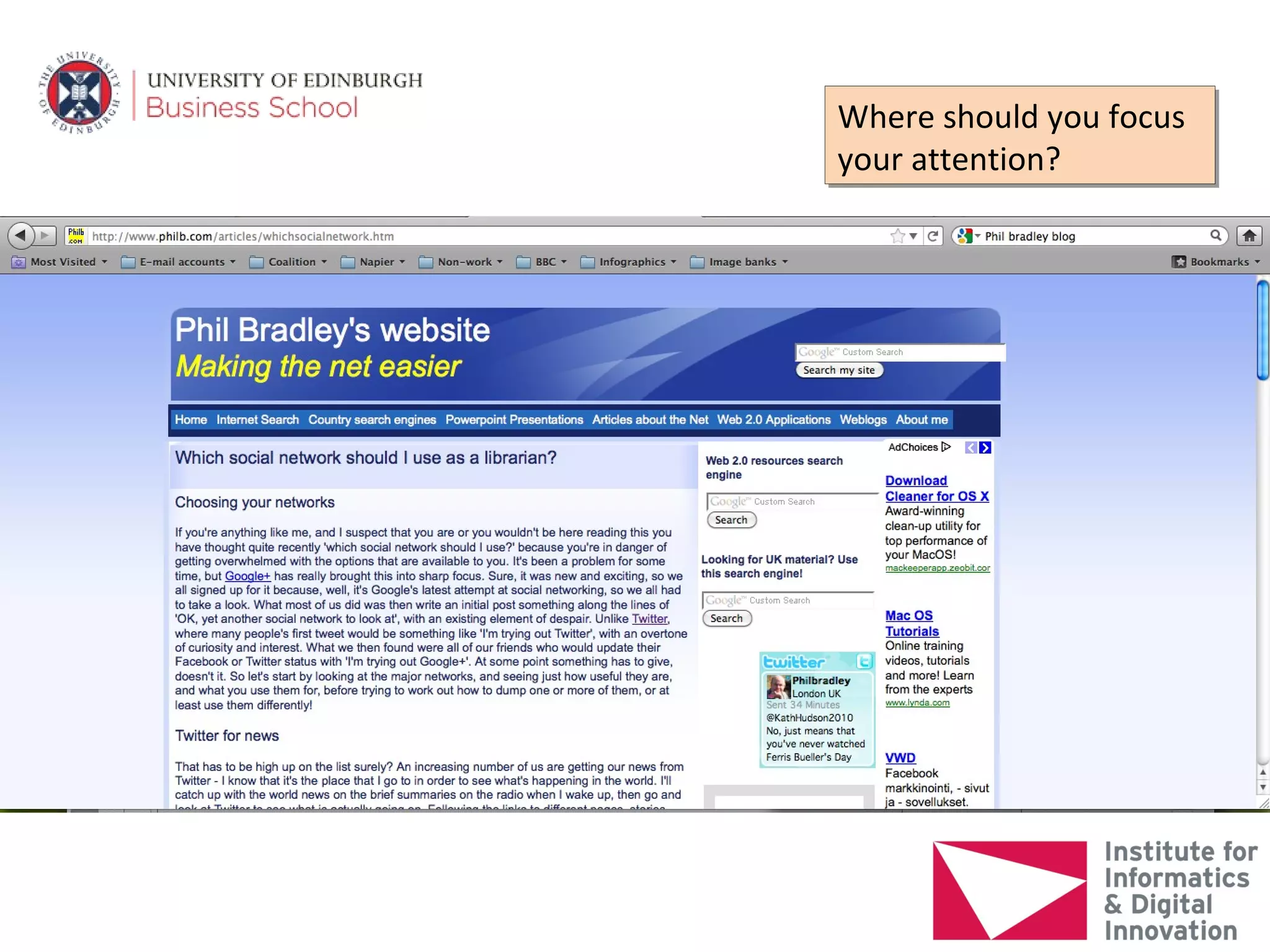
Where should you focus
your attention?
your attention?
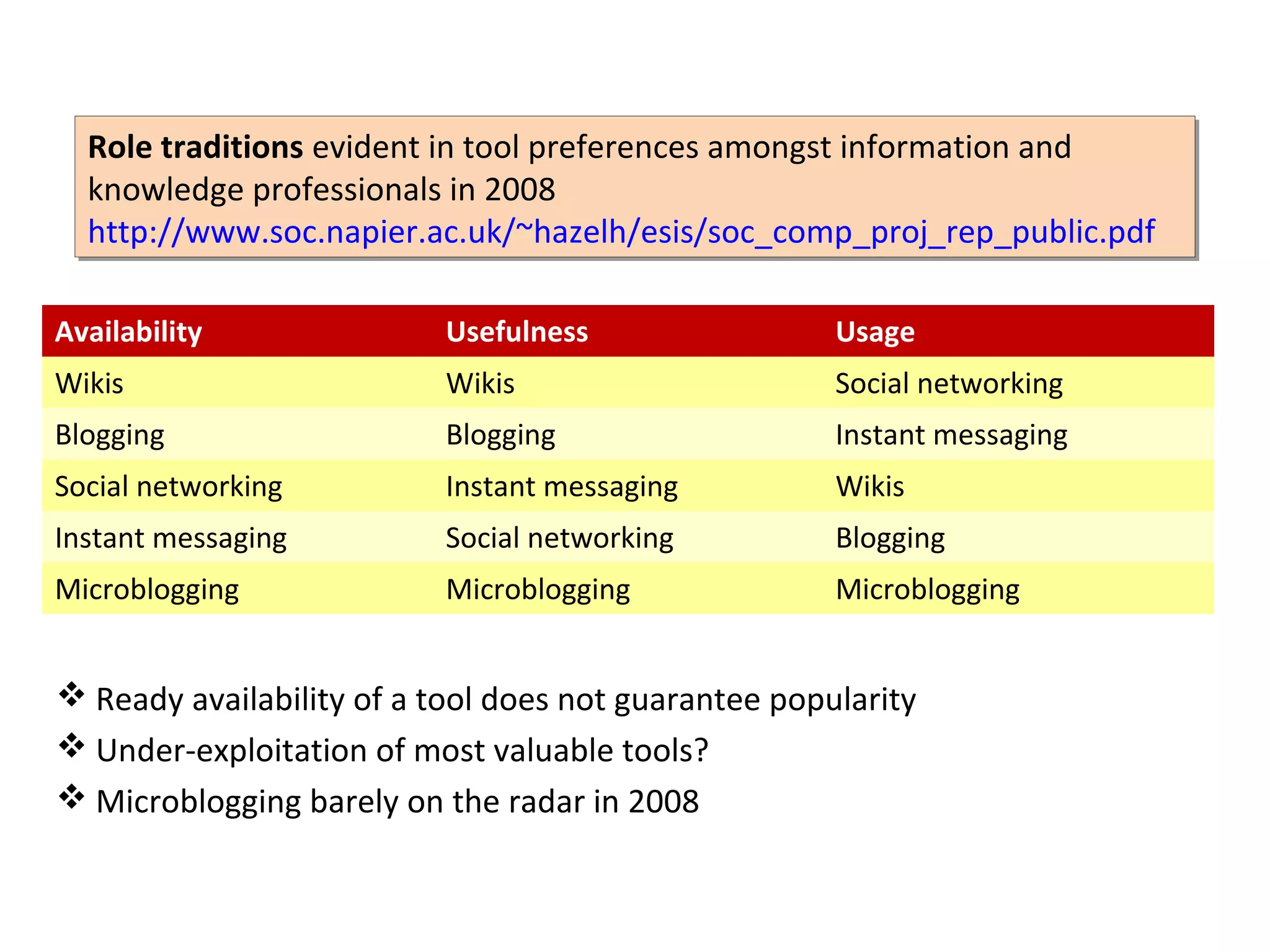
Role traditions evident in tool preferences amongst information and
  Role traditions evident in tool preferences amongst information and
  knowledge professionals in 2008
  knowledge professionals in 2008
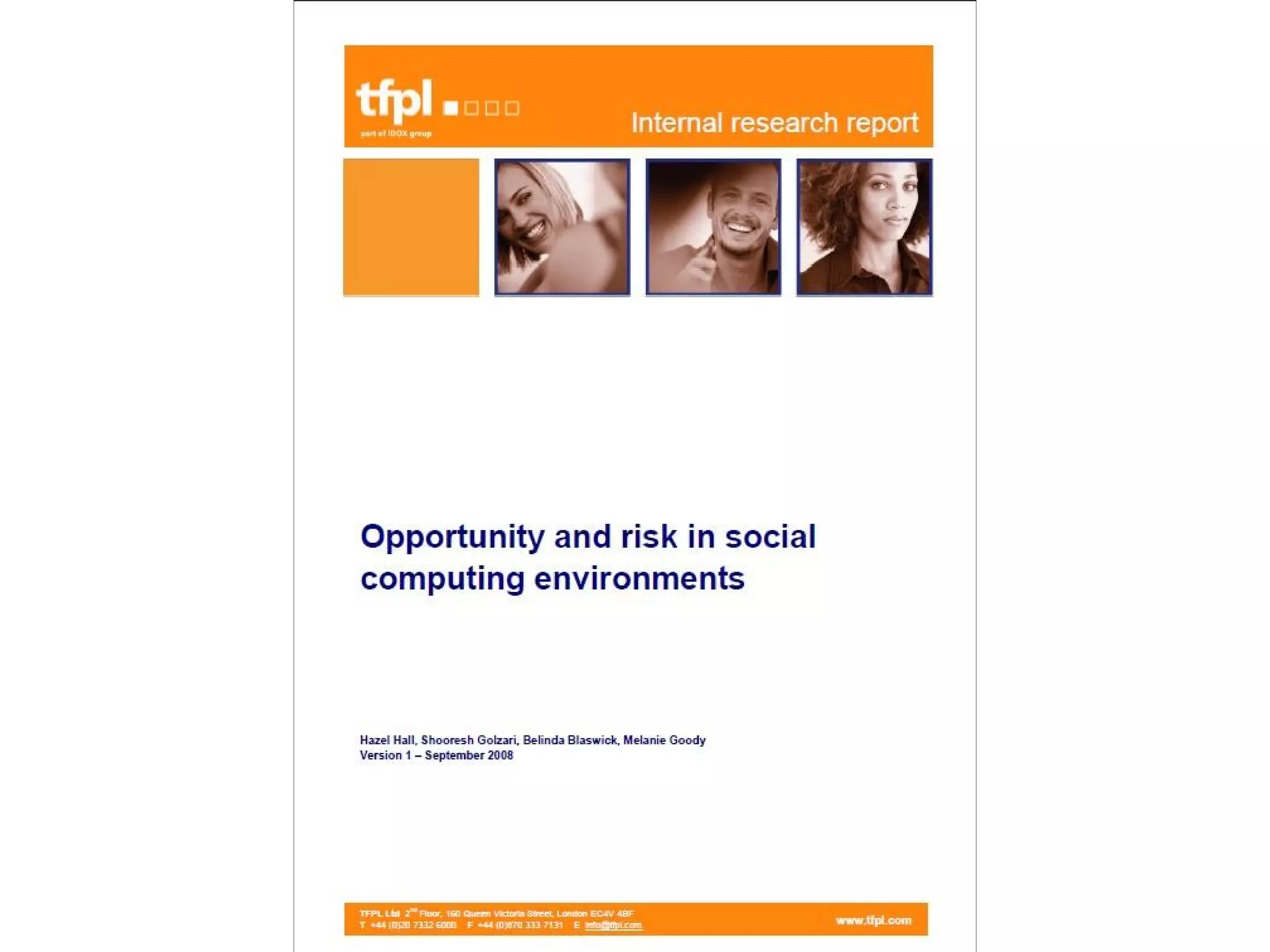
  http://www.soc.napier.ac.uk/~hazelh/esis/soc_comp_proj_rep_public.pdf
  http://www.soc.napier.ac.uk/~hazelh/esis/soc_comp_proj_rep_public.pdf

Availability               Usefulness                 Usage
Wikis                      Wikis                      Social networking
Blogging                   Blogging                   Instant messaging
Social networking          Instant messaging          Wikis
Instant messaging          Social networking          Blogging
Microblogging              Microblogging              Microblogging


 Ready availability of a tool does not guarantee popularity
 Under-exploitation of most valuable tools?
 Microblogging barely on the radar in 2008
Role traditions
Role traditions
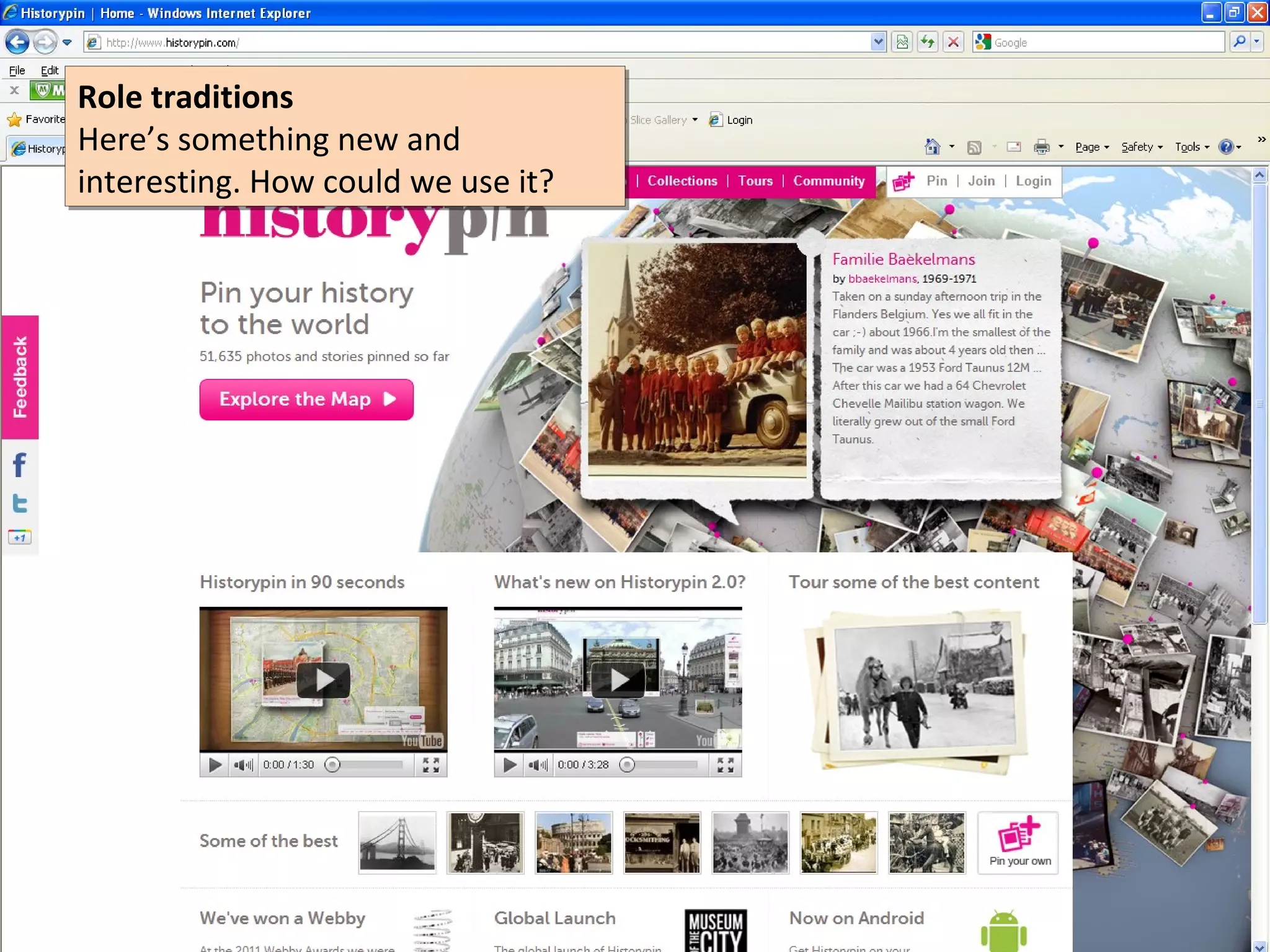
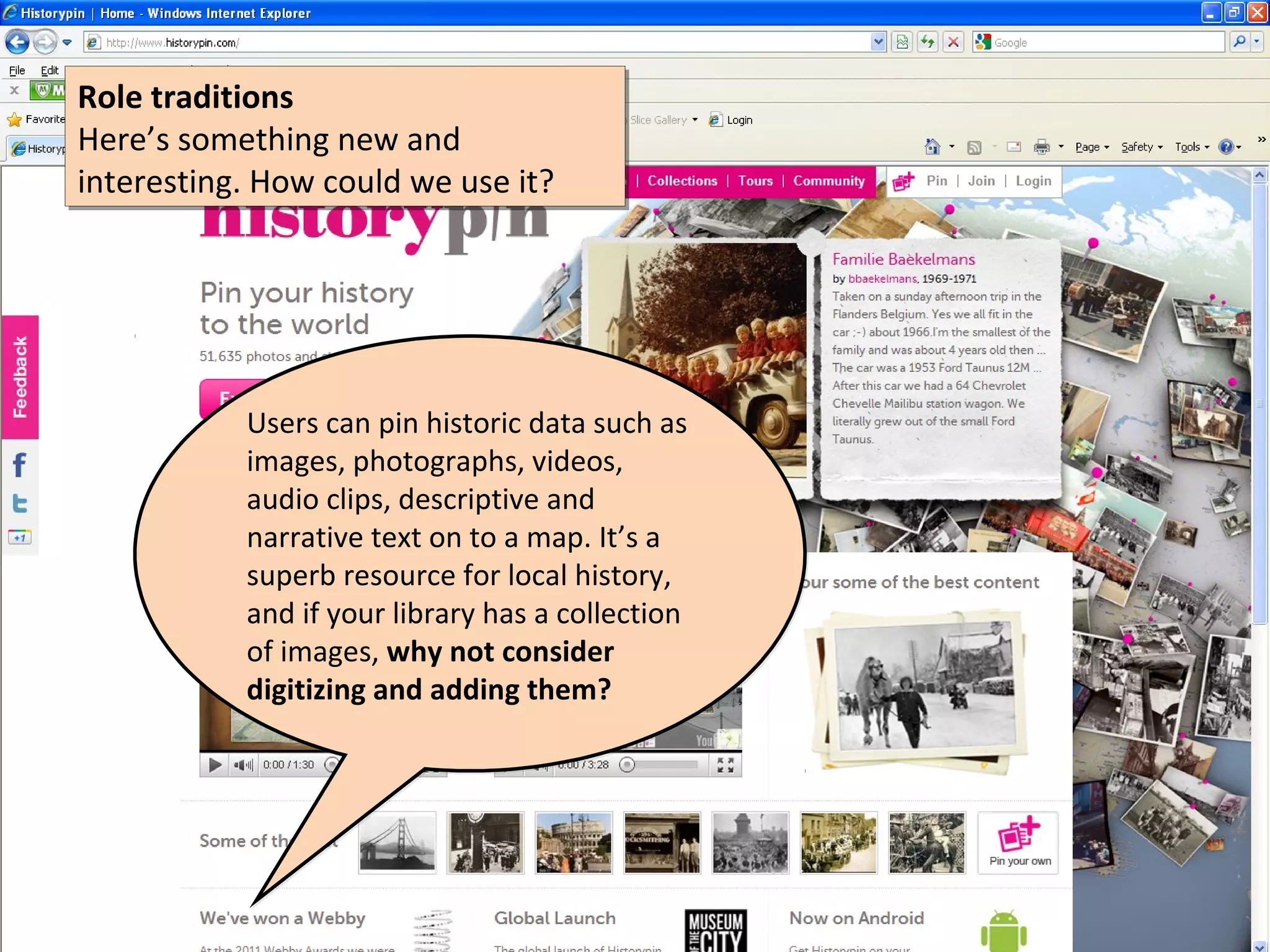
Here’s something new and
interesting. How could we use it?
Role traditions
Role traditions
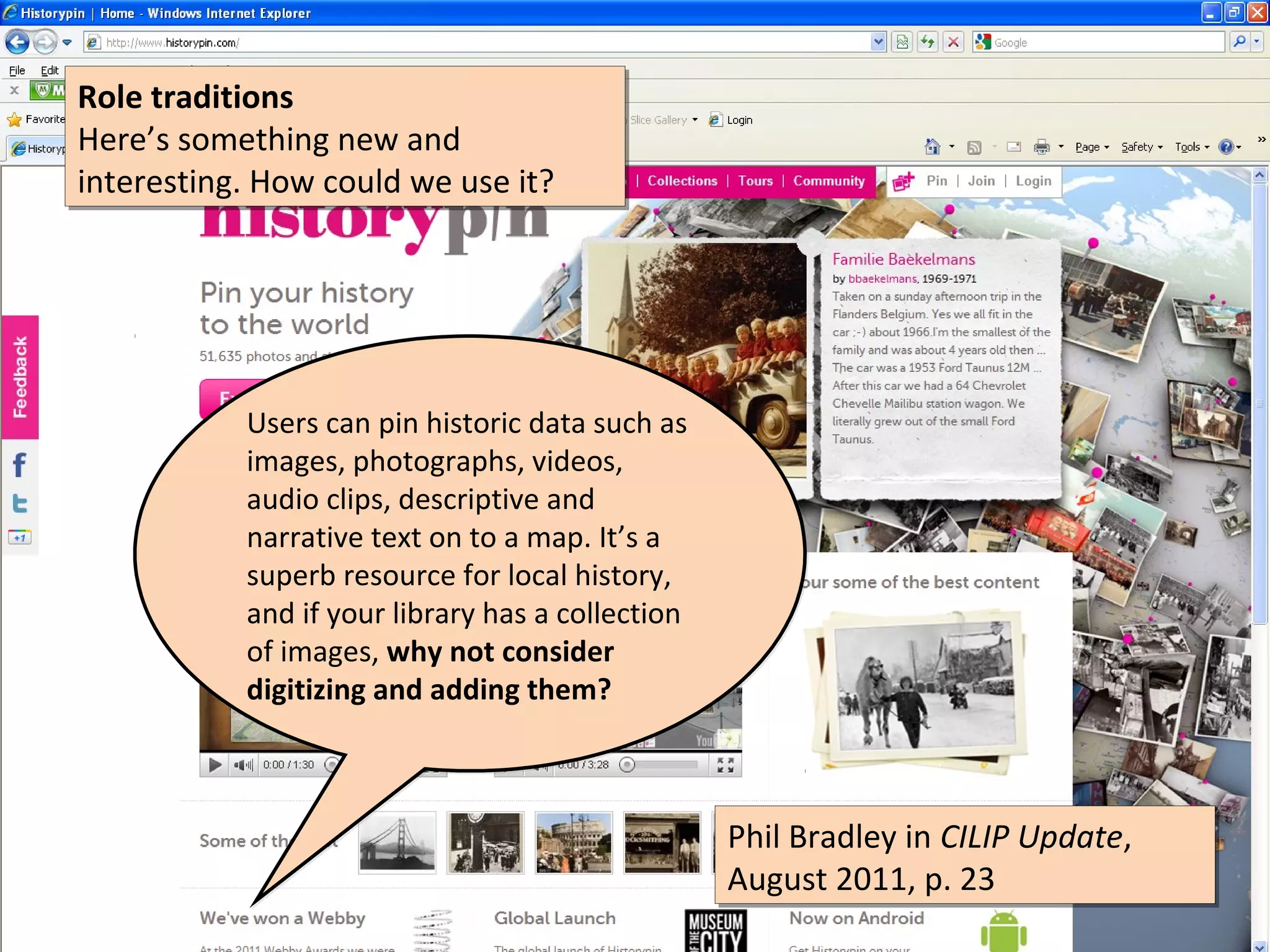
Here’s something new and
interesting. How could we use it?


           Users can pin historic data such as
           images, photographs, videos,
           audio clips, descriptive and
           narrative text on to a map. It’s a
           superb resource for local history,
           and if your library has a collection
           of images, why not consider
           digitizing and adding them?
Role traditions
Role traditions
Here’s something new and
interesting. How could we use it?


           Users can pin historic data such as
           images, photographs, videos,
           audio clips, descriptive and
           narrative text on to a map. It’s a
           superb resource for local history,
           and if your library has a collection
           of images, why not consider
           digitizing and adding them?


                                                  Phil Bradley in CILIP Update,
                                                  Phil Bradley in CILIP Update,
                                                  August 2011, p. 23
                                                  August 2011, p. 23
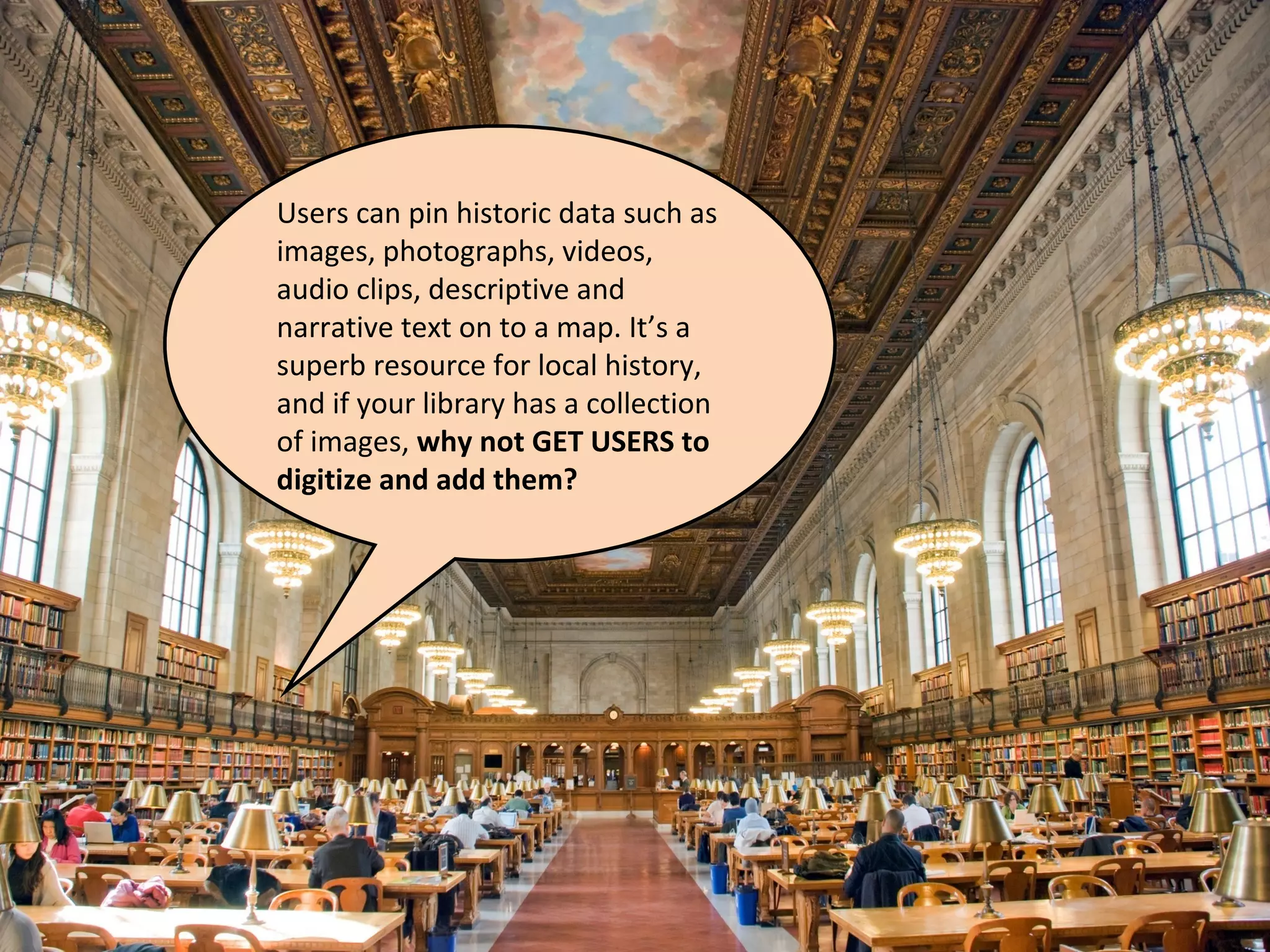
Users can pin historic data such as
images, photographs, videos,
audio clips, descriptive and
narrative text on to a map. It’s a
superb resource for local history,
and if your library has a collection
of images, why not GET USERS to
digitize and add them?
Role traditions
Role traditions
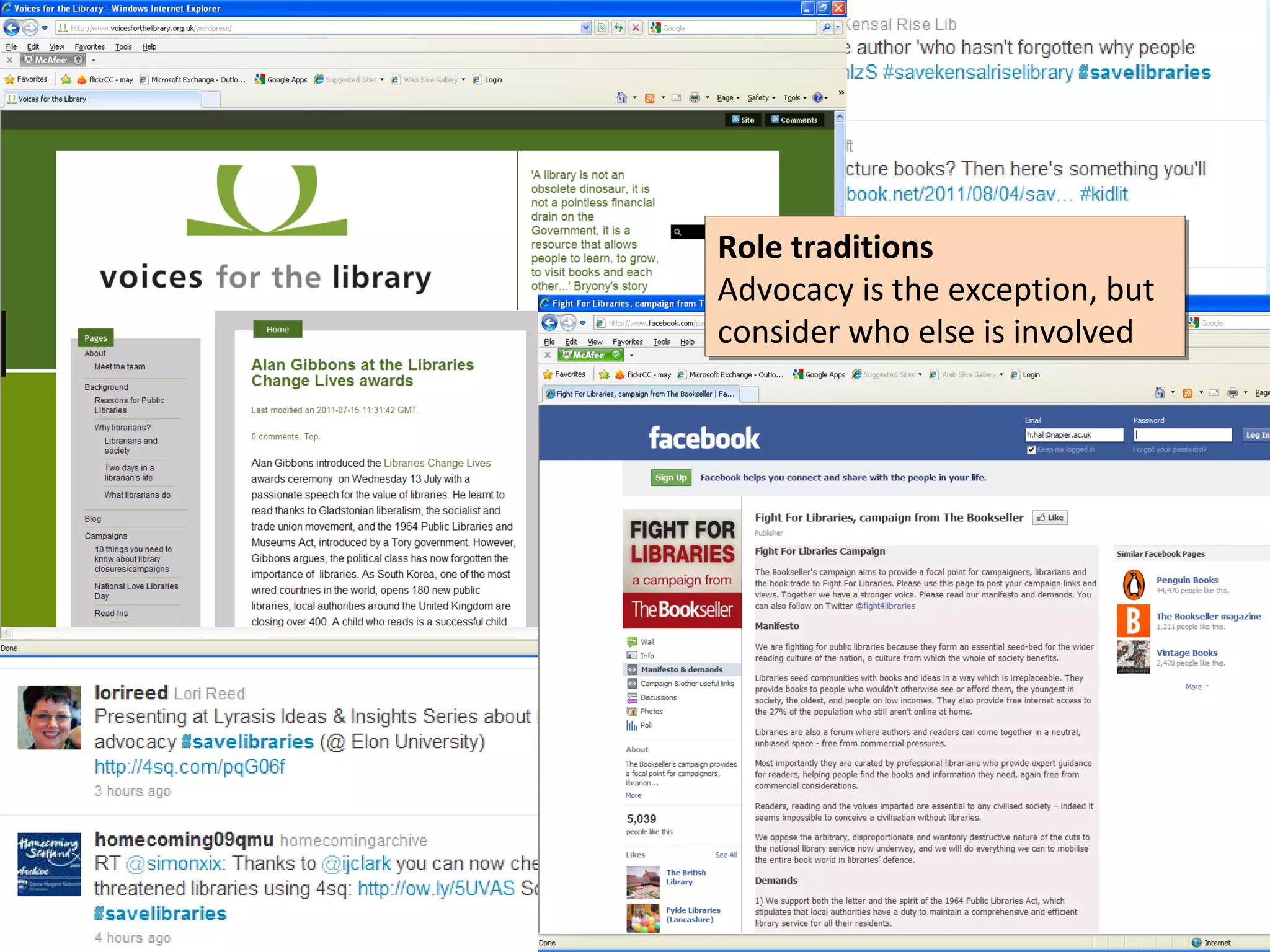
Advocacy is the exception, but
consider who else is involved
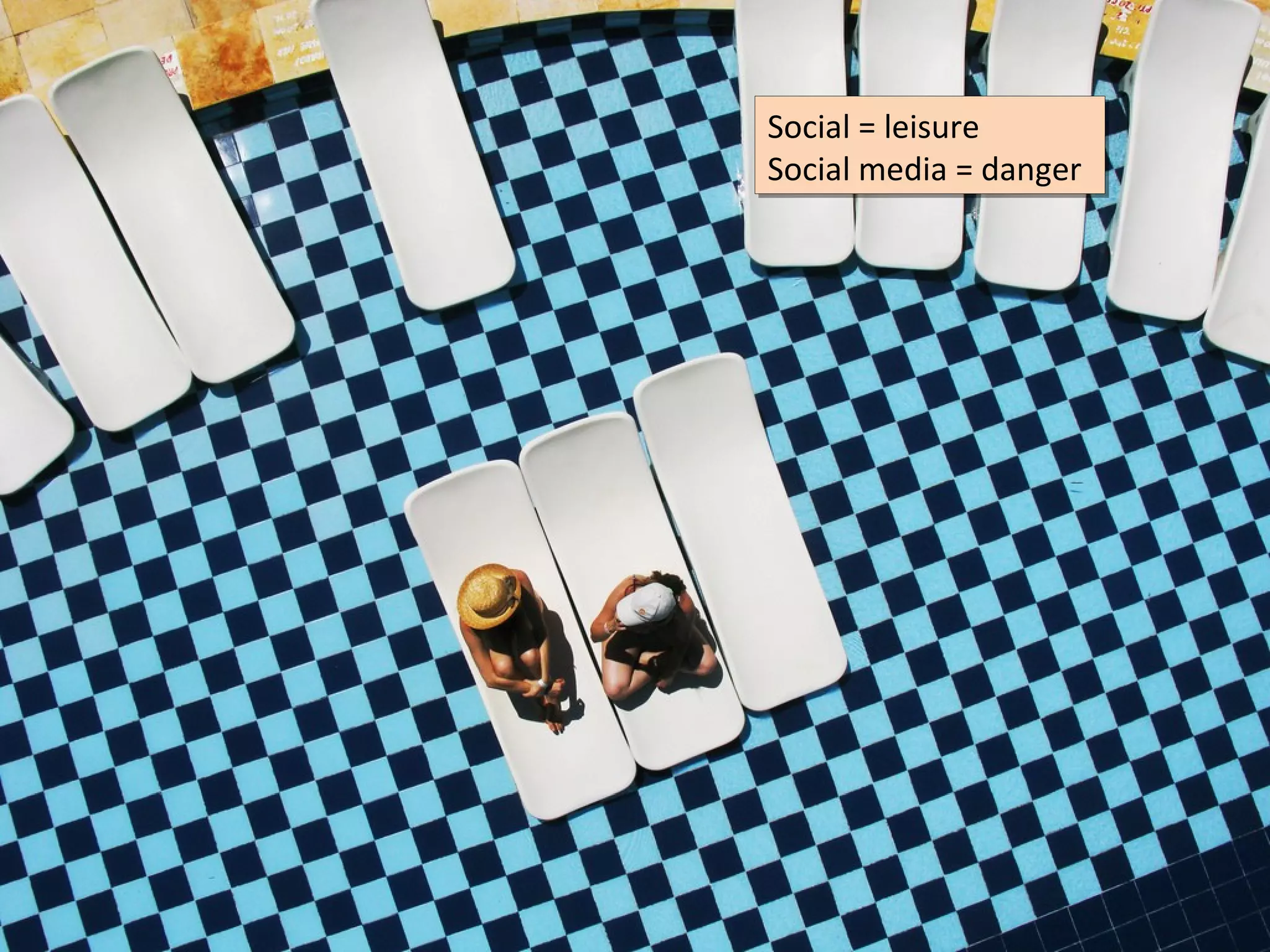
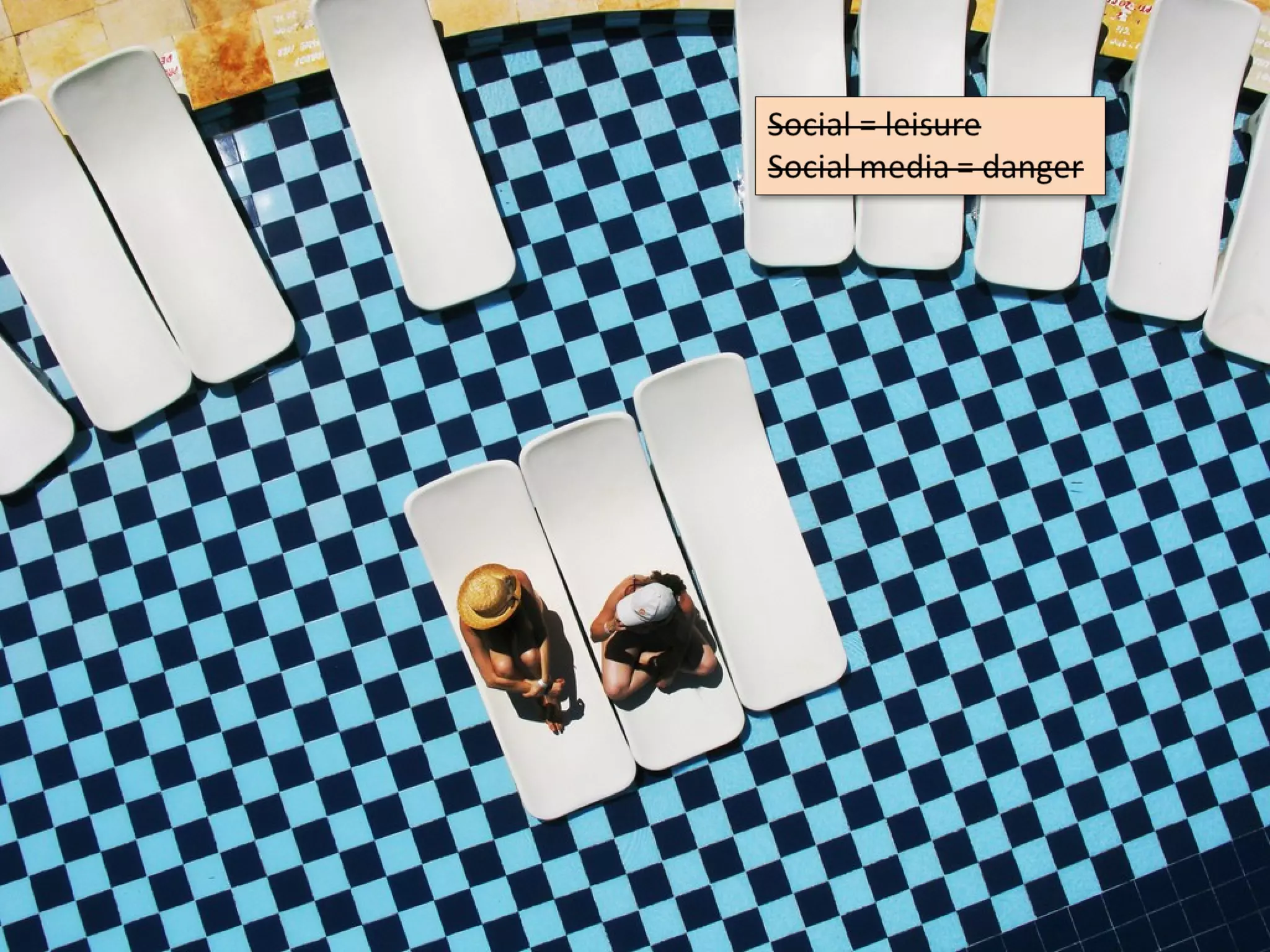
Social = leisure
Social = leisure
Social media = danger
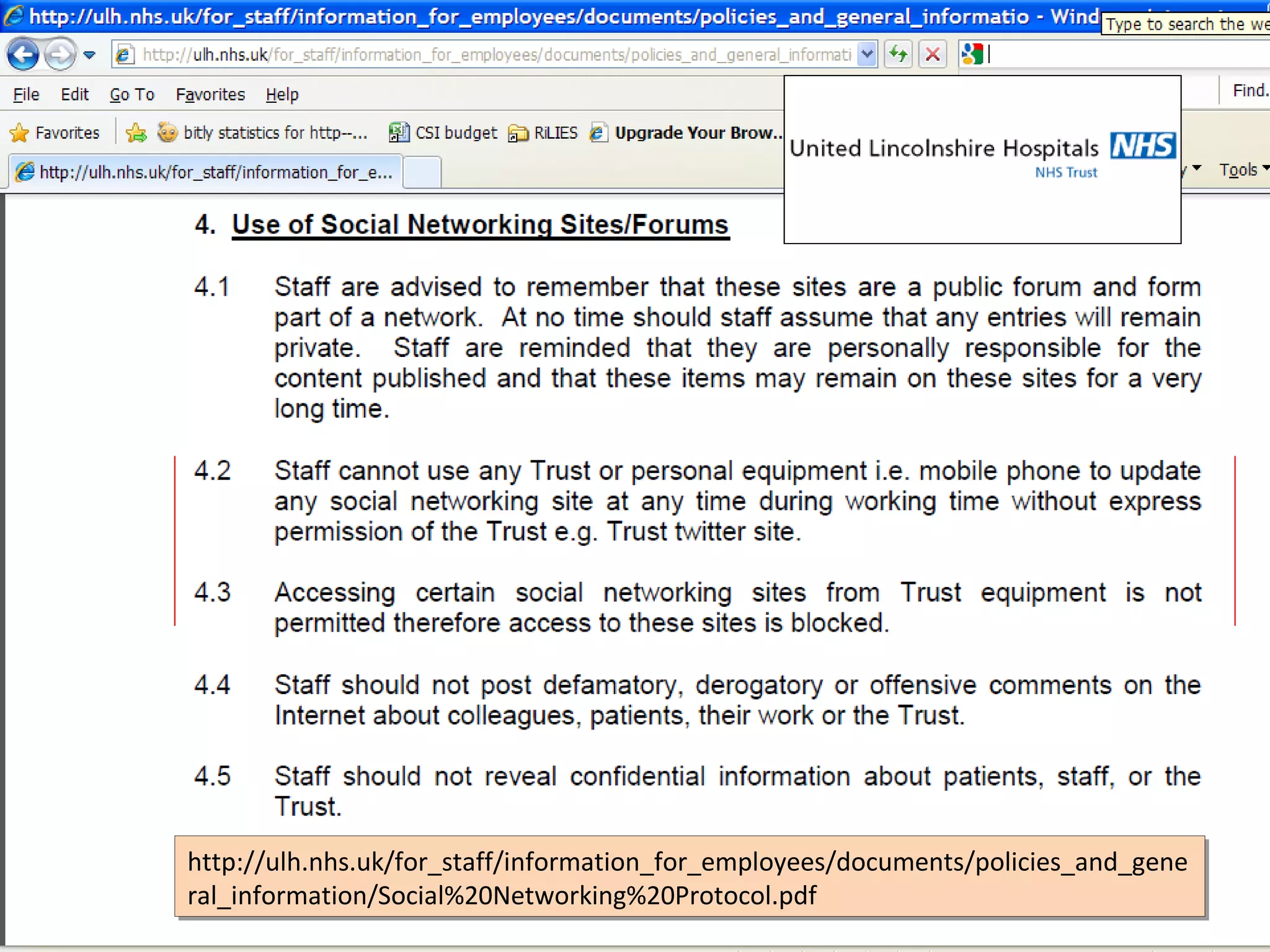
http://ulh.nhs.uk/for_staff/information_for_employees/documents/policies_and_gene
ral_information/Social%20Networking%20Protocol.pdf
The reach of social media in information services
  delivery is limited when
 Social media are treated as additional
  information assets and communication is
  prioritised over community
 Tool uncertainty discourages adoption
 Role “traditions” dominate
 Employers restrict use
The reach of social media in information services
  delivery is likely to extend as
 Lessons from sophisticated personal
  professional social media use are applied
  elsewhere
 Service delivery strategies consider users not
  as passive consumers, but as active
  collaborating partners
Professor Hazel Hall
h.hall@napier.ac.uk @hazelh

More than mere information assets : the reach of social media in information services delivery

  • 1.
    More than mereinformation assets The reach of social media in information services delivery University of Edinburgh Business School New Directions in Management series Professor Hazel Hall, Director, Centre for Social Informatics, 11 November 2011
  • 2.
    Thank you forinviting me Thank you for inviting me
  • 3.
    Thank you forinviting me Thank you for inviting me Thank you for coming! Thank you for coming!
  • 4.
  • 6.
    Centre for SocialInformatics  e-democracy, e-government, e-participation, e-petitioning  information society  information and knowledge management  library and information science research
  • 7.
    Research, evaluate, advise, Research, evaluate, advise, train on for example: train on for example: Systems Systems Markets Markets Centre for Social Informatics Communities Communities Impact Impact  e-democracy, e-government, e-participation, e-petitioning  information society  information and knowledge management  library and information science research
  • 9.
    Provide strategic Provide strategic approachto LIS approach to LIS research in the UK research in the UK
  • 10.
    Provide strategic Provide strategic Develop a formal Develop a formal approach to LIS approach to LIS UK-wide network UK-wide network research in the UK research in the UK of LIS researchers of LIS researchers
  • 11.
    Explore the extent Explore the extent Provide strategic Provide strategic Develop a formal Develop a formal to which LIS to which LIS approach to LIS approach to LIS UK-wide network UK-wide network research influences research influences research in the UK research in the UK of LIS researchers of LIS researchers practice in the UK practice in the UK
  • 12.
  • 13.
    This presentation alignswith personal research interests  Information sharing in online environments  Communities  Tool adoption/adaptation
  • 14.
    This presentation alignswith personal research interests  Information sharing in online environments  Communities  Tool adoption/adaptation Within specific professional context  Information services delivery
  • 15.
    Key points  Socialmedia deployment in information services delivery (generally) replicates traditional models of provision
  • 16.
    Key points  Socialmedia deployment in information services delivery (generally) replicates traditional models of provision  Personal professional use of social media amongst library and information services staff points to possibilities for sophisticated services enhancement
  • 17.
    Key points  Socialmedia deployment in information services delivery (generally) replicates traditional models of provision  Personal professional use of social media amongst library and information services staff points to possibilities for sophisticated services enhancement  Tool uncertainty, role traditions and restrictions of external environment limit scope
  • 18.
     Social mediadeployment in information services delivery (generally) replicates traditional models of provision  Treated as information assets to be integrated into existing service models
  • 19.
     Social mediadeployment in information services delivery (generally) replicates traditional models of provision  Treated as information assets to be integrated into existing service models  Information access and discovery (think cataloguing)  Reference services  Current awareness  User education
  • 20.
    Information access Information access anddiscovery and discovery e.g. book-marking e.g. book-marking
  • 21.
    Reference services Reference services e.g.instant messaging, e.g. instant messaging, online chat online chat
  • 22.
    Current awareness Current awareness e.g.microblogging e.g. microblogging
  • 23.
    User education User education e.g.video sharing e.g. video sharing
  • 24.
     So, ingeneral…  Broadcasters (librarians) create  Customers (users) consume  There are few opportunities (if any) for user collaboration, co-production, contributions to decision making  To take advantage of the “social”, recognition that these tools aggregate more than data/information: relationships, experience…  Communication is prioritised over community
  • 25.
    News and currentawareness News and current awareness
  • 26.
    News and currentawareness News and current awareness An extreme example An extreme example of “twinforming” of “twinforming”
  • 27.
    Key points  Socialmedia deployment in information services delivery (generally) replicates traditional models of provision  Personal professional use of social media amongst library and information services staff points to possibilities for sophisticated services enhancement
  • 28.
    Key points  Socialmedia deployment in information services delivery (generally) replicates traditional models of provision  Personal professional use of social media amongst library and information services staff points to possibilities for sophisticated services enhancement Loudon, L. & Hall, H. (2010). From triviality to business Loudon, L. & Hall, H. (2010). From triviality to business tool: the case of Twitter in information services tool: the case of Twitter in information services delivery. Business Information Review, 27(4), 236-241. delivery. Business Information Review, 27(4), 236-241.
  • 29.
    Community, collaboration andco-production  “Meeting” in social media space  A “place” for members  Collaborating in social media space  Platforms for membership co-production
  • 30.
    Community building Community building Networkingbased on Networking based on career stage career stage
  • 31.
    Community building Community building Networking based on Networking based on career stage career stage Community building Community building Networking based on a Networking based on a particular interest particular interest
  • 32.
    Community building Community building Networking based on Networking based on career stage career stage Meeting, making Meeting, making connections as peers connections as peers Collaboration with view Collaboration with view to co-production to co-production Community building Community building Networking based on Networking based on a particular interest a particular interest
  • 33.
    Shared meeting spaceat Shared meeting space at events for co-located and events for co-located and remote participants remote participants Possibilities for Possibilities for collaboration and co- collaboration and co- production derived from production derived from discussions discussions
  • 34.
    Shared meeting spaceat Shared meeting space at events where all events where all participants are remote participants are remote Possibilities for Possibilities for collaboration and co- collaboration and co- production derived from production derived from discussions discussions
  • 35.
    Wikis for communityco-production Wikis for community co-production Workplace and repository Workplace and repository
  • 36.
    Other sophisticated informationbehaviours exhibited by librarians using social media  To support staff development and career direction  To promote productivity and efficiency at work  To inspire innovation and services development
  • 37.
    Blogging supports developmentand Blogging supports development and career direction, e.g. peer review – career direction, e.g. peer review – ideas, work (and profile raising) ideas, work (and profile raising)
  • 38.
    Twitter promotes Twitter promotes productivityand efficiency productivity and efficiency
  • 39.
    Twitter promotes Twitter promotes productivity and efficiency productivity and efficiency Twitter is the big surprise here. Despite being a disorganised and unstructured approach to finding information I continue to come across amazingly relevant and useful material.
  • 40.
    Experimentation with applications Experimentationwith applications inspire innovation and services inspire innovation and services development development
  • 41.
    Key points  Socialmedia deployment in information services delivery (generally) replicates traditional models of provision  Personal professional use of social media amongst library and information services staff points to possibilities for sophisticated services enhancement  Tool uncertainty, role traditions and restrictions of external environment limit scope
  • 42.
    So many tools… So many tools… http://www.bite.ca/bitedaily/2010/07/social-media-monopoly-board-game/
  • 43.
    So many applications… Somany applications…
  • 44.
    Tools have multiplefunctions Tools have multiple functions
  • 45.
    Where should youfocus Where should you focus your attention? your attention?
  • 46.
    Role traditions evidentin tool preferences amongst information and Role traditions evident in tool preferences amongst information and knowledge professionals in 2008 knowledge professionals in 2008 http://www.soc.napier.ac.uk/~hazelh/esis/soc_comp_proj_rep_public.pdf http://www.soc.napier.ac.uk/~hazelh/esis/soc_comp_proj_rep_public.pdf Availability Usefulness Usage Wikis Wikis Social networking Blogging Blogging Instant messaging Social networking Instant messaging Wikis Instant messaging Social networking Blogging Microblogging Microblogging Microblogging  Ready availability of a tool does not guarantee popularity  Under-exploitation of most valuable tools?  Microblogging barely on the radar in 2008
  • 48.
    Role traditions Role traditions Here’ssomething new and Here’s something new and interesting. How could we use it? interesting. How could we use it?
  • 49.
    Role traditions Role traditions Here’ssomething new and Here’s something new and interesting. How could we use it? interesting. How could we use it? Users can pin historic data such as images, photographs, videos, audio clips, descriptive and narrative text on to a map. It’s a superb resource for local history, and if your library has a collection of images, why not consider digitizing and adding them?
  • 50.
    Role traditions Role traditions Here’ssomething new and Here’s something new and interesting. How could we use it? interesting. How could we use it? Users can pin historic data such as images, photographs, videos, audio clips, descriptive and narrative text on to a map. It’s a superb resource for local history, and if your library has a collection of images, why not consider digitizing and adding them? Phil Bradley in CILIP Update, Phil Bradley in CILIP Update, August 2011, p. 23 August 2011, p. 23
  • 51.
    Users can pinhistoric data such as images, photographs, videos, audio clips, descriptive and narrative text on to a map. It’s a superb resource for local history, and if your library has a collection of images, why not GET USERS to digitize and add them?
  • 52.
    Role traditions Role traditions Advocacyis the exception, but Advocacy is the exception, but consider who else is involved consider who else is involved
  • 53.
    Social = leisure Social= leisure Social media = danger Social media = danger
  • 54.
  • 56.
    The reach ofsocial media in information services delivery is limited when  Social media are treated as additional information assets and communication is prioritised over community  Tool uncertainty discourages adoption  Role “traditions” dominate  Employers restrict use
  • 57.
    The reach ofsocial media in information services delivery is likely to extend as  Lessons from sophisticated personal professional social media use are applied elsewhere  Service delivery strategies consider users not as passive consumers, but as active collaborating partners
  • 58.