Paper presented at Information: interactions and impact (i3) 2015, 23-26
June 2015, Aberdeen
By Louise Rasmussen and Professor Hazel Hall, Edinburgh Napier University
l.rasmussen@napier.ac.uk
h.hall@napier.ac.uk, @hazelh
A Knowledge Management
implementation as a management
innovation: the impact of an agent of
change
Key themes: Knowledge Management and
management innovation
• KM and innovation
– KM more usually discussed in term of a facilitator of innovation
– Here attention is focused on KM as a type of innovation in its own right
• ‘Management innovation’
– Term derives from innovation literature
– Refers to a new practice that
• is generated, or adopted (and often modified), from elsewhere
• is intended to further organisational goals
• has an impact on managerial work
– Here KM is conceived as a management innovation
What does detailed study of a
KM implementation tell us about
the process of adoption of a
management innovation?
What does detailed study of a
KM implementation tell us about
the process of adoption of a
management innovation?
What does detailed study of a
KM implementation tell us about
the process of adoption of a
management innovation…
What does detailed study of a
KM implementation tell us about
the process of adoption of a
management innovation…
… in a large, distributed, public
sector organisation that uses
task forces for the delivery and
management of its services?
… in a large, distributed, public
sector organisation that uses
task forces for the delivery and
management of its services?
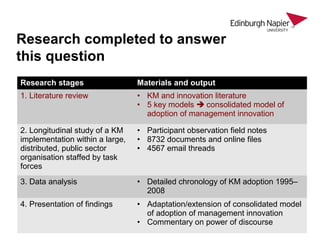
Research completed to answer
this question
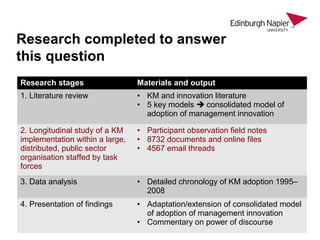
Research stages Materials and output
1. Literature review • KM and innovation literature
• 5 key models  consolidated model of
adoption of management innovation
2. Longitudinal study of a KM
implementation within a large,
distributed, public sector
organisation staffed by task
forces
• Participant observation field notes
• 8732 documents and online files
• 4567 email threads
3. Data analysis • Detailed chronology of KM adoption 1995–
2008
4. Presentation of findings • Adaptation/extension of consolidated model
of adoption of management innovation
• Commentary on power of discourse
Research completed to answer
this question
Research stages Materials and output
1. Literature review • KM and innovation literature
• 5 key models  consolidated model of
adoption of management innovation
2. Longitudinal study of a KM
implementation within a large,
distributed, public sector
organisation staffed by task
forces
• Participant observation field notes
• 8732 documents and online files
• 4567 email threads
3. Data analysis • Detailed chronology of KM adoption 1995–
2008
4. Presentation of findings • Adaptation/extension of consolidated model
of adoption of management innovation
• Commentary on power of discourse
Research completed to answer
this question
Research stages Materials and output
1. Literature review • KM and innovation literature
• 5 key models  consolidated model of
adoption of management innovation
2. Longitudinal study of a KM
implementation within a large,
distributed, public sector
organisation staffed by task
forces
• Participant observation field notes
• 8732 documents and online files
• 4567 email threads
3. Data analysis • Detailed chronology of KM adoption 1995–
2008
4. Presentation of findings • Adaptation/extension of consolidated model
of adoption of management innovation
• Commentary on power of discourse
Research completed to answer
this question
Research stages Materials and output
1. Literature review • KM and innovation literature
• 5 key models  consolidated model of
adoption of management innovation
2. Longitudinal study of a KM
implementation within a large,
distributed, public sector
organisation staffed by task
forces
• Participant observation field notes
• 8732 documents and online files
• 4567 email threads
3. Data analysis • Detailed chronology of KM adoption 1995–
2008
4. Presentation of findings • Adaptation/extension of consolidated model
of adoption of management innovation
• Commentary on power of discourse
What does the literature tell us
about the process of adoption of
a management innovation?
What does the literature tell us
about the process of adoption of
a management innovation?
Don’t panic! This
can be explained
(and reformulated
as a consolidated
model)
Don’t panic! This
can be explained
(and reformulated
as a consolidated
model)
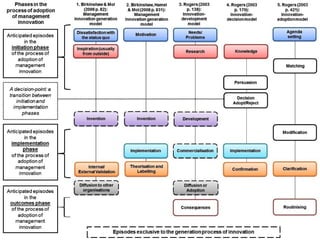
5 models describe
adoption of management
innovation
5 models describe
adoption of management
innovation
Although the vocabulary in
the models varies, there is
commonality in the
coverage of stages of
adoption in each model
Although the vocabulary in
the models varies, there is
commonality in the
coverage of stages of
adoption in each model
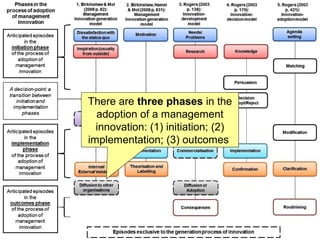
There are three phases in the
adoption of a management
innovation: (1) initiation; (2)
implementation; (3) outcomes
There are three phases in the
adoption of a management
innovation: (1) initiation; (2)
implementation; (3) outcomes
Decision points occur
between phases
Decision points occur
between phases
Each of the three phases
comprises a number of
episodes
Each of the three phases
comprises a number of
episodes
Decision points occur
between episodes
Decision points occur
between episodes
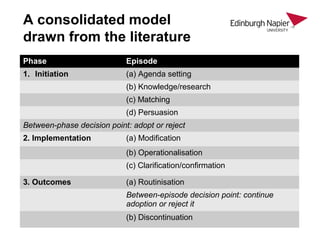
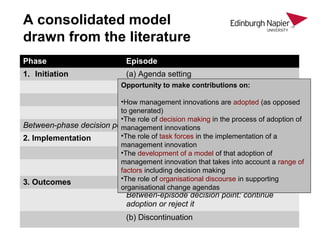
Phase Episode
1. Initiation (a) Agenda setting
(b) Knowledge/research
(c) Matching
(d) Persuasion
Between-phase decision point: adopt or reject
2. Implementation (a) Modification
(b) Operationalisation
(c) Clarification/confirmation
3. Outcomes (a) Routinisation
Between-episode decision point: continue
adoption or reject it
(b) Discontinuation
A consolidated model
drawn from the literature
Phase Episode
1. Initiation (a) Agenda setting
(b) Knowledge/research
(c) Matching
(d) Persuasion
Between-phase decision point: adopt or reject
2. Implementation (a) Modification
(b) Operationalisation
(c) Clarification/confirmation
3. Outcomes (a) Routinisation
Between-episode decision point: continue
adoption or reject it
(b) Discontinuation
A consolidated model
drawn from the literature
Opportunity to make contributions on:
•How management innovations are adopted (as opposed
to generated)
•The role of decision making in the process of adoption of
management innovations
•The role of task forces in the implementation of a
management innovation
•The development of a model of that adoption of
management innovation that takes into account a range of
factors including decision making
•The role of organisational discourse in supporting
organisational change agendas
Opportunity to make contributions on:
•How management innovations are adopted (as opposed
to generated)
•The role of decision making in the process of adoption of
management innovations
•The role of task forces in the implementation of a
management innovation
•The development of a model of that adoption of
management innovation that takes into account a range of
factors including decision making
•The role of organisational discourse in supporting
organisational change agendas
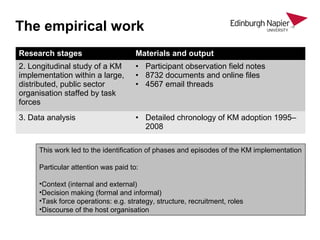
The empirical work
Research stages Materials and output
2. Longitudinal study of a KM
implementation within a large,
distributed, public sector
organisation staffed by task
forces
• Participant observation field notes
• 8732 documents and online files
• 4567 email threads
3. Data analysis • Detailed chronology of KM adoption 1995–
2008
This work led to the identification of phases and episodes of the KM implementation
Particular attention was paid to:
•Context (internal and external)
•Decision making (formal and informal)
•Task force operations: e.g. strategy, structure, recruitment, roles
•Discourse of the host organisation
This work led to the identification of phases and episodes of the KM implementation
Particular attention was paid to:
•Context (internal and external)
•Decision making (formal and informal)
•Task force operations: e.g. strategy, structure, recruitment, roles
•Discourse of the host organisation
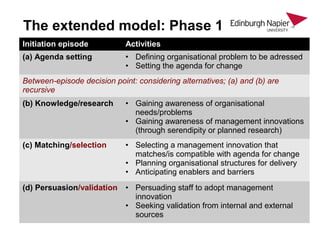
Initiation episode Activities
(a) Agenda setting • Defining organisational problem to be adressed
• Setting the agenda for change
Between-episode decision point: considering alternatives; (a) and (b) are
recursive
(b) Knowledge/research • Gaining awareness of organisational
needs/problems
• Gaining awareness of management innovations
(through serendipity or planned research)
(c) Matching/selection • Selecting a management innovation that
matches/is compatible with agenda for change
• Planning organisational structures for delivery
• Anticipating enablers and barriers
(d) Persuasion/validation • Persuading staff to adopt management
innovation
• Seeking validation from internal and external
sources
The extended model: Phase 1
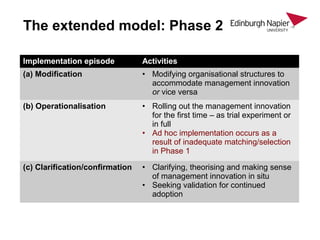
Implementation episode Activities
(a) Modification • Modifying organisational structures to
accommodate management innovation
or vice versa
(b) Operationalisation • Rolling out the management innovation
for the first time – as trial experiment or
in full
• Ad hoc implementation occurs as a
result of inadequate matching/selection
in Phase 1
(c) Clarification/confirmation • Clarifying, theorising and making sense
of management innovation in situ
• Seeking validation for continued
adoption
The extended model: Phase 2
Outcomes episode Activities
(a) Routinisation • Continuing the adoption so that the
management innovation becomes routine
and standard practice
(b) Discontinuation • Ceasing adoption due to disenchantment or
dissatisfaction with performance
• Replacing the management innovation
The extended model: Phase 3
This research only identified decision making relevant to elements of these
two episodes (routinisation and discontinuation) of the management
innovation, i.e. not the management innovation as a whole
This finding supports the suggestion that routinisation may take 10 years or
more (Milton, 2014)
This research only identified decision making relevant to elements of these
two episodes (routinisation and discontinuation) of the management
innovation, i.e. not the management innovation as a whole
This finding supports the suggestion that routinisation may take 10 years or
more (Milton, 2014)
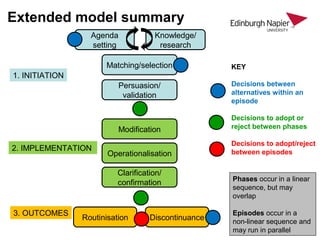
Agenda
setting
Knowledge/
research
Matching/selection
Persuasion/
validation
Modification
Operationalisation
Clarification/
confirmation
Routinisation Discontinuance
1. INITIATION
2. IMPLEMENTATION
3. OUTCOMES
KEY
Decisions between
alternatives within an
episode
Decisions to adopt or
reject between phases
Decisions to adopt/reject
between episodes
Phases occur in a linear
sequence, but may
overlap
Episodes occur in a
non-linear sequence and
may run in parallel
Phases occur in a linear
sequence, but may
overlap
Episodes occur in a
non-linear sequence and
may run in parallel
Extended model summary
The wider context: evident in analysis of
discourse and observation of behaviours
• Ambition for ‘One Network’
– Co-operation and collaboration
– Centralisation
– Consistency
– Resource sharing
• Reality of distributed fiefdoms
– Independent working
– Decentralisation
– Inconsistency
– Resource hoarding
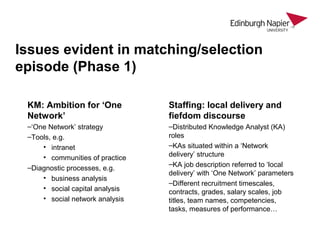
Issues evident in matching/selection
episode (Phase 1)
KM: Ambition for ‘One
Network’
–‘One Network’ strategy
–Tools, e.g.
• intranet
• communities of practice
–Diagnostic processes, e.g.
• business analysis
• social capital analysis
• social network analysis
Staffing: local delivery and
fiefdom discourse
–Distributed Knowledge Analyst (KA)
roles
–KAs situated within a ‘Network
delivery’ structure
–KA job description referred to ‘local
delivery’ with ‘One Network’ parameters
–Different recruitment timescales,
contracts, grades, salary scales, job
titles, team names, competencies,
tasks, measures of performance…
Contributions of the study
• Detailed case study of a KM implementation in the public sector
• Greater understanding of the process of adoption of management
innovation, particularly with reference to:
– decision making
– the role of task forces
• Further evidence on the importance of context to any KM
implementation, in this case with specific reference to organisational
discourse
References
Birkinshaw, J., Hamel, G., & Mol, M.J. (2008). Management innovation. Advanced
Institute of Management Research Working Paper Series (021-July-2005).
Birkinshaw, J.M., & Mol, M.J. (2006). How management innovation happens. MIT
Sloan Management Review, 47(4), 81–88.
Milton, N. (2014). Global KM Survey: How long does it really take for KM to bed
in? Retrieved June 19 2015 from http://www.nickmilton.com/2014/08/how-
long-does-km-really-take-to-bed-in.html
Rogers, E. M. (2003). Diffusion of Innovations, (5th
ed.). London: Simon &
Schuster.
Paper presented at Information: interactions and impact (i3) 2015, 23-26
June 2015, Aberdeen
By Louise Rasmussen and Professor Hazel Hall, Edinburgh Napier University
l.rasmussen@napier.ac.uk
h.hall@napier.ac.uk, @hazelh
A Knowledge Management
implementation as a management
innovation: the impact of an agent of
change

A Knowledge Management implementation as a management innovation: the impact of an agent of change

  • 1.
    Paper presented atInformation: interactions and impact (i3) 2015, 23-26 June 2015, Aberdeen By Louise Rasmussen and Professor Hazel Hall, Edinburgh Napier University l.rasmussen@napier.ac.uk h.hall@napier.ac.uk, @hazelh A Knowledge Management implementation as a management innovation: the impact of an agent of change
  • 2.
    Key themes: KnowledgeManagement and management innovation • KM and innovation – KM more usually discussed in term of a facilitator of innovation – Here attention is focused on KM as a type of innovation in its own right • ‘Management innovation’ – Term derives from innovation literature – Refers to a new practice that • is generated, or adopted (and often modified), from elsewhere • is intended to further organisational goals • has an impact on managerial work – Here KM is conceived as a management innovation
  • 3.
    What does detailedstudy of a KM implementation tell us about the process of adoption of a management innovation? What does detailed study of a KM implementation tell us about the process of adoption of a management innovation?
  • 4.
    What does detailedstudy of a KM implementation tell us about the process of adoption of a management innovation… What does detailed study of a KM implementation tell us about the process of adoption of a management innovation… … in a large, distributed, public sector organisation that uses task forces for the delivery and management of its services? … in a large, distributed, public sector organisation that uses task forces for the delivery and management of its services?
  • 5.
    Research completed toanswer this question Research stages Materials and output 1. Literature review • KM and innovation literature • 5 key models  consolidated model of adoption of management innovation 2. Longitudinal study of a KM implementation within a large, distributed, public sector organisation staffed by task forces • Participant observation field notes • 8732 documents and online files • 4567 email threads 3. Data analysis • Detailed chronology of KM adoption 1995– 2008 4. Presentation of findings • Adaptation/extension of consolidated model of adoption of management innovation • Commentary on power of discourse
  • 6.
    Research completed toanswer this question Research stages Materials and output 1. Literature review • KM and innovation literature • 5 key models  consolidated model of adoption of management innovation 2. Longitudinal study of a KM implementation within a large, distributed, public sector organisation staffed by task forces • Participant observation field notes • 8732 documents and online files • 4567 email threads 3. Data analysis • Detailed chronology of KM adoption 1995– 2008 4. Presentation of findings • Adaptation/extension of consolidated model of adoption of management innovation • Commentary on power of discourse
  • 7.
    Research completed toanswer this question Research stages Materials and output 1. Literature review • KM and innovation literature • 5 key models  consolidated model of adoption of management innovation 2. Longitudinal study of a KM implementation within a large, distributed, public sector organisation staffed by task forces • Participant observation field notes • 8732 documents and online files • 4567 email threads 3. Data analysis • Detailed chronology of KM adoption 1995– 2008 4. Presentation of findings • Adaptation/extension of consolidated model of adoption of management innovation • Commentary on power of discourse
  • 8.
    Research completed toanswer this question Research stages Materials and output 1. Literature review • KM and innovation literature • 5 key models  consolidated model of adoption of management innovation 2. Longitudinal study of a KM implementation within a large, distributed, public sector organisation staffed by task forces • Participant observation field notes • 8732 documents and online files • 4567 email threads 3. Data analysis • Detailed chronology of KM adoption 1995– 2008 4. Presentation of findings • Adaptation/extension of consolidated model of adoption of management innovation • Commentary on power of discourse
  • 9.
    What does theliterature tell us about the process of adoption of a management innovation? What does the literature tell us about the process of adoption of a management innovation?
  • 11.
    Don’t panic! This canbe explained (and reformulated as a consolidated model) Don’t panic! This can be explained (and reformulated as a consolidated model)
  • 12.
    5 models describe adoptionof management innovation 5 models describe adoption of management innovation
  • 13.
    Although the vocabularyin the models varies, there is commonality in the coverage of stages of adoption in each model Although the vocabulary in the models varies, there is commonality in the coverage of stages of adoption in each model
  • 14.
    There are threephases in the adoption of a management innovation: (1) initiation; (2) implementation; (3) outcomes There are three phases in the adoption of a management innovation: (1) initiation; (2) implementation; (3) outcomes
  • 15.
    Decision points occur betweenphases Decision points occur between phases
  • 16.
    Each of thethree phases comprises a number of episodes Each of the three phases comprises a number of episodes
  • 17.
    Decision points occur betweenepisodes Decision points occur between episodes
  • 18.
    Phase Episode 1. Initiation(a) Agenda setting (b) Knowledge/research (c) Matching (d) Persuasion Between-phase decision point: adopt or reject 2. Implementation (a) Modification (b) Operationalisation (c) Clarification/confirmation 3. Outcomes (a) Routinisation Between-episode decision point: continue adoption or reject it (b) Discontinuation A consolidated model drawn from the literature
  • 19.
    Phase Episode 1. Initiation(a) Agenda setting (b) Knowledge/research (c) Matching (d) Persuasion Between-phase decision point: adopt or reject 2. Implementation (a) Modification (b) Operationalisation (c) Clarification/confirmation 3. Outcomes (a) Routinisation Between-episode decision point: continue adoption or reject it (b) Discontinuation A consolidated model drawn from the literature Opportunity to make contributions on: •How management innovations are adopted (as opposed to generated) •The role of decision making in the process of adoption of management innovations •The role of task forces in the implementation of a management innovation •The development of a model of that adoption of management innovation that takes into account a range of factors including decision making •The role of organisational discourse in supporting organisational change agendas Opportunity to make contributions on: •How management innovations are adopted (as opposed to generated) •The role of decision making in the process of adoption of management innovations •The role of task forces in the implementation of a management innovation •The development of a model of that adoption of management innovation that takes into account a range of factors including decision making •The role of organisational discourse in supporting organisational change agendas
  • 20.
    The empirical work Researchstages Materials and output 2. Longitudinal study of a KM implementation within a large, distributed, public sector organisation staffed by task forces • Participant observation field notes • 8732 documents and online files • 4567 email threads 3. Data analysis • Detailed chronology of KM adoption 1995– 2008 This work led to the identification of phases and episodes of the KM implementation Particular attention was paid to: •Context (internal and external) •Decision making (formal and informal) •Task force operations: e.g. strategy, structure, recruitment, roles •Discourse of the host organisation This work led to the identification of phases and episodes of the KM implementation Particular attention was paid to: •Context (internal and external) •Decision making (formal and informal) •Task force operations: e.g. strategy, structure, recruitment, roles •Discourse of the host organisation
  • 21.
    Initiation episode Activities (a)Agenda setting • Defining organisational problem to be adressed • Setting the agenda for change Between-episode decision point: considering alternatives; (a) and (b) are recursive (b) Knowledge/research • Gaining awareness of organisational needs/problems • Gaining awareness of management innovations (through serendipity or planned research) (c) Matching/selection • Selecting a management innovation that matches/is compatible with agenda for change • Planning organisational structures for delivery • Anticipating enablers and barriers (d) Persuasion/validation • Persuading staff to adopt management innovation • Seeking validation from internal and external sources The extended model: Phase 1
  • 22.
    Implementation episode Activities (a)Modification • Modifying organisational structures to accommodate management innovation or vice versa (b) Operationalisation • Rolling out the management innovation for the first time – as trial experiment or in full • Ad hoc implementation occurs as a result of inadequate matching/selection in Phase 1 (c) Clarification/confirmation • Clarifying, theorising and making sense of management innovation in situ • Seeking validation for continued adoption The extended model: Phase 2
  • 23.
    Outcomes episode Activities (a)Routinisation • Continuing the adoption so that the management innovation becomes routine and standard practice (b) Discontinuation • Ceasing adoption due to disenchantment or dissatisfaction with performance • Replacing the management innovation The extended model: Phase 3 This research only identified decision making relevant to elements of these two episodes (routinisation and discontinuation) of the management innovation, i.e. not the management innovation as a whole This finding supports the suggestion that routinisation may take 10 years or more (Milton, 2014) This research only identified decision making relevant to elements of these two episodes (routinisation and discontinuation) of the management innovation, i.e. not the management innovation as a whole This finding supports the suggestion that routinisation may take 10 years or more (Milton, 2014)
  • 24.
    Agenda setting Knowledge/ research Matching/selection Persuasion/ validation Modification Operationalisation Clarification/ confirmation Routinisation Discontinuance 1. INITIATION 2.IMPLEMENTATION 3. OUTCOMES KEY Decisions between alternatives within an episode Decisions to adopt or reject between phases Decisions to adopt/reject between episodes Phases occur in a linear sequence, but may overlap Episodes occur in a non-linear sequence and may run in parallel Phases occur in a linear sequence, but may overlap Episodes occur in a non-linear sequence and may run in parallel Extended model summary
  • 25.
    The wider context:evident in analysis of discourse and observation of behaviours • Ambition for ‘One Network’ – Co-operation and collaboration – Centralisation – Consistency – Resource sharing • Reality of distributed fiefdoms – Independent working – Decentralisation – Inconsistency – Resource hoarding
  • 26.
    Issues evident inmatching/selection episode (Phase 1) KM: Ambition for ‘One Network’ –‘One Network’ strategy –Tools, e.g. • intranet • communities of practice –Diagnostic processes, e.g. • business analysis • social capital analysis • social network analysis Staffing: local delivery and fiefdom discourse –Distributed Knowledge Analyst (KA) roles –KAs situated within a ‘Network delivery’ structure –KA job description referred to ‘local delivery’ with ‘One Network’ parameters –Different recruitment timescales, contracts, grades, salary scales, job titles, team names, competencies, tasks, measures of performance…
  • 27.
    Contributions of thestudy • Detailed case study of a KM implementation in the public sector • Greater understanding of the process of adoption of management innovation, particularly with reference to: – decision making – the role of task forces • Further evidence on the importance of context to any KM implementation, in this case with specific reference to organisational discourse
  • 28.
    References Birkinshaw, J., Hamel,G., & Mol, M.J. (2008). Management innovation. Advanced Institute of Management Research Working Paper Series (021-July-2005). Birkinshaw, J.M., & Mol, M.J. (2006). How management innovation happens. MIT Sloan Management Review, 47(4), 81–88. Milton, N. (2014). Global KM Survey: How long does it really take for KM to bed in? Retrieved June 19 2015 from http://www.nickmilton.com/2014/08/how- long-does-km-really-take-to-bed-in.html Rogers, E. M. (2003). Diffusion of Innovations, (5th ed.). London: Simon & Schuster.
  • 29.
    Paper presented atInformation: interactions and impact (i3) 2015, 23-26 June 2015, Aberdeen By Louise Rasmussen and Professor Hazel Hall, Edinburgh Napier University l.rasmussen@napier.ac.uk h.hall@napier.ac.uk, @hazelh A Knowledge Management implementation as a management innovation: the impact of an agent of change