What Does Openness Mean To The Museum Community? Brian Kelly UKOLN University of Bath Bath, UK [email_address] UKOLN is supported by: Co-Author:  Ross Gardler, JISC OSS Watch, University of Oxford http://www.ukoln.ac.uk/web-focus/events/conferences/mw-2008/ This work is licensed under a Attribution-NonCommercial- ShareAlike 2.0 licence  (but note caveat) Resources bookmarked using ‘ mw2008 ' tag  Mike Ellis Eduserv Bath, UK [email_address]
About The Facilitators Brian Kelly: UK Web Focus – a national Web advisory post Based at UKOLN, a national centre of expertise in digital information management, located at University of Bath, UK Advisor to HE and cultural heritage sectors Mike Ellis: Head of Web for the National Museum of Science and Industry for 7 years Now working at Eduserv, Bath Interests include  user generated content, Web 2.0, ubiquitous computing and innovation and how to exploit these to gain maximum benefit  for cultural institutions  BK Introduction
About This Professional Forum Openness: A positive term Covers open standards, open source, open content, open services and open culture But: What are the limitations of openness? To what extent do we wish to embrace the concept of openness? How do we respond if we feel that openness concepts may (a) be flawed (b) endanger our business models or  (c) not be sustainable? BK Introduction
About You What responsibilities do you have? Why have you chosen to attend this professional forum? What do you hope to get out of the session? BK Introduction
Benefits Of Open Standards Open standards  can: Provide device- and application-independence Avoid vendor lock-in Provide an open marketplace for development Maximise access to resources Enhance interoperability Provide architectural integrity Provide long-term access to resources Benefits are widely accepted by the development community: Mandation of open standards in procurement Lists of recommended open standards for digital library development  programmes Benefits Of Openness BK
Benefits Of Open Source Open source software  can: Provide freedom to  use, modify and redistribute software  Encourage competition which can increase  the quality, satisfaction and flexibility of software Help to ensure that software remains valuable to an organisation regardless of changing strategic objectives of any single software development organisation Ensure there is  no incentive to attempt to lock-in a customer by using proprietary extensions to file formats or data standards  Benefits Of Openness BK
Benefits Of Open APIs Open APIs ... ..are systems which allow free sharing of data, programmatically Typically have  open standards  at their core, or at least an  open framework Examples include RSS, REST, SOAP, OAI-PMH, for data sharing  Usually have XML or JSON as interchange format Benefits Of Openness ME
Benefits Of Open APIs Why is this good? Fundamental to the web now is  user-centricity . RSS etc. allow users to get  what they want  and  how they want it Shared data inspires creativity: “ we  is better than  me ” – see the Frankie & Seb show...  It frees us (and others) to use tools like the MIT timeline, Yahoo Maps, Google charts, etc – usually for  no or low cost . Additional benefits like mobile version are “easy” The more data the better! Also – if we don’t do it, services like Google images, Dapper etc will do it for us! Benefits Of Openness ME
Benefits Of Open Content Open Content: Is content which can “got at” and shared A hidden API or RSS feed isn’t “open”.. Word/PDF/Fax/email (etc.) isn’t “open” Is often associated with CC licences ...which means it is usually  free   As per Open APIs, if you provide access then you can see blossoming creativity Throws up issues around income... Benefits Of Openness ME
Benefits Of Open Content Open Content: ...is  reusable  content. Benefits Of Openness ME
Benefits Of An Open Culture Openness is a core component of web 2.0 If we can’t use the web to connect with our users, then why use the web at all...? Web 2.0 (actually, the web) is becoming more and more about  people  and  relationships A lot of what we’ve talked about this week is about or around Open Culture! e.g. “Web 2.0: where do we go from here?” Benefits Of Openness ME
Problems With Open Culture Problems with user generated content: Not all users are nice! Users may prefer to listen to voice of authority Automated spam is an increasing annoyance (email, blog comments, …) Discussion often degenerates into flam wars May be legal implications It’s expensive to monitor Open culture – great in theory;  flawed in practice   Limitations Of Openness BK
Problems With Open APIs Problems with making use of 3 rd  party APIs and services: They don’t do this for our benefit, but to make money The long-term business models are unproven They can change their T&C at any time They can withdraw services cf Amazon withdrawing their SOAP interface Limitations Of Openness BK
Problems With Open Standards Open standards: Can be too complex Can be difficult to implement May fail to be accepted in the market place Take long time to reach agreement What is an open standard: PDF, RSS or MS Word? We can seek to deploy too soon, before limitations, costs, etc. are understood (RDF?) Limitations Of Openness BK
Problems With Open Source Open source software: Has been over-hyped Didn’t bring long the demise of western capitalism! May be issues related to: documentation • support SLA •  sustainability Source Forge as a dumping ground for failed Open Source projects The discussion now is more about sustainability & fitness for purpose,  whether OSS or proprietary Limitations Of Openness BK
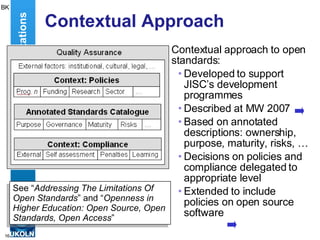
Contextual Approach Contextual approach to open standards: Developed to support JISC’s development programmes Described at MW 2007 Based on annotated descriptions: ownership, purpose, maturity, risks, … Decisions on policies and compliance delegated to appropriate level Extended to include policies on open source software Addressing The Limitations BK See “ Addressing The Limitations Of Open Standards ” and “ Openness in Higher Education: Open Source, Open Standards, Open Access ”
Problems With Open Content Problems with allowing others to reuse content: Undermines one’s business Duplication of popular services but neglecting of minority interests This isn’t liberal; it’s privatisation (similar to deregulation of public services) The content owners are likely to be unhappy Why should Facebook, MySpace, … make money from our content? Open content – like socialism great  in theory; doesn’t work in practice! Limitations Of Openness BK
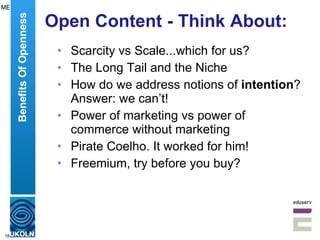
Open Content - Think About: Scarcity vs Scale...which for us? The Long Tail and the Niche How do we address notions of  intention ? Answer: we can’t! Power of marketing vs power of commerce without marketing Pirate Coelho. It worked for him! Freemium, try before you buy? Benefits Of Openness ME
Any Conclusions...?

What Does Openness Mean To The Openness Museum Community

  • 1.
    What Does OpennessMean To The Museum Community? Brian Kelly UKOLN University of Bath Bath, UK [email_address] UKOLN is supported by: Co-Author: Ross Gardler, JISC OSS Watch, University of Oxford http://www.ukoln.ac.uk/web-focus/events/conferences/mw-2008/ This work is licensed under a Attribution-NonCommercial- ShareAlike 2.0 licence (but note caveat) Resources bookmarked using ‘ mw2008 ' tag Mike Ellis Eduserv Bath, UK [email_address]
  • 2.
    About The FacilitatorsBrian Kelly: UK Web Focus – a national Web advisory post Based at UKOLN, a national centre of expertise in digital information management, located at University of Bath, UK Advisor to HE and cultural heritage sectors Mike Ellis: Head of Web for the National Museum of Science and Industry for 7 years Now working at Eduserv, Bath Interests include user generated content, Web 2.0, ubiquitous computing and innovation and how to exploit these to gain maximum benefit for cultural institutions BK Introduction
  • 3.
    About This ProfessionalForum Openness: A positive term Covers open standards, open source, open content, open services and open culture But: What are the limitations of openness? To what extent do we wish to embrace the concept of openness? How do we respond if we feel that openness concepts may (a) be flawed (b) endanger our business models or (c) not be sustainable? BK Introduction
  • 4.
    About You Whatresponsibilities do you have? Why have you chosen to attend this professional forum? What do you hope to get out of the session? BK Introduction
  • 5.
    Benefits Of OpenStandards Open standards can: Provide device- and application-independence Avoid vendor lock-in Provide an open marketplace for development Maximise access to resources Enhance interoperability Provide architectural integrity Provide long-term access to resources Benefits are widely accepted by the development community: Mandation of open standards in procurement Lists of recommended open standards for digital library development programmes Benefits Of Openness BK
  • 6.
    Benefits Of OpenSource Open source software can: Provide freedom to use, modify and redistribute software Encourage competition which can increase the quality, satisfaction and flexibility of software Help to ensure that software remains valuable to an organisation regardless of changing strategic objectives of any single software development organisation Ensure there is no incentive to attempt to lock-in a customer by using proprietary extensions to file formats or data standards Benefits Of Openness BK
  • 7.
    Benefits Of OpenAPIs Open APIs ... ..are systems which allow free sharing of data, programmatically Typically have open standards at their core, or at least an open framework Examples include RSS, REST, SOAP, OAI-PMH, for data sharing Usually have XML or JSON as interchange format Benefits Of Openness ME
  • 8.
    Benefits Of OpenAPIs Why is this good? Fundamental to the web now is user-centricity . RSS etc. allow users to get what they want and how they want it Shared data inspires creativity: “ we is better than me ” – see the Frankie & Seb show... It frees us (and others) to use tools like the MIT timeline, Yahoo Maps, Google charts, etc – usually for no or low cost . Additional benefits like mobile version are “easy” The more data the better! Also – if we don’t do it, services like Google images, Dapper etc will do it for us! Benefits Of Openness ME
  • 9.
    Benefits Of OpenContent Open Content: Is content which can “got at” and shared A hidden API or RSS feed isn’t “open”.. Word/PDF/Fax/email (etc.) isn’t “open” Is often associated with CC licences ...which means it is usually free As per Open APIs, if you provide access then you can see blossoming creativity Throws up issues around income... Benefits Of Openness ME
  • 10.
    Benefits Of OpenContent Open Content: ...is reusable content. Benefits Of Openness ME
  • 11.
    Benefits Of AnOpen Culture Openness is a core component of web 2.0 If we can’t use the web to connect with our users, then why use the web at all...? Web 2.0 (actually, the web) is becoming more and more about people and relationships A lot of what we’ve talked about this week is about or around Open Culture! e.g. “Web 2.0: where do we go from here?” Benefits Of Openness ME
  • 12.
    Problems With OpenCulture Problems with user generated content: Not all users are nice! Users may prefer to listen to voice of authority Automated spam is an increasing annoyance (email, blog comments, …) Discussion often degenerates into flam wars May be legal implications It’s expensive to monitor Open culture – great in theory; flawed in practice  Limitations Of Openness BK
  • 13.
    Problems With OpenAPIs Problems with making use of 3 rd party APIs and services: They don’t do this for our benefit, but to make money The long-term business models are unproven They can change their T&C at any time They can withdraw services cf Amazon withdrawing their SOAP interface Limitations Of Openness BK
  • 14.
    Problems With OpenStandards Open standards: Can be too complex Can be difficult to implement May fail to be accepted in the market place Take long time to reach agreement What is an open standard: PDF, RSS or MS Word? We can seek to deploy too soon, before limitations, costs, etc. are understood (RDF?) Limitations Of Openness BK
  • 15.
    Problems With OpenSource Open source software: Has been over-hyped Didn’t bring long the demise of western capitalism! May be issues related to: documentation • support SLA • sustainability Source Forge as a dumping ground for failed Open Source projects The discussion now is more about sustainability & fitness for purpose, whether OSS or proprietary Limitations Of Openness BK
  • 16.
    Contextual Approach Contextualapproach to open standards: Developed to support JISC’s development programmes Described at MW 2007 Based on annotated descriptions: ownership, purpose, maturity, risks, … Decisions on policies and compliance delegated to appropriate level Extended to include policies on open source software Addressing The Limitations BK See “ Addressing The Limitations Of Open Standards ” and “ Openness in Higher Education: Open Source, Open Standards, Open Access ”
  • 17.
    Problems With OpenContent Problems with allowing others to reuse content: Undermines one’s business Duplication of popular services but neglecting of minority interests This isn’t liberal; it’s privatisation (similar to deregulation of public services) The content owners are likely to be unhappy Why should Facebook, MySpace, … make money from our content? Open content – like socialism great in theory; doesn’t work in practice! Limitations Of Openness BK
  • 18.
    Open Content -Think About: Scarcity vs Scale...which for us? The Long Tail and the Niche How do we address notions of intention ? Answer: we can’t! Power of marketing vs power of commerce without marketing Pirate Coelho. It worked for him! Freemium, try before you buy? Benefits Of Openness ME
  • 19.