#Occupythelibrary

  Who is your target?
How are you positioned?
What is your destination?
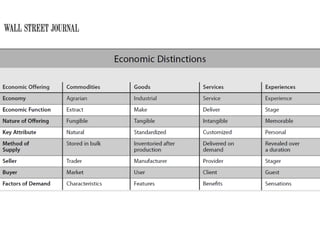
Commodity, goods, service or
            experience?
• “…move beyond
  thinking of our primary
  product as just a
  commodity to which we
  offer access”
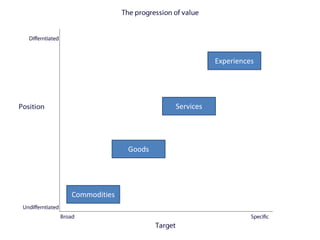
Experiences


                      Services


              Goods


Commodities
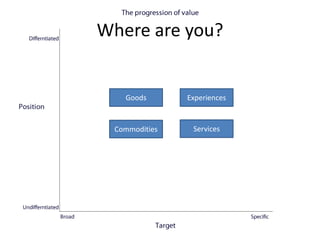
Where are you?


   Goods       Experiences


 Commodities    Services
Target: The Compass
• This strategic thinker has the big picture in
  mind and uses research and information
  gathering to make informed decisions about a
  company’s future. Compasses are able to
  identify growth and investment opportunities
  from a mile away and need access to
  information — both recent and historical. This
  professional sets the organization up for
  success by initiating the research and
  analyzing it.
Target: The connector
• This well networked individual lives and
  breathes news and information. As a “go-to”
  source of information for others, their
  personal and professional interests overlap—
  in fact, they may be resident workaholics.
  These individuals require access to a broad
  range of information from different sources
  including social media, print and online
  news, research, TV/Radio etc..
Target: The Captain
• Captains need information quickly to make
  near-term tactical decisions and longer-term
  strategic decisions and set goals. Captains
  initiate, delegate and receive/review research
  conducted by mid-level and junior staff. They
  also conduct initial research and then pass it
  off to their colleagues to look into further.
Target: The Miner
• The Miner: The Miner wants targeted
  information to stay on top of current events
  particular to their industry, clients and
  competitors. They’re often known for digging
  up and gathering information independently
  to make sure it’s pertinent, accurate and
  credible.
Target: The Scout
• Scouts are reactive and make things happen.
  They’re focused on the deliverables and their
  research behaviors are triggered by events
  and projects. Typically given assignments for
  review, they’re always monitoring specific
  topics or keywords to report to their superiors
  as-it-happens.
Target:InfoPro
• The InfoPro is the one that lives and breathes
  research and information. Methodical in their
  thinking, these individuals identify, retrieve
  and analyze information to determine the
  connection between words, numbers, ideas
  and people.
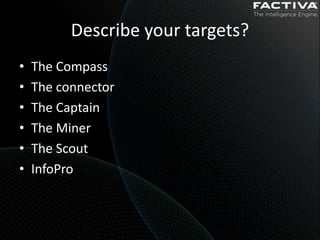
Describe your targets?
•   The Compass
•   The connector
•   The Captain
•   The Miner
•   The Scout
•   InfoPro
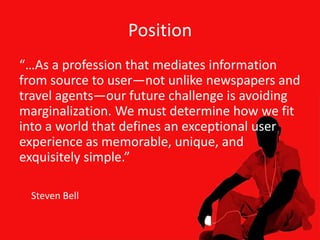
Position
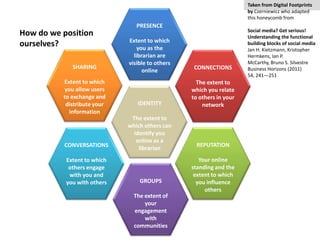
“…As a profession that mediates information
from source to user—not unlike newspapers and
travel agents—our future challenge is avoiding
marginalization. We must determine how we fit
into a world that defines an exceptional user
experience as memorable, unique, and
exquisitely simple.”

 Steven Bell
Taken from Digital Footprints
                                                                     by Czerniewicz who adapted
                                                                     this honeycomb from
                                PRESENCE
                                                                     Social media? Get serious!
How do we position                                                   Understanding the functional
                             Extent to which
ourselves?                       you as the
                                                                     building blocks of social media
                                                                     Jan H. Kietzmann, Kristopher
                               librarian are                         Hermkens, Ian P.
                             visible to others                       McCarthy, Bruno S. Silvestre
             SHARING                             CONNECTIONS         Business Horizons (2011)
                                   online
                                                                     54, 241—251
          Extent to which                          The extent to
          you allow users                        which you relate
          to exchange and                        to others in your
           distribute your      IDENTITY             network
            information
                              The extent to
                             which others can
                               identify you
                                online as a
          CONVERSATIONS                           REPUTATION
                                 librarian
           Extent to which                          Your online
            others engage                        standing and the
            with you and                          extent to which
           you with others       GROUPS            you influence
                                                      others
                               The extent of
                                   your
                               engagement
                                   with
                               communities
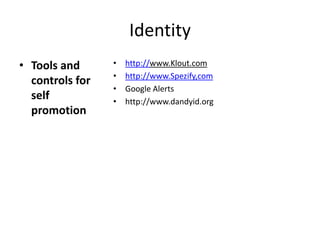
Identity
• Tools and      •   http://www.Klout.com
                 •   http://www.Spezify,com
  controls for
                 •   Google Alerts
  self           •   http://www.dandyid.org
  promotion
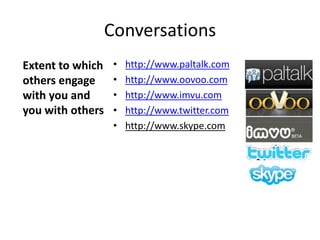
Conversations
Extent to which    •   http://www.paltalk.com
others engage      •   http://www.oovoo.com
with you and       •   http://www.imvu.com
you with others    •   http://www.twitter.com
                   •   http://www.skype.com
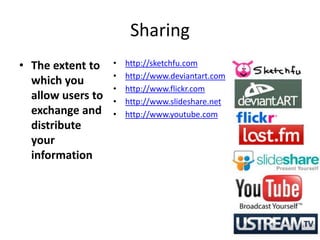
Sharing
• The extent to    •   http://sketchfu.com
                   •   http://www.deviantart.com
  which you
                   •   http://www.flickr.com
  allow users to   •   http://www.slideshare.net
  exchange and     •   http://www.youtube.com
  distribute
  your
  information
Presence
• The extent that   • http://www.foursquare.com
                    • http://www.gowalla.com
  others can know
  if you are
  accessible
Connections
• Forms of          •   http://www.friendsreunited.com
  associations      •   http://www.myspace.com
  that leads to     •   http://www.facebook.com
                    •   http://www.linkedin.com
  conversation, s
                    •   http://www.bebo.com
  haring, meeting   •   http://www.ning.com
  s or “friends”    •   http://learnhub.com/
Reputation
Your online         •   http://www.blogger.com/
                    •   http://www.wordpress.com
standing and the
                    •   http://www.tumblr.com
extent to which     •   http://edublogs.org/
you influence           http://twitter.com
others
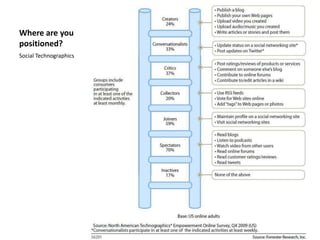
Where are you
positioned?
Social Technographics
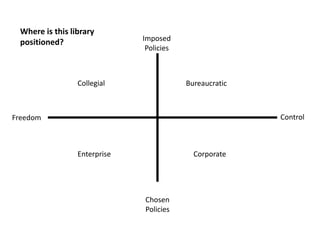
Where is this library
 positioned?                  Imposed
                               Policies


                 Collegial                Bureaucratic


Freedom                                                  Control


                 Enterprise                 Corporate


                              Chosen
                              Policies
Control & Innovation
• Strategies driven by technology will find their
  processes constrained by their adopted
  technologies (Stiles)
• Unfamiliar requirements on unprepared staff
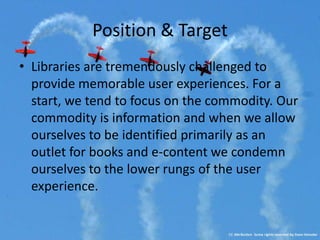
Position & Target
• Libraries are tremendously challenged to
  provide memorable user experiences. For a
  start, we tend to focus on the commodity. Our
  commodity is information and when we allow
  ourselves to be identified primarily as an
  outlet for books and e-content we condemn
  ourselves to the lower rungs of the user
  experience.
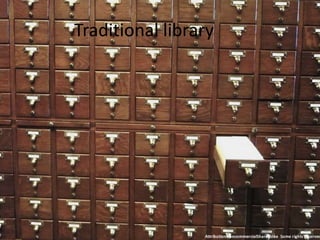
Traditional library
Virtual library
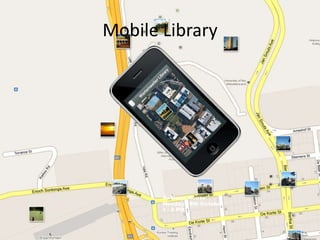
Mobile Library
Participative Library
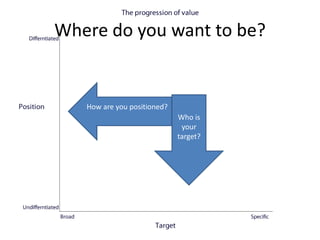
Where do you want to be?


   How are you positioned?
                             Who is
                              your
                             target?
Derek Moore
@weblearning

THANK-YOU
Credits
• Thanks to @Zaana (Zaana Howard) for resources, thoughts and conversations
References
• Bell, S. (2008) Design Thinking - [Accessed 20 Oct 2011]
   http://stevenbell.info/pdfs/ALdesignarticle.pdf
• Bernoff, J., & Li, C. (2010) Social Technographics - [Accessed 20 Oct 2011]
   http://forrester.typepad.com/groundswell/2010/01/conversationalists-get-onto-
   the-ladder.html
• Griffith , T. (201) The six data-savvy work personas [Accessed 20 Oct 2011]
   http://gigaom.com/collaboration/the-six-data-savvy-work-personas/
• [Accessed 20 Oct 2011] http://gigaom.com/collaboration/the-six-data-savvy-work-
   personas/
• Kietzmann, J.H., Hermkens, K., McCarthy, I.P., & Silvestre, B.S. 2011. Social Media?
   Get Serious! Understanding the Functional Building Blocks of Social Media.
   Business Horizons, 54, 241-251 [Accessed 20 Oct 2011]
   http://www.beedie.sfu.ca/Files/PDF/research/2011_Social_Media_BH.pdf
• Pine, J., II, & Gilmore, J.(1998). Welcome to the experience economy. Howard
   Business Review, 76 (4), 97-105. [Accessed 20 Oct 2011] http://red-
   tape.info/Images/Welcome to the Experience Economy Pine and Gilmore.pdf
Image Credits
• Slide 2 – CC Attribution Share Alike Some rights
  reserved by Shishberg
• Slide 6 – Adbusters Poster
• Slide 7 – CC Attribution Share Alike Some rights
  reserved by listentomyvoice
• Slide 17 - CC Attribution Noncommercial No Derivative
  Works Some rights reserved by Rodrigo Vera
• Slide 28 - CC Attribution Some rights reserved by Dave
  Hamster
• Slide 29 – CC Some rights reserved by ttcopley

#Occupythelibrary

  • 1.
    #Occupythelibrary Whois your target? How are you positioned? What is your destination?
  • 2.
    Commodity, goods, serviceor experience? • “…move beyond thinking of our primary product as just a commodity to which we offer access”
  • 4.
    Experiences Services Goods Commodities
  • 9.
    Where are you? Goods Experiences Commodities Services
  • 10.
    Target: The Compass •This strategic thinker has the big picture in mind and uses research and information gathering to make informed decisions about a company’s future. Compasses are able to identify growth and investment opportunities from a mile away and need access to information — both recent and historical. This professional sets the organization up for success by initiating the research and analyzing it.
  • 11.
    Target: The connector •This well networked individual lives and breathes news and information. As a “go-to” source of information for others, their personal and professional interests overlap— in fact, they may be resident workaholics. These individuals require access to a broad range of information from different sources including social media, print and online news, research, TV/Radio etc..
  • 12.
    Target: The Captain •Captains need information quickly to make near-term tactical decisions and longer-term strategic decisions and set goals. Captains initiate, delegate and receive/review research conducted by mid-level and junior staff. They also conduct initial research and then pass it off to their colleagues to look into further.
  • 13.
    Target: The Miner •The Miner: The Miner wants targeted information to stay on top of current events particular to their industry, clients and competitors. They’re often known for digging up and gathering information independently to make sure it’s pertinent, accurate and credible.
  • 14.
    Target: The Scout •Scouts are reactive and make things happen. They’re focused on the deliverables and their research behaviors are triggered by events and projects. Typically given assignments for review, they’re always monitoring specific topics or keywords to report to their superiors as-it-happens.
  • 15.
    Target:InfoPro • The InfoProis the one that lives and breathes research and information. Methodical in their thinking, these individuals identify, retrieve and analyze information to determine the connection between words, numbers, ideas and people.
  • 16.
    Describe your targets? • The Compass • The connector • The Captain • The Miner • The Scout • InfoPro
  • 17.
    Position “…As a professionthat mediates information from source to user—not unlike newspapers and travel agents—our future challenge is avoiding marginalization. We must determine how we fit into a world that defines an exceptional user experience as memorable, unique, and exquisitely simple.” Steven Bell
  • 18.
    Taken from DigitalFootprints by Czerniewicz who adapted this honeycomb from PRESENCE Social media? Get serious! How do we position Understanding the functional Extent to which ourselves? you as the building blocks of social media Jan H. Kietzmann, Kristopher librarian are Hermkens, Ian P. visible to others McCarthy, Bruno S. Silvestre SHARING CONNECTIONS Business Horizons (2011) online 54, 241—251 Extent to which The extent to you allow users which you relate to exchange and to others in your distribute your IDENTITY network information The extent to which others can identify you online as a CONVERSATIONS REPUTATION librarian Extent to which Your online others engage standing and the with you and extent to which you with others GROUPS you influence others The extent of your engagement with communities
  • 19.
    Identity • Tools and • http://www.Klout.com • http://www.Spezify,com controls for • Google Alerts self • http://www.dandyid.org promotion
  • 20.
    Conversations Extent to which • http://www.paltalk.com others engage • http://www.oovoo.com with you and • http://www.imvu.com you with others • http://www.twitter.com • http://www.skype.com
  • 21.
    Sharing • The extentto • http://sketchfu.com • http://www.deviantart.com which you • http://www.flickr.com allow users to • http://www.slideshare.net exchange and • http://www.youtube.com distribute your information
  • 22.
    Presence • The extentthat • http://www.foursquare.com • http://www.gowalla.com others can know if you are accessible
  • 23.
    Connections • Forms of • http://www.friendsreunited.com associations • http://www.myspace.com that leads to • http://www.facebook.com • http://www.linkedin.com conversation, s • http://www.bebo.com haring, meeting • http://www.ning.com s or “friends” • http://learnhub.com/
  • 24.
    Reputation Your online • http://www.blogger.com/ • http://www.wordpress.com standing and the • http://www.tumblr.com extent to which • http://edublogs.org/ you influence http://twitter.com others
  • 25.
  • 26.
    Where is thislibrary positioned? Imposed Policies Collegial Bureaucratic Freedom Control Enterprise Corporate Chosen Policies
  • 27.
    Control & Innovation •Strategies driven by technology will find their processes constrained by their adopted technologies (Stiles) • Unfamiliar requirements on unprepared staff
  • 28.
    Position & Target •Libraries are tremendously challenged to provide memorable user experiences. For a start, we tend to focus on the commodity. Our commodity is information and when we allow ourselves to be identified primarily as an outlet for books and e-content we condemn ourselves to the lower rungs of the user experience.
  • 29.
  • 30.
  • 31.
  • 32.
  • 33.
    Where do youwant to be? How are you positioned? Who is your target?
  • 34.
  • 35.
    Credits • Thanks to@Zaana (Zaana Howard) for resources, thoughts and conversations References • Bell, S. (2008) Design Thinking - [Accessed 20 Oct 2011] http://stevenbell.info/pdfs/ALdesignarticle.pdf • Bernoff, J., & Li, C. (2010) Social Technographics - [Accessed 20 Oct 2011] http://forrester.typepad.com/groundswell/2010/01/conversationalists-get-onto- the-ladder.html • Griffith , T. (201) The six data-savvy work personas [Accessed 20 Oct 2011] http://gigaom.com/collaboration/the-six-data-savvy-work-personas/ • [Accessed 20 Oct 2011] http://gigaom.com/collaboration/the-six-data-savvy-work- personas/ • Kietzmann, J.H., Hermkens, K., McCarthy, I.P., & Silvestre, B.S. 2011. Social Media? Get Serious! Understanding the Functional Building Blocks of Social Media. Business Horizons, 54, 241-251 [Accessed 20 Oct 2011] http://www.beedie.sfu.ca/Files/PDF/research/2011_Social_Media_BH.pdf • Pine, J., II, & Gilmore, J.(1998). Welcome to the experience economy. Howard Business Review, 76 (4), 97-105. [Accessed 20 Oct 2011] http://red- tape.info/Images/Welcome to the Experience Economy Pine and Gilmore.pdf
  • 36.
    Image Credits • Slide2 – CC Attribution Share Alike Some rights reserved by Shishberg • Slide 6 – Adbusters Poster • Slide 7 – CC Attribution Share Alike Some rights reserved by listentomyvoice • Slide 17 - CC Attribution Noncommercial No Derivative Works Some rights reserved by Rodrigo Vera • Slide 28 - CC Attribution Some rights reserved by Dave Hamster • Slide 29 – CC Some rights reserved by ttcopley

Editor's Notes

  • #3 http://stevenbell.info/pdfs/ALdesignarticle.pdf
  • #4 CommoditiesGoodsServicesExperiencesIndustrial economyServices economyExperiences economy
  • #5 Adapted from Welcome to the Experience EconomyFungibleTangibleIntangibleMemorable
  • #9 Welcome to the Experience Economy
  • #11 http://gigaom.com/collaboration/the-six-data-savvy-work-personas/
  • #12 http://gigaom.com/collaboration/the-six-data-savvy-work-personas/
  • #13 http://gigaom.com/collaboration/the-six-data-savvy-work-personas/
  • #14 http://gigaom.com/collaboration/the-six-data-savvy-work-personas/
  • #15 http://gigaom.com/collaboration/the-six-data-savvy-work-personas/
  • #16 http://gigaom.com/collaboration/the-six-data-savvy-work-personas/
  • #19 http://www.beedie.sfu.ca/Files/PDF/research/2011_Social_Media_BH.pdf
  • #21 Educational conversations can be supported by a variety of generic tools, including some with high bandwidth connectivity (Vyew). Other sites provide more structure and encourage international conversation (Think). For younger learners, the conversation may be set against more engaging visual scenery (Whyville). Chat discussion boards can support homework (Onionstreet). Users can create their own chat room (Chatmaker). Teachers also can link through discussion forums (Schoolhistory). http://vyew.com/sitehttp://www.think.com/enhttp://b.whyville.net/smmk/nicehttp://www.bbc.co.uk/onionstreethttp://www.chatmaker.nethttp://www.schoolhistory.co.uk/forum
  • #22 Sites have emerged that welcome creative digital material organised by educators. An example is the education groups on YouTube (Reteachers) or those made by young people themselves (BBC blast). The more educational media of video and PowerPoint may be shared (Sentation). However, student class notes define one of the most shareable of educational products (Miniciti, Notecentric). http://youtube.com/group/reteachers http://www.bbc.co.uk/blast http://www.zentation.com http://www.miniciti.com http://www.notecentric.com
  • #23 Some systems for sharing bookmarks are designed more for research and education users (Bibsonomy). Others centre on the collection and shared organisation of research publications (Citeulike). http://www.bibsonomy.org http://www.citeulike.org
  • #25  Blogs allow chronological organization of thoughts, status, ideas. This means more permanence than emails.Blog hosting sites exist especially for students and teachers (Edublogs). Some student blog collections that are institutionally managed are publically readable; these exist in the domain of undergraduates (Warwick), secondary (Longeaton) and primary (Sandaigprimary). Academic publishers are now encouraging scientific authors to blog around their findings (Nature). http://edublogs.orghttp://www.sandaigprimary.co.uk/pivothttp://blogs.longeaton.derbyshire.sch.ukhttp://blogs.warwick.ac.ukhttp://www.nature.com/blog
  • #29 CC Attribution Some rights reserved by Dave Hamster