E-Learning in its Element: Building Informal Learning and Research  Capacity in Large Communities John Cook Learning Technology Research Institute,  London Metropolitan University ESRC funded National Centre for Research Methods, 10th Nov, Work-Based Learning for Education centre, Institute of Education, London
Email:  [email_address]   Home page:  http://staffweb.londonmet.ac.uk/~cookj1/   Blog:  http://blogs.londonmet.ac.uk/tel   Twitter:  http://twitter.com/johnnigelcook   Slideshare:  http://www.slideshare.net/johnnigelcook   Skype: johnnigelcook  Google Wave:  [email_address]   Blip.fm:  http://blip.fm/johnnigelcook   Possible tag: #ncrm09
Structure Overview Strategies that could be adopted, particularly to support informal learning within communities Resources that are available How these resources can be used to help build research capacity
1. Overview Digital media and e-learning provide a cost-effective means of reaching large widely-distributed  communities  and building their  research capacity .  The session offers  experiential  advice on  the  strategies  that could be adopted, particularly to support informal learning within communities the  resources  that are available and  how  these resources can be used to help build  research capacity .
2. Strategies that could be adopted, particularly to support informal learning within communities I don’t have a strategy to give you as such! I will present some frameworks and trends/issues and hopefully your can develop your own strategies …
Preece, J. (2000)  Online Communities Preece (2000) has proposed that online communities are all about people policies and  purpose.  Typically, a group of people may come together in order to fulfil a particular  purpose  or to satisfy particular needs.  The online groupings of people who manage to build successful communities tend to be guided by  formal and, or sometimes informal policies  that are defined early on in the evolution of the online community.
Preece, J. (2000)  Online Communities A member of a community brings with them their own set of characteristics, thus the  people  dimension can include such things as: gender, expertise, personality, age, culture, motivation, abilities and disabilities.  A  policy  refers to the norms and rules of the community, which include: etiquette, flaming and privacy.  The  purpose  of a community can vary depending on the domain and task involved, but may include: education, information, civic, support, practice, health, problem-solving.  Thus in Preece’s (2000) framework there are strong elements of individual and collective sociability.
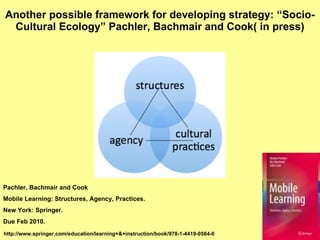
Another possible framework for developing strategy: “Socio-Cultural Ecology”  Pachler, Bachmair and Cook ( in press) Pachler, Bachmair and Cook  Mobile Learning: Structures, Agency, Practices.  New York: Springer.  Due Feb 2010. http://www.springer.com/education/learning+&+instruction/book/978-1-4419-0584-0
Socio-Cultural Ecology Agency (capacity to act on the world) Formation of identity and subjectivity. Environment a potential resource for learning. Giddens (1984). Cultural practices (routines in stable situations)  Institutional settings, be they school, university, the work place etc. Media use in everyday life (includes informal/non-formal). Cultural practices in the context of media and everyday life (Hall, 1997). Structures (mass communication and technology) Educational institutions no longer define alone what learning and knowledge are and they are certainly no longer the only, even the main location where learning and knowledge can be accessed and takes place. From push to pull, change of mass communication and media convergence. Giddens’ (1984) structuration theory, relationship of agency and structures in educational and media contexts
Blurring of boundaries between formal & informal communication (Czerniewicz, 2009) Formal scholarly communication selection, editing, printing and distribution of author content  by an intermediary  preferably one with some name recognition Informal communication enabled by Information and Communications Technology sharing of working papers, reports etc “ gray literature” Blurred spaces in between  preprint servers, blogs Repositories show  all  output
Scholars will rely on integrated electronic environments (Czerniewicz, 2009)  Layered, interlinked platforms containing a wide variety of content – from fee-based to free – including:  traditional peer-reviewed published material (monographs, journals, reference works)  multimedia projects  raw primary source material (data sets, gray literature)  primary source material designed with the interpretative and conceptual insights of scholars  conference proceedings and other non-peer-reviewed output from universities  pre-print workspaces that allow scholars to collaborate in advance of publication (working paper repositories, wikis)  post-print conversation spaces that encourage scholarly communication (message boards, author sites, newsletters, blogs )  dissertation repositories  subject matter repositories
3. Resources that are available How not to do it: Sharepoint imposition Tools I use in research networks (my PLE) Example experience of drawing on a community of professional practice in Twitter
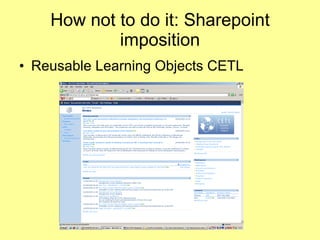
How not to do it: Sharepoint imposition Reusable Learning Objects CETL
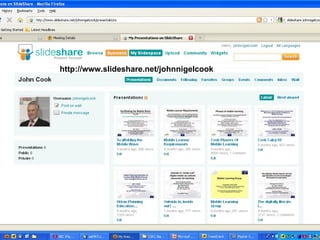
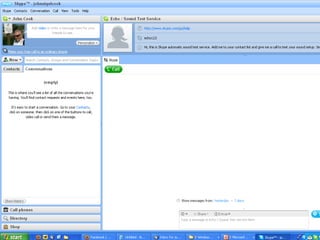
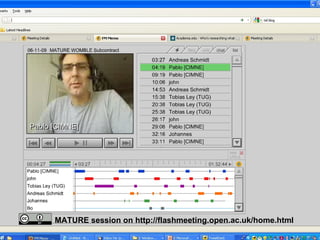
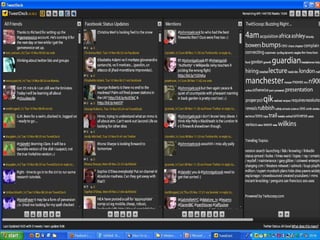
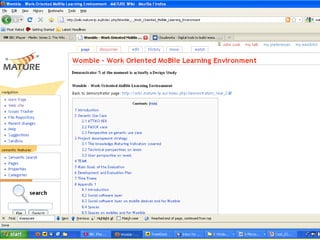
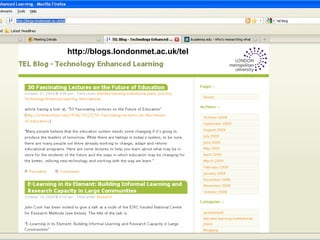
Tools I use in research networks  my PLE – Personal Learning Environment Slideshare:  http://www.slideshare.net/johnnigelcook   Skype: johnnigelcook Flashmeeting:  http://flashmeeting.open.ac.uk/home.html Semantic Wiki in MATURE (need password) http://wiki.mature-ip.eu/index.php/Main_Page   Twitter:  http://twitter.com/johnnigelcook Wordpress for TEL Blog:  http://blogs.londonmet.ac.uk/tel
http://www.slideshare.net/johnnigelcook
 
MATURE session on http://flashmeeting.open.ac.uk/home.html
 
 
http://blogs.londonmet.ac.uk/tel
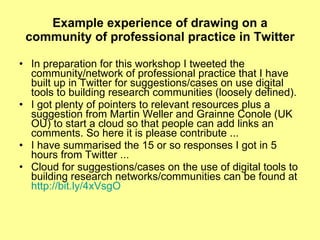
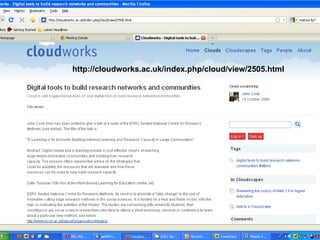
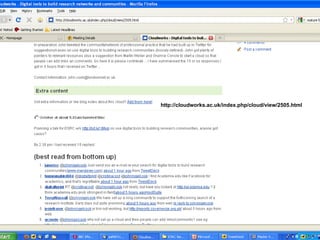
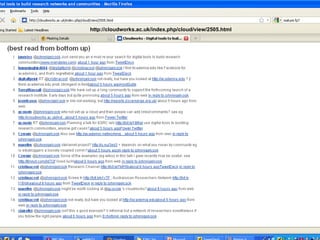
Example experience of drawing on a community of professional practice in Twitter In preparation for this workshop I tweeted the community/network of professional practice that I have built up in Twitter for suggestions/cases on use digital tools to building research communities (loosely defined).  I got plenty of pointers to relevant resources plus a suggestion from Martin Weller and Grainne Conole (UK OU) to start a cloud so that people can add links an comments. So here it is please contribute ...  I have summarised the 15 or so responses I got in 5 hours from Twitter ...  Cloud for suggestions/cases on the use of digital tools to building research networks/communities can be found at  http://bit.ly/4xVsgO
http://cloudworks.ac.uk/index.php/cloud/view/2505.html
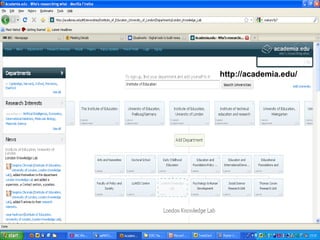
http://academia.edu/
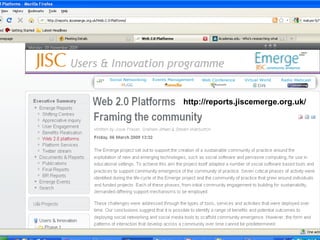
http://reports.jiscemerge.org.uk/
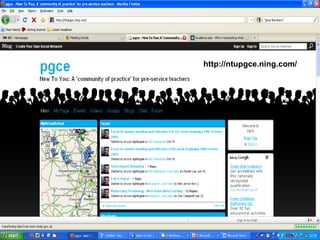
http://ntupgce.ning.com/
4.  How these resources can be used to help build research capacity  (all this section from Czerniewicz, 2009) Change of mindset If you don’t tell people they don’t know No false modesty It is not crass marketing Not just the output that is online - it is also the scholarly community- are you?
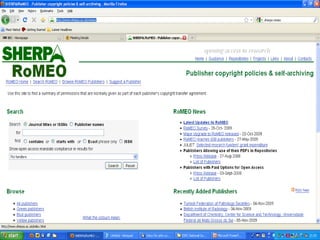
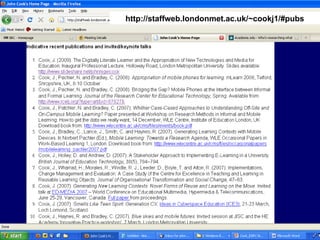
What is possible: less effort A website with a list of all output Copies on personal web sites and appropriate repositories of all output from journals listed on  sherpa romeo website http://www.sherpa.ac.uk/romeo/   “ Use this site to find a summary of permissions that are normally given as part of each publisher's copyright transfer agreement.”  Copies of penultimate versions
 
http://staffweb.londonmet.ac.uk/~cookj1/#pubs
What is possible: more effort Develop an online presence Become part of online communities Use social software
What is to be done? Lobby to change and expand the system Get informed Get involved with the open access debates Take control Exploit the many opportunities to share the knowledge that is produced
Thank You Questions Take the debate to: http://cloudworks.ac.uk/index.php/cloud/view/2505.html
Reference Czerniewicz, L. (2009). Scholarly communication ICT-enabled opportunities for academics.  http://tinyurl.com/ld7l2f , accessed 9 November 2009. Giddens, A. (1984).  The Constitution of Society: Outline of the Theory of Structuration.  University of California Press. Reprint edition (January 1, 1986). Hall, S. (1997) (ed.).  Representation. Cultural Representations and Signifying Practices.  London: Sage.  Pachler, N., Bachmair, B. and Cook, J. (in press).  Mobile Learning: Structures, Agency, Practices.  New York: Springer. Due Feb 2010.  http://bit.ly/3r3xRl   Preece, J. (2000)  Online Communities: Designing Usability, Supporting Sociability.  John Wiley & Sons.

Cook ESRC National Centre for Research Methods

  • 1.
    E-Learning in itsElement: Building Informal Learning and Research Capacity in Large Communities John Cook Learning Technology Research Institute, London Metropolitan University ESRC funded National Centre for Research Methods, 10th Nov, Work-Based Learning for Education centre, Institute of Education, London
  • 2.
    Email: [email_address] Home page: http://staffweb.londonmet.ac.uk/~cookj1/ Blog: http://blogs.londonmet.ac.uk/tel Twitter: http://twitter.com/johnnigelcook Slideshare: http://www.slideshare.net/johnnigelcook Skype: johnnigelcook Google Wave: [email_address] Blip.fm: http://blip.fm/johnnigelcook Possible tag: #ncrm09
  • 3.
    Structure Overview Strategiesthat could be adopted, particularly to support informal learning within communities Resources that are available How these resources can be used to help build research capacity
  • 4.
    1. Overview Digitalmedia and e-learning provide a cost-effective means of reaching large widely-distributed communities and building their research capacity . The session offers experiential advice on the strategies that could be adopted, particularly to support informal learning within communities the resources that are available and how these resources can be used to help build research capacity .
  • 5.
    2. Strategies thatcould be adopted, particularly to support informal learning within communities I don’t have a strategy to give you as such! I will present some frameworks and trends/issues and hopefully your can develop your own strategies …
  • 6.
    Preece, J. (2000) Online Communities Preece (2000) has proposed that online communities are all about people policies and purpose. Typically, a group of people may come together in order to fulfil a particular purpose or to satisfy particular needs. The online groupings of people who manage to build successful communities tend to be guided by formal and, or sometimes informal policies that are defined early on in the evolution of the online community.
  • 7.
    Preece, J. (2000) Online Communities A member of a community brings with them their own set of characteristics, thus the people dimension can include such things as: gender, expertise, personality, age, culture, motivation, abilities and disabilities. A policy refers to the norms and rules of the community, which include: etiquette, flaming and privacy. The purpose of a community can vary depending on the domain and task involved, but may include: education, information, civic, support, practice, health, problem-solving. Thus in Preece’s (2000) framework there are strong elements of individual and collective sociability.
  • 8.
    Another possible frameworkfor developing strategy: “Socio-Cultural Ecology” Pachler, Bachmair and Cook ( in press) Pachler, Bachmair and Cook Mobile Learning: Structures, Agency, Practices. New York: Springer. Due Feb 2010. http://www.springer.com/education/learning+&+instruction/book/978-1-4419-0584-0
  • 9.
    Socio-Cultural Ecology Agency(capacity to act on the world) Formation of identity and subjectivity. Environment a potential resource for learning. Giddens (1984). Cultural practices (routines in stable situations) Institutional settings, be they school, university, the work place etc. Media use in everyday life (includes informal/non-formal). Cultural practices in the context of media and everyday life (Hall, 1997). Structures (mass communication and technology) Educational institutions no longer define alone what learning and knowledge are and they are certainly no longer the only, even the main location where learning and knowledge can be accessed and takes place. From push to pull, change of mass communication and media convergence. Giddens’ (1984) structuration theory, relationship of agency and structures in educational and media contexts
  • 10.
    Blurring of boundariesbetween formal & informal communication (Czerniewicz, 2009) Formal scholarly communication selection, editing, printing and distribution of author content by an intermediary preferably one with some name recognition Informal communication enabled by Information and Communications Technology sharing of working papers, reports etc “ gray literature” Blurred spaces in between preprint servers, blogs Repositories show all output
  • 11.
    Scholars will relyon integrated electronic environments (Czerniewicz, 2009) Layered, interlinked platforms containing a wide variety of content – from fee-based to free – including: traditional peer-reviewed published material (monographs, journals, reference works) multimedia projects raw primary source material (data sets, gray literature) primary source material designed with the interpretative and conceptual insights of scholars conference proceedings and other non-peer-reviewed output from universities pre-print workspaces that allow scholars to collaborate in advance of publication (working paper repositories, wikis) post-print conversation spaces that encourage scholarly communication (message boards, author sites, newsletters, blogs ) dissertation repositories subject matter repositories
  • 12.
    3. Resources thatare available How not to do it: Sharepoint imposition Tools I use in research networks (my PLE) Example experience of drawing on a community of professional practice in Twitter
  • 13.
    How not todo it: Sharepoint imposition Reusable Learning Objects CETL
  • 14.
    Tools I usein research networks my PLE – Personal Learning Environment Slideshare: http://www.slideshare.net/johnnigelcook Skype: johnnigelcook Flashmeeting: http://flashmeeting.open.ac.uk/home.html Semantic Wiki in MATURE (need password) http://wiki.mature-ip.eu/index.php/Main_Page Twitter: http://twitter.com/johnnigelcook Wordpress for TEL Blog: http://blogs.londonmet.ac.uk/tel
  • 15.
  • 16.
  • 17.
    MATURE session onhttp://flashmeeting.open.ac.uk/home.html
  • 18.
  • 19.
  • 20.
  • 21.
    Example experience ofdrawing on a community of professional practice in Twitter In preparation for this workshop I tweeted the community/network of professional practice that I have built up in Twitter for suggestions/cases on use digital tools to building research communities (loosely defined). I got plenty of pointers to relevant resources plus a suggestion from Martin Weller and Grainne Conole (UK OU) to start a cloud so that people can add links an comments. So here it is please contribute ... I have summarised the 15 or so responses I got in 5 hours from Twitter ... Cloud for suggestions/cases on the use of digital tools to building research networks/communities can be found at http://bit.ly/4xVsgO
  • 22.
  • 23.
  • 24.
  • 25.
  • 26.
  • 27.
  • 28.
    4. Howthese resources can be used to help build research capacity (all this section from Czerniewicz, 2009) Change of mindset If you don’t tell people they don’t know No false modesty It is not crass marketing Not just the output that is online - it is also the scholarly community- are you?
  • 29.
    What is possible:less effort A website with a list of all output Copies on personal web sites and appropriate repositories of all output from journals listed on sherpa romeo website http://www.sherpa.ac.uk/romeo/ “ Use this site to find a summary of permissions that are normally given as part of each publisher's copyright transfer agreement.” Copies of penultimate versions
  • 30.
  • 31.
  • 32.
    What is possible:more effort Develop an online presence Become part of online communities Use social software
  • 33.
    What is tobe done? Lobby to change and expand the system Get informed Get involved with the open access debates Take control Exploit the many opportunities to share the knowledge that is produced
  • 34.
    Thank You QuestionsTake the debate to: http://cloudworks.ac.uk/index.php/cloud/view/2505.html
  • 35.
    Reference Czerniewicz, L.(2009). Scholarly communication ICT-enabled opportunities for academics. http://tinyurl.com/ld7l2f , accessed 9 November 2009. Giddens, A. (1984). The Constitution of Society: Outline of the Theory of Structuration. University of California Press. Reprint edition (January 1, 1986). Hall, S. (1997) (ed.). Representation. Cultural Representations and Signifying Practices. London: Sage. Pachler, N., Bachmair, B. and Cook, J. (in press). Mobile Learning: Structures, Agency, Practices. New York: Springer. Due Feb 2010. http://bit.ly/3r3xRl Preece, J. (2000) Online Communities: Designing Usability, Supporting Sociability. John Wiley & Sons.