Social exchange for knowledge exchange


 Hazel Hall
 Senior Lecturer
 School of Computing
 Napier University, Edinburgh

 h.hall@napier.ac.uk
 http://www.esis.bim.napier.ac.uk/esis/about_us/hazel.html


Managing Knowledge: Conversations and Critiques              1

University of Leicester, 10-11 April 2001
Social exchange for knowledge exchange


 Format of the presentation

 •   introduce topic of doctoral research
 •   present theoretical framework for the study
 •   provide short summary of literature reviewed to date


Managing Knowledge: Conversations and Critiques             2

University of Leicester, 10-11 April 2001
Social exchange for knowledge exchange


 Motivating knowledge sharing: interest in the
  topic

 •   widely discussed topic
 •   important area for research
 •   priority area for companies
 •   more important than issues related to capture, storage or
     dissemination of information


Managing Knowledge: Conversations and Critiques                  3

University of Leicester, 10-11 April 2001
Social exchange for knowledge exchange


 Motivating knowledge sharing: suitability for
  doctoral research

 •   respond to need to understand what motivates knowledge
     sharing
 •   emphasis on groups of individuals as well as individuals


Managing Knowledge: Conversations and Critiques                 4

University of Leicester, 10-11 April 2001
Social exchange for knowledge exchange


 Theoretical framework: exchange theory

 •   from economics
 •   studies relationships and “exchanges”
 •   assumes rational decisions based on best value, lowest cost


Managing Knowledge: Conversations and Critiques                5

University of Leicester, 10-11 April 2001
Social exchange for knowledge exchange


 Analytical concepts and assumptions of
   exchange theories

 •   actors - participants
 •   resources - “currencies”
 •   structures - relationships
 •   processes - interactions, opportunities


Managing Knowledge: Conversations and Critiques   6

University of Leicester, 10-11 April 2001
Social exchange for knowledge exchange


 Social exchange theory

 •   actors = people (long-term relationships, known parties)
 •   resources = what they value (not information/knowledge)
 •   structures = dependent relationships
 •   processes = interactions, opportunities


Managing Knowledge: Conversations and Critiques                 7

University of Leicester, 10-11 April 2001
Social exchange for knowledge exchange


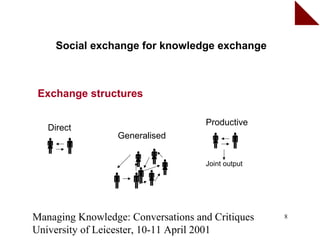
 Exchange structures

                                    Productive
   Direct
                  Generalised
                                  
                                 Joint output

                
               
Managing Knowledge: Conversations and Critiques    8

University of Leicester, 10-11 April 2001
Social exchange for knowledge exchange


 Interest in social exchange theory

 •   Anthropology - social cohesion (generalised exchange, gift
     giving)
 •   Behavioural psychology - learning
 •   Sociology - power relationships, commitment, affective ties


Managing Knowledge: Conversations and Critiques                    9

University of Leicester, 10-11 April 2001
Social exchange for knowledge exchange


 Social exchange theory and knowledge sharing
 Implied - examples

 •   relationship between job demands and innovative work
     behaviour
 •   relationships between employers and employees
 •   support of word-of-mouth information flows in marketing


Managing Knowledge: Conversations and Critiques                10

University of Leicester, 10-11 April 2001
Social exchange for knowledge exchange


 Social exchange theory and knowledge sharing
 Alluded - examples

 •   Constant et al (1994) - “exchange and expressive theory of
     information sharing”
 •   limited follow-up of Constant et al’s work
 •   Nahapiet & Ghoshal (1998) - knowledge markets, creating
     social capital and knowledge capital


Managing Knowledge: Conversations and Critiques               11

University of Leicester, 10-11 April 2001
Social exchange for knowledge exchange


 Social exchange theory and information science
 Implied - examples

 •   processes of scholarship
 •   scholarly communication
 •   citation analysis and trust
 •   information sharing across networks
 •   acknowledgements and gift giving


Managing Knowledge: Conversations and Critiques   12

University of Leicester, 10-11 April 2001
Social exchange for knowledge exchange


 Social exchange for knowledge exchange
 Incentives

 •   resources: rewards for knowledge sharing where knowledge
     is a private good
 •   conditions: create moral obligation, where knowledge is a
     public good

 NB majority of papers reviewed to date make no reference to
   social exchange theory
Managing Knowledge: Conversations and Critiques                13

University of Leicester, 10-11 April 2001
Social exchange for knowledge exchange


 Exchange resources for knowledge sharing: hard
   rewards


 •   economic rewards, e.g. cash, bonuses
 •   access to information and knowledge
 •   career advancement/security


Managing Knowledge: Conversations and Critiques   14

University of Leicester, 10-11 April 2001
Social exchange for knowledge exchange


 Exchange resources for knowledge sharing: soft
   rewards


 •   enhanced reputation
 •   personal satisfaction


Managing Knowledge: Conversations and Critiques   15

University of Leicester, 10-11 April 2001
Social exchange for knowledge exchange


 Exchange conditions for knowledge sharing

 •   explicit responsibility to knowledge share
 •   experimentation as a legitimate activity
 •   status ignored
 •   communities: shared identity/commitment/obligation to
     support social interaction
 •   provision of information and communication technologies


Managing Knowledge: Conversations and Critiques                16

University of Leicester, 10-11 April 2001
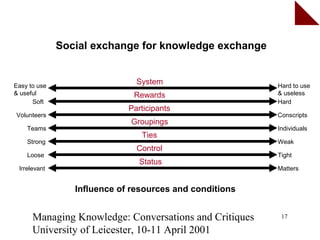
Social exchange for knowledge exchange


Easy to use
                               System                    Hard to use
& useful                      Rewards                    & useless
      Soft                                               Hard
                             Participants
Volunteers                                               Conscripts
                             Groupings
    Teams                                                Individuals
                                Ties
    Strong                                               Weak
                               Control
    Loose                                                Tight
                                Status
 Irrelevant                                              Matters


                 Influence of resources and conditions


      Managing Knowledge: Conversations and Critiques     17

      University of Leicester, 10-11 April 2001
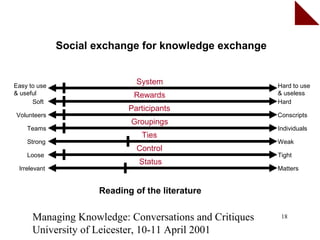
Social exchange for knowledge exchange


Easy to use
                              System                    Hard to use
& useful                     Rewards                    & useless
      Soft                                              Hard
                            Participants
Volunteers                                              Conscripts
                            Groupings
    Teams                                               Individuals
                               Ties
    Strong                                              Weak
                              Control
    Loose                                               Tight
                               Status
 Irrelevant                                             Matters


                     Reading of the literature


      Managing Knowledge: Conversations and Critiques    18

      University of Leicester, 10-11 April 2001
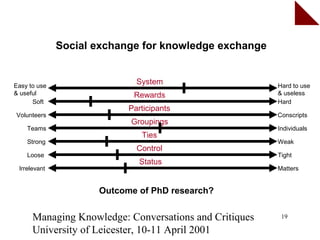
Social exchange for knowledge exchange


Easy to use
                             System                     Hard to use
& useful                    Rewards                     & useless
      Soft                                              Hard
                           Participants
Volunteers                                              Conscripts
                           Groupings
    Teams                                               Individuals
                              Ties
    Strong                                              Weak
                             Control
    Loose                                               Tight
                              Status
 Irrelevant                                             Matters


                     Outcome of PhD research?


      Managing Knowledge: Conversations and Critiques    19

      University of Leicester, 10-11 April 2001

Social exchange for knowledge exchange

  • 1.
    Social exchange forknowledge exchange Hazel Hall Senior Lecturer School of Computing Napier University, Edinburgh h.hall@napier.ac.uk http://www.esis.bim.napier.ac.uk/esis/about_us/hazel.html Managing Knowledge: Conversations and Critiques 1 University of Leicester, 10-11 April 2001
  • 2.
    Social exchange forknowledge exchange Format of the presentation • introduce topic of doctoral research • present theoretical framework for the study • provide short summary of literature reviewed to date Managing Knowledge: Conversations and Critiques 2 University of Leicester, 10-11 April 2001
  • 3.
    Social exchange forknowledge exchange Motivating knowledge sharing: interest in the topic • widely discussed topic • important area for research • priority area for companies • more important than issues related to capture, storage or dissemination of information Managing Knowledge: Conversations and Critiques 3 University of Leicester, 10-11 April 2001
  • 4.
    Social exchange forknowledge exchange Motivating knowledge sharing: suitability for doctoral research • respond to need to understand what motivates knowledge sharing • emphasis on groups of individuals as well as individuals Managing Knowledge: Conversations and Critiques 4 University of Leicester, 10-11 April 2001
  • 5.
    Social exchange forknowledge exchange Theoretical framework: exchange theory • from economics • studies relationships and “exchanges” • assumes rational decisions based on best value, lowest cost Managing Knowledge: Conversations and Critiques 5 University of Leicester, 10-11 April 2001
  • 6.
    Social exchange forknowledge exchange Analytical concepts and assumptions of exchange theories • actors - participants • resources - “currencies” • structures - relationships • processes - interactions, opportunities Managing Knowledge: Conversations and Critiques 6 University of Leicester, 10-11 April 2001
  • 7.
    Social exchange forknowledge exchange Social exchange theory • actors = people (long-term relationships, known parties) • resources = what they value (not information/knowledge) • structures = dependent relationships • processes = interactions, opportunities Managing Knowledge: Conversations and Critiques 7 University of Leicester, 10-11 April 2001
  • 8.
    Social exchange forknowledge exchange Exchange structures Productive Direct Generalised    Joint output   Managing Knowledge: Conversations and Critiques 8 University of Leicester, 10-11 April 2001
  • 9.
    Social exchange forknowledge exchange Interest in social exchange theory • Anthropology - social cohesion (generalised exchange, gift giving) • Behavioural psychology - learning • Sociology - power relationships, commitment, affective ties Managing Knowledge: Conversations and Critiques 9 University of Leicester, 10-11 April 2001
  • 10.
    Social exchange forknowledge exchange Social exchange theory and knowledge sharing Implied - examples • relationship between job demands and innovative work behaviour • relationships between employers and employees • support of word-of-mouth information flows in marketing Managing Knowledge: Conversations and Critiques 10 University of Leicester, 10-11 April 2001
  • 11.
    Social exchange forknowledge exchange Social exchange theory and knowledge sharing Alluded - examples • Constant et al (1994) - “exchange and expressive theory of information sharing” • limited follow-up of Constant et al’s work • Nahapiet & Ghoshal (1998) - knowledge markets, creating social capital and knowledge capital Managing Knowledge: Conversations and Critiques 11 University of Leicester, 10-11 April 2001
  • 12.
    Social exchange forknowledge exchange Social exchange theory and information science Implied - examples • processes of scholarship • scholarly communication • citation analysis and trust • information sharing across networks • acknowledgements and gift giving Managing Knowledge: Conversations and Critiques 12 University of Leicester, 10-11 April 2001
  • 13.
    Social exchange forknowledge exchange Social exchange for knowledge exchange Incentives • resources: rewards for knowledge sharing where knowledge is a private good • conditions: create moral obligation, where knowledge is a public good NB majority of papers reviewed to date make no reference to social exchange theory Managing Knowledge: Conversations and Critiques 13 University of Leicester, 10-11 April 2001
  • 14.
    Social exchange forknowledge exchange Exchange resources for knowledge sharing: hard rewards • economic rewards, e.g. cash, bonuses • access to information and knowledge • career advancement/security Managing Knowledge: Conversations and Critiques 14 University of Leicester, 10-11 April 2001
  • 15.
    Social exchange forknowledge exchange Exchange resources for knowledge sharing: soft rewards • enhanced reputation • personal satisfaction Managing Knowledge: Conversations and Critiques 15 University of Leicester, 10-11 April 2001
  • 16.
    Social exchange forknowledge exchange Exchange conditions for knowledge sharing • explicit responsibility to knowledge share • experimentation as a legitimate activity • status ignored • communities: shared identity/commitment/obligation to support social interaction • provision of information and communication technologies Managing Knowledge: Conversations and Critiques 16 University of Leicester, 10-11 April 2001
  • 17.
    Social exchange forknowledge exchange Easy to use System Hard to use & useful Rewards & useless Soft Hard Participants Volunteers Conscripts Groupings Teams Individuals Ties Strong Weak Control Loose Tight Status Irrelevant Matters Influence of resources and conditions Managing Knowledge: Conversations and Critiques 17 University of Leicester, 10-11 April 2001
  • 18.
    Social exchange forknowledge exchange Easy to use System Hard to use & useful Rewards & useless Soft Hard Participants Volunteers Conscripts Groupings Teams Individuals Ties Strong Weak Control Loose Tight Status Irrelevant Matters Reading of the literature Managing Knowledge: Conversations and Critiques 18 University of Leicester, 10-11 April 2001
  • 19.
    Social exchange forknowledge exchange Easy to use System Hard to use & useful Rewards & useless Soft Hard Participants Volunteers Conscripts Groupings Teams Individuals Ties Strong Weak Control Loose Tight Status Irrelevant Matters Outcome of PhD research? Managing Knowledge: Conversations and Critiques 19 University of Leicester, 10-11 April 2001