Input friendly intranets

            Hazel Hall - Napier University


Hazel Hall
Senior Lecturer in Information Management
School of Computing
Napier University

h.hall@napier.ac.uk


          Knowledge Management in an Age of Networks     1
          Redwood House, Edinburgh - 27th October 2000
Input friendly intranets

             Hazel Hall - Napier University


Sharing is important to efforts in Knowledge Management

Employees with straightforward access to common
  resources

•   execute routine tasks quickly
•   aggregate information  innovation in working
    practices/product design/service delivery
•   are less vulnerable to information loss

           Knowledge Management in an Age of Networks     2
           Redwood House, Edinburgh - 27th October 2000
Input friendly intranets

             Hazel Hall - Napier University
Tools for information sharing

•   browsers
•   data warehouses
•   filters
•   intranets
•   process handbooks
•   software agents
•   yield management software


            Knowledge Management in an Age of Networks     3
            Redwood House, Edinburgh - 27th October 2000
Input friendly intranets

              Hazel Hall - Napier University
Intranets as key platforms for information sharing

•   common resources for support of personal work, e.g. time
    sheets, travel bookings
•   integration of key business applications and tools
•   resources and “places”, e.g. shared databases, discussion
    space
•   sharing may extend beyond the organisation, e.g. extranet
    “shop window”


             Knowledge Management in an Age of Networks         4
             Redwood House, Edinburgh - 27th October 2000
Input friendly intranets

              Hazel Hall - Napier University
Intranet dependencies

•   An intranet is an infrastructure.
•   An intranet’s business value is contingent on resources and
    applications made available.
•   Some resources and applications can be bought, e.g.
    conferencing software, access to commercial online services.
•   Unique internally produced resources must be sought from
    individuals and teams.


             Knowledge Management in an Age of Networks        5
             Redwood House, Edinburgh - 27th October 2000
Input friendly intranets

              Hazel Hall - Napier University
Research on motivating knowledge sharing and intranets

•   priority area for knowledge research (Holsthouse, 1998)
•   addresses KM research questions about teams

•   “input friendliness” depends largely on organisational
    incentives
•   literature reviewed from domains of business studies,
    information systems, organisational science and sociology
•   (limited) case study material

             Knowledge Management in an Age of Networks         6
             Redwood House, Edinburgh - 27th October 2000
Input friendly intranets

               Hazel Hall - Napier University
Motivations to act happens when:

•   it is easy to do so
•   the usefulness of acting is obvious

This is not a new research finding!


             Knowledge Management in an Age of Networks     7
             Redwood House, Edinburgh - 27th October 2000
Input friendly intranets

               Hazel Hall - Napier University
Easy to act: intranet interfaces

•   HCI and systems design standards apply
•   channels for information flow important: dedicated mailboxes;
    speech input; requirement for all staff to become proficient in
    HTML
•   integration of tools into communities to match levels of
    formality to elicit high quality contributions (Brown and Duguid,
    1998)
•   levels of “control”


             Knowledge Management in an Age of Networks            8
             Redwood House, Edinburgh - 27th October 2000
Input friendly intranets

             Hazel Hall - Napier University
Usefulness of acting is obvious: intranet critical mass

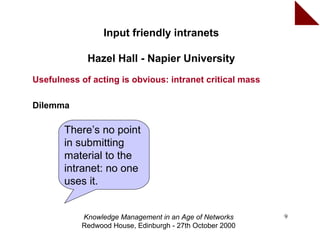
Dilemma

       There’s no point
       in submitting
       material to the
       intranet: no one
       uses it.


           Knowledge Management in an Age of Networks     9
           Redwood House, Edinburgh - 27th October 2000
Input friendly intranets

             Hazel Hall - Napier University
Usefulness of acting is obvious: intranet critical mass

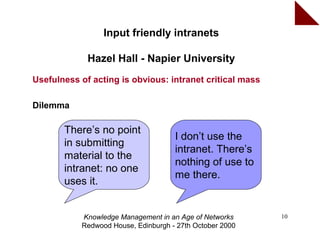
Dilemma

       There’s no point
                                     I don’t use the
       in submitting
                                     intranet. There’s
       material to the
                                     nothing of use to
       intranet: no one
                                     me there.
       uses it.


           Knowledge Management in an Age of Networks     10
           Redwood House, Edinburgh - 27th October 2000
Input friendly intranets

               Hazel Hall - Napier University
Usefulness of acting is obvious: intranet critical mass

“Output” friendliness

•   PR efforts: promotion of services; cross linking; indexing for
    search services
•   sole platform for content and applications
•   realistic expectations of use, e.g. pointer systems


             Knowledge Management in an Age of Networks              11
             Redwood House, Edinburgh - 27th October 2000
Input friendly intranets

              Hazel Hall - Napier University
Usefulness of acting is obvious: intranet critical mass

Finding of Cap Gemini and Cranfield University (1999)

“The critical mass has to appear in three key areas - users
   (success can only come from people using the intranet),
   content (there has to be ever-more useful and relevant
   material available) and utilisation (the extent to which users
   are connected per day).”


            Knowledge Management in an Age of Networks          12
            Redwood House, Edinburgh - 27th October 2000
Input friendly intranets

              Hazel Hall - Napier University
Usefulness of acting is obvious: intranet critical mass

Finding of Cap Gemini and Cranfield University (1999)

“The critical mass has to appear in three key areas - users
   (success can only come from people using the intranet),
   content (there has to be ever-more useful and relevant
   material available) and utilisation (the extent to which users
   are connected per day)… a minimum of around 40% of
   potential users need to connect to the intranet for real value
   generation to begin.”

            Knowledge Management in an Age of Networks          13
            Redwood House, Edinburgh - 27th October 2000
Input friendly intranets

               Hazel Hall - Napier University
Motivating knowledge sharing: broader issues

•   Providing good interfaces and establishing critical mass are
    just two issues to consider.
•   Creation of other more general enabling conditions is also
    important.


             Knowledge Management in an Age of Networks            14
             Redwood House, Edinburgh - 27th October 2000
Input friendly intranets

               Hazel Hall - Napier University
Enabling condition 1: environments that make knowledge
  sharing a key responsibility of staff

Knowledge sharing is more likely to be encouraged in staff
  who:

•   know that it’s a job requirement: acquire expertise and
    disseminate it
•   know that it’s a legitimate activity


             Knowledge Management in an Age of Networks       15
             Redwood House, Edinburgh - 27th October 2000
Input friendly intranets

               Hazel Hall - Napier University
Enabling condition 1: environments that make knowledge
  sharing a key responsibility of staff

•   encouraged through pro-active training, project debriefings,
    mentoring, assisting etc.
•   case study examples, e.g. Citibank - not until specific
    responsibilities were assigned to particular individuals were
    contributions to the online knowledge base elicited


             Knowledge Management in an Age of Networks             16
             Redwood House, Edinburgh - 27th October 2000
Input friendly intranets

               Hazel Hall - Napier University
Enabling condition 2: environments that promote
  communities for knowledge sharing

•   Cultures that place high value on personal technical expertise
    and knowledge creation are less likely to provide conditions
    conducive to knowledge sharing.
•   Community strength comes through strong ties and shared
    social capital: norms, obligations, trust and identity.
•   Identity derives from common purpose and aspirations to
    which group members are committed.


             Knowledge Management in an Age of Networks         17
             Redwood House, Edinburgh - 27th October 2000
Input friendly intranets

               Hazel Hall - Napier University
Enabling condition 2: environments that promote
  communities for knowledge sharing

•   carrot of continued vitality of the group
•   stick of obligation to the group
•   commitment invigorates the community


             Knowledge Management in an Age of Networks     18
             Redwood House, Edinburgh - 27th October 2000
Input friendly intranets

            Hazel Hall - Napier University
Enabling condition 2: environments that promote
  communities for knowledge sharing


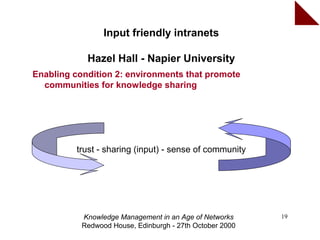
         trust - sharing (input) - sense of community


           Knowledge Management in an Age of Networks     19
           Redwood House, Edinburgh - 27th October 2000
Input friendly intranets

               Hazel Hall - Napier University
Enabling condition 2: environments that promote
  communities for knowledge sharing

Intranet checks

•   degrees of input control, e.g. location and branding of input
•   willingness to accept/reject lurkers


             Knowledge Management in an Age of Networks             20
             Redwood House, Edinburgh - 27th October 2000
Input friendly intranets

              Hazel Hall - Napier University
Enabling condition 3: environments that promote
  experimentation for knowledge sharing

Importance of experimentation in Knowledge Management
  activity

•   “distinctly new knowledge comes from experimenting” (Fahey
    and Prusak, 1998)
•   “non-experimentation”  simply reinforces, refines and
    sharpens what is already known
•   employees emboldened in environments that permit
    experimentation
            Knowledge Management in an Age of Networks      21
            Redwood House, Edinburgh - 27th October 2000
Input friendly intranets

              Hazel Hall - Napier University
Enabling condition 3: environments that promote
  experimentation for knowledge sharing

Intranet checks

•   status consciousness in the online environment
•   facilities for anonymity


             Knowledge Management in an Age of Networks     22
             Redwood House, Edinburgh - 27th October 2000
Input friendly intranets

            Hazel Hall - Napier University
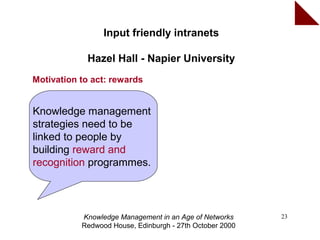
Motivation to act: rewards


Knowledge management
strategies need to be
linked to people by
building reward and
recognition programmes.


           Knowledge Management in an Age of Networks     23
           Redwood House, Edinburgh - 27th October 2000
Input friendly intranets

            Hazel Hall - Napier University
Motivation to act: rewards

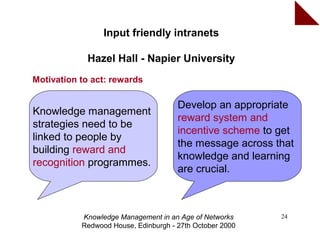
                                      Develop an appropriate
Knowledge management
                                      reward system and
strategies need to be
                                      incentive scheme to get
linked to people by
                                      the message across that
building reward and
                                      knowledge and learning
recognition programmes.
                                      are crucial.


           Knowledge Management in an Age of Networks     24
           Redwood House, Edinburgh - 27th October 2000
Input friendly intranets

              Hazel Hall - Napier University
Motivation to act: “hard” rewards

Economic incentives

•   increased pay
•   bonuses
•   stock options

Employees will seek ways to input, but some research shows
  “short-termism” in this activity.

            Knowledge Management in an Age of Networks       25
            Redwood House, Edinburgh - 27th October 2000
Input friendly intranets

               Hazel Hall - Napier University
Motivation to act: “soft” rewards

Access to information and knowledge

•   receipt of valuable knowledge in return for giving it, e.g.
    Toyota network (Dyer and Nobeoka, 2000).
•   anticipated return may be far in the future e.g. news groups
    and mailing lists

Ease of intranet access is important to reap reward.

             Knowledge Management in an Age of Networks            26
             Redwood House, Edinburgh - 27th October 2000
Input friendly intranets

               Hazel Hall - Napier University
Motivation to act: “soft” rewards

Career advancement/security/reputation

•   partnerships in professional consulting firms
•   tenure/promotion in academic institutions
•   future contracts for partner firms

Resource ownership and protection of this needs to be made
  obvious across the intranet.

             Knowledge Management in an Age of Networks      27
             Redwood House, Edinburgh - 27th October 2000
Input friendly intranets

               Hazel Hall - Napier University
Motivation to act: “soft” rewards

Personal satisfaction through:

•   acts of altruistic and pro-social behaviour
•   seeing results of altruistic and pro-social behaviour


             Knowledge Management in an Age of Networks     28
             Redwood House, Edinburgh - 27th October 2000
Input friendly intranets

               Hazel Hall - Napier University
Some conclusions

•   Input friendliness is not limited to “obvious” issues of interface
    design.
•   “Output” friendliness is important, especially to create critical
    mass.
•   Incentives and reward systems have their part to play, but
    further research is needed to assess which type of incentives
    are the most effective.


              Knowledge Management in an Age of Networks            29
              Redwood House, Edinburgh - 27th October 2000

Input friendly intranets

  • 1.
    Input friendly intranets Hazel Hall - Napier University Hazel Hall Senior Lecturer in Information Management School of Computing Napier University h.hall@napier.ac.uk Knowledge Management in an Age of Networks 1 Redwood House, Edinburgh - 27th October 2000
  • 2.
    Input friendly intranets Hazel Hall - Napier University Sharing is important to efforts in Knowledge Management Employees with straightforward access to common resources • execute routine tasks quickly • aggregate information  innovation in working practices/product design/service delivery • are less vulnerable to information loss Knowledge Management in an Age of Networks 2 Redwood House, Edinburgh - 27th October 2000
  • 3.
    Input friendly intranets Hazel Hall - Napier University Tools for information sharing • browsers • data warehouses • filters • intranets • process handbooks • software agents • yield management software Knowledge Management in an Age of Networks 3 Redwood House, Edinburgh - 27th October 2000
  • 4.
    Input friendly intranets Hazel Hall - Napier University Intranets as key platforms for information sharing • common resources for support of personal work, e.g. time sheets, travel bookings • integration of key business applications and tools • resources and “places”, e.g. shared databases, discussion space • sharing may extend beyond the organisation, e.g. extranet “shop window” Knowledge Management in an Age of Networks 4 Redwood House, Edinburgh - 27th October 2000
  • 5.
    Input friendly intranets Hazel Hall - Napier University Intranet dependencies • An intranet is an infrastructure. • An intranet’s business value is contingent on resources and applications made available. • Some resources and applications can be bought, e.g. conferencing software, access to commercial online services. • Unique internally produced resources must be sought from individuals and teams. Knowledge Management in an Age of Networks 5 Redwood House, Edinburgh - 27th October 2000
  • 6.
    Input friendly intranets Hazel Hall - Napier University Research on motivating knowledge sharing and intranets • priority area for knowledge research (Holsthouse, 1998) • addresses KM research questions about teams • “input friendliness” depends largely on organisational incentives • literature reviewed from domains of business studies, information systems, organisational science and sociology • (limited) case study material Knowledge Management in an Age of Networks 6 Redwood House, Edinburgh - 27th October 2000
  • 7.
    Input friendly intranets Hazel Hall - Napier University Motivations to act happens when: • it is easy to do so • the usefulness of acting is obvious This is not a new research finding! Knowledge Management in an Age of Networks 7 Redwood House, Edinburgh - 27th October 2000
  • 8.
    Input friendly intranets Hazel Hall - Napier University Easy to act: intranet interfaces • HCI and systems design standards apply • channels for information flow important: dedicated mailboxes; speech input; requirement for all staff to become proficient in HTML • integration of tools into communities to match levels of formality to elicit high quality contributions (Brown and Duguid, 1998) • levels of “control” Knowledge Management in an Age of Networks 8 Redwood House, Edinburgh - 27th October 2000
  • 9.
    Input friendly intranets Hazel Hall - Napier University Usefulness of acting is obvious: intranet critical mass Dilemma There’s no point in submitting material to the intranet: no one uses it. Knowledge Management in an Age of Networks 9 Redwood House, Edinburgh - 27th October 2000
  • 10.
    Input friendly intranets Hazel Hall - Napier University Usefulness of acting is obvious: intranet critical mass Dilemma There’s no point I don’t use the in submitting intranet. There’s material to the nothing of use to intranet: no one me there. uses it. Knowledge Management in an Age of Networks 10 Redwood House, Edinburgh - 27th October 2000
  • 11.
    Input friendly intranets Hazel Hall - Napier University Usefulness of acting is obvious: intranet critical mass “Output” friendliness • PR efforts: promotion of services; cross linking; indexing for search services • sole platform for content and applications • realistic expectations of use, e.g. pointer systems Knowledge Management in an Age of Networks 11 Redwood House, Edinburgh - 27th October 2000
  • 12.
    Input friendly intranets Hazel Hall - Napier University Usefulness of acting is obvious: intranet critical mass Finding of Cap Gemini and Cranfield University (1999) “The critical mass has to appear in three key areas - users (success can only come from people using the intranet), content (there has to be ever-more useful and relevant material available) and utilisation (the extent to which users are connected per day).” Knowledge Management in an Age of Networks 12 Redwood House, Edinburgh - 27th October 2000
  • 13.
    Input friendly intranets Hazel Hall - Napier University Usefulness of acting is obvious: intranet critical mass Finding of Cap Gemini and Cranfield University (1999) “The critical mass has to appear in three key areas - users (success can only come from people using the intranet), content (there has to be ever-more useful and relevant material available) and utilisation (the extent to which users are connected per day)… a minimum of around 40% of potential users need to connect to the intranet for real value generation to begin.” Knowledge Management in an Age of Networks 13 Redwood House, Edinburgh - 27th October 2000
  • 14.
    Input friendly intranets Hazel Hall - Napier University Motivating knowledge sharing: broader issues • Providing good interfaces and establishing critical mass are just two issues to consider. • Creation of other more general enabling conditions is also important. Knowledge Management in an Age of Networks 14 Redwood House, Edinburgh - 27th October 2000
  • 15.
    Input friendly intranets Hazel Hall - Napier University Enabling condition 1: environments that make knowledge sharing a key responsibility of staff Knowledge sharing is more likely to be encouraged in staff who: • know that it’s a job requirement: acquire expertise and disseminate it • know that it’s a legitimate activity Knowledge Management in an Age of Networks 15 Redwood House, Edinburgh - 27th October 2000
  • 16.
    Input friendly intranets Hazel Hall - Napier University Enabling condition 1: environments that make knowledge sharing a key responsibility of staff • encouraged through pro-active training, project debriefings, mentoring, assisting etc. • case study examples, e.g. Citibank - not until specific responsibilities were assigned to particular individuals were contributions to the online knowledge base elicited Knowledge Management in an Age of Networks 16 Redwood House, Edinburgh - 27th October 2000
  • 17.
    Input friendly intranets Hazel Hall - Napier University Enabling condition 2: environments that promote communities for knowledge sharing • Cultures that place high value on personal technical expertise and knowledge creation are less likely to provide conditions conducive to knowledge sharing. • Community strength comes through strong ties and shared social capital: norms, obligations, trust and identity. • Identity derives from common purpose and aspirations to which group members are committed. Knowledge Management in an Age of Networks 17 Redwood House, Edinburgh - 27th October 2000
  • 18.
    Input friendly intranets Hazel Hall - Napier University Enabling condition 2: environments that promote communities for knowledge sharing • carrot of continued vitality of the group • stick of obligation to the group • commitment invigorates the community Knowledge Management in an Age of Networks 18 Redwood House, Edinburgh - 27th October 2000
  • 19.
    Input friendly intranets Hazel Hall - Napier University Enabling condition 2: environments that promote communities for knowledge sharing trust - sharing (input) - sense of community Knowledge Management in an Age of Networks 19 Redwood House, Edinburgh - 27th October 2000
  • 20.
    Input friendly intranets Hazel Hall - Napier University Enabling condition 2: environments that promote communities for knowledge sharing Intranet checks • degrees of input control, e.g. location and branding of input • willingness to accept/reject lurkers Knowledge Management in an Age of Networks 20 Redwood House, Edinburgh - 27th October 2000
  • 21.
    Input friendly intranets Hazel Hall - Napier University Enabling condition 3: environments that promote experimentation for knowledge sharing Importance of experimentation in Knowledge Management activity • “distinctly new knowledge comes from experimenting” (Fahey and Prusak, 1998) • “non-experimentation”  simply reinforces, refines and sharpens what is already known • employees emboldened in environments that permit experimentation Knowledge Management in an Age of Networks 21 Redwood House, Edinburgh - 27th October 2000
  • 22.
    Input friendly intranets Hazel Hall - Napier University Enabling condition 3: environments that promote experimentation for knowledge sharing Intranet checks • status consciousness in the online environment • facilities for anonymity Knowledge Management in an Age of Networks 22 Redwood House, Edinburgh - 27th October 2000
  • 23.
    Input friendly intranets Hazel Hall - Napier University Motivation to act: rewards Knowledge management strategies need to be linked to people by building reward and recognition programmes. Knowledge Management in an Age of Networks 23 Redwood House, Edinburgh - 27th October 2000
  • 24.
    Input friendly intranets Hazel Hall - Napier University Motivation to act: rewards Develop an appropriate Knowledge management reward system and strategies need to be incentive scheme to get linked to people by the message across that building reward and knowledge and learning recognition programmes. are crucial. Knowledge Management in an Age of Networks 24 Redwood House, Edinburgh - 27th October 2000
  • 25.
    Input friendly intranets Hazel Hall - Napier University Motivation to act: “hard” rewards Economic incentives • increased pay • bonuses • stock options Employees will seek ways to input, but some research shows “short-termism” in this activity. Knowledge Management in an Age of Networks 25 Redwood House, Edinburgh - 27th October 2000
  • 26.
    Input friendly intranets Hazel Hall - Napier University Motivation to act: “soft” rewards Access to information and knowledge • receipt of valuable knowledge in return for giving it, e.g. Toyota network (Dyer and Nobeoka, 2000). • anticipated return may be far in the future e.g. news groups and mailing lists Ease of intranet access is important to reap reward. Knowledge Management in an Age of Networks 26 Redwood House, Edinburgh - 27th October 2000
  • 27.
    Input friendly intranets Hazel Hall - Napier University Motivation to act: “soft” rewards Career advancement/security/reputation • partnerships in professional consulting firms • tenure/promotion in academic institutions • future contracts for partner firms Resource ownership and protection of this needs to be made obvious across the intranet. Knowledge Management in an Age of Networks 27 Redwood House, Edinburgh - 27th October 2000
  • 28.
    Input friendly intranets Hazel Hall - Napier University Motivation to act: “soft” rewards Personal satisfaction through: • acts of altruistic and pro-social behaviour • seeing results of altruistic and pro-social behaviour Knowledge Management in an Age of Networks 28 Redwood House, Edinburgh - 27th October 2000
  • 29.
    Input friendly intranets Hazel Hall - Napier University Some conclusions • Input friendliness is not limited to “obvious” issues of interface design. • “Output” friendliness is important, especially to create critical mass. • Incentives and reward systems have their part to play, but further research is needed to assess which type of incentives are the most effective. Knowledge Management in an Age of Networks 29 Redwood House, Edinburgh - 27th October 2000