RIVAL Network Event 2 – November 7th 2019 – Edinburgh
Library linked data implementations and perceptions:
implications for practice
Dr Diane Pennington, Strathclyde University & Laura Cagnazzo, UWS
Research, Impact, Value & LIS - #lisrival - Edinburgh – 7th November 2019
Library linked data
implementations and perceptions:
Implications for practice
Dr Diane Rasmussen Pennington FHEA FRSA
Senior Lecturer in Information Science, University of Strathclyde
@infogamerist
diane.pennington@strath.ac.uk
Ms Laura Cagnazzo MA MSc
Repository & Research Data Librarian, University of the West of Scotland
@LauraFCagnazzo
laurafcagnazzo@outlook.com
The evolution of the Web (1989-now)
• Web 1.0: hand-coded HTML pages; accessible
and readable, but not interactive
• Web 2.0: Facebook and Twitter; everyone can
post, share, and respond without extensive
technical knowledge
• Web 3.0: the Semantic Web
– “Semantic” is “meaning in language”
– “Semantic Web” communicates “the meaning of the content on
web pages in a way that computers can understand. If they can
process these meanings, they can then make and convey
relationships between related web pages. This leads to improved
– and more meaningful – information retrieval.” (p. 34)
Source: Rasmussen Pennington, D. (2016, July/August). Demystifying linked data:
Are you ready for what's next? CILIP Update, 34-36.
4
Linked open data principles
1. Use URIs as names for things
2. Use HTTP URIs so that people can
look up those names
3. When someone looks up a name,
provide useful Resource
Description Framework [RDF]
information, using the standards
(RDF*, SPARQL)
4. Include links to other URIs so that
they can discover more things
Source: http://www.w3.org/DesignIssues/LinkedData.html
1. Use URIs as names for things
2. Use HTTP URIs so that people can
look up names
5
• The Hypertext Transfer Protocol (HTTP) is a
networking protocol for distributed, collaborative,
hypermedia information systems.
• HTTP is the foundation of data communication for
the World Wide Web.
• Use URIs to name people, for institutions,
concepts, topics, and geographical places.
Examples:
• http://www.strath.ac.uk (a university)
• https://www.facebook.com/CILIPinfo (a professional association)
• https://personal.cis.strath.ac.uk/diane.pennington (a lecturer)
• https://www.flickr.com/photos/chandlerinok/6168389622 (a
Chihuahua)
3. When someone looks up a name,
provide useful [RDF] information
6
• Use RDF subject-predicate-object ‘triples’ to describe a thing
• Reciprocate triples to show relationships between things
Emma Watson → StarredInMovie → Harry Potter and the Half-Blood Prince
Emma Watson is the subject, StarredInMovie is the predicate, and Harry Potter
and the Half-Blood Prince is the object.
This relationship also needs to be reciprocated:
Harry Potter and the Half-Blood Prince → Has Movie Star → Emma Watson
RDF, or Resource Description Framework, is
the language of the Semantic Web
predicate objectsubject
7
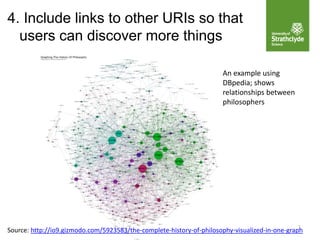
4. Include links to other URIs so that
users can discover more things
An example using
DBpedia; shows
relationships between
philosophers
Source: http://io9.gizmodo.com/5923583/the-complete-history-of-philosophy-visualized-in-one-graph
8
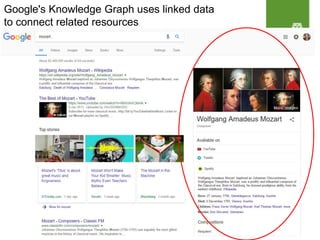
Google's Knowledge Graph uses linked data
to connect related resources
• Semantic Web = enhanced form of web;
content expressed in machine-readable
format (Berners-Lee, Hendler, Lassila,
2001)
• SW = goal; LD = means to reach it (Bizer
et al., 2009)
• LD as “a means to dismantle data silos”
(Heath, 2009)
• W3C standards
• LD applied to library data: Baker et al.,
2011; Tallerås, 2013; Shiri & Davoodi,
2016; OCLC surveys 2014, 2015, 2018
(Karen Smith-Yoshimura)
Linked data: what we know
10
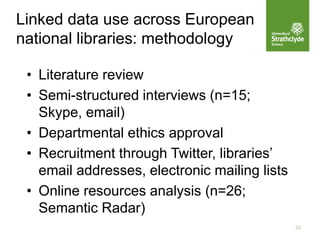
Linked data use across European
national libraries: methodology
• Literature review
• Semi-structured interviews (n=15;
Skype, email)
• Departmental ethics approval
• Recruitment through Twitter, libraries’
email addresses, electronic mailing lists
• Online resources analysis (n=26;
Semantic Radar)
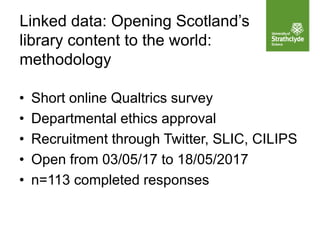
• Short online Qualtrics survey
• Departmental ethics approval
• Recruitment through Twitter, SLIC, CILIPS
• Open from 03/05/17 to 18/05/2017
• n=113 completed responses
Linked data: Opening Scotland’s
library content to the world:
methodology
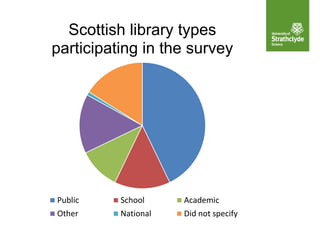
Scottish library types
participating in the survey
Public School Academic
Other National Did not specify
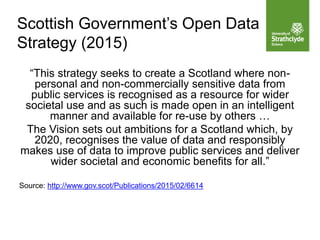
Scottish Government’s Open Data
Strategy (2015)
“This strategy seeks to create a Scotland where non-
personal and non-commercially sensitive data from
public services is recognised as a resource for wider
societal use and as such is made open in an intelligent
manner and available for re-use by others …
The Vision sets out ambitions for a Scotland which, by
2020, recognises the value of data and responsibly
makes use of data to improve public services and deliver
wider societal and economic benefits for all.”
Source: http://www.gov.scot/Publications/2015/02/6614
• Open government initiatives spreading world-
wide
• Transparency (fight corruption / improve
accountability)
• Enable citizens’ participation
• Strengthen democracy
• Data generated, gathered and stored by
government agencies (e.g., national, school,
public libraries) using public money (through
taxes) should be available to everyone
Open Government Data
• Two individual studies revealed similar
results
• Status of awareness of “linked data” and
“Semantic Web” concepts
• Linked data uses
• Reasons for, challenges/benefits of linked
data implementation
• Recommendation and best practice
Findings
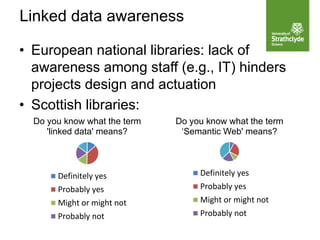
Do you know what the term
‘Semantic Web' means?
Definitely yes
Probably yes
Might or might not
Probably not
Do you know what the term
'linked data' means?
Definitely yes
Probably yes
Might or might not
Probably not
Linked data awareness
• European national libraries: lack of
awareness among staff (e.g., IT) hinders
projects design and actuation
• Scottish libraries:
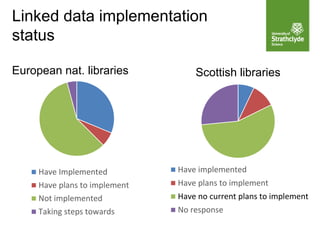
European nat. libraries
Linked data implementation
status
Scottish libraries
Have implemented
Have plans to implement
Have no current plans to implement
No response
Have Implemented
Have plans to implement
Not implemented
Taking steps towards
Uses of linked data
European nat. libraries
• Provide data to LD data
sets (VIAF, Wikidata,
Europeana)
• Publish bibliographic and
authority data
• National bibliographies
• Digitized resources
• Thesauri and ontologies
Scottish libraries
• MARC catalogue
records
• Digitized resources
• Social media
• Research outputs
using RDF, Dublin
Core, SPARQL
• OWL, SKOS,
Europeana Data
Model
• Popularity of linked data on international
scene (perceived/expected benefits)
• Improve data visibility and discoverability
• Enhance existing data sets
• Enriched, open, reusable information,
available for various purposes to the wider
community
• Adhere to standards (W3C)
• Open up data silos
Reasons for implementing linked
data
• Lack of awareness
• Lack of expertise / time / staff
• Difficulties in obtaining management buy-
in
• Licencing constraints (permission needed
from database providers to link)
• Potential loss of control of data
• Lack of agreement on standards
• Lack of tools / guidelines
Challenges of implementation
• Augment visibility and discoverability of
library data
• Support interoperability
• Overcome linguistic barriers
• Acquire better understanding of linked
data potential
• Enable cataloguing efficiency and
innovation (e.g., workload reduction)
• Obtain authoritative position as data
provider (to which other institution will
refer to)
Benefits of implementation
• Is LD the right technology for your scope?
• Design a detailed roadmap before acting
• Consider legal issues
• Training
• Adopt tools to support implementation
• Contact/collaborate with LD implementers
• Seek expert developers, if necessary
• URI syntax maintenance
• Reuse data /existing vocabularies, whenever
possible
• Adopt entity-based approach to data
Best practices
• Teach practitioners what linked data can achieve
• Familiarize yourself with LD
• Focus on goals, rather than technical matters
• Involve your institution/community of stakeholders
• Look at examples offered by successful projects
• Focus on data specific to your institution
• Consider needs of wider community (not just library
community)
• Collaborate with local universities/institutions and
benefit from their expertise – Collaboration is key!
Recommendations
• Encourage open data movement at government level
• Case studies: Successful implementation examples
• Re-use vs creation of ontologies
• Licensing constraints
• Step-by-step implementation guidelines
• Improve communication between system
providers/technicians and information professionals
• Collaboration towards design and adoption of a
common model, to facilitate data integration
Further research / direction
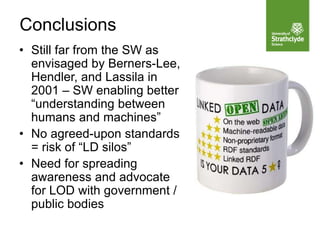
Conclusions
• Still far from the SW as
envisaged by Berners-Lee,
Hendler, and Lassila in
2001 – SW enabling better
“understanding between
humans and machines”
• No agreed-upon standards
= risk of “LD silos”
• Need for spreading
awareness and advocate
for LOD with government /
public bodies
Is that all???
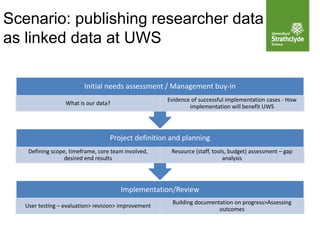
Implementation/Review
User testing – evaluation> revision> improvement
Building documentation on progress>Assessing
outcomes
Project definition and planning
Defining scope, timeframe, core team involved,
desired end results
Resource (staff, tools, budget) assessment – gap
analysis
Initial needs assessment / Management buy-in
What is our data?
Evidence of successful implementation cases - How
implementation will benefit UWS
Scenario: publishing researcher data
as linked data at UWS
Thank you!
(this is the end, we promise!)
References
• Baker, T., Bermès, E., Coyle, K., Dunsire, G., Isaac, A., Murray, P.,
Panzer, P., Schneider, J., Singer, R., Summers, E., Waiters, W., Young,
J. and Zheng, M. (2011) Library Linked Data Incubator Group final
report, W3C, http://www.w3.org/2005/Incubator/lld/XGR-lld-20111025/
• Berners-Lee, T., Linked Data:
http://www.w3.org/DesignIssues/LinkedData.html
• Berners-Lee, T., Hendler, J. and Lassila, O. (2001) ‘The Semantic Web’.
Scientific American, 284(5), pp.29-37, https://tinyurl.com/hh3h9m6
• Bizer, C., Heath, T. and Berners-Lee, T. (2009) ‘Linked Data: The story
so far’. International Journal on Semantic Web and Information
Systems, 5(3), pp.1-22
• Cagnazzo, L. (2017) Linked Data: Implementation, Use, and
Perceptions across European National Libraries, MSc Dissertation,
http://hdl.handle.net/10760/32004
• Heath, T. (2009) ‘Linked Data? Web of Data? Semantic Web? WTF?’
Tom Heath’s Displacement Activities, 2 March,
http://tomheath.com/blog/2009/03/linked-data-web-of-data-semantic-
web-wtf/
• Hobbs, P. (2009) Project management, London: Penguin Random
House.
• Rasmussen Pennington, D. (2016, July/August). Demystifying linked
data: Are you ready for what's next? CILIP Update, 34-36.
29
• Rasmussen Pennington, D. (2017) ‘Linked data: Opening
Scotland’s library content to the world’,
https://www.slideshare.net/CILIPScotland/linked-data-
opening-scotlands-library-content-to-the-world
• Shiri, A. and Davoodi, D. (2016) ‘Managing Linked Open Data
across discovery systems’, in Spiteri, L. (ed.) Managing
metadata in web-scale discovery systems. London: Facet
Publishing, pp.57-90
• Smith-Yoshimura, K. (2015) ‘Linked Data implementations—
Who, what and why?’,
http://www.oclc.org/research/themes/data-
science/linkeddata.html
• Suominen, O. and Hyvönen, N. (2017) ‘From MARC silos to
Linked Data silos?’, O-bib, 4(2), https://www.o-
bib.de/article/view/2017H2S1-13/5883
• The Linking Open Data cloud diagram: http://lod-cloud.net/
• Tallerås, K. (2013) ‘From many records to one graph:
Heterogeneity conflicts in the linked data restructuring cycle’.
Information Research, 18 (3),
http://www.informationr.net/ir/18-
3/colis/paperC18.html#.WUEwnZB95dg
References
RIVAL Network Event 2 – November 7th 2019 – Edinburgh
Library linked data implementations and perceptions:
implications for practice
Dr Diane Pennington, Strathclyde University & Laura Cagnazzo, UWS
Research, Impact, Value & LIS - #lisrival - Edinburgh – 7th November 2019

Research into Practice case study 2: Library linked data implementations and perceptions: implications for practice

  • 1.
    RIVAL Network Event2 – November 7th 2019 – Edinburgh Library linked data implementations and perceptions: implications for practice Dr Diane Pennington, Strathclyde University & Laura Cagnazzo, UWS Research, Impact, Value & LIS - #lisrival - Edinburgh – 7th November 2019
  • 2.
    Library linked data implementationsand perceptions: Implications for practice Dr Diane Rasmussen Pennington FHEA FRSA Senior Lecturer in Information Science, University of Strathclyde @infogamerist diane.pennington@strath.ac.uk Ms Laura Cagnazzo MA MSc Repository & Research Data Librarian, University of the West of Scotland @LauraFCagnazzo laurafcagnazzo@outlook.com
  • 3.
    The evolution ofthe Web (1989-now) • Web 1.0: hand-coded HTML pages; accessible and readable, but not interactive • Web 2.0: Facebook and Twitter; everyone can post, share, and respond without extensive technical knowledge • Web 3.0: the Semantic Web – “Semantic” is “meaning in language” – “Semantic Web” communicates “the meaning of the content on web pages in a way that computers can understand. If they can process these meanings, they can then make and convey relationships between related web pages. This leads to improved – and more meaningful – information retrieval.” (p. 34) Source: Rasmussen Pennington, D. (2016, July/August). Demystifying linked data: Are you ready for what's next? CILIP Update, 34-36.
  • 4.
    4 Linked open dataprinciples 1. Use URIs as names for things 2. Use HTTP URIs so that people can look up those names 3. When someone looks up a name, provide useful Resource Description Framework [RDF] information, using the standards (RDF*, SPARQL) 4. Include links to other URIs so that they can discover more things Source: http://www.w3.org/DesignIssues/LinkedData.html
  • 5.
    1. Use URIsas names for things 2. Use HTTP URIs so that people can look up names 5 • The Hypertext Transfer Protocol (HTTP) is a networking protocol for distributed, collaborative, hypermedia information systems. • HTTP is the foundation of data communication for the World Wide Web. • Use URIs to name people, for institutions, concepts, topics, and geographical places. Examples: • http://www.strath.ac.uk (a university) • https://www.facebook.com/CILIPinfo (a professional association) • https://personal.cis.strath.ac.uk/diane.pennington (a lecturer) • https://www.flickr.com/photos/chandlerinok/6168389622 (a Chihuahua)
  • 6.
    3. When someonelooks up a name, provide useful [RDF] information 6 • Use RDF subject-predicate-object ‘triples’ to describe a thing • Reciprocate triples to show relationships between things Emma Watson → StarredInMovie → Harry Potter and the Half-Blood Prince Emma Watson is the subject, StarredInMovie is the predicate, and Harry Potter and the Half-Blood Prince is the object. This relationship also needs to be reciprocated: Harry Potter and the Half-Blood Prince → Has Movie Star → Emma Watson RDF, or Resource Description Framework, is the language of the Semantic Web predicate objectsubject
  • 7.
    7 4. Include linksto other URIs so that users can discover more things An example using DBpedia; shows relationships between philosophers Source: http://io9.gizmodo.com/5923583/the-complete-history-of-philosophy-visualized-in-one-graph
  • 8.
    8 Google's Knowledge Graphuses linked data to connect related resources
  • 9.
    • Semantic Web= enhanced form of web; content expressed in machine-readable format (Berners-Lee, Hendler, Lassila, 2001) • SW = goal; LD = means to reach it (Bizer et al., 2009) • LD as “a means to dismantle data silos” (Heath, 2009) • W3C standards • LD applied to library data: Baker et al., 2011; Tallerås, 2013; Shiri & Davoodi, 2016; OCLC surveys 2014, 2015, 2018 (Karen Smith-Yoshimura) Linked data: what we know
  • 10.
    10 Linked data useacross European national libraries: methodology • Literature review • Semi-structured interviews (n=15; Skype, email) • Departmental ethics approval • Recruitment through Twitter, libraries’ email addresses, electronic mailing lists • Online resources analysis (n=26; Semantic Radar)
  • 11.
    • Short onlineQualtrics survey • Departmental ethics approval • Recruitment through Twitter, SLIC, CILIPS • Open from 03/05/17 to 18/05/2017 • n=113 completed responses Linked data: Opening Scotland’s library content to the world: methodology
  • 12.
    Scottish library types participatingin the survey Public School Academic Other National Did not specify
  • 13.
    Scottish Government’s OpenData Strategy (2015) “This strategy seeks to create a Scotland where non- personal and non-commercially sensitive data from public services is recognised as a resource for wider societal use and as such is made open in an intelligent manner and available for re-use by others … The Vision sets out ambitions for a Scotland which, by 2020, recognises the value of data and responsibly makes use of data to improve public services and deliver wider societal and economic benefits for all.” Source: http://www.gov.scot/Publications/2015/02/6614
  • 14.
    • Open governmentinitiatives spreading world- wide • Transparency (fight corruption / improve accountability) • Enable citizens’ participation • Strengthen democracy • Data generated, gathered and stored by government agencies (e.g., national, school, public libraries) using public money (through taxes) should be available to everyone Open Government Data
  • 15.
    • Two individualstudies revealed similar results • Status of awareness of “linked data” and “Semantic Web” concepts • Linked data uses • Reasons for, challenges/benefits of linked data implementation • Recommendation and best practice Findings
  • 16.
    Do you knowwhat the term ‘Semantic Web' means? Definitely yes Probably yes Might or might not Probably not Do you know what the term 'linked data' means? Definitely yes Probably yes Might or might not Probably not Linked data awareness • European national libraries: lack of awareness among staff (e.g., IT) hinders projects design and actuation • Scottish libraries:
  • 17.
    European nat. libraries Linkeddata implementation status Scottish libraries Have implemented Have plans to implement Have no current plans to implement No response Have Implemented Have plans to implement Not implemented Taking steps towards
  • 18.
    Uses of linkeddata European nat. libraries • Provide data to LD data sets (VIAF, Wikidata, Europeana) • Publish bibliographic and authority data • National bibliographies • Digitized resources • Thesauri and ontologies Scottish libraries • MARC catalogue records • Digitized resources • Social media • Research outputs using RDF, Dublin Core, SPARQL • OWL, SKOS, Europeana Data Model
  • 19.
    • Popularity oflinked data on international scene (perceived/expected benefits) • Improve data visibility and discoverability • Enhance existing data sets • Enriched, open, reusable information, available for various purposes to the wider community • Adhere to standards (W3C) • Open up data silos Reasons for implementing linked data
  • 20.
    • Lack ofawareness • Lack of expertise / time / staff • Difficulties in obtaining management buy- in • Licencing constraints (permission needed from database providers to link) • Potential loss of control of data • Lack of agreement on standards • Lack of tools / guidelines Challenges of implementation
  • 21.
    • Augment visibilityand discoverability of library data • Support interoperability • Overcome linguistic barriers • Acquire better understanding of linked data potential • Enable cataloguing efficiency and innovation (e.g., workload reduction) • Obtain authoritative position as data provider (to which other institution will refer to) Benefits of implementation
  • 22.
    • Is LDthe right technology for your scope? • Design a detailed roadmap before acting • Consider legal issues • Training • Adopt tools to support implementation • Contact/collaborate with LD implementers • Seek expert developers, if necessary • URI syntax maintenance • Reuse data /existing vocabularies, whenever possible • Adopt entity-based approach to data Best practices
  • 23.
    • Teach practitionerswhat linked data can achieve • Familiarize yourself with LD • Focus on goals, rather than technical matters • Involve your institution/community of stakeholders • Look at examples offered by successful projects • Focus on data specific to your institution • Consider needs of wider community (not just library community) • Collaborate with local universities/institutions and benefit from their expertise – Collaboration is key! Recommendations
  • 24.
    • Encourage opendata movement at government level • Case studies: Successful implementation examples • Re-use vs creation of ontologies • Licensing constraints • Step-by-step implementation guidelines • Improve communication between system providers/technicians and information professionals • Collaboration towards design and adoption of a common model, to facilitate data integration Further research / direction
  • 25.
    Conclusions • Still farfrom the SW as envisaged by Berners-Lee, Hendler, and Lassila in 2001 – SW enabling better “understanding between humans and machines” • No agreed-upon standards = risk of “LD silos” • Need for spreading awareness and advocate for LOD with government / public bodies
  • 26.
  • 27.
    Implementation/Review User testing –evaluation> revision> improvement Building documentation on progress>Assessing outcomes Project definition and planning Defining scope, timeframe, core team involved, desired end results Resource (staff, tools, budget) assessment – gap analysis Initial needs assessment / Management buy-in What is our data? Evidence of successful implementation cases - How implementation will benefit UWS Scenario: publishing researcher data as linked data at UWS
  • 28.
    Thank you! (this isthe end, we promise!)
  • 29.
    References • Baker, T.,Bermès, E., Coyle, K., Dunsire, G., Isaac, A., Murray, P., Panzer, P., Schneider, J., Singer, R., Summers, E., Waiters, W., Young, J. and Zheng, M. (2011) Library Linked Data Incubator Group final report, W3C, http://www.w3.org/2005/Incubator/lld/XGR-lld-20111025/ • Berners-Lee, T., Linked Data: http://www.w3.org/DesignIssues/LinkedData.html • Berners-Lee, T., Hendler, J. and Lassila, O. (2001) ‘The Semantic Web’. Scientific American, 284(5), pp.29-37, https://tinyurl.com/hh3h9m6 • Bizer, C., Heath, T. and Berners-Lee, T. (2009) ‘Linked Data: The story so far’. International Journal on Semantic Web and Information Systems, 5(3), pp.1-22 • Cagnazzo, L. (2017) Linked Data: Implementation, Use, and Perceptions across European National Libraries, MSc Dissertation, http://hdl.handle.net/10760/32004 • Heath, T. (2009) ‘Linked Data? Web of Data? Semantic Web? WTF?’ Tom Heath’s Displacement Activities, 2 March, http://tomheath.com/blog/2009/03/linked-data-web-of-data-semantic- web-wtf/ • Hobbs, P. (2009) Project management, London: Penguin Random House. • Rasmussen Pennington, D. (2016, July/August). Demystifying linked data: Are you ready for what's next? CILIP Update, 34-36. 29
  • 30.
    • Rasmussen Pennington,D. (2017) ‘Linked data: Opening Scotland’s library content to the world’, https://www.slideshare.net/CILIPScotland/linked-data- opening-scotlands-library-content-to-the-world • Shiri, A. and Davoodi, D. (2016) ‘Managing Linked Open Data across discovery systems’, in Spiteri, L. (ed.) Managing metadata in web-scale discovery systems. London: Facet Publishing, pp.57-90 • Smith-Yoshimura, K. (2015) ‘Linked Data implementations— Who, what and why?’, http://www.oclc.org/research/themes/data- science/linkeddata.html • Suominen, O. and Hyvönen, N. (2017) ‘From MARC silos to Linked Data silos?’, O-bib, 4(2), https://www.o- bib.de/article/view/2017H2S1-13/5883 • The Linking Open Data cloud diagram: http://lod-cloud.net/ • Tallerås, K. (2013) ‘From many records to one graph: Heterogeneity conflicts in the linked data restructuring cycle’. Information Research, 18 (3), http://www.informationr.net/ir/18- 3/colis/paperC18.html#.WUEwnZB95dg References
  • 31.
    RIVAL Network Event2 – November 7th 2019 – Edinburgh Library linked data implementations and perceptions: implications for practice Dr Diane Pennington, Strathclyde University & Laura Cagnazzo, UWS Research, Impact, Value & LIS - #lisrival - Edinburgh – 7th November 2019