Integrated Risks Transfer   Mode of   Large Scale Disasters in  China  and  World   Peijun SHI State Key Laboratory of Earth Surface Processes and Resource Ecology Key Laboratory of Environmental Change and Natural Disaster, MOE Academy of Disaster Reduction and Emergency Management, MOCA  &  MOE  China Plenary  Lecture   IDRC 2010, Davos, Switzerland, 3 June   Beijing Normal University/IHDP-IRGP
Contents Large-scale Disaster and  Its Risk Assessment  Integrated Risks Transfer   Mode of   Large Scale Disasters in  China   and  World  Discussion
1   Large-scale Disaster and  Its Risk Assessment
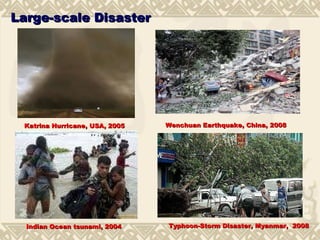
Indian Ocean tsunami, 2004 Katrina Hurricane, USA, 2005 Wenchuan Earthquake, China, 2008 Typhoon-Storm Disaster, Myanmar,  2008 Large-scale Disaster
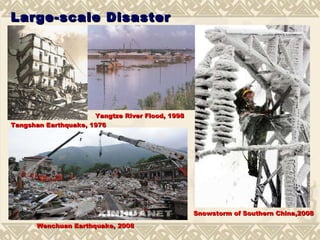
Large-scale Disaster Snowstorm of Southern China,2008 Wenchuan Earthquake, 2008 Tangshan Earthquake, 1976 Yangtze River Flood,   1998
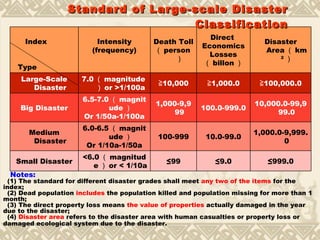
A serious disaster due to hazards encountered  once in one century , causing  huge human casualties  and  property losses  and  wide range of impact , which, upon occurring,  cannot be independently coped  with by the disaster areas and has to be aided by means of external forces Generally speaking, such large-scale disasters will usually: Standard of Large-scale Disaster Classification   (Peijun SHI, 2009 ) total death of more than  10,000 persons direct economic loss of more than  10 billion Euro affected area of over  100,000km 2
Standard of Large-scale Disaster Classification Notes: (1) The standard for different disaster grades shall meet  any two of the items  for the index; (2) Dead population  includes  the population killed and population missing for more than 1 month; (3) The direct property loss means  the value of properties  actually damaged in the year due to the disaster; (4)  Disaster area  refers to the disaster area with human casualties or property loss or damaged ecological system due to the disaster.   Index Type Intensity (frequency) Death Toll ( person ) Direct  Economics Losses ( billon ) Disaster Area ( km 2 ) Large-Scale Disaster 7.0 ( magnitude ) or >1/100a ≧ 10,000 ≧ 1,000.0 ≧ 100,000.0 Big Disaster 6.5-7.0 ( magnitude ) Or 1/50a-1/100a 1,000-9,999 100.0-999.0 10,000.0-99,999.0 Medium Disaster 6.0-6.5 ( magnitude ) Or 1/10a-1/50a 100-999 10.0-99.0 1,000.0-9,999.0 Small Disaster <6.0 ( magnitude ) or < 1/10a ≤ 99 ≤ 9.0 ≤ 999.0
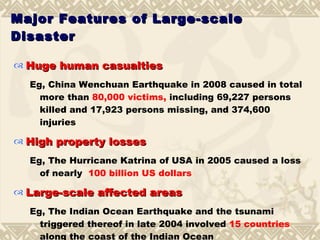
Major Features of Large-scale Disaster Huge human casualties Eg, China Wenchuan Earthquake in 2008 caused in total more than  80,000 victims,  including 69,227 persons killed and 17,923 persons missing, and 374,600 injuries High property losses Eg, The Hurricane Katrina of USA in 2005 caused a loss of nearly  100 billion US dollars Large-scale affected areas   Eg, The Indian Ocean Earthquake and the tsunami triggered thereof in late 2004 involved  15 countries  along the coast of the Indian Ocean
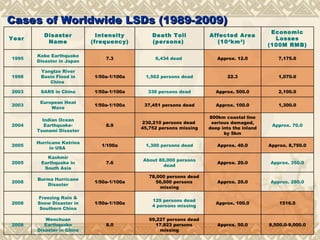
Cases of Worldwide LSDs (1989-2009) Year  Disaster Name Intensity (frequency) Death Toll (persons)  Affected Area (10 4 km 2 )  Economic Losses (100M RMB) 1995 Kobe Earthquake Disaster in Japan 7.3 6,434 dead  Approx. 12.0 7,175.0 1998 Yangtze River Basin Flood in China  1/50a-1/100a 1,562 persons dead 22.3 1,070.0 2003 SARS in China 1/50a-1/100a 336 persons dead Approx. 500.0 2,100.0 2003 European Heat Wave 1/50a-1/100a 37,451 persons dead Approx. 100.0 1,300.0 2004 Indian Ocean Earthquake-Tsunami Disaster 8.9 230,210 persons dead  45,752 persons missing 800km coastal line serious damaged, deep into the inland by 5km Approx. 70.0 2005 Hurricane Katrina in USA  1/100a 1,300 persons dead Approx. 40.0 Approx. 8,750.0 2005 Kashmir Earthquake  in  South Asia 7.6 About 80,000 persons dead Approx. 20.0 Approx. 350.0 2008 Burma Hurricane Disaster 1/50a-1/100a 78,000 persons dead 56,000 persons missing Approx. 20.0 Approx. 280.0 2008 Freezing Rain & Snow Disaster in Southern China 1/50a-1/100a 129 persons dead 4 persons missing Approx. 100.0 1516.5 2008 Wenchuan Earthquake Disaster in China 8.0 69,227 persons dead 17,923 persons missing Approx. 50.0 8,500.0-9,000.0
The Risk Assessment of Large-scale Disasters Regional Multi-hazard Loss Assessment Model  Regional Disaster-chain Loss Assessment Model
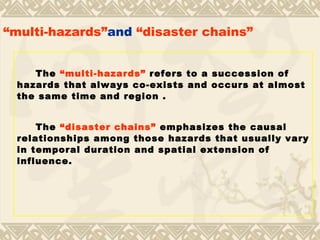
“ multi-hazards” and  “disaster chains”   The  “multi-hazards”  refers to a succession of hazards that always co-exists and occurs at almost the same time and region . The  “disaster chains”  emphasizes the causal relationships among those hazards that usually vary in temporal duration and spatial extension of influence.
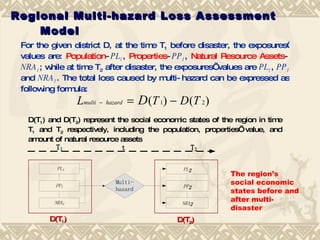
Regional Multi-hazard Loss Assessment Model For  the given district D, at the time T 1  before disaster, the exposures’ values are:  Population - PL 1 ,  Properties - PP 1 ,  Natural Resource Assets -   NRA 1 ; while at time  T 2  after disaster, the exposures’ values are  PL 1 ,  PP 1  and  NRA 1 . The total loss caused by multi-hazard can be expressed as following formula: D(T 1 )  D(T 2 )  The region’s social economic states before and after multi-disaster D(T 1 ) and D(T 2 ) represent the social economic states of the region in time T 1  and T 2  respectively, including the population, properties’ value, and amount of natural resource assets
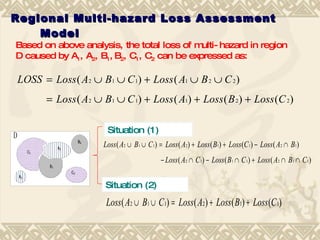
Regional Multi-hazard Loss Assessment Model Based on above analysis, the total loss of multi-hazard in region D caused by A 1 , A 2 , B 1 ,   B 2 , C 1 ,   C 2  can be expressed as: Situation (1) Situation (2)
Regional Multi-hazard Loss Assessment Model A Case of Regional Multi-hazard Loss Assessment
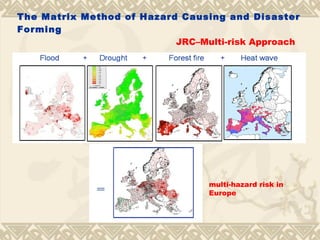
The Matrix Method of Hazard Causing and Disaster Forming multi-hazard risk in Europe JRC–Multi-risk Approach
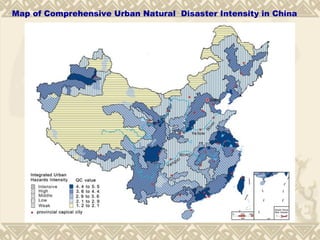
Map of Comprehensive Urban Natural  Disaster Intensity in China
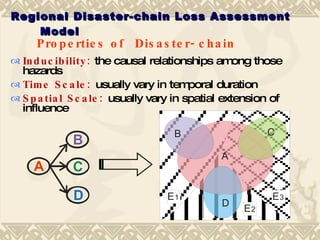
Regional Disaster-chain Loss Assessment Model Properties of  Disaster-chain Inducibility:  the causal relationships among those hazards Time Scale:   usually vary in temporal duration Spatial Scale:  usually vary in spatial extension of influence
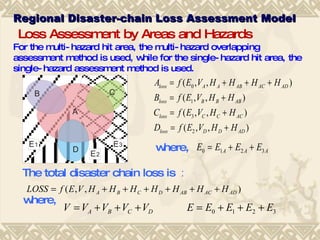
Loss Assessment by Areas and Hazards Regional Disaster-chain Loss Assessment Model where,  The total disaster chain loss is : where,  For the multi-hazard hit area, the multi-hazard overlapping assessment method is used, while for the single-hazard hit area, the single-hazard assessment method is used.
A Case of Regional Disaster-chain Loss Assessment Wenchuan Earthquake Catastrophe of May 12, 2008 Regional Disaster-chain Loss Assessment Model
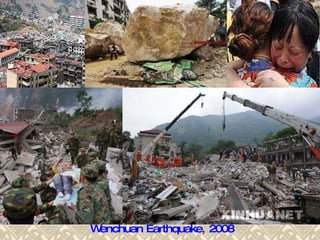
Wenchuan Earthquake 14:28 pm on May 12 of 2008 , a major earthquake measuring 8 Richter scale jolted  Wenchuan County of Southwest China’s Sichuan province. The most serious earthquake of China since 1949:  high intensity large disaster affected area serious frequent aftershocks and secondary disasters  the most difficulty of disaster relief the most severe damage and loss
Wenchuan Earthquake, 2008
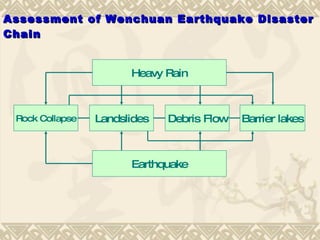
Assessment of Wenchuan Earthquake Disaster Chain Heavy Rain Rock Collapse Landslides Earthquake Barrier lakes Debris Flow
Disaster Index (DI) The weight for each indicators:  Average magnitude of earthquake (0.3);  Number of deaths and missings, percentage of deaths and missings(0.3, 0.15 for each);  Number of collapsed houses per 10,000 persons (0.2, 0.1 for each);  Risk of geological disaster: impacted residents (0.1); Percentage of people relocated(0.1).  DI=∑(fk* DIk) DIk is the normalized indicator value : DIk = [DIk –min(DIk)]/ [max(DIk)-min(DIk)] ; fk is the weight for each indicator
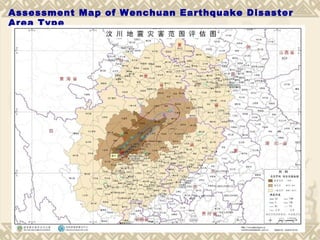
Assessment Map of Wenchuan Earthquake Disaster Area Type
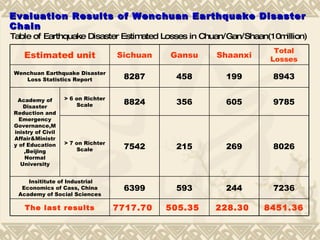
Evaluation Results of Wenchuan Earthquake Disaster Chain Table of Earthquake Disaster Estimated Losses in Chuan/Gan/Shaan(10million) Estimated unit Sichuan Gansu Shaanxi Total Losses Wenchuan Earthquake Disaster Loss Statistics Report 8287 458 199 8943 Academy of Disaster Reduction and Emergency Governance,Ministry of Civil Affair&Ministry of Education  ,Beijing Normal University > 6 on Richter Scale 8824 356 605 9785 > 7 on Richter Scale 7542 215 269 8026 Insititute of Industrial Economics of Cass, China Academy of Social Sciences 6399 593 244 7236 The last results 7717.70  505.35  228.30  8451.36
2  Integrated Risks Governance   Mode of   Large Scale Disasters in  China  and  World
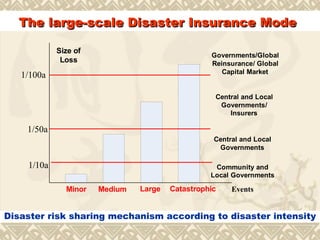
Disaster risk sharing mechanism according to disaster intensity The large-scale Disaster Insurance Mode
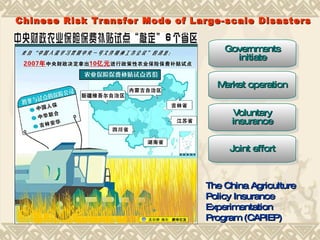
Chinese   Risk  Transfer Mode of   Large-scale Disasters The China Agriculture Policy Insurance Experimentation  Program (CAPIEP) Governments initiate Market operation Voluntary insurance Joint effort
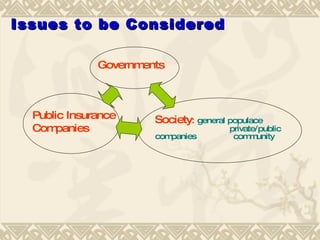
Issues to be Considered Governments Public Insurance Companies Society :   general populace  private/public companies  community
Chinese   Risk  Transfer Mode of Large Scale Disasters The principle of the risk transfer mode of LSDs should be  “ supported by governments from different levels, operated by insurance companies, and shared by all of the stakeholders”
Small disaster risk  relies on community government Medium-scale disaster risk  relies on local government governance Larger disaster risk  must be shared by central government, local governments, policyholders, insurers and reinsurers. LSDR  needs the cooperation of the central government, policyholders, insurers, reinsurers, and international financial institutes  ( Peijun SHI , et al , 2009 ). we should build such a pattern
The  financial products  of “LSD risk” available in concerned countries all over the world include mainly:  California Earthquake Insurance of USA(  CEA  ) Taiwan Residential Earthquake Insurance Pool ( TREIP )  Japanese Residential Earthquake Insurance ( JREI ) New Zealand Earthquake Insurance: Earthquake Committee ( EQC )   The Caribbean Catastrophe Risk Insurance Facility ( CCRIF )  Mexican Natural Disaster Relief Fund ( Forden )  The Turkish Earthquake Insurance Fund ( TEIF ) Globe Catastrophe Securities set up by Swiss RE ( GCS ) World   Risk  Transfer Mode of   Large Scale Disasters
World   Risk  Transfer Mode of   Large Scale Disasters Based on the experience of risk governance in China, we propose to establish global risk transfer mode for LSDs First,  attach high attention to the instability of global climate change.  Second,  formulate international standards for LSDs  ( Shi, Peijun etc., 2009 ).   Third,  give full play to the dual role of market and government. Finally , attach great importance to the diversification of financial management tools for LSDs risk .
World   Risk  Transfer Mode of   Large Scale Disasters The principle of global risk transfer mode should be   &quot;uniform standards, government support, market operation, public participation, disaster mitigation, and risk sharing&quot;.
3 Discussion
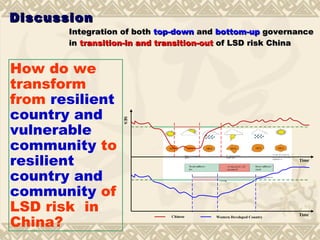
Discussion  Integration of both  top-down  and  bottom-up  governance in  transition-in and transition-out  of LSD risk China How do we transform from  resilient country and vulnerable community  to  resilient country and community  of LSD risk  in China?
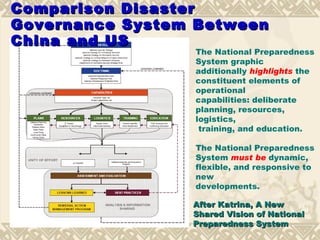
Comparison Disaster Governance System Between China and US After Katrina, A New Shared Vision of National Preparedness System The National Preparedness System graphic additionally  highlights  the constituent elements of operational capabilities: deliberate planning, resources, logistics, training, and education. The National Preparedness System  must be  dynamic,  flexible, and responsive to new developments.
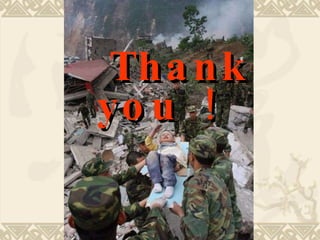
Thank you !

Integrated Risks Transfer Mode of Large Scale Disasters in China and World

  • 1.
    IntegratedRisks Transfer Mode of Large Scale Disasters in China and World Peijun SHI State Key Laboratory of Earth Surface Processes and Resource Ecology Key Laboratory of Environmental Change and Natural Disaster, MOE Academy of Disaster Reduction and Emergency Management, MOCA & MOE China Plenary Lecture IDRC 2010, Davos, Switzerland, 3 June Beijing Normal University/IHDP-IRGP
  • 2.
    Contents Large-scale Disasterand Its Risk Assessment Integrated Risks Transfer Mode of Large Scale Disasters in China and World Discussion
  • 3.
    1 Large-scale Disaster and Its Risk Assessment
  • 4.
    Indian Ocean tsunami,2004 Katrina Hurricane, USA, 2005 Wenchuan Earthquake, China, 2008 Typhoon-Storm Disaster, Myanmar, 2008 Large-scale Disaster
  • 5.
    Large-scale Disaster Snowstormof Southern China,2008 Wenchuan Earthquake, 2008 Tangshan Earthquake, 1976 Yangtze River Flood, 1998
  • 6.
    A serious disasterdue to hazards encountered once in one century , causing huge human casualties and property losses and wide range of impact , which, upon occurring, cannot be independently coped with by the disaster areas and has to be aided by means of external forces Generally speaking, such large-scale disasters will usually: Standard of Large-scale Disaster Classification (Peijun SHI, 2009 ) total death of more than 10,000 persons direct economic loss of more than 10 billion Euro affected area of over 100,000km 2
  • 7.
    Standard of Large-scaleDisaster Classification Notes: (1) The standard for different disaster grades shall meet any two of the items for the index; (2) Dead population includes the population killed and population missing for more than 1 month; (3) The direct property loss means the value of properties actually damaged in the year due to the disaster; (4) Disaster area refers to the disaster area with human casualties or property loss or damaged ecological system due to the disaster. Index Type Intensity (frequency) Death Toll ( person ) Direct Economics Losses ( billon ) Disaster Area ( km 2 ) Large-Scale Disaster 7.0 ( magnitude ) or >1/100a ≧ 10,000 ≧ 1,000.0 ≧ 100,000.0 Big Disaster 6.5-7.0 ( magnitude ) Or 1/50a-1/100a 1,000-9,999 100.0-999.0 10,000.0-99,999.0 Medium Disaster 6.0-6.5 ( magnitude ) Or 1/10a-1/50a 100-999 10.0-99.0 1,000.0-9,999.0 Small Disaster <6.0 ( magnitude ) or < 1/10a ≤ 99 ≤ 9.0 ≤ 999.0
  • 8.
    Major Features ofLarge-scale Disaster Huge human casualties Eg, China Wenchuan Earthquake in 2008 caused in total more than 80,000 victims, including 69,227 persons killed and 17,923 persons missing, and 374,600 injuries High property losses Eg, The Hurricane Katrina of USA in 2005 caused a loss of nearly 100 billion US dollars Large-scale affected areas Eg, The Indian Ocean Earthquake and the tsunami triggered thereof in late 2004 involved 15 countries along the coast of the Indian Ocean
  • 9.
    Cases of WorldwideLSDs (1989-2009) Year Disaster Name Intensity (frequency) Death Toll (persons) Affected Area (10 4 km 2 ) Economic Losses (100M RMB) 1995 Kobe Earthquake Disaster in Japan 7.3 6,434 dead Approx. 12.0 7,175.0 1998 Yangtze River Basin Flood in China 1/50a-1/100a 1,562 persons dead 22.3 1,070.0 2003 SARS in China 1/50a-1/100a 336 persons dead Approx. 500.0 2,100.0 2003 European Heat Wave 1/50a-1/100a 37,451 persons dead Approx. 100.0 1,300.0 2004 Indian Ocean Earthquake-Tsunami Disaster 8.9 230,210 persons dead 45,752 persons missing 800km coastal line serious damaged, deep into the inland by 5km Approx. 70.0 2005 Hurricane Katrina in USA 1/100a 1,300 persons dead Approx. 40.0 Approx. 8,750.0 2005 Kashmir Earthquake in South Asia 7.6 About 80,000 persons dead Approx. 20.0 Approx. 350.0 2008 Burma Hurricane Disaster 1/50a-1/100a 78,000 persons dead 56,000 persons missing Approx. 20.0 Approx. 280.0 2008 Freezing Rain & Snow Disaster in Southern China 1/50a-1/100a 129 persons dead 4 persons missing Approx. 100.0 1516.5 2008 Wenchuan Earthquake Disaster in China 8.0 69,227 persons dead 17,923 persons missing Approx. 50.0 8,500.0-9,000.0
  • 10.
    The Risk Assessmentof Large-scale Disasters Regional Multi-hazard Loss Assessment Model Regional Disaster-chain Loss Assessment Model
  • 11.
    “ multi-hazards” and “disaster chains” The “multi-hazards” refers to a succession of hazards that always co-exists and occurs at almost the same time and region . The “disaster chains” emphasizes the causal relationships among those hazards that usually vary in temporal duration and spatial extension of influence.
  • 12.
    Regional Multi-hazard LossAssessment Model For the given district D, at the time T 1 before disaster, the exposures’ values are: Population - PL 1 , Properties - PP 1 , Natural Resource Assets - NRA 1 ; while at time T 2 after disaster, the exposures’ values are PL 1 , PP 1 and NRA 1 . The total loss caused by multi-hazard can be expressed as following formula: D(T 1 ) D(T 2 ) The region’s social economic states before and after multi-disaster D(T 1 ) and D(T 2 ) represent the social economic states of the region in time T 1 and T 2 respectively, including the population, properties’ value, and amount of natural resource assets
  • 13.
    Regional Multi-hazard LossAssessment Model Based on above analysis, the total loss of multi-hazard in region D caused by A 1 , A 2 , B 1 , B 2 , C 1 , C 2 can be expressed as: Situation (1) Situation (2)
  • 14.
    Regional Multi-hazard LossAssessment Model A Case of Regional Multi-hazard Loss Assessment
  • 15.
    The Matrix Methodof Hazard Causing and Disaster Forming multi-hazard risk in Europe JRC–Multi-risk Approach
  • 16.
    Map of ComprehensiveUrban Natural Disaster Intensity in China
  • 17.
    Regional Disaster-chain LossAssessment Model Properties of Disaster-chain Inducibility: the causal relationships among those hazards Time Scale: usually vary in temporal duration Spatial Scale: usually vary in spatial extension of influence
  • 18.
    Loss Assessment byAreas and Hazards Regional Disaster-chain Loss Assessment Model where, The total disaster chain loss is : where, For the multi-hazard hit area, the multi-hazard overlapping assessment method is used, while for the single-hazard hit area, the single-hazard assessment method is used.
  • 19.
    A Case ofRegional Disaster-chain Loss Assessment Wenchuan Earthquake Catastrophe of May 12, 2008 Regional Disaster-chain Loss Assessment Model
  • 20.
    Wenchuan Earthquake 14:28pm on May 12 of 2008 , a major earthquake measuring 8 Richter scale jolted Wenchuan County of Southwest China’s Sichuan province. The most serious earthquake of China since 1949: high intensity large disaster affected area serious frequent aftershocks and secondary disasters the most difficulty of disaster relief the most severe damage and loss
  • 21.
  • 22.
    Assessment of WenchuanEarthquake Disaster Chain Heavy Rain Rock Collapse Landslides Earthquake Barrier lakes Debris Flow
  • 23.
    Disaster Index (DI)The weight for each indicators: Average magnitude of earthquake (0.3); Number of deaths and missings, percentage of deaths and missings(0.3, 0.15 for each); Number of collapsed houses per 10,000 persons (0.2, 0.1 for each); Risk of geological disaster: impacted residents (0.1); Percentage of people relocated(0.1). DI=∑(fk* DIk) DIk is the normalized indicator value : DIk = [DIk –min(DIk)]/ [max(DIk)-min(DIk)] ; fk is the weight for each indicator
  • 24.
    Assessment Map ofWenchuan Earthquake Disaster Area Type
  • 25.
    Evaluation Results ofWenchuan Earthquake Disaster Chain Table of Earthquake Disaster Estimated Losses in Chuan/Gan/Shaan(10million) Estimated unit Sichuan Gansu Shaanxi Total Losses Wenchuan Earthquake Disaster Loss Statistics Report 8287 458 199 8943 Academy of Disaster Reduction and Emergency Governance,Ministry of Civil Affair&Ministry of Education ,Beijing Normal University > 6 on Richter Scale 8824 356 605 9785 > 7 on Richter Scale 7542 215 269 8026 Insititute of Industrial Economics of Cass, China Academy of Social Sciences 6399 593 244 7236 The last results 7717.70 505.35 228.30 8451.36
  • 26.
    2 IntegratedRisks Governance Mode of Large Scale Disasters in China and World
  • 27.
    Disaster risk sharingmechanism according to disaster intensity The large-scale Disaster Insurance Mode
  • 28.
    Chinese Risk Transfer Mode of Large-scale Disasters The China Agriculture Policy Insurance Experimentation Program (CAPIEP) Governments initiate Market operation Voluntary insurance Joint effort
  • 29.
    Issues to beConsidered Governments Public Insurance Companies Society : general populace private/public companies community
  • 30.
    Chinese Risk Transfer Mode of Large Scale Disasters The principle of the risk transfer mode of LSDs should be “ supported by governments from different levels, operated by insurance companies, and shared by all of the stakeholders”
  • 31.
    Small disaster risk relies on community government Medium-scale disaster risk relies on local government governance Larger disaster risk must be shared by central government, local governments, policyholders, insurers and reinsurers. LSDR needs the cooperation of the central government, policyholders, insurers, reinsurers, and international financial institutes ( Peijun SHI , et al , 2009 ). we should build such a pattern
  • 32.
    The financialproducts of “LSD risk” available in concerned countries all over the world include mainly: California Earthquake Insurance of USA( CEA ) Taiwan Residential Earthquake Insurance Pool ( TREIP ) Japanese Residential Earthquake Insurance ( JREI ) New Zealand Earthquake Insurance: Earthquake Committee ( EQC ) The Caribbean Catastrophe Risk Insurance Facility ( CCRIF ) Mexican Natural Disaster Relief Fund ( Forden ) The Turkish Earthquake Insurance Fund ( TEIF ) Globe Catastrophe Securities set up by Swiss RE ( GCS ) World Risk Transfer Mode of Large Scale Disasters
  • 33.
    World Risk Transfer Mode of Large Scale Disasters Based on the experience of risk governance in China, we propose to establish global risk transfer mode for LSDs First, attach high attention to the instability of global climate change. Second, formulate international standards for LSDs ( Shi, Peijun etc., 2009 ). Third, give full play to the dual role of market and government. Finally , attach great importance to the diversification of financial management tools for LSDs risk .
  • 34.
    World Risk Transfer Mode of Large Scale Disasters The principle of global risk transfer mode should be &quot;uniform standards, government support, market operation, public participation, disaster mitigation, and risk sharing&quot;.
  • 35.
  • 36.
    Discussion Integrationof both top-down and bottom-up governance in transition-in and transition-out of LSD risk China How do we transform from resilient country and vulnerable community to resilient country and community of LSD risk in China?
  • 37.
    Comparison Disaster GovernanceSystem Between China and US After Katrina, A New Shared Vision of National Preparedness System The National Preparedness System graphic additionally highlights the constituent elements of operational capabilities: deliberate planning, resources, logistics, training, and education. The National Preparedness System must be dynamic, flexible, and responsive to new developments.
  • 38.