
SOEsatyobudikurniawan
        Palupi Listiyani
1   ABSTRACT

2   INTRODUCTIONS


3   INSURANCE FOR DRR


4   FACTS FINDINGS

5   QUESTIONS AND DISCUSSION
1    ABSTRACT


Disaster is not inevitable events by anyone, it can affect anyone,
anything and anywhere. Although basically a disaster itself has
specific symptoms that can detected by humans, it is not
uncommon disasters can occur spontaneously.

The disaster itself is defined as an event or series of events that
threaten and disrupt the lives and livelihoods caused by both
natural factors or non-natural factors and human factors that
lead to the emergence of human casualties, environmental
damage, loss of property and psychological impact, one
example as earthquakes.
The paradigm shift that considers earthquakes, volcanic
eruptions, floods and soil erosion is a natural phenomenon in
a future filled with uncertainty.

Losses would be very likely to occur if not done since the
disaster risk reduction at this time, in recent years many
stakeholders have developed several mitigation programs in
both structural and non-structural various sectors, especially
infrastructure.

 Although people are increasingly sensitive to seismic hazard
realize that earthquakes will not cause death, but the
vulnerability of structures that cause damage and casualties.
Implementation of the field is still a question mark.
One of the risk transfer (derivatives) in making disaster risk
management is insurance. Earthquake insurance product
applications has increased significantly in Jogjakarta, with only
1.5‰ of the premium total annual value of the building, customers
will get the full protection if we insure the building had been
completely destroyed by the earthquake that occurred.

Originally expected earthquake insurance organization to
encourage the implementation of Earthquake Resistant Buildings
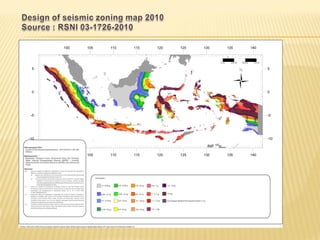
REGULATIONS In accordance RSNI 03-1726-2010 based MAP
Indonesia Earthquake 2010. Initial research will examine how the
application of the requirements The set tends to favor business
interests Insurance even cause a reduction in the level of
community awareness and may lead to moral hazard.
2   INTRODUCTION
Indonesia known as disaster-prone region it is situated at the
confluence of three major plates of the earth, the Pacific, Eurasian,
and Australian-Indian Ocean, which could potentially bring in a
variety of disasters, such as earthquakes, tsunamis, volcanic
eruptions, and landslides. In such a situation, there is no single
country in the world to feature completely Indonesia earthquake risk
threats.


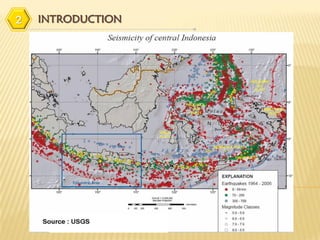
Indonesia is a highly active tectonic zone due to three plates of the world
and nine other small plates meet in Indonesia and establish pathways of
complex assembly plates (Bird, 2003). The existence of interactions
between these plates placed over Indonesia as the region is prone to
earthquakes (Milson et al., 1992). The high seismic activity was revealed by
the record where in the span of 1897-2009, there are more than 14,000
earthquakes with magnitude M> 5.0. Incidence of major earthquakes (main
shocks) within the period.
Recorded a variety of activities the massive earthquake in Indonesia


   Aceh earthquake accompanied by a tsunami in 2004 (Mw = 9.2)

    The 2005 Nias earthquake (Mw = 8.7)

    Yogyakarta earthquake in 2006 (Mw = 6.3 ),

     Tasik earthquake in 2009 (Mw = 7.4)

      Padang earthquake in 2009 (Mw = 7.6)

      Bogor earthquake 2012 (Mw = 4,8)


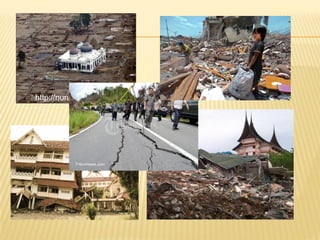
  Earthquakes have caused thousands of casualties, collapse and
 destruction of thousands infrastructures and buildings, as well as
   billions dollars of funds for rehabilitation and reconstruction.
http://nurudin.jauhari.net


                                        bhuana2601.blogspot.com

            Tribunnews.com


                             bankied.wordpress.com
The earthquake is one of the natural disasters that often occurs in
Indonesia, Indonesia is due to its location on the region is still unstable
state of the soil layer so that the movement of the earth's surface layer
called tectonic processes. In addition, many active volcanoes are widely
scattered throughout the area of Indonesia could erupt at any time.


Earthquakes unpredictable, the experts can only know the position and
direction of plate movement, but can not know for sure when the plates
are met that will meet and cause vibration as an earthquake.


   Earthquake did not cause death, but due to damage to the building
   that can lead to loss of life. On the surface, the vibrations can cause
   damage and collapse of buildings so as to cause fatalities. Tremor
   can also trigger landslides, rock debris, and other destructive land
   damage settlements.
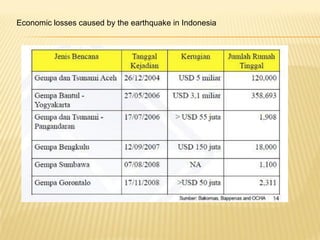
Economic losses caused by the earthquake in Indonesia
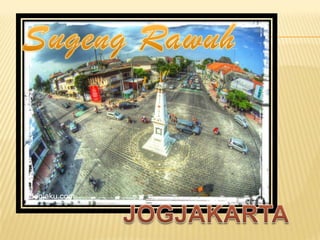
Jogjaku.com
Yogyakarta provide new strategic step to change the paradigm, disaster relief
and post-disaster emergency management into disaster prevention and
mitigation. Greater attention to the need for expansion of disaster relief efforts
than reactive measures through emergency response and post-disaster
management, with more attention to preventive measures through disaster
preparedness and mitigation has been stated in Law No. 24 Year 2007 on
Disaster Management and derivatives regulations .


Tectonic earthquake measuring 6.3 on the Richter scale occurred on May 27,
2006 at 5:55 pm with the epicenter at 37.6 kilometers south of the city of
Yogyakarta at a depth of 33km felt across parts of Yogyakarta and Central
Java, has claimed most of the victims were not small. Recorded number of
victims who are dead 5737 people (4674 people in Yogyakarta and Central
Java 1063 people), serious injury / light 38 423 people (19 897 people in 5
Yogyakarta and Central Java 18 526 people) and tens of thousands of people
forced to live in temporary shelters (displaced).
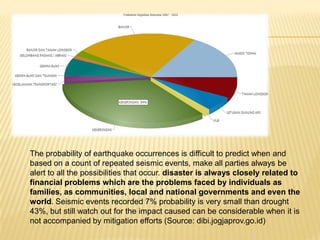
The probability of earthquake occurrences is difficult to predict when and
based on a count of repeated seismic events, make all parties always be
alert to all the possibilities that occur. disaster is always closely related to
financial problems which are the problems faced by individuals as
families, as communities, local and national governments and even the
world. Seismic events recorded 7% probability is very small than drought
43%, but still watch out for the impact caused can be considerable when it is
not accompanied by mitigation efforts (Source: dibi.jogjaprov.go.id)
3     INSURANCE FOR DRR

The risk always involves two terms :

         uncertainty

         financial loss opportunities

  A risk of an uncertain event do risk sharing joint efforts of various
  parties to the financial burden becomes lighter. Financial Risk is a fixed
  price for each particular risk due to the earthquake. It is not enough to
  just financial settlement, but also the business community capacity
  building is needed in disaster risk reduction.
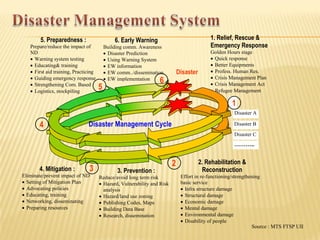
5. Preparedness :                     6. Early Warning                              1. Relief, Rescue &
   Prepare/reduce the impact of           Building comm. Awareness                          Emergency Response
   ND                                      Disaster Prediction                             Golden Hours stage
    Warning system testing                Using Warning System                             Quick response
    Educating& training                   EW information                                   Better Equipments
    First aid training, Practicing        EW comm../dissemination          Disaster        Profess. Human Res.
    Guiding emergency response                                                              Crisis Management Plan
    Strengthening Com. Based
                                           EW implementation    6                           Crisis Management Act
    Logistics, stockpiling
                                      5                                                      Refugee Management

                                                                                                     1
                                                                                                      Disaster A

       4                       Disaster Management Cycle                                              Disaster B
                                                                                                      Disaster C
                                                                                                      ………..


                                                                         2              2. Rehabilitation &
       4. Mitigation :         3               3. Prevention :                           Reconstruction
Eliminate/prevent impact of ND        Reduce/avoid long term risk             Effort in re-functioning/strengthening
 Setting of Mitigation Plan           Hazard, Vulnerability and Risk        basic service
 Advocating policies                   analysis                               Infra structure damage
 Educating, training                  Hazard/land use zoning                 Structural damage
 Networking, disseminating            Publishing Codes, Maps                 Economic damage
 Preparing resources                  Building Data Base                     Mental damage
                                       Research, dissemination                Environmental damage
                                                                               Disability of people
                                                                                                                Source : MTS FTSP UII
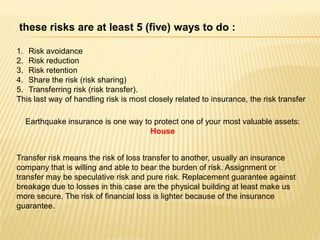
these risks are at least 5 (five) ways to do :

1. Risk avoidance
2. Risk reduction
3. Risk retention
4. Share the risk (risk sharing)
5. Transferring risk (risk transfer).
This last way of handling risk is most closely related to insurance, the risk transfer

  Earthquake insurance is one way to protect one of your most valuable assets:
                                    House


Transfer risk means the risk of loss transfer to another, usually an insurance
company that is willing and able to bear the burden of risk. Assignment or
transfer may be speculative risk and pure risk. Replacement guarantee against
breakage due to losses in this case are the physical building at least make us
more secure. The risk of financial loss is lighter because of the insurance
guarantee.
Insurance as one of disaster risk reduction is not the only
solution, but it should be coupled with an increased capacity of
the importance of disaster risk reduction efforts.

The Republic of Indonesia act no. 24 of 2007 “Penanggulangan
Bencana”       Disaster Management paradigm shift which was
originally the responsibility of the government be a shared
responsibility.
Various parties have a role in disaster risk reduction efforts that
can happen anytime. Government, private sector and individuals
have the same role in accordance with their capacity.
The contribute of private sector in this regard is the
          insurance industry with earthquake insurance services.
          Earthquake insurance to be an effective tool in
          mitigation efforts. Insurance provides financial security
          during the earthquake.


Insurance also assist the government in terms of financing in
the event of a disaster by providing insurance claim if the
house is collateral damage. Besides insurance also empower
people to be more independent in preparing financial problems
4     EARTHQUAKE INSURANCE
       PREMIUMS AND BENEFIT
The benefit gained by the community with earthquake insurance coverage,
will get a warranty replacement of the reconstruction cost worth the price of
the building before the damage occurred. The premium to be paid is very
small compared with the risk borne by the insurer. Easy terms and benefits
as one of the reasons for the increased interest of the community to this
day. Not just about disaster-prone locations such as Bantul district, but in
the city of Yogyakarta and district sleman.

Convenience provided by the insurance company to pay a premium in the
amount ranging from 1.5 ‰ to 2 ‰ of the value of buildings making up the
enthusiasm to buy earthquake insurance policies are packaged in a single
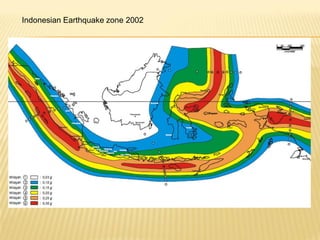
package with fire insurance. For example Yogyakarta included in zone 4, if the
rate is 1.5 ‰ estimated construction value of Rp. 200.000.000, - the owners
simply pay a premium of Rp. 300.000, - Benefit obtained during an
earthquake and the house was severely damaged even to the ground, the
insurance company will provide a maximum claim amount of the building after
the deductible or deductible at your own risk that only 10% of the value of
collateral, the homeowner will receive Rp. 180 000 000,
EI is automatically includes guarantees in case of fire, medical expenses for the
insured and include the cost of temporary housing if the object can not be
occupied. Convenience provided by the insurance company to pay a premium in
the amount ranging from 1.5 ‰ - 2 ‰ of the value of buildings making up to buy
earthquake insurance policies. They are packaged in a single package with fire
insurance.

For example Yogyakarta included in zone 4, if the rate is 1.5 ‰ estimated
construction value of Rp. 200.000.000, - the owners simply pay a premium of Rp.
300.000, -

Benefit obtained during an earthquake and the house was severely damaged
even to the ground, the insurance company will provide a maximum claim amount
of the building after the deductible or deductible at your own risk that only 10% of
the value of collateral,

the homeowner will receive Rp. 180 000 000,
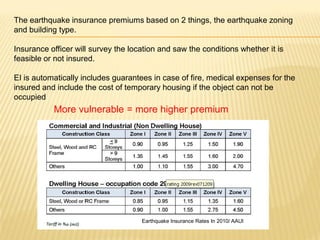
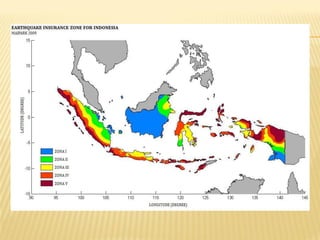
The earthquake insurance premiums based on 2 things, the earthquake zoning
and building type.

Insurance officer will survey the location and saw the conditions whether it is
feasible or not insured.

EI is automatically includes guarantees in case of fire, medical expenses for the
insured and include the cost of temporary housing if the object can not be
occupied
           More vulnerable = more higher premium


                                     Earthquake Insurance Rates In 2010/ AAUI
Indonesian Earthquake zone 2002
5      UNDERWRITING

Earthquake insurance to guarantee the financial security to the value of
the buildings and the handling of the economic recovery in Indonesia
earthquake insurance scheme has not been fully implemented

Underwriting acceptable decision whether or not for the insured is still very
weak. When you look at the regulations in force in Indonesia has no
regulations on Standards of ISO 1726 2002 Planning for Earthquake
Resistance and Non-Building Structures Building Permits and paperwork
of Building (IMB) equipped with a blue print of the plans.

Code of buildings for earthquake resistance structure plan covers all the
foundation, Sloof, columns and beams and roof construction planning.
Structure as the main pillar of the resistance of a particular building can not be
negotiable in the implementation should be according to the rules and
regulations. Insurance does not look too deep a few things. But if there is a
claim, the insurance company will assess the suitability of new construction
with the initial description of insurance coverage at the time.
Another factor not considered in the underwriting process is the age of the
building.

How old age insurance covered buildings remain, except for heritage buildings.
Age building will obviously affect earthquake resistance factor.

The longer the age of the building may be the stronger or the weaker depending
on the material used
6      COMPLIANCE WITH CURRENT CONDITIONS


The question that then arises is whether the earthquake map is still
relevant or urgent to be fixed?

Since the publication of SNI 03-1726-2002, there have been several major
earthquakes in Indonesia, which has a magnitude greater than the maximum
magnitude than previously thought, such as Aceh Earthquake (2004), Nias
Earthquake (2005) and Jogja earthquake (2006).

Earthquake insurance provides greater convenience and financial
benefits. insurance also help the earthquake disaster risk reduction
efforts made by the public are aware of the disaster on their own
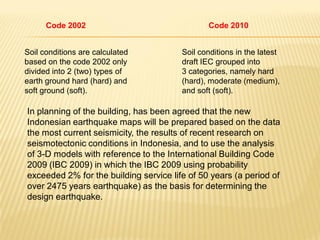
Code 2002                                Code 2010


Soil conditions are calculated          Soil conditions in the latest
based on the code 2002 only             draft IEC grouped into
divided into 2 (two) types of           3 categories, namely hard
earth ground hard (hard) and            (hard), moderate (medium),
soft ground (soft).                     and soft (soft).

In planning of the building, has been agreed that the new
Indonesian earthquake maps will be prepared based on the data
the most current seismicity, the results of recent research on
seismotectonic conditions in Indonesia, and to use the analysis
of 3-D models with reference to the International Building Code
2009 (IBC 2009) in which the IBC 2009 using probability
exceeded 2% for the building service life of 50 years (a period of
over 2475 years earthquake) as the basis for determining the
design earthquake.
EARTHQUAKE INSURANCE THREATS OF
            DISASTER RISK REDUCTION EFFORTS


The role of insurance as a form of mitigation was
initially expected to drive the implementation of the
regulations for the conduct of earthquake resistant
buildings in accordance with the applicable code must
not ignore the factor structure planning
Discourse earthquake insurance in Indonesia has not been fully
implemented. Most people do not realize what the significance of
insurance. Educating the public is still needed to provide knowledge
awareness of disaster mitigation is one such earthquake insurance.
For it is necessary to set up the Natural Disaster Risk Insurance Team
in charge of, among others, held a socialization or public awareness
of insurance to employers and insured people about the risks of
natural disasters especially earthquakes, gathering of information and
data relating to the risk of earthquakes and perform the review/
evaluation or reviews the policy closure earthquake risk.
7           FACTS FINDINGS
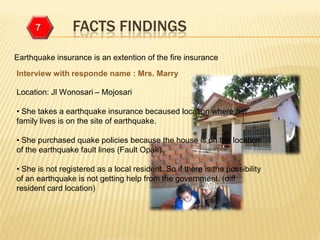
Earthquake insurance is an extention of the fire insurance

Interview with responde name : Mrs. Marry

Location: Jl Wonosari – Mojosari

• She takes a earthquake insurance becaused location where her
family lives is on the site of earthquake.

• She purchased quake policies because the house is on the location
of the earthquake fault lines (Fault Opak).

• She is not registered as a local resident. So if there is the possibility
of an earthquake is not getting help from the government. (diff
resident card location)
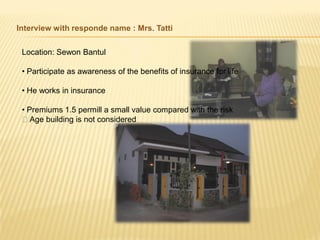
Interview with responde name : Mrs. Tatti


 Location: Sewon Bantul

 • Participate as awareness of the benefits of insurance for life

 • He works in insurance

 • Premiums 1.5 permill a small value compared with the risk
 Age building is not considered
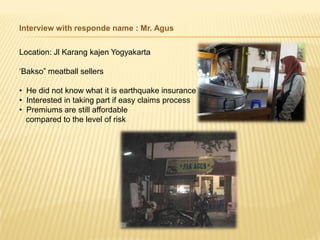
Interview with responde name : Mr. Agus


Location: Jl Karang kajen Yogyakarta

„Bakso” meatball sellers

• He did not know what it is earthquake insurance
• Interested in taking part if easy claims process
• Premiums are still affordable
  compared to the level of risk
8      QUESTIONS and DISCUSSION

What’s your opinian that insurance become
one of disaster risk reduction efforts?

The insurance premiums are relatively lower,
Can be an advanced moral hazard for disaster
risk reduction efforts?

How does earthquake insurance cover the lower class?

How the ideal system of earthquake should be examined in
Indonesia..??

Does the government covered the earthquake insurance
house??
Earthquake insurance- 4-drr

Earthquake insurance- 4-drr

  • 2.
    SOEsatyobudikurniawan Palupi Listiyani
  • 3.
    1 ABSTRACT 2 INTRODUCTIONS 3 INSURANCE FOR DRR 4 FACTS FINDINGS 5 QUESTIONS AND DISCUSSION
  • 4.
    1 ABSTRACT Disaster is not inevitable events by anyone, it can affect anyone, anything and anywhere. Although basically a disaster itself has specific symptoms that can detected by humans, it is not uncommon disasters can occur spontaneously. The disaster itself is defined as an event or series of events that threaten and disrupt the lives and livelihoods caused by both natural factors or non-natural factors and human factors that lead to the emergence of human casualties, environmental damage, loss of property and psychological impact, one example as earthquakes.
  • 5.
    The paradigm shiftthat considers earthquakes, volcanic eruptions, floods and soil erosion is a natural phenomenon in a future filled with uncertainty. Losses would be very likely to occur if not done since the disaster risk reduction at this time, in recent years many stakeholders have developed several mitigation programs in both structural and non-structural various sectors, especially infrastructure. Although people are increasingly sensitive to seismic hazard realize that earthquakes will not cause death, but the vulnerability of structures that cause damage and casualties. Implementation of the field is still a question mark.
  • 6.
    One of therisk transfer (derivatives) in making disaster risk management is insurance. Earthquake insurance product applications has increased significantly in Jogjakarta, with only 1.5‰ of the premium total annual value of the building, customers will get the full protection if we insure the building had been completely destroyed by the earthquake that occurred. Originally expected earthquake insurance organization to encourage the implementation of Earthquake Resistant Buildings REGULATIONS In accordance RSNI 03-1726-2010 based MAP Indonesia Earthquake 2010. Initial research will examine how the application of the requirements The set tends to favor business interests Insurance even cause a reduction in the level of community awareness and may lead to moral hazard.
  • 7.
    2 INTRODUCTION
  • 8.
    Indonesia known asdisaster-prone region it is situated at the confluence of three major plates of the earth, the Pacific, Eurasian, and Australian-Indian Ocean, which could potentially bring in a variety of disasters, such as earthquakes, tsunamis, volcanic eruptions, and landslides. In such a situation, there is no single country in the world to feature completely Indonesia earthquake risk threats. Indonesia is a highly active tectonic zone due to three plates of the world and nine other small plates meet in Indonesia and establish pathways of complex assembly plates (Bird, 2003). The existence of interactions between these plates placed over Indonesia as the region is prone to earthquakes (Milson et al., 1992). The high seismic activity was revealed by the record where in the span of 1897-2009, there are more than 14,000 earthquakes with magnitude M> 5.0. Incidence of major earthquakes (main shocks) within the period.
  • 9.
    Recorded a varietyof activities the massive earthquake in Indonesia Aceh earthquake accompanied by a tsunami in 2004 (Mw = 9.2) The 2005 Nias earthquake (Mw = 8.7) Yogyakarta earthquake in 2006 (Mw = 6.3 ), Tasik earthquake in 2009 (Mw = 7.4) Padang earthquake in 2009 (Mw = 7.6) Bogor earthquake 2012 (Mw = 4,8) Earthquakes have caused thousands of casualties, collapse and destruction of thousands infrastructures and buildings, as well as billions dollars of funds for rehabilitation and reconstruction.
  • 10.
    http://nurudin.jauhari.net bhuana2601.blogspot.com Tribunnews.com bankied.wordpress.com
  • 11.
    The earthquake isone of the natural disasters that often occurs in Indonesia, Indonesia is due to its location on the region is still unstable state of the soil layer so that the movement of the earth's surface layer called tectonic processes. In addition, many active volcanoes are widely scattered throughout the area of Indonesia could erupt at any time. Earthquakes unpredictable, the experts can only know the position and direction of plate movement, but can not know for sure when the plates are met that will meet and cause vibration as an earthquake. Earthquake did not cause death, but due to damage to the building that can lead to loss of life. On the surface, the vibrations can cause damage and collapse of buildings so as to cause fatalities. Tremor can also trigger landslides, rock debris, and other destructive land damage settlements.
  • 12.
    Economic losses causedby the earthquake in Indonesia
  • 13.
  • 14.
    Yogyakarta provide newstrategic step to change the paradigm, disaster relief and post-disaster emergency management into disaster prevention and mitigation. Greater attention to the need for expansion of disaster relief efforts than reactive measures through emergency response and post-disaster management, with more attention to preventive measures through disaster preparedness and mitigation has been stated in Law No. 24 Year 2007 on Disaster Management and derivatives regulations . Tectonic earthquake measuring 6.3 on the Richter scale occurred on May 27, 2006 at 5:55 pm with the epicenter at 37.6 kilometers south of the city of Yogyakarta at a depth of 33km felt across parts of Yogyakarta and Central Java, has claimed most of the victims were not small. Recorded number of victims who are dead 5737 people (4674 people in Yogyakarta and Central Java 1063 people), serious injury / light 38 423 people (19 897 people in 5 Yogyakarta and Central Java 18 526 people) and tens of thousands of people forced to live in temporary shelters (displaced).
  • 15.
    The probability ofearthquake occurrences is difficult to predict when and based on a count of repeated seismic events, make all parties always be alert to all the possibilities that occur. disaster is always closely related to financial problems which are the problems faced by individuals as families, as communities, local and national governments and even the world. Seismic events recorded 7% probability is very small than drought 43%, but still watch out for the impact caused can be considerable when it is not accompanied by mitigation efforts (Source: dibi.jogjaprov.go.id)
  • 16.
    3 INSURANCE FOR DRR The risk always involves two terms : uncertainty financial loss opportunities A risk of an uncertain event do risk sharing joint efforts of various parties to the financial burden becomes lighter. Financial Risk is a fixed price for each particular risk due to the earthquake. It is not enough to just financial settlement, but also the business community capacity building is needed in disaster risk reduction.
  • 17.
    5. Preparedness : 6. Early Warning 1. Relief, Rescue & Prepare/reduce the impact of Building comm. Awareness Emergency Response ND  Disaster Prediction Golden Hours stage  Warning system testing  Using Warning System  Quick response  Educating& training  EW information  Better Equipments  First aid training, Practicing  EW comm../dissemination Disaster  Profess. Human Res.  Guiding emergency response  Crisis Management Plan  Strengthening Com. Based  EW implementation 6  Crisis Management Act  Logistics, stockpiling 5  Refugee Management 1 Disaster A 4 Disaster Management Cycle Disaster B Disaster C ……….. 2 2. Rehabilitation & 4. Mitigation : 3 3. Prevention : Reconstruction Eliminate/prevent impact of ND Reduce/avoid long term risk Effort in re-functioning/strengthening  Setting of Mitigation Plan  Hazard, Vulnerability and Risk basic service  Advocating policies analysis  Infra structure damage  Educating, training  Hazard/land use zoning  Structural damage  Networking, disseminating  Publishing Codes, Maps  Economic damage  Preparing resources  Building Data Base  Mental damage  Research, dissemination  Environmental damage  Disability of people Source : MTS FTSP UII
  • 18.
    these risks areat least 5 (five) ways to do : 1. Risk avoidance 2. Risk reduction 3. Risk retention 4. Share the risk (risk sharing) 5. Transferring risk (risk transfer). This last way of handling risk is most closely related to insurance, the risk transfer Earthquake insurance is one way to protect one of your most valuable assets: House Transfer risk means the risk of loss transfer to another, usually an insurance company that is willing and able to bear the burden of risk. Assignment or transfer may be speculative risk and pure risk. Replacement guarantee against breakage due to losses in this case are the physical building at least make us more secure. The risk of financial loss is lighter because of the insurance guarantee.
  • 19.
    Insurance as oneof disaster risk reduction is not the only solution, but it should be coupled with an increased capacity of the importance of disaster risk reduction efforts. The Republic of Indonesia act no. 24 of 2007 “Penanggulangan Bencana” Disaster Management paradigm shift which was originally the responsibility of the government be a shared responsibility. Various parties have a role in disaster risk reduction efforts that can happen anytime. Government, private sector and individuals have the same role in accordance with their capacity.
  • 20.
    The contribute ofprivate sector in this regard is the insurance industry with earthquake insurance services. Earthquake insurance to be an effective tool in mitigation efforts. Insurance provides financial security during the earthquake. Insurance also assist the government in terms of financing in the event of a disaster by providing insurance claim if the house is collateral damage. Besides insurance also empower people to be more independent in preparing financial problems
  • 21.
    4 EARTHQUAKE INSURANCE PREMIUMS AND BENEFIT The benefit gained by the community with earthquake insurance coverage, will get a warranty replacement of the reconstruction cost worth the price of the building before the damage occurred. The premium to be paid is very small compared with the risk borne by the insurer. Easy terms and benefits as one of the reasons for the increased interest of the community to this day. Not just about disaster-prone locations such as Bantul district, but in the city of Yogyakarta and district sleman. Convenience provided by the insurance company to pay a premium in the amount ranging from 1.5 ‰ to 2 ‰ of the value of buildings making up the enthusiasm to buy earthquake insurance policies are packaged in a single package with fire insurance. For example Yogyakarta included in zone 4, if the rate is 1.5 ‰ estimated construction value of Rp. 200.000.000, - the owners simply pay a premium of Rp. 300.000, - Benefit obtained during an earthquake and the house was severely damaged even to the ground, the insurance company will provide a maximum claim amount of the building after the deductible or deductible at your own risk that only 10% of the value of collateral, the homeowner will receive Rp. 180 000 000,
  • 22.
    EI is automaticallyincludes guarantees in case of fire, medical expenses for the insured and include the cost of temporary housing if the object can not be occupied. Convenience provided by the insurance company to pay a premium in the amount ranging from 1.5 ‰ - 2 ‰ of the value of buildings making up to buy earthquake insurance policies. They are packaged in a single package with fire insurance. For example Yogyakarta included in zone 4, if the rate is 1.5 ‰ estimated construction value of Rp. 200.000.000, - the owners simply pay a premium of Rp. 300.000, - Benefit obtained during an earthquake and the house was severely damaged even to the ground, the insurance company will provide a maximum claim amount of the building after the deductible or deductible at your own risk that only 10% of the value of collateral, the homeowner will receive Rp. 180 000 000,
  • 23.
    The earthquake insurancepremiums based on 2 things, the earthquake zoning and building type. Insurance officer will survey the location and saw the conditions whether it is feasible or not insured. EI is automatically includes guarantees in case of fire, medical expenses for the insured and include the cost of temporary housing if the object can not be occupied More vulnerable = more higher premium Earthquake Insurance Rates In 2010/ AAUI
  • 25.
  • 26.
    5 UNDERWRITING Earthquake insurance to guarantee the financial security to the value of the buildings and the handling of the economic recovery in Indonesia earthquake insurance scheme has not been fully implemented Underwriting acceptable decision whether or not for the insured is still very weak. When you look at the regulations in force in Indonesia has no regulations on Standards of ISO 1726 2002 Planning for Earthquake Resistance and Non-Building Structures Building Permits and paperwork of Building (IMB) equipped with a blue print of the plans. Code of buildings for earthquake resistance structure plan covers all the foundation, Sloof, columns and beams and roof construction planning. Structure as the main pillar of the resistance of a particular building can not be negotiable in the implementation should be according to the rules and regulations. Insurance does not look too deep a few things. But if there is a claim, the insurance company will assess the suitability of new construction with the initial description of insurance coverage at the time.
  • 27.
    Another factor notconsidered in the underwriting process is the age of the building. How old age insurance covered buildings remain, except for heritage buildings. Age building will obviously affect earthquake resistance factor. The longer the age of the building may be the stronger or the weaker depending on the material used
  • 28.
    6 COMPLIANCE WITH CURRENT CONDITIONS The question that then arises is whether the earthquake map is still relevant or urgent to be fixed? Since the publication of SNI 03-1726-2002, there have been several major earthquakes in Indonesia, which has a magnitude greater than the maximum magnitude than previously thought, such as Aceh Earthquake (2004), Nias Earthquake (2005) and Jogja earthquake (2006). Earthquake insurance provides greater convenience and financial benefits. insurance also help the earthquake disaster risk reduction efforts made by the public are aware of the disaster on their own
  • 30.
    Code 2002 Code 2010 Soil conditions are calculated Soil conditions in the latest based on the code 2002 only draft IEC grouped into divided into 2 (two) types of 3 categories, namely hard earth ground hard (hard) and (hard), moderate (medium), soft ground (soft). and soft (soft). In planning of the building, has been agreed that the new Indonesian earthquake maps will be prepared based on the data the most current seismicity, the results of recent research on seismotectonic conditions in Indonesia, and to use the analysis of 3-D models with reference to the International Building Code 2009 (IBC 2009) in which the IBC 2009 using probability exceeded 2% for the building service life of 50 years (a period of over 2475 years earthquake) as the basis for determining the design earthquake.
  • 31.
    EARTHQUAKE INSURANCE THREATSOF DISASTER RISK REDUCTION EFFORTS The role of insurance as a form of mitigation was initially expected to drive the implementation of the regulations for the conduct of earthquake resistant buildings in accordance with the applicable code must not ignore the factor structure planning Discourse earthquake insurance in Indonesia has not been fully implemented. Most people do not realize what the significance of insurance. Educating the public is still needed to provide knowledge awareness of disaster mitigation is one such earthquake insurance. For it is necessary to set up the Natural Disaster Risk Insurance Team in charge of, among others, held a socialization or public awareness of insurance to employers and insured people about the risks of natural disasters especially earthquakes, gathering of information and data relating to the risk of earthquakes and perform the review/ evaluation or reviews the policy closure earthquake risk.
  • 32.
    7 FACTS FINDINGS Earthquake insurance is an extention of the fire insurance Interview with responde name : Mrs. Marry Location: Jl Wonosari – Mojosari • She takes a earthquake insurance becaused location where her family lives is on the site of earthquake. • She purchased quake policies because the house is on the location of the earthquake fault lines (Fault Opak). • She is not registered as a local resident. So if there is the possibility of an earthquake is not getting help from the government. (diff resident card location)
  • 33.
    Interview with respondename : Mrs. Tatti Location: Sewon Bantul • Participate as awareness of the benefits of insurance for life • He works in insurance • Premiums 1.5 permill a small value compared with the risk Age building is not considered
  • 34.
    Interview with respondename : Mr. Agus Location: Jl Karang kajen Yogyakarta „Bakso” meatball sellers • He did not know what it is earthquake insurance • Interested in taking part if easy claims process • Premiums are still affordable compared to the level of risk
  • 35.
    8 QUESTIONS and DISCUSSION What’s your opinian that insurance become one of disaster risk reduction efforts? The insurance premiums are relatively lower, Can be an advanced moral hazard for disaster risk reduction efforts? How does earthquake insurance cover the lower class? How the ideal system of earthquake should be examined in Indonesia..?? Does the government covered the earthquake insurance house??