Brian networks2010/02/06Brain Anatomical Network and Intelligence&Organization, development and function of complex brain networksSpeaker : Jimmy LuAdvisor : Hsing MeiWeb Computing LaboratoryComputer Science and Information Engineering DepartmentFu Jen Catholic University
OutlineIntroductionBackgroundGraph theoryComplex networksExamine principles (three aspects)Structural, functional, effective connectivityClinical termsExperimentFuture work2
IntroductionExamines principlesStructural propertiesRelationship between the structural substrate and dynamic functional and effective connectivity patternsThe efficiency of brain structural organization may be an important biological basis for intelligence3
Background – graph theoryAdjacency (connection) matrixCharacteristic path lengthClustering coefficientConnectednessCycleDegreeDistanceDistance matrixGraphPathRegular graphRandom graphScale-free graphSmall-world networks
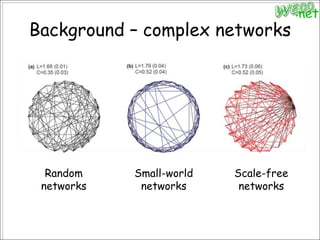
Background – complex networksRandom networksSmall-world networksScale-free networks
Background – three aspectsNeuroanatomical substrate (structural connectivity)Dynamics of neurons (functional connectivity)Functional segregationFunctional integrationCausal interaction (effective connectivity)
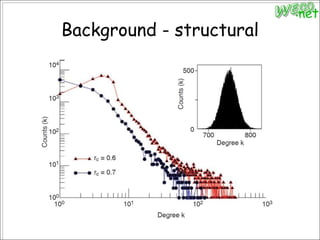
Background - structuralNetwork participation indicesIn-degree, out-degreetransmission coefficientBroadcasters, integratorscooperativeMatching indexConnectional fingerprintMotif analysis
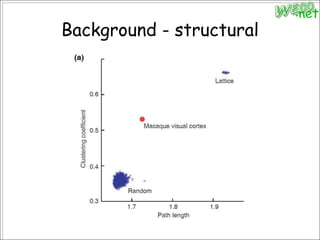
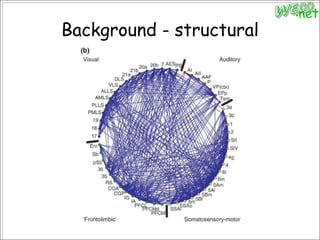
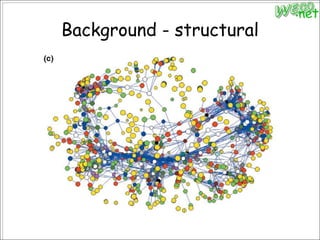
Background - structuralGraph theoretical analysisHigh clustering, short path lengthFunctional proximityMultivariate analysisMultidimensional scalingHierarchical clusterEvolutionary optimizationInter-cluster connectionConnectedness
Background - structural
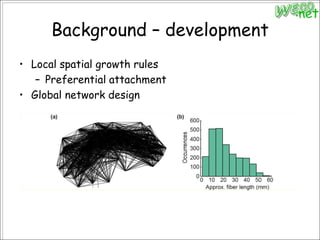
Background – developmentLocal spatial growth rulesPreferential attachmentGlobal network design
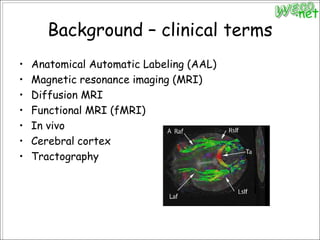
Background – clinical termsAnatomical Automatic Labeling (AAL)Magnetic resonance imaging (MRI)Diffusion MRIFunctional MRI (fMRI)In vivoCerebral cortexTractography
Background - functionalThere are some problems in the previous workOnly binary networksNonzero connection probability value to brain region pairs which are unlikely to be connectedEtc...But they all have evidence that brain network is close to small-world
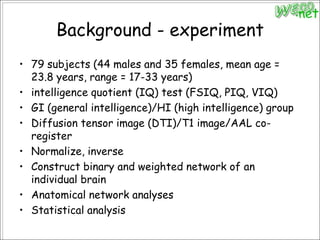
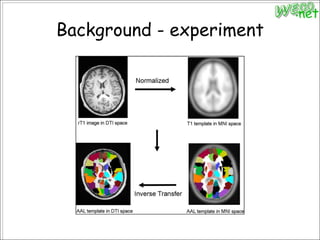
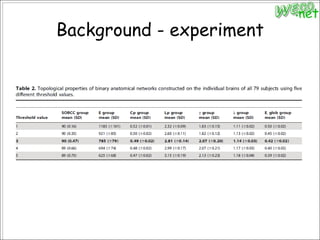
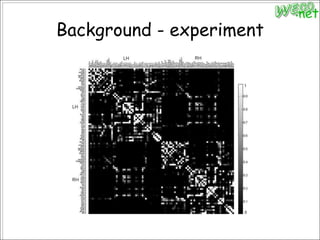
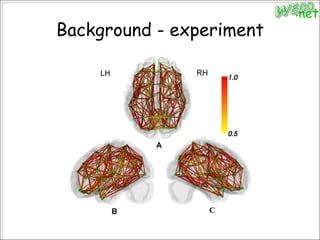
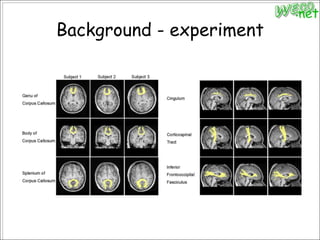
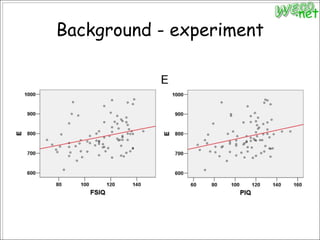
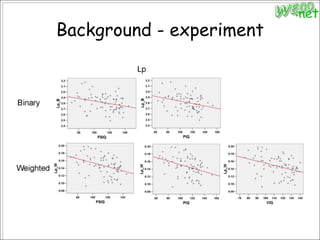
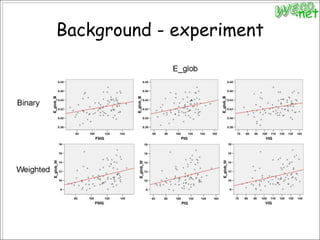
Background - experiment79 subjects (44 males and 35 females, mean age = 23.8 years, range = 17-33 years)intelligence quotient (IQ) test (FSIQ, PIQ, VIQ)GI (general intelligence)/HI (high intelligence) groupDiffusion tensor image (DTI)/T1 image/AAL co-registerNormalize, inverseConstruct binary and weighted network of an individual brainAnatomical network analysesStatistical analysis
Background - experiment
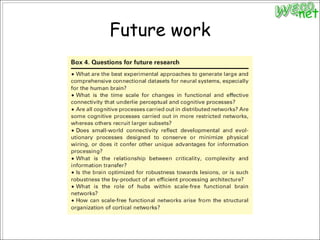
Future work
Future workFrom the computer science perspectiveHow about the social network?Other internet overlaid networks?A brain simulator?Etc…?
ReferenceLi Y, Liu Y, Li J, Qin W, Li K, et al. (2009) Brain Anatomical Network and Intelligence. PLoSComputOlaf Sporns, Dante R. Chialvo, Marcus Kaiser and Claus C. Hilgetag (2004) Organization, development and function of complex brain networks. TRENDS in Cognitive Sciences Vol.8 No.9

Brain Networks