
On the Development of
a Brain Simulator

                    Speaker : Jimmy Lu
                    Advisor : Hsing Mei

          Web Computing Laboratory(WECO Lab)
  Computer Science and Information Engineering Department
                 Fu Jen Catholic University
Outline
 Reviews of the braininformatics
 Current status of brain simulators
 The approaches and architecture of the
  proposed brain simulator
 Modular models of brain function
 Next steps and the focus

                WECO Lab, CSIE dept., FJU
2010/8/25                                   2
                 http://www.weco.net
Reviews of The Brain Informatics


                WECO Lab, CSIE dept., FJU
2010/8/25                                   3
                 http://www.weco.net
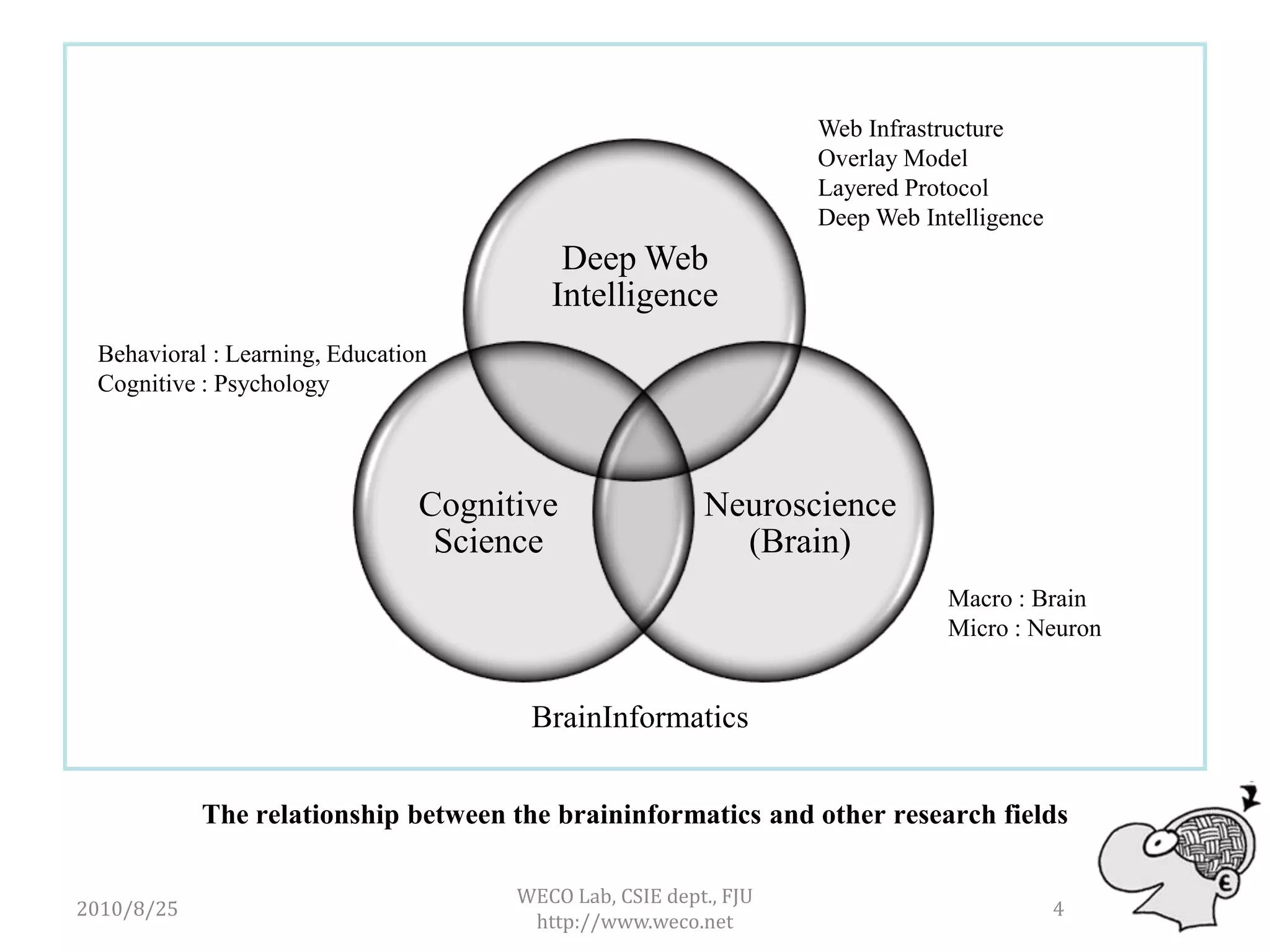
Web Infrastructure
                                                                  Overlay Model
                                                                  Layered Protocol
                                                                  Deep Web Intelligence
                                          Deep Web
                                         Intelligence
 Behavioral : Learning, Education
 Cognitive : Psychology


                                Cognitive                Neuroscience
                                 Science                   (Brain)
                                                                              Macro : Brain
                                                                              Micro : Neuron


                                       BrainInformatics


            The relationship between the braininformatics and other research fields

                                      WECO Lab, CSIE dept., FJU
2010/8/25                                                                                 4
                                       http://www.weco.net
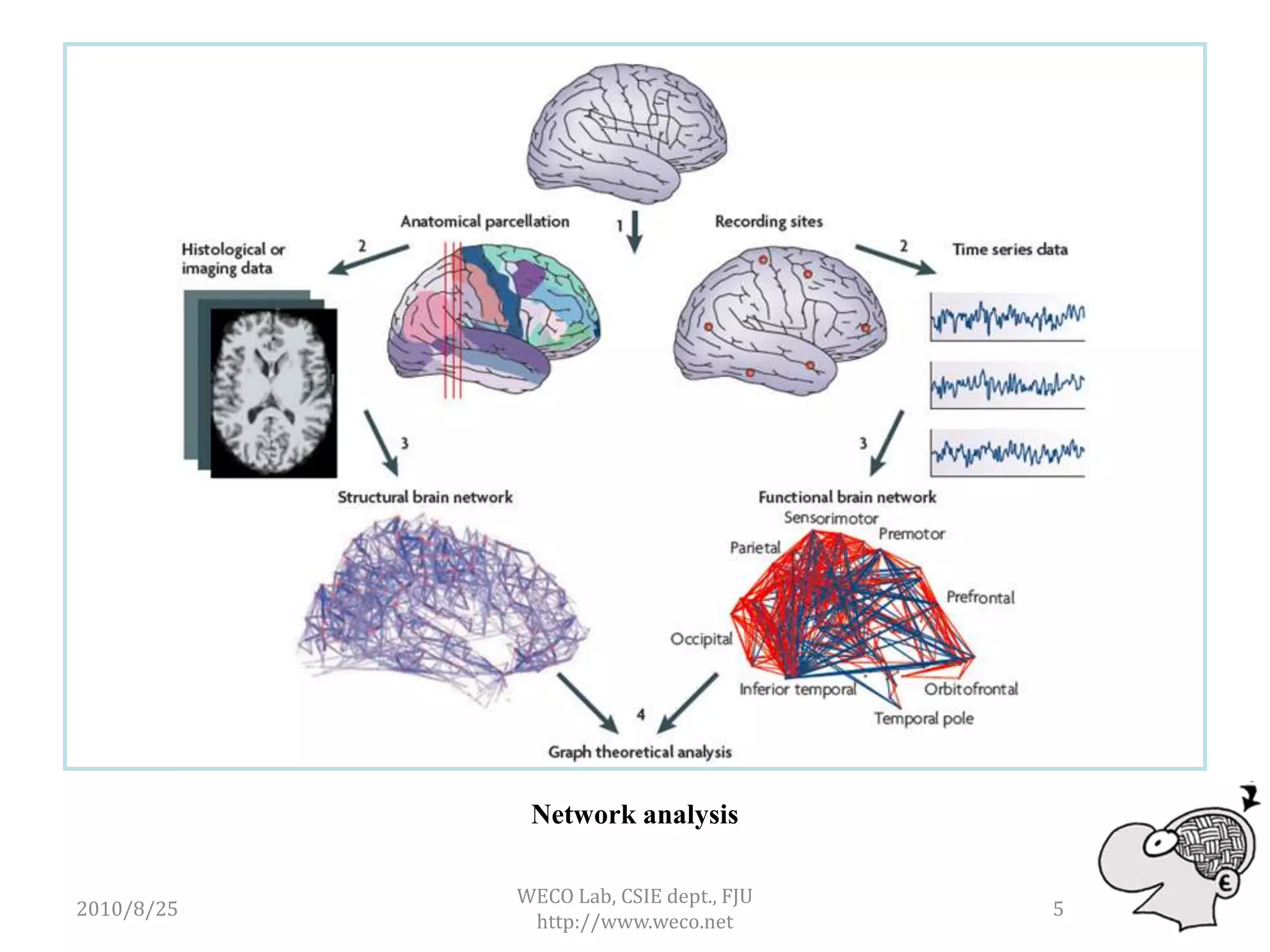
Network analysis

            WECO Lab, CSIE dept., FJU
2010/8/25                               5
             http://www.weco.net
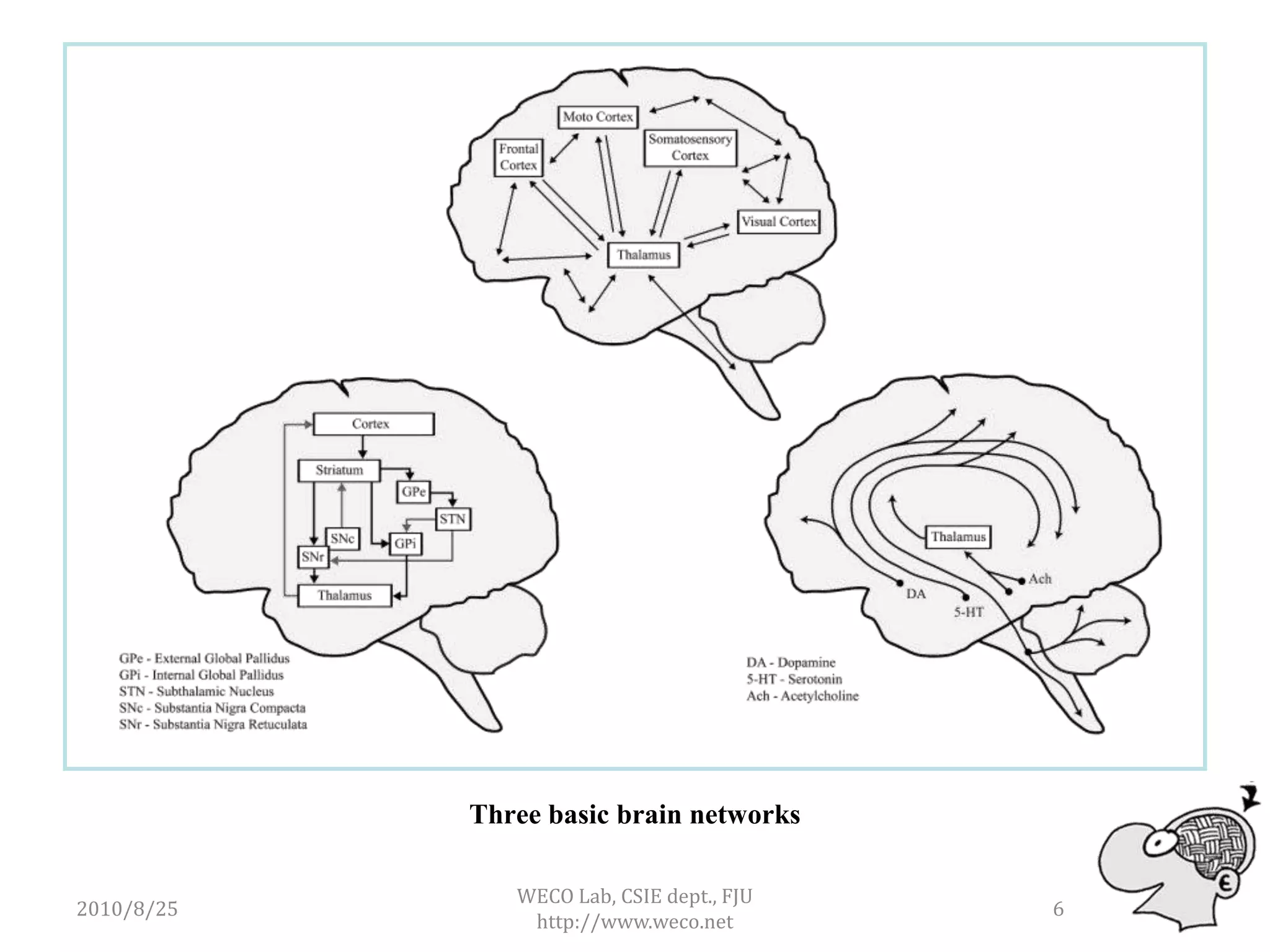
Three basic brain networks

               WECO Lab, CSIE dept., FJU
2010/8/25                                  6
                http://www.weco.net
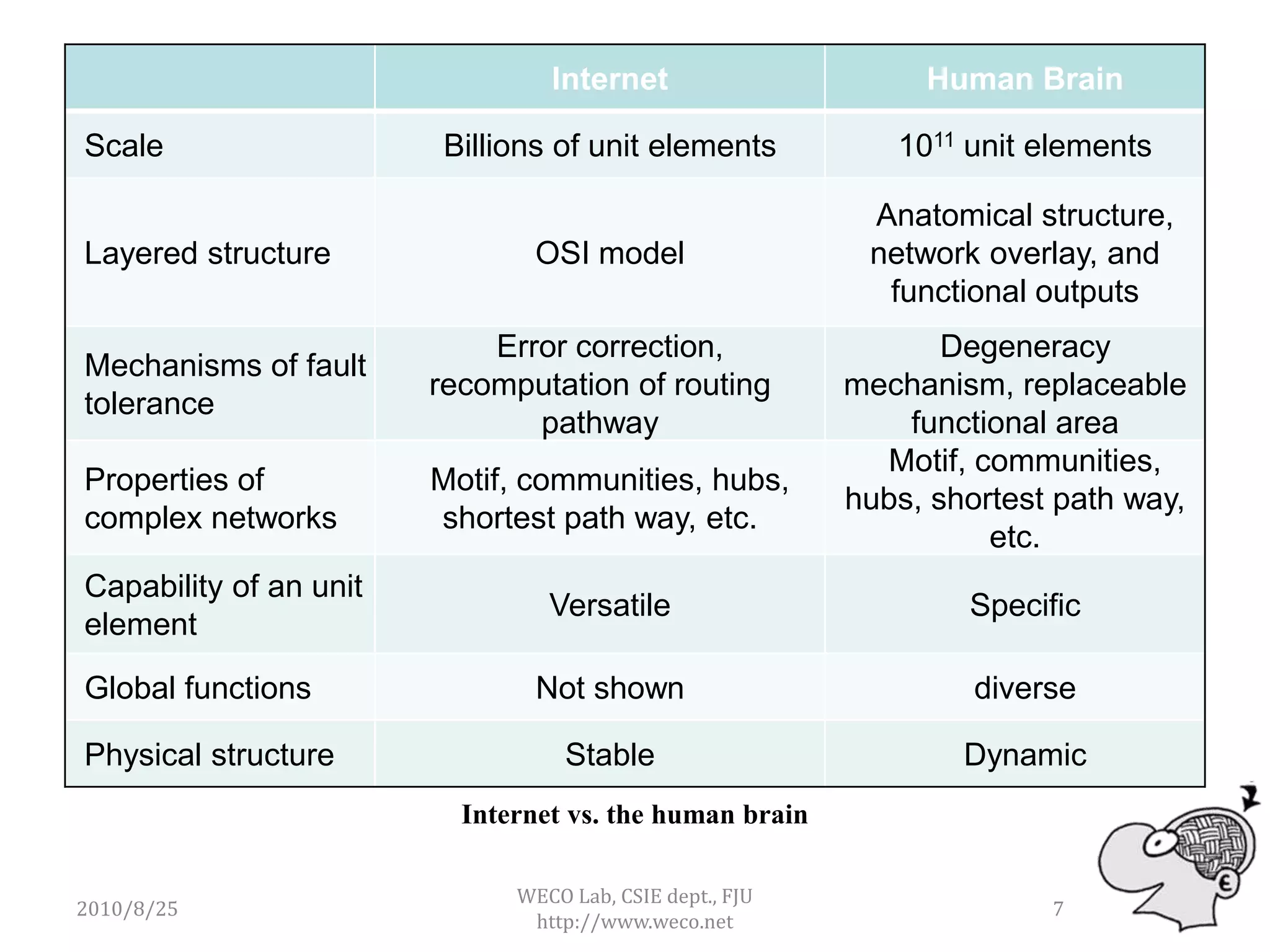
Internet                      Human Brain

Scale                    Billions of unit elements           1011 unit elements

                                                           Anatomical structure,
Layered structure              OSI model                   network overlay, and
                                                            functional outputs
                            Error correction,                    Degeneracy
Mechanisms of fault
                        recomputation of routing          mechanism, replaceable
tolerance
                               pathway                        functional area
                                                            Motif, communities,
Properties of           Motif, communities, hubs,
                                                          hubs, shortest path way,
complex networks        shortest path way, etc.
                                                                    etc.
Capability of an unit
                                 Versatile                        Specific
element

Global functions                Not shown                          diverse

Physical structure                 Stable                         Dynamic
                          Internet vs. the human brain

                              WECO Lab, CSIE dept., FJU
2010/8/25                                                               7
                               http://www.weco.net
Current Status of the Brain Simulator


              WECO Lab, CSIE dept., FJU
2010/8/25                                 8
               http://www.weco.net
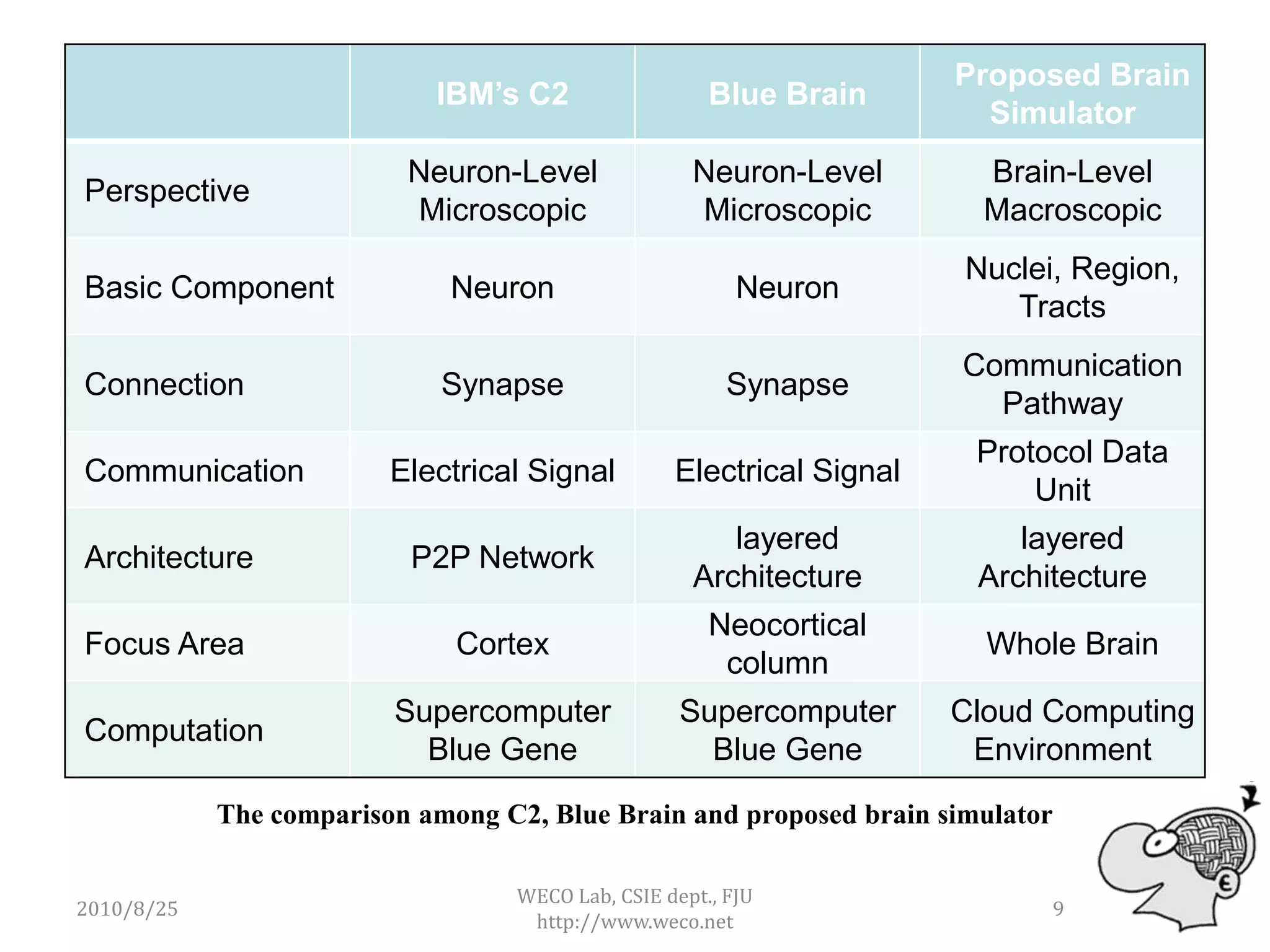
Proposed Brain
                            IBM’s C2                  Blue Brain
                                                                        Simulator
                          Neuron-Level              Neuron-Level        Brain-Level
Perspective
                          Microscopic               Microscopic         Macroscopic
                                                                      Nuclei, Region,
Basic Component              Neuron                      Neuron
                                                                         Tracts
                                                                      Communication
Connection                   Synapse                    Synapse
                                                                        Pathway
                                                                       Protocol Data
Communication            Electrical Signal        Electrical Signal
                                                                           Unit
                                                       layered            layered
Architecture              P2P Network
                                                    Architecture       Architecture
                                                      Neocortical
Focus Area                    Cortex                                    Whole Brain
                                                       column
                         Supercomputer             Supercomputer      Cloud Computing
Computation
                           Blue Gene                 Blue Gene         Environment
            The comparison among C2, Blue Brain and proposed brain simulator

                                  WECO Lab, CSIE dept., FJU
2010/8/25                                                                   9
                                   http://www.weco.net
The Approach and Architecture of
       Proposed Brain Simulator


               WECO Lab, CSIE dept., FJU
2010/8/25                                  10
                http://www.weco.net
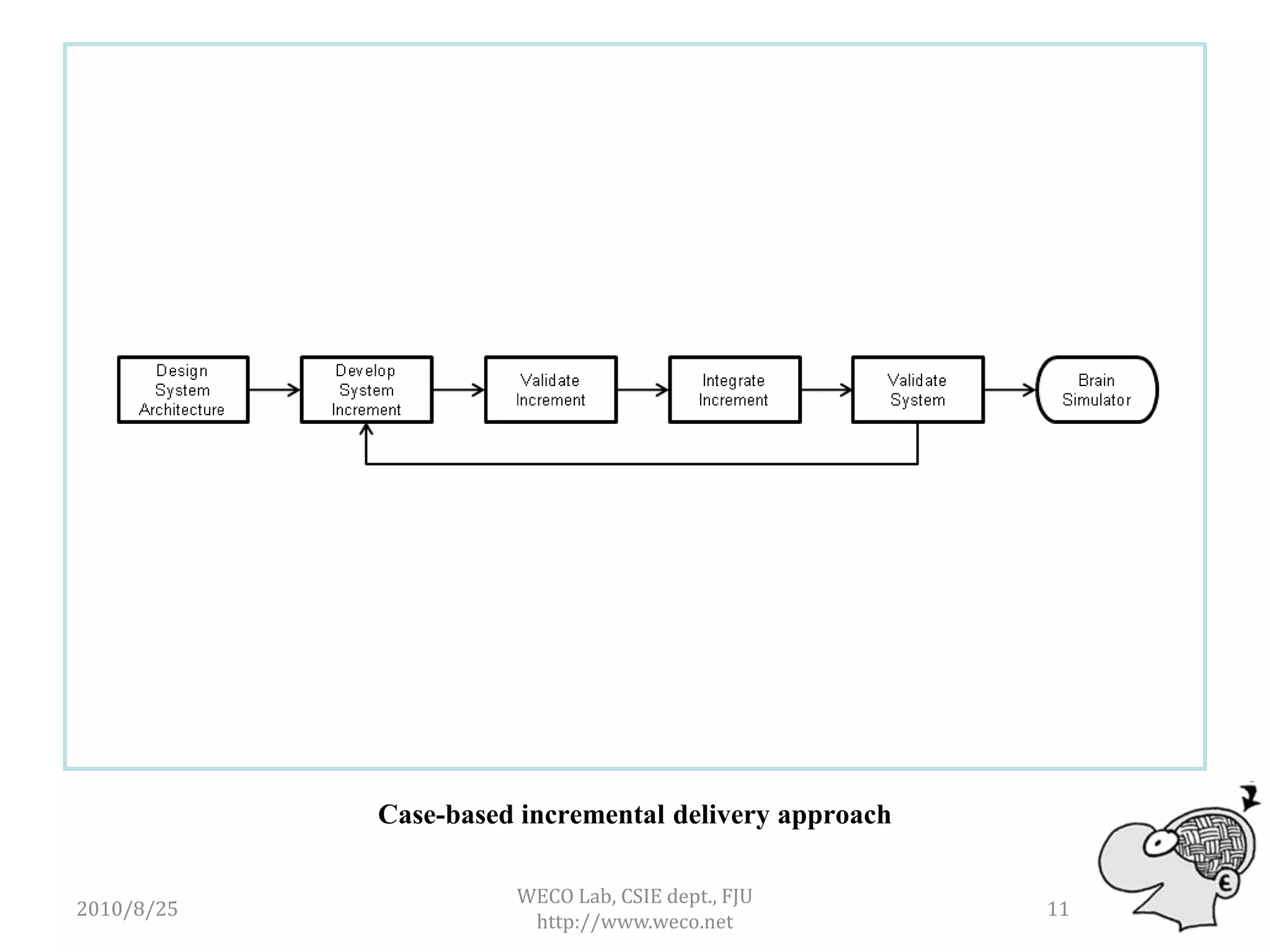
Case-based incremental delivery approach

                      WECO Lab, CSIE dept., FJU
2010/8/25                                              11
                       http://www.weco.net
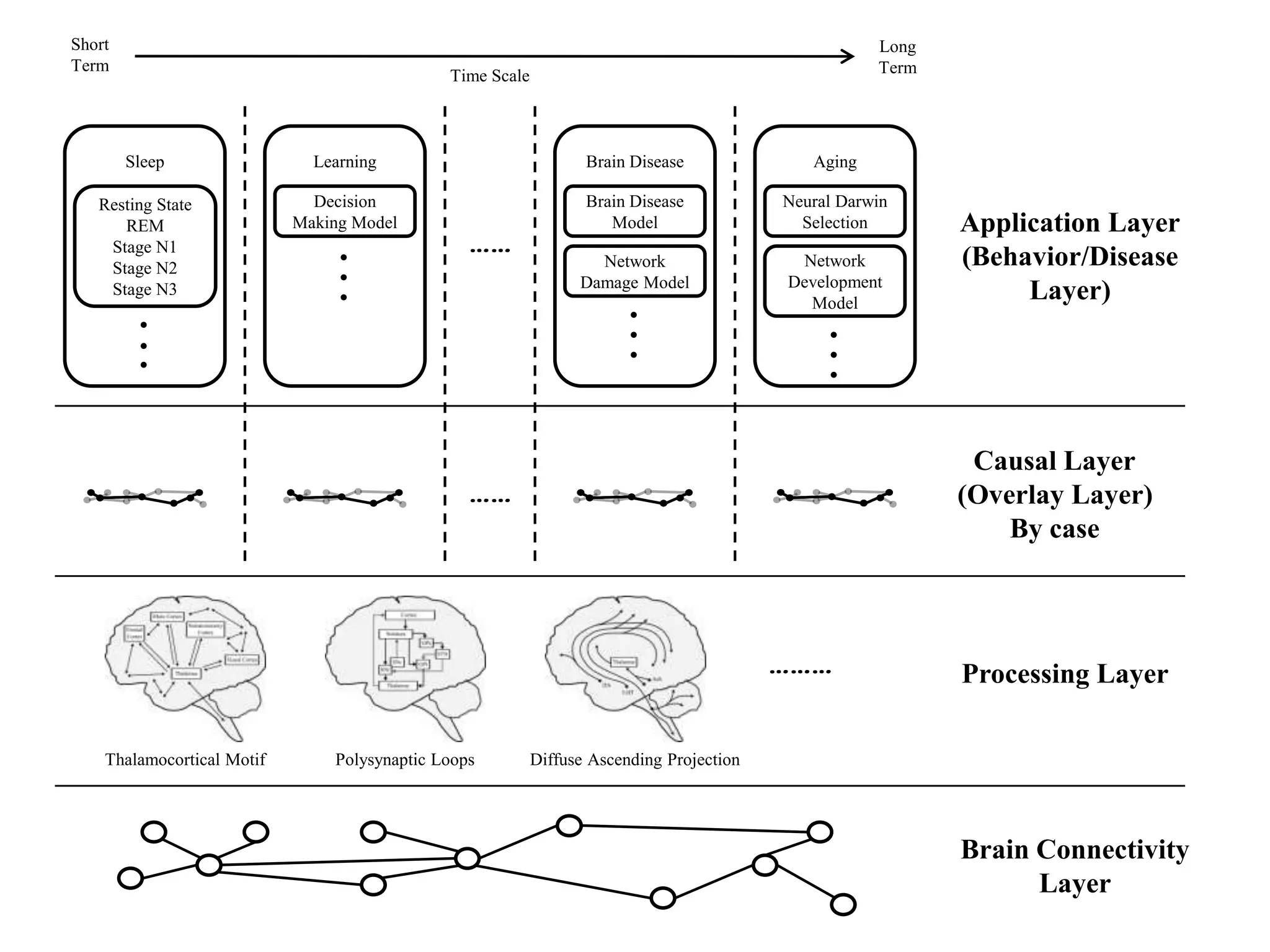
Short                                                                                                Long
Term                                                                                                 Term
                                              Time Scale


        Sleep                 Learning                            Brain Disease              Aging

   Resting State              Decision                            Brain Disease           Neural Darwin
                            Making Model                             Model                  Selection       Application Layer
                                                 ……
      REM
    Stage N1
    Stage N2                                                       Network                 Network          (Behavior/Disease
                                                                 Damage Model             Development
    Stage N3
                                                                                            Model
                                                                                                                 Layer)


                                                                                                             Causal Layer
                                                 ……                                                         (Overlay Layer)
                                                                                                                By case


                                                                                          ………               Processing Layer

    Thalamocortical Motif       Polysynaptic Loops         Diffuse Ascending Projection


                                                                                                            Brain Connectivity
                                                                                                                  Layer
Modular Models of Brain Function


              WECO Lab, CSIE dept., FJU
2010/8/25                                 13
               http://www.weco.net
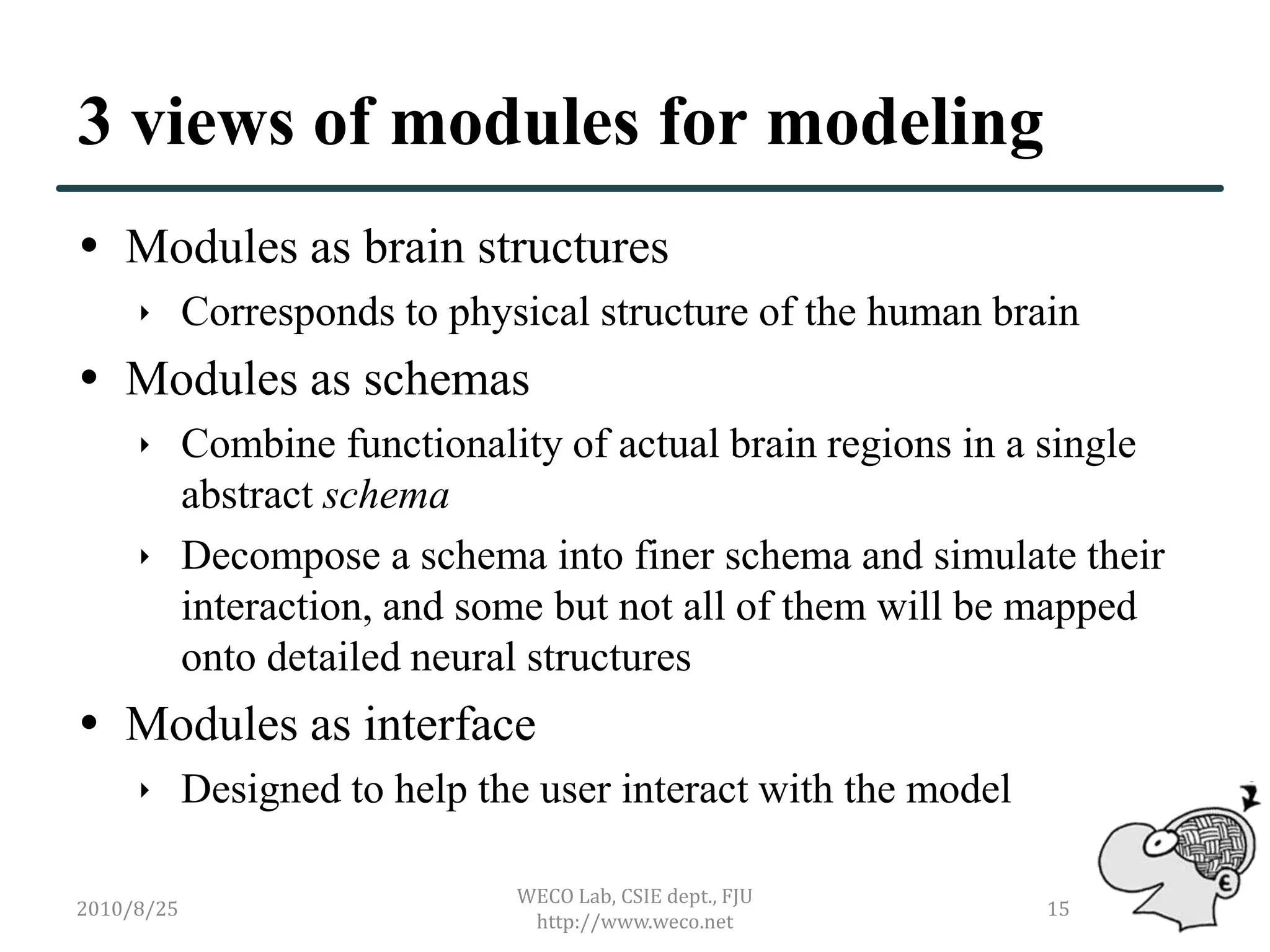
Modular approach
 Much of computational neuroscience focuses on
  properties of single neurons and small circuits
 However, modular approach to modeling is needed
 A complex system may be analyzed by being
  decomposed into a set of interacting subsystems
  because the complexity has been reduced.
 If we try to model “everything all at once” we will
  understand nothing


                      WECO Lab, CSIE dept., FJU
2010/8/25                                         14
                       http://www.weco.net
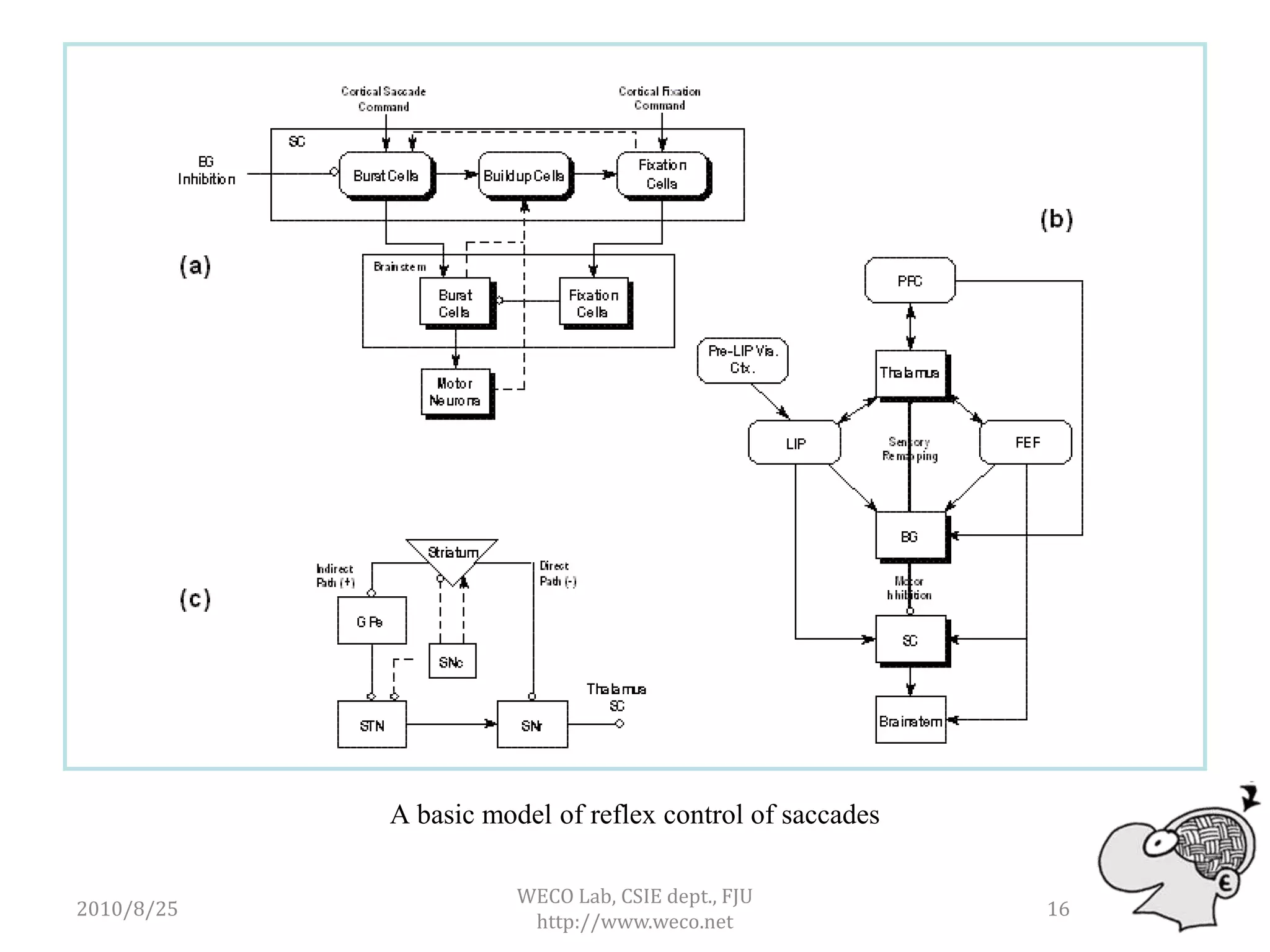
3 views of modules for modeling
 Modules as brain structures
      Corresponds to physical structure of the human brain
 Modules as schemas
      Combine functionality of actual brain regions in a single
       abstract schema
      Decompose a schema into finer schema and simulate their
       interaction, and some but not all of them will be mapped
       onto detailed neural structures
 Modules as interface
      Designed to help the user interact with the model

                           WECO Lab, CSIE dept., FJU
2010/8/25                                                  15
                            http://www.weco.net
A basic model of reflex control of saccades

                       WECO Lab, CSIE dept., FJU
2010/8/25                                                 16
                        http://www.weco.net
Neural simulation language
 Neural Simulation Language (NSL) was developed
  to support such modular modeling
 Object-oriented approach
 Run atop C++, Java, or Matlab
 http://www.neuralsimulationlanguage.org/
 http://nsl.usc.edu/nsl/Homepage.php


                   WECO Lab, CSIE dept., FJU
2010/8/25                                      17
                    http://www.weco.net
Interoperable simulator                             (1/2)


 The further issue is "simulator independent"
  descriptions of models
 The objective is to separate the model from a
  particular software implementation which then allows
  modelers to use models from other simulators within
  their preferred simulator
 This work is based in XML and can be further
  examined at the following:
      Systems Biology Markup Language
       (SBML) http://sbml.org/index.psp

                        WECO Lab, CSIE dept., FJU
2010/8/25                                                   18
                         http://www.weco.net
Interoperable simulator                              (2/2)


      CellML http://cellml.org/
      XML for computational neuroscience
       (NeuroML) http://www.neuroml.org/
      XML for Neuronal Morphology
       Data: http://www.morphml.org/ and http://www.morphml.o
       rg:8080/NeuroMLValidator/
      NeuroML Interfaces for GENESIS 3: http://www.genesis-
       sim.org/GENESIS/G3
      ChannelDB: http://www.genesis-
       sim.org/hbp/channeldb/ChannelDB.html


                         WECO Lab, CSIE dept., FJU
2010/8/25                                                    19
                          http://www.weco.net
Next Steps and the Focus


                    WECO Lab, CSIE dept., FJU
2010/8/25                                       20
                     http://www.weco.net
Next Steps and the Focus
 A comprehensive study of the neuroanatomy,
  Neurophysiology, and cognitive psychology in order
  to design and construct the components and
  mechanisms of the brain simulator
 Try to provide a extendable brain simulator
  framework, not just a workable application (needs to
  be well-architected and -documented)
 Focusing on AD, trying to simulate the dynamicity of
  the brain connectivity and the matches between
  structural patterns and explicit behavior
                     WECO Lab, CSIE dept., FJU
2010/8/25                                        21
                      http://www.weco.net
Reference
 [1] Wen-Hsien Tseng, Song-Yun Lu, Hsing Mei, “On the development of a
  brain simulator”, 2nd ICCCI (2010).
 [2] Michael A Arbib (2007), Scholarpedia,
  2(3):1869.doi:10.4249/scholarpedia.1869revision #59679
 [3] Thomas M. Morse (2007), Scholarpedia,
  2(4):3036.doi:10.4249/scholarpedia.3036revision #39060


                            WECO Lab, CSIE dept., FJU
2010/8/25                                                    22
                             http://www.weco.net

On the Development of a Brain Simulator

  • 1.
    On the Developmentof a Brain Simulator Speaker : Jimmy Lu Advisor : Hsing Mei Web Computing Laboratory(WECO Lab) Computer Science and Information Engineering Department Fu Jen Catholic University
  • 2.
    Outline  Reviews ofthe braininformatics  Current status of brain simulators  The approaches and architecture of the proposed brain simulator  Modular models of brain function  Next steps and the focus WECO Lab, CSIE dept., FJU 2010/8/25 2 http://www.weco.net
  • 3.
    Reviews of TheBrain Informatics WECO Lab, CSIE dept., FJU 2010/8/25 3 http://www.weco.net
  • 4.
    Web Infrastructure Overlay Model Layered Protocol Deep Web Intelligence Deep Web Intelligence Behavioral : Learning, Education Cognitive : Psychology Cognitive Neuroscience Science (Brain) Macro : Brain Micro : Neuron BrainInformatics The relationship between the braininformatics and other research fields WECO Lab, CSIE dept., FJU 2010/8/25 4 http://www.weco.net
  • 5.
    Network analysis WECO Lab, CSIE dept., FJU 2010/8/25 5 http://www.weco.net
  • 6.
    Three basic brainnetworks WECO Lab, CSIE dept., FJU 2010/8/25 6 http://www.weco.net
  • 7.
    Internet Human Brain Scale Billions of unit elements 1011 unit elements Anatomical structure, Layered structure OSI model network overlay, and functional outputs Error correction, Degeneracy Mechanisms of fault recomputation of routing mechanism, replaceable tolerance pathway functional area Motif, communities, Properties of Motif, communities, hubs, hubs, shortest path way, complex networks shortest path way, etc. etc. Capability of an unit Versatile Specific element Global functions Not shown diverse Physical structure Stable Dynamic Internet vs. the human brain WECO Lab, CSIE dept., FJU 2010/8/25 7 http://www.weco.net
  • 8.
    Current Status ofthe Brain Simulator WECO Lab, CSIE dept., FJU 2010/8/25 8 http://www.weco.net
  • 9.
    Proposed Brain IBM’s C2 Blue Brain Simulator Neuron-Level Neuron-Level Brain-Level Perspective Microscopic Microscopic Macroscopic Nuclei, Region, Basic Component Neuron Neuron Tracts Communication Connection Synapse Synapse Pathway Protocol Data Communication Electrical Signal Electrical Signal Unit layered layered Architecture P2P Network Architecture Architecture Neocortical Focus Area Cortex Whole Brain column Supercomputer Supercomputer Cloud Computing Computation Blue Gene Blue Gene Environment The comparison among C2, Blue Brain and proposed brain simulator WECO Lab, CSIE dept., FJU 2010/8/25 9 http://www.weco.net
  • 10.
    The Approach andArchitecture of Proposed Brain Simulator WECO Lab, CSIE dept., FJU 2010/8/25 10 http://www.weco.net
  • 11.
    Case-based incremental deliveryapproach WECO Lab, CSIE dept., FJU 2010/8/25 11 http://www.weco.net
  • 12.
    Short Long Term Term Time Scale Sleep Learning Brain Disease Aging Resting State Decision Brain Disease Neural Darwin Making Model Model Selection Application Layer …… REM Stage N1 Stage N2 Network Network (Behavior/Disease Damage Model Development Stage N3 Model Layer) Causal Layer …… (Overlay Layer) By case ……… Processing Layer Thalamocortical Motif Polysynaptic Loops Diffuse Ascending Projection Brain Connectivity Layer
  • 13.
    Modular Models ofBrain Function WECO Lab, CSIE dept., FJU 2010/8/25 13 http://www.weco.net
  • 14.
    Modular approach  Muchof computational neuroscience focuses on properties of single neurons and small circuits  However, modular approach to modeling is needed  A complex system may be analyzed by being decomposed into a set of interacting subsystems because the complexity has been reduced.  If we try to model “everything all at once” we will understand nothing WECO Lab, CSIE dept., FJU 2010/8/25 14 http://www.weco.net
  • 15.
    3 views ofmodules for modeling  Modules as brain structures  Corresponds to physical structure of the human brain  Modules as schemas  Combine functionality of actual brain regions in a single abstract schema  Decompose a schema into finer schema and simulate their interaction, and some but not all of them will be mapped onto detailed neural structures  Modules as interface  Designed to help the user interact with the model WECO Lab, CSIE dept., FJU 2010/8/25 15 http://www.weco.net
  • 16.
    A basic modelof reflex control of saccades WECO Lab, CSIE dept., FJU 2010/8/25 16 http://www.weco.net
  • 17.
    Neural simulation language Neural Simulation Language (NSL) was developed to support such modular modeling  Object-oriented approach  Run atop C++, Java, or Matlab  http://www.neuralsimulationlanguage.org/  http://nsl.usc.edu/nsl/Homepage.php WECO Lab, CSIE dept., FJU 2010/8/25 17 http://www.weco.net
  • 18.
    Interoperable simulator (1/2)  The further issue is "simulator independent" descriptions of models  The objective is to separate the model from a particular software implementation which then allows modelers to use models from other simulators within their preferred simulator  This work is based in XML and can be further examined at the following:  Systems Biology Markup Language (SBML) http://sbml.org/index.psp WECO Lab, CSIE dept., FJU 2010/8/25 18 http://www.weco.net
  • 19.
    Interoperable simulator (2/2)  CellML http://cellml.org/  XML for computational neuroscience (NeuroML) http://www.neuroml.org/  XML for Neuronal Morphology Data: http://www.morphml.org/ and http://www.morphml.o rg:8080/NeuroMLValidator/  NeuroML Interfaces for GENESIS 3: http://www.genesis- sim.org/GENESIS/G3  ChannelDB: http://www.genesis- sim.org/hbp/channeldb/ChannelDB.html WECO Lab, CSIE dept., FJU 2010/8/25 19 http://www.weco.net
  • 20.
    Next Steps andthe Focus WECO Lab, CSIE dept., FJU 2010/8/25 20 http://www.weco.net
  • 21.
    Next Steps andthe Focus  A comprehensive study of the neuroanatomy, Neurophysiology, and cognitive psychology in order to design and construct the components and mechanisms of the brain simulator  Try to provide a extendable brain simulator framework, not just a workable application (needs to be well-architected and -documented)  Focusing on AD, trying to simulate the dynamicity of the brain connectivity and the matches between structural patterns and explicit behavior WECO Lab, CSIE dept., FJU 2010/8/25 21 http://www.weco.net
  • 22.
    Reference  [1] Wen-HsienTseng, Song-Yun Lu, Hsing Mei, “On the development of a brain simulator”, 2nd ICCCI (2010).  [2] Michael A Arbib (2007), Scholarpedia, 2(3):1869.doi:10.4249/scholarpedia.1869revision #59679  [3] Thomas M. Morse (2007), Scholarpedia, 2(4):3036.doi:10.4249/scholarpedia.3036revision #39060 WECO Lab, CSIE dept., FJU 2010/8/25 22 http://www.weco.net