A Prototype of Brain Network Simulator for Spatiotemporal Dynamics of Alzheimer’s Disease
1.
A Prototype ofBrain Network Simulator for Spatiotemporal Dynamics of Alzheimer’s Disease一個模擬阿茲海默症之時空動態的腦網路模擬器原型Speaker : Jimmy Lu 盧松筠Advisor : HsingMei 梅 興Web Computing Laboratory (WECO Lab)Computer Science and Information Engineering DepartmentFu Jen Catholic University
2.
OutlineIntroductionMotivationBackground and RelatedWorkThe Brain Network SimulatorDesign Concepts and Development ApproachesAlzheimer’s DiseaseThree Different ModelsThe Proposed Spatiotemporal Model of Alzheimer’s DiseaseImplementation and DemoConclusion and Future Work2011/5/30WECO Lab http://www.weco.net2
3.
IntroductionIt’s the Decadeof Brain!NIH Blueprint for Neuroscience ResearchGrand Challengesthe connectivity of the adult human braintargeted therapy development for neurological diseasesCollaborative Works In the Multi-disciplinary Research FieldComputer Science plays a key roleBrain Network SimulatorModeling structural and functional dynamics of the human brainApply to different cases (brain functions, diseases, cognition, behavior)Keep evolvingeducation, research, diagnosis, personal health care, etc.2011/5/30WECO Lab http://www.weco.net3
4.
MotivationFew studies bysimilar approachBecause the issue is extremely complexBut we’d loved to be the pioneerThe start of the Human Connectome ProjectConnection map will be the foundation of brain network simulatorThe human brain is a large networkIn IT research field, we have experience on real network analysisThe experiences can be inspirations for study brain networksWe believe simulation is the trend in the future of brain science studies2011/5/30WECO Lab http://www.weco.net4
Background and RelatedWorkBrain informaticsAn emerging interdisciplinary research fieldHuman Information Processing System (HIPS)2011/5/30WECO Lab http://www.weco.net6Web IntelligenceDeep Web IntelligenceTechnology in web intelligence, especially in deep web intelligence, such as data mining, machine learning, and social network analysis, helps studies of brain scienceCognitive ScienceNeuroscienceBrain Informatics
7.
Background and RelatedWorkThe Human Connectome ProjectComprehensive map of neural connections in the human brain will be the foundation of studies of brain scienceThe-state-of-art neuroimaging technologyMacroscopic connectomes2011/5/30WECO Lab http://www.weco.net7Brain Networks
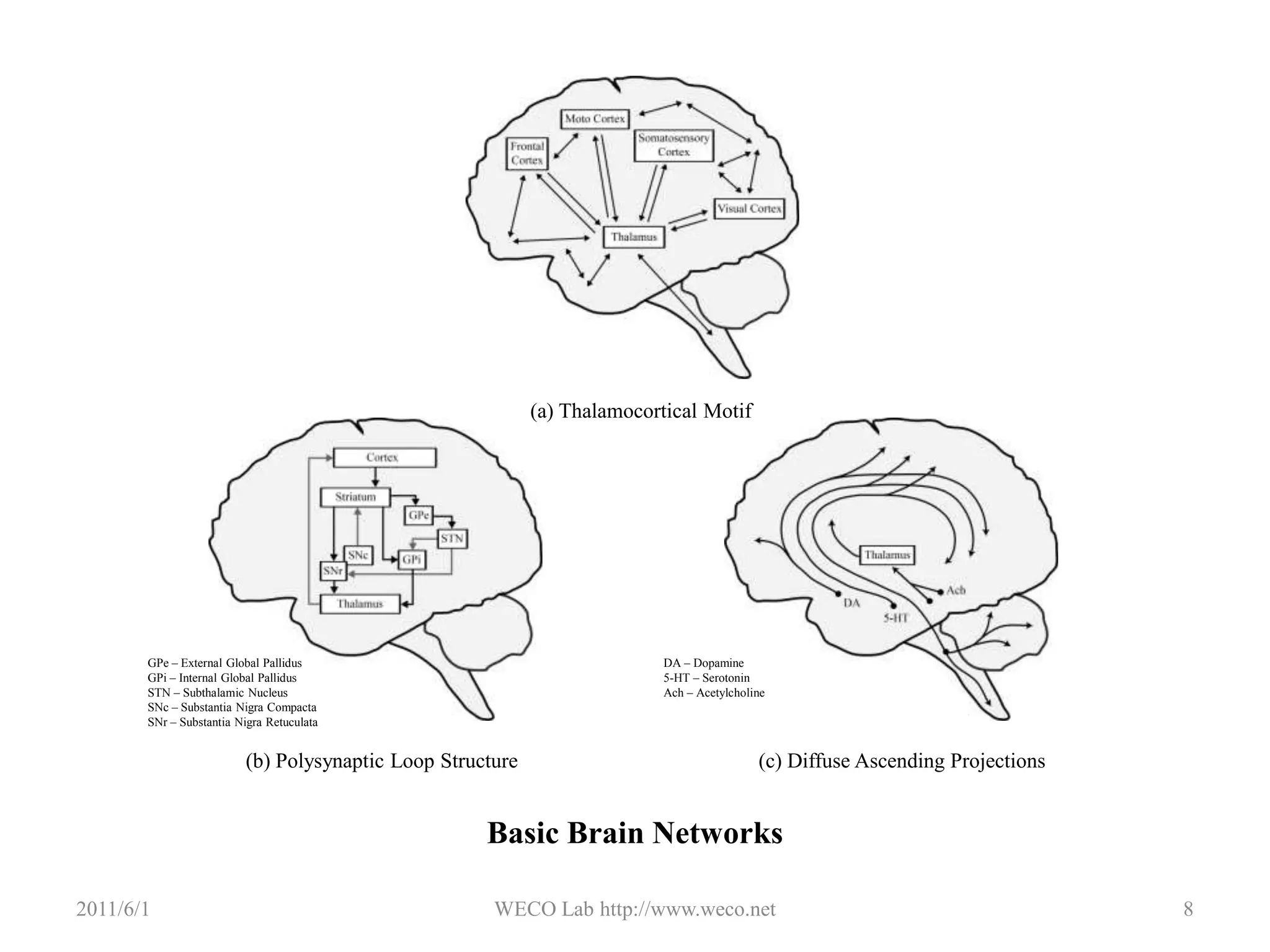
Diffuse Ascending Projections2011/5/30WECOLab http://www.weco.net8Basic Brain Networks(a) Thalamocortical MotifGPe – External Global PallidusGPi – Internal Global PallidusSTN – Subthalamic NucleusSNc – Substantia Nigra CompactaSNr – Substantia Nigra RetuculataDA – Dopamine5-HT – SerotoninAch – Acetylcholine(c) Diffuse Ascending Projections(b) Polysynaptic Loop Structure
16.
Background and RelatedWorkComplex Network AnalysisGraph theorytargets: real life networkincluding brain networksstructure-function mappingAlzheimer’s Diseasethe most common dementiaunknown causes, incurable, degenerative, and terminal diseasefour stages shows different patterns of impairments and symptoms on cognitive functionslasts a long period of time2011/5/30WECO Lab http://www.weco.net9modulesshortest pathcluster
17.
Background and RelatedWorkCurrent Status of Brain Simulator2011/5/30WECO Lab http://www.weco.net10
The Brain NetworkSimulatorDesign Concepts and ApproachesArchitectureComparison between brain networks and the InternetLayered architecture inspired by the InternetData StructureGraph Structure: node and edgeBrain ComponentsthalamushippocampusacetylcholineWorkflowDevelopment ApproachCase-based incremental delivery2011/5/30WECO Lab http://www.weco.net12
20.
The Brain NetworkSimulatorDesign Concepts and ApproachesArchitectureComparison between brain networks and the InternetLayered architecture inspired by the InternetData StructureGraph Structure: node and edgeBrain ComponentsthalamushippocampusacetylcholineWorkflowDevelopment ApproachCase-based incremental delivery2011/5/30WECO Lab http://www.weco.net13
The Brain NetworkSimulatorDesign Concepts and ApproachesArchitectureComparison between brain networks and the InternetLayered architecture inspired by the InternetData StructureGraph Structure: node and edgeBrain ComponentsthalamushippocampusacetylcholineWorkflowDevelopment ApproachCase-based incremental delivery2011/5/30WECO Lab http://www.weco.net16
24.
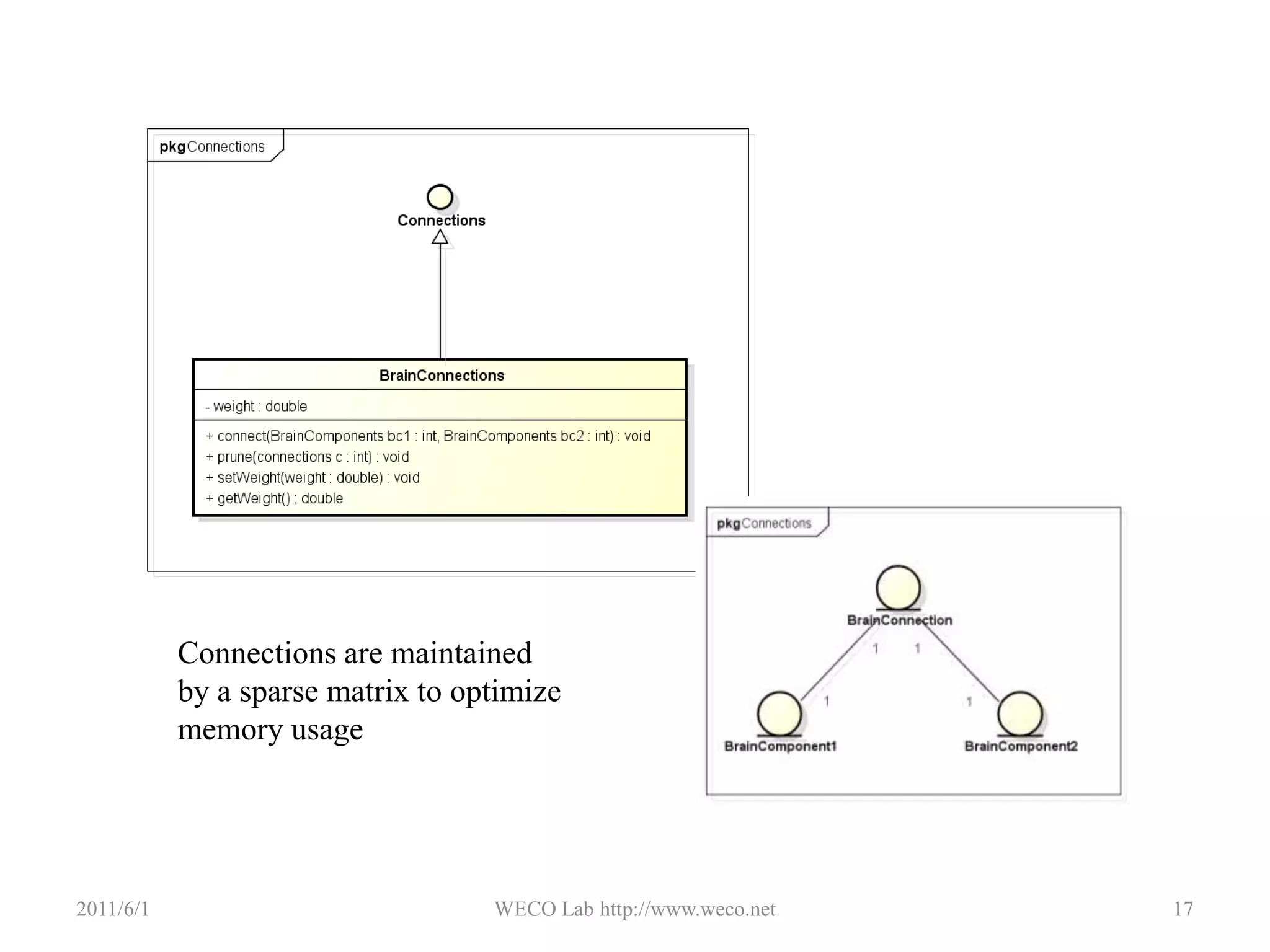
Connections are maintainedby a sparse matrix to optimize memory usage2011/5/30WECO Lab http://www.weco.net17
The Brain NetworkSimulatorDesign Concepts and ApproachesArchitectureComparison between brain networks and the InternetLayered architecture inspired by the InternetData StructureGraph Structure: node and edgeBrain ComponentsthalamushippocampusacetylcholineWorkflowDevelopment ApproachCase-based incremental delivery2011/5/30WECO Lab http://www.weco.net21
29.
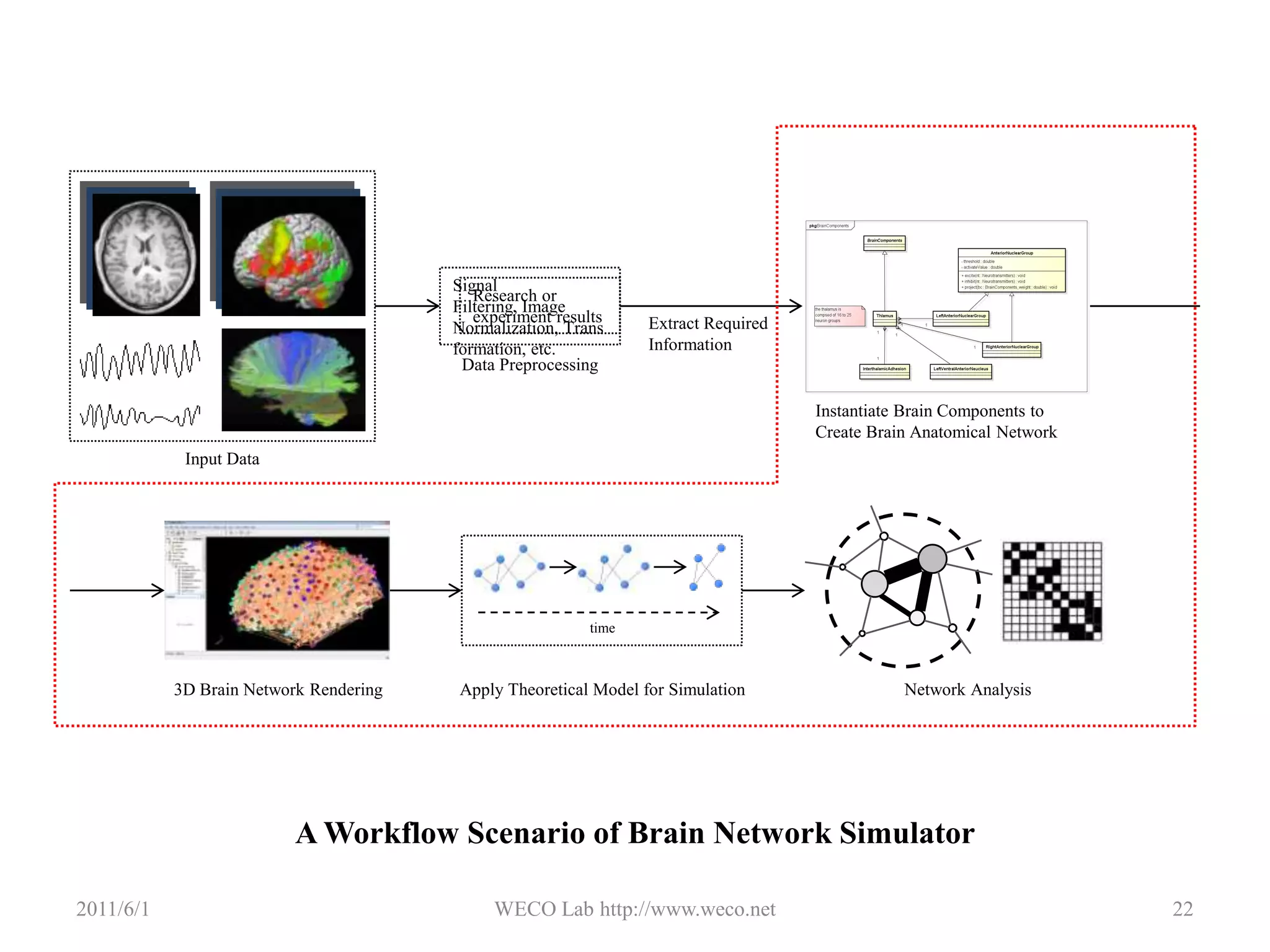
2011/5/30WECO Lab http://www.weco.net22AWorkflow Scenario of Brain Network SimulatorSignal Filtering, Image Normalization, Transformation, etc.Research or experiment resultsExtract Required InformationData PreprocessingInstantiate Brain Components to Create Brain Anatomical NetworkInput DatatimeApply Theoretical Model for SimulationNetwork Analysis3D Brain Network Rendering
30.
The Brain NetworkSimulatorDesign Concepts and ApproachesArchitectureComparison between brain networks and the InternetLayered architecture inspired by the InternetData StructureGraph Structure: node and edgeBrain ComponentsthalamushippocampusacetylcholineWorkflowDevelopment ApproachCase-based incremental delivery2011/5/30WECO Lab http://www.weco.net23
31.
2011/5/30WECO Lab http://www.weco.net24Case-basedIncremental DeliveryResearch or Experiment ResultsPersonalized Medical dataNew CasesCase Study and AnalysisExisting CasesLayered Architecture Extending and RefactoringCases IntegrationBrain Components Extending and RefactoringFeedbackBuild Theoretical ModelsModel PoolEvaluate Theoretical ModelsEvolved Brain Simulator
Spatiotemporal dynamics ofAlzheimer’s DiseaseThree different modelsNeuropathologicalstageing of Alzheimer-related changesDescribe global pattern of lesions caused by Alzheimer’s diseaseLesions: distribution of amyloid and neurofibrillary changesNetwork Damage ModelIntentional attack on the node with highest degreeObserved in the brain affected by Alzheimer’s diseaseFocus on fragments after attackTreatmentBased on cholingeric hypothesisNeeds to find out the cholingeric pathwaysA spatiotemporal model of Alzheimer’s DiseaseA combination of three with temporal parameter added in2011/5/30WECO Lab http://www.weco.net26
34.
SIMULATE-ALZHEIMER’S-DISEASE(time t, network$s)1 while time(t) < tend2 affectedRegions[] ← GLOBAL-PATTERN-OF-LESIONS(t)4 for each region r∈affectedRegions[]5 dotargetNodes[] ← CHOOSE-TARGET-NODES(t, r)6 for each node n∈targetNodes[]7 do compute the decreased number of neurons within n8 do update s9 for each edge e that connects to n10 do compute the decreased number of connections11 do re-compute the weight w of edge e12 do update s 2011/5/30WECO Lab http://www.weco.net27
35.
Spatiotemporal dynamics ofAlzheimer’s DiseaseThree different modelsNeuropathologicalstageing of Alzheimer-related changesDescribe global pattern of lesions caused by Alzheimer’s diseaseLesions: distribution of amyloid and neurofibrillary changesNetwork Damage ModelIntentional attack on the node with highest degreeObserved in the brain affected by Alzheimer’s diseaseFocus on fragments after attackTreatmentBased on cholingeric hypothesisNeeds to find out the cholingeric pathwaysA spatiotemporal model of Alzheimer’s DiseaseA combination of three with temporal parameter added in2011/5/30WECO Lab http://www.weco.net28
36.
Isocortical Areas(including thebelt fields and primary areas)Stage IIIIsocortex Association AreaStage IIBasal Portion of Occipital LobeBasal Portion of Frontal LobeStage IBasal Portion of Limbic LobeDistribution Pattern of Amyloid Deposits2011/5/30WECO Lab http://www.weco.net29
37.
IsorcortexStage V &VILimbic Area(involve the entorhinal and transentorhinal layer Pre-α)Stage III & IVTransentorhinal RegionStage I & IIDistribution Pattern of Neurofibrillary Tangles and Neuropil Threads2011/5/30WECO Lab http://www.weco.net30
38.
Spatiotemporal dynamics ofAlzheimer’s DiseaseThree different modelsNeuropathologicalstageing of Alzheimer-related changesDescribe global pattern of lesions caused by Alzheimer’s diseaseLesions: distribution of amyloid and neurofibrillary changesNetwork Damage ModelIntentional attack on the node with highest degreeObserved in the brain affected by Alzheimer’s diseaseFocus on fragments after attackTreatmentBased on cholingeric hypothesisNeeds to find out the cholingeric pathwaysA spatiotemporal model of Alzheimer’s DiseaseA combination of three with temporal parameter added in2011/5/30WECO Lab http://www.weco.net31
39.
Remove HubsHubA ClusterThreeClusterNetwork Damage Model2011/5/30WECO Lab http://www.weco.net32Where 𝑞𝑘 is the probability a node will be occupied,𝜃(𝑥) is the is the Heaviside step function,𝑘𝑚𝑎𝑥is the degree threshold,𝑘 is the degree of a node 𝑞𝑘=𝜃𝑘𝑚𝑎𝑥−𝑘=1 𝑖𝑓 𝑘≤𝑘𝑚𝑎𝑥0 𝑖𝑓 𝑘>𝑘𝑚𝑎𝑥 It has been applied to some studies of Alzheimer’s diseaseSpatiotemporal dynamics of Alzheimer’s DiseaseThree different modelsNeuropathologicalstageing of Alzheimer-related changesDescribe global pattern of lesions caused by Alzheimer’s diseaseLesions: distribution of amyloid and neurofibrillary changesNetwork Damage ModelIntentional attack on the node with highest degreeObserved in the brain affected by Alzheimer’s diseaseFocus on fragments after attackTreatmentBased on cholingeric hypothesisNeeds to find out the cholingeric pathwaysA spatiotemporal model of Alzheimer’s DiseaseA combination of three with temporal parameter added in2011/5/30WECO Lab http://www.weco.net33
Spatiotemporal dynamics ofAlzheimer’s DiseaseThree different modelsNeuropathologicalstageing of Alzheimer-related changesDescribe global pattern of lesions caused by Alzheimer’s diseaseLesions: distribution of amyloid and neurofibrillary changesNetwork Damage ModelIntentional attack on the node with highest degreeObserved in the brain affected by Alzheimer’s diseaseFocus on fragments after attackTreatmentBased on cholingeric hypothesisNeeds to find out the cholingeric pathwaysA spatiotemporal model of Alzheimer’s DiseaseA combination of three with temporal parameter added in2011/5/30WECO Lab http://www.weco.net36
2011/5/30WECO Lab http://www.weco.net38∀node 𝑖 in the network at time 𝑡, 𝜃𝑘𝑡𝑎𝑟𝑔𝑒𝑡−𝑘𝑖=1 𝑖𝑓 𝑘𝑖≤𝑘𝑡𝑎𝑟𝑔𝑒𝑡0 𝑖𝑓 𝑘𝑖>𝑘𝑡𝑎𝑟𝑔𝑒𝑡, 𝑙𝑒𝑡 𝑘𝑡𝑎𝑟𝑔𝑒𝑡=𝑓𝑡=𝑘𝑚𝑎𝑥−𝑡−𝑡0𝑝 Where 𝜽(𝒙) is the Heaviside step function, 𝒌𝒕𝒂𝒓𝒈𝒆𝒕represents a threshold of degree, 𝒌𝒎𝒂𝒙 is the maximum degree in a local region,𝒌𝒊is the degree of node 𝒊, 𝒕𝟎 is the start point of the simulation, 𝒑is a period of time that controls the duration of an attack
45.
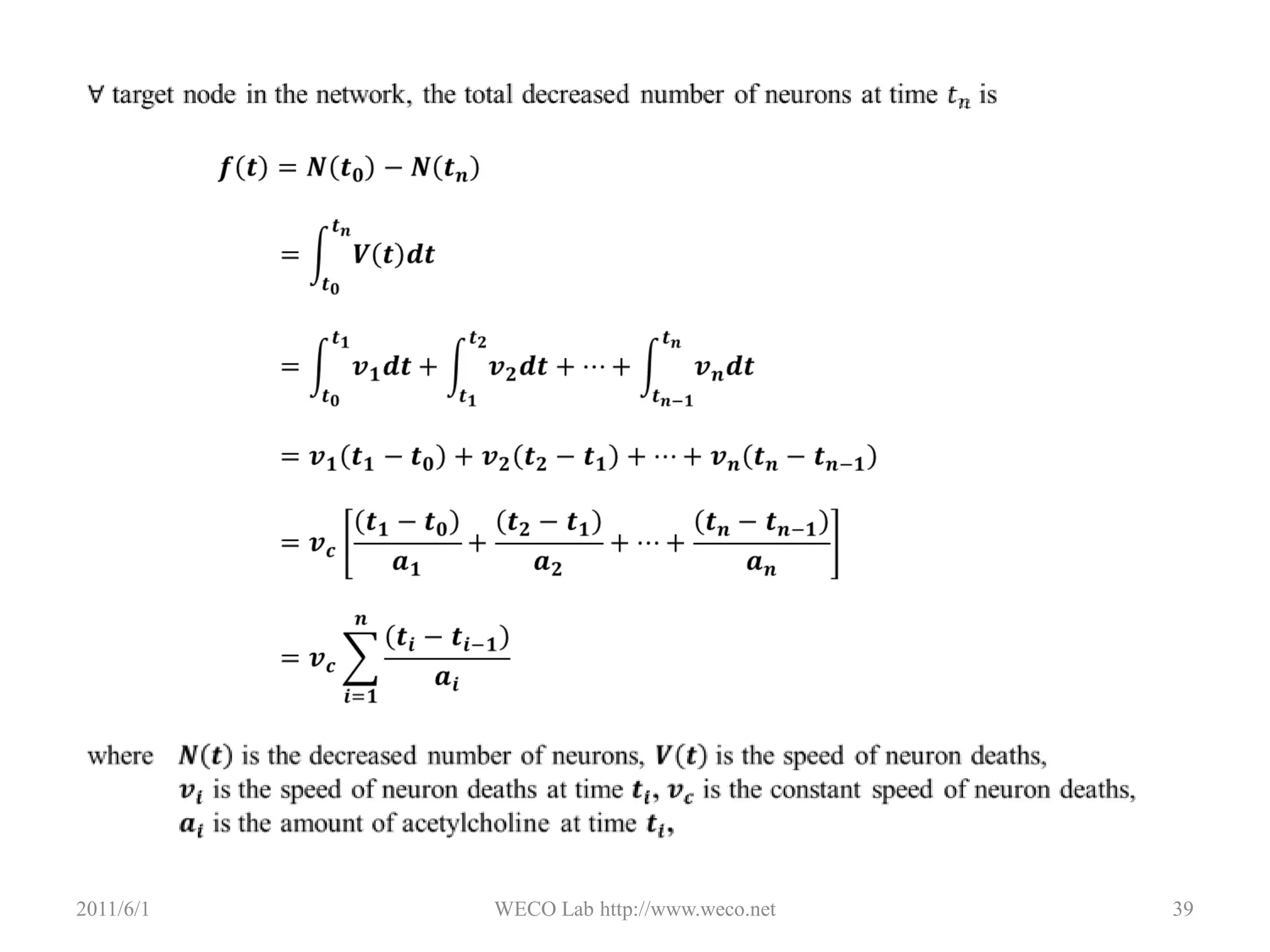
2011/5/30WECO Lab http://www.weco.net39∀target node in the network, the total decreased number of neurons at time 𝑡𝑛 is 𝒇𝒕=𝑵𝒕𝟎−𝑵𝒕𝒏 =𝒕𝟎𝒕𝒏𝑽𝒕𝒅𝒕 =𝒕𝟎𝒕𝟏𝒗𝟏𝒅𝒕+𝒕𝟏𝒕𝟐𝒗𝟐𝒅𝒕+⋯+𝒕𝒏−𝟏𝒕𝒏𝒗𝒏𝒅𝒕 =𝒗𝟏𝒕𝟏−𝒕𝟎+𝒗𝟐𝒕𝟐−𝒕𝟏+⋯+𝒗𝒏𝒕𝒏−𝒕𝒏−𝟏 =𝒗𝒄𝒕𝟏−𝒕𝟎𝒂𝟏+𝒕𝟐−𝒕𝟏𝒂𝟐+⋯+𝒕𝒏−𝒕𝒏−𝟏𝒂𝒏 =𝒗𝒄𝒊=𝟏𝒏𝒕𝒊−𝒕𝒊−𝟏𝒂𝒊 where𝑵𝒕is the decreased number of neurons,𝑽𝒕is the speed of neuron deaths,𝒗𝒊 is the speed of neuron deaths at time 𝒕𝒊,𝒗𝒄 is the constant speed of neuron deaths,𝒂𝒊 is the amount of acetylcholine at time 𝒕𝒊,
46.
2011/5/30WECO Lab http://www.weco.net40∀edge 𝒆in the network with source node 𝑺 and target node 𝑻, the weight of 𝒆 at time 𝒕𝒏is 𝑾𝒕𝒏=𝜷𝜶×𝑪(𝒕𝒏)𝟏𝟎𝟒×𝟏𝒍 where 𝜶,𝜷are coefficients to determine the ratio between 𝑪(𝒕𝒏)and 𝒍, notice that 𝟎<𝜶,𝜷<𝟏,𝑪(𝒕𝒏)is the number of connections that compose 𝒆 at time 𝒕𝒏,𝒍is the length of 𝒆 𝑪𝒕𝒏=𝑵𝑺𝒕𝒏×𝟏𝟎𝟒×𝒚𝒙+𝒚×𝑵𝑻(𝒕𝒏)𝒊=𝟎𝒚𝑵𝑻𝒊(𝒕𝒏) 𝒊𝒇 𝒏=𝟎𝑪𝒕𝒏−𝟏×𝟏−∆𝒏𝑺𝑵𝑺𝒕𝒏−𝟏 𝒊𝒇 ∆𝒏𝑺≥∆𝒏𝑻𝟏−∆𝒏𝑻𝑵𝑻𝒕𝒏−𝟏 𝒊𝒇 ∆𝒏𝑺<∆𝒏𝑻 𝒊𝒇 𝒏>𝟎 where 𝒙and 𝒚are the number of inlinks and outlinks respectively,∆𝒏𝑺and ∆𝒏𝑻are the decreased number of 𝑺and 𝑻respectively from𝒕𝒏−𝟏 to 𝒕𝒏
47.
2011/5/30WECO Lab http://www.weco.net41Stepsof Brain Network Simulation of Alzheimer’s DiseaseAssume that 𝜶,𝜷, 𝒍are all equal to 1, 𝒗𝒄 is 2 per unit time, and 𝒂 is a factor of 2, then the dynamics of weights are as follow: 5321.8751.1250.375ACh0.330.330.130.6250.3750.251.6610.333131110.330.330.11t = 0t = 1t = 2
ConclusionBrain simulation isthe trend in the future of brain science studiesTry to design a brain network simulatorLayered architecture inspired by network comparisonBrain componentsWorkflowDevelopment approachCase-based incremental deliveryA spatiotemporal model of Alzheimer’s diseaseA prototype of brain network simulator2011/5/30WECO Lab http://www.weco.net43
50.
Future WorkBrain networksimulator developmentBrain components refinementInput data and data preprocessingNetwork analysisDistributed computingEvolved brain network simulatorAdd more cases into the brain network simulatorEx: research result or experiment data of sleepUsageResearchDiagnosisPersonal healthcare2011/5/30WECO Lab http://www.weco.net44











![SIMULATE-ALZHEIMER’S-DISEASE(time t, network $s)1 while time(t) < tend2 affectedRegions[] ← GLOBAL-PATTERN-OF-LESIONS(t)4 for each region r∈affectedRegions[]5 dotargetNodes[] ← CHOOSE-TARGET-NODES(t, r)6 for each node n∈targetNodes[]7 do compute the decreased number of neurons within n8 do update s9 for each edge e that connects to n10 do compute the decreased number of connections11 do re-compute the weight w of edge e12 do update s 2011/5/30WECO Lab http://www.weco.net27](https://image.slidesharecdn.com/aprototypeofbrainnetworksimulatorforspatiotemporaldynamicsofalzheimersdisease-110601105854-phpapp01/75/A-Prototype-of-Brain-Network-Simulator-for-Spatiotemporal-Dynamics-of-Alzheimer-s-Disease-34-2048.jpg)




![Vibe Coding vs. Spec-Driven Development [Free Meetup]](https://cdn.slidesharecdn.com/ss_thumbnails/vibecodingvsspecdrivendevelopment-251209105622-43f455e7-thumbnail.jpg?width=640&height=640&fit=bounds)

