Department of Information Technology 1Soft Computing (ITC4256 )
Introduction to
Artificial neural network
Dr. C.V. Suresh Babu
Professor
Department of IT
Hindustan Institute of Science & Technology
Department of Information Technology 2Soft Computing (ITC4256 )
Discussion Topics
• Introduction
• Characteristics
• Learning methods
• Taxonomy
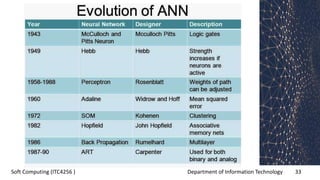
• Evolution of neural networks
• Basic models
• Important technologies
• Applications
Department of Information Technology 3Soft Computing (ITC4256 )
Action Plan
• Introduction to Artificial Neural Network (ANN)
- Introduction
- Biological Neuron Model
- Terminology
- Artificial Neural Network
- ANN Model
- Advantages of ANN
• Quiz at the end of session
3
Department of Information Technology 4Soft Computing (ITC4256 )
Action Plan
• Introduction to Artificial Neural Network (ANN)
- Introduction
- Biological Neuron Model
- Terminology
- Artificial Neural Network
- ANN Model
- Advantages of ANN
• Quiz at the end of session
Department of Information Technology 5Soft Computing (ITC4256 )
Introduction
• Artificial neural networks (ANNs) provide a practical
method for learning
– real-valued functions
– discrete-valued functions
– vector-valued functions
• Robust to errors in training data
• Successfully applied to such problems as
– interpreting visual scenes
– speech recognition
– learning robot control strategies
Department of Information Technology 6Soft Computing (ITC4256 )
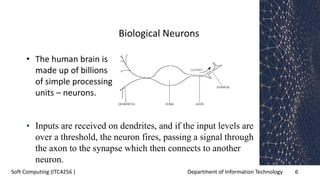
Biological Neurons
• The human brain is
made up of billions
of simple processing
units – neurons.
• Inputs are received on dendrites, and if the input levels are
over a threshold, the neuron fires, passing a signal through
the axon to the synapse which then connects to another
neuron.
Department of Information Technology 7Soft Computing (ITC4256 )
Neural Network Representation
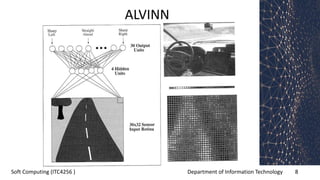
• ALVINN uses a learned ANN to steer an autonomous
vehicle driving at normal speeds on public highways
– Input to network: 30x32 grid of pixel intensities obtained
from a forward-pointed camera mounted on the vehicle
– Output: direction in which the vehicle is steered
– Trained to mimic observed steering commands of a
human driving the vehicle for approximately 5 minutes
Department of Information Technology 8Soft Computing (ITC4256 )
ALVINN
Department of Information Technology 9Soft Computing (ITC4256 )
Appropriate problems
• ANN learning well-suit to problems which the training data
corresponds to noisy, complex data (inputs from cameras or
microphones)
• Can also be used for problems with symbolic representations
• Most appropriate for problems where
– Instances have many attribute-value pairs
– Target function output may be discrete-valued, real-valued, or a vector of several
real- or discrete-valued attributes
– Training examples may contain errors
– Long training times are acceptable
– Fast evaluation of the learned target function may be required
– The ability for humans to understand the learned target function is not
important
Department of Information Technology 10Soft Computing (ITC4256 )
Terminology
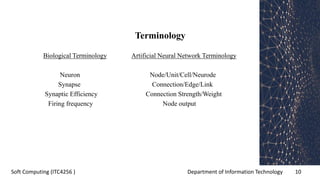
Biological Terminology Artificial Neural Network Terminology
Neuron Node/Unit/Cell/Neurode
Synapse Connection/Edge/Link
Synaptic Efficiency Connection Strength/Weight
Firing frequency Node output
Department of Information Technology 11Soft Computing (ITC4256 )
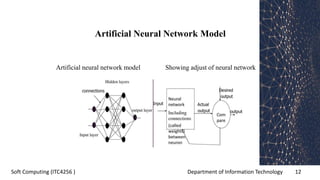
Artificial Neural Network
• Neural network resembles the human brain in the following two ways: -
* A neural network acquires knowledge through learning.
*A neural network’s knowledge is stored within the interconnection
strengths known as synaptic weight.
Department of Information Technology 12Soft Computing (ITC4256 )
Artificial Neural Network Model
Artificial neural network model Showing adjust of neural network
Department of Information Technology 13Soft Computing (ITC4256 )
Advantages of Artificial Neural Networks
• It involves human like thinking.
• They handle noisy or missing data.
• They can work with large number of variables or parameters.
• They provide general solutions with good predictive accuracy.
• System has got property of continuous learning.
• They deal with the non-linearity in the world in which we live.
Department of Information Technology 14Soft Computing (ITC4256 )
Quiz - Questions
1. Dendrites does the following
a) process inputs b) accepts inputs c) converts inputs to outputs d) none
2. Neural networks are based on simulated
a) neurons b) axons c) dendrites d) somas
3. ANN system has property of
a) definite learning b) digital learning c) continuous learning d) none
4. Synapse relates to
a) connection b) weight c) node d) node output
5. ------ are the electrochemical contact between the neurons.
a) synapses b) axon c) soma d) dendrites
Department of Information Technology 15Soft Computing (ITC4256 )
Quiz - Answers
1. Dendrites does the following
b) accepts inputs
2. Neural networks are based on simulated
a) neurons
3. ANN system has property of
c) continuous learning
4. Synapse relates to
a) connection
5. ------ are the electrochemical contact between the neurons.
a) synapses
Department of Information Technology 16Soft Computing (ITC4256 )
Action Plan
• Introduction to Artificial Neural Network (ANN)
- Characteristics
- Learning Process
- Learning Methods
- Supervised Learning
- Unsupervised Learning
- Reinforcement Learning
• Quiz at the end of session
Department of Information Technology 17Soft Computing (ITC4256 )
Characteristics
• Mathematical model
• Neurons
• Information are stored in neurons.
• Input signals
• Ability to learn
• Computational power is based on neurons.
Department of Information Technology 18Soft Computing (ITC4256 )
Learning Process
• Definition of learning adapted from Mendel and McClaren:
“Learning is a process by which the free parameters of a neural network are
adapted through a process of stimulation by the environment in which the
network is embedded. The type of learning is determined by the parameter
in which the changes take place.”
Department of Information Technology 19Soft Computing (ITC4256 )
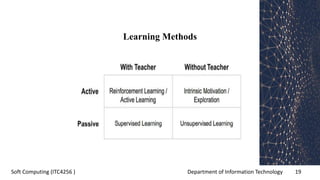
Learning Methods
Department of Information Technology 20Soft Computing (ITC4256 )
Learning Methods (Cont…)
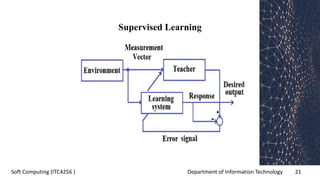
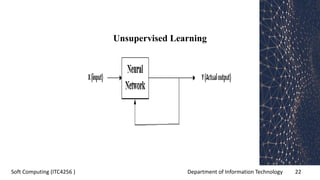
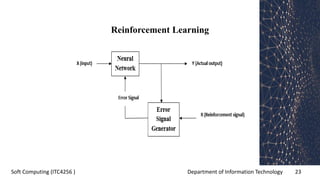
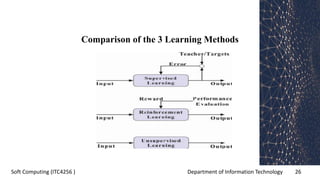
• There are three major learning methods:
1. Supervised learning
2. Unsupervised learning
3. Reinforcement learning
Department of Information Technology 21Soft Computing (ITC4256 )
Supervised Learning
Department of Information Technology 22Soft Computing (ITC4256 )
Unsupervised Learning
Department of Information Technology 23Soft Computing (ITC4256 )
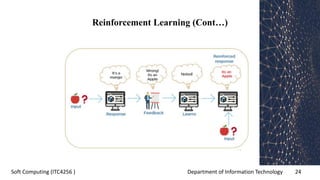
Reinforcement Learning
Department of Information Technology 24Soft Computing (ITC4256 )
Reinforcement Learning (Cont…)
Department of Information Technology 25Soft Computing (ITC4256 )
Types of Reinforcement Learning
• Positive reinforcement learning
• Negative reinforcement learning
Department of Information Technology 26Soft Computing (ITC4256 )
Comparison of the 3 Learning Methods
Department of Information Technology 27Soft Computing (ITC4256 )
Quiz - Questions
1. It is neurally implemented
a) mathematical model b) analytical model c) both a & b d) none
2. The neural network is stimulated by an
a) algorithm b) axon c) environment d) none
3. --------- learning can also be referred as classification
a) unsupervised b) reinforcement c) machine d) supervised
4. Learning process is independent in --------- learning.
a) unsupervised b) reinforcement c) machine d) supervised
5. ------ model is based on continuous learning.
a) unsupervised b) reinforcement c) machine d) supervised
Department of Information Technology 28Soft Computing (ITC4256 )
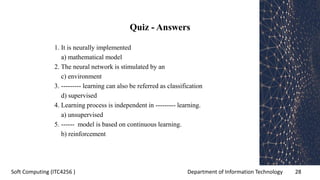
Quiz - Answers
1. It is neurally implemented
a) mathematical model
2. The neural network is stimulated by an
c) environment
3. --------- learning can also be referred as classification
d) supervised
4. Learning process is independent in --------- learning.
a) unsupervised
5. ------ model is based on continuous learning.
b) reinforcement
Department of Information Technology 29Soft Computing (ITC4256 )
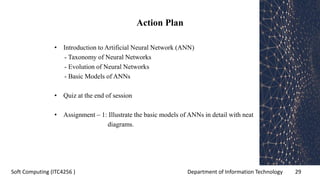
Action Plan
• Introduction to Artificial Neural Network (ANN)
- Taxonomy of Neural Networks
- Evolution of Neural Networks
- Basic Models of ANNs
• Quiz at the end of session
• Assignment – 1: Illustrate the basic models of ANNs in detail with neat
diagrams.
Department of Information Technology 30Soft Computing (ITC4256 )
Department of Information Technology 31Soft Computing (ITC4256 )
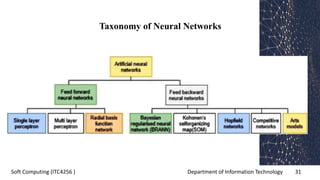
Taxonomy of Neural Networks
Department of Information Technology 32Soft Computing (ITC4256 )
Taxonomy of Neural Networks (Cont…)
• Adaptive Linear Element (ADALINE)
• Multiple ADALINEs (MADALINE)
• Perceptron
• Radial Basis Function Network
• Feed-forward
• Recurrent Neural Networks (RNNs)
Department of Information Technology 33Soft Computing (ITC4256 )
Department of Information Technology 34Soft Computing (ITC4256 )
Neural Networks – In the Past
• A team led by Ross King at the Manchester Institute of Biotechnology
created an artificial intelligence scientist named Eve.
• Such advanced specimens like Eve, advanced chatbots, and autonomous
cars, suggest that the vision for artificial neural networks is actually
shaping up!
Department of Information Technology 35Soft Computing (ITC4256 )
Neural Networks – In the Present
• One of the applications of artificial neural networks is chatbots.
• Some of the novel applications of neural networks include earthquake
prediction based on the existing seismograms and creating artworks based
on existing iconic paintings by Van Gogh, Picasso, and many more.
Department of Information Technology 36Soft Computing (ITC4256 )
Neural Networks – In the Future
• Governments and private organizations have realized the true potential of
the future of artificial neural networks.
• The future of artificial neural networks is going to unlock multiple
possibilities in various business sectors.
Department of Information Technology 37Soft Computing (ITC4256 )
Basic Models of Artificial Neural Networks
• Models are based on three entities
1. The model’s synaptic interconnections.
2. The training or learning rules adopted for updating and adjusting the
connection weights.
3. Their activation functions.
Department of Information Technology 38Soft Computing (ITC4256 )
Quiz - Questions
1. Radial basis function network is a --------- neural network.
a) feed backward b) feed forward c) feed outward d) feed inward
2. From which year evolution of neural networks started?
a) 1942 b) 1943 c) 1944 d) 1945
3. What is the name of the artificial intelligence specimen created by Ross King
and his team?
a) Sofia b) Eva c) Eve d) Evan
4. Chatbot is an application of --------.
a) Big data b) Data Science c) Blockchain d) Artificial neural network
5. Basic ANN models are not based on one of the following entities
a) activation functions b) connection weights c) synaptic interconnections
d) connection breakage
Department of Information Technology 39Soft Computing (ITC4256 )
Quiz - Answers
1. Radial basis function network is a --------- neural network.
b) feed forward
2. From which year evolution of neural networks started?
b) 1943
3. What is the name of the artificial intelligence specimen created by Ross King
and his team?
c) Eve
4. Chatbot is an application of --------.
d) Artificial neural network
5. Basic ANN models are not based on one of the following entities
d) connection breakage

Introduction to artificial neural network

  • 1.
    Department of InformationTechnology 1Soft Computing (ITC4256 ) Introduction to Artificial neural network Dr. C.V. Suresh Babu Professor Department of IT Hindustan Institute of Science & Technology
  • 2.
    Department of InformationTechnology 2Soft Computing (ITC4256 ) Discussion Topics • Introduction • Characteristics • Learning methods • Taxonomy • Evolution of neural networks • Basic models • Important technologies • Applications
  • 3.
    Department of InformationTechnology 3Soft Computing (ITC4256 ) Action Plan • Introduction to Artificial Neural Network (ANN) - Introduction - Biological Neuron Model - Terminology - Artificial Neural Network - ANN Model - Advantages of ANN • Quiz at the end of session 3
  • 4.
    Department of InformationTechnology 4Soft Computing (ITC4256 ) Action Plan • Introduction to Artificial Neural Network (ANN) - Introduction - Biological Neuron Model - Terminology - Artificial Neural Network - ANN Model - Advantages of ANN • Quiz at the end of session
  • 5.
    Department of InformationTechnology 5Soft Computing (ITC4256 ) Introduction • Artificial neural networks (ANNs) provide a practical method for learning – real-valued functions – discrete-valued functions – vector-valued functions • Robust to errors in training data • Successfully applied to such problems as – interpreting visual scenes – speech recognition – learning robot control strategies
  • 6.
    Department of InformationTechnology 6Soft Computing (ITC4256 ) Biological Neurons • The human brain is made up of billions of simple processing units – neurons. • Inputs are received on dendrites, and if the input levels are over a threshold, the neuron fires, passing a signal through the axon to the synapse which then connects to another neuron.
  • 7.
    Department of InformationTechnology 7Soft Computing (ITC4256 ) Neural Network Representation • ALVINN uses a learned ANN to steer an autonomous vehicle driving at normal speeds on public highways – Input to network: 30x32 grid of pixel intensities obtained from a forward-pointed camera mounted on the vehicle – Output: direction in which the vehicle is steered – Trained to mimic observed steering commands of a human driving the vehicle for approximately 5 minutes
  • 8.
    Department of InformationTechnology 8Soft Computing (ITC4256 ) ALVINN
  • 9.
    Department of InformationTechnology 9Soft Computing (ITC4256 ) Appropriate problems • ANN learning well-suit to problems which the training data corresponds to noisy, complex data (inputs from cameras or microphones) • Can also be used for problems with symbolic representations • Most appropriate for problems where – Instances have many attribute-value pairs – Target function output may be discrete-valued, real-valued, or a vector of several real- or discrete-valued attributes – Training examples may contain errors – Long training times are acceptable – Fast evaluation of the learned target function may be required – The ability for humans to understand the learned target function is not important
  • 10.
    Department of InformationTechnology 10Soft Computing (ITC4256 ) Terminology Biological Terminology Artificial Neural Network Terminology Neuron Node/Unit/Cell/Neurode Synapse Connection/Edge/Link Synaptic Efficiency Connection Strength/Weight Firing frequency Node output
  • 11.
    Department of InformationTechnology 11Soft Computing (ITC4256 ) Artificial Neural Network • Neural network resembles the human brain in the following two ways: - * A neural network acquires knowledge through learning. *A neural network’s knowledge is stored within the interconnection strengths known as synaptic weight.
  • 12.
    Department of InformationTechnology 12Soft Computing (ITC4256 ) Artificial Neural Network Model Artificial neural network model Showing adjust of neural network
  • 13.
    Department of InformationTechnology 13Soft Computing (ITC4256 ) Advantages of Artificial Neural Networks • It involves human like thinking. • They handle noisy or missing data. • They can work with large number of variables or parameters. • They provide general solutions with good predictive accuracy. • System has got property of continuous learning. • They deal with the non-linearity in the world in which we live.
  • 14.
    Department of InformationTechnology 14Soft Computing (ITC4256 ) Quiz - Questions 1. Dendrites does the following a) process inputs b) accepts inputs c) converts inputs to outputs d) none 2. Neural networks are based on simulated a) neurons b) axons c) dendrites d) somas 3. ANN system has property of a) definite learning b) digital learning c) continuous learning d) none 4. Synapse relates to a) connection b) weight c) node d) node output 5. ------ are the electrochemical contact between the neurons. a) synapses b) axon c) soma d) dendrites
  • 15.
    Department of InformationTechnology 15Soft Computing (ITC4256 ) Quiz - Answers 1. Dendrites does the following b) accepts inputs 2. Neural networks are based on simulated a) neurons 3. ANN system has property of c) continuous learning 4. Synapse relates to a) connection 5. ------ are the electrochemical contact between the neurons. a) synapses
  • 16.
    Department of InformationTechnology 16Soft Computing (ITC4256 ) Action Plan • Introduction to Artificial Neural Network (ANN) - Characteristics - Learning Process - Learning Methods - Supervised Learning - Unsupervised Learning - Reinforcement Learning • Quiz at the end of session
  • 17.
    Department of InformationTechnology 17Soft Computing (ITC4256 ) Characteristics • Mathematical model • Neurons • Information are stored in neurons. • Input signals • Ability to learn • Computational power is based on neurons.
  • 18.
    Department of InformationTechnology 18Soft Computing (ITC4256 ) Learning Process • Definition of learning adapted from Mendel and McClaren: “Learning is a process by which the free parameters of a neural network are adapted through a process of stimulation by the environment in which the network is embedded. The type of learning is determined by the parameter in which the changes take place.”
  • 19.
    Department of InformationTechnology 19Soft Computing (ITC4256 ) Learning Methods
  • 20.
    Department of InformationTechnology 20Soft Computing (ITC4256 ) Learning Methods (Cont…) • There are three major learning methods: 1. Supervised learning 2. Unsupervised learning 3. Reinforcement learning
  • 21.
    Department of InformationTechnology 21Soft Computing (ITC4256 ) Supervised Learning
  • 22.
    Department of InformationTechnology 22Soft Computing (ITC4256 ) Unsupervised Learning
  • 23.
    Department of InformationTechnology 23Soft Computing (ITC4256 ) Reinforcement Learning
  • 24.
    Department of InformationTechnology 24Soft Computing (ITC4256 ) Reinforcement Learning (Cont…)
  • 25.
    Department of InformationTechnology 25Soft Computing (ITC4256 ) Types of Reinforcement Learning • Positive reinforcement learning • Negative reinforcement learning
  • 26.
    Department of InformationTechnology 26Soft Computing (ITC4256 ) Comparison of the 3 Learning Methods
  • 27.
    Department of InformationTechnology 27Soft Computing (ITC4256 ) Quiz - Questions 1. It is neurally implemented a) mathematical model b) analytical model c) both a & b d) none 2. The neural network is stimulated by an a) algorithm b) axon c) environment d) none 3. --------- learning can also be referred as classification a) unsupervised b) reinforcement c) machine d) supervised 4. Learning process is independent in --------- learning. a) unsupervised b) reinforcement c) machine d) supervised 5. ------ model is based on continuous learning. a) unsupervised b) reinforcement c) machine d) supervised
  • 28.
    Department of InformationTechnology 28Soft Computing (ITC4256 ) Quiz - Answers 1. It is neurally implemented a) mathematical model 2. The neural network is stimulated by an c) environment 3. --------- learning can also be referred as classification d) supervised 4. Learning process is independent in --------- learning. a) unsupervised 5. ------ model is based on continuous learning. b) reinforcement
  • 29.
    Department of InformationTechnology 29Soft Computing (ITC4256 ) Action Plan • Introduction to Artificial Neural Network (ANN) - Taxonomy of Neural Networks - Evolution of Neural Networks - Basic Models of ANNs • Quiz at the end of session • Assignment – 1: Illustrate the basic models of ANNs in detail with neat diagrams.
  • 30.
    Department of InformationTechnology 30Soft Computing (ITC4256 )
  • 31.
    Department of InformationTechnology 31Soft Computing (ITC4256 ) Taxonomy of Neural Networks
  • 32.
    Department of InformationTechnology 32Soft Computing (ITC4256 ) Taxonomy of Neural Networks (Cont…) • Adaptive Linear Element (ADALINE) • Multiple ADALINEs (MADALINE) • Perceptron • Radial Basis Function Network • Feed-forward • Recurrent Neural Networks (RNNs)
  • 33.
    Department of InformationTechnology 33Soft Computing (ITC4256 )
  • 34.
    Department of InformationTechnology 34Soft Computing (ITC4256 ) Neural Networks – In the Past • A team led by Ross King at the Manchester Institute of Biotechnology created an artificial intelligence scientist named Eve. • Such advanced specimens like Eve, advanced chatbots, and autonomous cars, suggest that the vision for artificial neural networks is actually shaping up!
  • 35.
    Department of InformationTechnology 35Soft Computing (ITC4256 ) Neural Networks – In the Present • One of the applications of artificial neural networks is chatbots. • Some of the novel applications of neural networks include earthquake prediction based on the existing seismograms and creating artworks based on existing iconic paintings by Van Gogh, Picasso, and many more.
  • 36.
    Department of InformationTechnology 36Soft Computing (ITC4256 ) Neural Networks – In the Future • Governments and private organizations have realized the true potential of the future of artificial neural networks. • The future of artificial neural networks is going to unlock multiple possibilities in various business sectors.
  • 37.
    Department of InformationTechnology 37Soft Computing (ITC4256 ) Basic Models of Artificial Neural Networks • Models are based on three entities 1. The model’s synaptic interconnections. 2. The training or learning rules adopted for updating and adjusting the connection weights. 3. Their activation functions.
  • 38.
    Department of InformationTechnology 38Soft Computing (ITC4256 ) Quiz - Questions 1. Radial basis function network is a --------- neural network. a) feed backward b) feed forward c) feed outward d) feed inward 2. From which year evolution of neural networks started? a) 1942 b) 1943 c) 1944 d) 1945 3. What is the name of the artificial intelligence specimen created by Ross King and his team? a) Sofia b) Eva c) Eve d) Evan 4. Chatbot is an application of --------. a) Big data b) Data Science c) Blockchain d) Artificial neural network 5. Basic ANN models are not based on one of the following entities a) activation functions b) connection weights c) synaptic interconnections d) connection breakage
  • 39.
    Department of InformationTechnology 39Soft Computing (ITC4256 ) Quiz - Answers 1. Radial basis function network is a --------- neural network. b) feed forward 2. From which year evolution of neural networks started? b) 1943 3. What is the name of the artificial intelligence specimen created by Ross King and his team? c) Eve 4. Chatbot is an application of --------. d) Artificial neural network 5. Basic ANN models are not based on one of the following entities d) connection breakage