Contents
 Intoduction
 Artifcial Neural Network
 Biological Neuron Model
 Artificial Neuron Model
 Applications
 Advantages
 Disadvantages
Introduction
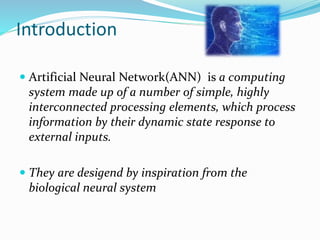
 Artificial Neural Network(ANN) is a computing
system made up of a number of simple, highly
interconnected processing elements, which process
information by their dynamic state response to
external inputs.
 They are desigend by inspiration from the
biological neural system
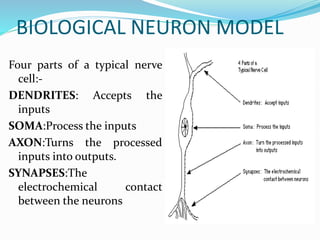
BIOLOGICAL NEURON MODEL
Four parts of a typical nerve
cell:-
DENDRITES: Accepts the
inputs
SOMA:Process the inputs
AXON:Turns the processed
inputs into outputs.
SYNAPSES:The
electrochemical contact
between the neurons
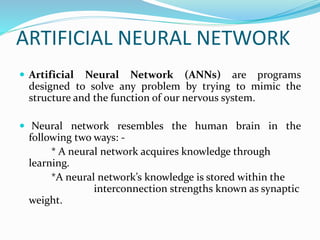
ARTIFICIAL NEURAL NETWORK
 Artificial Neural Network (ANNs) are programs
designed to solve any problem by trying to mimic the
structure and the function of our nervous system.
 Neural network resembles the human brain in the
following two ways: -
* A neural network acquires knowledge through
learning.
*A neural network’s knowledge is stored within the
interconnection strengths known as synaptic
weight.
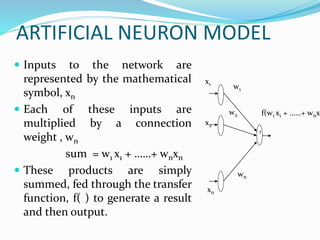
ARTIFICIAL NEURON MODEL
 Inputs to the network are
represented by the mathematical
symbol, xn
 Each of these inputs are
multiplied by a connection
weight , wn
sum = w1 x1 + ……+ wnxn
 These products are simply
summed, fed through the transfer
function, f( ) to generate a result
and then output.
f
w1
w2
xn
x2
x1
wn
f(w1 x1 + ……+ wnxn
Learning
 In artificial neural networks, learning refers to the method
of modifying the weights of connections between the
nodes of a specified network.
 The learning ability of a neural network is determined by
its architecture and by the algorithmic method chosen for
training.
 They are of two types.
 This is learning by doing.
 In this approach no sample
outputs are provided to the
network against which it
can measure its predictive
performance for a given
vector of inputs.
UNSUPERVISED LEARNING
• A teacher is available
• The training data consist of
pairs of input and desired
output values that are
traditionally represented in
data vectors.
SUPERVISED LEARNING
Applications
 Character Recognization
 Image Compression
 Stock Market Pridiction
 Medicine, Electronic Nose,
Security, and Loan
Applications
Advantages
 It involves human like thinking.
 They handle noisy or missing data.
 They can work with large number of variables or
parameters.
 They provide general solutions with good predictive
accuracy.
 System has got property of continuous learning.
Disadvantages
 Needs training to operate
 Architecture of NN is different from the architecture
of microprocessor.Therefore needs to be emulated
 Requires high processing time for large networks
Artificial Neural Network

Artificial Neural Network

  • 2.
    Contents  Intoduction  ArtifcialNeural Network  Biological Neuron Model  Artificial Neuron Model  Applications  Advantages  Disadvantages
  • 3.
    Introduction  Artificial NeuralNetwork(ANN) is a computing system made up of a number of simple, highly interconnected processing elements, which process information by their dynamic state response to external inputs.  They are desigend by inspiration from the biological neural system
  • 4.
    BIOLOGICAL NEURON MODEL Fourparts of a typical nerve cell:- DENDRITES: Accepts the inputs SOMA:Process the inputs AXON:Turns the processed inputs into outputs. SYNAPSES:The electrochemical contact between the neurons
  • 5.
    ARTIFICIAL NEURAL NETWORK Artificial Neural Network (ANNs) are programs designed to solve any problem by trying to mimic the structure and the function of our nervous system.  Neural network resembles the human brain in the following two ways: - * A neural network acquires knowledge through learning. *A neural network’s knowledge is stored within the interconnection strengths known as synaptic weight.
  • 6.
    ARTIFICIAL NEURON MODEL Inputs to the network are represented by the mathematical symbol, xn  Each of these inputs are multiplied by a connection weight , wn sum = w1 x1 + ……+ wnxn  These products are simply summed, fed through the transfer function, f( ) to generate a result and then output. f w1 w2 xn x2 x1 wn f(w1 x1 + ……+ wnxn
  • 7.
    Learning  In artificialneural networks, learning refers to the method of modifying the weights of connections between the nodes of a specified network.  The learning ability of a neural network is determined by its architecture and by the algorithmic method chosen for training.  They are of two types.
  • 8.
     This islearning by doing.  In this approach no sample outputs are provided to the network against which it can measure its predictive performance for a given vector of inputs. UNSUPERVISED LEARNING • A teacher is available • The training data consist of pairs of input and desired output values that are traditionally represented in data vectors. SUPERVISED LEARNING
  • 9.
    Applications  Character Recognization Image Compression  Stock Market Pridiction  Medicine, Electronic Nose, Security, and Loan Applications
  • 10.
    Advantages  It involveshuman like thinking.  They handle noisy or missing data.  They can work with large number of variables or parameters.  They provide general solutions with good predictive accuracy.  System has got property of continuous learning.
  • 11.
    Disadvantages  Needs trainingto operate  Architecture of NN is different from the architecture of microprocessor.Therefore needs to be emulated  Requires high processing time for large networks