



On the Development of a Brain Simulator


        Author: Wen-Hsien Tseng, Song-Yun Lu, Hsing Mei

            Web Computing Laboratory(WECO Lab)
    Computer Science and Information Engineering Department
                   Fu Jen Catholic University
Outline
    Introduction
    Background
    The proposed brain simulator
    Conclusion and future work


2011/6/1              ICCCI 2010    2
Introduction


2011/6/1       ICCCI 2010   3
Introduction
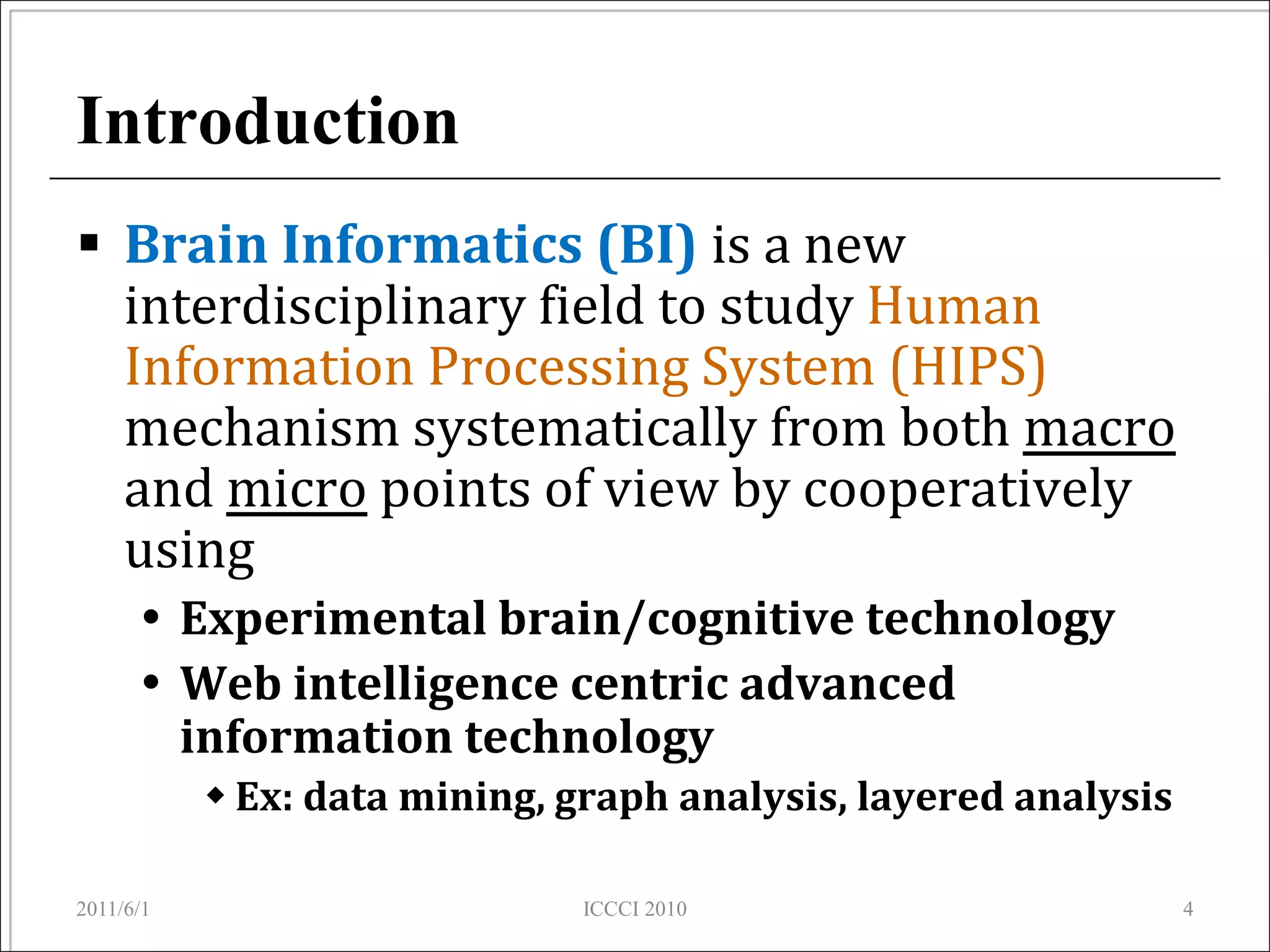
 Brain Informatics (BI) is a new
  interdisciplinary field to study Human
  Information Processing System (HIPS)
  mechanism systematically from both macro
  and micro points of view by cooperatively
  using
       Experimental brain/cognitive technology
       Web intelligence centric advanced
        information technology
            Ex: data mining, graph analysis, layered analysis

2011/6/1                      ICCCI 2010                         4
Introduction
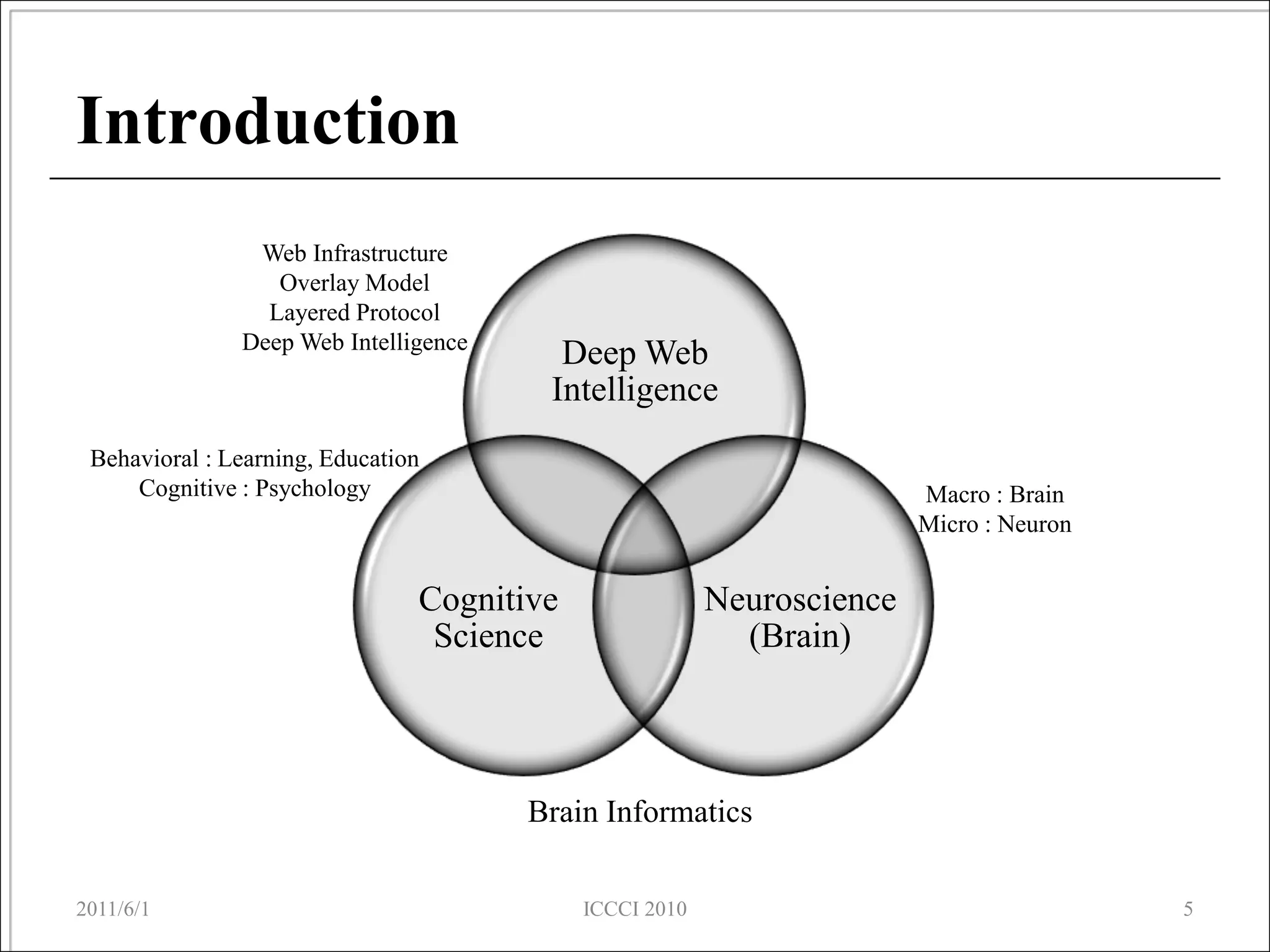
                Web Infrastructure
                  Overlay Model
                 Layered Protocol
               Deep Web Intelligence
                                         Deep Web
                                        Intelligence
 Behavioral : Learning, Education
     Cognitive : Psychology                                             Macro : Brain
                                                                        Micro : Neuron


                                Cognitive                Neuroscience
                                 Science                   (Brain)


                                       Brain Informatics

2011/6/1                                    ICCCI 2010                                   5
Introduction
 Brain simulator is a computer simulation in
  modeling brain structural dynamics and
  functionality
 Can be applied to the studies of brain
  related disease
       Ex: Alzheimer’s disease, sleep disorder,
        epilepsy, etc.
 It is a great steps toward better
  understanding of the human brain
2011/6/1                   ICCCI 2010              6
Background


2011/6/1      ICCCI 2010   7
Background
 Network analysis
       Brain networks are complex networks
       complex network analysis has been developed
        as an emerging research field
       It is based on the classical graph theory and
        mathematical models
       We applied network analysis to describe the
        brain networks


2011/6/1                  ICCCI 2010                    8
Background
 The human connectome project
       Aims to map the connectivity of the human
        brain.
 Brain networks
      Three basic brain networks:
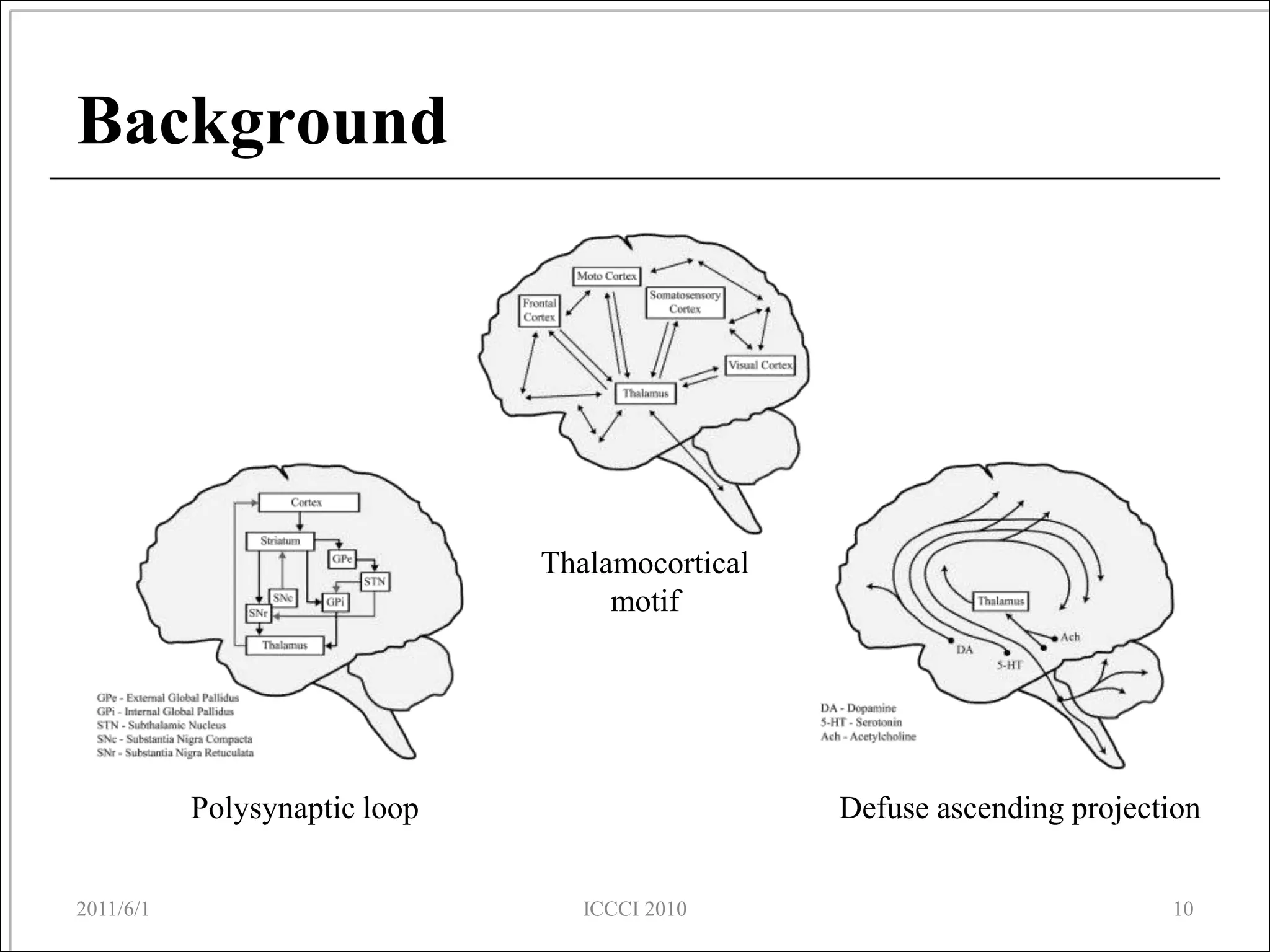
       Thalamocortical Motif
       Polysynaptic Loop Structure
       Diffuse Ascending Projection


2011/6/1                  ICCCI 2010                9
Background


                               Thalamocortical
                                    motif


           Polysynaptic loop                     Defuse ascending projection


2011/6/1                          ICCCI 2010                             10
Background
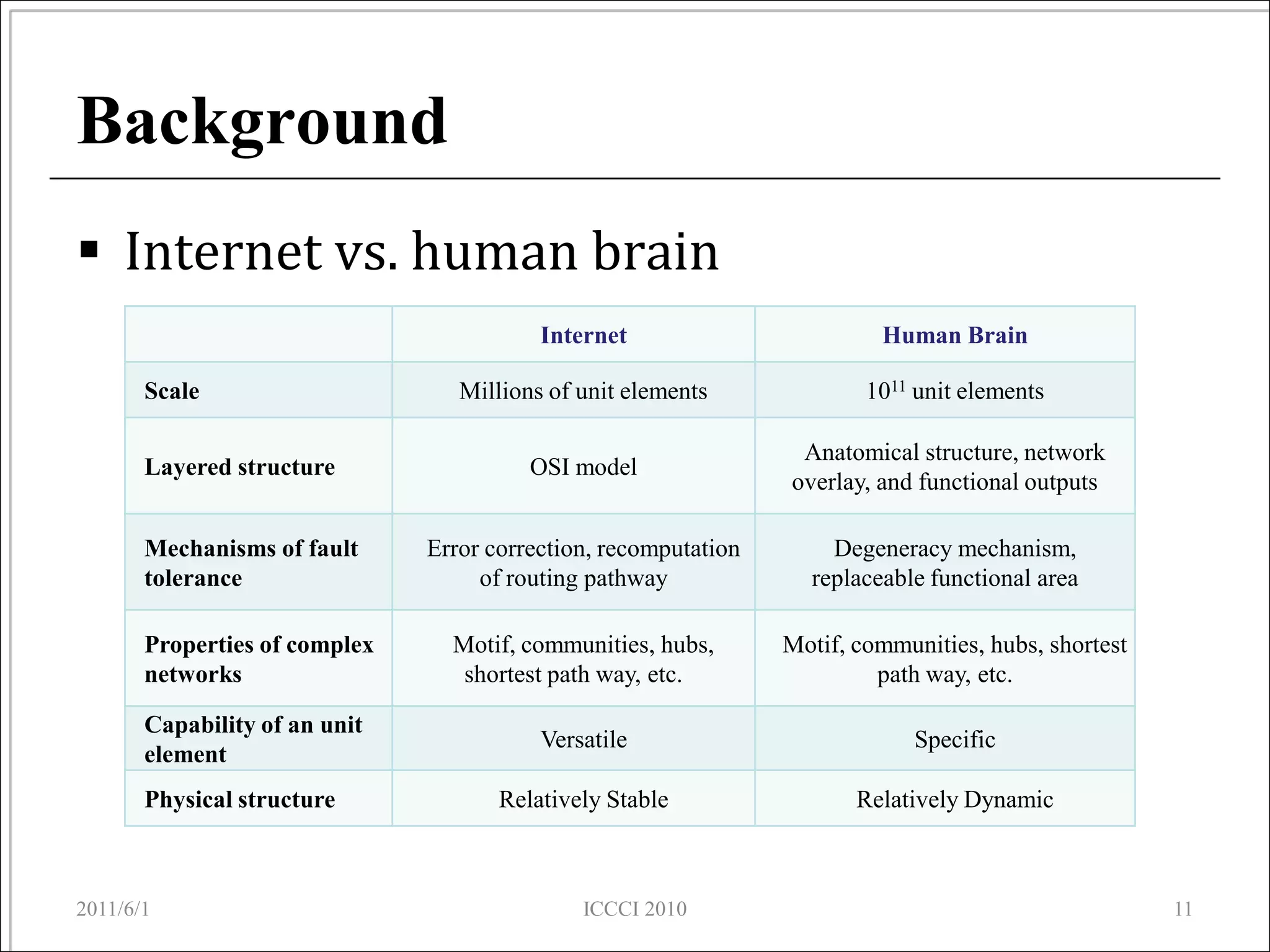
 Internet vs. human brain
                                          Internet                        Human Brain

       Scale                      Millions of unit elements              1011 unit elements

                                                                  Anatomical structure, network
       Layered structure                 OSI model
                                                                 overlay, and functional outputs

       Mechanisms of fault     Error correction, recomputation       Degeneracy mechanism,
       tolerance                    of routing pathway             replaceable functional area

       Properties of complex     Motif, communities, hubs,       Motif, communities, hubs, shortest
       networks                   shortest path way, etc.                 path way, etc.

       Capability of an unit
                                          Versatile                           Specific
       element
       Physical structure             Relatively Stable                 Relatively Dynamic


2011/6/1                                      ICCCI 2010                                              11
Background
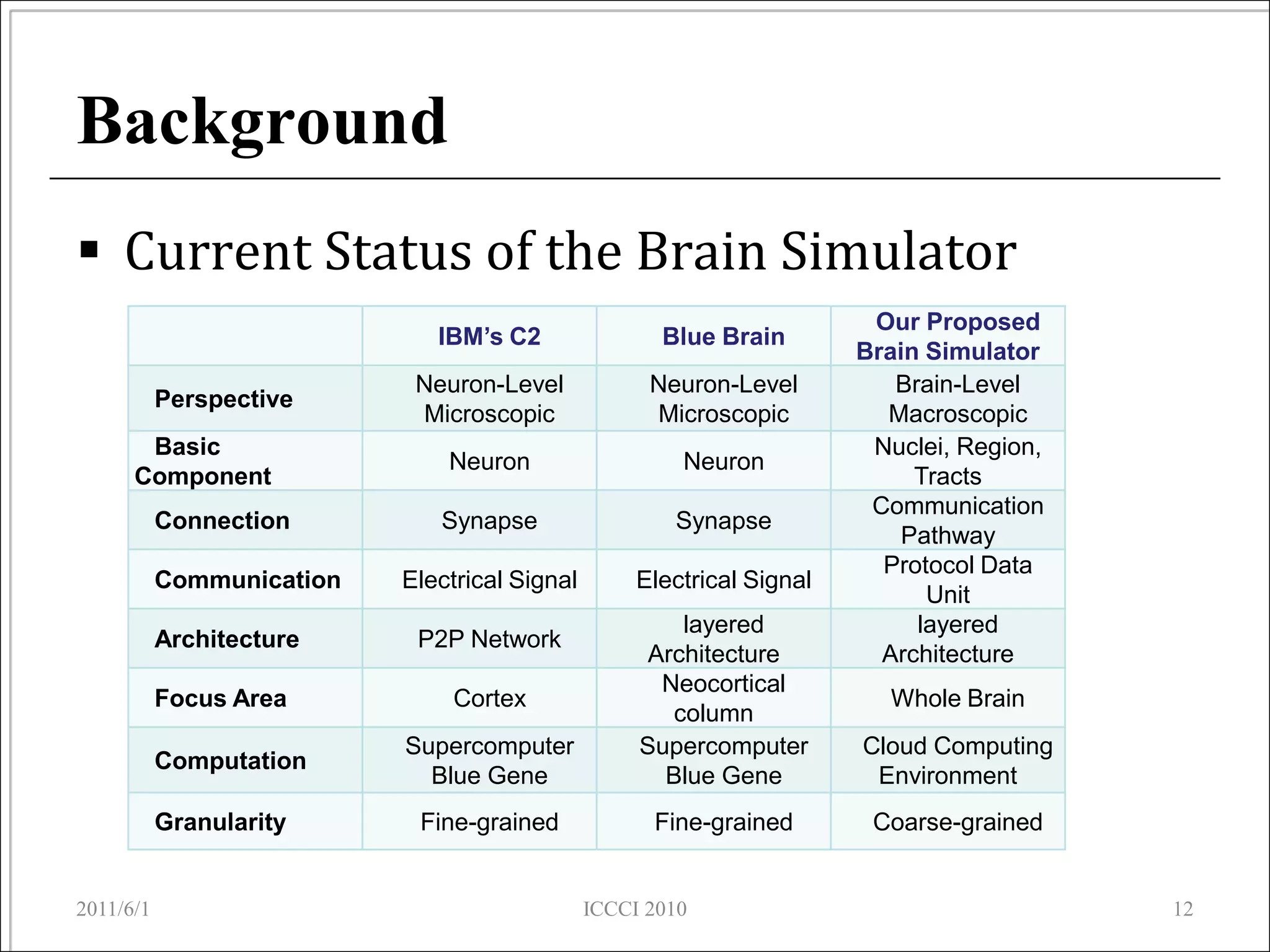
 Current Status of the Brain Simulator
                                                                         Our Proposed
                              IBM’s C2                Blue Brain
                                                                        Brain Simulator
                            Neuron-Level             Neuron-Level          Brain-Level
           Perspective
                            Microscopic              Microscopic          Macroscopic
       Basic                                                             Nuclei, Region,
                               Neuron                   Neuron
      Component                                                              Tracts
                                                                         Communication
           Connection         Synapse                  Synapse
                                                                            Pathway
                                                                          Protocol Data
           Communication   Electrical Signal        Electrical Signal
                                                                              Unit
                                                        layered              layered
           Architecture     P2P Network
                                                     Architecture         Architecture
                                                      Neocortical
           Focus Area          Cortex                                     Whole Brain
                                                       column
                           Supercomputer            Supercomputer       Cloud Computing
           Computation
                             Blue Gene                Blue Gene          Environment
           Granularity      Fine-grained             Fine-grained        Coarse-grained


2011/6/1                                       ICCCI 2010                                  12
The Proposed Brain Simulator


2011/6/1        ICCCI 2010         13
The Proposed Brain Simulator
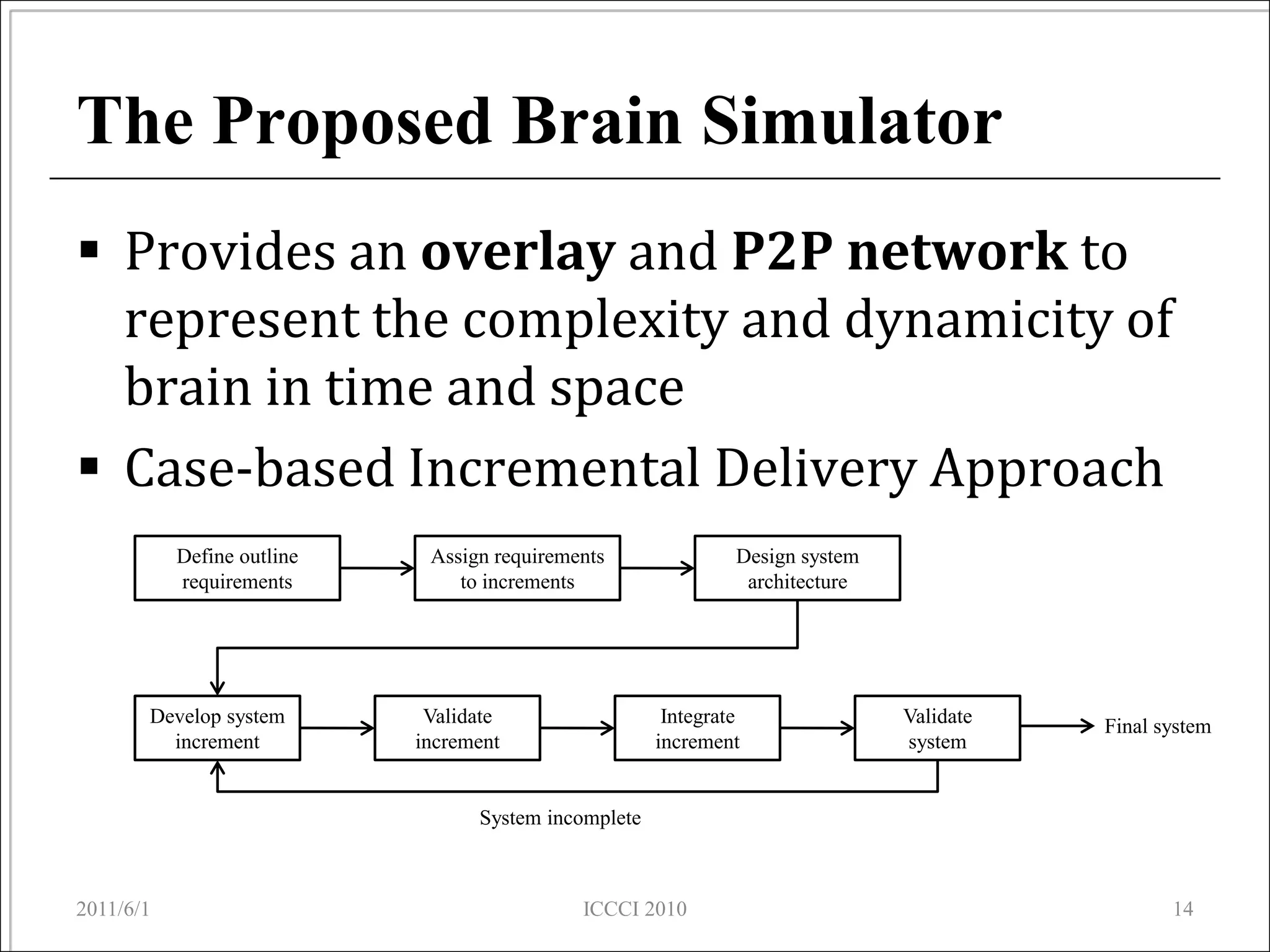
 Provides an overlay and P2P network to
  represent the complexity and dynamicity of
  brain in time and space
 Case-based Incremental Delivery Approach
           Define outline    Assign requirements               Design system
           requirements         to increments                   architecture


       Develop system        Validate                  Integrate               Validate   Final system
         increment          increment                 increment                system


                                  System incomplete


2011/6/1                                     ICCCI 2010                                          14
The Proposed Brain Simulator
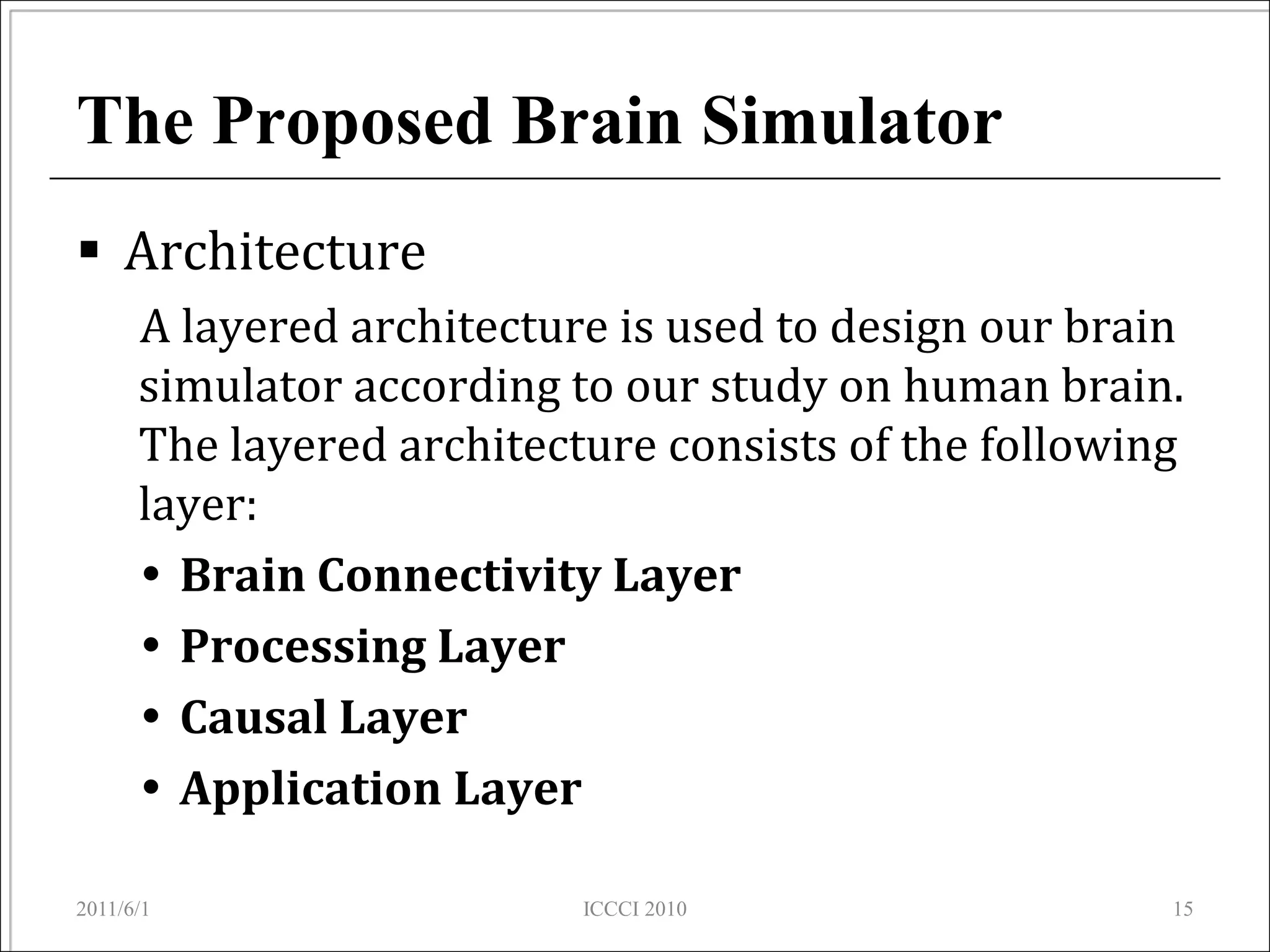
 Architecture
      A layered architecture is used to design our brain
      simulator according to our study on human brain.
      The layered architecture consists of the following
      layer:
       Brain Connectivity Layer
       Processing Layer
       Causal Layer
       Application Layer

2011/6/1                   ICCCI 2010                  15
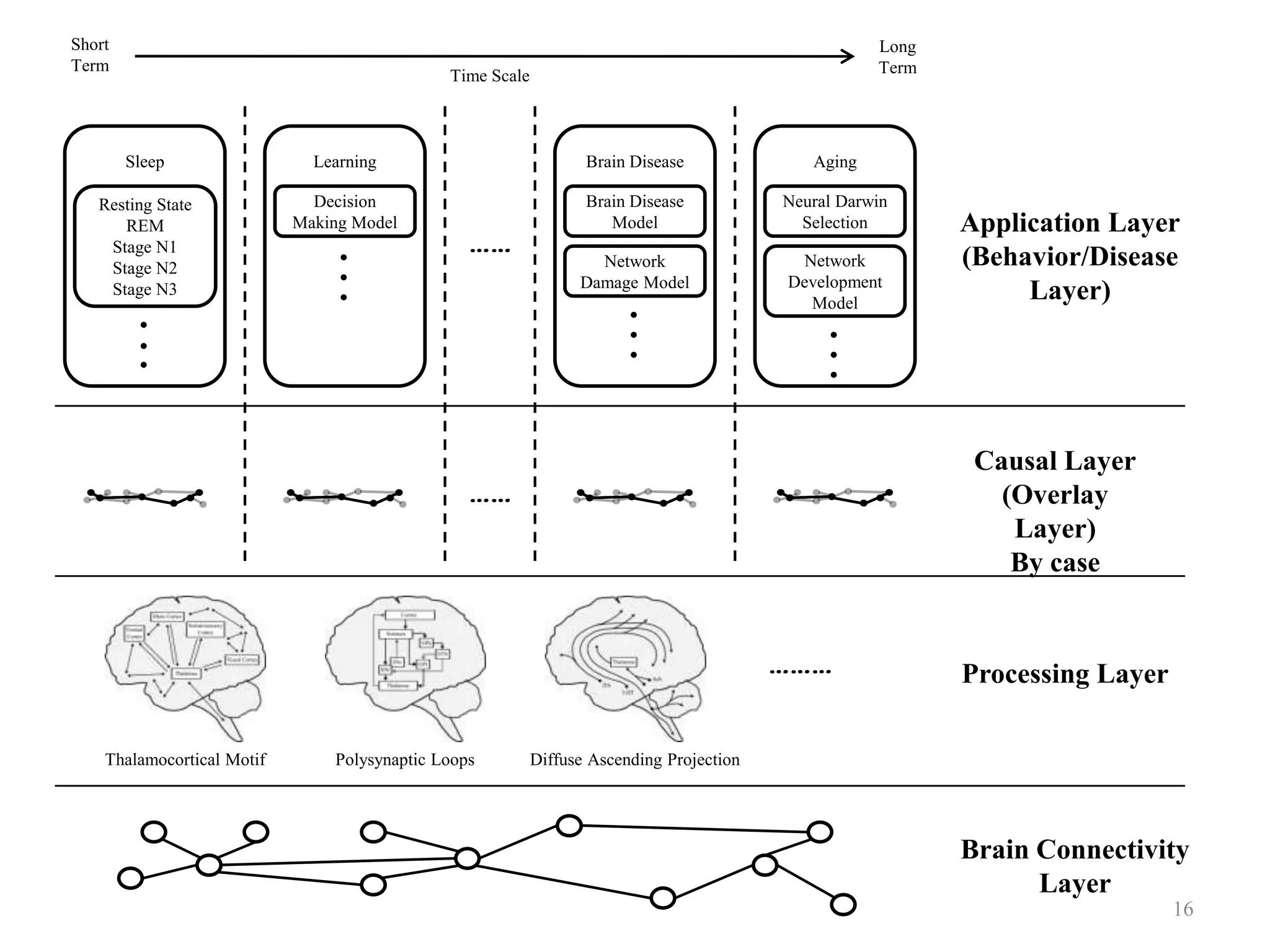
Short                                                                                                Long
Term                                                                                                 Term
                                              Time Scale


        Sleep                 Learning                            Brain Disease              Aging

   Resting State              Decision                            Brain Disease           Neural Darwin
                            Making Model                             Model                  Selection       Application Layer
                                                 ……
      REM
    Stage N1
    Stage N2                                                       Network                 Network          (Behavior/Disease
                                                                 Damage Model             Development
    Stage N3
                                                                                            Model
                                                                                                                 Layer)


                                                                                                             Causal Layer
                                                 ……                                                            (Overlay
                                                                                                                Layer)
                                                                                                                By case


                                                                                          ………               Processing Layer

    Thalamocortical Motif       Polysynaptic Loops         Diffuse Ascending Projection


                                                                                                            Brain Connectivity
                                                                                                                  Layer
                                                                                                                               16
Conclusion and Future Work


2011/6/1          ICCCI 2010        17
Conclusion and Future Work
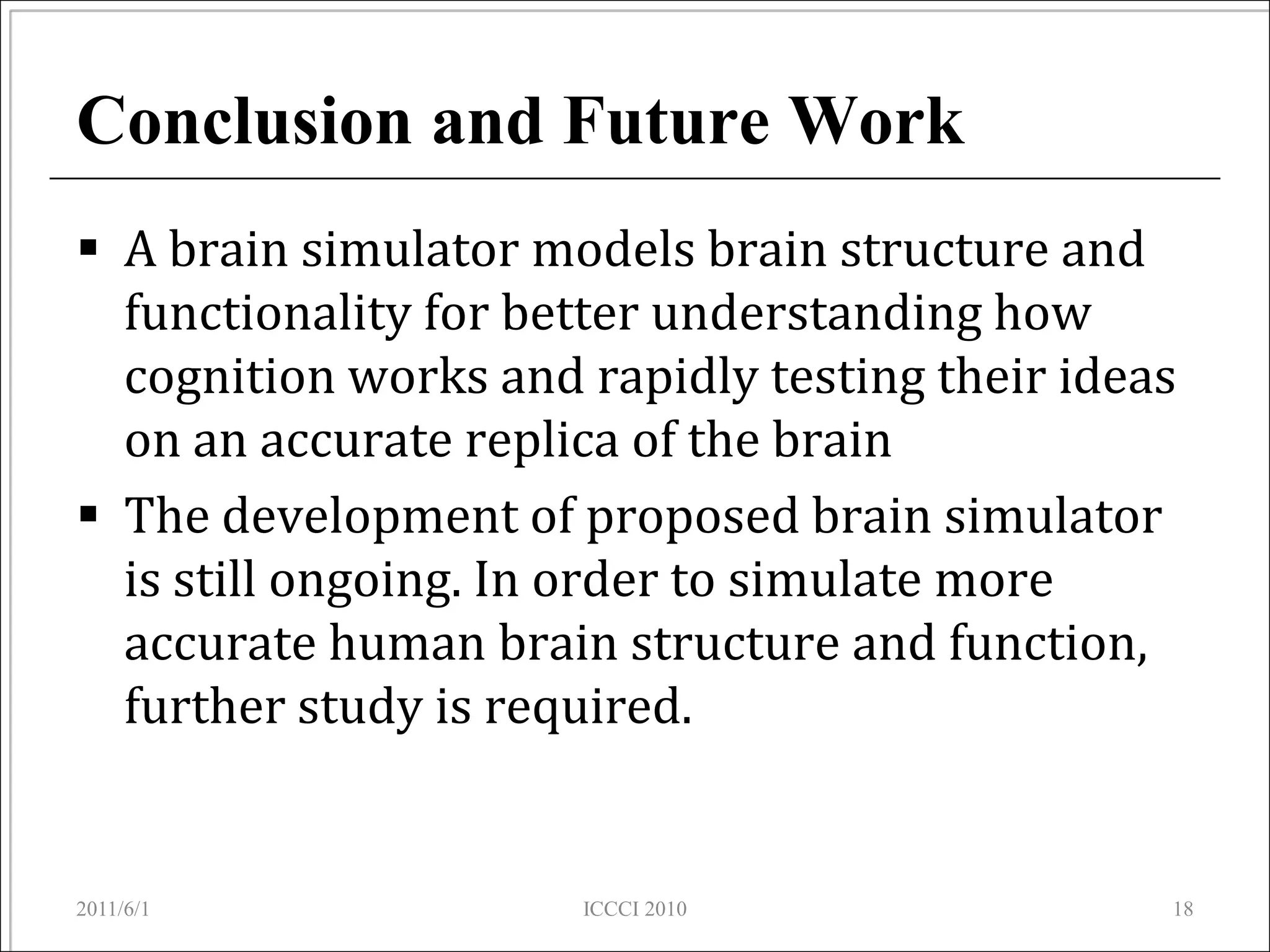
 A brain simulator models brain structure and
  functionality for better understanding how
  cognition works and rapidly testing their ideas
  on an accurate replica of the brain
 The development of proposed brain simulator
  is still ongoing. In order to simulate more
  accurate human brain structure and function,
  further study is required.


2011/6/1              ICCCI 2010                18
Reference
1.     Zhong, N., Li, K., Lu, S.; Chen, L. (Eds.): Brain Informatics. Springer (2010)
2.     Sendhoff, B., Körner, E., Sporns, O., Ritter, H., Doya, K. (Eds.): Creating Brain-
       Like Intelligence: From Basic Principles to Complex Intelligent Systems.
       Springer (2009)
3.     Catani, M., Ffytche, D. H.: The Rises and Falls of Disconnection Syndromes. J.
       Brain. 128, 2224--2239 (2005)
4.     Catani, M., Ffytche, D. H.: Graph Theoretical Analysis of
       Magnetoencephalographic Functional Connectivity in Alzheimer’s Disease. J.
       Brain. 132, 213--224 (2009)
5.     Deuschl, G. et al.: Deep-Brain Stimulation for Parkinson's Disease. J.
       Neurology. 249, 36--39 (2002)
6.     Tononi,G., Edelman, G. M., Sporns, O.: Complexity and Coherency: Integrating
       Information in the Brain. J. Trends in Cognitive Science. 2, 474--484 (1998)
7.     Strogatz, S. H.: Exploring complex network. J. Nature. 410, 268--276 (2001)


2011/6/1                                 ICCCI 2010                                     19
Reference
8. Bullmore, E., Sporns, O.: Complex Brain Networks: Graph Theoretical Analysis
    of Structural and Functional Systems. J. Nat. Rev. Neurosci. 10, 186--198
    (2009)
9. Sporns, O., Chialvo, D. R., Kaiser, M., Hilgetag, C. C.: Organization, Development
    and Function of Complex Brain Networks. J. Trends in Cognitive Science. 8,
    418--425 (2004)
10. Mikail Rubinov, Olaf Sporns, “Complex network measures of brain
    connectivity: uses and interpretations”, NeuroImage (2009)
11. NIH Launches the Human Connectome Project to Unravel the Brain
    Connections, http://www.nih.gov/news/health/jul2009/ninds-15.htm
12. Human Connectome Project, http://www.humanconnectomeproject.org/
13. Sporns, O., Tononi, G., Kotter, R.: The Human Connectome: A Structural
    Description of the Human Brain. J. PLoS Comput. Biol. 1(4), e42 (2005)
14. Edelman, G. M.: Wider than the Sky: The Phenomenal Gift of Consciousness.
    Yale University Press (2004)

2011/6/1                               ICCCI 2010                                   20
Reference
15. Thalamocortical Radiations,
    http://en.wikipedia.org/wiki/Thalamocortical_radiations
16. Basal Ganglia, http://en.wikipedia.org/wiki/Basal_ganglia
17. Neurotransmitter, http://en.wikipedia.org/wiki/Neurotransmitter
18. IBM Unveils a New Brain Simulator,
    http://spectrum.ieee.org/computing/hardware/ibm-unveils-a-new-brain-
    simulator
19. Blue Brain Project, http://bluebrain.epfl.ch/
20. Markram, H.: The Blue Brain Project. J. Nat. Rev. Neurosci. 7, 153--160 (2006)
21. King, J. G. et al.: A Component-based Extension Framework for Large-scale
    Parallel Simulations in NEURON. J. Frontiers in Neuroinformatics. 3, (2009)


2011/6/1                             ICCCI 2010                                      21
Thanks for Your Attention!

                     Q&A


2011/6/1              ICCCI 2010        22

On the Development of a Brain Simulator

  • 1.
    On the Developmentof a Brain Simulator Author: Wen-Hsien Tseng, Song-Yun Lu, Hsing Mei Web Computing Laboratory(WECO Lab) Computer Science and Information Engineering Department Fu Jen Catholic University
  • 2.
    Outline  Introduction  Background  The proposed brain simulator  Conclusion and future work 2011/6/1 ICCCI 2010 2
  • 3.
  • 4.
    Introduction  Brain Informatics(BI) is a new interdisciplinary field to study Human Information Processing System (HIPS) mechanism systematically from both macro and micro points of view by cooperatively using  Experimental brain/cognitive technology  Web intelligence centric advanced information technology  Ex: data mining, graph analysis, layered analysis 2011/6/1 ICCCI 2010 4
  • 5.
    Introduction Web Infrastructure Overlay Model Layered Protocol Deep Web Intelligence Deep Web Intelligence Behavioral : Learning, Education Cognitive : Psychology Macro : Brain Micro : Neuron Cognitive Neuroscience Science (Brain) Brain Informatics 2011/6/1 ICCCI 2010 5
  • 6.
    Introduction  Brain simulatoris a computer simulation in modeling brain structural dynamics and functionality  Can be applied to the studies of brain related disease  Ex: Alzheimer’s disease, sleep disorder, epilepsy, etc.  It is a great steps toward better understanding of the human brain 2011/6/1 ICCCI 2010 6
  • 7.
  • 8.
    Background  Network analysis  Brain networks are complex networks  complex network analysis has been developed as an emerging research field  It is based on the classical graph theory and mathematical models  We applied network analysis to describe the brain networks 2011/6/1 ICCCI 2010 8
  • 9.
    Background  The humanconnectome project  Aims to map the connectivity of the human brain.  Brain networks Three basic brain networks:  Thalamocortical Motif  Polysynaptic Loop Structure  Diffuse Ascending Projection 2011/6/1 ICCCI 2010 9
  • 10.
    Background Thalamocortical motif Polysynaptic loop Defuse ascending projection 2011/6/1 ICCCI 2010 10
  • 11.
    Background  Internet vs.human brain Internet Human Brain Scale Millions of unit elements 1011 unit elements Anatomical structure, network Layered structure OSI model overlay, and functional outputs Mechanisms of fault Error correction, recomputation Degeneracy mechanism, tolerance of routing pathway replaceable functional area Properties of complex Motif, communities, hubs, Motif, communities, hubs, shortest networks shortest path way, etc. path way, etc. Capability of an unit Versatile Specific element Physical structure Relatively Stable Relatively Dynamic 2011/6/1 ICCCI 2010 11
  • 12.
    Background  Current Statusof the Brain Simulator Our Proposed IBM’s C2 Blue Brain Brain Simulator Neuron-Level Neuron-Level Brain-Level Perspective Microscopic Microscopic Macroscopic Basic Nuclei, Region, Neuron Neuron Component Tracts Communication Connection Synapse Synapse Pathway Protocol Data Communication Electrical Signal Electrical Signal Unit layered layered Architecture P2P Network Architecture Architecture Neocortical Focus Area Cortex Whole Brain column Supercomputer Supercomputer Cloud Computing Computation Blue Gene Blue Gene Environment Granularity Fine-grained Fine-grained Coarse-grained 2011/6/1 ICCCI 2010 12
  • 13.
    The Proposed BrainSimulator 2011/6/1 ICCCI 2010 13
  • 14.
    The Proposed BrainSimulator  Provides an overlay and P2P network to represent the complexity and dynamicity of brain in time and space  Case-based Incremental Delivery Approach Define outline Assign requirements Design system requirements to increments architecture Develop system Validate Integrate Validate Final system increment increment increment system System incomplete 2011/6/1 ICCCI 2010 14
  • 15.
    The Proposed BrainSimulator  Architecture A layered architecture is used to design our brain simulator according to our study on human brain. The layered architecture consists of the following layer:  Brain Connectivity Layer  Processing Layer  Causal Layer  Application Layer 2011/6/1 ICCCI 2010 15
  • 16.
    Short Long Term Term Time Scale Sleep Learning Brain Disease Aging Resting State Decision Brain Disease Neural Darwin Making Model Model Selection Application Layer …… REM Stage N1 Stage N2 Network Network (Behavior/Disease Damage Model Development Stage N3 Model Layer) Causal Layer …… (Overlay Layer) By case ……… Processing Layer Thalamocortical Motif Polysynaptic Loops Diffuse Ascending Projection Brain Connectivity Layer 16
  • 17.
    Conclusion and FutureWork 2011/6/1 ICCCI 2010 17
  • 18.
    Conclusion and FutureWork  A brain simulator models brain structure and functionality for better understanding how cognition works and rapidly testing their ideas on an accurate replica of the brain  The development of proposed brain simulator is still ongoing. In order to simulate more accurate human brain structure and function, further study is required. 2011/6/1 ICCCI 2010 18
  • 19.
    Reference 1. Zhong, N., Li, K., Lu, S.; Chen, L. (Eds.): Brain Informatics. Springer (2010) 2. Sendhoff, B., Körner, E., Sporns, O., Ritter, H., Doya, K. (Eds.): Creating Brain- Like Intelligence: From Basic Principles to Complex Intelligent Systems. Springer (2009) 3. Catani, M., Ffytche, D. H.: The Rises and Falls of Disconnection Syndromes. J. Brain. 128, 2224--2239 (2005) 4. Catani, M., Ffytche, D. H.: Graph Theoretical Analysis of Magnetoencephalographic Functional Connectivity in Alzheimer’s Disease. J. Brain. 132, 213--224 (2009) 5. Deuschl, G. et al.: Deep-Brain Stimulation for Parkinson's Disease. J. Neurology. 249, 36--39 (2002) 6. Tononi,G., Edelman, G. M., Sporns, O.: Complexity and Coherency: Integrating Information in the Brain. J. Trends in Cognitive Science. 2, 474--484 (1998) 7. Strogatz, S. H.: Exploring complex network. J. Nature. 410, 268--276 (2001) 2011/6/1 ICCCI 2010 19
  • 20.
    Reference 8. Bullmore, E.,Sporns, O.: Complex Brain Networks: Graph Theoretical Analysis of Structural and Functional Systems. J. Nat. Rev. Neurosci. 10, 186--198 (2009) 9. Sporns, O., Chialvo, D. R., Kaiser, M., Hilgetag, C. C.: Organization, Development and Function of Complex Brain Networks. J. Trends in Cognitive Science. 8, 418--425 (2004) 10. Mikail Rubinov, Olaf Sporns, “Complex network measures of brain connectivity: uses and interpretations”, NeuroImage (2009) 11. NIH Launches the Human Connectome Project to Unravel the Brain Connections, http://www.nih.gov/news/health/jul2009/ninds-15.htm 12. Human Connectome Project, http://www.humanconnectomeproject.org/ 13. Sporns, O., Tononi, G., Kotter, R.: The Human Connectome: A Structural Description of the Human Brain. J. PLoS Comput. Biol. 1(4), e42 (2005) 14. Edelman, G. M.: Wider than the Sky: The Phenomenal Gift of Consciousness. Yale University Press (2004) 2011/6/1 ICCCI 2010 20
  • 21.
    Reference 15. Thalamocortical Radiations, http://en.wikipedia.org/wiki/Thalamocortical_radiations 16. Basal Ganglia, http://en.wikipedia.org/wiki/Basal_ganglia 17. Neurotransmitter, http://en.wikipedia.org/wiki/Neurotransmitter 18. IBM Unveils a New Brain Simulator, http://spectrum.ieee.org/computing/hardware/ibm-unveils-a-new-brain- simulator 19. Blue Brain Project, http://bluebrain.epfl.ch/ 20. Markram, H.: The Blue Brain Project. J. Nat. Rev. Neurosci. 7, 153--160 (2006) 21. King, J. G. et al.: A Component-based Extension Framework for Large-scale Parallel Simulations in NEURON. J. Frontiers in Neuroinformatics. 3, (2009) 2011/6/1 ICCCI 2010 21
  • 22.
    Thanks for YourAttention! Q&A 2011/6/1 ICCCI 2010 22