10/28/2016 1
Guided by
Dr. A G Keskar
Professor
Department of Electronics Engineering
VNIT, Nagpur
Visvesvaraya National Institute Of Technology, Nagpur
Presentation on Fuzzy Arithmetic
Presented By:
LOKESH GAHANE
(MT15CMN007)
MOHIT CHIMANKAR
(MT15CMN008)
Contents
• Fuzzy Numbers
• Linguistic Variables
• Arithmetic Operations On Fuzzy Intervals
• Arithmetic Operations On Fuzzy Numbers
2
4.1 Fuzzy Numbers
• Set A : R [0,1]
• To qualify as fuzzy number, a fuzzy set A on R must have following
properties:
1. Set A must be Normal Fuzzy set;
2. α-cut of A must be closed interval for every α in (0,1];
3. Support and strong α-cut of A must be bounded.
 Every Fuzzy number is a Convex fuzzy set, The Inverse is not
necessarily true.
3
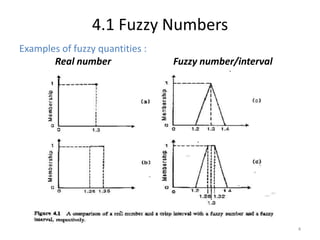
Examples of fuzzy quantities :
Real number Fuzzy number/interval
4
4.1 Fuzzy Numbers
4.2 Linguistic Variables
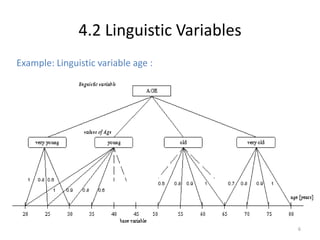
• It is fully described by name of the variable, linguistic values,
base variable range, various rules.
• A numerical variables takes numerical values: Age = 65
• A linguistic variables takes linguistic values: Age is old
• All such linguistic values set is a fuzzy set.
5
Example: Linguistic variable age :
6
4.2 Linguistic Variables
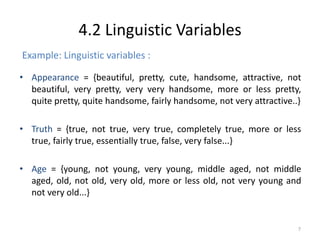
• Appearance = {beautiful, pretty, cute, handsome, attractive, not
beautiful, very pretty, very very handsome, more or less pretty,
quite pretty, quite handsome, fairly handsome, not very attractive..}
• Truth = {true, not true, very true, completely true, more or less
true, fairly true, essentially true, false, very false...}
• Age = {young, not young, very young, middle aged, not middle
aged, old, not old, very old, more or less old, not very young and
not very old...}
7
4.2 Linguistic Variables
Example: Linguistic variables :
4.3 Arithmetic Operations On Intervals
• Fuzzy arithmetic is based on two properties :
– Each fuzzy set and thus each fuzzy number is uniquely be
represented by its α-cuts;
– α-cut of A must be closed intervals of real numbers for all
α in (0,1].
Using above properties we define arithmetic operations
on fuzzy numbers in terms of arithmetic operations on
their α cuts.
Later operations are subject to interval analysis
8
• [a, b]*[d, e]={f*g|a ≤ f ≤ b, d ≤ g ≤ e}
1. Addition
[a, b]+[d, e]=[a+d, b+e];
2. Subtraction
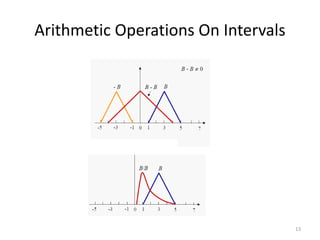
[a, b]-[d, e]=[a-e, b-d];
3.Multiplication
[a, b].[d, e]=[min(ad,ae,bd,be), max(ad,ae,bd,be)];
4. Division*
[a, b]/[d, e]=[a, b].[1/e, 1/d]
=[min(a/d,a/e,b/d,b/e), max(a/d,a/e,b/d,b/e)].
5. Inverse Interval*
[d,e] inverse =[min(1/d,1/e),max(1/d,1/e)]
* 0 ∉ [d,e] i.e excluding the case d=0 or e=0. 9
4.3 Arithmetic Operations On Intervals
Let * denotes any of the four arithmetic operations on
closed intervals :
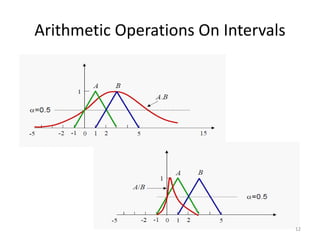
1. [-1,3]+[1, 5] = [-1+1, 3+5] = [0, 8]
2 . [-1,3]-[1, 5] = [-1-5, 3-1] = [-6,2]
3. [-1,3].[1, 5] = [min(-1,-5,3,15),max(-1,-5,3,15)]
=[-5,15]
4. [-1,3]/[1, 5] = [-1, 3].[1/1, 1/5]
= [min(-1/1,-1/5,3/1,3/5),max(-1/1,-1/5,3/1,3/5)]
= [-1/1,3/1] = [-1,3]
5. [-2,7]inverse = [min(1/-2,1/7),max(1/-2,1/7)]
= [-1/2,1/7]
10
4.3 Arithmetic Operations On Intervals
Examples illustrating interval-valued arithmetic operations :
Arithmetic Operations On Intervals
A=[-1,3] and B=[1,5]
11
Arithmetic Operations On Intervals
12
Arithmetic Operations On Intervals
13
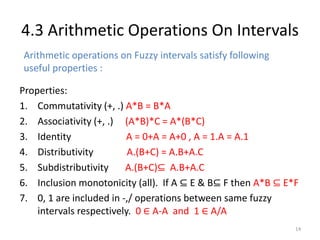
Properties:
1. Commutativity (+, .) A*B = B*A
2. Associativity (+, .) (A*B)*C = A*(B*C)
3. Identity A = 0+A = A+0 , A = 1.A = A.1
4. Distributivity A.(B+C) = A.B+A.C
5. Subdistributivity A.(B+C)⊆ A.B+A.C
6. Inclusion monotonicity (all). If A ⊆ E & B⊆ F then A*B ⊆ E*F
7. 0, 1 are included in -,/ operations between same fuzzy
intervals respectively. 0 ∈ A-A and 1 ∈ A/A
14
4.3 Arithmetic Operations On Intervals
Arithmetic operations on Fuzzy intervals satisfy following
useful properties :
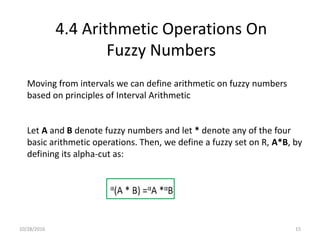
4.4 Arithmetic Operations On
Fuzzy Numbers
10/28/2016 15
Moving from intervals we can define arithmetic on fuzzy numbers
based on principles of Interval Arithmetic
Let A and B denote fuzzy numbers and let * denote any of the four
basic arithmetic operations. Then, we define a fuzzy set on R, A*B, by
defining its alpha-cut as:
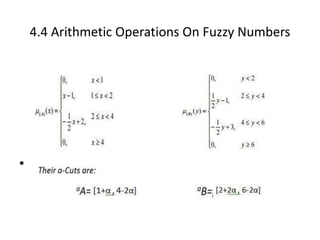
4.4 Arithmetic Operations On Fuzzy Numbers
•
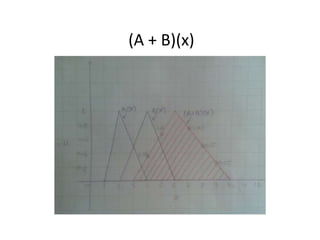
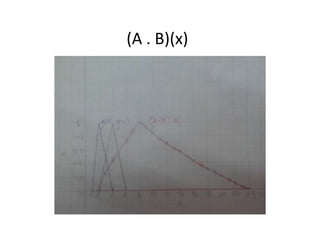
(A + B)(x)
(A . B)(x)
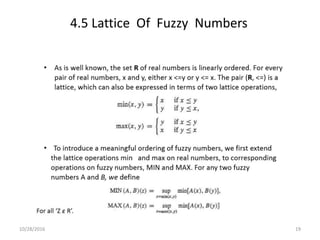
4.5 Lattice Of Fuzzy Numbers
10/28/2016 19
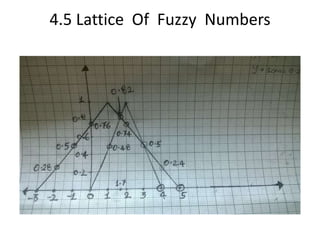
4.5 Lattice Of Fuzzy Numbers
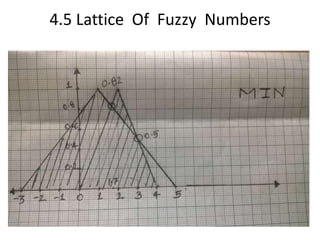
• How to find MIN?
• Solution
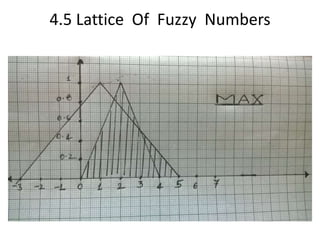
• How to find MAX?
• Solution
4.5 Lattice Of Fuzzy Numbers
10/28/2016 24
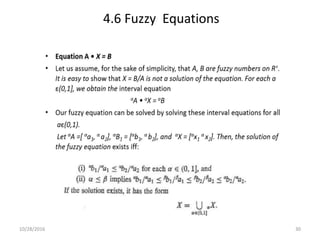
4.6 Fuzzy Equations
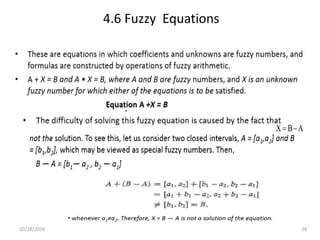
ABX 
10/28/2016 25

4.6 Fuzzy Equations
10/28/2016 26
1
0.6
α = 0.4
0.8
0.2
0
A B
10 20 30
αa1 = 4
αa2 = 16 αb2 = 26
A(x) , B(x)
x
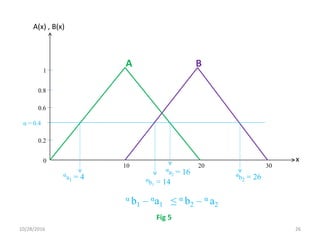
α b1 – αa1 ≤ α b2 – α a2
αb1 = 14
Fig 5
10/28/2016 27
1
0.6
α = 0.4
β = 0.8
0.2
0
A B
10 20 30
αa1 = 4
αa2 = 16 αb2 = 26
βa1 = 8 βa2 = 12 βb1 = 18 βb2 = 22
αb1 = 14
A(x) , B(x)
x
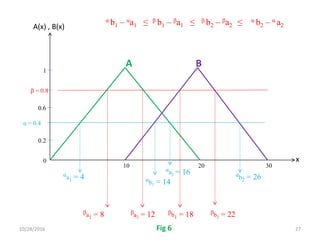
α b1 – αa1 ≤ β b1 – βa1 ≤ β b2 – βa2 ≤ α b2 – α a2
Fig 6
10/28/2016 28
4.6 Fuzzy Equations
10/28/2016 29
4.6 Fuzzy Equations
10/28/2016 30
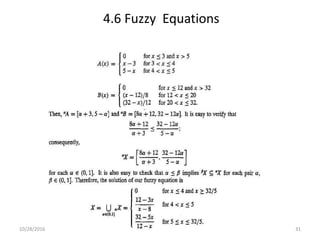
4.6 Fuzzy Equations
10/28/2016 31
4.6 Fuzzy Equations
THANK YOU.

Fuzzy arithmetic

  • 1.
    10/28/2016 1 Guided by Dr.A G Keskar Professor Department of Electronics Engineering VNIT, Nagpur Visvesvaraya National Institute Of Technology, Nagpur Presentation on Fuzzy Arithmetic Presented By: LOKESH GAHANE (MT15CMN007) MOHIT CHIMANKAR (MT15CMN008)
  • 2.
    Contents • Fuzzy Numbers •Linguistic Variables • Arithmetic Operations On Fuzzy Intervals • Arithmetic Operations On Fuzzy Numbers 2
  • 3.
    4.1 Fuzzy Numbers •Set A : R [0,1] • To qualify as fuzzy number, a fuzzy set A on R must have following properties: 1. Set A must be Normal Fuzzy set; 2. α-cut of A must be closed interval for every α in (0,1]; 3. Support and strong α-cut of A must be bounded.  Every Fuzzy number is a Convex fuzzy set, The Inverse is not necessarily true. 3
  • 4.
    Examples of fuzzyquantities : Real number Fuzzy number/interval 4 4.1 Fuzzy Numbers
  • 5.
    4.2 Linguistic Variables •It is fully described by name of the variable, linguistic values, base variable range, various rules. • A numerical variables takes numerical values: Age = 65 • A linguistic variables takes linguistic values: Age is old • All such linguistic values set is a fuzzy set. 5
  • 6.
    Example: Linguistic variableage : 6 4.2 Linguistic Variables
  • 7.
    • Appearance ={beautiful, pretty, cute, handsome, attractive, not beautiful, very pretty, very very handsome, more or less pretty, quite pretty, quite handsome, fairly handsome, not very attractive..} • Truth = {true, not true, very true, completely true, more or less true, fairly true, essentially true, false, very false...} • Age = {young, not young, very young, middle aged, not middle aged, old, not old, very old, more or less old, not very young and not very old...} 7 4.2 Linguistic Variables Example: Linguistic variables :
  • 8.
    4.3 Arithmetic OperationsOn Intervals • Fuzzy arithmetic is based on two properties : – Each fuzzy set and thus each fuzzy number is uniquely be represented by its α-cuts; – α-cut of A must be closed intervals of real numbers for all α in (0,1]. Using above properties we define arithmetic operations on fuzzy numbers in terms of arithmetic operations on their α cuts. Later operations are subject to interval analysis 8
  • 9.
    • [a, b]*[d,e]={f*g|a ≤ f ≤ b, d ≤ g ≤ e} 1. Addition [a, b]+[d, e]=[a+d, b+e]; 2. Subtraction [a, b]-[d, e]=[a-e, b-d]; 3.Multiplication [a, b].[d, e]=[min(ad,ae,bd,be), max(ad,ae,bd,be)]; 4. Division* [a, b]/[d, e]=[a, b].[1/e, 1/d] =[min(a/d,a/e,b/d,b/e), max(a/d,a/e,b/d,b/e)]. 5. Inverse Interval* [d,e] inverse =[min(1/d,1/e),max(1/d,1/e)] * 0 ∉ [d,e] i.e excluding the case d=0 or e=0. 9 4.3 Arithmetic Operations On Intervals Let * denotes any of the four arithmetic operations on closed intervals :
  • 10.
    1. [-1,3]+[1, 5]= [-1+1, 3+5] = [0, 8] 2 . [-1,3]-[1, 5] = [-1-5, 3-1] = [-6,2] 3. [-1,3].[1, 5] = [min(-1,-5,3,15),max(-1,-5,3,15)] =[-5,15] 4. [-1,3]/[1, 5] = [-1, 3].[1/1, 1/5] = [min(-1/1,-1/5,3/1,3/5),max(-1/1,-1/5,3/1,3/5)] = [-1/1,3/1] = [-1,3] 5. [-2,7]inverse = [min(1/-2,1/7),max(1/-2,1/7)] = [-1/2,1/7] 10 4.3 Arithmetic Operations On Intervals Examples illustrating interval-valued arithmetic operations :
  • 11.
    Arithmetic Operations OnIntervals A=[-1,3] and B=[1,5] 11
  • 12.
  • 13.
  • 14.
    Properties: 1. Commutativity (+,.) A*B = B*A 2. Associativity (+, .) (A*B)*C = A*(B*C) 3. Identity A = 0+A = A+0 , A = 1.A = A.1 4. Distributivity A.(B+C) = A.B+A.C 5. Subdistributivity A.(B+C)⊆ A.B+A.C 6. Inclusion monotonicity (all). If A ⊆ E & B⊆ F then A*B ⊆ E*F 7. 0, 1 are included in -,/ operations between same fuzzy intervals respectively. 0 ∈ A-A and 1 ∈ A/A 14 4.3 Arithmetic Operations On Intervals Arithmetic operations on Fuzzy intervals satisfy following useful properties :
  • 15.
    4.4 Arithmetic OperationsOn Fuzzy Numbers 10/28/2016 15 Moving from intervals we can define arithmetic on fuzzy numbers based on principles of Interval Arithmetic Let A and B denote fuzzy numbers and let * denote any of the four basic arithmetic operations. Then, we define a fuzzy set on R, A*B, by defining its alpha-cut as:
  • 16.
    4.4 Arithmetic OperationsOn Fuzzy Numbers •
  • 17.
  • 18.
  • 19.
    4.5 Lattice OfFuzzy Numbers 10/28/2016 19
  • 20.
    4.5 Lattice OfFuzzy Numbers
  • 21.
    4.5 Lattice OfFuzzy Numbers • How to find MIN? • Solution • How to find MAX? • Solution
  • 22.
    4.5 Lattice OfFuzzy Numbers
  • 23.
    4.5 Lattice OfFuzzy Numbers
  • 24.
    10/28/2016 24 4.6 FuzzyEquations ABX 
  • 25.
  • 26.
    10/28/2016 26 1 0.6 α =0.4 0.8 0.2 0 A B 10 20 30 αa1 = 4 αa2 = 16 αb2 = 26 A(x) , B(x) x α b1 – αa1 ≤ α b2 – α a2 αb1 = 14 Fig 5
  • 27.
    10/28/2016 27 1 0.6 α =0.4 β = 0.8 0.2 0 A B 10 20 30 αa1 = 4 αa2 = 16 αb2 = 26 βa1 = 8 βa2 = 12 βb1 = 18 βb2 = 22 αb1 = 14 A(x) , B(x) x α b1 – αa1 ≤ β b1 – βa1 ≤ β b2 – βa2 ≤ α b2 – α a2 Fig 6
  • 28.
  • 29.
  • 30.
  • 31.
  • 32.