Non-ionizing
radiation
Dr. Hiba ZBIB
2015-2016
1
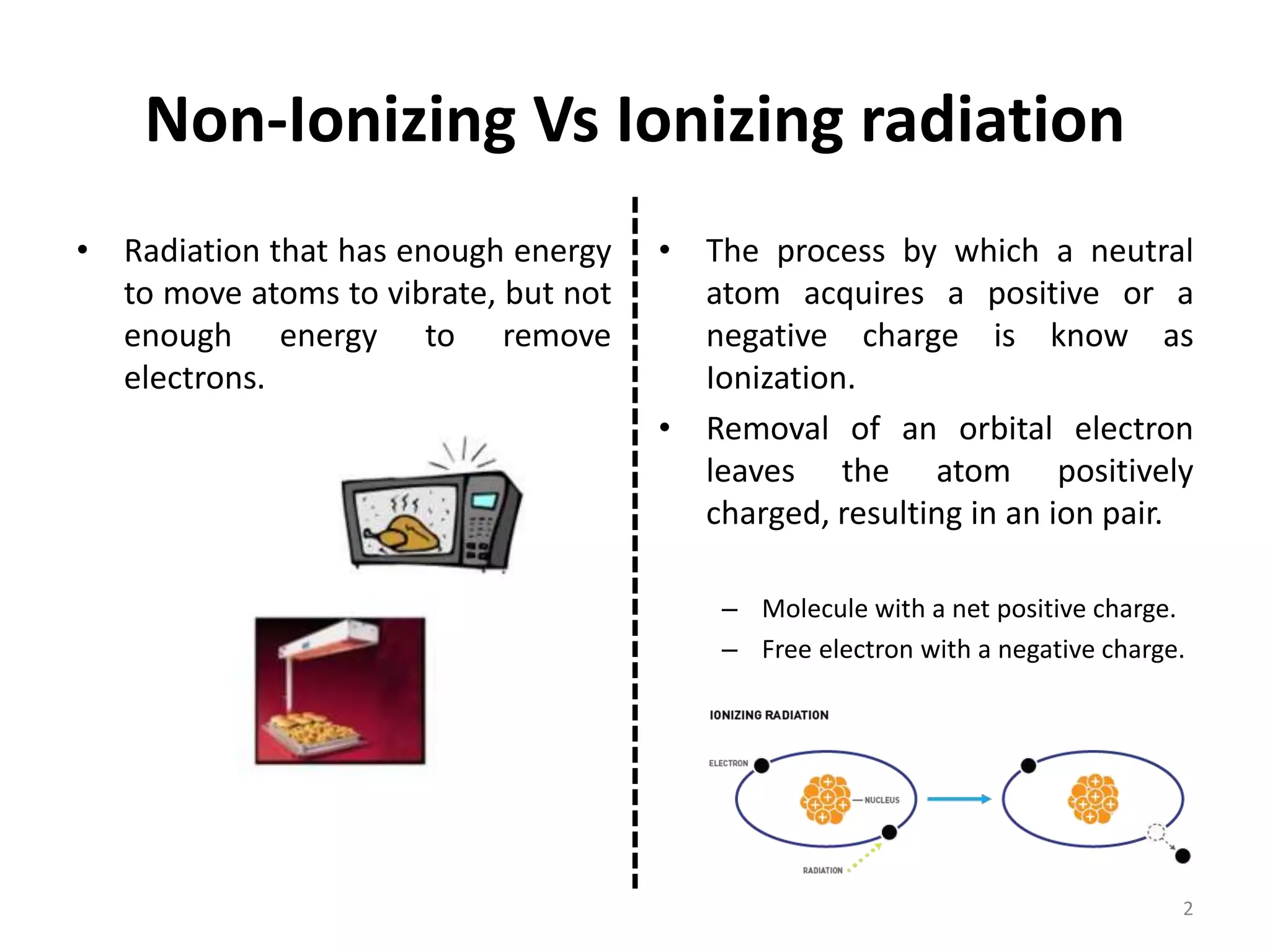
Non-Ionizing Vs Ionizing radiation
• Radiation that has enough energy
to move atoms to vibrate, but not
enough energy to remove
electrons.
• The process by which a neutral
atom acquires a positive or a
negative charge is know as
Ionization.
• Removal of an orbital electron
leaves the atom positively
charged, resulting in an ion pair.
– Molecule with a net positive charge.
– Free electron with a negative charge.
2
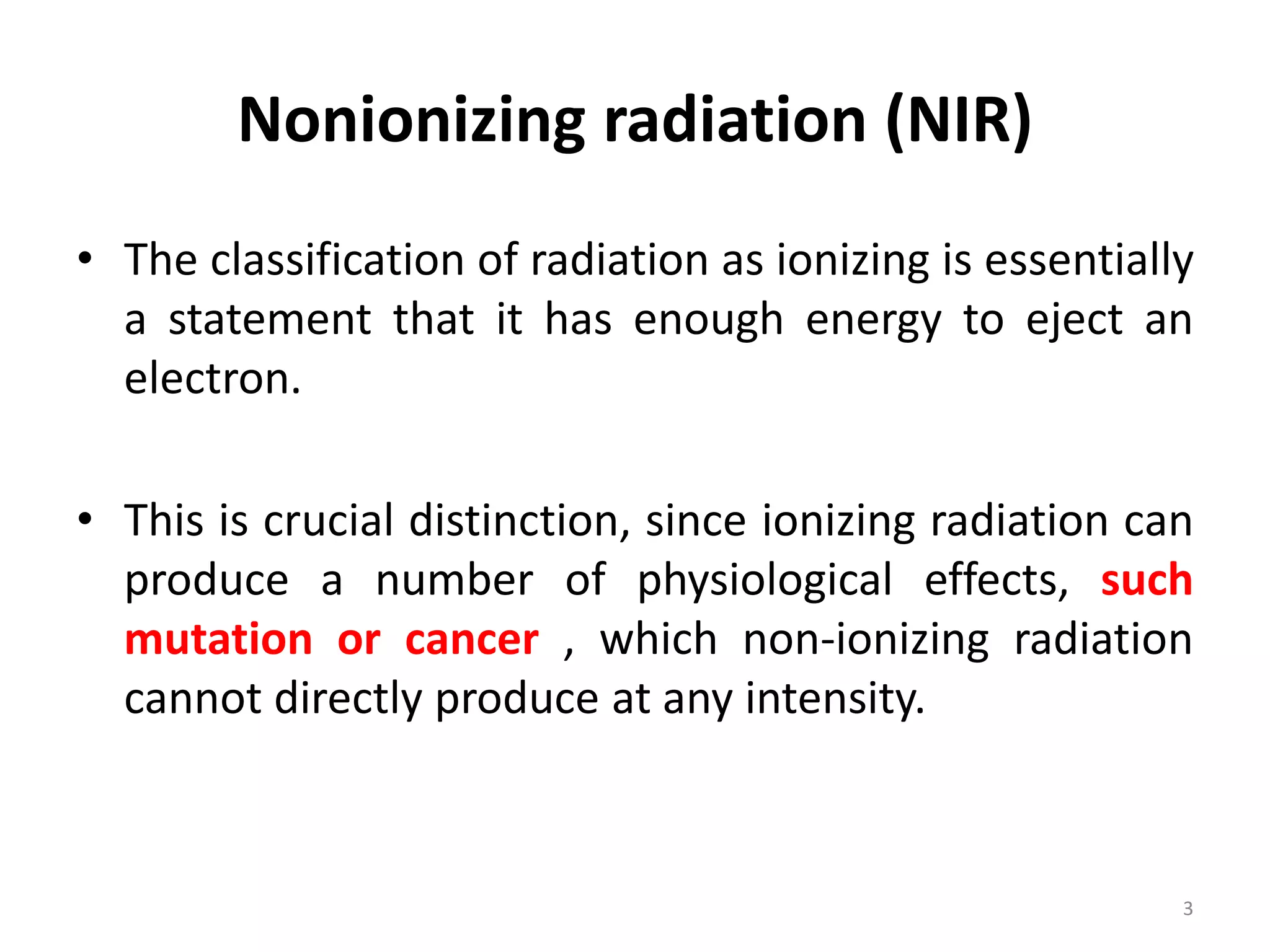
Nonionizing radiation (NIR)
• The classification of radiation as ionizing is essentially
a statement that it has enough energy to eject an
electron.
• This is crucial distinction, since ionizing radiation can
produce a number of physiological effects, such
mutation or cancer , which non-ionizing radiation
cannot directly produce at any intensity.
3
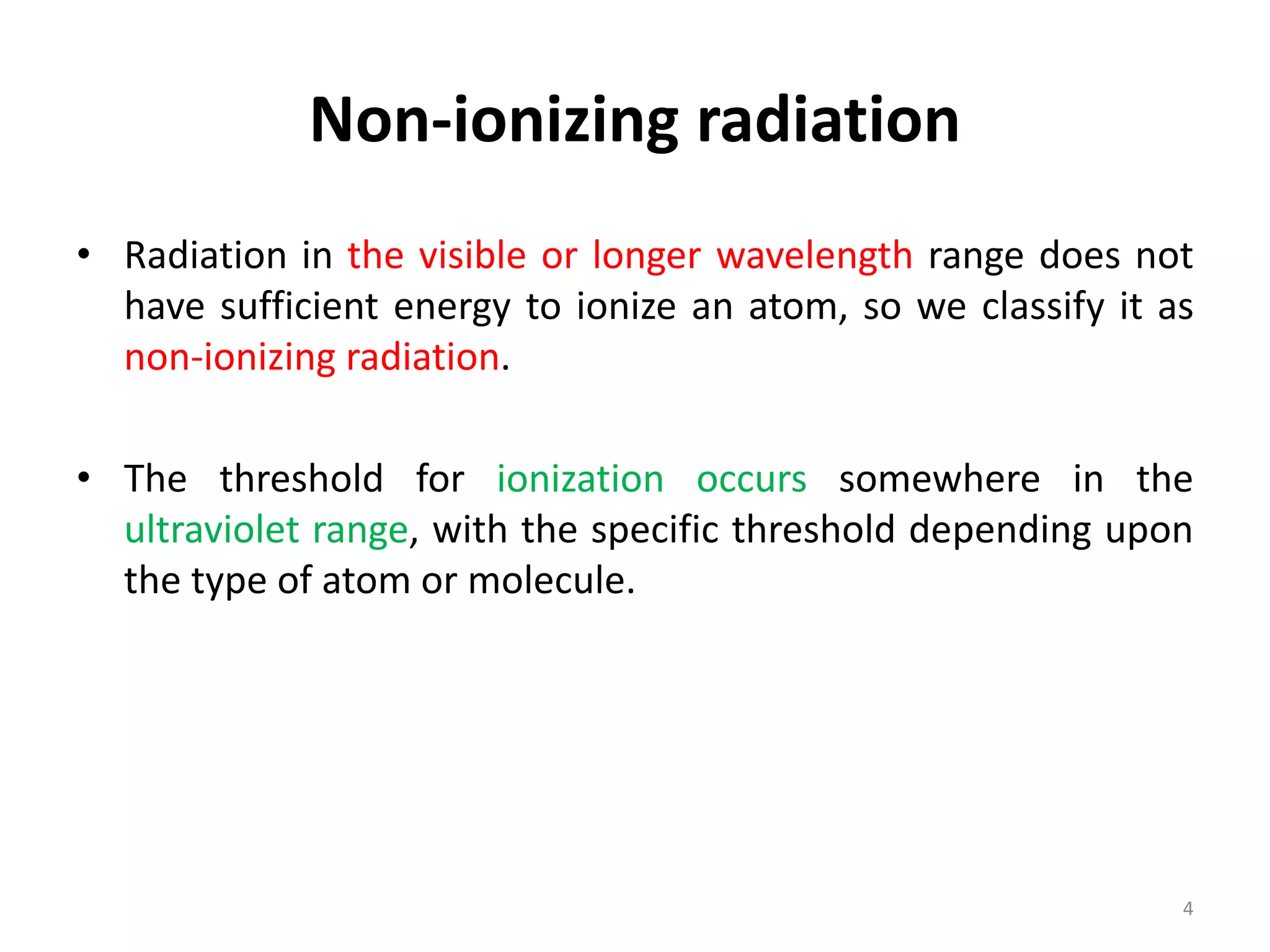
Non-ionizing radiation
• Radiation in the visible or longer wavelength range does not
have sufficient energy to ionize an atom, so we classify it as
non-ionizing radiation.
• The threshold for ionization occurs somewhere in the
ultraviolet range, with the specific threshold depending upon
the type of atom or molecule.
4
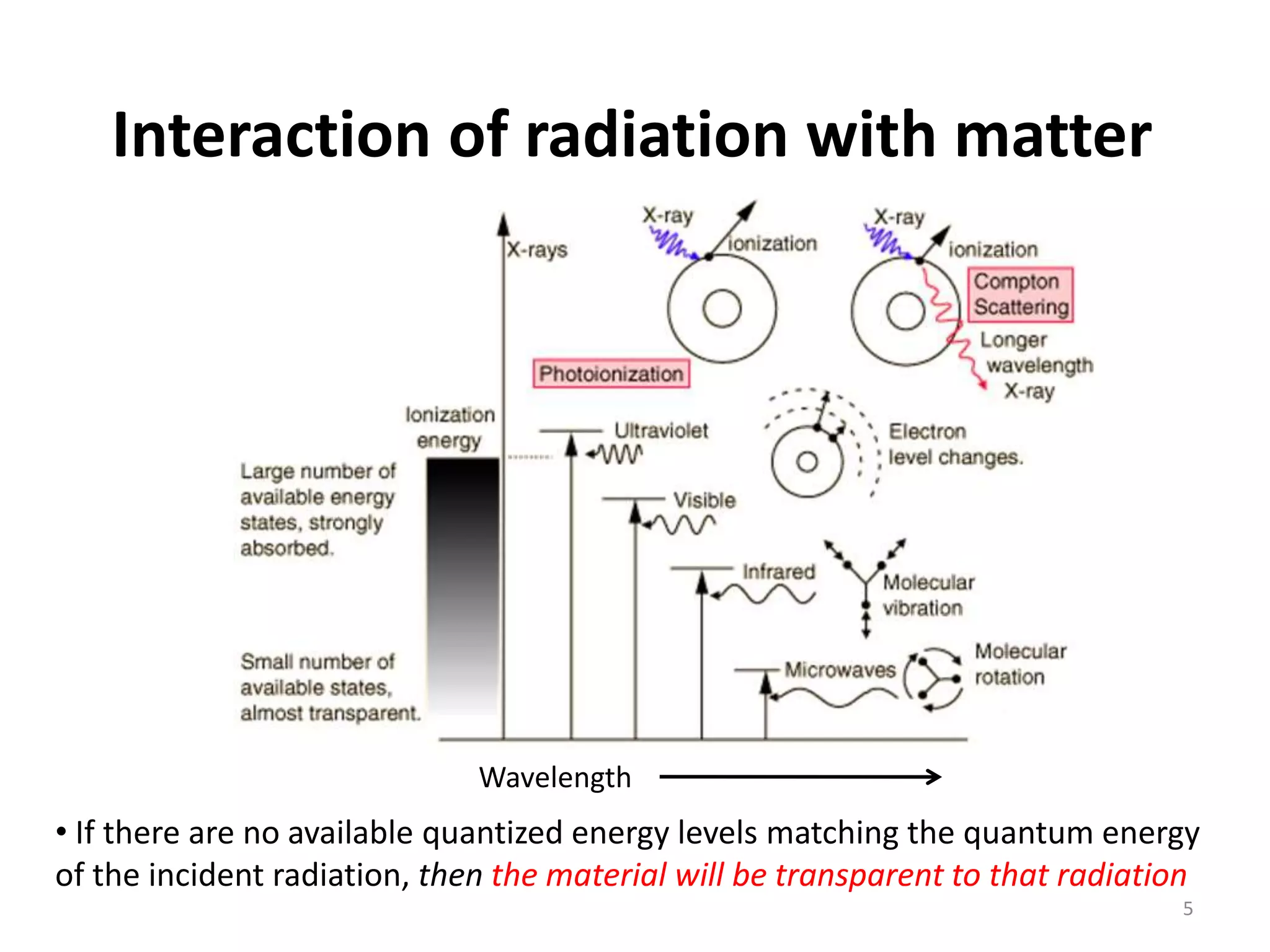
Interaction of radiation with matter
• If there are no available quantized energy levels matching the quantum energy
of the incident radiation, then the material will be transparent to that radiation
Wavelength
5
Interaction of radiation with matter
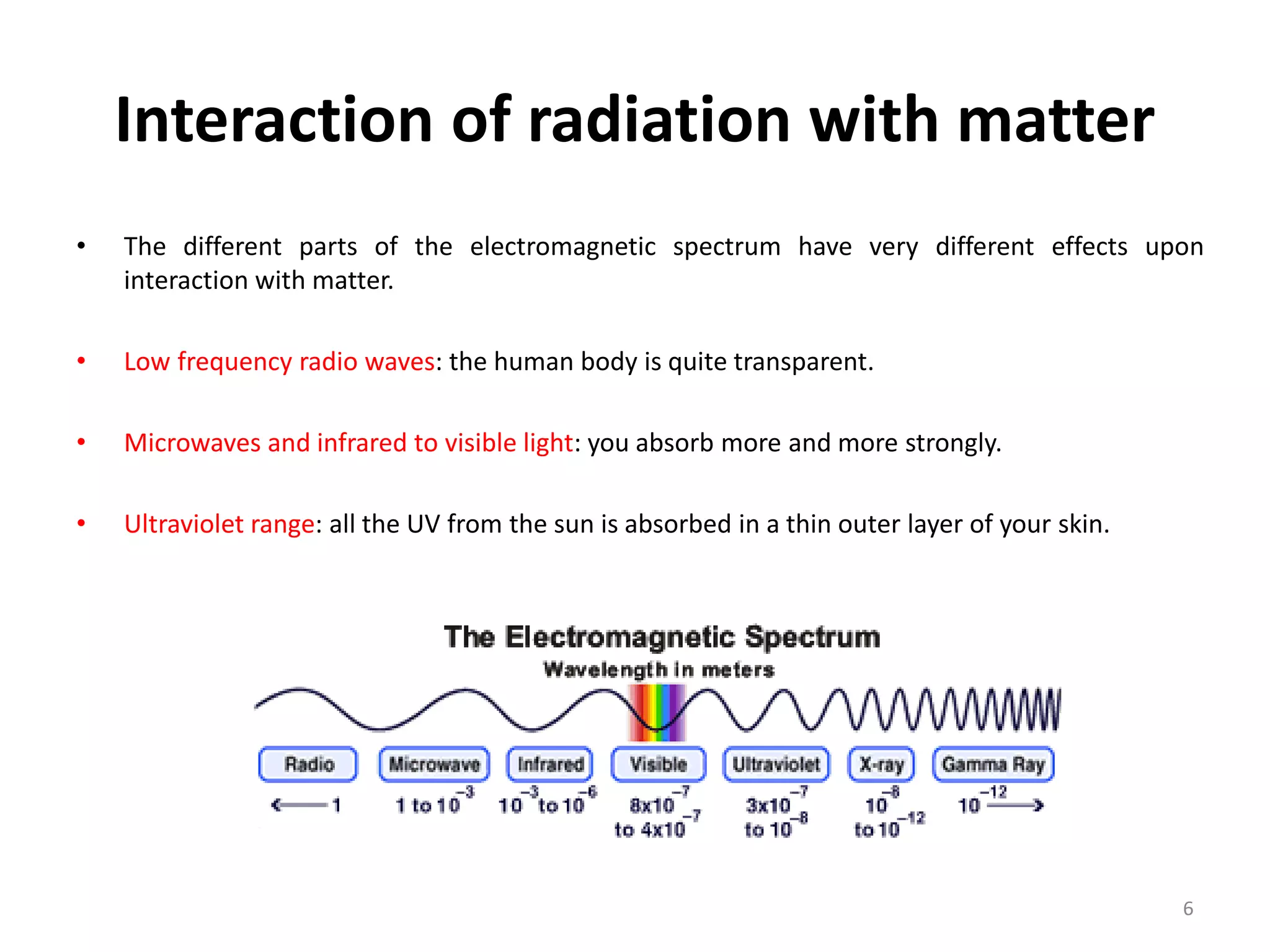
• The different parts of the electromagnetic spectrum have very different effects upon
interaction with matter.
• Low frequency radio waves: the human body is quite transparent.
• Microwaves and infrared to visible light: you absorb more and more strongly.
• Ultraviolet range: all the UV from the sun is absorbed in a thin outer layer of your skin.
6
Interaction of radiation with matter
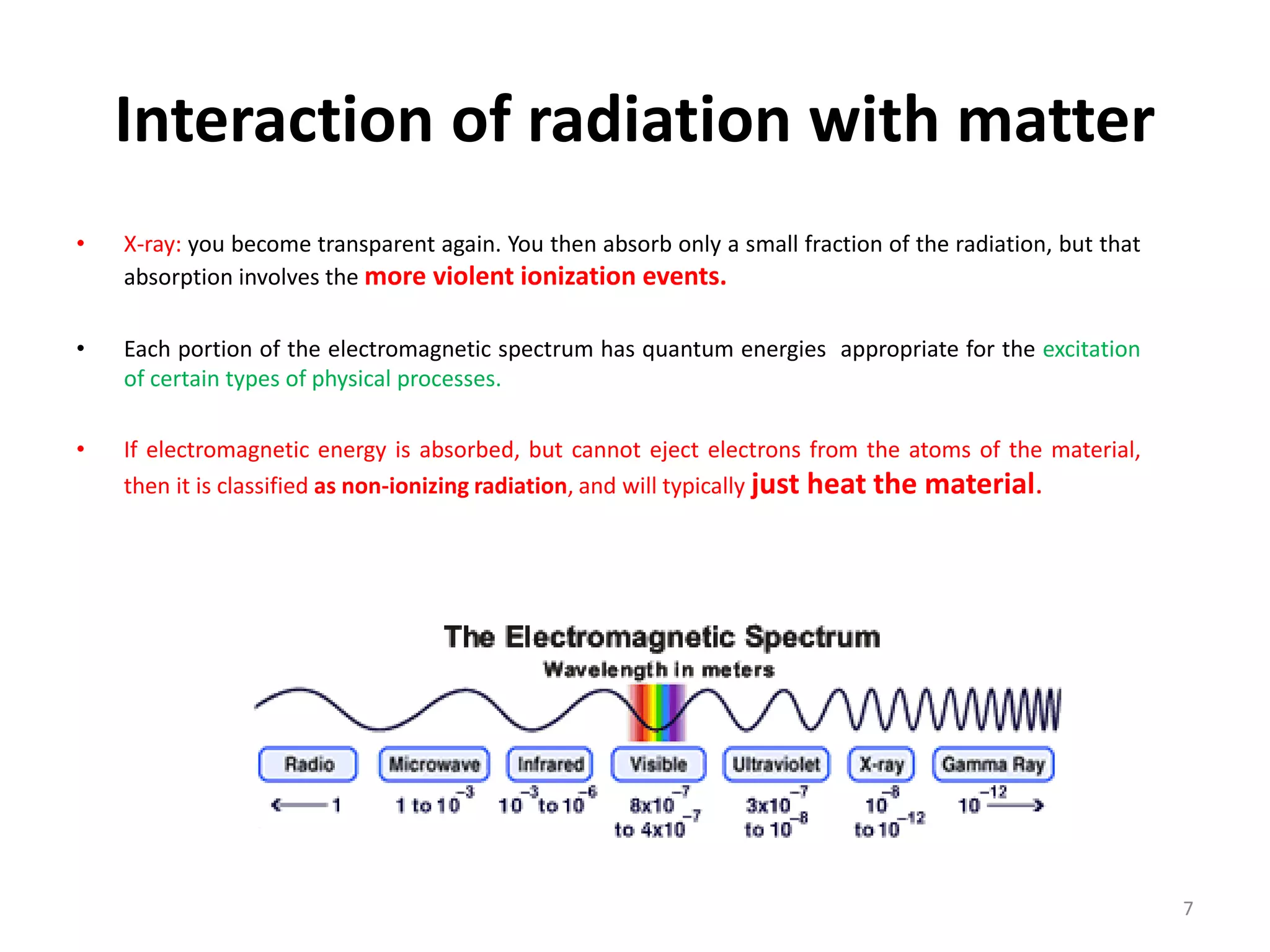
• X-ray: you become transparent again. You then absorb only a small fraction of the radiation, but that
absorption involves the more violent ionization events.
• Each portion of the electromagnetic spectrum has quantum energies appropriate for the excitation
of certain types of physical processes.
• If electromagnetic energy is absorbed, but cannot eject electrons from the atoms of the material,
then it is classified as non-ionizing radiation, and will typically just heat the material.
7
Molecular absorption processes
• Electronic transitions
• UV and visible wavelengths
• Molecular vibrations
• Thermal infrared wavelengths
• Molecular rotations
• Microwave and far-IR wavelengths
• Each of these processes is quantized
Increasing energy
8
Microwave interactions
• Quantum energy of microwave photons (0.00001-0.001 eV)
matches the ranges of energies separating quantum states of
molecular rotations.
• Note that rotational motion of molecules is quantized, like
electronic and vibrational transitions.
• Absorption of microwave radiation causes heating due to
increased molecular rotational activity.
•Since the quantum energies are a million times lower than those of
x-rays, they cannot produce ionization.
9
Infrared Interactions
• The term "infrared" refers to a broad range of frequencies, beginning at
the top end of the microwaves and extending up to the low frequency
(red) end of the visible spectrum.
• The range adjacent to the visible spectrum is called the "near infrared"
and the longer wavelength part is called "far infrared".
10
Infrared Interactions
• Infrared is absorbed more strongly than microwaves,
but less strongly than visible light.
• The result of infrared absorption is heating of the
tissue since it increases molecular vibrational activity.
11
Infrared (IR) interactions
•Quantum energy of IR photons (0.001-1.7 eV) matches the ranges of
energies separating quantum states of molecular vibrations.
• Vibrations arise as molecular bonds are not rigid but behave like springs.
•A single molecule can vibrate in various ways; each of these different
motions is called a vibration "mode".
12
Visible Light Interactions
• The primary mechanism for the absorption of visible light
photons is the elevation of electrons to higher energy levels.
• There are many available states, so visible light is absorbed
strongly.
13
Ultraviolet interactions
• Near UV radiation (just shorter than visible wavelengths) is absorbed very
strongly in the surface layer of the skin by electron transitions.
• At higher energies, ionization energies for many molecules are reached and
the more dangerous photoionization processes occur.
• Sunburn is primarily an effect of UV radiation, and ionization produces the
risk of skin cancer.
Ultraviolet Interactions
• The ozone layer is important
for human health because it
absorbs most of the harmful
ultraviolet radiation from the
sun before it reaches the
surface.
• The higher frequencies in the
ultraviolet are ionizing
radiation and can produce
harmful physiological effects
ranging from sunburn to skin
cancer.
15
UV LIGHT
• Light with wavelengths between 100 nm and 400 nm.
• The UV spectrum is divided into three regions:
– UVA, 320–400 nm;
– UVB, 280–320 nm;
– and UVC, 100–280 nm.
16
Sources of UV radiation
• The sun is the largest source of UV radiation; the
sunlight that reaches the earth’s surface consists
mainly of UVA radiation, with a smaller
component of UVB.
• All of the UVC is filtered by the ozone layer, and
thus no UVC reaches the earth’s surface.
• Man-made sources of UV radiation: black light
lamps
17
X-ray interactions (IR)
• Quantum energies of x-ray photons are too high to be absorbed by electronic
transitions in most atoms - only possible result is complete removal of an electron
from an atom
• Hence all x-rays are ionizing radiation
• If all the x-ray energy is given to an electron, it is called photoionization
• If part of the energy is given to an electron and the remainder to a lower energy
photon, it is called Compton scattering
Absorption of radiation by molecules
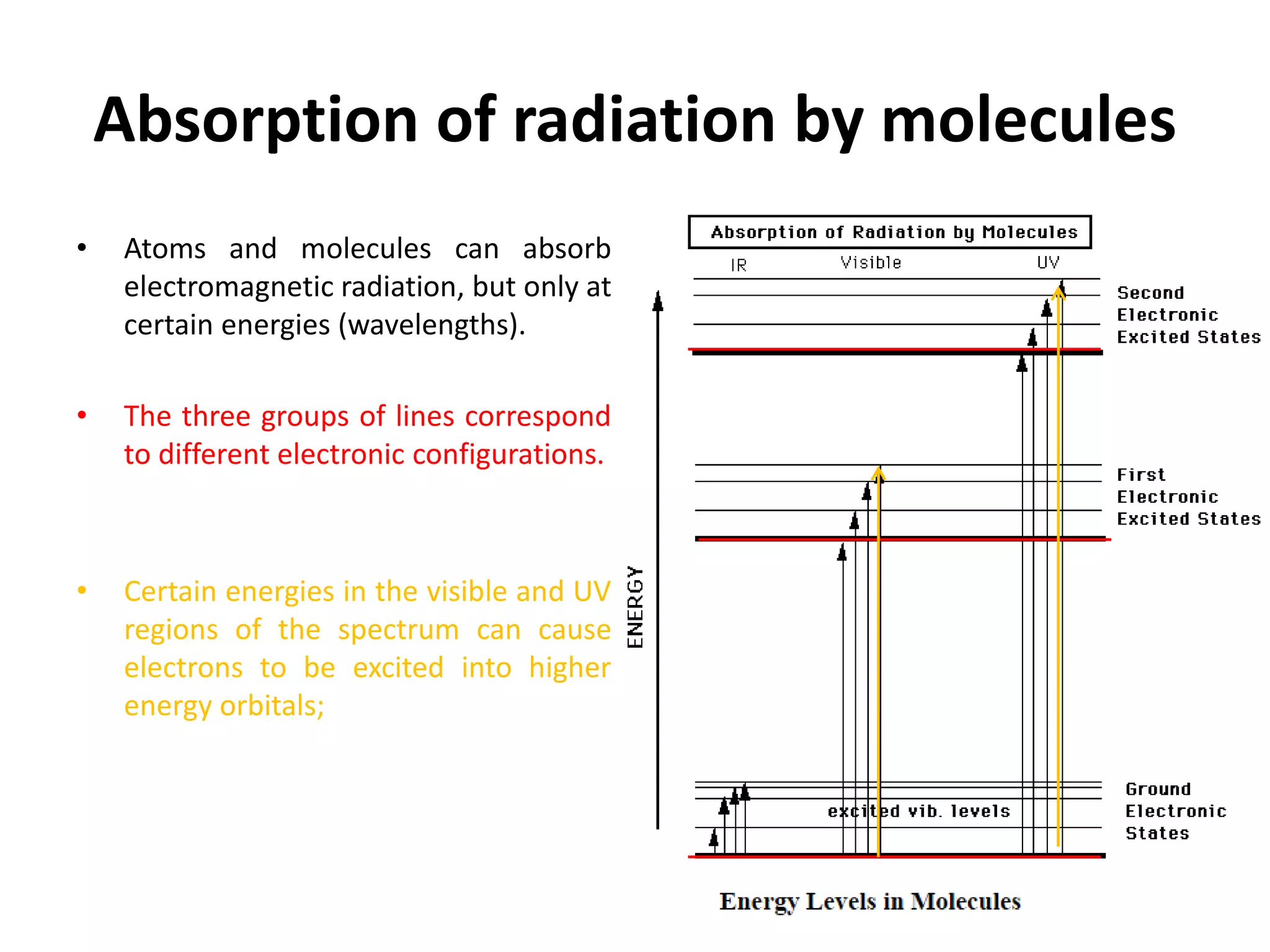
• Atoms and molecules can absorb
electromagnetic radiation, but only at
certain energies (wavelengths).
• The three groups of lines correspond
to different electronic configurations.
• Certain energies in the visible and UV
regions of the spectrum can cause
electrons to be excited into higher
energy orbitals;
19
Absorption of radiation by molecules
• Photons in the infrared region of the
spectrum can excite vibrations in
molecules.
• There are many possible vibrational
levels within each electronic state.
• Transitions between the vibrational
levels are indicated by the vertical
arrows on the left side of the
diagram.
20

Non-ionizing radiation.pptx

  • 1.
  • 2.
    Non-Ionizing Vs Ionizingradiation • Radiation that has enough energy to move atoms to vibrate, but not enough energy to remove electrons. • The process by which a neutral atom acquires a positive or a negative charge is know as Ionization. • Removal of an orbital electron leaves the atom positively charged, resulting in an ion pair. – Molecule with a net positive charge. – Free electron with a negative charge. 2
  • 3.
    Nonionizing radiation (NIR) •The classification of radiation as ionizing is essentially a statement that it has enough energy to eject an electron. • This is crucial distinction, since ionizing radiation can produce a number of physiological effects, such mutation or cancer , which non-ionizing radiation cannot directly produce at any intensity. 3
  • 4.
    Non-ionizing radiation • Radiationin the visible or longer wavelength range does not have sufficient energy to ionize an atom, so we classify it as non-ionizing radiation. • The threshold for ionization occurs somewhere in the ultraviolet range, with the specific threshold depending upon the type of atom or molecule. 4
  • 5.
    Interaction of radiationwith matter • If there are no available quantized energy levels matching the quantum energy of the incident radiation, then the material will be transparent to that radiation Wavelength 5
  • 6.
    Interaction of radiationwith matter • The different parts of the electromagnetic spectrum have very different effects upon interaction with matter. • Low frequency radio waves: the human body is quite transparent. • Microwaves and infrared to visible light: you absorb more and more strongly. • Ultraviolet range: all the UV from the sun is absorbed in a thin outer layer of your skin. 6
  • 7.
    Interaction of radiationwith matter • X-ray: you become transparent again. You then absorb only a small fraction of the radiation, but that absorption involves the more violent ionization events. • Each portion of the electromagnetic spectrum has quantum energies appropriate for the excitation of certain types of physical processes. • If electromagnetic energy is absorbed, but cannot eject electrons from the atoms of the material, then it is classified as non-ionizing radiation, and will typically just heat the material. 7
  • 8.
    Molecular absorption processes •Electronic transitions • UV and visible wavelengths • Molecular vibrations • Thermal infrared wavelengths • Molecular rotations • Microwave and far-IR wavelengths • Each of these processes is quantized Increasing energy 8
  • 9.
    Microwave interactions • Quantumenergy of microwave photons (0.00001-0.001 eV) matches the ranges of energies separating quantum states of molecular rotations. • Note that rotational motion of molecules is quantized, like electronic and vibrational transitions. • Absorption of microwave radiation causes heating due to increased molecular rotational activity. •Since the quantum energies are a million times lower than those of x-rays, they cannot produce ionization. 9
  • 10.
    Infrared Interactions • Theterm "infrared" refers to a broad range of frequencies, beginning at the top end of the microwaves and extending up to the low frequency (red) end of the visible spectrum. • The range adjacent to the visible spectrum is called the "near infrared" and the longer wavelength part is called "far infrared". 10
  • 11.
    Infrared Interactions • Infraredis absorbed more strongly than microwaves, but less strongly than visible light. • The result of infrared absorption is heating of the tissue since it increases molecular vibrational activity. 11
  • 12.
    Infrared (IR) interactions •Quantumenergy of IR photons (0.001-1.7 eV) matches the ranges of energies separating quantum states of molecular vibrations. • Vibrations arise as molecular bonds are not rigid but behave like springs. •A single molecule can vibrate in various ways; each of these different motions is called a vibration "mode". 12
  • 13.
    Visible Light Interactions •The primary mechanism for the absorption of visible light photons is the elevation of electrons to higher energy levels. • There are many available states, so visible light is absorbed strongly. 13
  • 14.
    Ultraviolet interactions • NearUV radiation (just shorter than visible wavelengths) is absorbed very strongly in the surface layer of the skin by electron transitions. • At higher energies, ionization energies for many molecules are reached and the more dangerous photoionization processes occur. • Sunburn is primarily an effect of UV radiation, and ionization produces the risk of skin cancer.
  • 15.
    Ultraviolet Interactions • Theozone layer is important for human health because it absorbs most of the harmful ultraviolet radiation from the sun before it reaches the surface. • The higher frequencies in the ultraviolet are ionizing radiation and can produce harmful physiological effects ranging from sunburn to skin cancer. 15
  • 16.
    UV LIGHT • Lightwith wavelengths between 100 nm and 400 nm. • The UV spectrum is divided into three regions: – UVA, 320–400 nm; – UVB, 280–320 nm; – and UVC, 100–280 nm. 16
  • 17.
    Sources of UVradiation • The sun is the largest source of UV radiation; the sunlight that reaches the earth’s surface consists mainly of UVA radiation, with a smaller component of UVB. • All of the UVC is filtered by the ozone layer, and thus no UVC reaches the earth’s surface. • Man-made sources of UV radiation: black light lamps 17
  • 18.
    X-ray interactions (IR) •Quantum energies of x-ray photons are too high to be absorbed by electronic transitions in most atoms - only possible result is complete removal of an electron from an atom • Hence all x-rays are ionizing radiation • If all the x-ray energy is given to an electron, it is called photoionization • If part of the energy is given to an electron and the remainder to a lower energy photon, it is called Compton scattering
  • 19.
    Absorption of radiationby molecules • Atoms and molecules can absorb electromagnetic radiation, but only at certain energies (wavelengths). • The three groups of lines correspond to different electronic configurations. • Certain energies in the visible and UV regions of the spectrum can cause electrons to be excited into higher energy orbitals; 19
  • 20.
    Absorption of radiationby molecules • Photons in the infrared region of the spectrum can excite vibrations in molecules. • There are many possible vibrational levels within each electronic state. • Transitions between the vibrational levels are indicated by the vertical arrows on the left side of the diagram. 20

Editor's Notes

  • #4 http://hyperphysics.phy-astr.gsu.edu/hbase/mod4.html
  • #5 If an atom absorbs a photon of electromagnetic radiation and remains intact, there is a strong tendency for it to return to its ground state. Just as water runs downhill, all physical systems will tend to move to lower energy levels. If the quantum energy of the radiation absorbed is higher than the average thermal energy of the molecules (that is, infrared or visible radiation), then the downward transitions may emit radiation that leaves the material, or it may be gradually transformed into general thermal energy in the material. Radiation in the microwave or longer wavelengths generally just contributes to the random molecular motion which we have described as thermal energy. The net result of the absorption of non-ionizing radiation is generally just to heat the sample. Of course if it heats it enough, then chemical changes are likely to occur, but those chemical changes would be expected to be the same changes that would occur as a result of any other source of heating. It typically takes a photon with energy in the range of a few electron volts to ionize an atom.
  • #7 Starting with low frequency radio waves, the human body is quite transparent. (You can listen to your portable radio inside your home since the waves pass freely through the walls of your house and even through the person beside you!) Energy levels associated with molecules, atoms and nuclei are in general discrete, quantized energy levels and transitions between those levels typically involve the absorption or emission of photons. Electron energy levels have been used as the example here, but quantized energy levels for molecular vibration and rotation also exist. Transitions between vibrational quantum states typically occur in the infrared and transitions between rotational quantum states are typically in the microwave region of the electromagnetic spectrum.
  • #8  Electron energy levels have been used as the example here, but quantized energy levels for molecular vibration and rotation also exist. The energy levels for all physical processes at the atomic and molecular levels are quantized, and if there are no available quantized energy levels with spacings which match the quantum energy of the incident radiation, then the material will be transparent to that radiation, and it will pass through. Energy levels associated with molecules, atoms and nuclei are in general discrete, quantized energy levels and transitions between those levels typically involve the absorption or emission of photons. Electron energy levels have been used as the example here, but quantized energy levels for molecular vibration and rotation also exist. Transitions between vibrational quantum states typically occur in the infrared and transitions between rotational quantum states are typically in the microwave region of the electromagnetic spectrum.
  • #9 Infrared light occurs at wavelengths just below red light, hence the name, infra- (below) red. Near-infrared is the "color" of the heating coil on an electric stove just before it glows red. The thermal (or mid-) infrared colors are found at even longer wavelengths.
  • #11 http://www.ezesauna.com/far-infrared/ The full light spectrum is produced by the sun, and within the scale of that spectrum at 0.75 to 1000 micron is infrared (IR). Moreover, 80 percent of the solar energy is made up of infrared waves. And within that 80 percent of that infrared is far-infrared. Keep in mind that along with a light source there is heat, but infrared is not just any heat. It is the essential radiant heat needed by living organisms to rejuvenate blood flow and deliver oxygen proportionally throughout the body. Infrared is divided up by three levels. First, there are near-infrared rays at .75 to 1.5 micron. Second, there are mid-infrared rays at 1.5 to around 5 micron. These two grouped together are commonly referred to as infrared (IR). Your body uses these waves for daily consumption from the sun. IR is thus, a natural radiant heat that you need to sustain life. Infrared is divided up by three levels. First, there are near-infrared rays at .75 to 1.5 micron. Second, there are mid-infrared rays at 1.5 to around 5 micron. These two grouped together are commonly referred to as infrared (IR). Your body uses these waves for daily consumption from the sun. IR is thus, a natural radiant heat that you need to sustain life. Now the third group begins at around 5 micron to 1000 micron. This is a longer wavelength known as far-infrared (FIR). FIR waves are absorbed by the body to aid in the healing process, balance bodily circulation and activate metabolism in tissues and cells. We live in an environment of far-infrared waves. Every living thing including animals and plants receive and radiate them. In comparison to all the different types of energy which come from the sun, the FIR is the safest and the most beneficial electromagnetic energy source. Most of the human body heat is typically radiated away as FIR at the 8 to 12 micron wavelength. The human body absorbs energy easily from the radiated FIR wave of 8-12 micron wavelengths. Extensive biological research has shown that FIR wavelengths of 6 to 15 micron are beneficial to the human body and consequently are known as physiological energy or Bio-Genetic energy.
  • #12 The quantum energy of infrared photons is in the range 0.001 to 1.7 eV which is in the range of energies separating the quantum states of molecular vibrations. Infrared radiation does penetrate the skin further than visible light and can thus be used for photographic imaging of subcutaneous blood vessels. Molecular vibrations and some energetic rotations have energy level spacings that correspond to energies in the IR region of the electromagnetic spectrum (most rotations are in the microwave range which runs between thermal IR and radio wavelengths). Thus IR radiation absorbed by molecules causes increased vibration. Collisions between these energized molecules and others in the sample transfer energy among all the molecules, which increases the average thermal energy and, hence, raises the temperature. Conversely, molecules that emit IR radiation lose their vibrational energy and their collisions with other molecules decrease the average thermal energy and lower the temperature. http://www.acs.org/content/acs/en/climatescience/greenhousegases/properties.html
  • #14 http://hyperphysics.phy-astr.gsu.edu/hbase/mod3.html#c5 Absorption of visible light causes heating, but not ionization With a strong light source, red light can be transmitted through the hand, showing that the red end of the spectrum is not absorbed as strongly as the violet end. 
  • #16 http://www.avogadro.co.uk/light/matter/quantised.htm Ionisation starts with wavelengths shorter than 200 nm and needs at least 6 eV, but more likely up to 33 eV (Hall and Giaccia 2006)
  • #18 Black light is commonly used to authenticate oil paintings, antiquesand banknotes. Black lights can be used to differentiate real currency from counterfeit notes because, in many countries, legal banknotes have fluorescent symbols on them that only show under a black light. . In addition, the paper used for printing money does not contain any of the brightening agents which cause commercially available papers to fluoresce under black light. Both of these features make illegal notes easier to detect and more difficult to successfully counterfeit. The same security features can be applied to identification cards. The sun provides ultraviolet (mainly UV-A and UV-B) as well as visible radiation black light lamps carbon arcs dental polymerizing instruments fluorescence equipment germicidal lamps hydrogen lamps metal halide lamps mercury lamps plasma torches
  • #20 http://www.avogadro.co.uk/light/matter/quantised.htm