E-mail & Phone etiquette
BY: POOJA RAJ SRIVASTAVA
E-mail etiquette
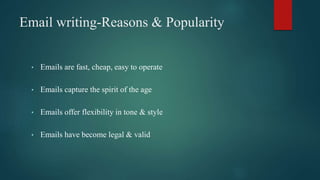
Email writing-Reasons & Popularity
• Emails are fast, cheap, easy to operate
• Emails capture the spirit of the age
• Emails offer flexibility in tone & style
• Emails have become legal & valid
Email writing- Some common pitfalls
• Privacy is lost
• Casualness creeps in
• Ambiguity impairs communication
• Virtue is sacrificed to inconvenience
• Junkyard is always full
Email writing- Principles for composition
• Courteous
• Complete
• Compact
• correct
• Concise
• Take care of punctuation marks
• Use salutations and
complimentary close
• Use subject lines effectively
• Avoid all capital letters
• Identify yourself
Email writing- common etiquette
• Reply immediately
• Avoid circulating emails to
everyone
• Avoid attaching unnecessary files
• Answer all queries
• Avoid sexist language
• Be aware of email jargon
• Keep your mail box uncluttered
• Read and edit your mails
Phone etiquette
Some common etiquettes of phone calls
• Answering Calls
• Tactful Responses
• Taking Messages
• Handling Rude Callers
• Making calls
• Ending Conversations
• Voicemail Etiquette
• Caller Complaints
Answering Calls For Your Department
• Answer promptly
• Before third ring if possible
• Discontinue all activities
• Other conversations , Eating,
Chewing gum
Speak clearly
Use pleasant tone
• Identify yourself
• Listen
• Do not interrupt
• Use hold button
• Explain transfers
• Why and where
Tactful Responses
• "She is busy.” “She is unavailable at the moment.”
• "He hasn't come in yet.” "I expect him shortly."
• "I don't know where he is.” "He has stepped out of the
office.”
• "He is out." "He is not in the office at the moment.”
• "She took the day off.” "She is out of the office for the day. Can
someone else help you?"
Taking Messages
• Be Prepared (with pen and paper )
• Ask For:
• Caller’s name with correct spelling
• Caller’s phone number
• What the call is in regards to
• Convey message to the person –Notate Date & Time
**Don’t forget to give the message to the intended recipient!
Handling Rude Callers
Stay calm, speak slowly, clearly and calmly
Remain diplomatic & polite : Acknowledge their feelings
Show willingness to resolve problem
Listen completely to the complaint, allow the caller to vent
Only when they are finished should you comment
For long-distance calls offer to call them back to avoid phone charges
Ending Conversations Gracefully
• Ways to end a long phone call:
• Leave conversation open
• Promise to finish conversation at another time
• End on an “up” note
Making Calls
• Identify yourself first
• State purpose of the communication
• Ask questions if needed to get to correct department/person
• Reached a wrong number
• Say: “I’m sorry, I must have the wrong number. Please excuse the
interruption.” And then hang up.
Voicemail Etiquette
• Update greeting regularly
• Let callers know when you will
return their call
• Extended absences
• Let callers know when you will be
returning and how they can contact
an alternate person if needed.
• Keep It Short & Simple
• Take your time while recording,
and sound sincere
• Check messages daily
• Return messages within 24 hours
Frequent Caller Complaints
• The telephone rings for a long time before it is answered.
• They place me on hold for a long time.
• The line is always busy.
• They don’t listen to my needs before transferring me.
• I get disconnected while being transferred.
• The person says “wait "and talks to other coworkers without putting me on hold.
• They answer with an aggravated voice.
General Guidelines
• Get the best time and phone number to be reached if taking a message.
• Do not call before 8 a.m. or after 9 p.m. unless you have specific
permission.
• Don’t make a habit of receiving personal calls at work.
• Don’t handle a rude caller openly at the service desk or call center.
Telephone Etiquette Summary
• Think about if you were the person on the other side of the line; how
would you want to be treated?
• Give respect, get results.
• “Smile” while you’re on the phone –it will make a huge impact on
your communications!
• Customer service can be hard work!
Thank You!!

2. telephone emailetiquette

  • 1.
    E-mail & Phoneetiquette BY: POOJA RAJ SRIVASTAVA
  • 2.
  • 3.
    Email writing-Reasons &Popularity • Emails are fast, cheap, easy to operate • Emails capture the spirit of the age • Emails offer flexibility in tone & style • Emails have become legal & valid
  • 4.
    Email writing- Somecommon pitfalls • Privacy is lost • Casualness creeps in • Ambiguity impairs communication • Virtue is sacrificed to inconvenience • Junkyard is always full
  • 5.
    Email writing- Principlesfor composition • Courteous • Complete • Compact • correct • Concise • Take care of punctuation marks • Use salutations and complimentary close • Use subject lines effectively • Avoid all capital letters • Identify yourself
  • 6.
    Email writing- commonetiquette • Reply immediately • Avoid circulating emails to everyone • Avoid attaching unnecessary files • Answer all queries • Avoid sexist language • Be aware of email jargon • Keep your mail box uncluttered • Read and edit your mails
  • 7.
  • 8.
    Some common etiquettesof phone calls • Answering Calls • Tactful Responses • Taking Messages • Handling Rude Callers • Making calls • Ending Conversations • Voicemail Etiquette • Caller Complaints
  • 9.
    Answering Calls ForYour Department • Answer promptly • Before third ring if possible • Discontinue all activities • Other conversations , Eating, Chewing gum Speak clearly Use pleasant tone • Identify yourself • Listen • Do not interrupt • Use hold button • Explain transfers • Why and where
  • 10.
    Tactful Responses • "Sheis busy.” “She is unavailable at the moment.” • "He hasn't come in yet.” "I expect him shortly." • "I don't know where he is.” "He has stepped out of the office.” • "He is out." "He is not in the office at the moment.” • "She took the day off.” "She is out of the office for the day. Can someone else help you?"
  • 11.
    Taking Messages • BePrepared (with pen and paper ) • Ask For: • Caller’s name with correct spelling • Caller’s phone number • What the call is in regards to • Convey message to the person –Notate Date & Time **Don’t forget to give the message to the intended recipient!
  • 12.
    Handling Rude Callers Staycalm, speak slowly, clearly and calmly Remain diplomatic & polite : Acknowledge their feelings Show willingness to resolve problem Listen completely to the complaint, allow the caller to vent Only when they are finished should you comment For long-distance calls offer to call them back to avoid phone charges
  • 13.
    Ending Conversations Gracefully •Ways to end a long phone call: • Leave conversation open • Promise to finish conversation at another time • End on an “up” note
  • 14.
    Making Calls • Identifyyourself first • State purpose of the communication • Ask questions if needed to get to correct department/person • Reached a wrong number • Say: “I’m sorry, I must have the wrong number. Please excuse the interruption.” And then hang up.
  • 15.
    Voicemail Etiquette • Updategreeting regularly • Let callers know when you will return their call • Extended absences • Let callers know when you will be returning and how they can contact an alternate person if needed. • Keep It Short & Simple • Take your time while recording, and sound sincere • Check messages daily • Return messages within 24 hours
  • 16.
    Frequent Caller Complaints •The telephone rings for a long time before it is answered. • They place me on hold for a long time. • The line is always busy. • They don’t listen to my needs before transferring me. • I get disconnected while being transferred. • The person says “wait "and talks to other coworkers without putting me on hold. • They answer with an aggravated voice.
  • 17.
    General Guidelines • Getthe best time and phone number to be reached if taking a message. • Do not call before 8 a.m. or after 9 p.m. unless you have specific permission. • Don’t make a habit of receiving personal calls at work. • Don’t handle a rude caller openly at the service desk or call center.
  • 18.
    Telephone Etiquette Summary •Think about if you were the person on the other side of the line; how would you want to be treated? • Give respect, get results. • “Smile” while you’re on the phone –it will make a huge impact on your communications! • Customer service can be hard work!
  • 19.