Telephone EtiquetteABE 302Fall 2010
Aspects of Telephone EtiquetteMaking a CallAnswering a CallLeaving a Message
Making a CallTime of daySelf-identificationGetting ThroughPurpose for the CallClarity of speechTone of voice
Making a CallTime of DayCalling too early or late can be considered rude.What is too early or too late?Guideline: don’t call at a time where the person may likely be asleep(before 7:00 am or after 9:00-10:00pm).Avoid calling around the usual times people would be eating.This is considered common courtesy.Also, avoid calling a business around closing time.
Making a CallSelf IdentificationIt is considered good manners to identify yourself after the person on the other end picks up the phone.Example phrases:“This is _______”“_________ here…”“(Hey) It’s ______”“My name is _______...”“I’m calling from _______”
Making a CallGetting Through to the Right PersonAsk to speak with the person you intended to call(If you know that it is a shared number or office phone number)Sample Phrases:“May I please speak with _________”“Could you please put me through to _____”“ Could I be connected with _______”“Is ______ available?”“Is ______ home/there”“Can I talk to ______”“Put ______ on the phone”
Making a CallPurpose for the CallOnce you have identified yourself and are speaking to your target audience, it is time to state your reason for calling.Be direct and to the point.One or two sentences maximum.After you’ve stated the purpose of your call, be sure to ask if it is a convenient time.Let the person know how much time you will need for the call.Be honest.
Making a CallClarity of SpeechBe sure to speak clearly and enunciate your words.It can be hard to understand a caller if they are not trying to speak clearly.This creates the need for repetition and can sometimes be frustrating for both the listener and the caller.It may also be necessary to adjust your normal rate of speech while on the phone.
Making a CallTone of VoiceRemember: The person you are speaking to cannot see you so your voice reflects your courtesy.If you smile while speaking on the phone, it will be reflected in your tone.Short words or responses can sound rude on the phone if they aren’t carefully inflected.
Answering a CallLetting it ringGreetingSelf-identificationPutting People on HoldTaking a Message
Answering a CallLetting it RingLet the phone ring a reasonable length of time.Don’t wait too long or you will miss the callDon’t pick up on the first ringIt can startle the caller, they may not be ready for youIf you rush, you may sound out of breath or impatient
Answering a CallGreetingThe standard greeting for answering the phone is “hello”.“Yes” is considered to short and sounds rude.In an office or at a business it is typical to answer the phone by identifying the company and then the speakeri.e. “ESL Department, Clara speaking. (How may I help you?)”
Answering a CallSelf IdentificationOnce the standard greeting has been given, it is standard for the speaker to identify themselves *unless it is their  personal phone line, in which case they assume the caller knows who they are calling.Examples:“Hello,  this is John. With whom am I speaking?”“HR department, Ray speaking. How can I help you?”
Answering a CallPutting People on Hold If you have an incoming call, you may choose to ignore it or put the person you are speaking with on hold.If you must put someone on hold, explain to them why. Be sure to do this diplomatically and politely.People are more likely to be patient if you explain the reason for their inconvenience.
Answering a CallTaking a MessageIf the person that the caller seeks is not in, ask if you can take a message.i.e. “May I take a message?”Ask for their name, purpose of their call, the desired response (would they like to be called back) and their phone number.Repeat the information back the the caller to make sure it is correct.
Leaving a MessageWith a PersonOn Voicemail
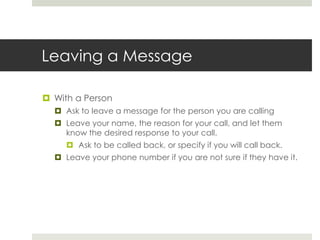
Leaving a MessageWith a PersonAsk to leave a message for the person you are callingLeave your name, the reason for your call, and let them know the desired response to your call.Ask to be called back, or specify if you will call back.Leave your phone number if you are not sure if they have it.
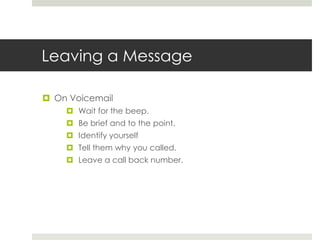
Leaving a MessageOn VoicemailWait for the beep.Be brief and to the point.Identify yourselfTell them why you called.Leave a call back number.

Telephone etiquette

  • 1.
  • 3.
    Aspects of TelephoneEtiquetteMaking a CallAnswering a CallLeaving a Message
  • 4.
    Making a CallTimeof daySelf-identificationGetting ThroughPurpose for the CallClarity of speechTone of voice
  • 5.
    Making a CallTimeof DayCalling too early or late can be considered rude.What is too early or too late?Guideline: don’t call at a time where the person may likely be asleep(before 7:00 am or after 9:00-10:00pm).Avoid calling around the usual times people would be eating.This is considered common courtesy.Also, avoid calling a business around closing time.
  • 6.
    Making a CallSelfIdentificationIt is considered good manners to identify yourself after the person on the other end picks up the phone.Example phrases:“This is _______”“_________ here…”“(Hey) It’s ______”“My name is _______...”“I’m calling from _______”
  • 7.
    Making a CallGettingThrough to the Right PersonAsk to speak with the person you intended to call(If you know that it is a shared number or office phone number)Sample Phrases:“May I please speak with _________”“Could you please put me through to _____”“ Could I be connected with _______”“Is ______ available?”“Is ______ home/there”“Can I talk to ______”“Put ______ on the phone”
  • 8.
    Making a CallPurposefor the CallOnce you have identified yourself and are speaking to your target audience, it is time to state your reason for calling.Be direct and to the point.One or two sentences maximum.After you’ve stated the purpose of your call, be sure to ask if it is a convenient time.Let the person know how much time you will need for the call.Be honest.
  • 9.
    Making a CallClarityof SpeechBe sure to speak clearly and enunciate your words.It can be hard to understand a caller if they are not trying to speak clearly.This creates the need for repetition and can sometimes be frustrating for both the listener and the caller.It may also be necessary to adjust your normal rate of speech while on the phone.
  • 10.
    Making a CallToneof VoiceRemember: The person you are speaking to cannot see you so your voice reflects your courtesy.If you smile while speaking on the phone, it will be reflected in your tone.Short words or responses can sound rude on the phone if they aren’t carefully inflected.
  • 11.
    Answering a CallLettingit ringGreetingSelf-identificationPutting People on HoldTaking a Message
  • 12.
    Answering a CallLettingit RingLet the phone ring a reasonable length of time.Don’t wait too long or you will miss the callDon’t pick up on the first ringIt can startle the caller, they may not be ready for youIf you rush, you may sound out of breath or impatient
  • 13.
    Answering a CallGreetingThestandard greeting for answering the phone is “hello”.“Yes” is considered to short and sounds rude.In an office or at a business it is typical to answer the phone by identifying the company and then the speakeri.e. “ESL Department, Clara speaking. (How may I help you?)”
  • 14.
    Answering a CallSelfIdentificationOnce the standard greeting has been given, it is standard for the speaker to identify themselves *unless it is their personal phone line, in which case they assume the caller knows who they are calling.Examples:“Hello, this is John. With whom am I speaking?”“HR department, Ray speaking. How can I help you?”
  • 15.
    Answering a CallPuttingPeople on Hold If you have an incoming call, you may choose to ignore it or put the person you are speaking with on hold.If you must put someone on hold, explain to them why. Be sure to do this diplomatically and politely.People are more likely to be patient if you explain the reason for their inconvenience.
  • 16.
    Answering a CallTakinga MessageIf the person that the caller seeks is not in, ask if you can take a message.i.e. “May I take a message?”Ask for their name, purpose of their call, the desired response (would they like to be called back) and their phone number.Repeat the information back the the caller to make sure it is correct.
  • 17.
    Leaving a MessageWitha PersonOn Voicemail
  • 18.
    Leaving a MessageWitha PersonAsk to leave a message for the person you are callingLeave your name, the reason for your call, and let them know the desired response to your call.Ask to be called back, or specify if you will call back.Leave your phone number if you are not sure if they have it.
  • 19.
    Leaving a MessageOnVoicemailWait for the beep.Be brief and to the point.Identify yourselfTell them why you called.Leave a call back number.

Editor's Notes

  • #3 http://ist.psu.edu/currentstudents/careersolutions/resources/profdev/page2.cfm?intpageid=633
  • #7 http://www.audioenglish.net/english-learning/efl_telephone.htm