Proper Telephone Etiquette
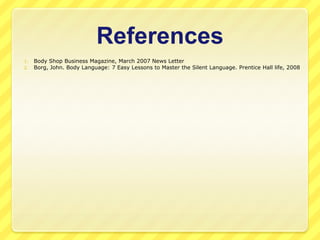
Why Is It Important?A customer’s first impression of your practice is formed during their first few seconds of contact over the phone or in person.More than 80% of your first-time customers call before coming into your practice.[2]It is often said that human communication consists of 93% body language… while only 7% of communication consists of words themselves.[1]Whether answering the phone or making phone calls, using the proper etiquette is a must in order to maintain a certain level of professionalism. Proper etiquette leaves callers with a favorable impression of you, your department, and the practice in general.Therefore, it is imperative to be at your best when answering the telephone.
Remember …..That customers may have already been interacting with their telephone key pad, and pre-recorded messages, so some of the initial impression may be out of the hands of your agents.Remember that you may be the first and only contact a person may have with your practice, and that first impression will stay with the caller long after the call is completed. So the key moment is when the speaking starts. Engage the caller and get them on your side.You need to lay the groundwork even before you pick up the phone, and you do this by …..
Smile and the World Smiles With YouThere are many characteristics that come across the phone.Body Language
Pleasantness
Courteousness
Responsiveness
Friendliness
Articulate
Attitude
Helpfulness
Sincerity
Confidence
Rate of Speech
Good Listener
Attentiveness
Posture
Demeanor
Name
Smile
Informative
Recall Ability
Greeting
Vocal ToneLet’s Try It……..Did you know people can hear you smile? It's true.Say good morning in two ways:first, without a smileand now, with a smile You'll notice there's an inflection when you smile and it gives your voice energy and a cheery tone.And that voice inflection conveys friendliness to the person at the other end of the line.
Get Ready For ItBefore picking up the receiver, discontinue any other conversation or activity such as eating, chewing gum, typing, etc. that may be heard by the calling party. Cell phones should be placed on low volume, vibrate, or silent.Sit up and SMILE!!!Answer promptly (before the third ring if possible).Speak clearly and distinctly in a pleasant tone of voice. If the caller has reached the wrong person and/or department, be courteous. Sometimes they have been transferred multiple times with a simple question.If possible, attempt to find out where they should call/to whom they should speak, and provide a direct number. They will greatly appreciate it.
The GreetingA bright, cheerful greeting will lift most people’s spirits and set the proper tone for the call.Speak clearly and at a conversational pace; softly yet audible.Don’t mumble or race through the greeting. This can give the impression that you don’t have time for the caller.“Thank you for calling Dr. X’s office, my name is Jessica, How may I help you today?”
The Verbal HandshakeA verbal handshake builds on the framework you set-up with the greeting.It makes the call more personal, and helps to disarm irate callers.So, ask for the caller's name, and introduce yourself.Jessica: Who am I speaking to, please?Caller: My name’s Brad.Jessica: Hi Brad, my name is Jessica, How are you today?
Ooops …Forgetting or mispronouncing the caller’s name, after they have provided it will put the prospect or customer off side immediately.Make sure you jot down the caller’s name (how to pronounce it phonetically), and what line they are on.Should you need to place them on hold and field multiple calls, you wont forget who is on which line.If you do mispronounce their name, which can happen, apologize, ask them how to pronounce it properly, tell them you want to get it right.
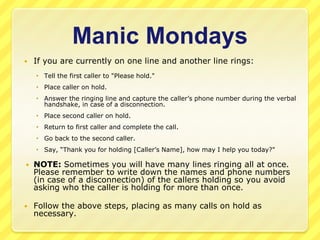
Manic MondaysIf you are currently on one line and another line rings: Tell the first caller to "Please hold."Place caller on hold.Answer the ringing line and capture the caller’s phone number during the verbal handshake, in case of a disconnection.Place second caller on hold.Return to first caller and complete the call.Go back to the second caller.Say, “Thank you for holding [Caller’s Name], how may I help you today?"NOTE: Sometimes you will have many lines ringing all at once. Please remember to write down the names and phone numbers (in case of a disconnection) of the callers holding so you avoid asking who the caller is holding for more than once. Follow the above steps, placing as many calls on hold as necessary.
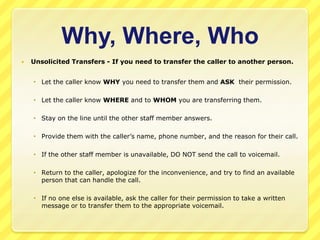
Why, Where, WhoUnsolicited Transfers - If you need to transfer the caller to another person.Let the caller know WHY you need to transfer them and ASK  their permission.Let the caller know WHERE and to WHOM you are transferring them.Stay on the line until the other staff member answers.Provide them with the caller’s name, phone number, and the reason for their call.If the other staff member is unavailable, DO NOT send the call to voicemail.Return to the caller, apologize for the inconvenience, and try to find an available person that can handle the call.If no one else is available, ask the caller for their permission to take a written message or to transfer them to the appropriate voicemail.
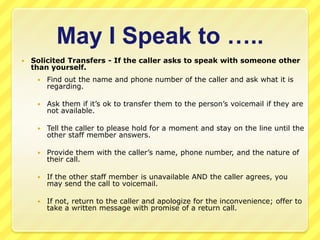
May I Speak to …..Solicited Transfers - If the caller asks to speak with someone other than yourself.
Find out the name and phone number of the caller and ask what it is regarding.
Ask them if it’s ok to transfer them to the person’s voicemail if they are not available.
Tell the caller to please hold for a moment and stay on the line until the other staff member answers.
Provide them with the caller’s name, phone number, and the nature of their call.
If the other staff member is unavailable AND the caller agrees, you may send the call to voicemail.
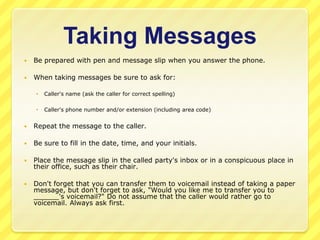
If not, return to the caller and apologize for the inconvenience; offer to take a written message with promise of a return call. Taking MessagesBe prepared with pen and message slip when you answer the phone.When taking messages be sure to ask for: Caller's name (ask the caller for correct spelling)Caller's phone number and/or extension (including area code)Repeat the message to the caller.Be sure to fill in the date, time, and your initials.Place the message slip in the called party's inbox or in a conspicuous place in their office, such as their chair.Don't forget that you can transfer them to voicemail instead of taking a paper message, but don't forget to ask, "Would you like me to transfer you to ______'s voicemail?" Do not assume that the caller would rather go to voicemail. Always ask first.
Handling Rude or Impatient CallersRemember it’s not WHAT you say, it’s HOW you say it!!!Stay calm. Try to remain diplomatic and polite. Getting angry will only make them angrier.Enthusiasm and Sincerity. Always show willingness to resolve the problem or conflict, and sound sincere. Be Empathic. Try to think like the caller. Remember, their problems and concerns are important.Non-supervisory: Offer to have your supervisor talk to the caller or call him/her back if the caller persists. Supervisor: Be willing to handle irate callers. Speak slowly and calmly. Be firm with your answers, but understanding. Sometimes the irate caller just wants someone in a supervisory capacity to listen to their story even if you are unable to help them.

Telephone Etiquette

  • 1.
  • 2.
    Why Is ItImportant?A customer’s first impression of your practice is formed during their first few seconds of contact over the phone or in person.More than 80% of your first-time customers call before coming into your practice.[2]It is often said that human communication consists of 93% body language… while only 7% of communication consists of words themselves.[1]Whether answering the phone or making phone calls, using the proper etiquette is a must in order to maintain a certain level of professionalism. Proper etiquette leaves callers with a favorable impression of you, your department, and the practice in general.Therefore, it is imperative to be at your best when answering the telephone.
  • 3.
    Remember …..That customersmay have already been interacting with their telephone key pad, and pre-recorded messages, so some of the initial impression may be out of the hands of your agents.Remember that you may be the first and only contact a person may have with your practice, and that first impression will stay with the caller long after the call is completed. So the key moment is when the speaking starts. Engage the caller and get them on your side.You need to lay the groundwork even before you pick up the phone, and you do this by …..
  • 4.
    Smile and theWorld Smiles With YouThere are many characteristics that come across the phone.Body Language
  • 5.
  • 6.
  • 7.
  • 8.
  • 9.
  • 10.
  • 11.
  • 12.
  • 13.
  • 14.
  • 15.
  • 16.
  • 17.
  • 18.
  • 19.
  • 20.
  • 21.
  • 22.
  • 23.
  • 24.
    Vocal ToneLet’s TryIt……..Did you know people can hear you smile? It's true.Say good morning in two ways:first, without a smileand now, with a smile You'll notice there's an inflection when you smile and it gives your voice energy and a cheery tone.And that voice inflection conveys friendliness to the person at the other end of the line.
  • 25.
    Get Ready ForItBefore picking up the receiver, discontinue any other conversation or activity such as eating, chewing gum, typing, etc. that may be heard by the calling party. Cell phones should be placed on low volume, vibrate, or silent.Sit up and SMILE!!!Answer promptly (before the third ring if possible).Speak clearly and distinctly in a pleasant tone of voice. If the caller has reached the wrong person and/or department, be courteous. Sometimes they have been transferred multiple times with a simple question.If possible, attempt to find out where they should call/to whom they should speak, and provide a direct number. They will greatly appreciate it.
  • 26.
    The GreetingA bright,cheerful greeting will lift most people’s spirits and set the proper tone for the call.Speak clearly and at a conversational pace; softly yet audible.Don’t mumble or race through the greeting. This can give the impression that you don’t have time for the caller.“Thank you for calling Dr. X’s office, my name is Jessica, How may I help you today?”
  • 27.
    The Verbal HandshakeAverbal handshake builds on the framework you set-up with the greeting.It makes the call more personal, and helps to disarm irate callers.So, ask for the caller's name, and introduce yourself.Jessica: Who am I speaking to, please?Caller: My name’s Brad.Jessica: Hi Brad, my name is Jessica, How are you today?
  • 28.
    Ooops …Forgetting ormispronouncing the caller’s name, after they have provided it will put the prospect or customer off side immediately.Make sure you jot down the caller’s name (how to pronounce it phonetically), and what line they are on.Should you need to place them on hold and field multiple calls, you wont forget who is on which line.If you do mispronounce their name, which can happen, apologize, ask them how to pronounce it properly, tell them you want to get it right.
  • 29.
    Manic MondaysIf youare currently on one line and another line rings: Tell the first caller to "Please hold."Place caller on hold.Answer the ringing line and capture the caller’s phone number during the verbal handshake, in case of a disconnection.Place second caller on hold.Return to first caller and complete the call.Go back to the second caller.Say, “Thank you for holding [Caller’s Name], how may I help you today?"NOTE: Sometimes you will have many lines ringing all at once. Please remember to write down the names and phone numbers (in case of a disconnection) of the callers holding so you avoid asking who the caller is holding for more than once. Follow the above steps, placing as many calls on hold as necessary.
  • 30.
    Why, Where, WhoUnsolicitedTransfers - If you need to transfer the caller to another person.Let the caller know WHY you need to transfer them and ASK their permission.Let the caller know WHERE and to WHOM you are transferring them.Stay on the line until the other staff member answers.Provide them with the caller’s name, phone number, and the reason for their call.If the other staff member is unavailable, DO NOT send the call to voicemail.Return to the caller, apologize for the inconvenience, and try to find an available person that can handle the call.If no one else is available, ask the caller for their permission to take a written message or to transfer them to the appropriate voicemail.
  • 31.
    May I Speakto …..Solicited Transfers - If the caller asks to speak with someone other than yourself.
  • 32.
    Find out thename and phone number of the caller and ask what it is regarding.
  • 33.
    Ask them ifit’s ok to transfer them to the person’s voicemail if they are not available.
  • 34.
    Tell the callerto please hold for a moment and stay on the line until the other staff member answers.
  • 35.
    Provide them withthe caller’s name, phone number, and the nature of their call.
  • 36.
    If the otherstaff member is unavailable AND the caller agrees, you may send the call to voicemail.
  • 37.
    If not, returnto the caller and apologize for the inconvenience; offer to take a written message with promise of a return call. Taking MessagesBe prepared with pen and message slip when you answer the phone.When taking messages be sure to ask for: Caller's name (ask the caller for correct spelling)Caller's phone number and/or extension (including area code)Repeat the message to the caller.Be sure to fill in the date, time, and your initials.Place the message slip in the called party's inbox or in a conspicuous place in their office, such as their chair.Don't forget that you can transfer them to voicemail instead of taking a paper message, but don't forget to ask, "Would you like me to transfer you to ______'s voicemail?" Do not assume that the caller would rather go to voicemail. Always ask first.
  • 38.
    Handling Rude orImpatient CallersRemember it’s not WHAT you say, it’s HOW you say it!!!Stay calm. Try to remain diplomatic and polite. Getting angry will only make them angrier.Enthusiasm and Sincerity. Always show willingness to resolve the problem or conflict, and sound sincere. Be Empathic. Try to think like the caller. Remember, their problems and concerns are important.Non-supervisory: Offer to have your supervisor talk to the caller or call him/her back if the caller persists. Supervisor: Be willing to handle irate callers. Speak slowly and calmly. Be firm with your answers, but understanding. Sometimes the irate caller just wants someone in a supervisory capacity to listen to their story even if you are unable to help them.