Business Etiquettes

Pratyush Banerjee & Sunny Bose
        MTP Workshop
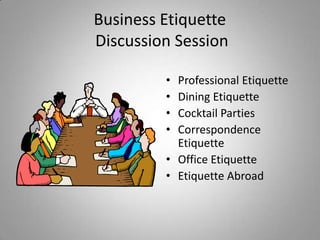
Business Etiquette
Discussion Session

         • Professional Etiquette
         • Dining Etiquette
         • Cocktail Parties
         • Correspondence
           Etiquette
         • Office Etiquette
         • Etiquette Abroad
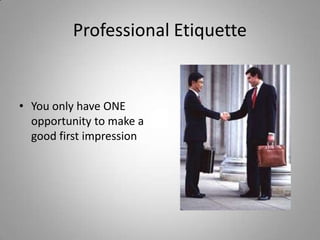
Professional Etiquette


• You only have ONE
  opportunity to make a
  good first impression
First Impressions
• Within 30 seconds people judge your
    –   Economic level
    –   Educational level
    –   Social position
    –   Level of sophistication
    –   Level of success
• Within 4 minutes people decide your
    –   Trustworthiness
    –   Compassion
    –   Reliability
    –   Intelligence
    –   Capability
    –   Humility
    –   Friendliness
    –   Confidence
Are First Impressions Lasting?
•   YES
•   Made with emotional not rational brain
•   Once made rational brain seeks validation
•   Don’t want to change opinions
•   Experience teaches us validity of first
    impressions
Making Positive First Impressions


•   Determine audience
•   Identify their expectations
•   Establish objectives
•   Dress, behave, and communication in a way
    that reflects audience expectations
A,B,C’s of Image
• Appearance
  – Color, wardrobe, grooming
• Behavior
  – Etiquette, civility, attitude
• Communication
  – Verbal, nonverbal, written
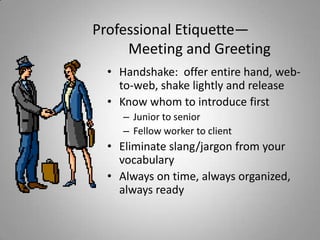
Professional Etiquette—
     Meeting and Greeting
  • Handshake: offer entire hand, web-
    to-web, shake lightly and release
  • Know whom to introduce first
     – Junior to senior
     – Fellow worker to client
  • Eliminate slang/jargon from your
    vocabulary
  • Always on time, always organized,
    always ready
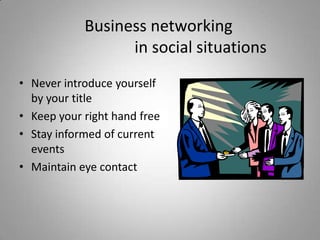
Business networking
                  in social situations
• Never introduce yourself
  by your title
• Keep your right hand free
• Stay informed of current
  events
• Maintain eye contact
Showing Respect
• Always use last names with customers unless

  they are about your age and rank
• Don’t keep customers waiting
• Escort clients out
• When someone of higher rank or from outside
  the organization enters, everyone in the office
  stands
• Junior employees stand until seniors sit
Business Cards

•   Manage business card exchanges flawlessly
•   Always have a supply of cards
•   Ask for someone’s card before offering your own
•   Present card face up
•   Take time to look at received card
•   NEVER turn down an offered card
•   Be selective when distributing cards
•   Be aware of international card etiquette
Lunch/Dinner Host
• Consider preferences of guests
• Give specifics
• Make reservation and reconfirm day before
• Arrive 10 min early, look at table, meet server
• Greet guest at entrance. Guest precedes down aisle.
  Guest gets best seat. Seat yourself to their left.
• Offer menu advice to guests, order easy-to-eat food
  and limit drinks for yourself
Lunch/Dinner Guest
• Reply promptly to invitation
• Only cancel on very urgent business
• Be on time—call restaurant and send message to
  host if late
• If you arrive before host, you may sit at table but eat
  nothing but water until host arrives
• Never order the most expensive item
• Take no notice of check. Do NOT offer to leave tip
• Thank your host!
Lunch/Dinner Meetings--Beginnings
• Stand on the right side of your chair and enter
  from your left
• Napkins go in lap asap—fold toward waist
• Toasts may be offered before eating and after
  dessert. Both are initiated by host. Toasted
  party does NOT drink to himself
• Pass to the right and do not help yourself
  first—pass salt and pepper as a set
Lunch/Dinner Meetings--
                     Ordering Food

• Decide on your menu selections
  quickly
• Order medium-priced food
• Think about the mess factor
• Don’t order alcohol
• Do not share a dessert
Lunch/Dinner Meetings—
      Dealing with the Food

    • Put your napkin in your lap
    • Wait for all people to be served before
      beginning
    • Know which silverware to use with which
      food
    • Cut your meat one bite at a time
    • Break off small bites of bread and butter
      only one bite at a time
    • Hold wine glass by the stem for whites
      and by the bowl for reds
    • Take cues from the host-if in doubt,
      watch and copy
Lunch/Dinner--Foods
• Soup - dip spoon into soup sideways away from you.
  Sip from side. Tip bowl only for last drops. Never
  crumble saltines in soup Rest spoon on plate when
  finished.
• Salad—eat salad with fork, use knife only as last
  resort. Leave utensils on plate at 10:20 position
• Dessert—Slide utensils down from top as dessert is
  served. Place both on plate when finished
Lunch/Dinner—Difficult Foods
• Asparagus—Eat with fingers unless in sauce, then use knife
  and ford
• Bacon—Only very crisp bacon may be eaten with fingers
• Pastries—Cut in halves or quarters and eat with fingers or fork
• French fries—Eat with fingers if served with sandwiches or
  burgers
• Grapefruit halves—Eat with spoon, leave juice
• Lemon Wedge—Squeeze over fish with fingers
• Pasta—Separate a few strands with folk. Twirl onto fork with
  tines held again plate
• Potatoes—Eat baked potatoes with a fork. Skins with knife
  and fork. Move butter from butter plate to potato with fork.
  Never mash potatoes on plate. Eat chips with fingers
Lunch/Dinner - Taboos
•   Elbows on table
•   Salt/pepper on food before tasting
•   Talking with mouth full
•   Drinking with food in mouth
•   Gesturing with silverware
•   Pushing back or stacking plates at end of meal
•   Answering or placing cell phone calls at table
•   Dunking anything into coffee or water
•   Making a fuss over incorrect orders
•   Arranging hair or applying makeup at table
•   Picking your teeth at the table
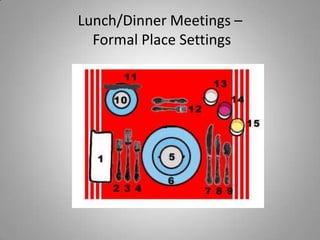
Lunch/Dinner Meetings –
  Formal Place Settings
Lunch/Dinner Meetings - Extras

• Don’t eat with your mouth full
• Keep one hand in your lap unless you are eating European
  style
• Remove anything from your mouth with the same implement
  that it went in with (except bones)
• Eat at a moderate speed
• Try to maintain some polite dinner conversation
• Never medicate yourself at the table
• If you must leave the table, place your napkin in your chair
Lunch/Dinner Meetings—
               Easy endings

• Knife and fork side by side in the 10:20
  position on dinner plate
• The host or person who has issued invitation
  pays (regardless of gender)
• If you are paying bill, handle it with
  waitperson as discreetly as possible
• As you depart table, refold your napkin simply
  and leave it to left of place setting
Cocktail Parties
• Work event—not social
• Determine your strategy: network with new people
  or certain known targets
• Don’t just hang out with friends
• Enter room, step to one side, survey room
• Move toward friendly faces or already formed group
• If someone enters your group, greet them and make
  introductions
Cocktail Party Tips
• Go to food table first—easiest place to start
  conversations
• Stand in middle of room or near food table, stay
  away from walls
• Learn how to hold napkin, plate and glass in one
  hand
• Keep one hand free to shake hands
• Don’t overindulge in alcohol
• Maneuver among people—don’t get stuck
Small Talk

• 3 distinct parts
  – Opener
  – Middle
  – Break away
Small Talk Openers
• Individuals
   – Compliment, weather, food, current event
   – “I love your______. Is it a family heirloom?”
• Group
   – Something pertaining to everyone
   – “How do you all know each other?”
   – “Will you be traveling this summer?”
• Casual acquaintances
   – General comments
   – “How has your year been?”
Small Talk Middle
• Safe topics
  – Sports, books, movies, theater, art, travel
• Questions
  – Ask, listen, elaborate with matching experience,
    Ask again
• Be more interested than interesting
Small Talk Break-Away
• Stay no more than 10 min in one place
• Break-away lines
  – “I don’t want to monopolize you.”
  – “I’m going to circulate.”
  – “I see someone I must meet.”
• Tell them you enjoyed speaking with them
• Discuss next steps
  – Going for food, to next person, etc.
Correspondence Etiquette
• Every written invitation gets a response
  unless it asks for money
• Respond within 1 week
• Follow directions for response
• Special instructions (dress code) will be in
  lower corners
• Envelope will indicate if you may bring
  guest
• Send “Thank you” letters
• Always include a cover letter for written
  documents
• Sit on written documents for 24 hours (if
  possible)
E-mail Etiquette
      • E-mail only those people to whom
        your messages actually pertain to—
        don’t send mass or chain letters
      • M-ake a point of responding to
        messages promptly
      • A-lways use spell-check and grammar
        check before sending messages—be
        brief and clear
      • I-nclude your telephone number in
        your message
      • L-earn that e-mail should be used for
        business rather than personal use—
        don’t send anything you wouldn’t want
        to see in public
Telephone manners
• Answer the phone with your name and company (or
  department)
• When placing calls, state your name and company or
  department immediately when phone is answered
• Speak clearly
• State the purpose of your call
• Only use speakerphone for conference calls
• Always smile when using the phone
• Say please and thank you
• Judge your audience before making small talk
• Return your calls
Voice Mail/Mobile Phone Use
     • Realize proper usage of mobile phones in
       business
     • Understand how to leave an adequate voice
       message
     • Check messages frequently on a daily basis
     • Avoid using in a restaurant, movie, church, or
       meeting
     • Limit your conversation when in close quarters
     • Use a quiet voice
     • Don’t give out credit card #
     • Refrain from using when driving
Office Etiquette

• Be self-aware-use common sense
• Mind your own business
• Avoid strong cologne
• Never ever go over your supervisor’s head
• Obey your company’s business dress attire
• Treat every employee with the same
  respect
• Do not post things of an offensive nature
• No matter your job or your title, always
  hold yourself to a higher standard
The 12 Commandments of Cubicle Etiquette

•   Thou shall not enter another person’s   •   Thou shall realize that everything you
    cubicle unless you are invited.             say makes an impression on your
•   Thou shall not interrupt someone            “internal customers.”
    who is on the telephone by using sign   •   Thou shall not make or receive
    language or any other means of              personal telephone calls during the
    communication.                              workday.
•   Thou shall think twice before           •   Thou shall not establish eye contact
    interrupting someone who appears            with someone when you would
    deep in thought.                            prefer not to be interrupted.
•   Thou shall be aware of how your         •   Thou shall stand up and walk toward
    voice projects.                             the entrance of your cubicle when
•   Thou shall realize that speaker             you would like an impromptu
    phones and cubicles don’t mix.              meeting short.
•   Thou shall not discuss a confidential   •   Thou shall recognize your cubicle is a
    matter in a cubicle setting.                direct reflection of you. Keep it neat
                                                and orderly.
Meeting Etiquette
   • Always have your calendar, notebook &
     pen
   • Never bring up personal
     problems/issues in a professional
     situation
   • Avoid “you” talk
   • Stay on schedule
   • In conference rooms hang back until
     power players have taken seats: ends
     and middle sides of table are power
     seats
Etiquette Abroad
• Know the various
  cultural nuances of the
  particular country
• Do your homework
• Problem solving &
  issues of protocol and
  chain of command
  differ greatly between
  countries
Thank You.

Business etiquette

  • 1.
    Business Etiquettes Pratyush Banerjee& Sunny Bose MTP Workshop
  • 2.
    Business Etiquette Discussion Session • Professional Etiquette • Dining Etiquette • Cocktail Parties • Correspondence Etiquette • Office Etiquette • Etiquette Abroad
  • 3.
    Professional Etiquette • Youonly have ONE opportunity to make a good first impression
  • 4.
    First Impressions • Within30 seconds people judge your – Economic level – Educational level – Social position – Level of sophistication – Level of success • Within 4 minutes people decide your – Trustworthiness – Compassion – Reliability – Intelligence – Capability – Humility – Friendliness – Confidence
  • 5.
    Are First ImpressionsLasting? • YES • Made with emotional not rational brain • Once made rational brain seeks validation • Don’t want to change opinions • Experience teaches us validity of first impressions
  • 6.
    Making Positive FirstImpressions • Determine audience • Identify their expectations • Establish objectives • Dress, behave, and communication in a way that reflects audience expectations
  • 7.
    A,B,C’s of Image •Appearance – Color, wardrobe, grooming • Behavior – Etiquette, civility, attitude • Communication – Verbal, nonverbal, written
  • 8.
    Professional Etiquette— Meeting and Greeting • Handshake: offer entire hand, web- to-web, shake lightly and release • Know whom to introduce first – Junior to senior – Fellow worker to client • Eliminate slang/jargon from your vocabulary • Always on time, always organized, always ready
  • 9.
    Business networking in social situations • Never introduce yourself by your title • Keep your right hand free • Stay informed of current events • Maintain eye contact
  • 10.
    Showing Respect • Alwaysuse last names with customers unless they are about your age and rank • Don’t keep customers waiting • Escort clients out • When someone of higher rank or from outside the organization enters, everyone in the office stands • Junior employees stand until seniors sit
  • 11.
    Business Cards • Manage business card exchanges flawlessly • Always have a supply of cards • Ask for someone’s card before offering your own • Present card face up • Take time to look at received card • NEVER turn down an offered card • Be selective when distributing cards • Be aware of international card etiquette
  • 12.
    Lunch/Dinner Host • Considerpreferences of guests • Give specifics • Make reservation and reconfirm day before • Arrive 10 min early, look at table, meet server • Greet guest at entrance. Guest precedes down aisle. Guest gets best seat. Seat yourself to their left. • Offer menu advice to guests, order easy-to-eat food and limit drinks for yourself
  • 13.
    Lunch/Dinner Guest • Replypromptly to invitation • Only cancel on very urgent business • Be on time—call restaurant and send message to host if late • If you arrive before host, you may sit at table but eat nothing but water until host arrives • Never order the most expensive item • Take no notice of check. Do NOT offer to leave tip • Thank your host!
  • 14.
    Lunch/Dinner Meetings--Beginnings • Standon the right side of your chair and enter from your left • Napkins go in lap asap—fold toward waist • Toasts may be offered before eating and after dessert. Both are initiated by host. Toasted party does NOT drink to himself • Pass to the right and do not help yourself first—pass salt and pepper as a set
  • 15.
    Lunch/Dinner Meetings-- Ordering Food • Decide on your menu selections quickly • Order medium-priced food • Think about the mess factor • Don’t order alcohol • Do not share a dessert
  • 16.
    Lunch/Dinner Meetings— Dealing with the Food • Put your napkin in your lap • Wait for all people to be served before beginning • Know which silverware to use with which food • Cut your meat one bite at a time • Break off small bites of bread and butter only one bite at a time • Hold wine glass by the stem for whites and by the bowl for reds • Take cues from the host-if in doubt, watch and copy
  • 17.
    Lunch/Dinner--Foods • Soup -dip spoon into soup sideways away from you. Sip from side. Tip bowl only for last drops. Never crumble saltines in soup Rest spoon on plate when finished. • Salad—eat salad with fork, use knife only as last resort. Leave utensils on plate at 10:20 position • Dessert—Slide utensils down from top as dessert is served. Place both on plate when finished
  • 18.
    Lunch/Dinner—Difficult Foods • Asparagus—Eatwith fingers unless in sauce, then use knife and ford • Bacon—Only very crisp bacon may be eaten with fingers • Pastries—Cut in halves or quarters and eat with fingers or fork • French fries—Eat with fingers if served with sandwiches or burgers • Grapefruit halves—Eat with spoon, leave juice • Lemon Wedge—Squeeze over fish with fingers • Pasta—Separate a few strands with folk. Twirl onto fork with tines held again plate • Potatoes—Eat baked potatoes with a fork. Skins with knife and fork. Move butter from butter plate to potato with fork. Never mash potatoes on plate. Eat chips with fingers
  • 19.
    Lunch/Dinner - Taboos • Elbows on table • Salt/pepper on food before tasting • Talking with mouth full • Drinking with food in mouth • Gesturing with silverware • Pushing back or stacking plates at end of meal • Answering or placing cell phone calls at table • Dunking anything into coffee or water • Making a fuss over incorrect orders • Arranging hair or applying makeup at table • Picking your teeth at the table
  • 20.
    Lunch/Dinner Meetings – Formal Place Settings
  • 21.
    Lunch/Dinner Meetings -Extras • Don’t eat with your mouth full • Keep one hand in your lap unless you are eating European style • Remove anything from your mouth with the same implement that it went in with (except bones) • Eat at a moderate speed • Try to maintain some polite dinner conversation • Never medicate yourself at the table • If you must leave the table, place your napkin in your chair
  • 22.
    Lunch/Dinner Meetings— Easy endings • Knife and fork side by side in the 10:20 position on dinner plate • The host or person who has issued invitation pays (regardless of gender) • If you are paying bill, handle it with waitperson as discreetly as possible • As you depart table, refold your napkin simply and leave it to left of place setting
  • 23.
    Cocktail Parties • Workevent—not social • Determine your strategy: network with new people or certain known targets • Don’t just hang out with friends • Enter room, step to one side, survey room • Move toward friendly faces or already formed group • If someone enters your group, greet them and make introductions
  • 24.
    Cocktail Party Tips •Go to food table first—easiest place to start conversations • Stand in middle of room or near food table, stay away from walls • Learn how to hold napkin, plate and glass in one hand • Keep one hand free to shake hands • Don’t overindulge in alcohol • Maneuver among people—don’t get stuck
  • 25.
    Small Talk • 3distinct parts – Opener – Middle – Break away
  • 26.
    Small Talk Openers •Individuals – Compliment, weather, food, current event – “I love your______. Is it a family heirloom?” • Group – Something pertaining to everyone – “How do you all know each other?” – “Will you be traveling this summer?” • Casual acquaintances – General comments – “How has your year been?”
  • 27.
    Small Talk Middle •Safe topics – Sports, books, movies, theater, art, travel • Questions – Ask, listen, elaborate with matching experience, Ask again • Be more interested than interesting
  • 28.
    Small Talk Break-Away •Stay no more than 10 min in one place • Break-away lines – “I don’t want to monopolize you.” – “I’m going to circulate.” – “I see someone I must meet.” • Tell them you enjoyed speaking with them • Discuss next steps – Going for food, to next person, etc.
  • 29.
    Correspondence Etiquette • Everywritten invitation gets a response unless it asks for money • Respond within 1 week • Follow directions for response • Special instructions (dress code) will be in lower corners • Envelope will indicate if you may bring guest • Send “Thank you” letters • Always include a cover letter for written documents • Sit on written documents for 24 hours (if possible)
  • 30.
    E-mail Etiquette • E-mail only those people to whom your messages actually pertain to— don’t send mass or chain letters • M-ake a point of responding to messages promptly • A-lways use spell-check and grammar check before sending messages—be brief and clear • I-nclude your telephone number in your message • L-earn that e-mail should be used for business rather than personal use— don’t send anything you wouldn’t want to see in public
  • 31.
    Telephone manners • Answerthe phone with your name and company (or department) • When placing calls, state your name and company or department immediately when phone is answered • Speak clearly • State the purpose of your call • Only use speakerphone for conference calls • Always smile when using the phone • Say please and thank you • Judge your audience before making small talk • Return your calls
  • 32.
    Voice Mail/Mobile PhoneUse • Realize proper usage of mobile phones in business • Understand how to leave an adequate voice message • Check messages frequently on a daily basis • Avoid using in a restaurant, movie, church, or meeting • Limit your conversation when in close quarters • Use a quiet voice • Don’t give out credit card # • Refrain from using when driving
  • 33.
    Office Etiquette • Beself-aware-use common sense • Mind your own business • Avoid strong cologne • Never ever go over your supervisor’s head • Obey your company’s business dress attire • Treat every employee with the same respect • Do not post things of an offensive nature • No matter your job or your title, always hold yourself to a higher standard
  • 34.
    The 12 Commandmentsof Cubicle Etiquette • Thou shall not enter another person’s • Thou shall realize that everything you cubicle unless you are invited. say makes an impression on your • Thou shall not interrupt someone “internal customers.” who is on the telephone by using sign • Thou shall not make or receive language or any other means of personal telephone calls during the communication. workday. • Thou shall think twice before • Thou shall not establish eye contact interrupting someone who appears with someone when you would deep in thought. prefer not to be interrupted. • Thou shall be aware of how your • Thou shall stand up and walk toward voice projects. the entrance of your cubicle when • Thou shall realize that speaker you would like an impromptu phones and cubicles don’t mix. meeting short. • Thou shall not discuss a confidential • Thou shall recognize your cubicle is a matter in a cubicle setting. direct reflection of you. Keep it neat and orderly.
  • 35.
    Meeting Etiquette • Always have your calendar, notebook & pen • Never bring up personal problems/issues in a professional situation • Avoid “you” talk • Stay on schedule • In conference rooms hang back until power players have taken seats: ends and middle sides of table are power seats
  • 36.
    Etiquette Abroad • Knowthe various cultural nuances of the particular country • Do your homework • Problem solving & issues of protocol and chain of command differ greatly between countries
  • 37.