Skills Development
Index
 Are You Listening well.
 Communication Skills.
 Telephone Etiquettes.
 Email Etiquettes.
 Handling of Customer.
 How can you know if you are a bad listener?
A good listener uses his/ her eyes and mind while listening.
 If you find yourself already formulating your next sentence in your mind
while someone is speaking to you, you are doing injustice to the
conversation.
 You will get more out of the conversation if you understand, comprehend
and assimilate what is being said BEFORE responding.
 Good etiquette = listening!
 Do you make these common listening mistakes?
The difference between being a good listener versus a great listener is using
your heart in addition to your eyes and mind while listening.
 Do you do this?
 If a friend tells you something is wrong, you immediately tend to give
advice or criticism.
 If a friend tells you about something wonderful that has happened, you
usually chip in with something similar that you have experienced.
 Rarely do we share joy or sympathize with pain. Rarely do we just let
others speak.
 To improve your listening skills, practice with those closest to you.
 When family members or friends share their thoughts and feelings, limit the
advice to relate what you hear to one of your own experiences
 It facilitates planning.
 Act as a strong ‘Team Worker’ builder.
 It improves relationship among peers,
superiors and subordinates.
 It improves motivation and morale.
Types of Communication
 There are two types of communication
1.Verbal Communication.
2.Non-Verbal Communication.
Verbal Communication
 There are two types of Verbal
Communication.
1.Written.
2.Oral.
Non-Verbal Communication
It includes:-
 Gesture.
 Eye-Contact.
 Posture.
 Facial expression.
Communication Barrier
All factor are adversely affect
effectiveness of communication
are called as “barrier to
communication”
How to overcome from Barrier?
 Clear thinking about objectives, message, wordings.
 Tips on effective communication (like note taking, rephrasing,
summarizing, asking questions to understand needs, active
listening, Smile etc.
 System must be clearly defined and recognized.
 Proper meeting, conference, letters, notice, telephonic talks.
 Basic elements: honesty, sincerity, simplicity
“Professionalism is polite, thoughtful, efficient,
educated, and valuable at all times.’
The following guidelines will help you to make
the first impression a good one:-
Pre-calling guidelines
 Before the call always have purpose in mind.
 If you are calling in relation to a meeting then
prepare an agenda.
 Identify a second point of contact.
 For a conference call identify a coordinator or
a leader to lead the team.
 Answer calls promptly-within 3rings.
 Before picking up the receiver, discontinue
any other conversation or activity such as
chewing gum, typing, etc .that can be heard
by the calling party.
 Keep a note pad and pen handy at your desk.
 Smile as you pick the phone- the caller will
hear it in your voice.
Handling complaints by Phone
 Listen Carefully.
 Convey sincere interest and be empathetic.
 Agree as often as possible.
 Remain calm and courteous. Do Not Argue.
 Do not blame co-workers.
 Do not make unrealistic promises.
 Follow up. Get back to the caller to make sure the
problem has be solved.
Answering calls for others
 Identify yourself and the company for whom you
are answering and say,” How may I help you?
 Offer assistance in the absence of others-say, “
She is not in today, perhaps I can be of
assistance”.
 Do not make commitments for others-say, “I’ll give
him/her your message when he/she returns,” rather
than- “He will can you as soon as he returns”.
 Take accurate, legible messages with time, date,
reason for call, urgency, company represented, if
any, the best time to reach them and all other
pertinent information.
Transferring Calls
 Explain the reason for the transfer-( “ let me
connect you with Mr. XYZ in that dept.). Use
the name of the person you are transferring
to whenever possible.
 Know the transfer instructions for the
telephone system so that you do not cut off
your caller.
When you are away from the office
 Arrange for coverage or leave a voice mail
message for callers.
 Place a short message on the machine.
 Check your message during a day.
Qualities of a good Voice
 Distinctness.
 Vitality.
 Warmth.
 Naturalness.
 Expressiveness.
 Lower, mellow pitch.
Tips for creating a good image
 Use basic phrases of courtesy- “May I help you?,
Please, Thank you, You are welcome.”
 Use standard, accepted business phrases.
 Avoid slang- “ uh huh, yeah, or bye bye for good
bye.”
 Do not chew gum.
 Keep your promises.
 Smile while speaking. People can “hear a smile”
over the phone.
Suggested phrases
 “Accounting department, this is XYZ. How
may I help you.?
 “Good Morning, XYZ Co. name/office, how
may I help you.?
Acknowledgement
 “Thank you. I’ll check.” or “I’ll see”.
 “Yes ma’am/sir.”
 “One moment please, I’ll find out.”
 “ Yes, you may.”
Report to caller
 “ He is away from his desk, may I take a
message.”
 “I’m sorry, XYZ is out of the office , may
someone else help you.”
 “I’m sorry to keep you waiting.”
Obtaining the correct
information
 Always repeat and read back messages for
accuracy.
 “Will you please spell your name, please?”
 “Will you repeat the number, please?”
Your key to effective communication.
Need of Email Etiquette
 Professionalism- by using proper email
language your company will convey a
professional image.
 Efficiency- emails that get to the point are
much more effective than poorly worded
emails.
What are the Etiquette rules?
There are many etiquette guides and many
different etiquette rules. Below is list what is
consider as the most important email
etiquette rules that apply to nearly all
companies.
Tips of Email Etiquette:-
 Be concise and to the point.
 Give answer all questions.
 Use proper spelling, grammar & punctuation.
 Answer swiftly.
 Do not attach unnecessary files.
 Use proper structure & layout.
 Do not write in CAPITALS.
 Read the mail before sending it.
 Do not overuse Reply to All.
 Do not overuse the high priority option.
 Avoid using URGENT and IMPORTANT.
 Take care with abbreviations and emotions.
 Be careful with formatting.
 Take care with rich text and HTML
messages.
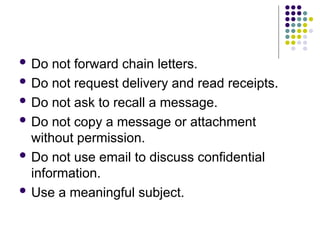
 Do not forward chain letters.
 Do not request delivery and read receipts.
 Do not ask to recall a message.
 Do not copy a message or attachment
without permission.
 Do not use email to discuss confidential
information.
 Use a meaningful subject.
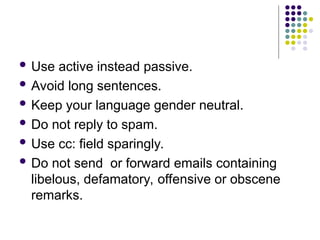
 Use active instead passive.
 Avoid long sentences.
 Keep your language gender neutral.
 Do not reply to spam.
 Use cc: field sparingly.
 Do not send or forward emails containing
libelous, defamatory, offensive or obscene
remarks.
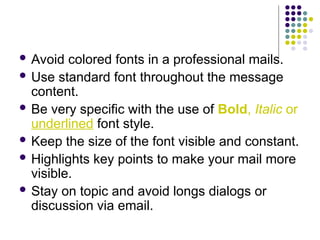
 Avoid colored fonts in a professional mails.
 Use standard font throughout the message
content.
 Be very specific with the use of Bold, Italic or
underlined font style.
 Keep the size of the font visible and constant.
 Highlights key points to make your mail more
visible.
 Stay on topic and avoid longs dialogs or
discussion via email.
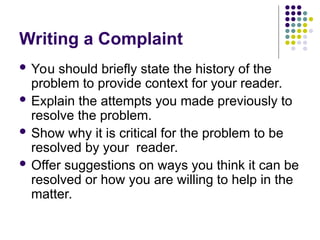
Writing a Complaint
 You should briefly state the history of the
problem to provide context for your reader.
 Explain the attempts you made previously to
resolve the problem.
 Show why it is critical for the problem to be
resolved by your reader.
 Offer suggestions on ways you think it can be
resolved or how you are willing to help in the
matter.
When Email Won’t Work
 There are times when you need to take your
discussion out of the virtual world and make
a phone call.
 If things become very heated, a lot of
misunderstanding occurs, or when you are
delivering very delicate news then the best
way is still face-to-face.
Be Accessible
Your customer should be able to get a hold of
you, or someone in your company, if they
have a question or if they need service.
Acknowledge , speak his language, feel sorry
for them, be respectful and polite by using
empathy words and there you are always
present for them.
Respond in a Timely Manner
Make it a policy to tell customer whatever he
needs and you know. Customer’s time is very
precious as ours.
Listen to him completely before answering his
queries.
Listen to your Customers
Often when a customer calls, they just want to
be heard.
In fact, sometimes, just listening is all you need
to do. Take the time to listen to what your
customers have to say before you start
responding or defending your product or
service.
They must having a point.
Look and sound like your listening. The
customer wants to know that you take care
and that you are interested in their problem.
Treat your Customers with
Respect
Even if the customer on the other end of the
phone is acting irrationally, or being rude,
don’t lower yourself to their level by
reciprocating.
Treat everyone with respect and you will be
respected in return.
You never know when someone’s just having a
bad day, they happen to be taken it out on
you.
Don’t Argue with Your
Customer
You can never win an argument with a
customer.
We all know customer is not really always right,
but instead of focusing on what went wrong
and defending yourself, focus on how you
can solve the problem or fix the situation.
Honour Your Commitments
If you offer a guarantee or promise, then
honour it. Nothing spoils a Customer
Relationship faster then being promise
something and not honouring it.
Feel the joy of a customer showering all
praised on you for keeping promise and
helping them out.
It’s is the best motivating factor and worth than
any other gift you get.
Do what you say
If you say a customer that he/she will be getting
a solution fast act on it.
Never go back on your words, if you want
customer’s.
Be Honest
Don’t exaggerate things, don’t promise things
which cannot be delivered just to close the
conversation and get rid of angry customers.
Think that customer is ever going to make
another purchase from the business? Not
likely. Be honest and direct about what your
products and services can deliver.
Admit when you make a
Mistake
No one’s perfect. We all make mistakes; it’s
part of learning. So when you do make a
mistake, don't try to cover it up or deny it.
Just admit it and if necessary , do something to
make the situation right. Your customers will
appreciate it and they will be more likely to
stay customers.
Must have skills development for corporate

Must have skills development for corporate

  • 1.
  • 2.
    Index  Are YouListening well.  Communication Skills.  Telephone Etiquettes.  Email Etiquettes.  Handling of Customer.
  • 3.
     How canyou know if you are a bad listener? A good listener uses his/ her eyes and mind while listening.  If you find yourself already formulating your next sentence in your mind while someone is speaking to you, you are doing injustice to the conversation.  You will get more out of the conversation if you understand, comprehend and assimilate what is being said BEFORE responding.  Good etiquette = listening!
  • 4.
     Do youmake these common listening mistakes? The difference between being a good listener versus a great listener is using your heart in addition to your eyes and mind while listening.  Do you do this?  If a friend tells you something is wrong, you immediately tend to give advice or criticism.  If a friend tells you about something wonderful that has happened, you usually chip in with something similar that you have experienced.  Rarely do we share joy or sympathize with pain. Rarely do we just let others speak.  To improve your listening skills, practice with those closest to you.  When family members or friends share their thoughts and feelings, limit the advice to relate what you hear to one of your own experiences
  • 5.
     It facilitatesplanning.  Act as a strong ‘Team Worker’ builder.  It improves relationship among peers, superiors and subordinates.  It improves motivation and morale.
  • 6.
    Types of Communication There are two types of communication 1.Verbal Communication. 2.Non-Verbal Communication.
  • 7.
    Verbal Communication  Thereare two types of Verbal Communication. 1.Written. 2.Oral.
  • 8.
    Non-Verbal Communication It includes:- Gesture.  Eye-Contact.  Posture.  Facial expression.
  • 9.
    Communication Barrier All factorare adversely affect effectiveness of communication are called as “barrier to communication”
  • 10.
    How to overcomefrom Barrier?  Clear thinking about objectives, message, wordings.  Tips on effective communication (like note taking, rephrasing, summarizing, asking questions to understand needs, active listening, Smile etc.  System must be clearly defined and recognized.  Proper meeting, conference, letters, notice, telephonic talks.  Basic elements: honesty, sincerity, simplicity
  • 11.
    “Professionalism is polite,thoughtful, efficient, educated, and valuable at all times.’
  • 12.
    The following guidelineswill help you to make the first impression a good one:-
  • 13.
    Pre-calling guidelines  Beforethe call always have purpose in mind.  If you are calling in relation to a meeting then prepare an agenda.  Identify a second point of contact.  For a conference call identify a coordinator or a leader to lead the team.  Answer calls promptly-within 3rings.
  • 14.
     Before pickingup the receiver, discontinue any other conversation or activity such as chewing gum, typing, etc .that can be heard by the calling party.  Keep a note pad and pen handy at your desk.  Smile as you pick the phone- the caller will hear it in your voice.
  • 15.
    Handling complaints byPhone  Listen Carefully.  Convey sincere interest and be empathetic.  Agree as often as possible.  Remain calm and courteous. Do Not Argue.  Do not blame co-workers.  Do not make unrealistic promises.  Follow up. Get back to the caller to make sure the problem has be solved.
  • 16.
    Answering calls forothers  Identify yourself and the company for whom you are answering and say,” How may I help you?  Offer assistance in the absence of others-say, “ She is not in today, perhaps I can be of assistance”.  Do not make commitments for others-say, “I’ll give him/her your message when he/she returns,” rather than- “He will can you as soon as he returns”.  Take accurate, legible messages with time, date, reason for call, urgency, company represented, if any, the best time to reach them and all other pertinent information.
  • 17.
    Transferring Calls  Explainthe reason for the transfer-( “ let me connect you with Mr. XYZ in that dept.). Use the name of the person you are transferring to whenever possible.  Know the transfer instructions for the telephone system so that you do not cut off your caller.
  • 18.
    When you areaway from the office  Arrange for coverage or leave a voice mail message for callers.  Place a short message on the machine.  Check your message during a day.
  • 19.
    Qualities of agood Voice  Distinctness.  Vitality.  Warmth.  Naturalness.  Expressiveness.  Lower, mellow pitch.
  • 20.
    Tips for creatinga good image  Use basic phrases of courtesy- “May I help you?, Please, Thank you, You are welcome.”  Use standard, accepted business phrases.  Avoid slang- “ uh huh, yeah, or bye bye for good bye.”  Do not chew gum.  Keep your promises.  Smile while speaking. People can “hear a smile” over the phone.
  • 21.
    Suggested phrases  “Accountingdepartment, this is XYZ. How may I help you.?  “Good Morning, XYZ Co. name/office, how may I help you.?
  • 22.
    Acknowledgement  “Thank you.I’ll check.” or “I’ll see”.  “Yes ma’am/sir.”  “One moment please, I’ll find out.”  “ Yes, you may.”
  • 23.
    Report to caller “ He is away from his desk, may I take a message.”  “I’m sorry, XYZ is out of the office , may someone else help you.”  “I’m sorry to keep you waiting.”
  • 24.
    Obtaining the correct information Always repeat and read back messages for accuracy.  “Will you please spell your name, please?”  “Will you repeat the number, please?”
  • 25.
    Your key toeffective communication. Your key to effective communication.
  • 26.
    Need of EmailEtiquette  Professionalism- by using proper email language your company will convey a professional image.  Efficiency- emails that get to the point are much more effective than poorly worded emails.
  • 27.
    What are theEtiquette rules? There are many etiquette guides and many different etiquette rules. Below is list what is consider as the most important email etiquette rules that apply to nearly all companies.
  • 28.
    Tips of EmailEtiquette:-  Be concise and to the point.  Give answer all questions.  Use proper spelling, grammar & punctuation.  Answer swiftly.  Do not attach unnecessary files.  Use proper structure & layout.  Do not write in CAPITALS.
  • 29.
     Read themail before sending it.  Do not overuse Reply to All.  Do not overuse the high priority option.  Avoid using URGENT and IMPORTANT.  Take care with abbreviations and emotions.  Be careful with formatting.  Take care with rich text and HTML messages.
  • 30.
     Do notforward chain letters.  Do not request delivery and read receipts.  Do not ask to recall a message.  Do not copy a message or attachment without permission.  Do not use email to discuss confidential information.  Use a meaningful subject.
  • 31.
     Use activeinstead passive.  Avoid long sentences.  Keep your language gender neutral.  Do not reply to spam.  Use cc: field sparingly.  Do not send or forward emails containing libelous, defamatory, offensive or obscene remarks.
  • 32.
     Avoid coloredfonts in a professional mails.  Use standard font throughout the message content.  Be very specific with the use of Bold, Italic or underlined font style.  Keep the size of the font visible and constant.  Highlights key points to make your mail more visible.  Stay on topic and avoid longs dialogs or discussion via email.
  • 33.
    Writing a Complaint You should briefly state the history of the problem to provide context for your reader.  Explain the attempts you made previously to resolve the problem.  Show why it is critical for the problem to be resolved by your reader.  Offer suggestions on ways you think it can be resolved or how you are willing to help in the matter.
  • 34.
    When Email Won’tWork  There are times when you need to take your discussion out of the virtual world and make a phone call.  If things become very heated, a lot of misunderstanding occurs, or when you are delivering very delicate news then the best way is still face-to-face.
  • 36.
    Be Accessible Your customershould be able to get a hold of you, or someone in your company, if they have a question or if they need service. Acknowledge , speak his language, feel sorry for them, be respectful and polite by using empathy words and there you are always present for them.
  • 37.
    Respond in aTimely Manner Make it a policy to tell customer whatever he needs and you know. Customer’s time is very precious as ours. Listen to him completely before answering his queries.
  • 38.
    Listen to yourCustomers Often when a customer calls, they just want to be heard. In fact, sometimes, just listening is all you need to do. Take the time to listen to what your customers have to say before you start responding or defending your product or service.
  • 39.
    They must havinga point. Look and sound like your listening. The customer wants to know that you take care and that you are interested in their problem.
  • 40.
    Treat your Customerswith Respect Even if the customer on the other end of the phone is acting irrationally, or being rude, don’t lower yourself to their level by reciprocating. Treat everyone with respect and you will be respected in return. You never know when someone’s just having a bad day, they happen to be taken it out on you.
  • 41.
    Don’t Argue withYour Customer You can never win an argument with a customer. We all know customer is not really always right, but instead of focusing on what went wrong and defending yourself, focus on how you can solve the problem or fix the situation.
  • 42.
    Honour Your Commitments Ifyou offer a guarantee or promise, then honour it. Nothing spoils a Customer Relationship faster then being promise something and not honouring it. Feel the joy of a customer showering all praised on you for keeping promise and helping them out. It’s is the best motivating factor and worth than any other gift you get.
  • 43.
    Do what yousay If you say a customer that he/she will be getting a solution fast act on it. Never go back on your words, if you want customer’s.
  • 44.
    Be Honest Don’t exaggeratethings, don’t promise things which cannot be delivered just to close the conversation and get rid of angry customers. Think that customer is ever going to make another purchase from the business? Not likely. Be honest and direct about what your products and services can deliver.
  • 45.
    Admit when youmake a Mistake No one’s perfect. We all make mistakes; it’s part of learning. So when you do make a mistake, don't try to cover it up or deny it. Just admit it and if necessary , do something to make the situation right. Your customers will appreciate it and they will be more likely to stay customers.