Expressions
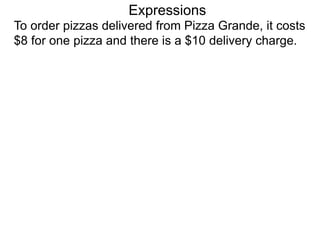
To order pizzas delivered from Pizza Grande, it costs
$8 for one pizza and there is a $10 delivery charge.
Expressions
To order pizzas delivered from Pizza Grande, it costs
$8 for one pizza and there is a $10 delivery charge.
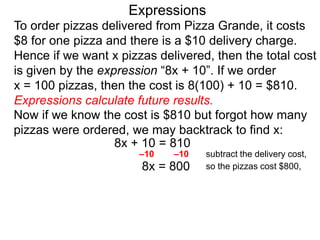
Hence if we want x pizzas delivered, then the total cost
is given by the expression “8x + 10”.
Expressions
To order pizzas delivered from Pizza Grande, it costs
$8 for one pizza and there is a $10 delivery charge.
Hence if we want x pizzas delivered, then the total cost
is given by the expression “8x + 10”. If we order
x = 100 pizzas, then the cost is 8(100) + 10 = $810.
Expressions
To order pizzas delivered from Pizza Grande, it costs
$8 for one pizza and there is a $10 delivery charge.
Hence if we want x pizzas delivered, then the total cost
is given by the expression “8x + 10”. If we order
x = 100 pizzas, then the cost is 8(100) + 10 = $810.
Expressions calculate future results.
Expressions
To order pizzas delivered from Pizza Grande, it costs
$8 for one pizza and there is a $10 delivery charge.
Hence if we want x pizzas delivered, then the total cost
is given by the expression “8x + 10”. If we order
x = 100 pizzas, then the cost is 8(100) + 10 = $810.
Expressions calculate future results.
Now if we know the cost is $810 but forgot how many
pizzas were ordered, we may backtrack to find x:
Expressions
To order pizzas delivered from Pizza Grande, it costs
$8 for one pizza and there is a $10 delivery charge.
Hence if we want x pizzas delivered, then the total cost
is given by the expression “8x + 10”. If we order
x = 100 pizzas, then the cost is 8(100) + 10 = $810.
Expressions calculate future results.
Now if we know the cost is $810 but forgot how many
pizzas were ordered, we may backtrack to find x:
8x + 10 = 810
Expressions
To order pizzas delivered from Pizza Grande, it costs
$8 for one pizza and there is a $10 delivery charge.
Hence if we want x pizzas delivered, then the total cost
is given by the expression “8x + 10”. If we order
x = 100 pizzas, then the cost is 8(100) + 10 = $810.
Expressions calculate future results.
Now if we know the cost is $810 but forgot how many
pizzas were ordered, we may backtrack to find x:
8x + 10 = 810
8x = 800
–10 –10 subtract the delivery cost,
so the pizzas cost $800,
Expressions
To order pizzas delivered from Pizza Grande, it costs
$8 for one pizza and there is a $10 delivery charge.
Hence if we want x pizzas delivered, then the total cost
is given by the expression “8x + 10”. If we order
x = 100 pizzas, then the cost is 8(100) + 10 = $810.
Expressions calculate future results.
Now if we know the cost is $810 but forgot how many
pizzas were ordered, we may backtrack to find x:
8x + 10 = 810
8x = 800
–10 –10 subtract the delivery cost,
so the pizzas cost $800,
divide this by $8/per pizza,
x = 100 (pizzas)
8 8
Expressions
To order pizzas delivered from Pizza Grande, it costs
$8 for one pizza and there is a $10 delivery charge.
Hence if we want x pizzas delivered, then the total cost
is given by the expression “8x + 10”. If we order
x = 100 pizzas, then the cost is 8(100) + 10 = $810.
Expressions
Expressions calculate future results.
Now if we know the cost is $810 but forgot how many
pizzas were ordered, we may backtrack to find x:
8x + 10 = 810
8x = 800
–10 –10 subtract the delivery cost,
so the pizzas cost $800,
divide this by $8/per pizza,
x = 100
8 8
“8x + 10 = 810” is called an equation.
(pizzas)
To order pizzas delivered from Pizza Grande, it costs
$8 for one pizza and there is a $10 delivery charge.
Hence if we want x pizzas delivered, then the total cost
is given by the expression “8x + 10”. If we order
x = 100 pizzas, then the cost is 8(100) + 10 = $810.
Expressions
Expressions calculate future results.
Now if we know the cost is $810 but forgot how many
pizzas were ordered, we may backtrack to find x:
8x + 10 = 810
8x = 800
–10 –10 subtract the delivery cost,
so the pizzas cost $800,
divide this by $8/per pizza,
x = 100
8 8
“8x + 10 = 810” is called an equation.
Equations are set up to backtrack to the original
input x or x’s, i.e. we want to solve equations.
(pizzas)
An equation is made by setting two expressions
equal to each other:
expression 1 = expression 2
Solving Equations
An equation is made by setting two expressions
equal to each other:
expression 1 = expression 2
Solving Equations
To solve an equation means to find value(s)
for the variables that makes the equation true.
An equation is made by setting two expressions
equal to each other:
expression 1 = expression 2
Solving Equations
The above equation
8x + 10 = 810
is a 1st degree or linear equation because the highest
power of x is the 1st power.
To solve an equation means to find value(s)
for the variables that makes the equation true.
An equation is made by setting two expressions
equal to each other:
expression 1 = expression 2
Solving Equations
The above equation
8x + 10 = 810
is a 1st degree or linear equation because the highest
power of x is the 1st power. Its solution is x = 100.
To solve an equation means to find value(s)
for the variables that makes the equation true.
An equation is made by setting two expressions
equal to each other:
expression 1 = expression 2
Solving Equations
The above equation
8x + 10 = 810
is a 1st degree or linear equation because the highest
power of x is the 1st power. Its solution is x = 100.
The equation x2 – 2x = 3
having x2, is not linear.
To solve an equation means to find value(s)
for the variables that makes the equation true.
An equation is made by setting two expressions
equal to each other:
expression 1 = expression 2
Solving Equations
The above equation
8x + 10 = 810
is a 1st degree or linear equation because the highest
power of x is the 1st power. Its solution is x = 100.
The equation x2 – 2x = 3
having x2, is not linear. It’s a 2nd degree or quadratic
equation with solutions x = –1 or 3. (Check this!)
To solve an equation means to find value(s)
for the variables that makes the equation true.
An equation is made by setting two expressions
equal to each other:
expression 1 = expression 2
Solving Equations
The above equation
8x + 10 = 810
is a 1st degree or linear equation because the highest
power of x is the 1st power. Its solution is x = 100.
The equation x2 – 2x = 3
having x2, is not linear. It’s a 2nd degree or quadratic
equation with solutions x = –1 or 3. (Check this!)
Linear and quadratic equations are the most basic
and also the important equations.
To solve an equation means to find value(s)
for the variables that makes the equation true.
Solving Linear Equations
Solving Equations
Solving Linear Equations
Solving Equations
An equation that can take the form of ax + b = 0
where a ≠ 0, b are numbers, is a linear equation.
Solving Linear Equations
Solving Equations
An equation that can take the form of ax + b = 0
where a ≠ 0, b are numbers, is a linear equation.
The solution for ax + b = 0
x = –b/a
Solving Linear Equations
Solving Equations
An equation that can take the form of ax + b = 0
where a ≠ 0, b are numbers, is a linear equation.
The solution for ax + b = 0
x = –b/a
Example A. Solve the following linear equations.
2x + 10 = 0a. 0 = 3x – 10b.
3x + 10 = 1c.
Solving Linear Equations
Solving Equations
An equation that can take the form of ax + b = 0
where a ≠ 0, b are numbers, is a linear equation.
The solution for ax + b = 0
x = –b/a
Example A. Solve the following linear equations.
2x + 10 = 0a. 0 = 3x – 10b.
2x = –10
–10 –10
3x + 10 = 1c.
Solving Linear Equations
Solving Equations
An equation that can take the form of ax + b = 0
where a ≠ 0, b are numbers, is a linear equation.
The solution for ax + b = 0
x = –b/a
Example A. Solve the following linear equations.
2x + 10 = 0a. 0 = 3x – 10b.
2x = –10
x = –10/2 = –5
–10 –10
3x + 10 = 1c.
Solving Linear Equations
Solving Equations
An equation that can take the form of ax + b = 0
where a ≠ 0, b are numbers, is a linear equation.
The solution for ax + b = 0
x = –b/a
Example A. Solve the following linear equations.
2x + 10 = 0a. 0 = 3x – 10b.
2x = –10
x = –10/2 = –5
10 = 3x
–10 –10 +10 +10
3x + 10 = 1c.
Solving Linear Equations
Solving Equations
An equation that can take the form of ax + b = 0
where a ≠ 0, b are numbers, is a linear equation.
The solution for ax + b = 0
x = –b/a
Example A. Solve the following linear equations.
2x + 10 = 0a. 0 = 3x – 10b.
2x = –10
x = –10/2 = –5
10 = 3x
–10 –10 +10 +10
10/3 = x
3x + 10 = 1c.
Solving Linear Equations
Solving Equations
An equation that can take the form of ax + b = 0
where a ≠ 0, b are numbers, is a linear equation.
The solution for ax + b = 0
x = –b/a
Example A. Solve the following linear equations.
2x + 10 = 0a. 0 = 3x – 10b.
2x = –10
x = –10/2 = –5
10 = 3x
–10 –10 +10 +10
10/3 = x
3x + 10 = 1c.
3x = –9
–10 –10
Solving Linear Equations
Solving Equations
An equation that can take the form of ax + b = 0
where a ≠ 0, b are numbers, is a linear equation.
The solution for ax + b = 0
x = –b/a
Example A. Solve the following linear equations.
2x + 10 = 0a. 0 = 3x – 10b.
2x = –10
x = –10/2 = –5
10 = 3x
–10 –10 +10 +10
10/3 = x
3x + 10 = 1c.
3x = –9
x = –9/3 = –3
–10 –10
Solving Equations
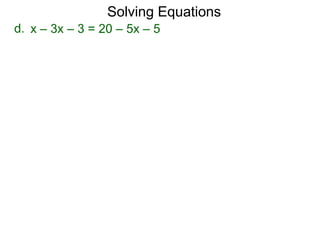
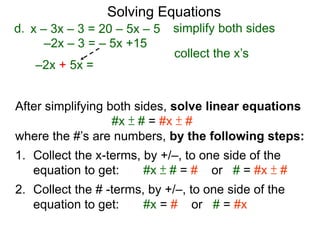
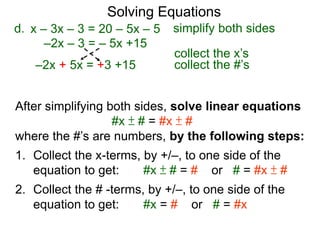
d. x – 3x – 3 = 20 – 5x – 5
Solving Equations
–2x – 3 = – 5x +15
d. x – 3x – 3 = 20 – 5x – 5 simplify both sides
Solving Equations
After simplifying both sides, solve linear equations
#x ± # = #x ± #
where the #’s are numbers, by the following steps:
–2x – 3 = – 5x +15
d. x – 3x – 3 = 20 – 5x – 5 simplify both sides
Solving Equations
After simplifying both sides, solve linear equations
#x ± # = #x ± #
where the #’s are numbers, by the following steps:
1. Collect the x-terms, by +/–, to one side of the
equation to get: #x ± # = # or # = #x ± #
–2x – 3 = – 5x +15
d. x – 3x – 3 = 20 – 5x – 5 simplify both sides
Solving Equations
After simplifying both sides, solve linear equations
#x ± # = #x ± #
where the #’s are numbers, by the following steps:
1. Collect the x-terms, by +/–, to one side of the
equation to get: #x ± # = # or # = #x ± #
–2x – 3 = – 5x +15
d.
–2x + 5x =
x – 3x – 3 = 20 – 5x – 5 simplify both sides
collect the x’s
Solving Equations
After simplifying both sides, solve linear equations
#x ± # = #x ± #
where the #’s are numbers, by the following steps:
1. Collect the x-terms, by +/–, to one side of the
equation to get: #x ± # = # or # = #x ± #
2. Collect the # -terms, by +/–, to one side of the
equation to get: #x = # or # = #x
–2x – 3 = – 5x +15
d.
–2x + 5x =
x – 3x – 3 = 20 – 5x – 5 simplify both sides
collect the x’s
Solving Equations
After simplifying both sides, solve linear equations
#x ± # = #x ± #
where the #’s are numbers, by the following steps:
1. Collect the x-terms, by +/–, to one side of the
equation to get: #x ± # = # or # = #x ± #
2. Collect the # -terms, by +/–, to one side of the
equation to get: #x = # or # = #x
–2x – 3 = – 5x +15
d.
–2x + 5x = +3 +15
x – 3x – 3 = 20 – 5x – 5 simplify both sides
collect the x’s
collect the #’s
Solving Equations
After simplifying both sides, solve linear equations
#x ± # = #x ± #
where the #’s are numbers, by the following steps:
1. Collect the x-terms, by +/–, to one side of the
equation to get: #x ± # = # or # = #x ± #
2. Collect the # -terms, by +/–, to one side of the
equation to get: #x = # or # = #x
3. Obtain x, by * / ÷, to get: x = Ans or Ans = x
–2x – 3 = – 5x +15
d.
–2x + 5x = +3 +15
x – 3x – 3 = 20 – 5x – 5 simplify both sides
collect the x’s
collect the #’s
Solving Equations
After simplifying both sides, solve linear equations
#x ± # = #x ± #
where the #’s are numbers, by the following steps:
1. Collect the x-terms, by +/–, to one side of the
equation to get: #x ± # = # or # = #x ± #
2. Collect the # -terms, by +/–, to one side of the
equation to get: #x = # or # = #x
3. Obtain x, by * / ÷, to get: x = Ans or Ans = x
–2x – 3 = – 5x +15
d.
–2x + 5x = +3 +15
3x = 18
x = 6
x – 3x – 3 = 20 – 5x – 5 simplify both sides
collect the x’s
collect the #’s
divide to get x
An equation expressed with fractions may always be
reformulated in integers by cleaning the fractions with
multiplying the least common denominator (LCD) to
all the terms.
Fractional Equations
An equation expressed with fractions may always be
reformulated in integers by cleaning the fractions with
multiplying the least common denominator (LCD) to
all the terms.
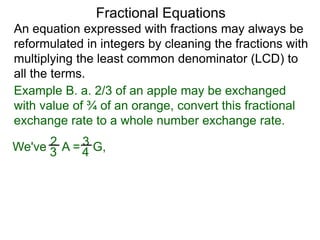
Example B. a. 2/3 of an apple may be exchanged
with value of ¾ of an orange, convert this fractional
exchange rate to a whole number exchange rate.
Fractional Equations
An equation expressed with fractions may always be
reformulated in integers by cleaning the fractions with
multiplying the least common denominator (LCD) to
all the terms.
Example B. a. 2/3 of an apple may be exchanged
with value of ¾ of an orange, convert this fractional
exchange rate to a whole number exchange rate.
2
3 A = 3
4 G,We've
Fractional Equations
An equation expressed with fractions may always be
reformulated in integers by cleaning the fractions with
multiplying the least common denominator (LCD) to
all the terms.
Example B. a. 2/3 of an apple may be exchanged
with value of ¾ of an orange, convert this fractional
exchange rate to a whole number exchange rate.
2
3 A = 3
4 G,
( ) *12
We've
2
3 A = 3
4 G
LCD =12, multiply 12
to both sides,
Fractional Equations
An equation expressed with fractions may always be
reformulated in integers by cleaning the fractions with
multiplying the least common denominator (LCD) to
all the terms.
Example B. a. 2/3 of an apple may be exchanged
with value of ¾ of an orange, convert this fractional
exchange rate to a whole number exchange rate.
2
3 A = 3
4 G,
4
( ) *12
We've
2
3 A = 3
4 G
LCD =12, multiply 12
to both sides,
Fractional Equations
An equation expressed with fractions may always be
reformulated in integers by cleaning the fractions with
multiplying the least common denominator (LCD) to
all the terms.
Example B. a. 2/3 of an apple may be exchanged
with value of ¾ of an orange, convert this fractional
exchange rate to a whole number exchange rate.
2
3 A = 3
4 G,
34
( ) *12
We've
2
3 A = 3
4 G
LCD =12, multiply 12
to both sides,
Fractional Equations
An equation expressed with fractions may always be
reformulated in integers by cleaning the fractions with
multiplying the least common denominator (LCD) to
all the terms.
Example B. a. 2/3 of an apple may be exchanged
with value of ¾ of an orange, convert this fractional
exchange rate to a whole number exchange rate.
2
3 A = 3
4 G,
34
8A = 9G
( ) *12
We've
2
3 A = 3
4 G
LCD =12, multiply 12
to both sides,
Fractional Equations
An equation expressed with fractions may always be
reformulated in integers by cleaning the fractions with
multiplying the least common denominator (LCD) to
all the terms.
Example B. a. 2/3 of an apple may be exchanged
with value of ¾ of an orange, convert this fractional
exchange rate to a whole number exchange rate.
2
3 A = 3
4 G,
34
8A = 9G
( ) *12
We've
2
3 A = 3
4 G
So the whole number exchange rate is
8 apples equal to 9 oranges.
LCD =12, multiply 12
to both sides,
Fractional Equations
b. Solve by clearing the denominators first.
x4 3
1 2
6
5
4
3–+ = x
Solving Equations
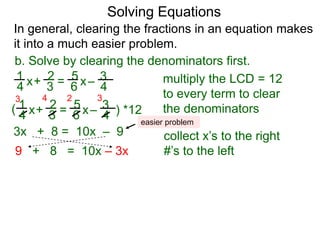
In general, clearing the fractions in an equation makes
it into a much easier problem.
b. Solve by clearing the denominators first.
x4 3
1 2
6
5
4
3 multiply the LCD = 12
to every term to clear
the denominators( ) *12
3
–+ = x
x4 3
1 2
6
5
4
3–+ = x
Solving Equations
In general, clearing the fractions in an equation makes
it into a much easier problem.
b. Solve by clearing the denominators first.
x4 3
1 2
6
5
4
3 multiply the LCD = 12
to every term to clear
the denominators( ) *12
3 4
–+ = x
x4 3
1 2
6
5
4
3–+ = x
Solving Equations
In general, clearing the fractions in an equation makes
it into a much easier problem.
b. Solve by clearing the denominators first.
x4 3
1 2
6
5
4
3 multiply the LCD = 12
to every term to clear
the denominators( ) *12
3 4 2 3
–+ = x
x4 3
1 2
6
5
4
3–+ = x
Solving Equations
In general, clearing the fractions in an equation makes
it into a much easier problem.
b. Solve by clearing the denominators first.
x4 3
1 2
6
5
4
3 multiply the LCD = 12
to every term to clear
the denominators( ) *12
3 4 2 3
3x + 8 = 10x – 9
–+ = x
x4 3
1 2
6
5
4
3–+ = x
Solving Equations
In general, clearing the fractions in an equation makes
it into a much easier problem.
easier problem
b. Solve by clearing the denominators first.
x4 3
1 2
6
5
4
3 multiply the LCD = 12
to every term to clear
the denominators( ) *12
3 4 2 3
3x + 8 = 10x – 9
9 + 8 = 10x – 3x
–+ = x
x4 3
1 2
6
5
4
3–+ = x
collect x’s to the right
#’s to the left
Solving Equations
In general, clearing the fractions in an equation makes
it into a much easier problem.
easier problem
b. Solve by clearing the denominators first.
x4 3
1 2
6
5
4
3 multiply the LCD = 12
to every term to clear
the denominators( ) *12
3 4 2 3
3x + 8 = 10x – 9
9 + 8 = 10x – 3x
17 = 7x
–+ = x
x4 3
1 2
6
5
4
3–+ = x
collect x’s to the right
#’s to the left
Solving Equations
In general, clearing the fractions in an equation makes
it into a much easier problem.
easier problem
b. Solve by clearing the denominators first.
x4 3
1 2
6
5
4
3 multiply the LCD = 12
to every term to clear
the denominators( ) *12
3 4 2 3
3x + 8 = 10x – 9
9 + 8 = 10x – 3x
17 = 7x
17/7= x
–+ = x
x4 3
1 2
6
5
4
3–+ = x
collect x’s to the right
#’s to the left
div by 7 to get x
Solving Equations
In general, clearing the fractions in an equation makes
it into a much easier problem.
easier problem
b. Solve by clearing the denominators first.
x4 3
1 2
6
5
4
3 multiply the LCD = 12
to every term to clear
the denominators( ) *12
3 4 2 3
3x + 8 = 10x – 9
9 + 8 = 10x – 3x
17 = 7x
17/7= x
–+ = x
x4 3
1 2
6
5
4
3–+ = x
collect x’s to the right
#’s to the left
div by 7 to get x
Solving Equations
In general, clearing the fractions in an equation makes
it into a much easier problem.
easier problem
The simplest type of fractional equations are
proportions of the form in which case
cross-multiplication accomplish the same objective.
A
B
C
D ,=
A
B
C
D ,=If then AD = BC.
Cross-Multiplication-Rule
Proportions
A
B
C
D ,=If then AD = BC.
Cross-Multiplication-Rule
Proportions
Example C. Solve for x.
3
x
5
2=a.
2
3
(x + 2)
(x – 5)=b.
A
B
C
D ,=If then AD = BC.
Cross-Multiplication-Rule
Proportions
Example C. Solve for x.
3
x
5
2=a. cross multiply
6 = 5x
2
3
(x + 2)
(x – 5)=b.
A
B
C
D ,=If then AD = BC.
Cross-Multiplication-Rule
Proportions
Example C. Solve for x.
3
x
5
2=a. cross multiply
6 = 5x
= x
2
3
(x + 2)
(x – 5)=b.
5
6
A
B
C
D ,=If then AD = BC.
Cross-Multiplication-Rule
Proportions
Example C. Solve for x.
3
x
5
2=a. cross multiply
6 = 5x
= x
2
3
(x + 2)
(x – 5)=b. cross multiply
2(x – 5) = 3(x + 2)
5
6
A
B
C
D ,=If then AD = BC.
Cross-Multiplication-Rule
Proportions
Example C. Solve for x.
3
x
5
2=a. cross multiply
6 = 5x
= x
2
3
(x + 2)
(x – 5)=b. cross multiply
2(x – 5) = 3(x + 2)
2x – 10 = 3x + 6
5
6
A
B
C
D ,=If then AD = BC.
Cross-Multiplication-Rule
Proportions
Example C. Solve for x.
3
x
5
2=a. cross multiply
6 = 5x
= x
2
3
(x + 2)
(x – 5)=b. cross multiply
2(x – 5) = 3(x + 2)
2x – 10 = 3x + 6
–10 – 6 = 3x – 2x
–16 = x
5
6
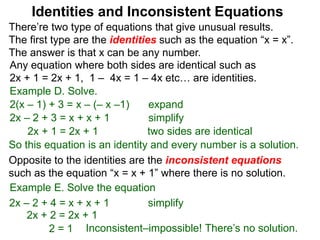
There’re two type of equations that give unusual results.
The first type are the identities such as the equation “x = x”.
Identities and Inconsistent Equations
There’re two type of equations that give unusual results.
The first type are the identities such as the equation “x = x”.
The answer is that x can be any number.
Identities and Inconsistent Equations
There’re two type of equations that give unusual results.
The first type are the identities such as the equation “x = x”.
The answer is that x can be any number.
Identities and Inconsistent Equations
Any equation where both sides are identical such as
2x + 1 = 2x + 1, 1 – 4x = 1 – 4x etc… are identities.
There’re two type of equations that give unusual results.
The first type are the identities such as the equation “x = x”.
The answer is that x can be any number.
Example D. Solve.
Identities and Inconsistent Equations
2(x – 1) + 3 = x – (– x –1)
Any equation where both sides are identical such as
2x + 1 = 2x + 1, 1 – 4x = 1 – 4x etc… are identities.
There’re two type of equations that give unusual results.
The first type are the identities such as the equation “x = x”.
The answer is that x can be any number.
Example D. Solve.
Identities and Inconsistent Equations
2(x – 1) + 3 = x – (– x –1)
Any equation where both sides are identical such as
2x + 1 = 2x + 1, 1 – 4x = 1 – 4x etc… are identities.
expand
2x – 2 + 3 = x + x + 1 simplify
There’re two type of equations that give unusual results.
The first type are the identities such as the equation “x = x”.
The answer is that x can be any number.
Example D. Solve.
Identities and Inconsistent Equations
2(x – 1) + 3 = x – (– x –1)
Any equation where both sides are identical such as
2x + 1 = 2x + 1, 1 – 4x = 1 – 4x etc… are identities.
expand
2x – 2 + 3 = x + x + 1 simplify
2x + 1 = 2x + 1 two sides are identical
There’re two type of equations that give unusual results.
The first type are the identities such as the equation “x = x”.
The answer is that x can be any number.
Example D. Solve.
Identities and Inconsistent Equations
2(x – 1) + 3 = x – (– x –1)
Any equation where both sides are identical such as
2x + 1 = 2x + 1, 1 – 4x = 1 – 4x etc… are identities.
expand
2x – 2 + 3 = x + x + 1 simplify
2x + 1 = 2x + 1
So this equation is an identity and every number is a solution.
two sides are identical
There’re two type of equations that give unusual results.
The first type are the identities such as the equation “x = x”.
The answer is that x can be any number.
Example D. Solve.
Identities and Inconsistent Equations
2(x – 1) + 3 = x – (– x –1)
Any equation where both sides are identical such as
2x + 1 = 2x + 1, 1 – 4x = 1 – 4x etc… are identities.
expand
2x – 2 + 3 = x + x + 1 simplify
2x + 1 = 2x + 1
So this equation is an identity and every number is a solution.
two sides are identical
Opposite to the identities are the inconsistent equations
such as the equation “x = x + 1” where there is no solution.
There’re two type of equations that give unusual results.
The first type are the identities such as the equation “x = x”.
The answer is that x can be any number.
Example D. Solve.
Identities and Inconsistent Equations
2(x – 1) + 3 = x – (– x –1)
Any equation where both sides are identical such as
2x + 1 = 2x + 1, 1 – 4x = 1 – 4x etc… are identities.
expand
2x – 2 + 3 = x + x + 1 simplify
2x + 1 = 2x + 1
So this equation is an identity and every number is a solution.
two sides are identical
Opposite to the identities are the inconsistent equations
such as the equation “x = x + 1” where there is no solution.
Example E. Solve the equation
2x – 2 + 4 = x + x + 1
There’re two type of equations that give unusual results.
The first type are the identities such as the equation “x = x”.
The answer is that x can be any number.
Example D. Solve.
Identities and Inconsistent Equations
2(x – 1) + 3 = x – (– x –1)
Any equation where both sides are identical such as
2x + 1 = 2x + 1, 1 – 4x = 1 – 4x etc… are identities.
expand
2x – 2 + 3 = x + x + 1 simplify
2x + 1 = 2x + 1
So this equation is an identity and every number is a solution.
two sides are identical
Opposite to the identities are the inconsistent equations
such as the equation “x = x + 1” where there is no solution.
Example E. Solve the equation
2x – 2 + 4 = x + x + 1 simplify
2x + 2 = 2x + 1
2 = 1
There’re two type of equations that give unusual results.
The first type are the identities such as the equation “x = x”.
The answer is that x can be any number.
Example D. Solve.
Identities and Inconsistent Equations
2(x – 1) + 3 = x – (– x –1)
Any equation where both sides are identical such as
2x + 1 = 2x + 1, 1 – 4x = 1 – 4x etc… are identities.
expand
2x – 2 + 3 = x + x + 1 simplify
2x + 1 = 2x + 1
So this equation is an identity and every number is a solution.
two sides are identical
Opposite to the identities are the inconsistent equations
such as the equation “x = x + 1” where there is no solution.
Example E. Solve the equation
2x – 2 + 4 = x + x + 1 simplify
2x + 2 = 2x + 1
2 = 1 Inconsistent–impossible! There’s no solution.
Exercise 2.
A. Solve for x. Remember to collect the x’s first (and keep
the x– term positive).
1. x + 2 = 5 – 2x 2. 2x – 1 = – x – 7 3. –x = x – 8
4. –x = 3 – 2x 5. –5x = 6 – 3x 6. –x + 2 = 3 + 2x
7. –3x – 1= 3 – 6x 8. –x + 7 = 3 – 3x 9. –2x + 2 = 9 + x
Linear Equations
x = 5 2x = – 7 = x
B. Solve the following fractional equations by using the LCD
to remove the denominators first.
x = –2
5
3
10. x = –5
3
–4
11. =
4
3x
12.
2
–1
=
3
9x
13.
2
3 x =
3
–2
14.
2
–1
=
6
7x
15.
4
–3
Linear Equations
x
6 3
1 2
3
5
2
3–+ = x16. x
4 6
–3 1
8
–5
– 1– = x17.
x
4 5
3 2
10
7
4
3+– = x18. x
8 12
–5 7
16
–5
+ 1+ = x19.
28. –3x – 12 = 30 – 6x 29. 15x – 10x = 25x – 20
30. –4(x – 3) = 12(x + 2) – 8x 31. 15x – 10(x + 2) = 25x – 20
Answer:
A. 1. x=1 3. x=4 5. x= –3 7. x=4/3 9. x= –7/3
B. 11. x=15/4 13. x=1/2 15. x= –9/14 17. x=20/3
19. x= –4/3 21. x=15 23. x=490/9 25. x=12 27. x=11/70
29. x=1 31. x=0
C. a and b are inconsistent, c and d are identities.
a. –3x – 1= 3 – 3x b. –x + 7 = 2x – 3x + 4
c. –2x + 2 = –3x + x + 3 –1
C. Which equation is an identity and which is inconsistent?
c. –x + 22 = –1/2 x –1/2 x + 22

2 solving equations nat-e

  • 1.
  • 2.
    To order pizzasdelivered from Pizza Grande, it costs $8 for one pizza and there is a $10 delivery charge. Expressions
  • 3.
    To order pizzasdelivered from Pizza Grande, it costs $8 for one pizza and there is a $10 delivery charge. Hence if we want x pizzas delivered, then the total cost is given by the expression “8x + 10”. Expressions
  • 4.
    To order pizzasdelivered from Pizza Grande, it costs $8 for one pizza and there is a $10 delivery charge. Hence if we want x pizzas delivered, then the total cost is given by the expression “8x + 10”. If we order x = 100 pizzas, then the cost is 8(100) + 10 = $810. Expressions
  • 5.
    To order pizzasdelivered from Pizza Grande, it costs $8 for one pizza and there is a $10 delivery charge. Hence if we want x pizzas delivered, then the total cost is given by the expression “8x + 10”. If we order x = 100 pizzas, then the cost is 8(100) + 10 = $810. Expressions calculate future results. Expressions
  • 6.
    To order pizzasdelivered from Pizza Grande, it costs $8 for one pizza and there is a $10 delivery charge. Hence if we want x pizzas delivered, then the total cost is given by the expression “8x + 10”. If we order x = 100 pizzas, then the cost is 8(100) + 10 = $810. Expressions calculate future results. Now if we know the cost is $810 but forgot how many pizzas were ordered, we may backtrack to find x: Expressions
  • 7.
    To order pizzasdelivered from Pizza Grande, it costs $8 for one pizza and there is a $10 delivery charge. Hence if we want x pizzas delivered, then the total cost is given by the expression “8x + 10”. If we order x = 100 pizzas, then the cost is 8(100) + 10 = $810. Expressions calculate future results. Now if we know the cost is $810 but forgot how many pizzas were ordered, we may backtrack to find x: 8x + 10 = 810 Expressions
  • 8.
    To order pizzasdelivered from Pizza Grande, it costs $8 for one pizza and there is a $10 delivery charge. Hence if we want x pizzas delivered, then the total cost is given by the expression “8x + 10”. If we order x = 100 pizzas, then the cost is 8(100) + 10 = $810. Expressions calculate future results. Now if we know the cost is $810 but forgot how many pizzas were ordered, we may backtrack to find x: 8x + 10 = 810 8x = 800 –10 –10 subtract the delivery cost, so the pizzas cost $800, Expressions
  • 9.
    To order pizzasdelivered from Pizza Grande, it costs $8 for one pizza and there is a $10 delivery charge. Hence if we want x pizzas delivered, then the total cost is given by the expression “8x + 10”. If we order x = 100 pizzas, then the cost is 8(100) + 10 = $810. Expressions calculate future results. Now if we know the cost is $810 but forgot how many pizzas were ordered, we may backtrack to find x: 8x + 10 = 810 8x = 800 –10 –10 subtract the delivery cost, so the pizzas cost $800, divide this by $8/per pizza, x = 100 (pizzas) 8 8 Expressions
  • 10.
    To order pizzasdelivered from Pizza Grande, it costs $8 for one pizza and there is a $10 delivery charge. Hence if we want x pizzas delivered, then the total cost is given by the expression “8x + 10”. If we order x = 100 pizzas, then the cost is 8(100) + 10 = $810. Expressions Expressions calculate future results. Now if we know the cost is $810 but forgot how many pizzas were ordered, we may backtrack to find x: 8x + 10 = 810 8x = 800 –10 –10 subtract the delivery cost, so the pizzas cost $800, divide this by $8/per pizza, x = 100 8 8 “8x + 10 = 810” is called an equation. (pizzas)
  • 11.
    To order pizzasdelivered from Pizza Grande, it costs $8 for one pizza and there is a $10 delivery charge. Hence if we want x pizzas delivered, then the total cost is given by the expression “8x + 10”. If we order x = 100 pizzas, then the cost is 8(100) + 10 = $810. Expressions Expressions calculate future results. Now if we know the cost is $810 but forgot how many pizzas were ordered, we may backtrack to find x: 8x + 10 = 810 8x = 800 –10 –10 subtract the delivery cost, so the pizzas cost $800, divide this by $8/per pizza, x = 100 8 8 “8x + 10 = 810” is called an equation. Equations are set up to backtrack to the original input x or x’s, i.e. we want to solve equations. (pizzas)
  • 12.
    An equation ismade by setting two expressions equal to each other: expression 1 = expression 2 Solving Equations
  • 13.
    An equation ismade by setting two expressions equal to each other: expression 1 = expression 2 Solving Equations To solve an equation means to find value(s) for the variables that makes the equation true.
  • 14.
    An equation ismade by setting two expressions equal to each other: expression 1 = expression 2 Solving Equations The above equation 8x + 10 = 810 is a 1st degree or linear equation because the highest power of x is the 1st power. To solve an equation means to find value(s) for the variables that makes the equation true.
  • 15.
    An equation ismade by setting two expressions equal to each other: expression 1 = expression 2 Solving Equations The above equation 8x + 10 = 810 is a 1st degree or linear equation because the highest power of x is the 1st power. Its solution is x = 100. To solve an equation means to find value(s) for the variables that makes the equation true.
  • 16.
    An equation ismade by setting two expressions equal to each other: expression 1 = expression 2 Solving Equations The above equation 8x + 10 = 810 is a 1st degree or linear equation because the highest power of x is the 1st power. Its solution is x = 100. The equation x2 – 2x = 3 having x2, is not linear. To solve an equation means to find value(s) for the variables that makes the equation true.
  • 17.
    An equation ismade by setting two expressions equal to each other: expression 1 = expression 2 Solving Equations The above equation 8x + 10 = 810 is a 1st degree or linear equation because the highest power of x is the 1st power. Its solution is x = 100. The equation x2 – 2x = 3 having x2, is not linear. It’s a 2nd degree or quadratic equation with solutions x = –1 or 3. (Check this!) To solve an equation means to find value(s) for the variables that makes the equation true.
  • 18.
    An equation ismade by setting two expressions equal to each other: expression 1 = expression 2 Solving Equations The above equation 8x + 10 = 810 is a 1st degree or linear equation because the highest power of x is the 1st power. Its solution is x = 100. The equation x2 – 2x = 3 having x2, is not linear. It’s a 2nd degree or quadratic equation with solutions x = –1 or 3. (Check this!) Linear and quadratic equations are the most basic and also the important equations. To solve an equation means to find value(s) for the variables that makes the equation true.
  • 19.
  • 20.
    Solving Linear Equations SolvingEquations An equation that can take the form of ax + b = 0 where a ≠ 0, b are numbers, is a linear equation.
  • 21.
    Solving Linear Equations SolvingEquations An equation that can take the form of ax + b = 0 where a ≠ 0, b are numbers, is a linear equation. The solution for ax + b = 0 x = –b/a
  • 22.
    Solving Linear Equations SolvingEquations An equation that can take the form of ax + b = 0 where a ≠ 0, b are numbers, is a linear equation. The solution for ax + b = 0 x = –b/a Example A. Solve the following linear equations. 2x + 10 = 0a. 0 = 3x – 10b. 3x + 10 = 1c.
  • 23.
    Solving Linear Equations SolvingEquations An equation that can take the form of ax + b = 0 where a ≠ 0, b are numbers, is a linear equation. The solution for ax + b = 0 x = –b/a Example A. Solve the following linear equations. 2x + 10 = 0a. 0 = 3x – 10b. 2x = –10 –10 –10 3x + 10 = 1c.
  • 24.
    Solving Linear Equations SolvingEquations An equation that can take the form of ax + b = 0 where a ≠ 0, b are numbers, is a linear equation. The solution for ax + b = 0 x = –b/a Example A. Solve the following linear equations. 2x + 10 = 0a. 0 = 3x – 10b. 2x = –10 x = –10/2 = –5 –10 –10 3x + 10 = 1c.
  • 25.
    Solving Linear Equations SolvingEquations An equation that can take the form of ax + b = 0 where a ≠ 0, b are numbers, is a linear equation. The solution for ax + b = 0 x = –b/a Example A. Solve the following linear equations. 2x + 10 = 0a. 0 = 3x – 10b. 2x = –10 x = –10/2 = –5 10 = 3x –10 –10 +10 +10 3x + 10 = 1c.
  • 26.
    Solving Linear Equations SolvingEquations An equation that can take the form of ax + b = 0 where a ≠ 0, b are numbers, is a linear equation. The solution for ax + b = 0 x = –b/a Example A. Solve the following linear equations. 2x + 10 = 0a. 0 = 3x – 10b. 2x = –10 x = –10/2 = –5 10 = 3x –10 –10 +10 +10 10/3 = x 3x + 10 = 1c.
  • 27.
    Solving Linear Equations SolvingEquations An equation that can take the form of ax + b = 0 where a ≠ 0, b are numbers, is a linear equation. The solution for ax + b = 0 x = –b/a Example A. Solve the following linear equations. 2x + 10 = 0a. 0 = 3x – 10b. 2x = –10 x = –10/2 = –5 10 = 3x –10 –10 +10 +10 10/3 = x 3x + 10 = 1c. 3x = –9 –10 –10
  • 28.
    Solving Linear Equations SolvingEquations An equation that can take the form of ax + b = 0 where a ≠ 0, b are numbers, is a linear equation. The solution for ax + b = 0 x = –b/a Example A. Solve the following linear equations. 2x + 10 = 0a. 0 = 3x – 10b. 2x = –10 x = –10/2 = –5 10 = 3x –10 –10 +10 +10 10/3 = x 3x + 10 = 1c. 3x = –9 x = –9/3 = –3 –10 –10
  • 29.
    Solving Equations d. x– 3x – 3 = 20 – 5x – 5
  • 30.
    Solving Equations –2x –3 = – 5x +15 d. x – 3x – 3 = 20 – 5x – 5 simplify both sides
  • 31.
    Solving Equations After simplifyingboth sides, solve linear equations #x ± # = #x ± # where the #’s are numbers, by the following steps: –2x – 3 = – 5x +15 d. x – 3x – 3 = 20 – 5x – 5 simplify both sides
  • 32.
    Solving Equations After simplifyingboth sides, solve linear equations #x ± # = #x ± # where the #’s are numbers, by the following steps: 1. Collect the x-terms, by +/–, to one side of the equation to get: #x ± # = # or # = #x ± # –2x – 3 = – 5x +15 d. x – 3x – 3 = 20 – 5x – 5 simplify both sides
  • 33.
    Solving Equations After simplifyingboth sides, solve linear equations #x ± # = #x ± # where the #’s are numbers, by the following steps: 1. Collect the x-terms, by +/–, to one side of the equation to get: #x ± # = # or # = #x ± # –2x – 3 = – 5x +15 d. –2x + 5x = x – 3x – 3 = 20 – 5x – 5 simplify both sides collect the x’s
  • 34.
    Solving Equations After simplifyingboth sides, solve linear equations #x ± # = #x ± # where the #’s are numbers, by the following steps: 1. Collect the x-terms, by +/–, to one side of the equation to get: #x ± # = # or # = #x ± # 2. Collect the # -terms, by +/–, to one side of the equation to get: #x = # or # = #x –2x – 3 = – 5x +15 d. –2x + 5x = x – 3x – 3 = 20 – 5x – 5 simplify both sides collect the x’s
  • 35.
    Solving Equations After simplifyingboth sides, solve linear equations #x ± # = #x ± # where the #’s are numbers, by the following steps: 1. Collect the x-terms, by +/–, to one side of the equation to get: #x ± # = # or # = #x ± # 2. Collect the # -terms, by +/–, to one side of the equation to get: #x = # or # = #x –2x – 3 = – 5x +15 d. –2x + 5x = +3 +15 x – 3x – 3 = 20 – 5x – 5 simplify both sides collect the x’s collect the #’s
  • 36.
    Solving Equations After simplifyingboth sides, solve linear equations #x ± # = #x ± # where the #’s are numbers, by the following steps: 1. Collect the x-terms, by +/–, to one side of the equation to get: #x ± # = # or # = #x ± # 2. Collect the # -terms, by +/–, to one side of the equation to get: #x = # or # = #x 3. Obtain x, by * / ÷, to get: x = Ans or Ans = x –2x – 3 = – 5x +15 d. –2x + 5x = +3 +15 x – 3x – 3 = 20 – 5x – 5 simplify both sides collect the x’s collect the #’s
  • 37.
    Solving Equations After simplifyingboth sides, solve linear equations #x ± # = #x ± # where the #’s are numbers, by the following steps: 1. Collect the x-terms, by +/–, to one side of the equation to get: #x ± # = # or # = #x ± # 2. Collect the # -terms, by +/–, to one side of the equation to get: #x = # or # = #x 3. Obtain x, by * / ÷, to get: x = Ans or Ans = x –2x – 3 = – 5x +15 d. –2x + 5x = +3 +15 3x = 18 x = 6 x – 3x – 3 = 20 – 5x – 5 simplify both sides collect the x’s collect the #’s divide to get x
  • 38.
    An equation expressedwith fractions may always be reformulated in integers by cleaning the fractions with multiplying the least common denominator (LCD) to all the terms. Fractional Equations
  • 39.
    An equation expressedwith fractions may always be reformulated in integers by cleaning the fractions with multiplying the least common denominator (LCD) to all the terms. Example B. a. 2/3 of an apple may be exchanged with value of ¾ of an orange, convert this fractional exchange rate to a whole number exchange rate. Fractional Equations
  • 40.
    An equation expressedwith fractions may always be reformulated in integers by cleaning the fractions with multiplying the least common denominator (LCD) to all the terms. Example B. a. 2/3 of an apple may be exchanged with value of ¾ of an orange, convert this fractional exchange rate to a whole number exchange rate. 2 3 A = 3 4 G,We've Fractional Equations
  • 41.
    An equation expressedwith fractions may always be reformulated in integers by cleaning the fractions with multiplying the least common denominator (LCD) to all the terms. Example B. a. 2/3 of an apple may be exchanged with value of ¾ of an orange, convert this fractional exchange rate to a whole number exchange rate. 2 3 A = 3 4 G, ( ) *12 We've 2 3 A = 3 4 G LCD =12, multiply 12 to both sides, Fractional Equations
  • 42.
    An equation expressedwith fractions may always be reformulated in integers by cleaning the fractions with multiplying the least common denominator (LCD) to all the terms. Example B. a. 2/3 of an apple may be exchanged with value of ¾ of an orange, convert this fractional exchange rate to a whole number exchange rate. 2 3 A = 3 4 G, 4 ( ) *12 We've 2 3 A = 3 4 G LCD =12, multiply 12 to both sides, Fractional Equations
  • 43.
    An equation expressedwith fractions may always be reformulated in integers by cleaning the fractions with multiplying the least common denominator (LCD) to all the terms. Example B. a. 2/3 of an apple may be exchanged with value of ¾ of an orange, convert this fractional exchange rate to a whole number exchange rate. 2 3 A = 3 4 G, 34 ( ) *12 We've 2 3 A = 3 4 G LCD =12, multiply 12 to both sides, Fractional Equations
  • 44.
    An equation expressedwith fractions may always be reformulated in integers by cleaning the fractions with multiplying the least common denominator (LCD) to all the terms. Example B. a. 2/3 of an apple may be exchanged with value of ¾ of an orange, convert this fractional exchange rate to a whole number exchange rate. 2 3 A = 3 4 G, 34 8A = 9G ( ) *12 We've 2 3 A = 3 4 G LCD =12, multiply 12 to both sides, Fractional Equations
  • 45.
    An equation expressedwith fractions may always be reformulated in integers by cleaning the fractions with multiplying the least common denominator (LCD) to all the terms. Example B. a. 2/3 of an apple may be exchanged with value of ¾ of an orange, convert this fractional exchange rate to a whole number exchange rate. 2 3 A = 3 4 G, 34 8A = 9G ( ) *12 We've 2 3 A = 3 4 G So the whole number exchange rate is 8 apples equal to 9 oranges. LCD =12, multiply 12 to both sides, Fractional Equations
  • 46.
    b. Solve byclearing the denominators first. x4 3 1 2 6 5 4 3–+ = x Solving Equations In general, clearing the fractions in an equation makes it into a much easier problem.
  • 47.
    b. Solve byclearing the denominators first. x4 3 1 2 6 5 4 3 multiply the LCD = 12 to every term to clear the denominators( ) *12 3 –+ = x x4 3 1 2 6 5 4 3–+ = x Solving Equations In general, clearing the fractions in an equation makes it into a much easier problem.
  • 48.
    b. Solve byclearing the denominators first. x4 3 1 2 6 5 4 3 multiply the LCD = 12 to every term to clear the denominators( ) *12 3 4 –+ = x x4 3 1 2 6 5 4 3–+ = x Solving Equations In general, clearing the fractions in an equation makes it into a much easier problem.
  • 49.
    b. Solve byclearing the denominators first. x4 3 1 2 6 5 4 3 multiply the LCD = 12 to every term to clear the denominators( ) *12 3 4 2 3 –+ = x x4 3 1 2 6 5 4 3–+ = x Solving Equations In general, clearing the fractions in an equation makes it into a much easier problem.
  • 50.
    b. Solve byclearing the denominators first. x4 3 1 2 6 5 4 3 multiply the LCD = 12 to every term to clear the denominators( ) *12 3 4 2 3 3x + 8 = 10x – 9 –+ = x x4 3 1 2 6 5 4 3–+ = x Solving Equations In general, clearing the fractions in an equation makes it into a much easier problem. easier problem
  • 51.
    b. Solve byclearing the denominators first. x4 3 1 2 6 5 4 3 multiply the LCD = 12 to every term to clear the denominators( ) *12 3 4 2 3 3x + 8 = 10x – 9 9 + 8 = 10x – 3x –+ = x x4 3 1 2 6 5 4 3–+ = x collect x’s to the right #’s to the left Solving Equations In general, clearing the fractions in an equation makes it into a much easier problem. easier problem
  • 52.
    b. Solve byclearing the denominators first. x4 3 1 2 6 5 4 3 multiply the LCD = 12 to every term to clear the denominators( ) *12 3 4 2 3 3x + 8 = 10x – 9 9 + 8 = 10x – 3x 17 = 7x –+ = x x4 3 1 2 6 5 4 3–+ = x collect x’s to the right #’s to the left Solving Equations In general, clearing the fractions in an equation makes it into a much easier problem. easier problem
  • 53.
    b. Solve byclearing the denominators first. x4 3 1 2 6 5 4 3 multiply the LCD = 12 to every term to clear the denominators( ) *12 3 4 2 3 3x + 8 = 10x – 9 9 + 8 = 10x – 3x 17 = 7x 17/7= x –+ = x x4 3 1 2 6 5 4 3–+ = x collect x’s to the right #’s to the left div by 7 to get x Solving Equations In general, clearing the fractions in an equation makes it into a much easier problem. easier problem
  • 54.
    b. Solve byclearing the denominators first. x4 3 1 2 6 5 4 3 multiply the LCD = 12 to every term to clear the denominators( ) *12 3 4 2 3 3x + 8 = 10x – 9 9 + 8 = 10x – 3x 17 = 7x 17/7= x –+ = x x4 3 1 2 6 5 4 3–+ = x collect x’s to the right #’s to the left div by 7 to get x Solving Equations In general, clearing the fractions in an equation makes it into a much easier problem. easier problem The simplest type of fractional equations are proportions of the form in which case cross-multiplication accomplish the same objective. A B C D ,=
  • 55.
    A B C D ,=If thenAD = BC. Cross-Multiplication-Rule Proportions
  • 56.
    A B C D ,=If thenAD = BC. Cross-Multiplication-Rule Proportions Example C. Solve for x. 3 x 5 2=a. 2 3 (x + 2) (x – 5)=b.
  • 57.
    A B C D ,=If thenAD = BC. Cross-Multiplication-Rule Proportions Example C. Solve for x. 3 x 5 2=a. cross multiply 6 = 5x 2 3 (x + 2) (x – 5)=b.
  • 58.
    A B C D ,=If thenAD = BC. Cross-Multiplication-Rule Proportions Example C. Solve for x. 3 x 5 2=a. cross multiply 6 = 5x = x 2 3 (x + 2) (x – 5)=b. 5 6
  • 59.
    A B C D ,=If thenAD = BC. Cross-Multiplication-Rule Proportions Example C. Solve for x. 3 x 5 2=a. cross multiply 6 = 5x = x 2 3 (x + 2) (x – 5)=b. cross multiply 2(x – 5) = 3(x + 2) 5 6
  • 60.
    A B C D ,=If thenAD = BC. Cross-Multiplication-Rule Proportions Example C. Solve for x. 3 x 5 2=a. cross multiply 6 = 5x = x 2 3 (x + 2) (x – 5)=b. cross multiply 2(x – 5) = 3(x + 2) 2x – 10 = 3x + 6 5 6
  • 61.
    A B C D ,=If thenAD = BC. Cross-Multiplication-Rule Proportions Example C. Solve for x. 3 x 5 2=a. cross multiply 6 = 5x = x 2 3 (x + 2) (x – 5)=b. cross multiply 2(x – 5) = 3(x + 2) 2x – 10 = 3x + 6 –10 – 6 = 3x – 2x –16 = x 5 6
  • 62.
    There’re two typeof equations that give unusual results. The first type are the identities such as the equation “x = x”. Identities and Inconsistent Equations
  • 63.
    There’re two typeof equations that give unusual results. The first type are the identities such as the equation “x = x”. The answer is that x can be any number. Identities and Inconsistent Equations
  • 64.
    There’re two typeof equations that give unusual results. The first type are the identities such as the equation “x = x”. The answer is that x can be any number. Identities and Inconsistent Equations Any equation where both sides are identical such as 2x + 1 = 2x + 1, 1 – 4x = 1 – 4x etc… are identities.
  • 65.
    There’re two typeof equations that give unusual results. The first type are the identities such as the equation “x = x”. The answer is that x can be any number. Example D. Solve. Identities and Inconsistent Equations 2(x – 1) + 3 = x – (– x –1) Any equation where both sides are identical such as 2x + 1 = 2x + 1, 1 – 4x = 1 – 4x etc… are identities.
  • 66.
    There’re two typeof equations that give unusual results. The first type are the identities such as the equation “x = x”. The answer is that x can be any number. Example D. Solve. Identities and Inconsistent Equations 2(x – 1) + 3 = x – (– x –1) Any equation where both sides are identical such as 2x + 1 = 2x + 1, 1 – 4x = 1 – 4x etc… are identities. expand 2x – 2 + 3 = x + x + 1 simplify
  • 67.
    There’re two typeof equations that give unusual results. The first type are the identities such as the equation “x = x”. The answer is that x can be any number. Example D. Solve. Identities and Inconsistent Equations 2(x – 1) + 3 = x – (– x –1) Any equation where both sides are identical such as 2x + 1 = 2x + 1, 1 – 4x = 1 – 4x etc… are identities. expand 2x – 2 + 3 = x + x + 1 simplify 2x + 1 = 2x + 1 two sides are identical
  • 68.
    There’re two typeof equations that give unusual results. The first type are the identities such as the equation “x = x”. The answer is that x can be any number. Example D. Solve. Identities and Inconsistent Equations 2(x – 1) + 3 = x – (– x –1) Any equation where both sides are identical such as 2x + 1 = 2x + 1, 1 – 4x = 1 – 4x etc… are identities. expand 2x – 2 + 3 = x + x + 1 simplify 2x + 1 = 2x + 1 So this equation is an identity and every number is a solution. two sides are identical
  • 69.
    There’re two typeof equations that give unusual results. The first type are the identities such as the equation “x = x”. The answer is that x can be any number. Example D. Solve. Identities and Inconsistent Equations 2(x – 1) + 3 = x – (– x –1) Any equation where both sides are identical such as 2x + 1 = 2x + 1, 1 – 4x = 1 – 4x etc… are identities. expand 2x – 2 + 3 = x + x + 1 simplify 2x + 1 = 2x + 1 So this equation is an identity and every number is a solution. two sides are identical Opposite to the identities are the inconsistent equations such as the equation “x = x + 1” where there is no solution.
  • 70.
    There’re two typeof equations that give unusual results. The first type are the identities such as the equation “x = x”. The answer is that x can be any number. Example D. Solve. Identities and Inconsistent Equations 2(x – 1) + 3 = x – (– x –1) Any equation where both sides are identical such as 2x + 1 = 2x + 1, 1 – 4x = 1 – 4x etc… are identities. expand 2x – 2 + 3 = x + x + 1 simplify 2x + 1 = 2x + 1 So this equation is an identity and every number is a solution. two sides are identical Opposite to the identities are the inconsistent equations such as the equation “x = x + 1” where there is no solution. Example E. Solve the equation 2x – 2 + 4 = x + x + 1
  • 71.
    There’re two typeof equations that give unusual results. The first type are the identities such as the equation “x = x”. The answer is that x can be any number. Example D. Solve. Identities and Inconsistent Equations 2(x – 1) + 3 = x – (– x –1) Any equation where both sides are identical such as 2x + 1 = 2x + 1, 1 – 4x = 1 – 4x etc… are identities. expand 2x – 2 + 3 = x + x + 1 simplify 2x + 1 = 2x + 1 So this equation is an identity and every number is a solution. two sides are identical Opposite to the identities are the inconsistent equations such as the equation “x = x + 1” where there is no solution. Example E. Solve the equation 2x – 2 + 4 = x + x + 1 simplify 2x + 2 = 2x + 1 2 = 1
  • 72.
    There’re two typeof equations that give unusual results. The first type are the identities such as the equation “x = x”. The answer is that x can be any number. Example D. Solve. Identities and Inconsistent Equations 2(x – 1) + 3 = x – (– x –1) Any equation where both sides are identical such as 2x + 1 = 2x + 1, 1 – 4x = 1 – 4x etc… are identities. expand 2x – 2 + 3 = x + x + 1 simplify 2x + 1 = 2x + 1 So this equation is an identity and every number is a solution. two sides are identical Opposite to the identities are the inconsistent equations such as the equation “x = x + 1” where there is no solution. Example E. Solve the equation 2x – 2 + 4 = x + x + 1 simplify 2x + 2 = 2x + 1 2 = 1 Inconsistent–impossible! There’s no solution.
  • 73.
    Exercise 2. A. Solvefor x. Remember to collect the x’s first (and keep the x– term positive). 1. x + 2 = 5 – 2x 2. 2x – 1 = – x – 7 3. –x = x – 8 4. –x = 3 – 2x 5. –5x = 6 – 3x 6. –x + 2 = 3 + 2x 7. –3x – 1= 3 – 6x 8. –x + 7 = 3 – 3x 9. –2x + 2 = 9 + x Linear Equations x = 5 2x = – 7 = x B. Solve the following fractional equations by using the LCD to remove the denominators first. x = –2 5 3 10. x = –5 3 –4 11. = 4 3x 12. 2 –1 = 3 9x 13. 2 3 x = 3 –2 14. 2 –1 = 6 7x 15. 4 –3
  • 74.
    Linear Equations x 6 3 12 3 5 2 3–+ = x16. x 4 6 –3 1 8 –5 – 1– = x17. x 4 5 3 2 10 7 4 3+– = x18. x 8 12 –5 7 16 –5 + 1+ = x19. 28. –3x – 12 = 30 – 6x 29. 15x – 10x = 25x – 20 30. –4(x – 3) = 12(x + 2) – 8x 31. 15x – 10(x + 2) = 25x – 20 Answer: A. 1. x=1 3. x=4 5. x= –3 7. x=4/3 9. x= –7/3 B. 11. x=15/4 13. x=1/2 15. x= –9/14 17. x=20/3 19. x= –4/3 21. x=15 23. x=490/9 25. x=12 27. x=11/70 29. x=1 31. x=0 C. a and b are inconsistent, c and d are identities. a. –3x – 1= 3 – 3x b. –x + 7 = 2x – 3x + 4 c. –2x + 2 = –3x + x + 3 –1 C. Which equation is an identity and which is inconsistent? c. –x + 22 = –1/2 x –1/2 x + 22