Expressions
http://www.lahc.edu/math/precalculus/math_260a.html
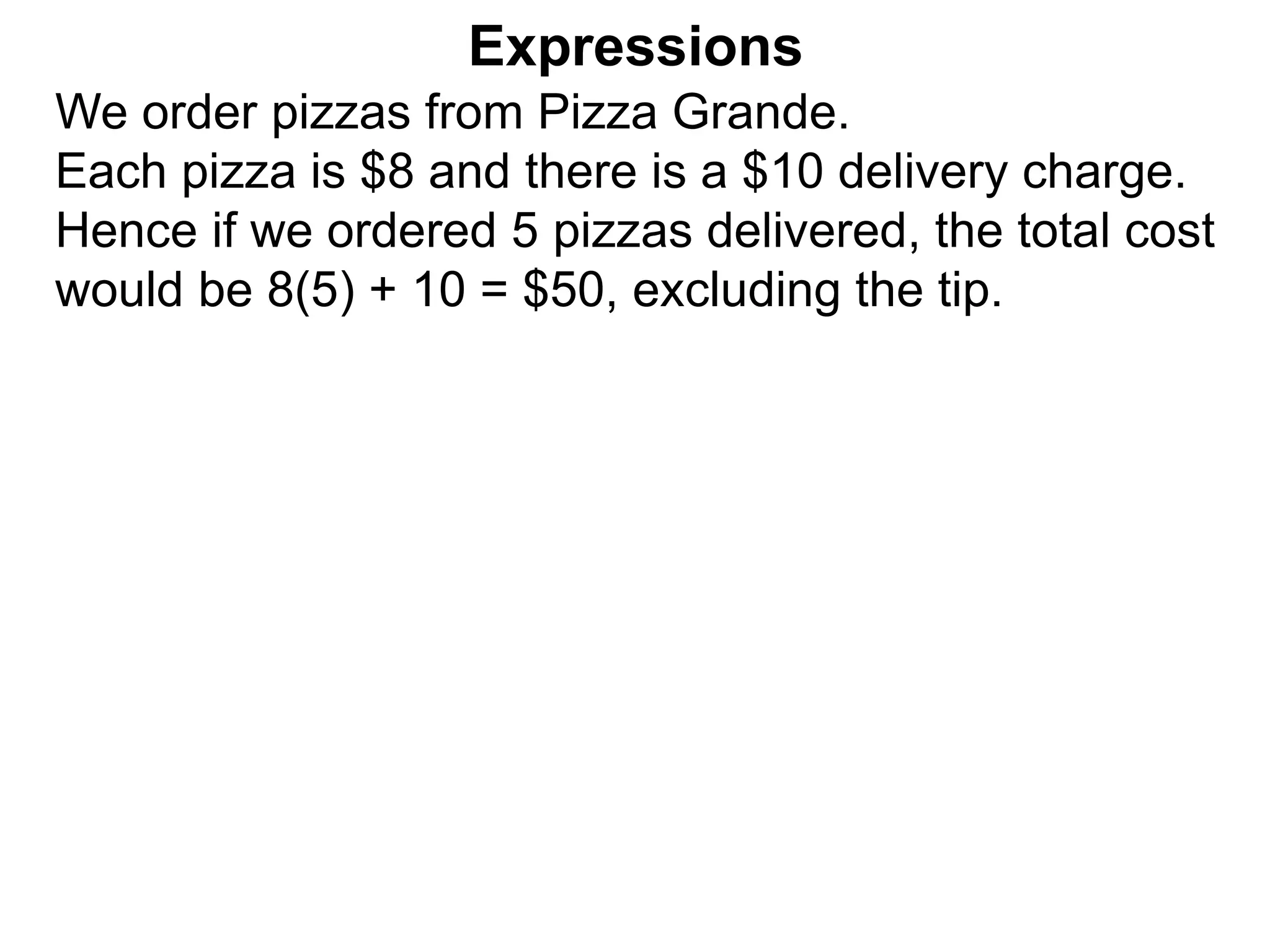
We order pizzas from Pizza Grande.
Expressions
We order pizzas from Pizza Grande.
Each pizza is $8 and there is a $10 delivery charge.
Expressions
We order pizzas from Pizza Grande.
Each pizza is $8 and there is a $10 delivery charge.
Hence if we ordered 5 pizzas delivered, the total cost
would be 8(5) + 10 = $50, excluding the tip.
Expressions
We order pizzas from Pizza Grande.
Each pizza is $8 and there is a $10 delivery charge.
Hence if we ordered 5 pizzas delivered, the total cost
would be 8(5) + 10 = $50, excluding the tip.
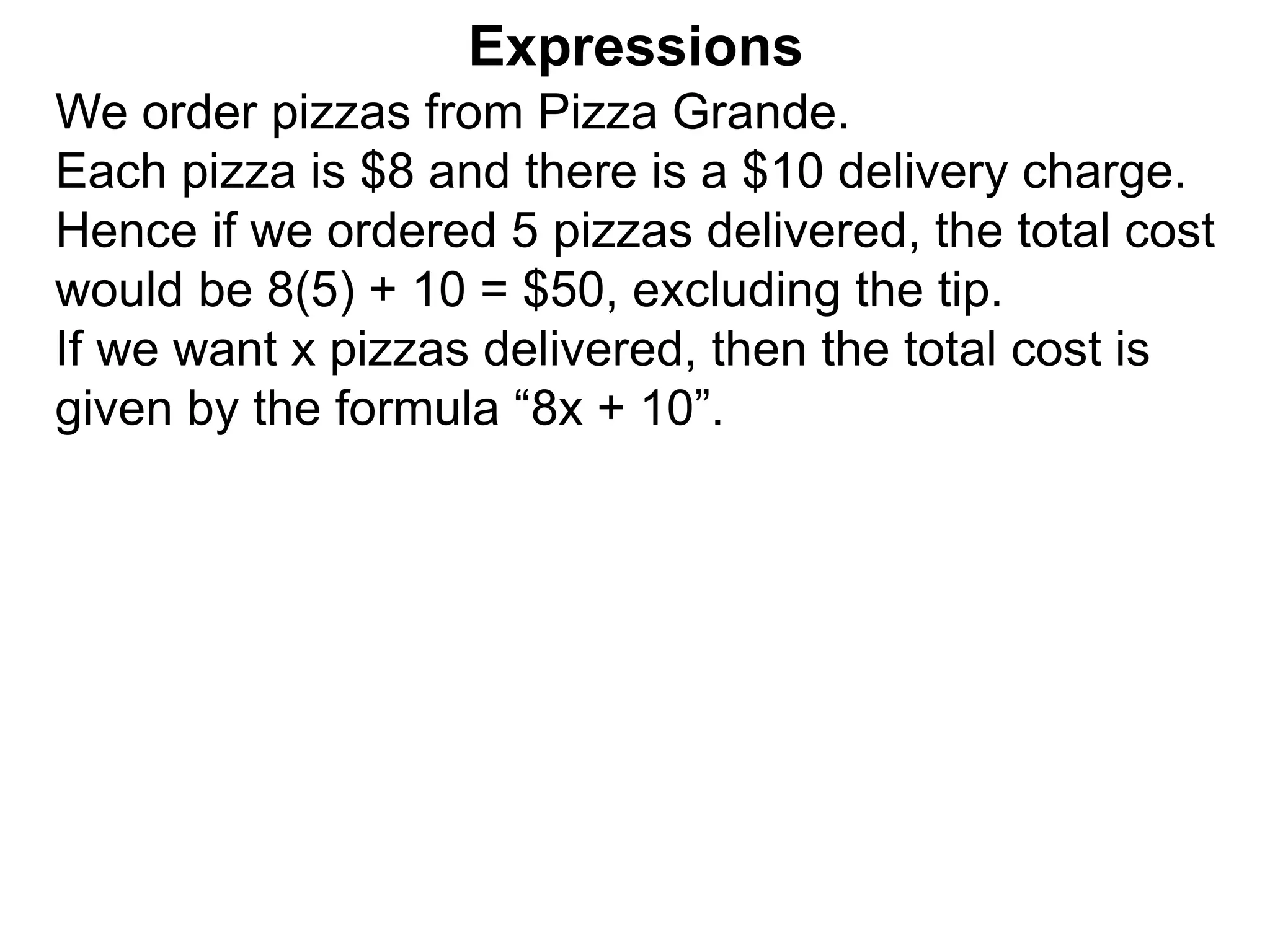
If we want x pizzas delivered, then the total cost is
given by the formula “8x + 10”.
Expressions
We order pizzas from Pizza Grande.
Each pizza is $8 and there is a $10 delivery charge.
Hence if we ordered 5 pizzas delivered, the total cost
would be 8(5) + 10 = $50, excluding the tip.
If we want x pizzas delivered, then the total cost is
given by the formula “8x + 10”.
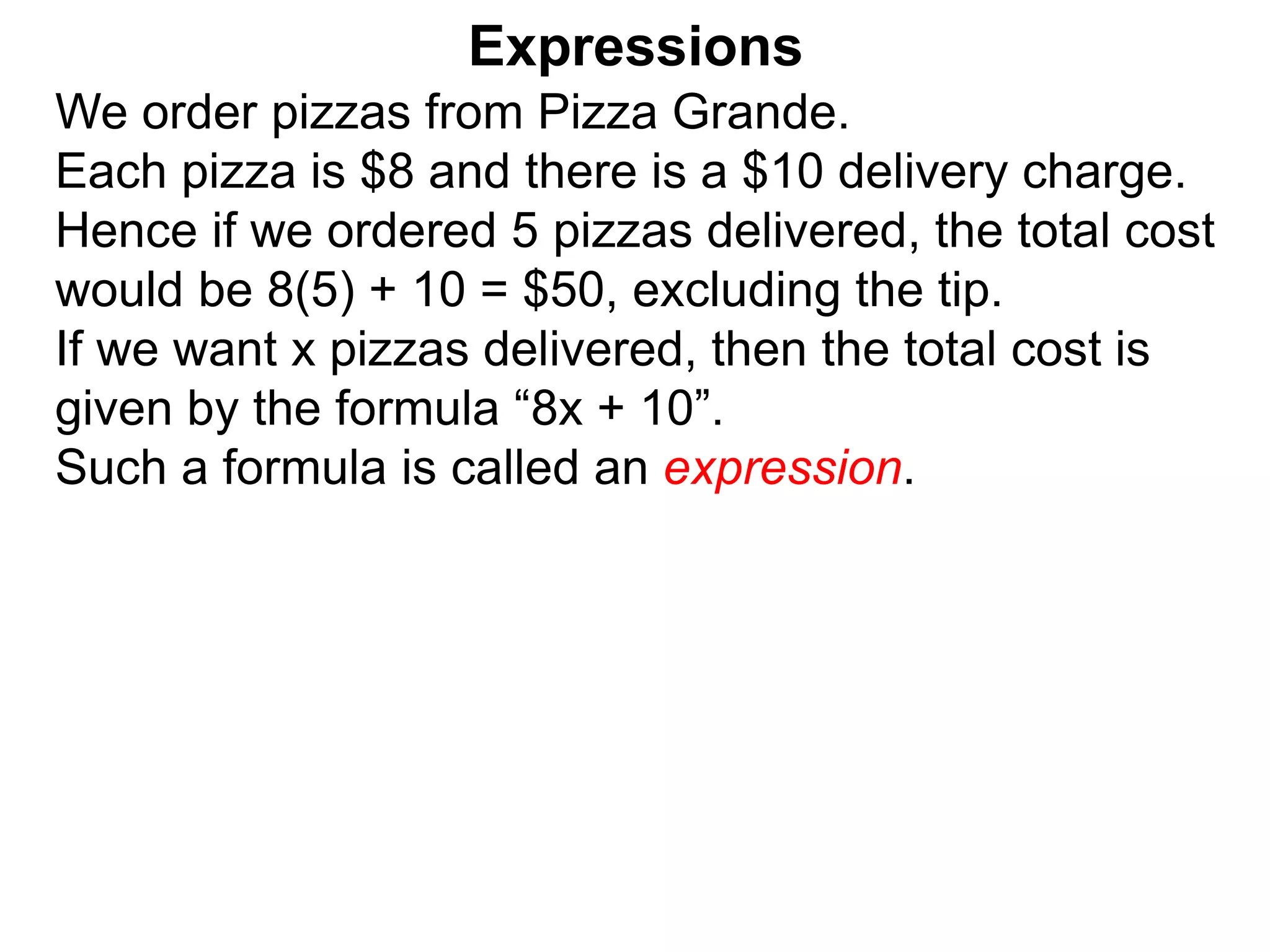
Such a formula is called an expression.
Expressions
We order pizzas from Pizza Grande.
Each pizza is $8 and there is a $10 delivery charge.
Hence if we ordered 5 pizzas delivered, the total cost
would be 8(5) + 10 = $50, excluding the tip.
If we want x pizzas delivered, then the total cost is
given by the formula “8x + 10”.
Such a formula is called an expression.
Expressions
If we ordered x = 100 pizzas, the cost would be
8(100)+10 = $810.
We order pizzas from Pizza Grande.
Each pizza is $8 and there is a $10 delivery charge.
Hence if we ordered 5 pizzas delivered, the total cost
would be 8(5) + 10 = $50, excluding the tip.
If we want x pizzas delivered, then the total cost is
given by the formula “8x + 10”.
Such a formula is called an expression.
Expressions
If we ordered x = 100 pizzas, the cost would be
8(100)+10 = $810. The value x = 100 is called the
input and the projected cost $810 is called the output.
We order pizzas from Pizza Grande.
Each pizza is $8 and there is a $10 delivery charge.
Hence if we ordered 5 pizzas delivered, the total cost
would be 8(5) + 10 = $50, excluding the tip.
If we want x pizzas delivered, then the total cost is
given by the formula “8x + 10”.
Such a formula is called an expression.
Expressions
Definition: Mathematical expressions are calculation
procedures which are written with numbers, variables,
operation symbols +, –, *, / and ( )’s.
If we ordered x = 100 pizzas, the cost would be
8(100)+10 = $810. The value x = 100 is called the
input and the projected cost $810 is called the output.
We order pizzas from Pizza Grande.
Each pizza is $8 and there is a $10 delivery charge.
Hence if we ordered 5 pizzas delivered, the total cost
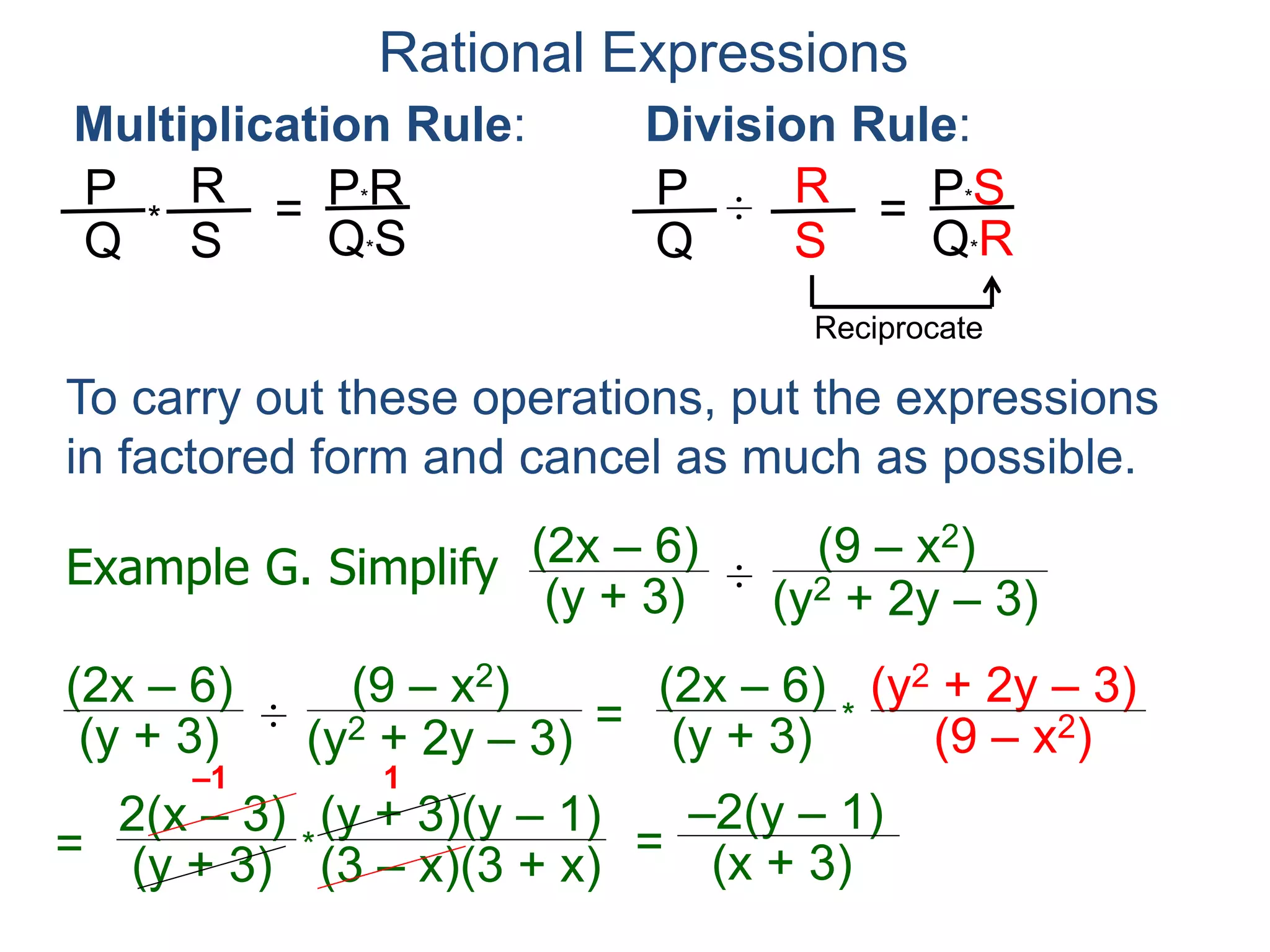
would be 8(5) + 10 = $50, excluding the tip.
If we want x pizzas delivered, then the total cost is
given by the formula “8x + 10”.
Such a formula is called an expression.
Expressions
Definition: Mathematical expressions are calculation
procedures which are written with numbers, variables,
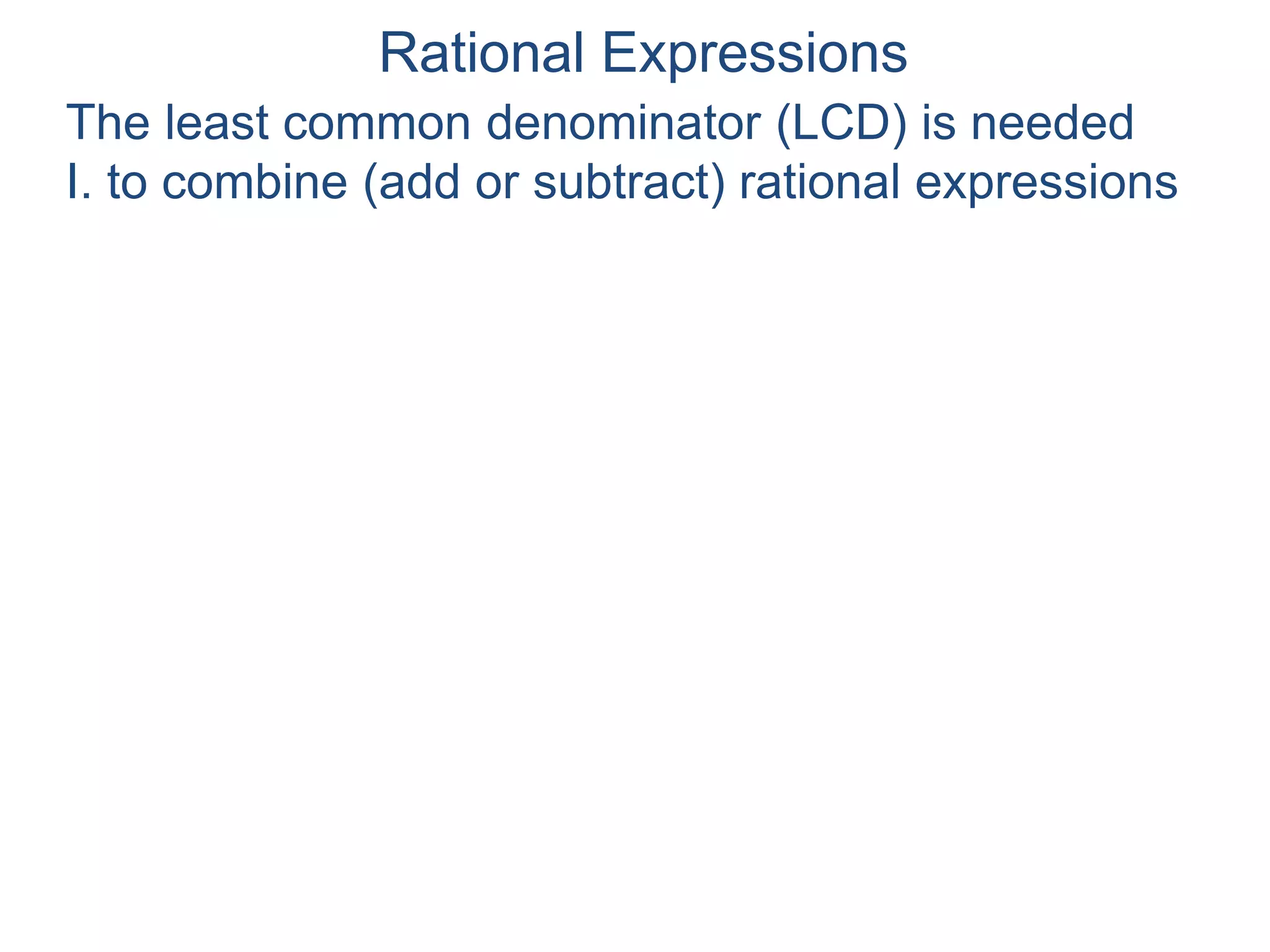
operation symbols +, –, *, / and ( )’s.
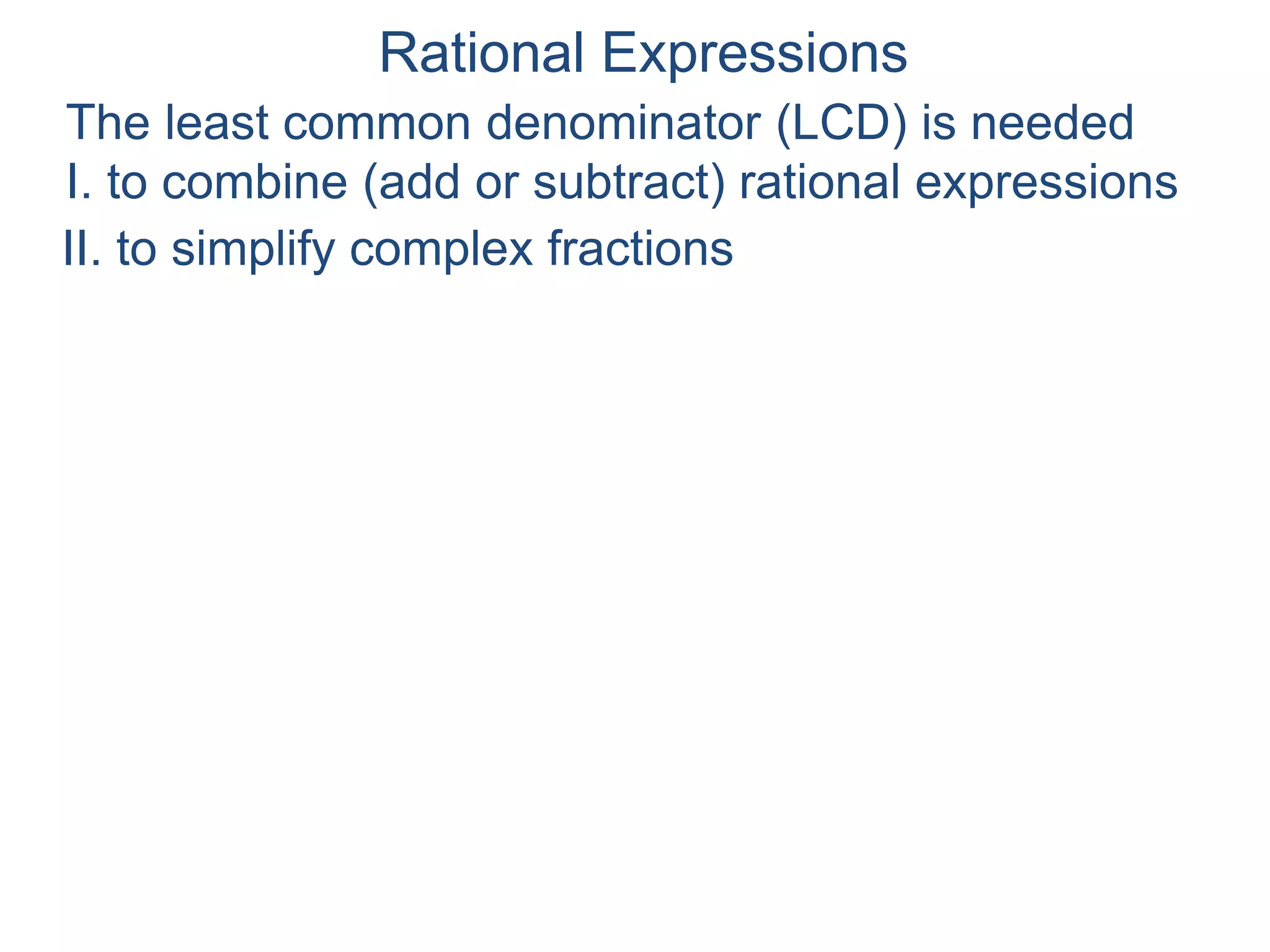
Expressions calculate the expected future results.
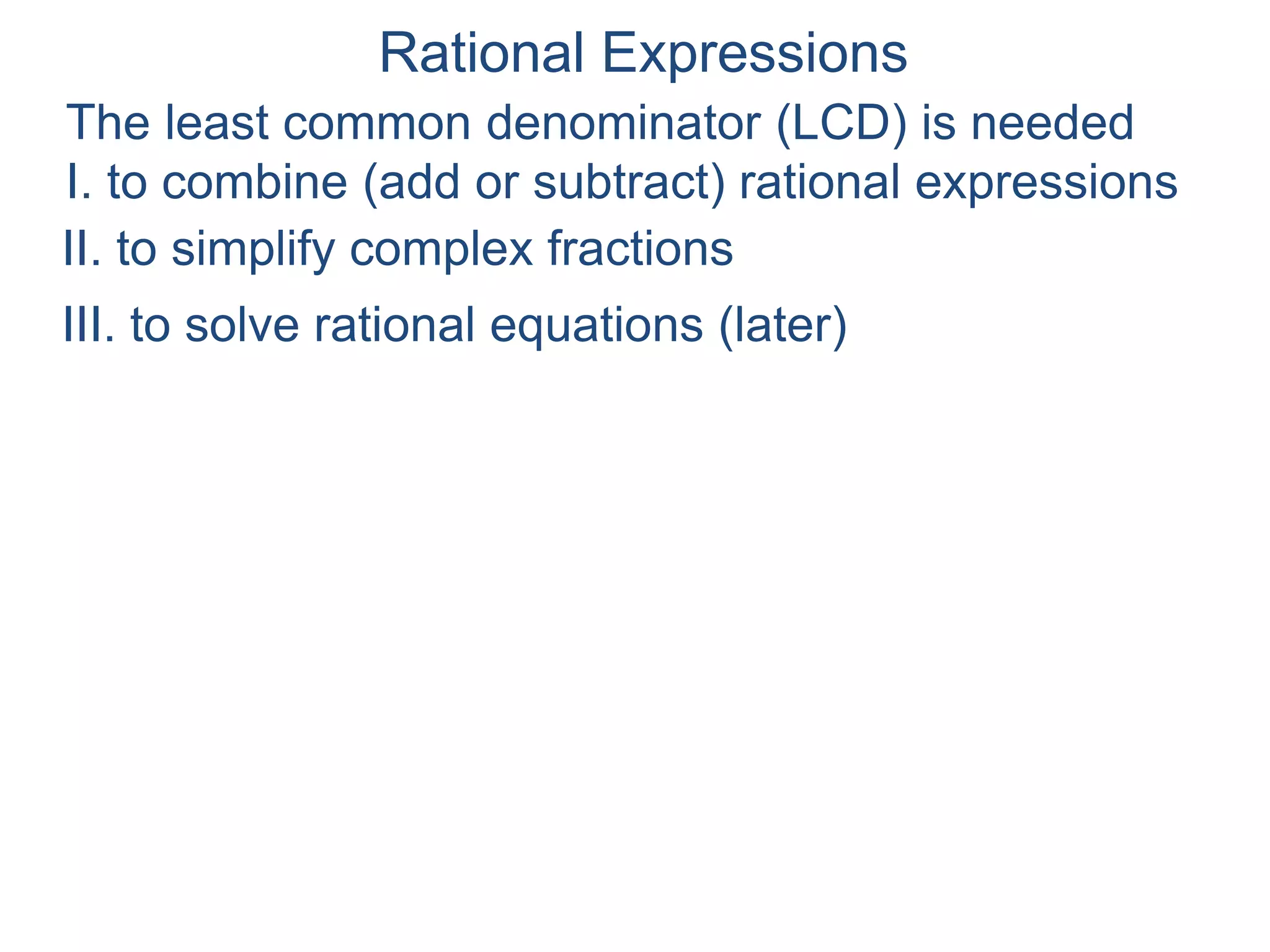
If we ordered x = 100 pizzas, the cost would be
8(100)+10 = $810. The value x = 100 is called the
input and the projected cost $810 is called the output.
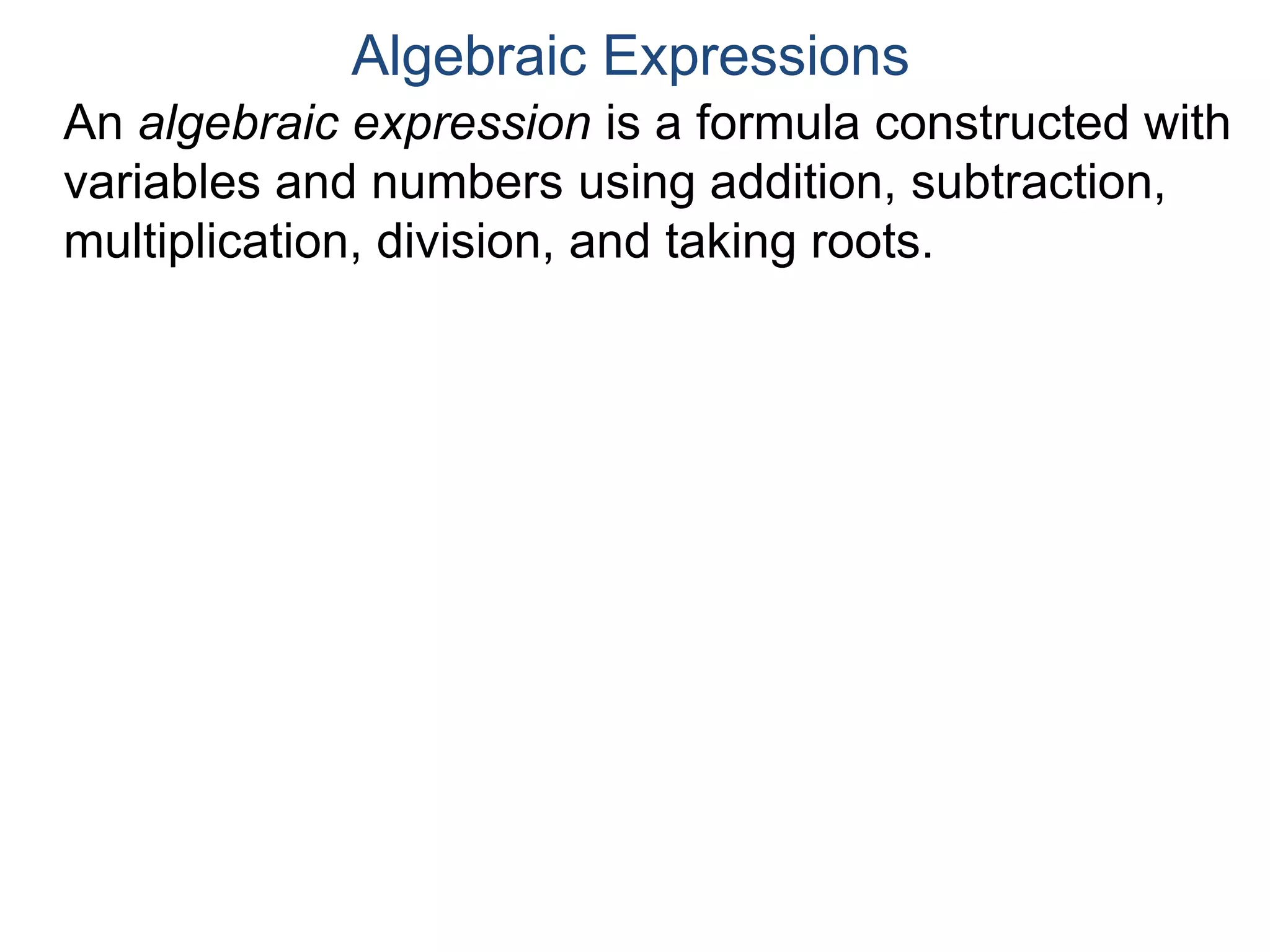
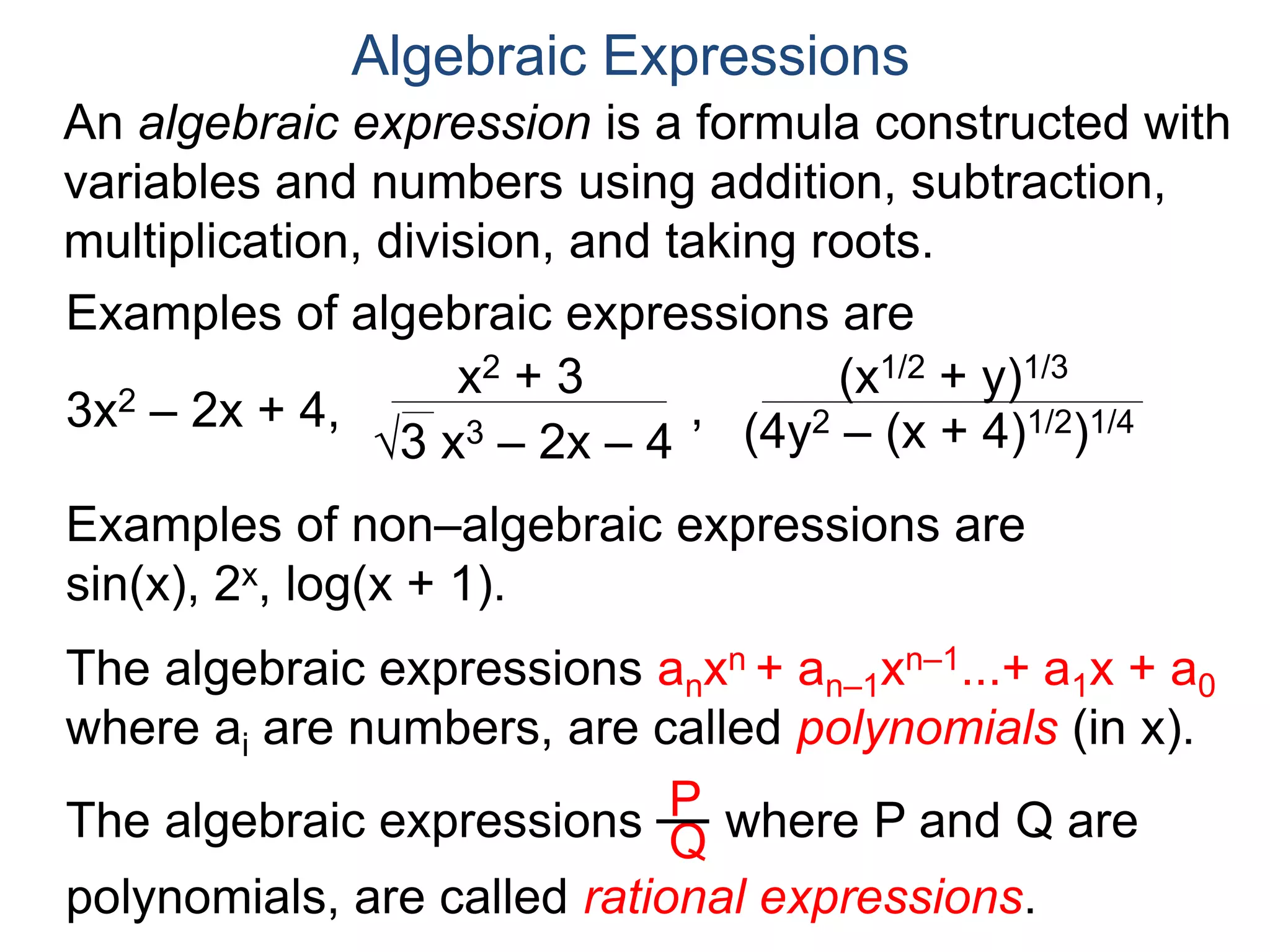
An algebraic expression is a formula constructed
with variables and numbers using addition,
subtraction, multiplication, division, and taking roots.
Algebraic Expressions
An algebraic expression is a formula constructed
with variables and numbers using addition,
subtraction, multiplication, division, and taking roots.
Algebraic Expressions
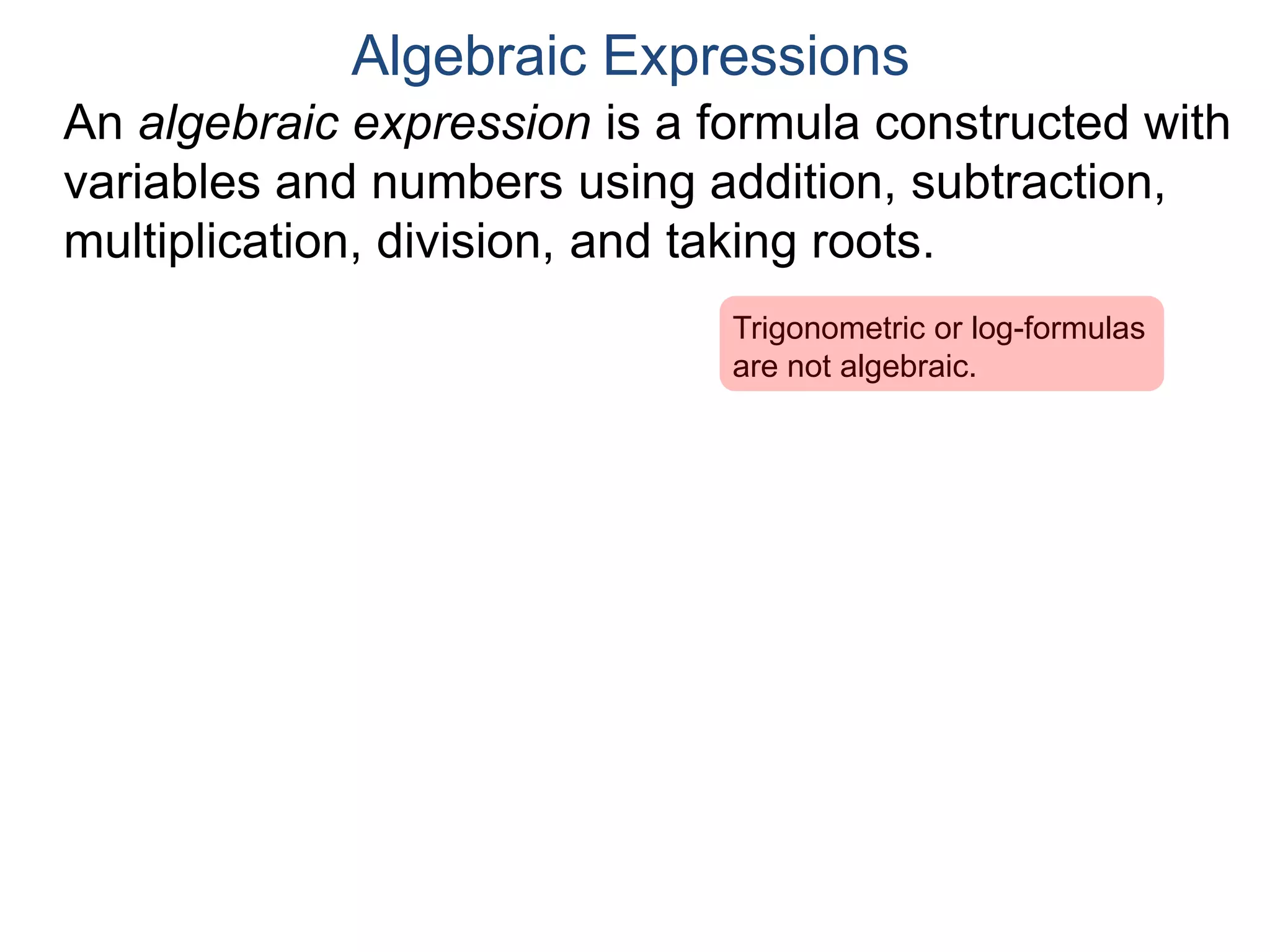
Trigonometric or log-formulas
are not algebraic.
An algebraic expression is a formula constructed
with variables and numbers using addition,
subtraction, multiplication, division, and taking roots.
Algebraic Expressions
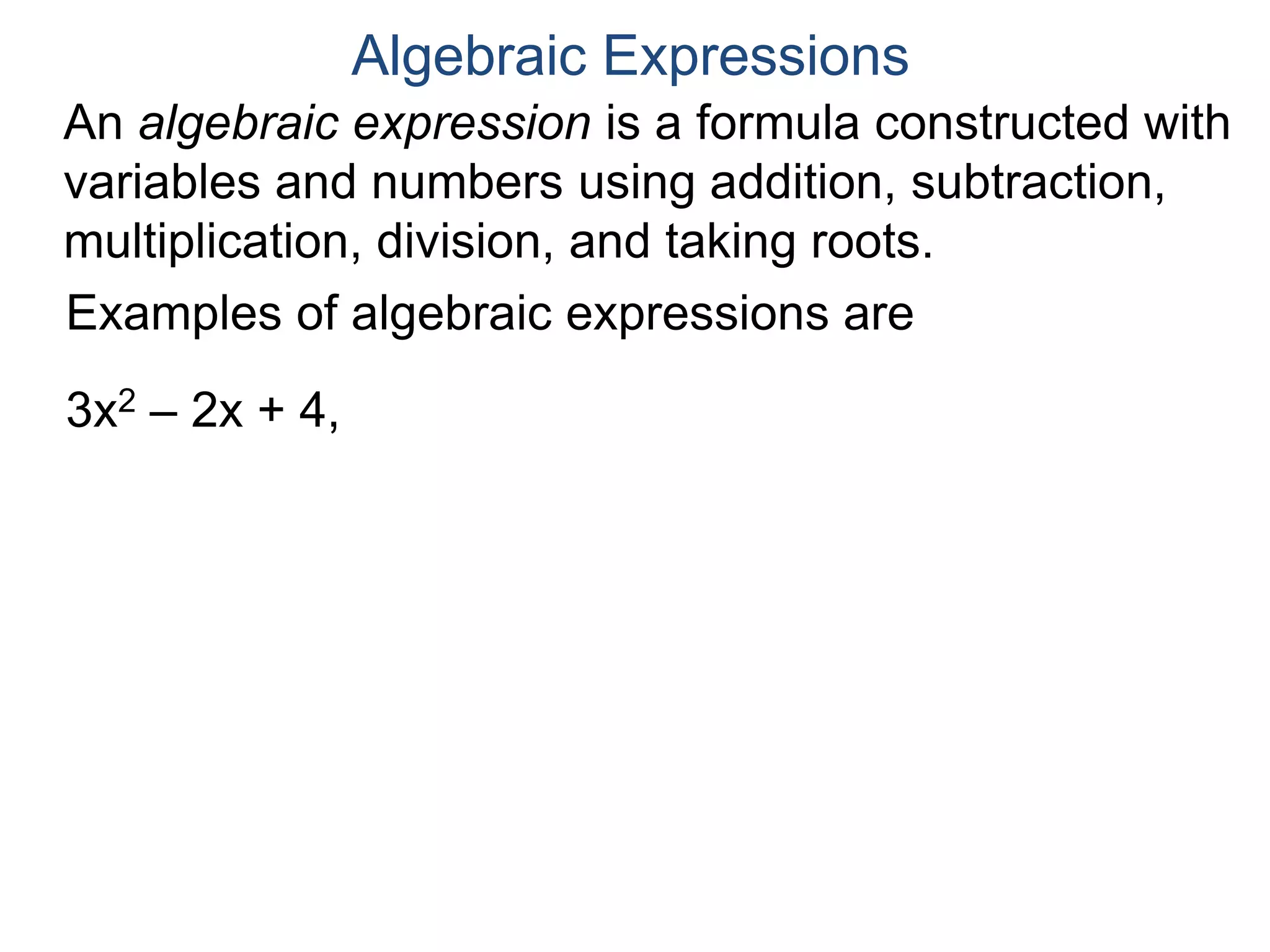
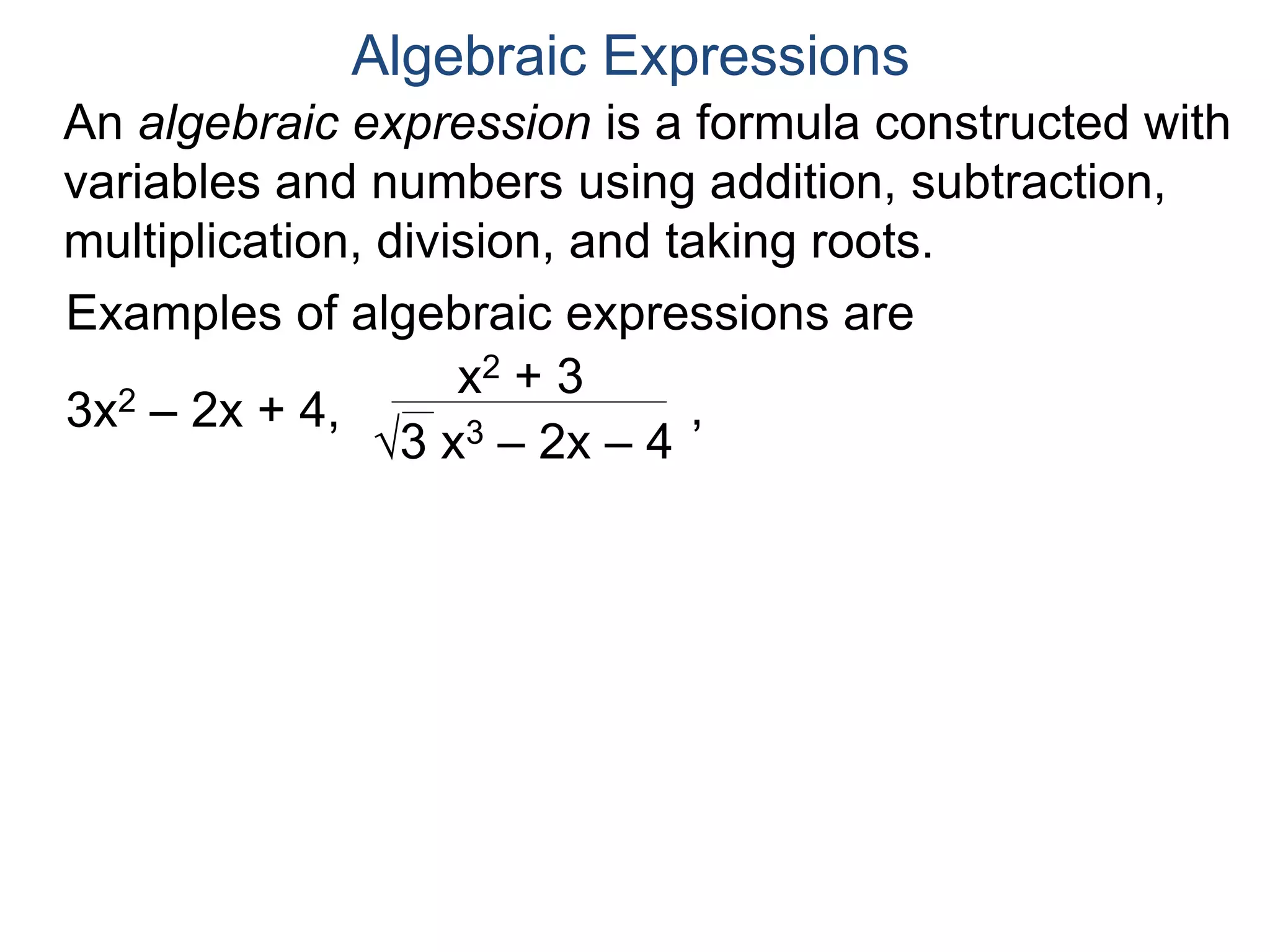
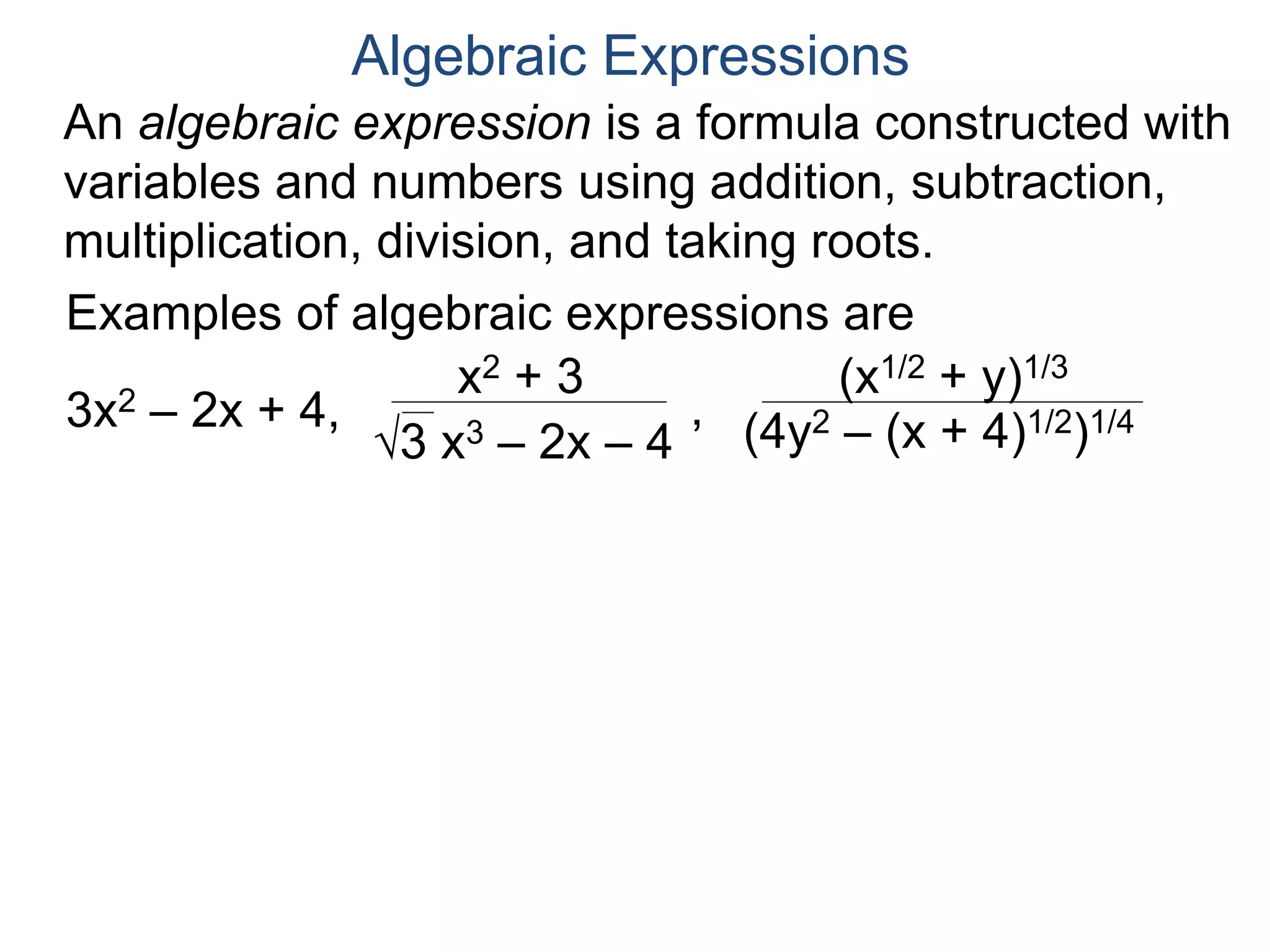
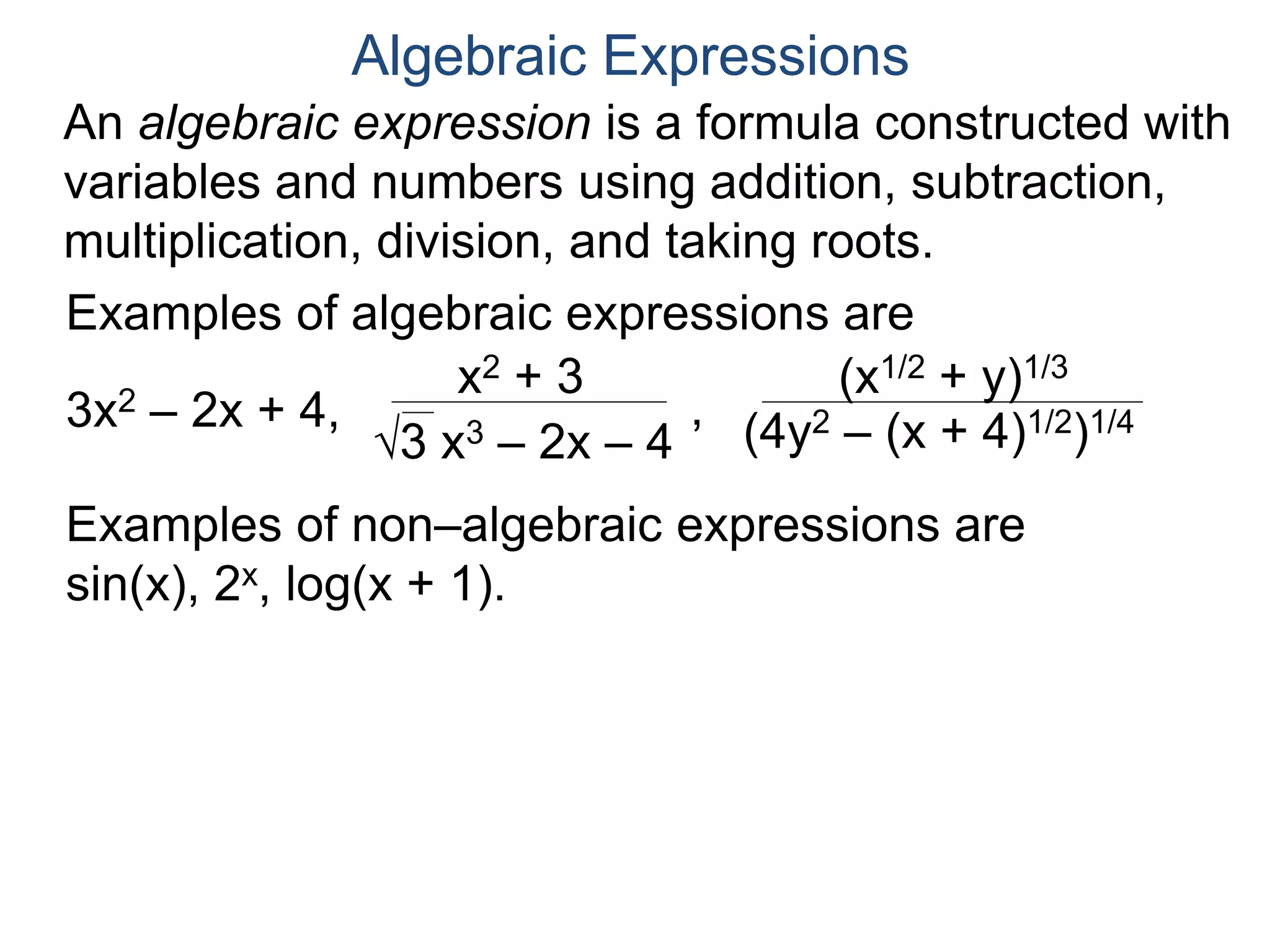
Examples of algebraic expressions are
3x2 – 2x + 4,
An algebraic expression is a formula constructed
with variables and numbers using addition,
subtraction, multiplication, division, and taking roots.
Algebraic Expressions
Examples of algebraic expressions are
3x2 – 2x + 4,
x2 + 3
3 x3 – 2x – 4
,
An algebraic expression is a formula constructed
with variables and numbers using addition,
subtraction, multiplication, division, and taking roots.
Algebraic Expressions
Examples of algebraic expressions are
3x2 – 2x + 4,
x2 + 3
3 x3 – 2x – 4
,
(x1/2 + y)1/3
(4y2 – (x + 4)1/2)1/4
An algebraic expression is a formula constructed
with variables and numbers using addition,
subtraction, multiplication, division, and taking roots.
Algebraic Expressions
Examples of algebraic expressions are
3x2 – 2x + 4,
x2 + 3
3 x3 – 2x – 4
,
(x1/2 + y)1/3
(4y2 – (x + 4)1/2)1/4
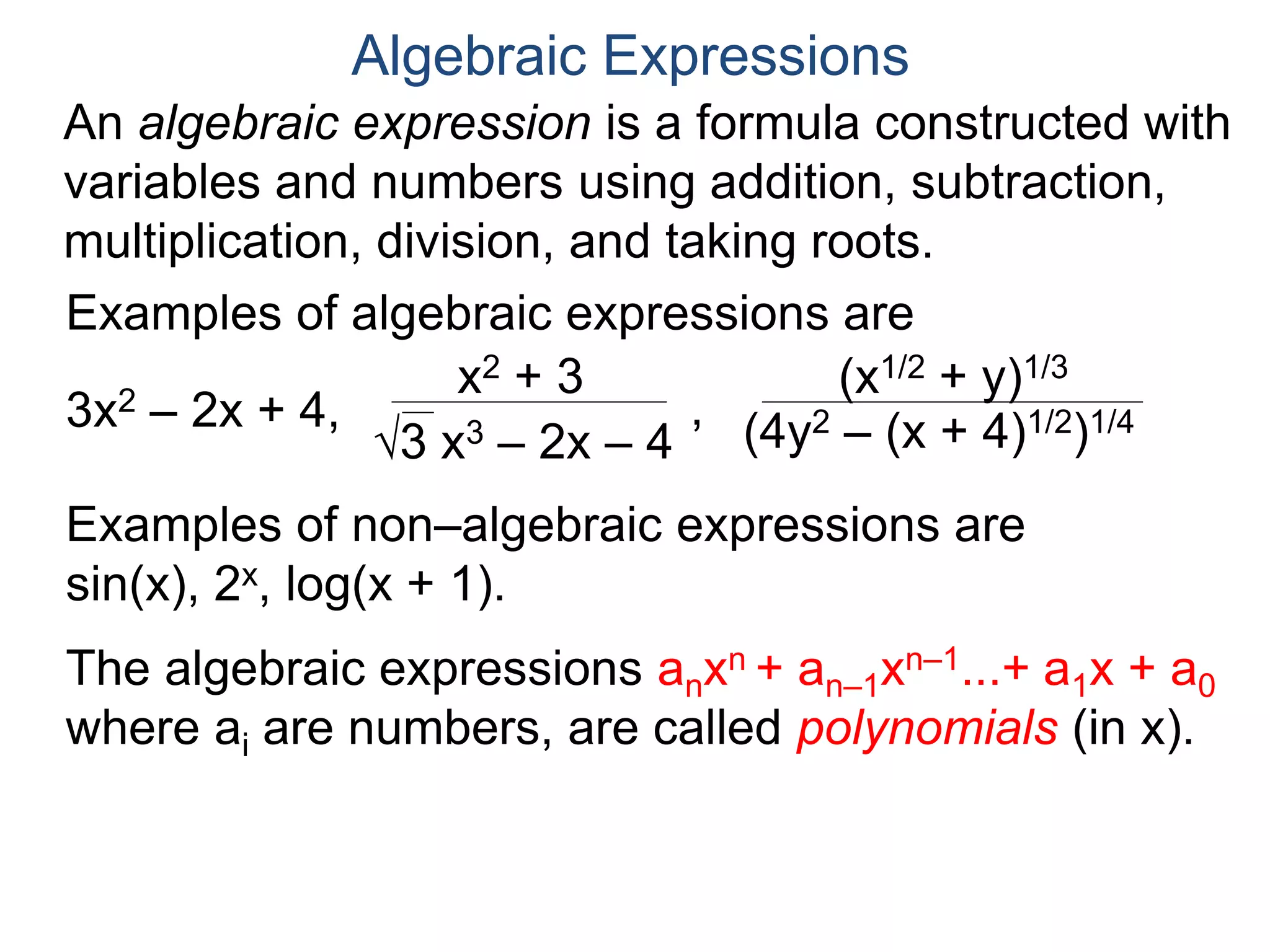
Examples of non–algebraic expressions are
sin(x), 2x, log(x + 1).
An algebraic expression is a formula constructed
with variables and numbers using addition,
subtraction, multiplication, division, and taking roots.
Algebraic Expressions
Examples of algebraic expressions are
3x2 – 2x + 4,
x2 + 3
3 x3 – 2x – 4
,
(x1/2 + y)1/3
(4y2 – (x + 4)1/2)1/4
Examples of non–algebraic expressions are
sin(x), 2x, log(x + 1).
The algebraic expressions anxn + an–1xn–1...+ a1x + a0
where ai are numbers, are called polynomials (in x).
An algebraic expression is a formula constructed
with variables and numbers using addition,
subtraction, multiplication, division, and taking roots.
Algebraic Expressions
Examples of algebraic expressions are
3x2 – 2x + 4,
x2 + 3
3 x3 – 2x – 4
,
(x1/2 + y)1/3
(4y2 – (x + 4)1/2)1/4
Examples of non–algebraic expressions are
sin(x), 2x, log(x + 1).
The algebraic expressions anxn + an–1xn–1...+ a1x + a0
where ai are numbers, are called polynomials (in x).
The algebraic expressions where P and Q are
polynomials, are called rational expressions.
P
Q
Polynomial Expressions
Following are examples of operations with
polynomials and rational expressions.
Polynomial Expressions
Following are examples of operations with
polynomials and rational expressions.
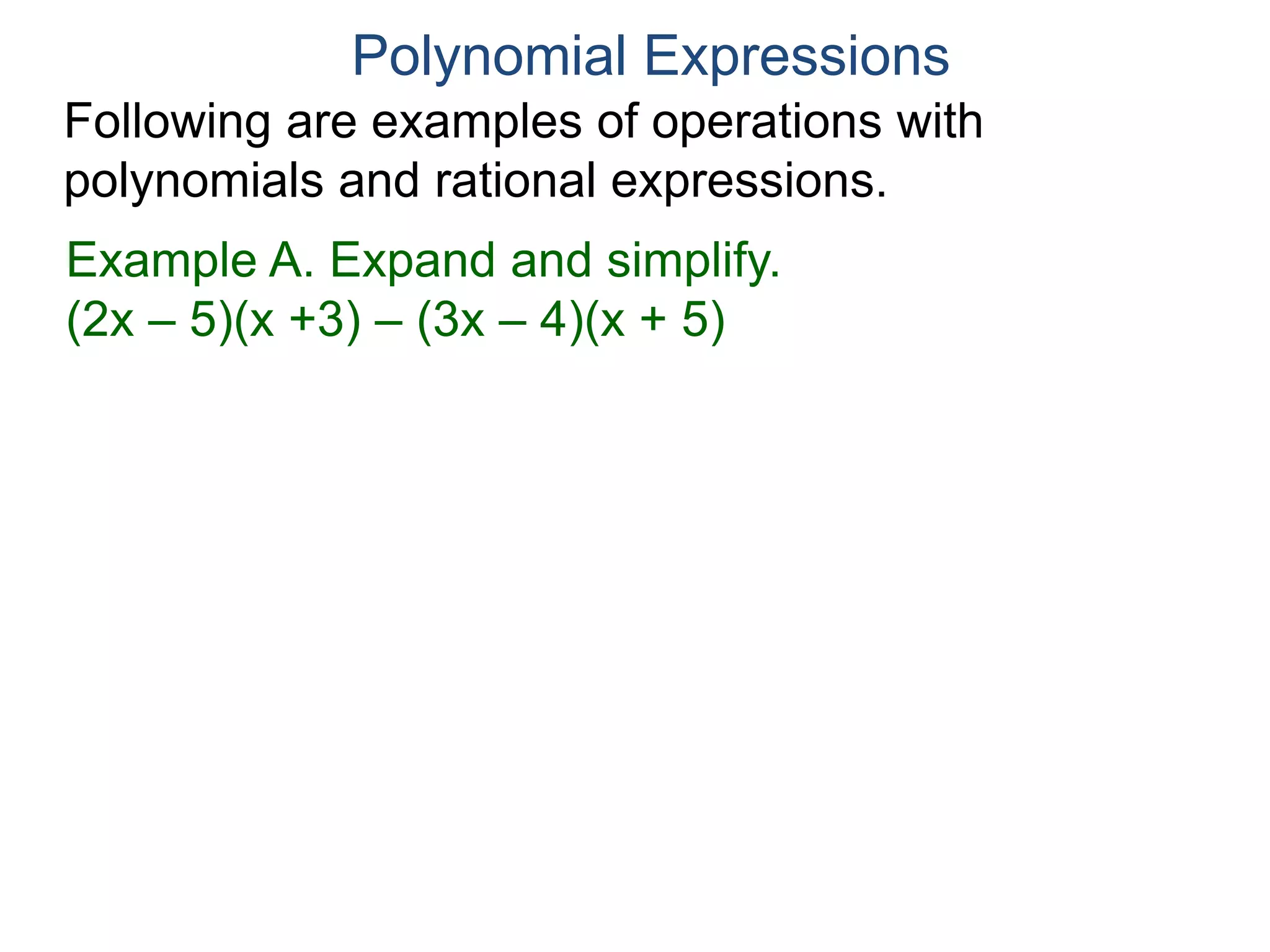
Example A. Expand and simplify.
(2x – 5)(x +3) – (3x – 4)(x + 5)
Polynomial Expressions
Following are examples of operations with
polynomials and rational expressions.
Example A. Expand and simplify.
(2x – 5)(x +3) – (3x – 4)(x + 5)
The point of this problem is
how to subtract a “product”.
Polynomial Expressions
Following are examples of operations with
polynomials and rational expressions.
Example A. Expand and simplify.
(2x – 5)(x +3) – [(3x – 4)(x + 5)] Insert [ ]
The point of this problem is
how to subtract a “product”.
Polynomial Expressions
Following are examples of operations with
polynomials and rational expressions.
Example A. Expand and simplify.
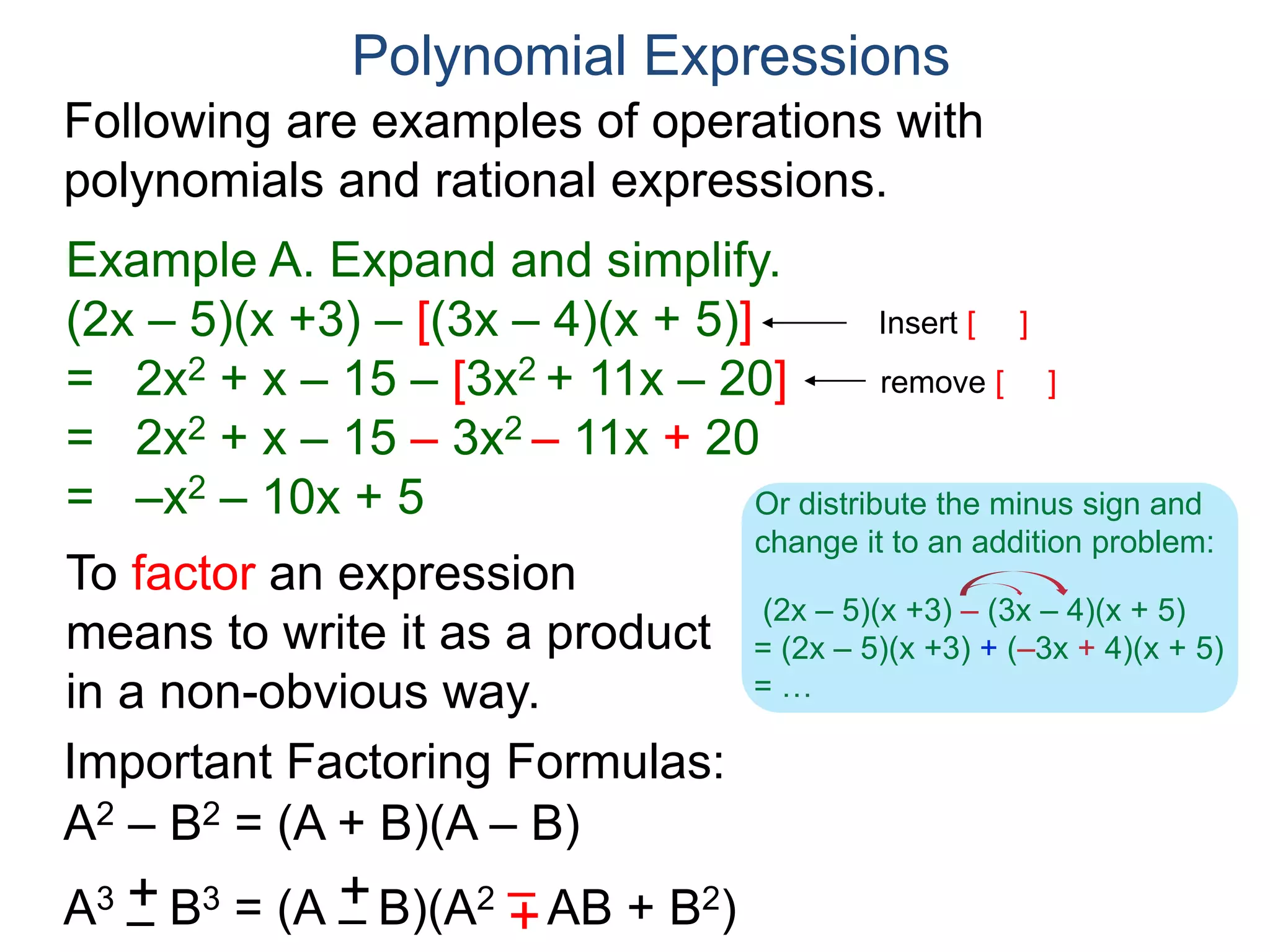
(2x – 5)(x +3) – [(3x – 4)(x + 5)]
= 2x2 + x – 15 – [3x2 + 11x – 20]
Insert [ ]
remove [ ]
Polynomial Expressions
Following are examples of operations with
polynomials and rational expressions.
Example A. Expand and simplify.
(2x – 5)(x +3) – [(3x – 4)(x + 5)]
= 2x2 + x – 15 – [3x2 + 11x – 20]
= 2x2 + x – 15 – 3x2 – 11x + 20
Insert [ ]
remove [ ]
Polynomial Expressions
Following are examples of operations with
polynomials and rational expressions.
Example A. Expand and simplify.
(2x – 5)(x +3) – [(3x – 4)(x + 5)]
= 2x2 + x – 15 – [3x2 + 11x – 20]
= 2x2 + x – 15 – 3x2 – 11x + 20
= –x2 – 10x + 5
Insert [ ]
remove [ ]
Polynomial Expressions
Following are examples of operations with
polynomials and rational expressions.
Example A. Expand and simplify.
(2x – 5)(x +3) – [(3x – 4)(x + 5)]
= 2x2 + x – 15 – [3x2 + 11x – 20]
= 2x2 + x – 15 – 3x2 – 11x + 20
= –x2 – 10x + 5
Insert [ ]
remove [ ]
Polynomial Expressions
Following are examples of operations with
polynomials and rational expressions.
Example A. Expand and simplify.
(2x – 5)(x +3) – [(3x – 4)(x + 5)]
= 2x2 + x – 15 – [3x2 + 11x – 20]
= 2x2 + x – 15 – 3x2 – 11x + 20
= –x2 – 10x + 5
Insert [ ]
remove [ ]
(2x – 5)(x +3) – (3x – 4)(x + 5)
= (2x – 5)(x +3) + (–3x + 4)(x + 5)
= …
Or distribute the minus sign and
change it to an addition problem:
Polynomial Expressions
Following are examples of operations with
polynomials and rational expressions.
Example A. Expand and simplify.
(2x – 5)(x +3) – [(3x – 4)(x + 5)]
= 2x2 + x – 15 – [3x2 + 11x – 20]
= 2x2 + x – 15 – 3x2 – 11x + 20
= –x2 – 10x + 5
Insert [ ]
To factor an expression
means to write it as a product
in a non-obvious way.
remove [ ]
(2x – 5)(x +3) – (3x – 4)(x + 5)
= (2x – 5)(x +3) + (–3x + 4)(x + 5)
= …
Or distribute the minus sign and
change it to an addition problem:
Polynomial Expressions
Following are examples of operations with
polynomials and rational expressions.
Example A. Expand and simplify.
(2x – 5)(x +3) – [(3x – 4)(x + 5)]
= 2x2 + x – 15 – [3x2 + 11x – 20]
= 2x2 + x – 15 – 3x2 – 11x + 20
= –x2 – 10x + 5
Insert [ ]
A3 B3 = (A B)(A2 AB + B2)
Important Factoring Formulas:
To factor an expression
means to write it as a product
in a non-obvious way.
A2 – B2 = (A + B)(A – B)
+–
+– +–
remove [ ]
(2x – 5)(x +3) – (3x – 4)(x + 5)
= (2x – 5)(x +3) + (–3x + 4)(x + 5)
= …
Or distribute the minus sign and
change it to an addition problem:
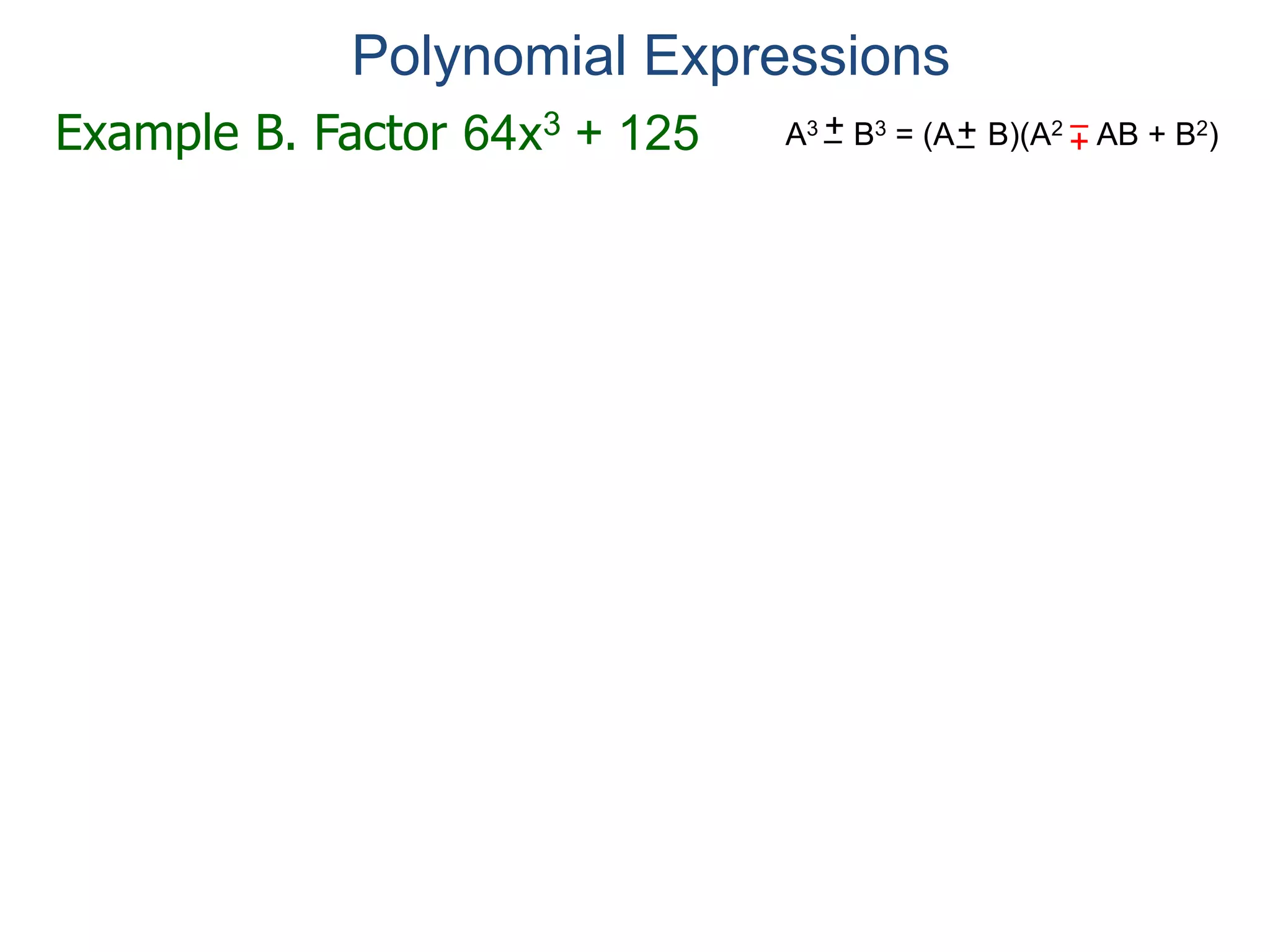
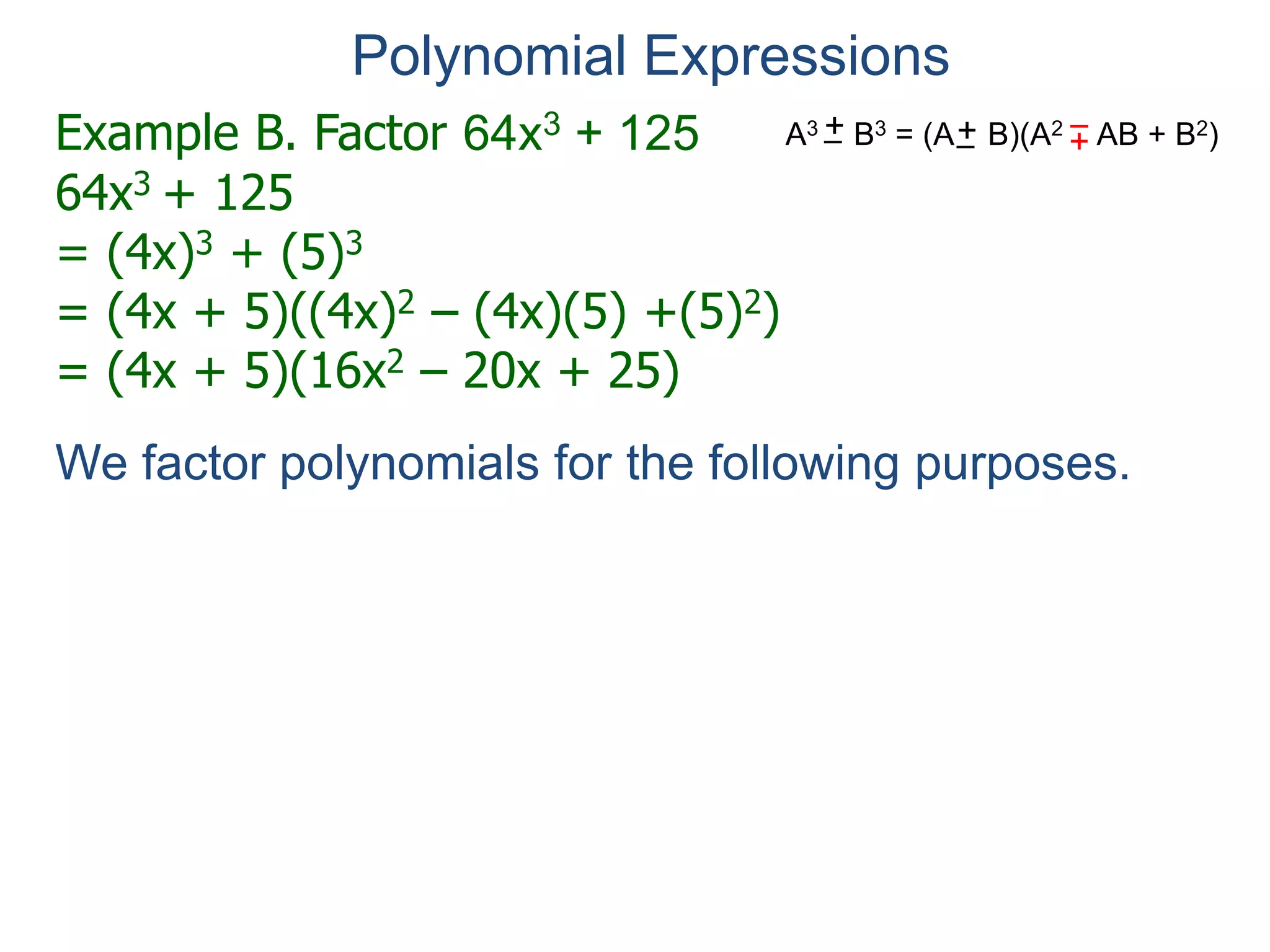
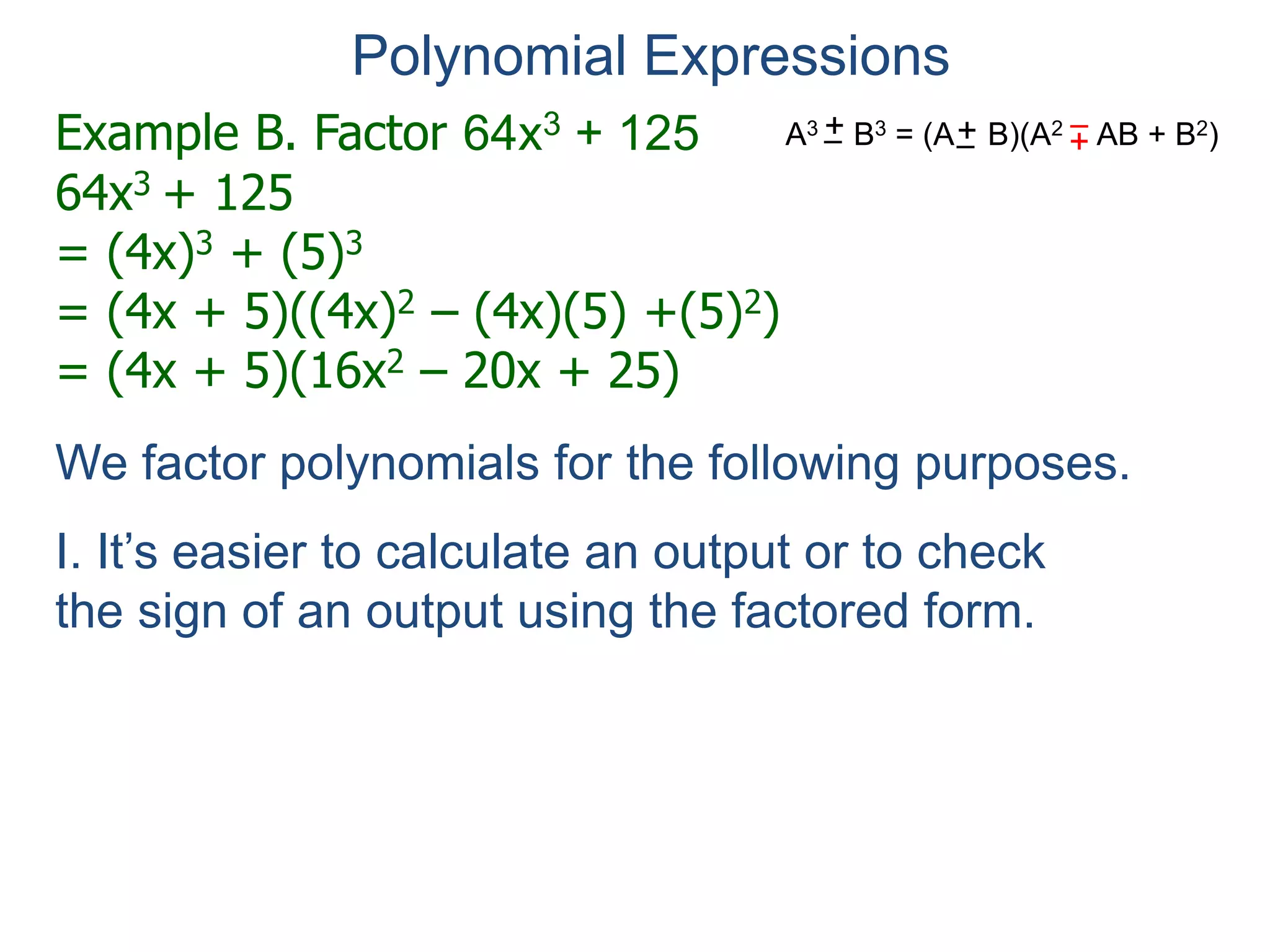
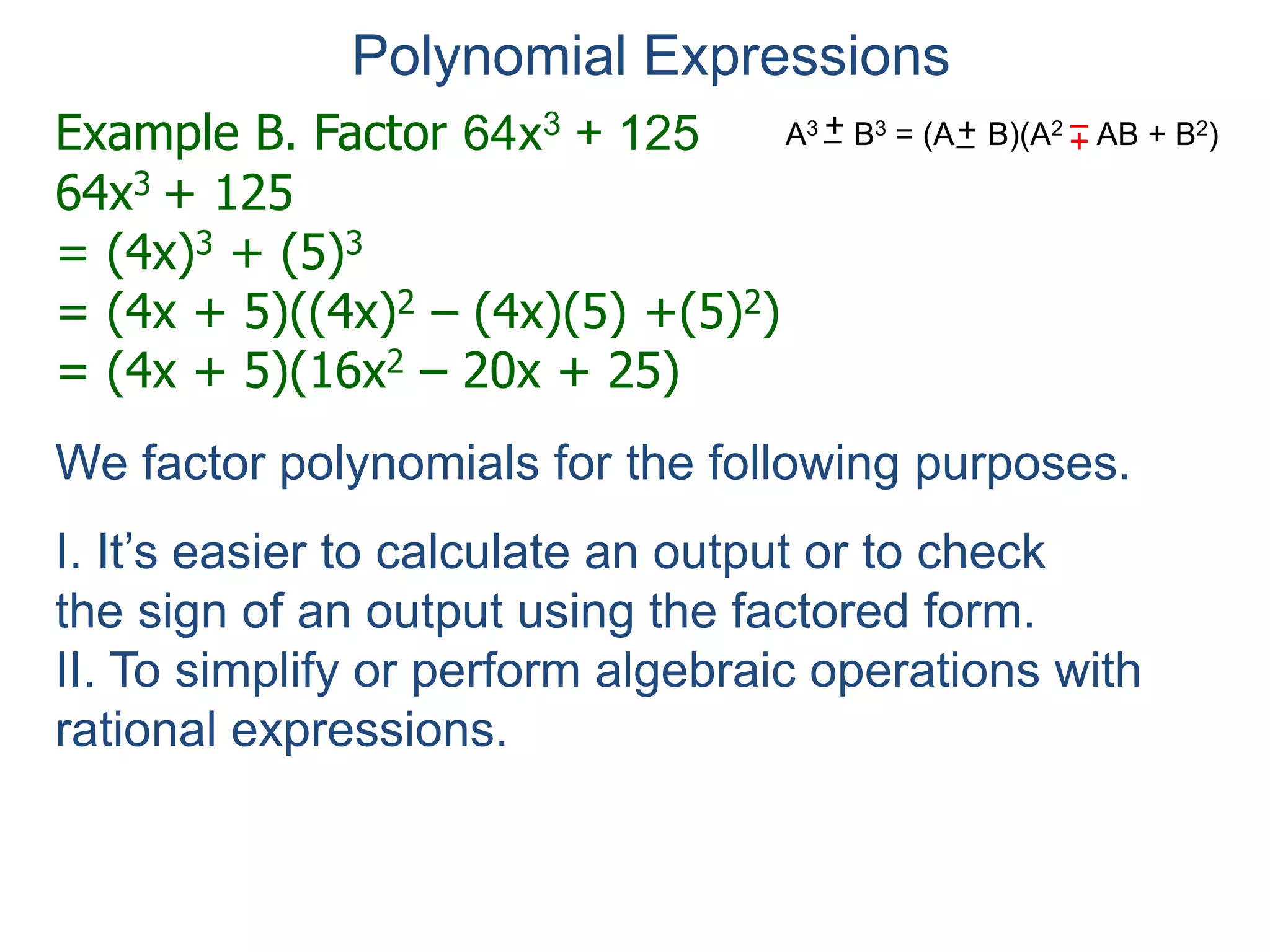
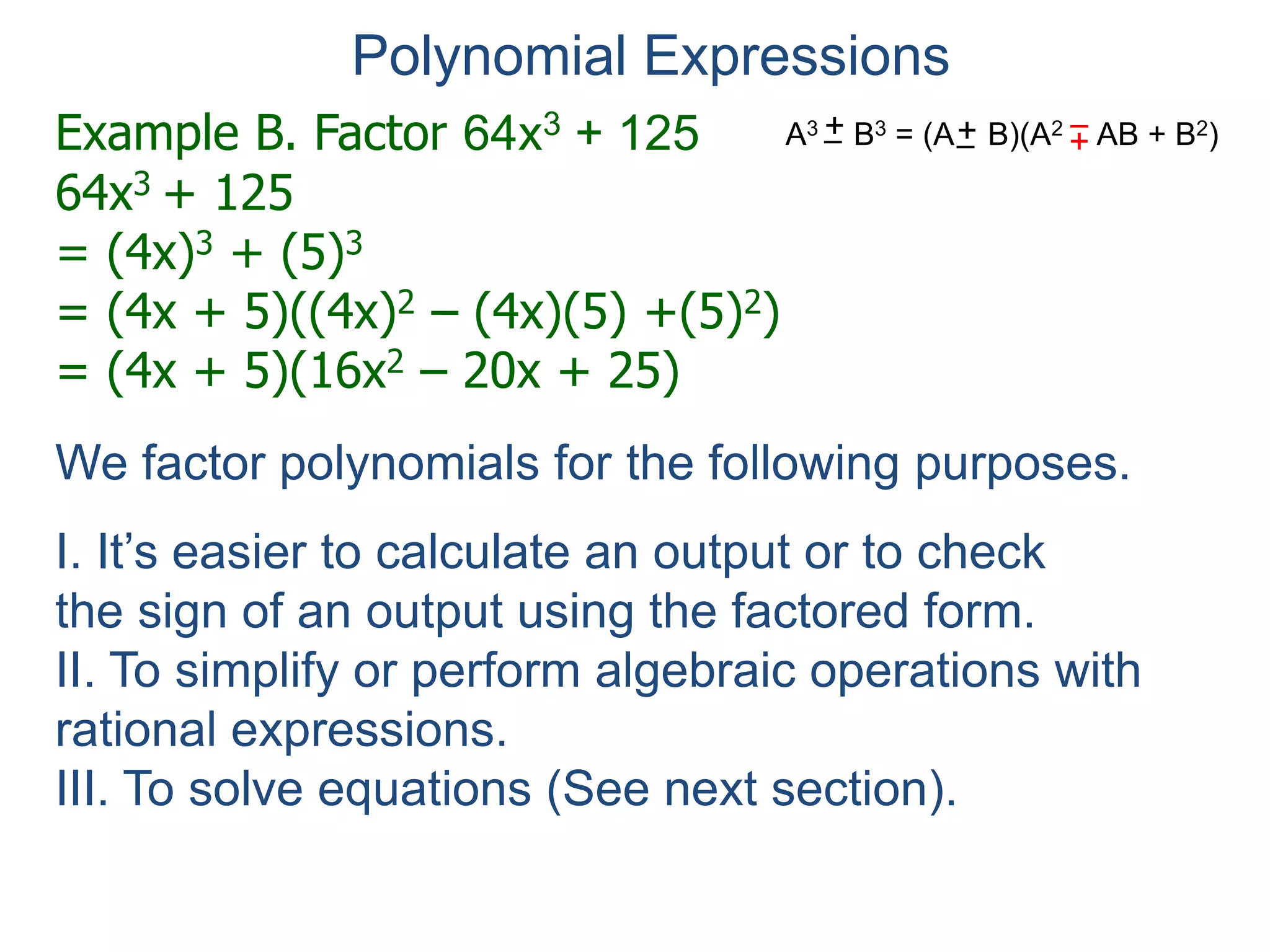
Example B. Factor 64x3 + 125
Polynomial Expressions
A3 B3 = (A B)(A2 AB + B2)+– +
–+–
Example B. Factor 64x3 + 125
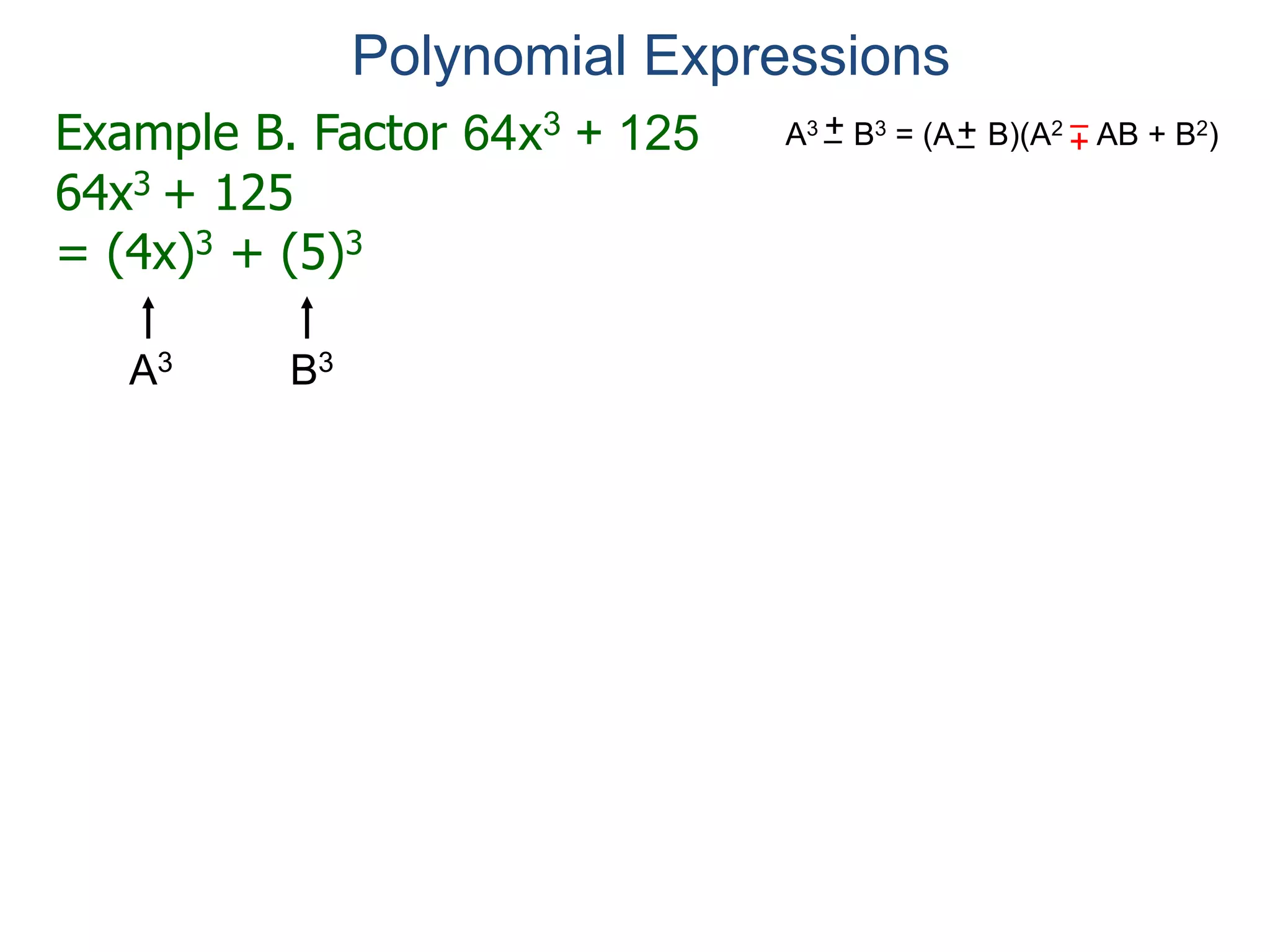
64x3 + 125
= (4x)3 + (5)3
Polynomial Expressions
A3 B3 = (A B)(A2 AB + B2)+– +
–+–
A3 B3
Example B. Factor 64x3 + 125
64x3 + 125
= (4x)3 + (5)3
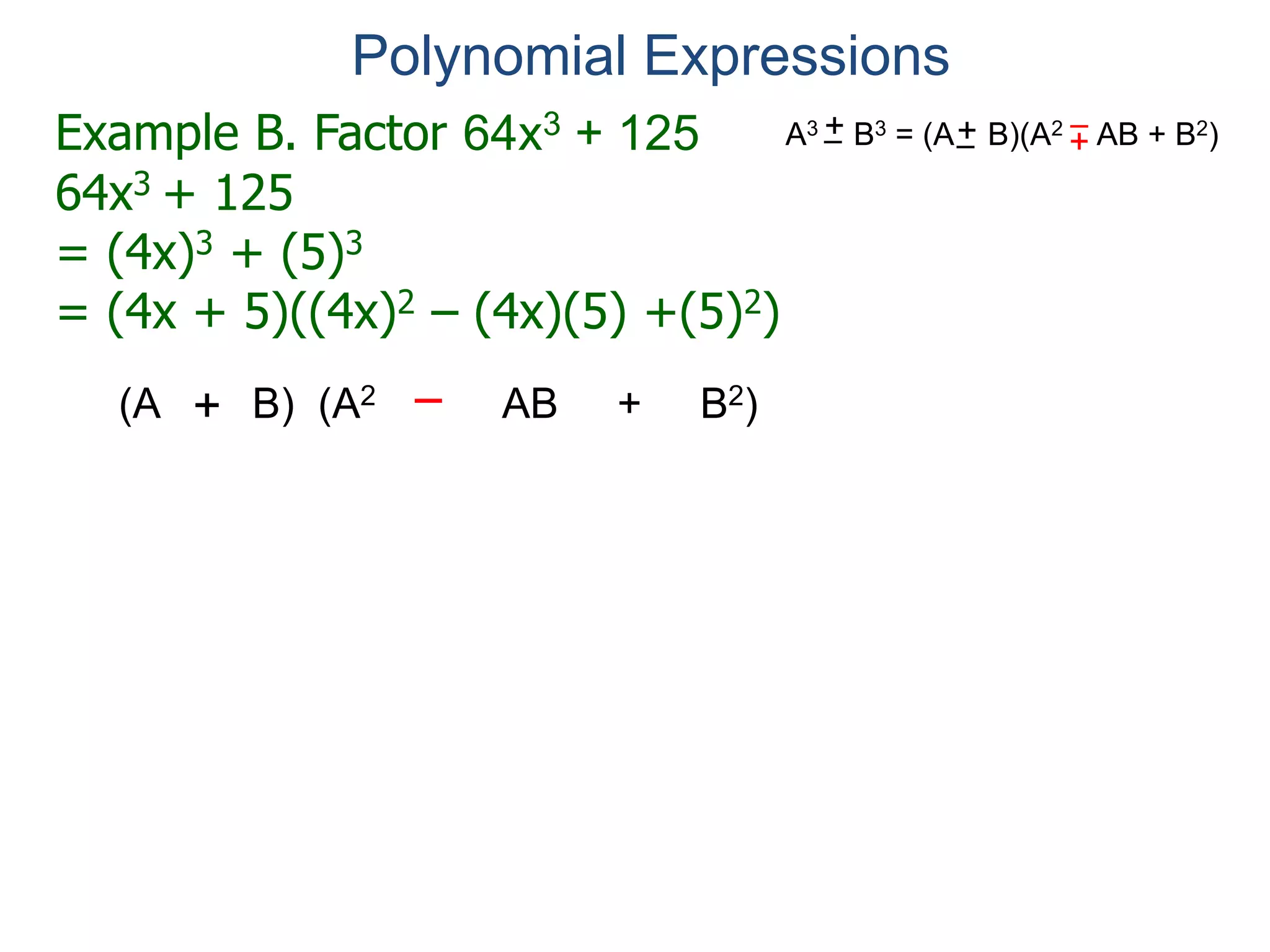
= (4x + 5)((4x)2 – (4x)(5) +(5)2)
Polynomial Expressions
A3 B3 = (A B)(A2 AB + B2)+– +
–+–
(A B) (A2 AB + B2)+ –
Example B. Factor 64x3 + 125
64x3 + 125
= (4x)3 + (5)3
= (4x + 5)((4x)2 – (4x)(5) +(5)2)
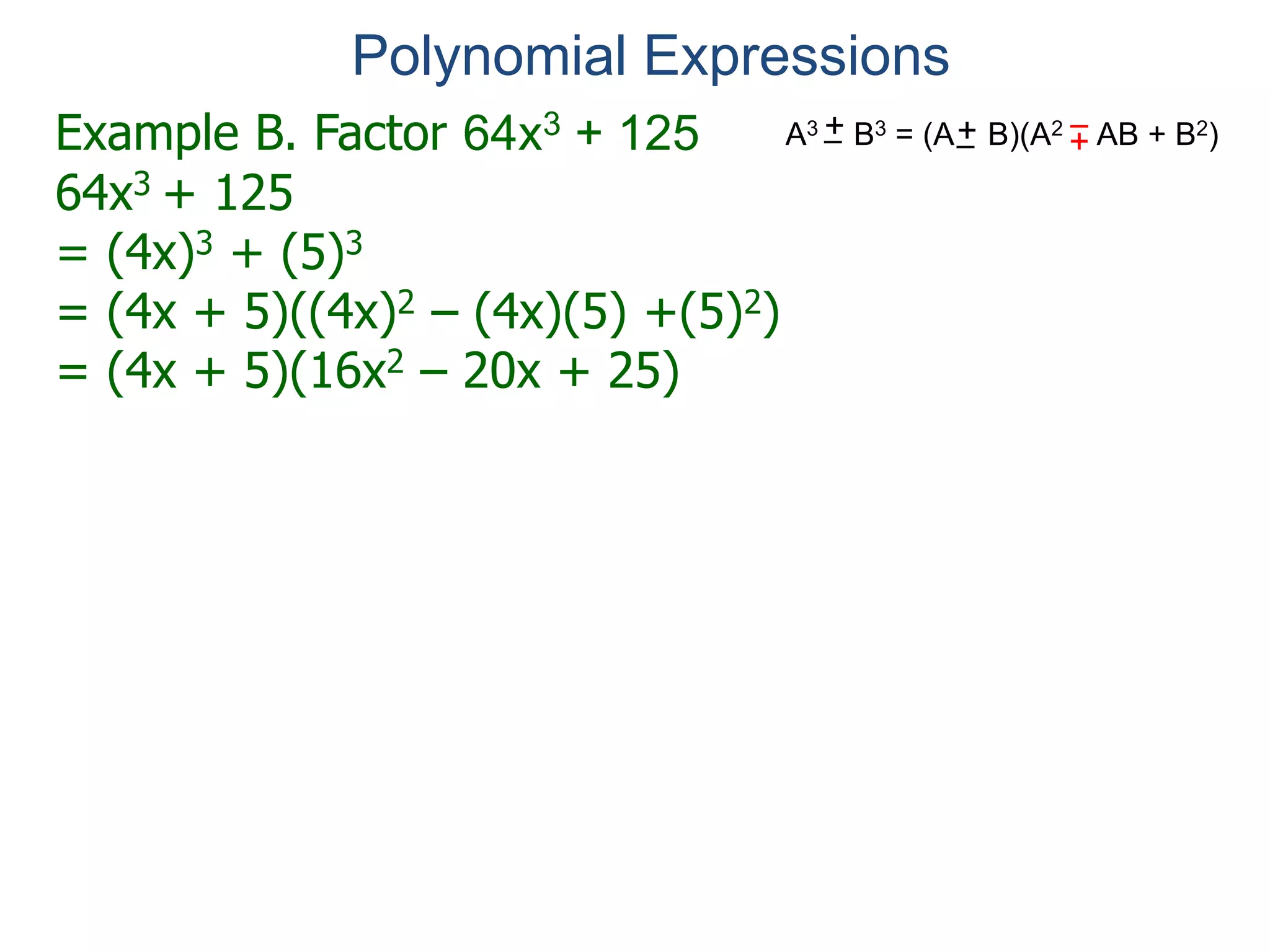
= (4x + 5)(16x2 – 20x + 25)
Polynomial Expressions
A3 B3 = (A B)(A2 AB + B2)+– +
–+–
Example B. Factor 64x3 + 125
64x3 + 125
= (4x)3 + (5)3
= (4x + 5)((4x)2 – (4x)(5) +(5)2)
= (4x + 5)(16x2 – 20x + 25)
Polynomial Expressions
We factor polynomials for the following purposes.
A3 B3 = (A B)(A2 AB + B2)+– +
–+–
Example B. Factor 64x3 + 125
64x3 + 125
= (4x)3 + (5)3
= (4x + 5)((4x)2 – (4x)(5) +(5)2)
= (4x + 5)(16x2 – 20x + 25)
Polynomial Expressions
We factor polynomials for the following purposes.
I. It’s easier to calculate an output or to check
the sign of an output using the factored form.
A3 B3 = (A B)(A2 AB + B2)+– +
–+–
Example B. Factor 64x3 + 125
64x3 + 125
= (4x)3 + (5)3
= (4x + 5)((4x)2 – (4x)(5) +(5)2)
= (4x + 5)(16x2 – 20x + 25)
Polynomial Expressions
We factor polynomials for the following purposes.
I. It’s easier to calculate an output or to check
the sign of an output using the factored form.
II. To simplify or perform algebraic operations with
rational expressions.
A3 B3 = (A B)(A2 AB + B2)+– +
–+–
Example B. Factor 64x3 + 125
64x3 + 125
= (4x)3 + (5)3
= (4x + 5)((4x)2 – (4x)(5) +(5)2)
= (4x + 5)(16x2 – 20x + 25)
Polynomial Expressions
We factor polynomials for the following purposes.
I. It’s easier to calculate an output or to check
the sign of an output using the factored form.
II. To simplify or perform algebraic operations with
rational expressions.
III. To solve equations (See next section).
A3 B3 = (A B)(A2 AB + B2)+– +
–+–
Evaluate Polynomial Expressions
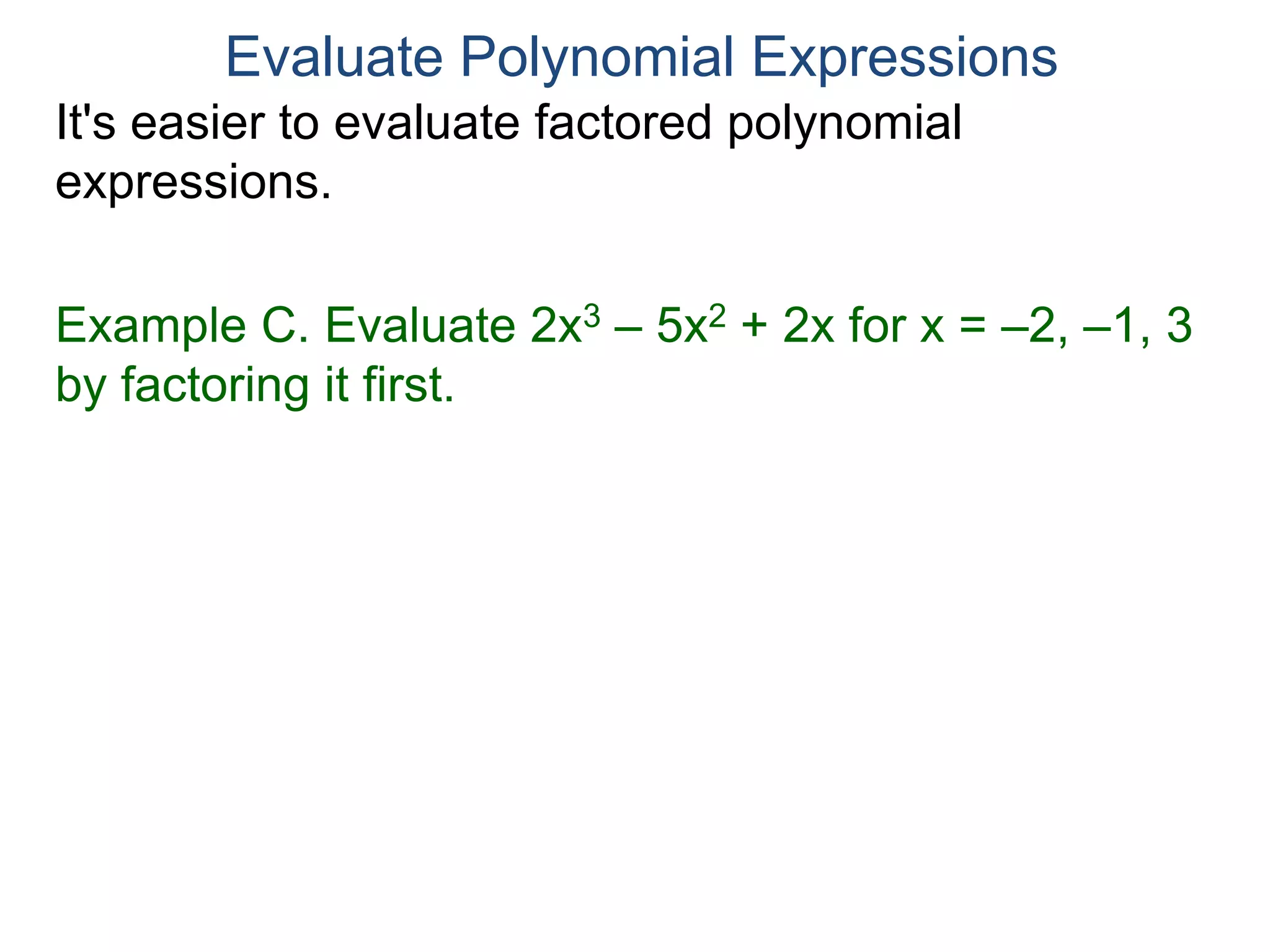
It's easier to evaluate factored polynomial
expressions.
Example C. Evaluate 2x3 – 5x2 + 2x for x = –2, –1, 3
by factoring it first.
Evaluate Polynomial Expressions
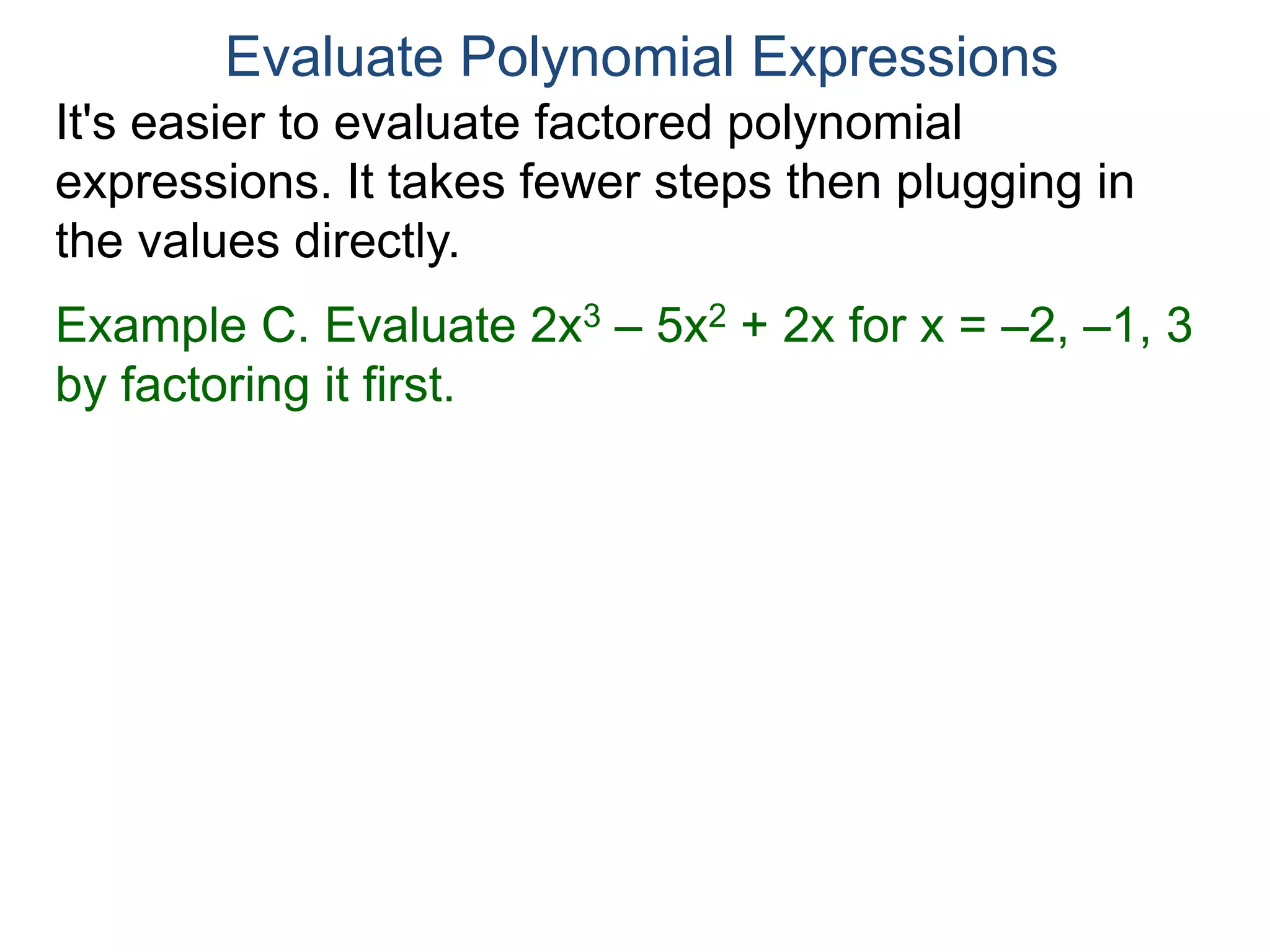
It's easier to evaluate factored polynomial
expressions. It takes fewer steps then plugging in
the values directly.
Example C. Evaluate 2x3 – 5x2 + 2x for x = –2, –1, 3
by factoring it first.
Example C. Evaluate 2x3 – 5x2 + 2x for x = –2, –1, 3
by factoring it first.
Evaluate Polynomial Expressions
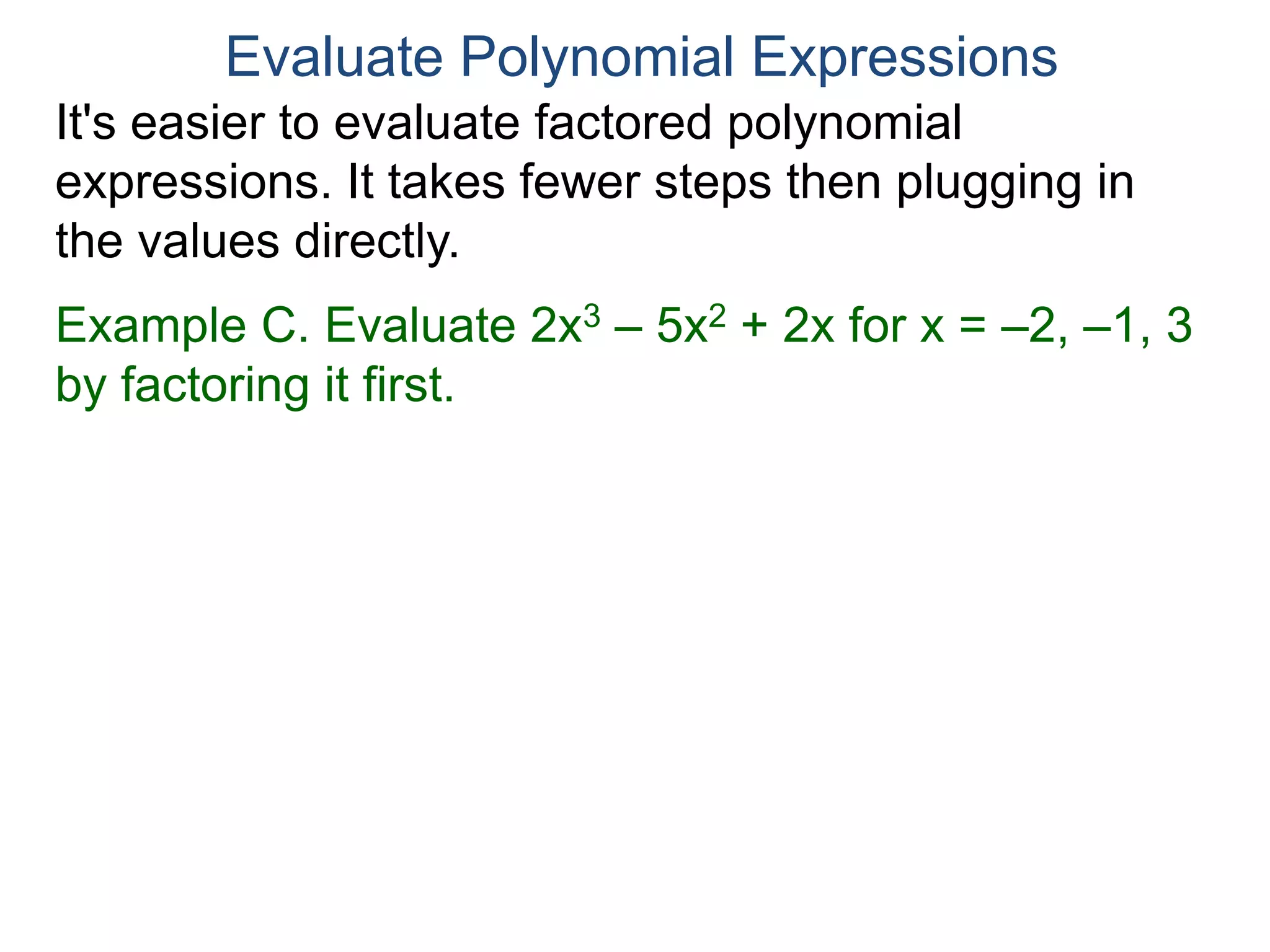
It's easier to evaluate factored polynomial
expressions. It takes fewer steps then plugging in
the values directly.
Example C. Evaluate 2x3 – 5x2 + 2x for x = –2, –1, 3
by factoring it first.
2x3 – 5x2 + 2x = x(2x2 – 5x + 2)
= x(2x – 1)(x – 2)
Evaluate Polynomial Expressions
It's easier to evaluate factored polynomial
expressions. It takes fewer steps then plugging in
the values directly.
Example C. Evaluate 2x3 – 5x2 + 2x for x = –2, –1, 3
by factoring it first.
2x3 – 5x2 + 2x = x(2x2 – 5x + 2)
= x(2x – 1)(x – 2)
Plug in x = –2:
–2 [2(–2) – 1] [(–2) – 2]
Evaluate Polynomial Expressions
It's easier to evaluate factored polynomial
expressions. It takes fewer steps then plugging in
the values directly.
Example C. Evaluate 2x3 – 5x2 + 2x for x = –2, –1, 3
by factoring it first.
2x3 – 5x2 + 2x = x(2x2 – 5x + 2)
= x(2x – 1)(x – 2)
Plug in x = –2:
–2 [2(–2) – 1] [(–2) – 2] = –2 [–5] [–4] = –40
Evaluate Polynomial Expressions
It's easier to evaluate factored polynomial
expressions. It takes fewer steps then plugging in
the values directly.
Example C. Evaluate 2x3 – 5x2 + 2x for x = –2, –1, 3
by factoring it first.
2x3 – 5x2 + 2x = x(2x2 – 5x + 2)
= x(2x – 1)(x – 2)
Plug in x = –2:
–2 [2(–2) – 1] [(–2) – 2] = –2 [–5] [–4] = –40
Plug in x = –1:
–1 [2(–1) – 1] [(–1) – 2]
Evaluate Polynomial Expressions
It's easier to evaluate factored polynomial
expressions. It takes fewer steps then plugging in
the values directly.
Example C. Evaluate 2x3 – 5x2 + 2x for x = –2, –1, 3
by factoring it first.
2x3 – 5x2 + 2x = x(2x2 – 5x + 2)
= x(2x – 1)(x – 2)
Plug in x = –2:
–2 [2(–2) – 1] [(–2) – 2] = –2 [–5] [–4] = –40
Plug in x = –1:
–1 [2(–1) – 1] [(–1) – 2] = –1 [–3] [–3] = –9
Evaluate Polynomial Expressions
It's easier to evaluate factored polynomial
expressions. It takes fewer steps then plugging in
the values directly.
Example C. Evaluate 2x3 – 5x2 + 2x for x = –2, –1, 3
by factoring it first.
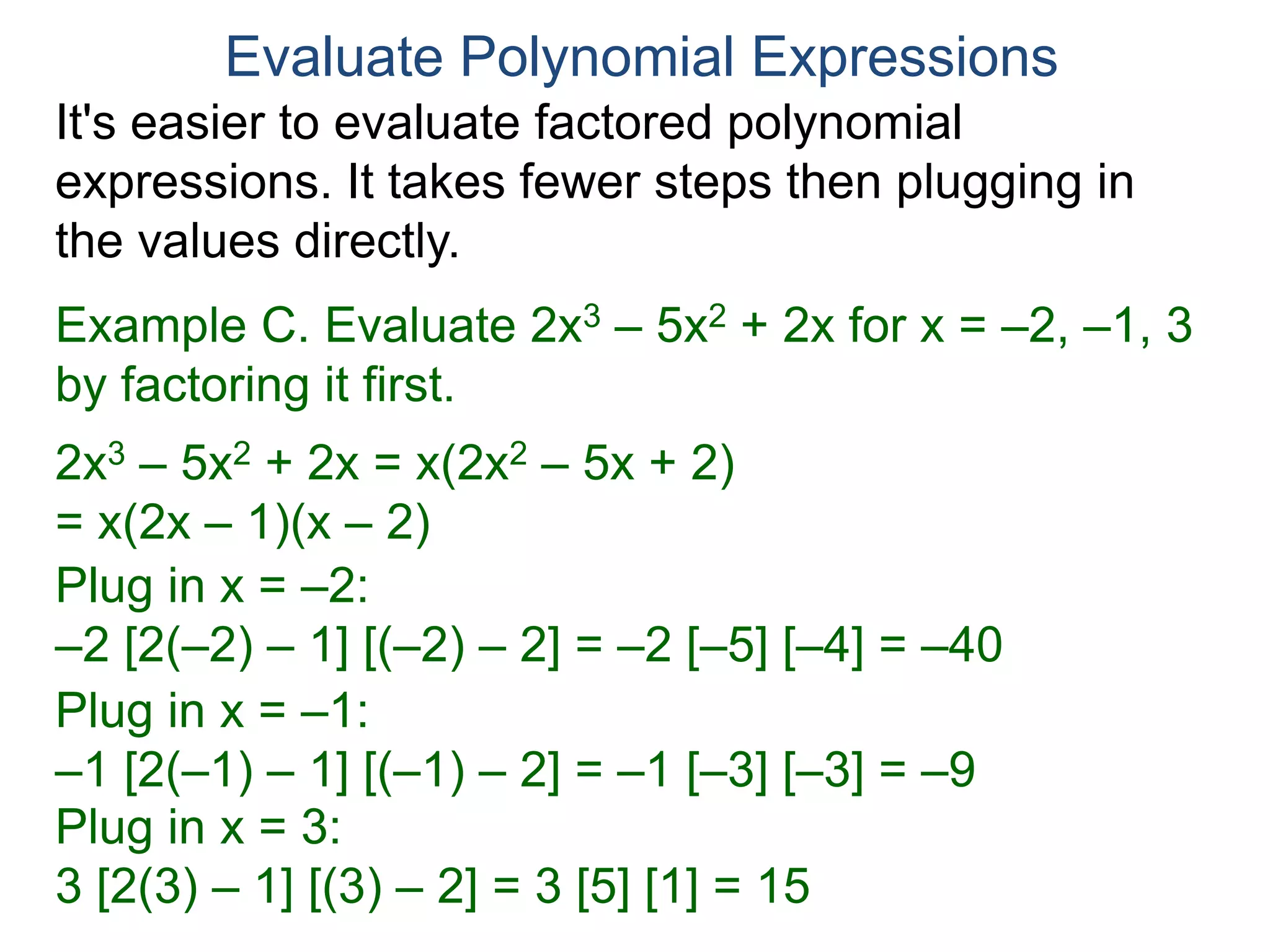
2x3 – 5x2 + 2x = x(2x2 – 5x + 2)
= x(2x – 1)(x – 2)
Plug in x = –2:
–2 [2(–2) – 1] [(–2) – 2] = –2 [–5] [–4] = –40
Plug in x = –1:
–1 [2(–1) – 1] [(–1) – 2] = –1 [–3] [–3] = –9
Plug in x = 3:
3 [2(3) – 1] [(3) – 2] = 3 [5] [1] = 15
Evaluate Polynomial Expressions
It's easier to evaluate factored polynomial
expressions. It takes fewer steps then plugging in
the values directly.
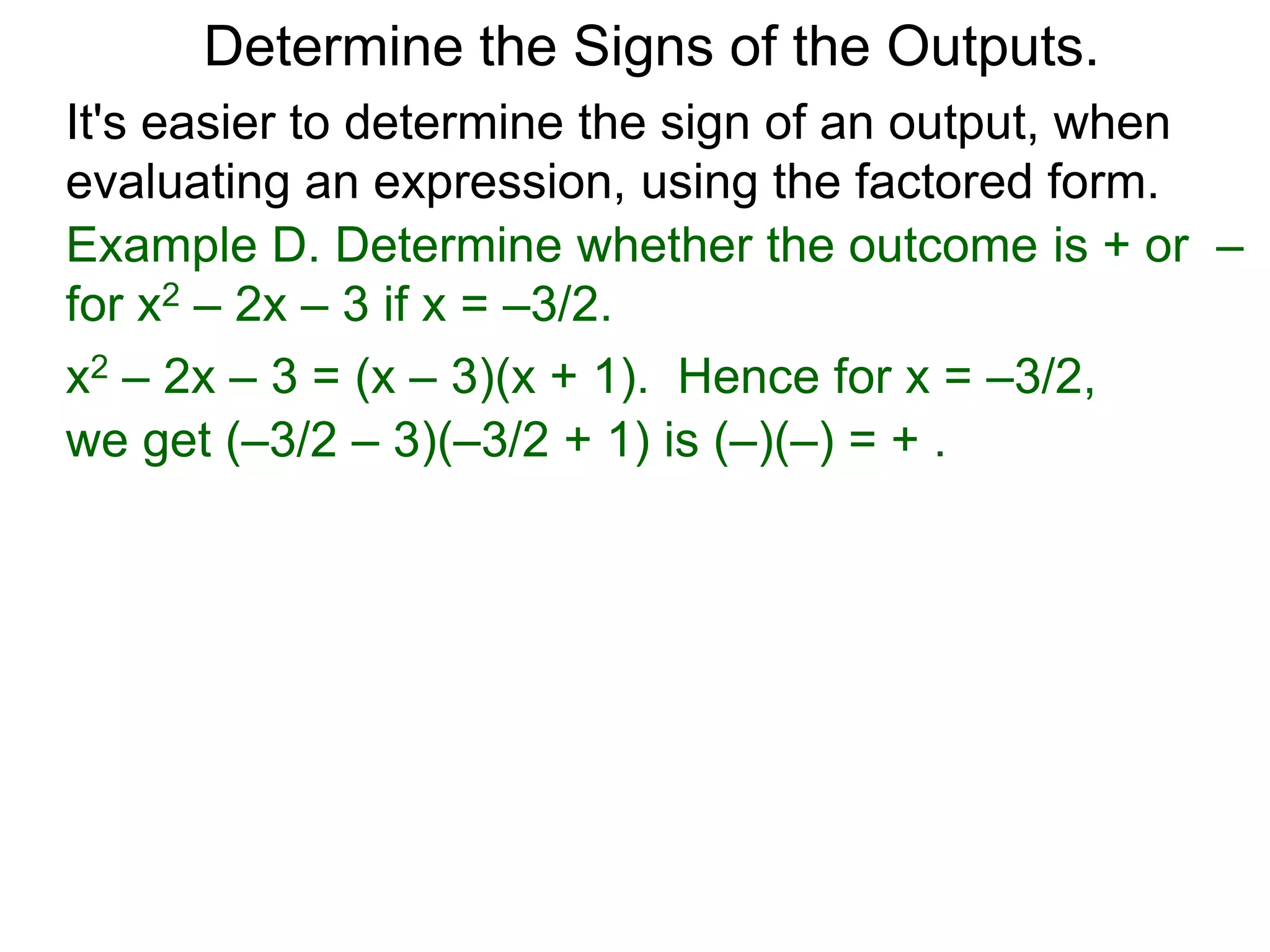
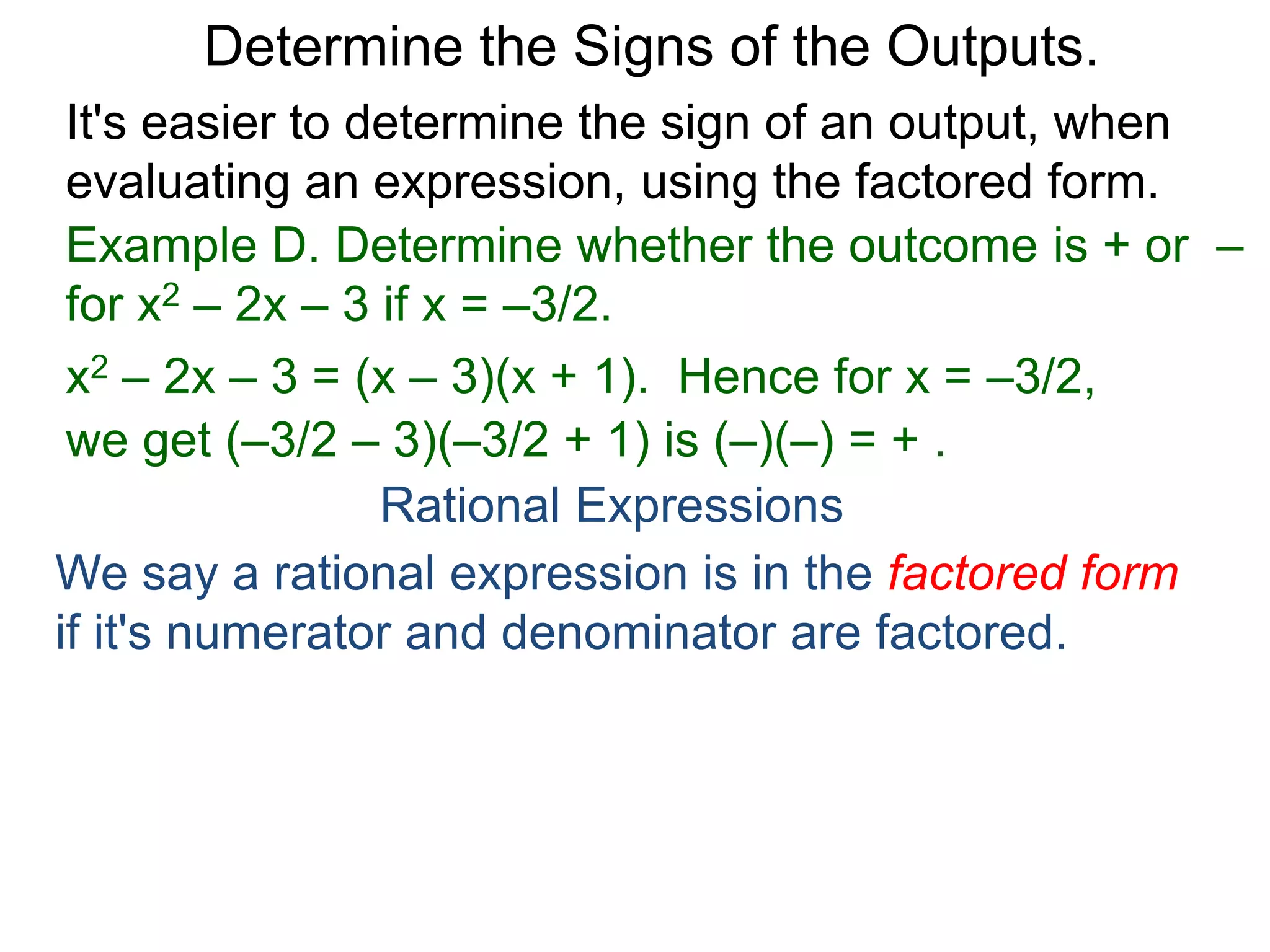
Determine the Signs of the Outputs.
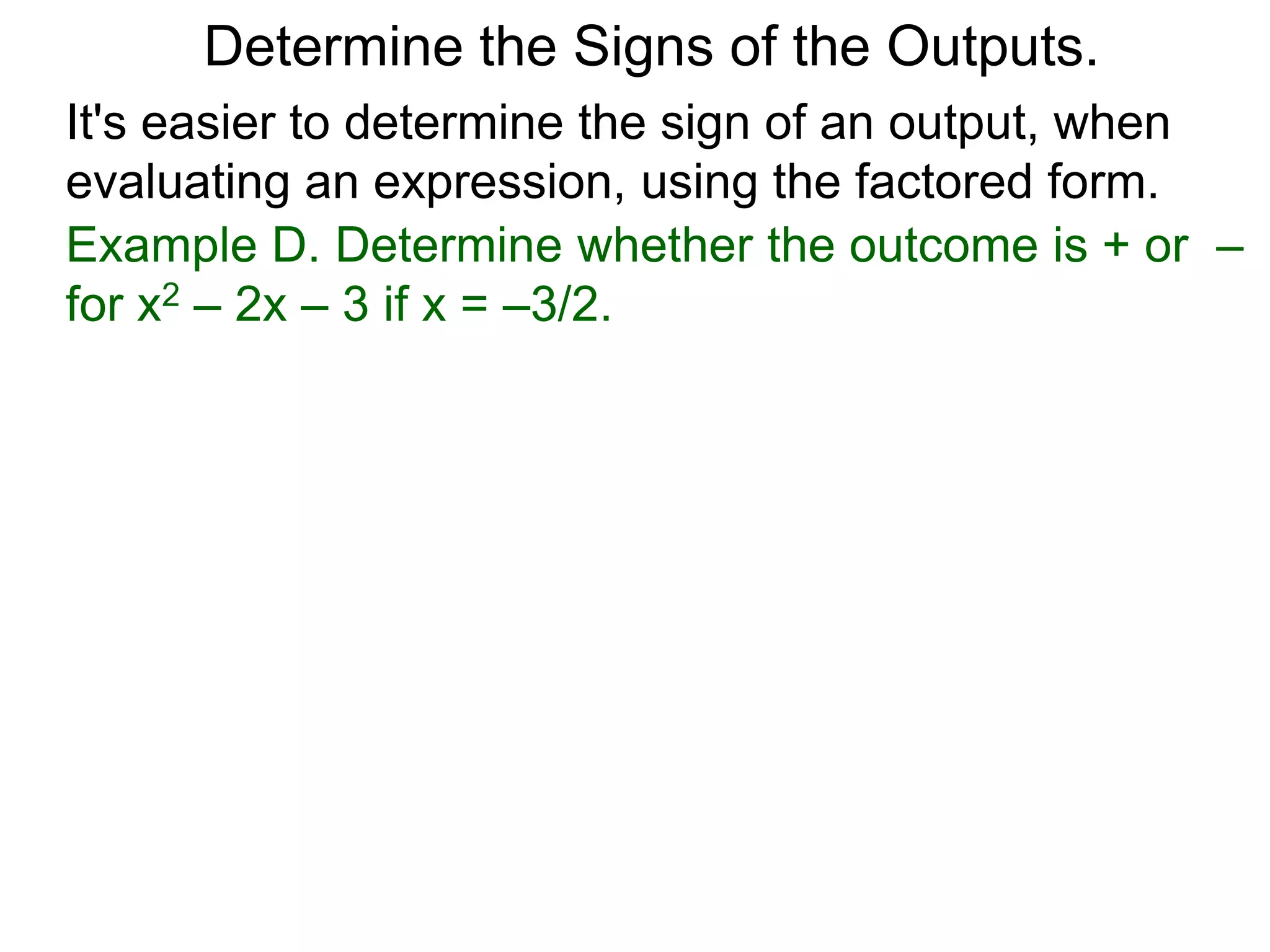
It's easier to determine the sign of an output, when
evaluating an expression, using the factored form.
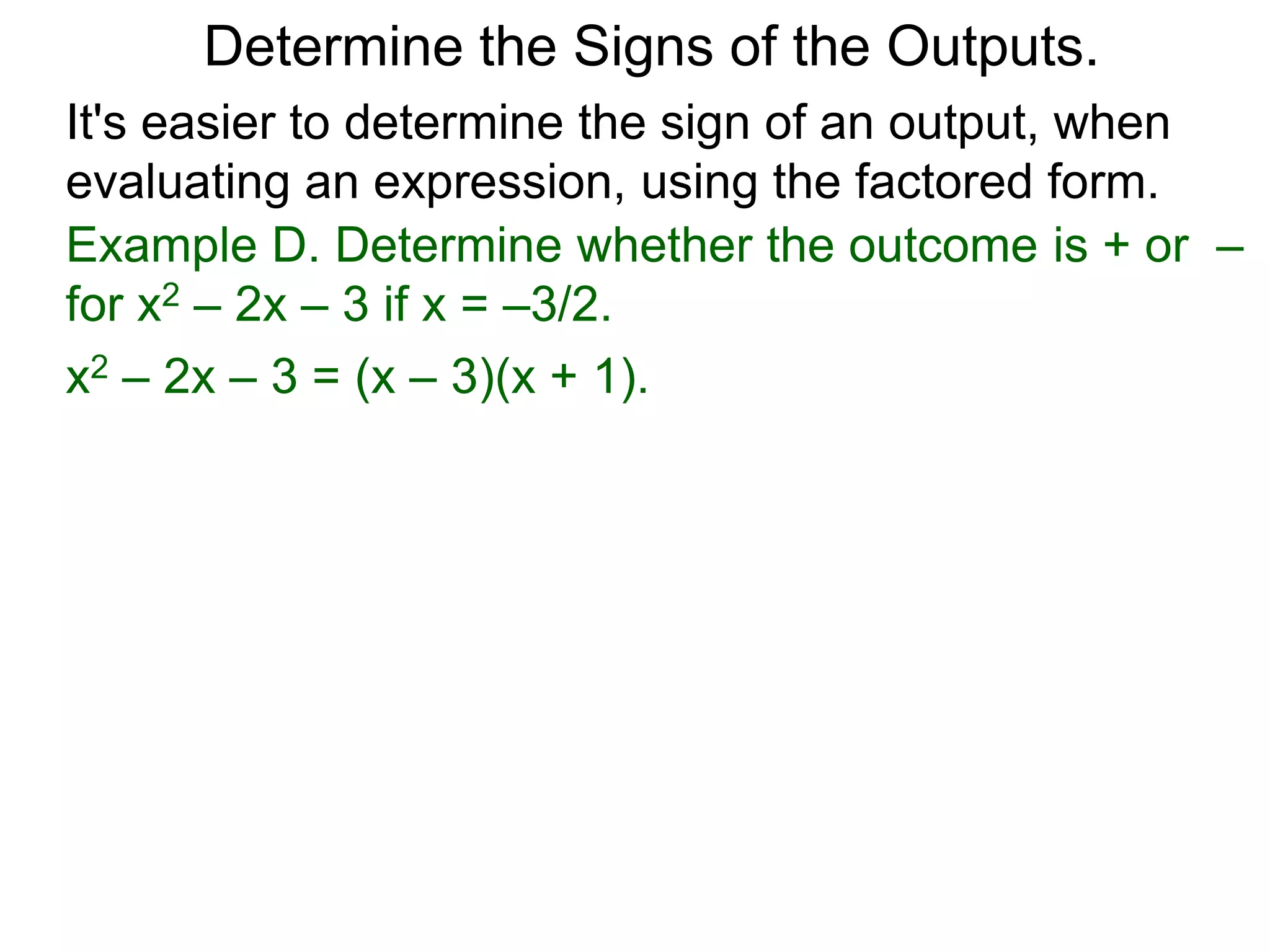
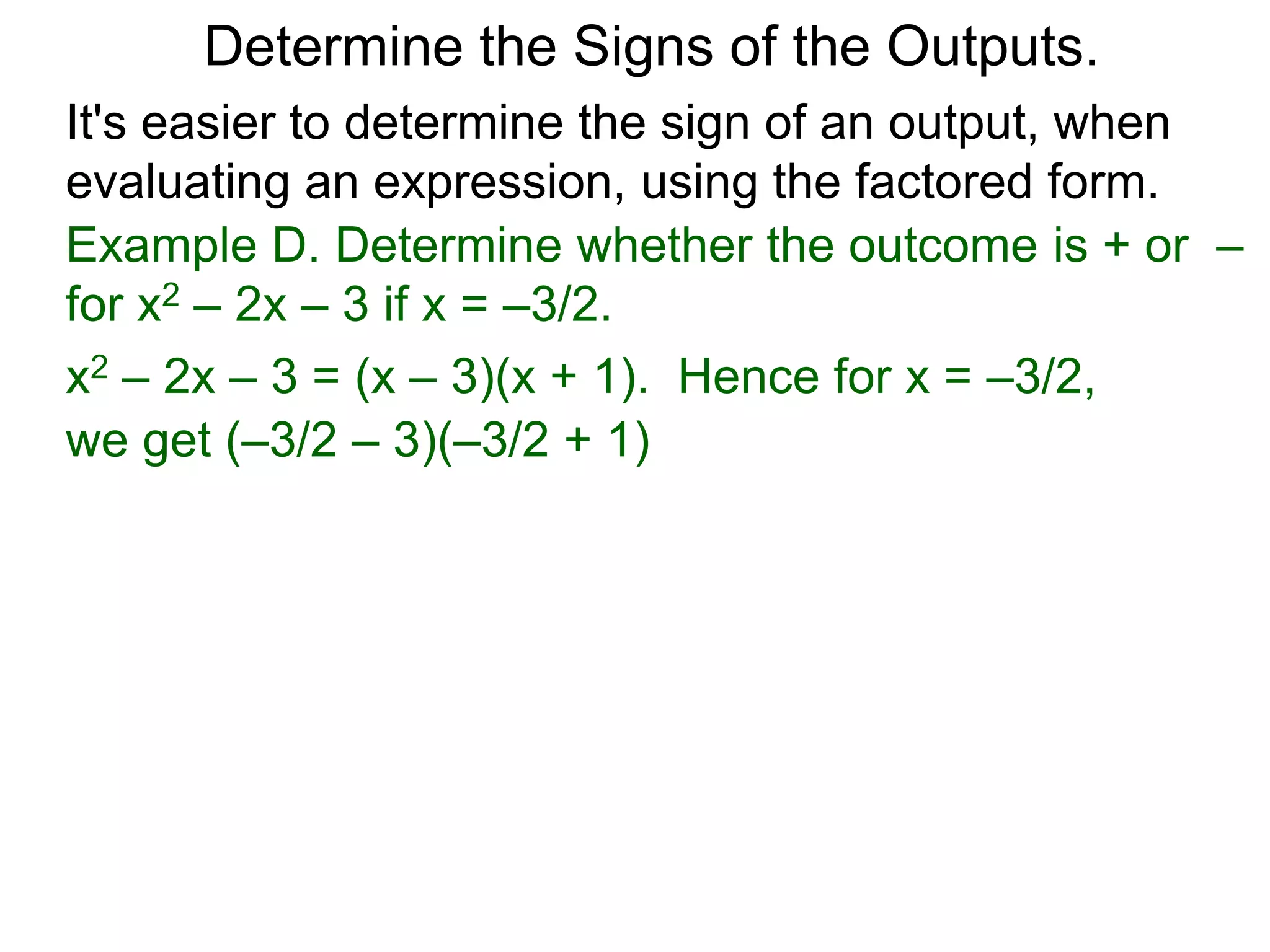
Example D. Determine whether the outcome is + or –
for x2 – 2x – 3 if x = –3/2.
Determine the Signs of the Outputs.
It's easier to determine the sign of an output, when
evaluating an expression, using the factored form.
Example D. Determine whether the outcome is + or –
for x2 – 2x – 3 if x = –3/2.
x2 – 2x – 3 = (x – 3)(x + 1).
Determine the Signs of the Outputs.
It's easier to determine the sign of an output, when
evaluating an expression, using the factored form.
Example D. Determine whether the outcome is + or –
for x2 – 2x – 3 if x = –3/2.
x2 – 2x – 3 = (x – 3)(x + 1). Hence for x = –3/2,
we get (–3/2 – 3)(–3/2 + 1)
Determine the Signs of the Outputs.
It's easier to determine the sign of an output, when
evaluating an expression, using the factored form.
Example D. Determine whether the outcome is + or –
for x2 – 2x – 3 if x = –3/2.
x2 – 2x – 3 = (x – 3)(x + 1). Hence for x = –3/2,
we get (–3/2 – 3)(–3/2 + 1) is (–)(–) = + .
Determine the Signs of the Outputs.
It's easier to determine the sign of an output, when
evaluating an expression, using the factored form.
Example D. Determine whether the outcome is + or –
for x2 – 2x – 3 if x = –3/2.
x2 – 2x – 3 = (x – 3)(x + 1). Hence for x = –3/2,
we get (–3/2 – 3)(–3/2 + 1) is (–)(–) = + .
Determine the Signs of the Outputs.
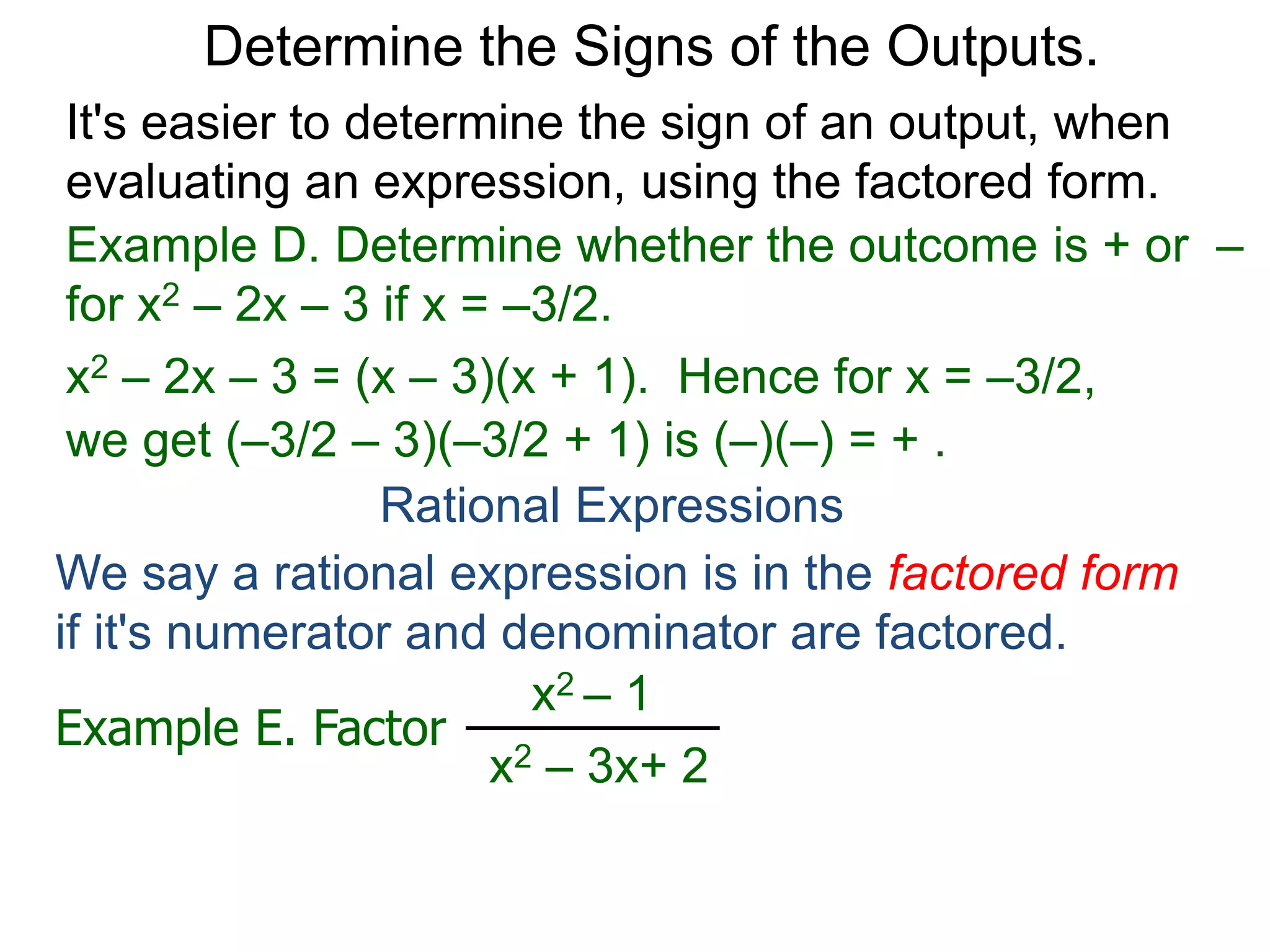
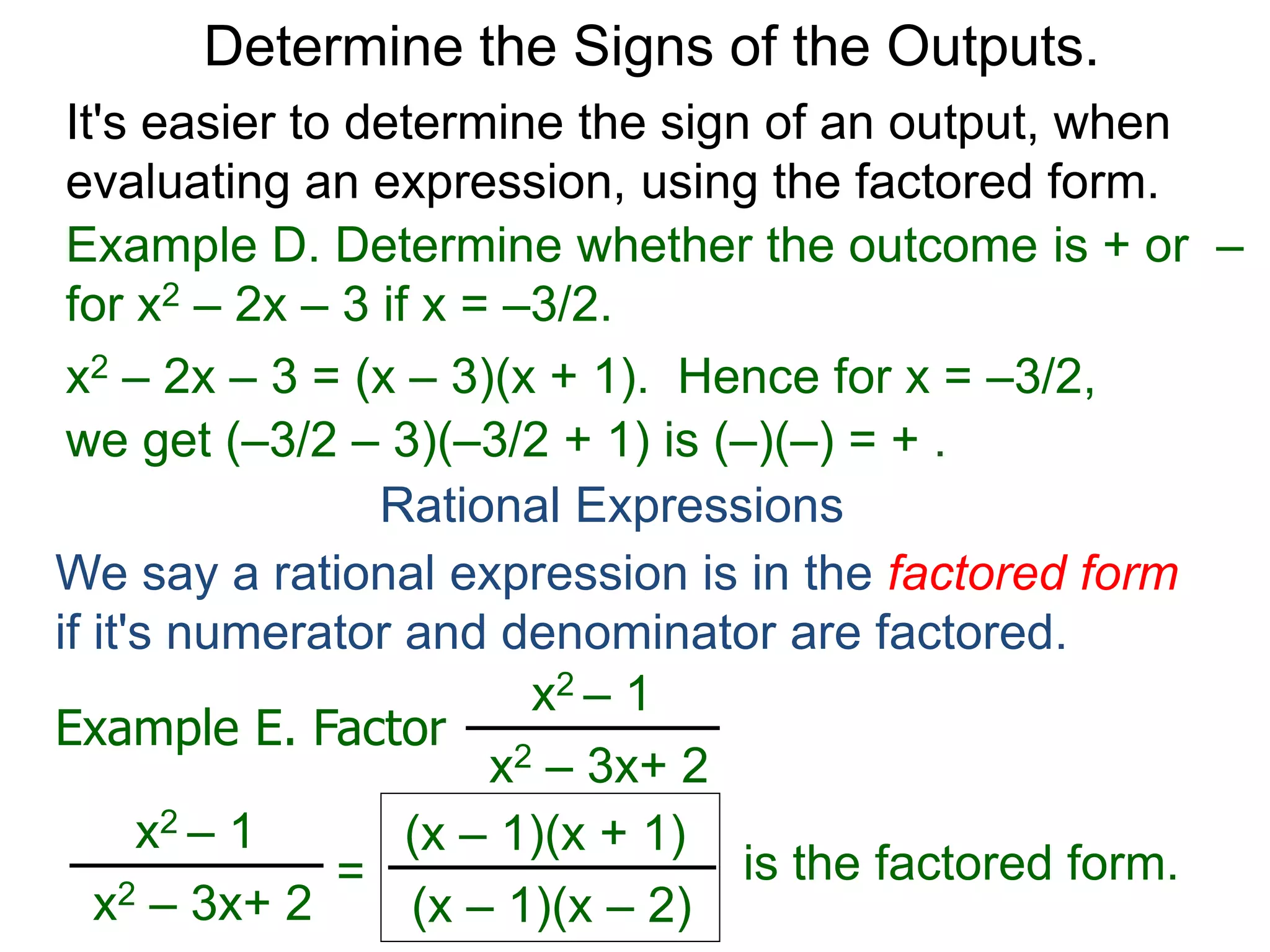
Rational Expressions
We say a rational expression is in the factored form
if it's numerator and denominator are factored.
It's easier to determine the sign of an output, when
evaluating an expression, using the factored form.
Example D. Determine whether the outcome is + or –
for x2 – 2x – 3 if x = –3/2.
x2 – 2x – 3 = (x – 3)(x + 1). Hence for x = –3/2,
we get (–3/2 – 3)(–3/2 + 1) is (–)(–) = + .
Determine the Signs of the Outputs.
Rational Expressions
We say a rational expression is in the factored form
if it's numerator and denominator are factored.
Example E. Factor
x2 – 1
x2 – 3x+ 2
It's easier to determine the sign of an output, when
evaluating an expression, using the factored form.
Example D. Determine whether the outcome is + or –
for x2 – 2x – 3 if x = –3/2.
x2 – 2x – 3 = (x – 3)(x + 1). Hence for x = –3/2,
we get (–3/2 – 3)(–3/2 + 1) is (–)(–) = + .
Determine the Signs of the Outputs.
Rational Expressions
We say a rational expression is in the factored form
if it's numerator and denominator are factored.
Example E. Factor
x2 – 1
x2 – 3x+ 2
x2 – 1
x2 – 3x+ 2
=
(x – 1)(x + 1)
(x – 1)(x – 2)
is the factored form.
It's easier to determine the sign of an output, when
evaluating an expression, using the factored form.
Rational Expressions
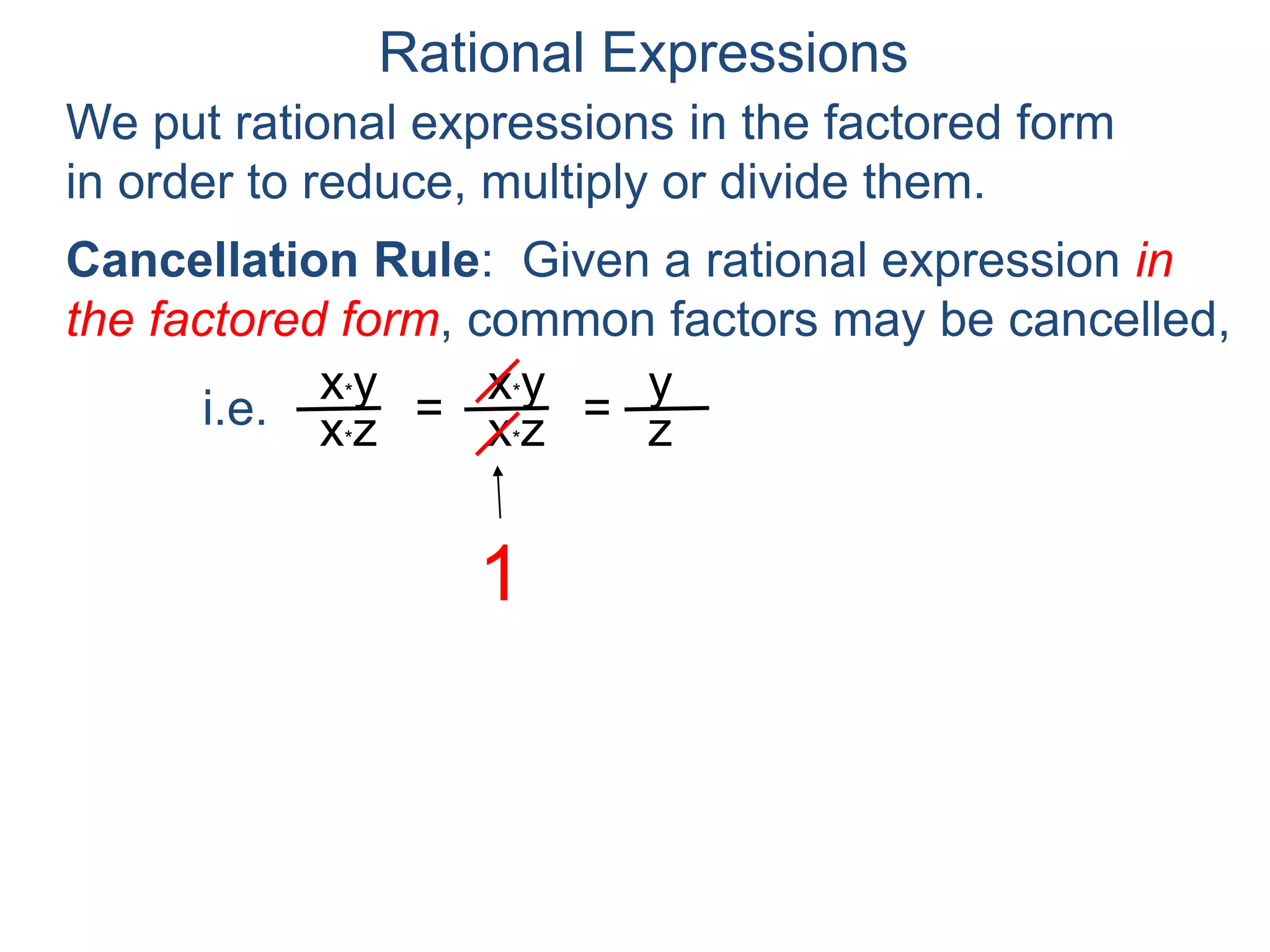
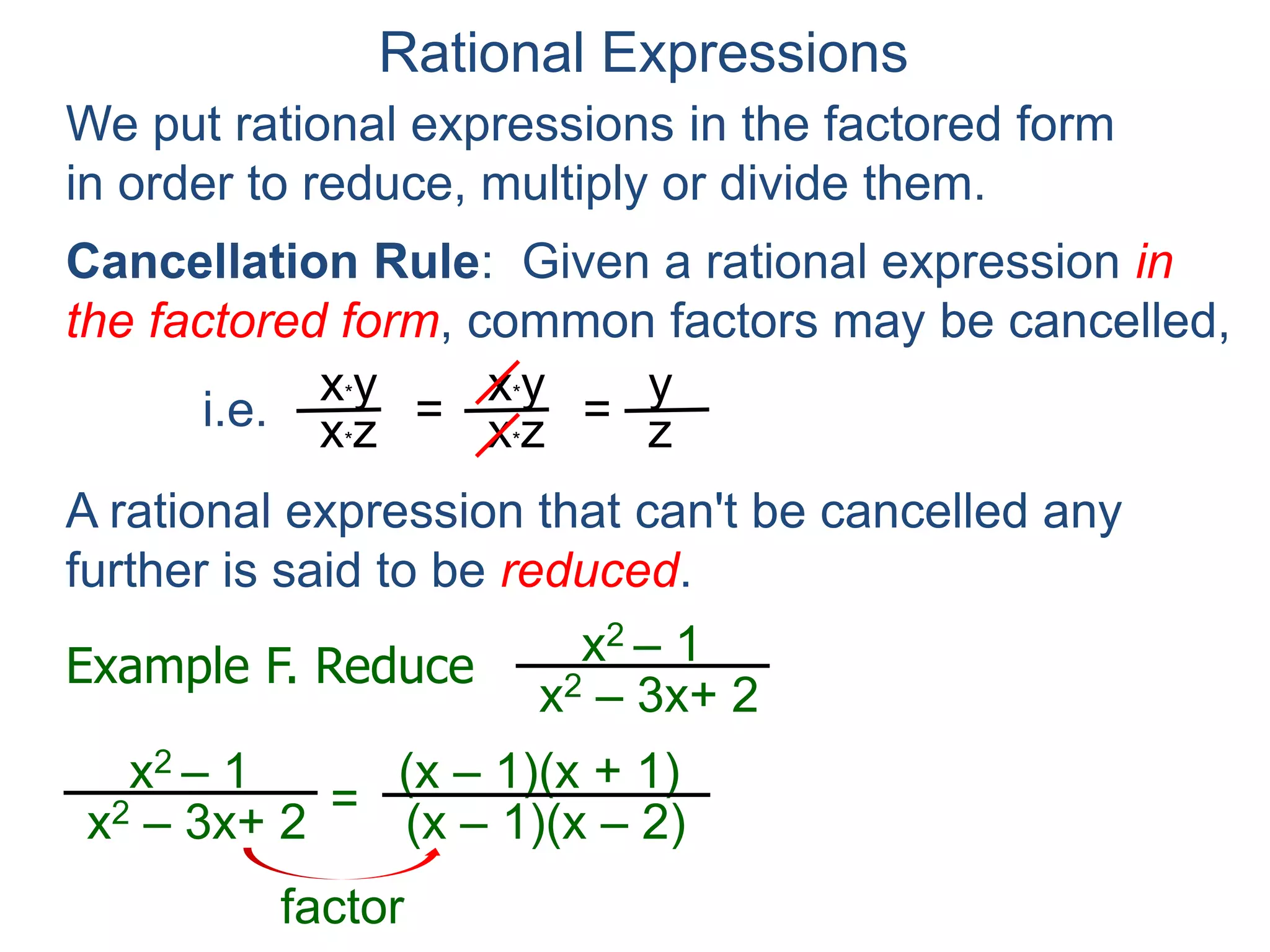
We put rational expressions in the factored form
in order to reduce, multiply or divide them.
Rational Expressions
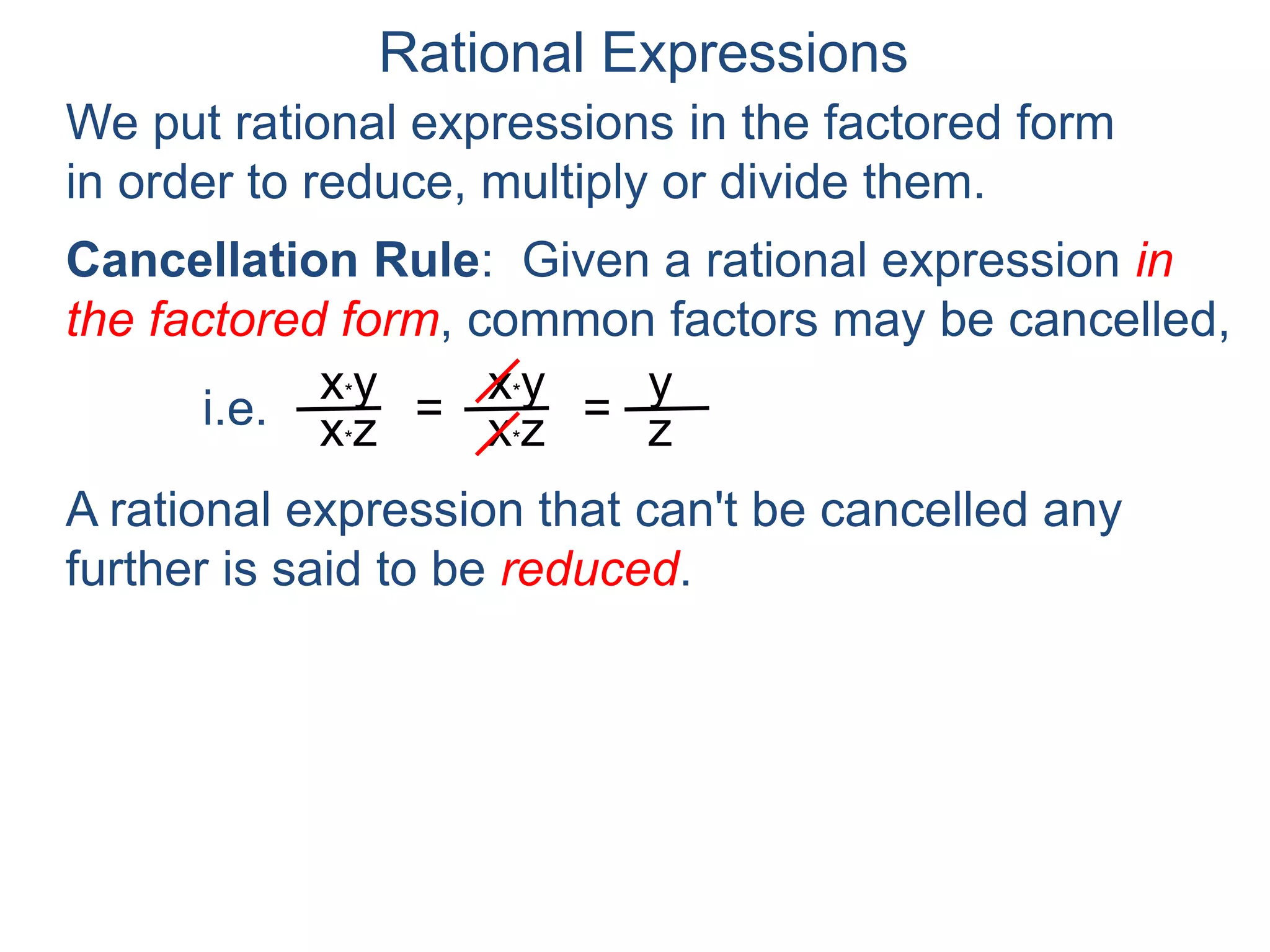
We put rational expressions in the factored form
in order to reduce, multiply or divide them.
Cancellation Rule: Given a rational expression in
the factored form, common factors may be cancelled,
i.e.
x*y
x*z =
x*y
x*z =
y
z
1
Rational Expressions
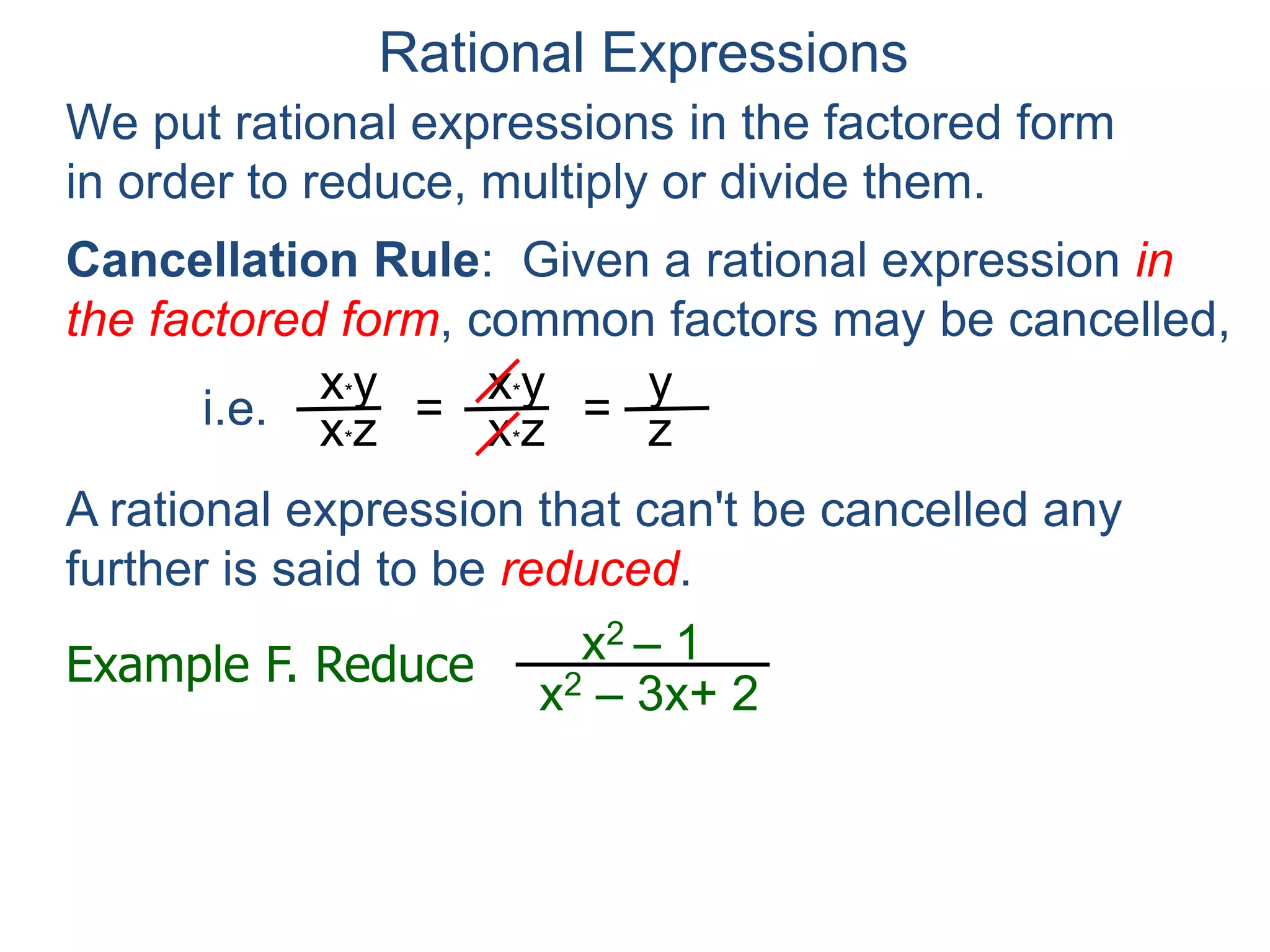
We put rational expressions in the factored form
in order to reduce, multiply or divide them.
x*y
x*z =
x*y
x*z =
y
z
A rational expression that can't be cancelled any
further is said to be reduced.
Cancellation Rule: Given a rational expression in
the factored form, common factors may be cancelled,
i.e.
Rational Expressions
We put rational expressions in the factored form
in order to reduce, multiply or divide them.
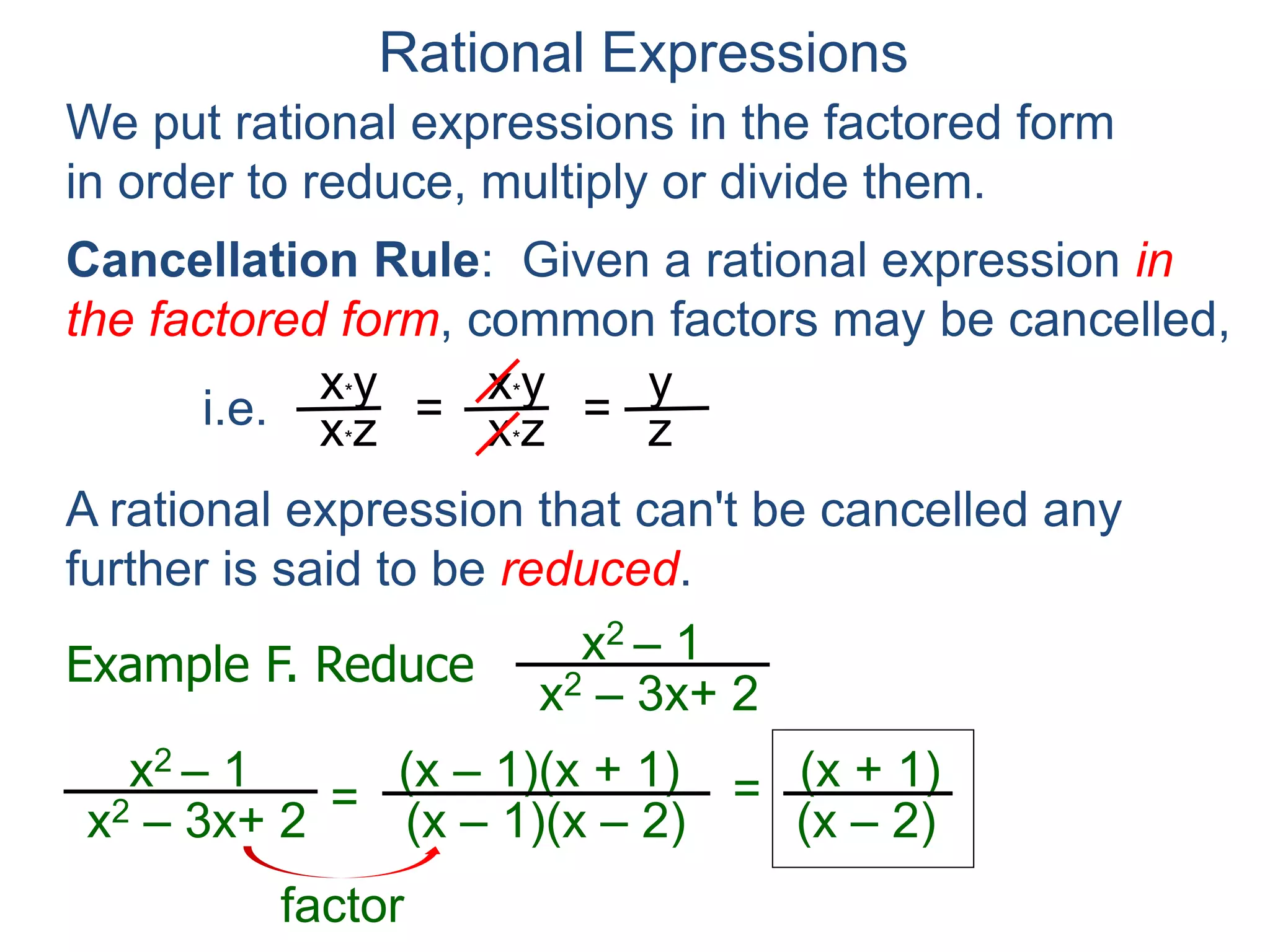
Example F. Reduce x2 – 1
x2 – 3x+ 2
x*y
x*z =
x*y
x*z =
y
z
A rational expression that can't be cancelled any
further is said to be reduced.
Cancellation Rule: Given a rational expression in
the factored form, common factors may be cancelled,
i.e.
Rational Expressions
We put rational expressions in the factored form
in order to reduce, multiply or divide them.
Example F. Reduce x2 – 1
x2 – 3x+ 2
x2 – 1
x2 – 3x+ 2 =
(x – 1)(x + 1)
(x – 1)(x – 2)
x*y
x*z =
x*y
x*z =
y
z
A rational expression that can't be cancelled any
further is said to be reduced.
factor
Cancellation Rule: Given a rational expression in
the factored form, common factors may be cancelled,
i.e.
Rational Expressions
We put rational expressions in the factored form
in order to reduce, multiply or divide them.
Example F. Reduce x2 – 1
x2 – 3x+ 2
x2 – 1
x2 – 3x+ 2 =
(x – 1)(x + 1)
(x – 1)(x – 2)
x*y
x*z =
x*y
x*z =
y
z
A rational expression that can't be cancelled any
further is said to be reduced.
= (x + 1)
(x – 2)
factor
Cancellation Rule: Given a rational expression in
the factored form, common factors may be cancelled,
i.e.
Rational Expressions
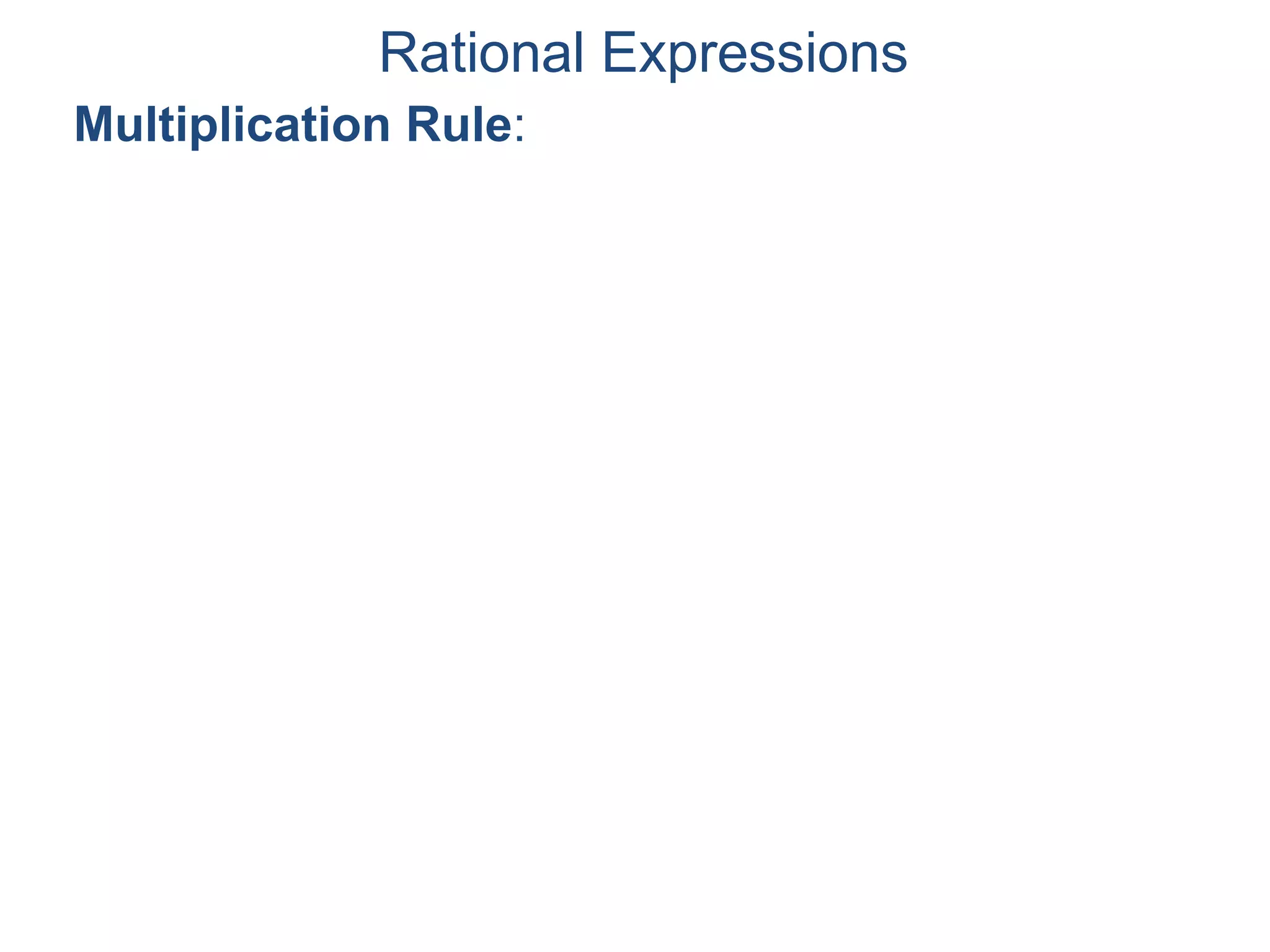
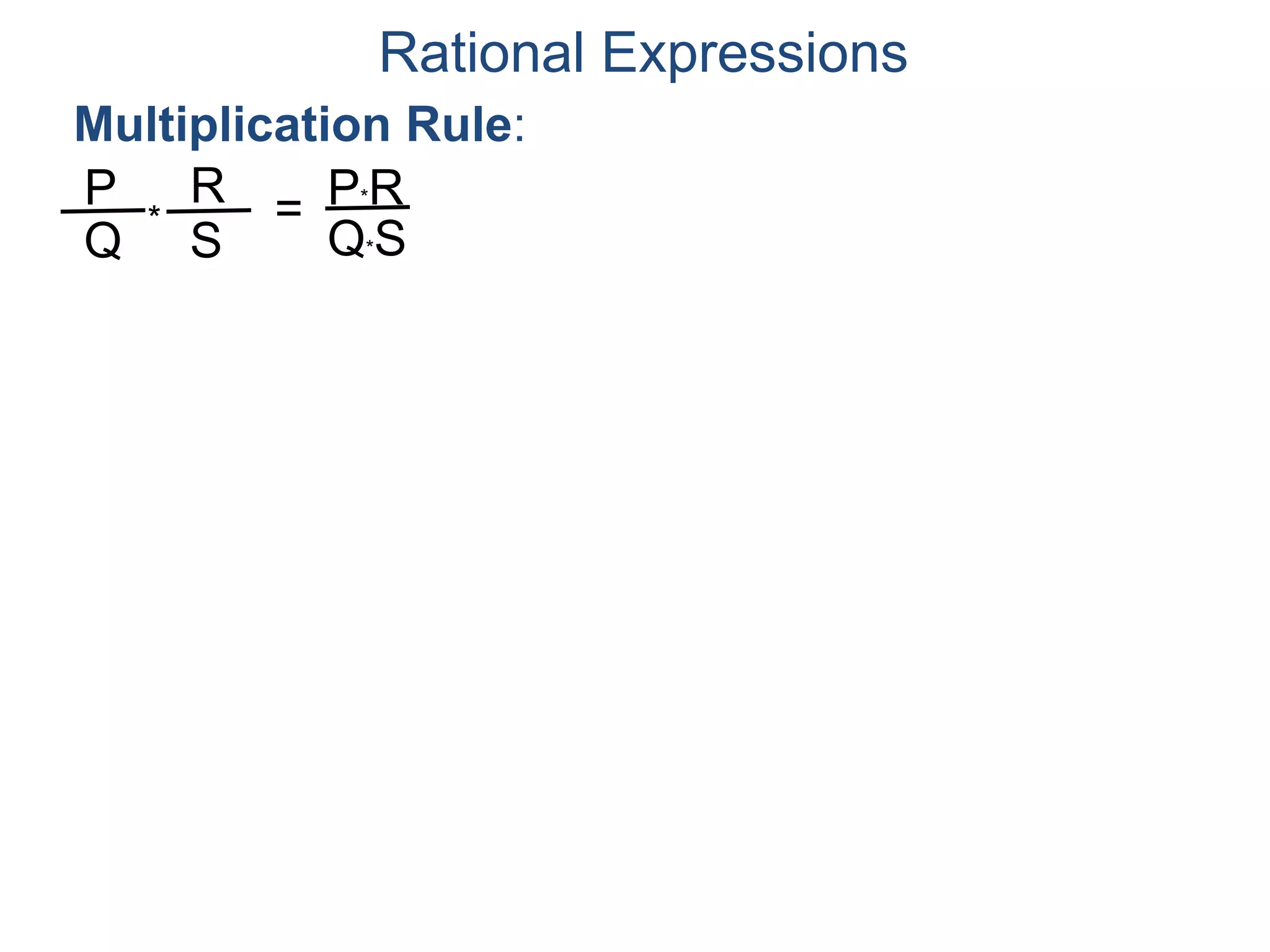
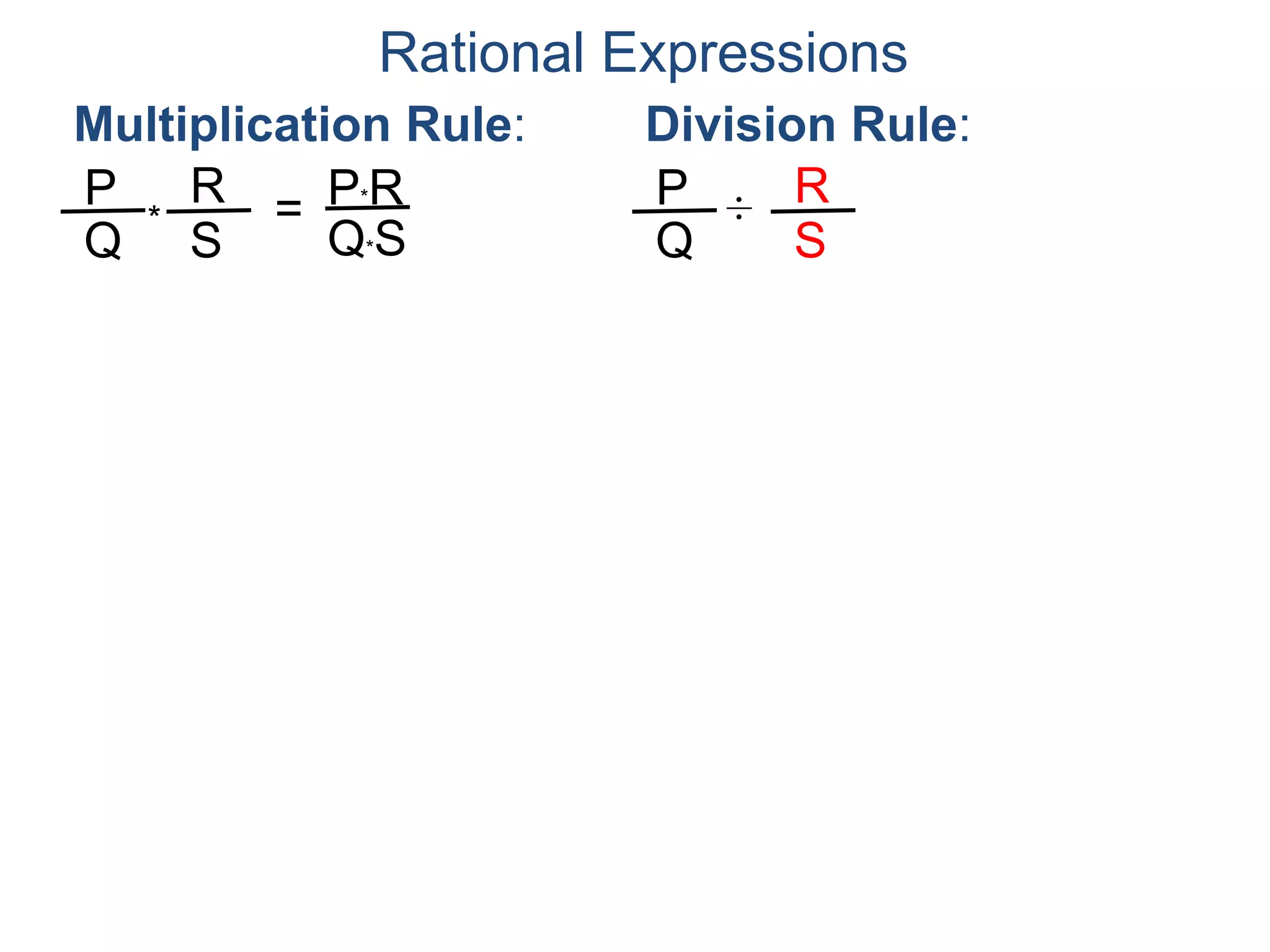
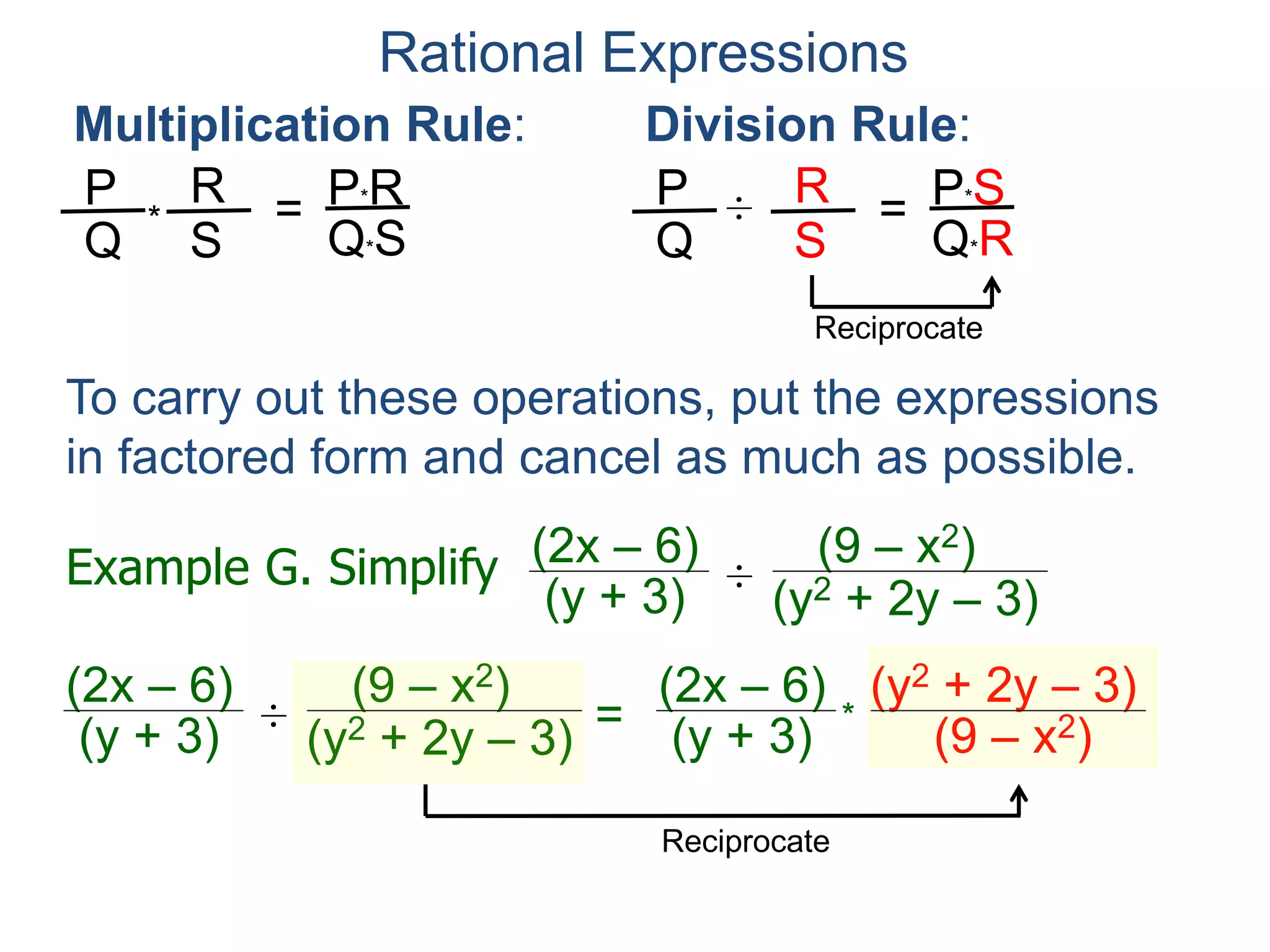
Multiplication Rule:
Rational Expressions
Multiplication Rule:
P
Q
R
S
* = P*R
Q*S
Rational Expressions
Multiplication Rule:
P
Q
R
S
* = P*R
Q*S
Division Rule:
P
Q
R
S
÷
Rational Expressions
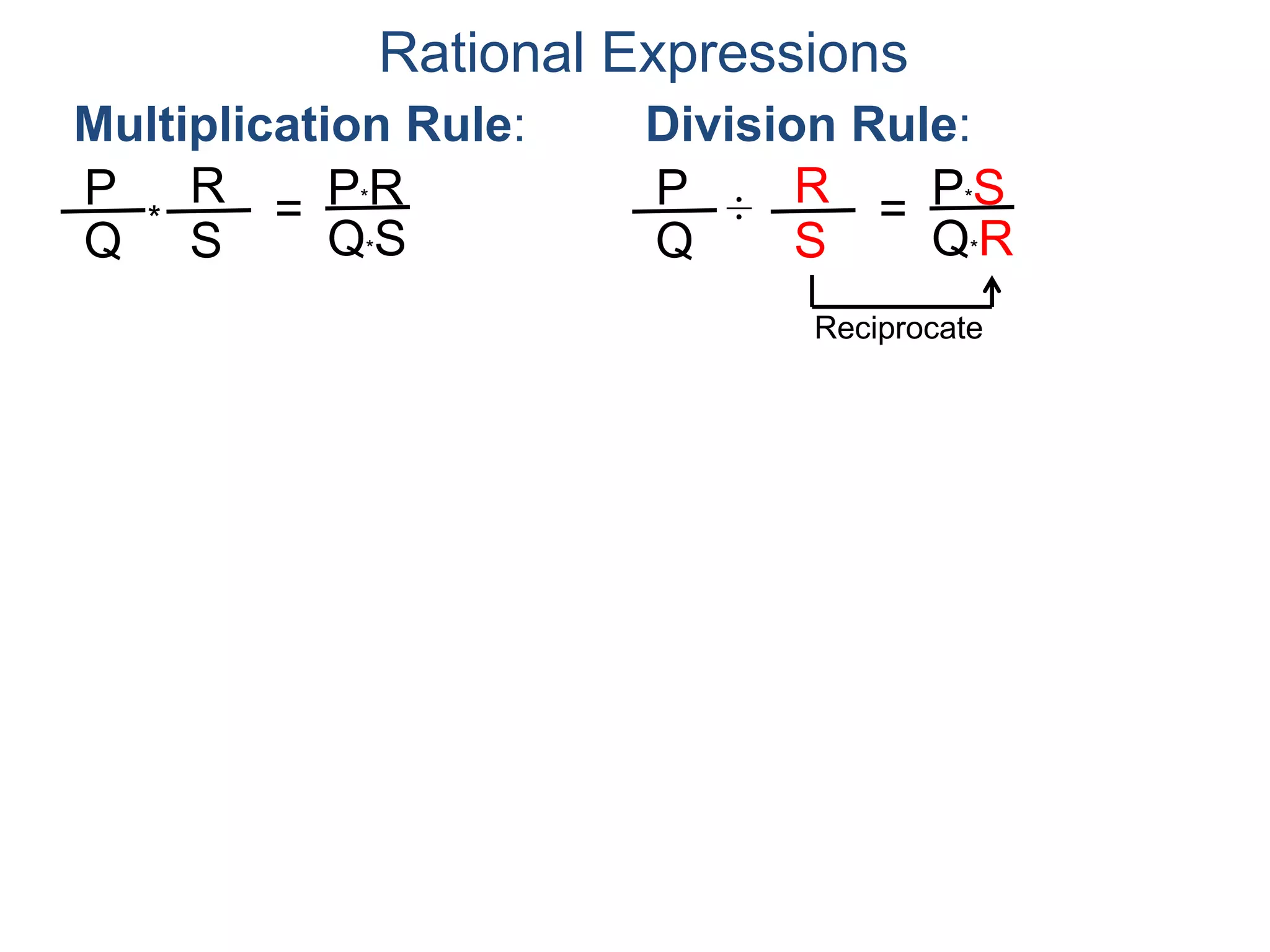
Multiplication Rule:
P
Q
R
S
* = P*R
Q*S
Division Rule:
P
Q
R
S
÷ = P*S
Q*R
Reciprocate
Rational Expressions
Multiplication Rule:
P
Q
R
S
* = P*R
Q*S
Division Rule:
P
Q
R
S
÷ = P*S
Q*R
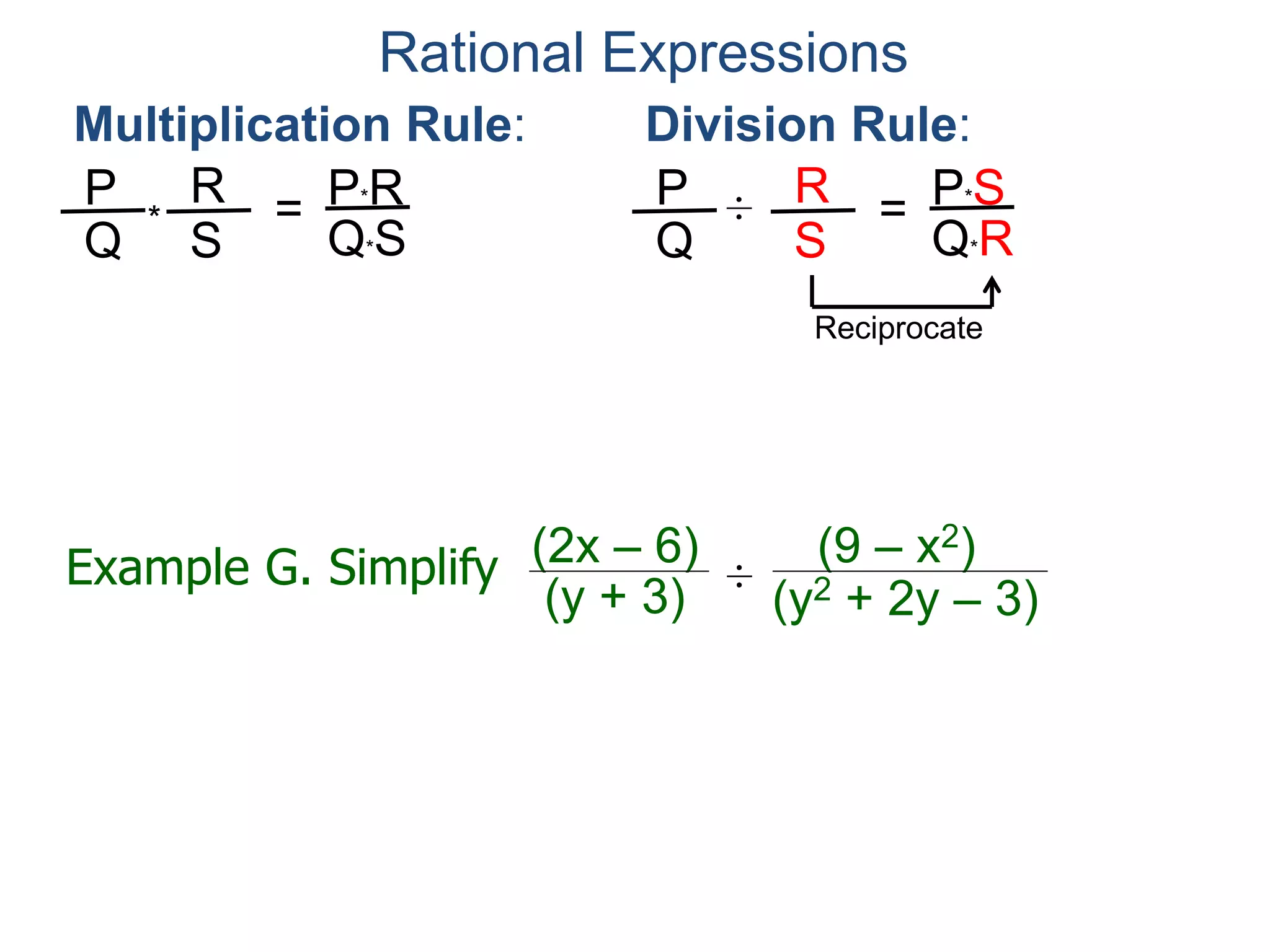
Reciprocate
Example G. Simplify (2x – 6)
(y + 3) ÷
(y2 + 2y – 3)
(9 – x2)
Rational Expressions
Multiplication Rule:
P
Q
R
S
* = P*R
Q*S
Division Rule:
P
Q
R
S
÷ = P*S
Q*R
Reciprocate
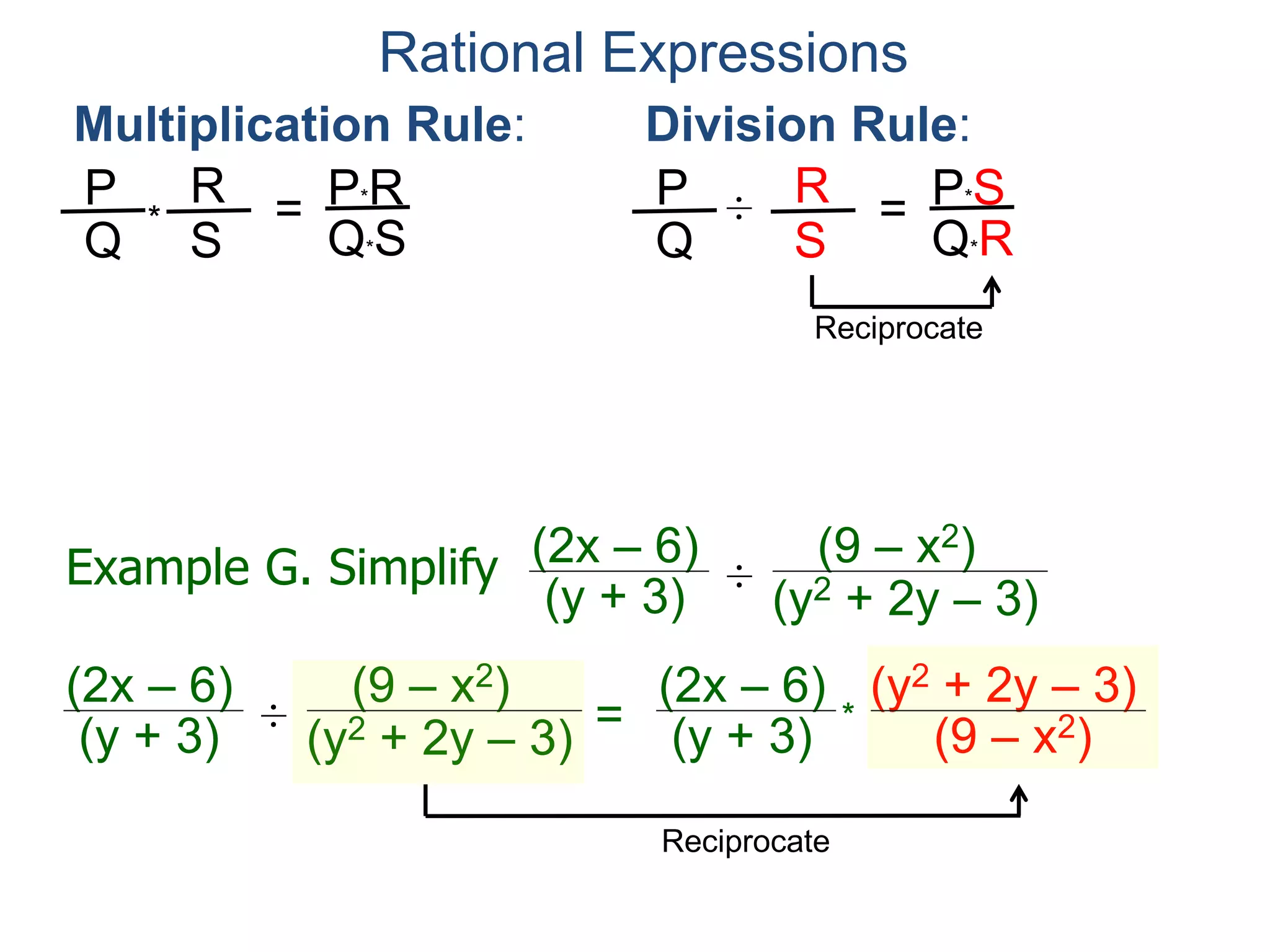
Example G. Simplify (2x – 6)
(y + 3) ÷
(y2 + 2y – 3)
(9 – x2)
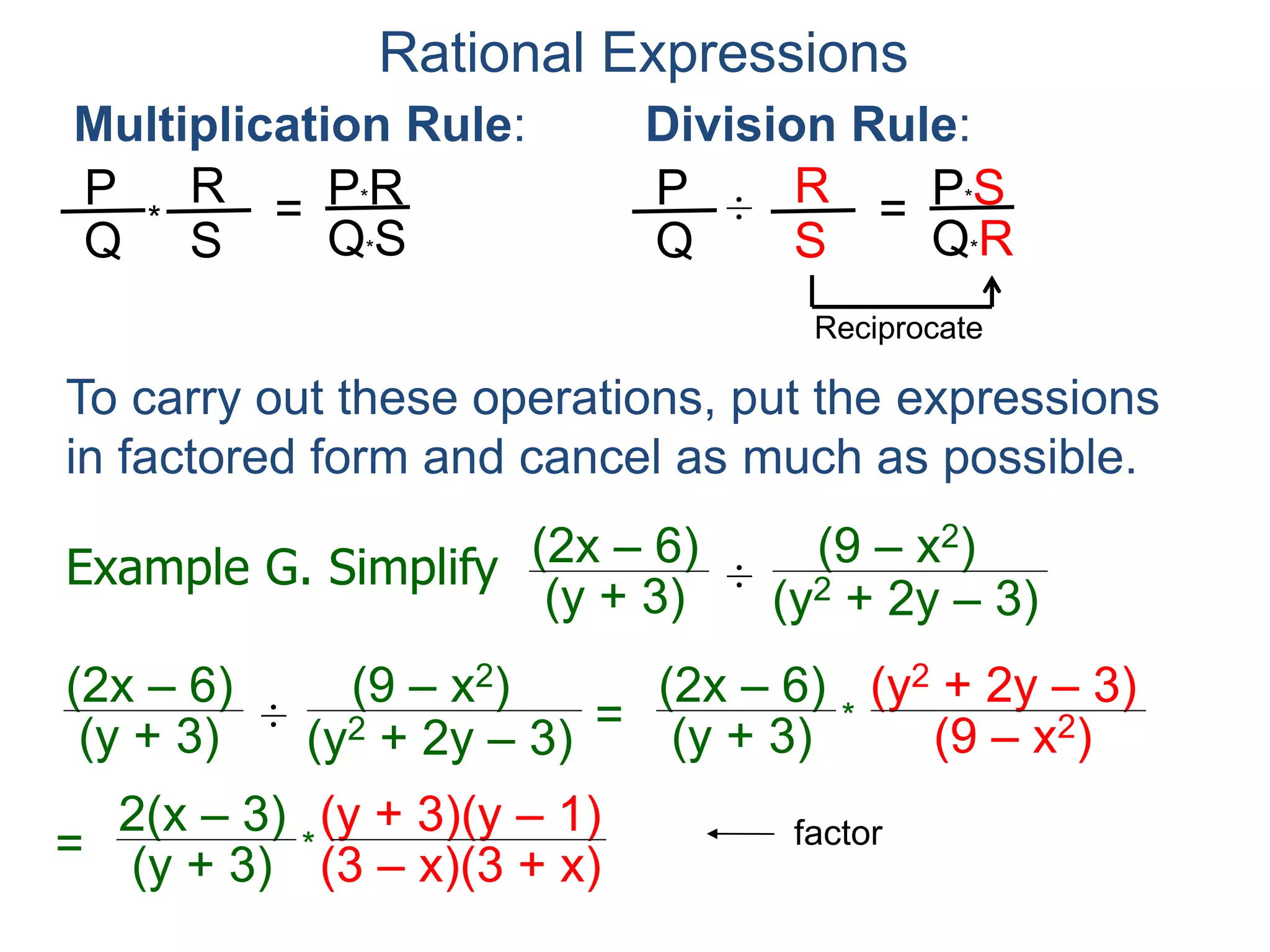
(2x – 6)
(y + 3) ÷
(y2 + 2y – 3)
(9 – x2)
=
(2x – 6)
(y + 3)
(y2 + 2y – 3)
(9 – x2)*
Reciprocate
Rational Expressions
Multiplication Rule:
P
Q
R
S
* = P*R
Q*S
Division Rule:
P
Q
R
S
÷ = P*S
Q*R
Reciprocate
Example G. Simplify (2x – 6)
(y + 3) ÷
(y2 + 2y – 3)
(9 – x2)
(2x – 6)
(y + 3) ÷
(y2 + 2y – 3)
(9 – x2)
=
(2x – 6)
(y + 3)
(y2 + 2y – 3)
(9 – x2)*
Reciprocate
To carry out these operations, put the expressions
in factored form and cancel as much as possible.
Rational Expressions
Multiplication Rule:
To carry out these operations, put the expressions
in factored form and cancel as much as possible.
P
Q
R
S
* = P*R
Q*S
Division Rule:
P
Q
R
S
÷ = P*S
Q*R
Reciprocate
Example G. Simplify (2x – 6)
(y + 3) ÷
(y2 + 2y – 3)
(9 – x2)
(2x – 6)
(y + 3) ÷
(y2 + 2y – 3)
(9 – x2)
=
(2x – 6)
(y + 3)
(y2 + 2y – 3)
(9 – x2)*
=
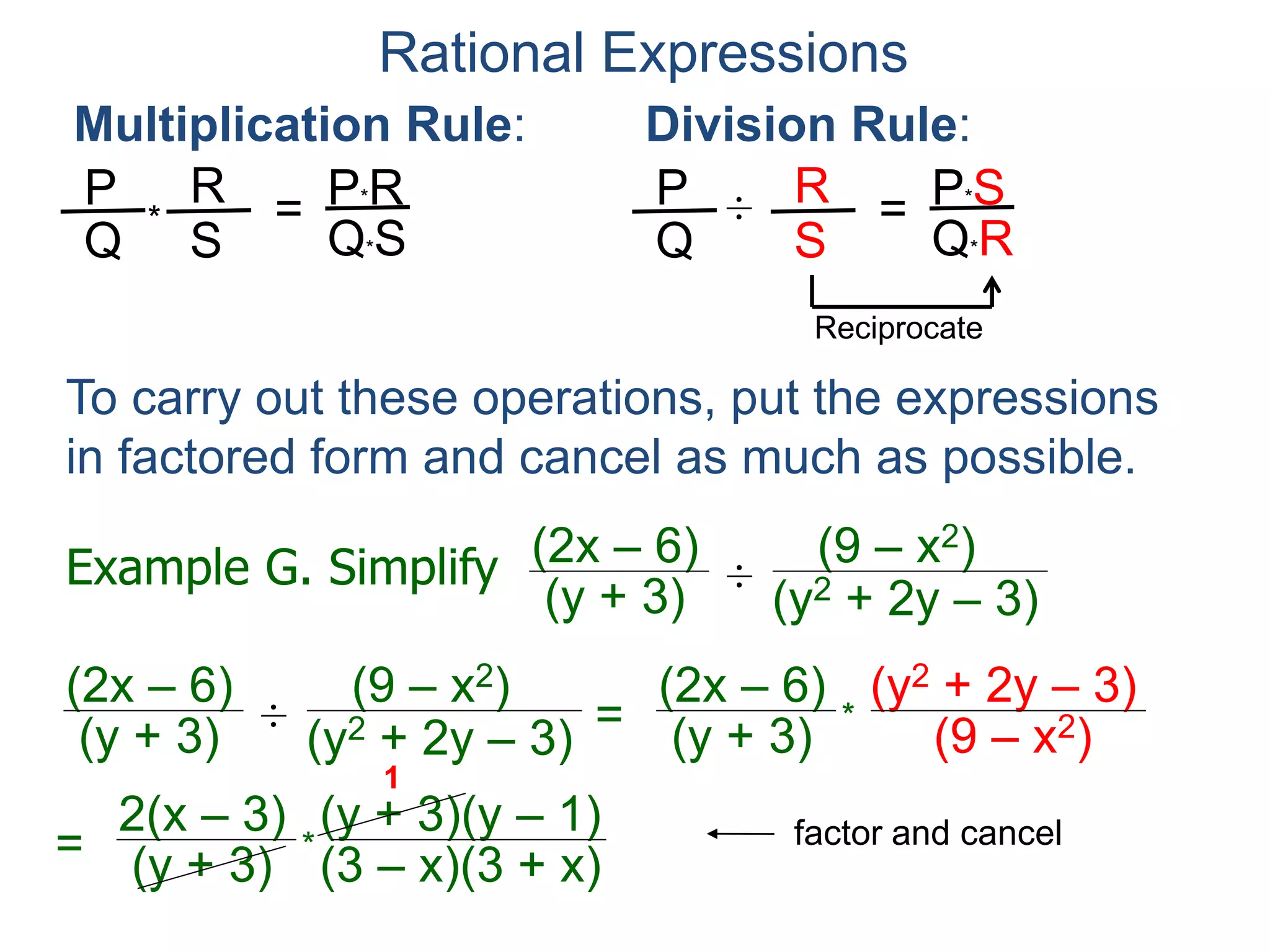
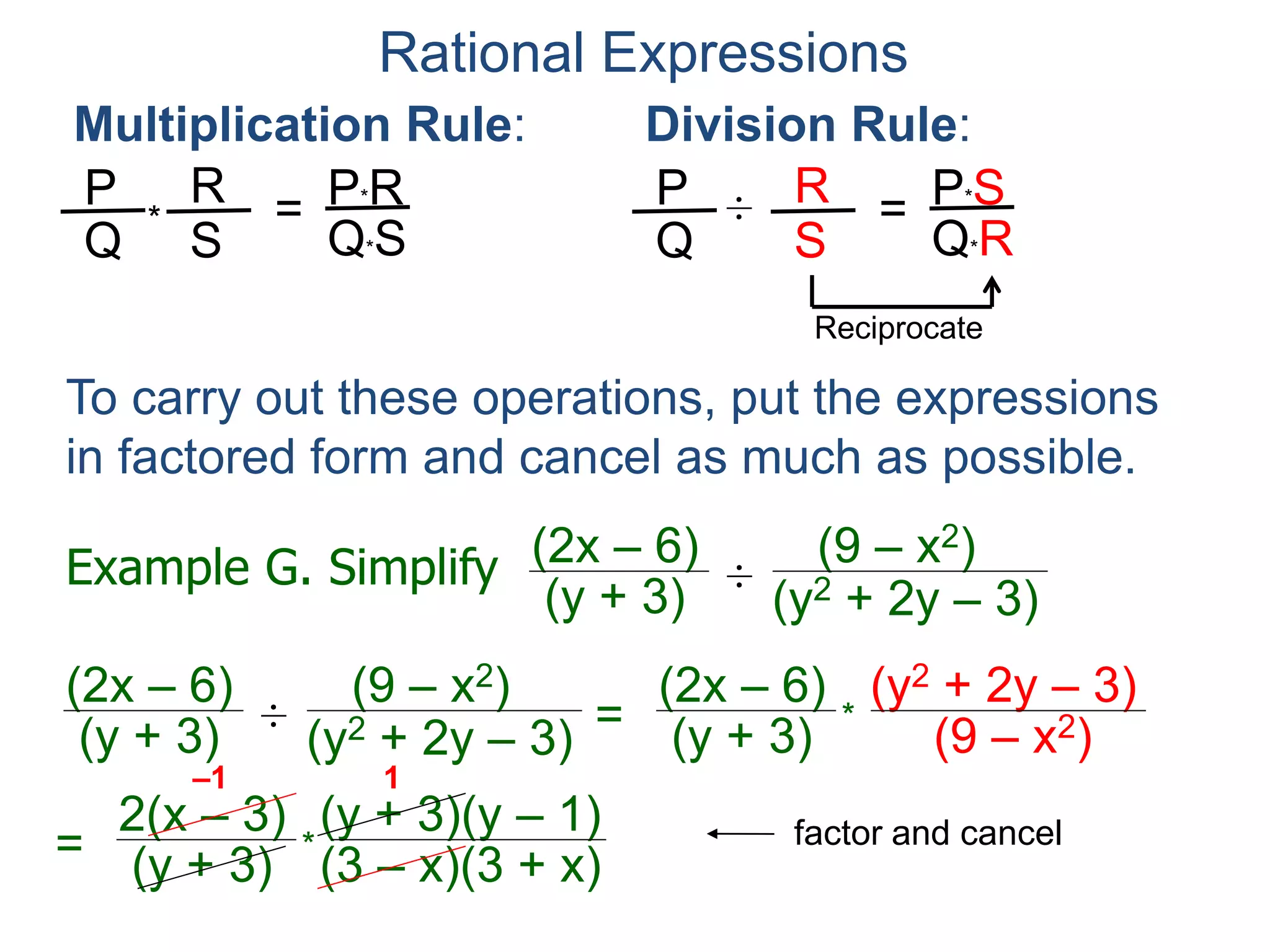
2(x – 3)
(y + 3)
(y + 3)(y – 1)
(3 – x)(3 + x)* factor and cancel
Rational Expressions
Multiplication Rule:
To carry out these operations, put the expressions
in factored form and cancel as much as possible.
P
Q
R
S
* = P*R
Q*S
Division Rule:
P
Q
R
S
÷ = P*S
Q*R
Reciprocate
Example G. Simplify (2x – 6)
(y + 3) ÷
(y2 + 2y – 3)
(9 – x2)
(2x – 6)
(y + 3) ÷
(y2 + 2y – 3)
(9 – x2)
=
(2x – 6)
(y + 3)
(y2 + 2y – 3)
(9 – x2)*
=
2(x – 3)
(y + 3)
(y + 3)(y – 1)
(3 – x)(3 + x)*
1
factor and cancel
Rational Expressions
Multiplication Rule:
To carry out these operations, put the expressions
in factored form and cancel as much as possible.
P
Q
R
S
* = P*R
Q*S
Division Rule:
P
Q
R
S
÷ = P*S
Q*R
Reciprocate
Example G. Simplify (2x – 6)
(y + 3) ÷
(y2 + 2y – 3)
(9 – x2)
(2x – 6)
(y + 3) ÷
(y2 + 2y – 3)
(9 – x2)
=
(2x – 6)
(y + 3)
(y2 + 2y – 3)
(9 – x2)*
=
2(x – 3)
(y + 3)
(y + 3)(y – 1)
(3 – x)(3 + x)*
–1 1
factor and cancel
Rational Expressions
Multiplication Rule:
To carry out these operations, put the expressions
in factored form and cancel as much as possible.
P
Q
R
S
* = P*R
Q*S
Division Rule:
P
Q
R
S
÷ = P*S
Q*R
Reciprocate
Example G. Simplify (2x – 6)
(y + 3) ÷
(y2 + 2y – 3)
(9 – x2)
(2x – 6)
(y + 3) ÷
(y2 + 2y – 3)
(9 – x2)
=
(2x – 6)
(y + 3)
(y2 + 2y – 3)
(9 – x2)*
=
2(x – 3)
(y + 3)
(y + 3)(y – 1)
(3 – x)(3 + x)*
–1 1
=
–2(y – 1)
(x + 3)
Rational Expressions
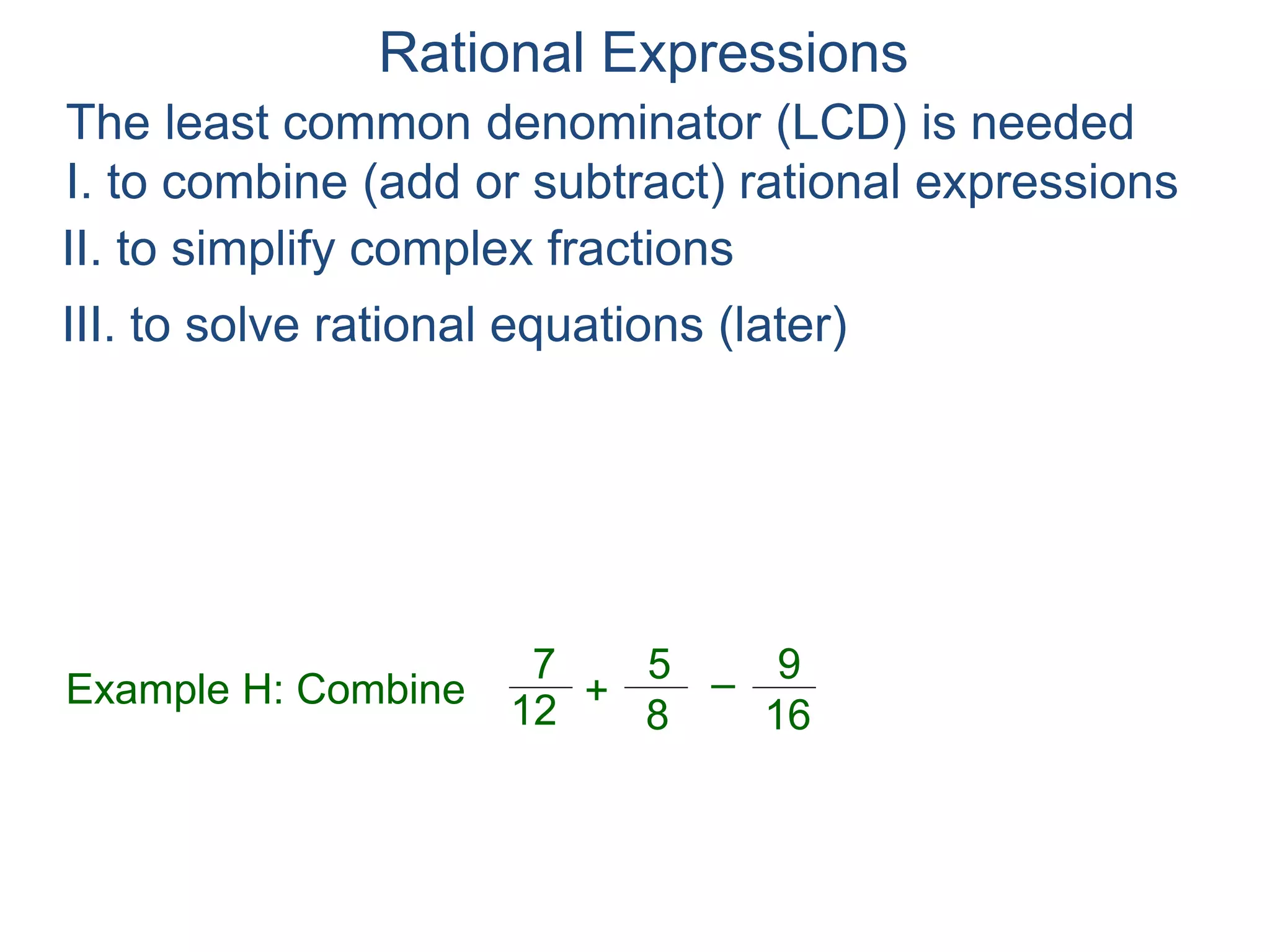
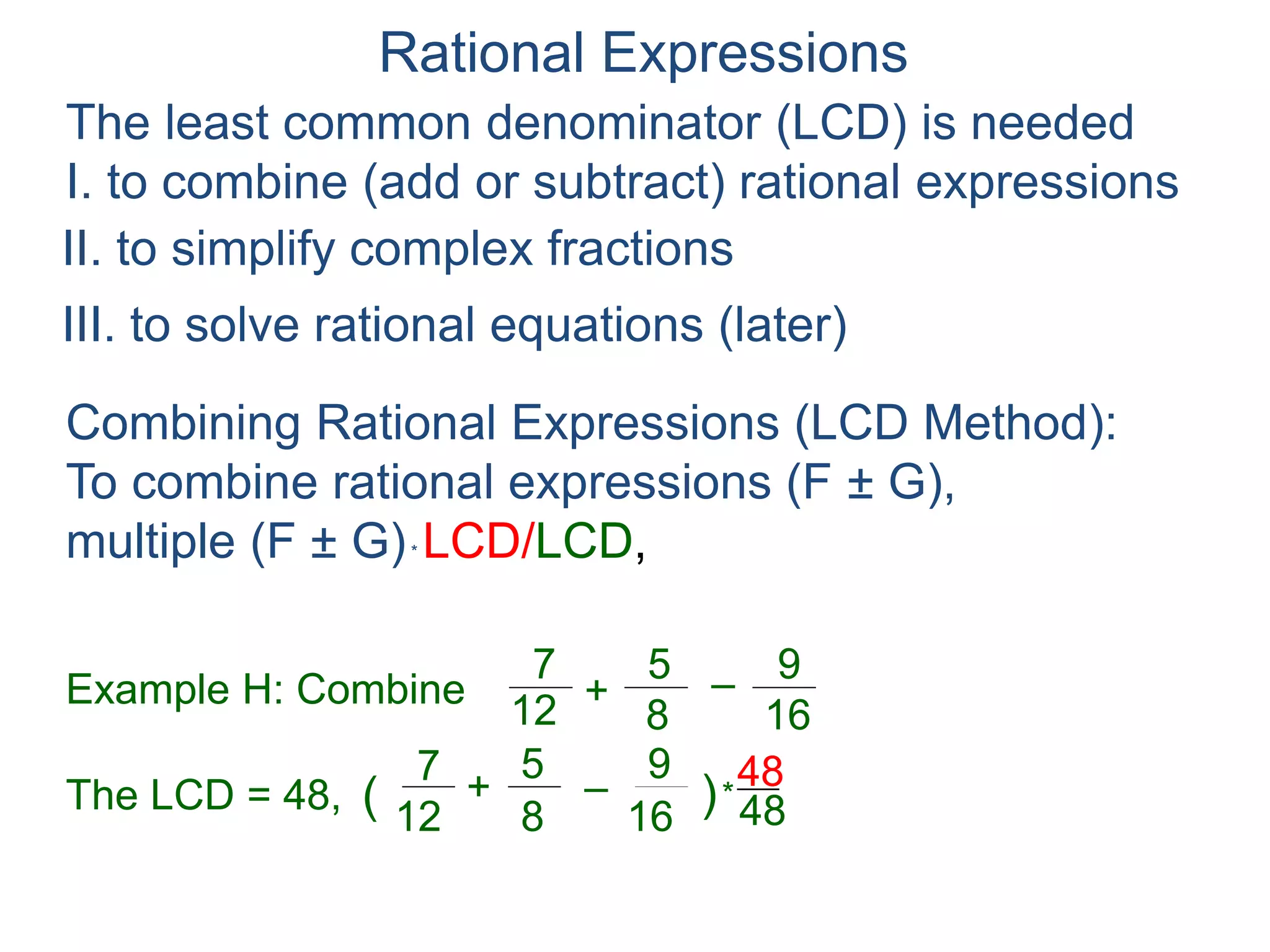
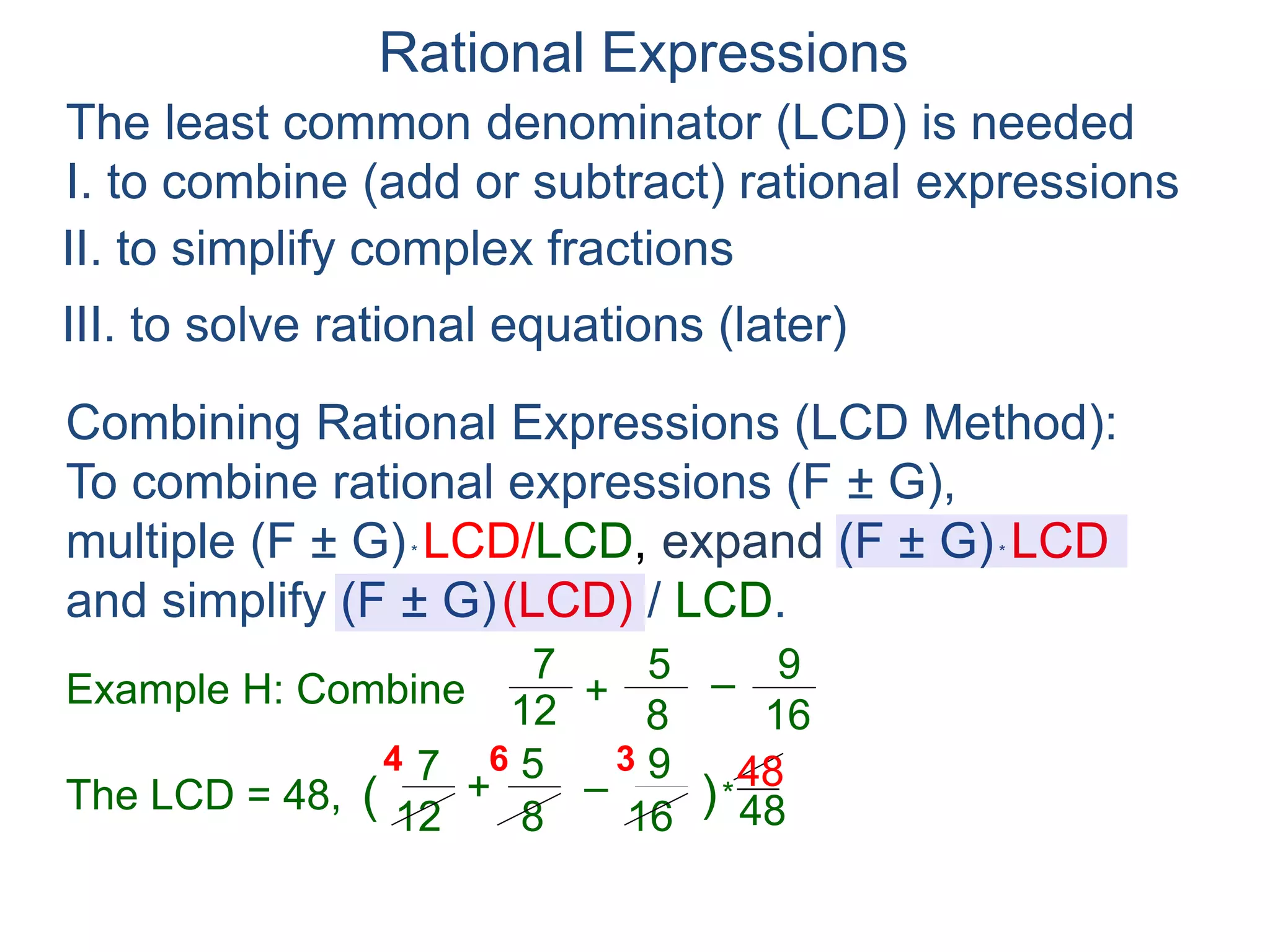
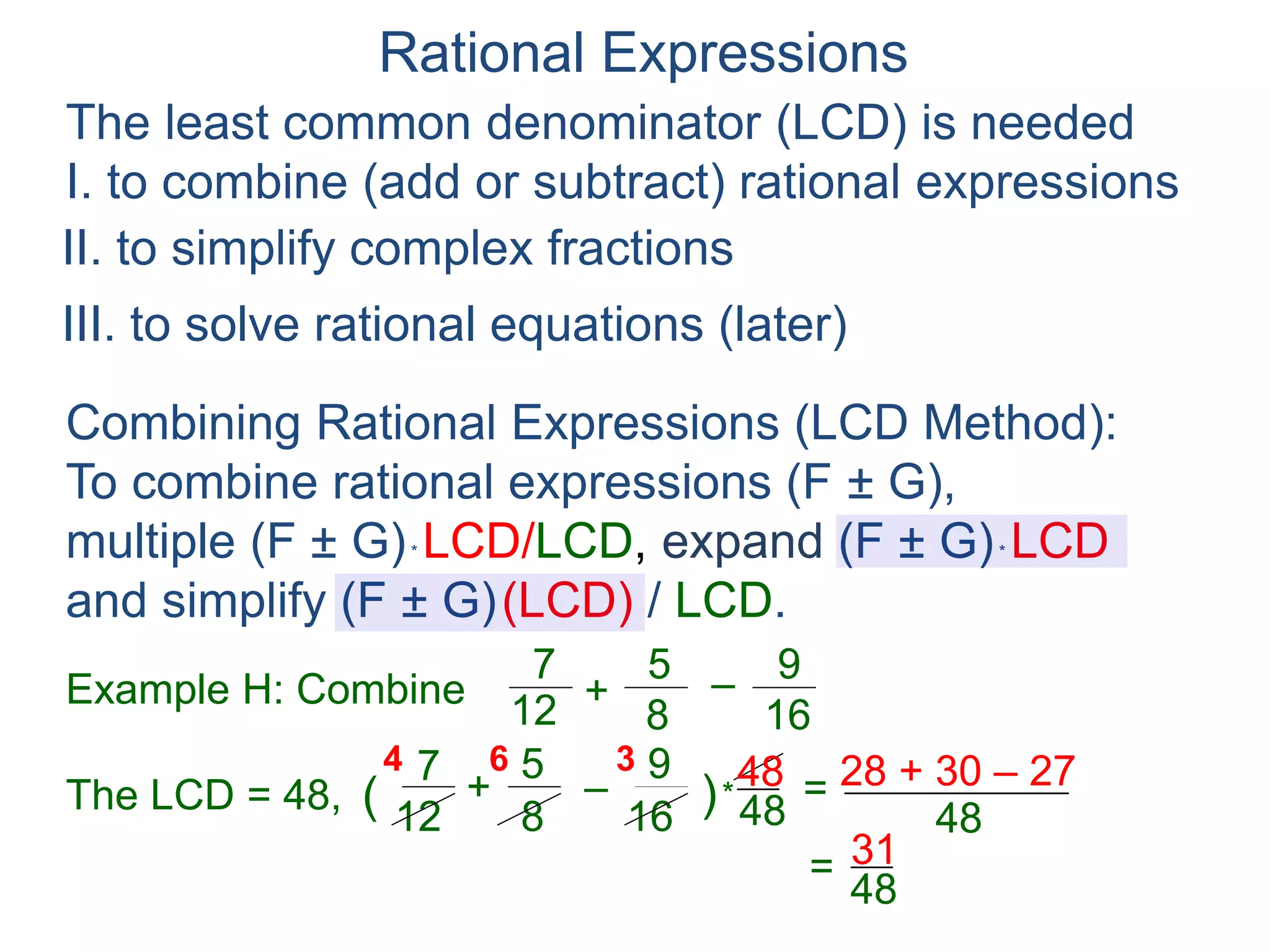
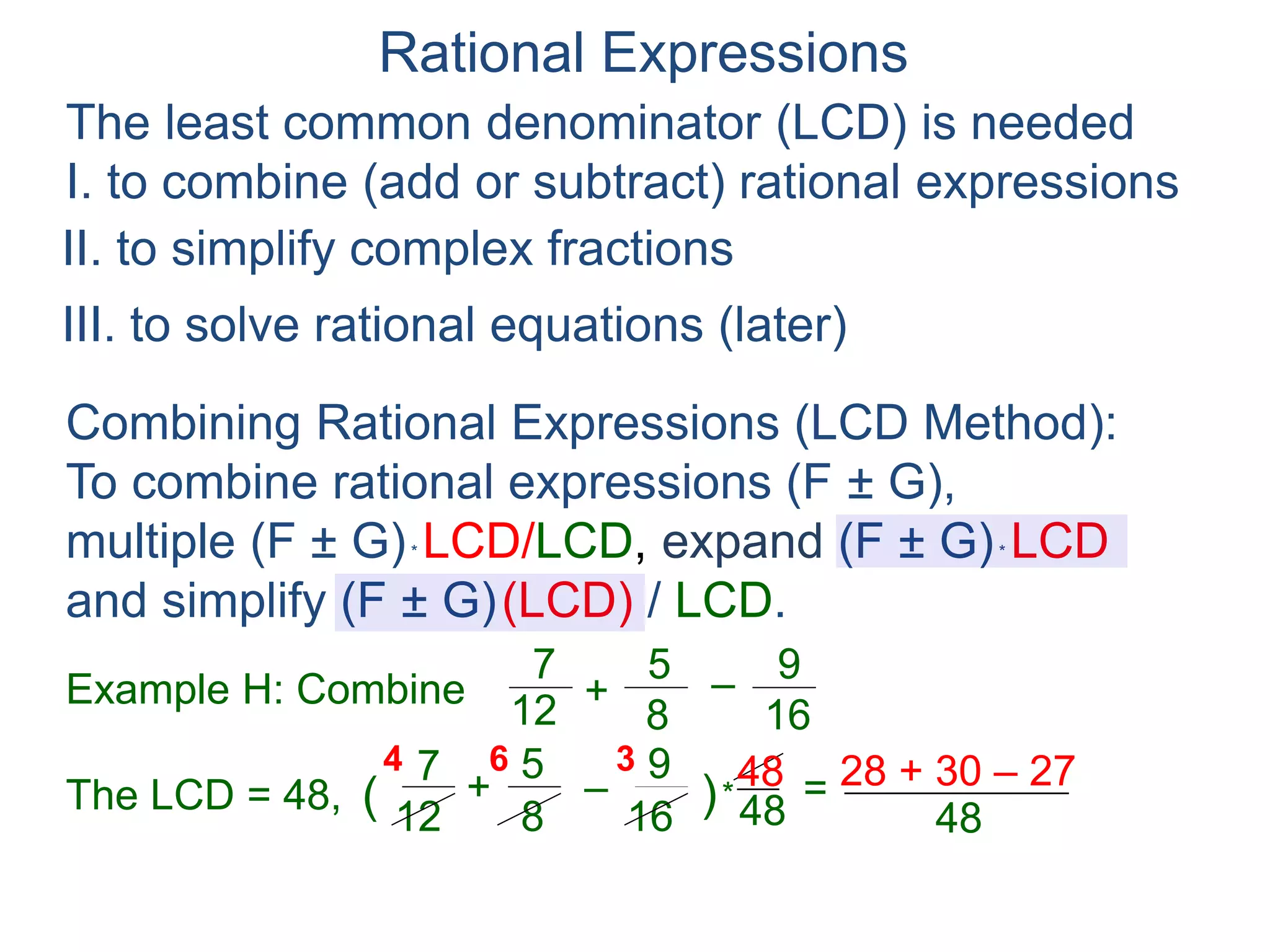
The least common denominator (LCD) is needed
I. to combine (add or subtract) rational expressions
Rational Expressions
The least common denominator (LCD) is needed
I. to combine (add or subtract) rational expressions
II. to simplify complex fractions
Rational Expressions
The least common denominator (LCD) is needed
I. to combine (add or subtract) rational expressions
II. to simplify complex fractions
III. to solve rational equations (later)
Rational Expressions
The least common denominator (LCD) is needed
I. to combine (add or subtract) rational expressions
Example H: Combine
7
12
5
8
+ –
16
9
II. to simplify complex fractions
III. to solve rational equations (later)
Rational Expressions
The least common denominator (LCD) is needed
I. to combine (add or subtract) rational expressions
Example H: Combine
7
12
5
8
+ –
16
9
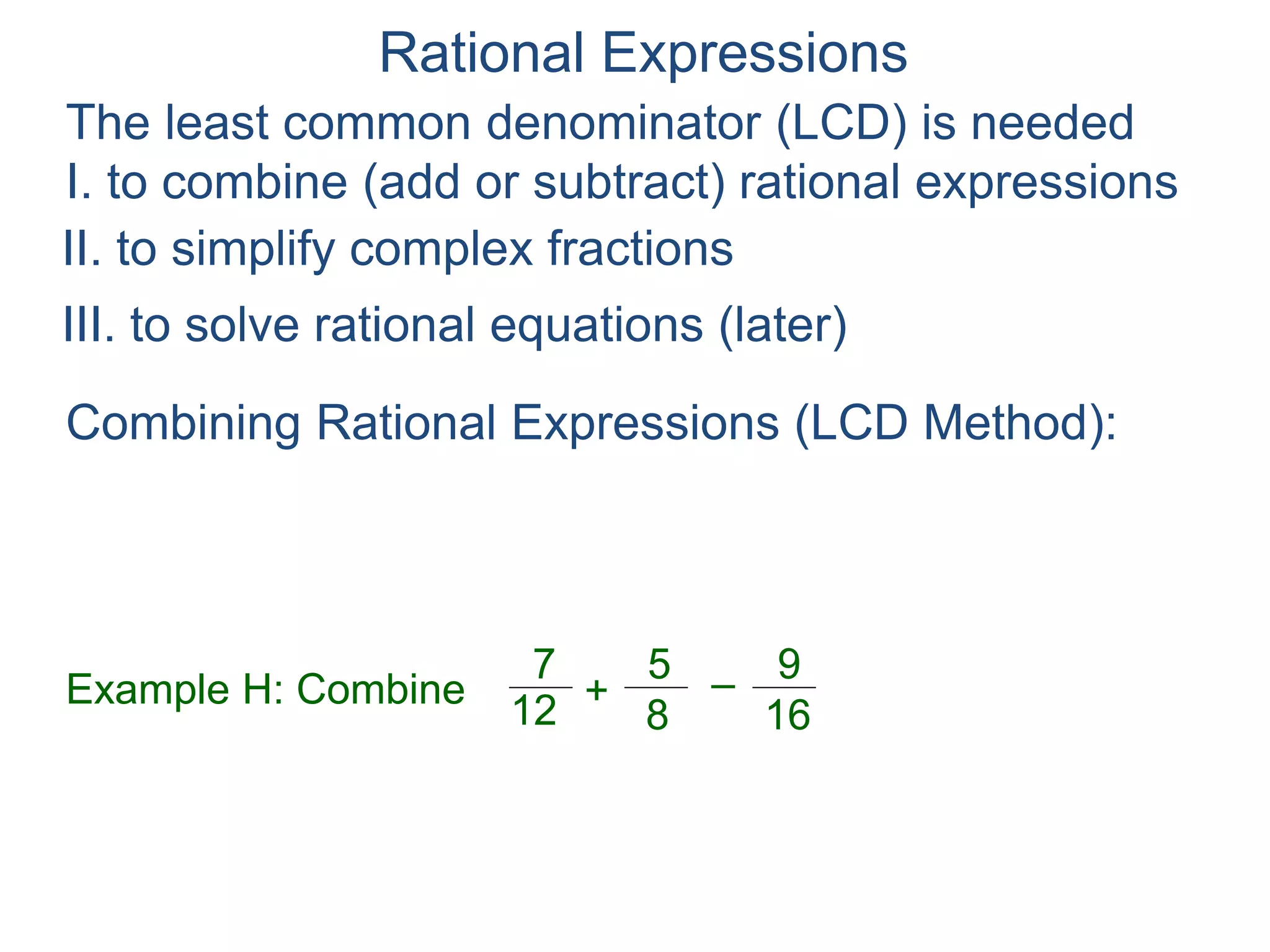
Combining Rational Expressions (LCD Method):
II. to simplify complex fractions
III. to solve rational equations (later)
Rational Expressions
The least common denominator (LCD) is needed
I. to combine (add or subtract) rational expressions
Example H: Combine
7
12
5
8
+ –
16
9
Combining Rational Expressions (LCD Method):
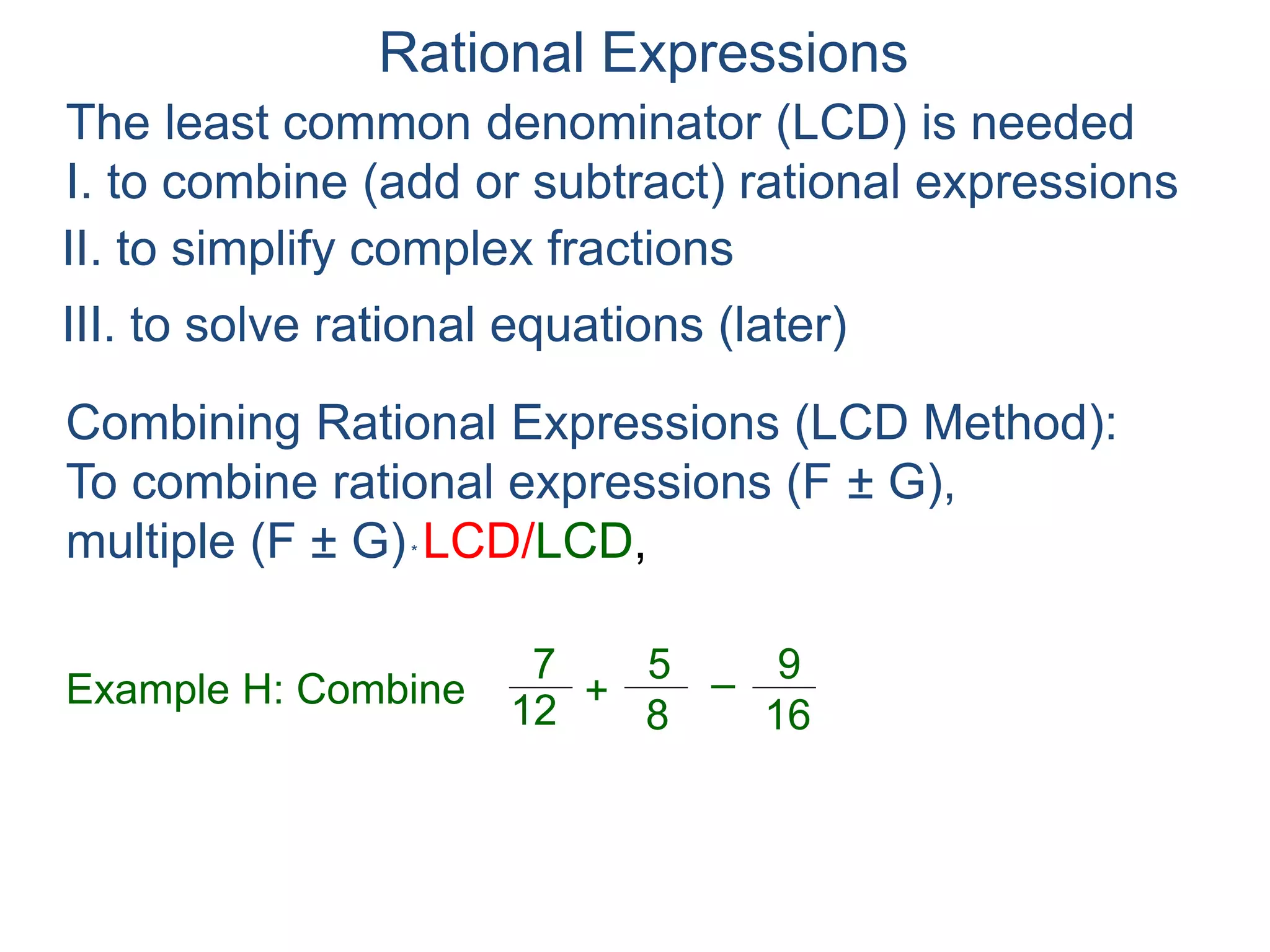
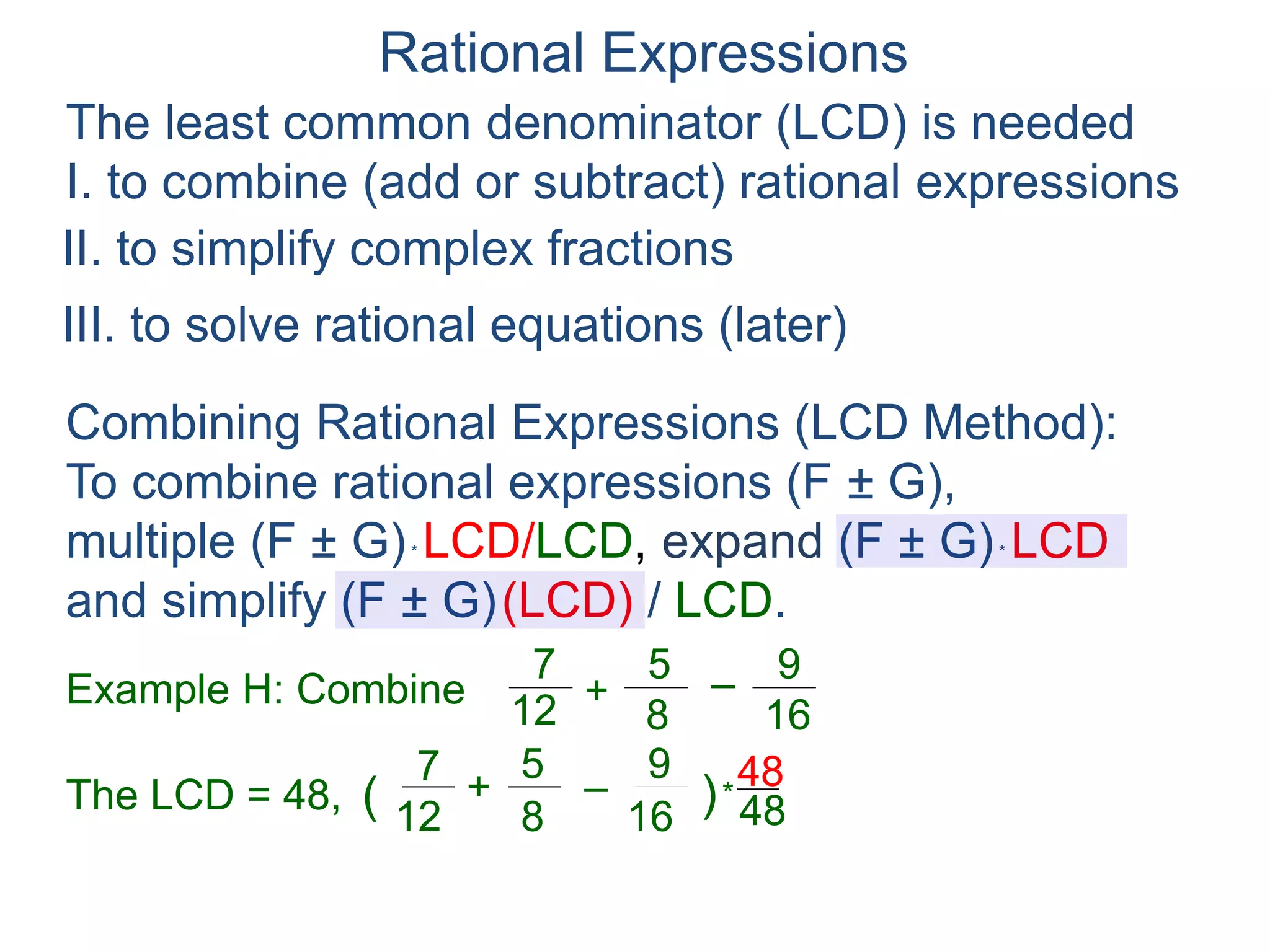
To combine rational expressions (F ± G),
multiple (F ± G)* LCD/LCD,
II. to simplify complex fractions
III. to solve rational equations (later)
Rational Expressions
The least common denominator (LCD) is needed
I. to combine (add or subtract) rational expressions
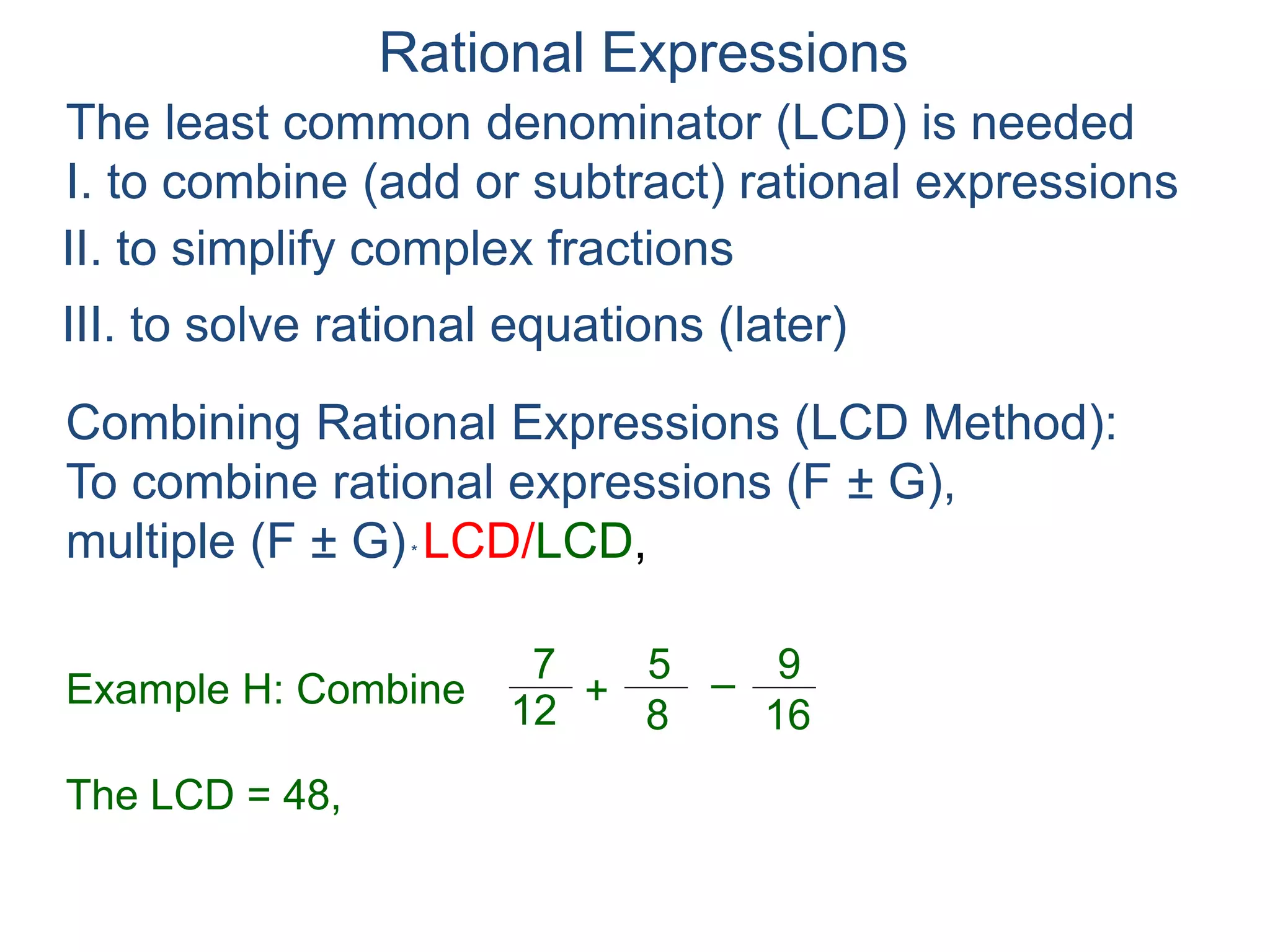
Example H: Combine
7
12
5
8
+ –
16
9
The LCD = 48,
Combining Rational Expressions (LCD Method):
To combine rational expressions (F ± G),
multiple (F ± G)* LCD/LCD,
II. to simplify complex fractions
III. to solve rational equations (later)
Rational Expressions
The least common denominator (LCD) is needed
I. to combine (add or subtract) rational expressions
Example H: Combine
7
12
5
8
+ –
16
9
The LCD = 48, ( )*
48
7
12
5
8
+ –
16
9
Combining Rational Expressions (LCD Method):
To combine rational expressions (F ± G),
multiple (F ± G)* LCD/LCD,
48
II. to simplify complex fractions
III. to solve rational equations (later)
Rational Expressions
The least common denominator (LCD) is needed
I. to combine (add or subtract) rational expressions
Example H: Combine
7
12
5
8
+ –
16
9
The LCD = 48, ( )*
48
7
12
5
8
+ –
16
9 48
Combining Rational Expressions (LCD Method):
To combine rational expressions (F ± G),
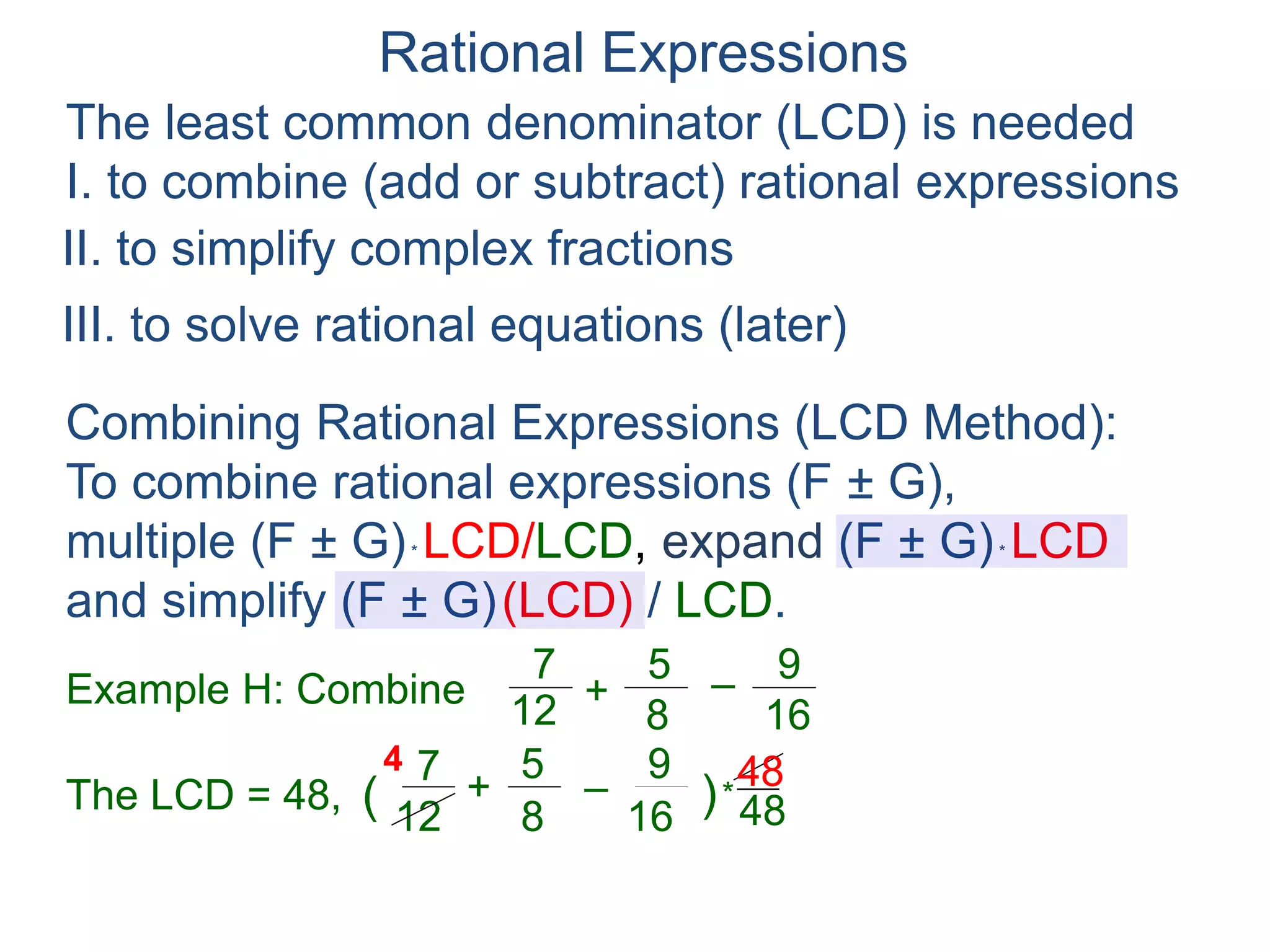
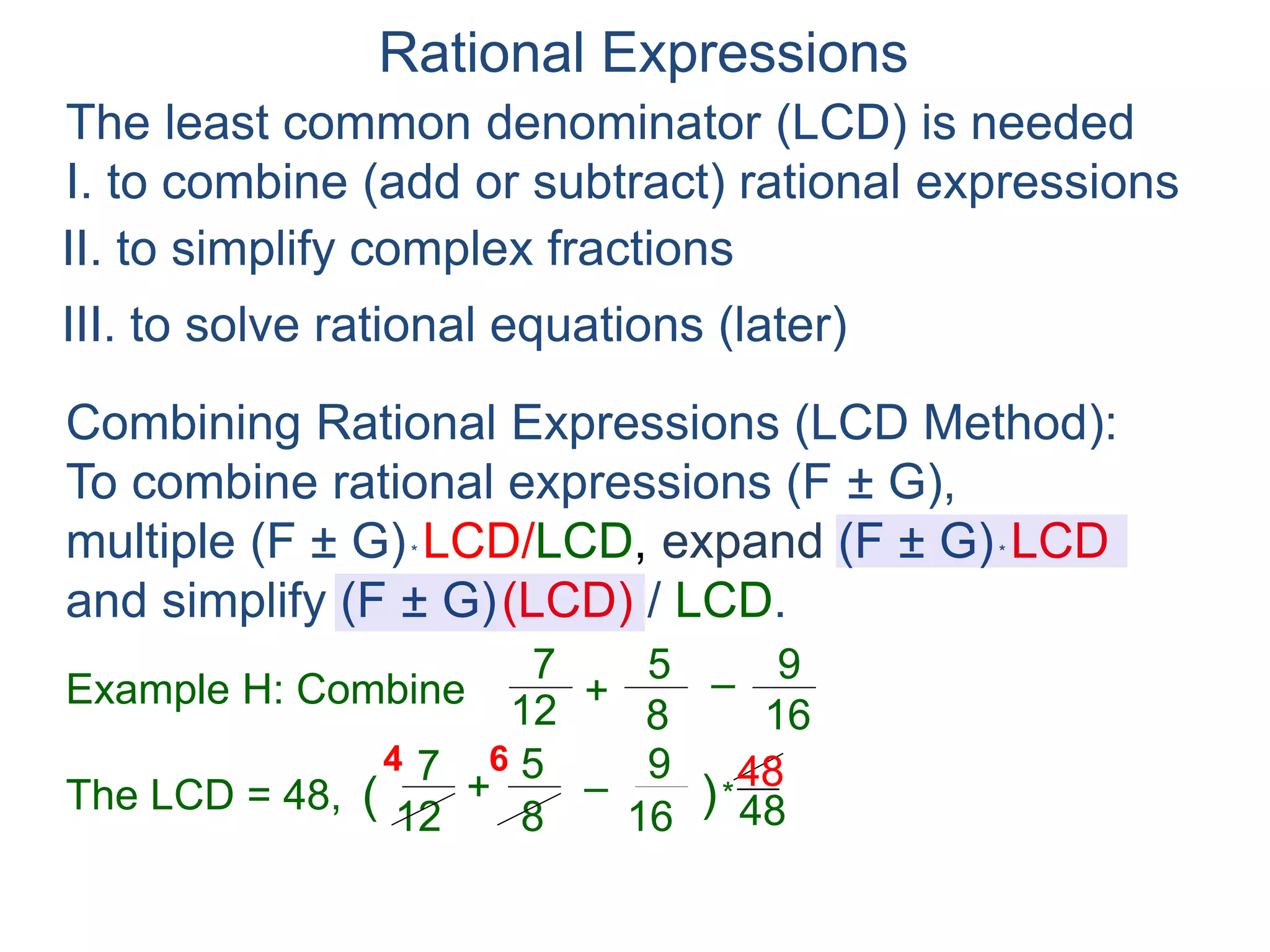
multiple (F ± G)* LCD/LCD, expand (F ± G)* LCD
and simplify (F ± G)(LCD) / LCD.
II. to simplify complex fractions
III. to solve rational equations (later)
Rational Expressions
The least common denominator (LCD) is needed
I. to combine (add or subtract) rational expressions
Example H: Combine
7
12
5
8
+ –
16
9
The LCD = 48, ( )*
48
7
12
5
8
+ –
16
94
Combining Rational Expressions (LCD Method):
To combine rational expressions (F ± G),
multiple (F ± G)* LCD/LCD, expand (F ± G)* LCD
and simplify (F ± G)(LCD) / LCD.
48
II. to simplify complex fractions
III. to solve rational equations (later)
Rational Expressions
The least common denominator (LCD) is needed
I. to combine (add or subtract) rational expressions
Example H: Combine
7
12
5
8
+ –
16
9
The LCD = 48, ( )*
48
67
12
5
8
+ –
16
94
Combining Rational Expressions (LCD Method):
To combine rational expressions (F ± G),
multiple (F ± G)* LCD/LCD, expand (F ± G)* LCD
and simplify (F ± G)(LCD) / LCD.
48
II. to simplify complex fractions
III. to solve rational equations (later)
Rational Expressions
The least common denominator (LCD) is needed
I. to combine (add or subtract) rational expressions
Example H: Combine
7
12
5
8
+ –
16
9
The LCD = 48, ( )*
48
67
12
5
8
+ –
16
94 3
Combining Rational Expressions (LCD Method):
To combine rational expressions (F ± G),
multiple (F ± G)* LCD/LCD, expand (F ± G)* LCD
and simplify (F ± G)(LCD) / LCD.
48
II. to simplify complex fractions
III. to solve rational equations (later)
Rational Expressions
The least common denominator (LCD) is needed
I. to combine (add or subtract) rational expressions
Example H: Combine
7
12
5
8
+ –
16
9
The LCD = 48, ( )*
48
67
12
5
8
+ –
16
94 3
=
Combining Rational Expressions (LCD Method):
To combine rational expressions (F ± G),
multiple (F ± G)* LCD/LCD, expand (F ± G)* LCD
and simplify (F ± G)(LCD) / LCD.
48 28 + 30 – 27
48
II. to simplify complex fractions
III. to solve rational equations (later)
Rational Expressions
The least common denominator (LCD) is needed
I. to combine (add or subtract) rational expressions
Example H: Combine
7
12
5
8
+ –
16
9
The LCD = 48, ( )*
48
67
12
5
8
+ –
16
94 3
=
Combining Rational Expressions (LCD Method):
To combine rational expressions (F ± G),
multiple (F ± G)* LCD/LCD, expand (F ± G)* LCD
and simplify (F ± G)(LCD) / LCD.
48 28 + 30 – 27
48
=
48
31
II. to simplify complex fractions
III. to solve rational equations (later)
Rational Expressions
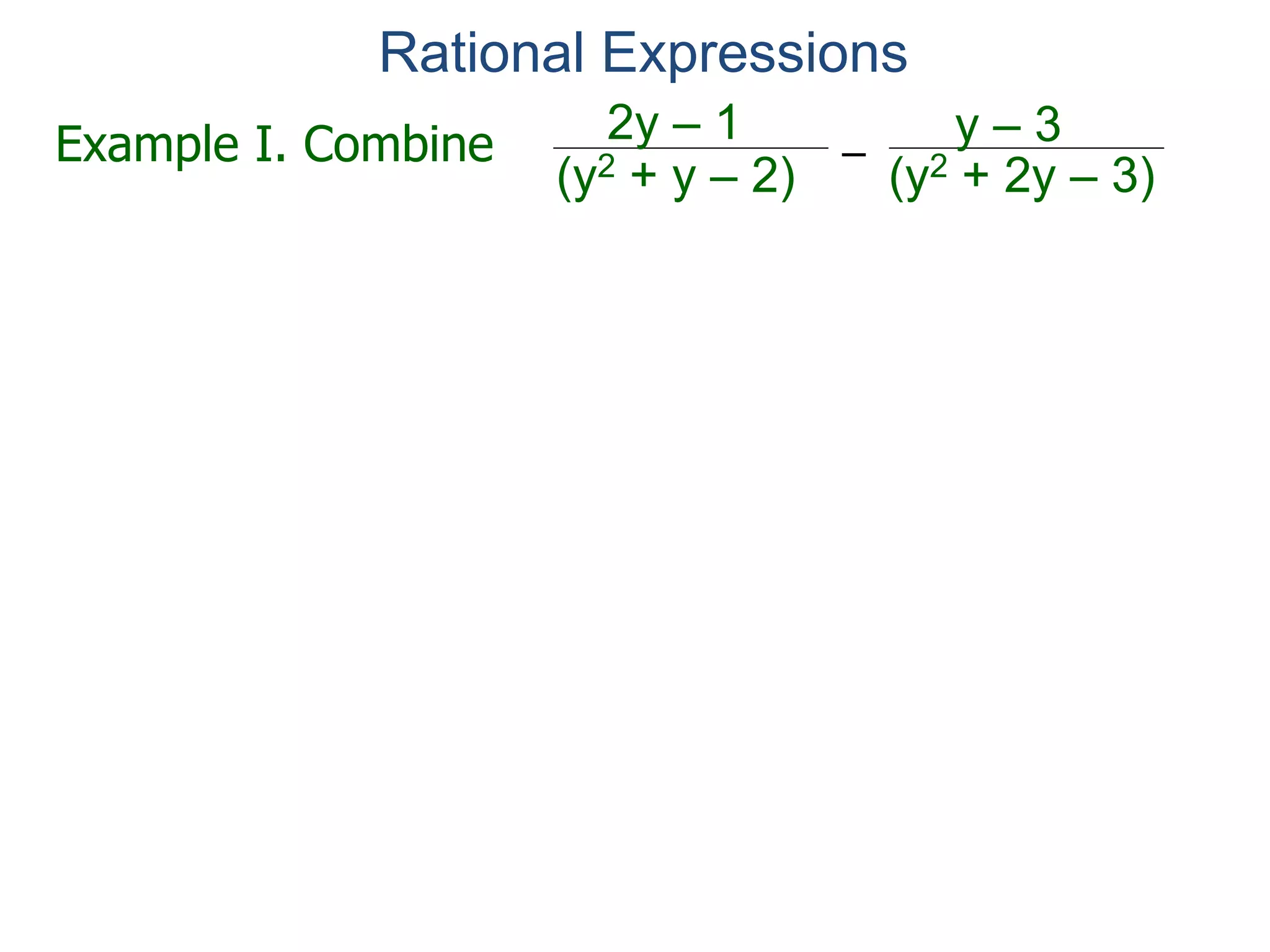
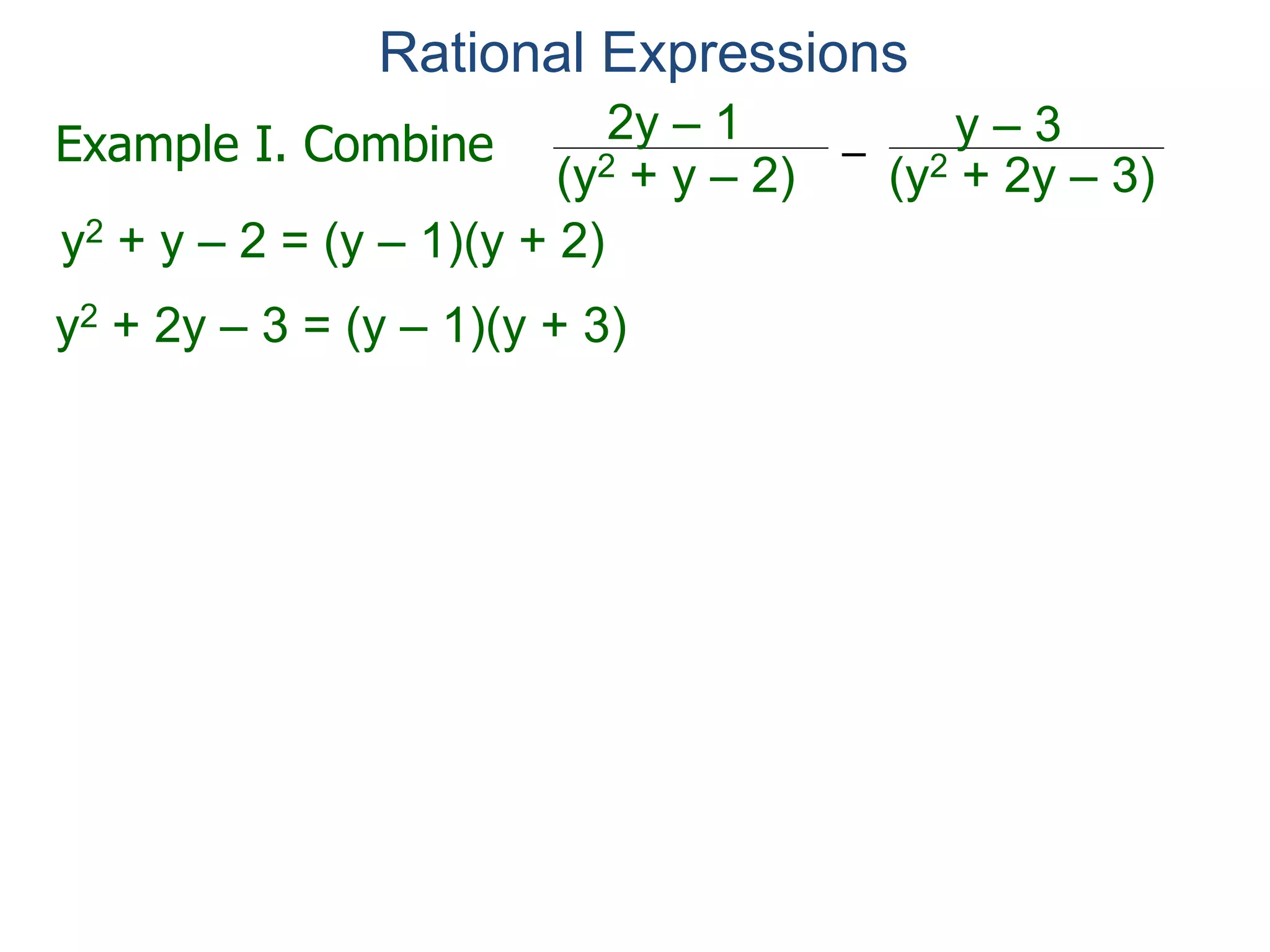
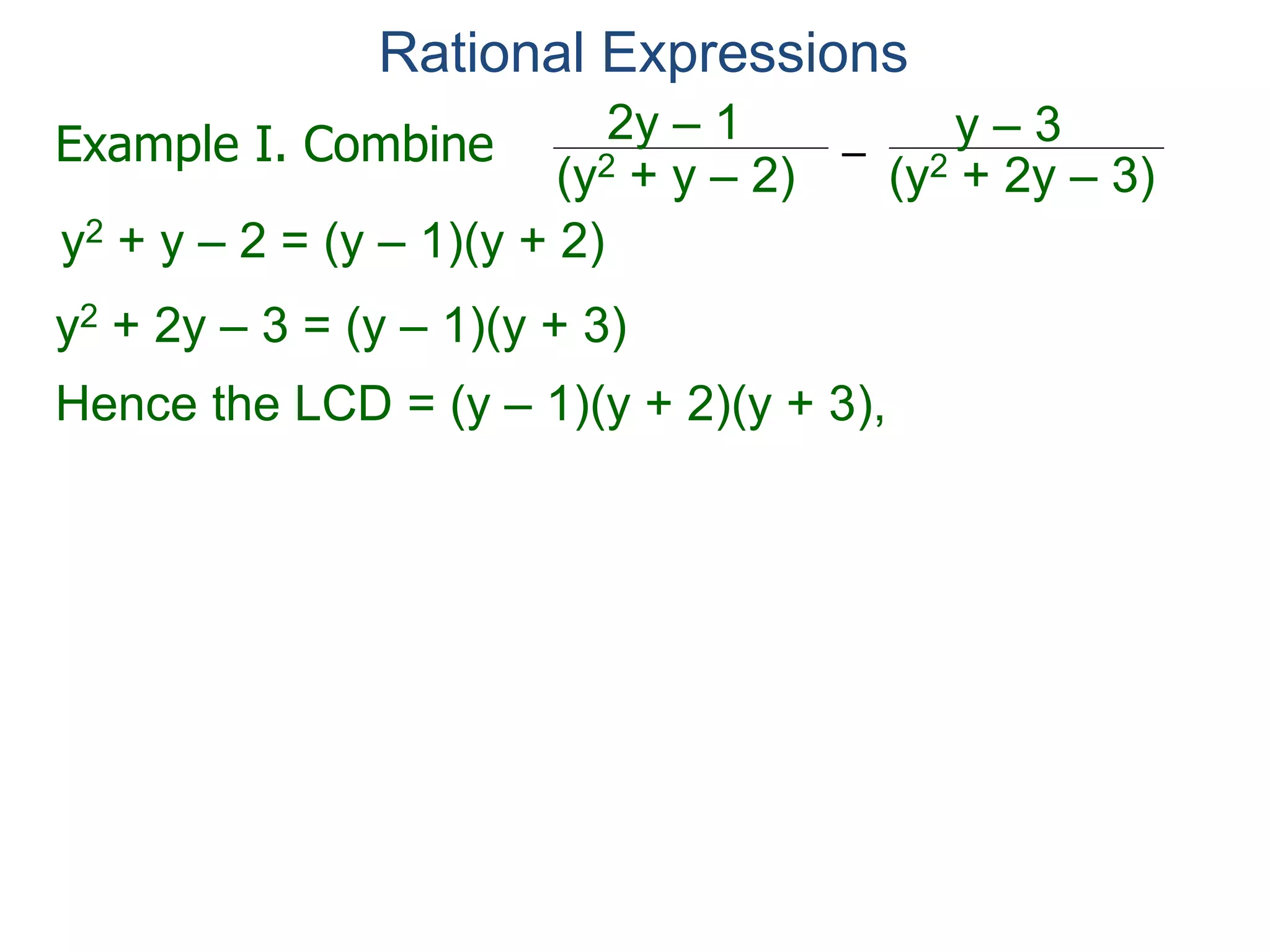
–
(y2 + 2y – 3)(y2 + y – 2)
2y – 1 y – 3Example I. Combine
Rational Expressions
–
(y2 + 2y – 3)(y2 + y – 2)
2y – 1 y – 3
y2 + y – 2 = (y – 1)(y + 2)
y2 + 2y – 3 = (y – 1)(y + 3)
Example I. Combine
Rational Expressions
–
(y2 + 2y – 3)(y2 + y – 2)
2y – 1 y – 3
y2 + y – 2 = (y – 1)(y + 2)
y2 + 2y – 3 = (y – 1)(y + 3)
Hence the LCD = (y – 1)(y + 2)(y + 3),
Example I. Combine
Rational Expressions
–
(y2 + 2y – 3)(y2 + y – 2)
2y – 1 y – 3
y2 + y – 2 = (y – 1)(y + 2)
y2 + 2y – 3 = (y – 1)(y + 3)
Hence the LCD = (y – 1)(y + 2)(y + 3),
multiplying LCD/LCD (= 1) to the problem,
Example I. Combine
Rational Expressions
–
(y2 + 2y – 3)(y2 + y – 2)
2y – 1 y – 3
y2 + y – 2 = (y – 1)(y + 2)
y2 + 2y – 3 = (y – 1)(y + 3)
Hence the LCD = (y – 1)(y + 2)(y + 3),
multiplying LCD/LCD (= 1) to the problem,
–
(y2 + 2y – 3)(y – 1)(y + 2)
2y – 1 y – 3[ ]
Example I. Combine
Rational Expressions
–
(y2 + 2y – 3)(y2 + y – 2)
2y – 1 y – 3
y2 + y – 2 = (y – 1)(y + 2)
y2 + 2y – 3 = (y – 1)(y + 3)
Hence the LCD = (y – 1)(y + 2)(y + 3),
multiplying LCD/LCD (= 1) to the problem,
–
(y2 + 2y – 3)(y – 1)(y + 2)
2y – 1 y – 3[ ](y – 1)(y + 2)(y + 3)
Example I. Combine
LCD
Rational Expressions
–
(y2 + 2y – 3)(y2 + y – 2)
2y – 1 y – 3
y2 + y – 2 = (y – 1)(y + 2)
y2 + 2y – 3 = (y – 1)(y + 3)
Hence the LCD = (y – 1)(y + 2)(y + 3),
multiplying LCD/LCD (= 1) to the problem,
–
(y – 1)(y + 2)
2y – 1 y – 3[ ](y – 1)(y + 2)(y + 3)
Example I. Combine
LCD
expand and simplify.
(y – 1)(y + 3)
Rational Expressions
–
(y2 + 2y – 3)(y2 + y – 2)
2y – 1 y – 3
y2 + y – 2 = (y – 1)(y + 2)
y2 + 2y – 3 = (y – 1)(y + 3)
Hence the LCD = (y – 1)(y + 2)(y + 3),
multiplying LCD/LCD (= 1) to the problem,
–
(y – 1)(y + 2)
2y – 1 y – 3[ ](y – 1)(y + 2)(y + 3)
(y + 3)
Example I. Combine
LCD
expand and simplify.
(y – 1)(y + 3)
Rational Expressions
–
(y2 + 2y – 3)(y2 + y – 2)
2y – 1 y – 3
y2 + y – 2 = (y – 1)(y + 2)
y2 + 2y – 3 = (y – 1)(y + 3)
Hence the LCD = (y – 1)(y + 2)(y + 3),
multiplying LCD/LCD (= 1) to the problem,
–
(y – 1)(y + 2)
2y – 1 y – 3[ ](y – 1)(y + 2)(y + 3)
(y + 3) (y + 2)
Example I. Combine
LCD
expand and simplify.
(y – 1)(y + 3)
Rational Expressions
–
(y2 + 2y – 3)(y2 + y – 2)
2y – 1 y – 3
y2 + y – 2 = (y – 1)(y + 2)
y2 + 2y – 3 = (y – 1)(y + 3)
Hence the LCD = (y – 1)(y + 2)(y + 3),
multiplying LCD/LCD (= 1) to the problem,
–
(y – 1)(y + 2)
2y – 1 y – 3[ ](y – 1)(y + 2)(y + 3)
= (2y – 1)(y + 3) – (y – 3)(y + 2)
(y + 3) (y + 2)
Example I. Combine
LCD
LCD
expand and simplify.
(y – 1)(y + 3)
Rational Expressions
–
(y2 + 2y – 3)(y2 + y – 2)
2y – 1 y – 3
y2 + y – 2 = (y – 1)(y + 2)
y2 + 2y – 3 = (y – 1)(y + 3)
Hence the LCD = (y – 1)(y + 2)(y + 3),
multiplying LCD/LCD (= 1) to the problem,
–
(y – 1)(y + 2)
2y – 1 y – 3[ ](y – 1)(y + 2)(y + 3)
= (2y – 1)(y + 3) – (y – 3)(y + 2) = y2 + 6y + 3
(y + 3) (y + 2)
Example I. Combine
LCD
LCDLCD
expand and simplify.
(y – 1)(y + 3)
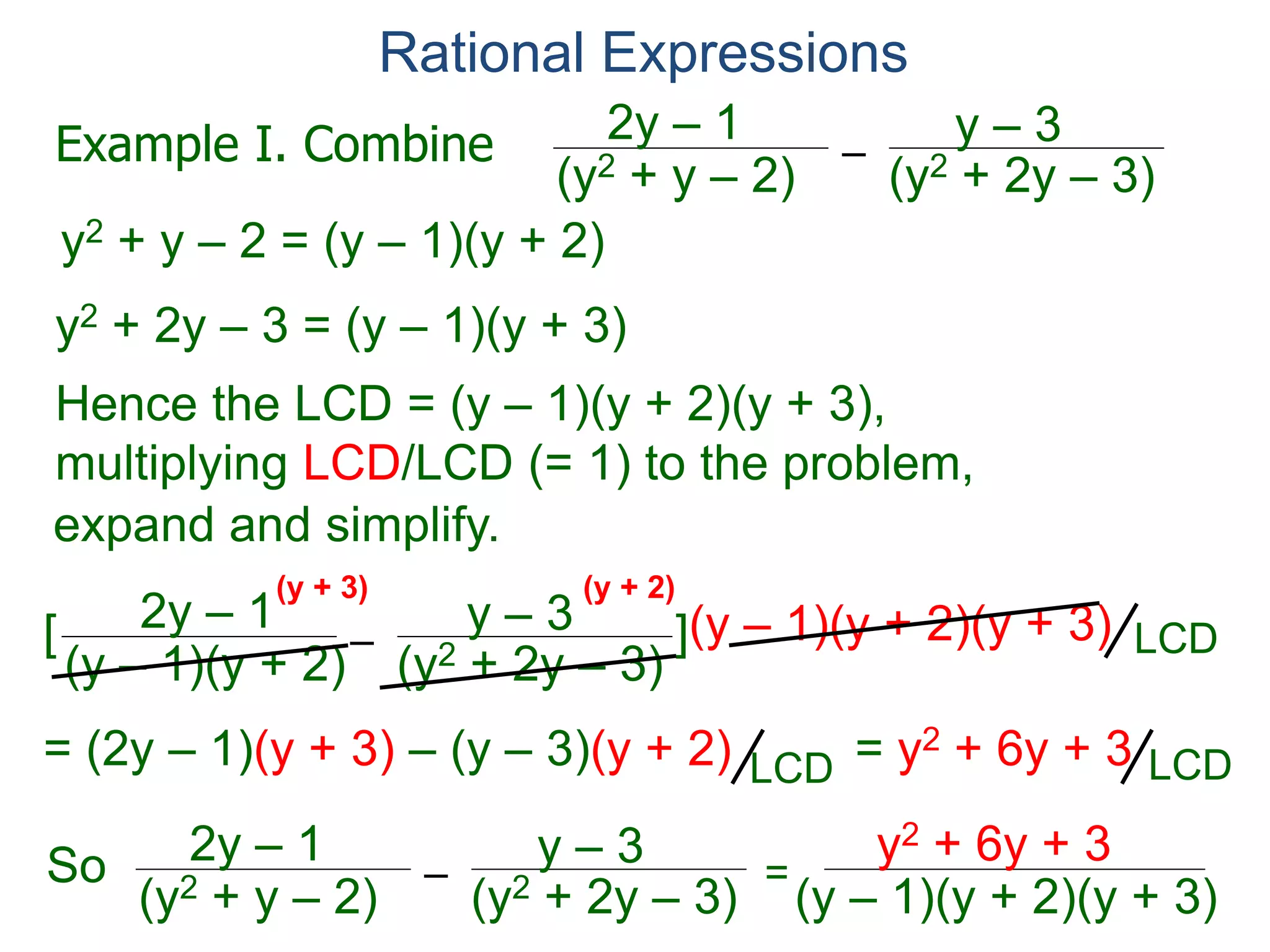
Rational Expressions
–
(y2 + 2y – 3)(y2 + y – 2)
2y – 1 y – 3
y2 + y – 2 = (y – 1)(y + 2)
y2 + 2y – 3 = (y – 1)(y + 3)
Hence the LCD = (y – 1)(y + 2)(y + 3),
multiplying LCD/LCD (= 1) to the problem,
–
(y – 1)(y + 2)
2y – 1 y – 3[ ](y – 1)(y + 2)(y + 3)
= (2y – 1)(y + 3) – (y – 3)(y + 2) = y2 + 6y + 3
So –
(y2 + 2y – 3)(y2 + y – 2)
2y – 1 y – 3
=
y2 + 6y + 3
(y – 1)(y + 2)(y + 3)
(y + 3) (y + 2)
Example I. Combine
LCD
LCDLCD
expand and simplify.
(y – 1)(y + 3)
Rational Expressions
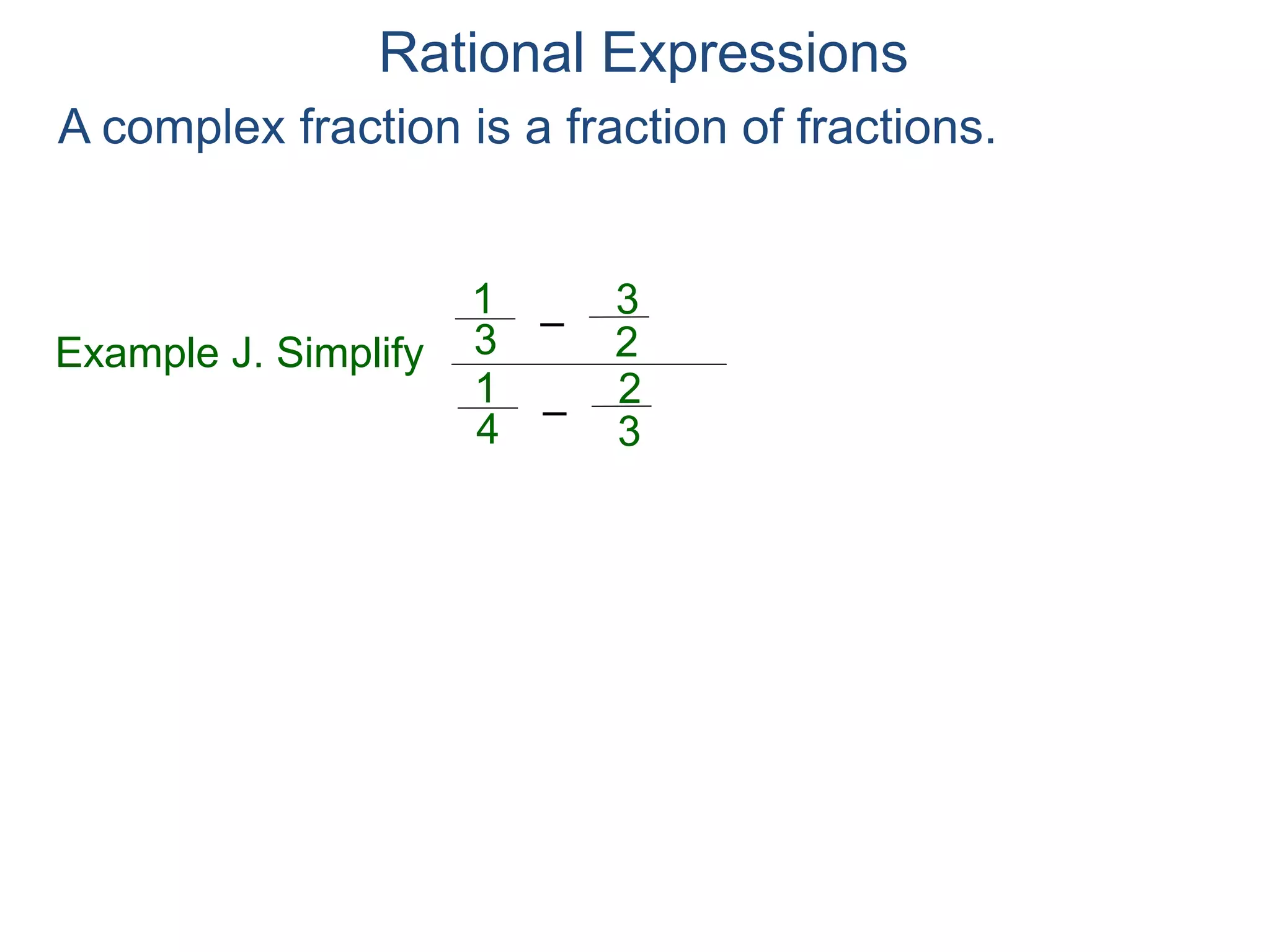
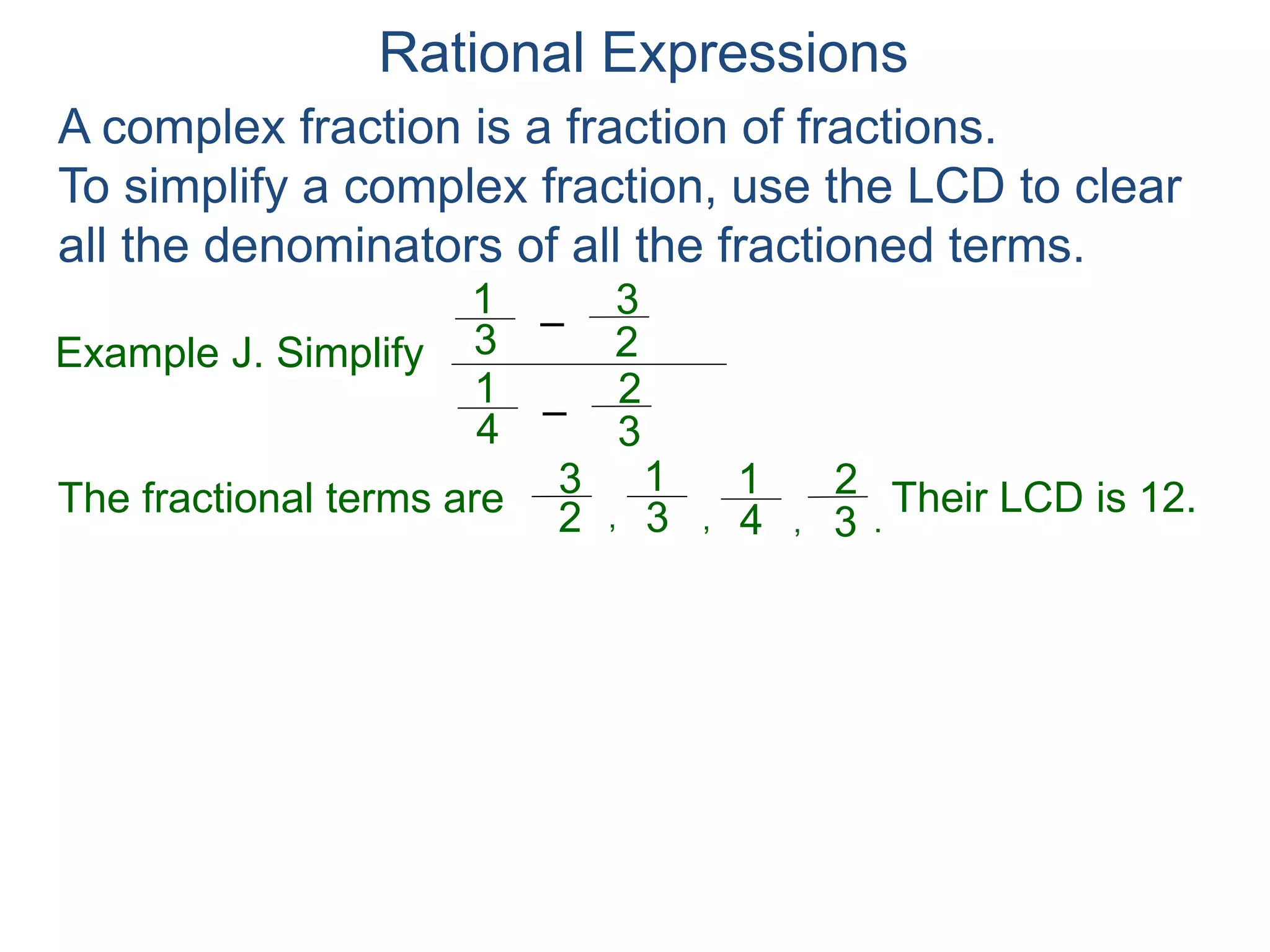
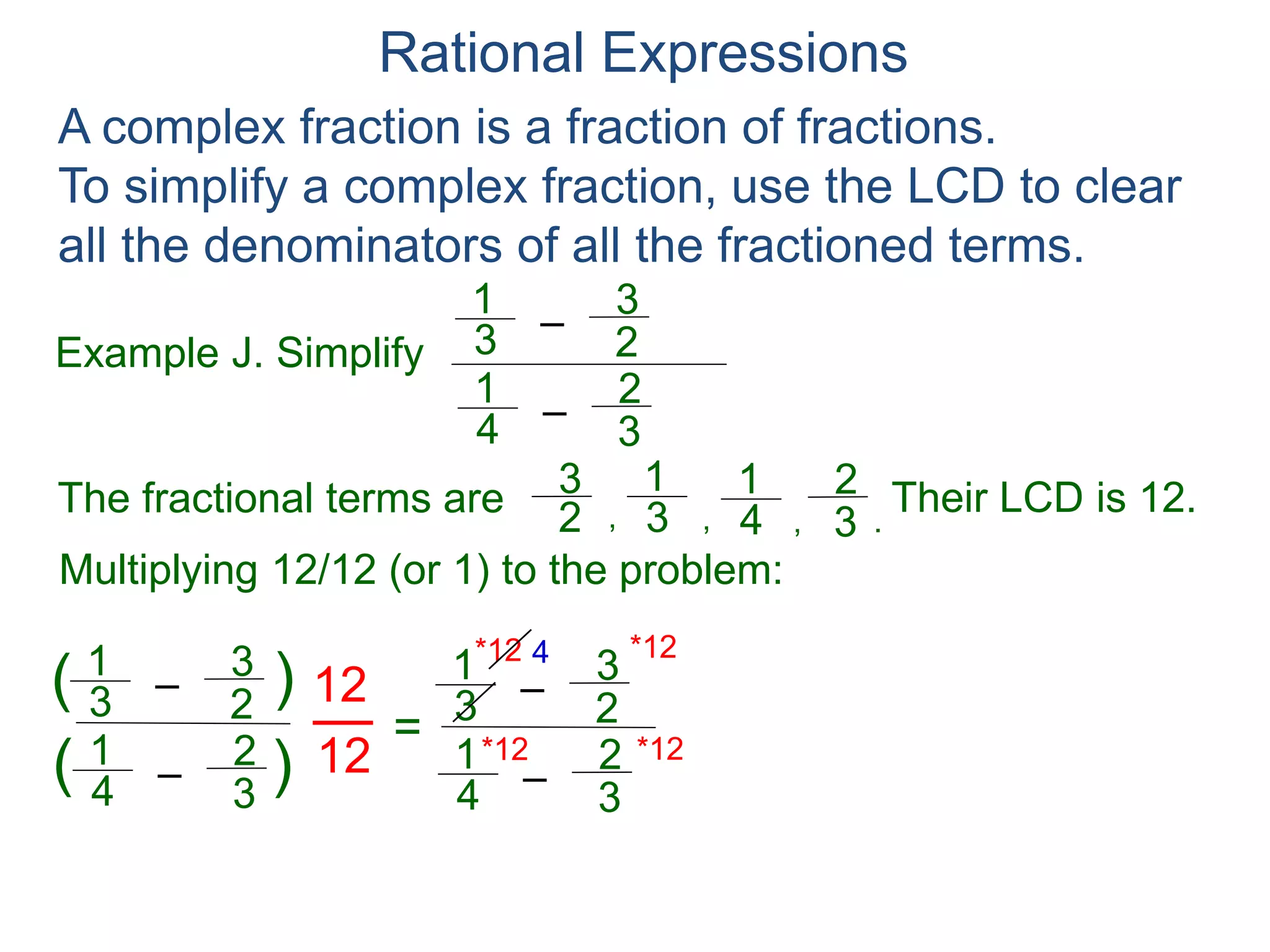
Example J. Simplify
–3
1
A complex fraction is a fraction of fractions.
2
3
–4
1
3
2
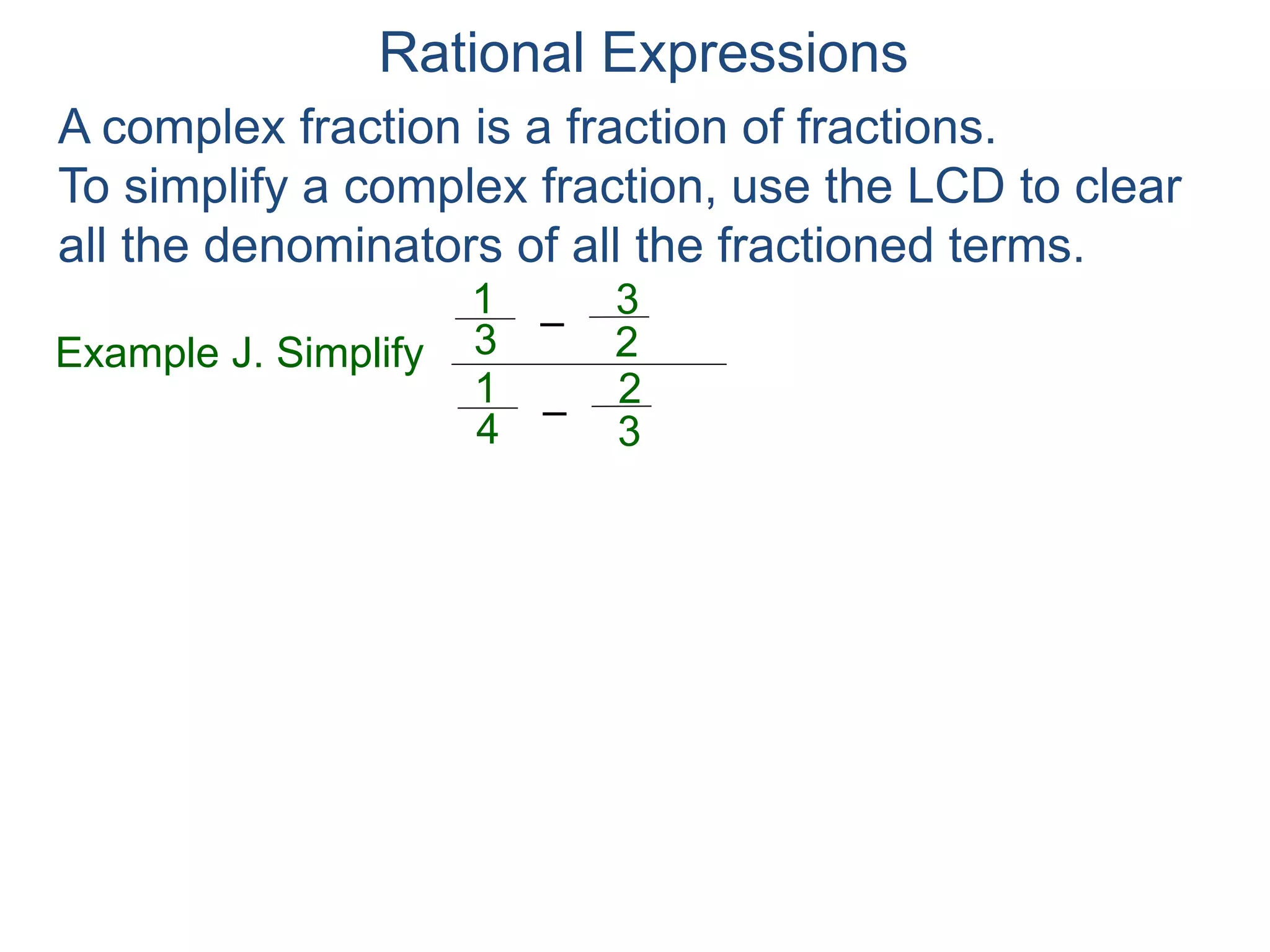
Rational Expressions
Example J. Simplify
–3
1
A complex fraction is a fraction of fractions.
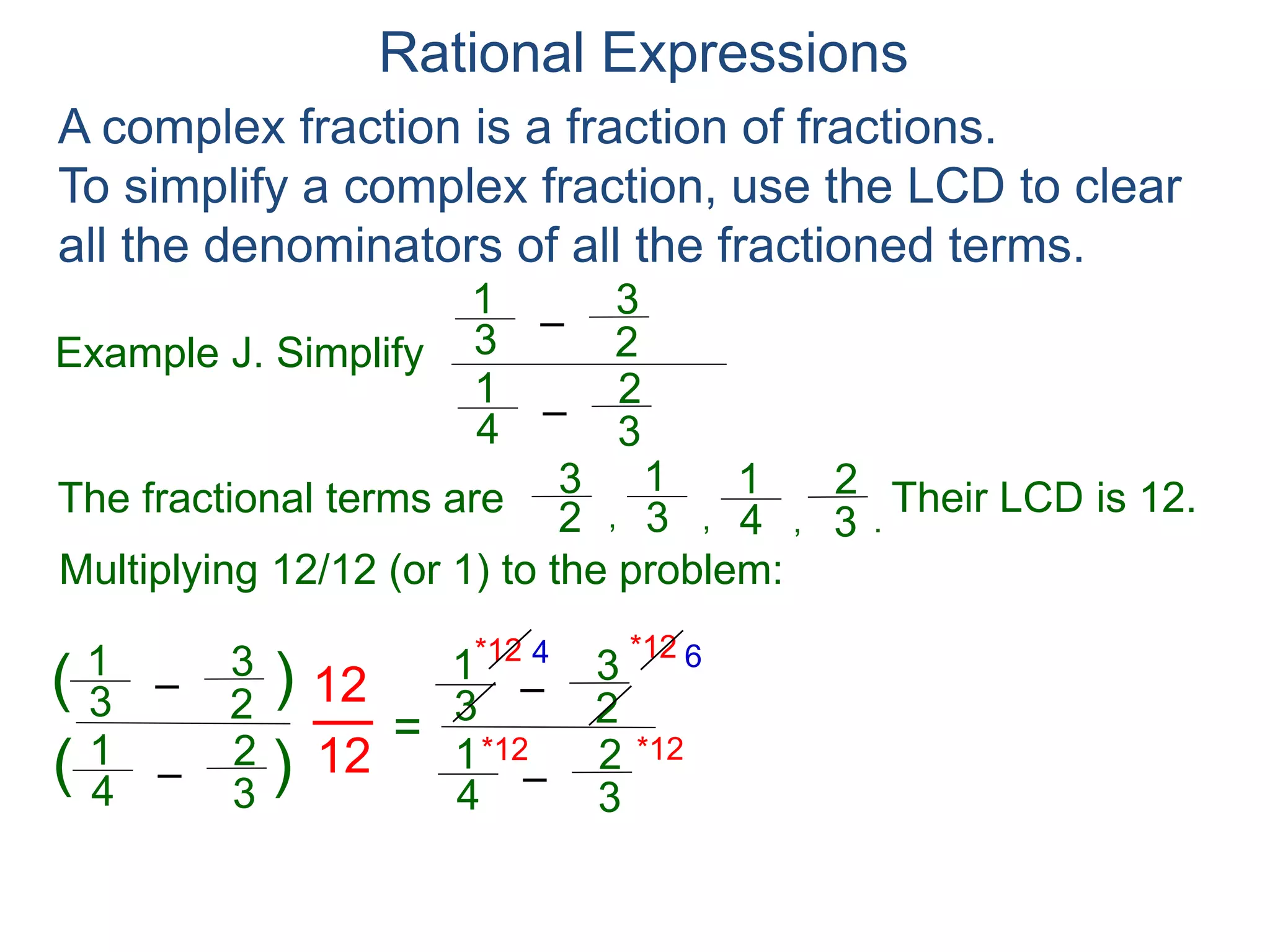
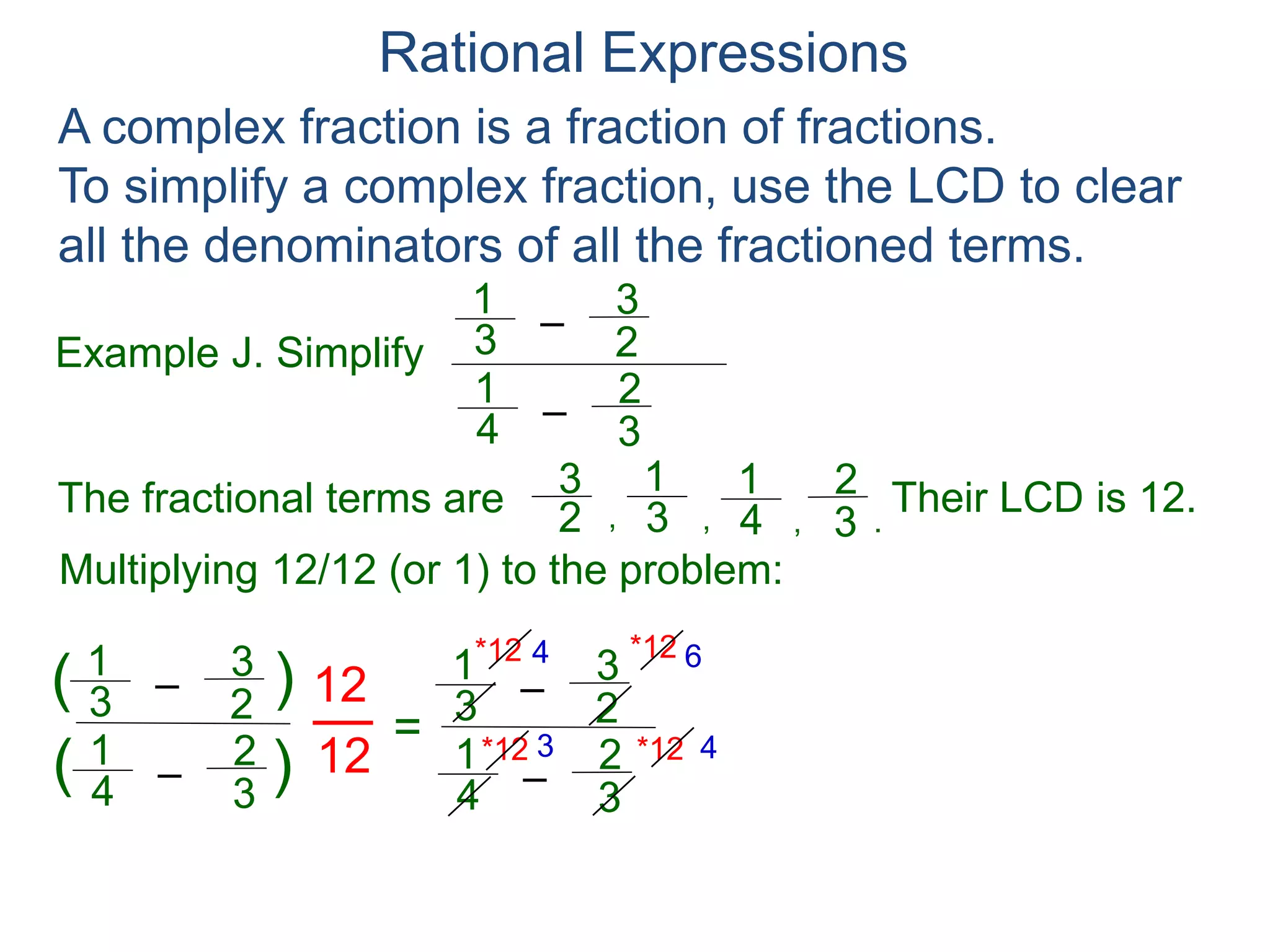
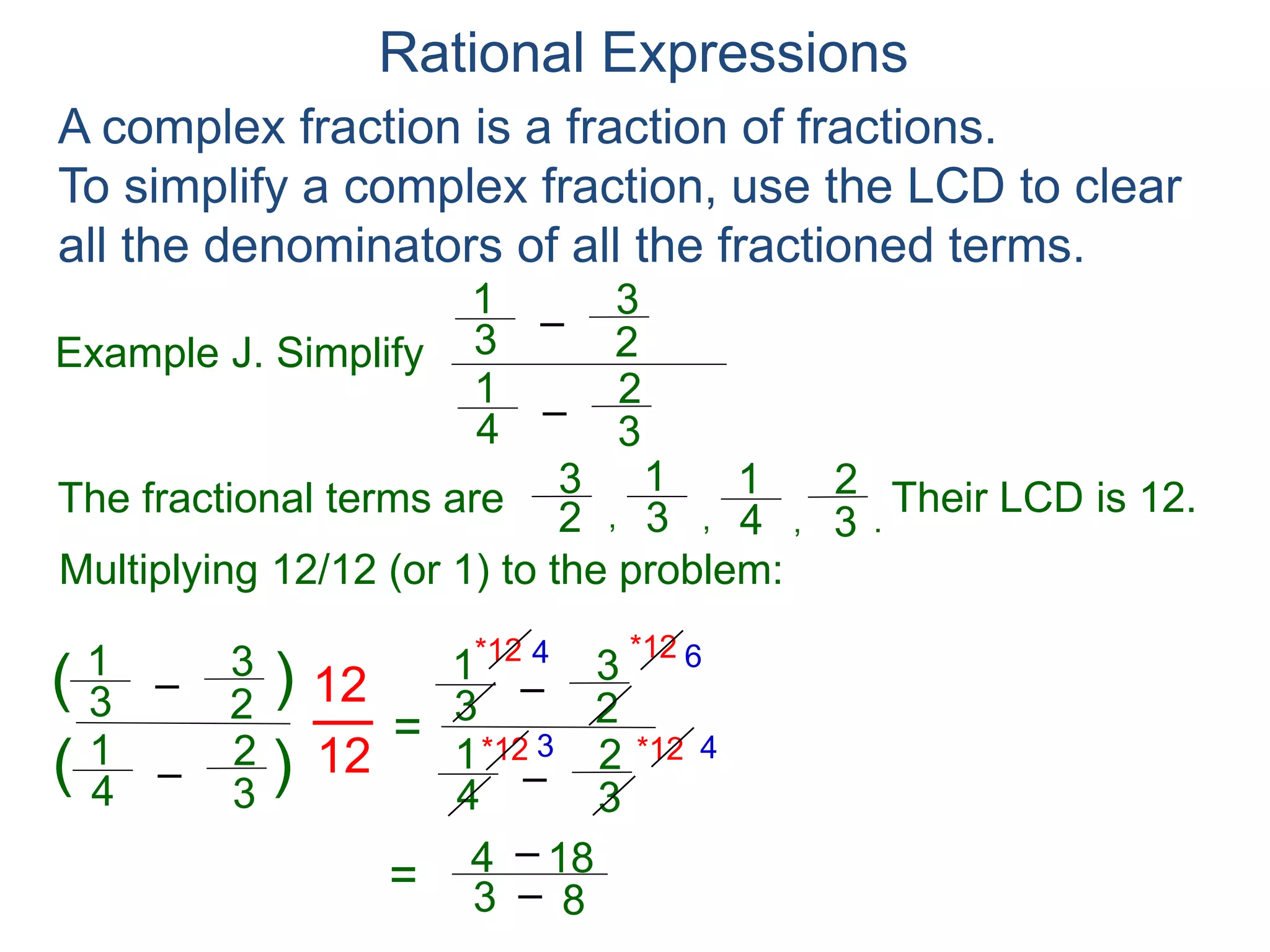
To simplify a complex fraction, use the LCD to clear
all the denominators of all the fractioned terms.
2
3
–4
1
3
2
Rational Expressions
Example J. Simplify
–3
1
A complex fraction is a fraction of fractions.
To simplify a complex fraction, use the LCD to clear
all the denominators of all the fractioned terms.
2
3
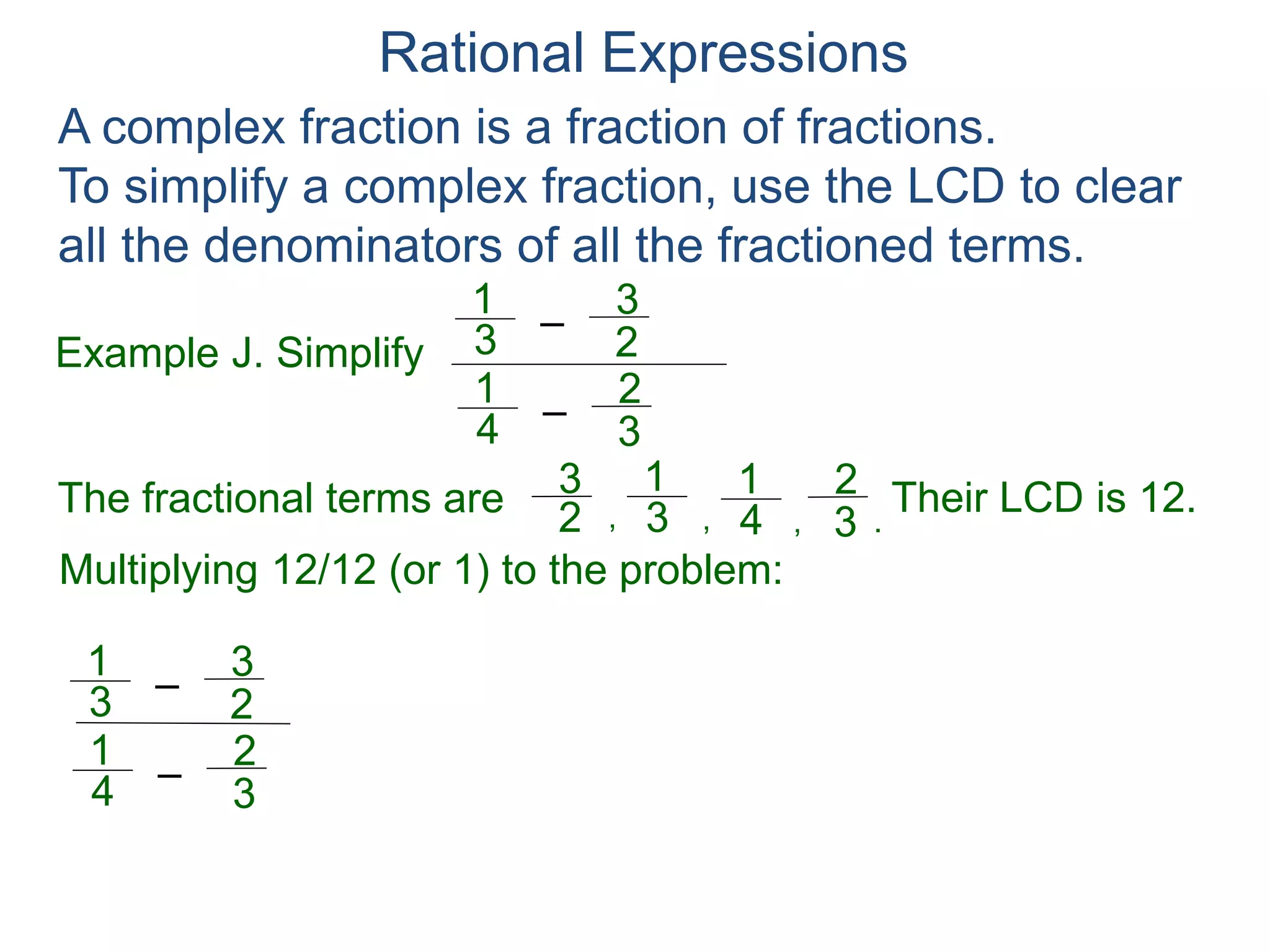
The fractional terms are
–4
1
3
2
3
1
2
3
4
1
3
2
.,,, Their LCD is 12.
Rational Expressions
Example J. Simplify
–3
1
A complex fraction is a fraction of fractions.
To simplify a complex fraction, use the LCD to clear
all the denominators of all the fractioned terms.
2
3
The fractional terms are
–4
1
3
2
3
1
2
3
4
1
3
2
.,,,
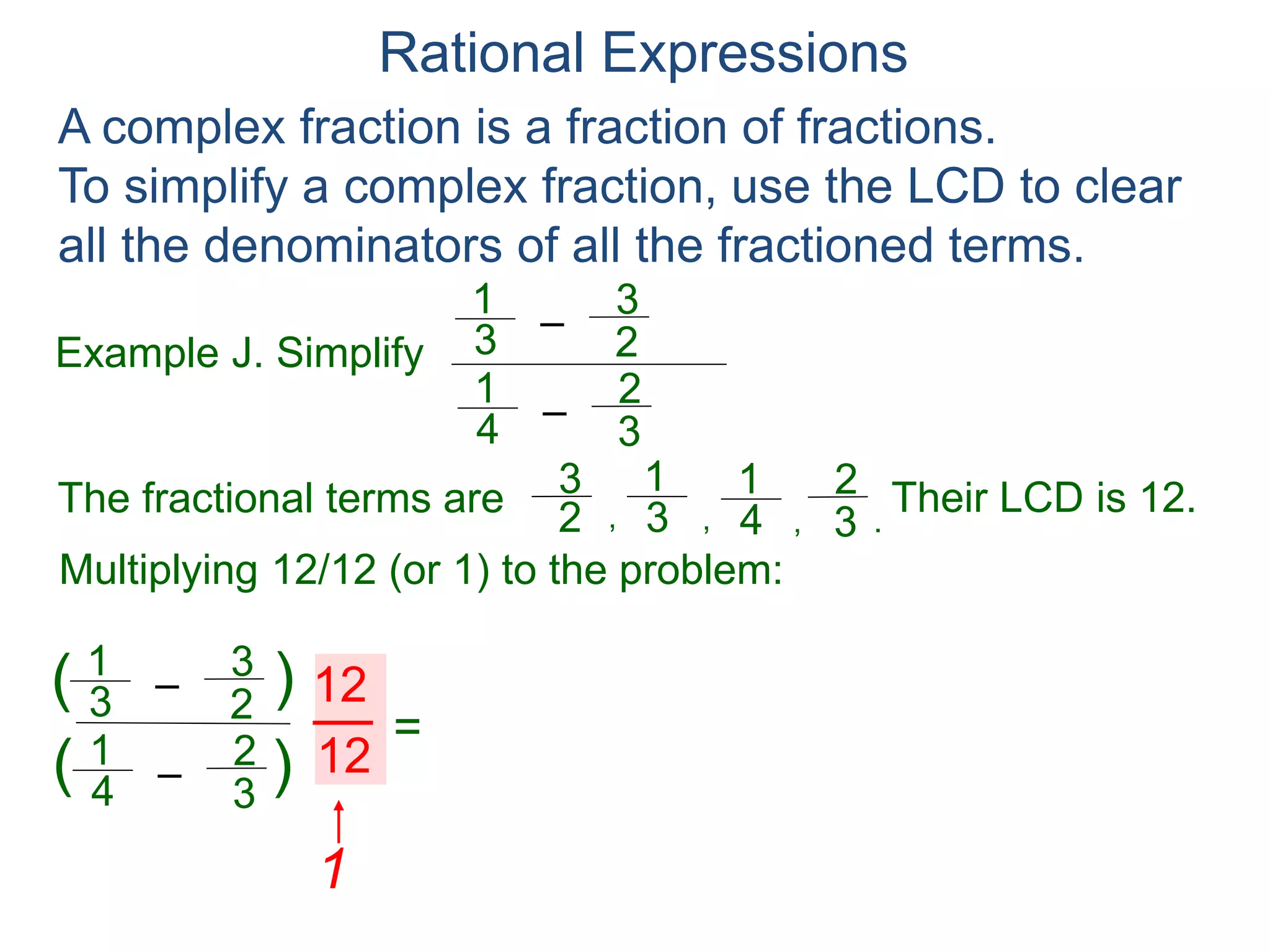
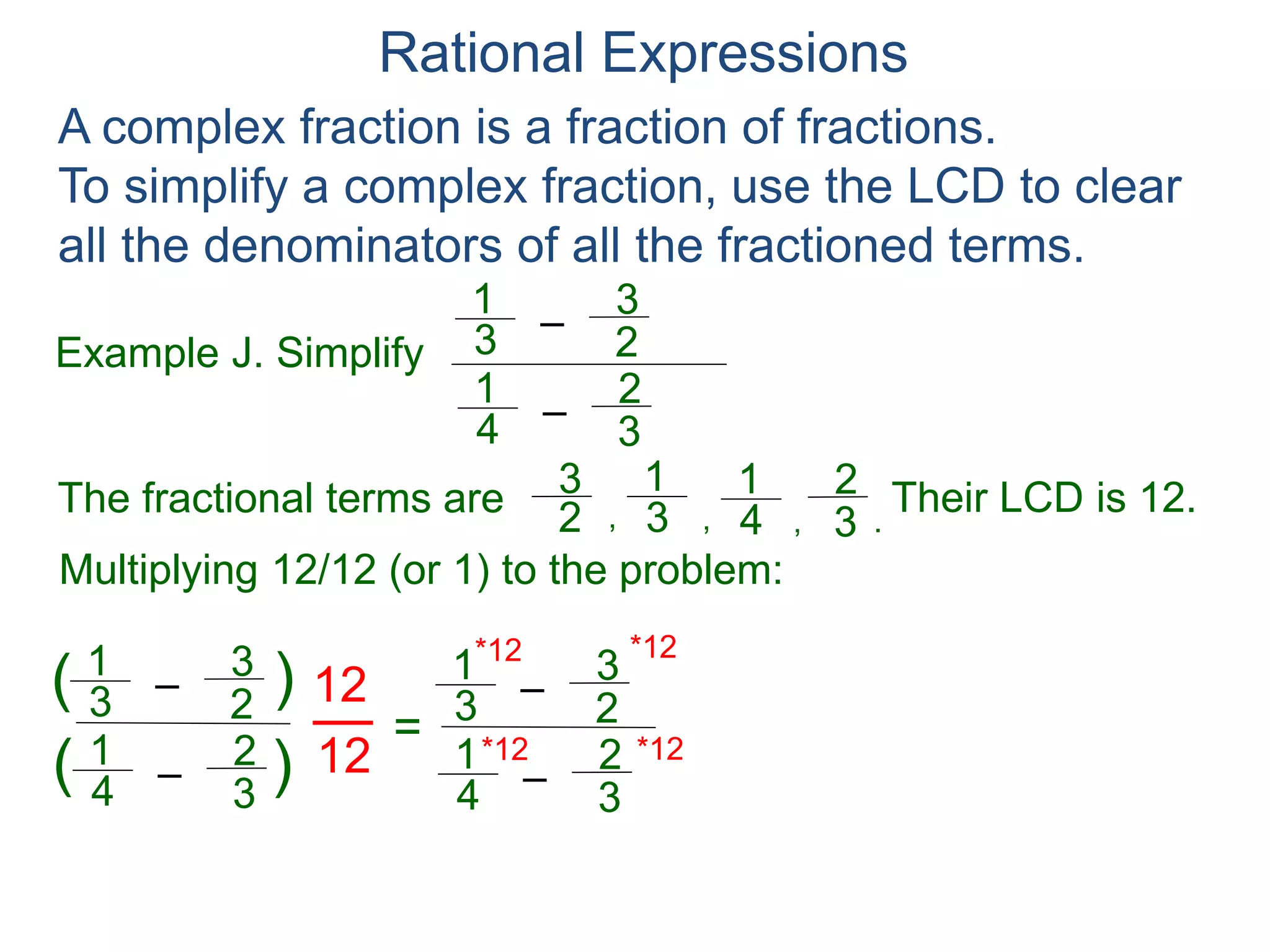
Multiplying 12/12 (or 1) to the problem:
–3
1
2
3
–4
1
3
2
Their LCD is 12.
Rational Expressions
Example J. Simplify
–3
1
A complex fraction is a fraction of fractions.
To simplify a complex fraction, use the LCD to clear
all the denominators of all the fractioned terms.
2
3
The fractional terms are
–4
1
3
2
3
1
2
3
4
1
3
2
.,,,
Multiplying 12/12 (or 1) to the problem:
–3
1
2
3
–4
1
3
2
( )
)(
12
12
Their LCD is 12.
=
1
Rational Expressions
Example J. Simplify
–3
1
A complex fraction is a fraction of fractions.
To simplify a complex fraction, use the LCD to clear
all the denominators of all the fractioned terms.
2
3
The fractional terms are
–4
1
3
2
3
1
2
3
4
1
3
2
.,,,
Multiplying 12/12 (or 1) to the problem:
–3
1
2
3
–4
1
3
2
( )
)(
12
12
=
Their LCD is 12.
–3
1
2
3
–4
1
3
2
*12
*12
*12
*12
Rational Expressions
Example J. Simplify
–3
1
A complex fraction is a fraction of fractions.
To simplify a complex fraction, use the LCD to clear
all the denominators of all the fractioned terms.
2
3
The fractional terms are
–4
1
3
2
3
1
2
3
4
1
3
2
.,,,
Multiplying 12/12 (or 1) to the problem:
–3
1
2
3
–4
1
3
2
( )
)(
12
12
=
Their LCD is 12.
–3
1
2
3
–4
1
3
2
*12
*12 *12
*12 4
Rational Expressions
Example J. Simplify
–3
1
A complex fraction is a fraction of fractions.
To simplify a complex fraction, use the LCD to clear
all the denominators of all the fractioned terms.
2
3
The fractional terms are
–4
1
3
2
3
1
2
3
4
1
3
2
.,,,
Multiplying 12/12 (or 1) to the problem:
–3
1
2
3
–4
1
3
2
( )
)(
12
12
=
Their LCD is 12.
–3
1
2
3
–4
1
3
2
*12
*12 *12
*12 4 6
Rational Expressions
Example J. Simplify
–3
1
A complex fraction is a fraction of fractions.
To simplify a complex fraction, use the LCD to clear
all the denominators of all the fractioned terms.
2
3
The fractional terms are
–4
1
3
2
3
1
2
3
4
1
3
2
.,,,
Multiplying 12/12 (or 1) to the problem:
–3
1
2
3
–4
1
3
2
( )
)(
12
12
=
Their LCD is 12.
–3
1
2
3
–4
1
3
2
*12
*12 *12
*12 4 6
3 4
Rational Expressions
Example J. Simplify
–3
1
A complex fraction is a fraction of fractions.
To simplify a complex fraction, use the LCD to clear
all the denominators of all the fractioned terms.
2
3
The fractional terms are
–4
1
3
2
3
1
2
3
4
1
3
2
.,,,
Multiplying 12/12 (or 1) to the problem:
–3
1
2
3
–4
1
3
2
( )
)(
12
12
=
Their LCD is 12.
–3
1
2
3
–4
1
3
2
*12
*12 *12
*12 4 6
3 4
= 3
4 – 18
– 8
Rational Expressions
Example J. Simplify
–3
1
A complex fraction is a fraction of fractions.
To simplify a complex fraction, use the LCD to clear
all the denominators of all the fractioned terms.
2
3
The fractional terms are
–4
1
3
2
3
1
2
3
4
1
3
2
.,,,
Multiplying 12/12 (or 1) to the problem:
–3
1
2
3
–4
1
3
2
( )
)(
12
12
=
Their LCD is 12.
–3
1
2
3
–4
1
3
2
*12
*12 *12
*12 4 6
3 4
= 3
4 – 18
– 8 = 14
5
Rational Expressions
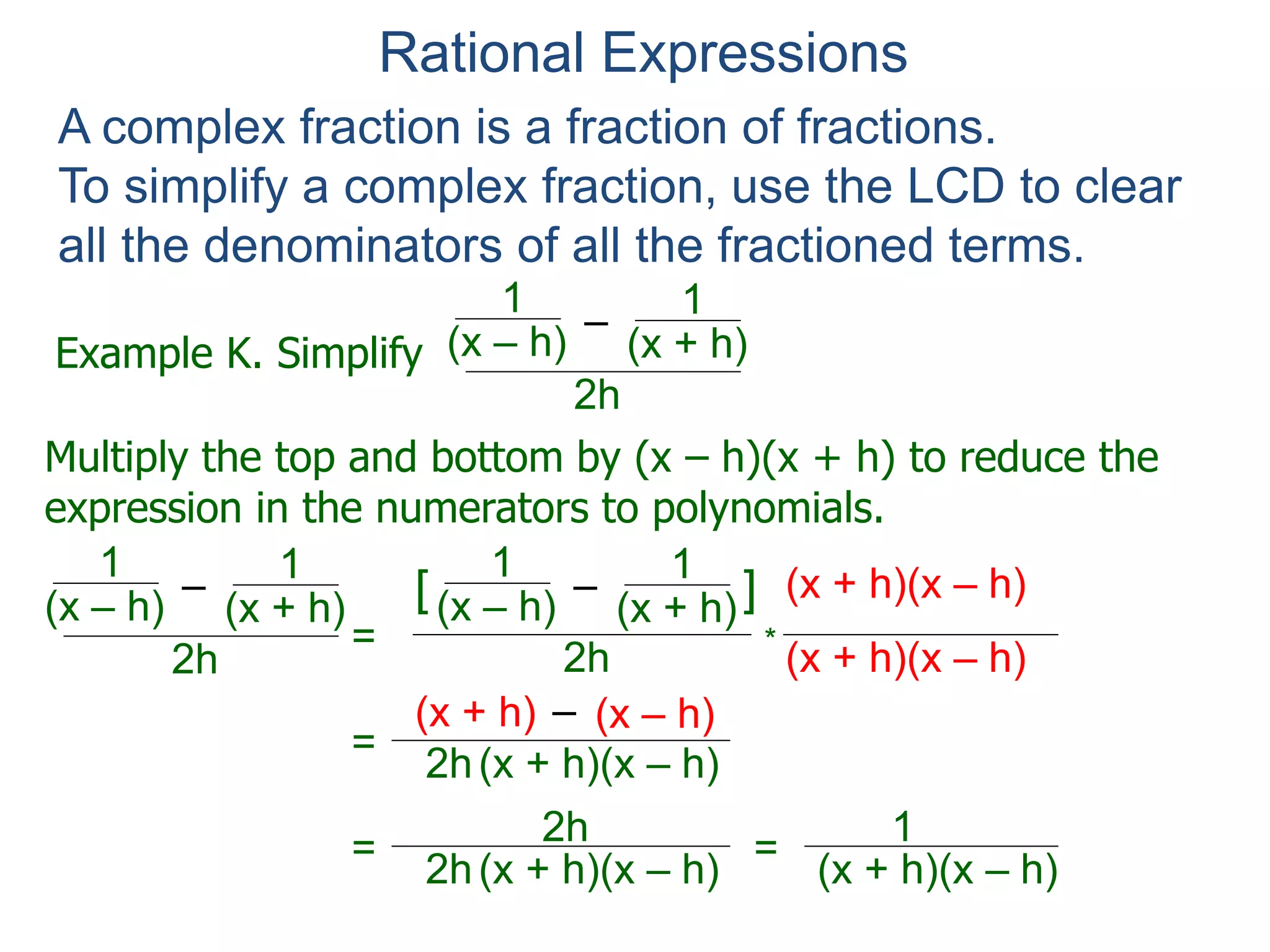
Example K. Simplify
–
(x – h)
1
A complex fraction is a fraction of fractions.
To simplify a complex fraction, use the LCD to clear
all the denominators of all the fractioned terms.
(x + h)
1
2h
Multiply the top and bottom by (x – h)(x + h) to reduce the
expression in the numerators to polynomials.
–
(x – h)
1
(x + h)
1
2h
=
–
(x – h)
1
(x + h)
1
2h
(x + h)(x – h)[ ]
(x + h)(x – h)*
=
–(x + h) (x – h)
2h(x + h)(x – h)
=
2h
2h(x + h)(x – h)
=
1
(x + h)(x – h)
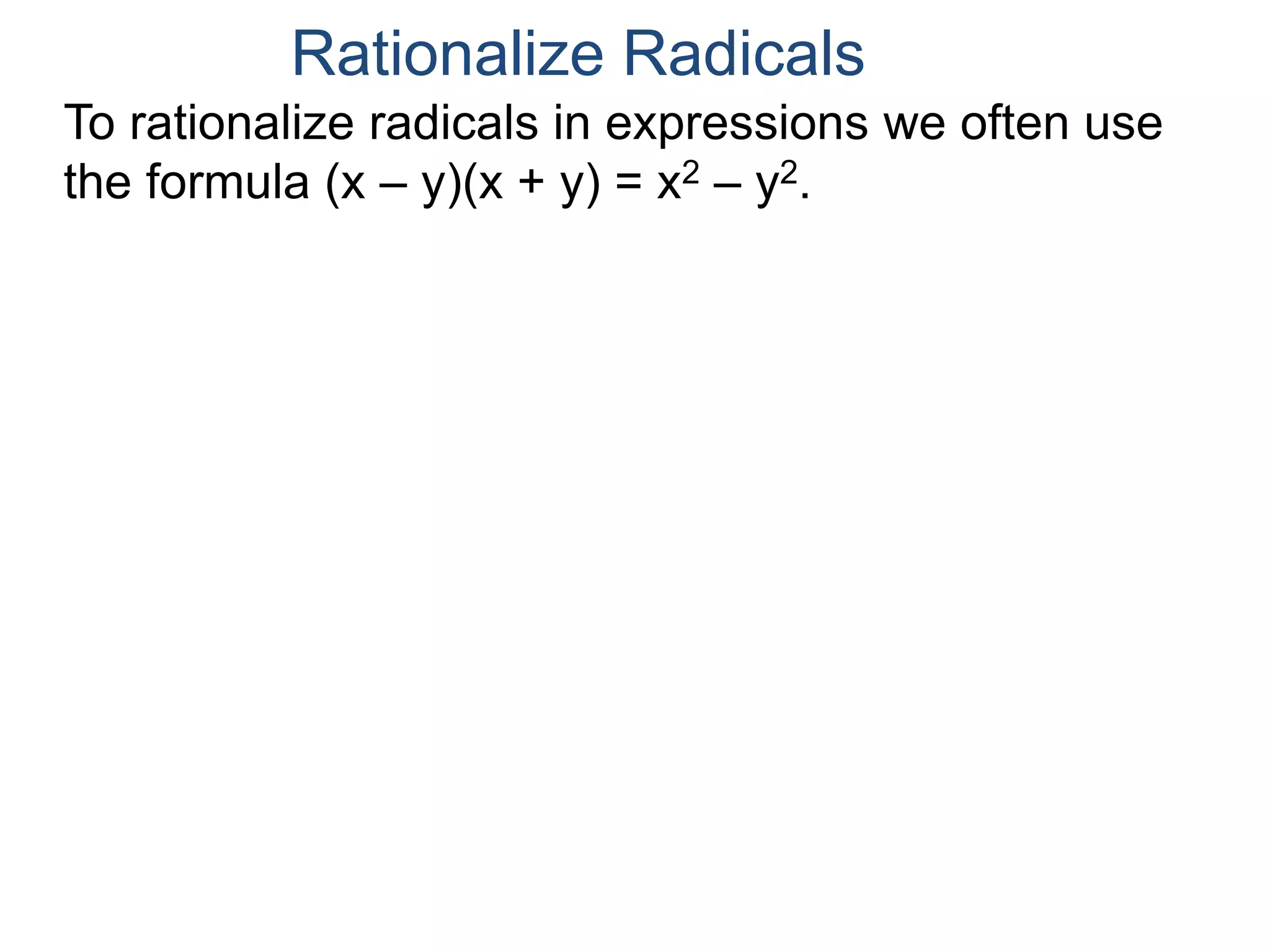
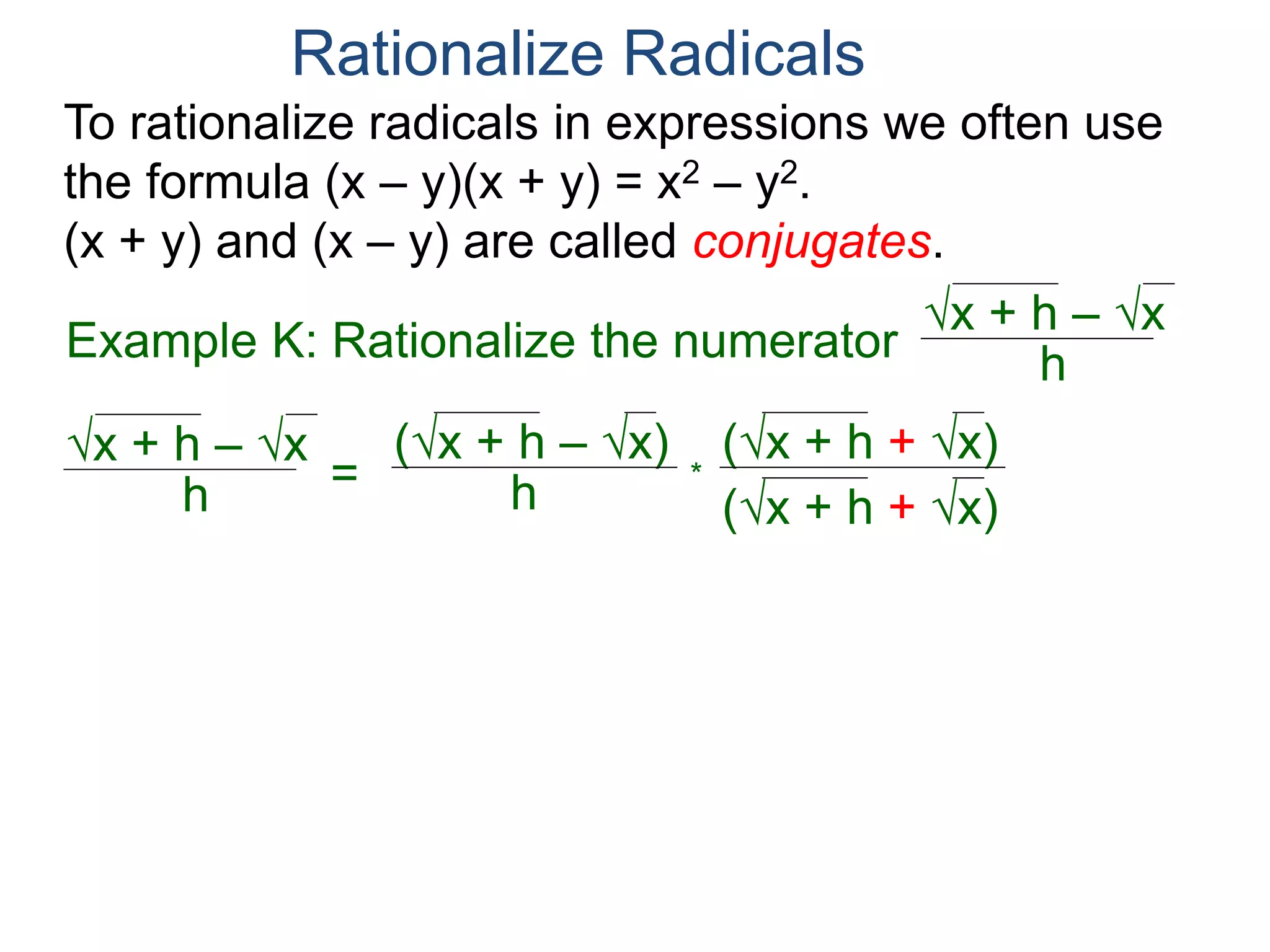
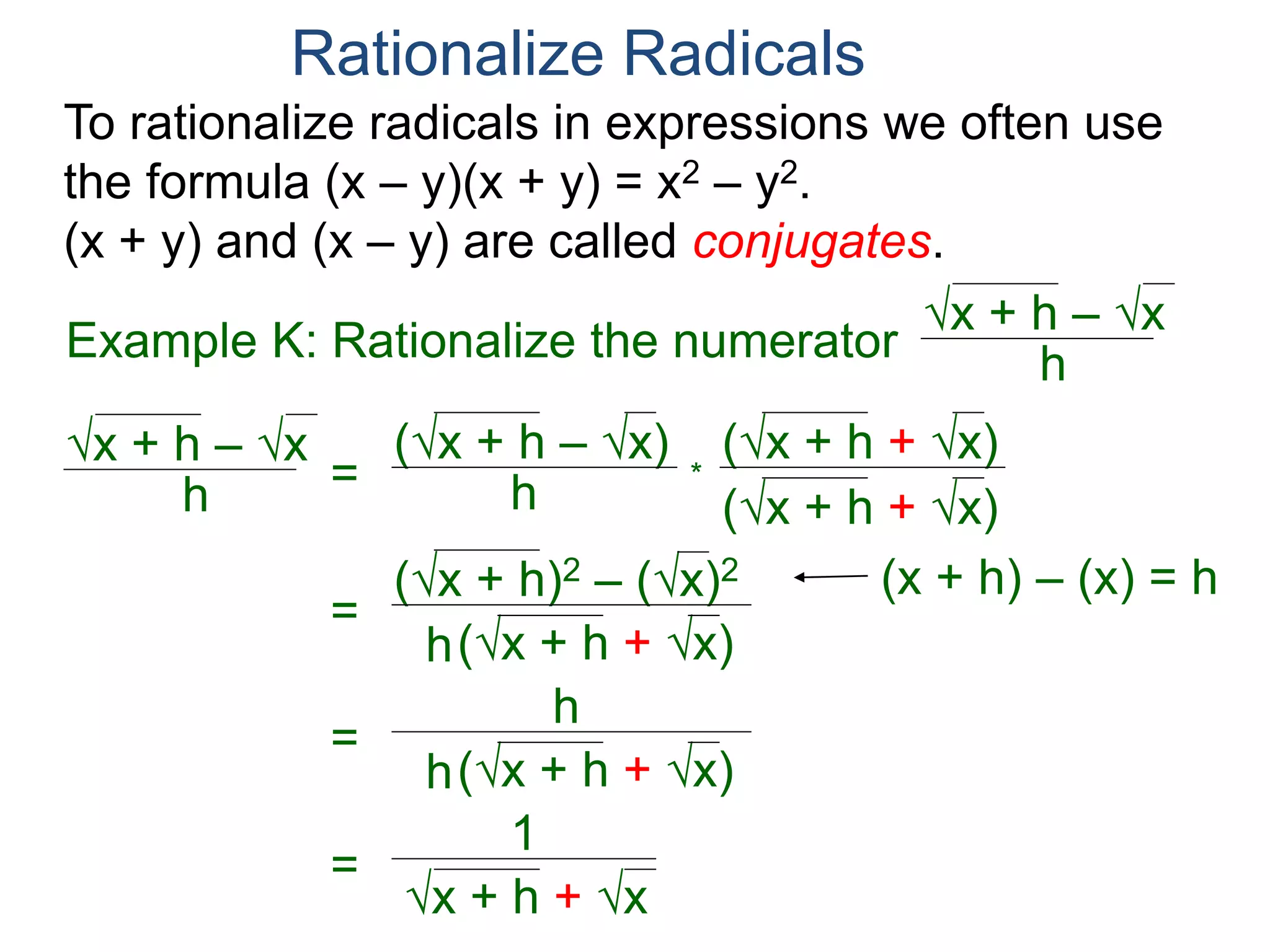
To rationalize radicals in expressions we often use
the formula (x – y)(x + y) = x2 – y2.
Rationalize Radicals
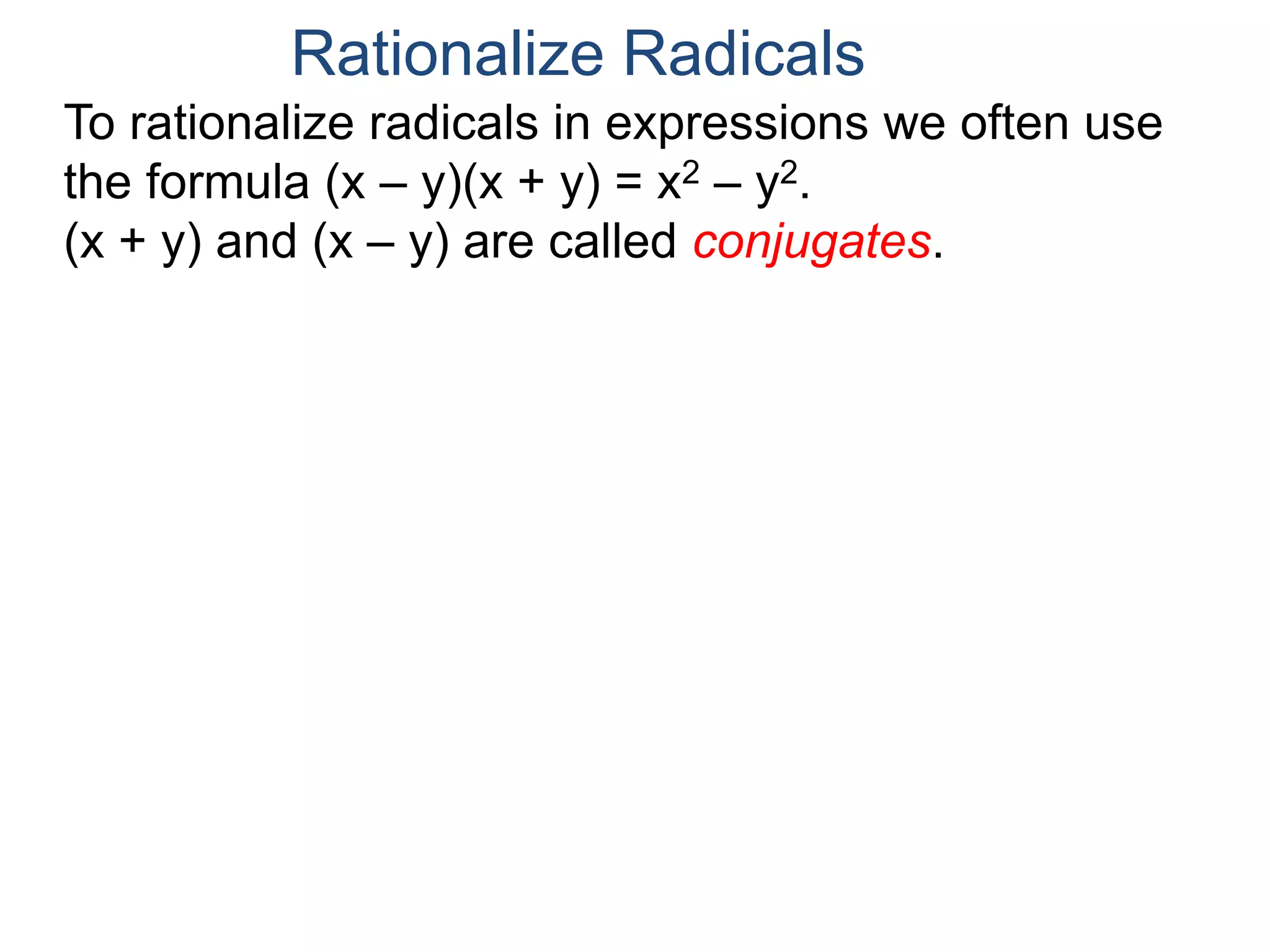
To rationalize radicals in expressions we often use
the formula (x – y)(x + y) = x2 – y2.
(x + y) and (x – y) are called conjugates.
Rationalize Radicals
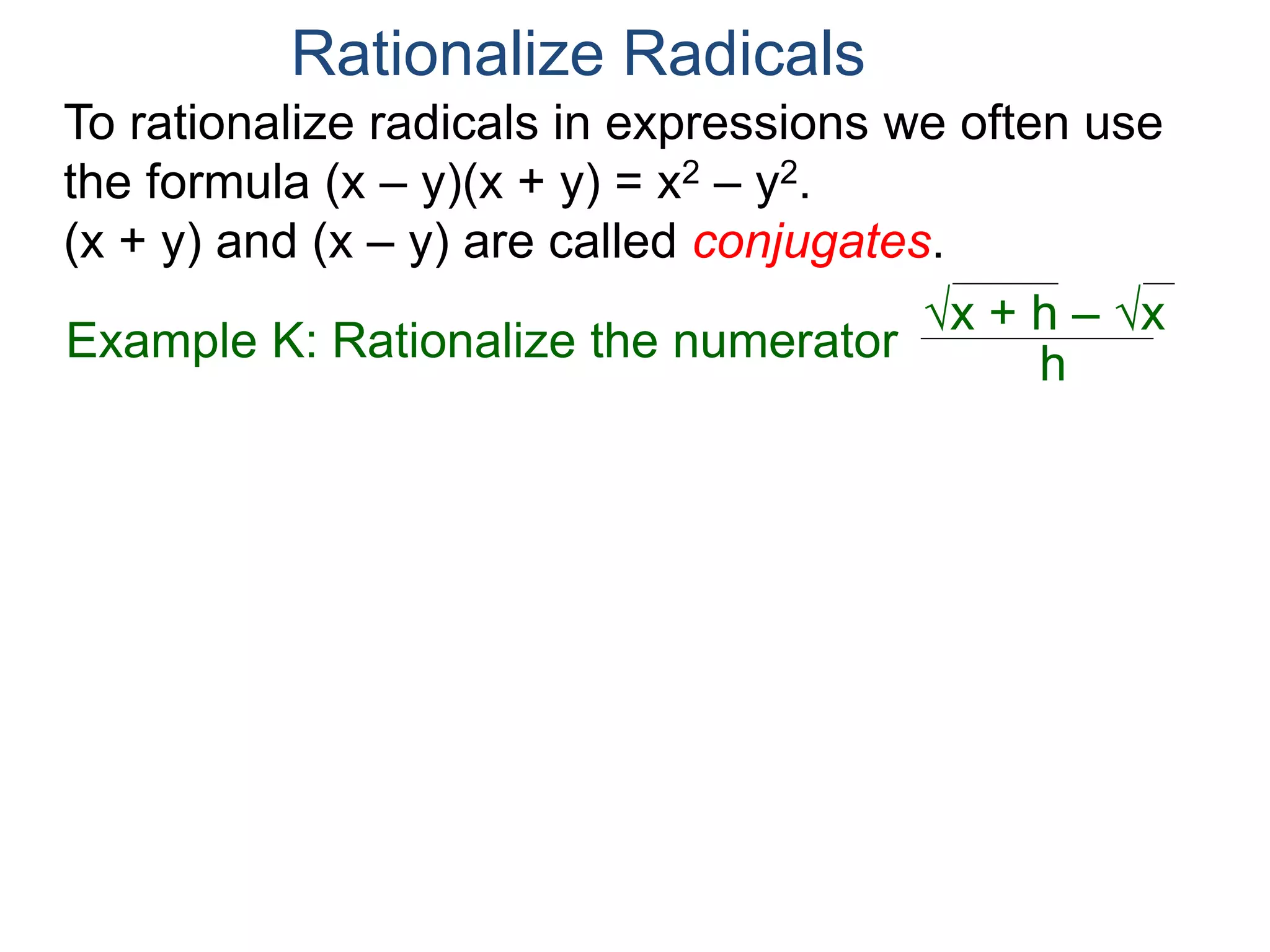
Example K: Rationalize the numerator
To rationalize radicals in expressions we often use
the formula (x – y)(x + y) = x2 – y2.
(x + y) and (x – y) are called conjugates.
h
x + h – x
Rationalize Radicals
To rationalize radicals in expressions we often use
the formula (x – y)(x + y) = x2 – y2.
(x + y) and (x – y) are called conjugates.
Rationalize Radicals
h
x + h – x
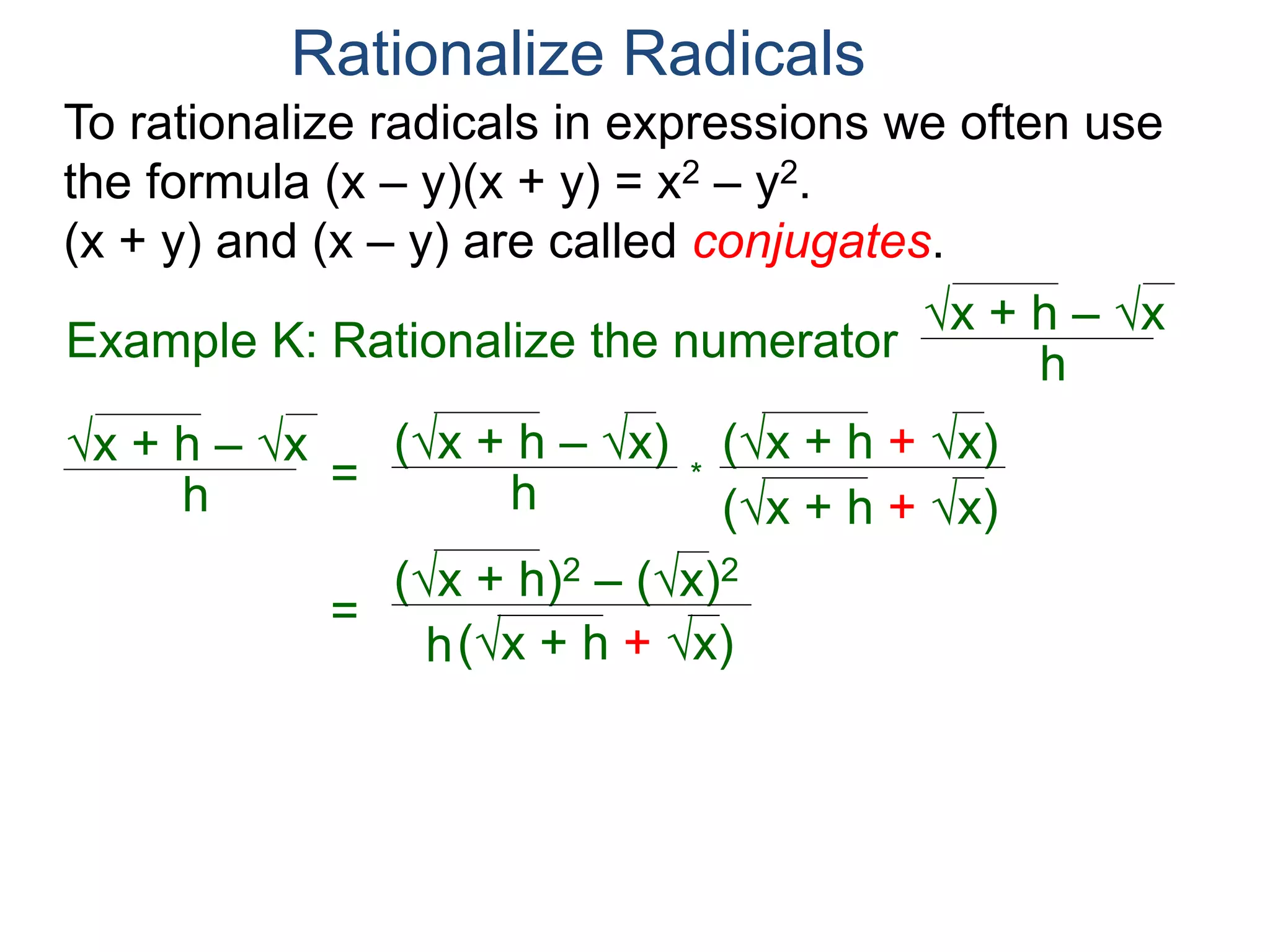
= h
(x + h – x) (x + h + x)
(x + h + x)
*
Example K: Rationalize the numerator h
x + h – x
To rationalize radicals in expressions we often use
the formula (x – y)(x + y) = x2 – y2.
(x + y) and (x – y) are called conjugates.
Rationalize Radicals
h
x + h – x
= h
(x + h – x) (x + h + x)
(x + h + x)
*
=
h
(x + h)2 – (x)2
(x + h + x)
Example K: Rationalize the numerator h
x + h – x
To rationalize radicals in expressions we often use
the formula (x – y)(x + y) = x2 – y2.
(x + y) and (x – y) are called conjugates.
Rationalize Radicals
h
x + h – x
= h
(x + h – x) (x + h + x)
(x + h + x)
*
=
h
(x + h)2 – (x)2
(x + h + x)
Example K: Rationalize the numerator h
x + h – x
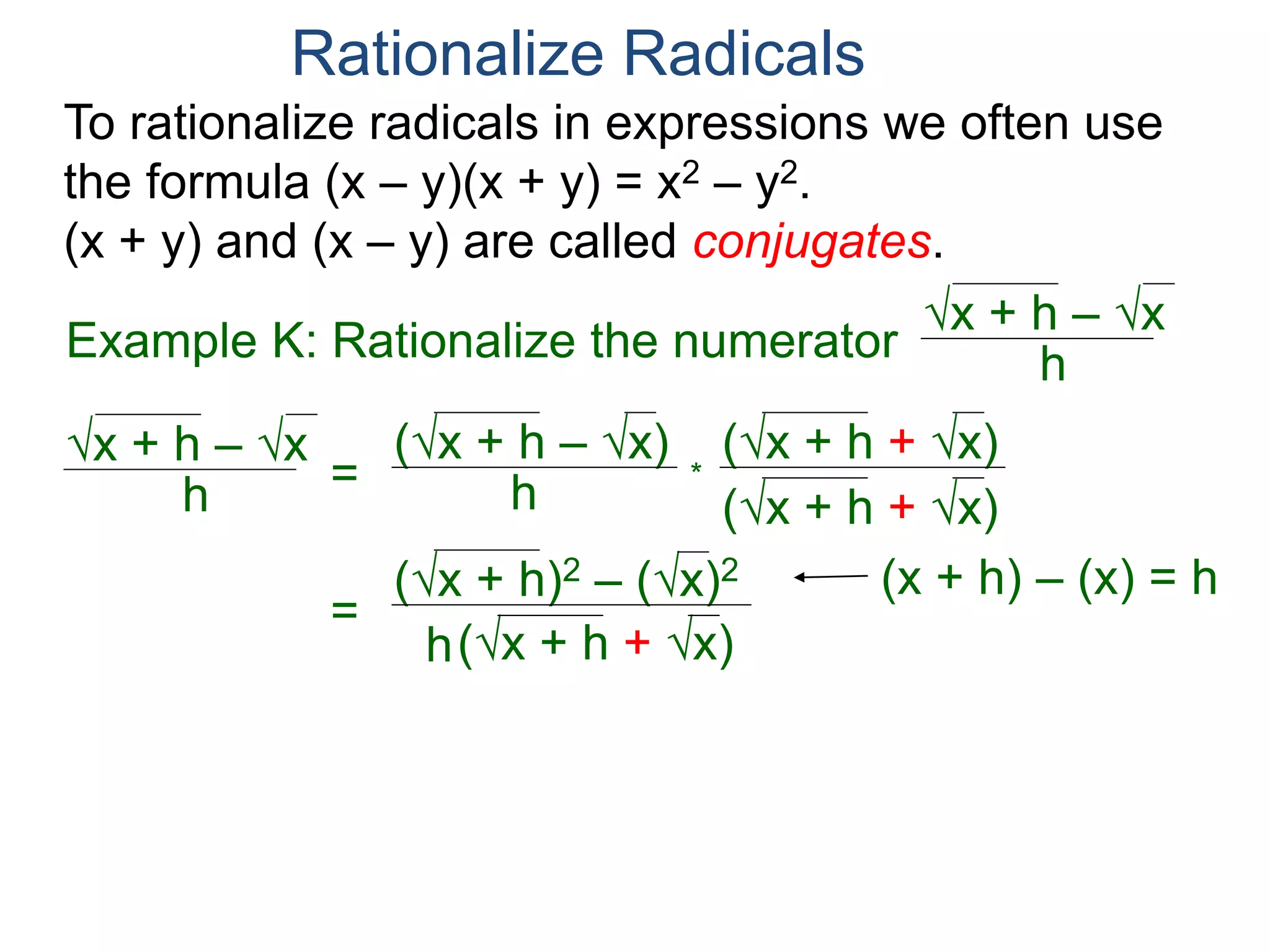
(x + h) – (x) = h
To rationalize radicals in expressions we often use
the formula (x – y)(x + y) = x2 – y2.
(x + y) and (x – y) are called conjugates.
Rationalize Radicals
h
x + h – x
= h
(x + h – x) (x + h + x)
(x + h + x)
*
=
h
(x + h)2 – (x)2
(x + h + x)
=
h
h
(x + h + x)
Example K: Rationalize the numerator h
x + h – x
(x + h) – (x) = h
To rationalize radicals in expressions we often use
the formula (x – y)(x + y) = x2 – y2.
(x + y) and (x – y) are called conjugates.
Rationalize Radicals
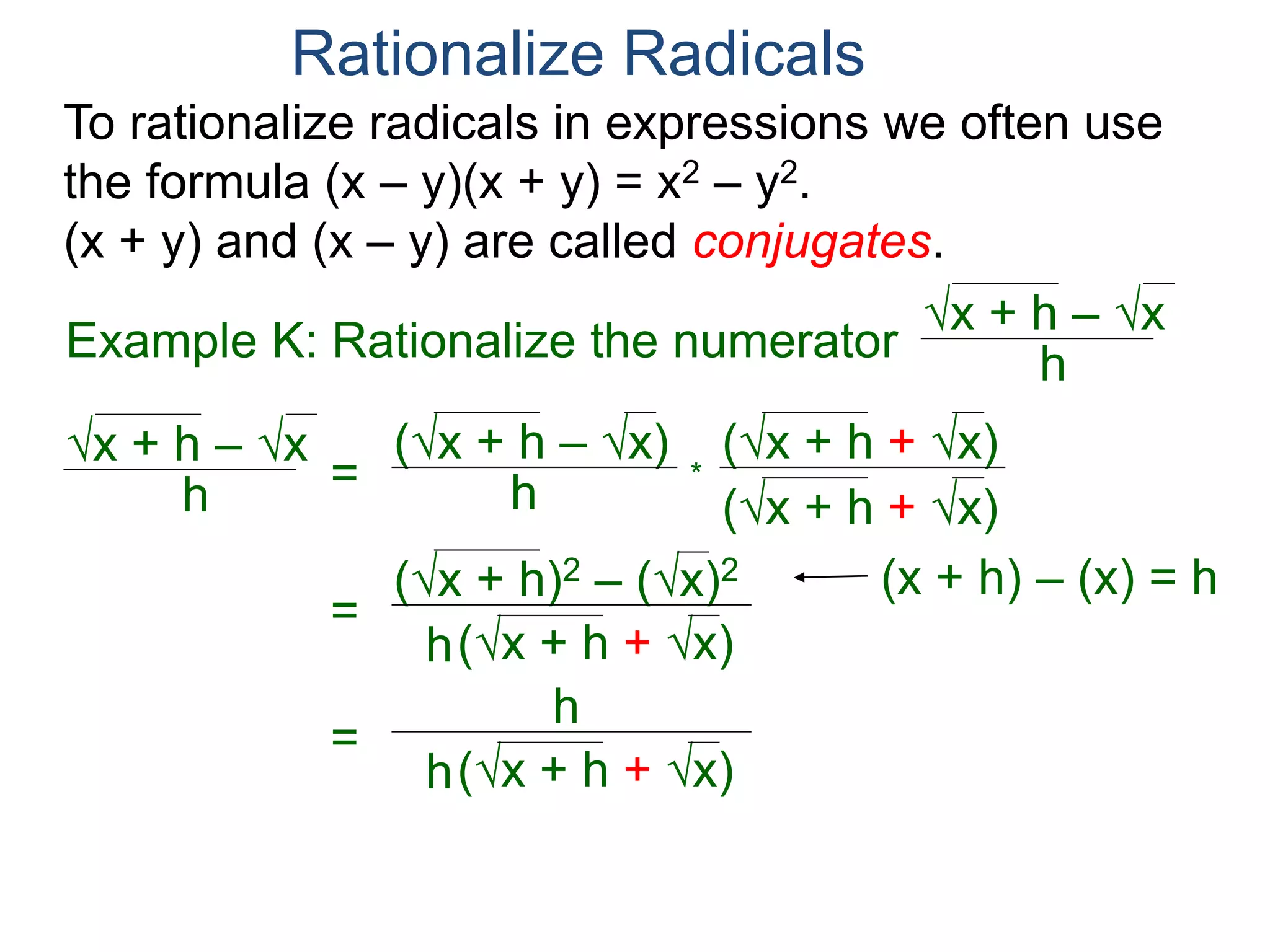
h
x + h – x
= h
(x + h – x) (x + h + x)
(x + h + x)
*
=
h
(x + h)2 – (x)2
(x + h + x)
=
h
h
(x + h + x)
=
1
x + h + x
Example K: Rationalize the numerator h
x + h – x
(x + h) – (x) = h
Exercise A. Factor each expression then use the factored
form to evaluate the given input values. No calculator.
Applications of Factoring
1. x2 – 3x – 4, x = –2, 3, 5 2. x2 – 2x – 15, x = –1, 4, 7
3. x2 – x – 2, x = ½ ,–2, –½ 4. x3 – 2x2, x = –2, 2, 4
5. x4 – 3x2, x = –1, 1, 5 6. x3 – 4x2 – 5x, x = –4, 2, 6
B. Determine if the output is positive or negative using the
factored form.
7.
x2 – 4
x + 4
8. x3 – 2x2
x2 – 2x + 1
, x = –3, 1, 5 , x = –0.1, 1/2, 5
4.
x2 – 4
x + 4 5. x2 + 2x – 3
x2 + x
6. x3 – 2x2
x2 – 2x + 1
, x = –3.1, 1.9 , x = –0.1, 0.9, 1.05
, x = –0.1, 0.99, 1.01
1. x2 – 3x – 4, x = –2½, –2/3, 2½, 5¼
2. –x2 + 2x + 8, x = –2½, –2/3, 2½, 5¼
3. x3 – 2x2 – 8x, x = –4½, –3/4, ¼, 6¼,
C. Simplify. Do not expand the results.
Multiplication and Division of Rational Expressions
1. 10x *
2
5x3
15x
4
*
16
25x42. 3.12x6 *
5
6x14
4. 75x
49
*
42
25x3
5. 2x – 4
2x + 4
5x + 10
3x – 6
6.
x + 4
–x – 4
4 – x
x – 4
7. 3x – 9
15x – 5
3 – x
5 – 15x
8. 42 – 6x
–2x + 14
4 – 2x
–7x + 14
*
*
*
*
9.
(x2 – x – 2 )
(x2 – 1) (x2 + 2x + 1)
(x2 + x )
* 10.
(x2 + 5x – 6 )
(x2 + 5x + 6) (x2 – 5x – 6 )
(x2 – 5x + 6)
*
11. (x2 – 3x – 4 )
(x2 – 1) (x2 – 2x – 8)
(x2 – 3x + 2)
*
12. (– x2 + 6 – x )
(x2 + 5x + 6) (x2 – x – 12)
(6 – x2 – x)
*
13.(3x2 – x – 2)
(x2 – x + 2) (3x2 + 4x + 1)
(–x – 3x2)
14. (x + 1 – 6x2)
(–x2 – 4)
(2x2 + x – 1 )
(x2 – 5x – 6)
15. (x3 – 4x)
(–x2 + 4x – 4)
(x2 + 2)
(–x + 2)
16. (–x3 + 9x ) (x2 + 6x + 9)
(x2 + 3x) (–3x2 – 9x)
÷
÷
÷
÷
Multiplication and Division of Rational Expressions
D. Multiply, expand and simplify the results.
1. x + 3
x + 1
(x2 – 1) 2. x – 3
x – 2
(x2 – 4) 3. 2x + 3
1 – x
(x2 – 1)
4. 3 – 2x
x + 2
(x + 2)(x +1) 5.
3 – 2x
2x – 1
(3x + 2)(1 – 2x)
6. x – 2
x – 3
( x + 1
x + 3)( x – 3)(x + 3)
7. 2x – 1
x + 2
( – x + 2
2x – 3 )( 2x – 3)(x + 2)
+
8.
x – 2
x – 3
( x + 1
x + 3
) ( x – 3)(x + 3)–
9.
x – 2
x2 – 9
( –
x + 1
x2 – 2x – 3
) ( x – 3)(x + 3)(x + 1)
10.
x + 3
x2 – 4
( – 2x + 1
x2 + x – 2
) ( x – 2)(x + 2)(x – 1)
11.
x – 1
x2 – x – 6
( –
x + 1
x2 – 2x – 3
) ( x – 3)(x + 2)(x + 1)
E. Combine and simplify the answers.
–3
x – 3
+ 2x
–6 – 2x
3. 2x – 3
x – 3
– 5x + 4
5 – 15x
4.
3x + 1
6x – 4
– 2x + 3
2 – 3x5.
–5x + 7
3x – 12+
4x – 3
–2x + 86.
3x + 1
+
x + 3
4 – x211. x2 – 4x + 4
x – 4
+
x + 5
–x2 + x + 2
12.
x2 – x – 6
3x + 1
+
2x + 3
9 – x213.
x2 – x – 6
3x – 4
–
2x + 5
x2 – x – 6
14.
–x2 + 5x + 6
3x + 4
+
2x – 3
–x2 – 2x + 3
15.
x2 – x
5x – 4
–
3x – 5
1 – x216.
x2 + 2x – 3
–3
2x – 1
+ 2x
2 – 4x
1.
2x – 3
x – 2
+
3x + 4
5 – 10x
2.
3x + 1
2x – 5
– 2x + 3
5 – 10x
9.
–3x + 2
3x – 12
+
7x – 2
–2x + 8
10.
3x + 5
3x –2
– x + 3
2 – 3x7. –5x + 7
3x – 4 + 4x – 3
–6x + 88.
Addition and Subtraction of Fractions
Complex Fractions
1
2x + 1
– 2
3 –
1
2x + 1
3.
–2
2x + 1
–
+
3
x + 4
4.
1
x + 4
2
2x + 1
4
2x + 3
–
+
3
x + 4
5.
3
3x – 2
5
3x – 2
–5
2x + 5
–
+ 3
–x + 4
6.
2
2x – 3
6
2x – 3
2
3
+ 2
2 –
–
1
6
2
3
1
2+
1.
1
2
– +
5
6
2
3
1
4
–
2.
3
4
3
2
+
F. Combine and simplify the answers.
7.
2
x – 1
–
+
3
x + 3
x
x + 3
x
x – 1
8.
3
x + 2
–
+
3
x + 2
x
x – 2
x
x – 2
9.
2
x + h
–
2
x
h
10.
3
x – h
–
3
x
h
11.
2
x + h – 2
x – h
h
12.
3
x + h
–
h
3
x – h
G. Rationalize the denominator.
1.
1 – 3
1 + 3
2.
5 + 2
3 – 2
3.
1 – 33
2 + 3
4.
1 – 53
4 + 23
5.
32 – 33
22 – 43
6.
25 + 22
34 – 32
7.
42 – 37
22 – 27
8.
x + 3
x – 3
9. 3x – 3
3x + 2
10. x – 2
x + 2 + 2
11. x – 4
x – 3 – 1
Algebra of Radicals

1.2Algebraic Expressions-x

  • 1.
  • 2.
    We order pizzasfrom Pizza Grande. Expressions
  • 3.
    We order pizzasfrom Pizza Grande. Each pizza is $8 and there is a $10 delivery charge. Expressions
  • 4.
    We order pizzasfrom Pizza Grande. Each pizza is $8 and there is a $10 delivery charge. Hence if we ordered 5 pizzas delivered, the total cost would be 8(5) + 10 = $50, excluding the tip. Expressions
  • 5.
    We order pizzasfrom Pizza Grande. Each pizza is $8 and there is a $10 delivery charge. Hence if we ordered 5 pizzas delivered, the total cost would be 8(5) + 10 = $50, excluding the tip. If we want x pizzas delivered, then the total cost is given by the formula “8x + 10”. Expressions
  • 6.
    We order pizzasfrom Pizza Grande. Each pizza is $8 and there is a $10 delivery charge. Hence if we ordered 5 pizzas delivered, the total cost would be 8(5) + 10 = $50, excluding the tip. If we want x pizzas delivered, then the total cost is given by the formula “8x + 10”. Such a formula is called an expression. Expressions
  • 7.
    We order pizzasfrom Pizza Grande. Each pizza is $8 and there is a $10 delivery charge. Hence if we ordered 5 pizzas delivered, the total cost would be 8(5) + 10 = $50, excluding the tip. If we want x pizzas delivered, then the total cost is given by the formula “8x + 10”. Such a formula is called an expression. Expressions If we ordered x = 100 pizzas, the cost would be 8(100)+10 = $810.
  • 8.
    We order pizzasfrom Pizza Grande. Each pizza is $8 and there is a $10 delivery charge. Hence if we ordered 5 pizzas delivered, the total cost would be 8(5) + 10 = $50, excluding the tip. If we want x pizzas delivered, then the total cost is given by the formula “8x + 10”. Such a formula is called an expression. Expressions If we ordered x = 100 pizzas, the cost would be 8(100)+10 = $810. The value x = 100 is called the input and the projected cost $810 is called the output.
  • 9.
    We order pizzasfrom Pizza Grande. Each pizza is $8 and there is a $10 delivery charge. Hence if we ordered 5 pizzas delivered, the total cost would be 8(5) + 10 = $50, excluding the tip. If we want x pizzas delivered, then the total cost is given by the formula “8x + 10”. Such a formula is called an expression. Expressions Definition: Mathematical expressions are calculation procedures which are written with numbers, variables, operation symbols +, –, *, / and ( )’s. If we ordered x = 100 pizzas, the cost would be 8(100)+10 = $810. The value x = 100 is called the input and the projected cost $810 is called the output.
  • 10.
    We order pizzasfrom Pizza Grande. Each pizza is $8 and there is a $10 delivery charge. Hence if we ordered 5 pizzas delivered, the total cost would be 8(5) + 10 = $50, excluding the tip. If we want x pizzas delivered, then the total cost is given by the formula “8x + 10”. Such a formula is called an expression. Expressions Definition: Mathematical expressions are calculation procedures which are written with numbers, variables, operation symbols +, –, *, / and ( )’s. Expressions calculate the expected future results. If we ordered x = 100 pizzas, the cost would be 8(100)+10 = $810. The value x = 100 is called the input and the projected cost $810 is called the output.
  • 11.
    An algebraic expressionis a formula constructed with variables and numbers using addition, subtraction, multiplication, division, and taking roots. Algebraic Expressions
  • 12.
    An algebraic expressionis a formula constructed with variables and numbers using addition, subtraction, multiplication, division, and taking roots. Algebraic Expressions Trigonometric or log-formulas are not algebraic.
  • 13.
    An algebraic expressionis a formula constructed with variables and numbers using addition, subtraction, multiplication, division, and taking roots. Algebraic Expressions Examples of algebraic expressions are 3x2 – 2x + 4,
  • 14.
    An algebraic expressionis a formula constructed with variables and numbers using addition, subtraction, multiplication, division, and taking roots. Algebraic Expressions Examples of algebraic expressions are 3x2 – 2x + 4, x2 + 3 3 x3 – 2x – 4 ,
  • 15.
    An algebraic expressionis a formula constructed with variables and numbers using addition, subtraction, multiplication, division, and taking roots. Algebraic Expressions Examples of algebraic expressions are 3x2 – 2x + 4, x2 + 3 3 x3 – 2x – 4 , (x1/2 + y)1/3 (4y2 – (x + 4)1/2)1/4
  • 16.
    An algebraic expressionis a formula constructed with variables and numbers using addition, subtraction, multiplication, division, and taking roots. Algebraic Expressions Examples of algebraic expressions are 3x2 – 2x + 4, x2 + 3 3 x3 – 2x – 4 , (x1/2 + y)1/3 (4y2 – (x + 4)1/2)1/4 Examples of non–algebraic expressions are sin(x), 2x, log(x + 1).
  • 17.
    An algebraic expressionis a formula constructed with variables and numbers using addition, subtraction, multiplication, division, and taking roots. Algebraic Expressions Examples of algebraic expressions are 3x2 – 2x + 4, x2 + 3 3 x3 – 2x – 4 , (x1/2 + y)1/3 (4y2 – (x + 4)1/2)1/4 Examples of non–algebraic expressions are sin(x), 2x, log(x + 1). The algebraic expressions anxn + an–1xn–1...+ a1x + a0 where ai are numbers, are called polynomials (in x).
  • 18.
    An algebraic expressionis a formula constructed with variables and numbers using addition, subtraction, multiplication, division, and taking roots. Algebraic Expressions Examples of algebraic expressions are 3x2 – 2x + 4, x2 + 3 3 x3 – 2x – 4 , (x1/2 + y)1/3 (4y2 – (x + 4)1/2)1/4 Examples of non–algebraic expressions are sin(x), 2x, log(x + 1). The algebraic expressions anxn + an–1xn–1...+ a1x + a0 where ai are numbers, are called polynomials (in x). The algebraic expressions where P and Q are polynomials, are called rational expressions. P Q
  • 19.
    Polynomial Expressions Following areexamples of operations with polynomials and rational expressions.
  • 20.
    Polynomial Expressions Following areexamples of operations with polynomials and rational expressions. Example A. Expand and simplify. (2x – 5)(x +3) – (3x – 4)(x + 5)
  • 21.
    Polynomial Expressions Following areexamples of operations with polynomials and rational expressions. Example A. Expand and simplify. (2x – 5)(x +3) – (3x – 4)(x + 5) The point of this problem is how to subtract a “product”.
  • 22.
    Polynomial Expressions Following areexamples of operations with polynomials and rational expressions. Example A. Expand and simplify. (2x – 5)(x +3) – [(3x – 4)(x + 5)] Insert [ ] The point of this problem is how to subtract a “product”.
  • 23.
    Polynomial Expressions Following areexamples of operations with polynomials and rational expressions. Example A. Expand and simplify. (2x – 5)(x +3) – [(3x – 4)(x + 5)] = 2x2 + x – 15 – [3x2 + 11x – 20] Insert [ ] remove [ ]
  • 24.
    Polynomial Expressions Following areexamples of operations with polynomials and rational expressions. Example A. Expand and simplify. (2x – 5)(x +3) – [(3x – 4)(x + 5)] = 2x2 + x – 15 – [3x2 + 11x – 20] = 2x2 + x – 15 – 3x2 – 11x + 20 Insert [ ] remove [ ]
  • 25.
    Polynomial Expressions Following areexamples of operations with polynomials and rational expressions. Example A. Expand and simplify. (2x – 5)(x +3) – [(3x – 4)(x + 5)] = 2x2 + x – 15 – [3x2 + 11x – 20] = 2x2 + x – 15 – 3x2 – 11x + 20 = –x2 – 10x + 5 Insert [ ] remove [ ]
  • 26.
    Polynomial Expressions Following areexamples of operations with polynomials and rational expressions. Example A. Expand and simplify. (2x – 5)(x +3) – [(3x – 4)(x + 5)] = 2x2 + x – 15 – [3x2 + 11x – 20] = 2x2 + x – 15 – 3x2 – 11x + 20 = –x2 – 10x + 5 Insert [ ] remove [ ]
  • 27.
    Polynomial Expressions Following areexamples of operations with polynomials and rational expressions. Example A. Expand and simplify. (2x – 5)(x +3) – [(3x – 4)(x + 5)] = 2x2 + x – 15 – [3x2 + 11x – 20] = 2x2 + x – 15 – 3x2 – 11x + 20 = –x2 – 10x + 5 Insert [ ] remove [ ] (2x – 5)(x +3) – (3x – 4)(x + 5) = (2x – 5)(x +3) + (–3x + 4)(x + 5) = … Or distribute the minus sign and change it to an addition problem:
  • 28.
    Polynomial Expressions Following areexamples of operations with polynomials and rational expressions. Example A. Expand and simplify. (2x – 5)(x +3) – [(3x – 4)(x + 5)] = 2x2 + x – 15 – [3x2 + 11x – 20] = 2x2 + x – 15 – 3x2 – 11x + 20 = –x2 – 10x + 5 Insert [ ] To factor an expression means to write it as a product in a non-obvious way. remove [ ] (2x – 5)(x +3) – (3x – 4)(x + 5) = (2x – 5)(x +3) + (–3x + 4)(x + 5) = … Or distribute the minus sign and change it to an addition problem:
  • 29.
    Polynomial Expressions Following areexamples of operations with polynomials and rational expressions. Example A. Expand and simplify. (2x – 5)(x +3) – [(3x – 4)(x + 5)] = 2x2 + x – 15 – [3x2 + 11x – 20] = 2x2 + x – 15 – 3x2 – 11x + 20 = –x2 – 10x + 5 Insert [ ] A3 B3 = (A B)(A2 AB + B2) Important Factoring Formulas: To factor an expression means to write it as a product in a non-obvious way. A2 – B2 = (A + B)(A – B) +– +– +– remove [ ] (2x – 5)(x +3) – (3x – 4)(x + 5) = (2x – 5)(x +3) + (–3x + 4)(x + 5) = … Or distribute the minus sign and change it to an addition problem:
  • 30.
    Example B. Factor64x3 + 125 Polynomial Expressions A3 B3 = (A B)(A2 AB + B2)+– + –+–
  • 31.
    Example B. Factor64x3 + 125 64x3 + 125 = (4x)3 + (5)3 Polynomial Expressions A3 B3 = (A B)(A2 AB + B2)+– + –+– A3 B3
  • 32.
    Example B. Factor64x3 + 125 64x3 + 125 = (4x)3 + (5)3 = (4x + 5)((4x)2 – (4x)(5) +(5)2) Polynomial Expressions A3 B3 = (A B)(A2 AB + B2)+– + –+– (A B) (A2 AB + B2)+ –
  • 33.
    Example B. Factor64x3 + 125 64x3 + 125 = (4x)3 + (5)3 = (4x + 5)((4x)2 – (4x)(5) +(5)2) = (4x + 5)(16x2 – 20x + 25) Polynomial Expressions A3 B3 = (A B)(A2 AB + B2)+– + –+–
  • 34.
    Example B. Factor64x3 + 125 64x3 + 125 = (4x)3 + (5)3 = (4x + 5)((4x)2 – (4x)(5) +(5)2) = (4x + 5)(16x2 – 20x + 25) Polynomial Expressions We factor polynomials for the following purposes. A3 B3 = (A B)(A2 AB + B2)+– + –+–
  • 35.
    Example B. Factor64x3 + 125 64x3 + 125 = (4x)3 + (5)3 = (4x + 5)((4x)2 – (4x)(5) +(5)2) = (4x + 5)(16x2 – 20x + 25) Polynomial Expressions We factor polynomials for the following purposes. I. It’s easier to calculate an output or to check the sign of an output using the factored form. A3 B3 = (A B)(A2 AB + B2)+– + –+–
  • 36.
    Example B. Factor64x3 + 125 64x3 + 125 = (4x)3 + (5)3 = (4x + 5)((4x)2 – (4x)(5) +(5)2) = (4x + 5)(16x2 – 20x + 25) Polynomial Expressions We factor polynomials for the following purposes. I. It’s easier to calculate an output or to check the sign of an output using the factored form. II. To simplify or perform algebraic operations with rational expressions. A3 B3 = (A B)(A2 AB + B2)+– + –+–
  • 37.
    Example B. Factor64x3 + 125 64x3 + 125 = (4x)3 + (5)3 = (4x + 5)((4x)2 – (4x)(5) +(5)2) = (4x + 5)(16x2 – 20x + 25) Polynomial Expressions We factor polynomials for the following purposes. I. It’s easier to calculate an output or to check the sign of an output using the factored form. II. To simplify or perform algebraic operations with rational expressions. III. To solve equations (See next section). A3 B3 = (A B)(A2 AB + B2)+– + –+–
  • 38.
    Evaluate Polynomial Expressions It'seasier to evaluate factored polynomial expressions. Example C. Evaluate 2x3 – 5x2 + 2x for x = –2, –1, 3 by factoring it first.
  • 39.
    Evaluate Polynomial Expressions It'seasier to evaluate factored polynomial expressions. It takes fewer steps then plugging in the values directly. Example C. Evaluate 2x3 – 5x2 + 2x for x = –2, –1, 3 by factoring it first.
  • 40.
    Example C. Evaluate2x3 – 5x2 + 2x for x = –2, –1, 3 by factoring it first. Evaluate Polynomial Expressions It's easier to evaluate factored polynomial expressions. It takes fewer steps then plugging in the values directly.
  • 41.
    Example C. Evaluate2x3 – 5x2 + 2x for x = –2, –1, 3 by factoring it first. 2x3 – 5x2 + 2x = x(2x2 – 5x + 2) = x(2x – 1)(x – 2) Evaluate Polynomial Expressions It's easier to evaluate factored polynomial expressions. It takes fewer steps then plugging in the values directly.
  • 42.
    Example C. Evaluate2x3 – 5x2 + 2x for x = –2, –1, 3 by factoring it first. 2x3 – 5x2 + 2x = x(2x2 – 5x + 2) = x(2x – 1)(x – 2) Plug in x = –2: –2 [2(–2) – 1] [(–2) – 2] Evaluate Polynomial Expressions It's easier to evaluate factored polynomial expressions. It takes fewer steps then plugging in the values directly.
  • 43.
    Example C. Evaluate2x3 – 5x2 + 2x for x = –2, –1, 3 by factoring it first. 2x3 – 5x2 + 2x = x(2x2 – 5x + 2) = x(2x – 1)(x – 2) Plug in x = –2: –2 [2(–2) – 1] [(–2) – 2] = –2 [–5] [–4] = –40 Evaluate Polynomial Expressions It's easier to evaluate factored polynomial expressions. It takes fewer steps then plugging in the values directly.
  • 44.
    Example C. Evaluate2x3 – 5x2 + 2x for x = –2, –1, 3 by factoring it first. 2x3 – 5x2 + 2x = x(2x2 – 5x + 2) = x(2x – 1)(x – 2) Plug in x = –2: –2 [2(–2) – 1] [(–2) – 2] = –2 [–5] [–4] = –40 Plug in x = –1: –1 [2(–1) – 1] [(–1) – 2] Evaluate Polynomial Expressions It's easier to evaluate factored polynomial expressions. It takes fewer steps then plugging in the values directly.
  • 45.
    Example C. Evaluate2x3 – 5x2 + 2x for x = –2, –1, 3 by factoring it first. 2x3 – 5x2 + 2x = x(2x2 – 5x + 2) = x(2x – 1)(x – 2) Plug in x = –2: –2 [2(–2) – 1] [(–2) – 2] = –2 [–5] [–4] = –40 Plug in x = –1: –1 [2(–1) – 1] [(–1) – 2] = –1 [–3] [–3] = –9 Evaluate Polynomial Expressions It's easier to evaluate factored polynomial expressions. It takes fewer steps then plugging in the values directly.
  • 46.
    Example C. Evaluate2x3 – 5x2 + 2x for x = –2, –1, 3 by factoring it first. 2x3 – 5x2 + 2x = x(2x2 – 5x + 2) = x(2x – 1)(x – 2) Plug in x = –2: –2 [2(–2) – 1] [(–2) – 2] = –2 [–5] [–4] = –40 Plug in x = –1: –1 [2(–1) – 1] [(–1) – 2] = –1 [–3] [–3] = –9 Plug in x = 3: 3 [2(3) – 1] [(3) – 2] = 3 [5] [1] = 15 Evaluate Polynomial Expressions It's easier to evaluate factored polynomial expressions. It takes fewer steps then plugging in the values directly.
  • 47.
    Determine the Signsof the Outputs. It's easier to determine the sign of an output, when evaluating an expression, using the factored form.
  • 48.
    Example D. Determinewhether the outcome is + or – for x2 – 2x – 3 if x = –3/2. Determine the Signs of the Outputs. It's easier to determine the sign of an output, when evaluating an expression, using the factored form.
  • 49.
    Example D. Determinewhether the outcome is + or – for x2 – 2x – 3 if x = –3/2. x2 – 2x – 3 = (x – 3)(x + 1). Determine the Signs of the Outputs. It's easier to determine the sign of an output, when evaluating an expression, using the factored form.
  • 50.
    Example D. Determinewhether the outcome is + or – for x2 – 2x – 3 if x = –3/2. x2 – 2x – 3 = (x – 3)(x + 1). Hence for x = –3/2, we get (–3/2 – 3)(–3/2 + 1) Determine the Signs of the Outputs. It's easier to determine the sign of an output, when evaluating an expression, using the factored form.
  • 51.
    Example D. Determinewhether the outcome is + or – for x2 – 2x – 3 if x = –3/2. x2 – 2x – 3 = (x – 3)(x + 1). Hence for x = –3/2, we get (–3/2 – 3)(–3/2 + 1) is (–)(–) = + . Determine the Signs of the Outputs. It's easier to determine the sign of an output, when evaluating an expression, using the factored form.
  • 52.
    Example D. Determinewhether the outcome is + or – for x2 – 2x – 3 if x = –3/2. x2 – 2x – 3 = (x – 3)(x + 1). Hence for x = –3/2, we get (–3/2 – 3)(–3/2 + 1) is (–)(–) = + . Determine the Signs of the Outputs. Rational Expressions We say a rational expression is in the factored form if it's numerator and denominator are factored. It's easier to determine the sign of an output, when evaluating an expression, using the factored form.
  • 53.
    Example D. Determinewhether the outcome is + or – for x2 – 2x – 3 if x = –3/2. x2 – 2x – 3 = (x – 3)(x + 1). Hence for x = –3/2, we get (–3/2 – 3)(–3/2 + 1) is (–)(–) = + . Determine the Signs of the Outputs. Rational Expressions We say a rational expression is in the factored form if it's numerator and denominator are factored. Example E. Factor x2 – 1 x2 – 3x+ 2 It's easier to determine the sign of an output, when evaluating an expression, using the factored form.
  • 54.
    Example D. Determinewhether the outcome is + or – for x2 – 2x – 3 if x = –3/2. x2 – 2x – 3 = (x – 3)(x + 1). Hence for x = –3/2, we get (–3/2 – 3)(–3/2 + 1) is (–)(–) = + . Determine the Signs of the Outputs. Rational Expressions We say a rational expression is in the factored form if it's numerator and denominator are factored. Example E. Factor x2 – 1 x2 – 3x+ 2 x2 – 1 x2 – 3x+ 2 = (x – 1)(x + 1) (x – 1)(x – 2) is the factored form. It's easier to determine the sign of an output, when evaluating an expression, using the factored form.
  • 55.
    Rational Expressions We putrational expressions in the factored form in order to reduce, multiply or divide them.
  • 56.
    Rational Expressions We putrational expressions in the factored form in order to reduce, multiply or divide them. Cancellation Rule: Given a rational expression in the factored form, common factors may be cancelled, i.e. x*y x*z = x*y x*z = y z 1
  • 57.
    Rational Expressions We putrational expressions in the factored form in order to reduce, multiply or divide them. x*y x*z = x*y x*z = y z A rational expression that can't be cancelled any further is said to be reduced. Cancellation Rule: Given a rational expression in the factored form, common factors may be cancelled, i.e.
  • 58.
    Rational Expressions We putrational expressions in the factored form in order to reduce, multiply or divide them. Example F. Reduce x2 – 1 x2 – 3x+ 2 x*y x*z = x*y x*z = y z A rational expression that can't be cancelled any further is said to be reduced. Cancellation Rule: Given a rational expression in the factored form, common factors may be cancelled, i.e.
  • 59.
    Rational Expressions We putrational expressions in the factored form in order to reduce, multiply or divide them. Example F. Reduce x2 – 1 x2 – 3x+ 2 x2 – 1 x2 – 3x+ 2 = (x – 1)(x + 1) (x – 1)(x – 2) x*y x*z = x*y x*z = y z A rational expression that can't be cancelled any further is said to be reduced. factor Cancellation Rule: Given a rational expression in the factored form, common factors may be cancelled, i.e.
  • 60.
    Rational Expressions We putrational expressions in the factored form in order to reduce, multiply or divide them. Example F. Reduce x2 – 1 x2 – 3x+ 2 x2 – 1 x2 – 3x+ 2 = (x – 1)(x + 1) (x – 1)(x – 2) x*y x*z = x*y x*z = y z A rational expression that can't be cancelled any further is said to be reduced. = (x + 1) (x – 2) factor Cancellation Rule: Given a rational expression in the factored form, common factors may be cancelled, i.e.
  • 61.
  • 62.
  • 63.
    Rational Expressions Multiplication Rule: P Q R S *= P*R Q*S Division Rule: P Q R S ÷
  • 64.
    Rational Expressions Multiplication Rule: P Q R S *= P*R Q*S Division Rule: P Q R S ÷ = P*S Q*R Reciprocate
  • 65.
    Rational Expressions Multiplication Rule: P Q R S *= P*R Q*S Division Rule: P Q R S ÷ = P*S Q*R Reciprocate Example G. Simplify (2x – 6) (y + 3) ÷ (y2 + 2y – 3) (9 – x2)
  • 66.
    Rational Expressions Multiplication Rule: P Q R S *= P*R Q*S Division Rule: P Q R S ÷ = P*S Q*R Reciprocate Example G. Simplify (2x – 6) (y + 3) ÷ (y2 + 2y – 3) (9 – x2) (2x – 6) (y + 3) ÷ (y2 + 2y – 3) (9 – x2) = (2x – 6) (y + 3) (y2 + 2y – 3) (9 – x2)* Reciprocate
  • 67.
    Rational Expressions Multiplication Rule: P Q R S *= P*R Q*S Division Rule: P Q R S ÷ = P*S Q*R Reciprocate Example G. Simplify (2x – 6) (y + 3) ÷ (y2 + 2y – 3) (9 – x2) (2x – 6) (y + 3) ÷ (y2 + 2y – 3) (9 – x2) = (2x – 6) (y + 3) (y2 + 2y – 3) (9 – x2)* Reciprocate To carry out these operations, put the expressions in factored form and cancel as much as possible.
  • 68.
    Rational Expressions Multiplication Rule: Tocarry out these operations, put the expressions in factored form and cancel as much as possible. P Q R S * = P*R Q*S Division Rule: P Q R S ÷ = P*S Q*R Reciprocate Example G. Simplify (2x – 6) (y + 3) ÷ (y2 + 2y – 3) (9 – x2) (2x – 6) (y + 3) ÷ (y2 + 2y – 3) (9 – x2) = (2x – 6) (y + 3) (y2 + 2y – 3) (9 – x2)* = 2(x – 3) (y + 3) (y + 3)(y – 1) (3 – x)(3 + x)* factor and cancel
  • 69.
    Rational Expressions Multiplication Rule: Tocarry out these operations, put the expressions in factored form and cancel as much as possible. P Q R S * = P*R Q*S Division Rule: P Q R S ÷ = P*S Q*R Reciprocate Example G. Simplify (2x – 6) (y + 3) ÷ (y2 + 2y – 3) (9 – x2) (2x – 6) (y + 3) ÷ (y2 + 2y – 3) (9 – x2) = (2x – 6) (y + 3) (y2 + 2y – 3) (9 – x2)* = 2(x – 3) (y + 3) (y + 3)(y – 1) (3 – x)(3 + x)* 1 factor and cancel
  • 70.
    Rational Expressions Multiplication Rule: Tocarry out these operations, put the expressions in factored form and cancel as much as possible. P Q R S * = P*R Q*S Division Rule: P Q R S ÷ = P*S Q*R Reciprocate Example G. Simplify (2x – 6) (y + 3) ÷ (y2 + 2y – 3) (9 – x2) (2x – 6) (y + 3) ÷ (y2 + 2y – 3) (9 – x2) = (2x – 6) (y + 3) (y2 + 2y – 3) (9 – x2)* = 2(x – 3) (y + 3) (y + 3)(y – 1) (3 – x)(3 + x)* –1 1 factor and cancel
  • 71.
    Rational Expressions Multiplication Rule: Tocarry out these operations, put the expressions in factored form and cancel as much as possible. P Q R S * = P*R Q*S Division Rule: P Q R S ÷ = P*S Q*R Reciprocate Example G. Simplify (2x – 6) (y + 3) ÷ (y2 + 2y – 3) (9 – x2) (2x – 6) (y + 3) ÷ (y2 + 2y – 3) (9 – x2) = (2x – 6) (y + 3) (y2 + 2y – 3) (9 – x2)* = 2(x – 3) (y + 3) (y + 3)(y – 1) (3 – x)(3 + x)* –1 1 = –2(y – 1) (x + 3)
  • 72.
    Rational Expressions The leastcommon denominator (LCD) is needed I. to combine (add or subtract) rational expressions
  • 73.
    Rational Expressions The leastcommon denominator (LCD) is needed I. to combine (add or subtract) rational expressions II. to simplify complex fractions
  • 74.
    Rational Expressions The leastcommon denominator (LCD) is needed I. to combine (add or subtract) rational expressions II. to simplify complex fractions III. to solve rational equations (later)
  • 75.
    Rational Expressions The leastcommon denominator (LCD) is needed I. to combine (add or subtract) rational expressions Example H: Combine 7 12 5 8 + – 16 9 II. to simplify complex fractions III. to solve rational equations (later)
  • 76.
    Rational Expressions The leastcommon denominator (LCD) is needed I. to combine (add or subtract) rational expressions Example H: Combine 7 12 5 8 + – 16 9 Combining Rational Expressions (LCD Method): II. to simplify complex fractions III. to solve rational equations (later)
  • 77.
    Rational Expressions The leastcommon denominator (LCD) is needed I. to combine (add or subtract) rational expressions Example H: Combine 7 12 5 8 + – 16 9 Combining Rational Expressions (LCD Method): To combine rational expressions (F ± G), multiple (F ± G)* LCD/LCD, II. to simplify complex fractions III. to solve rational equations (later)
  • 78.
    Rational Expressions The leastcommon denominator (LCD) is needed I. to combine (add or subtract) rational expressions Example H: Combine 7 12 5 8 + – 16 9 The LCD = 48, Combining Rational Expressions (LCD Method): To combine rational expressions (F ± G), multiple (F ± G)* LCD/LCD, II. to simplify complex fractions III. to solve rational equations (later)
  • 79.
    Rational Expressions The leastcommon denominator (LCD) is needed I. to combine (add or subtract) rational expressions Example H: Combine 7 12 5 8 + – 16 9 The LCD = 48, ( )* 48 7 12 5 8 + – 16 9 Combining Rational Expressions (LCD Method): To combine rational expressions (F ± G), multiple (F ± G)* LCD/LCD, 48 II. to simplify complex fractions III. to solve rational equations (later)
  • 80.
    Rational Expressions The leastcommon denominator (LCD) is needed I. to combine (add or subtract) rational expressions Example H: Combine 7 12 5 8 + – 16 9 The LCD = 48, ( )* 48 7 12 5 8 + – 16 9 48 Combining Rational Expressions (LCD Method): To combine rational expressions (F ± G), multiple (F ± G)* LCD/LCD, expand (F ± G)* LCD and simplify (F ± G)(LCD) / LCD. II. to simplify complex fractions III. to solve rational equations (later)
  • 81.
    Rational Expressions The leastcommon denominator (LCD) is needed I. to combine (add or subtract) rational expressions Example H: Combine 7 12 5 8 + – 16 9 The LCD = 48, ( )* 48 7 12 5 8 + – 16 94 Combining Rational Expressions (LCD Method): To combine rational expressions (F ± G), multiple (F ± G)* LCD/LCD, expand (F ± G)* LCD and simplify (F ± G)(LCD) / LCD. 48 II. to simplify complex fractions III. to solve rational equations (later)
  • 82.
    Rational Expressions The leastcommon denominator (LCD) is needed I. to combine (add or subtract) rational expressions Example H: Combine 7 12 5 8 + – 16 9 The LCD = 48, ( )* 48 67 12 5 8 + – 16 94 Combining Rational Expressions (LCD Method): To combine rational expressions (F ± G), multiple (F ± G)* LCD/LCD, expand (F ± G)* LCD and simplify (F ± G)(LCD) / LCD. 48 II. to simplify complex fractions III. to solve rational equations (later)
  • 83.
    Rational Expressions The leastcommon denominator (LCD) is needed I. to combine (add or subtract) rational expressions Example H: Combine 7 12 5 8 + – 16 9 The LCD = 48, ( )* 48 67 12 5 8 + – 16 94 3 Combining Rational Expressions (LCD Method): To combine rational expressions (F ± G), multiple (F ± G)* LCD/LCD, expand (F ± G)* LCD and simplify (F ± G)(LCD) / LCD. 48 II. to simplify complex fractions III. to solve rational equations (later)
  • 84.
    Rational Expressions The leastcommon denominator (LCD) is needed I. to combine (add or subtract) rational expressions Example H: Combine 7 12 5 8 + – 16 9 The LCD = 48, ( )* 48 67 12 5 8 + – 16 94 3 = Combining Rational Expressions (LCD Method): To combine rational expressions (F ± G), multiple (F ± G)* LCD/LCD, expand (F ± G)* LCD and simplify (F ± G)(LCD) / LCD. 48 28 + 30 – 27 48 II. to simplify complex fractions III. to solve rational equations (later)
  • 85.
    Rational Expressions The leastcommon denominator (LCD) is needed I. to combine (add or subtract) rational expressions Example H: Combine 7 12 5 8 + – 16 9 The LCD = 48, ( )* 48 67 12 5 8 + – 16 94 3 = Combining Rational Expressions (LCD Method): To combine rational expressions (F ± G), multiple (F ± G)* LCD/LCD, expand (F ± G)* LCD and simplify (F ± G)(LCD) / LCD. 48 28 + 30 – 27 48 = 48 31 II. to simplify complex fractions III. to solve rational equations (later)
  • 86.
    Rational Expressions – (y2 +2y – 3)(y2 + y – 2) 2y – 1 y – 3Example I. Combine
  • 87.
    Rational Expressions – (y2 +2y – 3)(y2 + y – 2) 2y – 1 y – 3 y2 + y – 2 = (y – 1)(y + 2) y2 + 2y – 3 = (y – 1)(y + 3) Example I. Combine
  • 88.
    Rational Expressions – (y2 +2y – 3)(y2 + y – 2) 2y – 1 y – 3 y2 + y – 2 = (y – 1)(y + 2) y2 + 2y – 3 = (y – 1)(y + 3) Hence the LCD = (y – 1)(y + 2)(y + 3), Example I. Combine
  • 89.
    Rational Expressions – (y2 +2y – 3)(y2 + y – 2) 2y – 1 y – 3 y2 + y – 2 = (y – 1)(y + 2) y2 + 2y – 3 = (y – 1)(y + 3) Hence the LCD = (y – 1)(y + 2)(y + 3), multiplying LCD/LCD (= 1) to the problem, Example I. Combine
  • 90.
    Rational Expressions – (y2 +2y – 3)(y2 + y – 2) 2y – 1 y – 3 y2 + y – 2 = (y – 1)(y + 2) y2 + 2y – 3 = (y – 1)(y + 3) Hence the LCD = (y – 1)(y + 2)(y + 3), multiplying LCD/LCD (= 1) to the problem, – (y2 + 2y – 3)(y – 1)(y + 2) 2y – 1 y – 3[ ] Example I. Combine
  • 91.
    Rational Expressions – (y2 +2y – 3)(y2 + y – 2) 2y – 1 y – 3 y2 + y – 2 = (y – 1)(y + 2) y2 + 2y – 3 = (y – 1)(y + 3) Hence the LCD = (y – 1)(y + 2)(y + 3), multiplying LCD/LCD (= 1) to the problem, – (y2 + 2y – 3)(y – 1)(y + 2) 2y – 1 y – 3[ ](y – 1)(y + 2)(y + 3) Example I. Combine LCD
  • 92.
    Rational Expressions – (y2 +2y – 3)(y2 + y – 2) 2y – 1 y – 3 y2 + y – 2 = (y – 1)(y + 2) y2 + 2y – 3 = (y – 1)(y + 3) Hence the LCD = (y – 1)(y + 2)(y + 3), multiplying LCD/LCD (= 1) to the problem, – (y – 1)(y + 2) 2y – 1 y – 3[ ](y – 1)(y + 2)(y + 3) Example I. Combine LCD expand and simplify. (y – 1)(y + 3)
  • 93.
    Rational Expressions – (y2 +2y – 3)(y2 + y – 2) 2y – 1 y – 3 y2 + y – 2 = (y – 1)(y + 2) y2 + 2y – 3 = (y – 1)(y + 3) Hence the LCD = (y – 1)(y + 2)(y + 3), multiplying LCD/LCD (= 1) to the problem, – (y – 1)(y + 2) 2y – 1 y – 3[ ](y – 1)(y + 2)(y + 3) (y + 3) Example I. Combine LCD expand and simplify. (y – 1)(y + 3)
  • 94.
    Rational Expressions – (y2 +2y – 3)(y2 + y – 2) 2y – 1 y – 3 y2 + y – 2 = (y – 1)(y + 2) y2 + 2y – 3 = (y – 1)(y + 3) Hence the LCD = (y – 1)(y + 2)(y + 3), multiplying LCD/LCD (= 1) to the problem, – (y – 1)(y + 2) 2y – 1 y – 3[ ](y – 1)(y + 2)(y + 3) (y + 3) (y + 2) Example I. Combine LCD expand and simplify. (y – 1)(y + 3)
  • 95.
    Rational Expressions – (y2 +2y – 3)(y2 + y – 2) 2y – 1 y – 3 y2 + y – 2 = (y – 1)(y + 2) y2 + 2y – 3 = (y – 1)(y + 3) Hence the LCD = (y – 1)(y + 2)(y + 3), multiplying LCD/LCD (= 1) to the problem, – (y – 1)(y + 2) 2y – 1 y – 3[ ](y – 1)(y + 2)(y + 3) = (2y – 1)(y + 3) – (y – 3)(y + 2) (y + 3) (y + 2) Example I. Combine LCD LCD expand and simplify. (y – 1)(y + 3)
  • 96.
    Rational Expressions – (y2 +2y – 3)(y2 + y – 2) 2y – 1 y – 3 y2 + y – 2 = (y – 1)(y + 2) y2 + 2y – 3 = (y – 1)(y + 3) Hence the LCD = (y – 1)(y + 2)(y + 3), multiplying LCD/LCD (= 1) to the problem, – (y – 1)(y + 2) 2y – 1 y – 3[ ](y – 1)(y + 2)(y + 3) = (2y – 1)(y + 3) – (y – 3)(y + 2) = y2 + 6y + 3 (y + 3) (y + 2) Example I. Combine LCD LCDLCD expand and simplify. (y – 1)(y + 3)
  • 97.
    Rational Expressions – (y2 +2y – 3)(y2 + y – 2) 2y – 1 y – 3 y2 + y – 2 = (y – 1)(y + 2) y2 + 2y – 3 = (y – 1)(y + 3) Hence the LCD = (y – 1)(y + 2)(y + 3), multiplying LCD/LCD (= 1) to the problem, – (y – 1)(y + 2) 2y – 1 y – 3[ ](y – 1)(y + 2)(y + 3) = (2y – 1)(y + 3) – (y – 3)(y + 2) = y2 + 6y + 3 So – (y2 + 2y – 3)(y2 + y – 2) 2y – 1 y – 3 = y2 + 6y + 3 (y – 1)(y + 2)(y + 3) (y + 3) (y + 2) Example I. Combine LCD LCDLCD expand and simplify. (y – 1)(y + 3)
  • 98.
    Rational Expressions Example J.Simplify –3 1 A complex fraction is a fraction of fractions. 2 3 –4 1 3 2
  • 99.
    Rational Expressions Example J.Simplify –3 1 A complex fraction is a fraction of fractions. To simplify a complex fraction, use the LCD to clear all the denominators of all the fractioned terms. 2 3 –4 1 3 2
  • 100.
    Rational Expressions Example J.Simplify –3 1 A complex fraction is a fraction of fractions. To simplify a complex fraction, use the LCD to clear all the denominators of all the fractioned terms. 2 3 The fractional terms are –4 1 3 2 3 1 2 3 4 1 3 2 .,,, Their LCD is 12.
  • 101.
    Rational Expressions Example J.Simplify –3 1 A complex fraction is a fraction of fractions. To simplify a complex fraction, use the LCD to clear all the denominators of all the fractioned terms. 2 3 The fractional terms are –4 1 3 2 3 1 2 3 4 1 3 2 .,,, Multiplying 12/12 (or 1) to the problem: –3 1 2 3 –4 1 3 2 Their LCD is 12.
  • 102.
    Rational Expressions Example J.Simplify –3 1 A complex fraction is a fraction of fractions. To simplify a complex fraction, use the LCD to clear all the denominators of all the fractioned terms. 2 3 The fractional terms are –4 1 3 2 3 1 2 3 4 1 3 2 .,,, Multiplying 12/12 (or 1) to the problem: –3 1 2 3 –4 1 3 2 ( ) )( 12 12 Their LCD is 12. = 1
  • 103.
    Rational Expressions Example J.Simplify –3 1 A complex fraction is a fraction of fractions. To simplify a complex fraction, use the LCD to clear all the denominators of all the fractioned terms. 2 3 The fractional terms are –4 1 3 2 3 1 2 3 4 1 3 2 .,,, Multiplying 12/12 (or 1) to the problem: –3 1 2 3 –4 1 3 2 ( ) )( 12 12 = Their LCD is 12. –3 1 2 3 –4 1 3 2 *12 *12 *12 *12
  • 104.
    Rational Expressions Example J.Simplify –3 1 A complex fraction is a fraction of fractions. To simplify a complex fraction, use the LCD to clear all the denominators of all the fractioned terms. 2 3 The fractional terms are –4 1 3 2 3 1 2 3 4 1 3 2 .,,, Multiplying 12/12 (or 1) to the problem: –3 1 2 3 –4 1 3 2 ( ) )( 12 12 = Their LCD is 12. –3 1 2 3 –4 1 3 2 *12 *12 *12 *12 4
  • 105.
    Rational Expressions Example J.Simplify –3 1 A complex fraction is a fraction of fractions. To simplify a complex fraction, use the LCD to clear all the denominators of all the fractioned terms. 2 3 The fractional terms are –4 1 3 2 3 1 2 3 4 1 3 2 .,,, Multiplying 12/12 (or 1) to the problem: –3 1 2 3 –4 1 3 2 ( ) )( 12 12 = Their LCD is 12. –3 1 2 3 –4 1 3 2 *12 *12 *12 *12 4 6
  • 106.
    Rational Expressions Example J.Simplify –3 1 A complex fraction is a fraction of fractions. To simplify a complex fraction, use the LCD to clear all the denominators of all the fractioned terms. 2 3 The fractional terms are –4 1 3 2 3 1 2 3 4 1 3 2 .,,, Multiplying 12/12 (or 1) to the problem: –3 1 2 3 –4 1 3 2 ( ) )( 12 12 = Their LCD is 12. –3 1 2 3 –4 1 3 2 *12 *12 *12 *12 4 6 3 4
  • 107.
    Rational Expressions Example J.Simplify –3 1 A complex fraction is a fraction of fractions. To simplify a complex fraction, use the LCD to clear all the denominators of all the fractioned terms. 2 3 The fractional terms are –4 1 3 2 3 1 2 3 4 1 3 2 .,,, Multiplying 12/12 (or 1) to the problem: –3 1 2 3 –4 1 3 2 ( ) )( 12 12 = Their LCD is 12. –3 1 2 3 –4 1 3 2 *12 *12 *12 *12 4 6 3 4 = 3 4 – 18 – 8
  • 108.
    Rational Expressions Example J.Simplify –3 1 A complex fraction is a fraction of fractions. To simplify a complex fraction, use the LCD to clear all the denominators of all the fractioned terms. 2 3 The fractional terms are –4 1 3 2 3 1 2 3 4 1 3 2 .,,, Multiplying 12/12 (or 1) to the problem: –3 1 2 3 –4 1 3 2 ( ) )( 12 12 = Their LCD is 12. –3 1 2 3 –4 1 3 2 *12 *12 *12 *12 4 6 3 4 = 3 4 – 18 – 8 = 14 5
  • 109.
    Rational Expressions Example K.Simplify – (x – h) 1 A complex fraction is a fraction of fractions. To simplify a complex fraction, use the LCD to clear all the denominators of all the fractioned terms. (x + h) 1 2h Multiply the top and bottom by (x – h)(x + h) to reduce the expression in the numerators to polynomials. – (x – h) 1 (x + h) 1 2h = – (x – h) 1 (x + h) 1 2h (x + h)(x – h)[ ] (x + h)(x – h)* = –(x + h) (x – h) 2h(x + h)(x – h) = 2h 2h(x + h)(x – h) = 1 (x + h)(x – h)
  • 110.
    To rationalize radicalsin expressions we often use the formula (x – y)(x + y) = x2 – y2. Rationalize Radicals
  • 111.
    To rationalize radicalsin expressions we often use the formula (x – y)(x + y) = x2 – y2. (x + y) and (x – y) are called conjugates. Rationalize Radicals
  • 112.
    Example K: Rationalizethe numerator To rationalize radicals in expressions we often use the formula (x – y)(x + y) = x2 – y2. (x + y) and (x – y) are called conjugates. h x + h – x Rationalize Radicals
  • 113.
    To rationalize radicalsin expressions we often use the formula (x – y)(x + y) = x2 – y2. (x + y) and (x – y) are called conjugates. Rationalize Radicals h x + h – x = h (x + h – x) (x + h + x) (x + h + x) * Example K: Rationalize the numerator h x + h – x
  • 114.
    To rationalize radicalsin expressions we often use the formula (x – y)(x + y) = x2 – y2. (x + y) and (x – y) are called conjugates. Rationalize Radicals h x + h – x = h (x + h – x) (x + h + x) (x + h + x) * = h (x + h)2 – (x)2 (x + h + x) Example K: Rationalize the numerator h x + h – x
  • 115.
    To rationalize radicalsin expressions we often use the formula (x – y)(x + y) = x2 – y2. (x + y) and (x – y) are called conjugates. Rationalize Radicals h x + h – x = h (x + h – x) (x + h + x) (x + h + x) * = h (x + h)2 – (x)2 (x + h + x) Example K: Rationalize the numerator h x + h – x (x + h) – (x) = h
  • 116.
    To rationalize radicalsin expressions we often use the formula (x – y)(x + y) = x2 – y2. (x + y) and (x – y) are called conjugates. Rationalize Radicals h x + h – x = h (x + h – x) (x + h + x) (x + h + x) * = h (x + h)2 – (x)2 (x + h + x) = h h (x + h + x) Example K: Rationalize the numerator h x + h – x (x + h) – (x) = h
  • 117.
    To rationalize radicalsin expressions we often use the formula (x – y)(x + y) = x2 – y2. (x + y) and (x – y) are called conjugates. Rationalize Radicals h x + h – x = h (x + h – x) (x + h + x) (x + h + x) * = h (x + h)2 – (x)2 (x + h + x) = h h (x + h + x) = 1 x + h + x Example K: Rationalize the numerator h x + h – x (x + h) – (x) = h
  • 118.
    Exercise A. Factoreach expression then use the factored form to evaluate the given input values. No calculator. Applications of Factoring 1. x2 – 3x – 4, x = –2, 3, 5 2. x2 – 2x – 15, x = –1, 4, 7 3. x2 – x – 2, x = ½ ,–2, –½ 4. x3 – 2x2, x = –2, 2, 4 5. x4 – 3x2, x = –1, 1, 5 6. x3 – 4x2 – 5x, x = –4, 2, 6 B. Determine if the output is positive or negative using the factored form. 7. x2 – 4 x + 4 8. x3 – 2x2 x2 – 2x + 1 , x = –3, 1, 5 , x = –0.1, 1/2, 5 4. x2 – 4 x + 4 5. x2 + 2x – 3 x2 + x 6. x3 – 2x2 x2 – 2x + 1 , x = –3.1, 1.9 , x = –0.1, 0.9, 1.05 , x = –0.1, 0.99, 1.01 1. x2 – 3x – 4, x = –2½, –2/3, 2½, 5¼ 2. –x2 + 2x + 8, x = –2½, –2/3, 2½, 5¼ 3. x3 – 2x2 – 8x, x = –4½, –3/4, ¼, 6¼,
  • 119.
    C. Simplify. Donot expand the results. Multiplication and Division of Rational Expressions 1. 10x * 2 5x3 15x 4 * 16 25x42. 3.12x6 * 5 6x14 4. 75x 49 * 42 25x3 5. 2x – 4 2x + 4 5x + 10 3x – 6 6. x + 4 –x – 4 4 – x x – 4 7. 3x – 9 15x – 5 3 – x 5 – 15x 8. 42 – 6x –2x + 14 4 – 2x –7x + 14 * * * * 9. (x2 – x – 2 ) (x2 – 1) (x2 + 2x + 1) (x2 + x ) * 10. (x2 + 5x – 6 ) (x2 + 5x + 6) (x2 – 5x – 6 ) (x2 – 5x + 6) * 11. (x2 – 3x – 4 ) (x2 – 1) (x2 – 2x – 8) (x2 – 3x + 2) * 12. (– x2 + 6 – x ) (x2 + 5x + 6) (x2 – x – 12) (6 – x2 – x) * 13.(3x2 – x – 2) (x2 – x + 2) (3x2 + 4x + 1) (–x – 3x2) 14. (x + 1 – 6x2) (–x2 – 4) (2x2 + x – 1 ) (x2 – 5x – 6) 15. (x3 – 4x) (–x2 + 4x – 4) (x2 + 2) (–x + 2) 16. (–x3 + 9x ) (x2 + 6x + 9) (x2 + 3x) (–3x2 – 9x) ÷ ÷ ÷ ÷
  • 120.
    Multiplication and Divisionof Rational Expressions D. Multiply, expand and simplify the results. 1. x + 3 x + 1 (x2 – 1) 2. x – 3 x – 2 (x2 – 4) 3. 2x + 3 1 – x (x2 – 1) 4. 3 – 2x x + 2 (x + 2)(x +1) 5. 3 – 2x 2x – 1 (3x + 2)(1 – 2x) 6. x – 2 x – 3 ( x + 1 x + 3)( x – 3)(x + 3) 7. 2x – 1 x + 2 ( – x + 2 2x – 3 )( 2x – 3)(x + 2) + 8. x – 2 x – 3 ( x + 1 x + 3 ) ( x – 3)(x + 3)– 9. x – 2 x2 – 9 ( – x + 1 x2 – 2x – 3 ) ( x – 3)(x + 3)(x + 1) 10. x + 3 x2 – 4 ( – 2x + 1 x2 + x – 2 ) ( x – 2)(x + 2)(x – 1) 11. x – 1 x2 – x – 6 ( – x + 1 x2 – 2x – 3 ) ( x – 3)(x + 2)(x + 1)
  • 121.
    E. Combine andsimplify the answers. –3 x – 3 + 2x –6 – 2x 3. 2x – 3 x – 3 – 5x + 4 5 – 15x 4. 3x + 1 6x – 4 – 2x + 3 2 – 3x5. –5x + 7 3x – 12+ 4x – 3 –2x + 86. 3x + 1 + x + 3 4 – x211. x2 – 4x + 4 x – 4 + x + 5 –x2 + x + 2 12. x2 – x – 6 3x + 1 + 2x + 3 9 – x213. x2 – x – 6 3x – 4 – 2x + 5 x2 – x – 6 14. –x2 + 5x + 6 3x + 4 + 2x – 3 –x2 – 2x + 3 15. x2 – x 5x – 4 – 3x – 5 1 – x216. x2 + 2x – 3 –3 2x – 1 + 2x 2 – 4x 1. 2x – 3 x – 2 + 3x + 4 5 – 10x 2. 3x + 1 2x – 5 – 2x + 3 5 – 10x 9. –3x + 2 3x – 12 + 7x – 2 –2x + 8 10. 3x + 5 3x –2 – x + 3 2 – 3x7. –5x + 7 3x – 4 + 4x – 3 –6x + 88. Addition and Subtraction of Fractions
  • 122.
    Complex Fractions 1 2x +1 – 2 3 – 1 2x + 1 3. –2 2x + 1 – + 3 x + 4 4. 1 x + 4 2 2x + 1 4 2x + 3 – + 3 x + 4 5. 3 3x – 2 5 3x – 2 –5 2x + 5 – + 3 –x + 4 6. 2 2x – 3 6 2x – 3 2 3 + 2 2 – – 1 6 2 3 1 2+ 1. 1 2 – + 5 6 2 3 1 4 – 2. 3 4 3 2 + F. Combine and simplify the answers. 7. 2 x – 1 – + 3 x + 3 x x + 3 x x – 1 8. 3 x + 2 – + 3 x + 2 x x – 2 x x – 2 9. 2 x + h – 2 x h 10. 3 x – h – 3 x h 11. 2 x + h – 2 x – h h 12. 3 x + h – h 3 x – h
  • 123.
    G. Rationalize thedenominator. 1. 1 – 3 1 + 3 2. 5 + 2 3 – 2 3. 1 – 33 2 + 3 4. 1 – 53 4 + 23 5. 32 – 33 22 – 43 6. 25 + 22 34 – 32 7. 42 – 37 22 – 27 8. x + 3 x – 3 9. 3x – 3 3x + 2 10. x – 2 x + 2 + 2 11. x – 4 x – 3 – 1 Algebra of Radicals